

ISO 8429:1986
(Main)Optics and optical instruments — Ophthalmology — Graduated dial scale
General Information
- Abstract
- Status
- Published
- Publication Date
- 17-Sep-1986
- Technical Committee
- ISO/TC 172/SC 7 - Ophthalmic optics and instruments
- Drafting Committee
- ISO/TC 172/SC 7 - Ophthalmic optics and instruments
- Current Stage
- 9093 - International Standard confirmed
- Start Date
- 07-Apr-2022
- Completion Date
- 29-Aug-2026
Buy Documents

ISO 8429:1986 - Optics and optical instruments — Ophthalmology — Graduated dial scale Released:9/18/1986

ISO 8429:1986 - Optique et instruments d'optique — Ophtalmologie — Échelle graduée Released:9/18/1986

ISO 8429:1986 - Optique et instruments d'optique — Ophtalmologie — Échelle graduée Released:9/18/1986
Overview
ISO 8429:1986 is an international standard developed by the International Organization for Standardization (ISO) that specifies the design and use of graduated dial scales in the field of ophthalmology. It focuses on optics and optical instruments used for eye care, specifically addressing the measurement scales applied in ophthalmic equipment. This standard provides guidelines for the coordinate system and angular measurements critical for correctly representing optical properties related to the human eye, such as cylinder axis orientation and prism base direction.
This document is essential for manufacturers and designers of ophthalmic optical instruments, ensuring consistency and accuracy in the graduations and scales applied in devices used for vision correction and diagnostic purposes.
Key Topics
Coordinate System
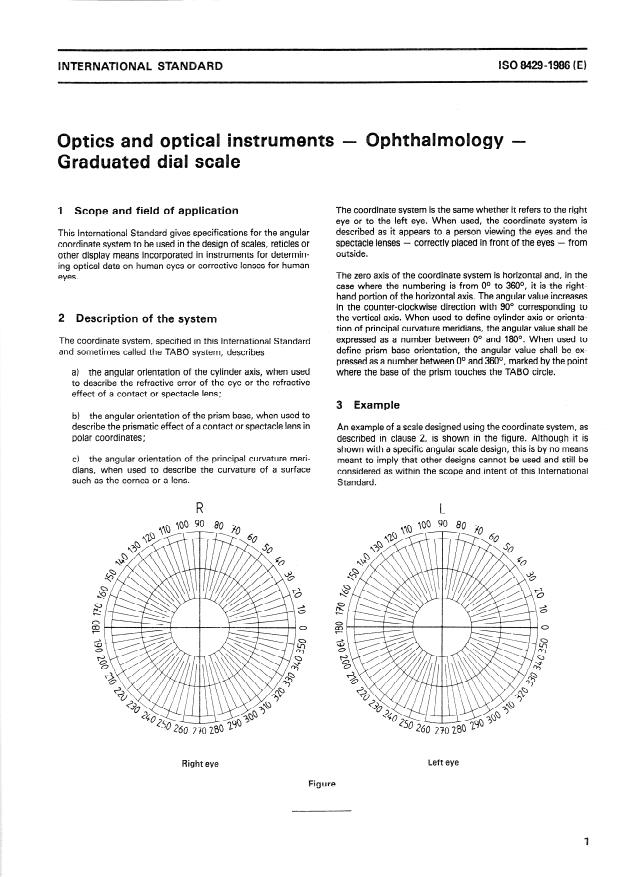
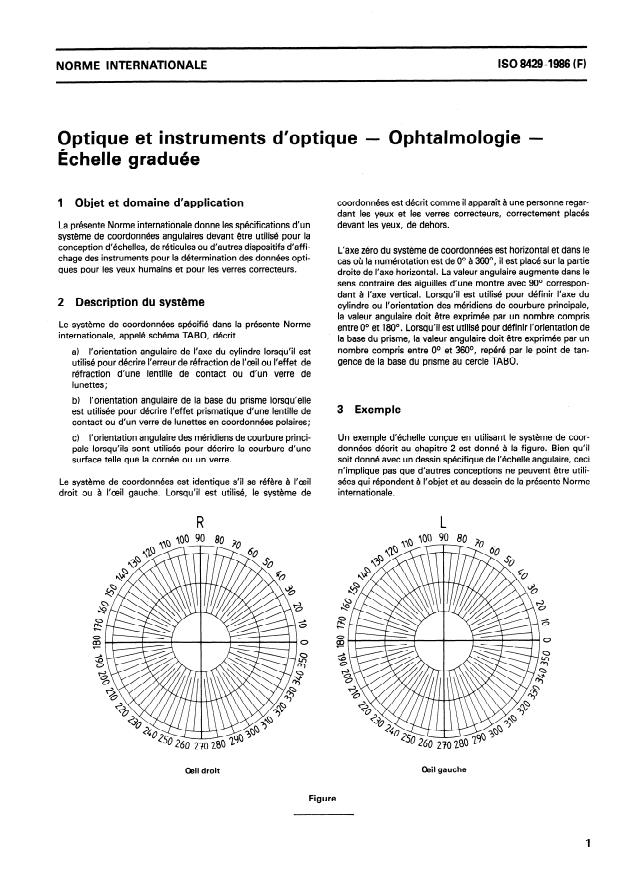
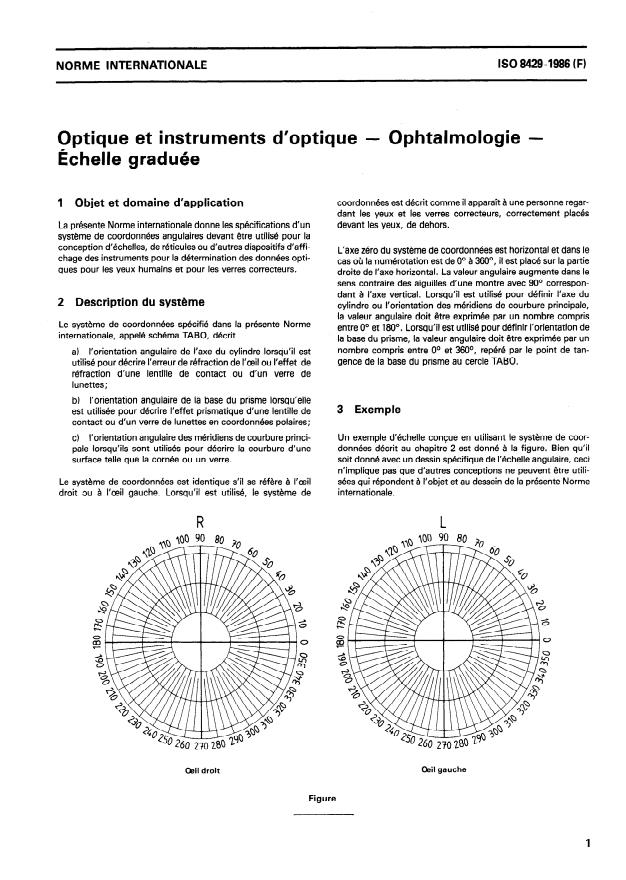
The standard defines a consistent coordinate system used for both the right and left eyes, viewed from the observer’s perspective. This system:- Has a zero axis aligned horizontally.
- Utilizes a 0° to 360° angular scale increasing counter-clockwise.
- Applies specifically to the orientation of cylinder axes, prism bases, and principal curvature meridians.
Angularity and Measurement
Angular values are used to describe:- The cylinder axis related to refractive errors.
- Prism base orientation in corrective lenses.
- Curvature descriptions of lenses and corneal surfaces.
Scale Design
The standard details how graduated dial scales should be designed using polar coordinate systems, ensuring reliable and repeatable measurements. It emphasizes accuracy in reading and interpreting angular values essential for ophthalmic prescriptions and instrument calibrations.
Applications
ISO 8429:1986 is applicable in various practical ophthalmic scenarios, such as:
Ophthalmic Lens Manufacturing
Ensuring lenses are accurately marked with cylinder axis and prism base orientation to meet prescription specifications.Diagnostic Optical Instruments
Devices like keratometers, phoropters, and refractometers utilize scales conforming to this standard to provide precise angular readings.Vision Assessment Tools
Instruments measuring corneal curvature, lens power, and axis alignment during eye examinations rely on standardized dial scales for consistent results.Quality Control and Calibration
Optical instrument manufacturers employ this standard for calibration procedures to maintain the accuracy and reliability of ophthalmic equipment.
Related Standards
Professionals working with ISO 8429:1986 may also refer to these related standards for comprehensive understanding and integration:
ISO 21987 - Ophthalmic optics - Spectacle lenses - Vocabulary and classification of geometrical defects
Provides definitions and classifications relevant to lens manufacturing and quality assurance.ISO 14889 - Ophthalmic optics - Contact lenses - Vocabulary, classification, and designation
Complements the framework for describing optical characteristics pertinent to contact lenses.ISO 13666 - Ophthalmic optics - Spectacle frames - Dimensions of markings
Addresses markings relevant to frames, including those related to lens positioning and axis orientation.ISO 21968 - Ophthalmic optics - Terminology and characteristics of contact lenses
Helps unify terminology across related ophthalmic optical instruments and devices.
By adhering to ISO 8429:1986, clinicians, instrument manufacturers, and optical laboratories benefit from internationally recognized standards that enhance precision in ophthalmic optics. The standardized dial scale design is fundamental for the accurate interpretation and application of optical corrections, directly impacting patient eye care and vision quality.
Relations
- Effective Date
- 25-Aug-2026
- Effective Date
- 25-Aug-2026
- Effective Date
- 25-Aug-2026
- Effective Date
- 25-Aug-2026
- Effective Date
- 25-Aug-2026
- Effective Date
- 25-Aug-2026
- Effective Date
- 25-Aug-2026
- Effective Date
- 25-Aug-2026
- Effective Date
- 25-Aug-2026
- Effective Date
- 25-Aug-2026
- Effective Date
- 25-Aug-2026
- Effective Date
- 25-Aug-2026
- Effective Date
- 25-Aug-2026
- Effective Date
- 25-Aug-2026
- Effective Date
- 25-Aug-2026
Buy Documents
ISO 8429:1986 - Optics and optical instruments — Ophthalmology — Graduated dial scale Released:9/18/1986
ISO 8429:1986 - Optique et instruments d'optique — Ophtalmologie — Échelle graduée Released:9/18/1986
ISO 8429:1986 - Optique et instruments d'optique — Ophtalmologie — Échelle graduée Released:9/18/1986
Get Certified
Connect with accredited certification bodies for this standard

BSI Group
BSI (British Standards Institution) is the business standards company that helps organizations make excellence a habit.

TÜV Rheinland
TÜV Rheinland is a leading international provider of technical services.

TÜV SÜD
TÜV SÜD is a trusted partner of choice for safety, security and sustainability solutions.
Sponsored listings
Frequently Asked Questions
ISO 8429:1986 is a standard published by the International Organization for Standardization (ISO). Its full title is "Optics and optical instruments — Ophthalmology — Graduated dial scale". This standard covers: La présente Norme internationale donne les spécifications d'un système de coordonnées angulaires devant être utilisé pour la conception d'échelles, de réticules ou d'autres dispositifs d'affichage des instruments pour la détermination des données optiques pour les yeux humains et pour les verres correcteurs.
La présente Norme internationale donne les spécifications d'un système de coordonnées angulaires devant être utilisé pour la conception d'échelles, de réticules ou d'autres dispositifs d'affichage des instruments pour la détermination des données optiques pour les yeux humains et pour les verres correcteurs.
ISO 8429:1986 is classified under the following ICS (International Classification for Standards) categories: 11.040.70 - Ophthalmic equipment. The ICS classification helps identify the subject area and facilitates finding related standards.
ISO 8429:1986 has the following relationships with other standards: It is inter standard links to EN ISO 13666:2012, EN ISO 8980-2:2017, EN ISO 21987:2009, EN ISO 10343:2009, EN ISO 10343:2014, EN ISO 8980-1:2004, EN ISO 8980-2:2004, EN ISO 24157:2008, EN ISO 8598-1:2014, EN ISO 8598:1998, EN ISO 10341:2009, EN ISO 21987:2017, EN ISO 8980-1:2017, EN ISO 12867:2010, EN ISO 10341:2012. Understanding these relationships helps ensure you are using the most current and applicable version of the standard.
ISO 8429:1986 is available in PDF format for immediate download after purchase. The document can be added to your cart and obtained through the secure checkout process. Digital delivery ensures instant access to the complete standard document.
Standards Content (Sample)
INTERNATIONAL ORGANIZATION FOR STANDARDIZATIONWIEX~YHAPOCIHAF OW-AHM3AYMH i-!O CTAHL1APTM3A~MM.ORGANISATION INTERNATIONALE DE NORMALISATION
Optique et instruments d’optique - Ophtalmologie - iche/ie gradde
iast edition - 1
escriptora : 0pticaS equipment, ophthahic sptics, measusing scales, specifications.
Price based on 1 page
rganimation Bor Stan
srk of preparing Bnternatisnal
rmaHy carried sut throuyh IS
h a subject for which a technkal committee has been established has
represented on that tormit
nmentaf, Sn iiaison wit
the technica8 committees arc circulated to
ir acceptance as hteana nal Standards by
y Technical Committee E
repare
ards Underg@ rovision f
rs ShQUBd nste that all I
chdther ~~tg~~at~Q~a~ Sta
that any r-ederence
latest editicsn, unless Qt~g~~~sg stated.
The coordinate System is the Same whether it refers to the right
eye or to the left eye. When used, the coordinate System is
as it appears Po a person wiewing the e
ecifications for the angulaa
spectacle lenses - correctly placed in front of the eyes - frsm
ccmrdinate System t design of scales, reticles or
other display means inco in instruments fsr d outside.
hg optical data on kuma correctiwe lenses for
The zero axis sf the caordinate System
...
Norme internationale
INTERNATIONAL ORGANIZATION FOR STANDARDlZATlON.ME~YHAPOflHAR OPrAHM3A~MR ll0 CTAH~APTbl3A~MM*ORGANlSATlON INTERNATIONALE DE NORMALISATION
Optique et instruments d’optique - Ophtalmologie -
Échelle graduée
Graduated dia1 scale
Op tics and op tical instruments - Oph thalmolog y -
Première édition - 1986-09-15
CDU 681.2.085 : 681.7
Réf. no : ISO 84294986 (F)
Descripteurs : matériel d’optique, optique ophtalmique, échelle de mesure, spécification.
Prix basé sur 1 page
Avant-propos
L’ISO (Organisation internationale de normalisation) est une fédération mondiale
d’organismes nationaux de normalisation (comités membres de I’ISO). L’élaboration
des Normes internationales est confiée aux comités techniques de I’ISO. Chaque
comité membre intéressé par une étude a le droit de faire partie du comité technique
créé à cet effet. Les organisations internationales, gouvernementales et non gouverne-
mentales, en liaison avec I’ISO participent également aux travaux.
Les projets de Normes internationales adoptés par les comités techniques sont soumis
aux comites membres pour approbation, avant leur acceptation comme Normes inter-
nationales par le Conseil de I’ISO. Les Normes internationales sont approuvées confor-
mément aux procédures de I’ISO qui requiérent l’approbation de 75 % au moins des
comités membres votants.
La Norme internationale ISO 8429 a été élaborée par le comité technique ISO/TC 172,
Optique et ins twmen ts d’optique.
L’attention des utilisateurs est attirée sur le fait que toutes les Normes internationales
sont de temps en temps soumises à révision et que toute référence faite à une autre
Norme internationale dans le présent document implique qu’il s’agit, sauf indication
, contraire, de la dernière édition.
0 Organisation internationale de normalisation, 1986
Imprimé en Suisse
ISO 84294986 (F)
NORME INTERNATIONALE
Optique et instruments d’optique - Ophtalmologie -
Échelle graduée
coordonnées est décrit comme il apparaît à une personne regar-
1 Objet et domaine d’application
dant les yeux et les verres correcteurs, correctement placés
La présente Norme internationale donne les spécifications
...
Norme internationale
INTERNATIONAL ORGANIZATION FOR STANDARDlZATlON.ME~YHAPOflHAR OPrAHM3A~MR ll0 CTAH~APTbl3A~MM*ORGANlSATlON INTERNATIONALE DE NORMALISATION
Optique et instruments d’optique - Ophtalmologie -
Échelle graduée
Graduated dia1 scale
Op tics and op tical instruments - Oph thalmolog y -
Première édition - 1986-09-15
CDU 681.2.085 : 681.7
Réf. no : ISO 84294986 (F)
Descripteurs : matériel d’optique, optique ophtalmique, échelle de mesure, spécification.
Prix basé sur 1 page
Avant-propos
L’ISO (Organisation internationale de normalisation) est une fédération mondiale
d’organismes nationaux de normalisation (comités membres de I’ISO). L’élaboration
des Normes internationales est confiée aux comités techniques de I’ISO. Chaque
comité membre intéressé par une étude a le droit de faire partie du comité technique
créé à cet effet. Les organisations internationales, gouvernementales et non gouverne-
mentales, en liaison avec I’ISO participent également aux travaux.
Les projets de Normes internationales adoptés par les comités techniques sont soumis
aux comites membres pour approbation, avant leur acceptation comme Normes inter-
nationales par le Conseil de I’ISO. Les Normes internationales sont approuvées confor-
mément aux procédures de I’ISO qui requiérent l’approbation de 75 % au moins des
comités membres votants.
La Norme internationale ISO 8429 a été élaborée par le comité technique ISO/TC 172,
Optique et ins twmen ts d’optique.
L’attention des utilisateurs est attirée sur le fait que toutes les Normes internationales
sont de temps en temps soumises à révision et que toute référence faite à une autre
Norme internationale dans le présent document implique qu’il s’agit, sauf indication
, contraire, de la dernière édition.
0 Organisation internationale de normalisation, 1986
Imprimé en Suisse
ISO 84294986 (F)
NORME INTERNATIONALE
Optique et instruments d’optique - Ophtalmologie -
Échelle graduée
coordonnées est décrit comme il apparaît à une personne regar-
1 Objet et domaine d’application
dant les yeux et les verres correcteurs, correctement placés
La présente Norme internationale donne les spécifications
...