

ISO/TS 22239-3:2017
(Main)Road vehicles — Child seat presence and orientation detection system (CPOD) — Part 3: Labelling
General Information
- Abstract
ISO/DIS 22239-3:2017 specifies instructions for use as well as labelling requirements of child restraint systems (CRS) and vehicles equipped with the child seat presence and orientation detection system (CPOD) specified in ISO/TS 22239‑1, which enables the automatic recognition of CRS placed on a passenger seat.
- Status
- Published
- Publication Date
- 28-Sep-2017
- Technical Committee
- ISO/TC 22/SC 36 - Safety and impact testing
- Drafting Committee
- ISO/TC 22/SC 36/WG 2 - Child restraint systems
- Current Stage
- 9093 - International Standard confirmed
- Start Date
- 23-Dec-2025
- Completion Date
- 29-Aug-2026
Buy Documents



ISO/TS 22239-3:2017 - Road vehicles -- Child seat presence and orientation detection system (CPOD)

REDLINE ISO/TS 22239-3:2017 - Road vehicles — Child seat presence and orientation detection system (CPOD) — Part 3: Labelling Released:9/29/2017


ISO/TS 22239-3:2017 - Road vehicles — Child seat presence and orientation detection system (CPOD) — Part 3: Labelling/29/2017
Overview
ISO/TS 22239-3:2017 is a technical specification developed by the International Organization for Standardization (ISO) for the automotive sector. This standard details the labelling requirements and user instructions for both child restraint systems (CRS) and vehicles fitted with a Child Seat Presence and Orientation Detection System (CPOD). The CPOD system, described in ISO/TS 22239-1, allows vehicles to automatically recognize if a CRS is placed on a passenger seat and its orientation, ensuring child safety and proper airbag deployment.
Proper labelling and clear information are critical to ensuring that CRSs and vehicles with CPOD are correctly installed and used, supporting regulatory compliance and promoting user awareness. ISO/TS 22239-3 offers guidelines for manufacturers to help end-users easily identify and understand the CPOD compatibility and function.
Key Topics
- CPOD Symbol Usage: Specifies the symbol representing CPOD, ensuring clear international recognition.
- Label Content and Size:
- CRS and vehicle labels must contain specific symbols and, optionally, additional text.
- Minimum label dimensions for both vertical and horizontal formats are defined to ensure visibility.
- Visibility and Placement:
- Labels on CRSs must remain visible after installation.
- Vehicle labels should be noticeable when the passenger door is open.
- Owner Manual Instructions: Clear directions must be provided to stress that the CPOD system only functions if both the seat and the CRS have compatible CPOD systems.
- In-Vehicle Messaging:
- Visual messages indicate the detection status of the CRS (correct position, incorrect position, system malfunction, or not detected).
- Message colours and symbols must comply with established international graphical standards.
- Colour Specifications:
- Labels must use designated safety colours aligned with ISO 3864-4 to maintain consistency and legibility.
Applications
ISO/TS 22239-3:2017 is essential for manufacturers and stakeholders in the automotive and child safety sectors, including:
- Automotive Manufacturers: Ensures that new vehicle models equipped with CPOD meet international safety labelling requirements, supporting market access and regulatory compliance.
- Child Restraint System Manufacturers: Guides the design and labelling of CRSs compatible with CPOD, enhancing user confidence and product clarity.
- Automotive Designers and Engineers: Informs the integration of CPOD-related icons and instructions within vehicles and manuals.
- Fleet Operators and Regulatory Authorities: Supports procurement and inspection criteria for vehicle fleets, particularly those involving child transport and safety.
- Parents and Caregivers: Enables informed and correct use of CPOD-equipped systems, reducing installation errors and risk.
By following ISO/TS 22239-3 labelling standards, manufacturers help end-users correctly install and utilize these safety systems, ultimately improving child passenger protection.
Related Standards
- ISO/TS 22239-1:2017: Road vehicles - Child seat presence and orientation detection system (CPOD) - Part 1: Specifications and test methods. This foundational standard defines the technical requirements for CPOD systems.
- ISO 3864-4: Graphical symbols - Safety colours and safety signs - Part 4: Colorimetric and photometric properties of safety sign materials. Specifies the colours used in safety labels and signs.
- ISO 2575: Road vehicles - Symbols for controls, indicators, and tell-tales. Provides guidance for standardizing vehicle dashboard and indicator icons.
Manufacturers and standards professionals are encouraged to consult the full ISO/TS 22239 series and referenced documents to ensure comprehensive compliance and optimum safety performance.
By adopting ISO/TS 22239-3:2017, companies and stakeholders demonstrate their commitment to child safety, international alignment, and user-focused design in the automotive industry.
Relations
- Effective Date
- 29-Jun-2013
Buy Documents
ISO/TS 22239-3:2017 - Road vehicles -- Child seat presence and orientation detection system (CPOD)
REDLINE ISO/TS 22239-3:2017 - Road vehicles — Child seat presence and orientation detection system (CPOD) — Part 3: Labelling Released:9/29/2017
ISO/TS 22239-3:2017 - Road vehicles — Child seat presence and orientation detection system (CPOD) — Part 3: Labelling/29/2017
Get Certified
Connect with accredited certification bodies for this standard

TÜV Rheinland
TÜV Rheinland is a leading international provider of technical services.

TÜV SÜD
TÜV SÜD is a trusted partner of choice for safety, security and sustainability solutions.

DEKRA Certification Inc.
DEKRA US certification services.
Sponsored listings
Frequently Asked Questions
ISO/TS 22239-3:2017 is a technical specification published by the International Organization for Standardization (ISO). Its full title is "Road vehicles — Child seat presence and orientation detection system (CPOD) — Part 3: Labelling". This standard covers: ISO/DIS 22239-3:2017 specifies instructions for use as well as labelling requirements of child restraint systems (CRS) and vehicles equipped with the child seat presence and orientation detection system (CPOD) specified in ISO/TS 22239‑1, which enables the automatic recognition of CRS placed on a passenger seat.
ISO/DIS 22239-3:2017 specifies instructions for use as well as labelling requirements of child restraint systems (CRS) and vehicles equipped with the child seat presence and orientation detection system (CPOD) specified in ISO/TS 22239‑1, which enables the automatic recognition of CRS placed on a passenger seat.
ISO/TS 22239-3:2017 is classified under the following ICS (International Classification for Standards) categories: 43.040.80 - Crash protection and restraint systems. The ICS classification helps identify the subject area and facilitates finding related standards.
ISO/TS 22239-3:2017 has the following relationships with other standards: It is inter standard links to ISO/TS 22239-3:2009. Understanding these relationships helps ensure you are using the most current and applicable version of the standard.
ISO/TS 22239-3:2017 is available in PDF format for immediate download after purchase. The document can be added to your cart and obtained through the secure checkout process. Digital delivery ensures instant access to the complete standard document.
Standards Content (Sample)
TECHNICAL ISO/TS
SPECIFICATION 22239-3
Second edition
2017-09
Road vehicles — Child seat presence
and orientation detection system
(CPOD) —
Part 3:
Labelling
Véhicules routiers — Système de détection de la présence d'un siège
enfant et de son orientation (CPOD) —
Partie 3: Étiquetage
Reference number
©
ISO 2017
© ISO 2017, Published in Switzerland
All rights reserved. Unless otherwise specified, no part of this publication may be reproduced or utilized otherwise in any form
or by any means, electronic or mechanical, including photocopying, or posting on the internet or an intranet, without prior
written permission. Permission can be requested from either ISO at the address below or ISO’s member body in the country of
the requester.
ISO copyright office
Ch. de Blandonnet 8 • CP 401
CH-1214 Vernier, Geneva, Switzerland
Tel. +41 22 749 01 11
Fax +41 22 749 09 47
copyright@iso.org
www.iso.org
ii © ISO 2017 – All rights reserved
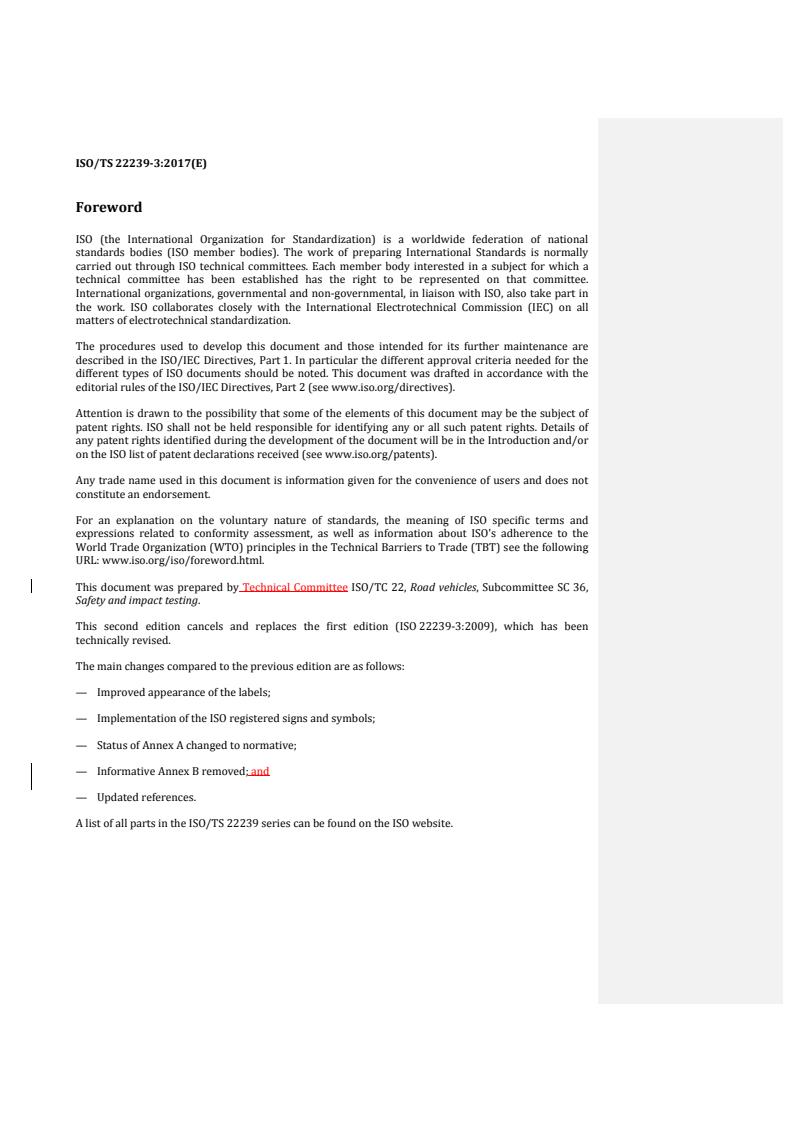
Contents Page
Foreword .iv
1 Scope . 1
2 Normative references . 1
3 Terms and definitions . 1
4 Labelling requirements . 1
4.1 CPOD symbol . 1
4.2 Labelling of CPOD child restraint systems (CRS) . 2
4.2.1 Label content . 2
4.2.2 Minimum size . 2
4.2.3 Visibility. 2
4.2.4 Owner manual information . 2
4.3 Labelling of CPOD vehicles . 2
4.3.1 Label content . 2
4.3.2 Minimum size . 2
4.3.3 Visibility. 2
4.3.4 Owner manual information . 2
5 In-vehicle information . 3
5.1 Message content and visibility . 3
5.2 Information strategy . 3
Annex A (normative) Labels . 4
Bibliography . 6
Foreword
ISO (the International Organization for Standardization) is a worldwide federation of national standards
bodies (ISO member bodies). The work of preparing International Standards is normally carried out
through ISO technical committees. Each member body interested in a subject for which a technical
committee has been established has the right to be represented on that committee. International
organizations, governmental and non-governmental, in liaison with ISO, also take part in the work.
ISO collaborates closely with the International Electrotechnical Commission (IEC) on all matters of
electrotechnical standardization.
The procedures used to develop this document and those intended for its further maintenance are
described in the ISO/IEC Directives, Part 1. In particular the different approval criteria needed for the
different types of ISO documents should be noted. This document was drafted in accordance with the
editorial rules of the ISO/IEC Directives, Part 2 (see www.iso.org/directives).
Attention is drawn to the possibility that some of the elements of this document may be the subject of
patent rights. ISO shall not be held responsible for identifying any or all such patent rights. Details of
any patent rights identified during the development of the document will be in the Introduction and/or
on the ISO list of patent declarations received (see www.iso.org/patents).
Any trade name used in this document is information given for the convenience of users and does not
constitute an endorsement.
For an explanation on the voluntary nature of standards, the meaning of ISO specific terms and
expressions related to conformity assessment, as well as information about ISO's adherence to the
World Trade Organization (WTO) principles in the Technical Barriers to Trade (TBT) see the following
URL: www.iso.org/iso/foreword.html.
This document was prepared by Technical Committee ISO/TC 22, Road vehicles, Subcommittee SC 36,
Safety and impact testing.
This second edition cancels and replaces the first edition (ISO 22239-3:2009), which has been
technically revised.
The main chan
...
Foreword
ISO (the International Organization for Standardization) is a worldwide federation of national
standards bodies (ISO member bodies). The work of preparing International Standards is normally
carried out through ISO technical committees. Each member body interested in a subject for which a
technical committee has been established has the right to be represented on that committee.
International organizations, governmental and non‐governmental, in liaison with ISO, also take part in
the work. ISO collaborates closely with the International Electrotechnical Commission (IEC) on all
matters of electrotechnical standardization.
The procedures used to develop this document and those intended for its further maintenance are
described in the ISO/IEC Directives, Part 1. In particular the different approval criteria needed for the
different types of ISO documents should be noted. This document was drafted in accordance with the
editorial rules of the ISO/IEC Directives, Part 2 (see www.iso.org/directives).
Attenti
on is drawn to the possibility that some of the elements of this document may be the subject of
patent rights. ISO shall not be held responsible for identifying any or all such patent rights. Details of
any patent rights identified during the development of the document will be in the Introduction and/or
on the ISO list of patent declarations received (see www.iso.org/patents).
Any trade name used in this document is information given for the convenience of users and does not
constitute an endorsement.
For an explanation on the voluntary nature of standards, the meaning of ISO specific terms and
expressions related to conformity assessment, as well as information about ISO's adherence to the
World Trade Organization (WTO) principles in the Technical Barriers to Trade (TBT) see the following
URL: www.iso.org/iso/foreword.html.
This document was prepared by Technical Committee ISO/TC 22, Road vehicles, Subcommittee SC 36,
Safety and impact testing.
This second edition cancels and replaces the first edition (ISO 22239‐3:2009), which has been
technically revised.
The main changes compared to the previous edition are as follows:
— Improved appearance of the labels;
— Implementation of the ISO registered signs and symbols;
— Status of Annex A changed to normative;
— Informative Annex B removed; and
— Updated references.
A list of all parts in the ISO/TS 22239 series can be found on the ISO website.
TECHNICAL SPECIFICATION ISO/TS 22239-3:2017(E)
Road vehicles — Child seat presence and orientation detection
system (CPOD) — Part 3: Labelling
IMPORTANT — The electronic file of this document contains colours which are considered to be useful
for the correct understanding of the document. Users should therefore consider printing this document
using a colour printer.
1 Scope
This document specifies instructions for use as well as labelling requirements of child restraint systems
(CRS) and vehicles equipped with the child seat presence and orientation detection system (CPOD)
specified in ISO/TS 22239‐1, which enables the automatic recognition of CRS placed on a passenger
seat.
2 Normative references
The following documents are referred to in the text in such a way that some or all of their content
constitutes requirements of this document. For dated references, only the edition cited applies. For
undated references, the latest edition of the referenced document (including any amendments) applies.
ISO/TS 22239‐1:2017, Road vehicles — Child seat presence and orientation detection system (CPOD) —
Part 1: Specifications and test methods
ISO 3864‐4, Graphical symbols — Safety colours and safety signs — Part 4: Colorimetric and photometric
properties of safety sign materials
3 Terms and definitions
For the purposes of this document, the terms and definitions given in ISO/TS 22239‐1 apply.
ISO and IEC maintain terminological databases for use in standardization at the following addresses:
— ISO Online browsing platform: available at http://www.iso.org/obp
— IEC Electropedia: available at http://www.electropedia.org/
4 Labelling requirements
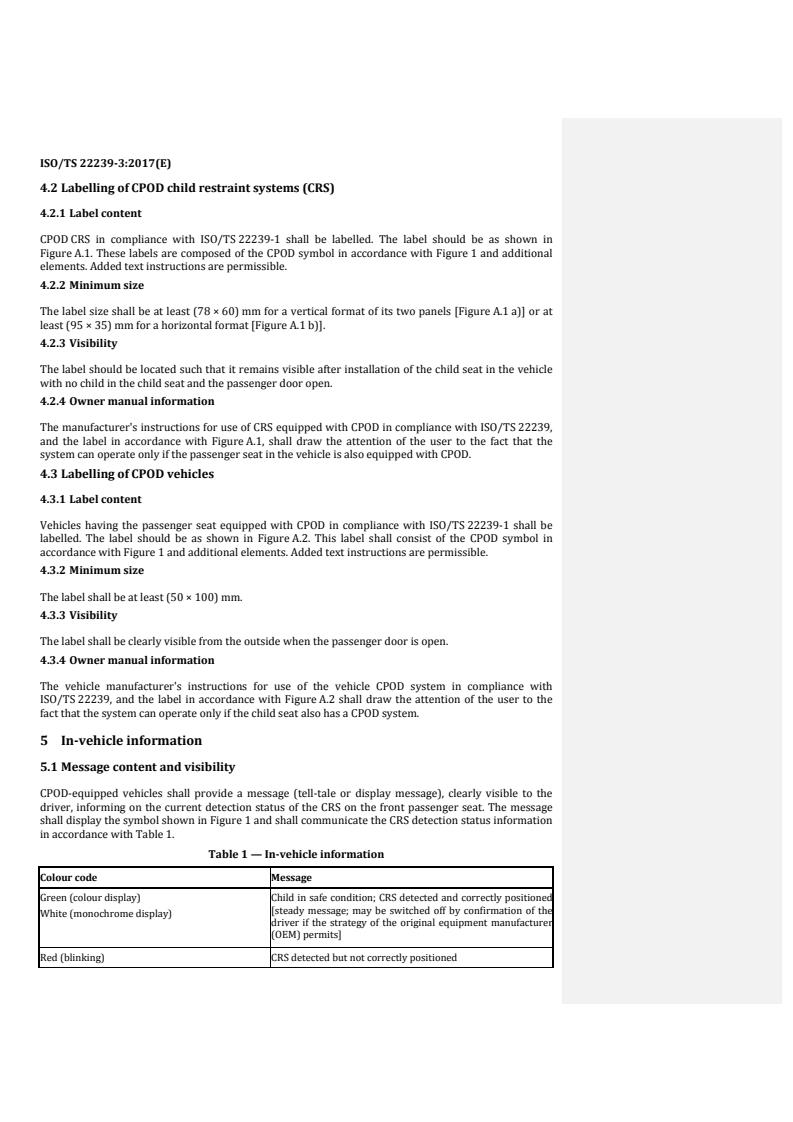
4.1 CPOD symbol
The symbol for the automatic child seat presence and orientation detection system is shown in Figure 1.
Deleted: 22239‐3_ed2fig1.EPS
Formatted: Font:
Figure 1 — Symbol for automatic child seat presence and orientation detection system (CPOD),
ISO 7000-2960
4.2 Labelling of CPOD child restraint systems (CRS)
4.2.1 Label content
CPOD CRS in compliance with ISO/TS 22239‐1 shall be labelled. The label should be as shown in
Figure A.1. These labels are composed of the CPOD symbol in accordance with Figu
...
TECHNICAL ISO/TS
SPECIFICATION 22239-3
Second edition
2017-09
Road vehicles — Child seat presence
and orientation detection system
(CPOD) —
Part 3:
Labelling
Véhicules routiers — Système de détection de la présence d'un siège
enfant et de son orientation (CPOD) —
Partie 3: Étiquetage
Reference number
©
ISO 2017
© ISO 2017, Published in Switzerland
All rights reserved. Unless otherwise specified, no part of this publication may be reproduced or utilized otherwise in any form
or by any means, electronic or mechanical, including photocopying, or posting on the internet or an intranet, without prior
written permission. Permission can be requested from either ISO at the address below or ISO’s member body in the country of
the requester.
ISO copyright office
Ch. de Blandonnet 8 • CP 401
CH-1214 Vernier, Geneva, Switzerland
Tel. +41 22 749 01 11
Fax +41 22 749 09 47
copyright@iso.org
www.iso.org
ii © ISO 2017 – All rights reserved
Contents Page
Foreword .iv
1 Scope . 1
2 Normative references . 1
3 Terms and definitions . 1
4 Labelling requirements . 1
4.1 CPOD symbol . 1
4.2 Labelling of CPOD child restraint systems (CRS) . 2
4.2.1 Label content . 2
4.2.2 Minimum size . 2
4.2.3 Visibility. 2
4.2.4 Owner manual information . 2
4.3 Labelling of CPOD vehicles . 2
4.3.1 Label content . 2
4.3.2 Minimum size . 2
4.3.3 Visibility. 2
4.3.4 Owner manual information . 2
5 In-vehicle information . 3
5.1 Message content and visibility . 3
5.2 Information strategy . 3
Annex A (normative) Labels . 4
Bibliography . 6
Foreword
ISO (the International Organization for Standardization) is a worldwide federation of national standards
bodies (ISO member bodies). The work of preparing International Standards is normally carried out
through ISO technical committees. Each member body interested in a subject for which a technical
committee has been established has the right to be represented on that committee. International
organizations, governmental and non-governmental, in liaison with ISO, also take part in the work.
ISO collaborates closely with the International Electrotechnical Commission (IEC) on all matters of
electrotechnical standardization.
The procedures used to develop this document and those intended for its further maintenance are
described in the ISO/IEC Directives, Part 1. In particular the different approval criteria needed for the
different types of ISO documents should be noted. This document was drafted in accordance with the
editorial rules of the ISO/IEC Directives, Part 2 (see www.iso.org/directives).
Attention is drawn to the possibility that some of the elements of this document may be the subject of
patent rights. ISO shall not be held responsible for identifying any or all such patent rights. Details of
any patent rights identified during the development of the document will be in the Introduction and/or
on the ISO list of patent declarations received (see www.iso.org/patents).
Any trade name used in this document is information given for the convenience of users and does not
constitute an endorsement.
For an explanation on the voluntary nature of standards, the meaning of ISO specific terms and
expressions related to conformity assessment, as well as information about ISO's adherence to the
World Trade Organization (WTO) principles in the Technical Barriers to Trade (TBT) see the following
URL: www.iso.org/iso/foreword.html.
This document was prepared by Technical Committee ISO/TC 22, Road vehicles, Subcommittee SC 36,
Safety and impact testing.
This second edition cancels and replaces the first edition (ISO 22239-3:2009), which has been
technically revised.
The main chan
...