

ISO 5313:2026
(Main)High nitrogen content, straight ammonium nitrate fertilizers — Determination of oil retention
General Information
- Abstract
This document specifies a method for the determination of the gas oil retention of solid, high nitrogen content, straight ammonium nitrate fertilizers. The method is applicable to fertilizers which do not contain materials soluble in gas oil and which are prilled or granular.
- Status
- Published
- Publication Date
- 29-Jan-2026
- Technical Committee
- ISO/TC 134 - Fertilizers, soil conditioners and beneficial substances
- Drafting Committee
- ISO/TC 134/WG 1 - Fertilizers
- Current Stage
- 6060 - International Standard published
- Start Date
- 30-Jan-2026
- Due Date
- 13-Feb-2027
- Completion Date
- 30-Jan-2026
Overview
ISO 5313:2026 details the standardized method for determining the oil retention of high nitrogen content, straight ammonium nitrate fertilizers. This international standard specifies a procedure for measuring the gas oil retention in solid fertilizers, specifically those that are prilled or granular and do not contain materials soluble in gas oil. Accurate oil retention measurement is critical for assessing fertilizer porosity and handling characteristics, which affect storage, safety, and application performance.
Key Topics
- Scope: Applies to prilled or granular, high nitrogen straight ammonium nitrate fertilizers free of gas oil-soluble materials.
- Oil Retention Test: Defines the process for immersing fertilizer samples in gas oil, removing excess oil, and calculating the percentage retained based on mass difference.
- Apparatus:
- Laboratory balance (precision to 0.01 g)
- Standard test sieves conforming to ISO 3310-1
- Beaker, funnel, and specific filter paper
- Reagents: Specifies quality criteria for gas oil used in the test, including viscosity, density, and sulfur content.
- Results Expression: Oil retention is expressed as a percent by mass; repeatability and reproducibility guidelines help ensure reliable results.
- Reporting Requirements: Includes specific instructions for documenting observations, methodology, and any deviations.
Applications
- Fertilizer Quality Control: Ensuring consistent physical properties in ammonium nitrate fertilizers, which impacts their behavior during handling, transport, and field application.
- Safety and Handling: Oil retention relates to granule porosity and potential risks in storage, such as caking, dust generation, and chemical instability. Higher porosity can affect how these fertilizers absorb moisture or interact with other substances.
- Regulatory Compliance: Following ISO 5313:2026 helps manufacturers, laboratories, and regulators meet both national and international requirements for fertilizer quality assessment.
- Product Development and Optimization: Fertilizer producers can use oil retention measurements to refine formulation and granulation processes, targeting improved performance and safety.
- International Trade: Standardized testing methods enable comparability and trust in product quality between suppliers and buyers across different regions.
Related Standards
- ISO 3310-1: Test sieves - Technical requirements and testing for sieves of metal wire cloth used in sample preparation.
- ISO 14820-2: Fertilizers and liming materials - Guidelines for sampling and sample preparation in laboratory testing.
- ISO/TC 134: The technical committee focused on fertilizers, soil conditioners, and beneficial substances, which oversees relevant standardization initiatives.
Practical Value
Adhering to ISO 5313:2026 ensures that results for oil retention in ammonium nitrate fertilizers are repeatable and reliable, regardless of where the test is conducted. This supports:
- Consistent product quality in large-scale fertilizer production
- Efficient communication of quality data among manufacturers, laboratories, and regulatory authorities
- Enhanced safety management during transportation and storage
- Recognition in global markets for products tested according to internationally accepted procedures
Utilizing the ISO 5313:2026 standard helps foster trust throughout the fertilizer supply chain and supports best practices in agricultural chemical management.
Relations
- Effective Date
- 16-Aug-2025
Get Certified
Connect with accredited certification bodies for this standard

Control Union Certifications
Global certification for agriculture and sustainability.

ECOCERT
Organic and sustainability certification.

FSC International
Forest Stewardship Council certification.
Sponsored listings
Frequently Asked Questions
ISO 5313:2026 is a standard published by the International Organization for Standardization (ISO). Its full title is "High nitrogen content, straight ammonium nitrate fertilizers — Determination of oil retention". This standard covers: This document specifies a method for the determination of the gas oil retention of solid, high nitrogen content, straight ammonium nitrate fertilizers. The method is applicable to fertilizers which do not contain materials soluble in gas oil and which are prilled or granular.
This document specifies a method for the determination of the gas oil retention of solid, high nitrogen content, straight ammonium nitrate fertilizers. The method is applicable to fertilizers which do not contain materials soluble in gas oil and which are prilled or granular.
ISO 5313:2026 is classified under the following ICS (International Classification for Standards) categories: 65.080 - Fertilizers. The ICS classification helps identify the subject area and facilitates finding related standards.
ISO 5313:2026 has the following relationships with other standards: It is inter standard links to ISO 5313:1986. Understanding these relationships helps ensure you are using the most current and applicable version of the standard.
ISO 5313:2026 is available in PDF format for immediate download after purchase. The document can be added to your cart and obtained through the secure checkout process. Digital delivery ensures instant access to the complete standard document.
Standards Content (Sample)
International
Standard
ISO 5313
Second edition
High nitrogen content, straight
2026-01
ammonium nitrate fertilizers —
Determination of oil retention
Engrais simples à base de nitrate d'ammonium et à forte teneur
en azote — Détermination de la rétention d'huile
Reference number
© ISO 2026
All rights reserved. Unless otherwise specified, or required in the context of its implementation, no part of this publication may
be reproduced or utilized otherwise in any form or by any means, electronic or mechanical, including photocopying, or posting on
the internet or an intranet, without prior written permission. Permission can be requested from either ISO at the address below
or ISO’s member body in the country of the requester.
ISO copyright office
CP 401 • Ch. de Blandonnet 8
CH-1214 Vernier, Geneva
Phone: +41 22 749 01 11
Email: copyright@iso.org
Website: www.iso.org
Published in Switzerland
ii
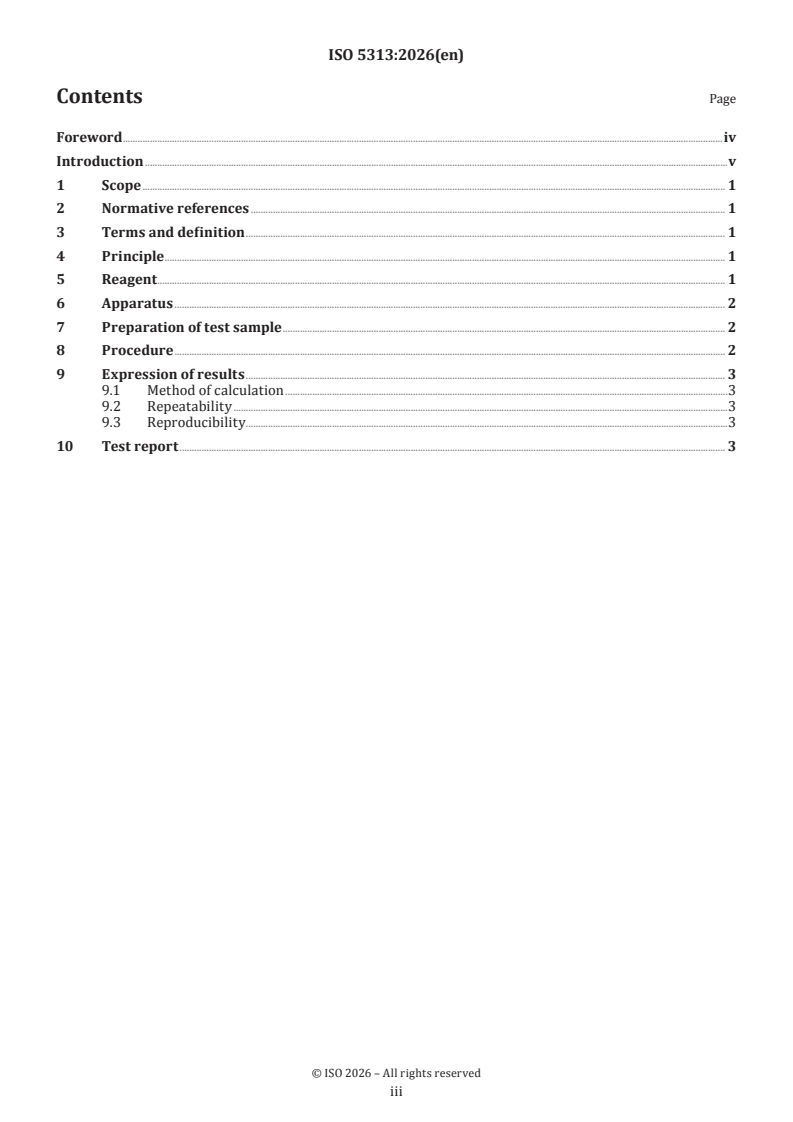
Contents Page
Foreword .iv
Introduction .v
1 Scope . 1
2 Normative references . 1
3 Terms and definition . 1
4 Principle . 1
5 Reagent . 1
6 Apparatus . 2
7 Preparation of test sample . 2
8 Procedure . 2
9 Expression of results . 3
9.1 Method of calculation .3
9.2 Repeatability .3
9.3 Reproducibility .3
10 Test report . 3
iii
Foreword
ISO (the International Organization for Standardization) is a worldwide federation of national standards
bodies (ISO member bodies). The work of preparing International Standards is normally carried out through
ISO technical committees. Each member body interested in a subject for which a technical committee
has been established has the right to be represented on that committee. International organizations,
governmental and non-governmental, in liaison with ISO, also take part in the work. ISO collaborates closely
with the International Electrotechnical Commission (IEC) on all matters of electrotechnical standardization.
The procedures used to develop this document and those intended for its further maintenance are described
in the ISO/IEC Directives, Part 1. In particular, the different approval criteria needed for the different types
of ISO documents should be noted. This document was drafted in accordance with the editorial rules of the
ISO/IEC Directives, Part 2 (see www.iso.org/directives).
ISO draws attention to the possibility that the implementation of this document may involve the use of (a)
patent(s). ISO takes no position concerning the evidence, validity or applicability of any claimed patent
rights in respect thereof. As of the date of publication of this document, ISO had not received notice of (a)
patent(s) which may be required to implement this document. However, implementers are cautioned that
this may not represent the latest information, which may be obtained from the patent database available at
www.iso.org/patents. ISO shall not be held responsible for identifying any or all such patent rights.
Any trade name used in this document is information given for the convenience of users and does not
constitute an endorsement.
For an explanation of the voluntary nature of standards, the meaning of ISO specific terms and expressions
related to conformity assessment, as well as information about ISO’s adherence to the World Trade
Organization (WTO) principles in the Technical Barriers to Trade (TBT), see www.iso.org/iso/foreword.html.
This document was prepared by Technical Committee ISO/TC 134, Fertilizers,
...