

ISO 12988-1:2000
(Main)Carbonaceous materials used in the production of aluminium — Baked anodes — Determination of the reactivity to carbon dioxide — Part 1: Loss in mass method
General Information
- Abstract
This part of ISO 12988 specifies a loss in mass method for the determination of the reactivity of carbonaceous products to carbon dioxide. This method was developed especially for baked anodes used in the production of aluminium.
- Status
- Published
- Publication Date
- 10-May-2000
- Technical Committee
- ISO/TC 226 - Materials for the production of primary aluminium
- Drafting Committee
- ISO/TC 226 - Materials for the production of primary aluminium
- Current Stage
- 9093 - International Standard confirmed
- Start Date
- 13-Jun-2022
- Completion Date
- 29-Aug-2026
Overview
ISO 12988-1:2000 - Carbonaceous materials used in the production of aluminium - Part 1: Loss in mass method - specifies a laboratory procedure to determine the reactivity of baked anodes to carbon dioxide (CO2). The method was developed for baked anodes used in aluminium electrolysis and quantifies how much anode material reacts with CO2 under controlled high-temperature conditions.
Key topics and requirements
- Scope: Measures reactivity-to-CO2 for carbonaceous products (baked anodes) using a loss-in-mass test.
- Test conditions: Specimens (two cores per test) are heated at 960 ±2 °C in a furnace purged with CO2 for 7 hours, with a controlled CO2 flow of 200 L/h.
- Specimen preparation: Cores of 50 ±1 mm diameter × 60 ±1 mm length, dried at 120 ±5 °C for 12 h. Initial and post-test masses are recorded to 0.1 g.
- Atmosphere purity: CO2 gas minimum 99.5% by volume (impurities N2/Ar ≤ 0.5% vol.; H2O ≤ 150 mg/m3).
- Apparatus & controls: Vertical muffle furnace (≥1000 °C capability), K-type thermocouple (IEC 60584-2 reference), gas-flow meter/manometer (pressure ~0.2 MPa), alumina preheater tube, and a tumbling apparatus (two chambers, steel balls, 4 mm sieve) to separate dust from unreacted residue.
- Measurements & results: Compute mass-percent residue, dust and loss using specified formulae; report results in mass percent and to 0.1 g. Repeatability depends on core homogeneity; reproducibility estimates are provided based on multi-lab studies.
- Sampling reference: When extracting cores from larger anodes follow ISO 8007-2.
Applications and users
This standard is practical for:
- Anode manufacturers - quality control and product specification (CO2 reactivity performance).
- Aluminium producers & smelters - evaluating anode behaviour in electrolytic cells and predicting material loss and dust generation.
- Materials R&D - testing formulations and baking processes to optimize resistance to CO2 attack.
- Third‑party testing laboratories - standardized method for contract testing and compliance checks.
- Procurement/specification writers - establishing acceptance criteria in supply contracts.
Practical benefits include consistent, comparable reactivity data for lifetime prediction, process optimization, and supplier qualification.
Related standards
- ISO 8007-2 - Sampling plans and sampling from individual units (prebaked anodes) - referenced for specimen extraction.
- IEC 60584-2 - Thermocouples - tolerances - referenced for K-type thermocouple accuracy.
- Note: ISO 12988 Part 2 (thermogravimetric method) is indicated as a future complement to this loss-in-mass method.
Keywords: ISO 12988-1:2000, baked anodes, reactivity to carbon dioxide, loss in mass method, carbonaceous materials, aluminium production, CO2 reactivity test.
Get Certified
Connect with accredited certification bodies for this standard

ECOCERT
Organic and sustainability certification.

Eurofins Food Testing Global
Global leader in food, environment, and pharmaceutical product testing.

Intertek Bangladesh
Intertek certification and testing services in Bangladesh.
Sponsored listings
Frequently Asked Questions
ISO 12988-1:2000 is a standard published by the International Organization for Standardization (ISO). Its full title is "Carbonaceous materials used in the production of aluminium — Baked anodes — Determination of the reactivity to carbon dioxide — Part 1: Loss in mass method". This standard covers: This part of ISO 12988 specifies a loss in mass method for the determination of the reactivity of carbonaceous products to carbon dioxide. This method was developed especially for baked anodes used in the production of aluminium.
This part of ISO 12988 specifies a loss in mass method for the determination of the reactivity of carbonaceous products to carbon dioxide. This method was developed especially for baked anodes used in the production of aluminium.
ISO 12988-1:2000 is classified under the following ICS (International Classification for Standards) categories: 71.100.10 - Materials for aluminium production. The ICS classification helps identify the subject area and facilitates finding related standards.
ISO 12988-1:2000 is available in PDF format for immediate download after purchase. The document can be added to your cart and obtained through the secure checkout process. Digital delivery ensures instant access to the complete standard document.
Standards Content (Sample)
INTERNATIONAL ISO
STANDARD 12988-1
First edition
2000-05-01
Carbonaceous materials used in the
production of aluminium — Baked
anodes — Determination of the reactivity to
carbon dioxide —
Part 1:
Loss in mass method
Produits carbonés utilisés pour la production de l'aluminium — Anodes
cuites — Détermination de la réactivité au dioxyde de carbone —
Partie 1: Méthode par perte de masse
Reference number
©
ISO 2000
PDF disclaimer
This PDF file may contain embedded typefaces. In accordance with Adobe's licensing policy, this file may be printed or viewed but shall not
be edited unless the typefaces which are embedded are licensed to and installed on the computer performing the editing. In downloading this
file, parties accept therein the responsibility of not infringing Adobe's licensing policy. The ISO Central Secretariat accepts no liability in this
area.
Adobe is a trademark of Adobe Systems Incorporated.
Details of the software products used to create this PDF file can be found in the General Info relative to the file; the PDF-creation parameters
were optimized for printing. Every care has been taken to ensure that the file is suitable for use by ISO member bodies. In the unlikely event
that a problem relating to it is found, please inform the Central Secretariat at the address given below.
All rights reserved. Unless otherwise specified, no part of this publication may be reproduced or utilized in any form or by any means, electronic
or mechanical, including photocopying and microfilm, without permission in writing from either ISO at the address below or ISO's member body
in the country of the requester.
ISO copyright office
Case postale 56 � CH-1211 Geneva 20
Tel. + 41 22 749 01 11
Fax + 41 22 734 10 79
E-mail copyright@iso.ch
Web www.iso.ch
Printed in Switzerland
ii © ISO 2000 – All rights reserved
Foreword
ISO (the International Organization for Standardization) is a worldwide federation of national standards bodies (ISO
member bodies). The work of preparing International Standards is normally carried out through ISO technical
committees. Each member body interested in a subject for which a technical committee has been established has
the right to be represented on that committee. International organizations, governmental and non-governmental, in
liaison with ISO, also take part in the work. ISO collaborates closely with the International Electrotechnical
Commission (IEC) on all matters of electrotechnical standardization.
International Standards are drafted in accordance with the rules given in the ISO/IEC Directives, Part 3.
Draft International Standards adopted by the technical committees are circulated to the member bodies for voting.
Publication as an International Standard requires approval by at least 75 % of the member bodies casting a vote.
Attention is drawn to the possibility that some of the elements of this part of ISO 12988 may be the subject of
patent rights. ISO shall not be held responsible for identifying any or all such patent rights.
International Standard ISO 12988-1 was prepared by Technical Committee ISO/TC 47, Chemistry, Subcommittee
SC 7, Aluminium oxide, cryolite, aluminium fluoride, sodium fluoride, carbonaceous products for the aluminium
industry.
ISO 12988 consists of the following parts, under the general title Carbonaceous materials used in the production of
aluminium — Baked anodes — Determination of the reactivity to carbon dioxide:
� Part 1: Loss in mass method
A thermogravimetric method will be the subject of a future part 2 to ISO 12988.
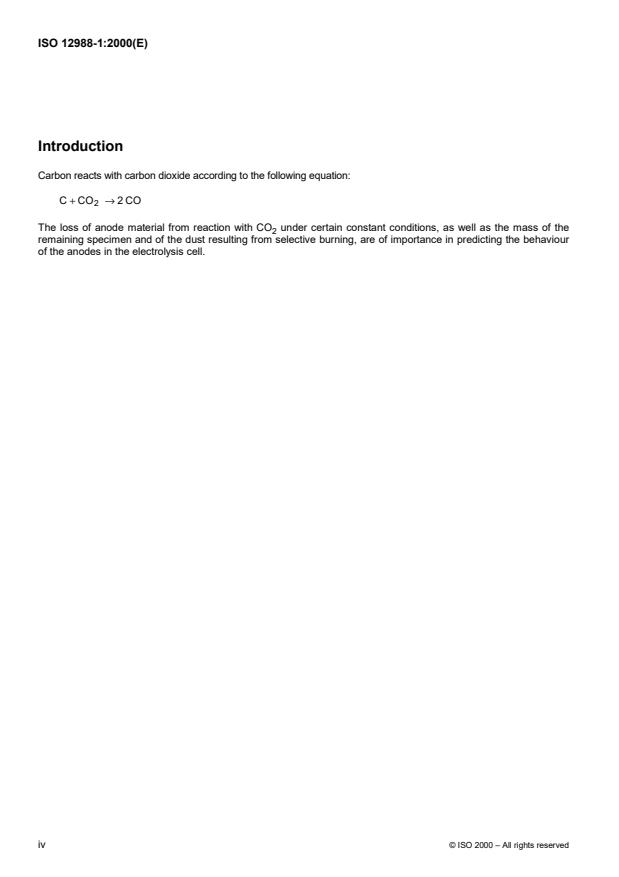
Introduction
Carbon reacts with carbon dioxide according to the following equation:
CC��O 2CO
The loss of anode material from reaction with CO under certain constant conditions, as well as the mass of the
remaining specimen and of the dust resulting from selective burning, are of importance in predicting the behaviour
of the anodes in the electrolysis cell.
iv © ISO 2000 – All rights reserved
INTERNATIONAL STANDARD ISO 12988-1:2000(E)
Carbonaceous materials used in the production of aluminium —
Baked anodes — Determination of the reactivity to carbon
dioxide —
Part 1:
Loss in mass method
1 Scope
This part of ISO 12988 specifies a loss in mass method for the determination of the reactivity of carbonaceous products
to carbon dioxide. This method was developed especially for baked anodes used in the production of aluminium.
2 Normative references
The following normative documents contain provisions which, through reference in this text, constitute provisions of
this part of ISO 12988. For dated references, subsequent amendments to, or revisions of, any of these publications
do not apply. However, parties to agreements based on this part of ISO 12988 are encouraged to investigate the
possibility of applying the most recent editions of the normative documents indicated below. For undated
references, the latest edition of the normative document referred to applies. Members of ISO and IEC maintain
registers of currently valid International Standards.
ISO 8007-2:1999, Carbonaceous materials used in the production of aluminium — Sampling plans and sampling
from individual units — Part 2: Prebaked anodes.
IEC 60584-2, Thermocouples — Part 2: Tolerances.
3Principle
A baked test cylinder is placed in a furnace purged with carbon dioxide, CO , at a temperature of 960 °C for 7 h. The
loss in mass is determined and the dust produced is measured using a tumbling-apparatus. The residual body of the
test cylinder, called the unreacted residue, is weighed and all results calculated in mass percent.
4 Reagent
4.1 Carbon dioxide,(CO ) having a minimum purity of 99,5 % by volume and impurities of
� N � Ar� 0,5 % by volume,
� H O� 150 mg/m .
5 Apparatus
A diagram showing a typical apparatus in accordance with specifications is shown in Figure 1.
Normal ordinary apparatus and in particular the following:
5.1 Muffle furnace, having the dimensions given in Figure 2 with a vertical, single-zone tube ensuring good,
vertical temperature distribution and capable of heating to a maximum temperature of at least 1 000 °C as well as
maintaining the temperature at (960� 2) °C.
5.2 Sample holder, made of heat-resistant steel to support the two test specimens in the centre of the furnace
with a collection plate incorporated for ca
...