

ISO/IEC TS 17021-14:2022
(Main)Conformity assessment — Requirements for bodies providing audit and certification of management systems — Part 14: Competence requirements for auditing and certification of management systems for records
General Information
- Abstract
This document specifies the competence requirements for personnel involved in the audit and certification process for management systems for records (MSR). It complements the existing requirements of ISO/IEC 17021-1. NOTE This document is applicable for auditing and certification of MSR based on ISO 30301. It can also be used for other MSR applications.
- Status
- Published
- Publication Date
- 03-Feb-2022
- Technical Committee
- ISO/CASCO - Committee on conformity assessment
- Drafting Committee
- ISO/CASCO/JWG 60 - Joint ISO/CASCO - ISO/TC 46/SC 11 WG: Development of ISO/IEC TS 17021-14
- Parallel Committee
- ISO/TC 46/SC 11 - Archives/records management
- Current Stage
- 9093 - International Standard confirmed
- Start Date
- 06-Jun-2025
- Completion Date
- 29-Aug-2026
Buy Documents


ISO/IEC TS 17021-14:2022 - Conformity assessment — Requirements for bodies providing audit and certification of management systems — Part 14: Competence requirements for auditing and certification of management systems for records Released:2/4/2022
ISO/IEC TS 17021-14:2022 - Conformity assessment — Requirements for bodies providing audit and certification of management systems — Part 14: Competence requirements for auditing and certification of management systems for records Released:16. 01. 2026
Overview
ISO/IEC TS 17021-14:2022 is a technical specification developed by ISO and IEC that outlines the competence requirements for personnel involved in the audit and certification of management systems for records (MSR). This standard is intended to complement ISO/IEC 17021-1, which addresses the requirements for bodies providing audit and certification of management systems broadly.
This document ensures that certification bodies assign properly qualified personnel to the audit and certification of MSR, which is especially important for organizations seeking to certify their records management systems, such as those developed according to ISO 30301. ISO/IEC TS 17021-14:2022 is also applicable for broader MSR contexts beyond ISO 30301.
Key Topics
Core Competence Requirements:
ISO/IEC TS 17021-14:2022 requires that audit and certification personnel possess:
- Generic competence: As described in ISO/IEC 17021-1, covering standard audit skills and processes.
- MSR-specific knowledge: Including core records management concepts, policies, and terminology.
- Discipline-specific skills: Understanding records processes, metadata, technological tools, controls, and legal/regulatory requirements.
- Context of the organization: Ability to assess internal/external influences, stakeholder needs, and strategic relevance of the MSR scope.
- Client-specific knowledge: Awareness of organizational structure, products, services, operational environments, and sector regulations.
- Risk-based thinking: Applying risk assessment and management principles to records systems.
Competencies for Key Roles:
- Auditors: Required to understand the fundamental concepts of MSR, specific records processes, organizational contexts, and technical/sector-specific knowledge.
- Certification decision personnel: Must possess knowledge to review audit reports, understand records management principles, risk-based approaches, and MSR scoping.
Applications
ISO/IEC TS 17021-14:2022 is primarily used by:
- Certification bodies: Ensuring qualified audit teams for assessing and certifying management systems for records in compliance with international standards.
- Organizations seeking MSR certification: Supporting compliance with ISO 30301 by engaging with certification bodies that use qualified personnel.
- Consultants and auditors: Guiding professional development and training to meet competence expectations for MSR audits.
The standard supports effective management of records by:
- Improving organizational accountability, risk management, and business continuity.
- Protecting the integrity and reliability of records in digital and physical environments.
- Addressing evolving business, legal, and technological requirements across all sectors.
Benefits include:
- Greater confidence in the certification process for MSR.
- Enhanced ability to meet legal and regulatory obligations for records management.
- Strengthened stakeholder trust through adherence to internationally recognized competence criteria.
Related Standards
When implementing or auditing management systems for records, organizations and certification bodies may also reference:
- ISO/IEC 17021-1: Conformity assessment - Requirements for bodies providing audit and certification of management systems.
- ISO 30301: Management systems for records - Requirements.
- ISO 30300: Records management - Core concepts and vocabulary.
- ISO 19011: Guidelines for auditing management systems.
- ISO 15489-1: Records management - Concepts and principles.
- ISO 23081 series: Metadata for records management.
- ISO 13008: Digital conversion and migration process.
- ISO 17068: Trusted third party repository for digital records.
Certification bodies and organizations adopting ISO/IEC TS 17021-14:2022 demonstrate commitment to best practices in MSR auditing and certification, ensuring robust, compliant, and effective records management systems.
Buy Documents
ISO/IEC TS 17021-14:2022 - Conformity assessment — Requirements for bodies providing audit and certification of management systems — Part 14: Competence requirements for auditing and certification of management systems for records Released:2/4/2022
ISO/IEC TS 17021-14:2022 - Conformity assessment — Requirements for bodies providing audit and certification of management systems — Part 14: Competence requirements for auditing and certification of management systems for records Released:16. 01. 2026
Get Certified
Connect with accredited certification bodies for this standard

BSI Group
BSI (British Standards Institution) is the business standards company that helps organizations make excellence a habit.

Bureau Veritas
Bureau Veritas is a world leader in laboratory testing, inspection and certification services.

DNV
DNV is an independent assurance and risk management provider.
Sponsored listings
Frequently Asked Questions
ISO/IEC TS 17021-14:2022 is a technical specification published by the International Organization for Standardization (ISO). Its full title is "Conformity assessment — Requirements for bodies providing audit and certification of management systems — Part 14: Competence requirements for auditing and certification of management systems for records". This standard covers: This document specifies the competence requirements for personnel involved in the audit and certification process for management systems for records (MSR). It complements the existing requirements of ISO/IEC 17021-1. NOTE This document is applicable for auditing and certification of MSR based on ISO 30301. It can also be used for other MSR applications.
This document specifies the competence requirements for personnel involved in the audit and certification process for management systems for records (MSR). It complements the existing requirements of ISO/IEC 17021-1. NOTE This document is applicable for auditing and certification of MSR based on ISO 30301. It can also be used for other MSR applications.
ISO/IEC TS 17021-14:2022 is classified under the following ICS (International Classification for Standards) categories: 03.120.20 - Product and company certification. Conformity assessment. The ICS classification helps identify the subject area and facilitates finding related standards.
ISO/IEC TS 17021-14:2022 is available in PDF format for immediate download after purchase. The document can be added to your cart and obtained through the secure checkout process. Digital delivery ensures instant access to the complete standard document.
Standards Content (Sample)
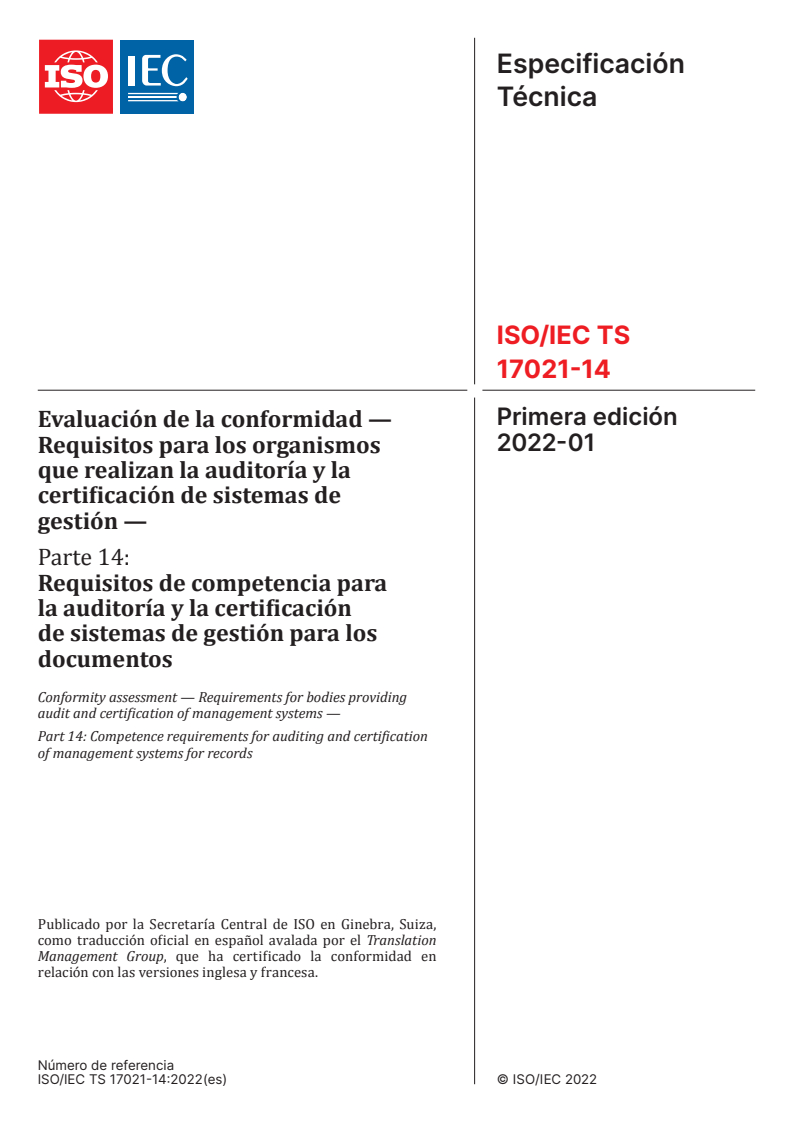
TECHNICAL ISO/IEC TS
SPECIFICATION 17021-14
First edition
2022-01
Conformity assessment —
Requirements for bodies providing
audit and certification of management
systems —
Part 14:
Competence requirements for
auditing and certification of
management systems for records
Reference number
© ISO/IEC 2022
© ISO/IEC 2022
All rights reserved. Unless otherwise specified, or required in the context of its implementation, no part of this publication may
be reproduced or utilized otherwise in any form or by any means, electronic or mechanical, including photocopying, or posting on
the internet or an intranet, without prior written permission. Permission can be requested from either ISO at the address below
or ISO’s member body in the country of the requester.
ISO copyright office
CP 401 • Ch. de Blandonnet 8
CH-1214 Vernier, Geneva
Phone: +41 22 749 01 11
Email: copyright@iso.org
Website: www.iso.org
Published in Switzerland
ii
© ISO/IEC 2022 – All rights reserved
Contents Page
Foreword .iv
Introduction .v
1 Scope . 1
2 Normative references . 1
3 Terms and definitions . 1
4 Generic competence requirements . 1
5 Competence requirements for MSR auditors . 2
5.1 General . 2
5.2 Fundamental concepts and principles for managing records . 2
5.3 Discipline-specific knowledge . 2
5.4 Context of the organization . . 3
5.5 Client products, services, processes and organization . . 3
6 Competence requirements for other personnel . 3
6.1 General . 3
6.2 Competence of personnel reviewing audit reports and making certification
decisions . 3
Annex A (informative) Knowledge for MSR auditing and certification . 5
Bibliography . 6
iii
© ISO/IEC 2022 – All rights reserved
Foreword
ISO (the International Organization for Standardization) and IEC (the International Electrotechnical
Commission) form the specialized system for worldwide standardization. National bodies that are
members of ISO or IEC participate in the development of International Standards through technical
committees established by the respective organization to deal with particular fields of technical
activity. ISO and IEC technical committees collaborate in fields of mutual interest. Other international
organizations, governmental and non-governmental, in liaison with ISO and IEC, also take part in the
work.
The procedures used to develop this document and those intended for its further maintenance
are described in the ISO/IEC Directives, Part 1. In particular, the different approval criteria
needed for the different types of document should be noted. This document was drafted in
accordance with the editorial rules of the ISO/IEC Directives, Part 2 (see www.iso.org/directives or
www.iec.ch/members_experts/refdocs).
Attention is drawn to the possibility that some of the elements of this document may be the subject
of patent rights. ISO and IEC shall not be held responsible for identifying any or all such patent
rights. Details of any patent rights identified during the development of the document will be in the
Introduction and/or on the ISO list of patent declarations received (see www.iso.org/patents) or the IEC
list of patent declarations received (see https://patents.iec.ch).
Any trade name used in this document is information given for the convenience of users and does not
constitute an endorsement.
For an explanation of the voluntary nature of standards, the meaning of ISO specific terms and
expressions related to conformity assessment, as well as information about ISO's adherence to
the World Trade Organization (WTO) principles in the Technical Barriers to Trade (TBT) see
www.iso.org/iso/foreword.html. In the IEC, see www.iec.ch/understanding-standards.
This document was prepared by the ISO Committee on Conformity Assessment (CASCO), in
collaboration with ISO Technical Committee ISO/TC 46, Information and documentation, Subcommittee
SC 11, Archives/records management.
A list of all parts in the ISO/IEC 17021 series can be found on the ISO and IEC websites.
Any feedback or questions on this document should be directed to the user’s national standards
body. A complete listing of these bodies can be found at www.iso.org/members.html and
www.iec.ch/national-committees.
iv
© ISO/IEC 2022 – All rights reserved
Introduction
Creation and management of records are integral to any organization's activities, processes and
systems. They enable business effectiveness and efficiency, accountability, risk management and
business continuity. They also enable organizations to capitalize on the value of their information
resources as strategic assets, and to contribute to the preservation of collective memory, in response to
the challenges of the global and digital environment.
ISO 30301 specifies requirements to be met by management systems for records (MSR) in order to
support an organization in the achievement of its mandate, mission, strategy and goals. It addresses
the development and implementation of a records policy and objectives and gives information on
measuring and monitoring performance.
This document complements the requirements in ISO/IEC 17021-1:2015. In particular, it clarifies
the requirements for the competence of personnel involved in the certification process set out in
ISO/IEC 17021-1:2015, Annex A.
Certification bodies have a responsibility to interested parties, including their clients and the customers
of the organizations whose management systems are certified, to ensure that only those auditors who
demonstrate relevant competence are allowed to conduct audits of management systems for records
(MSR). It is intended that all auditors possess the generic competencies described in ISO/IEC 17021-1, as
well as the specific competencies described in this document. Certification bodies will need to identify
the specific audit team competence needed for the scope of each audit.
In this document, the following verbal forms are used:
— “shall” indicates a requirement;
— “should” indicates a recommendation;
— “may” indicates a permission;
— “can” indicates a possibility or a capability.
Further details can be found in the ISO/IEC Directives, Part 2.
v
© ISO/IEC 2022 – All rights reserved
TECHNICAL SPECIFICATION ISO/IEC TS 17021-14:2022(E)
Conformity assessment — Requirements for bodies
providing audit and certification of management
systems —
Part 14:
Competence requirements for auditing and certification of
management systems for records
1 Scope
This document specifies the competence requirements for personnel involved in the audit and
certification process for management systems for records (MSR). It complements the existing
requirements of ISO/IEC 17021-1.
NOTE This document is applicable for auditing and certification of MSR based on ISO 30301. It can also be
used for other MSR applications.
2 Normative references
The following documents are ref
...
Especificación
Técnica
ISO/IEC TS
17021-14
Primera edición
Evaluación de la conformidad —
2022-01
Requisitos para los organismos
que realizan la auditoría y la
certificación de sistemas de
gestión —
Parte 14:
Requisitos de competencia para
la auditoría y la certificación
de sistemas de gestión para los
documentos
Conformity assessment — Requirements for bodies providing
audit and certification of management systems —
Part 14: Competence requirements for auditing and certification
of management systems for records
Publicado por la Secretaría Central de ISO en Ginebra, Suiza,
como traducción oficial en español avalada por el Translation
Management Group, que ha certificado la conformidad en
relación con las versiones inglesa y francesa.
Número de referencia
DOCUMENTO PROTEGIDO POR COPYRIGHT
© ISO 2022
Todos los derechos reservados. Salvo que se especifique de otra manera o se requiera en el contexto de su implementación, no
puede reproducirse ni utilizarse ninguna parte de esta publicación bajo ninguna forma y por ningún medio, electrónico o mecánico,
incluidos el fotocopiado, o la publicación en Internet o una Intranet, sin la autorización previa por escrito. La autorización puede
solicitarse a ISO en la siguiente dirección o al organismo miembro de ISO en el país del solicitante.
ISO copyright office
CP 401 • Ch. de Blandonnet 8
CH-1214 Vernier, Geneva
Phone: +41 22 749 01 11
Email: copyright@iso.org
Website: www.iso.org
Publicado en Suiza
Versión en español publicada en 2026
Traducción oficial
© ISO/IEC 2022 – Todos los derechos reservados
ii
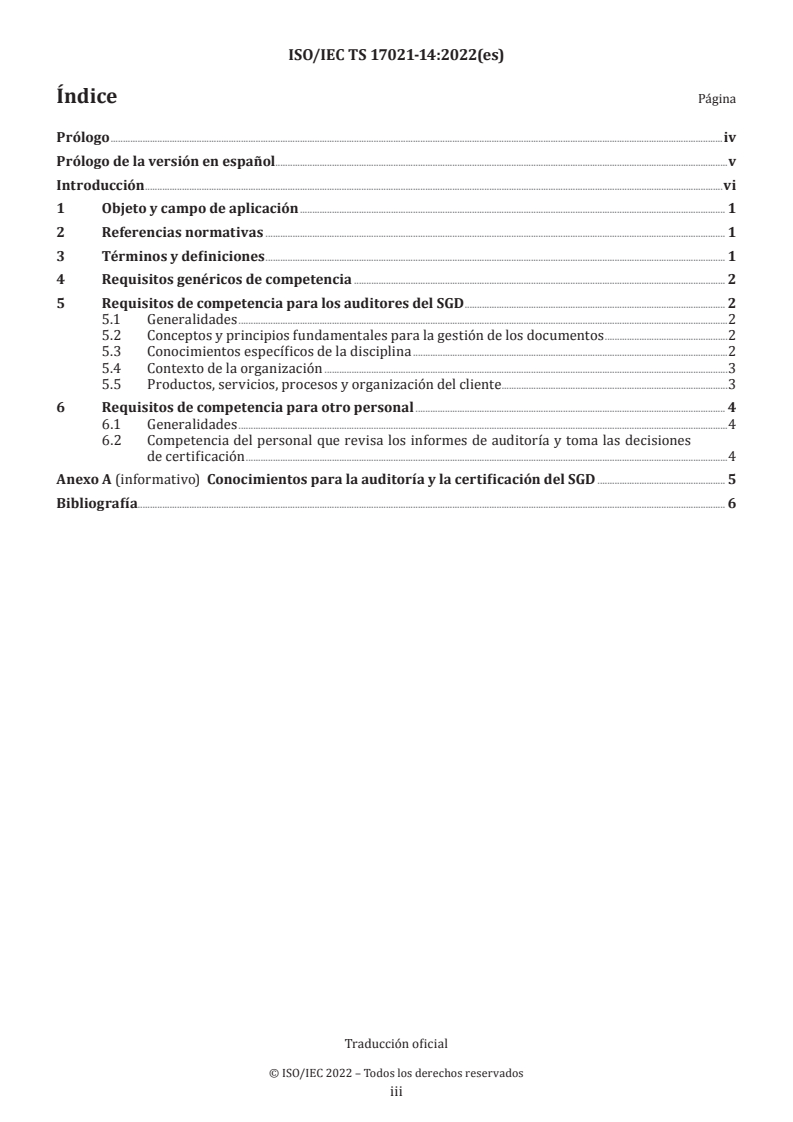
Índice Página
Prólogo .iv
Prólogo de la versión en español.v
Introducción .vi
1 Objeto y campo de aplicación . 1
2 Referencias normativas . 1
3 Términos y definiciones . 1
4 Requisitos genéricos de competencia . 2
5 Requisitos de competencia para los auditores del SGD . 2
5.1 Generalidades .2
5.2 Conceptos y principios fundamentales para la gestión de los documentos .2
5.3 Conocimientos específicos de la disciplina .2
5.4 Contexto de la organización .3
5.5 Productos, servicios, procesos y organización del cliente .3
6 Requisitos de competencia para otro personal . 4
6.1 Generalidades .4
6.2 Competencia del personal que revisa los informes de auditoría y toma las decisiones
de certificación .4
Anexo A (informativo) Conocimientos para la auditoría y la certificación del SGD . 5
Bibliografía. 6
Traducción oficial
© ISO/IEC 2022 – Todos los derechos reservados
iii
Prólogo
ISO (Organización Internacional de Normalización) e IEC (Comisión Electrotécnica Internacional) forman el
sistema especializado para la normalización mundial. Los organismos nacionales que son miembros de ISO o
IEC participan en el desarrollo de Normas Internacionales a través de comités técnicos establecidos por la
organización respectiva para tratar materias específicas de la actividad técnica. Los comités técnicos de
ISO e IEC colaboran en materias de interés mutuo. Otras organizaciones internacionales, gubernamentales y
no gubernamentales, vinculadas con ISO e IEC, también participan en el trabajo.
En la Parte 1 de las Directivas ISO/IEC se describen los procedimientos utilizados para desarrollar este
documento y aquellos previstos para su mantenimiento posterior. En particular debería tomarse nota de
los diferentes criterios de aprobación necesarios para los distintos tipos de documentos. Este documento
ha sido redactado de acuerdo con las reglas editoriales de la Parte 2 de las Directivas ISO/IEC (véase
www.iso.org/directiveso www.iec.ch/members_experts/refdocs).
Se llama la atención sobre la posibilidad de que algunos de los elementos de este documento puedan estar
sujetos a derechos de patente. ISO e IEC no asumen la responsabilidad por la identificación de alguno
o todos los derechos de patente. Los detalles sobre cualquier derecho de patente identificado durante el
desarrollo de este documento se indicarán en la Introducción y/o en la lista ISO de declaraciones de
patente recibidas (véase www.iso.org/patents) o la lista IEC de declaraciones de patente recibidas (véase
https://patents.iec.ch).
Cualquier nombre comercial utilizado en este documento es información que se proporciona para comodidad
del usuario y no constituye una recomendación.
Para una explicación de la naturaleza voluntaria de las normas, el significado de los términos específicos
de ISO y las expresiones relacionadas con la evaluación de la conformidad, así como la información
acerca de la adhesión de ISO a los principios de la Organización Mundial del Comercio (OMC) respecto
a los Obstáculos Técnicos al Comercio (OTC), véase www.iso.org/iso/foreword.html. En IEC, véase
www.iec.ch/understanding-standards.
Este documento ha sido elaborado por el Comité ISO/CASCO, Comité para la evaluación de la conformidad,
en colaboración con el Comité Técnico ISO/TC 46, Información y documentación, Subcomité SC 11, Gestión de
documentos y archivos.
En el sitio web de ISO e IEC se puede encontrar un listado de todas las partes de la serie de Normas
ISO/IEC 17021.
Cualquier comentario o pregunta sobre este documento deberían dirigirse al organismo nacional de
normalización del usuario. En www.iso.org/members.html y www.iec.ch/national-committees se puede
encontrar un listado completo de estos organismos.
Traducción oficial
© ISO/IEC 2022 – Todos los derechos reservados
iv
Prólogo de la versión en español
Este documento ha sido traducido por el Grupo de Trabajo Spanish Translation Task Force (STTF) del Comité
Técnico ISO/CASCO, Comité para la evaluación de la conformidad, en el que participan representantes de
los organismos nacionales de normalización y otras partes interesadas, para lograr la unificación de la
terminología en lengua española en el ámbito de la evaluación de la conformidad.
Este documento ha sido validado por el ISO/TMBG/Spanish Translation Management Group (STMG)
conformado por los siguientes países: Argentina, Bolivia, Chile, Colombia, Costa Rica, Cuba, Ecuador, El
Salvador, España, Guatemala, Honduras, República Dominicana, México, Panamá, Paraguay, Perú y Uruguay.
Traducción oficial
© ISO/IEC 2022 – Todos los derechos reservados
v
Introducción
La creación y gestión de los documentos forma parte integral de las actividades, procesos y sistemas de
cualquier organización. Permiten la eficacia y eficiencia del negocio, la rendición de cuentas, la gestión
de riesgos y la continuidad del negocio. También permiten a las organizaciones capitalizar el valor de sus
recursos de información como activos estratégicos y contribuir a la preservación de la memoria colectiva, en
respuesta a los retos del entorno global y digital.
La Norma ISO 30301 especifica los requisitos que deben cumplir los sistemas de gestión para los
documentos (SGD) para ayudar a la organización a cumplir su mandato, misión, estrategia y objetivos.
Aborda el desarrollo y la implementación de una política y objetivos en materia de gestión de documentos y
proporciona información sobre la medición y el seguimiento del desempeño.
Este documento complementa los requisitos de la Norma ISO/IEC 17021-1:2015. En particular, aclara los
requisitos de competencia del personal involucrado en el proceso de certificación establecidos en el Anexo A
de la Norma ISO/IEC 17021-1:2015.
Los organismos de certificación tienen la responsabilidad ante las partes interesadas, incluidos sus clientes y
los clientes de las organizaciones cuyos sistemas de gestión están certificados, de asegurarse de que solo los
auditores que demuestren la competencia pertinente están autorizados para realizar auditorías de Sistemas
de Gestión para los Documentos (SGD). Se pretende que todos los auditores posean las competencias
genéricas descritas en la Norma ISO/IEC 17021-1, así como las competencias específicas descritas en este
documento. Los organismos de certificación necesitarán identificar la competencia específica del equipo
auditor necesaria para el alcance de cada auditoría.
En este documento, se utilizan las siguientes formas verbales:
— “debe” indica un requisito;
— “debería” indica una recomendación;
— “puede” indica un permiso, una posibilidad o una capacidad.
Para más información, consulte la Parte 2 de las Directivas de ISO/IEC.
Traducción oficial
© ISO/IEC 2022 – Todos los derechos reservados
vi
Especificación Técnica ISO/IEC TS 17021-14:2022(es)
Evaluación de la conformidad — Requisitos para los
organismos que realizan la auditoría y la certificación de
sistemas de gestión —
Parte 14:
Requisitos de competencia para la auditoría y la certificación
de sistemas de gestión para los documentos
1 Objeto y campo de aplicación
Este documento especifica los requisitos de competencia del personal involucrado en el proceso de auditoría
y certificación de sistemas de gestión para los documentos (SGD). Complementa los requisitos existentes de
la Norma
...