


ISO 16881-1:2024
(Main)Cranes — Design calculation for wheel/rail contacts and associated trolley track supporting structure — Part 1: General
Cranes — Design calculation for wheel/rail contacts and associated trolley track supporting structure — Part 1: General
This document specifies requirements for selecting the size of iron or steel wheels. It also presents formulae to determine local stresses in crane structures due to the effects of wheel loads. This document covers requirements for steel and cast-iron wheels. It applies to metallic contacts only. This document does not apply to roller bearings. This document is used together with the classification of the ISO 4301 series and the loads and load combinations of the ISO 8686 series. This document is based on the limit state method (see ISO 8686-1). This document is for design purposes only. It is not a guarantee of actual performance.
Appareils de levage à charge suspendue — Calcul de conception des contacts galets/rails et de la structure porteuse du chariot de roulement — Partie 1: Généralités
General Information
Relations
Standards Content (Sample)
International
Standard
ISO 16881-1
Second edition
Cranes — Design calculation
2024-07
for wheel/rail contacts and
associated trolley track supporting
structure —
Part 1:
General
Appareils de levage à charge suspendue — Calcul de conception
des contacts galets/rails et de la structure porteuse du chariot de
roulement —
Partie 1: Généralités
Reference number
© ISO 2024
All rights reserved. Unless otherwise specified, or required in the context of its implementation, no part of this publication may
be reproduced or utilized otherwise in any form or by any means, electronic or mechanical, including photocopying, or posting on
the internet or an intranet, without prior written permission. Permission can be requested from either ISO at the address below
or ISO’s member body in the country of the requester.
ISO copyright office
CP 401 • Ch. de Blandonnet 8
CH-1214 Vernier, Geneva
Phone: +41 22 749 01 11
Email: copyright@iso.org
Website: www.iso.org
Published in Switzerland
ii
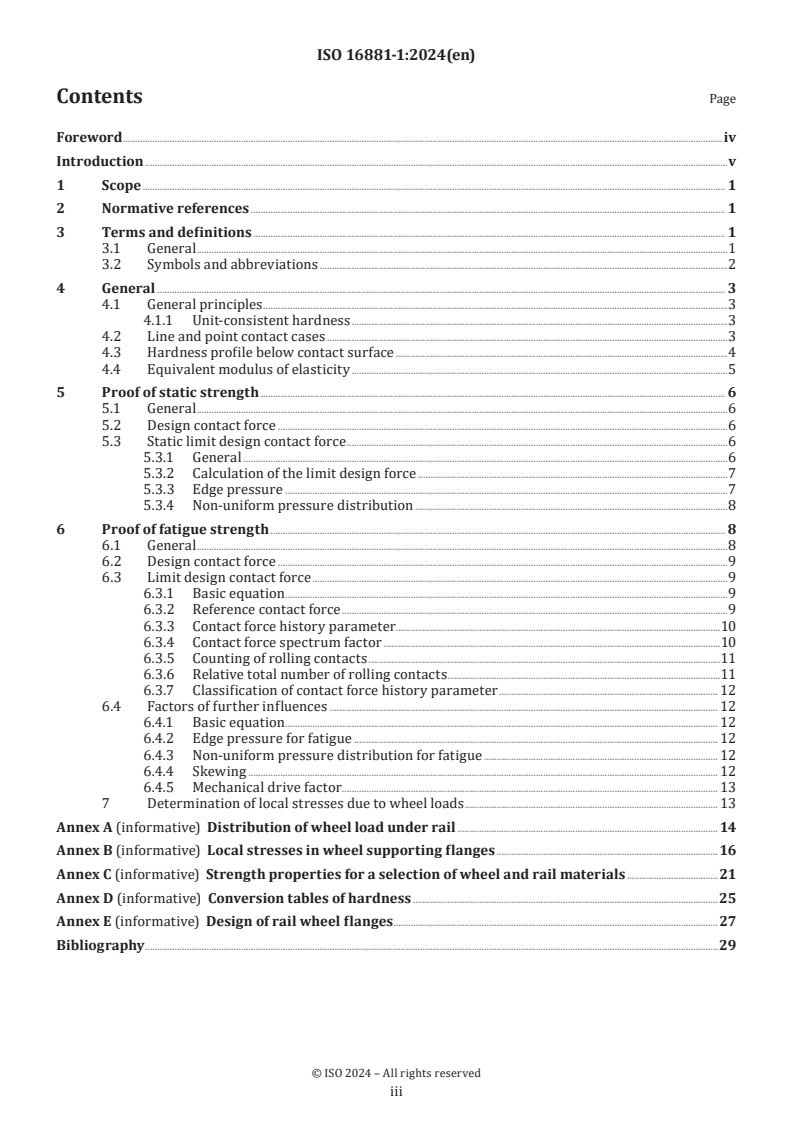
Contents Page
Foreword .iv
Introduction .v
1 Scope . 1
2 Normative references . 1
3 Terms and definitions . 1
3.1 General .1
3.2 Symbols and abbreviations .2
4 General . 3
4.1 General principles .3
4.1.1 Unit-consistent hardness .3
4.2 Line and point contact cases .3
4.3 Hardness profile below contact surface .4
4.4 Equivalent modulus of elasticity .5
5 Proof of static strength . 6
5.1 General .6
5.2 Design contact force .6
5.3 Static limit design contact force .6
5.3.1 General .6
5.3.2 Calculation of the limit design force .7
5.3.3 Edge pressure .7
5.3.4 Non-uniform pressure distribution .8
6 Proof of fatigue strength . 8
6.1 General .8
6.2 Design contact force .9
6.3 Limit design contact force .9
6.3.1 Basic equation .9
6.3.2 Reference contact force .9
6.3.3 Contact force history parameter .10
6.3.4 Contact force spectrum factor .10
6.3.5 Counting of rolling contacts .11
6.3.6 Relative total number of rolling contacts .11
6.3.7 Classification of contact force history parameter . 12
6.4 Factors of further influences . 12
6.4.1 Basic equation . 12
6.4.2 Edge pressure for fatigue . 12
6.4.3 Non-uniform pressure distribution for fatigue . 12
6.4.4 Skewing . 12
6.4.5 Mechanical drive factor . . 13
7 Determination of local stresses due to wheel loads . 13
Annex A (informative) Distribution of wheel load under rail . 14
Annex B (informative) Local stresses in wheel supporting flanges .16
Annex C (informative) Strength properties for a selection of wheel and rail materials .21
Annex D (informative) Conversion tables of hardness .25
Annex E (informative) Design of rail wheel flanges .27
Bibliography .29
iii
Foreword
ISO (the International Organization for Standardization) is a worldwide federation of national standards
bodies (ISO member bodies). The work of preparing International Standards is normally carried out through
ISO technical committees. Each member body interested in a subject for which a technical committee
has been established has the right to be represented on that committee. International organizations,
governmental and non-governmental, in liaison with ISO, also take part in the work. ISO collaborates closely
with the International Electrotechnical Commission (IEC) on all matters of electrotechnical standardization.
The procedures used to develop this document and those intended for its further maintenance are described
in the ISO/IEC Directives, Part 1. In particular, the different approval criteria needed for the different types
of ISO documents should be noted. This document was drafted in accordance with the editorial rules of the
ISO/IEC Directives, Part 2 (see www.iso.org/directives).
ISO draws attention to the possibility that the implementation of this document may involve the use of (a)
patent(s). ISO takes no position concerning the evidence, validity or applicability of any claimed patent
rights in respect thereof. As of the date of publication of this document, ISO had not received notice of (a)
patent(s) which may be required to implement this document. However, implementers are cautioned that
this may not represent the latest information, which may be obtained from the patent database available at
www.iso.org/patents. ISO shall not be held responsible for identifying any or all such patent rights.
Any trade name used in this document is information given for the convenience of users and does not
constitute an endorsement.
For an explanation of the voluntary nature of standards, the meaning of ISO specific terms and expressions
related to conformity assessment, as well as information about ISO's adherence to the World Trade
Organization (WTO) principles in the Technical Barriers to Trade (TBT), see www.iso.org/iso/foreword.html.
This document was prepared by Technical Committee ISO/TC 96, Cranes, Subcommittee SC 10, Design
principles and requirements.
This second edition cancels and replaces the first edition (ISO 16881-1:2005), which has been technically
revised.
The main changes are as follows:
— improvements were made to Annex B (local stresses);
— tables were added to Annex C to cover American, Chinese, and Japanese steels.
A list of all parts in the ISO 16881 series can be found on the ISO website.
Any feedback or questions on this document should be directed to the user’s national standards body. A
complete listing of these bodies can be found at www.iso.org/members.html.
iv
Introduction
This document establishes requirements and gives guidance and design rules that reflect the state of the
art in crane machine design. The rules represent good design practice that ensures that essential safety
requirements are met and that the components have an adequate service life. Deviation from these rules can
increase risk or reduce service life. However, new technical innovations and materials provide solutions that
result in equal or improved safety and durability.
v
International Standard ISO 16881-1:2024(en)
Cranes — Design calculation for wheel/rail contacts and
associated trolley track supporting structure —
Part 1:
General
1 Scope
This document specifies requirements for selecting the size of iron or steel wheels. It also presents formulae
to determine local stresses in crane structures due to the effects of wheel loads.
This document covers requirements for steel and cast-iron wheels. It applies to metallic contacts only.
This document does not apply to roller bearings.
This document is used together with the classification of the ISO 4301 series and the loads and load
combinations of the ISO 8686 series.
This document is based on the limit state method (see ISO 8686-1).
This document is for design purposes only. It is not a guarantee of actual performance.
2 Normative references
The following documents are referred to in the text in such a way that some or all of their content constitutes
requirements of this document. For dated references, only the edition cited applies. For undated references,
the latest edition of the referenced document (including any amendments) applies.
ISO 4301 (all parts), Cranes — Classification
ISO 4302, Cranes — Wind load assessment
ISO 4306-1, Cranes — Vocabulary — Part 1: General
ISO 6506-1, Metallic materials — Brinell hardness test — Part 1: Test method
ISO 8686 (all parts), Cranes — Design principles for loads and load combinations
ISO 11031, Cranes — Principles for seismically resistant design
ISO 12100, Safety of machinery — General principles for design — Risk assessment and risk reduction
ISO 12488-1, Cranes — Tolerances for wheels and travel and traversing tracks — Part 1: General
ISO 20332, Cranes — Proof of competence of steel structures
3 Terms and definitions
3.1 General
For the purposes of this document, the terms and definitions given in ISO 4306-1, ISO 12100 and the
following apply.
ISO and IEC maintain terminology databases for use in standardization at the following addresses:
— ISO Online browsing platform: available at https:// www .iso .org/ obp
— IEC Electropedia: available at https:// www .electropedia .org/
3.2 Symbols and abbreviations
For the purposes of this document, the symbols and abbreviations given in Table 1 apply.
Table 1 — Symbols and abbreviations
Symbols, abbreviations Description
b load-bearing width
b , b effective contact widths of rail and wheel
r w
D wheel diameter
w
E equivalent modulus of elasticity
m
E modulus of elasticity of the rail or track
r
E modulus of elasticity of the wheel
w
F wheel load
F limit design contact force for fatigue
Rd,f
F limit design contact force
Rd,s
F design contact force for fatigue
Sd,f
F design contact force in contact i
Sd,f,i
F design contact force
Sd,s
F reference contact force
u
f factor of further influences in fatigue
f
f decreasing factor for edge pressure in fatigue
f1
f decreasing factor for non-uniform pressure distribution in fatigue
f2
f decreasing factor for skewing in fatigue
f3
f materials factor in fatigue
f4
f decreasing factor for driven wheels in fatigue
f5
f yield point
y
f decreasing factor for edge pressure
f decreasing factor for non-uniform pressure distribution
HBW Brinell hardness
*
HB unit-consistent hardness
i index of one rolling contact with f
sd,f,i
i number of rolling contacts at reference point
D
i total number of rolling contacts during the useful life of a wheel, rail or track
tot
m exponent for wheel/rail contacts
k contact force spectrum factor
c
r radius of the rail surface or the second wheel radius
k
r radius of the edge
s contact force history parameter
c
S classes of contact force history parameter s
C c
w width of projecting non-contact area
z z depth of point of maximum shear for point or line contact
mp, ml
α skewing angle
TTabablele 1 1 ((ccoonnttiinnueuedd))
Symbols, abbreviations Description
α part of the skewing angle α due to the slack of the guide
g
α part of the skewing angle α due to tolerances
t
α part of the skewing angle α due to wear
w
γ contact resistance factor for fatigue
cf
γ general resistance coefficient; γ =1,1
m m
γ risk coefficient
n
γ partial safety factors
p
ν radial strain coefficient (ν = 0,3 for steel)
ν relative total number of rolling contacts
c
ϕ dynamic factors (see ISO 8686 series)
4 General
4.1 General principles
The proof of competence for static strength and fatigue strength shall be fulfilled when selecting a wheel
and rail combination. In the proof of competence for static strength, the material properties of the weaker
party (wheel or rail) shall be applied. The proof of competence for fatigue strength, or rolling contact fatigue
(RCF), shall be conducted separately to each party, applying its specific material property and number of
rolling contacts.
The proof shall be applied to all arrangements in cranes, where a wheel/rail type of rolling contact occurs,
e.g. crane travel wheels, trolley traverse wheels, guide rollers and wheels/rollers supporting slewing
structures. The term wheel is used throughout this document for the rolling party in a contact.
The proof of competence criteria in Clauses 5 and 6 are based upon Hertz pressure on the contact surface
and the shear stress below the surface due to wheel/rail contact.
NOTE Guidance on the nominal dimensions of wheels is given in Annex E.
4.1.1 Unit-consistent hardness
*
Some of the formulae in this document refer to unit-consistent hardness (HB ), which is based on the Brinell
hardness (HBW) and given as a value without units in line with ISO 6506-1. The unit of HB* shall match the
unit of the modulus of elasticity used in the calculation. Using SI units, the unit-consistent hardness is given by:
N
*
HB =⋅HBW
mm
where
HB* is the unit-consistent hardness;
HBW is the value of the Brinell hardness.
EXAMPLE If HBW = 300, then HB* = 300 N/mm .
NOTE Annex D provides a table of hardness conversion.
4.2 Line and point contact cases
There are two main theoretical contact cases: a line contact and a point contact (see Figure 1).
Where the crown radius, r , in typical designs of crane wheels and rails is large in relation to the width of
k
the wheel and rail, slight wear due to contact will occur for cranes. This document uses the line contact
model to calculate Hertz pressure.
The conditions of point contact cases conforming to this assumption are stated in Figure 1 b).
a) Line contact b) Point contact
NOTE 1 The point contact in Figure 1 b) is assumed where the following condition applies:
5⋅minb ;;br≤≤200⋅min bb
[] []
rw kr w
Where rb>⋅200 min ;b , the requirements for line contact shall be applied.
[]
kr w
NOTE 2 The effective contact widths (b , b ) are determined by deducting the effect of the corner radius equal to 2
w r
× r from the material width of the wheel/rail.
Figure 1 — Contact cases
4.3 Hardness profile below contact surface
The hardness shall extend deeper into the material than the depth of maximum shear, preferably twice this
depth. The hardness value may be obtained using the ultimate strength of the material and the appropriate
conversion tables for commonly used materials (see Annex C and Annex D).
Special care shall be taken with surface hardening and the depth zone to ensure that the hardness profile
does not drop below the shear profile (see Figure 2).
The thickness of the surface-hardened layers should be determined according to ISO 18203.
Key
z depth
z , z depths of maximum shear stress
ml mp
HB unit-consistent hardness
1 hardness, the surface hardened zone
2 hardness, the natural hardness of the material
shear stress τ due to contact force
Figure 2 — Depth of hardness versus shear stress
The depth of the maximum shear for theoretical line contact cases shall be calculated using Formula (1).
πν⋅⋅D 1−
()
w
zF=⋅05, 0 ⋅ (1)
ml Sd0,s
bE⋅
m
Theoretical point contact cases shall be calculated using Formula (2).
F
1−ν
Sd0,s
z =⋅06, 8 ⋅ (2)
mp
E
21
m
+
Dr
wk
where
F
is the maximum design wheel/rail contact force within the load combinations A to C in accordance
Sd0,s
with the ISO 8686 series, taking into account the respective dynamic factors φ , but where all
i
partial safety factors, γ , are set to 1. The most unfavourable load effects from possible positions
p
of the mass of the hoist load and crane configurations shall be taken into account;
E
is the equivalent modulus of elasticity (see 4.4);
m
b is the effective contact width of the rail (b ) or the wheel (b ) under consideration.
r w
4.4 Equivalent modulus of elasticity
The equivalent modulus of elasticity shall be calculated using Formula (3), which also covers when the
elastic modulus of the wheel and the rail are different:
2⋅⋅EE
wr
E = (3)
m
EE+
wr
where
E
is the equivalent modulus of elasticity;
m
E
is the modulus of elasticity of the wheel;
w
E
is the modulus of elasticity of the rail.
r
Values of the elastic moduli for selected materials are given in Table 2.
Table 2 — Values of elastic modulus
Wheel/rail material Modulus of elasticity in N/mm
Steel 210 000
Cast iron 176 000
Steel/cast iron -combination E = 191 500
m
5 Proof of static strength
5.1 General
The static strength of wheel/rail contacts shall be proven using Formula (4) for all relevant load combinations
of the ISO 8686 series:
FF ≤ (4)
Sd,s Rd,s
where
F
is the design contact force;
Sd,s
F
is the limit design contact force.
Rd,s
5.2 Design contact force
The design contact force F of wheel/rail contacts shall be calculated for all relevant load combinations of
Sd,s
the ISO 8686 series (eventually including the wind loads of ISO 4302 or the seismic loads of ISO 11031). This
takes into account the respective dynamic factors φ , partial safety factors γ and where required the risk
i p
coefficient γ . The most unfavourable load effects from possible positions of the mass of the hoist load and
n
crane configurations shall be taken into account.
5.3 Static limit design contact force
5.3.1 General
The static limit design contact force F is specified as a force to cause a permanent radial deformation of
Rd ,s
0,02 % of the wheel radius.
The static limit design contact force depends on:
— the material properties of the wheel and the rail (modulus of elasticity, yield stress and hardness);
— geometry (radii of wheel and rail);
— further influences (stiffness, edge effects).
5.3.2 Calculation of the limit design force
The static limit design contact force shall be calculated separately both for the wheel and the rail, either by
Formula (5) or Formula (6). For the proof of competence in accordance with Formula (4), the value taken for
F shall be the smaller of the values obtained either for the wheel or the rail. The effective load-bearing
Rd,s
width is the same in both calculations.
Formula (5) applies to non-surface hardened materials only, e.g. materials as cast, forged, rolled or quenched
and tempered.
π ⋅⋅Db⋅−1 v
()
w
()7⋅HB
F = ⋅ ⋅⋅ff (5)
Rd,s 12
γ E
m m
Formula (6) applies to surface hardened materials, e.g. flame or induction hardened, provided that surface
hardness is equal to or greater than HB =×06, f , and the depth of the hardened layer meets the
y
requirements of 4.3.
π ⋅⋅Db⋅−1 v
42, ⋅ f
() ()
w
y
F = ⋅ ⋅⋅ff (6)
Rd,s 12
γ E
m m
where
F
is the static limit design contact force;
Rd,s
E
is the equivalent modulus of elasticity;
m
v is the radial strain coefficient ( v = 0,3 for steel);
D
is the wheel diameter;
w
b is the effective load-bearing width taken as bm= in bb; (see Figure 1);
[]
rw
HB
is the unit-consistent hardness (see 4.1.1) based on the natural hardness of the material at the
depth of maximum shear (see Annex C);
γ is the general resistance coefficient, γ = 1,1;
m m
f
is the yield stress of the material below the hardened surface, i.e. the natural yield stress of the
y
material prior to the surface hardening process (see Annex C).
f
is the decreasing factor for edge pressure: for the line contact, see 5.3.3; for point contact cases,
f may be set to 1.
f
is the decreasing factor for non-uniform pressure distribution: for line contact, see 5.3.4; for point
contact cases, f may be set to 1.
5.3.3 Edge pressure
Formulae for the limit design contact force in the line contact case are derived from two bodies in contact,
infinitely wide or of the same width. Factor f (Table 3) introduces a correction to the limit design contact
force for when the two bodies are of unequal width (see Figure 3). Where the rail is wider than the wheel,
the radius of the edge (r ) shall be taken as that of the wheel.
Key
radius of the edge of the narrower party (wheel or rail)
r
w width of the projecting non-contact area
Figure 3 — Edge pressure
Table 3 — Factor f for edge pressure in line contact
Ratio rw/ Factor f
3 1
rw/,≤ 01 08, 5
01,/<
3 3
rw/,≥ 08 10,
where
w
is the width of the projecting non-contact area;
r
is the radius of the edge of the narrower party (wheel or rail).
5.3.4 Non-uniform pressure distribution
In the case of line contact, an ideal uniform distribution across the tread of the wheel is dependent on the
rail fixing being elastic enough or its support and/or wheels having self-aligning suspension. Otherwise, the
limit design contact force will be diminished due to pressure being distributed in non-uniform ways, due to
deformation in the crane structure (e.g. the main girders bending) or misalignment in the rail. This effect is
taken into account by factor f (Table 4).
Table 4 — Factor f for non-uniform pressure distribution in line contact
Tolerance class of ISO 12488-1
1 2 3 4
Wheels with self-aligning
1,0 1,0 0,95 0,9
suspension
Rail mounted on elastic support 0,95 0,9 0,85 0,8
Rail mounted on rigid support 0,9 0,85 0,8 0,7
6 Proof of fatigue strength
6.1 General
The proof of competence of the fatigue strength of wheels and rails shall be carried out in accordance with
ISO 20332 and ISO 8686-1. The wheels and the rails shall have a specified design life that is proportionate
to that of the related crane or hoist. The proof covers hazards related to rolling contact fatigue, i.e. surface
cracking and pitting of wheels and rails.
The fatigue strength of wheel/rail contacts shall be proven by Formula (7) for each wheel and for all points
on the rails under consideration.
FF≤ (7)
Sd,f Rd,f
where
F
is the maximum design contact force for fatigue;
Sd,f
F
is the limit design contact force for fatigue.
Rd,f
6.2 Design contact force
The design contact force F shall be calculated for the load combination A of the ISO 8686 series (regular
Sd,f
loads). This includes the risk coefficient and all dynamic factors φ = 1 and all partial safety factors γ = 1. For
i p
the purpose of this document, the skewing forces acting on guide rollers shall be considered as regular loads.
6.3 Limit design contact force
6.3.1 Basic equation
The limit design contact force F shall be calculated separately both for the wheel and for the rail using
Rd,f
Formula (8):
F
u
F = ⋅ f (8)
Rd ,f f
m
γ ⋅ s
cfc
where
F
is the reference contact force;
u
s
is the contact force history parameter, calculated separately for the wheel and the rail;
c
γ is the contact resistance factor for fatigue γ = 1,1;
cf cf
f
is the factor of further influences;
f
m
is the exponent for wheel/rail contacts, m = 3,33.
6.3.2 Reference contact force
The limit design contact force of a wheel or rail subjected to rolling contact fatigue is characterized by the
reference contact force F which represents the fatigue strength under 6,4 × 10 rolling contacts under
u
constant contact force and a probability of surv
...
Questions, Comments and Discussion
Ask us and Technical Secretary will try to provide an answer. You can facilitate discussion about the standard in here.