

ISO/TS 10303-1102:2005
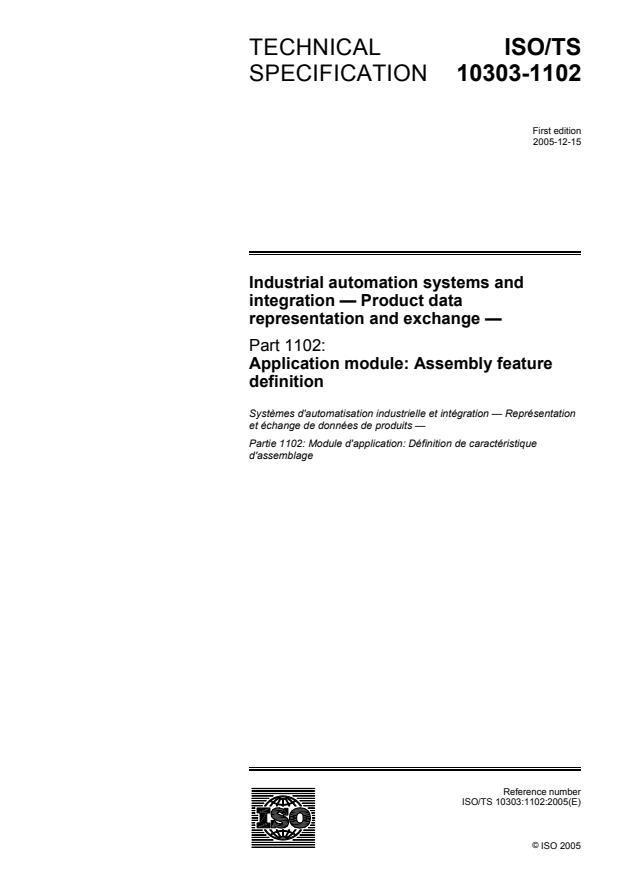
(Main)Industrial automation systems and integration — Product data representation and exchange — Part 1102: Application module: Assembly feature definition
General Information
- Abstract
ISO/TS 10303-1102:2005 specifies the application module for Assembly feature definition. The following are within the scope of ISO/TS 10303-1102:2005: specification of the use of a characterized object as an assembly feature definition of a product; specification of the use of a shape aspect as an instanced assembly feature of a product; specification of the shape aspect relationship as a peer-to-peer relationship between a pair of instanced assembly features.
- Status
- Published
- Publication Date
- 11-Dec-2005
- Technical Committee
- ISO/TC 184/SC 4 - Industrial data
- Drafting Committee
- ISO/TC 184/SC 4/WG 12 - STEP product modelling and resources
- Current Stage
- 9093 - International Standard confirmed
- Start Date
- 10-Nov-2023
- Completion Date
- 29-Aug-2026


Overview
ISO/TS 10303-1102:2005 is an international standard developed by ISO for industrial automation systems, focusing on product data representation and exchange. Specifically, this part of the ISO 10303 series addresses the application module for assembly feature definition. The standard provides essential guidelines for specifying how objects and shape aspects are used to define assembly features within a product, and establishes methodologies for managing peer-to-peer relationships between instanced assembly features.
Adhering to ISO/TS 10303-1102:2005 enhances the consistency and reliability of product data integration across industrial automation platforms, supporting improved data exchange and more efficient manufacturing and product development processes.
Key Topics
- Assembly Feature Definition: Defines how characterized objects serve as assembly features within a product, providing clarity and consistency in product structure.
- Shape Aspect Instancing: Specifies the rules and procedures for using a shape aspect as an instanced assembly feature, enabling accurate representation of product geometry.
- Peer-to-Peer Relationships: Details the specification of relationships between pairs of assembly features, ensuring precise mapping of how features interact within an assembly.
- Product Data Exchange: Facilitates standardized data communication between different CAD, CAM, and CAE systems, aligning with broader objectives of digital manufacturing.
Applications
Implementing ISO/TS 10303-1102:2005 brings significant benefits to a range of industries and engineering processes:
- Manufacturing and Assembly: Enables manufacturers to define, capture, and exchange detailed assembly feature data accurately, leading to streamlined automation and integration in production lines.
- Product Lifecycle Management (PLM): Assists PLM systems in managing product configurations and versions, ensuring accurate records of assembly features across all stages of development.
- Collaborative Engineering: Supports collaboration between global teams and suppliers by providing a universal format for assembly feature data, minimizing misinterpretations during product development.
- Quality Assurance: Improves traceability of feature definitions and relationships, helping maintain high standards in product design and manufacturing.
- Interoperability: Enhances the interoperability of various systems involved in automation, such as CAD and simulation tools, by providing clear protocols for product data exchange.
Related Standards
For effective application of ISO/TS 10303-1102:2005, it is important to consider its relationships with other standards in the ISO 10303 (STEP) series:
- ISO 10303-1: Overview and fundamental principles of STEP for product data exchange.
- ISO 10303-203: Application protocol for configuration controlled 3D design of mechanical parts and assemblies.
- ISO 10303-214: Core data for automotive mechanical design processes.
- ISO/TS 10303-1100: Application module: Assembly structure.
- ISO/TS 10303-1101: Application module: Assembly configuration.
Together, these standards form a robust framework for ensuring consistency, accuracy, and efficiency in the exchange and management of assembly feature data in industrial automation environments.
Adopting ISO/TS 10303-1102:2005 is key to modernizing digital engineering workflows and optimizing product data quality throughout the lifecycle of industrial automation systems.
Get Certified
Connect with accredited certification bodies for this standard

DVS-ZERT GmbH
German welding certification society.
CARES (UK Certification Authority for Reinforcing Steels)
UK certification for reinforcing steels and construction.
EWF/IIW (European/International Welding Federation)
International welding personnel certification.
Sponsored listings
Frequently Asked Questions
ISO/TS 10303-1102:2005 is a technical specification published by the International Organization for Standardization (ISO). Its full title is "Industrial automation systems and integration — Product data representation and exchange — Part 1102: Application module: Assembly feature definition". This standard covers: ISO/TS 10303-1102:2005 specifies the application module for Assembly feature definition. The following are within the scope of ISO/TS 10303-1102:2005: specification of the use of a characterized object as an assembly feature definition of a product; specification of the use of a shape aspect as an instanced assembly feature of a product; specification of the shape aspect relationship as a peer-to-peer relationship between a pair of instanced assembly features.
ISO/TS 10303-1102:2005 specifies the application module for Assembly feature definition. The following are within the scope of ISO/TS 10303-1102:2005: specification of the use of a characterized object as an assembly feature definition of a product; specification of the use of a shape aspect as an instanced assembly feature of a product; specification of the shape aspect relationship as a peer-to-peer relationship between a pair of instanced assembly features.
ISO/TS 10303-1102:2005 is classified under the following ICS (International Classification for Standards) categories: 25.040.40 - Industrial process measurement and control. The ICS classification helps identify the subject area and facilitates finding related standards.
ISO/TS 10303-1102:2005 is available in PDF format for immediate download after purchase. The document can be added to your cart and obtained through the secure checkout process. Digital delivery ensures instant access to the complete standard document.
Standards Content (Sample)
TECHNICAL ISO/TS
SPECIFICATION 10303-1102
First edition
2005-12-15
Industrial automation systems and
integration — Product data
representation and exchange —
Part 1102:
Application module: Assembly feature
definition
Systèmes d'automatisation industrielle et intégration — Représentation
et échange de données de produits —
Partie 1102: Module d'application: Définition de caractéristique
d'assemblage
Reference number
ISO/TS 10303:1102:2005(E)
©
ISO 2005
This CD-ROM contains the publication ISO/TS 10303-1102:2005 in hypertext markup language (HTML),
together with the ARM and MIM EXPRESS listings.
© ISO 2005
All rights reserved. Unless otherwise specified, no part of this CD-ROM may be reproduced, stored in a retrieval system or transmitted in
any form or by any means without prior permission from ISO. Requests for permission to reproduce this product should be addressed to
ISO copyright office • Case postale 56 • CH-1211 Geneva 20 • Switzerland
Internet copyright@iso.org
Reproduction may be subject to royalty payments or a licensing agreement.
Violators may be prosecuted.
Published in Switzerland
ii © ISO 2005 – All rights reserved
Installation
If this publication has been packaged as a zipped file, do NOT open the file from the CD-ROM, but copy it to
the desired location in your local environment. On
...