

ISO/FDIS 10896-2
(Main)Rough-terrain trucks — Safety requirements and verification — Part 2: Slewing trucks
General Information
- Abstract
ISO 10896-2:2016 specifies general safety requirements for slewing rough-terrain variable-reach trucks (hereafter known as "trucks"), consisting of a lower chassis with a slewing upper structure equipped with a telescopic lifting means (pivoted boom), on which a load handling device (e.g., carriage and fork arms) is typically fitted. Fork arms and other integrated attachments are considered to be parts of the truck. Other standards, in addition to the relevant provisions of this part of ISO 10896, can apply to the attachments. ISO 10896-2:2016 is not applicable to the following: a) rough terrain variable-reach trucks covered by ISO 10896‑1 (non-slewing); b) industrial variable-reach trucks covered by ISO 3691‑2; c) mobile cranes; d) machines designed primarily for earth-moving, such as loaders, even if their buckets are replaced by fork arms (see ISO 20474); e) trucks designed primarily with variable-length load suspension elements (e.g. chain, ropes) from which the load may swing freely in all directions; NOTE Additional requirements for trucks intended for freely swinging load applications, their lifting devices and attachments, and personnel/work platform applications on trucks, are being developed by ISO/TC 110/SC4. f) trucks designed primarily for container handling. The significant hazards covered by this part of ISO 10896 are listed in Annex A. This part of ISO 10896 does not address hazards that can occur - during manufacture, - when handling suspended loads, which may swing freely, - when lifting personnel, - when using trucks on public roads, - when operating in potentially explosive atmospheres, or - with a battery, LPG or hybrid as the primary power source.
- Status
- Not Published
- Technical Committee
- ISO/TC 110/SC 4 - Rough-terrain trucks
- Drafting Committee
- ISO/TC 110/SC 4 - Rough-terrain trucks
- Current Stage
- 5000 - FDIS registered for formal approval
- Start Date
- 22-Aug-2025
- Completion Date
- 15-Sep-2025
Buy Documents
ISO/FDIS 10896-2 - Rough-terrain trucks — Safety requirements and verification — Part 2: Slewing trucks/17/2025
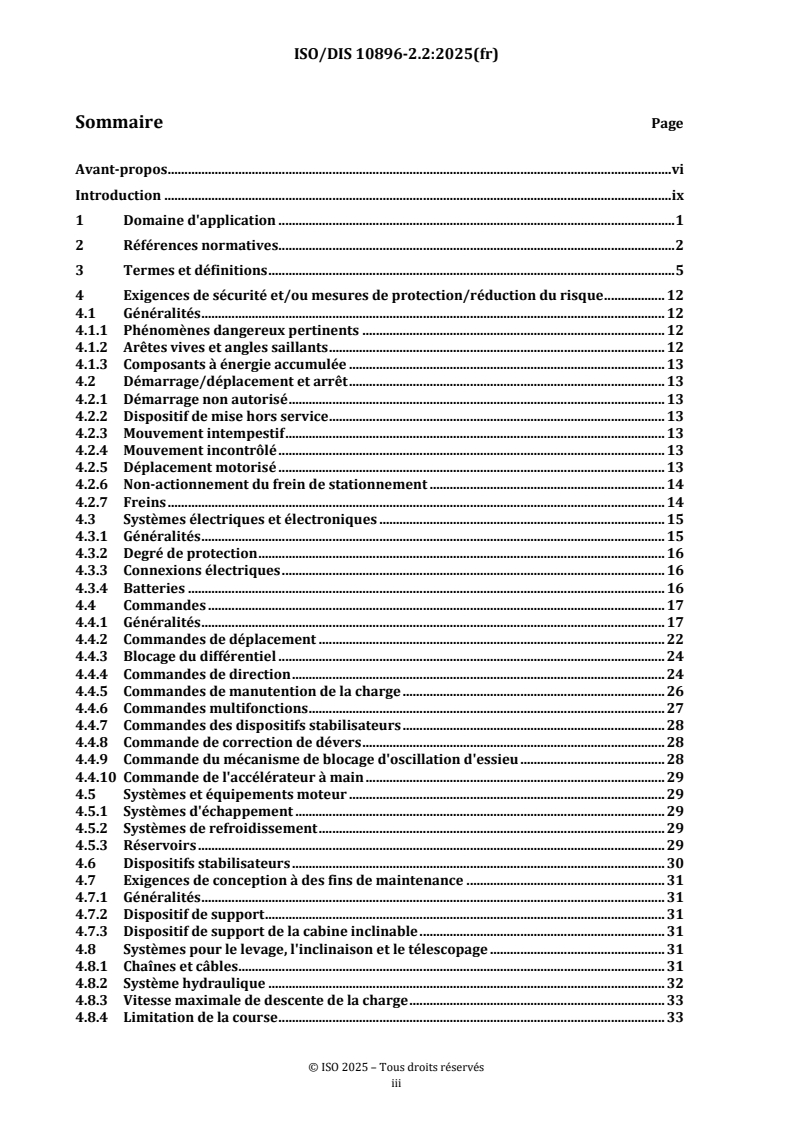
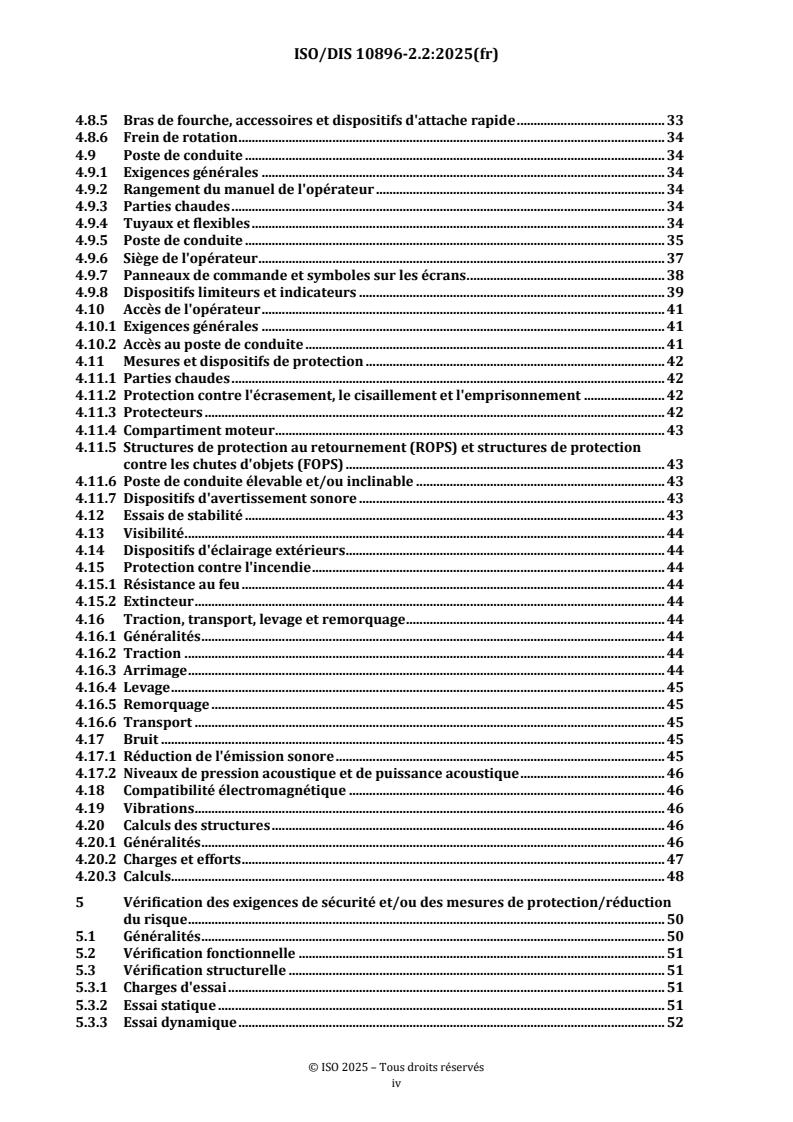
ISO/FDIS 10896-2 - Chariots tout-terrain — Exigences de sécurité et vérification — Partie 2: Chariots rotatifs/22/2025
Overview
ISO/FDIS 10896-2:2025 sets the international safety requirements for slewing rough-terrain variable-reach trucks-commonly known as slewing telehandlers or slewing telescopic handlers. These specialized trucks are designed to lift, transport, and place loads on rough, unimproved terrain, with a unique capability: their upper structure slews (rotates) relative to the lower chassis. They are equipped with a pivoted telescopic boom that often has a load handling device (such as fork arms or carriages) attached. ISO/FDIS 10896-2 specifies safety criteria and methods for verifying compliance, addressing significant hazards during operation and setting out documentation requirements for manufacturers and users.
This standard does not cover non-slewing variable-reach rough-terrain trucks, industrial variable-reach trucks, mobile cranes, earth-moving machinery, container handlers, or trucks equipped primarily for freely swinging suspended-load applications.
Key Topics
ISO/FDIS 10896-2 addresses comprehensive safety aspects of slewing rough-terrain telehandlers. Key areas include:
- Structural Safety: Requirements for the chassis, slewing mechanism, telescopic boom, and integrated attachments.
- Operator Safety: Specifications for operator’s station, controls, access, restraint systems, ROPS (Roll-Over Protective Structure), and FOPS (Falling Object Protective Structure).
- Mechanical and Electrical Systems: Guidance on braking, steering, stability, hydraulic systems, electrical protection, and noise and vibration limits.
- Functional Verification: Methods for testing safety-critical functions, including load holding, stability, and dynamic load handling.
- Control and Visibility: Design and positioning requirements for operator controls, display symbols, external visibility, and audible warning systems.
- Attachment Integration: Rules for attachments used with slewing trucks, with guidance given in referenced standards.
- Information for Use: Mandates for instruction handbooks, marking, graphical warnings, operator training, and maintenance documentation.
Hazard coverage is extensive, listing significant risks and situations, but explicitly excludes hazards arising from manufacturing, use on public roads, operation in explosive atmospheres, handling freely swinging loads, or certain power sources like battery or LPG.
Applications
ISO/FDIS 10896-2 is vital in sectors that demand robust and versatile materials handling on rough terrain:
- Construction: Ensures safe lifting and placement of building materials on uneven ground using slewing telehandlers.
- Agriculture: Supports safe handling of bulk materials, bales, and machinery components in off-road and field environments.
- Mining and Industrial Sites: Provides safety assurance where terrain is unpredictable, and rotating booms are essential for tight spaces.
- Emergency and Utility Operations: Assists in transport and placement of equipment where maneuverability and stability are critical.
By applying this standard, manufacturers and site operators reduce risk of injury or equipment damage, ensure regulatory compliance, and support best practices in machine selection, operator training, and maintenance planning.
Related Standards
Implementing ISO/FDIS 10896-2 often involves coordination with additional key standards:
- ISO 10896-1: Safety requirements for non-slewing rough-terrain variable-reach trucks.
- ISO 3691-2: Industrial trucks with variable-reach, non-rough terrain models.
- ISO 20474 and EN 474 Series: Earth-moving machinery safety.
- EN 1459-2: European standard for slewing rough-terrain trucks-important for regulatory alignment.
- ISO 10896-4: Requirements for handling freely suspended loads.
- ISO 10896-5: Additional safety requirements for trucks fitted with platforms for lifting personnel.
ISO/FDIS 10896-2 is an essential reference for manufacturers, safety managers, fleet operators, and regulators involved in the design, procurement, and use of slewing rough-terrain variable-reach trucks, supporting accident prevention and operational excellence in challenging environments.
Relations
- Effective Date
- 12-Feb-2026
- Effective Date
- 05-Nov-2022
Buy Documents
ISO/FDIS 10896-2 - Rough-terrain trucks — Safety requirements and verification — Part 2: Slewing trucks/17/2025
ISO/FDIS 10896-2 - Chariots tout-terrain — Exigences de sécurité et vérification — Partie 2: Chariots rotatifs/22/2025
Frequently Asked Questions
ISO/FDIS 10896-2 is a draft published by the International Organization for Standardization (ISO). Its full title is "Rough-terrain trucks — Safety requirements and verification — Part 2: Slewing trucks". This standard covers: ISO 10896-2:2016 specifies general safety requirements for slewing rough-terrain variable-reach trucks (hereafter known as "trucks"), consisting of a lower chassis with a slewing upper structure equipped with a telescopic lifting means (pivoted boom), on which a load handling device (e.g., carriage and fork arms) is typically fitted. Fork arms and other integrated attachments are considered to be parts of the truck. Other standards, in addition to the relevant provisions of this part of ISO 10896, can apply to the attachments. ISO 10896-2:2016 is not applicable to the following: a) rough terrain variable-reach trucks covered by ISO 10896‑1 (non-slewing); b) industrial variable-reach trucks covered by ISO 3691‑2; c) mobile cranes; d) machines designed primarily for earth-moving, such as loaders, even if their buckets are replaced by fork arms (see ISO 20474); e) trucks designed primarily with variable-length load suspension elements (e.g. chain, ropes) from which the load may swing freely in all directions; NOTE Additional requirements for trucks intended for freely swinging load applications, their lifting devices and attachments, and personnel/work platform applications on trucks, are being developed by ISO/TC 110/SC4. f) trucks designed primarily for container handling. The significant hazards covered by this part of ISO 10896 are listed in Annex A. This part of ISO 10896 does not address hazards that can occur - during manufacture, - when handling suspended loads, which may swing freely, - when lifting personnel, - when using trucks on public roads, - when operating in potentially explosive atmospheres, or - with a battery, LPG or hybrid as the primary power source.
ISO 10896-2:2016 specifies general safety requirements for slewing rough-terrain variable-reach trucks (hereafter known as "trucks"), consisting of a lower chassis with a slewing upper structure equipped with a telescopic lifting means (pivoted boom), on which a load handling device (e.g., carriage and fork arms) is typically fitted. Fork arms and other integrated attachments are considered to be parts of the truck. Other standards, in addition to the relevant provisions of this part of ISO 10896, can apply to the attachments. ISO 10896-2:2016 is not applicable to the following: a) rough terrain variable-reach trucks covered by ISO 10896‑1 (non-slewing); b) industrial variable-reach trucks covered by ISO 3691‑2; c) mobile cranes; d) machines designed primarily for earth-moving, such as loaders, even if their buckets are replaced by fork arms (see ISO 20474); e) trucks designed primarily with variable-length load suspension elements (e.g. chain, ropes) from which the load may swing freely in all directions; NOTE Additional requirements for trucks intended for freely swinging load applications, their lifting devices and attachments, and personnel/work platform applications on trucks, are being developed by ISO/TC 110/SC4. f) trucks designed primarily for container handling. The significant hazards covered by this part of ISO 10896 are listed in Annex A. This part of ISO 10896 does not address hazards that can occur - during manufacture, - when handling suspended loads, which may swing freely, - when lifting personnel, - when using trucks on public roads, - when operating in potentially explosive atmospheres, or - with a battery, LPG or hybrid as the primary power source.
ISO/FDIS 10896-2 is classified under the following ICS (International Classification for Standards) categories: 53.060 - Industrial trucks. The ICS classification helps identify the subject area and facilitates finding related standards.
ISO/FDIS 10896-2 has the following relationships with other standards: It is inter standard links to prEN ISO 10896-2, ISO 10896-2:2016. Understanding these relationships helps ensure you are using the most current and applicable version of the standard.
ISO/FDIS 10896-2 is available in PDF format for immediate download after purchase. The document can be added to your cart and obtained through the secure checkout process. Digital delivery ensures instant access to the complete standard document.
Standards Content (Sample)
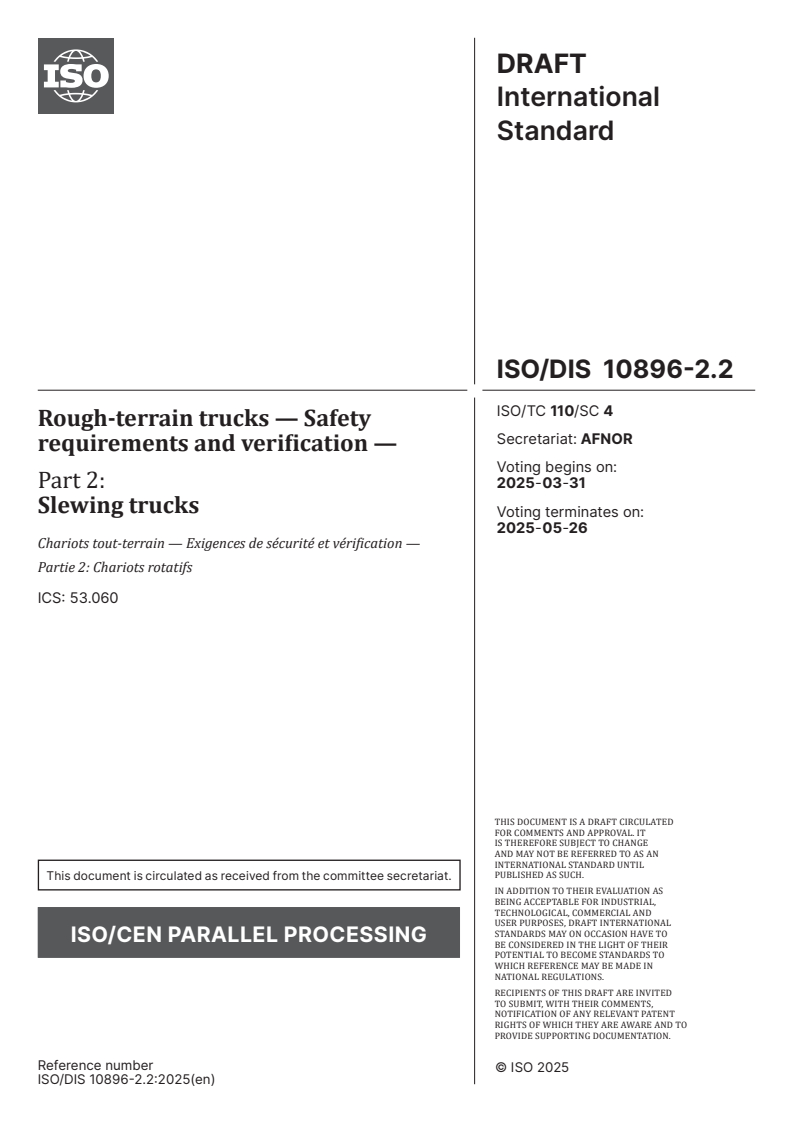
DRAFT
International
Standard
ISO/DIS 10896-2.2
ISO/TC 110/SC 4
Rough-terrain trucks — Safety
Secretariat: AFNOR
requirements and verification —
Voting begins on:
Part 2: 2025-03-31
Slewing trucks
Voting terminates on:
2025-05-26
Chariots tout-terrain — Exigences de sécurité et vérification —
Partie 2: Chariots rotatifs
ICS: 53.060
THIS DOCUMENT IS A DRAFT CIRCULATED
FOR COMMENTS AND APPROVAL. IT
IS THEREFORE SUBJECT TO CHANGE
AND MAY NOT BE REFERRED TO AS AN
INTERNATIONAL STANDARD UNTIL
PUBLISHED AS SUCH.
This document is circulated as received from the committee secretariat.
IN ADDITION TO THEIR EVALUATION AS
BEING ACCEPTABLE FOR INDUSTRIAL,
TECHNOLOGICAL, COMMERCIAL AND
USER PURPOSES, DRAFT INTERNATIONAL
STANDARDS MAY ON OCCASION HAVE TO
ISO/CEN PARALLEL PROCESSING
BE CONSIDERED IN THE LIGHT OF THEIR
POTENTIAL TO BECOME STANDARDS TO
WHICH REFERENCE MAY BE MADE IN
NATIONAL REGULATIONS.
RECIPIENTS OF THIS DRAFT ARE INVITED
TO SUBMIT, WITH THEIR COMMENTS,
NOTIFICATION OF ANY RELEVANT PATENT
RIGHTS OF WHICH THEY ARE AWARE AND TO
PROVIDE SUPPORTING DOCUMENTATION.
Reference number
ISO/DIS 10896-2.2:2025(en)
DRAFT
ISO/DIS 10896-2.2:2025(en)
International
Standard
ISO/DIS 10896-2.2
ISO/TC 110/SC 4
Rough-terrain trucks — Safety
Secretariat: AFNOR
requirements and verification —
Voting begins on:
Part 2:
Slewing trucks
Voting terminates on:
Chariots tout-terrain — Exigences de sécurité et vérification —
Partie 2: Chariots rotatifs
ICS: 53.060
THIS DOCUMENT IS A DRAFT CIRCULATED
FOR COMMENTS AND APPROVAL. IT
IS THEREFORE SUBJECT TO CHANGE
AND MAY NOT BE REFERRED TO AS AN
INTERNATIONAL STANDARD UNTIL
PUBLISHED AS SUCH.
This document is circulated as received from the committee secretariat.
IN ADDITION TO THEIR EVALUATION AS
BEING ACCEPTABLE FOR INDUSTRIAL,
© ISO 2025
TECHNOLOGICAL, COMMERCIAL AND
USER PURPOSES, DRAFT INTERNATIONAL
All rights reserved. Unless otherwise specified, or required in the context of its implementation, no part of this publication may
STANDARDS MAY ON OCCASION HAVE TO
ISO/CEN PARALLEL PROCESSING
be reproduced or utilized otherwise in any form or by any means, electronic or mechanical, including photocopying, or posting on
BE CONSIDERED IN THE LIGHT OF THEIR
the internet or an intranet, without prior written permission. Permission can be requested from either ISO at the address below
POTENTIAL TO BECOME STANDARDS TO
WHICH REFERENCE MAY BE MADE IN
or ISO’s member body in the country of the requester.
NATIONAL REGULATIONS.
ISO copyright office
RECIPIENTS OF THIS DRAFT ARE INVITED
CP 401 • Ch. de Blandonnet 8
TO SUBMIT, WITH THEIR COMMENTS,
CH-1214 Vernier, Geneva
NOTIFICATION OF ANY RELEVANT PATENT
Phone: +41 22 749 01 11
RIGHTS OF WHICH THEY ARE AWARE AND TO
PROVIDE SUPPORTING DOCUMENTATION.
Email: copyright@iso.org
Website: www.iso.org
Published in Switzerland Reference number
ISO/DIS 10896-2.2:2025(en)
ii
ISO/DIS 10896-2.2:2025(en)
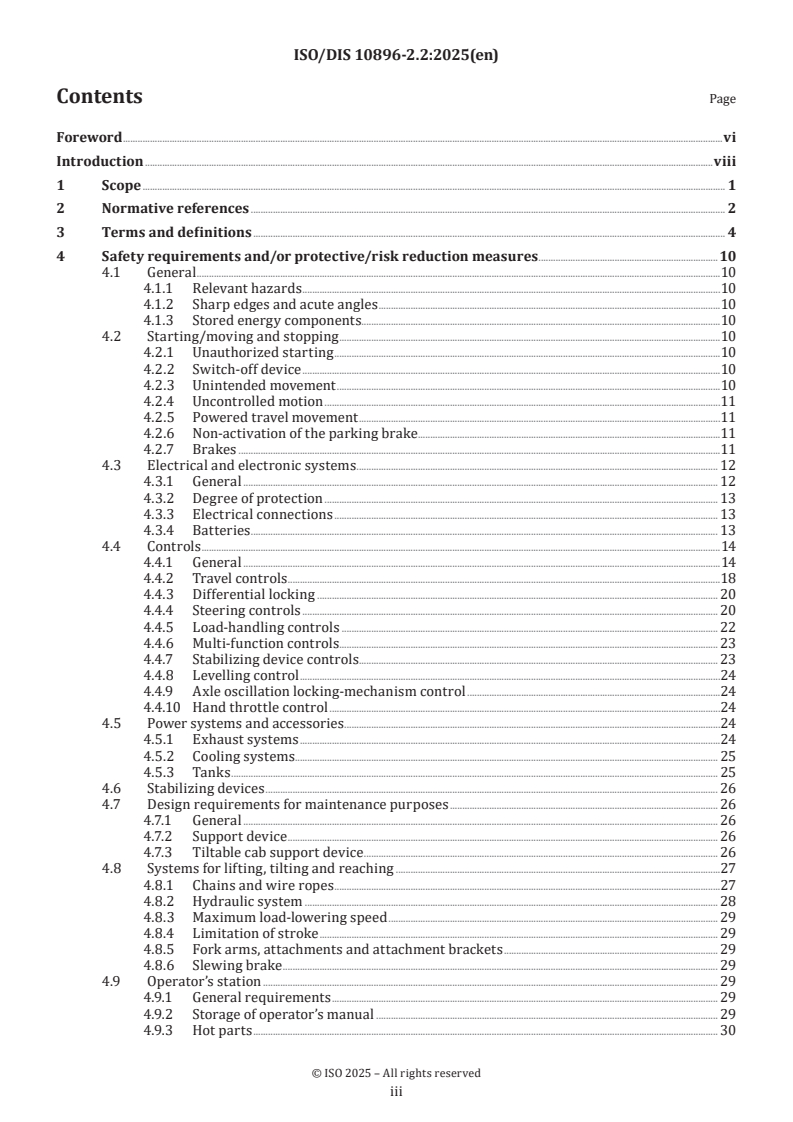
Contents Page
Foreword .vi
Introduction .viii
1 Scope . 1
2 Normative references . 2
3 Terms and definitions . 4
4 Safety requirements and/or protective/risk reduction measures .10
4.1 General .10
4.1.1 Relevant hazards .10
4.1.2 Sharp edges and acute angles .10
4.1.3 Stored energy components.10
4.2 Starting/moving and stopping .10
4.2.1 Unauthorized starting .10
4.2.2 Switch-off device .10
4.2.3 Unintended movement .10
4.2.4 Uncontrolled motion .11
4.2.5 Powered travel movement .11
4.2.6 Non-activation of the parking brake.11
4.2.7 Brakes .11
4.3 Electrical and electronic systems . 12
4.3.1 General . 12
4.3.2 Degree of protection . 13
4.3.3 Electrical connections . 13
4.3.4 Batteries . 13
4.4 Controls .14
4.4.1 General .14
4.4.2 Travel controls .18
4.4.3 Differential locking . 20
4.4.4 Steering controls . 20
4.4.5 Load-handling controls . 22
4.4.6 Multi-function controls. 23
4.4.7 Stabilizing device controls . 23
4.4.8 Levelling control .24
4.4.9 Axle oscillation locking-mechanism control .24
4.4.10 Hand throttle control .24
4.5 Power systems and accessories . .24
4.5.1 Exhaust systems .24
4.5.2 Cooling systems. 25
4.5.3 Tanks . 25
4.6 Stabilizing devices . 26
4.7 Design requirements for maintenance purposes . 26
4.7.1 General . 26
4.7.2 Support device . 26
4.7.3 Tiltable cab support device . 26
4.8 Systems for lifting, tilting and reaching .27
4.8.1 Chains and wire ropes .27
4.8.2 Hydraulic system . 28
4.8.3 Maximum load-lowering speed . 29
4.8.4 Limitation of stroke . 29
4.8.5 Fork arms, attachments and attachment brackets . 29
4.8.6 Slewing brake . 29
4.9 Operator’s station . 29
4.9.1 General requirements . 29
4.9.2 Storage of operator’s manual . 29
4.9.3 Hot parts . 30
iii
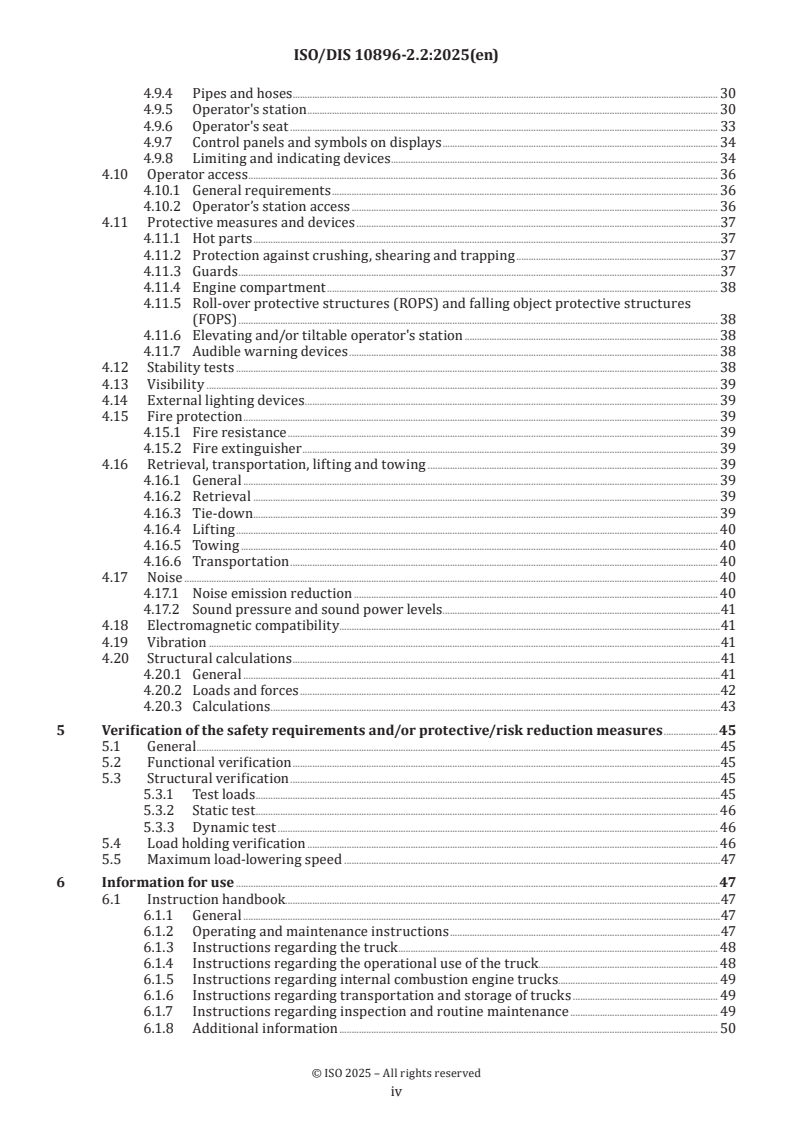
ISO/DIS 10896-2.2:2025(en)
4.9.4 Pipes and hoses . . 30
4.9.5 Operator's station . 30
4.9.6 Operator's seat . 33
4.9.7 Control panels and symbols on displays . 34
4.9.8 Limiting and indicating devices . 34
4.10 Operator access . 36
4.10.1 General requirements . 36
4.10.2 Operator’s station access . 36
4.11 Protective measures and devices .37
4.11.1 Hot parts .37
4.11.2 Protection against crushing, shearing and trapping .37
4.11.3 Guards .37
4.11.4 Engine compartment . 38
4.11.5 Roll-over protective structures (ROPS) and falling object protective structures
(FOPS) . 38
4.11.6 Elevating and/or tiltable operator's station . 38
4.11.7 Audible warning devices . 38
4.12 Stability tests . 38
4.13 Visibility . 39
4.14 External lighting devices . 39
4.15 Fire protection . 39
4.15.1 Fire resistance . 39
4.15.2 Fire extinguisher . 39
4.16 Retrieval, transportation, lifting and towing . 39
4.16.1 General . 39
4.16.2 Retrieval . 39
4.16.3 Tie-down. 39
4.16.4 Lifting . 40
4.16.5 Towing . 40
4.16.6 Transportation . 40
4.17 Noise . 40
4.17.1 Noise emission reduction . 40
4.17.2 Sound pressure and sound power levels .41
4.18 Electromagnetic compatibility.41
4.19 Vibration .41
4.20 Structural calculations .41
4.20.1 General .41
4.20.2 Loads and forces .42
4.20.3 Calculations . .43
5 Verification of the safety requirements and/or protective/risk reduction measures .45
5.1 General .45
5.2 Functional verification .45
5.3 Structural verification .45
5.3.1 Test loads .45
5.3.2 Static test . 46
5.3.3 Dynamic test . 46
5.4 Load holding verification . 46
5.5 Maximum load-lowering speed .47
6 Information for use . 47
6.1 Instruction handbook.47
6.1.1 General .47
6.1.2 Operating and maintenance instructions .47
6.1.3 Instructions regarding the truck . 48
6.1.4 Instructions regarding the operational use of the truck . 48
6.1.5 Instructions regarding internal combustion engine trucks. 49
6.1.6 Instructions regarding transportation and storage of trucks . 49
6.1.7 Instructions regarding inspection and routine maintenance . 49
6.1.8 Additional information . 50
iv
ISO/DIS 10896-2.2:2025(en)
6.2 Graphical symbols and warnings. 50
6.2.1 Safety signs and graphical symbols . 50
6.2.2 Graphical symbols lift point . 50
6.2.3 Graphical symbols tie-down point .51
6.2.4 Graphical symbols of retrieval point .51
6.2.5 Graphical symbols for pneumatic tyre inflation pressures .51
6.2.6 Graphical symbol for fuel filling points .52
6.2.7 Graphical symbol for hydraulic fluid filling points .52
6.2.8 Graphical symbol for stored energy components .52
6.2.9 Graphical symbol for brake fluid filling points .52
6.2.10 Graphical symbol for battery disconnection . 53
6.2.11 Graphical symbol for differential locking . 53
6.2.12 Graphical symbol for stabilizing devices . 53
6.2.13 Risk of contact with overhead power lines . 54
6.2.14 Warnings . 55
6.3 Marking . 55
6.4 Load charts . 55
6.4.1 Trucks with load-carrying attachments . 55
6.4.2 Trucks with non-load-carrying attachments .57
Annex A (informative) List of significant hazards .58
Annex B (normative) Attachments .64
Annex ZA (informative) Relationship between this European Standard and the essential
requirements of Directive 2006/42/EC aimed to be covered . 67
Annex ZB (informative) Relationship between this European Standard and the essential
requirements of Regulation (EU) 2023/1230 aimed to be covered .70
Bibliography . 74
v
ISO/DIS 10896-2.2:2025(en)
Foreword
ISO (the International Organization for Standardization) is a worldwide federation of national standards
bodies (ISO member bodies). The work of preparing International Standards is normally carried out through
ISO technical committees. Each member body interested in a subject for which a technical committee
has been established has the right to be represented on that committee. International organizations,
governmental and non-governmental, in liaison with ISO, also take part in the work. ISO collaborates closely
with the International Electrotechnical Commission (IEC) on all matters of electrotechnical standardization.
The procedures used to develop this document and those intended for its further maintenance are described
in the ISO/IEC Directives, Part 1. In particular, the different approval criteria needed for the different types
of ISO documents should be noted. This document was drafted in accordance with the editorial rules of the
ISO/IEC Directives, Part 2 (see www.iso.org/directives).
ISO draws attention to the possibility that the implementation of this document may involve the use of (a)
patent(s). ISO takes no position concerning the evidence, validity or applicability of any claimed patent
rights in respect thereof. As of the date of publication of this document, ISO had not received notice of (a)
patent(s) which may be required to implement this document. However, implementers are cautioned that
this may not represent the latest information, which may be obtained from the patent database available at
www.iso.org/patents. ISO shall not be held responsible for identifying any or all such patent rights.
Any trade name used in this document is information given for the convenience of users and does not
constitute an endorsement.
For an explanation of the voluntary nature of standards, the meaning of ISO specific terms and expressions
related to conformity assessment, as well as information about ISO's adherence to the World Trade
Organization (WTO) principles in the Technical Barriers to Trade (TBT), see www.iso.org/iso/foreword.html.
This document was prepared by Technical Committee ISO/TC 110, Industrial trucks, Subcommittee SC 4,
Rough-terrain trucks, in collaboration with the European Committee for Standardization (CEN) Technical
Committee CEN/TC 150, Industrial trucks — Safety, in accordance with the Agreement on technical
cooperation between ISO and CEN (Vienna Agreement).
This second edition cancels and replaces the first edition (ISO 10896-2:2016), which has been technically
revised.
The main changes are as follows:
— hazards specifically related to autonomous trucks and to corruption of trucks connected to a device or a
communication network have been excluded from the Scope of this document;
— the normative references have been updated;
— adjustments have been made to the definitions, including actual capacity, rated capacity, operating
positions and fork arms;
— holding performance has been added for service brakes;
— definition and requirements for a remote-operating position have been updated, including clarification
on emergency stop;
— maximum operating force for brake controls has been added;
— specification to test for failure to steering system with technically permissible maximum operating mass
and actuating force in normal conditions have been added;
— requirements for hand throttle have been added;
— requirements for demisting and defrosting have been modified;
— provisions concerning the boom-side window have been modified;
vi
ISO/DIS 10896-2.2:2025(en)
— requirements for the operator's seat have been modified;
— acronyms for limiting and indicating devices have been revised;
— indication of aligned configuration has been modified;
— marking requirements for storage position of access systems have been modified;
— Roll-Over Protective Structure (ROPS) and Falling Object Protective Structures (FOPS) requirements for
tiltable and/or elevating cabs have been added;
— requirements have been added for if a reverse audible alarm is fitted;
— requirements for visibility have been added;
— requirements for towing has been added;
— requirements for emission sound power level have been added;
— requirements for electro-magnetic compatibility have been revised;
— requirements for calculation of dynamic loads have been revised;
— specification on partial safety factors has been added;
— reference guidance for calculation of hydraulic cylinders has been added;
— information for use has been updated;
— Annex B for attachments has been added;
— Annex C for elevating operator’s stations has been removed;
— new requirements have been added for test of safety functions, data log of uploaded software, operator
restraint system interlock and related required performance level (PL ), hand-arm vibrations and risk of
r
contact with overhead power lines;
— other minor changes, mainly editorial, have been made to existing requirements.
A list of all parts in the ISO 10896 series can be found on the ISO website.
Any feedback or questions on this document should be directed to the user’s national standards body. A
complete listing of these bodies can be found at www.iso.org/members.html.
vii
ISO/DIS 10896-2.2:2025(en)
Introduction
This document is a type-C standard as stated in ISO 12100.
This document is of relevance, in particular, for the following stakeholder groups representing the market
players with regard to machinery safety:
— machine manufacturers (small, medium and large enterprises);
— health and safety bodies (regulators, accident prevention organisations, market surveillance etc.)
Others can be affected by the level of machinery safety achieved with the means of the document by the
above-mentioned stakeholder groups:
— machine users/employers (small, medium and large enterprises);
— machine users/employees (e.g. trade unions, organizations for people with special needs);
— service providers, e. g. for maintenance (small, medium and large enterprises);
— consumers (in case of machinery intended for use by consumers).
The above-mentioned stakeholder groups have been given the possibility to participate at the drafting
process of this document.
The machinery concerned and the extent to which hazards, hazardous situations or hazardous events are
covered are indicated in the Scope of this document.
When requirements of this type-C standard are different from those which are stated in type-A or type-B
standards, the requirements of this type-C standard take precedence over the requirements of the other
standards for machines that have been designed and built in accordance with the requirements of this
type-C standard.
This document has been developed in order to create alignment as far as possible between the requirements
of regional standards EN 1459-2 for EU, B56.6 for USA (also referenced to in CAN/CSA-B335 for Canada) and
AS 10896.1 for Australia and New Zealand. Requirements from ISO 10896-1 have also been considered for
non-specific aspects.
viii
DRAFT International Standard ISO/DIS 10896-2.2:2025(en)
Rough-terrain trucks — Safety requirements and
verification —
Part 2:
Slewing trucks
1 Scope
This document specifies general safety requirements for slewing rough-terrain variable-reach trucks
(referred to as trucks), with rigid chassis and equipped with a telescopic lifting means (pivoting boom)
on which a load-handling device such as a carriage with fork arms is typically fitted. Fork arms and fork
carriage are considered to be parts of the truck.
NOTE These trucks are also known as slewing telehandlers, or slewing telescopic handlers.
For the purpose of this document, trucks are designed to transport, lift and place loads and can be driven
on unimproved terrain. They can also be equipped with a variety of attachments other than fork arms,
which can be both load-carrying and non-load-carrying. They can also be equipped with a remote operating
position for load handling, travelling or both.
Other standards, in addition to the relevant provisions of this document, can apply to the attachments.
This document is not applicable to the following:
a) rough-terrain variable-reach trucks (covered by ISO 10896-1, EN 1459-1 and AS 10896.1);
b) industrial variable-reach trucks covered by ISO 3691-2;
c) machines designed primarily for earth moving, such as loaders, even if their buckets are replaced by
fork arms (see ISO 20474 and the EN 474 series);
d) trucks with articulated chassis;
e) machines designed primarily with variable-length load suspension elements (for example chain, ropes)
from which the load can swing freely in all directions (mobile cranes);
f) trucks designed primarily for container handling.
This document deals with all significant hazards, hazardous situations and events relevant to the trucks
when they are used as intended and under reasonably foreseeable conditions of misuse (see Annex A).
This document does not address hazards that can occur:
— during manufacture;
— when handling suspended loads, which can swing freely (see ISO 10896-4 and EN 1459-4);
— when using trucks on public roads;
— when operating in potentially explosive atmospheres;
— with a battery, LPG or hybrid (battery/internal combustion engine) as the primary power source;
— when operating underground;
ISO/DIS 10896-2.2:2025(en)
— when fitted with a personnel work platform (additional requirements are given in ISO 10896-5 and EN
1459-3).
This document does not address hazards specifically related to:
— varying levels of autonomy or embedded safety-systems with fully or partially self-evolving behaviour
or logic using “machine learning” approaches;
— communication network connection of the truck;
— corruption via device connected to the truck or via any remote device that communicates with the truck.
This document does not cover sales literature.
This document is not applicable to trucks manufactured before the date of its publication.
2 Normative references
The following documents are referred to in the text in such a way that some or all of their content constitutes
requirements of this document. For dated references, only the edition cited applies. For undated references,
the latest edition of the referenced document (including any amendments) applies.
EN 1459-5:2020, Rough-terrain trucks — Safety requirements and verification — Part 5: Attachment interface
EN 1459-5:2020/FprA1, Rough-terrain trucks — Safety requirements and verification — Part 5: Attachment
interface
EN 12053:2001+A1:2008, Safety of industrial trucks — Test methods for measuring noise emissions
EN 12895:2015+A1:2019, Industrial trucks — Electromagnetic compatibility
EN 13059:2002+A1:2008, Safety of industrial trucks — Test methods for measuring vibration
IEC 60529:1989, Degrees of protection provided by enclosures (IP Code)
IEC 60529:1989/AMD1:1999, Degrees of protection provided by enclosures (IP Code)
IEC 60529:1989/AMD2:2013, Degrees of protection provided by enclosures (IP Code)
IEC 62061:2021, Safety of machinery — Functional safety of safety-related control systems
ISO 2860:1992, Earth-moving machinery — Minimum access dimensions
ISO 2867:2011, Earth-moving machinery — Access systems
ISO 3449:2005, Earth-moving machinery — Falling-object protective structures — Laboratory tests and
performance requirements
ISO 3457:2003, Earth-moving machinery — Guards — Definitions and requirements
ISO 3471:2008, Earth-moving machinery — Roll-over protective structures — Laboratory tests and performance
requirements
ISO 4413:2010, Hydraulic fluid power — General rules and safety requirements for systems and their components
ISO 6682:1986, Earth-moving machinery — Zones of comfort and reach for controls
ISO 6682:1986/AMD1:1989, Earth-moving machinery — Zones of comfort and reach for controls
ISO 7096:2020, Earth-moving machinery — Laboratory evaluation of operator seat vibration
ISO 12100:2010, Safety of machinery — General principles for design — Risk assessment and risk reduction
ISO/DIS 10896-2.2:2025(en)
ISO 13766-1:2018, Earth-moving and building construction machinery — Electromagnetic compatibility
(EMC) of machines with internal electrical power supply — Part 1: General EMC requirements under typical
electromagnetic environmental conditions
ISO 13766-2:2018, Earth-moving and building construction machinery — Electromagnetic compatibility (EMC)
of machines with internal electrical power supply — Part 2: Additional EMC requirements for functional safety
ISO 13849-1:2023, Safety of machinery — Safety-related parts of control systems — Part 1: General principles
for design
ISO 13850:2015, Safety of machinery — Emergency stop function — Principles for design
ISO 13857:2019, Safety of machinery — Safety distances to prevent hazard zones being reached by upper and
lower limbs
ISO 2330:2002, Fork-lift trucks — Fork arms — Technical characteristics and testing
ISO 3795:1989, Road vehicles, and tractors and machinery for agriculture and forestry — Determination of
burning behaviour of interior materials
ISO 5053-1:2020, Industrial trucks — Vocabulary — Part 1: Types of industrial trucks
ISO 6292:2020, Powered industrial trucks and tractors — Brake performance and component strength
ISO 7000:2019, Graphical symbols for use on equipment — Registered symbols
ISO 9533:2010, Earth-moving machinery — Machine-mounted audible travel alarms and forward horns — Test
methods and performance criteria
ISO 10263-2:2009, Earth-moving machinery — Operator enclosure environment — Part 2: Air filter element
test method
ISO 10263-3:2009, Earth-moving machinery — Operator enclosure environment — Part 3: Pressurization
test method
ISO 10263-4:2009, Earth-moving machinery — Operator enclosure environment — Part 4: Heating, ventilating
and air conditioning (HVAC) test method and performance
ISO 11112:1995, Earth-moving machinery — Operator's seat — Dimensions and requirements
ISO 11112:1995/AMD1:2001, Earth-moving machinery — Operator’s seat — Dimensions and requirements
ISO 12508:1994, Earth-moving machinery — Operator station and maintenance areas — Bluntness of edges
ISO 12509:2023, Earth-moving machinery and rough-terrain trucks — Lighting, signalling and marking lights,
and reflex reflectors
ISO 13284:2022, Industrial trucks — Fork arm extensions and telescopic fork arms — Technical characteristics
and strength requirements
ISO 15817:2012, Earth-moving machinery — Safety requirements for remote operator control systems
ISO 15818:2017, Earth-moving machinery — Lifting and tying-down attachment points — Performance
requirements
ISO 15870:2000, Powered industrial trucks — Safety signs and hazard pictorials — General principles
ISO 21507:2010, Earth-moving machinery — Performance requirements for non-metallic fuel tanks
ISO 22915-10:2023, Industrial trucks — Verification of stability — Part 10: Additional stability test for trucks
operating in the special condition of stacking with load laterally displaced by powered device
...
PROJET
Norme
internationale
ISO/DIS 10896-2.2
ISO/TC 110/SC 4
Chariots tout-terrain — Exigences
Secrétariat: AFNOR
de sécurité et vérification —
Début de vote:
Partie 2: 2025-03-31
Chariots rotatifs
Vote clos le:
2025-05-26
Rough-terrain trucks — Safety requirements and verification —
Part 2: Slewing trucks
ICS: 53.060
CE DOCUMENT EST UN PROJET DIFFUSÉ
POUR OBSERVATIONS ET APPROBATION. IL
EST DONC SUSCEPTIBLE DE MODIFICATION
ET NE PEUT ÊTRE CITÉ COMME NORME
INTERNATIONALE AVANT SA PUBLICATION EN
TANT QUE TELLE.
Le présent document est distribué tel qu’il est parvenu du secrétariat
du comité. OUTRE LE FAIT D’ÊTRE EXAMINÉS POUR
ÉTABLIR S’ILS SONT ACCEPTABLES À DES
FINS INDUSTRIELLES, TECHNOLOGIQUES ET
COMMERCIALES, AINSI QUE DU POINT DE VUE
DES UTILISATEURS, LES PROJETS DE NORMES
INTERNATIONALES DOIVENT PARFOIS ÊTRE
TRAITEMENT PARALLÈLE ISO/CEN
CONSIDÉRÉS DU POINT DE VUE DE LEUR
POSSIBILITÉ DE DEVENIR DES NORMES
POUVANT SERVIR DE RÉFÉRENCE DANS LA
RÉGLEMENTATION NATIONALE.
LES DESTINATAIRES DU PRÉSENT PROJET
SONT INVITÉS À PRÉSENTER, AVEC LEURS
OBSERVATIONS, NOTIFICATION DES DROITS
DE PROPRIÉTÉ DONT ILS AURAIENT
ÉVENTUELLEMENT CONNAISSANCE
ET À FOURNIR UNE DOCUMENTATION
EXPLICATIVE.
Numéro de référence
ISO/DIS 10896-2.2:2025(fr)
ISO/DIS 10896-2.2:2025(fr)
ISO/TC 110/SC 4
Date : 2025-03-31
ISO/DIS.2 10896-2:2025(fr)
ISO/TC 110/SC 4
Secrétariat : AFNOR
Chariots tout-terrain— Exigences de sécurité et vérification—
Partie 2 : Chariots rotatifs
Rough-terrain trucks — Safety requirements and verification — Part 2: Slewing trucks
ICS : 53.060
DOCUMENT PROTÉGÉ PAR COPYRIGHT
© ISO 2025
Tous droits réservés. Sauf prescription différente ou nécessité dans le contexte de sa mise en œuvre, aucune partie de cette
publication ne peut être reproduite ni utilisée sous quelque forme que ce soit et par aucun procédé, électronique ou mécanique,
y compris la photocopie, ou la diffusion sur l’internet ou sur un intranet, sans autorisation écrite préalable. Une autorisation peut
être demandée à l’ISO à l’adresse ci-après ou au comité membre de l’ISO dans le pays du demandeur.
ISO copyright office
Case postale 401 • Ch. de Blandonnet 8
CH-1214 Vernier, Genève
Tél.: +41 22 749 01 11
E-mail: copyright@iso.org
Web: www.iso.org
Publié en Suisse
ii
ISO/DIS 10896-2.2:2025(fr)
ISO/DIS.2 10896-2:2025(fr)
Sommaire Page
Avant-propos . vi
Introduction . ix
1 Domaine d'application . 1
2 Références normatives . 2
3 Termes et définitions . 5
4 Exigences de sécurité et/ou mesures de protection/réduction du risque . 12
4.1 Généralités . 12
4.1.1 Phénomènes dangereux pertinents . 12
4.1.2 Arêtes vives et angles saillants . 12
4.1.3 Composants à énergie accumulée . 13
4.2 Démarrage/déplacement et arrêt . 13
4.2.1 Démarrage non autorisé . 13
4.2.2 Dispositif de mise hors service . 13
4.2.3 Mouvement intempestif . 13
4.2.4 Mouvement incontrôlé . 13
4.2.5 Déplacement motorisé . 13
4.2.6 Non-actionnement du frein de stationnement . 14
4.2.7 Freins . 14
4.3 Systèmes électriques et électroniques . 15
4.3.1 Généralités . 15
4.3.2 Degré de protection . 16
4.3.3 Connexions électriques . 16
4.3.4 Batteries . 16
4.4 Commandes . 17
4.4.1 Généralités . 17
4.4.2 Commandes de déplacement . 22
4.4.3 Blocage du différentiel . 24
4.4.4 Commandes de direction . 24
4.4.5 Commandes de manutention de la charge . 26
4.4.6 Commandes multifonctions . 27
4.4.7 Commandes des dispositifs stabilisateurs . 28
4.4.8 Commande de correction de dévers . 28
4.4.9 Commande du mécanisme de blocage d'oscillation d'essieu . 28
4.4.10 Commande de l'accélérateur à main . 29
4.5 Systèmes et équipements moteur . 29
4.5.1 Systèmes d'échappement . 29
4.5.2 Systèmes de refroidissement . 29
4.5.3 Réservoirs . 29
4.6 Dispositifs stabilisateurs . 30
4.7 Exigences de conception à des fins de maintenance . 31
4.7.1 Généralités . 31
4.7.2 Dispositif de support . 31
4.7.3 Dispositif de support de la cabine inclinable . 31
4.8 Systèmes pour le levage, l'inclinaison et le télescopage . 31
4.8.1 Chaînes et câbles. 31
4.8.2 Système hydraulique . 32
4.8.3 Vitesse maximale de descente de la charge . 33
4.8.4 Limitation de la course . 33
iii
ISO/DIS 10896-2.2:2025(fr)
ISO/DIS.2 10896-2:2025(fr)
4.8.5 Bras de fourche, accessoires et dispositifs d'attache rapide . 33
4.8.6 Frein de rotation . 34
4.9 Poste de conduite . 34
4.9.1 Exigences générales . 34
4.9.2 Rangement du manuel de l'opérateur . 34
4.9.3 Parties chaudes . 34
4.9.4 Tuyaux et flexibles . 34
4.9.5 Poste de conduite . 35
4.9.6 Siège de l'opérateur . 37
4.9.7 Panneaux de commande et symboles sur les écrans . 38
4.9.8 Dispositifs limiteurs et indicateurs . 39
4.10 Accès de l'opérateur . 41
4.10.1 Exigences générales . 41
4.10.2 Accès au poste de conduite . 41
4.11 Mesures et dispositifs de protection . 42
4.11.1 Parties chaudes . 42
4.11.2 Protection contre l'écrasement, le cisaillement et l'emprisonnement . 42
4.11.3 Protecteurs . 42
4.11.4 Compartiment moteur . 43
4.11.5 Structures de protection au retournement (ROPS) et structures de protection
contre les chutes d'objets (FOPS) . 43
4.11.6 Poste de conduite élevable et/ou inclinable . 43
4.11.7 Dispositifs d'avertissement sonore . 43
4.12 Essais de stabilité . 43
4.13 Visibilité . 44
4.14 Dispositifs d'éclairage extérieurs . 44
4.15 Protection contre l'incendie . 44
4.15.1 Résistance au feu . 44
4.15.2 Extincteur . 44
4.16 Traction, transport, levage et remorquage . 44
4.16.1 Généralités . 44
4.16.2 Traction . 44
4.16.3 Arrimage . 44
4.16.4 Levage . 45
4.16.5 Remorquage . 45
4.16.6 Transport . 45
4.17 Bruit . 45
4.17.1 Réduction de l'émission sonore . 45
4.17.2 Niveaux de pression acoustique et de puissance acoustique . 46
4.18 Compatibilité électromagnétique . 46
4.19 Vibrations . 46
4.20 Calculs des structures . 46
4.20.1 Généralités . 46
4.20.2 Charges et efforts . 47
4.20.3 Calculs . 48
5 Vérification des exigences de sécurité et/ou des mesures de protection/réduction
du risque . 50
5.1 Généralités . 50
5.2 Vérification fonctionnelle . 51
5.3 Vérification structurelle . 51
5.3.1 Charges d'essai . 51
5.3.2 Essai statique . 51
5.3.3 Essai dynamique . 52
iv
ISO/DIS 10896-2.2:2025(fr)
ISO/DIS.2 10896-2:2025(fr)
5.4 Vérification du maintien de la charge . 52
5.5 Vitesse maximale de descente de la charge . 52
6 Informations pour l'utilisation . 53
6.1 Notice d'instructions . 53
6.1.1 Généralités . 53
6.1.2 Instructions d'utilisation et de maintenance . 53
6.1.3 Instructions concernant le chariot . 53
6.1.4 Instructions concernant l'utilisation opérationnelle du chariot . 54
6.1.5 Instructions concernant les chariots à moteur à combustion interne. 55
6.1.6 Instructions concernant le transport et le stockage des chariots . 55
6.1.7 Instructions concernant l'inspection et la maintenance périodique . 55
6.1.8 Informations supplémentaires . 56
6.2 Symboles graphiques et avertissements . 57
6.2.1 Signaux de sécurité et symboles graphiques . 57
6.2.2 Symboles graphiques des points de levage . 57
6.2.3 Symboles graphiques des points d'arrimage . 57
6.2.4 Symboles graphiques des points de traction . 58
6.2.5 Symboles graphiques pour les pressions de gonflage des pneumatiques . 58
6.2.6 Symbole graphique pour les points de remplissage de carburant . 58
6.2.7 Symbole graphique pour les points de remplissage du fluide hydraulique . 58
6.2.8 Symbole graphique pour les composants à énergie accumulée . 59
6.2.9 Symbole graphique pour les points de remplissage du liquide de frein . 59
6.2.10 Symbole graphique pour la déconnexion de la batterie . 59
6.2.11 Symbole graphique pour le blocage du différentiel . 60
6.2.12 Symbole graphique pour les dispositifs stabilisateurs . 60
6.2.13 Risque de contact avec les lignes électriques aériennes . 61
6.2.14 Avertissements. 62
6.3 Marquage . 62
6.4 Abaques de charge . 63
6.4.1 Chariots avec accessoires porte-charges . 63
6.4.2 Chariots avec accessoires non destinés au transport de charges . 65
Annexe A (informative) Liste des phénomènes dangereux significatifs . 66
Annexe B (normative) Accessoires . 74
Annexe ZA (informative) Relation entre la présente Norme européenne et les exigences
essentielles concernées de la Directive 2006/42/CE . 77
Annexe ZB (informative) Relation entre la présente Norme européenne et les exigences
essentielles concernées du Règlement (UE) 2023/1230 . 81
Bibliographie . 86
v
ISO/DIS 10896-2.2:2025(fr)
ISO/DIS.2 10896-2:2025(fr)
Avant-propos
L'ISO (Organisation internationale de normalisation) est une fédération mondiale d'organismes
nationaux de normalisation (comités membres de l'ISO). L'élaboration des Normes internationales est
en général confiée aux comités techniques de l'ISO. Chaque comité membre intéressé par une étude a le
droit de faire partie du comité technique créé à cet effet. Les organisations internationales,
gouvernementales et non gouvernementales, en liaison avec l'ISO participent également aux travaux.
L'ISO collabore étroitement avec la Commission électrotechnique internationale (IEC) en ce qui
concerne la normalisation électrotechnique.
Les procédures utilisées pour élaborer le présent document et celles destinées à sa mise à jour sont
décrites dans les Directives ISO/IEC, Partie 1. Il convient, en particulier, de prendre note des différents
critères d'approbation requis pour les différents types de documents ISO. Le présent document a été
rédigé conformément aux règles de rédaction données dans les Directives ISO/IEC, Partie 2
(voir www.iso.org/directives).
L'ISO attire l'attention sur le fait que la mise en application du présent document peut entraîner
l'utilisation d'un ou de plusieurs brevets. L'ISO ne prend pas position quant à la preuve, à la validité et à
l'applicabilité de tout droit de propriété revendiqué à cet égard. À la date de publication du présent
document, l'ISO n'avait pas reçu notification qu'un ou plusieurs brevets pouvaient être nécessaires à sa
mise en application. Toutefois, il y a lieu d'avertir les responsables de la mise en application du présent
document que des informations plus récentes sont susceptibles de figurer dans la base de données de
brevets, disponible à l'adresse www.iso.org/brevets. L'ISO ne saurait être tenue pour responsable de ne
pas avoir identifié tout ou partie de tels droits de brevet.
Les appellations commerciales éventuellement mentionnées dans le présent document sont données
pour information, par souci de commodité, à l'intention des utilisateurs et ne sauraient constituer un
engagement.
Pour une explication de la nature volontaire des normes, la signification des termes et expressions
spécifiques de l'ISO liés à l'évaluation de la conformité, ou pour toute information au sujet de l'adhésion
de l'ISO aux principes de l’Organisation mondiale du commerce (OMC) concernant les obstacles
techniques au commerce (OTC), voir www.iso.org/avant-propos.
Le présent document a été élaboré par le comité technique ISO/TC 110, Chariots de manutention, sous-
comité SC 4, Chariots tout-terrain, en collaboration avec le Comité Technique CEN/TC 150, Chariots
industriels — Sécurité, du Comité Européen de Normalisation (CEN), conformément à l'Accord de
coopération technique entre l'ISO et le CEN (Accord de Vienne).
Cette deuxième édition annule et remplace la première édition (ISO 10896-2:2016), qui a fait l'objet
d'une révision technique.
Les principales modifications sont les suivantes :
— les phénomènes dangereux spécifiquement liés aux chariots autonomes et à la corruption de
chariots connectés à un dispositif ou un réseau de communication ont été exclus du Domaine
d'application du présent document ;
— les références normatives ont été mises à jour ;
— des ajustements ont été apportés aux définitions, y compris la capacité effective, la capacité
nominale, les postes de conduite et les bras de fourche ;
vi
ISO/DIS 10896-2.2:2025(fr)
ISO/DIS.2 10896-2:2025(fr)
— la performance de maintien a été ajoutée pour les freins de service ;
— la définition et les exigences relatives à un poste de conduite à distance ont été mises à jour, y
compris une clarification sur l'arrêt d'urgence ;
— la force maximale d'actionnement pour les commandes de frein a été ajoutée ;
— une spécification de l'essai jusqu'à défaillance du système de direction avec une masse maximale de
fonctionnement techniquement admissible et une force d'actionnement en conditions normales a
été ajoutée ;
— des exigences relatives à l'accélérateur à main ont été ajoutées ;
— les exigences relatives au désembuage et au dégivrage ont été modifiées ;
— les dispositions relatives à la fenêtre côté flèche ont été modifiées ;
— les exigences relatives au siège de l'opérateur ont été modifiées ;
— les acronymes pour les dispositifs limiteurs et indicateurs ont été révisés ;
— l'indication de la configuration alignée a été modifiée ;
— les exigences de marquage relatives à la position de stockage des systèmes d'accès ont été
modifiées ;
— des exigences relatives aux structures de protection au retournement (ROPS) et aux structures de
protection contre les chutes d'objets (FOPS) pour les cabines inclinables et/ou élevables ont été
ajoutées ;
— des exigences ont été ajoutées pour le cas où un avertisseur sonore de marche arrière est installé ;
— des exigences relatives à la visibilité ont été ajoutées ;
— des exigences relatives au remorquage ont été ajoutées ;
— des exigences relatives au niveau de puissance acoustique d'émission ont été ajoutées ;
— les exigences relatives à la compatibilité électromagnétique ont été révisées ;
— les exigences relatives au calcul des charges dynamiques ont été révisées ;
— une spécification sur les coefficients partiels de sécurité a été ajoutée ;
— un guide de référence pour le calcul des vérins hydrauliques a été ajouté ;
— les informations pour l'utilisation ont été mises à jour ;
— une Annexe B relative aux accessoires a été ajoutée ;
— l'Annexe C relative aux postes de conduite élevables a été supprimée ;
vii
ISO/DIS 10896-2.2:2025(fr)
ISO/DIS.2 10896-2:2025(fr)
— de nouvelles exigences ont été ajoutées pour l'essai des fonctions de sécurité, le journal de données
du logiciel téléversé, le verrouillage du système de retenue de l'opérateur et le niveau de
performance requis (PL ) correspondant, les vibrations main-bras et le risque de contact avec les
r
lignes électriques aériennes ;
— d'autres modifications mineures, essentiellement rédactionnelles, ont été apportées aux exigences
existantes.
Une liste de toutes les parties de la série ISO 10896 peut être trouvée sur le site web de l'ISO.
Il convient que l'utilisateur adresse tout retour d'information ou toute question concernant le présent
document à l'organisme national de normalisation de son pays. Une liste exhaustive desdits organismes
se trouve à l’adresse www.iso.org/fr/members.html.
viii
ISO/DIS 10896-2.2:2025(fr)
ISO/DIS.2 10896-2:2025(fr)
Introduction
Le présent document est une norme de type C tel que mentionné dans l'ISO 12100.
Le présent document est pertinent, en particulier, pour les groupes de parties prenantes suivants
représentant les acteurs du marché à l'égard de la sécurité des machines :
— fabricants de machines (petites, moyennes et grandes entreprises) ;
— organismes de santé et de sécurité (autorités réglementaires, organismes de prévention des risques
professionnels, surveillance du marché, etc.).
D'autres peuvent être affectés par le niveau de sécurité des machines obtenu au moyen du document
par les groupes de parties prenantes mentionnées ci-dessus :
— utilisateurs de machines/employeurs (petites, moyennes et grandes entreprises) ;
— utilisateurs de machines/employés (par exemple, syndicats, organisations pour les personnes ayant
des besoins spéciaux) ;
— prestataires de services, par exemple pour la maintenance (petites, moyennes et grandes
entreprises) ;
— consommateurs (dans le cas de machines destinées à l'utilisation par les consommateurs).
Les groupes de parties prenantes mentionnés ci-dessus ont eu la possibilité de participer au processus
d'élaboration du présent document.
Les machines concernées et l'étendue des phénomènes dangereux, situations dangereuses ou
événements dangereux couverts, sont indiquées dans le domaine d'application du présent document.
Lorsque des exigences de la présente norme de type C sont différentes de celles énoncées dans des
normes de type A ou de type B, les exigences de la présente norme de type C ont priorité sur les
exigences des autres normes pour les machines ayant été conçues et fabriquées conformément aux
exigences de la présente norme de type C.
Le présent document a été élaboré afin de créer autant que possible un alignement entre les exigences
des normes régionales EN 1459-2 pour l'UE, B56.6 pour les États-Unis (également référencée dans
la CAN/CSA-B335 pour le Canada) et l'AS 10896.1 pour l'Australie et la Nouvelle-Zélande. Les exigences
de l'ISO 10896-1 ont également été prises en compte pour les aspects non spécifiques.
ix
PROJET de Norme internationale ISO/DIS 10896-2.2:2025(fr)
Chariots tout-terrain — Exigences de sécurité et vérification —
Partie 2 : Chariots rotatifs
1 Domaine d'application
Le présent document spécifie les exigences générales de sécurité pour les chariots tout-terrain rotatifs
à portée variable (désignés chariots), avec un châssis rigide et équipés de moyens de levage
télescopiques (flèche pivotante) sur lesquels un dispositif de manutention de la charge, tel qu'un tablier
avec bras de fourche, est généralement installé. Les bras de fourche et le tablier porte-fourche sont
considérés comme étant des parties du chariot.
NOTE Ces chariots sont également connus comme appareils télescopiques rotatifs.
Pour les besoins du présent document, les chariots sont conçus pour transporter, soulever et placer des
charges et peuvent être conduits sur des sols non aménagés. Ils peuvent également être équipés de
divers accessoires autres que les bras de fourche, qui peuvent être à la fois transporteurs de charges et
non transporteurs de charges. Ils peuvent également être équipés d'un poste de conduite à distance
pour la manutention de la charge, le déplacement ou les deux.
D'autres normes, en complément des dispositions pertinentes du présent document, peuvent
s'appliquer aux accessoires.
Le présent document n'est pas applicable à ce qui suit :
a) chariots tout-terrain à portée variable (couverts par l'ISO 10896-1, l'EN 1459-1 et l'AS 10896.1) ;
b) chariots de manutention à portée variable couverts par l'ISO 3691-2 ;
c) machines conçues principalement pour le terrassement, telles que les chargeuses, même si leurs
godets sont remplacés par des bras de fourche (voir les séries ISO 20474 et EN 474) ;
d) chariots avec châssis articulé ;
e) machines conçues principalement avec des éléments de suspension de la charge à longueur variable
(par exemple, chaînes, câbles) à partir desquels la charge peut osciller librement dans toutes les
directions (grues mobiles) ;
f) chariots conçus principalement pour la manutention de conteneurs.
Le présent document traite de tous les phénomènes dangereux, situations et événements dangereux
significatifs pertinents pour les chariots lorsqu'ils sont utilisés comme prévu et dans les conditions de
mauvaise utilisation raisonnablement prévisibles (voir Annexe A).
Le présent document ne traite pas des phénomènes dangereux qui peuvent se produire :
— pendant la fabrication ;
— lors de la manutention de charges suspendues qui peuvent osciller librement (voir l'ISO 10896-4 et
l’EN 1459-4) ;
— lors de l'utilisation des chariots sur les voies publiques ;
— lors du fonctionnement dans des atmosphères explosibles ;
ISO/DIS ISO/DIS.210896-2.2:2025(fr) 10896-2:2025(fr)
— avec une batterie, du GPL ou un hybride (batterie/moteur à combustion interne) comme source
d'alimentation principale ;
— lors de travaux souterrains ;
— lorsqu'ils sont équipés d'une plateforme de personnel/travail (des exigences supplémentaires sont
données dans l'ISO 10896-5 et l'EN 1459-3).
Le présent document ne traite pas des phénomènes dangereux spécifiquement liés :
— aux niveaux d'autonomie variables ou aux systèmes de sécurité intégrés avec un comportement ou
une logique entièrement ou partiellement évolutifs utilisant des approches d'« apprentissage
automatique » ;
— au raccordement du chariot au réseau de communication ;
— à une corruption se produisant par l'intermédiaire d'un dispositif connecté au chariot ou de tout
dispositif distant qui communique avec le chariot.
Le présent document ne couvre pas les documents commerciaux.
Le présent document n'est pas applicable aux chariots fabriqués avant la date de sa publication.
2 Références normatives
Les documents suivants sont cités dans le texte de sorte qu'ils constituent, pour tout ou partie de leur
contenu, des exigences du présent document. Pour les références datées, seule l'édition citée s'applique.
Pour les références non datées, la dernière édition du document de référence s'applique (y compris les
éventuels amendements).
EN 1459-5:2020, Chariots tout-terrain — Prescriptions de sécurité et vérification — Partie 5 : Interface
de l'accessoire
EN 1459-5:2020/FprA1, Chariots tout-terrain — Prescriptions de sécurité et vérification —
Partie 5 : Interface de l'accessoire
EN 12053:2001+A1:2008, Sécurité des chariots de manutention — Méthodes d'essai pour le mesurage des
émissions de bruit
EN 12895:2015+A1:2019, Chariots de manutention — Compatibilité électromagnétique
EN 13059:2002+A1:2008, Sécurité des chariots de manutention — Méthodes d'essai pour mesurer les
vibrations
IEC 60529:1989, Degrés de protection procurés par les enveloppes (Code IP)
IEC 60529:1989/AMD1:1999, Degrés de protection procurés par les enveloppes (Code IP)
IEC 60529:1989/AMD2:2013, Degrés de protection procurés par les enveloppes (Code IP)
IEC 62061:2021, Sécurité des machines — Sécurité fonctionnelle des systèmes de commande relatifs à la
sécurité
ISO 2860:1992, Engins de terrassement — Dimensions minimales des passages
ISO 2867:2011, Engins de terrassement — Moyens d'accès
ISO/DIS ISO/DIS.210896-2.2:2025(fr) 10896-2:2025(fr)
ISO 3449:2005, Engins de terrassement — Structures de protection contre les chutes d'objets — Essais de
laboratoire et critères de performance
ISO 3457:2003, Engins de terrassement — Protecteurs — Définitions et exigences
ISO 3471:2008, Engins de terrassement — Structures de protection au retournement — Essais de
laboratoire et exigences de performance
ISO 4413:2010, Transmissions hydrauliques — Règles générales et exigences de sécurité relatives aux
systèmes et leurs composants
ISO 6682:1986, Engins de terrassement — Zones de confort et d'accessibilité des commandes
ISO 6682:1986/AMD1:1989, Engins de terrassement — Zones de confort et d'accessibilité des commandes
ISO 7096:2020, Engins de terrassement — Évaluation en laboratoire des vibrations transmises à
l'opérateur par le siège
ISO 12100:2010, Sécurité des machines — Principes généraux de conception — Appréciation du risque et
réduction du risque
ISO 13766-1:2018, Engins de terrassement et machines pour la construction des bâtiments —
Compatibilité électromagnétique (CEM) des machines équipées de réseaux électriques de distribution
interne — Partie 1 : Exigences CEM générales dans des conditions électromagnétiques environnementales
typiques
ISO 13766-2:2018, Engins de terrassement et machines pour la construction des bâtiments —
Compatibilité électromagnétique (CEM) des machines équipées de réseaux électriques de distribution
interne — Partie 2 : Exigences CEM supplémentaires pour les fonctions de sécurité
ISO 13849-1:2023, Sécurité des machines — Parties des systèmes de commande relatives à la sécurité —
Partie 1 : Principes généraux de conception
ISO 13850:2015, Sécurité des machines — Fonction d'arrêt d'urgence — Principes de conception
ISO 13857:2019, Sécurité des machines — Distances de sécurité empêchant les membres supérieurs et
inférieurs d'atteindre les zones dangereuses
ISO 2330:2002, Chariots élévateurs à fourches — Bras de fourche — Caractéristiques techniques et essais
ISO 3795:1989, Véhicules routiers et tracteurs et matériels agricoles et forestiers — Détermination des
caractéristiques de combustion des matériaux intérieurs
ISO 5053-1:2020, Chariots de manutention — Vocabulaire — Partie 1 : Types de chariots de manutention
ISO 6292:2020, Chariots de manutention et tracteurs industriels automoteurs — Performance de freinage
et résistance des éléments de frein
ISO 7000:2019, Symboles graphiques utilisables sur le matériel — Symboles enregistrés
ISO 9533:2010, Engins de terrassement — Avertisseurs sonores de déplacement et de recul montés sur
engins — Méthodes d'essai et critères de performance
ISO 10263-2:2009, Engins de terrassement — Environnement de l'enceinte de l'opérateur —
Partie 2 : Méthode d'essai de l'élément du filtre à air
ISO/DIS ISO/DIS.210896-2.2:2025(fr) 10896-2:2025(fr)
ISO 10263-3:2009, Engins de terrassement — Environnement de l'enceinte de l'opérateur —
Partie 3 : Méthode d'essai du système de pressurisation
ISO 10263-4:2009, Engins de terrassement — Environnement de l'enceinte de l'opérateur —
Partie 4 : Performances et méthode d'essai des systèmes de chauffage, de ventilation et de climatisation
(CVCA)
ISO 11112:1995, Engins de terrassement — Siège de l'opérateur — Dimensions et exigences
ISO 11112:1995/AMD1:2001, Engins de terrassement — Siège de l'opérateur — Dimensions et exigences
ISO 12508:1994, Engins de terrassement — Poste de l'opérateur et zones de maintenance — Acuité des
arêtes
ISO 12509:2023, Engins de terrassement et chariots tout-terrain — Feux d'éclairage, de signalisation, de
position et d'encombrement, et catadioptres
ISO 13284:2022, Chariots de manutention — Extensions de bras de fourche et bras de fourche
télescopiques — Caractéristiques techniques et prescriptions de résistance
ISO 15817:2012, Engins de terrassement — Exigences de sécurité relatives aux systèmes de commande à
distance utilisés par l'opérateur
ISO 15818:2017, Engins de terrassement — Points d'ancrage pour le levage et l'arrimage — Exigences de
performance
ISO 15870:2000, Chariots de manutention automoteurs — Signaux de sécurité et de danger — Principes
généraux
ISO 21507:2010, Engins de terrassement — Exigences de performance pour les réservoirs de carburant
non métalliques
ISO 22915-10:2023, Chariots de manutention — Vérification de la stabilité — Partie 10 : Essai de stabilité
supplémentaire pour les chariots travaillant dans des conditions de gerbage spéciales avec la charge
décentrée latéralement par des dispositifs à moteur
ISO 22915-20:2023, Chariots de manutention — Vérification de la stabilité — Partie 20 : Essai de stabilité
supplémentaire pour les chariots travaillant dans des conditions de gerbage spéciales avec une charge
déportée, déport par utilisation
ISO 22915-24:2015, Chariots de manutention — Vérification de la stabilité — Partie 24 : Chariots à
portée variable rotatifs tout-terrain
ISO 10896-1:2020, Chariots tout-terrain — Exigences de sécurité et vérification — Partie 1 : Chariots à
portée variable
ISO 10896-6/AMD1:2019, Chariots tout-terrain — Exigences de sécurité et vérification — Partie 6 :
Postes de l'opérateur inclinables
ISO 10896-8:2024, Chariots tout-terrain — Exigences de sécurité et vérification — Partie 8 : Exigences
pour les chariots conçus pour tracter
ISO 3411:2007, Engins de terrassement — Dimensions des opérateurs et espace enveloppe minimal pour
les opérateurs
ISO/DIS ISO/DIS.210896-2.2:2025(fr) 10896-2:2025(fr)
ISO 5353:1995, Engins de terrassement, et tracteurs et matériels agricoles et forestiers — Point repère du
siège
ISO 4302:2016, Appareils de levage à charge suspendue — Évaluation des charges dues au vent
ISO 6016:2008, Engins de terrassement — Méthodes de mesure des masses des engins de terrassement
complets, de leurs équipements et de leurs organes constitutifs
ISO 6683:2005, Engins de terrassement — Ceintures de sécurité et ancrages pour ceintures de sécurité —
Exigences de performance et essais
ISO 13732-1:2006, Ergonomie des ambiances thermiques — Méthodes d'évaluation de la réponse
humaine au contact avec des surfaces — Partie 1 : Surfaces chaudes
ISO 18063-2:2021, Chariots tout-terrain — Méthodes d'essai de la visibilité et leur vérification —
Partie 2 : Chariots tout-terrain rotatifs à portée variable
ISO 19014-1:2018, Engins de terrassement — Sécurité fonctionnelle — Partie 1 : Méthodologie pour la
détermination des parties relatives à la sécurité des systèmes de commande et les exigences de performance
ISO/TR 11688-1:1995, Acoustique — Pratique recommandée pour la conception de machines et
d'équipements à bruit réduit — Partie 1 : Planification
3 Termes et définitions
Pour les besoins du présent document, les termes et les définitions de l'ISO 5053-1:2020, de
l'ISO 12100:2010 ainsi que les suivants, s'appliquent.
L'ISO et l'IEC tiennent à jour des bases de données terminologiques destinées à être utilisées en
normalisation, consultables aux adresses suivantes :
— ISO Online browsing platform : disponible à l'adresse https://www.iso.org/obp
— IEC Electropedia : disponible à l'adresse https://www.electropedia.org/
3.1
chariot tout-terrain
chariot conçu pour fonctionner sur un terrain naturel non amélioré ainsi que sur le terrain perturbé des
chantiers
[SOURCE : ISO 10896-1:2020, 3.1]
3.2
chariot tout-terrain rotatif à portée variable
chariot télescopique rotatif
télescopique rotatif
chariot tout-terrain à portée variable avec une superstructure qui peut tourner autour d'un axe vertical
du châssis dans un mouvement circulaire supérieur à 5° de part et d'autre de l'axe longitudinal du
chariot
Note 1 à l'article : Voir la Figure 1.
[SOURCE : ISO 5053-1:2020, 3.22, modifié — La figure référencée dans la Note 1 à l'article a été modifiée
et la Note 2 à l'article a été supprimée.]
ISO/DIS ISO/DIS.210896-2.2:2025(fr) 10896-2:2025(fr)
Figure 1 — Chariot tout-terrain rotatif à portée variable
3.3
capacité no
...