

ISO 3574:2012
(Main)Cold-reduced carbon steel sheet of commercial and drawing qualities
General Information
- Abstract
ISO 3074:2012 applies to cold-reduced carbon steel sheet of commercial and drawing qualities. It is suitable for applications where the surface is of prime importance.
- Status
- Published
- Publication Date
- 09-Dec-2012
- Technical Committee
- ISO/TC 17/SC 12 - Continuous mill flat rolled products
- Drafting Committee
- ISO/TC 17/SC 12 - Continuous mill flat rolled products
- Current Stage
- 9093 - International Standard confirmed
- Start Date
- 21-Aug-2024
- Completion Date
- 29-Aug-2026
Buy Documents
ISO 3574:2012 - Cold-reduced carbon steel sheet of commercial and drawing qualities Released:12/10/2012
ISO 3574:2012 - Cold-reduced carbon steel sheet of commercial and drawing qualities Released:5/19/2014
Overview
ISO 3574:2012 specifies requirements for cold-reduced carbon steel sheet of commercial and drawing qualities. The standard covers sheets produced from hot‑rolled descaled steel that are cold‑reduced and annealed, and is intended for applications where surface appearance is of prime importance. Material is supplied in coils or cut lengths, commonly in thicknesses from 0.36 mm and up and widths 600 mm and over.
Key topics and technical requirements
- Material grades: Defines commercial and drawing qualities identified as CR1 (commercial) and CR2–CR5 (drawing / deep drawing / extra deep drawing, including stabilized interstitial free - IF - steels).
- Chemical composition: Heat analysis limits and product analysis tolerances are specified; certain alloying element limits and combinations are constrained (see Tables 1–3 in the standard).
- Surface condition and finish: Two surface qualities-A (unexposed) and B (exposed)-with permitted imperfections listed; surface finish and oiling practices (oil usually applied to deter rust) are addressed.
- Manufacturing conditions: Requirements on skin passing, annealing options, weldability and fabrication behaviour. Skin pass is used to improve surface smoothness and flatness but can affect ductility.
- Mechanical testing: Tensile test sampling and tensile tests (referencing ISO 6892‑1) and provisions for retests and additional tests.
- Dimensional and shape tolerances: Coil size, thickness and width ranges, camber, out‑of‑square and related tolerances (see ISO 16162 for dimensional tolerance details).
- Strain ageing: Guidance on susceptibility to Lüders lines and recommended stock rotation and handling to minimise strain ageing effects.
- Inspection, marking and purchaser information: Inspection/acceptance clauses, marking, and information the purchaser must supply at ordering.
Applications
ISO 3574:2012 is used where formability and surface quality matter. Typical practical applications include:
- Formed and drawn parts (automotive body panels, appliance shells)
- Decorative or exposed sheet components where surface appearance is critical
- Fabricated items requiring good weldability and controlled surface finish
Who uses this standard
- Steel producers and coil suppliers for quality control and product specification
- Purchasing/specification engineers for procurement of cold‑reduced sheets
- Fabricators, stampers and OEMs requiring defined drawing qualities (CR2–CR5)
- Quality assurance and inspection teams validating chemical and mechanical tests
Related standards
- ISO 6892‑1 (tensile testing at room temperature)
- ISO 10113, ISO 10275 (plastic strain ratio and strain hardening exponent)
- ISO 16162 (dimensional and shape tolerances)
Keywords: ISO 3574:2012, cold‑reduced carbon steel sheet, drawing qualities, CR1 CR2 CR3 CR4 CR5, skin pass, strain ageing, surface finish, tensile test.
Relations
- Effective Date
- 25-Aug-2026
- Referred By
EN ISO 9227:2017 - Corrosion tests in artificial atmospheres - Salt spray tests (ISO 9227:2017) - Effective Date
- 25-Aug-2026
- Effective Date
- 25-Aug-2026
- Referred By
EN ISO 9227:2022 - Corrosion tests in artificial atmospheres - Salt spray tests (ISO 9227:2022) - Effective Date
- 25-Aug-2026
- Referred By
EN ISO 16089:2025 - Machine tools - Safety - Stationary grinding machines (ISO 16089:2025) - Effective Date
- 04-Mar-2026
- Effective Date
- 18-Feb-2026
- Effective Date
- 06-Jun-2022
- Effective Date
- 22-Oct-2011
Buy Documents
ISO 3574:2012 - Cold-reduced carbon steel sheet of commercial and drawing qualities Released:12/10/2012
ISO 3574:2012 - Cold-reduced carbon steel sheet of commercial and drawing qualities Released:5/19/2014
Get Certified
Connect with accredited certification bodies for this standard

Element Materials Technology
Materials testing and product certification.

Inštitut za kovinske materiale in tehnologije
Institute of Metals and Technology. Materials testing, metallurgical analysis, NDT.
Sponsored listings
Frequently Asked Questions
ISO 3574:2012 is a standard published by the International Organization for Standardization (ISO). Its full title is "Cold-reduced carbon steel sheet of commercial and drawing qualities". This standard covers: ISO 3074:2012 applies to cold-reduced carbon steel sheet of commercial and drawing qualities. It is suitable for applications where the surface is of prime importance.
ISO 3074:2012 applies to cold-reduced carbon steel sheet of commercial and drawing qualities. It is suitable for applications where the surface is of prime importance.
ISO 3574:2012 is classified under the following ICS (International Classification for Standards) categories: 77.140.50 - Flat steel products and semi-products. The ICS classification helps identify the subject area and facilitates finding related standards.
ISO 3574:2012 has the following relationships with other standards: It is inter standard links to EN ISO 11997-3:2023, EN ISO 9227:2017, EN ISO 9455-13:2017, EN ISO 9227:2022, EN ISO 16089:2025, EN ISO 21182:2025, ISO 14731:2019, ISO 3574:2008. Understanding these relationships helps ensure you are using the most current and applicable version of the standard.
ISO 3574:2012 is available in PDF format for immediate download after purchase. The document can be added to your cart and obtained through the secure checkout process. Digital delivery ensures instant access to the complete standard document.
Standards Content (Sample)
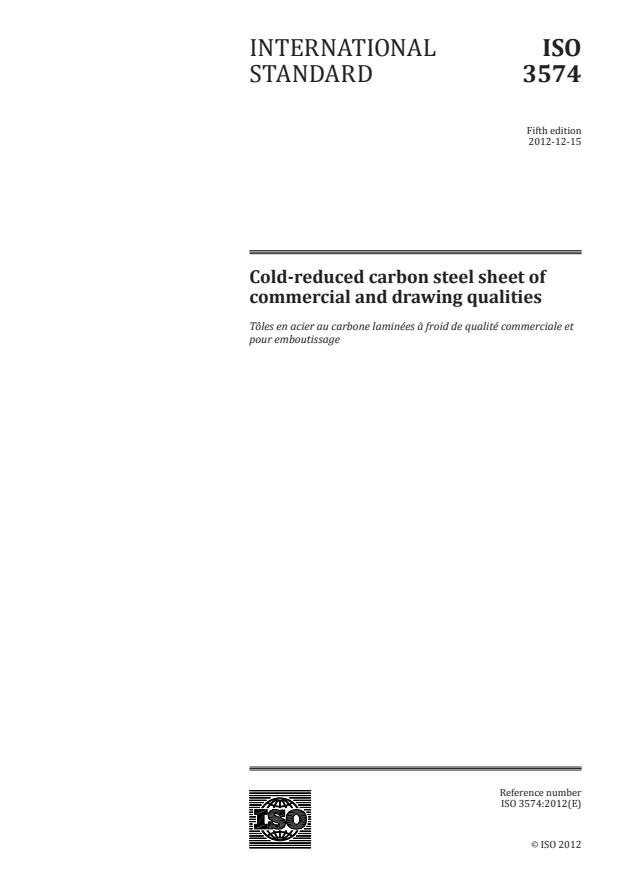
INTERNATIONAL ISO
STANDARD 3574
Fifth edition
2012-12-15
Cold-reduced carbon steel sheet of
commercial and drawing qualities
Tôles en acier au carbone laminées à froid de qualité commerciale et
pour emboutissage
Reference number
©
ISO 2012
© ISO 2012
All rights reserved. Unless otherwise specified, no part of this publication may be reproduced or utilized in any form or by any
means, electronic or mechanical, including photocopying and microfilm, without permission in writing from either ISO at the
address below or ISO’s member body in the country of the requester.
ISO copyright office
Case postale 56 • CH-1211 Geneva 20
Tel. + 41 22 749 01 11
Fax + 41 22 749 09 47
E-mail copyright@iso.org
Web www.iso.org
Published in Switzerland
ii © ISO 2012 – All rights reserved
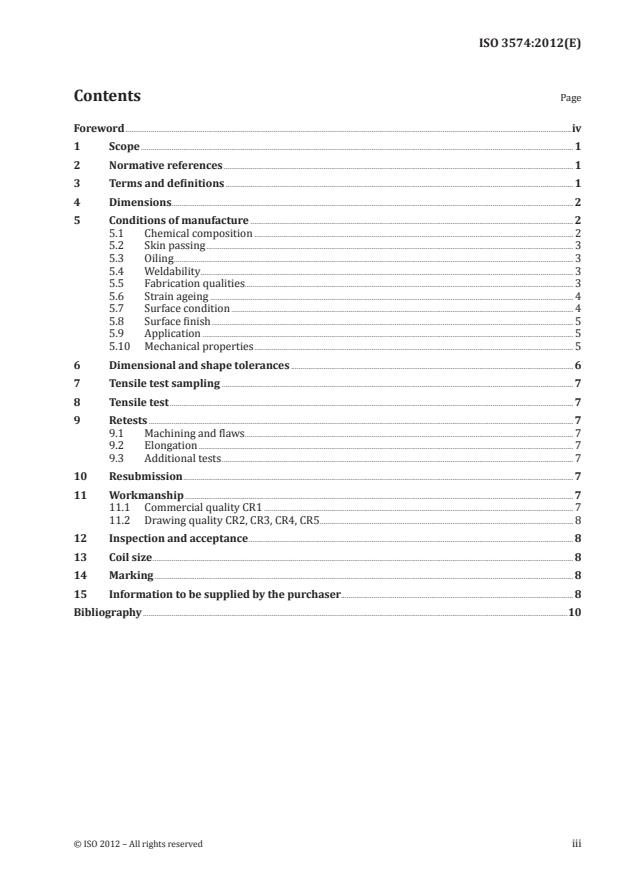
Contents Page
Foreword .iv
1 Scope . 1
2 Normative references . 1
3 Terms and definitions . 1
4 Dimensions . 2
5 Conditions of manufacture . 2
5.1 Chemical composition . 2
5.2 Skin passing . 3
5.3 Oiling . 3
5.4 Weldability . 3
5.5 Fabrication qualities. 3
5.6 Strain ageing . 4
5.7 Surface condition . 4
5.8 Surface finish . 5
5.9 Application . 5
5.10 Mechanical properties . 5
6 Dimensional and shape tolerances . 6
7 Tensile test sampling . 7
8 Tensile test . 7
9 Retests . 7
9.1 Machining and flaws. 7
9.2 Elongation . 7
9.3 Additional tests . 7
10 Resubmission . 7
11 Workmanship . 7
11.1 Commercial quality CR1 . 7
11.2 Drawing quality CR2, CR3, CR4, CR5 . 8
12 Inspection and acceptance . 8
13 Coil size . 8
14 Marking . 8
15 Information to be supplied by the purchaser. 8
Bibliography .10
Foreword
ISO (the International Organization for Standardization) is a worldwide federation of national standards
bodies (ISO member bodies). The work of preparing International Standards is normally carried out
through ISO technical committees. Each member body interested in a subject for which a technical
committee has been established has the right to be represented on that committee. International
organizations, governmental and non-governmental, in liaison with ISO, also take part in the work.
ISO collaborates closely with the International Electrotechnical Commission (IEC) on all matters of
electrotechnical standardization.
International Standards are drafted in accordance with the rules given in the ISO/IEC Directives, Part 2.
The main task of technical committees is to prepare International Standards. Draft International
Standards adopted by the technical committees are circulated to the member bodies for voting.
Publication as an International Standard requires approval by at least 75 % of the member bodies
casting a vote.
Attention is drawn to the possibility that some of the elements of this document may be the subject of
patent rights. ISO shall not be held responsible for identifying any or all such patent rights.
ISO 3574 was prepared by Technical Committee ISO/TC 17, Steel, Subcommittee SC 12, Continuous mill
flat rolled products.
This fifth edition cancels and replaces the fourth edition (ISO 3574:2008), which has been technically revised.
iv © ISO 2012 – All rights reserved
INTERNATIONAL STANDARD ISO 3574:2012(E)
Cold-reduced carbon steel sheet of commercial and
drawing qualities
1 Scope
This International Standard applies to cold-reduced carbon steel sheet of commercial and drawing
qualities. It is suitable for applications where the surface is of prime importance.
2 Normative references
The following documents, in whole or in part, are normatively referenced in this document and are
indispensable for its application. For dated references, only the edition cited applies. For undated
references, the latest edition of the reference document (including any amendments) applies.
ISO 6892-1, Metallic materials — Tensile testing — Part 1: Method of test at room temperature
ISO 10113, Metallic materials — Sheet and strip — Determination of plastic strain ratio
ISO 10275, Metallic materials — Sheet and strip — Determination of tensile strain hardening exponent
ISO 16162, Cold-rolled steel sheet products — Dimensional and shape tolerances
3 Terms and definitions
For the purposes of this document, the following terms and definitions apply.
3.1
cold-reduced steel sheet
product obtained from hot-rolled descaled steel sheet by cold reducing to the required sheet thickness
followed by annealing to recrystallize the grain structure
3.2
skin pass
light cold-rolling of hot-rolled steel sheet or hot-rolled descaled steel
Note 1 to entry: The purpose of the skin pass is to produce a higher degree of surface smoothness and thereby
improve the surface appearance. The skin pass also temporarily minimizes the occurrence of a surface condition
known as stretcher strain (Luder’s Lines) or fluting during the fabrication of finished parts. The skin pass also
controls and improves flatness. Some increase in hardness and loss of ductility will result from skin passing.
3.3
camber
greatest deviation of a side edge from a straight line, the measurement being taken on the concave side
with a straightedge
3.4
out-of-square
greatest deviation of an end edge from a straight line at right angles to a side and touching one corner, the
measurement being taken as described in ISO 16162, or measurable as one-half the difference between
the diagonals of the cut-length sheet
3.5
stabilized interstitial free steel
extra-low-carbon steel in which all interstitial elements are combined with titanium and/or
equivalent elements
4 Dimensions
4.1 Cold-reduced carbon steel sheet is produced in thicknesses of 0,36 mm and thicker (commonly
produced up to 4 mm) and in widths of 600 mm and over, in coils and cut lengths.
4.2 Cold-reduced sheet less than 600 mm wide can be slit from wide sheet and will be considered as sheet.
5 Conditions of manufacture
5.1 Chemical composition
The chemical composition (heat analysis) shall not exceed the values given in Tables 1 and 2. On request,
a report of the heat analysis shall be made to the purchaser.
Each of the elements listed in Table 2 shall be included in the report of the heat analysis. When the
amount of copper, nickel, chromium or molybdenum present is less that 0,02 %, the analysis result may
be reported as “< 0,02 %”.
A verification analysis may be made by the purchaser to verify the specified analysis of the product and
shall take into consideration any normal heterogeneity. Non-killed steels (such as rimmed or capped
steels) are not technologically suited to product analysis. For killed steels, the sampling method and
deviation limits shall be agreed upon between the interested parties at the time of ordering. The product
analysis tolerances are shown in Table 3.
The processes used in making the steel and in manufacturing zinc-coated sheet are left to the discretion
of the manufacturer. When requested, the purchaser shall be informed of the steel-making process used.
Table 1 — Chemical composition (heat analysis)
Mass fractions in percent
Quality
a
Carbon Manganese Phosphorus Sulfur Titanium
max. max. max. max. max.
Designation Name
CR1 Commercial 0,15 0,60 0,050 0,035 —
b
CR2 Drawing 0,10 0,50 0,040 0,035 —
b
CR3 Deep drawing 0,08 0,45 0,030 0,03 —
Deep drawing aluminum
CR4 0,06 0,45 0,030 0,03 —
killedb (non-ageing)
c
Extra deep drawing
CR5 0,02 0,25 0,020 0,02 0,15
(stabilized interstitial free)
a
Titanium may be replaced totally or partially by niobium or vanadium. Carbon and nitrogen shall be completely stabilized.
b
If interstitial free (IF steel) is to be applied to CR2, CR3 and CR4 orders, the values of 0,15 % maximum Ti, and 0,10 %
maximum Nb and V, are acceptable to ensure that the carbon and nitrogen are fully stabilized.
c
By agreement, the manganese, phosphorus and sulfur maximums may be adjusted.
2 © ISO 2012 – All rights reserved
Table 2 — Limits on additional chemical elements
Mass fractions in percent
Heat analysis Product analysis
Elements
max. max.
a
Cu 0,20 0,23
a
Ni 0,20 0,23
a, b
Cr 0,15 0,19
a, b
Mo 0,06 0,07
c
Nb 0,008 0,018
c
V 0,008 0,018
c
Ti 0,008 0,018
a
The sum of copper, nickel, chromium and molybdenum shall not exceed 0,50 % on heat analysis. When one or more of
these elements are specified, the sum does not apply; in which case, only the individual limits on the remaining elements will
apply.
b
The sum of chromium and molybdenum shall not exceed 0,16 % on heat analysis. When one or more of these elements
are specified, the sum does not apply; in which case, only the individual limits on the remaining elements will apply.
c
For stabilized steels, the maximum for titanium is 0,15 %, and the maximum for each of niobium and vanadium is
0,10 %, to ensure that the carbon and nitrogen are fully stabilized.
Table 3 — Product analysis tolerances
Mass fractions in percent
Tolerance over maximum speci-
Element Maximum of specified element
fied
Carbon 0,15 0,03
Manganese 0,60 0,03
Phosphoru
...
МЕЖДУНАРОДНЫЙ ISO
СТАНДАРТ 3574
Пятое издание
2012-12-15
Сталь углеродистая листовая, обжатая
в холодном состоянии, торгового
качества и для вытяжки
Cold reduced carbon steel of commercial and drawing qualities
Ответственность за подготовку русской версии несѐт GOST R
(Российская Федерация) в соответствии со статьѐй 18.1 Устава ISO
Ссылочный номер
©
ISO 2012
ДОКУМЕНТ ЗАЩИЩЕН АВТОРСКИМ ПРАВОМ
© ISO 2012
Все права сохраняются. Если не задано иначе, никакую часть настоящей публикации нельзя копировать или использовать в
какой-либо форме или каким-либо электронным или механическим способом, включая фотокопии и микрофильмы, без
предварительного письменного согласия офиса ISO по адресу, указанному ниже, или членов ISO в стране регистрации
пребывания.
ISO copyright office
Case postale 56 CH-1211 Geneva 20
Tel. + 41 22 749 01 11
Fax + 41 22 749 09 47
E-mail copyright@iso.org
Web www.iso.org
Опубликовано в Швейцарии
ii © ISO 2012 – Все права сохраняются
Содержание Страница
Предисловие. iv
1 Область применения . 1
2 Нормативные ссылки . 1
3 Термины и определения . 1
4 Размеры . 2
5 Производственные условия . 2
5.1 Химический состав . 2
5.2 Дрессировка . 4
5.3 Промасливание . 4
5.4 Свариваемость . 4
5.5 Качества изготовления . 4
5.6 Деформационное старение . 4
5.7 Состояние поверхности . 5
5.8 Чистота обработки поверхности . 5
5.9 Применение . 5
5.10 Механические свойства . 5
6 Допуски на размеры и форму . 7
7 Отбор образцов для испытания на растяжение . 7
8 Испытание на растяжение . 7
9 Повторные испытания . 7
9.1 Механическая обработка и трещины . 7
9.2 Удлинение . 7
9.3 Дополнительные испытания . 7
10 Повторное представление для приемки . 8
11 Качество изготовления . 8
11.1 Листовая сталь торгового качества CR1 . 8
11.2 Листовая сталь торгового качества CR2, CR3, CR4, CR5 . 8
12 Контроль и приемка . 8
13 Размер рулона . 8
14 Маркировка . 8
15 Информация, которая должна представляться заказчиком . 9
Библиография . 10
Предисловие
Международная организация по стандартизации (ISO) является всемирной федерацией национальных
организаций по стандартизации (комитетов-членов ISO). Разработка международных стандартов
обычно осуществляется техническими комитетами ISO. Каждый комитет-член, заинтересованный в
деятельности, для которой был создан технический комитет, имеет право быть представленным в этом
комитете. Международные правительственные и неправительственные организации, имеющие связи с
ISO, также принимают участие в работах. ISO работает в тесном сотрудничестве с Международной
электротехнической комиссией (IEC) по всем вопросам стандартизации в области электротехники.
Международные стандарты разрабатываются в соответствии с правилами, заданными в Директивах
ISO/IEC, Часть 2.
Основная задача технических комитетов состоит в подготовке международных стандартов. Проекты
международных стандартов, одобренные техническими комитетами, рассылаются комитетам-членам
на голосование. Их опубликование в качестве международных стандартов требует одобрения, по
меньшей мере, 75 % комитетов-членов, принимающих участие в голосовании.
Необходимо обратить внимание на возможность того, что ряд элементов данного документа могут
быть предметом патентных прав. Международная организация ISO не должна нести ответственность
за идентификацию таких прав, частично или полностью.
ISO 3574 подготовлен Техническим комитетом ISO/TC 17, Сталь, Подкомитетом SC 12, Изделия
непрерывного плоского проката.
Настоящее пятое издание отменяет и заменяет четвертое издание (ISO 3574:2008), которое было
технически пересмотрено.
iv © ISO 2012 - Все права сохраняются
МЕЖДУНАРОДНЫЙ СТАНДАРТ ISO 3574:2012(R)
Сталь углеродистая листовая, обжатая в холодном состоянии,
торгового качества и для вытяжки
1 Область применения
Настоящий международный стандарт распространяется на тонколистовую углеродистую сталь,
обжатую в холодном состоянии, торгового качества и для вытяжки. Стандарт применяется в случаях,
когда в первую очередь важно состояние поверхности.
2 Нормативные ссылки
Следующие ссылочные нормативные документы являются обязательными для применения
настоящего документа. Для жестких ссылок применяется только цитируемое издание документа. Для
плавающих ссылок необходимо использовать самое последнее издание нормативного ссылочного
документа (включая любые изменения).
ISO 6892-1, Материалы металлические. Испытания на растяжение. Часть 1. Метод испытания
при комнатной температуре
ISO 10113, Материалы металлические. Листы и полосы. Определение коэффициента
пластической деформации
ISO 10275, Материалы металлические. Листы и полосы. Определение показателя
деформационного упрочнения при растяжении
ISO 16162, Изделия из холоднокатаной листовой стали. Допуски на размеры и форму
3 Термины и определения
Для данного документа используются следующие термины и определения.
3.1
стальной лист, обжатый в холодном состоянии
cold-reduced steel sheet
изделие, полученное из горячекатаного стального листа без окалины в результате холодного обжатия
до заданной толщины листа, после которого следует отжиг для рекристаллизации структуры зерна
3.2
дрессировка (пропуск в дрессировочной клети)
skin pass
легкая холодная прокатка стального листа или горячекатаного листа без окалины
ПРИМЕЧАНИЕ Целью пропуска в дрессировочной клети является получение более высокой степени гладкости
поверхности и улучшение ее внешнего вида. Пропуск в дрессировочной клети временно сводит к минимуму
появления состояния поверхности, известного как следы линий сдвига (линии Чернова - Людерса) или надлома
проката при изготовлении готовых деталей. Пропуск в дрессировочной клети также проверяет и улучшает
плоскостность. В результате пропуска в дрессировочной клети происходит некоторое повышение твердости и
потеря вязкости.
3.3
выпуклость (серповидность)
camber
наибольшее отклонение боковой кромки от прямой линии, измерение выполняется поверочной
линейкой по вогнутой стороне
3.4
неперпендикулярность (перекошенность)
out-of-square
наибольшее отклонение концевой кромки от прямой линии, измеренное под прямыми углами к боковой
стороне и касаясь одного угла, измерение выполняется, как описано в ISO 16162, или берется как
половина разности между диагоналями листа мерной длины
3.5
стабилизированная сталь без фазы внедрения
stabilized interstitial free steel
сверх малоуглеродистая сталь, в которой элементы, образующие твердый раствор внедрения
соединяются с титаном и/или другими эквивалентными элементами
4 Размеры
4.1 Листы углеродистой стали, обжатые в холодном состоянии, изготавливаются толщиной 0,36 мм и
толще (обычно до 4 мм) и шириной 600 мм и более, в рулонах и мерных длинах.
4.2 Листы, обжатые в холодном состоянии, шириной менее 600 мм могут нарезаться из широкого
листа и рассматриваются как лист.
5 Производственные условия
5.1 Химический состав
Химический состав (анализ плавки) не должен превышать значений, приведенных в Таблицах 1 и 2. По
требованию заказчику должен быть протокол анализа плавки.
Каждый из элементов, перечисленных в Таблице 2, включается в протокол анализа плавки. Когда
количество присутствующих меди, никеля, хрома или молибдена составляет менее 0,02 %, то
результат анализа может регистрироваться как ―< 0,02 %‖.
Заказчик может провести проверочный анализ, чтобы проконтролировать установленный анализ
изделия и учесть любую нормальную неоднородность. Нераскисленные стали (такие как кипящие или
полууспокоенные стали) технологически не подходят для анализа изделия. Для кипящих сталей метод
отбора проб и пределы отклонений должны быть согласованы между заинтересованными сторонами
при оформлении заказа. Допуски на анализ изделия представлены в Таблице 3.
Процессы, используемые при изготовлении стали и производства оцинкованных листов оставляются
на усмотрение изготовителя. При запросе заказчик должно быть сообщено об использованном
процессе производства стали.
2 © ISO 2012 – Все права сохраняются
Таблица 1 — Химический состав (анализ плавки)
В процентах по массе
Класс качества
a
Carbon Manganese Phosphorus Sulfur Titanium
Наименование по
макс. макс.
макс. макс. макс.
Обозначение
назначению
CR1 Торговая 0,15 0,60 0,050 0,035 —
b
CR2 Для вытяжки 0,10 0,50 0,040 0,035 —
b
CR3 Для глубокой вытяжки 0,08 0,45 0,030 0,03 —
Для глубокой вытяжки
раскисленная
CR4 0,06 0,45 0,030 0,03 —
алюминием
(нестареющая)
Для сверх глубокой
c
вытяжки
CR5 0,02 0,25 0,020 0,02 0,15
(стабилизирована, без
фазы внедрения)
a
Титан может быть полностью или частично заменен ниобием или ванадием. Углерод и азот должны быть полностью
стабилизированы.
b
Если заказаны стали CR2, CR3 and CR4 без фазы внедрения, то значения 0,15 % максимум Ti, и 0,10 % максимум Nb и V,
являются приемлемыми для обеспечения полной стабилизации углерода и азота.
c
По согласованию максимальное содержание марганца, фосфора и серы может быть скорректировано
Таблица 2 — Пределы на дополнительные химические элементы
В процентах по массе
Анализ плавки Анализ изделия
Элементы
макс. макс.
a
Cu 0,20 0,23
a
Ni 0,20 0,23
a, b
Cr 0,15 0,19
a, b
Mo 0,06 0,07
c
Nb 0,008 0,018
c
V 0,008 0,018
c
Ti 0,008 0,018
a
При анализе плавки сумма меди, никеля, хрома и молибдена не должна превышать 0,50 %. Если установлено содержание одного
или нескольких из этих элементов, то сумма не используется, а применяются только индивидуальные пределы на оставшиеся элементы.
b
При анализе плавки сумма хрома и молибдена не должна превышать 0,16 %. Если установлено содержание одного или
нескольких из этих элементов, то сумма не используется, а применяются только индивидуальные пределы на оставшиеся элементы.
c
Для стабилизированных сталей максимальное содержание титана - 0,15 %, и максимум 0,10 % для каждого элемента
ниобия и ванадия, чтобы обеспечить полную стабилизацию углерода и азота.
Таблица 3 — Допуски на анализ изделия
В процентах по массе
Максимум установленного Допуск сверх установленного
Элемент
элемента максимума
Углерод 0,15 0,03
Марганец 0,60 0,03
Фосфор 0,05 0,01
Сера 0,035 0,01
ПРИМЕЧАНИЕ Максимальный допуск в данной таблице – это допустимое превышение сверх установленного требования, а не
анализа плавки.
5.2 Дрессировка
Обычно изделие поставляется после дрессировки (см. 3.2), но может поставляться и в окончательно
отожженном состоянии (т.е. без дрессировки), если установлено заказчиком при заказе.
5.3 Промасливание
Для защиты от коррозии на изделие, как правило, наносится слой масла. Это масло не предназначено для
смазки при вытяжке или штамповке, и должно легко удаляться обезжиривающими химикатами. По запросу
производитель должен сообщить заказчику, какой тип масла был использован. По требованию изделие,
может быть поставлено без промасливания, но в этом случае поставщик несет ограниченную
ответственность, если произойдет окисление.
5.4 Свариваемость
Данная продукция обычно годится для сварки, если выбираются соответствующие условия сварки.
5.5 Качества изготовления
5.5.1 Листы торгового качества (CR1) предназначены для целей общего назначения, когда листы
используются в плоском состоянии или гнуться, неглубоко штампуются и свариваются.
5.5.2 Листы для вытяжки (CR2, CR3, CR4, CR5) предназначены для вытяжки и глубокой штамповки,
включая сварку. Такие листы изготовляются толщиной 0,36 мм и толще (обычно до 4 мм) и шириной
600 мм и шире, в рулонах и мерных длинах. Листы для вытяжки
...