

ISO 21300:2026
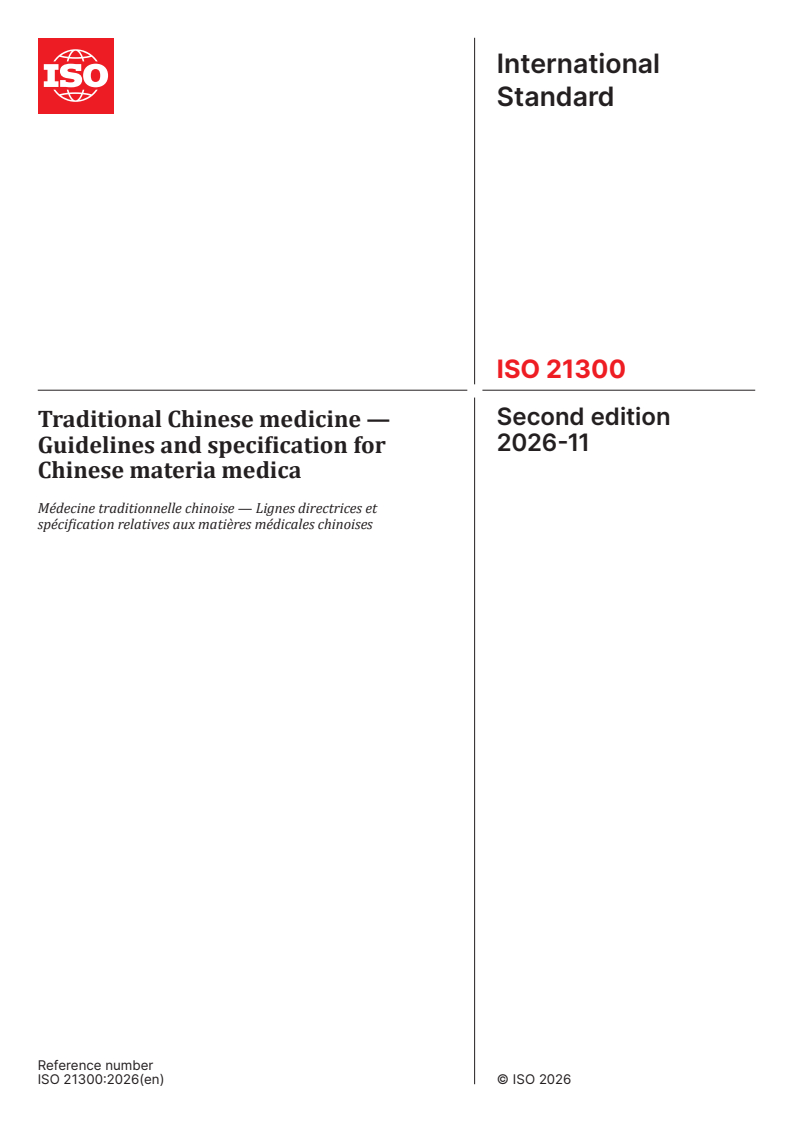
(Main)Traditional Chinese medicine — Guidelines and specification for Chinese materia medica
- Abstract
This document specifies the general guidelines for Chinese materia medica specification. This specification is relevant for dividing Chinese materia medica into categories.
- Status
- Published
- Publication Date
- 18-Nov-2026
- Technical Committee
- ISO/TC 249 - Traditional Chinese medicine
- Current Stage
- 6060 - International Standard published
- Start Date
- 19-Nov-2026
- Completion Date
- 19-Nov-2026
ISO 21300:2026 is an International Standard from ISO on Traditional Chinese medicine. It gives general guidelines for Chinese materia medica specification and for dividing Chinese materia medica into categories, so users can describe, sort and compare materials in a consistent way.
What does ISO 21300:2026 specify?
ISO 21300:2026 specifies general guidelines for Chinese materia medica specification. It is relevant when a material needs to be assigned to a category based on features such as origin, growing method, medicinal part, harvest time, processing and appearance.
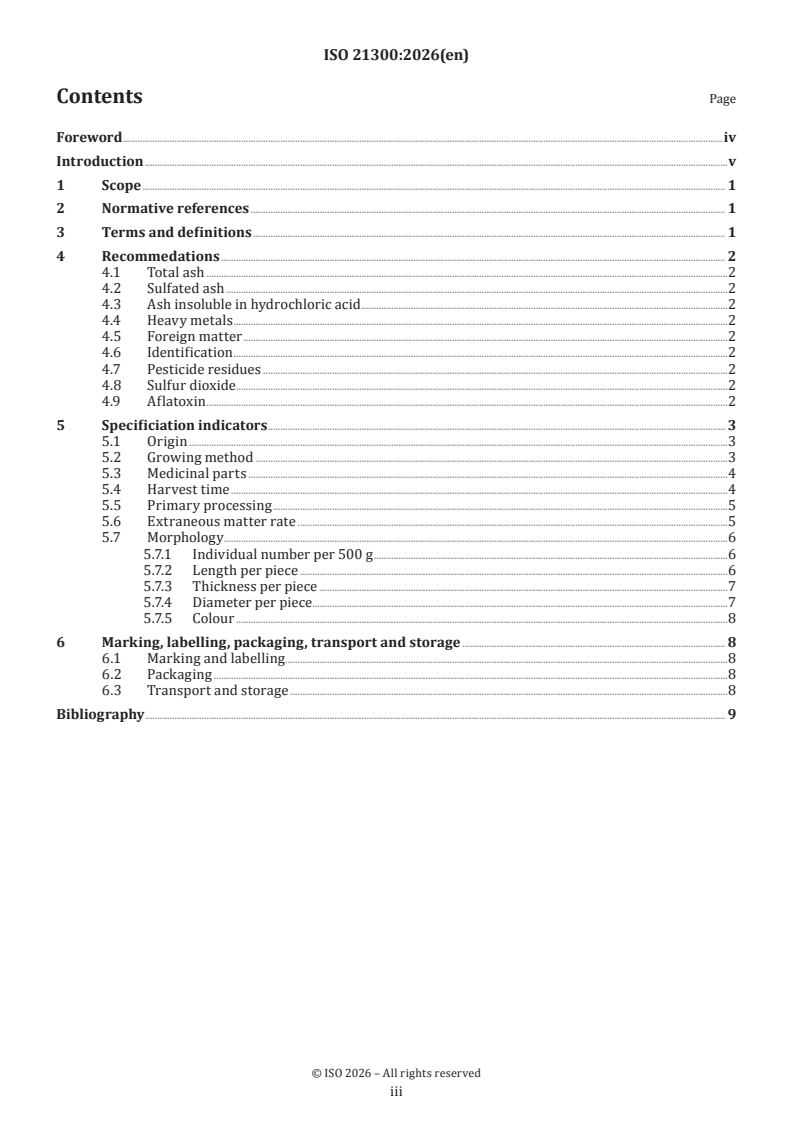
The document is organized into six clauses and a bibliography:
- Clause 1 Scope
- Clause 2 Normative references
- Clause 3 Terms and definitions
- Clause 4 Recommendations
- Clause 5 Specification indicators
- Clause 6 Marking, labelling, packaging, transport and storage
The scope is narrow and practical: it supports specification work, not clinical use or product formulation. In practice, it is a guide for describing Chinese materia medica in a way that supports sorting, purchasing, quality control and product identification.
What are the key requirements of ISO 21300:2026?
ISO 21300:2026 sets out recommended checks and specification indicators that help define and separate categories of Chinese materia medica. The main point is to document the features that change the appearance or quality of the material, rather than treating all material of one name as identical.
Clause 4 - recommended quality indicators
Clause 4 recommends determining a set of compositional and contamination-related indicators. These include total ash, sulfated ash, ash insoluble in hydrochloric acid, heavy metals, foreign matter, identification of marker compounds, pesticide residues, sulfur dioxide and aflatoxin.
In practice, this means a user should choose the relevant checks according to the characteristics of the Chinese materia medica being specified. The standard does not present these as one-size-fits-all tests for every material.
Clause 5 - category-defining specification indicators
Clause 5 identifies the main specification factors used to distinguish categories of the same Chinese materia medica:
- origin
- growing method
- medicinal parts
- harvest time
- primary processing
- extraneous matter rate
- morphology
These factors matter because the same named material can look different or be handled differently. The standard gives examples showing how category boundaries can be based on visible or measurable differences.
Clause 5.7 - morphology indicators
Clause 5.7 breaks morphology into five measurable features: individual number per 500 g, length per piece, thickness per piece, diameter per piece and colour. These are practical sorting criteria when the same material appears in different physical grades.
In practice, users need to measure or observe the lot and decide which category it fits. That helps make purchasing, inspection and storage decisions more consistent.
Clause 6 - marking and handling information
Clause 6 recommends that marking and labelling show the product name, net weight or quantity and storage method on the container or package, or on a label attached to it. It also says the marking and labelling method in ISO 21371 should apply.
Clause 6 also asks users to report packaging methods that can affect quality and any special transport or storage requirements such as temperature or storage time. That matters because Chinese materia medica can lose quality if it is packed, moved or stored under unsuitable conditions.
What terms does ISO 21300:2026 define?
ISO 21300:2026 defines a small set of core terms used throughout the document.
- Chinese materia medica (CMM) - the medicinal parts of medicinal plants, animals and minerals after preliminary processing, used as raw materials for decoction pieces in Chinese medicines.
- Specification - the explicit set of requirements to be satisfied for Chinese materia medica.
- Category - a collection of Chinese materia medica of the same species with common features.
- Primary processing - the pre-treatment stage during collecting and harvesting that turns raw materials into medicinal materials.
- Extraneous matter rate - the rate of material that is not retained for use as Chinese materia medica.
- Origin - the biological species of the Chinese materia medica.
These terms are central because the standard is about separating and describing materials consistently, not only naming them.
Who uses ISO 21300:2026?
ISO 21300:2026 is used by people who specify, inspect, buy, process or store Chinese materia medica. That includes manufacturers of traditional Chinese medicine, suppliers, quality control laboratories, buyers, and organizations that set or review product specifications.
It is also relevant for anyone deciding how to classify a material into a category based on source, processing history or appearance. The document is most useful in quality control, procurement specifications, incoming inspection and product description.
What changed in ISO 21300:2026 from the previous edition?
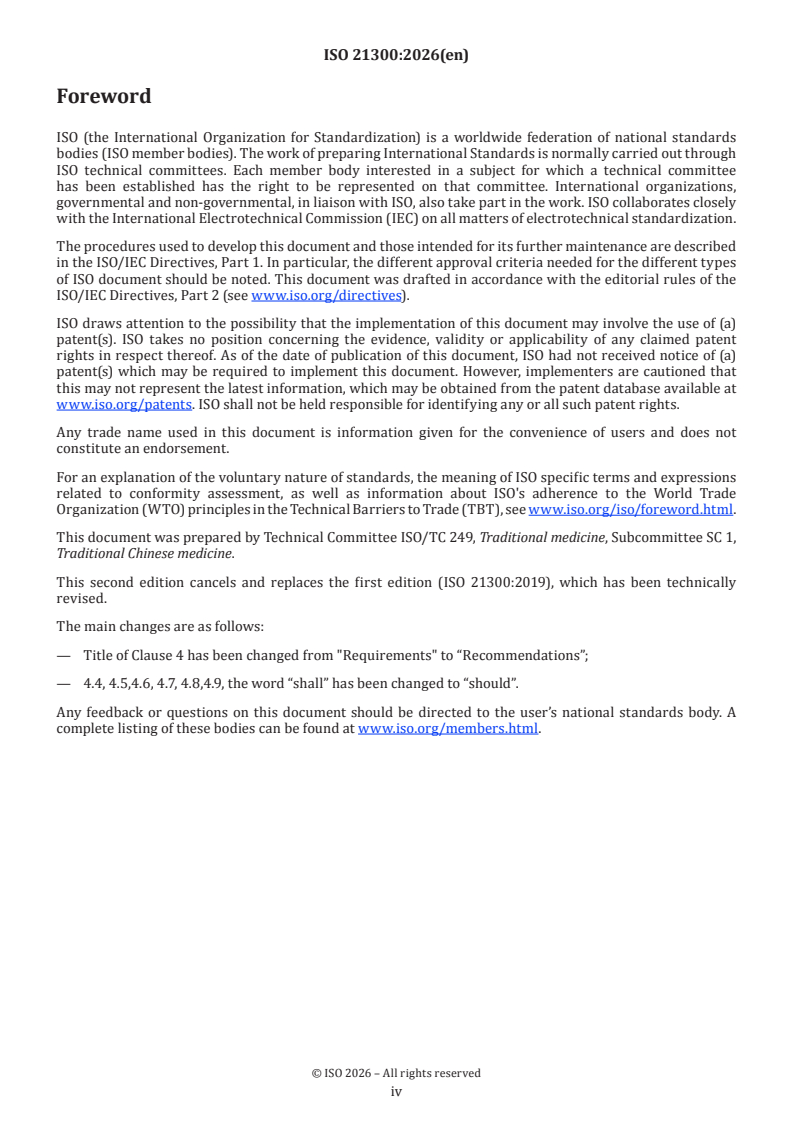
ISO 21300:2026 is the second edition and it cancels and replaces ISO 21300:2019. The foreword states that it has been technically revised.
The listed changes are:
- Clause 4 changed its title from "Requirements" to "Recommendations"
- In 4.4, 4.5, 4.6, 4.7, 4.8 and 4.9, "shall" was changed to "should"
This shows a shift from mandatory wording to recommended guidance in the quality-indicator clause.
What does the ISO 21300:2026 document contain?
ISO 21300:2026 contains narrative guidance, definitions, recommended quality indicators and example-based category criteria. Clause 5 is illustrated with figures showing how different origins, growing methods, medicinal parts, harvest times, primary processing methods, extraneous matter rates and morphology can lead to different categories.
The document also contains practical marking, packaging, transport and storage guidance in Clause 6. It refers users to ISO 21371 for labelling requirements and lists ISO 18662-1 in the terminology note for Chinese materia medica vocabulary.
The examples are useful for specification writers because they show how to turn visible differences into category rules without copying the same wording for every material.
Relations
- Effective Date
- 08-Feb-2025
Get Certified
Connect with accredited certification bodies for this standard

BSI Group
BSI (British Standards Institution) is the business standards company that helps organizations make excellence a habit.

TÜV Rheinland
TÜV Rheinland is a leading international provider of technical services.

TÜV SÜD
TÜV SÜD is a trusted partner of choice for safety, security and sustainability solutions.
Sponsored listings
Frequently Asked Questions
ISO 21300:2026 is a standard published by the International Organization for Standardization (ISO). Its full title is "Traditional Chinese medicine — Guidelines and specification for Chinese materia medica". This standard covers: This document specifies the general guidelines for Chinese materia medica specification. This specification is relevant for dividing Chinese materia medica into categories.
This document specifies the general guidelines for Chinese materia medica specification. This specification is relevant for dividing Chinese materia medica into categories.
ISO 21300:2026 is classified under the following ICS (International Classification for Standards) categories: 11.020.99 - Other standards related to health care in general. The ICS classification helps identify the subject area and facilitates finding related standards.
ISO 21300:2026 has the following relationships with other standards: It is inter standard links to ISO 21300:2019. Understanding these relationships helps ensure you are using the most current and applicable version of the standard.
ISO 21300:2026 is available in PDF format for immediate download after purchase. The document can be added to your cart and obtained through the secure checkout process. Digital delivery ensures instant access to the complete standard document.
Standards Content (Sample)
International
Standard
ISO 21300
Second edition
Traditional Chinese medicine —
2026-11
Guidelines and specification for
Chinese materia medica
Médecine traditionnelle chinoise — Lignes directrices et
spécification relatives aux matières médicales chinoises
Reference number
© ISO 2026
All rights reserved.
This ISO publication is protected by copyright and is owned by ISO and/or its licensors.
The content of this ISO publication is provided under licence, not sold. Use is subject to the applicable licence terms issued by ISO,
an ISO member body, or an authorized third-party distributor.
Except as required for implementation or expressly permitted by a separate licence, no part of this ISO publication may be
reproduced, distributed, modified, used, or made available in any form or by any means – electronic or mechanical, including
photocopying, scanning, recording, or posting on internal or external digital platforms.
Any use beyond the scope of the granted rights is prohibited and may result in legal action.
ISO copyright office
CP 401 • CH-1214 Vernier, Geneva
Phone: +41 22 749 01 11
Email: copyright@iso.org
Website: www.iso.org
Published in Switzerland
ii
Contents Page
Foreword .iv
Introduction .v
1 Scope . 1
2 Normative references . 1
3 Terms and definitions . 1
4 Recommedations . 2
4.1 Total ash .2
4.2 Sulfated ash .2
4.3 Ash insoluble in hydrochloric acid .2
4.4 Heavy metals .2
4.5 Foreign matter .2
4.6 Identification .2
4.7 Pesticide residues .2
4.8 Sulfur dioxide . .2
4.9 Aflatoxin .2
5 Specificiation indicators . 3
5.1 Origin .3
5.2 Growing method .3
5.3 Medicinal parts .4
5.4 Harvest time .4
5.5 Primary processing .5
5.6 Extraneous matter rate .5
5.7 Morphology . .6
5.7.1 Individual number per 500 g .6
5.7.2 Length per piece .6
5.7.3 Thickness per piece .7
5.7.4 Diameter per piece.7
5.7.5 Colour .8
6 Marking, labelling, packaging, transport and storage . 8
6.1 Marking and labelling .8
6.2 Packaging .8
6.3 Transport and storage .8
Bibliography . 9
iii
Foreword
ISO (the International Organization for Standardization) is a worldwide federation of national standards
bodies (ISO member bodies). The work of preparing International Standards is normally carried out through
ISO technical committees. Each member body interested in a subject for which a technical committee
has been established has the right to be represented on that committee. International organizations,
governmental and non-governmental, in liaison with ISO, also take part in the work. ISO collaborates closely
with the International Electrotechnical Commission (IEC) on all matters of electrotechnical standardization.
The procedures used to develop this document and those intended for its further maintenance are described
in the ISO/IEC Directives, Part 1. In particular, the different approval criteria needed for the different types
of ISO document should be noted. This document was drafted in accordance with the editorial rules of the
ISO/IEC Directives, Part 2 (see www.iso.org/directives).
ISO draws attention to the possibility that the implementation of this document may involve the use of (a)
patent(s). ISO takes no position concerning the evidence, validity or applicability of any claimed patent
rights in respect thereof. As of the date of publication of this document, ISO had not received notice of (a)
patent(s) which may be required to implement this document. However, implementers are cautioned that
this may not represent the latest information, which may be obtained from the patent database available at
www.iso.org/patents. ISO shall not be held responsible for identifying any or all such patent rights.
Any trade name used in this document is information given for the convenience of users and does not
constitute an endorsement.
For an explanation of the voluntary nature of standards, the meaning of ISO specific terms and expressions
related to conformity assessment, as well as information about ISO's adherence to the World Trade
Organization (WTO) principles in the Technical Barriers to Trade (TBT), see www.iso.org/iso/foreword.html.
This document was prepared by Technical Committee ISO/TC 249, Traditional medicine, Subcommittee SC 1,
Traditional Chinese medicine.
This second edition cancels and replaces the first edition (ISO 21300:2019), which has been technically
revised.
The main changes are as follows:
— Title of Clause 4 has been changed from "Requirements" to “Recommendations”;
— 4.4, 4.5,4.6, 4.7, 4.8,4.9, the word “shall” has been changed to “should”.
Any feedback or questions on this document should be directed to the user’s national standards body. A
complete listing of these bodies can be found at www.iso.org/members.html.
iv
Introduction
Chinese materia medica is a special commodity used for preventing and treating diseases. As an important
component of traditional medicine, the quality of Chinese materia medica directly affects clinical efficacy
and safety. However, due to the wide range of sources and diverse cultivation and processing methods of
Chinese materia medica, there is a lack of unified standards for the specifications of Chinese materia medica
in the global market, resulting in uneven quality and causing inconvenience to the production, circulation
and use of Chinese materia medica. In order to ensure the quality of Chinese materia medica, it is important
to establish a unified standard for the specifications of Chinese materia medica.
There are many factors that affect the specifications of Chinese materia medica, such as origin, growing
method, medicinal parts, harvest time, processing method, etc. This document lists various factors that
affect the specifications, and provides a basis for the development of specifications for individual Chinese
materia medica by establishing general standards. It can help regulate the order of the Chinese medicine
market and continuously improve the controllability and stability of the quality of Chinese medicinal
materials.
v
...