

ISO/IEC/IEEE 29148:2018
(Main)Systems and software engineering — Life cycle processes — Requirements engineering
General Information
- Abstract
This document: — specifies the required processes implemented in the engineering activities that result in requirements for systems and software products (including services) throughout the life cycle; — provides guidelines for applying the requirements and requirements-related processes described in ISO/IEC/IEEE 15288 and ISO/IEC/IEEE 12207; — specifies the required information items produced through the implementation of the requirements processes; — specifies the required contents of the required information items; — provides guidelines for the format of the required and related information items. This document is applicable to: — those who use or plan to use ISO/IEC/IEEE 15288 and ISO/IEC/IEEE 12207 on projects dealing with man-made systems, software-intensive systems, software and hardware products, and services related to those systems and products, regardless of the project scope, product(s), methodology, size or complexity; — anyone performing requirements engineering activities to aid in ensuring that their application of the requirements engineering processes conforms to ISO/IEC/IEEE 15288 and/or ISO/IEC/IEEE12207; — those who use or plan to use ISO/IEC/IEEE 15289 on projects dealing with man-made systems, software-intensive systems, software and hardware products and services related to those systems and products, regardless of the project scope, product(s), methodology, size or complexity; — anyone performing requirements engineering activities to aid in ensuring that the information items developed during the application of requirements engineering processes conforms to ISO/IEC/IEEE 15289.
- Status
- Published
- Publication Date
- 27-Nov-2018
- Technical Committee
- ISO/IEC JTC 1/SC 7 - Software and systems engineering
- Drafting Committee
- ISO/IEC JTC 1/SC 7/WG 7 - Life cycle management
- Current Stage
- 9092 - International Standard to be revised
- Start Date
- 16-Feb-2026
- Completion Date
- 29-Aug-2026
Buy Documents


ISO/IEC/IEEE 29148:2018 - Systems and software engineering -- Life cycle processes -- Requirements engineering
ISO/IEC/IEEE 29148:2018 - Systems and software engineering — Life cycle processes — Requirements engineering/28/2018
Overview
ISO/IEC/IEEE 29148:2018 - "Systems and software engineering - Life cycle processes - Requirements engineering" defines required processes, information items and content for effective requirements engineering across the system/software life cycle. The standard specifies how to derive, document, manage and verify requirements for systems, software-intensive systems, hardware products and services, and it provides guidelines aligned with ISO/IEC/IEEE 15288 and ISO/IEC/IEEE 12207. It also maps to information-item expectations in ISO/IEC/IEEE 15289.
Key topics and technical requirements
- Requirements life‑cycle processes: Defines required processes such as business/mission analysis, stakeholder needs & requirements definition, system/software requirements definition, and requirements management (including change control and measurement).
- Requirements information items: Specifies required artifacts and outlines for common documents, e.g. Business Requirements Specification (BRS), Stakeholder Requirements Specification (StRS), System Requirements Specification (SyRS) and Software Requirements Specification (SRS).
- Information item content & format: Specifies mandatory content elements (identification, front matter, definitions, references, acronyms) and provides guidance on content structure and presentation.
- Requirements constructs and quality characteristics: Covers fundamentals such as stakeholder roles, transformation of needs into requirements, attributes of individual requirements and requirement sets, and language/clarity criteria.
- Integration with other technical processes: Guidance for embedding requirements activities into architecture, verification and validation processes.
- Conformance and tailoring: Defines intended usage, full and tailored conformance options for processes and information items.
Keywords: ISO/IEC/IEEE 29148:2018, requirements engineering, requirements specification, requirements management, system requirements specification, software requirements specification.
Applications - who uses this standard
- Systems and software engineers creating or managing requirements across product life cycles.
- Systems integrators, project managers and business analysts performing business or mission analysis and stakeholder needs definition.
- Quality assurance, verification and validation teams ensuring requirements are testable and traceable.
- Organizations adopting ISO/IEC/IEEE 15288 or 12207 who need consistent requirements engineering guidance.
- Contracting authorities and suppliers seeking standard-compliant requirements documentation for procurement and system development.
Practical uses include creating standard-compliant SRS/SyRS documents, establishing requirements change control, improving requirements clarity and traceability, and ensuring requirements integrate with architecture, verification and validation activities.
Related standards
- ISO/IEC/IEEE 15288 - System life cycle processes (mapping of requirements processes)
- ISO/IEC/IEEE 12207 - Software life cycle processes (software-specific alignment)
- ISO/IEC/IEEE 15289 - Content of lifecycle technical information (information-item conformance)
Using ISO/IEC/IEEE 29148:2018 helps organizations standardize requirements practices, improve communication between stakeholders, and increase predictability and quality in systems and software engineering projects.
Relations
- Effective Date
- 30-Jul-2016
Buy Documents
ISO/IEC/IEEE 29148:2018 - Systems and software engineering -- Life cycle processes -- Requirements engineering
ISO/IEC/IEEE 29148:2018 - Systems and software engineering — Life cycle processes — Requirements engineering/28/2018
Get Certified
Connect with accredited certification bodies for this standard

BSI Group
BSI (British Standards Institution) is the business standards company that helps organizations make excellence a habit.

BSCIC Certifications Pvt. Ltd.
Established 2006, accredited by NABCB, JAS-ANZ, EIAC, IAS. CDSCO Notified Body.

Intertek India Pvt. Ltd.
Delivers Assurance, Testing, Inspection & Certification since 1993 with 26 labs and 32 offices.
Sponsored listings
Frequently Asked Questions
ISO/IEC/IEEE 29148:2018 is a standard published by the International Organization for Standardization (ISO). Its full title is "Systems and software engineering — Life cycle processes — Requirements engineering". This standard covers: This document: — specifies the required processes implemented in the engineering activities that result in requirements for systems and software products (including services) throughout the life cycle; — provides guidelines for applying the requirements and requirements-related processes described in ISO/IEC/IEEE 15288 and ISO/IEC/IEEE 12207; — specifies the required information items produced through the implementation of the requirements processes; — specifies the required contents of the required information items; — provides guidelines for the format of the required and related information items. This document is applicable to: — those who use or plan to use ISO/IEC/IEEE 15288 and ISO/IEC/IEEE 12207 on projects dealing with man-made systems, software-intensive systems, software and hardware products, and services related to those systems and products, regardless of the project scope, product(s), methodology, size or complexity; — anyone performing requirements engineering activities to aid in ensuring that their application of the requirements engineering processes conforms to ISO/IEC/IEEE 15288 and/or ISO/IEC/IEEE12207; — those who use or plan to use ISO/IEC/IEEE 15289 on projects dealing with man-made systems, software-intensive systems, software and hardware products and services related to those systems and products, regardless of the project scope, product(s), methodology, size or complexity; — anyone performing requirements engineering activities to aid in ensuring that the information items developed during the application of requirements engineering processes conforms to ISO/IEC/IEEE 15289.
This document: — specifies the required processes implemented in the engineering activities that result in requirements for systems and software products (including services) throughout the life cycle; — provides guidelines for applying the requirements and requirements-related processes described in ISO/IEC/IEEE 15288 and ISO/IEC/IEEE 12207; — specifies the required information items produced through the implementation of the requirements processes; — specifies the required contents of the required information items; — provides guidelines for the format of the required and related information items. This document is applicable to: — those who use or plan to use ISO/IEC/IEEE 15288 and ISO/IEC/IEEE 12207 on projects dealing with man-made systems, software-intensive systems, software and hardware products, and services related to those systems and products, regardless of the project scope, product(s), methodology, size or complexity; — anyone performing requirements engineering activities to aid in ensuring that their application of the requirements engineering processes conforms to ISO/IEC/IEEE 15288 and/or ISO/IEC/IEEE12207; — those who use or plan to use ISO/IEC/IEEE 15289 on projects dealing with man-made systems, software-intensive systems, software and hardware products and services related to those systems and products, regardless of the project scope, product(s), methodology, size or complexity; — anyone performing requirements engineering activities to aid in ensuring that the information items developed during the application of requirements engineering processes conforms to ISO/IEC/IEEE 15289.
ISO/IEC/IEEE 29148:2018 is classified under the following ICS (International Classification for Standards) categories: 35.080 - Software. The ICS classification helps identify the subject area and facilitates finding related standards.
ISO/IEC/IEEE 29148:2018 has the following relationships with other standards: It is inter standard links to ISO/IEC/IEEE 29148:2011. Understanding these relationships helps ensure you are using the most current and applicable version of the standard.
ISO/IEC/IEEE 29148:2018 is available in PDF format for immediate download after purchase. The document can be added to your cart and obtained through the secure checkout process. Digital delivery ensures instant access to the complete standard document.
Standards Content (Sample)
INTERNATIONAL ISO/IEC/
STANDARD IEEE
Second edition
2018-11
Systems and software engineering —
Life cycle processes — Requirements
engineering
Ingénierie des systèmes et du logiciel — Processus du cycle de vie —
Ingénierie des exigences
Reference number
©
ISO/IEC 2018
©
IEEE 2018
© ISO/IEC 2018
© IEEE 2018
All rights reserved. Unless otherwise specified, or required in the context of its implementation, no part of this publication may
be reproduced or utilized otherwise in any form or by any means, electronic or mechanical, including photocopying, or posting
on the internet or an intranet, without prior written permission. Permission can be requested from either ISO or IEEE at the
respective address below or ISO’s member body in the country of the requester.
ISO copyright office Institute of Electrical and Electronics Engineers, Inc
CP 401 • Ch. de Blandonnet 8 3 Park Avenue, New York
CH-1214 Vernier, Geneva NY 10016-5997, USA
Phone: +41 22 749 01 11
Fax: +41 22 749 09 47
Email: copyright@iso.org Email: stds.ipr@ieee.org
Website: www.iso.org Website: www.ieee.org
Published in Switzerland
© ISO/IEC 2018 – All rights reserved
ii © IEEE 2018 – All rights reserved
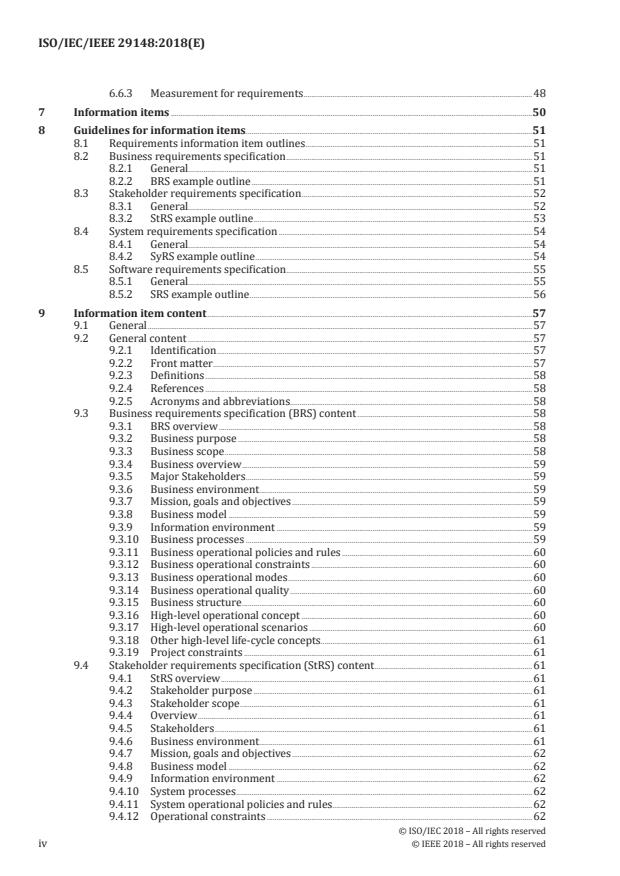
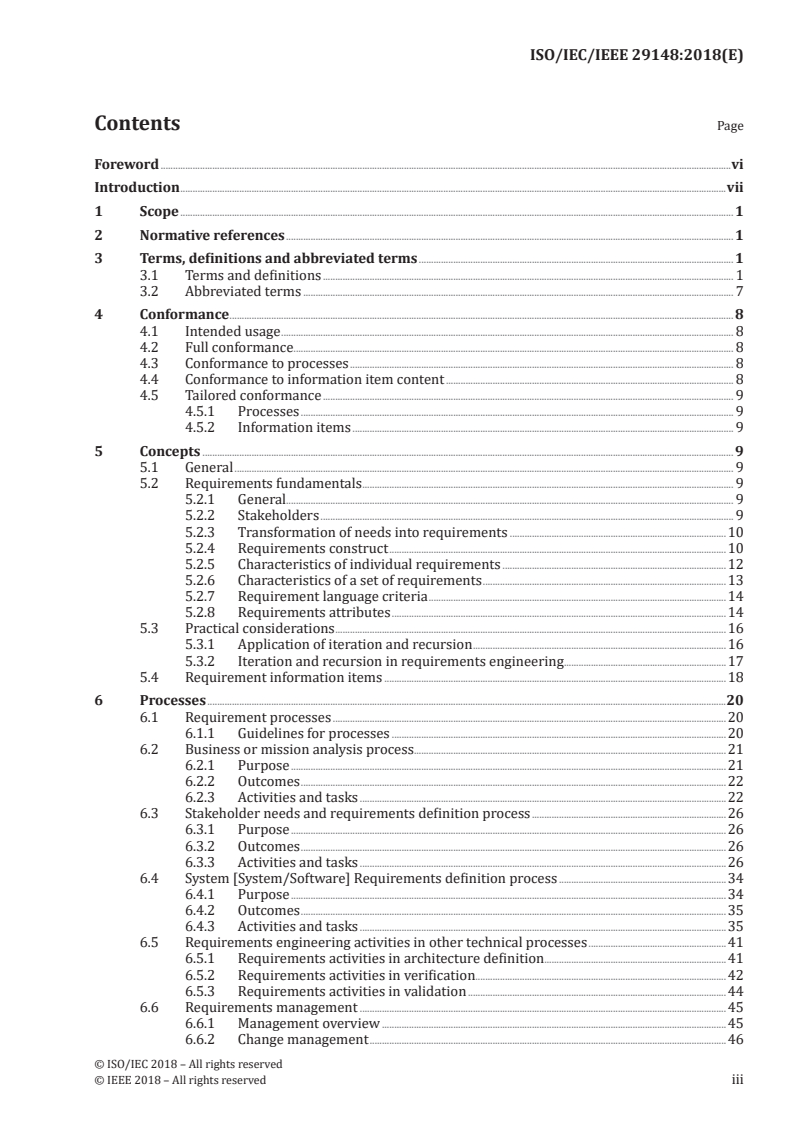
Contents Page
Foreword .vi
Introduction .vii
1 Scope . 1
2 Normative references . 1
3 Terms, definitions and abbreviated terms . 1
3.1 Terms and definitions . 1
3.2 Abbreviated terms . 7
4 Conformance . 8
4.1 Intended usage . 8
4.2 Full conformance. 8
4.3 Conformance to processes . 8
4.4 Conformance to information item content . 8
4.5 Tailored conformance . 9
4.5.1 Processes . 9
4.5.2 Information items . 9
5 Concepts . 9
5.1 General . 9
5.2 Requirements fundamentals . 9
5.2.1 General. 9
5.2.2 Stakeholders . 9
5.2.3 Transformation of needs into requirements .10
5.2.4 Requirements construct .10
5.2.5 Characteristics of individual requirements .12
5.2.6 Characteristics of a set of requirements .13
5.2.7 Requirement language criteria .14
5.2.8 Requirements attributes .14
5.3 Practical considerations .16
5.3.1 Application of iteration and recursion .16
5.3.2 Iteration and recursion in requirements engineering .17
5.4 Requirement information items .18
6 Processes .20
6.1 Requirement processes .20
6.1.1 Guidelines for processes .20
6.2 Business or mission analysis process . .21
6.2.1 Purpose .21
6.2.2 Outcomes .22
6.2.3 Activities and tasks .22
6.3 Stakeholder needs and requirements definition process .26
6.3.1 Purpose .26
6.3.2 Outcomes .26
6.3.3 Activities and tasks .26
6.4 System [System/Software] Requirements definition process .34
6.4.1 Purpose .34
6.4.2 Outcomes .35
6.4.3 Activities and tasks .35
6.5 Requirements engineering activities in other technical processes .41
6.5.1 Requirements activities in architecture definition.41
6.5.2 Requirements activities in verification.42
6.5.3 Requirements activities in validation .44
6.6 Requirements management .45
6.6.1 Management overview .45
6.6.2 Change management .46
© ISO/IEC 2018 – All rights reserved
© IEEE 2018 – All rights reserved iii
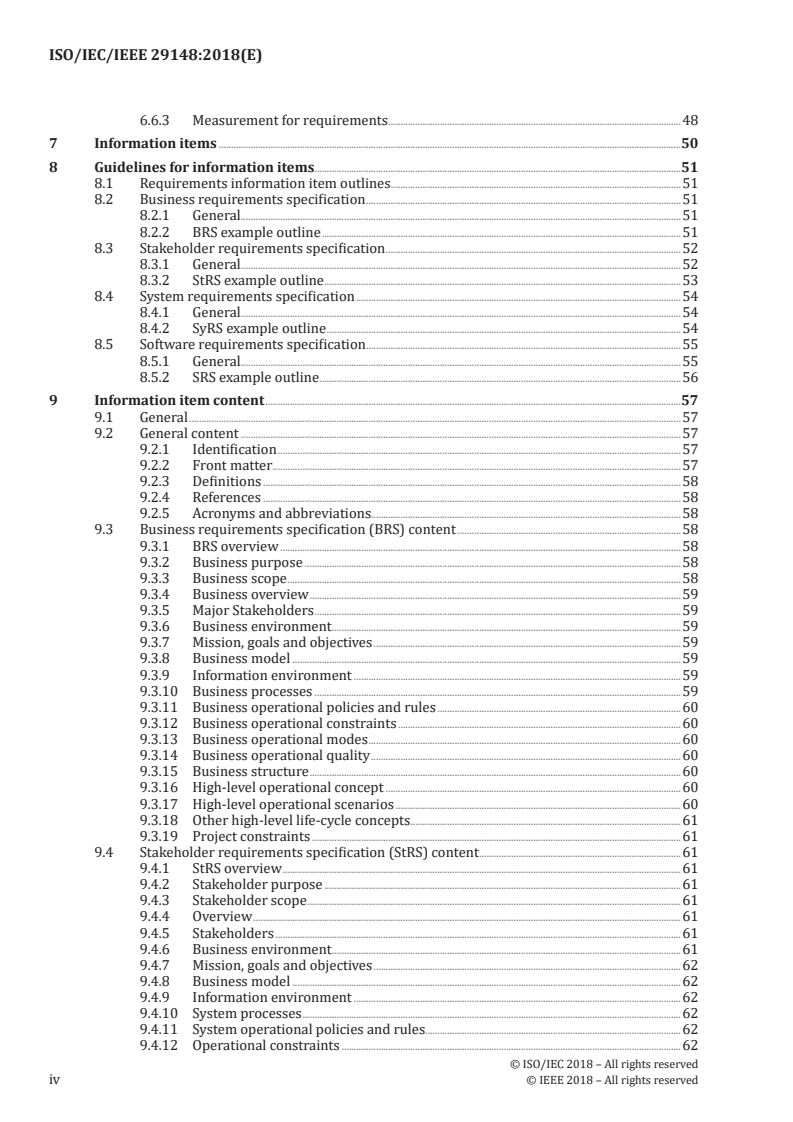
6.6.3 Measurement for requirements .48
7 Information items .50
8 Guidelines for information items .51
8.1 Requirements information item outlines .51
8.2 Business requirements specification .51
8.2.1 General.51
8.2.2 BRS example outline .51
8.3 Stakeholder requirements specification .52
8.3.1 General.52
8.3.2 StRS example outline .53
8.4 System requirements specification .54
8.4.1 General.54
8.4.2 SyRS example outline .54
8.5 Software requirements specification .55
8.5.1 General.55
8.5.2 SRS example outline .56
9 Information item content .57
9.1 General .57
9.2 General content .57
9.2.1 Identification .57
9.2.2 Front matter .57
9.2.3 Definitions .58
9.2.4 References .58
9.2.5 Acronyms and abbreviations.58
9.3 Business requirements specification (BRS) content .58
9.3.1 BRS overview .58
9.3.2 Business purpose .58
9.3.3 Business scope .58
9.3.4 Business overview .59
9.3.5 Major Stakeholders .59
9.3.6 Business environment.59
9.3.7 Mission, goals and objectives .59
9.3.8 Business model .59
9.3.9 Information environment .59
9.3.10 Business processes .59
9.3.11 Business operational policies and rules .60
9.3.12 Business operational constraints .60
9.3.13 Business operational modes .60
9.3.14 Business operational quality .60
9.3.15 Business structure .60
9.3.16 High-level operational concept .60
9.3.17 High-level operational scenarios .60
9.3.18 Other high-level life-cycle concepts .61
9.3.19 Project constraints .61
9.4 Stakeholder requirements specification (StRS) content .61
9.4.1 StRS overview .61
9.4.2 Stakeholder purpose .61
9.4.3 Stakeholder scope .61
9.4.4 Overview .61
9.4.5 Stakeholders .61
9.4.6 Business environment.61
9.4.7 Mission, goals and objectives .62
9.4.8 Business model .62
9.4.9 Information environment .62
9.4.10 System processes .62
9.4.11 System operational policies and rules.62
9.4.12 Operational constraints .62
© ISO/IEC 2018 – All rights reserved
iv © IEEE 2018 – All rights reserved
9.4.13 System operational modes and states .62
9.4.14 System operational quality .63
9.4.15 User requirements.63
9.4.16 Operational concept .63
9.4.17 Operational scenarios . .63
9.4.18 Other detailed concepts of proposed system .63
9.4.19 Project constraints .64
9.5 System requirements specification (SyRS) content .64
9.5.1 SyRS overview .64
9.5.2 System purpose .64
9.5.3 System scope .64
9.5.4 System overview .64
9.5.5 Functional requirements .64
9.5.6 Usability requirements .64
9.5.7 Performance requirements .65
9.5.8 System interface requirements .65
9.5.9 System operations .65
9.5.10 System modes and states .66
9.5.11 Physical characteristics .66
9.5.12 Environmental conditions .66
9.5.13 System security requirements .66
9.5.14 Information management requirements .66
9.5.15 Policy and regulation requirements .67
9.5.16 System life cycle sustainment requirements .67
9.5.17 Packaging, handling, shipping and transportation requirements .67
9.5.18 Verification .67
9.5.19 Assumptions and dependencies .67
9.6 Software requirements specification (SRS) content .67
9.6.1 SRS overview .67
9.6.2 Purpose .67
9.6.3 Scope .67
9.6.4 Product perspective .68
9.6.5 Product functions .69
9.6.6 User characteristics .70
9.6.7 Limitations .70
9.6.8 Assumptions and dependencies .70
9.6.9 Apportioning of requirements .71
9.6.10 Specified requirements .71
9.6.11 External interfaces .71
9.6.12 Functions .72
9.6.13 Usability requirements .72
9.6.14 Performance requirements .72
9.6.15 Logical database requirements .73
9.6.16 Design constraints .73
9.6.17 Standards compliance .73
9.6.18 Software system attributes .73
9.6.19 Verification .74
9.6.20 Supporting information .74
Annex A (normative) System operational concept .75
Annex B (informative) Concept of operations .87
Annex C (normative) Tailoring policies .89
Bibliography .91
IEEE notices and abstract .93
© ISO/IEC 2018 – All rights reserved
© IEEE 2018 – All rights reserved v
Foreword
ISO (the International Organization for Standardization) and IEC (the International Electrotechnical
Commission) form the specialized system for worldwide standardization. National bodies that are
members of ISO or IEC participate in the development of International Standards through technical
committees established by the respective organization to deal with particular fields of technical
activity. ISO and IEC technical committees collaborate in fields of mutual interest. Other international
organizations, governmental and nongovernmental, in liaison with ISO and IEC, also take part in the
work. In the field of information technology, ISO and IEC have established a joint technical committee,
ISO/IEC JTC 1.
The procedures used to develop this document and those intended for its further maintenance are
described in the ISO/IEC Directives, Part 1. In particular, the different approval criteria needed for the
different types of ISO documents should be noted. This document was drafted in accordance with the
rules given in the ISO/IEC Directives, Part 2 (see www .iso .org/directives).
IEEE Standards documents are developed within the IEEE Societies and the Standards Coordinating
Committees of the IEEE Standards Association (IEEE-SA) Standards Board. The IEEE develops its
standards through a consensus development process, approved by the American National Standards
Institute, which brings together volunteers representing varied viewpoints and interests to achieve the
final product. Volunteers are not necessarily members of the Institute and serve without compensation.
While the IEEE administers the process and establishes rules to promote fairness in the consensus
development process, the IEEE does not independently evaluate, test, or verify the accuracy of any of
the information contained in its standards.
Attention is drawn to the possibility that some of the elements of this document may be the subject
of patent rights. ISO and IEC shall not be held responsible for identifying any or all such patent
rights. Details of any patent rights identified during the development of the document will be in the
Introduction and/or on the ISO list of patent declarations received (see www .iso .org/patents).
Any trade name used in this document is information given for the convenience of users and does not
constitute an endorsement.
For an explanation of the voluntary nature of standards, the meaning of ISO specific terms and
expressions related to conformity assessment, as well as information about ISO's adherence to the
World Trade Organization (WTO) principles in the Technical Barriers to Trade (TBT), see www .iso
.org/iso/foreword .html.
This document was prepared by Joint Technical Committee ISO/IEC JTC 1, Information technology,
Subcommittee SC 7, Systems and software engineering, in cooperation with the Systems and Software
Engineering Standards Committee of the IEEE Computer Society, under the Partner Standards
Development Organization cooperation agreement between ISO and IEEE.
This second edition cancels and replaces the first edition (ISO/IEC/IEEE 29148:2011), which has been
technically revised.
Changes in this revision of ISO/IEC/IEEE 29148 were developed in response to the revision of ISO/IEC/
IEEE 15288 and ISO/IEC/IEEE 12207. The purpose of these revisions is to accomplish the harmonization
of the structures and contents of the two documents, while supporting the requirements of the
assessment community.
Any feedback or questions on this document should be directed to the user’s national standards body. A
complete listing of these bodies can be found at www .iso .org/members .html.
© ISO/IEC 2018 – All rights reserved
vi © IEEE 2018 – All rights reserved
Introduction
This document provides a unified treatment of the processes and products involved in engineering
requirements throughout the life cycle of systems and software. It provides details for the construct of
well-formed textual requirements, to include characteristics and attributes, in the context of system and
software engineering. This document also provides guidance for the implementation of requirements
related processes from ISO/IEC/IEEE 15288 and ISO/IEC/IEEE 12207. Finally, this document identifies
information items related to requirements engineering and their content.
© ISO/IEC 2018 – All rights reserved
© IEEE 2018 – All rights reserved vii
INTERNATIONAL STANDARD ISO/IEC/IEEE 29148:2018(E)
Systems and software engineering — Life cycle processes
— Requirements engineering
1 Scope
This document:
— specifies the required processes implemented in the engineering activities that result in
requirements for systems and software products (including services) throughout the life cycle;
— provides guidelines for applying the requirements and requirements-related processes described
in ISO/IEC/IEEE 15288 and ISO/IEC/IEEE 12207;
— specifies the required information items produced through the implementation of the requirements
processes;
— specifies the required contents of the required information items;
— provides guidelines for the format of the required and related information items.
This document is applicable to:
— those who use or plan to use ISO/IEC/IEEE 15288 and ISO/IEC/IEEE 12207 on projects dealing with
man-made systems, software-intensive systems, software and hardware products, and services
related to those systems and products, regardless of the project scope, product(s), methodology,
size or complexity;
— anyone performing requirements engineering activities to aid in ensuring that their application
of the requirements engineering processes conforms to ISO/IEC/IEEE 15288 and/or ISO/IEC/
IEEE12207;
— those who use or plan to use ISO/IEC/IEEE 15289 on projects dealing with man-made systems,
software-intensive systems, software and hardware products and services related to those systems
and products, regardless of the project scope, product(s), methodology, size or complexity;
— anyone performing requirements engineering activities to aid in ensuring that the information
items developed during the application of requirements engineering processes conforms to ISO/
IEC/IEEE 15289.
2 Normative references
The following documents are referred to in the text in such a way that some or all of their content
constitutes requirements of this document. For dated references, only the edition cited applies. For
undated references, the latest edition of the referenced document, (including any amendments) applies.
ISO/IEC/IEEE 15288:2015, Systems and software engineering — System life cycle processes
ISO/IEC/IEEE 12207:2017, Systems and software engineering — Software life cycle processes
3 Terms, definitions and abbreviated terms
3.1 Terms and definitions
For the purposes of this document, the terms and definitions given in ISO/IEC/IEEE 15288, ISO/IEC/
IEEE 12207 and the following apply.
© ISO/IEC 2018 – All rights reserved
© IEEE 2018 – All rights reserved 1
ISO, IEC and IEEE maintain terminological databases for use in standardization at the following
addresses:
— ISO Online browsing platform: available at http: //www .iso .org/obp
— IEC Electropedia: available at http: //www .electropedia .org/
— IEEE Standards Dictionary Online: available at http: //dictionary .ieee .org
NOTE Definitions for other system and software engineering terms typically can be found in ISO/IEC/
IEEE 24765, available at www .computer .org/sevocab.
3.1.1
acquirer
stakeholder (3.1.28) that acquires or procures a product or service from a supplier (3.1.31)
Note 1 to entry: Other terms commonly used for an acquirer are buyer, customer (3.1.9), owner, purchaser or
internal/organizational sponsor.
[SOURCE: ISO/IEC/IEEE 15288:2015, 4.1.1]
3.1.2
attribute
inherent property or characteristic of an entity that can be distinguished quantitatively or qualitatively
by human or automated means
Note 1 to entry: ISO 9000 distinguishes two types of attributes: a permanent characteristic existing inherently in
something; and an assigned characteristic of a product, process, or system (e.g., the price of a product, the owner
of a product).
[SOURCE: ISO/IEC 25000:2014, 4.1, modified — The original NOTE 1 has been removed; NOTE 2 has
become Note 1 to entry.]
3.1.3
baseline
formally approved version of a configuration item, regardless of media, formally designated and fixed
at a specific time during the configuration item's life cycle
[SOURCE: ISO/IEC/IEEE 15288:2015, 4.1.10]
3.1.4
business requirements specification
structured collection of the requirements (3.1.19) (business or mission problem or opportunity
definition, concepts, and required conditions of solutions) of the business or mission and its relation to
the external environment
3.1.5
concept of operations
verbal and graphic statement, in broad outline, of an organization’s assumptions or intent in regard to
an operation or series of operations
Note 1 to entry: The concept of operations frequently is embodied in long-range strategic plans and annual
operational plans. In the latter case, the concept of operations in the plan covers a series of connected operations
to be carried out simultaneously or in succession. The concept is designed to give an overall picture of the
organization operations. See also operational concept (3.1.16).
Note 2 to entry: The concept of operations provides the basis for bounding the operating space, system
capabilities, interfaces and operating environment.
Note 3 to entry: The concept of operations includes how an enterprise or organization intends to employ available
human and technological resources to achieve one or more outcomes.
[SOURCE: ANSI/AIAA G-043A-2012e]
© ISO/IEC 2018 – All rights reserved
2 © IEEE 2018 – All rights reserved
3.1.6
condition
measurable qualitative or quantitative attribute (3.1.2) that is stipulated for a requirement (3.1.19) and
that indicates a circumstance or event under which a requirement applies
3.1.7
constraint
externally imposed limitation on the system, its design, or implementation or on the process used to
develop or modify a system
Note 1 to entry: A constraint is a factor that is imposed on the solution by force or compulsion and may limit or
modify the design.
3.1.8
context of use
users (3.1.35), tasks, equipment (hardware, software and materials), and the physical and social
environments in which a product is used
[SOURCE: ISO/IEC 25000:2014, 4.2]
3.1.9
customer
person or organization that could or does receive a product or a service that is intended for or required
by this person or organization
Note 1 to entry: Customers are a subset of stakeholders (3.1.28).
Note 2 to entry: A customer can be internal or external to the organization.
[SOURCE: ISO 9000:2015, 3.2.4, modified — The original Note 1 to entry has become Note 2 to entry; a
new Note 1 to entry has been introduced and the EXAMPLE has been removed.]
3.1.10
derived requirement
requirement (3.1.19) deduced or inferred from the collection and organization of requirements into a
particular system configuration and solution
Note 1 to entry: The next higher level requirement is referred to as a “parent” requirement while the derived
requirement from this parent is called a “child” requirement.
Note 2 to entry: A derived requirement is typically identified during the elicitation of stakeholder (3.1.28)
requirements, requirements analysis, trade studies or validation (3.1.36).
3.1.11
developer
individual or organization that performs development activities (including requirements analysis,
design, testing through acceptance) during the system or software life-cycle process
Note 1 to entry: Developers are a subset of stakeholders (3.1.28).
[SOURCE: ISO/IEC 25000:2014, 4.6, modified — Note 1 to entry has been added.]
3.1.12
document
uniquely identified unit of information for human use
EXAMPLE report, specification, manual or book in printed or electronic form.
Note 1 to entry: A document can be a single information item (3.1.14), or part of a larger information item (3.1.14).
Note 2 to entry: Documents include both paper and electronic documents.
© ISO/IEC 2018 – All rights reserved
© IEEE 2018 – All rights reserved 3
Note 3 to entry: The use of the term document is not intended to preclude interpretation in the broader sense of
“documentation”, especially as it applies to model-based engineering or conformance.
[SOURCE: ISO/IEC/IEEE 15289:2017, 3.1.10, modified – Notes 2 and 3 to entry have been added.]
3.1.13
human systems integration
interdisciplinary technical and management processes for integrating human considerations within
and across all system elements
[SOURCE: INCOSE SEHbk 4:2015]
3.1.14
information item
separately identifiable body of information that is produced, stored, and delivered for human use
[SOURCE: ISO/IEC/IEEE 15289:2017, 3.1.13, modified – Notes 1 and 2 to entry have been removed.]
3.1.15
level of abstraction
view at a specific level of detail in a description of a system
3.1.16
operational concept
verbal and graphic statement of an organization’s assumptions or intent in regard to an operation or
series of operations of a specific system or a related set of specific new, existing or modified systems
Note 1 to entry: The operational concept is designed to give an overall picture of the operations using one or
more specific systems, or set of related systems, in the organization’s operational environment from the users’
(3.1.35) and operators’ (3.1.18) perspective. It is what the enterprise or organization intends to achieve. See also
concept of operations (3.1.5).
[SOURCE: ANSI/AIAA G-043A-2012e]
3.1.17
operational scenario
description of an imagined sequence of events or activities that includes the interaction of the product
or service with its environment and users (3.1.35), as well as interaction among its product or service
components when there is end-use significance
Note 1 to entry: Operational scenarios are used to
...
INTERNATIONAL ISO/IEC/
STANDARD IEEE
Second edition
2018-11
Systems and software engineering —
Life cycle processes — Requirements
engineering
Ingénierie des systèmes et du logiciel — Processus du cycle de vie —
Ingénierie des exigences
Reference number
©
ISO/IEC 2018
©
IEEE 2018
© ISO/IEC 2018
© IEEE 2018
All rights reserved. Unless otherwise specified, or required in the context of its implementation, no part of this publication may
be reproduced or utilized otherwise in any form or by any means, electronic or mechanical, including photocopying, or posting
on the internet or an intranet, without prior written permission. Permission can be requested from either ISO or IEEE at the
respective address below or ISO’s member body in the country of the requester.
ISO copyright office Institute of Electrical and Electronics Engineers, Inc
CP 401 • Ch. de Blandonnet 8 3 Park Avenue, New York
CH-1214 Vernier, Geneva NY 10016-5997, USA
Phone: +41 22 749 01 11
Fax: +41 22 749 09 47
Email: copyright@iso.org Email: stds.ipr@ieee.org
Website: www.iso.org Website: www.ieee.org
Published in Switzerland
© ISO/IEC 2018 – All rights reserved
ii © IEEE 2018 – All rights reserved
Contents Page
Foreword .vi
Introduction .vii
1 Scope . 1
2 Normative references . 1
3 Terms, definitions and abbreviated terms . 1
3.1 Terms and definitions . 1
3.2 Abbreviated terms . 7
4 Conformance . 8
4.1 Intended usage . 8
4.2 Full conformance. 8
4.3 Conformance to processes . 8
4.4 Conformance to information item content . 8
4.5 Tailored conformance . 9
4.5.1 Processes . 9
4.5.2 Information items . 9
5 Concepts . 9
5.1 General . 9
5.2 Requirements fundamentals . 9
5.2.1 General. 9
5.2.2 Stakeholders . 9
5.2.3 Transformation of needs into requirements .10
5.2.4 Requirements construct .10
5.2.5 Characteristics of individual requirements .12
5.2.6 Characteristics of a set of requirements .13
5.2.7 Requirement language criteria .14
5.2.8 Requirements attributes .14
5.3 Practical considerations .16
5.3.1 Application of iteration and recursion .16
5.3.2 Iteration and recursion in requirements engineering .17
5.4 Requirement information items .18
6 Processes .20
6.1 Requirement processes .20
6.1.1 Guidelines for processes .20
6.2 Business or mission analysis process . .21
6.2.1 Purpose .21
6.2.2 Outcomes .22
6.2.3 Activities and tasks .22
6.3 Stakeholder needs and requirements definition process .26
6.3.1 Purpose .26
6.3.2 Outcomes .26
6.3.3 Activities and tasks .26
6.4 System [System/Software] Requirements definition process .34
6.4.1 Purpose .34
6.4.2 Outcomes .35
6.4.3 Activities and tasks .35
6.5 Requirements engineering activities in other technical processes .41
6.5.1 Requirements activities in architecture definition.41
6.5.2 Requirements activities in verification.42
6.5.3 Requirements activities in validation .44
6.6 Requirements management .45
6.6.1 Management overview .45
6.6.2 Change management .46
© ISO/IEC 2018 – All rights reserved
© IEEE 2018 – All rights reserved iii
6.6.3 Measurement for requirements .48
7 Information items .50
8 Guidelines for information items .51
8.1 Requirements information item outlines .51
8.2 Business requirements specification .51
8.2.1 General.51
8.2.2 BRS example outline .51
8.3 Stakeholder requirements specification .52
8.3.1 General.52
8.3.2 StRS example outline .53
8.4 System requirements specification .54
8.4.1 General.54
8.4.2 SyRS example outline .54
8.5 Software requirements specification .55
8.5.1 General.55
8.5.2 SRS example outline .56
9 Information item content .57
9.1 General .57
9.2 General content .57
9.2.1 Identification .57
9.2.2 Front matter .57
9.2.3 Definitions .58
9.2.4 References .58
9.2.5 Acronyms and abbreviations.58
9.3 Business requirements specification (BRS) content .58
9.3.1 BRS overview .58
9.3.2 Business purpose .58
9.3.3 Business scope .58
9.3.4 Business overview .59
9.3.5 Major Stakeholders .59
9.3.6 Business environment.59
9.3.7 Mission, goals and objectives .59
9.3.8 Business model .59
9.3.9 Information environment .59
9.3.10 Business processes .59
9.3.11 Business operational policies and rules .60
9.3.12 Business operational constraints .60
9.3.13 Business operational modes .60
9.3.14 Business operational quality .60
9.3.15 Business structure .60
9.3.16 High-level operational concept .60
9.3.17 High-level operational scenarios .60
9.3.18 Other high-level life-cycle concepts .61
9.3.19 Project constraints .61
9.4 Stakeholder requirements specification (StRS) content .61
9.4.1 StRS overview .61
9.4.2 Stakeholder purpose .61
9.4.3 Stakeholder scope .61
9.4.4 Overview .61
9.4.5 Stakeholders .61
9.4.6 Business environment.61
9.4.7 Mission, goals and objectives .62
9.4.8 Business model .62
9.4.9 Information environment .62
9.4.10 System processes .62
9.4.11 System operational policies and rules.62
9.4.12 Operational constraints .62
© ISO/IEC 2018 – All rights reserved
iv © IEEE 2018 – All rights reserved
9.4.13 System operational modes and states .62
9.4.14 System operational quality .63
9.4.15 User requirements.63
9.4.16 Operational concept .63
9.4.17 Operational scenarios . .63
9.4.18 Other detailed concepts of proposed system .63
9.4.19 Project constraints .64
9.5 System requirements specification (SyRS) content .64
9.5.1 SyRS overview .64
9.5.2 System purpose .64
9.5.3 System scope .64
9.5.4 System overview .64
9.5.5 Functional requirements .64
9.5.6 Usability requirements .64
9.5.7 Performance requirements .65
9.5.8 System interface requirements .65
9.5.9 System operations .65
9.5.10 System modes and states .66
9.5.11 Physical characteristics .66
9.5.12 Environmental conditions .66
9.5.13 System security requirements .66
9.5.14 Information management requirements .66
9.5.15 Policy and regulation requirements .67
9.5.16 System life cycle sustainment requirements .67
9.5.17 Packaging, handling, shipping and transportation requirements .67
9.5.18 Verification .67
9.5.19 Assumptions and dependencies .67
9.6 Software requirements specification (SRS) content .67
9.6.1 SRS overview .67
9.6.2 Purpose .67
9.6.3 Scope .67
9.6.4 Product perspective .68
9.6.5 Product functions .69
9.6.6 User characteristics .70
9.6.7 Limitations .70
9.6.8 Assumptions and dependencies .70
9.6.9 Apportioning of requirements .71
9.6.10 Specified requirements .71
9.6.11 External interfaces .71
9.6.12 Functions .72
9.6.13 Usability requirements .72
9.6.14 Performance requirements .72
9.6.15 Logical database requirements .73
9.6.16 Design constraints .73
9.6.17 Standards compliance .73
9.6.18 Software system attributes .73
9.6.19 Verification .74
9.6.20 Supporting information .74
Annex A (normative) System operational concept .75
Annex B (informative) Concept of operations .87
Annex C (normative) Tailoring policies .89
Bibliography .91
IEEE notices and abstract .93
© ISO/IEC 2018 – All rights reserved
© IEEE 2018 – All rights reserved v
Foreword
ISO (the International Organization for Standardization) and IEC (the International Electrotechnical
Commission) form the specialized system for worldwide standardization. National bodies that are
members of ISO or IEC participate in the development of International Standards through technical
committees established by the respective organization to deal with particular fields of technical
activity. ISO and IEC technical committees collaborate in fields of mutual interest. Other international
organizations, governmental and nongovernmental, in liaison with ISO and IEC, also take part in the
work. In the field of information technology, ISO and IEC have established a joint technical committee,
ISO/IEC JTC 1.
The procedures used to develop this document and those intended for its further maintenance are
described in the ISO/IEC Directives, Part 1. In particular, the different approval criteria needed for the
different types of ISO documents should be noted. This document was drafted in accordance with the
rules given in the ISO/IEC Directives, Part 2 (see www .iso .org/directives).
IEEE Standards documents are developed within the IEEE Societies and the Standards Coordinating
Committees of the IEEE Standards Association (IEEE-SA) Standards Board. The IEEE develops its
standards through a consensus development process, approved by the American National Standards
Institute, which brings together volunteers representing varied viewpoints and interests to achieve the
final product. Volunteers are not necessarily members of the Institute and serve without compensation.
While the IEEE administers the process and establishes rules to promote fairness in the consensus
development process, the IEEE does not independently evaluate, test, or verify the accuracy of any of
the information contained in its standards.
Attention is drawn to the possibility that some of the elements of this document may be the subject
of patent rights. ISO and IEC shall not be held responsible for identifying any or all such patent
rights. Details of any patent rights identified during the development of the document will be in the
Introduction and/or on the ISO list of patent declarations received (see www .iso .org/patents).
Any trade name used in this document is information given for the convenience of users and does not
constitute an endorsement.
For an explanation of the voluntary nature of standards, the meaning of ISO specific terms and
expressions related to conformity assessment, as well as information about ISO's adherence to the
World Trade Organization (WTO) principles in the Technical Barriers to Trade (TBT), see www .iso
.org/iso/foreword .html.
This document was prepared by Joint Technical Committee ISO/IEC JTC 1, Information technology,
Subcommittee SC 7, Systems and software engineering, in cooperation with the Systems and Software
Engineering Standards Committee of the IEEE Computer Society, under the Partner Standards
Development Organization cooperation agreement between ISO and IEEE.
This second edition cancels and replaces the first edition (ISO/IEC/IEEE 29148:2011), which has been
technically revised.
Changes in this revision of ISO/IEC/IEEE 29148 were developed in response to the revision of ISO/IEC/
IEEE 15288 and ISO/IEC/IEEE 12207. The purpose of these revisions is to accomplish the harmonization
of the structures and contents of the two documents, while supporting the requirements of the
assessment community.
Any feedback or questions on this document should be directed to the user’s national standards body. A
complete listing of these bodies can be found at www .iso .org/members .html.
© ISO/IEC 2018 – All rights reserved
vi © IEEE 2018 – All rights reserved
Introduction
This document provides a unified treatment of the processes and products involved in engineering
requirements throughout the life cycle of systems and software. It provides details for the construct of
well-formed textual requirements, to include characteristics and attributes, in the context of system and
software engineering. This document also provides guidance for the implementation of requirements
related processes from ISO/IEC/IEEE 15288 and ISO/IEC/IEEE 12207. Finally, this document identifies
information items related to requirements engineering and their content.
© ISO/IEC 2018 – All rights reserved
© IEEE 2018 – All rights reserved vii
INTERNATIONAL STANDARD ISO/IEC/IEEE 29148:2018(E)
Systems and software engineering — Life cycle processes
— Requirements engineering
1 Scope
This document:
— specifies the required processes implemented in the engineering activities that result in
requirements for systems and software products (including services) throughout the life cycle;
— provides guidelines for applying the requirements and requirements-related processes described
in ISO/IEC/IEEE 15288 and ISO/IEC/IEEE 12207;
— specifies the required information items produced through the implementation of the requirements
processes;
— specifies the required contents of the required information items;
— provides guidelines for the format of the required and related information items.
This document is applicable to:
— those who use or plan to use ISO/IEC/IEEE 15288 and ISO/IEC/IEEE 12207 on projects dealing with
man-made systems, software-intensive systems, software and hardware products, and services
related to those systems and products, regardless of the project scope, product(s), methodology,
size or complexity;
— anyone performing requirements engineering activities to aid in ensuring that their application
of the requirements engineering processes conforms to ISO/IEC/IEEE 15288 and/or ISO/IEC/
IEEE12207;
— those who use or plan to use ISO/IEC/IEEE 15289 on projects dealing with man-made systems,
software-intensive systems, software and hardware products and services related to those systems
and products, regardless of the project scope, product(s), methodology, size or complexity;
— anyone performing requirements engineering activities to aid in ensuring that the information
items developed during the application of requirements engineering processes conforms to ISO/
IEC/IEEE 15289.
2 Normative references
The following documents are referred to in the text in such a way that some or all of their content
constitutes requirements of this document. For dated references, only the edition cited applies. For
undated references, the latest edition of the referenced document, (including any amendments) applies.
ISO/IEC/IEEE 15288:2015, Systems and software engineering — System life cycle processes
ISO/IEC/IEEE 12207:2017, Systems and software engineering — Software life cycle processes
3 Terms, definitions and abbreviated terms
3.1 Terms and definitions
For the purposes of this document, the terms and definitions given in ISO/IEC/IEEE 15288, ISO/IEC/
IEEE 12207 and the following apply.
© ISO/IEC 2018 – All rights reserved
© IEEE 2018 – All rights reserved 1
ISO, IEC and IEEE maintain terminological databases for use in standardization at the following
addresses:
— ISO Online browsing platform: available at http: //www .iso .org/obp
— IEC Electropedia: available at http: //www .electropedia .org/
— IEEE Standards Dictionary Online: available at http: //dictionary .ieee .org
NOTE Definitions for other system and software engineering terms typically can be found in ISO/IEC/
IEEE 24765, available at www .computer .org/sevocab.
3.1.1
acquirer
stakeholder (3.1.28) that acquires or procures a product or service from a supplier (3.1.31)
Note 1 to entry: Other terms commonly used for an acquirer are buyer, customer (3.1.9), owner, purchaser or
internal/organizational sponsor.
[SOURCE: ISO/IEC/IEEE 15288:2015, 4.1.1]
3.1.2
attribute
inherent property or characteristic of an entity that can be distinguished quantitatively or qualitatively
by human or automated means
Note 1 to entry: ISO 9000 distinguishes two types of attributes: a permanent characteristic existing inherently in
something; and an assigned characteristic of a product, process, or system (e.g., the price of a product, the owner
of a product).
[SOURCE: ISO/IEC 25000:2014, 4.1, modified — The original NOTE 1 has been removed; NOTE 2 has
become Note 1 to entry.]
3.1.3
baseline
formally approved version of a configuration item, regardless of media, formally designated and fixed
at a specific time during the configuration item's life cycle
[SOURCE: ISO/IEC/IEEE 15288:2015, 4.1.10]
3.1.4
business requirements specification
structured collection of the requirements (3.1.19) (business or mission problem or opportunity
definition, concepts, and required conditions of solutions) of the business or mission and its relation to
the external environment
3.1.5
concept of operations
verbal and graphic statement, in broad outline, of an organization’s assumptions or intent in regard to
an operation or series of operations
Note 1 to entry: The concept of operations frequently is embodied in long-range strategic plans and annual
operational plans. In the latter case, the concept of operations in the plan covers a series of connected operations
to be carried out simultaneously or in succession. The concept is designed to give an overall picture of the
organization operations. See also operational concept (3.1.16).
Note 2 to entry: The concept of operations provides the basis for bounding the operating space, system
capabilities, interfaces and operating environment.
Note 3 to entry: The concept of operations includes how an enterprise or organization intends to employ available
human and technological resources to achieve one or more outcomes.
[SOURCE: ANSI/AIAA G-043A-2012e]
© ISO/IEC 2018 – All rights reserved
2 © IEEE 2018 – All rights reserved
3.1.6
condition
measurable qualitative or quantitative attribute (3.1.2) that is stipulated for a requirement (3.1.19) and
that indicates a circumstance or event under which a requirement applies
3.1.7
constraint
externally imposed limitation on the system, its design, or implementation or on the process used to
develop or modify a system
Note 1 to entry: A constraint is a factor that is imposed on the solution by force or compulsion and may limit or
modify the design.
3.1.8
context of use
users (3.1.35), tasks, equipment (hardware, software and materials), and the physical and social
environments in which a product is used
[SOURCE: ISO/IEC 25000:2014, 4.2]
3.1.9
customer
person or organization that could or does receive a product or a service that is intended for or required
by this person or organization
Note 1 to entry: Customers are a subset of stakeholders (3.1.28).
Note 2 to entry: A customer can be internal or external to the organization.
[SOURCE: ISO 9000:2015, 3.2.4, modified — The original Note 1 to entry has become Note 2 to entry; a
new Note 1 to entry has been introduced and the EXAMPLE has been removed.]
3.1.10
derived requirement
requirement (3.1.19) deduced or inferred from the collection and organization of requirements into a
particular system configuration and solution
Note 1 to entry: The next higher level requirement is referred to as a “parent” requirement while the derived
requirement from this parent is called a “child” requirement.
Note 2 to entry: A derived requirement is typically identified during the elicitation of stakeholder (3.1.28)
requirements, requirements analysis, trade studies or validation (3.1.36).
3.1.11
developer
individual or organization that performs development activities (including requirements analysis,
design, testing through acceptance) during the system or software life-cycle process
Note 1 to entry: Developers are a subset of stakeholders (3.1.28).
[SOURCE: ISO/IEC 25000:2014, 4.6, modified — Note 1 to entry has been added.]
3.1.12
document
uniquely identified unit of information for human use
EXAMPLE report, specification, manual or book in printed or electronic form.
Note 1 to entry: A document can be a single information item (3.1.14), or part of a larger information item (3.1.14).
Note 2 to entry: Documents include both paper and electronic documents.
© ISO/IEC 2018 – All rights reserved
© IEEE 2018 – All rights reserved 3
Note 3 to entry: The use of the term document is not intended to preclude interpretation in the broader sense of
“documentation”, especially as it applies to model-based engineering or conformance.
[SOURCE: ISO/IEC/IEEE 15289:2017, 3.1.10, modified – Notes 2 and 3 to entry have been added.]
3.1.13
human systems integration
interdisciplinary technical and management processes for integrating human considerations within
and across all system elements
[SOURCE: INCOSE SEHbk 4:2015]
3.1.14
information item
separately identifiable body of information that is produced, stored, and delivered for human use
[SOURCE: ISO/IEC/IEEE 15289:2017, 3.1.13, modified – Notes 1 and 2 to entry have been removed.]
3.1.15
level of abstraction
view at a specific level of detail in a description of a system
3.1.16
operational concept
verbal and graphic statement of an organization’s assumptions or intent in regard to an operation or
series of operations of a specific system or a related set of specific new, existing or modified systems
Note 1 to entry: The operational concept is designed to give an overall picture of the operations using one or
more specific systems, or set of related systems, in the organization’s operational environment from the users’
(3.1.35) and operators’ (3.1.18) perspective. It is what the enterprise or organization intends to achieve. See also
concept of operations (3.1.5).
[SOURCE: ANSI/AIAA G-043A-2012e]
3.1.17
operational scenario
description of an imagined sequence of events or activities that includes the interaction of the product
or service with its environment and users (3.1.35), as well as interaction among its product or service
components when there is end-use significance
Note 1 to entry: Operational scenarios are used to
...