

ISO/TS 14064-4:2025
(Main)Greenhouse gases — Part 4: Guidance for the application of ISO 14064-1
General Information
- Abstract
This document describes the principles, concepts, and methods relating to the quantification and reporting of direct and indirect greenhouse gas (GHG) emissions for an organization. It gives guidance on the application of ISO 14064-1 to GHG inventory at the organization level, for the quantification and reporting of direct emissions and indirect emissions. This document describes for all organizations, the steps for: establishing organizational boundaries, in accordance with either a control approach (financial or operational) or an equity share approach; establishing reporting boundaries, by identifying direct and indirect emissions to be quantified and reported; for each category of emission, guidance is provided on specific boundaries and methodologies for the quantification of GHG emissions and removals; GHG reporting: the guidance is provided to promote transparency regarding the boundaries, the methodologies used for the quantification of direct and indirect GHG emissions and removals, and the uncertainty of the results. The examples and case studies presented in this document are not exclusive nor exhaustive. The values of the emission or removal factors mentioned in the examples are given for illustrative purposes only. A non-exhaustive list of database references is provided in Annex A.
- Status
- Published
- Publication Date
- 24-Nov-2025
- Technical Committee
- ISO/TC 207/SC 7 - Greenhouse gas management and related activities
- Drafting Committee
- ISO/TC 207/SC 7 - Greenhouse gas management and related activities
- Current Stage
- 6060 - International Standard published
- Start Date
- 25-Nov-2025
- Due Date
- 01-Feb-2025
- Completion Date
- 25-Nov-2025
Buy Documents

ISO/TS 14064-4:2025 - Greenhouse gases — Part 4: Guidance for the application of ISO 14064-1 Released:11/25/2025

ISO/TS 14064-4:2025 - Gaz à effet de serre — Partie 4: Lignes directrices pour l’application de l’ISO 14064-1


REDLINE ISO/TS 14064-4:2025 - Gaz à effet de serre — Partie 4: Lignes directrices pour l’application de l’ISO 14064-1
Overview
ISO/TS 14064-4:2025 - "Greenhouse gases - Part 4: Guidance for the application of ISO 14064-1" provides practical guidance to organizations for quantifying and reporting direct and indirect greenhouse gas (GHG) emissions and removals. Aligned with ISO 14064-1, this Technical Specification clarifies principles, boundaries, methods and transparency practices for corporate GHG inventories expressed as CO2‑equivalent (CO2e, GWP-based). It supplements existing frameworks (GHG Protocol, IPCC guidance) with step‑by‑step advice, examples and non‑exhaustive database references for emission/removal factors.
Key topics
- Organizational boundaries: selecting consolidation approach (financial, operational control or equity share) and applying it consistently.
- Reporting boundaries: identifying direct (Scope 1) and indirect (Scopes 2–3) emissions and establishing category‑specific boundaries.
- GHG inventory categories: detailed guidance for the six ISO 14064‑1 categories (direct emissions and removals; imported energy; transport; products used; product use; other indirect sources).
- Quantification methods: source identification, data collection, emission factor selection, model choice and calculation procedures.
- Base‑year and recalculation: selecting, documenting and reviewing base years and handling recalculations.
- Quality management and uncertainty: data management, record keeping, assessing and reporting uncertainty.
- Mitigation and targets: documenting reduction/removal initiatives, projects and targets.
- Reporting and transparency: recommended report structure, required disclosures on boundaries, methods and uncertainty.
- Informative annexes: examples of emission factor databases, sectoral methods, reporting tables and case studies.
Applications
ISO/TS 14064-4:2025 is practical for:
- Corporate sustainability teams compiling or improving GHG inventories.
- Environmental consultants and GHG accounting specialists implementing ISO 14064‑1.
- Internal and external auditors and verifiers assessing inventory robustness and transparency.
- Regulators, investors and stakeholders seeking consistent, comparable emission disclosures.
Use cases include establishing organizational and reporting boundaries, selecting quantification approaches, preparing GHG reports consistent with international best practice, and improving transparency of emission/removal estimations.
Related standards
- ISO 14064‑1 (core standard for organizational GHG inventories)
- GHG Protocol Corporate Standard and IPCC guidelines (compatibility and cross‑reference)
- ISO/TR 14069 (replaced by this Technical Specification)
Keywords: ISO/TS 14064-4:2025, greenhouse gases, GHG inventory, ISO 14064-1, emissions reporting, organizational boundaries, emission factors, CO2e, GHG quantification.
Relations
- Effective Date
- 26-Nov-2022
Buy Documents
ISO/TS 14064-4:2025 - Greenhouse gases — Part 4: Guidance for the application of ISO 14064-1 Released:11/25/2025
ISO/TS 14064-4:2025 - Gaz à effet de serre — Partie 4: Lignes directrices pour l’application de l’ISO 14064-1
REDLINE ISO/TS 14064-4:2025 - Gaz à effet de serre — Partie 4: Lignes directrices pour l’application de l’ISO 14064-1
Get Certified
Connect with accredited certification bodies for this standard

BSI Group
BSI (British Standards Institution) is the business standards company that helps organizations make excellence a habit.

Bureau Veritas
Bureau Veritas is a world leader in laboratory testing, inspection and certification services.

DNV
DNV is an independent assurance and risk management provider.
Sponsored listings
Frequently Asked Questions
ISO/TS 14064-4:2025 is a technical specification published by the International Organization for Standardization (ISO). Its full title is "Greenhouse gases — Part 4: Guidance for the application of ISO 14064-1". This standard covers: This document describes the principles, concepts, and methods relating to the quantification and reporting of direct and indirect greenhouse gas (GHG) emissions for an organization. It gives guidance on the application of ISO 14064-1 to GHG inventory at the organization level, for the quantification and reporting of direct emissions and indirect emissions. This document describes for all organizations, the steps for: establishing organizational boundaries, in accordance with either a control approach (financial or operational) or an equity share approach; establishing reporting boundaries, by identifying direct and indirect emissions to be quantified and reported; for each category of emission, guidance is provided on specific boundaries and methodologies for the quantification of GHG emissions and removals; GHG reporting: the guidance is provided to promote transparency regarding the boundaries, the methodologies used for the quantification of direct and indirect GHG emissions and removals, and the uncertainty of the results. The examples and case studies presented in this document are not exclusive nor exhaustive. The values of the emission or removal factors mentioned in the examples are given for illustrative purposes only. A non-exhaustive list of database references is provided in Annex A.
This document describes the principles, concepts, and methods relating to the quantification and reporting of direct and indirect greenhouse gas (GHG) emissions for an organization. It gives guidance on the application of ISO 14064-1 to GHG inventory at the organization level, for the quantification and reporting of direct emissions and indirect emissions. This document describes for all organizations, the steps for: establishing organizational boundaries, in accordance with either a control approach (financial or operational) or an equity share approach; establishing reporting boundaries, by identifying direct and indirect emissions to be quantified and reported; for each category of emission, guidance is provided on specific boundaries and methodologies for the quantification of GHG emissions and removals; GHG reporting: the guidance is provided to promote transparency regarding the boundaries, the methodologies used for the quantification of direct and indirect GHG emissions and removals, and the uncertainty of the results. The examples and case studies presented in this document are not exclusive nor exhaustive. The values of the emission or removal factors mentioned in the examples are given for illustrative purposes only. A non-exhaustive list of database references is provided in Annex A.
ISO/TS 14064-4:2025 is classified under the following ICS (International Classification for Standards) categories: 13.020.40 - Pollution, pollution control and conservation. The ICS classification helps identify the subject area and facilitates finding related standards.
ISO/TS 14064-4:2025 has the following relationships with other standards: It is inter standard links to ISO/TR 14069:2013. Understanding these relationships helps ensure you are using the most current and applicable version of the standard.
ISO/TS 14064-4:2025 is available in PDF format for immediate download after purchase. The document can be added to your cart and obtained through the secure checkout process. Digital delivery ensures instant access to the complete standard document.
Standards Content (Sample)
Technical
Specification
ISO/TS 14064-4
First edition
Greenhouse gases —
2025-11
Part 4:
Guidance for the application of
ISO 14064-1
Gaz à effet de serre —
Partie 4: Recommandations relatives à l'application de l'ISO
14064-1
Reference number
© ISO 2025
All rights reserved. Unless otherwise specified, or required in the context of its implementation, no part of this publication may
be reproduced or utilized otherwise in any form or by any means, electronic or mechanical, including photocopying, or posting on
the internet or an intranet, without prior written permission. Permission can be requested from either ISO at the address below
or ISO’s member body in the country of the requester.
ISO copyright office
CP 401 • Ch. de Blandonnet 8
CH-1214 Vernier, Geneva
Phone: +41 22 749 01 11
Email: copyright@iso.org
Website: www.iso.org
Published in Switzerland
ii
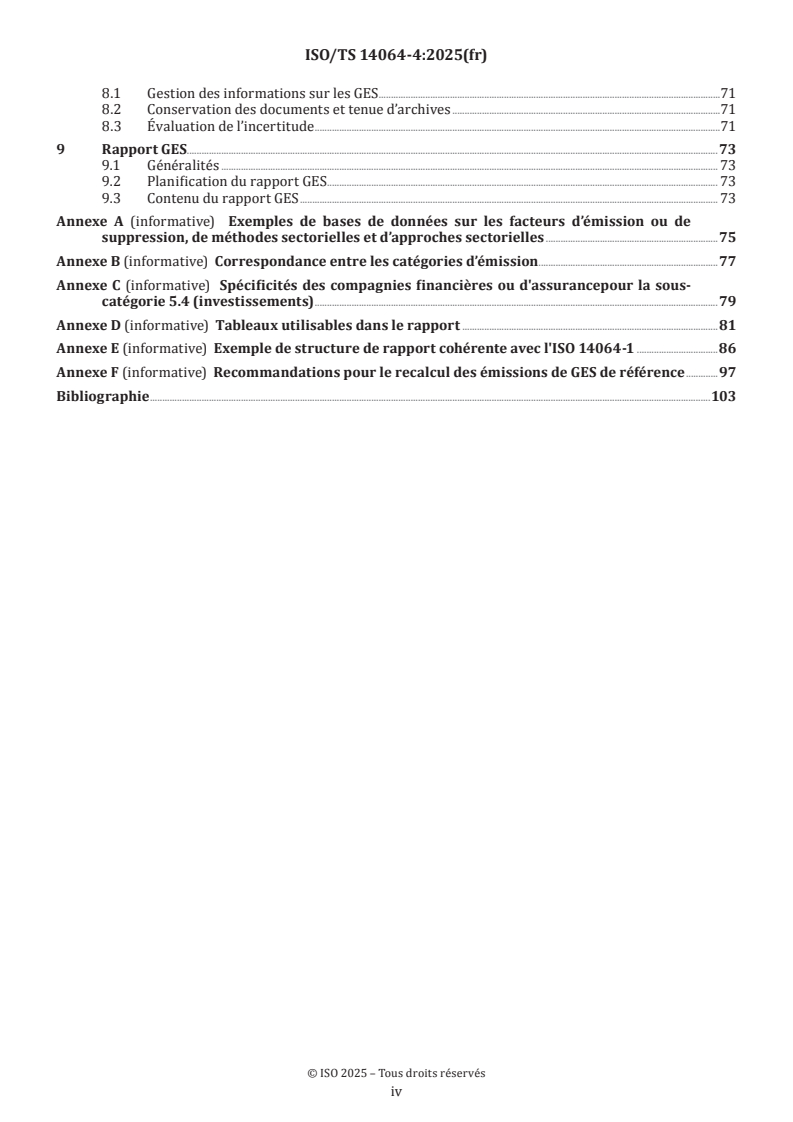
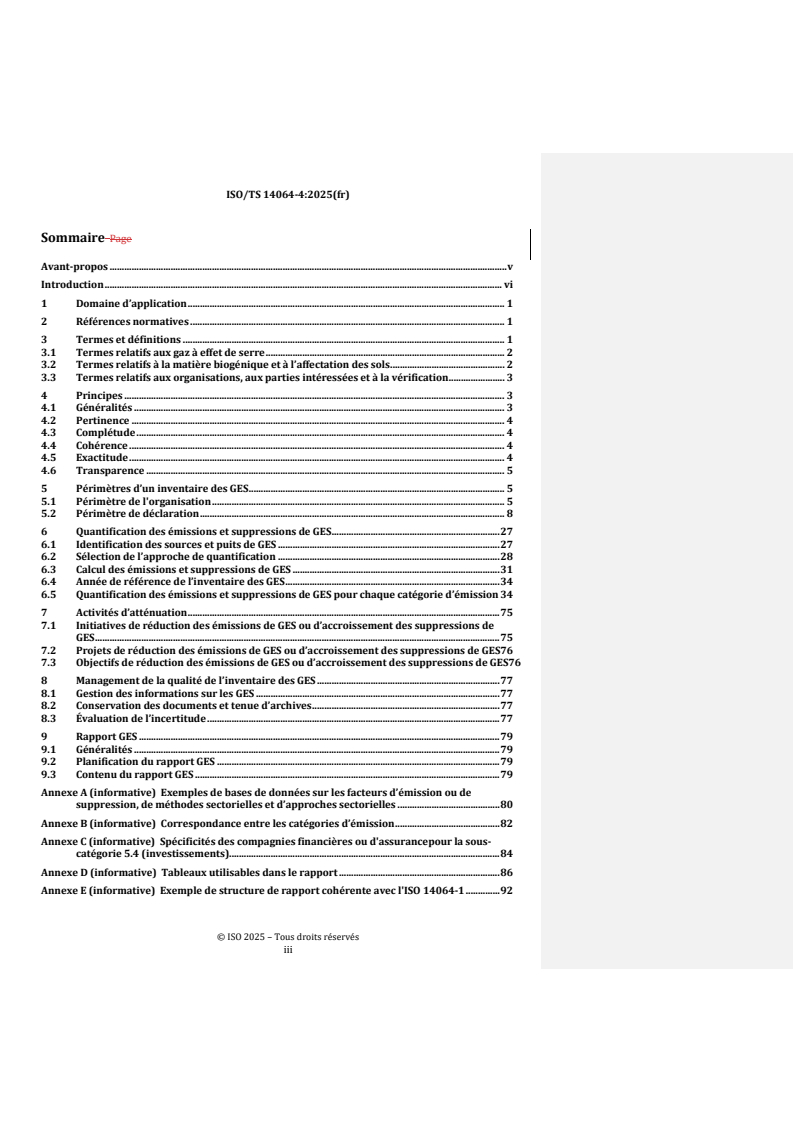
Contents Page
Foreword .v
Introduction .vi
1 Scope . 1
2 Normative references . 1
3 Terms and definitions . 1
3.1 Terms related to greenhouse gases .2
3.2 Terms related to biogenic material and land use .2
3.3 Terms relating to organizations, interested parties and verification .2
4 Principles . 3
4.1 General .3
4.2 Relevance .3
4.3 Completeness .4
4.4 Consistency .4
4.5 Accuracy .4
4.6 Transparency .4
5 GHG inventory boundaries . 4
5.1 Organizational boundaries .4
5.1.1 General .4
5.1.2 Selecting and applying the consolidation method .5
5.2 Reporting boundaries .7
5.2.1 Establishing reporting boundaries .7
5.2.2 Direct GHG emissions and removals .8
5.2.3 Indirect GHG emissions .10
5.2.4 GHG inventory categories .19
6 Quantification of GHG emissions and removals .24
6.1 Identification of GHG sources and sinks .24
6.2 Selection of quantification approach . 25
6.2.1 General . 25
6.2.2 Data selection and collection used for quantification . . 26
6.2.3 Selection or development of GHG quantification model . 26
6.3 Calculation of GHG emissions and removals .27
6.3.1 General .27
6.3.2 Specific issues applicable to several categories . . 28
6.4 Base-year GHG inventory . 30
6.4.1 Selection and establishment of base year . 30
6.4.2 Review of base-year GHG inventory . 30
6.5 Quantification of GHG emissions and removals for each category . 30
6.5.1 Category 1: Direct GHG emissions and removals . 30
6.5.2 Category 2: Indirect GHG emissions from imported energy . 38
6.5.3 Category 3: Indirect GHG emissions from transportation .41
6.5.4 Category 4: Indirect GHG emissions from products used by the organization .51
6.5.5 Category 5: Indirect GHG emissions and removals associated with the use of
products from the organization . 60
6.5.6 Category 6: Indirect GHG emissions from other sources . 65
7 Mitigation activities .65
7.1 GHG emission reduction and removal enhancement initiatives . 65
7.2 GHG emission reduction or removal enhancement projects . 65
7.3 GHG emission reduction or removal enhancement targets . 66
8 GHG inventory quality management .66
8.1 GHG information management . . 66
8.2 Document retention and record keeping . 66
8.3 Assessing uncertainty . 66
iii
9 GHG reporting .68
9.1 General . 68
9.2 Planning the GHG report . 68
9.3 GHG report content . 69
Annex A (informative) Examples of emission or removal factors databases, sectoral methods
and sectoral approaches .70
Annex B (informative) Categories correspondence .72
Annex C (informative) Specificities of financial or insurance companies for category 5.4
(investments) . 74
Annex D (informative) Tables for reporting .75
Annex E (informative) Example of reporting structure consistent with ISO 14064-1 .80
Annex F (informative) Guidance on the recalculation of reference GHG emissions .87
Bibliography .92
iv
Foreword
ISO (the International Organization for Standardization) is a worldwide federation of national standards
bodies (ISO member bodies). The work of preparing International Standards is normally carried out through
ISO technical committees. Each member body interested in a subject for which a technical committee
has been established has the right to be represented on that committee. International organizations,
governmental and non-governmental, in liaison with ISO, also take part in the work. ISO collaborates closely
with the International Electrotechnical Commission (IEC) on all matters of electrotechnical standardization.
The procedures used to develop this document and those intended for its further maintenance are described
in the ISO/IEC Directives, Part 1. In particular, the different approval criteria needed for the different types
of ISO document should be noted. This document was drafted in accordance with the editorial rules of the
ISO/IEC Directives, Part 2 (see www.iso.org/directives).
ISO draws attention to the possibility that the implementation of this document may involve the use of (a)
patent(s). ISO takes no position concerning the evidence, validity or applicability of any claimed patent
rights in respect thereof. As of the date of publication of this document, ISO had not received notice of (a)
patent(s) which may be required to implement this document. However, implementers are cautioned that
this may not represent the latest information, which may be obtained from the patent database available at
www.iso.org/patents. ISO shall not be held responsible for identifying any or all such patent rights.
Any trade name used in this document is information given for the convenience of users and does not
constitute an endorsement.
For an explanation of the voluntary nature of standards, the meaning of ISO specific terms and expressions
related to conformity assessment, as well as information about ISO’s adherence to the World Trade
Organization (WTO) principles in the Technical Barriers to Trade (TBT), see www.iso.org/iso/foreword.html.
This document was prepared by Technical Committee ISO/TC 207, Environmental management,
Subcommittee SC 7, Greenhouse gas and climate change management and related activities.
This first edition cancels and replaces ISO/TR 14069:2013, which has been technically revised.
The main changes are as follows:
— a more systematic structure has been adopted, aligned with the main clauses of ISO 14064-1:2018;
— a more detailed approach to quantification is provided, including step-by-step guidance on source
identification, data collection and emission factor selection;
— consistency with other international frameworks has been enhanced, notably the GHG Protocol and IPCC
guidelines;
— the conditions of use for this document in potentially more demanding contexts has been clarified,
with an emphasis on traceability and justification of methodological choices, supporting more robust
application.
Any feedback or questions on this document should be directed to the user’s national standards body. A
complete listing of these bodies can be found at www.iso.org/members.html.
v
Introduction
ISO 14064-1 enables organizations around the world to quantify greenhouse gas (GHG) emissions and
removals. This document uses the principles and process from ISO 14064-1 to develop guidance on
quantification and reporting of GHG for organizations.
This document is consistent with the objective of building on existing International Standards and protocols
on corporate GHG inventories. Many key concepts have been developed over a number of years.
ISO 14064-1 identifies six GHG inventory categories:
a) direct GHG emissions and removals;
b) indirect emissions from imported energy;
c) indirect emissions from transportation;
d) indirect emissions from products used by the organization;
e) indirect emissions associated with the use of products from the organization;
f) indirect emissions from other sources.
Annex B provides a table of correspondence between this document, the GHG Protocol Corporate Standard
[11]
(2010) and ISO 14064-1.
In tackling climate change, there is a convergence of interests between organizations, national and regional
regulators, and international negotiators on the need to develop methods of quantifying GHG emissions and
providing reliable tools to do so.
This document is intended to assist users in the application of ISO 14064-1, using guidance and examples, to
provide transparency in the quantification of emissions and their reporting.
This document enables an organization to:
— enhance the transparency and consistency of reported GHG emissions (direct and indirect);
— select categories and determine subcategories for ISO 14064-1 inventories;
— choose or develop the method of calculating emissions;
— differentiate, whenever necessary, the two main types of organization that are addressed in this
document:
— a facility or production site (spatially delimited) providing goods (industry) and/or services
(tertiary), belonging to a private or public organization;
— a private or public organization with several facilities/sites and/or subsidiaries, and needing
consolidation procedures;
— report GHG emissions and removals, using a simplified format to make the report easier to understand.
This document is intended to give guidance on the quantification of a GHG inventory within the selected
boundaries of an organization. The objective of this document is to offer organizations guidance on the
quantification and reporting of their GHG inventory, using a process that incorporates the principles of
relevance, completeness, consistency, accuracy and transparency. This kind of GHG inventory is expressed
as net global warming potential (GWP) in carbon dioxide equivalent (CO e).
vi
Technical Specification ISO/TS 14064-4:2025(en)
Greenhouse gases —
Part 4:
Guidance for the application of ISO 14064-1
1 Scope
This document describes the principles, concepts, and methods relating to the quantification and reporting
of direct and indirect greenhouse gas (GHG) emissions for an organization. It gives guidance on the
application of ISO 14064-1 to GHG inventory at the organization level, for the quantification and reporting of
direct emissions and indirect emissions.
This document describes for all organizations, the steps for:
— establishing organizational boundaries, in accordance with either a control approach (financial or
operational) or an equity share approach;
— establishing reporting boundaries, by identifying direct and indirect emissions to be quantified and
reported; for each category of emission, guidance is provided on specific boundaries and methodologies
for the quantification of GHG emissions and removals;
— GHG reporting: the guidance is provided to promote transparency regarding the boundaries, the
methodologies used for the quantification of direct and indirect GHG emissions and removals, and the
uncertainty of the results.
The examples and case studies presented in this document are not exclusive nor exhaustive. The values of
the emission or removal factors mentioned in the examples are given for illustrative purposes only. A non-
exhaustive list of database references is provided in Annex A.
2 Normative references
The following documents are referred to in the text in such a way that some or all of their content constitutes
requirements of this document. For dated references, only the edition cited applies. For undated references,
the latest edition of the referenced document (including any amendments) applies.
ISO 14064-1, Greenhouse gases — Part 1: Specification with guidance at the organization level for quantification
and reporting of greenhouse gas emissions and removals
3 Terms and definitions
For the purposes of this document, the terms and definitions given in ISO 14064-1 and the following apply.
ISO and IEC maintain terminology databases for use in standardization at the following addresses:
— ISO Online browsing platform: available at https:// www .iso .org/ obp
— IEC Electropedia: available at https:// www .electropedia .org/
3.1 Terms related to greenhouse gases
3.1.1
replaced emission
greenhouse gas (GHG) emission from producing functionally equivalent products or services replaced by
waste to energy or material recovery (recycled) from waste generated by the reporting company
Note 1 to entry: For material recovery, it refers to the emissions from producing the functionally equivalent virgin
material that is replaced with the recycled material produced from waste.
Note 2 to entry: For waste to energy, it refers to the emissions from producing the functionally equivalent energy that
is replaced with energy recovered from the incineration of waste.
3.1.2
downstream emission
other indirect greenhouse gas (GHG) emissions from goods and services subsequent to sale and/or delivery
by an organization and to the end of life of such goods and services
3.1.3
upstream emission
energy indirect greenhouse gas (GHG) emissions and other indirect GHG emissions from goods and services
acquired by an organization
3.1.4
double counting
accounting for greenhouse gas (GHG) emissions or removals more than once
Note 1 to entry: Double counting can occur between organizations, resulting in two or more organizations reporting
the same GHG emissions or removals. Double counting can also occur inside an organization when GHG emissions or
removals are taken into account in different categories (this type of double counting should not occur).
Note 2 to entry: Direct GHG emissions or removals reported by one organization can be reported as indirect GHG
emissions or removals by a number of other organizations resulting in two or more reporting organizations taking
ownership of the same GHG emissions or removals.
3.2 Terms related to biogenic material and land use
3.2.1
indirect land use change
iLUC
change in the use of land which is a consequence of direct land use change, but which occurs outside the
relevant boundary
Note 1 to entry: In this document, the relevant boundary is the boundary of the system under study.
Note 2 to entry: Land use change happens when there is a change in the “land-use category” as defined by the IPCC
(e.g. from forest land to cropland).
EXAMPLE If land use on a particular parcel of land changes from food production to biofuel production, land use
change can occur elsewhere to meet the demand for food. This land use change elsewhere is indirect land use change.
[SOURCE: ISO 14067:2018, 3.1.7.6]
3.3 Terms relating to organizations, interested parties and verification
3.3.1
product
any goods or service
[SOURCE: ISO 14050:2020, 3.512]
3.3.2
franchisee
organization that operates franchises and pays fees to a franchisor (3.3.3)
3.3.3
franchisor
organization that grants licences to other organizations to sell or distribute its goods or services, in return
for payments, such as royalties for the use of trademarks and other services
3.3.4
lessor
organization that receives payments from lessees
3.3.5
equity debt
holding of shares of stock on a stock market in anticipation of income from dividends and capital gains, as
the value of the stock rises, or the acquisition of equity (ownership) participation in a private (unlisted)
company or a start-up company
3.3.6
investment debt
investment in a firm or a project through the purchase of bonds or debentures, instead of through the
purchase of common or preferred stock (ordinary or preference shares)
Note 1 to entry: This is in contrast to equity debt (3.3.5).
3.3.7
project finance
long-term financing of infrastructure and industrial projects, under the form of either equity or debt
3.3.8
debt investment
investment in the financing of property or of some endeavour, in which the investor loaning funds does not
own the property or endeavour, nor share in its profits
3.3.9
contractual instrument
type of contract between two parties for the sale and purchase of energy bundled with attributes about the
energy generation, or for unbundled attribute claims
4 Principles
4.1 General
ISO 14064-1:2018, 4.1, should be applied.
4.2 Relevance
ISO 14064-1:2018, 4.2, should be applied.
For the relevance of appropriate GHGs taken into account: the organization should determine, as appropriate
to the needs of user, the GHGs taken into account, by using the GHG definition (see ISO 14064-1) in the same
way that is used for the selection of GHG sources, sinks and reservoirs.
This selection of GHGs should also be consistent with the completeness principle (see 4.3). This GHG selection
is identified and explained in the report (see Clause 9). The selection of GHG sources, sinks and reservoirs is
independent of GHGs taken into account. This selection of gases should also be consistent throughout all the
emission categories considered inside reporting boundaries (see 5.2).
Subclause 5.2.4 provides guidance to the intended user on the relevance and selection of data and
methodologies, category by category.
4.3 Completeness
ISO 14064-1:2018, 4.3, should be applied.
Completeness refers to the need for the organization to have identified and understood all its emissions
and removals and included them within its organizational and reporting boundaries. This requires an
organization to have the necessary competencies, capacity and processes in place to ensure the effective
achievement of identification and understanding.
The principle of completeness is used with the principle of relevance to explain the choice of the GHGs
included in the GHG inventory.
ISO 14064-1:2018, Annexes B and C, can help to identify all possible sources or sinks.
4.4 Consistency
ISO 14064-1:2018, 4.4, should be applied.
Consistency is necessary both for the organization’s internal and external comparisons.
Internal comparisons deal with period-to-period comparisons, in order to evaluate the potential results of
decided and/or implemented directed actions. It also deals with internal comparisons between departments
or subsidiaries within the organization.
For external comparisons, the GHG inventory should be presented in a manner that enables the users to
analyse the changes in the organization’s levels of emissions and removals over time.
4.5 Accuracy
ISO 14064-1:2018, 4.5, should be applied.
Accuracy refers to the need for an organization to provide information regarding its emissions and removals
that has a high degree of accuracy, a low margin of uncertainty, and is free of bias as far as is practicable in
order for users to make decisions with a high degree of confidence. The accuracy of quantitative information
may depend on specific sampling methods and qualitative information but is subject to a level of uncertainty.
4.6 Transparency
ISO 14064-1:2018, 4.6, should be applied.
Transparency refers to the need for an organization to disclose sufficient and appropriate GHG-related
information relevant to the processes, procedures and assumptions embodied in the reported information
to allow users to make decisions with reasonable confidence.
5 GHG inventory boundaries
5.1 Organizational boundaries
5.1.1 General
ISO 14064-1:2018, 5.1, should be applied.
An organization engaged in setting its organizational boundaries first establishes the objective of the GHG
inventory and then examines its mission, goals, operations and facilities to determine the GHG sources
which it can control and those which it can influence. The objective of its inventory is used to determine the
organizational boundaries.
If the objective is to calculate the GHG inventory of the whole organization, the organization should carefully
analyse its current organizational boundaries and consolidation methods, which are already in place for
financial accounting. If these organizational boundaries are suitable for the GHG inventory objectives and
are explained and followed consistently, the organization should consider using these financial boundaries
and consolidation methods.
If the organization wholly owns and operates all its operations, its organizational boundaries are the same
whichever consolidation method is used. In this case, the organization simply quantifies and reports all
emissions from each of its wholly owned operations.
For organizations with jointly owned operations, the organizational boundaries differ depending on the
consolidation method used (control or equity share).
5.1.2 Selecting and applying the consolidation method
5.1.2.1 General
Each consolidation method (equity share or control) has advantages and disadvantages. The operational and
financial control methods can best facilitate performance tracking of GHG management policies. However,
these do not always fully reflect the financial risks and opportunities associated with climate change,
compromising financial risk management. On the other hand, the equity share method best facilitates
financial risk management by reflecting the full financial risks and opportunities associated with climate
change, and is less subject to interpretation, but can be less effective at tracking the operational performance
of GHG management policies.
If both methods are equally applicable and meet the organization’s objectives, preference should be given to
the consolidation approach that follows the financial accounting rules already in place, in order to link GHG
emissions reporting with actions to improve GHG management.
NOTE Most companies use the control approach.
In some cases, the consolidation methods already in place for the organization’s financial accounting are not
always suitable for determining the GHG inventory of the organization. In these circumstances, a specific
definition of financial or operational control can be needed and reported in the GHG inventory.
The concepts described in 5.1.2.2 and 5.1.2.3 are derived from the International Financial Reporting
[9]
Standards (IFRS) .
If the organization is a franchisor (i.e. an organization that grants licences to other entities to sell or
distribute its goods or services, in return for payments, such as royalties for the use of trademarks and other
services), then it should include all its franchisees within its reporting boundaries.
5.1.2.2 Equity share consolidation method
Using the equity share consolidation method leads to an account of emissions for the consolidated entities
up to the ownership percentage of the reporting organization. This type of consolidation is rarely adopted
in financial accounting, so that it is not recommended to adopt it for GHG reporting purposes, in order to
remain as consistent as possible with financial reporting.
Equity share reflects the extent of the rights an organization has to the risks and rewards from an operation
based on its equity interest. Equity share is therefore the same as the ownership percentage.
NOTE In special cases, if the ownership percentage is below the economic interest, equity share is re-evaluated
[9]
(see IFRS rules).
A subsidiary is identified by the share of equity held in it by its parent organization. The equity share
communicates the stewardship of management in carrying out its responsibilities related to the subsidiary
more clearly than if the investments were accounted for on the basis of direct equity interest.
A parent organization should determine the degree of equity investment (more than 1 %) it has in its
subsidiaries to assist in defining its organizational boundaries.
The legal status of a subsidiary is independent of the control affiliation for the purposes of defining the
organization’s boundaries. Any change in equity share is a reason to reconsider the organizational
boundaries. When a subsidiary is excluded from consolidation, its shares are recorded as “equity” in
subcategory 5.4 of indirect emissions related to the use of products (see 6.5.5.4).
After the organizational boundaries are defined, the GHG inventory of the reporting organization includes
the equity share portion of GHG emissions of the consolidated subsidiaries. Therefore, assuming the
reporting organization is the parent organization, its GHG inventory includes the GHG emissions of the
parent organization and the emissions from its subsidiaries up to the representative portion of its interests.
EXAMPLE Parent organization A holds 30 % of the shares from organization B. The emissions from organizations A
and B are shown in Table 1. The consolidated results are shown in Table 2.
Table 1 — Values of emissions from parent organization A and subsidiary B
Emissions Parent organization A Subsidiary B 30 %
(emissions in tCO e) (emissions in tCO e)
2 2
Direct emissions 1 000 500 150
Energy indirect emissions 500 20 6
Other indirect emissions 8 000 7 000 2 100
Table 2 — Consolidated results for the GHG inventory of organization A
(equity share consolidation method)
Consolidation Emissions
tCO e
Direct emissions 1 150
Energy indirect emissions 506
Other indirect emissions 10 100
5.1.2.3 Control consolidation method
Using the control consolidation method leads to the account including 100 % of emissions of consolidated
entities which are under the control of the reporting organization.
IFRS defines control as the power to govern the financial and operating policies of an organization so as to
obtain benefits from its activities.
This definition of control encompasses both the notion of governance and the economic consequence of that
governance (i.e. benefits and risks). “Power to govern” implies having the capacity or ability to govern the
decision-making process through the selection of financial and operational policies.
As a general rule, control of an entity is presumed when the parent organization owns more than half of the
voting power of the entity either directly or indirectly through subsidiaries.
When the parent organization owns half or less of the shares of an entity, control may occur in the
following cases:
— extended voting rights over passing the majority by virtue of an agreement with other investors;
— power to govern the financial and operating policies of the entity under a statute or an agreement
(e.g. local authorities’ sharing entities or joint venture company);
— power to cast, appoint or remove the majority of the members of the board of directors (and other
stewardship committees);
— control based on contracts, where control means the right, under contractual or statutory provisions,
to exercise authority in an organization, whether the authority is a majority or minority shareholder of
this organization; a parent organization has the ability to use or direct the use of assets in the same way
it controls its own assets;
EXAMPLE 1 The parent organization can be a shareholder or a minority shareholder and be entrusted with
the effective management of an entity.
— control de facto.
In some cases, the organization can run sustainable financial and operating policies of another organization,
although it does not hold majority voting rights or does not have a formal contract to exercise a dominant
influence. The basis for the control should be explained.
An example of de facto control applies when the representatives of the parent organization are the top
management leaders of an entity. In such a case, the entity should be consolidated even if the parent
organization has no majority voting rights.
Explanation and disclosure should be provided in determining whether an organization controls another.
Once the organizational boundaries of the organization are defined, the parent organization should include
100 % of GHG emissions of the consolidated entities.
EXAMPLE 2 Parent organization A holds 70 % of voting rights from organization B (control explained). The
emissions from organizations A and B are shown in Table 3. The consolidated results are shown in Table 4.
Table 3 — Values of emissions from parent organization A and subsidiary B
Emissions Parent organization A Subsidiary B
(emissions in tCO e) (emissions in tCO e)
2 2
Direct emissions 1 000 500
Energy indirect emissions 500 20
Other indirect emissions 8 000 7 000
Table 4 — Consolidated results for the GHG inventory of organization A
(control consolidation method)
Consolidation Emissions
tCO e
Direct emissions 1 500
Energy indirect emissions 520
Other indirect emissions 15 000
5.2 Reporting boundaries
5.2.1 Establishing reporting boundaries
ISO 14064-1:2018, 5.2.1, should be applied.
GHG emissions and removals should be divided into direct and indirect emissions and removals in order
to help the organization to understand better those emissions and removals to better meet the needs of
the intended users (e.g. customers, suppliers, investors, governments, NGOs). This facilitates transparency
on double counting in the same supply chains that are part of different GHG inventories. Double counting
cannot be avoided between reporting organizations having activities on the same supply chain.
Indirect emissions and removals should be broken down into the following five categories that refer to
distinct practical items:
— imported energy;
— transportation;
— products (and services) used by the organization;
— use of products (and services) from the organization;
— other sources.
Further subdivision should be done by the organization for both direct and indirect GHG emissions and
removals, according to the subcategories detailed in 5.2.2 and 5.2.3.
GHG emissions and removals are classified into the 22 subcategories detailed in 5.2.2 and 5.2.3. Each
emission can only belong to one subcategory.
Additional information on sector-specific requirements regarding monitoring and reporting of GHG
emissions can be available from sector-specific guidelines or standards and can help to achieve the principles
of completeness, relevance and consistency.
NOTE Some categories can include emissions that occurred before or will occur after the reporting year
(e.g. emissions from previously made purchased products (before) or emissions from the use of sold products
(beyond)). With a view to account for all emissions related to the activities of the reporting organization, these
emissions are also considered in the reporting year in which the activity is recorded.
Clause 6 gives indications for the quantification of GHG emissions and removals for each of these categories.
5.2.2 Direct GHG emissions and removals
5.2.2.1 General
ISO 14064-1:2018, 5.2.2 and B.2.1, should be applied.
This category may be further subdivided, depending on the intended user or other factors. If so, its
subcategories should be given priority.
5.2.2.2 Category 1: Direct GHG emissions and removals
5.2.2.2.1 Subcategory 1.1: Direct emissions from stationary combustion
The consequence of combustion of any type of fuel (fossil or biomass) combusted in stationary (fixed)
equipment, such as heaters, gas turbines and boilers. This can be done to generate electricity, heat,
mechanical work and steam.
5.2.2.2.2 Subcategory 1.2: Direct emissions from mobile combustion
The consequence of fuel combusted in transport equipment, such as motor vehicles, trucks, ships, aircraft,
locomotives and fork lift trucks.
In general, emissions from vehicles not included within the organizational boundaries should be reported as
“category 3: indirect GHG emissions from transportation” arising from business travel, employee commuting,
client or visitor transport, upstream leased assets, etc., except in the following cases:
— Case 1: For an organization with a core business oriented to transport service that operates vehicles
owned by another organization (e.g. in public transport vehicles owned by a local authority but operated
by a private company or similar configurations), this activity should be considered as category 5 (indirect
GHG emissions associated with the use of products from the organization) because the activity should
be predominantly considered as a service provided instead of category 3 (indirect GHG emissions from
transportation).
— Case 2: GHG emissions resulting from vehicles and trucks operated by owner-drivers (e.g. a taxi, courier
or freight company) should be reported as direct emissions of the company where the vehicles are
branded by the company.
5.2.2.2.3 Subcategory 1.3: Direct process emissions and removals from industrial processes
Emissions from biological, mechanical or other activities that are not coming from the direct combustion of
fossil fuels, leaks from equipment, storage and transportation systems or leaks from reservoirs and injection
wells. The emissions sources are within the organizational boundaries of the reporting organization.
Examples of industrial processes that result in direct process emissions include, but are not limited to,
cement and lime production, chemical production, manufacturing, oil and gas refining, and non-combustion
processes involving the avoidance, replacement, destruction, decomposition or mitigation of industrial GHG
emissions (e.g. N O) and purification processes associated with carbon capture and storage (e.g. amine
solution capture systems).
5.2.2.2.4 Subcategory 1.4: Direct fugitive emissions from the release of GHG in anthropogenic systems
Direct fugitive emissions can come from:
— systems that extract, process, store and deliver fossil fuels (e.g. flanges, valves, unions and threaded
connections);
— equipment leaks (e.g. cooling systems);
— agricultural processes (e.g. putrefaction and fermentation, manure, livestock, application of nitrogen
fertilizers);
— the uncontrolled decomposition of waste material from sources such as landfills, composting facilities,
wastewater treatment and other waste management processes.
Emissions from flaring or venting are quantified as direct emissions. Emissions from flaring and venting can
be unintentional or intentional. Examples include designed releases of CH or CO containing natural gas or
4 2
hydrocarbon gas (not including stationary combustion flue gas) into the atmosphere through seals or vent
pipes, equipment blowdown for maintenance and direct venting of gas used to power equipment (such as
pneumatic devices).
5.2.2.2.5 Subcategory 1.5: Direct emissions and removals from land use, land use change and
forestry (LULUCF)
This subcategory covers all GHGs, from living biomass to organic matter in soils. According to IPCC
[10]
Guidelines , emissions can be assessed in six main lan
...
Spécification
technique
ISO/TS 14064-4
Première édition
Gaz à effet de serre —
2025-11
Partie 4:
Lignes directrices pour l’application
de l’ISO 14064-1
Greenhouse gases —
Part 4: Guidance for the application of ISO 14064-1
Numéro de référence
DOCUMENT PROTÉGÉ PAR COPYRIGHT
© ISO 2025
Tous droits réservés. Sauf prescription différente ou nécessité dans le contexte de sa mise en œuvre, aucune partie de cette
publication ne peut être reproduite ni utilisée sous quelque forme que ce soit et par aucun procédé, électronique ou mécanique,
y compris la photocopie, ou la diffusion sur l’internet ou sur un intranet, sans autorisation écrite préalable. Une autorisation peut
être demandée à l’ISO à l’adresse ci-après ou au comité membre de l’ISO dans le pays du demandeur.
ISO copyright office
Case postale 401 • Ch. de Blandonnet 8
CH-1214 Vernier, Genève
Tél.: +41 22 749 01 11
E-mail: copyright@iso.org
Web: www.iso.org
Publié en Suisse
ii
Sommaire Page
Avant-propos .v
Introduction .vi
1 Domaine d’application . 1
2 Références normatives . 1
3 Termes et définitions . 1
3.1 Termes relatifs aux gaz à effet de serre .2
3.2 Termes relatifs à la matière biogénique et à l’affectation des sols .2
3.3 Termes relatifs aux organisations, aux parties intéressées et à la vérification .3
4 Principes . 3
4.1 Généralités .3
4.2 Pertinence .3
4.3 Complétude .4
4.4 Cohérence .4
4.5 Exactitude .4
4.6 Transparence .4
5 Périmètres d’un inventaire des GES . 5
5.1 Périmètre de l'organisation .5
5.1.1 Généralités .5
5.1.2 Choix et application de la méthode de consolidation .5
5.2 Périmètre de déclaration . .8
5.2.1 Définition du périmètre de déclaration .8
5.2.2 Émissions et suppressions directes de GES.8
5.2.3 Émissions indirectes de GES .10
5.2.4 Catégories d’émission pour les inventaires de GES .21
6 Quantification des émissions et suppressions de GES .26
6.1 Identification des sources et puits de GES . 26
6.2 Sélection de l’approche de quantification .27
6.2.1 Généralités .27
6.2.2 Sélection et collecte des données utilisées pour la quantification . 28
6.2.3 Sélection ou développement d’un modèle de quantification des GES . 29
6.3 Calcul des émissions et suppressions de GES . 29
6.3.1 Généralités . 29
6.3.2 Questions spécifiques applicables à plusieurs catégories d’émission. 30
6.4 Année de référence de l’inventaire des GES .32
6.4.1 Sélection et établissement de l’année de référence .32
6.4.2 Revue de l’inventaire des GES sur l’année de référence .32
6.5 Quantification des émissions et suppressions de GES pour chaque catégorie d’émission. 33
6.5.1 Catégorie d’émission 1: Émissions et suppressions directes de GES . 33
6.5.2 Catégorie d’émission 2: Émissions indirectes de GES dues à l’énergie importée .41
6.5.3 Catégorie d’émission 3: Émissions indirectes de GES dues au transport . 44
6.5.4 Catégorie d’émission 4: Émissions indirectes de GES dues aux produits utilisés
par l’organisation . 55
6.5.5 Catégorie d’émission 5: Émissions et suppressions indirectes de GES associées à
l’utilisation de produits de l’organisation . 65
6.5.6 Catégorie d’émission 6: Émissions indirectes de GES dues à d’autres sources .70
7 Activités d’atténuation .70
7.1 Initiatives de réduction des émissions de GES ou d’accroissement des suppressions de
GES .70
7.2 Projets de réduction des émissions de GES ou d’accroissement des suppressions de GES .70
7.3 Objectifs de réduction des émissions de GES ou d’accroissement des suppressions de
GES .71
8 Management de la qualité de l’inventaire des GES .71
iii
8.1 Gestion des informations sur les GES .71
8.2 Conservation des documents et tenue d’archives .71
8.3 Évaluation de l’incertitude .71
9 Rapport GES.73
9.1 Généralités . 73
9.2 Planification du rapport GES . 73
9.3 Contenu du rapport GES . 73
Annexe A (informative) Exemples de bases de données sur les facteurs d’émission ou de
suppression, de méthodes sectorielles et d’approches sectorielles .75
Annexe B (informative) Correspondance entre les catégories d’émission .77
Annexe C (informative) Spécificités des compagnies financières ou d'assurancepour la sous-
catégorie 5.4 (investissements) .79
Annexe D (informative) Tableaux utilisables dans le rapport .81
Annexe E (informative) Exemple de structure de rapport cohérente avec l'ISO 14064-1 .86
Annexe F (informative) Recommandations pour le recalcul des émissions de GES de référence .97
Bibliographie .103
iv
Avant-propos
L’ISO (Organisation internationale de normalisation) est une fédération mondiale d’organismes nationaux
de normalisation (comités membres de l’ISO). L’élaboration des Normes internationales est en général
confiée aux comités techniques de l’ISO. Chaque comité membre intéressé par une étude a le droit de faire
partie du comité technique créé à cet effet. Les organisations internationales, gouvernementales et non
gouvernementales, en liaison avec l’ISO participent également aux travaux. L’ISO collabore étroitement avec
la Commission électrotechnique internationale (IEC) en ce qui concerne la normalisation électrotechnique.
Les procédures utilisées pour élaborer le présent document et celles destinées à sa mise à jour sont
décrites dans les Directives ISO/IEC, Partie 1. Il convient, en particulier, de prendre note des différents
critères d’approbation requis pour les différents types de documents ISO. Le présent document a
été rédigé conformément aux règles de rédaction données dans les Directives ISO/IEC, Partie 2 (voir
www.iso.org/directives).
L’ISO attire l’attention sur le fait que la mise en application du présent document peut entraîner l’utilisation
d’un ou de plusieurs brevets. L’ISO ne prend pas position quant à la preuve, à la validité et à l’applicabilité de
tout droit de brevet revendiqué à cet égard. À la date de publication du présent document, l’ISO n’avait pas
reçu notification qu’un ou plusieurs brevets pouvaient être nécessaires à sa mise en application. Toutefois,
il y a lieu d’avertir les responsables de la mise en application du présent document que des informations
plus récentes sont susceptibles de figurer dans la base de données de brevets, disponible à l’adresse
www.iso.org/brevets. L’ISO ne saurait être tenue pour responsable de ne pas avoir identifié tout ou partie de
tels droits de propriété.
Les appellations commerciales éventuellement mentionnées dans le présent document sont données pour
information, par souci de commodité, à l’intention des utilisateurs et ne sauraient constituer un engagement.
Pour une explication de la nature volontaire des normes, la signification des termes et expressions
spécifiques de l’ISO liés à l’évaluation de la conformité, ou pour toute information au sujet de l’adhésion de
l’ISO aux principes de l’Organisation mondiale du commerce (OMC) concernant les obstacles techniques au
commerce (OTC), voir www.iso.org/avant-propos.
Le présent document a été élaboré par le comité technique ISO/TC 207, Management environnemental, sous-
comité SC 7, Gestion des gaz à effet de serre et du changement climatique et activités associées.
Cette première édition annule et remplace l’ISO/TR 14069:2013, qui a fait l’objet d’une révision technique.
Les principales modifications sont les suivantes:
— une structure plus systématique a été adoptée, alignée sur les principaux articles de l’ISO 14064-1:2018;
— une approche plus détaillée a été adoptée en matière de quantification, y compris des recommandations
étape par étape pour l’identification des sources, la collecte des données et la sélection des facteurs
d’émission;
— la cohérence a été améliorée vis-à-vis des autres cadres internationaux, notamment le Protocole sur les
GES et les lignes directrices du GIEC;
— les conditions d’utilisation du présent document dans des contextes potentiellement plus exigeants
ont été clarifiées, en mettant l’accent sur la traçabilité et la justification des choix méthodologiques afin
de renforcer la robustesse de l’application.
Il convient que l’utilisateur adresse tout retour d’information ou toute question concernant le présent
document à l’organisme national de normalisation de son pays. Une liste exhaustive desdits organismes se
trouve à l’adresse www.iso.org/fr/members.html.
v
Introduction
L'ISO 14064-1 permet aux organisations du monde entier de quantifier les émissions des gaz à effet de serre
(GES) et leur suppression. Le présent document utilise les principes et la méthode énoncés dans l'ISO 14064-1
pour développer des recommandations pour la quantification et la déclaration des GES par les organisations.
Le présent document est cohérent quant à l’objectif de s’appuyer sur les Normes internationales existantes
ainsi que sur les protocoles relatifs aux inventaires de GES des entreprises. De nombreux concepts clés ont
été développés au cours de ces dernières années.
L’ISO 14064-1 identifie six catégories d’émissions pour les inventaires de GES:
a) les émissions et suppressions directes de GES;
b) les émissions indirectes dues à l’énergie importée;
c) les émissions indirectes dues au transport;
d) les émissions indirectes dues aux produits utilisés par l’organisation;
e) les émissions indirectes associées à l’utilisation des produits de l’organisation;
f) les émissions indirectes dues à d’autres sources.
L’Annexe B fournit un tableau de correspondance entre le présent document, la Norme d’entreprise du
[11]
protocole sur les GES (2010) et l’ISO 14064-1.
Dans la lutte contre le changement climatique, il y a une convergence d'intérêts entre les organisations,
les régulateurs nationaux et régionaux et les interlocuteurs internationaux sur la nécessité de développer
des méthodes permettant de quantifier les émissions de GES et de fournir des outils fiables pour y parvenir.
Le présent document est destiné à aider les utilisateurs dans l'application de l’ISO 14064-1 en leur
fournissant des recommandations et des exemples, afin d'apporter de la transparence dans la quantification
des émissions et dans leur déclaration.
Le présent document permettra à l’organisation:
— d’améliorer la transparence et la cohérence des émissions (directes et indirectes) de GES déclarées;
— de sélectionner les catégories d’émission et de déterminer les sous-catégories pour les inventaires
réalisés selon l’ISO 14064-1;
— de choisir ou d'élaborer la méthode de calcul des émissions;
— de faire la distinction, si nécessaire, entre les deux principaux types d'organisation concernées par le
présent document:
— une installation ou un site de production (délimités dans l'espace) fournissant des biens (industrie)
et/ou des services (tertiaire), appartenant à une organisation privée ou publique;
— une organisation privée ou publique avec plusieurs installations/sites et/ou filiales et nécessitant
des méthodes de consolidation;
— de déclarer les émissions de GES et leurs suppressions, en utilisant un format simplifié pour faciliter
la compréhension du rapport.
Le but du présent document est de fournir des recommandations pour la quantification de l’inventaire des
émissions de GES dans les périmètres choisis d'une organisation. Le but du présent document est de fournir
aux organisations des recommandations pour la quantification et la déclaration de leur inventaire des GES,
à l'aide d'un processus intégrant les principes de pertinence, de complétude, de cohérence, d'exactitude et de
transparence. Ce type d'inventaire des GES est exprimé sous la forme d'un potentiel net de réchauffement
global (PRG) en équivalent-dioxyde de carbone (CO e).
vi
Spécification technique ISO/TS 14064-4:2025(fr)
Gaz à effet de serre —
Partie 4:
Lignes directrices pour l’application de l’ISO 14064-1
1 Domaine d’application
Le présent document décrit les principes, les concepts et les méthodes se rapportant à la quantification et
à la rédaction de rapport sur les émissions directes et indirectes de gaz à effet de serre (GES) par une
organisation. Il fournit des recommandations pour l'application de l'ISO 14064-1 aux inventaires de GES,
au niveau des organisations, pour la quantification et la rédaction de rapport sur les émissions directes et
les émissions indirectes.
Le présent document décrit, pour toutes les organisations, les étapes destinées à:
— définir le périmètre organisationnel, selon une approche fondée sur un contrôle (financier ou opérationnel)
ou sur la participation au capital;
— établir le périmètre de la déclaration, en identifiant les émissions directes et indirectes à quantifier et
déclarer; pour chaque catégorie d’émission, des recommandations sont fournies sur les périmètres et
les méthodologies spécifiques de quantification des émissions et suppressions de GES;
— établir le rapport GES: des recommandations sont données pour promouvoir la transparence concernant
les périmètres, les méthodologies utilisées pour la quantification des émissions directes et indirectes
de GES et leur suppression, ainsi que l'incertitude des résultats.
Les exemples et les études de cas présentés dans ce document ne sont ni exclusifs ni exhaustifs. Les valeurs
des facteurs d'émission ou de suppression mentionnées dans les exemples sont uniquement données à des
fins d'illustration. L'Annexe A fournit une liste non exhaustive de références de bases de données.
2 Références normatives
Les documents suivants sont cités dans le texte de sorte qu’ils constituent, pour tout ou partie de leur
contenu, des exigences du présent document. Pour les références datées, seule l’édition citée s’applique. Pour
les références non datées, la dernière édition du document de référence s'applique (y compris les éventuels
amendements).
ISO 14064-1, Gaz à effet de serre — Partie 1: Spécifications et lignes directrices, au niveau des organismes, pour
la quantification et la déclaration des émissions et des suppressions des gaz à effet de serre
3 Termes et définitions
Pour les besoins du présent document, les termes et les définitions de l’ISO 14064-1 ainsi que les suivants
s’appliquent.
L’ISO et l’IEC tiennent à jour des bases de données terminologiques destinées à être utilisées en normalisation,
consultables aux adresses suivantes:
— ISO Online browsing platform: disponible à l’adresse https:// www .iso .org/ obp
— IEC Electropedia: disponible à l’adresse https:// www .electropedia .org/
3.1 Termes relatifs aux gaz à effet de serre
3.1.1
émission remplacée
émission de gaz à effet de serre (GES) provenant de la production de produits ou services fonctionnellement
équivalents, remplacée par la valorisation énergétique ou la valorisation matière (recyclage) des déchets
générés par la société déclarante
Note 1 à l'article: La valorisation matière se rapporte aux émissions provenant de la production de matière vierge
fonctionnellement équivalente qui est remplacée par la matière recyclée produite à partir des déchets.
Note 2 à l'article: La valorisation énergétique des déchets se réfère aux émissions provenant de l’énergie
fonctionnellement équivalente qui est remplacée par l’énergie récupérée à partir de l’incinération des déchets.
3.1.2
émission en aval
autres émissions indirectes de gaz à effet de serre (GES) provenant de biens et de services après la vente et/
ou la livraison par une organisation et provenant de la fin du cycle de vie de ces biens et services
3.1.3
émission en amont
émissions indirectes de gaz à effet de serre (GES) liées à l'énergie et autres émissions indirectes de GES
provenant de biens et de services acquis par une organisation
3.1.4
double comptage
au moins deux fois le même comptage d'émissions ou de suppressions de gaz à effet de serre (GES)
Note 1 à l'article: Le double comptage peut avoir lieu entre des organisations et entraîner une déclaration des mêmes
émissions ou suppressions de GES par deux organisations ou plus. Le double comptage peut également avoir lieu au
sein d'une organisation lorsque les émissions ou suppressions de GES sont prises en compte dans différentes catégories
d’émission (il convient que ce type de double comptage n’ait pas lieu).
Note 2 à l'article: Les émissions ou suppressions directes de GES déclarées par une organisation peuvent être déclarées
comme des émissions ou suppressions indirectes de GES par plusieurs autres organisations, ce qui entraîne que deux
organisations déclarantes ou plus ont la propriété des mêmes émissions ou suppressions de GES.
3.2 Termes relatifs à la matière biogénique et à l’affectation des sols
3.2.1
changement indirect d’affectation des sols
iLUC
changement dans l’utilisation des sols, qui a pour cause un changement direct d’affectation des sols, mais qui
se produit à l’extérieur des frontières considérées
Note 1 à l'article: Dans le présent document “les frontières considérées” se rapporte à la frontière au système objet
de l’étude.
Note 2 à l'article: Un changement d’affectation des sols se produit lorsqu’il y a un changement de catégorie d’affectation
des sols selon la définition du GIEC (par exemple, d’un sol forestier à un sol de culture).
EXEMPLE Si l’affectation des sols sur une parcelle donnée passe de la production de nourriture à la production
de biocarburant, il peut se produire ailleurs un changement d’affectation des sols pour répondre à la demande en
nourriture. Ce changement qui se produit ailleurs est un changement indirect d’affectation des sols.
[SOURCE: ISO 14067:2018, 3.1.7.6]
3.3 Termes relatifs aux organisations, aux parties intéressées et à la vérification
3.3.1
produit
tout bien ou service
[SOURCE: ISO 14050:2020, 3.5.12]
3.3.2
franchisé
organisation qui exploite des franchises et règles des honoraires à un franchiseur (3.3.3)
3.3.3
franchiseur
organisation qui cède des licences à d'autres organisations afin de vendre ou distribuer ses biens ou ses
services contre rémunération, telle que des redevances pour l'utilisation de marques et d'autres services
3.3.4
bailleur
organisation qui perçoit des règlements de locataires
3.3.5
dette en action ou participation
détention d’actions sur un marché boursier en anticipant un bénéfice découlant des dividendes et des plus-
values lorsque la valeur de l’action augmente, ou acquisition d’une participation au capital social (propriété)
d’une entreprise privée (non cotée) ou d’une jeune pousse
3.3.6
dette en obligation
investissement engagé dans une firme ou un projet par l’achat de titres obligataires plutôt que d’actions
ordinaires ou préférentielles
Note 1 à l'article: Ce terme s’oppose à la dette en action ou participation (3.3.5).
3.3.7
financement de projet
financement à long terme de projets d’infrastructure et de projets industriels, sous forme de titre de capital
ou de titre de créance
3.3.8
dette d'investissement
investissement permettant de financer une propriété ou une activité pour lequel l'investisseur prêtant
les fonds ne détient pas la propriété ou l'activité et ne prend pas part à leurs résultats
3.3.9
instrument contractuel
type de contrat conclu entre deux parties pour la vente et l’achat groupés d’énergie avec des attributs
concernant la production d’énergie, ou pour des revendications d’attributs non regroupé
4 Principes
4.1 Généralités
Il convient que l’ISO 14064-1:2018, 4.1, s’applique.
4.2 Pertinence
Il convient que l’ISO 14064-1:2018, 4.2, s’applique.
En ce qui concerne la pertinence des GES à prendre en compte: il convient que l'organisation détermine,
selon les besoins spécifiques de l'utilisateur, les GES pris en compte, en utilisant la définition des GES
(voir ISO 14064-1) de la même manière que celle utilisée pour le choix des sources, puits et réservoirs de
GES.
Il convient que le choix des GES soit également cohérent avec le principe de complétude (voir 4.3). Ce choix
de GES est identifié et expliqué dans le rapport (voir Article 9). Le choix des sources, puits et réservoir de GES
est indépendant des GES pris en compte. Il convient également que ce choix des gaz soit cohérent pour toutes
les catégories d’émission considérées à l'intérieur du périmètre de la déclaration (voir 5.2).
Le paragraphe 5.2.4 fournit à l'utilisateur concerné des recommandations sur la pertinence et le choix des
données et des méthodologies, catégorie d’émission par catégorie d’émission.
4.3 Complétude
Il convient que l’ISO 14064-1:2018, 4.3, s’applique.
La complétude se rapporte à la nécessité pour l'organisation d'identifier et de comprendre de façon
exhaustive toutes ses émissions et suppressions et de les inclure dans son périmètre organisationnel et
son périmètre de déclaration. Une organisation doit donc disposer des compétences, de la capacité et des
processus nécessaires pour assurer une identification et une compréhension effectives.
Le principe de complétude est utilisé conjointement avec le principe de pertinence pour expliquer le choix
des GES inclus dans l'inventaire des GES.
L'ISO 14064-1:2018, Annexes B et C, peut aider à identifier toutes les sources ou tous les puits possibles.
4.4 Cohérence
Il convient que l’ISO 14064-1:2018, 4.4, s’applique.
La cohérence est nécessaire pour que l'organisation puisse procéder à des comparaisons internes et externes.
Les comparaisons internes portent sur des comparaisons entre périodes, afin d'évaluer les résultats
potentiels des actions ciblées qui ont été décidées et/ou mises en œuvre. La cohérence porte également sur
des comparaisons internes entre des services ou des filiales au sein de l'organisation.
En ce qui concerne les comparaisons externes, il convient que l'inventaire des GES soit présenté de manière
à permettre aux utilisateurs d'analyser les variations dans le temps des émissions et suppressions de GES
de l’organisation.
4.5 Exactitude
Il convient que l’ISO 14064-1:2018, 4.5, s’applique.
L'exactitude se rapporte à la nécessité pour une organisation de fournir, à propos de ses émissions et
suppressions de GES, des informations qui ont, autant que possible, un haut degré d'exactitude et une faible
marge d'incertitude et qui sont exemptes de biais afin de permettre aux utilisateurs de prendre des décisions
avec un niveau de confiance élevé. L'exactitude des informations quantitatives peut dépendre des méthodes
d'échantillonnage spécifiques ainsi que des informations qualitatives, mais elle reste soumise à un certain
niveau d'incertitude.
4.6 Transparence
Il convient que l’ISO 14064-1:2018, 4.6, s’applique.
La transparence se rapporte à la nécessité pour une organisation de divulguer des informations suffisantes
et appropriées relatives aux GES, concernant les processus, les procédures et les hypothèses contenues dans
les informations déclarées, afin de permettre aux utilisateurs de prendre des décisions avec une confiance
raisonnable.
5 Périmètres d’un inventaire des GES
5.1 Périmètre de l'organisation
5.1.1 Généralités
Il convient que l’ISO 14064-1:2018, 5.1, s’applique.
Une organisation qui définit son périmètre organisationnel définit d'abord l'objectif de l'inventaire des GES
puis examine sa mission, ses objectifs, ses opérations et ses installations afin de déterminer les sources de
GES qu'il peut contrôler et celles sur lesquelles il peut avoir une influence. L'objectif de son inventaire est
utilisé pour déterminer son périmètre organisationnel.
Si l'objectif est de calculer l'inventaire des GES de l'organisation dans son ensemble, il convient que
l'organisation analyse minutieusement son périmètre organisationnel actuel et ses méthodes de consolidation
déjà définis pour la comptabilité générale. Si ce périmètre organisationnel est adapté aux objectifs de
l'inventaire des GES et s'il est expliqué et suivi de manière cohérente, il convient que l'organisation envisage
l'utilisation de ce périmètre financier et de ces méthodes de consolidation.
Si l'organisation détient et contrôle entièrement toutes ses opérations, son périmètre organisationnel
est le même, quelle que soit la méthode de consolidation utilisée. Dans ce cas, l'organisation se contente
de quantifier et de déclarer toutes les émissions provenant de chacune des opérations sur lesquelles elle
exerce un contrôle total.
Pour des organisations contrôlant des opérations détenues conjointement, le périmètre organisationnel
diffère selon la méthode de consolidation utilisée (basée sur le contrôle ou sur la part du capital).
5.1.2 Choix et application de la méthode de consolidation
5.1.2.1 Généralités
Chaque méthode de consolidation (fondée sur la part du capital ou sur le contrôle) présente des avantages
et des inconvénients. Les méthodes de contrôles financier et opérationnel peuvent être celles qui facilitent
le mieux le suivi des performances des politiques de gestion des GES. Cependant, ces méthodes ne
reflètent pas toujours totalement les opportunités et risques financiers liés au changement climatique, en
compromettant ainsi la gestion des risques financiers. En revanche, la méthode fondée sur la part du capital
est celle qui facilite le mieux la gestion des risques financiers dans la mesure où elle reflète l'ensemble des
opportunités et risques financiers liés au changement climatique et où elle est moins sujette à interprétation;
cependant, elle peut s'avérer moins efficace pour le suivi des performances opérationnelles des politiques de
gestion des GES.
Si les deux méthodes sont applicables de manière équivalente et si elles répondent aux objectifs de
l'organisation, il convient d'opter pour la méthode de consolidation qui suit les règles de comptabilité
générale déjà définies, afin de relier la déclaration des émissions de GES aux actions visant à améliorer la
gestion des GES.
NOTE La plupart des sociétés utilisent l'approche fondée sur le contrôle.
Dans certains cas, les méthodes de consolidation déjà définies pour la comptabilité générale de l'organisation
ne sont pas toujours appropriées pour la détermination de l'inventaire des GES de l'organisation. Dans ces
circonstances, une définition spécifique du contrôle financier ou opérationnel peut s’avérer nécessaire et
figurer dans l'inventaire des GES.
Les concepts décrits en 5.1.2.2 et 5.1.2.3 sont issus des normes internationales d’information financière
[9]
(IFRS) .
Si l'organisation est un franchiseur (c'est-à-dire une organisation qui cède des licences à d'autres
organisations afin de vendre ou distribuer ses biens ou ses services contre rémunération, telle que des
redevances pour l'utilisation de marques et d'autres services), il convient qu'elle inclue tous ses franchisés
dans son périmètre de déclaration.
5.1.2.2 Méthode de consolidation fondée sur la part du capital
L'utilisation de la méthode de consolidation fondée sur la part du capital implique une prise en compte des
émissions des entités consolidées à hauteur du pourcentage de leur participation au capital de l'organisation
réalisant le rapport GES. Ce type de consolidation est rarement adopté en comptabilité financière, de sorte
qu'il n'est pas recommandé de l'adopter à des fins de déclaration des GES, afin de rester aussi cohérent que
possible avec l'information financière.
La part du capital reflète les droits détenus par une organisation eu égard aux risques et rétributions liés
à une opération sur la base de sa participation. La part du capital est donc identique à la répartition de la
propriété.
NOTE Dans des cas particuliers, si la répartition de la propriété est inférieure à l'intérêt économique, la part du
[9]
capital est réévaluée (voir les règles IFRS ).
Une filiale est identifiée par la part du capital détenue par son organisation principale. La part du capital
communique la gestion de la direction en assumant ses responsabilités vis-à-vis de la filiale de façon plus
claire que si les investissements étaient pris en compte sur la base d'une participation directe.
Il convient qu'une organisation principale détermine son niveau de prise de participation (plus de 1 %) dans
ses filiales pour aider à définir son périmètre organisationnel.
La forme juridique d'une filiale est indépendante de l'affiliation de contrôle pour définir le périmètre
de l'organisation. Toute modification de la part du capital constitue un motif de réexamen du périmètre
organisationnel. Lorsqu’une filiale est exclue de la consolidation, ses parts sont comptabilisés en “capitaux
propres” dans la sous-catégorie 5.4 des émissions indirectes liées à l’utilisation des produits (voir 6.5.5.4).
Après définition du périmètre organisationnel, l'inventaire des GES de l'organisation déclarante comprend
la part du capital correspondant aux émissions de GES des filiales consolidées. Par conséquent, en supposant
que l'organisation déclarante est l'organisation principale, son inventaire des GES comprend les émissions
de GES de l'organisation principale ainsi que les émissions de ses filiales jusqu'à la part représentative de
ses intérêts.
EXEMPLE L'organisation principale A détient 30 % des parts d'une organisation B. Les émissions produites par
les organisations A et B sont présentées dans le Tableau 1. Les résultats consolidés sont présentés dans le Tableau 2.
Tableau 1 — Valeurs des émissions produites par l'organisation principale A et la filiale B
Émissions Organisation principale A Filiale B 30 %
(émissions en tCO e) (émissions en tCO e)
2 2
Émissions directes 1 000 500 150
Émissions indirectes liées à l’énergie 500 20 6
Autres émissions indirectes 8 000 7 000 2 100
Tableau 2 — Résultats consolidés pour l'inventaire des GES de l'organisation A
(méthode de consolidation fondée sur la part du capital)
Consolidation Émissions
tCO e
Émissions directes 1 150
Émissions indirectes liées à l’énergie 506
Autres émissions indirectes 10 100
5.1.2.3 Méthode de consolidation fondée sur le contrôle
L'utilisation de la méthode de consolidation fondée sur le contrôle implique la prise en compte de 100 % des
émissions provenant d'entités consolidées qui sont sous le contrôle de l'organisation réalisant le rapport
GES.
Les normes internationales d'informations financières (IFRS) définissent le contrôle comme “le pouvoir de
diriger les politiques financières et opérationnelles d'une organisation afin d'obtenir des avantages de ses
activités”.
Cette définition du contrôle englobe à la fois la notion de “pouvoir de diriger” et la conséquence économique
de ce “pouvoir de diriger” (c'est-à-dire les avantages et les risques). Le “pouvoir de diriger” implique la
capacité ou l'aptitude à diriger le processus décisionnel à travers le choix de politiques financières et
opérationnelles.
En règle générale, le contrôle d'une entité est présumé exister lorsque l'organisation principale détient,
directement ou indirectement par l'intermédiaire de filiales, plus de la moitié des droits de vote.
Lorsque l'organisation principale ne détient que la moitié ou moins des parts d'une entité, le contrôle peut
exister dans les cas suivants:
— pouvoir sur plus de la moitié des droits de vote en vertu d'un accord avec d'autres investisseurs;
— pouvoir de diriger les politiques financières et opérationnelles de l'entité en vertu d'un texte réglementaire
ou d'un contrat (par exemple, autorités locales partageant des entités ou coentreprise);
— pouvoir de réunir, de nommer ou de révoquer la majorité des membres du conseil d'administration
(et autres comités de gestion responsables);
— contrôle fondé sur des contrats, où le contrôle désigne le droit, en vertu de dispositions contractuelles
ou réglementaires, d'exercer l'autorité au sein d'une organisation, l'autorité pouvant être un actionnaire
majoritaire ou minoritaire de cette organisation; une organisation principale a la possibilité d'utiliser
des actifs ou de diriger l'utilisation d'actifs de la même manière qu'il contrôle ses propres actifs;
EXEMPLE 1 L'organisation principale peut être un actionnaire ou un actionnaire minoritaire auquel est
confiée la gestion effective d'une entité.
— contrôle de facto.
Dans certains cas, l'organisation peut conduire les politiques financières et opérationnelles pérennes d'une
autre organisation, bien qu'elle ne dispose pas de la majorité des voix ou n'ait pas conclu un contrat officiel
lui permettant d'exercer une influence dominante. Il convient d'expliquer les éléments sur lesquels se fonde
le contrôle.
Un exemple de contrôle de facto s'applique lorsque les représentants de l'organisation principale sont des
hauts responsables de la direction d'une entité. En pareil cas, il convient que l'entité soit consolidée même si
l'organisation principale ne dispose pas de la majorité des voix.
Il convient qu'une explication soit fournie et que des informations soient divulguées pour déterminer si
une organisation en contrôle une autre. Une fois que le périmètre organisationnel de l'organisation a été
défini, il convient que l'organisation principale inclue 100 % des émissions de GES des entités consolidées.
EXEMPLE 2 L'organisation principale A détient 70 % des droits de vote de l'organisation B (contrôle expliqué).
Les émissions des organisations A et B sont présentés dans le Tableau 3. Les résultats consolidés sont présentés dans
le Tableau 4.
Tableau 3 — Valeurs des émissions produites par l'organisation principale A et la filiale B
Émissions Organisation principale A Filiale B
(émissions en tCO e) (émissions en tCO e)
2 2
Émissions directes 1 000 500
Émissions indirectes liées à l’énergie 500 20
Autres émissions indirectes 8 000 7 000
Tableau 4 — Résultats consolidés pour l'inventaire des GES de l'organisation A
(méthode de consolidation fondée sur le contrôle)
Consolidation Émissions
tCO e
Émissions directes 1 500
Émissions indirectes liées à l’énergie 520
Autres émissions indirectes 15 000
5.2 Périmètre de déclaration
5.2.1 Définition du périmètre de déclaration
Il convient d’appliquer l’ISO 14064-1:2018, 5.2.1.
Il est recommandé de diviser les émissions et suppressions de GES en émissions et suppressions directes
et indirectes afin d'aider l'organisation à mieux comprendre ces émissions et suppressions et ainsi de
mieux répondre aux besoins des utilisateurs cibles (par exemple clients, fournisseurs, investisseurs,
gouvernements, ONG). Cette opération facilite la transparence sur le double comptage dans les mêmes
chaînes d'approvisionnement qui font partie de différents inventaires de GES. Le double comptage ne peut pas
être évité entre les organisations déclarantes ayant des activités sur la même chaîne d'approvisionnement.
Il convient de scinder les émissions et suppressions indirectes dans l’une des cinq catégories suivantes qui
font référence à des éléments pratiques distincts:
— l’énergie importée;
— le transport;
— les produits (et services) utilisés par l'organisation;
— l'utilisation des produits (et services) de l'organisation;
— d’autres sources.
Il convient que l'organisation procède à une subdivision supplémentaire pour les émissions et suppressions
directes et indirectes de GES, en fonction des sous-catégories détaillées en 5.2.2 et 5.2.3.
Les émissions et suppressions de GES sont classées dans les 22 sous-catégories d’émission ou de suppression
détaillées en 5.2.2 et 5.2.3. Chaque émission ne peut appartenir qu'à une seule sous-catégorie d’émission.
Des informations supplémentaires sur les exigences sectorielles concernant la surveillance et la déclaration
des émissions de GES peuvent figurer dans des directives ou des nor
...
ISO/TC 207/SC 7
Date: ISO/TS 2025-11
ISO/TC 207/SC 7Première édition
2025-11
Date: 2026-03-10
Gaz à effet de serre —
Partie 4:
Lignes directrices pour l’application de l’ISO 14064-1
Greenhouse gases —
Part 4: Guidance for the application of ISO 14064-1
ICS: 13.020.40
SPÉCIFICATION TECHNIQUE ISO/TS 14064-4:2025(fr)
DOCUMENT PROTÉGÉ PAR COPYRIGHT
Droits de reproductionTous droits réservés. Sauf prescription différente ou nécessité dans le contexte de sa mise en
œuvre, aucune partie de cette publication ne peut être reproduite ni utilisée sous quelque forme que ce soit et par aucun
procédé, électronique ou mécanique, y compris la photocopie, ou la diffusion sur l’internet ou sur un Intranetintranet,
sans autorisation écrite préalable. Une autorisation peut être demandée à l’ISO à l’adresse ci--après ou au comité membre
de l’ISO dans le pays du demandeur.
ISO copyright office
Case postaleCP 401 • • Ch. de Blandonnet 8
CH--1214 Vernier, GenèveGeneva
Tél.: Phone: + 41 22 749 01 11
E-mail: copyright@iso.org
WebWebsite: www.iso.org
Publié en Suisse
ii
Sommaire Page
Avant-propos . v
Introduction . vi
1 Domaine d’application . 1
2 Références normatives . 1
3 Termes et définitions . 1
3.1 Termes relatifs aux gaz à effet de serre . 2
3.2 Termes relatifs à la matière biogénique et à l’affectation des sols . 2
3.3 Termes relatifs aux organisations, aux parties intéressées et à la vérification . 3
4 Principes . 3
4.1 Généralités . 3
4.2 Pertinence . 4
4.3 Complétude . 4
4.4 Cohérence . 4
4.5 Exactitude . 4
4.6 Transparence . 5
5 Périmètres d’un inventaire des GES . 5
5.1 Périmètre de l'organisation . 5
5.2 Périmètre de déclaration . 8
6 Quantification des émissions et suppressions de GES . 27
6.1 Identification des sources et puits de GES . 27
6.2 Sélection de l’approche de quantification . 28
6.3 Calcul des émissions et suppressions de GES . 31
6.4 Année de référence de l’inventaire des GES . 34
6.5 Quantification des émissions et suppressions de GES pour chaque catégorie d’émission 34
7 Activités d’atténuation . 75
7.1 Initiatives de réduction des émissions de GES ou d’accroissement des suppressions de
GES . 75
7.2 Projets de réduction des émissions de GES ou d’accroissement des suppressions de GES 76
7.3 Objectifs de réduction des émissions de GES ou d’accroissement des suppressions de GES76
8 Management de la qualité de l’inventaire des GES . 77
8.1 Gestion des informations sur les GES . 77
8.2 Conservation des documents et tenue d’archives . 77
8.3 Évaluation de l’incertitude . 77
9 Rapport GES . 79
9.1 Généralités . 79
9.2 Planification du rapport GES . 79
9.3 Contenu du rapport GES . 79
Annexe A (informative) Exemples de bases de données sur les facteurs d’émission ou de
suppression, de méthodes sectorielles et d’approches sectorielles . 80
Annexe B (informative) Correspondance entre les catégories d’émission . 82
Annexe C (informative) Spécificités des compagnies financières ou d'assurancepour la sous-
catégorie 5.4 (investissements). 84
Annexe D (informative) Tableaux utilisables dans le rapport . 86
Annexe E (informative) Exemple de structure de rapport cohérente avec l'ISO 14064-1 . 92
iii
Annexe F (informative) Recommandations pour le recalcul des émissions de GES de référence110
Bibliographie . 116
iv
Avant-propos
L’ISO (Organisation internationale de normalisation) est une fédération mondiale d’organismes nationaux de
normalisation (comités membres de l’ISO). L’élaboration des Normes internationales est en général confiée
aux comités techniques de l’ISO. Chaque comité membre intéressé par une étude a le droit de faire partie du
comité technique créé à cet effet. Les organisations internationales, gouvernementales et non
gouvernementales, en liaison avec l’ISO participent également aux travaux. L’ISO collabore étroitement avec
la Commission électrotechnique internationale (IEC) en ce qui concerne la normalisation électrotechnique.
Les procédures utilisées pour élaborer le présent document et celles destinées à sa mise à jour sont décrites
dans les Directives ISO/IEC, Partie 1. Il convient, en particulier, de prendre note des différents critères
d’approbation requis pour les différents types de documents ISO. Le présent document a été rédigé
conformément aux règles de rédaction données dans les Directives ISO/IEC, Partie 2 (voir
www.iso.org/directives).
L’ISO attire l’attention sur le fait que la mise en application du présent document peut entraîner l’utilisation
d’un ou de plusieurs brevets. L’ISO ne prend pas position quant à la preuve, à la validité et à l’applicabilité de
tout droit de brevet revendiqué à cet égard. À la date de publication du présent document, l’ISO n’avait pas
reçu notification qu’un ou plusieurs brevets pouvaient être nécessaires à sa mise en application. Toutefois, il
y a lieu d’avertir les responsables de la mise en application du présent document que des informations plus
récentes sont susceptibles de figurer dans la base de données de brevets, disponible à l’adresse
www.iso.org/brevets. L’ISO ne saurait être tenue pour responsable de ne pas avoir identifié tout ou partie de
tels droits de brevet et averti de leur existence propriété.
Les appellations commerciales éventuellement mentionnées dans le présent document sont données pour
information, par souci de commodité, à l’intention des utilisateurs et ne sauraient constituer un engagement.
Pour une explication de la nature volontaire des normes, la signification des termes et expressions spécifiques
de l’ISO liés à l’évaluation de la conformité, ou pour toute information au sujet de l’adhésion de l’ISO aux
principes de l’Organisation mondiale du commerce (OMC) concernant les obstacles techniques au commerce
(OTC), voir www.iso.org/avant-propos.
Le présent document a été élaboré par le comité technique ISO/TC 207, Management environnemental, sous--
comité SC 7, Gestion des gaz à effet de serre et du changement climatique et activités associées.
Cette première édition annule et remplace l’ISO/TR 14069:2013, qui a fait l’objet d’une révision technique.
Les principales modifications sont les suivantes:
— une structure plus systématique a été adoptée, alignée sur les principaux articles de l’ISO 14064-1:2018;
— une approche plus détaillée a été adoptée en matière de quantification, y compris des recommandations
étape par étape pour l’identification des sources, la collecte des données et la sélection des facteurs
d’émission;
— la cohérence a été améliorée vis-à-vis des autres cadres internationaux, notamment le Protocole sur les
GES et les lignes directrices du GIEC;
— les conditions d’utilisation du présent document dans des contextes potentiellement plus exigeants ont été
clarifiées, en mettant l’accent sur la traçabilité et la justification des choix méthodologiques afin de
renforcer la robustesse de l’application.
Il convient que l’utilisateur adresse tout retour d’information ou toute question concernant le présent
document à l’organisme national de normalisation de son pays. Une liste exhaustive desdits organismes se
trouve à l’adresse www.iso.org/fr/members.html.
Field Code Changed
v
Introduction
L'ISO 14064-1 permet aux organisations du monde entier de quantifier les émissions des gaz à effet de serre
(GES) et leur suppression. Le présent document utilise les principes et la méthode énoncés dans l'ISO 14064-
1 pour développer des recommandations pour la quantification et la déclaration des GES par les organisations.
Le présent document est cohérent quant à l’objectif de s’appuyer sur les Normes internationales existantes
ainsi que sur les protocoles relatifs aux inventaires de GES des entreprises. De nombreux concepts clés ont été
développés au cours de ces dernières années.
L’ISO 14064-1 identifie six catégories d’émissions pour les inventaires de GES:
a) les émissions et suppressions directes de GES;
b) les émissions indirectes dues à l’énergie importée;
c) les émissions indirectes dues au transport;
d) les émissions indirectes dues aux produits utilisés par l’organisation;
e) les émissions indirectes associées à l’utilisation des produits de l’organisation;
f) les émissions indirectes dues à d’autres sources.
L’Annexe B fournit un tableau de correspondance entre le présent document, la Norme d’entreprise du
[[11]]
protocole sur les GES (2010) et l’ISO 14064-1.
Dans la lutte contre le changement climatique, il y a une convergence d'intérêts entre les organisations,
les régulateurs nationaux et régionaux et les interlocuteurs internationaux sur la nécessité de développer
des méthodes permettant de quantifier les émissions de GES et de fournir des outils fiables pour y parvenir.
Le présent document est destiné à aider les utilisateurs dans l'application de l’ISO 14064-1 en leur fournissant
des recommandations et des exemples, afin d'apporter de la transparence dans la quantification des émissions
et dans leur déclaration.
Le présent document permettra à l’organisation:
— d’améliorer la transparence et la cohérence des émissions (directes et indirectes) de GES déclarées;
— de sélectionner les catégories d’émission et de déterminer les sous-catégories pour les inventaires réalisés
selon l’ISO 14064-1;
— de choisir ou d'élaborer la méthode de calcul des émissions;
— de faire la distinction, si nécessaire, entre les deux principaux types d'organisation concernées par le
présent document:
— une installation ou un site de production (délimités dans l'espace) fournissant des biens (industrie)
et/ou des services (tertiaire), appartenant à une organisation privée ou publique;
— une organisation privée ou publique avec plusieurs installations/sites et/ou filiales et nécessitant des
méthodes de consolidation;
— de déclarer les émissions de GES et leurs suppressions, en utilisant un format simplifié pour faciliter
la compréhension du rapport.
vi
Le but du présent document est de fournir des recommandations pour la quantification de l’inventaire des
émissions de GES dans les périmètres choisis d'une organisation. Le but du présent document est de fournir
aux organisations des recommandations pour la quantification et la déclaration de leur inventaire des GES,
à l'aide d'un processus intégrant les principes de pertinence, de complétude, de cohérence, d'exactitude et de
transparence. Ce type d'inventaire des GES est exprimé sous la forme d'un potentiel net de réchauffement
global (PRG) en équivalent-dioxyde de carbone (CO e).
vii
SPÉCIFICATION TECHNIQUE ISO/TS 14064-4:2025(fr)
Gaz à effet de serre —
Partie 4: Ligne
Lignes directrices pour l’application de l’ISO 14064-1
1 Domaine d’application
Le présent document décrit les principes, les concepts et les méthodes se rapportant à la quantification et
à la rédaction de rapport sur les émissions directes et indirectes de gaz à effet de serre (GES) par une
organisation. Il fournit des recommandations pour l'application de l'ISO 14064-1 aux inventaires de GES,
au niveau des organisations, pour la quantification et la rédaction de rapport sur les émissions directes et
les émissions indirectes.
Le présent document décrit, pour toutes les organisations, les étapes destinées à:
— définir le périmètre organisationnel, selon une approche fondée sur un contrôle (financier ou
opérationnel) ou sur la participation au capital;
— établir le périmètre de la déclaration, en identifiant les émissions directes et indirectes à quantifier et
déclarer; pour chaque catégorie d’émission, des recommandations sont fournies sur les périmètres et
les méthodologies spécifiques de quantification des émissions et suppressions de GES;
— établir le rapport GES: des recommandations sont données pour promouvoir la transparence concernant
les périmètres, les méthodologies utilisées pour la quantification des émissions directes et indirectes
de GES et leur suppression, ainsi que l'incertitude des résultats.
Les exemples et les études de cas présentés dans ce document ne sont ni exclusifs ni exhaustifs. Les valeurs
des facteurs d'émission ou de suppression mentionnées dans les exemples sont uniquement données à des
fins d'illustration. L'Annexe A fournit une liste non exhaustive de références de bases de données.
2 Références normatives
Les documents suivants sont cités dans le texte de sorte qu’ils constituent, pour tout ou partie de leur contenu,
des exigences du présent document. Pour les références datées, seule l’édition citée s’applique. Pour les
références non datées, la dernière édition du document de référence s'applique (y compris les éventuels
amendements).
ISO 14064-1, Gaz à effet de serre — Partie 1: Spécifications et lignes directrices, au niveau des organismes, pour
la quantification et la déclaration des émissions et des suppressions des gaz à effet de serre.
3 Termes et définitions
Pour les besoins du présent document, les termes et les définitions de l’ISO 14064-1 ainsi que les suivants
s’appliquent.
L’ISO et l’IEC tiennent à jour des bases de données terminologiques destinées à être utilisées en normalisation,
consultables aux adresses suivantes:
— ISO Online browsing platform: disponible à l’adresse https://www.iso.org/obp
— IEC Electropedia: disponible à l’adresse https://www.electropedia.org/
3.1 Termes relatifs aux gaz à effet de serre
3.1.1
émission remplacée
émission de gaz à effet de serre (GES) provenant de la production de produits ou services fonctionnellement
équivalents, remplacée par la valorisation énergétique ou la valorisation matière (recyclage) des déchets
générés par la société déclarante
Note 1 à l'article: La valorisation matière se rapporte aux émissions provenant de la production de matière vierge
fonctionnellement équivalente qui est remplacée par la matière recyclée produite à partir des déchets.
Note 2 à l'article: La valorisation énergétique des déchets se réfère aux émissions provenant de l’énergie
fonctionnellement équivalente qui est remplacée par l’énergie récupérée à partir de l’incinération des déchets.
3.1.2
émission en aval
autres émissions indirectes de gaz à effet de serre (GES) provenant de biens et de services après la vente et/ou
la livraison par une organisation et provenant de la fin du cycle de vie de ces biens et services
3.1.3
émission en amont
émissions indirectes de gaz à effet de serre (GES) liées à l'énergie et autres émissions indirectes de GES
provenant de biens et de services acquis par une organisation
3.1.4
double comptage
au moins deux fois le même comptage d'émissions ou de suppressions de gaz à effet de serre (GES)
Note 1 à l'article: Le double comptage peut avoir lieu entre des organisations et entraîner une déclaration des mêmes
émissions ou suppressions de GES par deux organisations ou plus. Le double comptage peut également avoir lieu au sein
d'une organisation lorsque les émissions ou suppressions de GES sont prises en compte dans différentes catégories
d’émission (il convient que ce type de double comptage n’ait pas lieu).
Note 2 à l'article: Les émissions ou suppressions directes de GES déclarées par une organisation peuvent être déclarées
comme des émissions ou suppressions indirectes de GES par plusieurs autres organisations, ce qui entraîne que deux
organisations déclarantes ou plus ont la propriété des mêmes émissions ou suppressions de GES.
3.2 Termes relatifs à la matière biogénique et à l’affectation des sols
3.2.1
changement indirect d’affectation des sols
iLUC
changement dans l’utilisation des sols, qui a pour cause un changement direct d’affectation des sols, mais qui
se produit à l’extérieur des frontières considérées
Note 1 à l'article: Dans le présent document “les frontières considérées” se rapporte à la frontière au système objet
de l’étude.
Note 2 à l'article: Un changement d’affectation des sols se produit lorsqu’il y a un changement de catégorie d’affectation
des sols selon la définition du GIEC (par exemple, d’un sol forestier à un sol de culture).
EXEMPLE Si l’affectation des sols sur une parcelle donnée passe de la production de nourriture à la production
de biocarburant, il peut se produire ailleurs un changement d’affectation des sols pour répondre à la demande en
nourriture. Ce changement qui se produit ailleurs est un changement indirect d’affectation des sols.
[SOURCE: ISO 14067:2018, 3.1.7.6]
3.3 Termes relatifs aux organisations, aux parties intéressées et à la vérification
3.3.1
produit
tout bien ou service
[SOURCE: ISO 14050:2020, 3.5.12]
3.3.2
franchisé
organisation qui exploite des franchises et règles des honoraires à un franchiseur (3.3.3)
3.3.3
franchiseur
organisation qui cède des licences à d'autres organisations afin de vendre ou distribuer ses biens ou ses
services contre rémunération, telle que des redevances pour l'utilisation de marques et d'autres services
3.3.4
bailleur
organisation qui perçoit des règlements de locataires
3.3.5
dette en action ou participation
détention d’actions sur un marché boursier en anticipant un bénéfice découlant des dividendes et des plus-
values lorsque la valeur de l’action augmente, ou acquisition d’une participation au capital social (propriété)
d’une entreprise privée (non cotée) ou d’une jeune pousse
3.3.6
dette en obligation
investissement engagé dans une firme ou un projet par l’achat de titres obligataires plutôt que d’actions
ordinaires ou préférentielles
Note 1 à l'article: Ce terme s’oppose à la dette en action ou participation (3.3.5).
3.3.7
financement de projet
financement à long terme de projets d’infrastructure et de projets industriels, sous forme de titre de capital
ou de titre de créance
3.3.8
dette d'investissement
investissement permettant de financer une propriété ou une activité pour lequel l'investisseur prêtant
les fonds ne détient pas la propriété ou l'activité et ne prend pas part à leurs résultats
3.3.9
instrument contractuel
type de contrat conclu entre deux parties pour la vente et l’achat groupés d’énergie avec des attributs
concernant la production d’énergie, ou pour des revendications d’attributs non regroupé.
4 Principes
4.1 Généralités
Il convient que l’ISO 14064-1:2018, 4.1, s’applique.
4.2 Pertinence
Il convient que l’ISO 14064-1:2018, 4.2, s’applique.
En ce qui concerne la pertinence des GES à prendre en compte: il convient que l'organisation détermine,
selon les besoins spécifiques de l'utilisateur, les GES pris en compte, en utilisant la définition des GES
(voir ISO 14064-1) de la même manière que celle utilisée pour le choix des sources, puits et réservoirs de GES.
Il convient que le choix des GES soit également cohérent avec le principe de complétude (voir 4.3). Ce choix
de GES est identifié et expliqué dans le rapport (voir Article 9). Le choix des sources, puits et réservoir de GES
est indépendant des GES pris en compte. Il convient également que ce choix des gaz soit cohérent pour toutes
les catégories d’émission considérées à l'intérieur du périmètre de la déclaration (voir 5.2).
Le paragraphe 5.2.4 fournit à l'utilisateur concerné des recommandations sur la pertinence et le choix des
données et des méthodologies, catégorie d’émission par catégorie d’émission.
4.3 Complétude
Il convient que l’ISO 14064-1:2018, 4.3, s’applique.
La complétude se rapporte à la nécessité pour l'organisation d'identifier et de comprendre de façon exhaustive
toutes ses émissions et suppressions et de les inclure dans son périmètre organisationnel et son périmètre de
déclaration. Une organisation doit donc disposer des compétences, de la capacité et des processus nécessaires
pour assurer une identification et une compréhension effectives.
Le principe de complétude est utilisé conjointement avec le principe de pertinence pour expliquer le choix
des GES inclus dans l'inventaire des GES.
L'ISO 14064-1:2018, Annexes B et C, peut aider à identifier toutes les sources ou tous les puits possibles.
4.4 Cohérence
Il convient que l’ISO 14064-1:2018, 4.4, s’applique.
La cohérence est nécessaire pour que l'organisation puisse procéder à des comparaisons internes et externes.
Les comparaisons internes portent sur des comparaisons entre périodes, afin d'évaluer les résultats potentiels
des actions ciblées qui ont été décidées et/ou mises en œuvre. La cohérence porte également sur des
comparaisons internes entre des services ou des filiales au sein de l'organisation.
En ce qui concerne les comparaisons externes, il convient que l'inventaire des GES soit présenté de manière
à permettre aux utilisateurs d'analyser les variations dans le temps des émissions et suppressions de GES
de l’organisation.
4.5 Exactitude
Il convient que l’ISO 14064-1:2018, 4.5, s’applique.
L'exactitude se rapporte à la nécessité pour une organisation de fournir, à propos de ses émissions et
suppressions de GES, des informations qui ont, autant que possible, un haut degré d'exactitude et une faible
marge d'incertitude et qui sont exemptes de biais afin de permettre aux utilisateurs de prendre des décisions
avec un niveau de confiance élevé. L'exactitude des informations quantitatives peut dépendre des méthodes
d'échantillonnage spécifiques ainsi que des informations qualitatives, mais elle reste soumise à un certain
niveau d'incertitude.
4.6 Transparence
Il convient que l’ISO 14064-1:2018, 4.6, s’applique.
La transparence se rapporte à la nécessité pour une organisation de divulguer des informations suffisantes
et appropriées relatives aux GES, concernant les processus, les procédures et les hypothèses contenues dans
les informations déclarées, afin de permettre aux utilisateurs de prendre des décisions avec une confiance
raisonnable.
5 Périmètres d’un inventaire des GES
5.1 Périmètre de l'organisation
5.1.1 Généralités
Il convient que l’ISO 14064-1:2018, 5.1, s’applique.
Une organisation qui définit son périmètre organisationnel définit d'abord l'objectif de l'inventaire des GES
puis examine sa mission, ses objectifs, ses opérations et ses installations afin de déterminer les sources de GES
qu'il peut contrôler et celles sur lesquelles il peut avoir une influence. L'objectif de son inventaire est utilisé
pour déterminer son périmètre organisationnel.
Si l'objectif est de calculer l'inventaire des GES de l'organisation dans son ensemble, il convient que
l'organisation analyse minutieusement son périmètre organisationnel actuel et ses méthodes de consolidation
déjà définis pour la comptabilité générale. Si ce périmètre organisationnel est adapté aux objectifs de
l'inventaire des GES et s'il est expliqué et suivi de manière cohérente, il convient que l'organisation envisage
l'utilisation de ce périmètre financier et de ces méthodes de consolidation.
Si l'organisation détient et contrôle entièrement toutes ses opérations, son périmètre organisationnel est
le même, quelle que soit la méthode de consolidation utilisée. Dans ce cas, l'organisation se contente
de quantifier et de déclarer toutes les émissions provenant de chacune des opérations sur lesquelles elle
exerce un contrôle total.
Pour des organisations contrôlant des opérations détenues conjointement, le périmètre organisationnel
diffère selon la méthode de consolidation utilisée (basée sur le contrôle ou sur la part du capital).
5.1.2 Choix et application de la méthode de consolidation
5.1.2.1 Généralités
Chaque méthode de consolidation (fondée sur la part du capital ou sur le contrôle) présente des avantages
et des inconvénients. Les méthodes de contrôles financier et opérationnel peuvent être celles qui facilitent
le mieux le suivi des performances des politiques de gestion des GES. Cependant, ces méthodes ne reflètent
pas toujours totalement les opportunités et risques financiers liés au changement climatique, en
compromettant ainsi la gestion des risques financiers. En revanche, la méthode fondée sur la part du capital
est celle qui facilite le mieux la gestion des risques financiers dans la mesure où elle reflète l'ensemble des
opportunités et risques financiers liés au changement climatique et où elle est moins sujette à interprétation;
cependant, elle peut s'avérer moins efficace pour le suivi des performances opérationnelles des politiques de
gestion des GES.
Si les deux méthodes sont applicables de manière équivalente et si elles répondent aux objectifs de
l'organisation, il convient d'opter pour la méthode de consolidation qui suit les règles de comptabilité générale
déjà définies, afin de relier la déclaration des émissions de GES aux actions visant à améliorer la gestion des
GES.
NOTE La plupart des sociétés utilisent l'approche fondée sur le contrôle.
Dans certains cas, les méthodes de consolidation déjà définies pour la comptabilité générale de l'organisation
ne sont pas toujours appropriées pour la détermination de l'inventaire des GES de l'organisation. Dans ces
circonstances, une définition spécifique du contrôle financier ou opérationnel peut s’avérer nécessaire et
figurer dans l'inventaire des GES.
Les concepts décrits en 5.1.2.2 et 5.1.2.3 sont issus des normes internationales d’information financière
[[9]]
(IFRS) .
Si l'organisation est un franchiseur (c'est-à-dire une organisation qui cède des licences à d'autres
organisations afin de vendre ou distribuer ses biens ou ses services contre rémunération, telle que des
redevances pour l'utilisation de marques et d'autres services), il convient qu'elle inclue tous ses franchisés
dans son périmètre de déclaration.
5.1.2.2 Méthode de consolidation fondée sur la part du capital
L'utilisation de la méthode de consolidation fondée sur la part du capital implique une prise en compte des
émissions des entités consolidées à hauteur du pourcentage de leur participation au capital de l'organisation
réalisant le rapport GES. Ce type de consolidation est rarement adopté en comptabilité financière, de sorte
qu'il n'est pas recommandé de l'adopter à des fins de déclaration des GES, afin de rester aussi cohérent que
possible avec l'information financière.
La part du capital reflète les droits détenus par une organisation eu égard aux risques et rétributions liés à une
opération sur la base de sa participation. La part du capital est donc identique à la répartition de la propriété.
NOTE Dans des cas particuliers, si la répartition de la propriété est inférieure à l'intérêt économique, la part du
[[9]]
capital est réévaluée (voir les règles IFRS ).
Une filiale est identifiée par la part du capital détenue par son organisation principale. La part du capital
communique la gestion de la direction en assumant ses responsabilités vis-à-vis de la filiale de façon plus claire
que si les investissements étaient pris en compte sur la base d'une participation directe.
Il convient qu'une organisation principale détermine son niveau de prise de participation (plus de 1 %) dans
ses filiales pour aider à définir son périmètre organisationnel.
La forme juridique d'une filiale est indépendante de l'affiliation de contrôle pour définir le périmètre de
l'organisation. Toute modification de la part du capital constitue un motif de réexamen du périmètre
organisationnel. Lorsqu’une filiale est exclue de la consolidation, ses parts sont comptabilisés en “capitaux
propres” dans la sous-catégorie 5.4 des émissions indirectes liées à l’utilisation des produits (voir 6.5.5.4).
Après définition du périmètre organisationnel, l'inventaire des GES de l'organisation déclarante comprend
la part du capital correspondant aux émissions de GES des filiales consolidées. Par conséquent, en supposant
que l'organisation déclarante est l'organisation principale, son inventaire des GES comprend les émissions
de GES de l'organisation principale ainsi que les émissions de ses filiales jusqu'à la part représentative de
ses intérêts.
EXEMPLE L'organisation principale A détient 30 % des parts d'une organisation B. Les émissions produites par
les organisations A et B sont présentées dans le Tableau 1. Les résultats consolidés sont présentés dans le Tableau 2.
Tableau 1— Valeurs des émissions produites par l'organisation principale A et la filiale B
Émissions Organisation principale A Filiale B 30 %
(émissions en tCO e) (émissions en tCO e)
2 2
Émissions directes 1 000 500 150
Émissions indirectes liées à l’énergie 500 20 6
Émissions Organisation principale A Filiale B 30 %
(émissions en tCO e) (émissions en tCO e)
2 2
Autres émissions indirectes 8 000 7 000 2 100
Tableau 2— Résultats consolidés pour l'inventaire des GES de l'organisation A
(méthode de consolidation fondée sur la part du capital)
Consolidation Émissions
tCO e
Émissions directes 1 150
Émissions indirectes liées à l’énergie 506
Autres émissions indirectes 10 100
5.1.2.3 Méthode de consolidation fondée sur le contrôle
L'utilisation de la méthode de consolidation fondée sur le contrôle implique la prise en compte de 100 % des
émissions provenant d'entités consolidées qui sont sous le contrôle de l'organisation réalisant le rapport GES.
Les normes internationales d'informations financières (IFRS) définissent le contrôle comme “le pouvoir de
diriger les politiques financières et opérationnelles d'une organisation afin d'obtenir des avantages de ses
activités”.
Cette définition du contrôle englobe à la fois la notion de “pouvoir de diriger” et la conséquence économique
de ce “pouvoir de diriger” (c'est-à-dire les avantages et les risques). Le “pouvoir de diriger” implique la
capacité ou l'aptitude à diriger le processus décisionnel à travers le choix de politiques financières et
opérationnelles.
En règle générale, le contrôle d'une entité est présumé exister lorsque l'organisation principale détient,
directement ou indirectement par l'intermédiaire de filiales, plus de la moitié des droits de vote.
Lorsque l'organisation principale ne détient que la moitié ou moins des parts d'une entité, le contrôle peut
exister dans les cas suivants:
— pouvoir sur plus de la moitié des droits de vote en vertu d'un accord avec d'autres investisseurs;
— pouvoir de diriger les politiques financières et opérationnelles de l'entité en vertu d'un texte
réglementaire ou d'un contrat (par exemple, autorités locales partageant des entités ou coentreprise);
— pouvoir de réunir, de nommer ou de révoquer la majorité des membres du conseil d'administration
(et autres comités de gestion responsables);
— contrôle fondé sur des contrats, où le contrôle désigne le droit, en vertu de dispositions contractuelles
ou réglementaires, d'exercer l'autorité au sein d'une organisation, l'autorité pouvant être un actionnaire
majoritaire ou minoritaire de cette organisation; une organisation principale a la possibilité d'utiliser
des actifs ou de diriger l'utilisation d'actifs de la même manière qu'il contrôle ses propres actifs;
EXEMPLE 1 L'organisation principale peut être un actionnaire ou un actionnaire minoritaire auquel est confiée
la gestion effective d'une entité.
— contrôle de facto.
Dans certains cas, l'organisation peut conduire les politiques financières et opérationnelles pérennes d'une
autre organisation, bien qu'elle ne dispose pas de la majorité des voix ou n'ait pas conclu un contrat officiel lui
permettant d'exercer une influence dominante. Il convient d'expliquer les éléments sur lesquels se fonde
le contrôle.
Un exemple de contrôle de facto s'applique lorsque les représentants de l'organisation principale sont des
hauts responsables de la direction d'une entité. En pareil cas, il convient que l'entité soit consolidée même si
l'organisation principale ne dispose pas de la majorité des voix.
Il convient qu'une explication soit fournie et que des informations soient divulguées pour déterminer si
une organisation en contrôle une autre. Une fois que le périmètre organisationnel de l'organisation a été défini,
il convient que l'organisation principale inclue 100 % des émissions de GES des entités consolidées.
EXEMPLE 2 L'organisation principale A détient 70 % des droits de vote de l'organisation B (contrôle expliqué).
Les émissions des organisations A et B sont présentés dans le Tableau 3. Les résultats consolidés sont présentés dans
le Tableau 4.
Tableau 3— Valeurs des émissions produites par l'organisation principale A et la filiale B
Émissions Organisation principale A Filiale B
(émissions en tCO e) (émissions en tCO e)
2 2
Émissions directes 1 000 500
Émissions indirectes liées à l’énergie 500 20
Autres émissions indirectes 8 000 7 000
Tableau 4— Résultats consolidés pour l'inventaire des GES de l'organisation A
(méthode de consolidation fondée sur le contrôle)
Consolidation Émissions
tCO e
Émissions directes 1 500
Émissions indirectes liées à l’énergie 520
Autres émissions indirectes 15 000
5.2 Périmètre de déclaration
5.2.1 Définition du périmètre de déclaration
Il convient d’appliquer l’ISO 14064-1:2018, 5.2.1.
Il est recommandé de diviser les émissions et suppressions de GES en émissions et suppressions directes et
indirectes afin d'aider l'organisation à mieux comprendre ces émissions et suppressions et ainsi de mieux
répondre aux besoins des utilisateurs cibles (par exemple clients, fournisseurs, investisseurs, gouvernements,
ONG). Cette opération facilite la transparence sur le double comptage dans les mêmes chaînes
d'approvisionnement qui font partie de différents inventaires de GES. Le double comptage ne peut pas être
évité entre les organisations déclarantes ayant des activités sur la même chaîne d'approvisionnement.
Il convient de scinder les émissions et suppressions indirectes dans l’une des cinq catégories suivantes qui
font référence à des éléments pratiques distincts:
— l’énergie importée;
— le transport;
— les produits (et services) utilisés par l'organisation;
— l'utilisation des produits (et services) de l'organisation;
— d’autres sources.
Il convient que l'organisation procède à une subdivision supplémentaire pour les émissions et suppressions
directes et indirectes de GES, en fonction des sous-catégories détaillées en 5.2.2 et 5.2.3.
Les émissions et suppressions de GES sont classées dans les 22 sous-catégories d’émission ou de suppression
détaillées en 5.2.2 et 5.2.3. Chaque émission ne peut appartenir qu'à une seule sous-catégorie d’émission.
Des informations supplémentaires sur les exigences sectorielles concernant la surveillance et la déclaration
des émissions de GES peuvent figurer dans des directives ou des normes sectorielles et peuvent aider à
atteindre les objectifs de complétude, de pertinence et de cohérence.
NOTE Certaines catégories d’émission peuvent inclure des émissions qui se sont produites avant ou qui se
produiront après l'année de déclaration (par exemple des émissions dues à de produits achetés précédemment (avant)
ou des émissions dues à l'utilisation de produits vendus (après)). Pour englober toutes les émissions liées aux activités
de l'organisation réalisant le rapport GES, ces émissions sont également prises en compte dans l'année de déclaration
au cours de laquelle l'activité est enregistrée.
Le paragraphe 6 donne des indications pour la quantification des émissions et suppressions de GES pour
chacune de ces catégories d’émission ou de suppression.
5.2.2 Émissions et suppressions directes de GES
5.2.2.1 Généralités
Il convient d'appliquer l'ISO 14064-1:2018, 5.2.2 et B.2.1.
Cette catégorie d’émission ou de suppression peut encore être subdivisée en fonction de l’utilisateur cible
ou d’autres facteurs. Si tel est le cas, il convient de donner la priorité à ses sous-catégories.
5.2.2.2 Catégorie 1: Émissions et suppressions directes de GES
5.2.2.2.1 Sous-catégorie 1.1: Émissions directes dues à la combustion stationnaire
Résultant de la combustion de tout type de combustible (fossile ou biomasse) brûlé dans un équipement
stationnaire (fixe), tels que des systèmes de chauffage, des turbines à gaz et des chaudières. Cette combustion
peut être destinée à générer de l’électricité, de la chaleur, de l’énergie mécanique et de la vapeur.
5.2.2.2.2 Sous-catégorie 1.2: Émissions directes dues à la combustion mobile
Résultant d’un combustible brûlé dans des équipements de transport, tels que des véhicules à moteur,
des camions, des bateaux, des avions, des locomotives et des chariots élévateurs à fourche.
En général, il convient que les émissions dues aux véhicules non inclus dans le périmètre organisationnel
soient déclarées dans la “catégorie d’émission 3: émissions indirectes de GES dues au transport” résultant
de voyages d’affaires, du transport quotidien des employés, du transport de clients ou de visiteurs, des actifs
loués en amont, sauf dans les cas suivants:
— cas 1: Pour une organisation dont le cœur de métier est orienté vers le service de transport et qui exploite
des véhicules appartenant à une autre organisation (par exemple, dans des véhicules de transport public
appartenant à une autorité locale mais exploités par une société privée ou dans des configurations
similaires), il est recommandé de considérer que cette activité relève de la catégorie d’émission 5
(émissions indirectes de GES associées à l'utilisation des produits de l'organisation) car il convient que
l'activité soit principalement considérée comme un service fourni, à la place de la catégorie d’émission 3
(émissions indirectes de GES dues au transport);
— cas 2: Il convient de déclarer les émissions de GES résultant des véhicules et camions exploités par des
conducteurs propriétaires (par exemple une société de taxi, de messagerie ou de fret) comme des
émissions directes de la société lorsque les véhicules portent la marque de la société.
5.2.2.2.3 Sous-catégorie 1.3: Émissions et suppressions directes issues de procédés industriels
Émissions issues d'activités biologiques, mécaniques ou autres, qui ne proviennent ni de la combustion directe
de carburants d'origine fossile, ni des fuites au niveau des équipements et des systèmes de stockage et
de transport, ni des fuites au niveau des réservoirs et des puits d'injection. Les sources d'émissions se situent
à l'intérieur du périmètre organisationnel de l'organisation réalisant le rapport GES.
Les procédés industriels sources d’émissions directes comprennent par exemple, de manière non exhaustive,
la production de ciment, de chaux et de produits chimiques, la fabrication, le raffinage du pétrole et du gaz,
et les procédés sans combustion impliquant l’évitement, le remplacement, la destruction, la décomposition
ou l’atténuation des émissions industrielles de GES (N O par exemple), et les procédés de purification associés
au captage et au
...