

ISO/FDIS 24952
(Main)Biotechnology — Biobanking — General requirements for fully automated and semi-automated storage and retrieval equipment
General Information
- Abstract
This document specifies general requirements for (semi-)automated storage and retrieval equipment for biobanking, including their design, customization and installation, (semi-)automated storage and retrieval functions, performance, personnel, facility environment, operation and maintenance. This document specifies consumable and software systems for (semi-)automated storage and retrieval equipment for biobanking. This document is applicable to manufacturers of (semi-)automated storage and retrieval equipment, as well as to biobanks that use or operate such equipment. This document is applicable to manufactures of consumables of (semi-)automated storage and retrieval equipment.
- Status
- Not Published
- Technical Committee
- ISO/TC 276 - Biotechnology
- Drafting Committee
- ISO/TC 276/WG 2 - Biobanks and bioresources
- Current Stage
- 5020 - FDIS ballot initiated: 2 months. Proof sent to secretariat
- Start Date
- 22-Sep-2026
- Completion Date
- 22-Sep-2026
Buy Documents
ISO/FDIS 24952 - Biotechnology — Biobanking — General requirements for fully automated and semi-automated storage and retrieval equipment
REDLINE ISO/FDIS 24952 - Biotechnology — Biobanking — General requirements for fully automated and semi-automated storage and retrieval equipment
Overview
ISO/FDIS 24952:2026 provides comprehensive requirements for fully automated and semi-automated storage and retrieval equipment used in biobanking within the field of biotechnology. Issued by the International Organization for Standardization (ISO), this standard establishes general guidelines for the design, customization, installation, operation, maintenance, and performance of (semi-)automated equipment, alongside key considerations for personnel, facility environments, consumables, and related software systems. The scope ensures both manufacturers and biobank users meet minimum quality, safety, and operational criteria for biological sample management, thereby supporting the integrity, efficiency, and traceability essential in modern biobanking.
Key Topics
- Design and Installation: Specifies parameters for equipment structure and installation, ensuring that automated and semi-automated units are robust, scalable, and fit for purpose within designated biobank environments.
- Performance Requirements: Encompasses criteria such as storage capacity, processing speed, precise temperature control, scalability, backup and redundancy mechanisms, as well as integration with control and data management systems.
- Automated Functions: Addresses the expectations for (semi-)automated storage, retrieval, and organization of biological materials-minimizing risks of human error and optimizing process efficiency.
- Personnel and Training: Establishes guidelines for staff qualifications, training programs, and access rights to minimize errors and raise operational safety within biobanking facilities.
- Facility Environment: Sets out requirements for space planning, energy supply (e.g., power and liquid nitrogen), and specific installation or environmental controls to preserve sample quality.
- Consumables and Software: Clarifies standards for containers, racks, and compatible consumables, as well as for the management software that supports traceability and inventory.
- Safety and Information Security: Details both personnel and facility safety protocols, as well as cyber and data security measures, emphasizing real-time monitoring, alarm systems, and risk management.
- Third-Party Monitoring and Maintenance: Requires periodic third-party inspections, calibration, and self-inspection programs to ensure compliance, reliable operation, and verification of equipment.
Applications
The requirements outlined in ISO/FDIS 24952 are highly relevant for:
- Biobank Infrastructure: Standardizing the set-up, operation, and maintenance of automated storage solutions for human, plant, animal, microbial, and cellular biological materials.
- Manufacturers of Automation Equipment: Guiding the design, performance, and documentation of equipment supplied to the biobank sector, ensuring compatibility and compliance.
- Quality Assurance: Helping biobanks implement internationally recognized procedures to safeguard biological sample integrity through controlled access, environmental monitoring, and secure data handling.
- Research and Healthcare: Supporting efficient, high-quality biobanking operations that underpin large-scale studies in genomics, personalized medicine, and clinical trials.
- Regulatory and Accreditation Activities: Serving as a reference for audit, certification, and third-party monitoring within biobanking networks.
Related Standards
- ISO 20387 – Biotechnology - Biobanking - General requirements for biobanks
This foundational standard outlines overarching principles for biobank operations, including sample traceability and data integrity. - ISO/IEC 27001 – Information security, cybersecurity, and privacy protection – Information security management systems – Requirements
Ensures that data within biobank automation systems is securely managed, aligning with best practices in cybersecurity.
ISO/FDIS 24952 builds on these global standards to address the specific needs of (semi-)automated storage and retrieval processes in biotechnology, enabling biobanks and equipment providers to meet modern demands for efficiency, scalability, and security in sample storage and management.
For more details and access to the full standard, visit www.iso.org.
Buy Documents
ISO/FDIS 24952 - Biotechnology — Biobanking — General requirements for fully automated and semi-automated storage and retrieval equipment
REDLINE ISO/FDIS 24952 - Biotechnology — Biobanking — General requirements for fully automated and semi-automated storage and retrieval equipment
Frequently Asked Questions
ISO/FDIS 24952 is a draft published by the International Organization for Standardization (ISO). Its full title is "Biotechnology — Biobanking — General requirements for fully automated and semi-automated storage and retrieval equipment". This standard covers: This document specifies general requirements for (semi-)automated storage and retrieval equipment for biobanking, including their design, customization and installation, (semi-)automated storage and retrieval functions, performance, personnel, facility environment, operation and maintenance. This document specifies consumable and software systems for (semi-)automated storage and retrieval equipment for biobanking. This document is applicable to manufacturers of (semi-)automated storage and retrieval equipment, as well as to biobanks that use or operate such equipment. This document is applicable to manufactures of consumables of (semi-)automated storage and retrieval equipment.
This document specifies general requirements for (semi-)automated storage and retrieval equipment for biobanking, including their design, customization and installation, (semi-)automated storage and retrieval functions, performance, personnel, facility environment, operation and maintenance. This document specifies consumable and software systems for (semi-)automated storage and retrieval equipment for biobanking. This document is applicable to manufacturers of (semi-)automated storage and retrieval equipment, as well as to biobanks that use or operate such equipment. This document is applicable to manufactures of consumables of (semi-)automated storage and retrieval equipment.
ISO/FDIS 24952 is classified under the following ICS (International Classification for Standards) categories: 07.080 - Biology. Botany. Zoology. The ICS classification helps identify the subject area and facilitates finding related standards.
ISO/FDIS 24952 is available in PDF format for immediate download after purchase. The document can be added to your cart and obtained through the secure checkout process. Digital delivery ensures instant access to the complete standard document.
Standards Content (Sample)
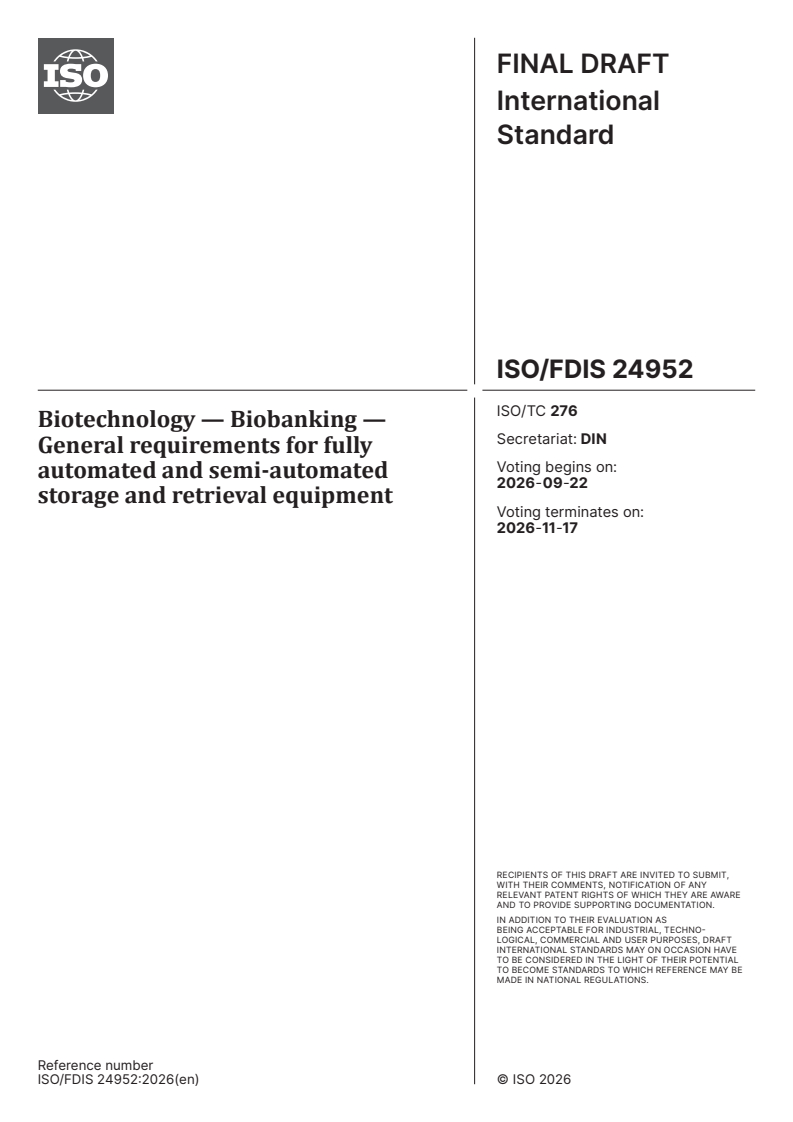
FINAL DRAFT
International
Standard
ISO/TC 276
Biotechnology — Biobanking —
Secretariat: DIN
General requirements for fully
Voting begins on:
automated and semi-automated
2026-09-22
storage and retrieval equipment
Voting terminates on:
2026-11-17
RECIPIENTS OF THIS DRAFT ARE INVITED TO SUBMIT,
WITH THEIR COMMENTS, NOTIFICATION OF ANY
RELEVANT PATENT RIGHTS OF WHICH THEY ARE AWARE
AND TO PROVIDE SUPPOR TING DOCUMENTATION.
IN ADDITION TO THEIR EVALUATION AS
BEING ACCEPTABLE FOR INDUSTRIAL, TECHNO
LOGICAL, COMMERCIAL AND USER PURPOSES, DRAFT
INTERNATIONAL STANDARDS MAY ON OCCASION HAVE
TO BE CONSIDERED IN THE LIGHT OF THEIR POTENTIAL
TO BECOME STAN DARDS TO WHICH REFERENCE MAY BE
MADE IN NATIONAL REGULATIONS.
Reference number
FINAL DRAFT
International
Standard
ISO/TC 276
Biotechnology — Biobanking —
Secretariat: DIN
General requirements for fully
Voting begins on:
automated and semi-automated
storage and retrieval equipment
Voting terminates on:
RECIPIENTS OF THIS DRAFT ARE INVITED TO SUBMIT,
WITH THEIR COMMENTS, NOTIFICATION OF ANY
RELEVANT PATENT RIGHTS OF WHICH THEY ARE AWARE
AND TO PROVIDE SUPPOR TING DOCUMENTATION.
© ISO 2026
IN ADDITION TO THEIR EVALUATION AS
All rights reserved. Unless otherwise specified, or required in the context of its implementation, no part of this publication may
BEING ACCEPTABLE FOR INDUSTRIAL, TECHNO
LOGICAL, COMMERCIAL AND USER PURPOSES, DRAFT
be reproduced or utilized otherwise in any form or by any means, electronic or mechanical, including photocopying, or posting on
INTERNATIONAL STANDARDS MAY ON OCCASION HAVE
the internet or an intranet, without prior written permission. Permission can be requested from either ISO at the address below
TO BE CONSIDERED IN THE LIGHT OF THEIR POTENTIAL
or ISO’s member body in the country of the requester.
TO BECOME STAN DARDS TO WHICH REFERENCE MAY BE
MADE IN NATIONAL REGULATIONS.
ISO copyright office
CP 401 • Ch. de Blandonnet 8
CH-1214 Vernier, Geneva
Phone: +41 22 749 01 11
Email: copyright@iso.org
Website: www.iso.org
Published in Switzerland Reference number
ii
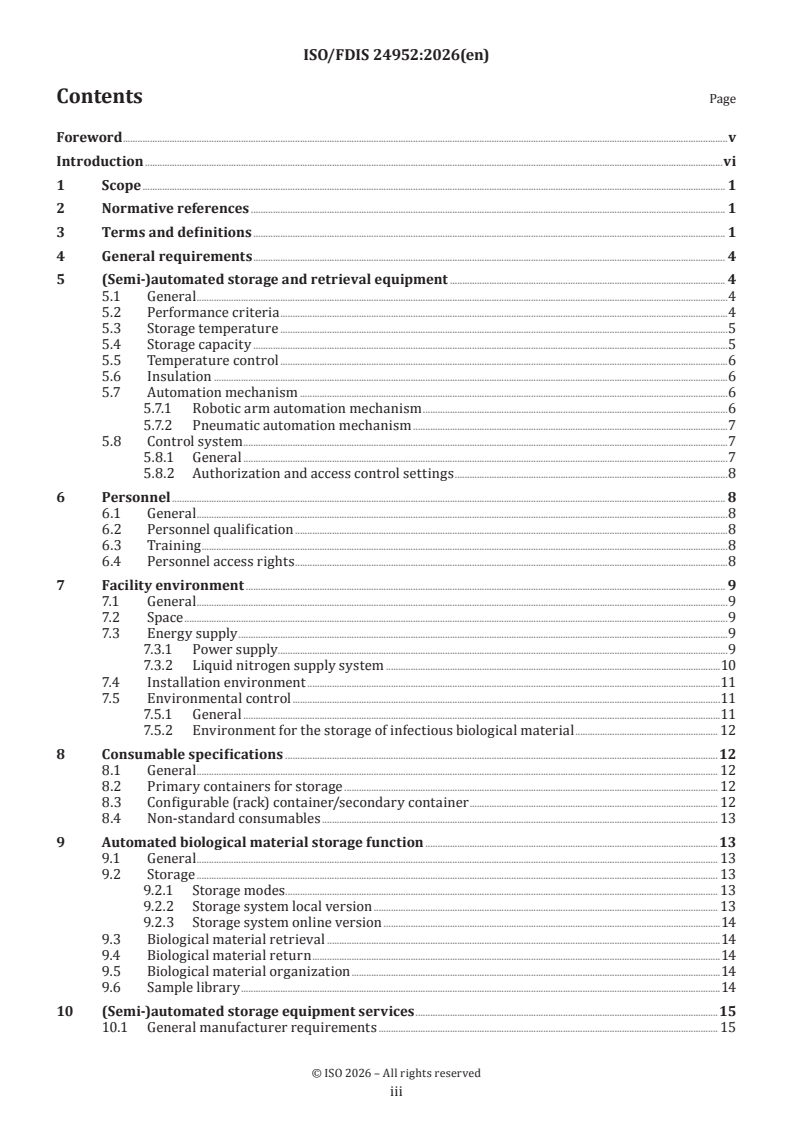
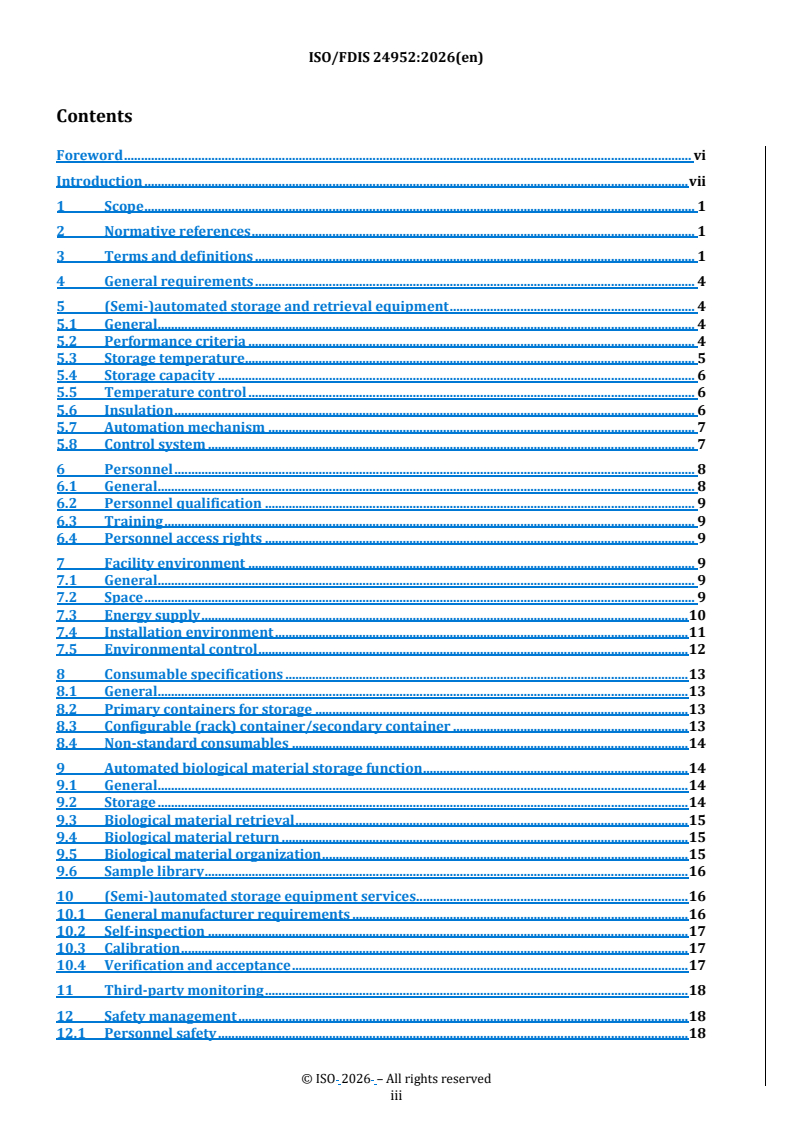
Contents Page
Foreword .v
Introduction .vi
1 Scope . 1
2 Normative references . 1
3 Terms and definitions . 1
4 General requirements . 4
5 (Semi-)automated storage and retrieval equipment . 4
5.1 General .4
5.2 Performance criteria .4
5.3 Storage temperature .5
5.4 Storage capacity .5
5.5 Temperature control .6
5.6 Insulation .6
5.7 Automation mechanism .6
5.7.1 Robotic arm automation mechanism .6
5.7.2 Pneumatic automation mechanism .7
5.8 Control system .7
5.8.1 General .7
5.8.2 Authorization and access control settings .8
6 Personnel . 8
6.1 General .8
6.2 Personnel qualification .8
6.3 Training .8
6.4 Personnel access rights .8
7 Facility environment . 9
7.1 General .9
7.2 Space .9
7.3 Energy supply .9
7.3.1 Power supply . .9
7.3.2 Liquid nitrogen supply system .10
7.4 Installation environment .11
7.5 Environmental control .11
7.5.1 General .11
7.5.2 Environment for the storage of infectious biological material . 12
8 Consumable specifications .12
8.1 General . 12
8.2 Primary containers for storage . 12
8.3 Configurable (rack) container/secondary container . 12
8.4 Non-standard consumables . 13
9 Automated biological material storage function .13
9.1 General . 13
9.2 Storage . 13
9.2.1 Storage modes . . 13
9.2.2 Storage system local version . 13
9.2.3 Storage system online version .14
9.3 Biological material retrieval .14
9.4 Biological material return .14
9.5 Biological material organization .14
9.6 Sample library .14
10 (Semi-)automated storage equipment services .15
10.1 General manufacturer requirements . 15
iii
10.2 Self-inspection . 15
10.3 Calibration .16
10.4 Verification and acceptance .16
11 Third-party monitoring . 16
12 Safety management . 17
12.1 Personnel safety .17
12.2 Information security .17
12.3 Facility and environmental safety .17
12.4 Measures to address risks .18
12.4.1 Handling of faults or abnormal situations .18
12.4.2 Risk response .18
Annex A (normative) Specifications for operation and management of (semi-)automated
storage and retrieval equipment. 19
Bibliography .20
iv
Foreword
ISO (the International Organization for Standardization) is a worldwide federation of national standards
bodies (ISO member bodies). The work of preparing International Standards is normally carried out through
ISO technical committees. Each member body interested in a subject for which a technical committee
has been established has the right to be represented on that committee. International organizations,
governmental and non-governmental, in liaison with ISO, also take part in the work. ISO collaborates closely
with the International Electrotechnical Commission (IEC) on all matters of electrotechnical standardization.
The procedures used to develop this document and those intended for its further maintenance are described
in the ISO/IEC Directives, Part 1. In particular, the different approval criteria needed for the different types
of ISO document should be noted. This document was drafted in accordance with the editorial rules of the
ISO/IEC Directives, Part 2 (see www.iso.org/directives).
ISO draws attention to the possibility that the implementation of this document may involve the use of (a)
patent(s). ISO takes no position concerning the evidence, validity or applicability of any claimed patent
rights in respect thereof. As of the date of publication of this document, ISO had not received notice of (a)
patent(s) which may be required to implement this document. However, implementers are cautioned that
this may not represent the latest information, which may be obtained from the patent database available at
www.iso.org/patents. ISO shall not be held responsible for identifying any or all such patent rights.
Any trade name used in this document is information given for the convenience of users and does not
constitute an endorsement.
For an explanation of the voluntary nature of standards, the meaning of ISO specific terms and expressions
related to conformity assessment, as well as information about ISO's adherence to the World Trade
Organization (WTO) principles in the Technical Barriers to Trade (TBT), see www.iso.org/iso/foreword.html.
This document was prepared by Technical Committee ISO/TC 276, Biotechnology.
Any feedback or questions on this document should be directed to the user’s national standards body. A
complete listing of these bodies can be found at www.iso.org/members.html.
v
Introduction
A biobank is a collection of biological materials and associated data with biological material numbers
spanning from the thousands to hundreds, or less. During the past decades, more and more biobanks were
established for research purposes. Recently, biobanks storing millions of biological materials and supported
by governments have been established, allowing experts to focus on the quality of biological materials
rather than quantity. The first international biobank standard, ISO 20387, was published by ISO/TC 276.
At present, many countries have created biobanks to represent their own populations. Specialized biobanks
have been established around the world, United States in 1987, the UK Biobank in 1999, the European
Biological Sample Bank in 2001, the Biobank Japan (BBJ) in 2004, and the European Union established the
Pan European Biological Sample Bank and Biomolecular Resource Research Platform (BBMRI) in 2008,
China Beijing Biobank in 2011, China Shanghai Biobank in 2018, China National GeneBank in 2011. In these
large biobanks, millions of biological materials are stored and processed.
It is a challenge to store and manage those biological materials with high quality standards. The UK Biobank
is well known for their automatic storage in -80 °C. However, during the last ten years, multiple biobanks
(> 10 biobanks) in Europe, USA, Japan and China have implemented automatic storage solutions. There are
more than 50 (semi-)automatic storage biobanks in the world and the number is growing. (Semi-)automatic
storage solutions are very expensive and in this fast growth period, it is important to set/have standards
for (semi-)automatic storage equipment, to cover issues, such as design, maintenance, management, and
training to enable efficient storage with high quality output biological materials. (Semi-)automatic storage
equipment can cause significant loss of money or damage biological materials if no standards for their setup
and operation are available. The various (semi-)automatic storage equipment units can cause difficulties
in transportation between the equipment. This expensive and complex equipment requires standards, and
professional care or operation process(es).
Biobanking includes human and non-human biological materials, such as plants, animals, microorganisms,
seeds, and cells. (Semi-)automated storage and retrieval equipment can store all types of biological material
utilizing different designs for specific purposes, or applications.
vi
FINAL DRAFT International Standard ISO/FDIS 24952:2026(en)
Biotechnology — Biobanking — General requirements for
fully automated and semi-automated storage and retrieval
equipment
1 Scope
This document specifies general requirements for fully automated and semi-automated storage and retrieval
equipment for biobanking, including their design, customization and installation, (semi-)automated storage
and retrieval functions, performance, personnel, facility environment, operation and maintenance.
NOTE Where this document addresses both ‘fully automated and semi-automated storage and retrieval
equipment’ this is made clear by using the shortened form of ‘(semi-)automated storage and retrieval equipment’.
This document specifies consumable and software systems for (semi-)automated storage and retrieval
equipment for biobanking.
This document is applicable to manufacturers of (semi-)automated storage and retrieval equipment, as
well as to biobanks that use or operate such equipment. This document is applicable to manufactures of
consumables of (semi-)automated storage and retrieval equipment.
2 Normative references
The following documents are referred to in the text in such a way that some or all of their content constitutes
requirements of this document. For dated references, only the edition cited applies. For undated references,
the latest edition of the referenced document (including any amendments) applies.
ISO 20387, Biotechnology — Biobanking — General requirements for biobanks
3 Terms and definitions
For the purposes of this document, the terms and definitions in ISO 20387 and the following apply.
ISO and IEC maintain terminological databases for use in standardization at the following addresses:
— ISO Online browsing platform: available at https:// www .iso .org/ obp
— IEC Electropedia: available at https:// www .electropedia .org/
3.1
automated picker
automated specific arms which can pick up and place tubes or containers in automated storage and retrieval
equipment (3.3)
3.2
automated storage
controlled environment or system where biological materials are systematically placed, organized, and
retrieved using programmable machines with minimal human intervention
Note 1 to entry: Biological material handling, tracking and retrieval are performed by robotic arms or pneumatic
devices. However, when adding a sample into an equipment with automated storage, human intervention is needed in
the form of forwarding the sample to the equipment for it to be scanned and/or taken into the storage.
EXAMPLE A biobank receives a shipment of sample tubes. After manually loading the shipment into the receiving
module, the system automatically identifies each tube by barcode scanning, transfers the tubes through a controlled-
temperature pathway, assigns storage locations, stores the tubes in the repository, and subsequently retrieves
requested tubes for distribution. No human intervention is needed during routine sample handling, storage, retrieval
or inventory operations.
3.3
automated storage and retrieval equipment
equipment specifically designed for the storage of biological materials that operates with minimal
human intervention, utilizing robotics or pneumatic devices, conveyor or pneumatic tube systems, and
computerized controls to manage the storage, retrieval, and tracking of biological materials in a highly
efficient and accurate manner
Note 1 to entry: Automated pneumatic access systems do not require robotic arms. They transfer biological material
through pneumatic pipelines and do not need cryopreservation tube boxes or racks for storage.
EXAMPLE A biobank receives a shipment of sample tubes. After manually loading the shipment into the receiving
module, the system automatically identifies each tube by barcode scanning, transfers the tubes through a controlled-
temperature pathway, assigns storage locations, stores the tubes in the repository, and subsequently retrieves
requested tubes for distribution. No human intervention is needed during routine sample handling, storage, retrieval
or inventory operations.
3.4
automation
implement work processes through automated methods or device
3.5
buffer zone
designated space within a (semi)automated storage system for temporary holding of biological materials
prior to retrieval, disposal or before being moved to long-term storage
3.6
configurable (rack) container
container adapted to robot arms, which is used to transfer or store primary containers (3.15) or secondary
containers (3.16) that do not conform with relevant container quality or size specifications for use by a
(semi-)automated storage and retrieval equipment (3.18)
Note 1 to entry: Normally standard consumables, customized according to relevant quality or size specifications.
Note 2 to entry: For pneumatic access systems, a secondary container or configurable (rack) container such as a
transfer tank is not mandatory.
3.7
dedicated storage area
specifically allocated space within the biobank facility designed to house (semi-)automated storage and
retrieval equipment (ASRE) which meets the power supply and infrastructure requirements necessary for
the operation of the installed ASRE(s)
3.8
device self-inspection program
structured and systematic process implemented by a device manufacturer or operator to internally assess
and evaluate the conformance, performance, and safety of their devices
3.9
docking interface
physical or virtual connection point where two equipment, devices, or components can be joined or
integrated to enable data exchange, communication, or interaction
3.10
equipment control system
hardware and software platform designed to organize, track, manage, store and retrieve data related to
biological materials stored within a (semi-)automated storage and retrieval equipment (3.18)
3.11
human-interaction interface
interface allows human as users to interact with and manipulate the (semi-)automated storage and retrieval
equipment (3.18)
3.12
inbound list
biological material list which consists of all biological material entering the (semi-)automated storage and
retrieval equipment (3.18)
3.13
liquid nitrogen tower
vessel containing the liquid nitrogen that is intended to be used for supplying the storage unit cooling system
3.14
outbound list
list of biological material which is taken out from the automated storage and retrieval equipment (3.3)
3.15
primary container
receptacle that is in direct contact with the biological material for storage and/or transportation of a
biological material, and adapted to the type of biological material and on the kind of subsequent examination
or analysis
Note 1 to entry: Adapted from ISO 11609:2017, 3.4 and ISO 11074:2025, 4.4.19.
3.16
secondary container
container into which the primary container (3.15) is placed
[SOURCE: ISO 12891-1:2015, 2.6]
3.17
semi-automated storage
controlled environment or system where biological materials are systematically placed, organized, and
retrieved using a combination of human input and programable machines
Note 1 to entry: Biological material handling, tracking and retrieval are performed by robotic arms or pneumatic
devices.
EXAMPLE A biobank uses an automated storage unit in a semi-automated storage and retrieval equipment to
maintain and organize sample racks. Operators manually scan sample identifiers, place sample tubes into racks,
and remove requested tubes following system-generated location information. The storage equipment performs
location management and rack movement, while sample loading, retrieval and other handling steps require human
intervention.
3.18
semi-automated storage and retrieval equipment
equipment specifically designed for the storage of biological materials that operates with partial human
intervention, that can utilize robotics, conveyor systems, and computerized controls to manage the storage,
retrieval, and tracking of biological material
EXAMPLE A biobank uses an automated storage unit in a semi-automated storage and retrieval equipment to
maintain and organize sample racks. Operators manually scan sample identifiers, place sample tubes into racks,
and remove requested tubes following system-generated location information. The storage equipment performs
location management and rack movement, while sample loading, retrieval and other handling steps require human
intervention.
3.19
storage mode
specific method and conditions under which biological materials are preserved to maintain their integrity,
viability, and usability over time
Note 1 to entry: This can include factors such as temperature (e.g., cryogenic, refrigerated, ambient), containment
(e.g., liquid nitrogen tanks, freezers, desiccation chambers), and preservation techniques (e.g., freezing, lyophilization,
fixation).
3.20
storage task
activity to run the (semi-)automated storage and retrieval equipment (3.18)
4 General requirements
The relevant requirements for the traceability of biological material and associated data and the storage of
biological material from ISO 20387 shall be implemented.
5 (Semi-)automated storage and retrieval equipment
5.1 General
The (semi-)automated storage and retrieval equipment shall be provided, installed and operated within
defined specifications to regulate storage conditions, uphold biological material integrity, and sustain
equipment functionality. Annex A specifies the requirements for normal operation of storage equipment,
storage temperature, etc.
5.2 Performance criteria
5.2.1 The (semi-)automated storage and retrieval equipment shall meet specific performance criteria
critical to the efficient and reliable operation of the biobank. These criteria should encompass a range of
factors, including but not limited to storage capacity to accommodate a large volume of biological material,
processing speed to ensure rapid and accurate handling of biological material, transfer speed to guarantee
the biological materials be transferred to storage and retrieval equipment safely and timely, retrieval speed
for timely access to stored materials, and a precisely controlled temperature range to maintain biological
material integrity.
In addition to these primary performance criteria, other essential factors can include:
a) equipment scalability to accommodate future growth;
b) robust security features and access control to safeguard sensitive data and biological materials;
c) redundancy and backup to ensure equipment reliability;
d) intuitive human-interaction interface allowing for easy operation and management;
e) the ability to integrate with equipment control system and other data management platforms; and
f) the adaptability to evolving technological advancements in the field of biobank automation.
5.2.2 The manufacturer shall provide suitable devices which meet the requirements for temperature
settings and accuracy specified by the biobank.
5.2.3 The (semi-)automatic storage and retrieval equipment shall perform real-time monitoring of the
environmental conditions within each storage and retrieval unit to ensure that biological materials are
stored and accessed in a safe and stable state.
5.2.4 The (semi-)automatic storage and retrieval equipment shall have an alarm function (e.g. SMS or
email) to notify the user in real-time when any abnormal conditions, e.g. temperature, deviations occur.
5.2.5 The (semi-)automatic storage and retrieval equipment shall be able to real-time display the actual
temperature, set temperature, alarm information and sample management data.
5.2.6 The (semi-)automatic storage and retrieval equipment shall support remote monitoring, allowing
users to view equipment status and temperature data in real-time (e.g. mobile facility).
NOTE The (semi-)automatic storage and retrieval equipment can be equipped with an IoT (Internet of Things)
module, which can collect temperature and humidity in real time, upload real-time information and error alarm,
record and analyse historical data, and can also have comprehensive information summary function.
5.2.7 The picking speed, (e.g. total time of movement, time for pick and place) shall be stated in the
manufacturer’s instructions for use, if applicable.
5.2.8 The working noise of the (semi-)automated storage and retrieval equipment should fall within
[1]
acceptable limit, typically less than 80 dB. The manufacturer should ensure this requirement.
NOTE The minimum health and safety requirements regarding exposure of workers to the risks arising from
[1]
physical agents (noise) introduces lower exposure action value at Leq, 8 h = 80 dB(A) .
5.2.9 The automated storage and retrieval equipment should adopt an efficient energy saving technology.
5.2.10 The liquid nitrogen automatic biological material storage equipment shall have safety devices such
as an oxygen deficiency monitor and temperature alarms.
5.3 Storage temperature
The (semi-)automated storage and retrieval equipment shall be able to meet specified biological material
storage temperature requirements. Different storage temperature settings should be available based on
relevant types of biological materials as needed. Such requirements can be established by the manufacturer
alone or in coordination with the biobank.
The manufacturer shall specify the temperature range(s) with any known tolerance that the (semi-)
automated storage and retrieval equipment is designed to maintain.
The appropriate biological material storage temperature shall be determined by the biobank taking into
account relevant factors including but not limited to the biological material type, the intended use and
expected shelf-life.
5.4 Storage capacity
The storage capacity of the (semi-)automated storage and retrieval equipment shall be planned, taking
into account limitations such as the available space for the equipment, the construction budget and future
expansion needs.
NOTE In a given volume of space, there is a storage capacity based on the different specifications of tubes.
Within the storage space, the equipment shall be designed to accommodate and handle different types of
biological materials:
a) in accordance with the specifications (i.e. required storage temperature, intended storage time,
primary/secondary container dimensions and specifications) of each biological material.
b) using appropriate, uniquely identifiable tagging or barcoding formats (e.g. QR code, 2D-code, 1D-barcode,
RFID);
5.5 Temperature control
The (semi-)automated storage and retrieval equipment shall be able to establish and maintain storage
conditions that meet the requirements of dedicated biological material preservation. The equipment shall be
designed to operate at defined temperatures, e.g. ranging from ambient to liquid nitrogen.
The reliability of the temperature regulation unit should be ensured.
Temperature control systems should be adapted according to the different storage temperature requirements
of biological material, environmental conditions (7.5), cost effectiveness, and safety management (Clause 12).
NOTE 1 Common refrigeration methods include mechanical refrigeration, liquid nitrogen refrigeration, etc.
NOTE 2 The equipment can also operate at or be designed for use at room temperature or 2 °C to 8 °C.
The requirements for the storage environment temperature should meet the requirements specified in 5.3.
A short-term backup plan shall be developed to ensure that accurate storage conditions (such as temperature)
can be maintained in the event of an emergency that affects the predetermined storage conditions.
NOTE 3 Common backup plans include backup power supply, redundant cooling systems, emergency response
procedures, alternative storage equipment, etc.
5.6 Insulation
According to the biological material storage temperature requirements, the (semi-) automated storage
and retrieval equipment should have insulation to ensure that the temperature distribution in the
storage environment is as uniform as possible. The biobank and manufacturer can agree upon acceptable
temperature distribution.
When the cooling function fails, the insulation structure should maintain storage temperature within a
certain time frame to support the biological material stability until the biobank or service provider restores
cooling capacity. The biobank and manufacturer should agree upon a duration, specifying the number of
hours for which a defined temperature shall be maintained at a designated level. During this agreed period,
the biobank and manufacturer should restore the cooling capacity as soon as possible.
5.7 Automation mechanism
5.7.1 Robotic arm automation mechanism
The automation mechanism is a mechanism used for automated transfer and the re-organization of biological
material within a single piece of equipment or between different pieces of equipment. The automation
mechanism shall be designed to complete a series of actions for transferring suitable primary, secondary
and/or configurable (rack) containers from the docking interface to the storage area or from the storage
area to the docking interface, including the process of entering and exiting the storage area.
Automation mechanisms shall be able to:
a) withstand low-temperature or ultra-low temperature environments (e.g. -20 °C, -190 °C) where they are
intended to come in contact with such environment;
b) operate normally for an extended period with proper maintenance (e.g., 10 years).
Automation mechanisms should ensure the safety of biological material during their operation and should
avoid an impact on biological material in the event of mechanism failure. Emergency plans according to
12.4.2 should be in place for abnormal states during operation, which can be handled without affecting the
biological material quality and integrity.
The automation mechanism shall complete relevant actions according to the instructions of the operating
system.
5.7.2 Pneumatic automation mechanism
The pneumatic automation mechanism is a mechanism used for automated transfer and the re-organization
of biological material within or between different storage and retrieval equipment(s). The pneumatic
automation mechanism can be designed to complete a series of actions for transferring room temperature
(or low-temperature) primary, secondary or configurable (rack) containers from the docking interface to the
low-temperature storage area or from the low-temperature storage area to the docking interface, including
the process of entering and exiting the storage and retrieval equipment, collecting biological material
information, and operating on designated biological material.
5.8 Control system
5.8.1 General
The human-machine interaction interface of the equipment should be intuitive, concise, with complete
functions, and easy to operate and maintain.
The data interface shall be interoperable and robust.
NOTE 1 File interfaces can be implemented in many ways, such as file transfer (e.g., Secure File Transfer Protocol
(SFTP)), mounted/mapped file storage (e.g., Network File System (NFS), WebDAV), and transfer on removable storage
(e.g., USB driver). Each of the mechanisms has its own specific requirements, limitations, and risks.
NOTE 2 The different levels of interfaces can be clearly distinguished (see ISO/OSI model, ISO/IEC 7498-1). The
relevant layer can be data-link, transport, presentation and application.
EXAMPLE The interfaces can be the following: SSI (Synchronous Serial Interface); RS (Recommended Standard),
mainly RS-485; Modbus; CAN (Controller Area Network) family: CANbus, DeviceNet, CANopen; PROFIBUS (Process
Field Bus); Ethernet family: EtherCAT (Ethernet for Control Automation Technology), Ethernet/IP (Industrial
Protocol), PROFINET (Process Field Network); USB, etc.
To sequentially send task files, the biological material management system should generate a task-
independent and single-readable text file, including but not limited to:
a) the task number;
b) the storage equipment number;
c) the box number;
d) the storage tube number;
e) calling appropriate communication interfaces.
The control computer hardware and software shall obtain real-time task information from the
communication interface, receive task files in a timely manner, and immediately store them.
The (semi-)automated storage and retrieval equipment should have a data interface to communicate to third-
party devices. Application programming interfaces (APIs) and formats should be semantically interoperable.
Access permission for third-party devices should be segregated within the internal network or physical
partitions between internal and external networks. Only entries of the specifications and quantity of storage
tubes shall be required by the equipment to perform the automated position allocation during storage. The
control computer hardware and software shall automatically generate a biological material storage order
and transmit it back to the biological material management system.
The (semi-)automated storage and retrieval equipment should have the capability to automatically record
equipment operation process parameters and mechanical operation videos. The (semi-)automated storage
and retrieval equipment should be configured to display these records in real-time.
The (semi-)automated storage and retrieval equipment shall have alarm functions, i.e. parameter deviation
and abnormal conditions, and should provide real-time feedback on alarm information. It shall meet the
exception handling requirements of 12.4.1.
After the (semi-)automated storage and retrieval equipment completes a task, it should return the task
execution status report. When there are no tasks to execute, it should automatically enter standby mode to
ensure communication availability.
5.8.2 Authorization and access control settings
The (semi-)automated storage equipment shall enable the biobank to define and establish different roles in
managing, using and (physically) accessing their (semi-)automated storage equipment.
The access right content at different levels of the (semi-)automated storage and retrieval equipment shall be
determined based on the role permissions of relevant personnel in 6.4.
The login system shall have an identity recognition module to authenticate and manage login personnel
information.
6 Personnel
6.1 General
The personnel of the biobank should define the daily operation and maintenance responsibilities of the
(semi-)automated storage and retrieval equipment.
6.2 Personnel qualification
(Semi-)automated storage and retrieval equipment operators (the personnel of the biobank) should be
proficient in, but not limited to, the principles, operating procedures, precautions of (semi-)automated
storage and retrieval equipment.
(Semi-)automated storage and retrieval equipment administrators shall be proficient in (semi-)automated
storage and retrieval equipment inspections and initial troubleshooting.
6.3 Training
The manufacturer shall provide systematic training for the personnel and operators responsible for the
(semi-)automated storage and retriev
...
ISO/TC 276
Secretariat: DIN
Date: 2026-06-1509-07
Biotechnology — Biobanking — General requirements for (fully
automated and semi-)-automated storage and retrieval equipment
FDIS stage
ISO/CD FDIS 24952:2025(E2026(en)
All rights reserved. Unless otherwise specified, or required in the context of its implementation, no part of this publication
may be reproduced or utilized otherwise in any form or by any means, electronic or mechanical, including photocopying,
or posting on the internet or an intranet, without prior written permission. Permission can be requested from either ISO
at the address below or ISO’s member body in the country of the requester.
ISO copyright office
CP 401 • Ch. de Blandonnet 8
CH-1214 Vernier, Geneva
Phone: + 41 22 749 01 11
Fax: +41 22 749 09 47
EmailE-mail: copyright@iso.org
Website: www.iso.orgwww.iso.org
Published in Switzerland
ii © ISO 2025 2026 – All rights reserved
ii
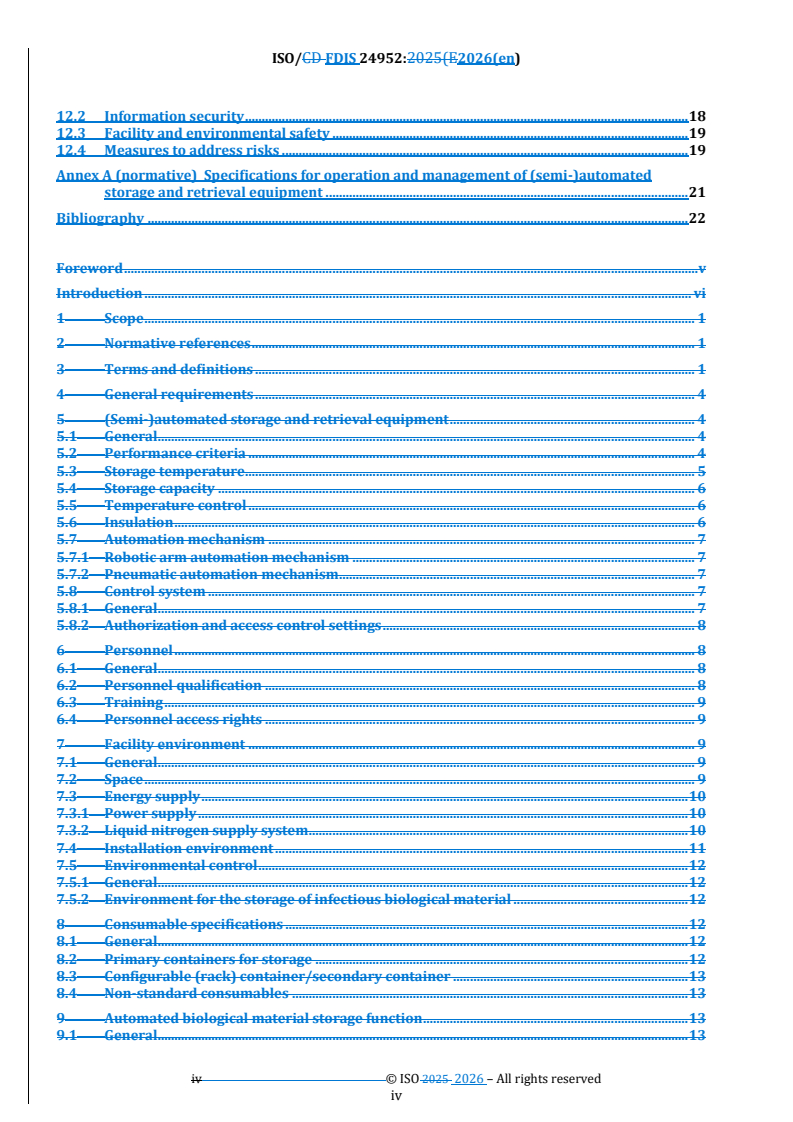
Contents
Foreword . vi
Introduction . vii
1 Scope . 1
2 Normative references . 1
3 Terms and definitions . 1
4 General requirements . 4
5 (Semi-)automated storage and retrieval equipment . 4
5.1 General . 4
5.2 Performance criteria . 4
5.3 Storage temperature. 5
5.4 Storage capacity . 6
5.5 Temperature control . 6
5.6 Insulation . 6
5.7 Automation mechanism . 7
5.8 Control system . 7
6 Personnel . 8
6.1 General . 8
6.2 Personnel qualification . 9
6.3 Training . 9
6.4 Personnel access rights . 9
7 Facility environment . 9
7.1 General . 9
7.2 Space . 9
7.3 Energy supply . 10
7.4 Installation environment . 11
7.5 Environmental control . 12
8 Consumable specifications . 13
8.1 General . 13
8.2 Primary containers for storage . 13
8.3 Configurable (rack) container/secondary container . 13
8.4 Non-standard consumables . 14
9 Automated biological material storage function . 14
9.1 General . 14
9.2 Storage . 14
9.3 Biological material retrieval . 15
9.4 Biological material return . 15
9.5 Biological material organization . 15
9.6 Sample library . 16
10 (Semi-)automated storage equipment services. 16
10.1 General manufacturer requirements . 16
10.2 Self-inspection . 17
10.3 Calibration . 17
10.4 Verification and acceptance . 17
11 Third-party monitoring . 18
12 Safety management . 18
12.1 Personnel safety . 18
© ISO 2026 – All rights reserved
iii
ISO/CD FDIS 24952:2025(E2026(en)
12.2 Information security . 18
12.3 Facility and environmental safety . 19
12.4 Measures to address risks . 19
Annex A (normative) Specifications for operation and management of (semi-)automated
storage and retrieval equipment . 21
Bibliography . 22
Foreword . v
Introduction . vi
1 Scope . 1
2 Normative references . 1
3 Terms and definitions . 1
4 General requirements . 4
5 (Semi-)automated storage and retrieval equipment . 4
5.1 General . 4
5.2 Performance criteria . 4
5.3 Storage temperature. 5
5.4 Storage capacity . 6
5.5 Temperature control . 6
5.6 Insulation . 6
5.7 Automation mechanism . 7
5.7.1 Robotic arm automation mechanism . 7
5.7.2 Pneumatic automation mechanism . 7
5.8 Control system . 7
5.8.1 General . 7
5.8.2 Authorization and access control settings . 8
6 Personnel . 8
6.1 General . 8
6.2 Personnel qualification . 8
6.3 Training . 9
6.4 Personnel access rights . 9
7 Facility environment . 9
7.1 General . 9
7.2 Space . 9
7.3 Energy supply . 10
7.3.1 Power supply . 10
7.3.2 Liquid nitrogen supply system . 10
7.4 Installation environment . 11
7.5 Environmental control . 12
7.5.1 General . 12
7.5.2 Environment for the storage of infectious biological material . 12
8 Consumable specifications . 12
8.1 General . 12
8.2 Primary containers for storage . 12
8.3 Configurable (rack) container/secondary container . 13
8.4 Non-standard consumables . 13
9 Automated biological material storage function . 13
9.1 General . 13
iv © ISO 2025 2026 – All rights reserved
iv
9.2 Storage . 14
9.2.1 Storage modes . 14
9.2.2 Storage system local version . 14
9.2.3 Storage system online version . 14
9.3 Biological material retrieval . 14
9.4 Biological material return . 15
9.5 Biological material organization . 15
9.6 Sample library . 15
10 (Semi-)automated storage equipment services. 15
10.1 General manufacturer requirements . 15
10.2 Self-inspection . 16
10.3 Calibration . 16
10.4 Verification and acceptance . 16
11 Third-party monitoring . 17
12 Safety management . 17
12.1 Personnel safety . 17
12.2 Information security . 17
12.3 Facility and environmental safety . 18
12.4 Measures to address risks . 18
12.4.1 Handling of faults or abnormal situations . 18
12.4.2 Risk response . 19
Annex A (normative) Specifications for operation and management of (semi-)automated storage
and retrieval equipment . 20
A.1 General . 20
A.2 Equipment operation . 20
A.2.1 Regular maintenance . 20
A.2.2 Emergency procedures . 20
A.2.3 Temperature control . 20
A.3 Biological material safety . 20
A.3.1 Biological material identification . 20
A.3.2 Security measures . 20
A.3.3 Backup systems . 20
A.4 Training and education . 20
Bibliography . 21
© ISO 2026 – All rights reserved
v
ISO/CD FDIS 24952:2025(E2026(en)
Foreword
ISO (the International Organization for Standardization) is a worldwide federation of national standards
bodies (ISO member bodies). The work of preparing International Standards is normally carried out through
ISO technical committees. Each member body interested in a subject for which a technical committee has been
established has the right to be represented on that committee. International organizations, governmental and
non-governmental, in liaison with ISO, also take part in the work. ISO collaborates closely with the
International Electrotechnical Commission (IEC) on all matters of electrotechnical standardization.
The procedures used to develop this document and those intended for its further maintenance are described
in the ISO/IEC Directives, Part 1. In particular, the different approval criteria needed for the different types of
ISO document should be noted. This document was drafted in accordance with the editorial rules of the
ISO/IEC Directives, Part 2 (see www.iso.org/directives).
ISO draws attention to the possibility that the implementation of this document may involve the use of (a)
patent(s). ISO takes no position concerning the evidence, validity or applicability of any claimed patent rights
in respect thereof. As of the date of publication of this document, ISO had not received notice of (a) patent(s)
which may be required to implement this document. However, implementers are cautioned that this may not
represent the latest information, which may be obtained from the patent database available at
www.iso.org/patents.www.iso.org/patents. ISO shall not be held responsible for identifying any or all such
patent rights.
Any trade name used in this document is information given for the convenience of users and does not
constitute an endorsement.
For an explanation of the voluntary nature of standards, the meaning of ISO specific terms and expressions
related to conformity assessment, as well as information about ISO's adherence to the World Trade
Organization (WTO) principles in the Technical Barriers to Trade (TBT), see
www.iso.org/iso/foreword.htmlwww.iso.org/iso/foreword.html.
This document was prepared by Technical Committee ISO/TC 276, Biotechnology.
Any feedback or questions on this document should be directed to the user’s national standards body. A
complete listing of these bodies can be found at www.iso.org/members.htmlwww.iso.org/members.html.
vi © ISO 2025 2026 – All rights reserved
vi
Introduction
A biobank is a collection of biological materials and associated data with biological material numbers spanning
from the thousands to hundreds, or less. During the past decades, more and more biobanks were established
for research purposes. Recently, biobanks storing millions of biological materials and supported by
governments have been established, allowing experts to focus on the quality of biological materials rather
than quantity. The first international biobank standard, ISO 20387, was published by ISO/TC 276.
At present, many countries have created biobanks to represent their own populations. Specialized biobanks
have been established around the world, United States in 1987, the UK Biobank in 1999, the European
Biological Sample Bank in 2001, the Biobank Japan (BBJ) in 2004, and the European Union established the Pan
European Biological Sample Bank and Biomolecular Resource Research Platform (BBMRI) in 2008, China
Beijing Biobank in 2011, China Shanghai Biobank in 2018, China National GeneBank in 2011. In these large
biobanks, millions of biological materials are stored and processed.
It is a challenge to store and manage those biological materials with high quality standards. The UK Biobank
is well known for their automatic storage in -80 °C. However, during the last ten years, multiple biobanks (>
10 biobanks) in Europe, USA, Japan and China have implemented automatic storage solutions. There are more
than 50 (semi-)automatic storage biobanks in the world and the number is growing. (Semi-)automatic storage
solutions are very expensive and in this fast growth period, it is important to set/have standards for (semi-
)automatic storage equipment, to cover issues, such as design, maintenance, management, and training to
enable efficient storage with high quality output biological materials. (Semi-)automatic storage equipment can
cause significant loss of money or damage biological materials if no standards for their setup and operation
are available. The various (semi-)automatic storage equipment units can cause difficulties in transportation
between the equipment. This expensive and complex equipment requires standards, and professional care or
operation process(es).
Biobanking includes human and non-human biological materials, such as plants, animals, microorganisms,
seeds, and cells. (Semi-)automated storage and retrieval equipment can store all types of biological material
utilizing different designs for specific purposes, or applications.
In this document, the following verbal forms are used:
— — “shall” indicates a requirement;
— — “should” indicates a recommendation;
— — “may” indicates a permission;
— — “can” indicates a possibility or a capability.
Further details can be found in the ISO/IEC Directives, Part 2.
© ISO 2026 – All rights reserved
vii
FINAL DRAFT International Standard ISO/FDIS 24952:2026(en)
Biotechnology — Biobanking — General requirements for
(fully automated and semi-)-automated storage and retrieval
equipment
1 Scope
This document specifies general requirements for fully automated and semi-automated storage and retrieval
equipment for biobanking, including their design, customization and installation, (semi-)automated storage
and retrieval functions, performance, personnel, facility environment, operation and maintenance.
NOTE Where this document addresses both ‘fully automated and semi-automated storage and retrieval equipment’
this is made clear by using the shortened form of ‘(semi-)automated storage and retrieval equipment’.
This document specifies consumable and software systems for (semi-)automated storage and retrieval
equipment for biobanking.
This document is applicable to manufacturers of (semi-)automated storage and retrieval equipment, as well
as to biobanks that use or operate such equipment. This document is applicable to manufactures of
consumables of (semi-)automated storage and retrieval equipment.
2 Normative references
The following documents are referred to in the text in such a way that some or all of their content constitutes
requirements of this document. For dated references, only the edition cited applies. For undated references,
the latest edition of the referenced document (including any amendments) applies.
ISO 20387, Biotechnology — Biobanking — General requirements for biobanks
ISO/IEC 27001, Information security, cybersecurity and privacy protection — Information security
management systems — Requirements
ISO 20387, Biotechnology — Biobanking — General requirements for biobanks
3 Terms and definitions
For the purposes of this document, the terms and definitions in ISO 20387 and the following apply.
ISO and IEC maintain terminological databases for use in standardization at the following addresses:
— — ISO Online browsing platform: available at https://www.iso.org/obphttps://www.iso.org/obp
— — IEC Electropedia: available at https://www.electropedia.org/https://www.electropedia.org/
3.1 3.1
automated picker
automated specific arms which can pick up and place tubes or containers in automated storage and retrieval
equipment (3.3)(3.3)
ISO/CD FDIS 24952:2025(E2026(en)
3.2 3.2
automated storage
controlled environment or system where biological materials are systematically placed, organized, and
retrieved using programmable machines with minimal human intervention
Note 1 to entry: Biological material handling, tracking and retrieval are performed by robotic arms or pneumatic
devices. However, when adding a sample into an equipment with automated storage, human intervention is needed in
the form of forwarding the sample to the equipment for it to be scanned and/or taken into the storage.
EXAMPLE A biobank receives a shipment of sample tubes. After manually loading the shipment into the receiving
module, the system automatically identifies each tube by barcode scanning, transfers the tubes through a controlled-
temperature pathway, assigns storage locations, stores the tubes in the repository, and subsequently retrieves requested
tubes for distribution. No human intervention is needed during routine sample handling, storage, retrieval or inventory
operations.
3.3 3.3
automated storage and retrieval equipment
equipment specifically designed for the storage of biological materials that operates with minimal human
intervention, utilizing robotics or pneumatic devices, conveyor or pneumatic tube systems, and computerized
controls to manage the storage, retrieval, and tracking of biological materials in a highly efficient and accurate
manner
Note 1 to entry: Automated pneumatic access systems do not require robotic arms. They transfer biological material
through pneumatic pipelines and do not need cryopreservation tube boxes or racks for storage.
EXAMPLE A biobank receives a shipment of sample tubes. After manually loading the shipment into the receiving
module, the system automatically identifies each tube by barcode scanning, transfers the tubes through a controlled-
temperature pathway, assigns storage locations, stores the tubes in the repository, and subsequently retrieves requested
tubes for distribution. No human intervention is needed during routine sample handling, storage, retrieval or inventory
operations.
3.4 3.4
automation
implement work processes through automated methods or device
3.5 3.5
buffer zone
designated space within a (semi)automated storage system for temporary holding of biological materials prior
to retrieval, disposal or before being moved to long-term storage
3.6 3.6
configurable (rack) container
container adapted to robot arms, which is used to transfer or store primary containers (3.15)(3.15) or
secondary containers (3.16)(3.16) that do not conform with relevant container quality or size specifications
for use by a (semi-)automated storage and retrieval equipment (3.18)(3.18)
Note 1 to entry: Normally standard consumables, customized according to relevant quality or size specifications.
Note 2 to entry: For pneumatic access systems, a secondary container or configurable (rack) container such as a transfer
tank is not mandatory.
3.7 3.7
dedicated storage area
specifically allocated space within the biobank facility designed to house (semi-)automated storage and
retrieval equipment (ASRE) which meets the power supply and infrastructure requirements necessary for the
operation of the installed ASRE(s)
2 © ISO 2025 2026 – All rights reserved
3.8 3.8
device self-inspection program
structured and systematic process implemented by a device manufacturer or operator to internally assess and
evaluate the conformance, performance, and safety of their devices
3.9 3.9
docking interface
physical or virtual connection point where two equipment, devices, or components can be joined or integrated
to enable data exchange, communication, or interaction
3.10 3.10
equipment control system
hardware and software platform designed to organize, track, manage, store and retrieve data related to
biological materials stored within a (semi-)automated storage and retrieval equipment (3.18)(3.18)
3.11 3.11
human-interaction interface
interface allows human as users to interact with and manipulate the (semi-)automated storage and retrieval
equipment (3.18)(3.18)
3.12 3.12
inbound list
biological material list which consists of all biological material entering the (semi-)automated storage and
retrieval equipment (3.18)(3.18)
3.13 3.13
liquid nitrogen tower
vessel containing the liquid nitrogen that is intended to be used for supplying the storage unit cooling system
3.14 3.14
outbound list
list of biological material which is taken out from the automated storage and retrieval equipment (3.3)(3.3)
3.15 3.15
primary container
receptacle that is in direct contact with the biological material for storage and/or transportation of a biological
material, and adapted to the type of biological material and on the kind of subsequent examination or analysis
Note 1 to entry: Adapted from ISO 11609:2017, 3.4 and ISO 11074:2025, 4.4.19.
3.16 3.16
secondary container
container into which the primary container (3.15)(3.15) is placed
[SOURCE: ISO 12891-1:2015, 2.6]
3.17 3.17
semi-automated storage
controlled environment or system where biological materials are systematically placed, organized, and
retrieved using a combination of human input and programable machines
Note 1 to entry: Biological material handling, tracking and retrieval are performed by robotic arms or pneumatic
devices.
EXAMPLE A biobank uses an automated storage unit in a semi-automated storage and retrieval equipment to
maintain and organize sample racks. Operators manually scan sample identifiers, place sample tubes into racks, and
© ISO 2026 – All rights reserved
ISO/CD FDIS 24952:2025(E2026(en)
remove requested tubes following system-generated location information. The storage equipment performs location
management and rack movement, while sample loading, retrieval and other handling steps require human intervention.
3.18 3.18
semi-automated storage and retrieval equipment
equipment specifically designed for the storage of biological materials that operates with partial human
intervention, that can utilize robotics, conveyor systems, and computerized controls to manage the storage,
retrieval, and tracking of biological material
EXAMPLE A biobank uses an automated storage unit in a semi-automated storage and retrieval equipment to
maintain and organize sample racks. Operators manually scan sample identifiers, place sample tubes into racks, and
remove requested tubes following system-generated location information. The storage equipment performs location
management and rack movement, while sample loading, retrieval and other handling steps require human intervention.
3.19 3.19
storage mode
specific method and conditions under which biological materials are preserved to maintain their integrity,
viability, and usability over time
Note 1 to entry: This can include factors such as temperature (e.g., cryogenic, refrigerated, ambient), containment (e.g.,
liquid nitrogen tanks, freezers, desiccation chambers), and preservation techniques (e.g., freezing, lyophilization,
fixation).
3.20 3.20
storage task
activity to run the (semi-)automated storage and retrieval equipment (3.18)(3.18)
4 General requirements
The relevant requirements for the traceability of biological material and associated data and the storage of
biological material from ISO 20387 shall be implemented.
5 (Semi-)automated storage and retrieval equipment
5.1 General
The (semi-)automated storage and retrieval equipment shall be provided, installed and operated within
defined specifications to regulate storage conditions, uphold biological material integrity, and sustain
equipment functionality. Annex AAnnex A specifies the requirements for normal operation of storage
equipment, storage temperature, etc.
5.2 Performance criteria
5.2.1 5.2.1 The (semi-)automated storage and retrieval equipment shall meet specific performance
criteria critical to the efficient and reliable operation of the biobank. These criteria should encompass a range
of factors, including but not limited to storage capacity to accommodate a large volume of biological material,
processing speed to ensure rapid and accurate handling of biological material, transfer speed to guarantee the
biological materials be transferred to storage and retrieval equipment safely and timely, retrieval speed for
timely access to stored materials, and a precisely controlled temperature range to maintain biological material
integrity.
In addition to these primary performance criteria, other essential factors can include:
a) a) equipment scalability to accommodate future growth;
b) b) robust security features and access control to safeguard sensitive data and biological materials;
4 © ISO 2025 2026 – All rights reserved
c) c) redundancy and backup to ensure equipment reliability;
d) d) intuitive human-interaction interface allowing for easy operation and management;
e) e) the ability to integrate with equipment control system and other data management platforms;
and
f) f) the adaptability to evolving technological advancements in the field of biobank automation.
5.2.2 5.2.2 The manufacturer shall provide suitable devices which meet the requirements for temperature
settings and accuracy specified by the biobank.
5.2.3 5.2.3 The (semi-)automatic storage and retrieval equipment shall perform real-time monitoring of
the environmental conditions within each storage and retrieval unit to ensure that biological materials are
stored and accessed in a safe and stable state.
5.2.4 5.2.4 The (semi-)automatic storage and retrieval equipment shall have an alarm function (e.g. SMS
or email) to notify the user in real-time when any abnormal conditions, e.g. temperature, deviations occur.
5.2.5 5.2.5 The (semi-)automatic storage and retrieval equipment shall be able to real-time display the
actual temperature, set temperature, alarm information and sample management data.
5.2.6 5.2.6 The (semi-)automatic storage and retrieval equipment shall support remote monitoring,
allowing users to view equipment status and temperature data in real-time (e.g. mobile facility).
NOTE The (semi-)automatic storage and retrieval equipment can be equipped with an IoT (Internet of Things)
module, which can collect temperature and humidity in real time, upload real-time information and error alarm, record
and analyse historical data, and can also have comprehensive information summary function.
5.2.7 5.2.7 The picking speed, (e.g. total time of movement, time for pick and place) shall be stated in the
manufacturer’s instructions for use, if applicable.
5.2.8 5.2.8 The working noise of the (semi-)automated storage and retrieval equipment should fall within
[1]
acceptable limit, typically less than 80 dB. .[1] The manufacturer should ensure this requirement.
NOTE The minimum health and safety requirements regarding exposure of workers to the risks arising from
[1]
physical agents (noise) introduces lower exposure action value at Leq, 8 h = 80 dB(A) .)[1].
5.2.9 5.2.9 The automated storage and retrieval equipment should adopt an efficient energy saving
technology.
5.2.10 5.2.10 The liquid nitrogen automatic biological material storage equipment shall have safety devices
such as an oxygen deficiency monitor and temperature alarms.
5.3 Storage temperature
The (semi-)automated storage and retrieval equipment shall be able to meet specified biological material
storage temperature requirements. Different storage temperature settings should be available based on
relevant types of biological materials as needed. Such requirements can be established by the manufacturer
alone or in coordination with the biobank.
The manufacturer shall specify the temperature range(s) with any known tolerance that the (semi-)automated
storage and retrieval equipment is designed to maintain.
The appropriate biological material storage temperature shall be determined by the biobank taking into
account relevant factors including but not limited to the biological material type, the intended use and
expected shelf-life.
© ISO 2026 – All rights reserved
ISO/CD FDIS 24952:2025(E2026(en)
5.4 Storage capacity
The storage capacity of the (semi-)automated storage and retrieval equipment shall be planned, taking into
account limitations such as the available space for the equipment, the construction budget and future
expansion needs.
NOTE In a given volume of space, there is a storage capacity based on the different specifications of tubes.
Within the storage space, the equipment shall be designed to accommodate and handle different types of
biological materials:
a) a) in accordance with the specifications (i.e. required storage temperature, intended storage time,
primary/secondary container dimensions and specifications) of each biological material.
b) b) using appropriate, uniquely identifiable tagging or barcoding formats (e.g. QR code, 2D-code,
1D-barcode, RFID);
5.5 Temperature control
The (semi-)automated storage and retrieval equipment shall be able to establish and maintain storage
conditions that meet the requirements of dedicated biological material preservation. The equipment shall be
designed to operate at defined temperatures, e.g. ranging from ambient to liquid nitrogen.
The reliability of the temperature regulation unit should be ensured.
Temperature control systems should be adapted according to the different storage temperature requirements
of biological material, environmental conditions (7.5),(7.5), cost effectiveness, and safety management
(Clause 12).(12).
NOTE 1 Common refrigeration methods include mechanical refrigeration, liquid nitrogen refrigeration, etc.
NOTE 2 The equipment can also operate at or be designed for use at room temperature or 2 °C to 8 °C.
The requirements for the storage environment temperature should meet the requirements specified in 5.3.5.3.
A short-term backup plan shall be developed to ensure that accurate storage conditions (such as temperature)
can be maintained in the event of an emergency that affects the predetermined storage conditions.
NOTE 3 Common backup plans include backup power supply, redundant cooling systems, emergency response
procedures, alternative storage equipment, etc.
5.6 Insulation
According to the biological material storage temperature requirements, the (semi-) automated storage and
retrieval equipment should have insulation to ensure that the temperature distribution in the storage
environment is as uniform as possible. The biobank and manufacturer can agree upon acceptable temperature
distribution.
When the cooling function fails, the insulation structure should maintain storage temperature within a certain
time frame to support the biological material stability until the biobank or service provider restores cooling
capac
...