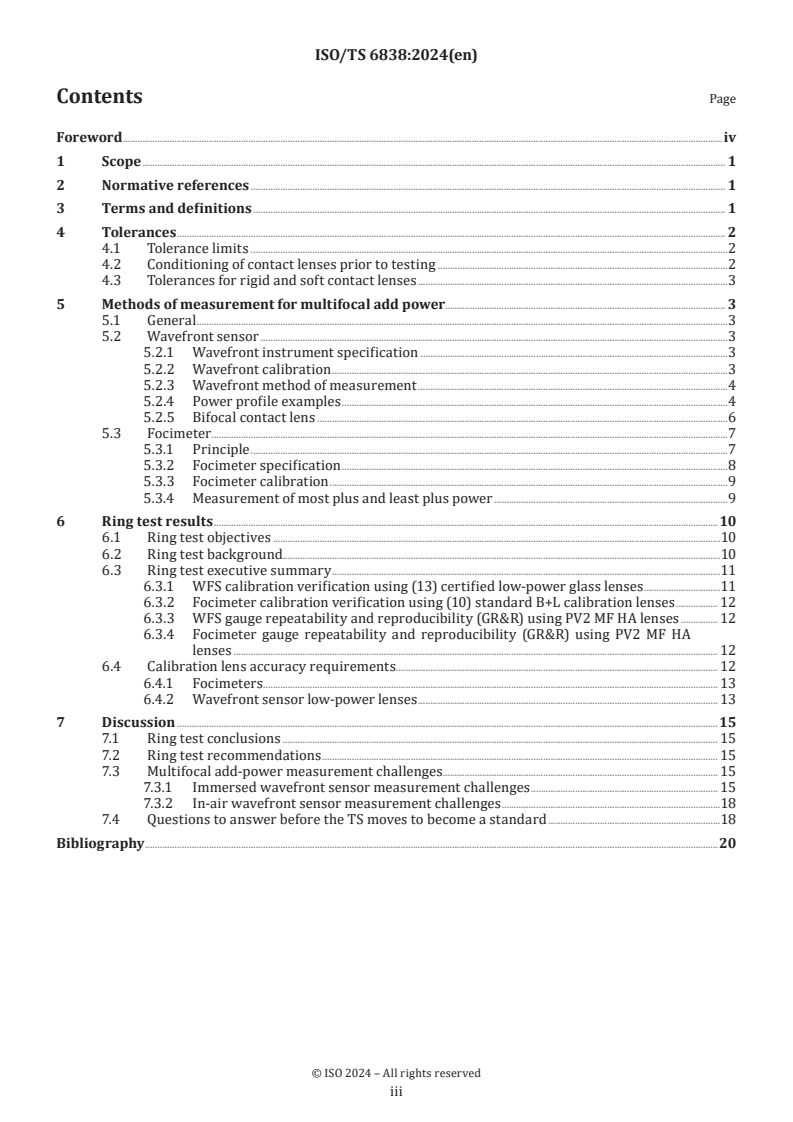
ISO/TS 6838:2024
(Main)Ophthalmic optics — Contact lenses — Tolerances and methods for measurement of multifocal contact lens addition power
Ophthalmic optics — Contact lenses — Tolerances and methods for measurement of multifocal contact lens addition power
This document specifies proposals for the tolerances and methods for measuring the base and add power of refractive/symmetric multifocal contact lenses. This document is not intended to measure current production lenses (or similar) and does not include measurement of diffractive multifocal contact lenses nor the measurement of distance (or label) power. This document is intended to obtain additional feedback from clinicians, manufacturers, and health authorities on the proposals for tolerances and test methods. This document is not intended to be used in any quality system or by any governing body to control the manufacturing or acceptance of contact lenses.
Optique ophtalmique — Lentilles de contact — Tolérances et méthodes de mesure de la puissance additionnelle des lentilles de contact multifocales
General Information
- Status
- Published
- Publication Date
- 10-Jul-2024
- Technical Committee
- ISO/TC 172/SC 7 - Ophthalmic optics and instruments
- Drafting Committee
- ISO/TC 172/SC 7 - Ophthalmic optics and instruments
- Current Stage
- 6060 - International Standard published
- Start Date
- 11-Jul-2024
- Due Date
- 13-Apr-2024
- Completion Date
- 11-Jul-2024
Overview
ISO/TS 6838:2024 addresses proposed tolerances and measurement methods for multifocal contact lens addition power. The Technical Specification focuses on refractive/symmetric multifocal designs and sets out proposals for measuring the base and add power of these lenses. It explicitly excludes diffractive multifocal lenses and the measurement of distance (label) power. The document is intended to solicit feedback from clinicians, manufacturers and health authorities and is not intended for use as a production acceptance or quality control standard.
Key Topics
- Scope and purpose: Proposals for tolerances and test methods specifically for multifocal add power rather than distance power.
- Tolerances: Framework for tolerance limits and conditioning of lenses prior to testing; separate considerations for rigid and soft materials are discussed.
- Measurement methods: Detailed methods described include:
- Wavefront sensor (WFS): Instrument specification, calibration, in-air and immersed measurement considerations, and example power profiles.
- Focimeter: Principle, specification, calibration and procedures to measure most-plus and least-plus power points.
- Ring test results: Results and analysis from interlaboratory ring tests, including calibration verification and gauge repeatability and reproducibility (GR&R).
- Discussion and challenges: Practical measurement challenges (e.g., immersed vs in-air WFS), calibration lens accuracy requirements, and questions to resolve before potential standardization.
Applications
This Technical Specification has practical value for a range of stakeholders involved in contact lens design, testing and regulation:
- Clinicians and researchers: Understand proposed measurement approaches and their limitations when evaluating multifocal addition power in study settings.
- Manufacturers and test labs: Review proposed tolerances, calibration needs and equipment specifications (wavefront sensors and focimeters) to inform internal test methods and R&D.
- Health authorities and standards bodies: Use the document as a consultation tool to assess measurement consistency and identify open questions before formal standard adoption.
Although informative, ISO/TS 6838:2024 is not intended to be used as a binding acceptance criterion in quality systems - its primary role is to gather feedback and harmonize measurement approaches.
Related Standards
- ISO 18369 series (contact lens standards) - note ISO/TS 6838:2024 clarifies add-power measurement where ISO 18369-3:2017 does not specify methods for multifocal add power.
- ISO/TC 172/SC 7 working documents and guidance referenced in the TS for optics and ophthalmic instrumentation.
For implementation, stakeholders should review the full ISO/TS text, consult calibration-lens requirements described in the ring-test summaries, and participate in the feedback process to refine these proposals.
ISO/TS 6838:2024 - Ophthalmic optics — Contact lenses — Tolerances and methods for measurement of multifocal contact lens addition power Released:7/11/2024
ISO/DTS 6838 - Ophthalmic optics — Contact lenses — Tolerances and methods for measurement of multifocal contact lens addition power Released:15. 04. 2024
REDLINE ISO/DTS 6838 - Ophthalmic optics — Contact lenses — Tolerances and methods for measurement of multifocal contact lens addition power Released:15. 04. 2024
Get Certified
Connect with accredited certification bodies for this standard

BSI Group
BSI (British Standards Institution) is the business standards company that helps organizations make excellence a habit.

TÜV Rheinland
TÜV Rheinland is a leading international provider of technical services.

TÜV SÜD
TÜV SÜD is a trusted partner of choice for safety, security and sustainability solutions.
Sponsored listings
Frequently Asked Questions
ISO/TS 6838:2024 is a technical specification published by the International Organization for Standardization (ISO). Its full title is "Ophthalmic optics — Contact lenses — Tolerances and methods for measurement of multifocal contact lens addition power". This standard covers: This document specifies proposals for the tolerances and methods for measuring the base and add power of refractive/symmetric multifocal contact lenses. This document is not intended to measure current production lenses (or similar) and does not include measurement of diffractive multifocal contact lenses nor the measurement of distance (or label) power. This document is intended to obtain additional feedback from clinicians, manufacturers, and health authorities on the proposals for tolerances and test methods. This document is not intended to be used in any quality system or by any governing body to control the manufacturing or acceptance of contact lenses.
This document specifies proposals for the tolerances and methods for measuring the base and add power of refractive/symmetric multifocal contact lenses. This document is not intended to measure current production lenses (or similar) and does not include measurement of diffractive multifocal contact lenses nor the measurement of distance (or label) power. This document is intended to obtain additional feedback from clinicians, manufacturers, and health authorities on the proposals for tolerances and test methods. This document is not intended to be used in any quality system or by any governing body to control the manufacturing or acceptance of contact lenses.
ISO/TS 6838:2024 is classified under the following ICS (International Classification for Standards) categories: 11.040.70 - Ophthalmic equipment. The ICS classification helps identify the subject area and facilitates finding related standards.
ISO/TS 6838:2024 is available in PDF format for immediate download after purchase. The document can be added to your cart and obtained through the secure checkout process. Digital delivery ensures instant access to the complete standard document.
Standards Content (Sample)
Technical
Specification
ISO/TS 6838
First edition
Ophthalmic optics — Contact lenses
2024-07
— Tolerances and methods for
measurement of multifocal contact
lens addition power
Optique ophtalmique — Lentilles de contact — Tolérances et
méthodes de mesure de la puissance additionnelle des lentilles de
contact multifocales
Reference number
© ISO 2024
All rights reserved. Unless otherwise specified, or required in the context of its implementation, no part of this publication may
be reproduced or utilized otherwise in any form or by any means, electronic or mechanical, including photocopying, or posting on
the internet or an intranet, without prior written permission. Permission can be requested from either ISO at the address below
or ISO’s member body in the country of the requester.
ISO copyright office
CP 401 • Ch. de Blandonnet 8
CH-1214 Vernier, Geneva
Phone: +41 22 749 01 11
Email: copyright@iso.org
Website: www.iso.org
Published in Switzerland
ii
Contents Page
Foreword .iv
1 Scope . 1
2 Normative references . 1
3 Terms and definitions . 1
4 Tolerances . 2
4.1 Tolerance limits .2
4.2 Conditioning of contact lenses prior to testing .2
4.3 Tolerances for rigid and soft contact lenses .3
5 Methods of measurement for multifocal add power. 3
5.1 General .3
5.2 Wavefront sensor .3
5.2.1 Wavefront instrument specification .3
5.2.2 Wavefront calibration .3
5.2.3 Wavefront method of measurement .4
5.2.4 Power profile examples .4
5.2.5 Bifocal contact lens .6
5.3 Focimeter .7
5.3.1 Principle .7
5.3.2 Focimeter specification .8
5.3.3 Focimeter calibration .9
5.3.4 Measurement of most plus and least plus power .9
6 Ring test results . 10
6.1 Ring test objectives .10
6.2 Ring test background.10
6.3 Ring test executive summary .11
6.3.1 WFS calibration verification using (13) certified low-power glass lenses .11
6.3.2 Focimeter calibration verification using (10) standard B+L calibration lenses . 12
6.3.3 WFS gauge repeatability and reproducibility (GR&R) using PV2 MF HA lenses . 12
6.3.4 Focimeter gauge repeatability and reproducibility (GR&R) using PV2 MF HA
lenses . 12
6.4 Calibration lens accuracy requirements. 12
6.4.1 Focimeters. 13
6.4.2 Wavefront sensor low-power lenses . 13
7 Discussion .15
7.1 Ring test conclusions . 15
7.2 Ring test recommendations . 15
7.3 Multifocal add-power measurement challenges. 15
7.3.1 Immersed wavefront sensor measurement challenges . 15
7.3.2 In-air wavefront sensor measurement challenges .18
7.4 Questions to answer before the TS moves to become a standard .18
Bibliography .20
iii
Foreword
ISO (the International Organization for Standardization) is a worldwide federation of national standards
bodies (ISO member bodies). The work of preparing International Standards is normally carried out through
ISO technical committees. Each member body interested in a subject for which a technical committee
has been established has the right to be represented on that committee. International organizations,
governmental and non-governmental, in liaison with ISO, also take part in the work. ISO collaborates closely
with the International Electrotechnical Commission (IEC) on all matters of electrotechnical standardization.
The procedures used to develop this document and those intended for its further maintenance are described
in the ISO/IEC Directives, Part 1. In particular, the different approval criteria needed for the different types
of ISO document should be noted. This document was drafted in accordance with the editorial rules of the
ISO/IEC Directives, Part 2 (see www.iso.org/directives).
ISO draws attention to the possibility that the implementation of this document may involve the use of (a)
patent(s). ISO takes no position concerning the evidence, validity or applicability of any claimed patent
rights in respect thereof. As of the date of publication of this document, ISO had not received notice of (a)
patent(s) which may be required to implement this document. However, implementers are cautioned that
this may not represent the latest information, which may be obtained from the patent database available at
www.iso.org/patents. ISO shall not be held responsible for identifying any or all such patent rights.
Any trade name used in this document is information given for the convenience of users and does not
constitute an endorsement.
For an explanation of the voluntary nature of standards, the meaning of ISO specific terms and expressions
related to conformity assessment, as well as information about ISO's adherence to the World Trade
Organization (WTO) principles in the Technical Barriers to Trade (TBT), see www.iso.org/iso/foreword.html.
This document was prepared by Technical Committee ISO/TC 172, Optics and photonics, Subcommittee SC 7,
Ophthalmic optics and instruments.
Any feedback or questions on this document should be directed to the user’s national standards body. A
complete listing of these bodies can be found at www.iso.org/members.html.
iv
Technical Specification ISO/TS 6838:2024(en)
Ophthalmic optics — Contact lenses — Tolerances and methods
for measurement of multifocal contact lens addition power
1 Scope
This document specifies proposals for the tolerances and methods for measuring the base and add power
of refractive/symmetric multifocal contact lenses. This document is not intended to measure current
production lenses (or similar) and does not include measurement of diffractive multifocal contact lenses nor
the measurement of distance (or label) power.
This document is intended to obtain additional feedback from clinicians, manufacturers, and health
authorities on the proposals for tolerances and test methods. This document is not intended to be used in
any quality system or by any governing body to control the manufacturing or acceptance of contact lenses.
2 Normative references
The following documents are referred to in the text in such a way that some or all of their content constitutes
requirements of this document. For dated references, only the edition cited applies. For undated references,
the latest edition of the referenced document (including any amendments) applies.
ISO 9342-1, Optics and optical instruments — Test lenses for calibration of focimeters — Part 1: Reference lenses
for focimeters used for measuring spectacle lenses
ISO 18369-3:2017, Ophthalmic optics — Contact lenses — Part 3: Measurement methods
3 Terms and definitions
For the purposes of this document, the following terms and definitions apply.
ISO and IEC maintain terminology databases for use in standardization at the following addresses:
— ISO Online browsing platform: available at https:// www .iso .org/ obp
— IEC Electropedia: available at https:// www .electropedia .org/
3.1
power map
localized radial back vertex power (in-air) as a function of two- dimensional coordinates from the centre of
the lens
3.2
power profile
one-dimensional localized optical power as a function of radial distance from the centre of the lens as
derived from the power map, thereby creating the power-map equivalent of a power profile
3.3
average most plus power
area-weighted average power across an annular zone corresponding to the most plus region of a progressive
optical zone
3.4
average least plus power
base power
area-weighted average power across an annular zone corresponding to the least plus region of a progressive
optical zone
3.5
distance power
label power
power, determined clinically, to produce the best distance vision
Note 1 to entry: The distance power may not equal the measured base power. In this case, a regression will be required
to determine the distance power from the base power. Clinicians should contact the manufacturer’s Professional
Services for the regression(s).
3.6
measure add power
difference between the average most plus and average least plus power of the contact lens
Note 1 to entry: The average most plus and least plus powers are measured over optical zones provided by the
manufacturer.
3.7
label add power
the clinically determined add power of the multifocal contact lens
Note 1 to entry: The label add power may not equal the measured add power. A regression may be required to
determine the label add power from the measured add power.
3.8
localized radial back vertex power
1 ∂Wr(),θ
Pr =
()
r ∂r
where W(r, θ) is the measured wavefront
Note 1 to entry: The definition of associated terms, such as bifocal or progressive contact lens, can be found in
ISO 18369-1.
4 Tolerances
4.1 Tolerance limits
When tested as specified in ISO 18369-3, the dimensional and optical properties for multifocal contact
lenses addition power (or add power) shall be as specified within the appropriate tolerance lines given in
Table 1 and Table 2.
The proposed add power tolerance is based on a variety of sources, including the results of the ring testing
discussed in this specification, guidance found in the national standard ANSI Z80.20-2016, the combined
statistical nature of how add power is computed as a difference and the 0,25 D tolerance on spherical power,
and feedback from clinicians and manufacturers.
4.2 Conditioning of contact lenses prior to testing
Contact lenses shall be equilibrated in standard saline or packing solution, unless otherwise specified in the
relevant test methods specified in ISO 18369-3.
4.3 Tolerances for rigid and soft contact lenses
Optical tolerances for rigid and soft contact lenses are given in Table 1 and Table 2.
Table 1 — Optical tolerances for rigid contact lenses
Dimension Tolerance limit Relevant method
Multifocal add power ±0,38 D 5.2 or 5.3
Table 2 — Optical tolerances for soft contact lenses
Dimension Tolerance limit Relevant method
Multifocal add power ±0,38 D 5.2 or 5.3
5 Methods of measurement for multifocal add power
5.1 General
Prescribing multifocal contact lenses requires clinicians to consider the user’s pupil diameter, how the lens
conforms to the user’s cornea, how the lens centres on the cornea, the inherent aberrations of the user’s eye,
how the user processes the variable optical power across their pupil, excess visual function, and the unique
optical design of the multifocal lens as reflected in the manufacturers’ fitting guides. Accounting for these
design and manufacturing specificities and clinical practices, the exact labelled distance and add powers
may exist over different regions of the contact lens for different designs. A regression equation, provided
by the manufacturer, may be required to determine the label distance and label add power. The process of
determining these regressions will vary with manufacturers. Regressions created using a focimeter or a
wavefront sensor may be different.
5.2 Wavefront sensor
5.2.1 Wavefront instrument specification
The optical wavefront over the relevant optical zone shall be measured using an accurate and precise
wavefront sensor (e.g. Shack Hartmann, Moiré deflectometer, phase-shifting Schlieren deflectometer, or
other types of interferometers). The wavefront sensor (WFS) shall produce power profiles of the contact
lens under test. In addition, the wavefront sensor shall be capable of outputting the average optical power
over user-defined regions.
A key specification for any wavefront method is the converting of immersed effective power to in-air back
vertex power. As described in 7.3.1.3, there are three recognized methods for this conversion.
5.2.2 Wavefront calibration
5.2.2.1 Wavefront calibration in-air
Calibration should be completed with calibration test pieces, known as test standards, with known
nominal values. Calibration should occur with the test standards in-air. Minimum requirements for this
purpose include four plus lenses and four minus lenses to cover the power ranges of the contact lenses to be
measured. Consideration should be given to matching the range of test standards to the range of lenses and
the intended test condition (in-air or immersed). Test standards shall be placed in calibrated cuvettes, as
shown in Figure 1. Refer to 6.4.2 for additional information.
Calibration shall follow the steps outlined in ISO 18369-3:2017, Annex B, including following the
manufacturer’s instructions to calibrate the instrument.
NOTE Be careful to check with the manufacturer for the correct contact lens orientation for back vertex power
measurement.
It is recommended to plot the power deviation versus the nominal standard power to better understand the
shape (or form) of any bias.
5.2.2.2 Wavefront verification in-solution
5.2.3 Wavefront method of measurement
The following steps, given in Table 3, shall be followed to determine the base power and measured add
power of refractive multifocal contact lenses.
Table 3 — Steps to determine the base power and measured add power of refractive multifocal
contact lenses
Step Action
1 Measure the wavefront over the relevant optics zone using an accurate and precise
wavefront sensor (e.g. Shack Hartmann, Moiré deflectometer, phase-shifting Schlier-
en deflectometer, other types of interferometers).
2 The manufacturer specifies two or more annular regions that will be used to deter-
mine the
a) average most plus power, and
b) average least plus power of the multifocal contact lens.
Generally, the zones shall be as wide as possible to improve averaging but narrow
enough to cover only the region of interest. The manufacturer shall provide, via pro-
fessional services, the positions of the most plus and least plus annular zones.
3 Determine the average power over each region using the power profile or power map
data derived from the measured optical wavefront.
4 The add power is the absolute value of the difference between the average most plus
and average least plus powers. If necessary, a regression may be applied to correlate
the measured add power with the label add power. If required, the manufacturer
shall provide the regression formula, via Professional Services, to determine the
label add power.
NOTE 1 The measured add power is a metric derived the power profile; and the measured add power may be different from the
labeled add or the value listed in the fitting guide.
NOTE 2 Additional independent average powers may need to be taken to meet ISO 18369-3 guidance for precision.
5.2.4 Power profile examples
In the following examples, the location of the label power relative to the power profile does not equal the
average Most Plus Power. The shape of the power profile is a degree of freedom for the manufacturer.
5.2.4.1 Centre-near progressive
Figure 1 shows the power profile of a centre-near, progressive multifocal contact lens. In this case the most
and least plus zones are chosen to ensure the power does not change appreciably over each zone, but still
contains the profile region of interest.
Key
1 most plus
2 label power
3 least plus
Figure 1 — Example 1 power profile
Figure 2 shows a second example of a centre-near progressive contact lens.
Key
1 most plus
2 label power
3 least plus
Figure 2 — Example 2 power profile
5.2.4.2 Centre-distance progressive
Figure 3 shows the power profile of a centre-distance contact lens.
Figure 3 — Example 3 power profile
5.2.5 Bifocal contact lens
Figure 4 shows the measured power profiles for a centre-near, bifocal contact lens.
Key
1 most plus
2 label power
3 least plus
Figure 4 — Centre-near, bifocal contact lens
5.2.5.1 Multi-Zone, bifocal contact lens
Figures 5 and 6 show the power profiles for a multi-zone, bifocal contact lens. In Figure 5, single most-plus
and least-plus zones are defined, whereas in Figure 6, three most-plus and least-plus zones are defined. For
Figure 6, the least-plus power would be the average of the power in the three bottom zones. The most-plus
power would be the average of the three top zones.
Key
1 most plus
2 label power
3 least plus
Figure 5 — Multi-zone, bifocal power profile with two defined regions
Key
1 most plus 1
2 least plus 1
3 most plus 2
4 least plus 2
5 most plus 3
6 least plus 3
7 label power
Figure 6 — Multi-zone, bifocal power profile with six defined regions
5.3 Focimeter
5.3.1 Principle
A manually-focusing focimeter may be used to measure the most plus power and least plus power of a
multifocal contact lens via the use of lens supports with various aperture geometries. The determination of
such lens supports requires knowledge of the optical zones provided by the manufacturer. The manufacturer
shall provide, via professional services, the positions of the most plus and least plus annular zones. The
location and width of the focimeter aperture shall be chosen to correspond with the location of the most
plus and least plus powers for each lens design. Multiple apertures may be required to measure add power
across the desired power range.
5.3.2 Focimeter specification
5.3.2.1 Focimeter
The focimeter shall have a minimum range of -20,00 D to +20,00 D with a minimum measuring accuracy of
±0,06 D, and capable of manual focusing. Other focimeters may be used provided the readings derived are
shown to be equivalent to those of a manually-focusing focimeter. A focimeter conforming to ISO 8598-1 can
be used.
5.3.2.2 Focimeter lens supports/apertures
Focimeter supports allow for centration of the contact lens optic zone around the optical axis of the focimeter,
correct placement of the contact lens back vertex relative to the measurement plane of the focimeter and
transmission of light through a defined aperture geometry.
The supports and fixtures detailed in Figures 7 and 8 show one design type for such lens supports. Other
support configurations can also be utilized (such as supports designed like ISO 18369-3:2017, 4.3.2.2).
Figure 7 shows three lens paddles with different aperture geometries. Figure 8 shows an adjustable paddle
fixture t
...
FINAL DRAFT
Technical
Specification
ISO/DTS 6838
ISO/TC 172/SC 7
Ophthalmic optics — Contact lenses
Secretariat: DIN
— Tolerances and methods for
Voting begins on:
measurement of multifocal contact
2024-04-29
lens addition power
Voting terminates on:
2024-06-24
RECIPIENTS OF THIS DRAFT ARE INVITED TO SUBMIT,
WITH THEIR COMMENTS, NOTIFICATION OF ANY
RELEVANT PATENT RIGHTS OF WHICH THEY ARE AWARE
AND TO PROVIDE SUPPOR TING DOCUMENTATION.
IN ADDITION TO THEIR EVALUATION AS
BEING ACCEPTABLE FOR INDUSTRIAL, TECHNO
LOGICAL, COMMERCIAL AND USER PURPOSES, DRAFT
INTERNATIONAL STANDARDS MAY ON OCCASION HAVE
TO BE CONSIDERED IN THE LIGHT OF THEIR POTENTIAL
TO BECOME STAN DARDS TO WHICH REFERENCE MAY BE
MADE IN NATIONAL REGULATIONS.
Reference number
ISO/DTS 6838:2024(en) © ISO 2024
FINAL DRAFT
ISO/DTS 6838:2024(en)
Technical
Specification
ISO/DTS 6838
ISO/TC 172/SC 7
Ophthalmic optics — Contact lenses
Secretariat: DIN
— Tolerances and methods for
Voting begins on:
measurement of multifocal contact
lens addition power
Voting terminates on:
RECIPIENTS OF THIS DRAFT ARE INVITED TO SUBMIT,
WITH THEIR COMMENTS, NOTIFICATION OF ANY
RELEVANT PATENT RIGHTS OF WHICH THEY ARE AWARE
AND TO PROVIDE SUPPOR TING DOCUMENTATION.
© ISO 2024
IN ADDITION TO THEIR EVALUATION AS
All rights reserved. Unless otherwise specified, or required in the context of its implementation, no part of this publication may
BEING ACCEPTABLE FOR INDUSTRIAL, TECHNO
LOGICAL, COMMERCIAL AND USER PURPOSES, DRAFT
be reproduced or utilized otherwise in any form or by any means, electronic or mechanical, including photocopying, or posting on
INTERNATIONAL STANDARDS MAY ON OCCASION HAVE
the internet or an intranet, without prior written permission. Permission can be requested from either ISO at the address below
TO BE CONSIDERED IN THE LIGHT OF THEIR POTENTIAL
or ISO’s member body in the country of the requester.
TO BECOME STAN DARDS TO WHICH REFERENCE MAY BE
MADE IN NATIONAL REGULATIONS.
ISO copyright office
CP 401 • Ch. de Blandonnet 8
CH-1214 Vernier, Geneva
Phone: +41 22 749 01 11
Email: copyright@iso.org
Website: www.iso.org
Published in Switzerland Reference number
ISO/DTS 6838:2024(en) © ISO 2024
ii
ISO/DTS 6838:2024(en)
Contents Page
Foreword .iv
1 Scope . 1
2 Normative references . 1
3 Terms and definitions . 1
4 Tolerances . 2
4.1 Tolerance limits .2
4.2 Conditioning of contact lenses prior to testing .2
4.3 Tolerances for rigid and soft contact lenses .3
5 Methods of measurement for multifocal add power. 3
5.1 General .3
5.2 Wavefront sensor .3
5.2.1 Wavefront instrument specification .3
5.2.2 Wavefront calibration .3
5.2.3 Wavefront method of measurement .4
5.2.4 Power profile examples .4
5.2.5 Bifocal contact lens .6
5.3 Focimeter .7
5.3.1 Principle .7
5.3.2 Focimeter specification .8
5.3.3 Focimeter calibration .9
5.3.4 Measurement of most plus and least plus power .9
6 Ring test results . 10
6.1 Ring test objectives .10
6.2 Ring test background.10
6.3 Ring test executive summary .11
6.3.1 WFS calibration verification using (13) certified low-power glass lenses .11
6.3.2 Focimeter calibration verification using (10) standard B+L calibration lenses . 12
6.3.3 WFS gauge repeatability and reproducibility (GR&R) using PV2 MF HA lenses . 12
6.3.4 Focimeter gauge repeatability and reproducibility (GR&R) using PV2 MF HA
lenses . 12
6.4 Calibration lens accuracy requirements. 12
6.4.1 Focimeters. 13
6.4.2 Wavefront sensor low-power lenses . 13
7 Discussion .15
7.1 Ring test conclusions . 15
7.2 Ring test recommendations . 15
7.3 Multifocal add-power measurement challenges. 15
7.3.1 Immersed wavefront sensor measurement challenges . 15
7.3.2 In-air wavefront sensor measurement challenges .18
7.4 Questions to answer before the TS moves to become a standard .18
Bibliography . 19
iii
ISO/DTS 6838:2024(en)
Foreword
ISO (the International Organization for Standardization) is a worldwide federation of national standards
bodies (ISO member bodies). The work of preparing International Standards is normally carried out through
ISO technical committees. Each member body interested in a subject for which a technical committee
has been established has the right to be represented on that committee. International organizations,
governmental and non-governmental, in liaison with ISO, also take part in the work. ISO collaborates closely
with the International Electrotechnical Commission (IEC) on all matters of electrotechnical standardization.
The procedures used to develop this document and those intended for its further maintenance are described
in the ISO/IEC Directives, Part 1. In particular, the different approval criteria needed for the different types
of ISO document should be noted. This document was drafted in accordance with the editorial rules of the
ISO/IEC Directives, Part 2 (see www.iso.org/directives).
ISO draws attention to the possibility that the implementation of this document may involve the use of (a)
patent(s). ISO takes no position concerning the evidence, validity or applicability of any claimed patent
rights in respect thereof. As of the date of publication of this document, ISO had not received notice of (a)
patent(s) which may be required to implement this document. However, implementers are cautioned that
this may not represent the latest information, which may be obtained from the patent database available at
www.iso.org/patents. ISO shall not be held responsible for identifying any or all such patent rights.
Any trade name used in this document is information given for the convenience of users and does not
constitute an endorsement.
For an explanation of the voluntary nature of standards, the meaning of ISO specific terms and expressions
related to conformity assessment, as well as information about ISO's adherence to the World Trade
Organization (WTO) principles in the Technical Barriers to Trade (TBT), see www.iso.org/iso/foreword.html.
This document was prepared by Technical Committee ISO/TC 172, Optics and photonics, Subcommittee SC 7,
Ophthalmic optics and instruments.
Any feedback or questions on this document should be directed to the user’s national standards body. A
complete listing of these bodies can be found at www.iso.org/members.html.
iv
FINAL DRAFT Technical Specification ISO/DTS 6838:2024(en)
Ophthalmic optics — Contact lenses — Tolerances and methods
for measurement of multifocal contact lens addition power
1 Scope
This document specifies proposals for the tolerances and methods for measuring the base and add power
of refractive/symmetric multifocal contact lenses. This document is not intended to measure current
production lenses (or similar) and does not include measurement of diffractive multifocal contact lenses nor
the measurement of distance (or label) power.
This document is intended to obtain additional feedback from clinicians, manufacturers, and health
authorities on the proposals for tolerances and test methods. This document is not intended to be used in
any quality system or by any governing body to control the manufacturing or acceptance of contact lenses.
2 Normative references
The following documents are referred to in the text in such a way that some or all of their content constitutes
requirements of this document. For dated references, only the edition cited applies. For undated references,
the latest edition of the referenced document (including any amendments) applies.
ISO 9342-1, Optics and optical instruments — Test lenses for calibration of focimeters — Part 1: Reference lenses
for focimeters used for measuring spectacle lenses
ISO 18369-3:2017, Ophthalmic optics — Contact lenses — Part 3: Measurement methods
3 Terms and definitions
For the purposes of this document, the following terms and definitions apply.
ISO and IEC maintain terminology databases for use in standardization at the following addresses:
— ISO Online browsing platform: available at https:// www .iso .org/ obp
— IEC Electropedia: available at https:// www .electropedia .org/
3.1
power map
localized radial back vertex power (in-air) as a function of two- dimensional coordinates from the centre of
the lens
3.2
power profile
one-dimensional localized optical power as a function of radial distance from the centre of the lens as
derived from the power map, thereby creating the power-map equivalent of a power profile
3.3
average most plus power
area-weighted average power across an annular zone corresponding to the most plus region of a progressive
optical zone
ISO/DTS 6838:2024(en)
3.4
average least plus power
base power
area-weighted average power across an annular zone corresponding to the least plus region of a progressive
optical zone
3.5
distance power
label power
power, determined clinically, to produce the best distance vision
Note 1 to entry: The distance power may not equal the measured base power. In this case, a regression will be required
to determine the distance power from the base power. Clinicians should contact the manufacturer’s Professional
Services for the regression(s).
3.6
measure add power
difference between the average most plus and average least plus power of the contact lens
Note 1 to entry: The average most plus and least plus powers are measured over optical zones provided by the
manufacturer.
3.7
label add power
the clinically determined add power of the multifocal contact lens
Note 1 to entry: The label add power may not equal the measured add power. A regression may be required to
determine the label add power from the measured add power.
3.8
localized radial back vertex power
1 ∂Wr(),θ
Pr =
()
r ∂r
where W(r, θ) is the measured wavefront
Note 1 to entry: The definition of associated terms, such as bifocal or progressive contact lens, can be found in
ISO 18369-1.
4 Tolerances
4.1 Tolerance limits
When tested as specified in ISO 18369-3, the dimensional and optical properties for multifocal contact
lenses addition power (or add power) shall be as specified within the appropriate tolerance lines given in
Table 1 and Table 2.
The proposed add power tolerance is based on a variety of sources, including the results of the ring testing
discussed in this specification, guidance found in the national standard ANSI Z80.20-2016, the combined
statistical nature of how add power is computed as a difference and the 0,25 D tolerance on spherical power,
and feedback from clinicians and manufacturers.
4.2 Conditioning of contact lenses prior to testing
Contact lenses shall be equilibrated in standard saline or packing solution, unless otherwise specified in the
relevant test methods specified in ISO 18369-3.
ISO/DTS 6838:2024(en)
4.3 Tolerances for rigid and soft contact lenses
Optical tolerances for rigid and soft contact lenses are given in Table 1 and Table 2.
Table 1 — Optical tolerances for rigid contact lenses
Dimension Tolerance limit Relevant method
Multifocal add power ±0,38 D 5.2 or 5.3
Table 2 — Optical tolerances for soft contact lenses
Dimension Tolerance limit Relevant method
Multifocal add power ±0,38 D 5.2 or 5.3
5 Methods of measurement for multifocal add power
5.1 General
Prescribing multifocal contact lenses requires clinicians to consider the user’s pupil diameter, how the lens
conforms to the user’s cornea, how the lens centres on the cornea, the inherent aberrations of the user’s eye,
how the user processes the variable optical power across their pupil, excess visual function, and the unique
optical design of the multifocal lens as reflected in the manufacturers’ fitting guides. Accounting for these
design and manufacturing specificities and clinical practices, the exact labelled distance and add powers
may exist over different regions of the contact lens for different designs. A regression equation, provided
by the manufacturer, may be required to determine the label distance and label add power. The process of
determining these regressions will vary with manufacturers. Regressions created using a focimeter or a
wavefront sensor may be different.
5.2 Wavefront sensor
5.2.1 Wavefront instrument specification
The optical wavefront over the relevant optical zone shall be measured using an accurate and precise
wavefront sensor (e.g. Shack Hartmann, Moiré deflectometer, phase-shifting Schlieren deflectometer, or
other types of interferometers). The wavefront sensor (WFS) shall produce power profiles of the contact
lens under test. In addition, the wavefront sensor shall be capable of outputting the average optical power
over user-defined regions.
A key specification for any wavefront method is the converting of immersed effective power to in-air back
vertex power. As described in 7.3.1.3, there are three recognized methods for this conversion.
5.2.2 Wavefront calibration
5.2.2.1 Wavefront calibration in-air
Calibration should be completed with calibration test pieces, known as test standards, with known
nominal values. Calibration should occur with the test standards in-air. Minimum requirements for this
purpose include four plus lenses and four minus lenses to cover the power ranges of the contact lenses to be
measured. Consideration should be given to matching the range of test standards to the range of lenses and
the intended test condition (in-air or immersed). Test standards shall be placed in calibrated cuvettes, as
shown in Figure 1. Refer to 6.4.2 for additional information.
Calibration shall follow the steps outlined in ISO 18369-3:2017, Annex B, including following the
manufacturer’s instructions to calibrate the instrument.
NOTE Be careful to check with the manufacturer for the correct contact lens orientation for back vertex power
measurement.
ISO/DTS 6838:2024(en)
It is recommended to plot the power deviation versus the nominal standard power to better understand the
shape (or form) of any bias.
5.2.2.2 Wavefront verification in-solution
5.2.3 Wavefront method of measurement
The following steps, given in Table 3, shall be followed to determine the base power and measured add
power of refractive multifocal contact lenses.
Table 3 — Steps to determine the base power and measured add power of refractive multifocal
contact lenses
Step Action
1 Measure the wavefront over the relevant optics zone using an accurate and precise
wavefront sensor (e.g. Shack Hartmann, Moiré deflectometer, phase-shifting Schlier-
en deflectometer, other types of interferometers).
2 The manufacturer specifies two or more annular regions that will be used to deter-
mine the
a) average most plus power, and
b) average least plus power of the multifocal contact lens.
Generally, the zones shall be as wide as possible to improve averaging but narrow
enough to cover only the region of interest. The manufacturer shall provide, via pro-
fessional services, the positions of the most plus and least plus annular zones.
3 Determine the average power over each region using the power profile or power map
data derived from the measured optical wavefront.
4 The add power is the absolute value of the difference between the average most plus
and average least plus powers. If necessary, a regression may be applied to correlate
the measured add power with the label add power. If required, the manufacturer
shall provide the regression formula, via Professional Services, to determine the
label add power.
NOTE 1 The measured add power is a metric derived the power profile; and the measured add power may be different from the
labeled add or the value listed in the fitting guide.
NOTE 2 Additional independent average powers may need to be taken to meet ISO 18369-3 guidance for precision.
5.2.4 Power profile examples
In the following examples, the location of the label power relative to the power profile does not equal the
average Most Plus Power. The shape of the power profile is a degree of freedom for the manufacturer.
5.2.4.1 Centre-near progressive
Figure 1 shows the power profile of a centre-near, progressive multifocal contact lens. In this case the most
and least plus zones are chosen to ensure the power does not change appreciably over each zone, but still
contains the profile region of interest.
ISO/DTS 6838:2024(en)
Key
1 most plus
2 label power
3 least plus
Figure 1 — Example 1 power profile
Figure 2 shows a second example of a centre-near progressive contact lens.
Key
1 most plus
2 label power
3 least plus
Figure 2 — Example 2 power profile
5.2.4.2 Centre-distance progressive
Figure 3 shows the power profile of a centre-distance contact lens.
ISO/DTS 6838:2024(en)
Figure 3 — Example 3 power profile
5.2.5 Bifocal contact lens
Figure 4 shows the measured power profiles for a centre-near, bifocal contact lens.
Key
1 most plus
2 label power
3 least plus
Figure 4 — Centre-near, bifocal contact lens
5.2.5.1 Multi-Zone, bifocal contact lens
Figures 5 and 6 show the power profiles for a multi-zone, bifocal contact lens. In Figure 5, single most-plus
and least-plus zones are defined, whereas in Figure 6, three most-plus and least-plus zones are defined. For
Figure 6, the least-plus power would be the average of the power in the three bottom zones. The most-plus
power would be the average of the three top zones.
ISO/DTS 6838:2024(en)
Key
1 most plus
2 label power
3 least plus
Figure 5 — Multi-zone, bifocal power profile with two defined regions
Key
1 most plus 1
2 least plus 1
3 most plus 2
4 least plus 2
5 most plus 3
6 least plus 3
7 label power
Figure 6 — Multi-zone, bifocal power profile with six defined regions
5.3 Focimeter
5.3.1 Principle
A manually-focusing focimeter may be used to measure the most plus power and least plus power of a
multifocal contact lens via the use of lens supports with various aperture geometries. The determination of
such lens supports requires knowledge of the optical zones provided by the manufacturer. The manufacturer
shall provide, via professional services, the positions of the most plus and least plus annular zones. The
location and width of the focimeter aperture shall be chosen to correspond with the location of the most
ISO/DTS 6838:2024(en)
plus and least plus powers for each lens design. Multiple apertures may be required to measure add power
across the desired power range.
5.3.2 Focimeter specification
5.3.2.1 Focimeter
The focimeter shall have a minimum range of -20,00 D to +20,00 D with a minimum measuring accuracy of
±0,06 D, and capable of manual focusing. Other focimeters may be used provided the readings derived are
shown to be equivalent to those of a manually-focusing focimeter. A focimeter conforming to I
...
Style Definition
...
Style Definition
...
Style Definition
...
ISO/DTS 6838:2024(en)
Style Definition
...
ISO /TC 172/SC 7/WG 9
Style Definition
...
Style Definition
Secretariat: DIN .
Style Definition
...
Date: 2024-03-15xx
Style Definition
...
Style Definition
...
Style Definition
...
Style Definition
...
Style Definition
...
Style Definition
Ophthalmic optics — Contact lenses — Tolerances and methods for
...
Style Definition
measurement of multifocal contact lens addition power .
Style Definition
...
Style Definition
...
Style Definition
...
Style Definition
...
Style Definition
...
Style Definition
...
Style Definition
...
Style Definition
...
Style Definition
...
Style Definition
...
Style Definition
...
Style Definition
...
Style Definition
...
Style Definition
...
Style Definition
...
Style Definition
...
Style Definition
...
Style Definition
...
Style Definition
...
Style Definition
...
Style Definition
...
Style Definition
...
Style Definition
...
Style Definition
...
Style Definition
...
Style Definition
...
Style Definition
...
Style Definition
...
Style Definition
...
Style Definition
...
Style Definition
...
Style Definition
...
Style Definition
...
Style Definition
...
Style Definition
...
Style Definition
...
Style Definition
...
Style Definition
...
Style Definition
...
Style Definition
...
Style Definition
...
Style Definition
...
Style Definition
...
St l D fi iti
ISO/DTS 6838:2024(E:(en) Formatted: Font: 11 pt, Bold
Formatted: Font: 11 pt, Bold
Formatted: HeaderCentered, Space After: 0 pt, Line
spacing: single
All rights reserved. Unless otherwise specified, or required in the context of its implementation, no part of this publication
may be reproduced or utilized otherwise in any form or by any means, electronic or mechanical, including photocopying, Formatted: Right: 1.5 cm, Bottom: 1 cm, Gutter: 0 cm,
Header distance from edge: 1.27 cm, Footer distance
or posting on the internet or an intranet, without prior written permission. Permission can be requested from either ISO
from edge: 0.5 cm
at the address below or ISO’s member body in the country of the requester.
Commented [eXtyles1]: The reference "ISO 2024" is to a
ISO copyright office
withdrawn standard
CP 401 • Ch. de Blandonnet 8
Formatted: Default Paragraph Font
CH-1214 Vernier, Geneva
Phone: + 41 22 749 01 11
Formatted: Default Paragraph Font
EmailE-mail: copyright@iso.org
Formatted: Indent: Left: 0 cm, Right: 0 cm, Space
Website: www.iso.orgwww.iso.org
Before: 0 pt, No page break before, Adjust space
between Latin and Asian text, Adjust space between
Published in Switzerland
Asian text and numbers
Formatted: French (France)
Formatted: Font: 10 pt
Formatted: Font: 11 pt
Formatted: FooterPageRomanNumber, Space After: 0
pt, Line spacing: single
ii © ISO 2024 – All rights reserved
ii
ISO/DTS 6838:2024(:(en) Formatted: Font: 11 pt, Bold
Formatted: Font: 11 pt, Bold
Formatted: HeaderCentered, Left, Space After: 0 pt,
Contents
Line spacing: single
Formatted: Adjust space between Latin and Asian text,
Foreword . v
Adjust space between Asian text and numbers
1 Scope . 1
2 Normative references . 1
3 Terms and definitions . 1
4 Tolerances . 3
4.1 Tolerance limits. 3
4.2 Conditioning of contact lenses prior to testing . 3
4.3 Tolerances for rigid and soft contact lenses . 3
5 Methods of measurement for multifocal add power . 3
5.1 General. 3
5.2 Wavefront sensor . 4
5.2.1 Wavefront instrument specification . 4
5.2.2 Wavefront calibration . 4
5.2.3 Wavefront method of measurement . 4
5.2.4 Power profile examples . 5
5.2.5 Bifocal contact lens. 7
5.3 Focimeter . 8
5.3.1 Principle . 8
5.3.2 Focimeter specification . 8
5.3.3 Focimeter calibration . 10
5.3.4 Measurement of most plus and least plus power . 10
6 Ring test results . 11
6.1 Ring test objectives . 11
6.2 Ring test background . 12
6.3 Ring test executive summary. 12
6.3.1 WFS calibration verification using (13) certified low-power glass lenses . 13
6.3.2 Focimeter calibration verification using (10) standard B+L calibration lenses . 13
6.3.3 WFS gauge repeatability and reproducibility (GR&R) using PV2 MF HA lenses . 14
6.3.4 Focimeter gauge repeatability and reproducibility (GR&R) using PV2 MF HA lenses . 14
6.4 Calibration lens accuracy requirements . 14
6.4.1 Focimeters . 14
6.4.2 Wavefront sensor low-power lenses . 15
7 Discussion . 17
7.1 Ring test conclusions . 17
7.2 Ring test recommendations . 17
7.3 Multifocal add-power measurement challenges . 18
7.3.1 Immersed wavefront sensor measurement challenges . 18
7.3.2 In-air wavefront sensor measurement challenges . 20
7.4 Questions to answer before the TS moves to become a standard . 21
Bibliography . 22
Formatted: Font: 10 pt
Foreword . iv
Formatted: Font: 10 pt
Introduction . v
Formatted: FooterCentered, Left, Line spacing: single
1 Scope . 1
Formatted: Font: 11 pt
2 Normative references . 1
Formatted: FooterPageRomanNumber, Left, Space
After: 0 pt, Line spacing: single
© ISO 2024 – All rights reserved
iii
ISO/DTS 6838:2024(E:(en) Formatted: Font: 11 pt, Bold
Formatted: Font: 11 pt, Bold
3 Terms and definitions . 1
Formatted: HeaderCentered, Space After: 0 pt, Line
4 Tolerances . 2
spacing: single
4.1 Tolerance limits. 2
4.2 Conditioning of contact lenses prior to testing . 3
4.3 Tolerances for rigid and soft contact lenses . 3
5 Methods of measurement for multifocal add power . 3
5.1 General. 3
5.2 Wavefront sensor . 3
5.2.1 Wavefront instrument specification . 3
5.2.2 Wavefront calibration . 4
5.2.3 Wavefront method of measurement . 4
5.2.4 Power profile examples . 5
5.2.5 Bifocal contact lens. 6
5.3 Focimeter . 8
5.3.1 Principle . 8
5.3.2 Focimeter specification . 8
5.3.3 Focimeter calibration . 10
5.3.4 Measurement of most plus and least plus power . 10
6 Ring test results . 11
6.1 Ring test objectives . 11
6.2 Ring test background . 11
6.3 Ring test executive summary. 11
6.3.1 WFS calibration verification using (13) certified low-power glass lenses . 12
6.3.2 Focimeter calibration verification using (10) standard B+L calibration lenses . 12
6.3.3 WFS gauge repeatability and reproducibility (GR&R) using PV2 MF HA lenses . 13
6.3.4 Focimeter gauge repeatability and reproducibility (GR&R) using PV2 MF HA lenses . 13
6.4 Calibration lens accuracy requirements . 13
6.4.1 Focimeters . 13
6.4.2 Wavefront sensor low-power lenses . 14
7 Discussion . 16
7.1 Ring test conclusions . 16
7.2 Ring test recommendations . 16
7.3 Multifocal add-power measurement challenges . 16
7.3.1 Immersed wavefront sensor measurement challenges . 16
7.3.2 In-air wavefront sensor measurement challenges . 19
8 Questions to answer before the TS moves to become a standard . 19
Formatted: Font: 10 pt
Formatted: Font: 11 pt
Formatted: FooterPageRomanNumber, Space After: 0
pt, Line spacing: single
iv © ISO 2024 – All rights reserved
iv
ISO/DTS 6838:2024(:(en) Formatted: Font: 11 pt, Bold
Formatted: Font: 11 pt, Bold
Formatted: HeaderCentered, Left, Space After: 0 pt,
Foreword
Line spacing: single
Formatted: Adjust space between Latin and Asian text,
ISO (the International Organization for Standardization) is a worldwide federation of national standards
Adjust space between Asian text and numbers
bodies (ISO member bodies). The work of preparing International Standards is normally carried out through
ISO technical committees. Each member body interested in a subject for which a technical committee has been
established has the right to be represented on that committee. International organizations, governmental and
non-governmental, in liaison with ISO, also take part in the work. ISO collaborates closely with the
International Electrotechnical Commission (IEC) on all matters of electrotechnical standardization.
The procedures used to develop this document and those intended for its further maintenance are described
in the ISO/IEC Directives, Part 1. In particular, the different approval criteria needed for the different types of
ISO documentsdocument should be noted. This document was drafted in accordance with the editorial rules
of the ISO/IEC Directives, Part 2 (see www.iso.org/directiveswww.iso.org/directives).
Attention is drawnISO draws attention to the possibility that some of the elementsimplementation of this
document may beinvolve the subjectuse of (a) patent(s). ISO takes no position concerning the evidence,
validity or applicability of any claimed patent rights. in respect thereof. As of the date of publication of this
document, ISO had not received notice of (a) patent(s) which may be required to implement this document.
However, implementers are cautioned that this may not represent the latest information, which may be
obtained from the patent database available at www.iso.org/patents. ISO shall not be held responsible for
identifying any or all such patent rights. Details of any patent rights identified during the development of the
document will be in the Introduction and/or on the ISO list of patent declarations received (see
www.iso.org/patents).
Any trade name used in this document is information given for the convenience of users and does not
constitute an endorsement.
For an explanation of the voluntary nature of standards, the meaning of ISO specific terms and expressions
related to conformity assessment, as well as information about ISO's adherence to the World Trade
Organization (WTO) principles in the Technical Barriers to Trade (TBT), see
.
www.iso.org/iso/foreword.htmlwww.iso.org/iso/foreword.html
This document was prepared by Technical Committee ISO/TC 172, Optics and photonics, Subcommittee SC 7,
Ophthalmic optics and instruments.
Any feedback or questions on this document should be directed to the user’s national standards body. A
complete listing of these bodies can be found at www.iso.org/members.htmlwww.iso.org/members.html.
Formatted: Font: 10 pt
Formatted: FooterCentered, Left, Line spacing: single
Formatted: Font: 11 pt
Formatted: FooterPageRomanNumber, Left, Space
After: 0 pt, Line spacing: single
© ISO 2024 – All rights reserved
v
ISO/DTS 6838:2024(E:(en) Formatted: Font: 11 pt, Bold
Formatted: Font: 11 pt, Bold
Introduction
Formatted: HeaderCentered, Space After: 0 pt, Line
spacing: single
Two parameters of multifocal contact lenses are contained on the label: distance power and add power. The
measurement of these parameters is not specified in ISO 18369-3:2017 because a capable method has not
been developed. In addition, the add power tolerance is not contained in ISO 18369-2:2017 due to the lack of
measurement methods.
This document contains three sections.
— Proposed standard for multifocal contact lens tolerances and measurement methods,
— Ring test results, and
— Questions to answer before the TS moves to become a standard.
Formatted: Font: 10 pt
Formatted: Font: 11 pt
Formatted: FooterPageRomanNumber, Space After: 0
pt, Line spacing: single
vi © ISO 2024 – All rights reserved
vi
FINAL DRAFT Technical Specification ISO/DTS 6838:2024(en)
Formatted: Right: 1.5 cm, Bottom: 1 cm, Gutter: 0 cm,
Ophthalmic optics — Contact lenses — Tolerances and methods for
Section start: New page, Header distance from edge:
1.27 cm, Footer distance from edge: 0.5 cm
measurement of multifocal contact lens addition power
Formatted: Main Title 1, Space After: 0 pt, Adjust
space between Latin and Asian text, Adjust space
1 Scope
between Asian text and numbers
Formatted: Adjust space between Latin and Asian text,
This document specifies proposals for the tolerances and methods for measuring the base and add power of
Adjust space between Asian text and numbers
refractive/symmetric multifocal contact lenses. This document is not intended to measure current production
lenses (or similar) and does not include measurement of diffractive multifocal contact lenses nor the
measurement of distance (or label) power.
This document is intended to obtain additional feedback from clinicians, manufacturers, and health
authorities on the proposals for tolerances and test methods. This document is not intended to be used in any
quality system or by any governing body to control the manufacturing or acceptance of contact lenses.
2 Normative references
The following documents are referred to in the text in such a way that some or all of their content constitutes
requirements of this document. For dated references, only the edition cited applies. For undated references,
the latest edition of the referenced document (including any amendments) applies.
18369-1:2017, Ophthalmic optics — Contact lenses — Part 1: Vocabulary, classification system and
recommendations for labelling specifications
ISO 18369-2:2017, Ophthalmic optics — Contact lenses — Part 2: Tolerances
ISO 18369-3:2017, Ophthalmic optics — Contact lenses — Part 3: Measurement methods
ISO 18369-4:2017, Ophthalmic optics — Contact lenses — Part 4: Physicochemical properties of contact
lens materials
Commented [eXtyles2]: eXtyles Inline Standards Citation
Match reports that the normative reference
"ISO 18369-4:2017" is not cited in the text.
ISO 8598-1, Optics and optical instruments — Focimeters — Part 1: General purpose instruments
Formatted: Default Paragraph Font
ISO 9342-ISO 9342-1, Optics and optical instruments — Test lenses for calibration of focimeters — Part
Formatted: Default Paragraph Font
1: Reference lenses for focimeters used for measuring spectacle lenses
Formatted: Adjust space between Latin and Asian text,
Adjust space between Asian text and numbers, Tab
ISO 18369-3:2017, Ophthalmic optics — Contact lenses — Part 3: Measurement methods
stops: Not at 0.7 cm + 1.4 cm + 2.1 cm + 2.8 cm +
3.5 cm + 4.2 cm + 4.9 cm + 5.6 cm + 6.3 cm + 7 cm
3 Terms and definitions
Formatted: Adjust space between Latin and Asian text,
For the purposes of this document, the following terms and definitions apply. Adjust space between Asian text and numbers
Commented [eXtyles3]: The URL
ISO and IEC maintain terminology databases for use in standardization at the following addresses:
https://www.iso.org/obp has been redirected to
https://www.iso.org/obp/ui. Please verify the URL.
— — ISO Online browsing platform: available at https://www.iso.org/obphttps://www.iso.org/obp
Formatted: Adjust space between Latin and Asian text,
Adjust space between Asian text and numbers, Tab
— — IEC Electropedia: available at https://www.electropedia.org/https://www.electropedia.org/
stops: Not at 0.7 cm + 1.4 cm + 2.1 cm + 2.8 cm +
3.5 cm + 4.2 cm + 4.9 cm + 5.6 cm + 6.3 cm + 7 cm
Formatted: Font: 11 pt
Formatted: Left, Space After: 0 pt, Line spacing: single
ISO/DTS 6838:(en)
Formatted: Font: Bold
Formatted: HeaderCentered
3.1
Formatted: Adjust space between Latin and Asian text,
Powerpower map Adjust space between Asian text and numbers
localized radial back vertex power (in-air) as a function of two- dimensional coordinates from the centre of
Commented [eXtyles4]: The term "Power map" has not
...
the lens
Formatted
...
3.2
Formatted
...
Powerpower profile
Commented [eXtyles5]: The term "Power profile" has not
...
one-dimensional localized optical power as a function of radial distance from the centre of the lens as derived
Formatted
from the power map, thereby creating the power-map equivalent of a power profile .
Formatted
...
3.3
Averageaverage most plus power
Commented [eXtyles6]: The term "Average most plus
...
area-weighted average power across an annular zone corresponding to the most plus region of a progressive
Formatted
...
optical zone
Formatted
...
3.4
Average least plus power
Commented [eXtyles7]: The term "Average least plus
...
average least plus power
Formatted
...
base power
area-weighted average power across an annular zone corresponding to the least plus region of a progressive
Formatted
...
optical zone
Commented [eXtyles8]: The term "Base power" has not
3.5 .
Basedistance power
Formatted
...
average least plus power
Formatted
...
3.6
Commented [eXtyles9]: The term "Distance power" has
...
Distancelabel power
Label power
Formatted
...
power, determined clinically, to produce the best distance vision
Commented [eXtyles10]: The term "Label power" has not
...
Note 1 to entry: The distance power may not equal the measured base power. In this case, a regression will be required Formatted
...
to determine the distance power from the base power. Clinicians should contact the manufacturer’s Professional Services
Formatted
...
for the regression(s).
Formatted
...
3.76
Commented [eXtyles11]: The term "Measure add power"
...
Measuremeasure add power
Formatted
...
difference between the average most plus and average least plus power of the contact lens
Formatted
...
Note 1 to entry: The average most plus and least plus powers are measured over optical zones provided by the
Formatted
...
manufacturer.
Formatted
...
3.87
Commented [eXtyles12]: The term "Label add power" has
...
Labellabel add power
Formatted
...
the clinically determined add power of the multifocal contact lens
Formatted
...
Note 1 to entry: The label add power may not equal the measured add power. A regression may be required to
Formatted
...
determine the label add power from the measured add power.
Formatted
...
3.98
Commented [eXtyles13]: The term "Localized radial back
...
Localizedlocalized radial back vertex power
Formatted
...
Formatted: Font: 10 pt
∂Wr ,θ
1 ( )
Formatted: Font: 10 pt
Pr( )= (1)
rr∂
Formatted: Font: 11 pt
Formatted
...
2 © ISO 2022 2024 – All rights reserved
ISO/DTS 6838:2024(:(en) Formatted: Font: 11 pt, Bold
Formatted: Font: 11 pt, Bold
Formatted: HeaderCentered, Left, Space After: 0 pt,
1𝜕𝜕𝜕𝜕(𝑟𝑟,𝜃𝜃)
Line spacing: single
𝑃𝑃(𝑟𝑟) =
𝑟𝑟 𝜕𝜕𝑟𝑟
where W(r, θ) is the measured wavefront
Note 1 to entry: The definition of associated terms, such as bifocal or progressive contact lens, can be found in
Formatted
...
ISO 18369-1.
Formatted
...
4 Tolerances
Formatted
...
4.1 Tolerance limits
Formatted
...
When tested as specified in ISO 18369-3, the dimensional and optical properties for multifocal contact lenses
Formatted
...
addition power (or add power) shall be as specified within the appropriate tolerance lines given in Table 1
Formatted
...
and Table 2.Table 1 and Table 2.
Formatted
...
The proposed add power tolerance is based on a variety of sources, including the results of the ring testing
Formatted
...
discussed in this specification, guidance found in the national standard ANSI Z80.20-2016, the combined
Formatted
statistical nature of how add power is computed as a difference and the 0,25 D tolerance on spherical power,
...
and feedback from clinicians and manufacturers.
Formatted
...
Formatted
...
4.2 Conditioning of contact lenses prior to testing
Formatted
...
Contact lenses shall be equilibrated in standard saline or packing solution, unless otherwise specified in the
Formatted
...
relevant test methods specified in ISO 18369-3.
Formatted: Font: Bold
4.3 Tolerances for rigid and soft contact lenses
Formatted: Font: 10 pt, English (United Kingdom)
Formatted
...
Optical tolerances for rigid and soft contact lenses are given in Table 1 and Table 2.Table 1 and Table 2.
Formatted
...
Table 1 — Optical Tolerancestolerances for rigid contact lenses
Formatted
...
Dimension Tolerance limit Relevant method
Formatted
...
Formatted
Multifocal add power ±0,38 D 5.2 or 5.35.2 or 5.3
...
Formatted
...
Table 2 — Optical Tolerancestolerances for soft contact lenses
Formatted: Font: Bold
Dimension Tolerance limit Relevant method
Formatted: Font: 10 pt, English (United Kingdom)
Multifocal add power ±0,38 D 5.2 or 5.35.2 or 5.3
Formatted
...
Formatted
...
5 Methods of measurement for multifocal add power
Formatted
...
5.1 General
Formatted
...
Formatted
...
Prescribing multifocal contact lenses requires clinicians to consider the user’s pupil diameter, how the lens
Formatted
conforms to the user’s cornea, how the lens centres on the cornea, the inherent aberrations of the user’s eye,
...
how the user processes the variable optical power across their pupil, excess visual function, and the unique
Formatted
...
optical design of the multifocal lens as reflected in the manufacturers’ fitting guides. Accounting for these
Formatted: Font: 10 pt
design and manufacturing specificities and clinical practices, the exact labelled distance and add powers may
exist over different regions of the contact lens for different designs. A regression equation, provided by the Formatted
...
manufacturer, may be required to determine the label distance and label add power. The process of
Formatted: FooterCentered, Left, Line spacing: single
determining these regressions will vary with manufacturers. Regressions created using a focimeter or a
Formatted: Font: 11 pt, Not Bold
wavefront sensor may be different.
Formatted: Font: 11 pt
Formatted
...
© ISO 2024 – All rights reserved
ISO/DTS 6838:(en)
Formatted: Font: Bold
Formatted: HeaderCentered
5.2 Wavefront sensor
Formatted: Adjust space between Latin and Asian text,
Adjust space between Asian text and numbers, Tab
5.2.1 Wavefront instrument specification
stops: Not at 0.71 cm
Formatted: Adjust space between Latin and Asian text,
The optical wavefront over the relevant optical zone shall be measured using an accurate and precise
Adjust space between Asian text and numbers, Tab
wavefront sensor (e.g.,. Shack Hartmann, Moiré deflectometer, phase-shifting Schlieren deflectometer, or
stops: Not at 0.71 cm + 0.99 cm + 1.27 cm
other types of interferometers). The wavefront sensor (WFS) shall produce power profiles of the contact lens
Formatted: Adjust space between Latin and Asian text,
under test. In addition, the wavefront sensor shall be capable of outputting the average optical power over
Adjust space between Asian text and numbers
user-defined regions.
A key specification for any wavefront method is the converting of immersed effective power to in-air back
vertex power. As described in Section 7.3.1.3,7.3.1.3, there are three recognized methods for this conversion.
Formatted: Adjust space between Latin and Asian text,
Adjust space between Asian text and numbers, Tab
5.2.2 Wavefront calibration
stops: Not at 0.71 cm + 0.99 cm + 1.27 cm
5.2.2.1 Wavefront calibration in-air
Formatted: Adjust space between Latin and Asian text,
Adjust space between Asian text and numbers, Tab
Calibration should be completed with calibration test pieces, known as test standards, with known nominal
stops: Not at 0.71 cm + 0.99 cm + 1.27 cm + 1.55 cm
values. Calibration should occur with the test standards in-air. Minimum requirements for this purpose
+ 1.9 cm
include four plus lenses and four minus lenses to cover the power ranges of the contact lenses to be measured.
Formatted
...
Consideration should be given to matching the range of test standards to the range of lenses and the intended
Commented [eXtyles14]: eXtyles Inline Standards
test condition (in-air or immersed). Test standards shall be placed in calibrated cuvettes, as shown in Figure 1. .
Refer to Section 6.4.2Figure 1. Refer to 6.4.2 for additional information.
Formatted: Default Paragraph Font
Calibration shall follow the steps outlined in ISO 18369-3:2017, Annex B, including following the
manufacturer’s instructions to calibrate the instrument. Formatted: Default Paragraph Font
Formatted: Default Paragraph Font
NOTE: Be careful to check with the manufacturer for the correct contact lens orientation for back vertex power
Formatted
measurement. .
Formatted
...
It is recommended to plot the power deviation versus the nominal standard power to better understand the
Formatted
...
shape (or form) of any bias.
Formatted
...
5.2.2.2 Wavefront verification in-solution
Formatted
...
5.2.3 Wavefront method of measurement
Formatted
...
Formatted: Font: Bold
The following steps, given in Table 3,Table 3, shall be followed to determine the base power and measured
Formatted: English (United Kingdom)
add power of refractive multifocal contact lenses.
Formatted: Font: Bold
Table 3 — Steps to determine the base power and measured add power of refractive multifocal
Formatted: English (United Kingdom)
contact lenses
Formatted
...
Step Action
Formatted Table
1 Measure the wavefront over the relevant optics zone using an accurate and precise
Formatted
...
wavefront sensor (e.g.,. Shack Hartmann, Moiré deflectometer, phase-shifting
Schlieren deflectometer, other types of interferometers). Formatted
...
Formatted
2 The manufacturer specifies two or more annular regions that will be used to .
determine the:
Formatted
...
(a) average most plus power;, and
Formatted: Font color: Auto
(b) average least plus power of the multifocal contact lens.
Formatted: Font: 10 pt
Generally, the zones shall be as wide as possible to improve averaging but narrow
enough to cover only the region of interest. The manufacturer shall provide, via Formatted: Font: 10 pt
Professional Servicesprofessional services, the positions of the most plus and least
Formatted: Font: 11 pt
plus annular zones.
Formatted
...
4 © ISO 2022 2024 – All rights reserved
ISO/DTS 6838:2024(:(en) Formatted: Font: 11 pt, Bold
Formatted: Font: 11 pt, Bold
Formatted: HeaderCentered, Left, Space After: 0 pt,
Step Action
Line spacing: single
3 Determine the average power over each region using the power profile or power Formatted: Font: Bold
map data derived from the measured optical wavefront.
Formatted: English (United Kingdom)
4 The add power is the absolute value of the difference between the average most plus
Formatted: Font: Bold
and average least plus powers. If necessary, a regression may be applied to correlate
Formatted: Adjust space between Latin and Asian text,
the measured add power with the label add power. If required, the manufacturer
shall provide the regression formula, via Professional Services, to determine the Adjust space between Asian text and numbers
label add power.
Formatted Table
Note NOTE 1: The measured add power is a metric derived the power profile; and the measured add power may be different
Formatted: English (United Kingdom)
from the labeled add or the value listed in the fitting guide.
Formatted: Adjust space between Latin and Asian text,
Note NOTE 2: Additional independent average powers may need to be taken to meet ISO 18369-3:2017 guidance for precision.
Adjust space between Asian text and numbers
Formatted: Font color: Auto
5.2.4 Power profile examples
Formatted: Adjust space between Latin and Asian text,
In the following examples, the location of the label power relative to the power profile does not equal the
Adjust space between Asian text and numbers
average Most Plus Power. The shape of the power profile is a degree of freedom for the manufacturer.
Formatted Table
5.2.4.1 Centre-near progressive
Formatted: Font color: Auto
Formatted: Adjust space between Latin and Asian text,
Figure 1Figure 1 shows the power profile of a centre-near, progressive multifocal contact lens. In this case the
Adjust space between Asian text and numbers, Tab
most and least plus zones are chosen to ensure the power does not change appreciably over each zone, but
stops: Not at 0.7 cm + 1.4 cm + 2.1 cm + 2.17 cm +
still contains the profile region of interest.
2.8 cm + 3.5 cm + 4.2 cm + 4.9 cm + 5.6 cm + 6.3
cm + 7 cm
Formatted: Default Paragraph Font
Formatted: Space Before: 12 pt, Adjust space between
Latin and Asian text, Adjust space between Asian text
and numbers, Tab stops: Not at 0.71 cm + 0.99 cm +
1.27 cm
Formatted
...
Formatted
...
Formatted
...
Key
Formatted
...
1 most plus
Formatted Table
2 label power
Formatted
...
3 least plus
Formatted
...
6838_ed1fig1.EPS
Figure 1 — Example 1 power profile
Figure 2 shows a second example of a centre-near progressive contact lens. Formatted: Font: 10 pt
Formatted: Font: 10 pt
Formatted: FooterCentered, Left, Line spacing: single
Formatted: Font: 11 pt, Not Bold
Formatted: Font: 11 pt
Formatted
...
© ISO 2024 – All rights reserved
ISO/DTS 6838:(en)
Formatted: Font: Bold
Formatted: HeaderCentered
Formatted: Adjust space between Latin and Asian text,
Adjust space between Asian text and numbers, Tab
stops: Not at 0.7 cm + 1.4 cm + 2.1 cm + 2.8 cm +
3.5 cm + 4.2 cm + 4.9 cm + 5.6 cm + 6.3 cm + 7 cm
Formatted Table
Key
Formatted: Adjust space between Latin and Asian text,
Adjust space between Asian text and numbers, Tab
1 most plus
stops: Not at 0.7 cm + 1.4 cm + 2.1 cm + 2.8 cm +
2 label power
3.5 cm + 4.2 cm + 4.9 cm + 5.6 cm + 6.3 cm + 7 cm
3 least plus
Formatted: Adjust space between Latin and Asian text,
Adjust space between Asian text and numbers, Tab
Figure 1 — Example 1 power profile
stops: Not at 0.7 cm + 1.4 cm + 2.1 cm + 2.8 cm +
3.5 cm + 4.2 cm + 4.9 cm + 5.6 cm + 6.3 cm + 7 cm
Figure 2 shows a second example of a centre-near progressive contact lens.
Formatted: Default Paragraph Font
6838_ed1fig2.EPS Formatted: Adjust space between Latin and Asian text,
Adjust space between Asian text and numbers, Tab
Key
stops: Not at 0.7 cm + 1.4 cm + 2.1 cm + 2.8 cm +
1 most plus
3.5 cm + 4.2 cm + 4.9 cm + 5.6 cm + 6.3 cm + 7 cm
2 label power
Formatted Table
3 least plus
Formatted: Adjust space between Latin and Asian text,
Figure 2 — Example 2 power profile
Adjust space between Asian text and numbers, Tab
stops: Not at 0.7 cm + 1.4 cm + 2.1 cm + 2.8 cm +
3.5 cm + 4.2 cm + 4.9 cm + 5.6 cm + 6.3 cm + 7 cm
5.2.4.2 Centre-distance progressive
Formatted: Adjust space between Latin and Asian text,
Figure 3Figure 3 shows the power profile of a centre-distance contact lens. Adjust space between Asian text and numbers, Tab
stops: Not at 0.7 cm + 1.4 cm + 2.1 cm + 2.8 cm +
6838_ed1fig3.EPS 3.5 cm + 4.2 cm + 4.9 cm + 5.6 cm + 6.3 cm + 7 cm
Formatted: None, Space Before: 6 pt, Adjust space
between Latin and Asian text, Adjust space between
Asian text and numbers
Formatted: Adjust space between Latin and Asian text,
Adjust space between Asian text and numbers, Tab
stops: Not at 0.71 cm + 0.99 cm + 1.27 cm + 1.55 cm
+ 1.9 cm
Formatted: Adjust space between Latin and Asian text,
Adjust space between Asian text and numbers
Formatted: None, Adjust space between Latin and
Asian text, Adjust space between Asian text and
numbers
Formatted: Font: 10 pt
Figure 3 — Example 3 power profile
Formatted: Font: 10 pt
Formatted: Font: 11 pt
Formatted: FooterPageRomanNumber, Space After: 0
pt, Line spacing: single
6 © ISO 2022 2024 – All rights reserved
ISO/DTS 6838:2024(:(en) Formatted: Font: 11 pt, Bold
Formatted: Font: 11 pt, Bold
Formatted: HeaderCentered, Left, Space After: 0 pt,
5.2.5 Bifocal contact lens
Line spacing: single
Formatted: Adjust space between Latin and Asian text,
Figure 4Figure 4 shows the measured power profiles for a centre-near, bifocal contact lens.
Adjust space between Asian text and numbers, Tab
stops: Not at 0.71 cm + 0.99 cm + 1.27 cm
Formatted: Adjust space between Latin and Asian text,
Adjust space between Asian text and numbers
Formatted: Adjust space between Latin and Asian text,
Adjust space between Asian text and numbers, Tab
stops: Not at 0.7 cm + 1.4 cm + 2.1 cm + 2.8 cm +
3.5 cm + 4.2 cm + 4.9 cm + 5.6 cm + 6.3 cm + 7 cm
Key
Formatted Table
1 most plus
Formatted: Adjust space between Latin and Asian text,
2 label power
Adjust space between Asian text and numbers, Tab
3 least plus
stops: Not at 0.7 cm + 1.4 cm + 2.1 cm + 2.8 cm +
3.5 cm + 4.2 cm + 4.9 cm + 5.6 cm + 6.3 cm + 7 cm
6838_ed1fig4.EPS
Formatted: Adjust space between Latin and Asian text,
Key
Adjust space between Asian text and numbers, Tab
1 most plus
stops: Not at 0.7 cm + 1.4 cm + 2.1 cm + 2.8 cm +
2 label power
3.5 cm + 4.2 cm + 4.9 cm + 5.6 cm + 6.3 cm + 7 cm
3 least plus
Formatted: Adjust space between Latin and Asian text,
Adjust space between Asian text and numbers, Tab
Figure 4 — Centre-near, bifocal contact lens
stops: Not at 0.7 cm + 1.4 cm + 2.1 cm + 2.8 cm +
3.5 cm + 4.2 cm + 4.9 cm + 5.6 cm + 6.3 cm + 7 cm
5.2.5.1 Multi-Zone, bifocal contact lens
Formatted Table
Formatted: Adjust space between Latin and Asian text,
Figures 5Figures 5 and 66 show the power profiles for a multi-zone, bifocal contact lens. In Figure 5,In
Adjust space between Asian text and numbers, Tab
Figure 5, single most-plus and least-plus zones are defined, whereas in Figure 6,Figure 6, three most-plus and
stops: Not at 0.7 cm + 1.4 cm + 2.1 cm + 2.8 cm +
least-plus zones are defined. For Figure 6,For Figure 6, the least-plus power would be the average of the power
3.5 cm + 4.2 cm + 4.9 cm + 5.6 cm + 6.3 cm + 7 cm
in the three bottom zones. The most-plus power would be the average of the three top zones.
Formatted
...
6838_ed1fig5.EPS
Formatted
...
Formatted
...
Formatted: Default Paragraph Font
Formatted
...
Formatted
...
Formatted Table
Formatted: Font: 10 pt
Formatted: FooterCentered, Left, Line spacing: single
Formatted: Font: 11 pt, Not Bold
Key
Formatted: Font: 11 pt
1 most plus
Formatted
...
© ISO 2024 – All rights reserved
ISO/DTS 6838:(en)
Formatted: Font: Bold
Formatted: HeaderCentered
2 label power
Formatted: Adjust space between Latin and Asian text,
3 least plus
Adjust space between Asian text and numbers, Tab
stops: Not at 0.7 cm + 1.4 cm + 2.1 cm + 2.8 cm +
Figure 5 — Multi-zone, bifocal power profile with two defined regions
3.5 cm + 4.2 cm + 4.9 cm + 5.6 cm + 6.3 cm + 7 cm
Formatted: Adjust space between Latin and Asian text,
6838_ed1fig6.EPS
Adjust space between Asian text and numbers, Tab
stops: Not at 0.7 cm + 1.4 cm + 2.1 cm + 2.8 cm +
3.5 cm + 4.2 cm + 4.9 cm + 5.6 cm + 6.3 cm + 7 cm
Formatted: None, Space Before: 6 pt, Adjust space
between Latin and Asian text, Adjust space between
Asian text and numbers
Formatted: Adjust space between Latin and Asian text,
Adjust space between Asian text and numbers, Tab
stops: Not at 0.7 cm + 1.4 cm + 2.1 cm + 2.8 cm +
3.5 cm + 4.2 cm + 4.9 cm + 5.6 cm + 6.3 cm + 7 cm
Formatted Table
Key
Formatted: Adjust space between Latin and Asian text,
1 most plus 1
Adjust space between Asian text and numbers, Tab
2 least plus 1
stops: Not at 0.7 cm + 1.4 cm + 2.1 cm + 2.8 cm +
3 most plus 2 3.5 cm + 4.2 cm + 4.9 cm + 5.6 cm + 6.3 cm + 7 cm
4 least plus 2 Formatted: Adjust space between Latin and Asian text,
Adjust space between Asian text and number
...


Questions, Comments and Discussion
Ask us and Technical Secretary will try to provide an answer. You can facilitate discussion about the standard in here.
Loading comments...