

ISO/TR 21275:2017
(Main)Rubber — Comprehensive review of the composition and nature of process fumes in the rubber industry
General Information
- Abstract
ISO/TR 21275:2017, based on 95 publications, gives an overview of what is the composition of the fumes emitted during the rubber manufacturing processes. The results obtained confirm that rubber fumes are a complex and variable mix of chemicals which have a wide range of possible sources and origins, including chemicals generated from the chemical reactions occurring in the rubber compounds during processing and curing. Some of these chemical substances can be hazardous, others are not. This document demonstrates the need for International Standards to qualify and quantify the hazardous chemicals to which the operators in the factories producing rubber articles can be exposed to, allowing the identification and mitigation of potential health risks.
- Status
- Published
- Publication Date
- 31-Jan-2017
- Technical Committee
- ISO/TC 45 - Rubber and rubber products
- Drafting Committee
- ISO/TC 45/WG 16 - Environmental aspects and sustainability
- Current Stage
- 6060 - International Standard published
- Start Date
- 01-Feb-2017
- Due Date
- 25-Oct-2018
- Completion Date
- 25-Oct-2018
Buy Documents

ISO/TR 21275:2017 - Rubber — Comprehensive review of the composition and nature of process fumes in the rubber industry Released:2/1/2017

ISO/TR 21275:2017 - Rubber — Comprehensive review of the composition and nature of process fumes in the rubber industry/1/2017

ISO/TR 21275:2017 - Caoutchouc — Examen exhaustif de la composition et de la nature des fumées de process dans l'industrie du caoutchouc Released:2/1/2017

ISO/TR 21275:2017 - Caoutchouc — Examen exhaustif de la composition et de la nature des fumées de process dans l'industrie du caoutchouc/1/2017
Overview
ISO/TR 21275:2017 - Rubber - Comprehensive review of the composition and nature of process fumes in the rubber industry is a technical report that compiles and critically reviews published data (95 publications) on the chemical composition of fumes emitted during rubber manufacturing. The report evaluates whether “rubber fumes” can be treated as a single homogeneous chemical entity and highlights the complexity and variability of emissions generated during processing and vulcanization. Its findings support the need for international methods to identify, qualify and quantify hazardous chemicals to which rubber industry workers may be exposed.
Key topics covered
- Scope and objectives: literature-based assessment focused on chemical composition of rubber process fumes (not toxicology or epidemiology).
- Overview of the rubber industry: rubber types (natural and synthetic), component production processes and typical end‑use products.
- Chemistry of vulcanization and processing: mechanisms (sulfur-accelerated, peroxide systems, metal oxides, etc.) and how reactions generate volatile compounds.
- Definition and nature of rubber fumes: characterization of fumes as a complex, variable mixture with multiple sources (additives, polymer degradation, curing reactions).
- Major chemical groups of concern: polycyclic aromatic hydrocarbons (PAHs), nitrosamines, volatile organic compounds and other process-derived species - and how additive choice and processing conditions affect emissions.
- Sampling and analytical approaches: methods used in factory and laboratory studies to trap, analyze and quantify process fumes.
- Factors affecting variability: compound formulation, manufacturing process, processing temperature and technology changes.
- Literature synthesis and conclusions: comprehensive review of in-house and external studies, trends in worker exposure and implications for standardization.
Practical applications and users
ISO/TR 21275:2017 is useful for:
- Occupational hygienists and health & safety managers - to inform exposure assessment, monitoring strategy and control measures in rubber manufacturing workplaces.
- Rubber manufacturers and process engineers - to understand how formulation and process choices influence fume composition and to guide substitution or engineering controls.
- Standards developers and regulators - to support development of quantitative methods, exposure limits and regulatory guidance (the report notes relevance to initiatives such as the EU Carcinogens Directive).
- Analytical laboratories and researchers - to select sampling and analytical protocols and to prioritize chemical targets (PAHs, nitrosamines, VOCs) for measurement.
- Chemical suppliers and product stewards - to evaluate additive-related emission risks and product stewardship requirements.
Related standards and context
- Prepared by ISO/TC 45 (Rubber and rubber products).
- Complements regulatory assessments and workplace exposure standards; it informs the need for harmonized measurement and control standards for rubber fumes, occupational exposure, and process emissions in the rubber industry.
Keywords: ISO/TR 21275:2017, rubber fumes, rubber industry, vulcanization, process fumes composition, occupational exposure, sampling and analysis, PAHs, nitrosamines.
Buy Documents
ISO/TR 21275:2017 - Rubber — Comprehensive review of the composition and nature of process fumes in the rubber industry Released:2/1/2017
ISO/TR 21275:2017 - Rubber — Comprehensive review of the composition and nature of process fumes in the rubber industry/1/2017
ISO/TR 21275:2017 - Caoutchouc — Examen exhaustif de la composition et de la nature des fumées de process dans l'industrie du caoutchouc Released:2/1/2017
ISO/TR 21275:2017 - Caoutchouc — Examen exhaustif de la composition et de la nature des fumées de process dans l'industrie du caoutchouc/1/2017
Get Certified
Connect with accredited certification bodies for this standard

DIN CERTCO
DIN Group product certification.

Smithers Quality Assessments
US management systems and product certification.
Sponsored listings
Frequently Asked Questions
ISO/TR 21275:2017 is a technical report published by the International Organization for Standardization (ISO). Its full title is "Rubber — Comprehensive review of the composition and nature of process fumes in the rubber industry". This standard covers: ISO/TR 21275:2017, based on 95 publications, gives an overview of what is the composition of the fumes emitted during the rubber manufacturing processes. The results obtained confirm that rubber fumes are a complex and variable mix of chemicals which have a wide range of possible sources and origins, including chemicals generated from the chemical reactions occurring in the rubber compounds during processing and curing. Some of these chemical substances can be hazardous, others are not. This document demonstrates the need for International Standards to qualify and quantify the hazardous chemicals to which the operators in the factories producing rubber articles can be exposed to, allowing the identification and mitigation of potential health risks.
ISO/TR 21275:2017, based on 95 publications, gives an overview of what is the composition of the fumes emitted during the rubber manufacturing processes. The results obtained confirm that rubber fumes are a complex and variable mix of chemicals which have a wide range of possible sources and origins, including chemicals generated from the chemical reactions occurring in the rubber compounds during processing and curing. Some of these chemical substances can be hazardous, others are not. This document demonstrates the need for International Standards to qualify and quantify the hazardous chemicals to which the operators in the factories producing rubber articles can be exposed to, allowing the identification and mitigation of potential health risks.
ISO/TR 21275:2017 is classified under the following ICS (International Classification for Standards) categories: 83.020 - Manufacturing processes in the rubber and plastics industries. The ICS classification helps identify the subject area and facilitates finding related standards.
ISO/TR 21275:2017 is available in PDF format for immediate download after purchase. The document can be added to your cart and obtained through the secure checkout process. Digital delivery ensures instant access to the complete standard document.
Standards Content (Sample)
TECHNICAL ISO/TR
REPORT 21275
First edition
2017-02
Rubber — Comprehensive review of
the composition and nature of process
fumes in the rubber industry
Caoutchouc — Examen exhaustif de la composition et de la nature des
fumées de process dans l’industrie du caoutchouc
Reference number
©
ISO 2017
© ISO 2017, Published in Switzerland
All rights reserved. Unless otherwise specified, no part of this publication may be reproduced or utilized otherwise in any form
or by any means, electronic or mechanical, including photocopying, or posting on the internet or an intranet, without prior
written permission. Permission can be requested from either ISO at the address below or ISO’s member body in the country of
the requester.
ISO copyright office
Ch. de Blandonnet 8 • CP 401
CH-1214 Vernier, Geneva, Switzerland
Tel. +41 22 749 01 11
Fax +41 22 749 09 47
copyright@iso.org
www.iso.org
ii © ISO 2017 – All rights reserved
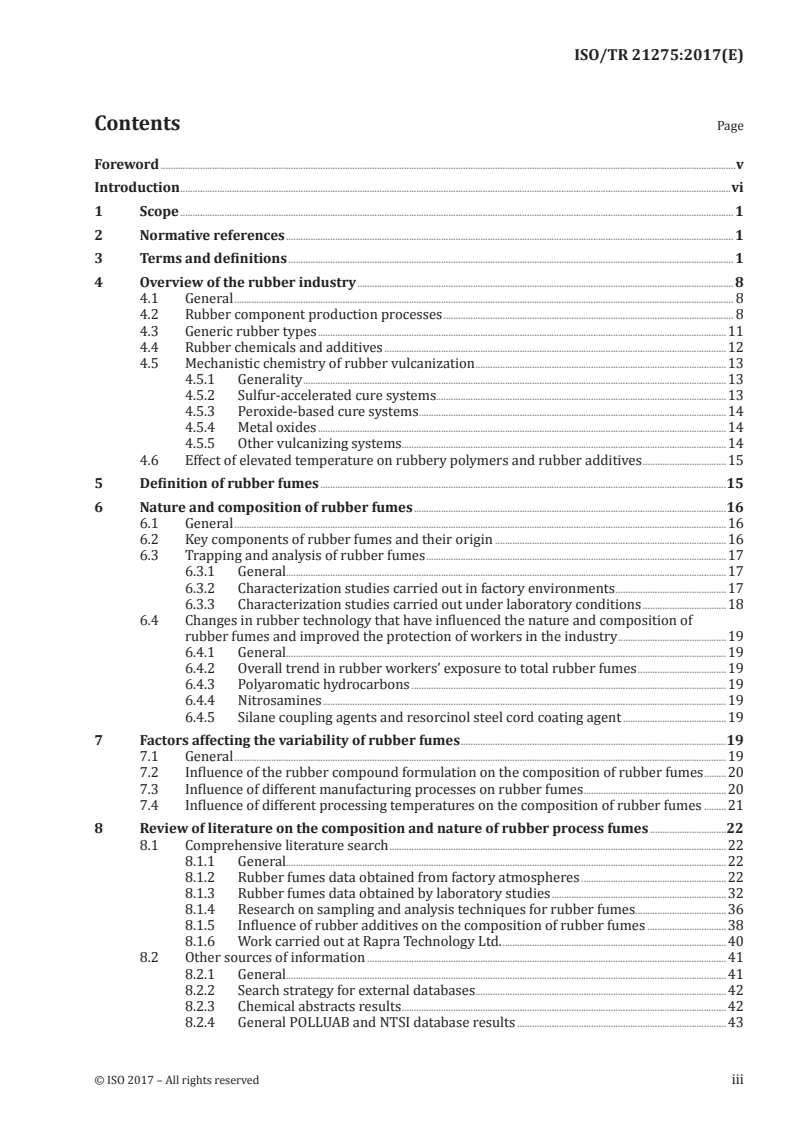
Contents Page
Foreword .v
Introduction .vi
1 Scope . 1
2 Normative references . 1
3 Terms and definitions . 1
4 Overview of the rubber industry . 8
4.1 General . 8
4.2 Rubber component production processes . 8
4.3 Generic rubber types .11
4.4 Rubber chemicals and additives .12
4.5 Mechanistic chemistry of rubber vulcanization .13
4.5.1 Generality .13
4.5.2 Sulfur-accelerated cure systems.13
4.5.3 Peroxide-based cure systems .14
4.5.4 Metal oxides .14
4.5.5 Other vulcanizing systems.14
4.6 Effect of elevated temperature on rubbery polymers and rubber additives .15
5 Definition of rubber fumes .15
6 Nature and composition of rubber fumes .16
6.1 General .16
6.2 Key components of rubber fumes and their origin .16
6.3 Trapping and analysis of rubber fumes .17
6.3.1 General.17
6.3.2 Characterization studies carried out in factory environments .17
6.3.3 Characterization studies carried out under laboratory conditions .18
6.4 Changes in rubber technology that have influenced the nature and composition of
rubber fumes and improved the protection of workers in the industry .19
6.4.1 General.19
6.4.2 Overall trend in rubber workers’ exposure to total rubber fumes .19
6.4.3 Polyaromatic hydrocarbons .19
6.4.4 Nitrosamines .19
6.4.5 Silane coupling agents and resorcinol steel cord coating agent .19
7 Factors affecting the variability of rubber fumes .19
7.1 General .19
7.2 Influence of the rubber compound formulation on the composition of rubber fumes .20
7.3 Influence of different manufacturing processes on rubber fumes .20
7.4 Influence of different processing temperatures on the composition of rubber fumes .21
8 Review of literature on the composition and nature of rubber process fumes .22
8.1 Comprehensive literature search .22
8.1.1 General.22
8.1.2 Rubber fumes data obtained from factory atmospheres .22
8.1.3 Rubber fumes data obtained by laboratory studies .32
8.1.4 Research on sampling and analysis techniques for rubber fumes.36
8.1.5 Influence of rubber additives on the composition of rubber fumes .38
8.1.6 Work carried out at Rapra Technology Ltd. .40
8.2 Other sources of information .41
8.2.1 General.41
8.2.2 Search strategy for external databases .42
8.2.3 Chemical abstracts results .42
8.2.4 General POLLUAB and NTSI database results .43
8.2.5 Search of industry-relevant publications, government publications and
relevant websites . .43
9 Summary of the finding of the literature review .44
10 Conclusions .45
Annex A (informative) Abbreviated terms .47
Bibliography .49
iv © ISO 2017 – All rights reserved
Foreword
ISO (the International Organization for Standardization) is a worldwide federation of national standards
bodies (ISO member bodies). The work of preparing International Standards is normally carried out
through ISO technical committees. Each member body interested in a subject for which a technical
committee has been established has the right to be represented on that committee. International
organizations, governmental and non-governmental, in liaison with ISO, also take part in the work.
ISO collaborates closely with the International Electrotechnical Commission (IEC) on all matters of
electrotechnical standardization.
The procedures used to develop this document and those intended for its further maintenance are
described in the ISO/IEC Directives, Part 1. In particular, the different approval criteria needed for the
different types of ISO documents should be noted. This document was drafted in accordance with the
editorial rules of the ISO/IEC Directives, Part 2 (see www .iso .org/ directives).
Attention is drawn to the possibility that some of the elements of this document may be the subject of
patent rights. ISO shall not be held responsible for identifying any or all such patent rights. Details of
any patent rights identified during the development of the document will be in the Introduction and/or
on the ISO list of patent declarations received (see www .iso .org/ patents).
Any trade name used in this document is information given for the convenience of users and does not
constitute an endorsement.
For an explanation on the meaning of ISO specific terms and expressions related to conformity assessment,
as well as information about ISO’s adherence to the World Trade Organization (WTO) principles in the
Technical Barriers to Trade (TBT) see the following URL: www . i so .org/ iso/ foreword .html.
This document was prepared by Technical Committee ISO/TC 45, Rubber and rubber products.
Introduction
Fumes emitted during the rubber manufacturing processes were the topic of many studies. This
comprehensive study was undertaken to compile and review published data with respect to rubber
fume emissions in the workplace. This review has provided a comprehensive bank of technical data
for dissemination and further debate. It has assessed literature regarding the chemical composition
of rubber fumes in manufacturing from a comprehensive range of processes. It has been postulated
that fume emissions from rubber compound vulcanization can be considered a single chemical entity,
cited as posing a carcinogenic risk to human health. Although many studies have tried to characterize
rubber fume emissions, there is no known concise study that provides a rational explanation for this
conclusion. This study has tested this postulation and provided an insight as to whether it is a sound
conclusion.
The aim of this project was to evaluate, on a basis of sound scientific literature, whether it is
scientifically robust to consider “rubber fumes” as a homogeneous entity from a chemical point of view
and, more importantly, in relation to measurement and control of occupational exposure risk for the
rubber industry as a whole.
An extensive literature review aimed at providing a compilation of literature related to rubber fume
emissions, this study has concentrated on the chemical compositional aspects of rubber fumes only and
not on the toxicological or epidemiological aspects.
In addition, although rubber dust and rubber fumes are being considered by the EU for a potential
incorporation in the scope of the Carcinogens Directive, this study has only considered rubber fumes.
This document provides detailed information on the study carried out, the results obtained from the
literature reviews and the conclusions drawn from this information.
This document comprises two main parts; the first provides a general overview of the key areas of
rubber technology and the second provides an extensive review of in-house and external literature on
the composition and nature of rubber process fumes.
Natural rubber (NR) has been known to the civilized world since about 1493 when early European
explorers found natives of Haiti playing with balls made from the exudates of a tree called “cau-uchu”.
The term “rubber” was coined much later by the English chemist J.B. Priestly for its ability to erase
lead pencil marks. The French scientist De La Condamine first introduced NR to Europe in 1736 and
published his observations on the material in 1745. Industrial application of rubber only occurred after
Charles Goodyear in 1841 discovered the process termed “vulcanization”, which converted the rubber
to a more stable and useful material, that paved the way for the growth of the modern industry.
Synthetic rubbers were first produced in Germany in the 1930s, and during the Second World War
when the supply of natural rubber was interrupted, methods were developed for the bulk production
of synthetic rubbers. Styrene butadiene rubber (SBR) was one of the first synthetic rubbers to be
developed and manufactured in high volume in the 1940s, mainly for the production of tyres and in an
attempt to match the properties of natural rubber. Since that time, many different synthetic rubbers
have been developed to allow the use of rubber in a very wide variety of environments and applications.
Over the years, the importance of rubber to modern life has constantly increased. This is not always
immediately apparent because rubber components are often not colourful, eye catching or are used in
applications where they are not readily visible. Natural and synthetic rubber compounds are used in
a highly diverse range of rubber products which are manufactured throughout the world for various
sectors of industry and for a variety of end users, including, but not exclusively, automotive, aerospace,
medical/pharmaceutical, defence, commercial, general industrial and others.
Of the sectors where rubber is used, the automotive industry is of particular importance since tyre and
tyre products account for approximately 60 % of the synthetic rubber and ~75 % of the natural rubber
used today.
vi © ISO 2017 – All rights reserved
Table 1 provides an overview of the diverse range of rubber components made from general
manufacturing processes and dipped latex technology. The list of components is by no means exhaustive
but helps highlight the diverse areas and products in which rubber is used.
Table 1 — Range of rubber components
Tyres passenger cars, trucks, racing vehicles, cycles, off-road tyres, inner tubes, curing
bladders
Conveyor/ steel cord conveyor belting, repair material for conveyor belting, scrapers, min-
Transmission belting ing conveyors, V-belts, flat belts, synchronous belts
Industrial hoses water hoses, high-pressure hoses, welding hoses, hydraulic hoses, spiral hoses,
offshore hoses, oil hoses, chemical hoses
Automotive products coolant hoses, fuel hoses, seals and gaskets, anti-vibration mounts, hydraulic
hoses, fuel injectors, timing belts, window and door channelling, transmission
and engine components, wiper blades, exhaust hangers
General mouldings/ moulded seals and gaskets, anti-vibration products, floor coverings, sheeting,
Sheeting tube rings, roofing layers, subsoil water sheeting, roller coverings, protection
linings, moulded micro-cellular products, composite profiles, rubberized fabric,
micro-cellular rubbers/profiles, wire and cable jackets and insulations, glass
sealants, pump impellors, roof membranes, pond liners, rail mounts, bridge
bearings, military vehicle track pads
Medical/ surgical gloves, medical tubing, MDI valve gaskets, catheters, dialysis products,
Pharmaceutical products surgical implants, prostheses, contraceptives, soothers, baby feeding teats and
breast caps, blood transfusion tubing and valves, medical and antistatic sheeting
and membranes, masks and respirators
Clothing boots/footwear, protective suits, household gloves, industrial gloves, footwear/
boot heels and soling, cellular rubber soles, wet suits, diving suits, coated fab-
rics, sports footwear and clothing
Food contact products food transportation (e.g. conveyer belts, hoses and tubing), food handling
(gloves), pipe and machinery components (seals, gaskets, flexible connectors and
diaphragm/butterfly valves), pumping system components (progressive cavity
pumps stators, diaphragm pumps), plate heat exchanger gaskets, seals/gaskets
for cans, bottles and closures
Potable water products pipe seals and gaskets, hoses, linings of pumps and valves, tap washers, mem-
branes in pipes and filters, coatings on process plant, tank linings
Miscellaneous products adhesives, rubberized asphalt, high vacuum and radiation components, carpet
backing, latex thread, sealants and caulking, toys
It is important that the reader of this document concludes that the rubber material used to make
any particular product is not a single entity but is a complex compounded material referred to as a
“compound” or “formulation”, which may contain a large number of essential chemical ingredients.
These ingredients will include the base rubber polymer(s), reinforcing and non-reinforcing particulate
fillers, process oils, vulcanizing agents, protective agents, process aids, etc. (all of which are available
in many types and grades from many suppliers and can be included at different levels). The company or
individual who designs a rubber formulation for a specific product has a vast number of ingredients to
choose from and as such, many formulations are therefore possible for a specific rubber product.
The processing route by which the majority of rubber components are manufactured includes mixing
the ingredients together in a controlled manner to produce a rubber “compound” or “mix”, shaping of
the mixed compound to give the desired shape or form, then “vulcanizing” (also known as “crosslinking”
and “curing”) the compound to convert it to a condition where it has permanent properties and shape.
The type of rubber materials and manufacturing processes used will depend upon the individual
product and are described in this document. Many of the manufacturing processes involve generating
heat in the rubber compound where volatile species such as “fumes” can be released from it.
The large diversity in both the rubber formulations available and the manufacturing processes used
can therefore potentially give rise to a highly diverse range of species evolved.
In order to assist the reader to understand the terminology associated with the rubber technology in
this document, a glossary of terms is included in Annex A.
viii © ISO 2017 – All rights reserved
TECHNICAL REPORT ISO/TR 21275:2017(E)
Rubber — Comprehensive review of the composition and
nature of process fumes in the rubber industry
1 Scope
This document, based on 95 publications, gives an overview of what is the composition of the fumes
emitted during the rubber manufacturing processes. The results obtained confirm that rubber fumes
are a complex and variable mix of chemicals which have a wide range of possible sources and origins,
including chemicals generated from the chemical reactions occurring in the rubber compounds during
processing and curing. Some of these chemical substances can be hazardous, others are not. This
document demonstrates the need for International Standards to qualify and quantify the hazardous
chemicals to which the operators in the factories producing rubber articles can be exposed to, allowing
the identification and mitigation of potential health risks.
2 Normative references
There are no normative references in this document.
3 Terms and definitions
For the purposes of this document, the following terms and definitions apply.
ISO and IEC maintain terminological databases for use in standardization at the following addresses:
— IEC Electropedia: available at http:// www .electropedia .org/
— ISO Online browsing platform: available at http:// www .iso .org/ obp
3.1
accelerator
compounding ingredient used in small amounts with a vulcanizing agent to increase the speed of
vulcanization and/or enhance the physical properties of the vulcanizate
[SOURCE: ISO 1382:2012, 2.5]
3.2
activator
compounding ingredient used in small proportions to increase the effectiveness of an accelerator
[SOURCE: ISO 1382:2012, 2.6]
3.3
ageing
exposure of a material to an environment for a period of time
[SOURCE: ISO 1382:2012, 2.13]
3.4
ageing
irreversible change of material properties during exposure to an environment for a
period of time
[SOURCE: ISO 1382:2012, 2.14]
3.5
antidegradant
compounding ingredient used to retard deterioration by ageing
Note 1 to entry: Antidegradant is a generic term for certain additives such as antioxidants, antiozonants, waxes
and other protective materials.
[SOURCE: ISO 1382:2012, 2.21]
3.6
antioxidant
compounding ingredient used to retard deterioration caused by oxidation
[SOURCE: ISO 1382:2012, 2.24]
3.7
autoclave
pressurized vessel used for vulcanizing rubber in a vapour or gas
[SOURCE: ISO 1382:2012, 2.33]
3.8
benzene
C H
6 6
simplest member of the aromatic series of hydrocarbons
Note 1 to entry: It is colourless liquid with a b.p. of 80 °C and is used in the manufacture of many organic
compounds.
3.9
blank
piece of rubber compound of suitable shape and volume to fill the mould
[SOURCE: ISO 1382:2012, 2.44]
3.10
bonding agent
substance, usually in liquid form, coated onto another material and used to produce a good bond
between the material and rubber
[SOURCE: ISO 1382:2012, 2.54, modified — Note 1 to entry has been deleted.]
3.11
butadiene
CH CHCHCH
2 2
buta-1,3-diene
gas used in the manufacture of polybutadiene rubber and as one of the copolymers in the manufacture
of styrene-butadiene and nitrile rubbers
3.12
calender
machine with two or more essentially parallel rolls, operating at selected surface speeds, nips and
temperatures, for such operations as sheeting, laminating, skim coating (topping) and friction coating
of a product to a controlled thickness and/or controlled surface characteristics
[SOURCE: ISO 1382:2012, 2.65]
2 © ISO 2017 – All rights reserved
3.13
carbon black
compounding ingredient consisting essentially of more than 95 % elemental carbon in the form of near-
spherical particles with major diameters less than 1 µm, generally coalesced into aggregates
Note 1 to entry: Carbon black is produced by incomplete burning or thermal decomposition of hydrocarbons.
[SOURCE: ISO 1382:2012, 2.66]
3.14
chlorohydrin rubbers
class of synthetic elastomers based on epichlorohydrin
3.15
chloroprene rubber
CR
elastomeric materials composed of chloroprene
Note 1 to entry: It has fair to good resistance to petroleum-based fluids and good resistance to ozone and
weathering.
[SOURCE: ISO 5598:2008, 3.2.96]
3.16
chlorosulfonated polyethylene
CSPE
elastomer made by substituting chlorine and sulfonyl chloride groups into polyethylene
Note 1 to entry: The material is best known by the trade name Hypalon (DuPont).
3.17
compound
intimate mixture of a rubber or rubbers or other polymer-forming materials with all the ingredients
necessary for the finished product
Note 1 to entry: The term rubber is sometimes used to mean compound, but this use is deprecated.
[SOURCE: ISO 1382:2012, 2.96]
3.18
compounding
development of rubber compounds which will effectively withstand the conditions under which the
products made from them are to be used
Note 1 to entry: The mixes so developed must be capable of being processed in the factory without undue
difficulty.
Note 2 to entry: The term is also applied to the assembling of elastomer and compounding ingredients ready
for mixing.
3.19
compounding ingredient
substance added to a rubber or rubber latex to form a mix
[SOURCE: ISO 1382:2012, 2.97]
3.20
compression moulding
moulding process in which the blank is placed directly in the mould cavity and compressed to shape by
closure of the mould
[SOURCE: ISO 1382:2012, 2.98]
3.21
conveyor belting
belting used mainly in the transmission of materials, although increasing use is being made of conveyor
belting in the transportation of passengers
3.22
crosslinking
insertion of crosslinks between or within rubber chains to give a network structure
[SOURCE: ISO 1382:2012, 2.118]
3.23
curing
application of accelerators and temperature for the establishment of chemical crosslinks between
macromolecules of rubber
Note 1 to entry: This term is synonymous with vulcanization only in case of mixes containing sulfur. Some other
chemicals are also used to establish these crosslink, for example, peroxide.
Note 2 to entry: The word curing is generally paired with a specific method, e.g. press curing, open steam curing,
cold curing.
3.24
dispersion
distribution of one or more ingredients into a rubber, a rubber blend or a continuum material,
by the application of shearing forces, in order to confer optimum and uniform properties
[SOURCE: ISO 1382:2012, 2.147]
3.25
double bond
bivalent gap
ethylenic linkage
bond in which two valency bonds link two atoms in a molecule
Note 1 to entry: It is typical of compounds showing unsaturation, such as ethylene. A double bond does not
indicate extra strength of the bond but rather chemical instability and reactivity.
3.26
elastomer
macromolecular material which returns rapidly to approximately its initial dimensions and shape after
substantial deformation by a weak stress and release of the stress
[SOURCE: ISO 1382:2012, 2.161]
3.27
extender
organic material used as a replacement for a portion of the rubber required in a compound
[SOURCE: ISO 1382:2012, 2.171]
3.28
extruder
machine which, through the use of a screw or a hydraulic ram, continuously shapes a material by forcing
it through a die or dies
[SOURCE: ISO 1382:2012, 2.176]
4 © ISO 2017 – All rights reserved
3.29
filler
solid compounding ingredient, in particulate form, which may be added in relatively large proportions
to a rubber or rubber latex for technical or economic purposes
[SOURCE: ISO 1382:2012, 2.184]
3.30
injection moulding
moulding process in which a rubber compound is forced into a closed mould from a separate chamber,
by a pressure which is independent of the mould clamping force
[SOURCE: ISO 1382:2012, 2.242]
3.31
internal mixer
machine with temperature controls containing one or more rotors operating in a closed cavity used to
masticate and/or to incorporate and disperse compounding ingredients into the rubber
[SOURCE: ISO 1382:2012, 2.242]
3.32
isoprene
2-methyl-1,3-butadiene
CH C(CH )CHCH
2 3 2
liquid hydrocarbon with boiling point 34°C
Note 1 to entry: It is regarded as the unit molecule of natural rubber, which is polyisoprene (3.43). Synthetic
polyisoprene is marketed under a variety of trade names.
3.33
latex
colloidal aqueous dispersion of a polymeric material
[SOURCE: ISO 1382:2012, 2.250]
3.34
mill
two-roll mill
machine with two counter-rotating rolls, frequently heated or cooled, usually driven at different speeds,
and having an adjustable nip for mastication, mixing, blending, warm-up or sheeting
[SOURCE: ISO 1382:2012, 2.274]
3.35
mix
mixture of rubber in any form with other compounding ingredients
Note 1 to entry: The term can apply to an incomplete rubber compound.
[SOURCE: ISO 1382:2012, 2.278]
3.36
mixer
machine which, through the action of mechanical work (shear), incorporates and disperses compounding
ingredients into rubber(s) to form a mix or compound
[SOURCE: ISO 1382:2012, 2.279]
3.37
moulding
process of shaping a material in a mould by applying pressure and, usually, heat
[SOURCE: ISO 1382:2012, 2.288]
3.38
natural rubber
cis-1,4-polyisoprene obtained from the botanical source Hevea brasiliensis
[SOURCE: ISO 1382:2012, 2.295]
3.39
nitrile rubber
elastomer resulting from the copolymerization of butadiene and acrylonitrile
3.40
oil resistance
resistance of an elastomer to swelling and ultimate degradation due to contact with or immersion in an oil
3.41
open mill
mill in which the rolls are exposed, in contrast to those of an internal mixer
3.42
plasticizer
compounding ingredient used to enhance the flexibility of a rubber or product, especially at low
temperature
[SOURCE: ISO 1382:2012, 2.333]
3.43
polyisoprene
polymerized isoprene
Note 1 to entry: Naturally occurring polyisoprene are natural rubber (cis-form) and gutta percha (trans-form).
Note 2 to entry: The use of stereospecific catalysts has made possible the manufacture of synthetic cis-
polyisoprene and trans-polyisoprene both of which are available commercially.
3.44
polymer
substance composed of molecules characterized by the multiple repetition of one or more species of
atoms or groups of atoms (constitutional units) linked to each other in amounts sufficient to provide
a set of properties that do not vary markedly with the addition or removal of one or a few of the
constitutional units
[SOURCE: ISO 1382:2012, 2.341]
3.45
processing
variety of operations required to convert a raw elastomer into finished products
Note 1 to entry: Processing include calendering, compounding (3.18), curing (3.23), extrusion, mastication,
mixing, spreading.
3.46
resin cure
vulcanization of elastomers effected by the incorporation in the compound of certain polymeric resins
derived from the condensation of formaldehyde with 4-alkyl phenols
Note 1 to entry: Most frequently used with butyl and EPDM compounds for enhanced heat resistance.
6 © ISO 2017 – All rights reserved
3.47
retarder
compounding ingredient used to reduce the tendency of a rubber compound to vulcanize prematurely
[SOURCE: ISO 1382:2012, 2.383]
3.48
rubber
family of polymeric materials which are flexible and elastic
Note 1 to entry: Rubber can be substantially deformed under stress, but recovers quickly to near its original
shape when the stress is removed. It is usually made from a mixture of materials (solid or liquid), and in most
products the base polymer is crosslinked by either chemical or physical links.
[SOURCE: ISO 1382:2012, 2.394]
3.49
rubber
natural or synthetic elastic polymer (elastomer) which forms the basis of the compound
used in many rubber products
[SOURCE: ISO 1382:2012, 2.395]
3.50
rubber
synonym for compound (the preferred term)
[SOURCE: ISO 1382:2012, 2.396]
3.51
silicone rubber
polyorganosiloxane, having a backbone structure consisting of alternating silicone and oxygen atoms
with organic groups, usually methyl, vinyl or phenyl radicals, attached to the silicone member
Note 1 to entry: It is an elastomer of the silicone family.
3.52
unsaturation
linking of some of the atoms of the molecule by more than one valency bond i.e.,
double or triple bonds
3.53
vulcanization
cure
process, usually involving heat, in which rubber, through a change in its chemical structure (for
example, crosslinking), is converted to a condition in which the elastic properties are conferred or re-
established or improved or extended over a greater range of temperatures
Note 1 to entry: In some cases, the process is carried to a point where the substance becomes rigid, e.g. ebonite.
[SOURCE: ISO 1382:2012, 2.513]
3.54
vulcanizing agent
curative
curing agent
compounding ingredient that produces crosslinking in rubber
[SOURCE: ISO 1382:2012, 2.515]
3.55
zinc oxide
activator in rubber compounds containing organic accelerators
4 Overview of the rubber industry
4.1 General
This clause is intended to give the reader a brief overview of rubber technology in order to provide some
essential background information that will support and inform non-technical readers of the literature
review. The overview is broken down into four specific areas (see 4.2 to 4.5) as detailed below, and
encompasses the full spectrum of the rubber industry, with the fifth part (see 4.6) covering the effect of
elevated temperature on the base polymers and rubber additives.
— Rubber component production processes
— Generic rubber types
— Rubber chemicals and additives
— Mechanistic chemistry of rubber vulcanization
— Effect of elevated temperature on rubbery polymers and rubber additives
4.2 Rubber component production processes
The wide diversity of rubber components in the market is highlighted in the Introduction. The rubber
product manufacturing industry can be divided into four groups: 1) vehicle tyres, 2) engineering and
industrial products, 3) latex products and 4) other miscellaneous rubber products.
The manufacturing processes involved in these industries have many similarities but there are also
many differences. The differences relate to the raw material (whether using NR or synthetic rubber), the
types of chemical additives used in the rubber formulations and the type of curing methods employed.
The main processing stages for the majority of rubber components manufactured involve the following:
— Mixing: The first stage of the rubber manufacturing process involves the production of a rubber
formulation, (also known as a “mix” or “compound”). Mixing is of crucial and fundamental
importance to the rubber industry. The base rubbers have to be extended with a variety of essential
ingredients including plasticizers, reinforced with particulate fillers and important additives such
as accelerators, curatives and protective agents, which all need to be thoroughly dispersed and
distributed before the resultant compound can be shaped and vulcanized to give an end product
with adequate properties. All these cannot be achieved without effective mixing.
Rubber formulations vary significantly in their composition depending upon the desired
characteristics of the product. As many as 15 to 20 different ingredients may be used in a single
compound depending upon the polymer type and application fumes.
The mixing equipment used to produce the rubber compounds includes internal batch mixers,
mixing mills, continuous internal mixers and mixing extruders. The appropriate compounding
ingredients for the formulation are normally weighed out in a compounding area or “drug” room
before being loaded into the mixer at predetermined stages. However, it is also a practice, especially
in the tyre manufacturing industry, for ingredients to be supplied preweighed by the supplier and
added directly into the mixer.
— Shaping operations: Involves processes to convert the mixed compound into a suitable form/shape
for the next stage of the process (e.g. extrusion to form profile shapes, calendering to produce
sheeted material, milling to form moulding blanks, hand building, etc.).This will also include the
processes where other reinforcing materials, including steel wire/cord or textiles are combined
8 © ISO 2017 – All rights reserved
with the uncured rubber compound before being built/assembled into the final product before
vulcanization.
— Vulcanization: For the vast majority of rubber product applications (except solution and latex
adhesives, putty-like products, chewing gum-based products and some forms of sheeting), it is
necessary to convert rubbery molecules into a stable three dimensional network so that recovery
after deformation is essentially complete. In layman’s terms, the process converts the rubber
compound into a material which has much more stable properties over its intended working
temperature range.
To achieve this, it is necessary to undertake an irreversible process of crosslinking the polymer
chains, which is known as “vulcanization”, “crosslinking” or “curing”. In the majority of cases, this
occurs by heating the rubber compound at an elevated temperature to accelerate the chemical
reaction and by pressurization of the material to consolidate it.
The actual crosslinking mechanisms will be discussed in a later clause.
The specific process method by which the product is vulcanized will depend on a number of
factors, which may include formulation of the compound, physical form of the product required,
the presence of other materials such as textile and steel reinforcement, and the size of the product.
— Post vulcanization processes: Other processes which may take place after the vulcanization stage to
achieve final form or properties (e.g. post-curing, ancillary processes).
A generalized flowchart for rubber product manufacturing is shown in Figure 1 to provide the reader
with some general guidance on the typical processes involved from raw materials to final product and
how they are linked together. It must be emphasized that the actual process route involved will depend
upon the actual product being manufactured. Therefore, not all rubber products will require all of the
process steps shown in Figure 1.
A number of the rubber manufacturing process steps involve the generation of heat or have heat applied
to them and therefore have the propensity for the generation of rubber fumes or volatiles from the
rubber compound being processed. The processes highlighted in red in Figure 1 indicate where rubber
fumes will be mainly generated, while those shown in pink indicate where there is also potential for
rubber fumes to be generated, depending upon the precise operating conditions of the process.
The following points should be taken into account when considering the processes used to manufacture
rubber products.
a) The process routes and actual processing equipment employed for each product type will be
specific to that product.
b) The material mixing, shaping and vulcanization processing conditions (including time and
temperature, etc.) employed for a particular product are not standardized throughout the industry,
but will depend on a number of factors including polymer type, formulation, process equipment
type, age and controls, product size and shape.
c) The main manufacturing processes where fumes are likely to be generated include mixing,
moulding, vulcanization and post curing. The processes where fumes may be generated, depending
upon the rubber formulations and processing conditions, include calendering, blank preparation,
extrusion and spreading.
d) Some manufacturing plants will manufacture single product types with very few different
compound formulation types utilizing the same processing equipment.
e) Other manufacturing plants may produce a large range of different products, utilizing a diverse
range of rubber compound types and formulations, which employ a range of processing routes
pertinent to the product.
f) The more modern factories or plants situated in more developed countries may have more
automation and a good level of ventilation for many of the rubber manufacturing processes which
generate fumes and where there is less direct contact by the employees. In contrast, within some of
the Eastern or less-developed countries, there will be significantly less automation combined with
older processing equipment, poorer ventilation and more direct employee contact with the rubber
compound as it passes through the process, all of which would have a direct influence on the levels
and types of fumes present.
Figure 1 — Generalized flowchart for rubber product manufacture
A flowchart for the general processes involved in tyre manufacturing is shown in Figure 2. In a similar
manner to Figure 1, the processes where rubber fumes will be generated are highlighted with the red
symbol, , and those where there is also potential for rubber fumes to be generated depending upon
the precise operating conditions of the process are highlighted with a purple symbol, .
10 © ISO 2017 – All rights reserved
Key
process where rubber fumes will be generated
process where fumes may be generated depending upon actual conditions
Figure 2 — Tyre manufacture flowchart
4.3 Generic rubber types
The following list identifies the main generic rubber types available in the market and gives their ISO
designation in brackets. Each rubber has a unique chemical structure which has a direct influence on
its inherent chemical and physical properties, processing behaviour and the applications and products
in which it finds use.
— Natural rubber and natural rubber latex (NR)
— Polyisoprene (synthetic NR) (IR)
— Polybutadiene (BR)
— Styrene butadiene (SBR)
— Acrylonitrile butadiene rubber (also known as nitrile or NBR)
— Hydrogenated nitrile rubber (HNBR)
— Polychloroprene (CR)
— Butyl rubber (IIR) and halogenated butyl rubber (BIIR/CIIR)
— Ethylene propylene rubber (EP/EPDM)
— Epichlorohydrin rubbers (CO/ECO/ETER)
— Chlorinated polyethylene (CPE, CM)
— Chlorosulfonated polyethylene (CSM/CSPE)
— Polyacrylate rubbers (ACM)
— Ethylene-acrylic rubber (EACM, AEM)
— Ethylene-vinyl acetate (EVA, EAM)
— Silicone rubbers (MQ, VMQ, FVMQ, PVMQ)
— Fluorocarbon rubbers (FPM, FKM)
— Polyurethane (AU, EU, PU)
— Polysulfide rubber (OT, EOT)
The reader should take note that
...
TECHNICAL ISO/TR
REPORT 21275
First edition
2017-02
Rubber — Comprehensive review of
the composition and nature of process
fumes in the rubber industry
Caoutchouc — Examen exhaustif de la composition et de la nature des
fumées de process dans l’industrie du caoutchouc
Reference number
©
ISO 2017
© ISO 2017, Published in Switzerland
All rights reserved. Unless otherwise specified, no part of this publication may be reproduced or utilized otherwise in any form
or by any means, electronic or mechanical, including photocopying, or posting on the internet or an intranet, without prior
written permission. Permission can be requested from either ISO at the address below or ISO’s member body in the country of
the requester.
ISO copyright office
Ch. de Blandonnet 8 • CP 401
CH-1214 Vernier, Geneva, Switzerland
Tel. +41 22 749 01 11
Fax +41 22 749 09 47
copyright@iso.org
www.iso.org
ii © ISO 2017 – All rights reserved
Contents Page
Foreword .v
Introduction .vi
1 Scope . 1
2 Normative references . 1
3 Terms and definitions . 1
4 Overview of the rubber industry . 8
4.1 General . 8
4.2 Rubber component production processes . 8
4.3 Generic rubber types .11
4.4 Rubber chemicals and additives .12
4.5 Mechanistic chemistry of rubber vulcanization .13
4.5.1 Generality .13
4.5.2 Sulfur-accelerated cure systems.13
4.5.3 Peroxide-based cure systems .14
4.5.4 Metal oxides .14
4.5.5 Other vulcanizing systems.14
4.6 Effect of elevated temperature on rubbery polymers and rubber additives .15
5 Definition of rubber fumes .15
6 Nature and composition of rubber fumes .16
6.1 General .16
6.2 Key components of rubber fumes and their origin .16
6.3 Trapping and analysis of rubber fumes .17
6.3.1 General.17
6.3.2 Characterization studies carried out in factory environments .17
6.3.3 Characterization studies carried out under laboratory conditions .18
6.4 Changes in rubber technology that have influenced the nature and composition of
rubber fumes and improved the protection of workers in the industry .19
6.4.1 General.19
6.4.2 Overall trend in rubber workers’ exposure to total rubber fumes .19
6.4.3 Polyaromatic hydrocarbons .19
6.4.4 Nitrosamines .19
6.4.5 Silane coupling agents and resorcinol steel cord coating agent .19
7 Factors affecting the variability of rubber fumes .19
7.1 General .19
7.2 Influence of the rubber compound formulation on the composition of rubber fumes .20
7.3 Influence of different manufacturing processes on rubber fumes .20
7.4 Influence of different processing temperatures on the composition of rubber fumes .21
8 Review of literature on the composition and nature of rubber process fumes .22
8.1 Comprehensive literature search .22
8.1.1 General.22
8.1.2 Rubber fumes data obtained from factory atmospheres .22
8.1.3 Rubber fumes data obtained by laboratory studies .32
8.1.4 Research on sampling and analysis techniques for rubber fumes.36
8.1.5 Influence of rubber additives on the composition of rubber fumes .38
8.1.6 Work carried out at Rapra Technology Ltd. .40
8.2 Other sources of information .41
8.2.1 General.41
8.2.2 Search strategy for external databases .42
8.2.3 Chemical abstracts results .42
8.2.4 General POLLUAB and NTSI database results .43
8.2.5 Search of industry-relevant publications, government publications and
relevant websites . .43
9 Summary of the finding of the literature review .44
10 Conclusions .45
Annex A (informative) Abbreviated terms .47
Bibliography .49
iv © ISO 2017 – All rights reserved
Foreword
ISO (the International Organization for Standardization) is a worldwide federation of national standards
bodies (ISO member bodies). The work of preparing International Standards is normally carried out
through ISO technical committees. Each member body interested in a subject for which a technical
committee has been established has the right to be represented on that committee. International
organizations, governmental and non-governmental, in liaison with ISO, also take part in the work.
ISO collaborates closely with the International Electrotechnical Commission (IEC) on all matters of
electrotechnical standardization.
The procedures used to develop this document and those intended for its further maintenance are
described in the ISO/IEC Directives, Part 1. In particular, the different approval criteria needed for the
different types of ISO documents should be noted. This document was drafted in accordance with the
editorial rules of the ISO/IEC Directives, Part 2 (see www .iso .org/ directives).
Attention is drawn to the possibility that some of the elements of this document may be the subject of
patent rights. ISO shall not be held responsible for identifying any or all such patent rights. Details of
any patent rights identified during the development of the document will be in the Introduction and/or
on the ISO list of patent declarations received (see www .iso .org/ patents).
Any trade name used in this document is information given for the convenience of users and does not
constitute an endorsement.
For an explanation on the meaning of ISO specific terms and expressions related to conformity assessment,
as well as information about ISO’s adherence to the World Trade Organization (WTO) principles in the
Technical Barriers to Trade (TBT) see the following URL: www . i so .org/ iso/ foreword .html.
This document was prepared by Technical Committee ISO/TC 45, Rubber and rubber products.
Introduction
Fumes emitted during the rubber manufacturing processes were the topic of many studies. This
comprehensive study was undertaken to compile and review published data with respect to rubber
fume emissions in the workplace. This review has provided a comprehensive bank of technical data
for dissemination and further debate. It has assessed literature regarding the chemical composition
of rubber fumes in manufacturing from a comprehensive range of processes. It has been postulated
that fume emissions from rubber compound vulcanization can be considered a single chemical entity,
cited as posing a carcinogenic risk to human health. Although many studies have tried to characterize
rubber fume emissions, there is no known concise study that provides a rational explanation for this
conclusion. This study has tested this postulation and provided an insight as to whether it is a sound
conclusion.
The aim of this project was to evaluate, on a basis of sound scientific literature, whether it is
scientifically robust to consider “rubber fumes” as a homogeneous entity from a chemical point of view
and, more importantly, in relation to measurement and control of occupational exposure risk for the
rubber industry as a whole.
An extensive literature review aimed at providing a compilation of literature related to rubber fume
emissions, this study has concentrated on the chemical compositional aspects of rubber fumes only and
not on the toxicological or epidemiological aspects.
In addition, although rubber dust and rubber fumes are being considered by the EU for a potential
incorporation in the scope of the Carcinogens Directive, this study has only considered rubber fumes.
This document provides detailed information on the study carried out, the results obtained from the
literature reviews and the conclusions drawn from this information.
This document comprises two main parts; the first provides a general overview of the key areas of
rubber technology and the second provides an extensive review of in-house and external literature on
the composition and nature of rubber process fumes.
Natural rubber (NR) has been known to the civilized world since about 1493 when early European
explorers found natives of Haiti playing with balls made from the exudates of a tree called “cau-uchu”.
The term “rubber” was coined much later by the English chemist J.B. Priestly for its ability to erase
lead pencil marks. The French scientist De La Condamine first introduced NR to Europe in 1736 and
published his observations on the material in 1745. Industrial application of rubber only occurred after
Charles Goodyear in 1841 discovered the process termed “vulcanization”, which converted the rubber
to a more stable and useful material, that paved the way for the growth of the modern industry.
Synthetic rubbers were first produced in Germany in the 1930s, and during the Second World War
when the supply of natural rubber was interrupted, methods were developed for the bulk production
of synthetic rubbers. Styrene butadiene rubber (SBR) was one of the first synthetic rubbers to be
developed and manufactured in high volume in the 1940s, mainly for the production of tyres and in an
attempt to match the properties of natural rubber. Since that time, many different synthetic rubbers
have been developed to allow the use of rubber in a very wide variety of environments and applications.
Over the years, the importance of rubber to modern life has constantly increased. This is not always
immediately apparent because rubber components are often not colourful, eye catching or are used in
applications where they are not readily visible. Natural and synthetic rubber compounds are used in
a highly diverse range of rubber products which are manufactured throughout the world for various
sectors of industry and for a variety of end users, including, but not exclusively, automotive, aerospace,
medical/pharmaceutical, defence, commercial, general industrial and others.
Of the sectors where rubber is used, the automotive industry is of particular importance since tyre and
tyre products account for approximately 60 % of the synthetic rubber and ~75 % of the natural rubber
used today.
vi © ISO 2017 – All rights reserved
Table 1 provides an overview of the diverse range of rubber components made from general
manufacturing processes and dipped latex technology. The list of components is by no means exhaustive
but helps highlight the diverse areas and products in which rubber is used.
Table 1 — Range of rubber components
Tyres passenger cars, trucks, racing vehicles, cycles, off-road tyres, inner tubes, curing
bladders
Conveyor/ steel cord conveyor belting, repair material for conveyor belting, scrapers, min-
Transmission belting ing conveyors, V-belts, flat belts, synchronous belts
Industrial hoses water hoses, high-pressure hoses, welding hoses, hydraulic hoses, spiral hoses,
offshore hoses, oil hoses, chemical hoses
Automotive products coolant hoses, fuel hoses, seals and gaskets, anti-vibration mounts, hydraulic
hoses, fuel injectors, timing belts, window and door channelling, transmission
and engine components, wiper blades, exhaust hangers
General mouldings/ moulded seals and gaskets, anti-vibration products, floor coverings, sheeting,
Sheeting tube rings, roofing layers, subsoil water sheeting, roller coverings, protection
linings, moulded micro-cellular products, composite profiles, rubberized fabric,
micro-cellular rubbers/profiles, wire and cable jackets and insulations, glass
sealants, pump impellors, roof membranes, pond liners, rail mounts, bridge
bearings, military vehicle track pads
Medical/ surgical gloves, medical tubing, MDI valve gaskets, catheters, dialysis products,
Pharmaceutical products surgical implants, prostheses, contraceptives, soothers, baby feeding teats and
breast caps, blood transfusion tubing and valves, medical and antistatic sheeting
and membranes, masks and respirators
Clothing boots/footwear, protective suits, household gloves, industrial gloves, footwear/
boot heels and soling, cellular rubber soles, wet suits, diving suits, coated fab-
rics, sports footwear and clothing
Food contact products food transportation (e.g. conveyer belts, hoses and tubing), food handling
(gloves), pipe and machinery components (seals, gaskets, flexible connectors and
diaphragm/butterfly valves), pumping system components (progressive cavity
pumps stators, diaphragm pumps), plate heat exchanger gaskets, seals/gaskets
for cans, bottles and closures
Potable water products pipe seals and gaskets, hoses, linings of pumps and valves, tap washers, mem-
branes in pipes and filters, coatings on process plant, tank linings
Miscellaneous products adhesives, rubberized asphalt, high vacuum and radiation components, carpet
backing, latex thread, sealants and caulking, toys
It is important that the reader of this document concludes that the rubber material used to make
any particular product is not a single entity but is a complex compounded material referred to as a
“compound” or “formulation”, which may contain a large number of essential chemical ingredients.
These ingredients will include the base rubber polymer(s), reinforcing and non-reinforcing particulate
fillers, process oils, vulcanizing agents, protective agents, process aids, etc. (all of which are available
in many types and grades from many suppliers and can be included at different levels). The company or
individual who designs a rubber formulation for a specific product has a vast number of ingredients to
choose from and as such, many formulations are therefore possible for a specific rubber product.
The processing route by which the majority of rubber components are manufactured includes mixing
the ingredients together in a controlled manner to produce a rubber “compound” or “mix”, shaping of
the mixed compound to give the desired shape or form, then “vulcanizing” (also known as “crosslinking”
and “curing”) the compound to convert it to a condition where it has permanent properties and shape.
The type of rubber materials and manufacturing processes used will depend upon the individual
product and are described in this document. Many of the manufacturing processes involve generating
heat in the rubber compound where volatile species such as “fumes” can be released from it.
The large diversity in both the rubber formulations available and the manufacturing processes used
can therefore potentially give rise to a highly diverse range of species evolved.
In order to assist the reader to understand the terminology associated with the rubber technology in
this document, a glossary of terms is included in Annex A.
viii © ISO 2017 – All rights reserved
TECHNICAL REPORT ISO/TR 21275:2017(E)
Rubber — Comprehensive review of the composition and
nature of process fumes in the rubber industry
1 Scope
This document, based on 95 publications, gives an overview of what is the composition of the fumes
emitted during the rubber manufacturing processes. The results obtained confirm that rubber fumes
are a complex and variable mix of chemicals which have a wide range of possible sources and origins,
including chemicals generated from the chemical reactions occurring in the rubber compounds during
processing and curing. Some of these chemical substances can be hazardous, others are not. This
document demonstrates the need for International Standards to qualify and quantify the hazardous
chemicals to which the operators in the factories producing rubber articles can be exposed to, allowing
the identification and mitigation of potential health risks.
2 Normative references
There are no normative references in this document.
3 Terms and definitions
For the purposes of this document, the following terms and definitions apply.
ISO and IEC maintain terminological databases for use in standardization at the following addresses:
— IEC Electropedia: available at http:// www .electropedia .org/
— ISO Online browsing platform: available at http:// www .iso .org/ obp
3.1
accelerator
compounding ingredient used in small amounts with a vulcanizing agent to increase the speed of
vulcanization and/or enhance the physical properties of the vulcanizate
[SOURCE: ISO 1382:2012, 2.5]
3.2
activator
compounding ingredient used in small proportions to increase the effectiveness of an accelerator
[SOURCE: ISO 1382:2012, 2.6]
3.3
ageing
exposure of a material to an environment for a period of time
[SOURCE: ISO 1382:2012, 2.13]
3.4
ageing
irreversible change of material properties during exposure to an environment for a
period of time
[SOURCE: ISO 1382:2012, 2.14]
3.5
antidegradant
compounding ingredient used to retard deterioration by ageing
Note 1 to entry: Antidegradant is a generic term for certain additives such as antioxidants, antiozonants, waxes
and other protective materials.
[SOURCE: ISO 1382:2012, 2.21]
3.6
antioxidant
compounding ingredient used to retard deterioration caused by oxidation
[SOURCE: ISO 1382:2012, 2.24]
3.7
autoclave
pressurized vessel used for vulcanizing rubber in a vapour or gas
[SOURCE: ISO 1382:2012, 2.33]
3.8
benzene
C H
6 6
simplest member of the aromatic series of hydrocarbons
Note 1 to entry: It is colourless liquid with a b.p. of 80 °C and is used in the manufacture of many organic
compounds.
3.9
blank
piece of rubber compound of suitable shape and volume to fill the mould
[SOURCE: ISO 1382:2012, 2.44]
3.10
bonding agent
substance, usually in liquid form, coated onto another material and used to produce a good bond
between the material and rubber
[SOURCE: ISO 1382:2012, 2.54, modified — Note 1 to entry has been deleted.]
3.11
butadiene
CH CHCHCH
2 2
buta-1,3-diene
gas used in the manufacture of polybutadiene rubber and as one of the copolymers in the manufacture
of styrene-butadiene and nitrile rubbers
3.12
calender
machine with two or more essentially parallel rolls, operating at selected surface speeds, nips and
temperatures, for such operations as sheeting, laminating, skim coating (topping) and friction coating
of a product to a controlled thickness and/or controlled surface characteristics
[SOURCE: ISO 1382:2012, 2.65]
2 © ISO 2017 – All rights reserved
3.13
carbon black
compounding ingredient consisting essentially of more than 95 % elemental carbon in the form of near-
spherical particles with major diameters less than 1 µm, generally coalesced into aggregates
Note 1 to entry: Carbon black is produced by incomplete burning or thermal decomposition of hydrocarbons.
[SOURCE: ISO 1382:2012, 2.66]
3.14
chlorohydrin rubbers
class of synthetic elastomers based on epichlorohydrin
3.15
chloroprene rubber
CR
elastomeric materials composed of chloroprene
Note 1 to entry: It has fair to good resistance to petroleum-based fluids and good resistance to ozone and
weathering.
[SOURCE: ISO 5598:2008, 3.2.96]
3.16
chlorosulfonated polyethylene
CSPE
elastomer made by substituting chlorine and sulfonyl chloride groups into polyethylene
Note 1 to entry: The material is best known by the trade name Hypalon (DuPont).
3.17
compound
intimate mixture of a rubber or rubbers or other polymer-forming materials with all the ingredients
necessary for the finished product
Note 1 to entry: The term rubber is sometimes used to mean compound, but this use is deprecated.
[SOURCE: ISO 1382:2012, 2.96]
3.18
compounding
development of rubber compounds which will effectively withstand the conditions under which the
products made from them are to be used
Note 1 to entry: The mixes so developed must be capable of being processed in the factory without undue
difficulty.
Note 2 to entry: The term is also applied to the assembling of elastomer and compounding ingredients ready
for mixing.
3.19
compounding ingredient
substance added to a rubber or rubber latex to form a mix
[SOURCE: ISO 1382:2012, 2.97]
3.20
compression moulding
moulding process in which the blank is placed directly in the mould cavity and compressed to shape by
closure of the mould
[SOURCE: ISO 1382:2012, 2.98]
3.21
conveyor belting
belting used mainly in the transmission of materials, although increasing use is being made of conveyor
belting in the transportation of passengers
3.22
crosslinking
insertion of crosslinks between or within rubber chains to give a network structure
[SOURCE: ISO 1382:2012, 2.118]
3.23
curing
application of accelerators and temperature for the establishment of chemical crosslinks between
macromolecules of rubber
Note 1 to entry: This term is synonymous with vulcanization only in case of mixes containing sulfur. Some other
chemicals are also used to establish these crosslink, for example, peroxide.
Note 2 to entry: The word curing is generally paired with a specific method, e.g. press curing, open steam curing,
cold curing.
3.24
dispersion
distribution of one or more ingredients into a rubber, a rubber blend or a continuum material,
by the application of shearing forces, in order to confer optimum and uniform properties
[SOURCE: ISO 1382:2012, 2.147]
3.25
double bond
bivalent gap
ethylenic linkage
bond in which two valency bonds link two atoms in a molecule
Note 1 to entry: It is typical of compounds showing unsaturation, such as ethylene. A double bond does not
indicate extra strength of the bond but rather chemical instability and reactivity.
3.26
elastomer
macromolecular material which returns rapidly to approximately its initial dimensions and shape after
substantial deformation by a weak stress and release of the stress
[SOURCE: ISO 1382:2012, 2.161]
3.27
extender
organic material used as a replacement for a portion of the rubber required in a compound
[SOURCE: ISO 1382:2012, 2.171]
3.28
extruder
machine which, through the use of a screw or a hydraulic ram, continuously shapes a material by forcing
it through a die or dies
[SOURCE: ISO 1382:2012, 2.176]
4 © ISO 2017 – All rights reserved
3.29
filler
solid compounding ingredient, in particulate form, which may be added in relatively large proportions
to a rubber or rubber latex for technical or economic purposes
[SOURCE: ISO 1382:2012, 2.184]
3.30
injection moulding
moulding process in which a rubber compound is forced into a closed mould from a separate chamber,
by a pressure which is independent of the mould clamping force
[SOURCE: ISO 1382:2012, 2.242]
3.31
internal mixer
machine with temperature controls containing one or more rotors operating in a closed cavity used to
masticate and/or to incorporate and disperse compounding ingredients into the rubber
[SOURCE: ISO 1382:2012, 2.242]
3.32
isoprene
2-methyl-1,3-butadiene
CH C(CH )CHCH
2 3 2
liquid hydrocarbon with boiling point 34°C
Note 1 to entry: It is regarded as the unit molecule of natural rubber, which is polyisoprene (3.43). Synthetic
polyisoprene is marketed under a variety of trade names.
3.33
latex
colloidal aqueous dispersion of a polymeric material
[SOURCE: ISO 1382:2012, 2.250]
3.34
mill
two-roll mill
machine with two counter-rotating rolls, frequently heated or cooled, usually driven at different speeds,
and having an adjustable nip for mastication, mixing, blending, warm-up or sheeting
[SOURCE: ISO 1382:2012, 2.274]
3.35
mix
mixture of rubber in any form with other compounding ingredients
Note 1 to entry: The term can apply to an incomplete rubber compound.
[SOURCE: ISO 1382:2012, 2.278]
3.36
mixer
machine which, through the action of mechanical work (shear), incorporates and disperses compounding
ingredients into rubber(s) to form a mix or compound
[SOURCE: ISO 1382:2012, 2.279]
3.37
moulding
process of shaping a material in a mould by applying pressure and, usually, heat
[SOURCE: ISO 1382:2012, 2.288]
3.38
natural rubber
cis-1,4-polyisoprene obtained from the botanical source Hevea brasiliensis
[SOURCE: ISO 1382:2012, 2.295]
3.39
nitrile rubber
elastomer resulting from the copolymerization of butadiene and acrylonitrile
3.40
oil resistance
resistance of an elastomer to swelling and ultimate degradation due to contact with or immersion in an oil
3.41
open mill
mill in which the rolls are exposed, in contrast to those of an internal mixer
3.42
plasticizer
compounding ingredient used to enhance the flexibility of a rubber or product, especially at low
temperature
[SOURCE: ISO 1382:2012, 2.333]
3.43
polyisoprene
polymerized isoprene
Note 1 to entry: Naturally occurring polyisoprene are natural rubber (cis-form) and gutta percha (trans-form).
Note 2 to entry: The use of stereospecific catalysts has made possible the manufacture of synthetic cis-
polyisoprene and trans-polyisoprene both of which are available commercially.
3.44
polymer
substance composed of molecules characterized by the multiple repetition of one or more species of
atoms or groups of atoms (constitutional units) linked to each other in amounts sufficient to provide
a set of properties that do not vary markedly with the addition or removal of one or a few of the
constitutional units
[SOURCE: ISO 1382:2012, 2.341]
3.45
processing
variety of operations required to convert a raw elastomer into finished products
Note 1 to entry: Processing include calendering, compounding (3.18), curing (3.23), extrusion, mastication,
mixing, spreading.
3.46
resin cure
vulcanization of elastomers effected by the incorporation in the compound of certain polymeric resins
derived from the condensation of formaldehyde with 4-alkyl phenols
Note 1 to entry: Most frequently used with butyl and EPDM compounds for enhanced heat resistance.
6 © ISO 2017 – All rights reserved
3.47
retarder
compounding ingredient used to reduce the tendency of a rubber compound to vulcanize prematurely
[SOURCE: ISO 1382:2012, 2.383]
3.48
rubber
family of polymeric materials which are flexible and elastic
Note 1 to entry: Rubber can be substantially deformed under stress, but recovers quickly to near its original
shape when the stress is removed. It is usually made from a mixture of materials (solid or liquid), and in most
products the base polymer is crosslinked by either chemical or physical links.
[SOURCE: ISO 1382:2012, 2.394]
3.49
rubber
natural or synthetic elastic polymer (elastomer) which forms the basis of the compound
used in many rubber products
[SOURCE: ISO 1382:2012, 2.395]
3.50
rubber
synonym for compound (the preferred term)
[SOURCE: ISO 1382:2012, 2.396]
3.51
silicone rubber
polyorganosiloxane, having a backbone structure consisting of alternating silicone and oxygen atoms
with organic groups, usually methyl, vinyl or phenyl radicals, attached to the silicone member
Note 1 to entry: It is an elastomer of the silicone family.
3.52
unsaturation
linking of some of the atoms of the molecule by more than one valency bond i.e.,
double or triple bonds
3.53
vulcanization
cure
process, usually involving heat, in which rubber, through a change in its chemical structure (for
example, crosslinking), is converted to a condition in which the elastic properties are conferred or re-
established or improved or extended over a greater range of temperatures
Note 1 to entry: In some cases, the process is carried to a point where the substance becomes rigid, e.g. ebonite.
[SOURCE: ISO 1382:2012, 2.513]
3.54
vulcanizing agent
curative
curing agent
compounding ingredient that produces crosslinking in rubber
[SOURCE: ISO 1382:2012, 2.515]
3.55
zinc oxide
activator in rubber compounds containing organic accelerators
4 Overview of the rubber industry
4.1 General
This clause is intended to give the reader a brief overview of rubber technology in order to provide some
essential background information that will support and inform non-technical readers of the literature
review. The overview is broken down into four specific areas (see 4.2 to 4.5) as detailed below, and
encompasses the full spectrum of the rubber industry, with the fifth part (see 4.6) covering the effect of
elevated temperature on the base polymers and rubber additives.
— Rubber component production processes
— Generic rubber types
— Rubber chemicals and additives
— Mechanistic chemistry of rubber vulcanization
— Effect of elevated temperature on rubbery polymers and rubber additives
4.2 Rubber component production processes
The wide diversity of rubber components in the market is highlighted in the Introduction. The rubber
product manufacturing industry can be divided into four groups: 1) vehicle tyres, 2) engineering and
industrial products, 3) latex products and 4) other miscellaneous rubber products.
The manufacturing processes involved in these industries have many similarities but there are also
many differences. The differences relate to the raw material (whether using NR or synthetic rubber), the
types of chemical additives used in the rubber formulations and the type of curing methods employed.
The main processing stages for the majority of rubber components manufactured involve the following:
— Mixing: The first stage of the rubber manufacturing process involves the production of a rubber
formulation, (also known as a “mix” or “compound”). Mixing is of crucial and fundamental
importance to the rubber industry. The base rubbers have to be extended with a variety of essential
ingredients including plasticizers, reinforced with particulate fillers and important additives such
as accelerators, curatives and protective agents, which all need to be thoroughly dispersed and
distributed before the resultant compound can be shaped and vulcanized to give an end product
with adequate properties. All these cannot be achieved without effective mixing.
Rubber formulations vary significantly in their composition depending upon the desired
characteristics of the product. As many as 15 to 20 different ingredients may be used in a single
compound depending upon the polymer type and application fumes.
The mixing equipment used to produce the rubber compounds includes internal batch mixers,
mixing mills, continuous internal mixers and mixing extruders. The appropriate compounding
ingredients for the formulation are normally weighed out in a compounding area or “drug” room
before being loaded into the mixer at predetermined stages. However, it is also a practice, especially
in the tyre manufacturing industry, for ingredients to be supplied preweighed by the supplier and
added directly into the mixer.
— Shaping operations: Involves processes to convert the mixed compound into a suitable form/shape
for the next stage of the process (e.g. extrusion to form profile shapes, calendering to produce
sheeted material, milling to form moulding blanks, hand building, etc.).This will also include the
processes where other reinforcing materials, including steel wire/cord or textiles are combined
8 © ISO 2017 – All rights reserved
with the uncured rubber compound before being built/assembled into the final product before
vulcanization.
— Vulcanization: For the vast majority of rubber product applications (except solution and latex
adhesives, putty-like products, chewing gum-based products and some forms of sheeting), it is
necessary to convert rubbery molecules into a stable three dimensional network so that recovery
after deformation is essentially complete. In layman’s terms, the process converts the rubber
compound into a material which has much more stable properties over its intended working
temperature range.
To achieve this, it is necessary to undertake an irreversible process of crosslinking the polymer
chains, which is known as “vulcanization”, “crosslinking” or “curing”. In the majority of cases, this
occurs by heating the rubber compound at an elevated temperature to accelerate the chemical
reaction and by pressurization of the material to consolidate it.
The actual crosslinking mechanisms will be discussed in a later clause.
The specific process method by which the product is vulcanized will depend on a number of
factors, which may include formulation of the compound, physical form of the product required,
the presence of other materials such as textile and steel reinforcement, and the size of the product.
— Post vulcanization processes: Other processes which may take place after the vulcanization stage to
achieve final form or properties (e.g. post-curing, ancillary processes).
A generalized flowchart for rubber product manufacturing is shown in Figure 1 to provide the reader
with some general guidance on the typical processes involved from raw materials to final product and
how they are linked together. It must be emphasized that the actual process route involved will depend
upon the actual product being manufactured. Therefore, not all rubber products will require all of the
process steps shown in Figure 1.
A number of the rubber manufacturing process steps involve the generation of heat or have heat applied
to them and therefore have the propensity for the generation of rubber fumes or volatiles from the
rubber compound being processed. The processes highlighted in red in Figure 1 indicate where rubber
fumes will be mainly generated, while those shown in pink indicate where there is also potential for
rubber fumes to be generated, depending upon the precise operating conditions of the process.
The following points should be taken into account when considering the processes used to manufacture
rubber products.
a) The process routes and actual processing equipment employed for each product type will be
specific to that product.
b) The material mixing, shaping and vulcanization processing conditions (including time and
temperature, etc.) employed for a particular product are not standardized throughout the industry,
but will depend on a number of factors including polymer type, formulation, process equipment
type, age and controls, product size and shape.
c) The main manufacturing processes where fumes are likely to be generated include mixing,
moulding, vulcanization and post curing. The processes where fumes may be generated, depending
upon the rubber formulations and processing conditions, include calendering, blank preparation,
extrusion and spreading.
d) Some manufacturing plants will manufacture single product types with very few different
compound formulation types utilizing the same processing equipment.
e) Other manufacturing plants may produce a large range of different products, utilizing a diverse
range of rubber compound types and formulations, which employ a range of processing routes
pertinent to the product.
f) The more modern factories or plants situated in more developed countries may have more
automation and a good level of ventilation for many of the rubber manufacturing processes which
generate fumes and where there is less direct contact by the employees. In contrast, within some of
the Eastern or less-developed countries, there will be significantly less automation combined with
older processing equipment, poorer ventilation and more direct employee contact with the rubber
compound as it passes through the process, all of which would have a direct influence on the levels
and types of fumes present.
Figure 1 — Generalized flowchart for rubber product manufacture
A flowchart for the general processes involved in tyre manufacturing is shown in Figure 2. In a similar
manner to Figure 1, the processes where rubber fumes will be generated are highlighted with the red
symbol, , and those where there is also potential for rubber fumes to be generated depending upon
the precise operating conditions of the process are highlighted with a purple symbol, .
10 © ISO 2017 – All rights reserved
Key
process where rubber fumes will be generated
process where fumes may be generated depending upon actual conditions
Figure 2 — Tyre manufacture flowchart
4.3 Generic rubber types
The following list identifies the main generic rubber types available in the market and gives their ISO
designation in brackets. Each rubber has a unique chemical structure which has a direct influence on
its inherent chemical and physical properties, processing behaviour and the applications and products
in which it finds use.
— Natural rubber and natural rubber latex (NR)
— Polyisoprene (synthetic NR) (IR)
— Polybutadiene (BR)
— Styrene butadiene (SBR)
— Acrylonitrile butadiene rubber (also known as nitrile or NBR)
— Hydrogenated nitrile rubber (HNBR)
— Polychloroprene (CR)
— Butyl rubber (IIR) and halogenated butyl rubber (BIIR/CIIR)
— Ethylene propylene rubber (EP/EPDM)
— Epichlorohydrin rubbers (CO/ECO/ETER)
— Chlorinated polyethylene (CPE, CM)
— Chlorosulfonated polyethylene (CSM/CSPE)
— Polyacrylate rubbers (ACM)
— Ethylene-acrylic rubber (EACM, AEM)
— Ethylene-vinyl acetate (EVA, EAM)
— Silicone rubbers (MQ, VMQ, FVMQ, PVMQ)
— Fluorocarbon rubbers (FPM, FKM)
— Polyurethane (AU, EU, PU)
— Polysulfide rubber (OT, EOT)
The reader should take note that
...
RAPPORT ISO/TR
TECHNIQUE 21275
Première édition
2017-02
Caoutchouc — Examen exhaustif de
la composition et de la nature des
fumées de process dans l’industrie du
caoutchouc
Rubber — Comprehensive review of the composition and nature of
process fumes in the rubber industry
Numéro de référence
©
ISO 2017
DOCUMENT PROTÉGÉ PAR COPYRIGHT
© ISO 2017, Publié en Suisse
Droits de reproduction réservés. Sauf indication contraire, aucune partie de cette publication ne peut être reproduite ni utilisée
sous quelque forme que ce soit et par aucun procédé, électronique ou mécanique, y compris la photocopie, l’affichage sur
l’internet ou sur un Intranet, sans autorisation écrite préalable. Les demandes d’autorisation peuvent être adressées à l’ISO à
l’adresse ci-après ou au comité membre de l’ISO dans le pays du demandeur.
ISO copyright office
Ch. de Blandonnet 8 • CP 401
CH-1214 Vernier, Geneva, Switzerland
Tel. +41 22 749 01 11
Fax +41 22 749 09 47
copyright@iso.org
www.iso.org
ii © ISO 2017 – Tous droits réservés
Sommaire Page
Avant-propos .v
Introduction .vi
1 Domaine d’application . 1
2 Références normatives . 1
3 Termes et définitions . 1
4 Vue d’ensemble de l’industrie du caoutchouc . 8
4.1 Généralités . 8
4.2 Procédés de production de composants en caoutchouc . 8
4.3 Types génériques de caoutchouc .12
4.4 Produits chimiques et additifs pour caoutchouc .13
4.5 Chimie mécanique de la vulcanisation du caoutchouc .14
4.5.1 Généralités .14
4.5.2 Systèmes de vulcanisation accélérée au soufre .15
4.5.3 Systèmes de vulcanisation au peroxyde .15
4.5.4 Oxydes métalliques .16
4.5.5 Autres systèmes de vulcanisation .16
4.6 Effets de température élevée sur les polymères caoutchouteux et sur les additifs
pour caoutchouc .16
5 Définition des fumées de caoutchouc .16
6 Nature et composition des fumées de caoutchouc .17
6.1 Généralités .17
6.2 Principaux composés présents dans les fumées de caoutchouc et origines .18
6.3 Piégeage et analyse des fumées de caoutchouc .19
6.3.1 Généralités .19
6.3.2 Études de caractérisation en milieu industriel .19
6.3.3 Études de caractérisation réalisées en laboratoire .20
6.4 Changements dans la technologie du caoutchouc ayant influencé la nature et la
composition des fumées de caoutchouc et amélioré la protection des travailleurs
dans l’industrie .21
6.4.1 Généralités .21
6.4.2 Tendance générale de l’exposition des travailleurs du caoutchouc aux
fumées de caoutchouc totales.21
6.4.3 Hydrocarbures aromatiques polycycliques .21
6.4.4 Nitrosamines .21
6.4.5 Agents adhésifs au silane et enrobant résorcine pour câble d’acier .21
7 Facteurs affectant la variabilité des fumées de caoutchouc .22
7.1 Généralités .22
7.2 Influence de la formulation du mélange caoutchouc sur la composition des fumées
de caoutchouc .22
7.3 Influence de différents procédés de production sur les fumées de caoutchouc .22
7.4 Influence de différentes températures de mise en œuvre sur la composition des
fumées de caoutchouc .23
8 Revue de la documentation relative à la composition et la nature des fumées de
procédés du caoutchouc .24
8.1 Recherches documentaires exhaustives .24
8.1.1 Généralités .24
8.1.2 Données relatives aux fumées de caoutchouc obtenues en
atmosphères industrielles .24
8.1.3 Données relatives aux fumées de caoutchouc obtenues lors d’études
en laboratoire .35
8.1.4 Recherches sur les techniques d’échantillonnage et d’analyse des fumées
de caoutchouc .39
8.1.5 Influence des additifs pour caoutchouc sur la composition des fumées
de caoutchouc .41
8.1.6 Travaux réalisés par Rapra Technology Ltd .43
8.2 Autres source d’informations .45
8.2.1 Généralités .45
8.2.2 Stratégie de recherche dans les bases de données externes .46
8.2.3 Résultats du Chemical Abstracts Service .46
8.2.4 Résultats des recherches dans les bases de données POLLUAB et NTSI .47
8.2.5 Recherches menées dans des publications industrielles pertinentes, dans
des publications gouvernementales et des sites web pertinents .47
9 Synthèse des conclusions de l’analyse documentaire .48
10 Conclusion .50
Annexe A (informative) Termes abbrégés .51
Bibliographie .53
iv © ISO 2017 – Tous droits réservés
Avant-propos
L’ISO (Organisation internationale de normalisation) est une fédération mondiale d’organismes
nationaux de normalisation (comités membres de l’ISO). L’élaboration des Normes internationales est
en général confiée aux comités techniques de l’ISO. Chaque comité membre intéressé par une étude
a le droit de faire partie du comité technique créé à cet effet. Les organisations internationales,
gouvernementales et non gouvernementales, en liaison avec l’ISO participent également aux travaux.
L’ISO collabore étroitement avec la Commission électrotechnique internationale (IEC) en ce qui
concerne la normalisation électrotechnique.
Les procédures utilisées pour élaborer le présent document et celles destinées à sa mise à jour sont
décrites dans les Directives ISO/IEC, Partie 1. Il convient, en particulier de prendre note des différents
critères d’approbation requis pour les différents types de documents ISO. Le présent document a été
rédigé conformément aux règles de rédaction données dans les Directives ISO/IEC, Partie 2 (voir www
.iso .org/ directives).
L’attention est appelée sur le fait que certains des éléments du présent document peuvent faire l’objet de
droits de propriété intellectuelle ou de droits analogues. L’ISO ne saurait être tenue pour responsable
de ne pas avoir identifié de tels droits de propriété et averti de leur existence. Les détails concernant
les références aux droits de propriété intellectuelle ou autres droits analogues identifiés lors de
l’élaboration du document sont indiqués dans l’Introduction et/ou dans la liste des déclarations de
brevets reçues par l’ISO (voir www .iso .org/ brevets).
Les appellations commerciales éventuellement mentionnées dans le présent document sont données
pour information, par souci de commodité, à l’intention des utilisateurs et ne sauraient constituer un
engagement.
Pour une explication de la signification des termes et expressions spécifiques de l’ISO liés à l’évaluation
de la conformité, ou pour toute information au sujet de l’adhésion de l’ISO aux principes de l’Organisation
mondiale du commerce (OMC) concernant les obstacles techniques au commerce (OTC), voir le lien
suivant: w w w . i s o .org/ iso/ fr/ avant -propos .html
Le présent document a été élaboré par le comité technique ISO/TC 45, Élastomères et produits à base
d’élastomères.
Introduction
Les fumées émises pendant les processus de fabrication de caoutchouc ont été le sujet de nombreuses
études. La présente étude complète a été menée dans le but de recenser et d’examiner les données
publiées concernant les émissions de fumées de caoutchouc sur les lieux de travail. L’examen réalisé
dans ce cadre a produit une banque de données techniques exhaustive destinée à être diffusée et à
faire l’objet d’une réflexion plus approfondie. La documentation relative à la composition chimique
des fumées de caoutchouc émises au cours de divers procédés de production a été évaluée. Le postulat
initial était que les fumées émises lors de la vulcanisation des composés à base de caoutchouc peuvent
être considérées comme une entité chimique unique présentant un risque de cancer pour l’homme. Bien
que la caractérisation des émissions de fumées de caoutchouc ait fait l’objet de nombreuses recherches,
aucune étude précise connue ne justifie cette conclusion de manière rationnelle. La présente étude s’est
attachée à vérifier ce postulat et à déterminer si cette conclusion est solide.
L’objectif de ce projet était d’évaluer, sur la base d’une documentation scientifique fiable, s’il est judicieux
sur le plan scientifique de considérer les « fumées de caoutchouc » comme une entité homogène d’un
point de vue chimique et, plus particulièrement par rapport au mesurage et au contrôle du risque
d’exposition professionnelle dans toute l’industrie du caoutchouc.
Une analyse documentaire approfondie a été réalisée afin d’obtenir une compilation des documents
de référence traitant des émissions de fumées de caoutchouc, cette étude s’est concentrée uniquement
sur les aspects liés à la composition chimique des fumées de caoutchouc, et non sur les aspects
toxicologiques ou épidémiologiques.
En outre, bien que l’Union européenne envisage la possibilité d’intégrer les poussières et fumées de
caoutchouc au champ d’application de la Directive relative aux substances cancérigènes, cette étude ne
s’est intéressée qu’aux fumées de caoutchouc.
Le présent document fournit des informations détaillées sur l’étude réalisée, sur les résultats de
l’analyse documentaire et sur les conclusions tirées de ces informations.
Le présent document comporte deux sections principales; la première propose une vue d’ensemble des
domaines clés de la technologie du caoutchouc et la seconde, une analyse détaillée de la documentation
interne et externe relative à la composition et à la nature des fumées de procédés du caoutchouc.
Le monde civilisé a découvert le caoutchouc naturel (NR) aux alentours de 1493, lorsque les premiers
explorateurs européens ont trouvé les natifs d’Haïti en train de jouer avec des balles fabriquées à partir
des exsudats d’un arbre appelé «cau-uchu». Le terme anglais rubber a été inventé bien plus tard par
le chimiste anglais J.B. Priestley pour sa capacité à effacer les marques des crayons à mine de plomb.
Le scientifique français De La Condamine a introduit le NR pour la première fois en Europe en 1736
et a publié ses observations sur ce matériau en 1745. L’utilisation industrielle du caoutchouc n’a vu le
jour qu’après la découverte en 1841 par Charles Goodyear d’un procédé appelé «vulcanisation», qui
permettait de transformer le caoutchouc en un matériau plus stable et plus utile, ouvrant la voie à
l’essor de l’industrie moderne.
Des caoutchoucs synthétiques ont été produits pour la première fois en Allemagne dans les années 1930
et, pendant la Seconde Guerre mondiale, lorsque l’approvisionnement en caoutchouc naturel a été
interrompu, des méthodes ont été mises au point pour produire en masse des caoutchoucs synthétiques.
Le caoutchouc butadiène-styrène (SBR) fut l’un des premiers caoutchoucs synthétiques à être développé
et fabriqué en grandes quantités dans les années 1940, principalement pour produire des pneumatiques
et dans une tentative de reproduction des propriétés du caoutchouc naturel. Depuis lors, de nombreux
caoutchoucs synthétiques ont été mis au point afin de permettre l’utilisation du caoutchouc dans les
environnements et applications les plus divers.
Au fil du temps, l’importance du caoutchouc dans la vie moderne n’a cessé d’augmenter. Un fait qui n’est
pas toujours évident dans la mesure où les composants en caoutchouc sont souvent peu colorés, discrets
et utilisés dans des applications où ils ne sont pas facilement visibles. Les mélanges de caoutchouc
naturel et de caoutchouc naturel synthétique sont utilisés dans une grande variété d’articles en
caoutchouc qui sont fabriqués à travers le monde par des différents secteurs industriels et pour de
vi © ISO 2017 – Tous droits réservés
nombreux utilisateurs finaux, comprenant, mais pas de façon exclusive, l’automobile, l’aéronautique,
l’industrie médicale/pharmaceutique, la défense, le commerce, le secteur industriel général et d’autres
secteurs.
Parmi les secteurs dans lesquels le caoutchouc est utilisé, l’industrie automobile est d’une importance
particulière dans la mesure où les pneumatiques et articles pour pneumatiques représentent environ
60 % du caoutchouc synthétique et près de 75 % du caoutchouc naturel utilisés à ce jour.
Le Tableau 1 donne une vue d’ensemble de la gamme diversifiée d’éléments en caoutchouc réalisés par
des procédés généraux de production et par la technologie au trempé pour le latex. Cette liste d’éléments
n’est en aucune façon exhaustive mais permet de mettre en exergue les différents domaines et produits
dans lesquels le caoutchouc est utilisé.
Tableau 1 — Gamme d’éléments en caoutchouc
Pneumatiques pneumatiques de voiture de tourisme, de camion, de véhicule de course, de
vélo, de véhicule tout-terrain, chambres à air, vessies de cuisson
Courroies transporteuses/de courroies transporteuses à câbles d’acier, matériau de réparation pour
transmission courroies transporteuses, racloirs, courroies transporteuses utilisés dans les
mines, courroies trapézoïdales, courroies plates, courroies synchrones
Tuyaux industriels tuyaux d’arrosage, tuyaux haute pression, tuyaux de soudage, tuyaux hydrau-
liques, tuyaux annelés, tuyaux offshore, tuyaux pour carburant, tuyaux pour
produits chimiques
Produits automobiles tuyaux de liquide de refroidissement, tuyaux de carburant, joints et bagues
d’étanchéité, supports antivibratoires, tuyaux hydrauliques, injecteurs de car-
burant, courroies de distribution, joints de fenêtres et de portes, composants
de transmission et de moteur, balais d’essuie-glace, supports d’échappement
Produits moulés/en feuilles joints et bagues d’étanchéité moulés, produits antivibratoires, revêtements
en général de sol, produits en feuilles, bagues de tubes, écran de sous-toiture, étan-
chéité de réservoir d’eau souterrain, revêtements de cylindres, revêtements
de protection, produits microcellulaires moulés, profilés composites, tissus
caoutchoutés, caoutchoucs/profilés microcellulaires, gaines et isolants de fils
et de câbles, mastic pour verre, turbines de pompes, membranes pour toiture,
géomembranes, supports de rails, appareils d’appui, patins de chenilles de
véhicules militaires
Produits médicaux/pharma- gants chirurgicaux, tuyaux médicaux, joints de valves d’aérosol-doseur,
ceutiques cathéters, produits pour dialyse, implants chirurgicaux, prothèses, moyens
de contraception, tétines, tétines de biberon et téterelles pour bébé, tuyaux et
valves pour transfusion sanguine, feuilles et membranes médicales et antista-
tiques, masques et appareils respiratoires
Vêtements bottes/chaussures, combinaisons de protection, gants ménagers, gants indus-
triels, talons et semelles de bottes/chaussures, semelles en caoutchouc alvéo-
laire, combinaisons isothermiques, combinaisons de plongée, tissus enduits,
chaussures et vêtements de sport
Produits pour contact alimen- systèmes de transport de denrées alimentaires (par exemple, courroies
taires transporteuses, tuyaux et tubes), manipulation de denrées alimentaires
(gants), composants de canalisations et de machines (joints, bagues, raccords
pour flexibles et robinets à membrane/papillon), composants de systèmes
de pompage (stator de pompes volumétriques, pompes à membrane), joints
d’échangeurs thermiques à plaques, joints/bagues pour conserves, bouteilles
et fermetures
Produits pour l’eau potable joints et bagues d’étanchéité de conduites, tuyaux, chemises de pompes et de
vannes, rondelles de robinets, membranes de conduites et de filtres, revête-
ments d’installations, revêtements de réservoirs
Autres produits adhésifs, caoutchouc bitumeux, composants pour vide poussé et pour rayon-
nement, supports de tapis, fils de latex, produits d’étanchéité et de calfeu-
trage, jouets
Il est important que le lecteur du présent document comprenne que le matériau caoutchouc utilisé
pour fabriqué un produit particulier n’est pas une entité unique mais un mélange complexe désigné par
les termes «mélange» et «formulation», qui peut contenir un grand nombre d’ingrédients chimiques
essentiels. Parmi ces ingrédients, on trouve le(s) polymère(s) de base du caoutchouc, les charges
renforçantes ou non-renforçantes, les huiles de mise en œuvre, les agents vulcanisants, les agents
protecteurs, les agents de mise en œuvre, etc. (tous ceux-ci sont disponibles dans de nombreux types et
classes de nombreux fournisseurs et pouvant être intégrés à des stades différents). Une société ou une
personne qui souhaite mettre au point une formulation pour un produit spécifique a le choix entre un
grand nombre d’ingrédients, et à ce titre, de nombreuses formulations sont possibles pour un article en
caoutchouc donné.
Le procédé de production par lequel la majorité des composants en caoutchouc est fabriquée comprend
un mélangeage des ingrédients de façon contrôlée afin d’obtenir un «mélange» caoutchouc, une mise en
forme du mélange selon le résultat souhaitée, puis une «vulcanisation» (également appelé «réticulation»
ou «cuisson») du mélange pour que ses propriétés et sa forme soient permanentes.
Le type de caoutchouc et le procédé de fabrication utilisés dépendront du produit considéré et ils sont
décrits dans le présent document. De nombreux procédés de fabrication impliquent une génération de
chaleur dans le mélange caoutchouc, qui peut libérer des espèces volatiles comme les «fumées».
La grande diversité des formulations de caoutchouc disponibles et des procédés de fabrication utilisés
peut donc potentiellement donner naissance à une très grande variété d’espèces.
Afin d’aider le lecteur à comprendre la terminologie associée à la technologie du caoutchouc dans le
présent rapport, un glossaire terminologique est inclus dans l’Annexe A.
viii © ISO 2017 – Tous droits réservés
RAPPORT TECHNIQUE ISO/TR 21275:2017(F)
Caoutchouc — Examen exhaustif de la composition et
de la nature des fumées de process dans l’industrie du
caoutchouc
1 Domaine d’application
Le présent document, basé sur 95 publications, donne une vue d’ensemble de la composition des fumées
émises lors du processus de fabrication du caoutchouc. Les résultats obtenus confirment que les fumées
de caoutchouc constituent un mélange complexe et variable de produits chimiques dont la source et
les origines sont multiples, notamment des substances chimiques issues des réactions chimiques qui
se produisent dans les composés à base de caoutchouc au cours de la mise en œuvre et de la cuisson.
Certaines de ces substances chimiques peuvent être dangereuses, tandis que d’autres ne le sont pas.
Le présent Rapport technique démontre la nécessité d’élaborer des normes internationales qualifiant
et quantifiant les substances chimiques dangereuses auxquelles les ouvriers des usines de production
d’articles en caoutchouc peuvent être exposés, afin de pouvoir identifier et atténuer les risques
potentiels pour leur santé.
2 Références normatives
Il n’y a pas de référence normative dans le présent document.
3 Termes et définitions
Pour les besoins du présent document, les termes et définitions suivants s’appliquent.
L’ISO et l’IEC maintiennent des bases de données terminologiques pour utilisation dans le domaine de la
normalisation aux adresses suivantes:
— IEC Electropedia: disponible à http:// www .electropedia .org/
— ISO Online browsing platform: disponible à http:// www .iso .org/ obp
3.1
accélérateur
ingrédient de mélange, utilisé en faible quantité avec un agent de vulcanisation pour augmenter la
vitesse de vulcanisation et/ou améliorer les propriétés physiques du vulcanisat
[SOURCE: ISO 1382:2012, 2.5]
3.2
activateur
ingrédient de mélange, utilisé à faible dose pour augmenter l’efficacité d’un accélérateur
[SOURCE: ISO 1382:2012, 2.6]
3.3
vieillissement
exposition d’un matériau à un environnement, pendant une période donnée
[SOURCE: ISO 1382:2012, 2.13]
3.4
vieillissement
changement irréversible des propriétés d’un matériau au cours de l’exposition à un
environnement pendant une période donnée
[SOURCE: ISO 1382:2012, 2.14]
3.5
agent protecteur
ingrédient de mélange utilisé pour retarder la détérioration causée par le vieillissement
Note 1 à l’article: «Agent protecteur» est un terme générique pour certains additifs tels que les antioxygènes, les
antiozones, les cires et d’autres matériaux protecteurs.
[SOURCE: ISO 1382:2012, 2.21]
3.6
antioxygène
ingrédient de mélange, utilisé pour retarder la détérioration causée par l’oxydation
[SOURCE: ISO 1382:2012, 2.24]
3.7
autoclave
enceinte sous pression utilisée pour vulcaniser le caoutchouc en milieu de vapeur ou de gaz
[SOURCE: ISO 1382:2012, 2.33]
3.8
benzène
C H
6 6
élément le plus simple de la série aromatique des hydrocarbures
Note 1 à l’article: C’est un liquide incolore avec un point d’ébullition de 80 °C et il est utilisé dans la fabrication de
nombreux mélanges organiques.
3.9
ébauche
morceau de mélange de caoutchouc de forme et de volume appropriés pour remplir le moule
[SOURCE: ISO 1382:2012, 2.44]
3.10
liant
substance, généralement sous forme liquide, appliquée sur un autre matériau et utilisée pour produire
une bonne liaison entre le matériau et le caoutchouc
[SOURCE: ISO 1382:2012, 2.54, modifiée — La Note 1 à l’article a été supprimée.]
3.11
butadiène
CH CHCHCH
2 2
buta-1,3-diène
gaz utilisé pour la fabrication de caoutchouc polybutadiène et comme un des copolymères dans la
fabrication des caoutchoucs styrène-butadiène et nitrile
2 © ISO 2017 – Tous droits réservés
3.12
calandre
machine comportant deux ou plusieurs cylindres essentiellement parallèles, opérant à des vitesses
tangentielles, des écartements et des températures définis, destinée à la mise en feuille, au contre-
collage, au gommage ou au frictionnage d’un produit afin d’obtenir une épaisseur contrôlée et/ou
certaines caractéristiques de surface
[SOURCE: ISO 1382:2012, 2.65]
3.13
noir de carbone
ingrédient de mélange constitué principalement de plus de 95 % de carbone élémentaire, sous forme
de particules sphéroïdales de diamètre maximal inférieur à 1 μm, généralement soudées par fusion en
agrégats
Note 1 à l’article: Le noir de carbone est obtenu par combustion partielle ou décomposition thermique
d’hydrocarbures.
[SOURCE: ISO 1382:2012, 2.66]
3.14
caoutchouc chlorohydrine
classe de caoutchouc synthétique basé sur l’épichlorohydrine
3.15
caoutchouc chloroprène
CR
matériau élastomère composée de chloroprène
Note 1 à l’article: Il a une bonne résistance aux liquides à base de pétrole et une bonne résistance à l’ozone et aux
intempéries.
[SOURCE: ISO 5598:2008, 3.2.96]
3.16
polyéthylène chlorosulfoné
CSM
caoutchouc fabriqué par substitution des groupes chlorure et chlorure de sulfonyle dans le polyéthylène
Note 1 à l’article: Le matériau est mieux connu sous le nom commercial Hypalon (DuPont).
3.17
mélange
mélange intime d’un ou de plusieurs caoutchoucs ou autre polymère formant des matériaux avec tous
les ingrédients nécessaires à leur transformation en produit fini
Note 1 à l’article: Le terme caoutchouc est parfois utilisé pour désigner le mélange, mais cet usage est déconseillé.
[SOURCE: ISO 1382:2012, 2.96]
3.18
mélangeage
formation de mélanges caoutchouc qui résisteront efficacement aux conditions dans lesquelles les
produits fabriqués à partir de ceux-ci sont à utiliser
Note 1 à l’article: Les mélanges ainsi développés doivent pouvoir être traités en usine sans difficulté.
Note 2 à l’article: Le terme s’applique également à l’ensemble élastomère et ingrédients de mélange prêt pour le
mélangeage.
3.19
ingrédient de mélange
substance ajoutée à un caoutchouc ou à un latex de caoutchouc pour former un mélange
[SOURCE: ISO 1382:2012, 2.97]
3.20
moulage par compression
procédé de moulage dans lequel l’ébauche est placée directement dans l’empreinte du moule et
comprimée pour la mettre en forme par fermeture du moule
[SOURCE: ISO 1382:2012, 2.98]
3.21
convoyeur à bande
courroies utilisées principalement dans la transmission de matériaux, bien que l’on utilise de plus en
plus de courroies transporteuses dans le transport de passagers
3.22
réticulation
rétification
insertion de ponts entre ou dans les chaînes de caoutchouc conférant une structure en réseau
[SOURCE: ISO 1382:2012, 2.118]
3.23
cuisson
application d’accélérateurs et d’une température pour établir une liaison chimique entre les
macromolécules du caoutchouc
Note 1 à l’article: Ce terme est synonyme de vulcanisation uniquement dans le cas de mélanges contenant du
soufre. D’autres produits chimiques sont également utilisés pour établir ces réticulations, par exemple le
peroxyde
Note 2 à l’article: Le terme cuisson est généralement associé à un procédé spécifique, par exemple cuisson à la
presse, cuisson à la vapeur à froid, cuisson à froid.
3.24
dispersion
répartition d’un ou de plusieurs ingrédients dans un caoutchouc, un mélange à base de
caoutchouc ou un matériau continu, par application de forces de cisaillement, pour conférer des
propriétés optimales et uniformes
[SOURCE: ISO 1382:2012, 2.147]
3.25
double liaison
liason éthylénique
liaison dans laquelle deux liaisons de valence relient deux atomes dans une molécule
Note 1 à l’article: Elle est typique de mélanges présentant une insaturation, tel que l’éthylène. Une double liaison
n’indique pas une résistance supplémentaire de la liaison mais plutôt une instabilité chimique et une réactivité.
3.26
élastomère
matière macromoléculaire qui reprend rapidement et approximativement sa forme et ses dimensions
initiales après relâchement d’une contrainte faible ayant produit une déformation importante
[SOURCE: ISO 1382:2012, 2.161]
4 © ISO 2017 – Tous droits réservés
3.27
diluant
produit organique utilisé en remplacement d’une partie du caoutchouc nécessaire à un mélange
[SOURCE: ISO 1382:2012, 2.171]
3.28
extrudeuse
machine qui, grâce à une vis ou un piston hydraulique, met en forme d’une manière continue un matériau
par passage forcé à travers une ou plusieurs filières
[SOURCE: ISO 1382:2012, 2.176]
3.29
charge
ingrédient de mélange solide, à l’état pulvérulent, pouvant être ajouté à un caoutchouc ou un latex de
caoutchouc en proportion relativement élevée, dans un but technique ou économique
[SOURCE: ISO 1382:2012, 2.184]
3.30
moulage par injection
procédé de moulage dans lequel un mélange de caoutchouc est forcé dans un moule fermé à partir d’une
chambre distincte du moule, sous une pression indépendante de la force de fermeture du moule
[SOURCE: ISO 1382:2012, 2.242]
3.31
mélangeur interne
machine dont on peut contrôler la température, possédant un ou plusieurs rotors opérant dans une
chambre fermée, ayant pour fonction principale de mastiquer le caoutchouc et/ou d’y incorporer et
disperser les ingrédients de mélange
[SOURCE: ISO 1382:2012, 2.242]
3.32
isoprène
2-méthyl-1,3-butadiène
CH C(CH )CHCH
2 3 2
hydrocarbure liquide avec point d’ébullition à 34 °C
Note 1 à l’article: Il est considéré comme la molécule unitaire du caoutchouc naturel, qui est le polyisoprène (3.43).
Le polyisoprène synthétique est commercialisé sous diverses marques de fabrique.
3.33
latex
dispersion colloïdale aqueuse d’une matière polymérique
[SOURCE: ISO 1382:2012, 2.250]
3.34
mélangeur à cylindres
machine possédant deux cylindres, souvent chauffés ou refroidis, tournant en sens inverse,
habituellement à des vitesses différentes, leur écartement étant ajustable, et permettant le réchauffage,
la mastication, le mélangeage ou la mise en feuille
[SOURCE: ISO 1382:2012, 2.274]
3.35
mélange
mélange de caoutchouc, sous quelque forme que ce soit, avec d’autres ingrédients de mélange
Note 1 à l’article: Ce terme peut s’appliquer à un mélange de caoutchoucs incomplet.
[SOURCE: ISO 1382:2012, 2.278]
3.36
mélangeur
machine qui, sous l’action d’un travail mécanique (cisaillement), incorpore et disperse les ingrédients
de mélange dans le ou les caoutchoucs pour former un mélange
[SOURCE: ISO 1382:2012, 2.279]
3.37
moulage
procédé de mise en forme d’une matière au moyen d’un moule par application de pression et,
habituellement, de chaleur
[SOURCE: ISO 1382:2012, 2.288]
3.38
caoutchouc naturel
cis-1,4-polyisoprène obtenu à partir de la source végétale Hevea brasiliensis
[SOURCE: ISO 1382:2012, 2.295]
3.39
caoutchouc nitrile
élastomère résultant de la copolymérisation du butadiène et de l’acrylonitrile
3.40
résistance à l’huile
résistance d’un élastomère au gonflement et à la dégradation ultime due au contact ou à l’immersion
dans une huile
3.41
mélangeur ouvert
mélangeur dans lequel les cylindres sont exposés, contrairement à ceux d’un mélangeur interne
3.42
plastifiant
ingrédient de mélange utilisé pour augmenter la flexibilité d’un caoutchouc ou d’un produit, plus
particulièrement à basse température
[SOURCE: ISO 1382:2012, 2.333]
3.43
polyisoprène
isoprène polymérisé
Note 1 à l’article: Le polyisoprène d’origine naturelle est le caoutchouc naturel (forme cis) et la gutta percha
(forme trans).
Note 2 à l’article: L’utilisation de catalyseurs stéréospécifiques a rendu possible la fabrication de cis-polyisoprène
et de trans-polyisoprène synthétiques, tous deux disponibles commercialement
6 © ISO 2017 – Tous droits réservés
3.44
polymère
substance composée de molécules caractérisées par la répétition multiple d’une ou plusieurs espèces
d’atomes ou groupes d’atomes (unités constitutionnelles) liés les uns aux autres en quantités suffisantes
pour fournir un ensemble de propriétés qui ne varient pas de façon marquée avec l’ajout ou le retrait
d’une ou plusieurs unités constitutionnelles
3.45
mise en oeuvre
diverses opérations nécessaires pour convertir un élastomère brut en produits finis
Note 1 à l’article: La mise en œuvre comprend le calandrage, la formulation (3.18), la cuisson (3.23), l’extrusion, la
mastication, le mélangeage, enduction.
3.46
vulcanisation par résine
vulcanisation d’élastomères effectuée par incorporation dans le mélange de certaines résines
polymérisées dérivées de la condensation de formaldéhyde avec des 4-alkyl phenols
Note 1 à l’article: Le plus souvent utilisé avec les mélages butyle et EPDM pour améliorer la résistance à la chaleur.
3.47
retardateur
ingrédient de mélange, utilisé pour réduire la tendance d’un mélange de caoutchouc à être vulcanisé
prématurément
[SOURCE: ISO 1382:2012, 2.383]
3.48
caoutchouc
famille de matériaux polymères souples et élastiques
Note 1 à l’article: Un caoutchouc peut subir une déformation importante sous une contrainte, mais il reprend
rapidement sa forme initiale dès que cesse la contrainte. Il est habituellement fabriqué à partir d’un mélange de
matériaux (solides ou liquides) et, dans la plupart des produits, le polymère de base est réticulé par des liaisons
chimiques ou physiques.
[SOURCE: ISO 1382:2012, 2.394]
3.49
caoutchouc
polymère élastique (élastomère) naturel ou synthétique qui sert de base au
mélange utilisé dans de nombreux articles en caoutchouc
[SOURCE: ISO 1382:2012, 2.395]
3.50
caoutchouc
synonyme de mélange (terme préférentiel)
[SOURCE: ISO 1382:2012, 2.396]
3.51
caoutchouc silicone
polyorganosiloxane, ayant une structure consistant en atomes de silicium et d’oxygène alternés avec des
groupes organiques, habituellement des radicaux méthyle, vinyle ou phényle, fixés à l’élément silicium
Note 1 à l’article: C’est un élastomère de la famille silicone.
3.52
insaturation
liaison de certains des atomes de la molécule par plus d’une liaison de valence,
c’est-à-dire des liaisons doubles ou triples
3.53
vulcanisation
cuisson
traitement, nécessitant généralement de la chaleur, qui, par un changement de structure chimique (par
exemple réticulation) confère, rétablit, améliore ou étend à un plus grand domaine de températures les
propriétés élastiques d’un caoutchouc
Note 1 à l’article: Ce traitement est parfois appliqué en vue d’obtenir des produits rigides, par exemple l’ébonite.
[SOURCE: ISO 1382:2012, 2.513]
3.54
agent vulcanisant
agent de vulcanisation
agent de cuisson
ingrédient de mélange responsable de la réticulation du caoutchouc
[SOURCE: ISO 1382:2012, 2.515]
3.55
oxyde de zinc
activateur dans les mélanges caoutchoucs contenant des accélérateurs organiques
4 Vue d’ensemble de l’industrie du caoutchouc
4.1 Généralités
Cet article est destiné à donner au lecteur un brève vue d’ensemble de la technologie du caoutchouc
afin de fournir des informations de base essentielles pour aider et informer les lecteurs non techniques
en ce qui concerne l’examen de la littérature. Cette vue d’ensemble se décompose en quatre domaines
spécifiques (voir 4.2 à 4.5) comme détaillés ci-dessous, et couvre l’intégralité de l’industrie du
caoutchouc, la cinquième partie (voir 4.6) couvrant l’effet d’une température élevée sur les polymères
de base et les additifs du caoutchouc.
— Procédés de production de composants en caoutchouc
— Types génériques de caoutchouc
— Produits chimiques et additifs pour caoutchouc
— Chimie mécanique de la vulcanisation du caoutchouc
— Effets d’une température élevée sur les polymères caoutchouteux et les additifs du caoutchouc
4.2 Procédés de production de composants en caoutchouc
L’introduction a mis en exergue la grande diversité des composants en caoutchouc présents sur le
marché. L’industrie des articles en caoutchouc peut être divisée en quatre groupes: 1) pneumatiques
de véhicules; 2) produits d’ingénierie et industriels; 3) produits en latex et 4) autres articles divers en
caoutchouc.
Les procédés de production utilisés dans ces industries présentent de nombreuses similitudes mais
aussi de nombreuses différences. Ces différences sont liées à la matière première utilisée [utilisation
d’un caoutchouc naturel ou d’un caoutchouc synthétique], les types d’additifs chimiques utilisés dans
les formulations du caoutchouc et le type de méthode de cuisson utilisé.
8 © ISO 2017 – Tous droits réservés
Les principales étapes de traitement pour la plupart des composants en caoutchouc fabriqués
comprennent les suivantes:
— Mélangeage: La première étape du procédé de production du caoutchouc implique d’élaborer
une formulation de caoutchouc (également désignée par le terme «mélange»). Le mélangeage est
d’une importance cruciale et fondamentale dans l’industrie du caoutchouc. Les caoutchoucs de
base doivent être étendus à l’aide d’un certain nombre d’ingrédients essentiels, comprenant des
plastifiants, renforcés par des charges particulaires et d’importants additifs tels qu’accélérateurs,
agents de vulcanisation et agents protecteurs, lesquels doivent tous être soigneusement dispersés
et répartis avant que le mélange obtenu ne puisse être façonné et vulcanisé pour former un
produit final présentant les propriétés adéquates. Toutes ces opérations sont impossibles sans un
mélangeage efficace.
Les formulations du caoutchouc varient significativement dans leur composition en fonction des
caractéristiques souhaitées pour le produit. Entre 15 et 20 ingrédients différents peuvent être
utilisés dans un même mélange, selon le type de polymère et les fumées émises par l’application.
L’équipement de mélangeage utilisé pour produire les mélanges de caoutchouc comprend les
malaxeurs internes, les mélangeurs à cylindres, les mélangeurs internes en continu, et les
extrudeuses. Les ingrédients de mélange appropriés pour la formulation sont normalement pesés
dans une zone de mélangeage ou dans une salle spécifique avant d’être chargés dans le mélangeur
à des stades prédéterminés. Cependant, il est également d’usage, en particulier dans l’industrie
de des pneumatiques, que les ingrédients soient fournis préalablement pesés par le fournisseur et
ajoutés directement dans le mélangeur.
— Mise en forme: Comprend les procédés permettant de donner au mélange une forme adéquate en
vue de l’étape suivante (par exemple, extrusion pour former des profilés, calandrage pour produire
des matériaux en feuilles, mélangeage pour former des ébauches moulées, confection manuelle, etc.).
Ceux-ci inclueront également les procédés dans lesquels d’autres matériaux renforçants, y compris
des fils/câbles en acier ou des textiles, sont associés au mélange caoutchouc non vulcanisé avant que
celui-ci ne soit confectionné/assemblé pour former le produit final avant vulcanisation.
— Vulcanisation: Pour la grande majorité des applications d’articles en caoutchouc (à l’exception des
adhésifs en solution et au latex, des produits de type mastic, des produits à base de gomme et de
certains types de produits en feuilles), il est nécessaire de convertir les molécules de caoutchouc en
un réseau tridimensionnel stable afin que la reprise élastique après déformation soit pratiquement
complète. En termes simples, ce procédé transforme le mélange caoutchouc en
...
RAPPORT ISO/TR
TECHNIQUE 21275
Première édition
2017-02
Caoutchouc — Examen exhaustif de
la composition et de la nature des
fumées de process dans l’industrie du
caoutchouc
Rubber — Comprehensive review of the composition and nature of
process fumes in the rubber industry
Numéro de référence
©
ISO 2017
DOCUMENT PROTÉGÉ PAR COPYRIGHT
© ISO 2017, Publié en Suisse
Droits de reproduction réservés. Sauf indication contraire, aucune partie de cette publication ne peut être reproduite ni utilisée
sous quelque forme que ce soit et par aucun procédé, électronique ou mécanique, y compris la photocopie, l’affichage sur
l’internet ou sur un Intranet, sans autorisation écrite préalable. Les demandes d’autorisation peuvent être adressées à l’ISO à
l’adresse ci-après ou au comité membre de l’ISO dans le pays du demandeur.
ISO copyright office
Ch. de Blandonnet 8 • CP 401
CH-1214 Vernier, Geneva, Switzerland
Tel. +41 22 749 01 11
Fax +41 22 749 09 47
copyright@iso.org
www.iso.org
ii © ISO 2017 – Tous droits réservés
Sommaire Page
Avant-propos .v
Introduction .vi
1 Domaine d’application . 1
2 Références normatives . 1
3 Termes et définitions . 1
4 Vue d’ensemble de l’industrie du caoutchouc . 8
4.1 Généralités . 8
4.2 Procédés de production de composants en caoutchouc . 8
4.3 Types génériques de caoutchouc .12
4.4 Produits chimiques et additifs pour caoutchouc .13
4.5 Chimie mécanique de la vulcanisation du caoutchouc .14
4.5.1 Généralités .14
4.5.2 Systèmes de vulcanisation accélérée au soufre .15
4.5.3 Systèmes de vulcanisation au peroxyde .15
4.5.4 Oxydes métalliques .16
4.5.5 Autres systèmes de vulcanisation .16
4.6 Effets de température élevée sur les polymères caoutchouteux et sur les additifs
pour caoutchouc .16
5 Définition des fumées de caoutchouc .16
6 Nature et composition des fumées de caoutchouc .17
6.1 Généralités .17
6.2 Principaux composés présents dans les fumées de caoutchouc et origines .18
6.3 Piégeage et analyse des fumées de caoutchouc .19
6.3.1 Généralités .19
6.3.2 Études de caractérisation en milieu industriel .19
6.3.3 Études de caractérisation réalisées en laboratoire .20
6.4 Changements dans la technologie du caoutchouc ayant influencé la nature et la
composition des fumées de caoutchouc et amélioré la protection des travailleurs
dans l’industrie .21
6.4.1 Généralités .21
6.4.2 Tendance générale de l’exposition des travailleurs du caoutchouc aux
fumées de caoutchouc totales.21
6.4.3 Hydrocarbures aromatiques polycycliques .21
6.4.4 Nitrosamines .21
6.4.5 Agents adhésifs au silane et enrobant résorcine pour câble d’acier .21
7 Facteurs affectant la variabilité des fumées de caoutchouc .22
7.1 Généralités .22
7.2 Influence de la formulation du mélange caoutchouc sur la composition des fumées
de caoutchouc .22
7.3 Influence de différents procédés de production sur les fumées de caoutchouc .22
7.4 Influence de différentes températures de mise en œuvre sur la composition des
fumées de caoutchouc .23
8 Revue de la documentation relative à la composition et la nature des fumées de
procédés du caoutchouc .24
8.1 Recherches documentaires exhaustives .24
8.1.1 Généralités .24
8.1.2 Données relatives aux fumées de caoutchouc obtenues en
atmosphères industrielles .24
8.1.3 Données relatives aux fumées de caoutchouc obtenues lors d’études
en laboratoire .35
8.1.4 Recherches sur les techniques d’échantillonnage et d’analyse des fumées
de caoutchouc .39
8.1.5 Influence des additifs pour caoutchouc sur la composition des fumées
de caoutchouc .41
8.1.6 Travaux réalisés par Rapra Technology Ltd .43
8.2 Autres source d’informations .45
8.2.1 Généralités .45
8.2.2 Stratégie de recherche dans les bases de données externes .46
8.2.3 Résultats du Chemical Abstracts Service .46
8.2.4 Résultats des recherches dans les bases de données POLLUAB et NTSI .47
8.2.5 Recherches menées dans des publications industrielles pertinentes, dans
des publications gouvernementales et des sites web pertinents .47
9 Synthèse des conclusions de l’analyse documentaire .48
10 Conclusion .50
Annexe A (informative) Termes abbrégés .51
Bibliographie .53
iv © ISO 2017 – Tous droits réservés
Avant-propos
L’ISO (Organisation internationale de normalisation) est une fédération mondiale d’organismes
nationaux de normalisation (comités membres de l’ISO). L’élaboration des Normes internationales est
en général confiée aux comités techniques de l’ISO. Chaque comité membre intéressé par une étude
a le droit de faire partie du comité technique créé à cet effet. Les organisations internationales,
gouvernementales et non gouvernementales, en liaison avec l’ISO participent également aux travaux.
L’ISO collabore étroitement avec la Commission électrotechnique internationale (IEC) en ce qui
concerne la normalisation électrotechnique.
Les procédures utilisées pour élaborer le présent document et celles destinées à sa mise à jour sont
décrites dans les Directives ISO/IEC, Partie 1. Il convient, en particulier de prendre note des différents
critères d’approbation requis pour les différents types de documents ISO. Le présent document a été
rédigé conformément aux règles de rédaction données dans les Directives ISO/IEC, Partie 2 (voir www
.iso .org/ directives).
L’attention est appelée sur le fait que certains des éléments du présent document peuvent faire l’objet de
droits de propriété intellectuelle ou de droits analogues. L’ISO ne saurait être tenue pour responsable
de ne pas avoir identifié de tels droits de propriété et averti de leur existence. Les détails concernant
les références aux droits de propriété intellectuelle ou autres droits analogues identifiés lors de
l’élaboration du document sont indiqués dans l’Introduction et/ou dans la liste des déclarations de
brevets reçues par l’ISO (voir www .iso .org/ brevets).
Les appellations commerciales éventuellement mentionnées dans le présent document sont données
pour information, par souci de commodité, à l’intention des utilisateurs et ne sauraient constituer un
engagement.
Pour une explication de la signification des termes et expressions spécifiques de l’ISO liés à l’évaluation
de la conformité, ou pour toute information au sujet de l’adhésion de l’ISO aux principes de l’Organisation
mondiale du commerce (OMC) concernant les obstacles techniques au commerce (OTC), voir le lien
suivant: w w w . i s o .org/ iso/ fr/ avant -propos .html
Le présent document a été élaboré par le comité technique ISO/TC 45, Élastomères et produits à base
d’élastomères.
Introduction
Les fumées émises pendant les processus de fabrication de caoutchouc ont été le sujet de nombreuses
études. La présente étude complète a été menée dans le but de recenser et d’examiner les données
publiées concernant les émissions de fumées de caoutchouc sur les lieux de travail. L’examen réalisé
dans ce cadre a produit une banque de données techniques exhaustive destinée à être diffusée et à
faire l’objet d’une réflexion plus approfondie. La documentation relative à la composition chimique
des fumées de caoutchouc émises au cours de divers procédés de production a été évaluée. Le postulat
initial était que les fumées émises lors de la vulcanisation des composés à base de caoutchouc peuvent
être considérées comme une entité chimique unique présentant un risque de cancer pour l’homme. Bien
que la caractérisation des émissions de fumées de caoutchouc ait fait l’objet de nombreuses recherches,
aucune étude précise connue ne justifie cette conclusion de manière rationnelle. La présente étude s’est
attachée à vérifier ce postulat et à déterminer si cette conclusion est solide.
L’objectif de ce projet était d’évaluer, sur la base d’une documentation scientifique fiable, s’il est judicieux
sur le plan scientifique de considérer les « fumées de caoutchouc » comme une entité homogène d’un
point de vue chimique et, plus particulièrement par rapport au mesurage et au contrôle du risque
d’exposition professionnelle dans toute l’industrie du caoutchouc.
Une analyse documentaire approfondie a été réalisée afin d’obtenir une compilation des documents
de référence traitant des émissions de fumées de caoutchouc, cette étude s’est concentrée uniquement
sur les aspects liés à la composition chimique des fumées de caoutchouc, et non sur les aspects
toxicologiques ou épidémiologiques.
En outre, bien que l’Union européenne envisage la possibilité d’intégrer les poussières et fumées de
caoutchouc au champ d’application de la Directive relative aux substances cancérigènes, cette étude ne
s’est intéressée qu’aux fumées de caoutchouc.
Le présent document fournit des informations détaillées sur l’étude réalisée, sur les résultats de
l’analyse documentaire et sur les conclusions tirées de ces informations.
Le présent document comporte deux sections principales; la première propose une vue d’ensemble des
domaines clés de la technologie du caoutchouc et la seconde, une analyse détaillée de la documentation
interne et externe relative à la composition et à la nature des fumées de procédés du caoutchouc.
Le monde civilisé a découvert le caoutchouc naturel (NR) aux alentours de 1493, lorsque les premiers
explorateurs européens ont trouvé les natifs d’Haïti en train de jouer avec des balles fabriquées à partir
des exsudats d’un arbre appelé «cau-uchu». Le terme anglais rubber a été inventé bien plus tard par
le chimiste anglais J.B. Priestley pour sa capacité à effacer les marques des crayons à mine de plomb.
Le scientifique français De La Condamine a introduit le NR pour la première fois en Europe en 1736
et a publié ses observations sur ce matériau en 1745. L’utilisation industrielle du caoutchouc n’a vu le
jour qu’après la découverte en 1841 par Charles Goodyear d’un procédé appelé «vulcanisation», qui
permettait de transformer le caoutchouc en un matériau plus stable et plus utile, ouvrant la voie à
l’essor de l’industrie moderne.
Des caoutchoucs synthétiques ont été produits pour la première fois en Allemagne dans les années 1930
et, pendant la Seconde Guerre mondiale, lorsque l’approvisionnement en caoutchouc naturel a été
interrompu, des méthodes ont été mises au point pour produire en masse des caoutchoucs synthétiques.
Le caoutchouc butadiène-styrène (SBR) fut l’un des premiers caoutchoucs synthétiques à être développé
et fabriqué en grandes quantités dans les années 1940, principalement pour produire des pneumatiques
et dans une tentative de reproduction des propriétés du caoutchouc naturel. Depuis lors, de nombreux
caoutchoucs synthétiques ont été mis au point afin de permettre l’utilisation du caoutchouc dans les
environnements et applications les plus divers.
Au fil du temps, l’importance du caoutchouc dans la vie moderne n’a cessé d’augmenter. Un fait qui n’est
pas toujours évident dans la mesure où les composants en caoutchouc sont souvent peu colorés, discrets
et utilisés dans des applications où ils ne sont pas facilement visibles. Les mélanges de caoutchouc
naturel et de caoutchouc naturel synthétique sont utilisés dans une grande variété d’articles en
caoutchouc qui sont fabriqués à travers le monde par des différents secteurs industriels et pour de
vi © ISO 2017 – Tous droits réservés
nombreux utilisateurs finaux, comprenant, mais pas de façon exclusive, l’automobile, l’aéronautique,
l’industrie médicale/pharmaceutique, la défense, le commerce, le secteur industriel général et d’autres
secteurs.
Parmi les secteurs dans lesquels le caoutchouc est utilisé, l’industrie automobile est d’une importance
particulière dans la mesure où les pneumatiques et articles pour pneumatiques représentent environ
60 % du caoutchouc synthétique et près de 75 % du caoutchouc naturel utilisés à ce jour.
Le Tableau 1 donne une vue d’ensemble de la gamme diversifiée d’éléments en caoutchouc réalisés par
des procédés généraux de production et par la technologie au trempé pour le latex. Cette liste d’éléments
n’est en aucune façon exhaustive mais permet de mettre en exergue les différents domaines et produits
dans lesquels le caoutchouc est utilisé.
Tableau 1 — Gamme d’éléments en caoutchouc
Pneumatiques pneumatiques de voiture de tourisme, de camion, de véhicule de course, de
vélo, de véhicule tout-terrain, chambres à air, vessies de cuisson
Courroies transporteuses/de courroies transporteuses à câbles d’acier, matériau de réparation pour
transmission courroies transporteuses, racloirs, courroies transporteuses utilisés dans les
mines, courroies trapézoïdales, courroies plates, courroies synchrones
Tuyaux industriels tuyaux d’arrosage, tuyaux haute pression, tuyaux de soudage, tuyaux hydrau-
liques, tuyaux annelés, tuyaux offshore, tuyaux pour carburant, tuyaux pour
produits chimiques
Produits automobiles tuyaux de liquide de refroidissement, tuyaux de carburant, joints et bagues
d’étanchéité, supports antivibratoires, tuyaux hydrauliques, injecteurs de car-
burant, courroies de distribution, joints de fenêtres et de portes, composants
de transmission et de moteur, balais d’essuie-glace, supports d’échappement
Produits moulés/en feuilles joints et bagues d’étanchéité moulés, produits antivibratoires, revêtements
en général de sol, produits en feuilles, bagues de tubes, écran de sous-toiture, étan-
chéité de réservoir d’eau souterrain, revêtements de cylindres, revêtements
de protection, produits microcellulaires moulés, profilés composites, tissus
caoutchoutés, caoutchoucs/profilés microcellulaires, gaines et isolants de fils
et de câbles, mastic pour verre, turbines de pompes, membranes pour toiture,
géomembranes, supports de rails, appareils d’appui, patins de chenilles de
véhicules militaires
Produits médicaux/pharma- gants chirurgicaux, tuyaux médicaux, joints de valves d’aérosol-doseur,
ceutiques cathéters, produits pour dialyse, implants chirurgicaux, prothèses, moyens
de contraception, tétines, tétines de biberon et téterelles pour bébé, tuyaux et
valves pour transfusion sanguine, feuilles et membranes médicales et antista-
tiques, masques et appareils respiratoires
Vêtements bottes/chaussures, combinaisons de protection, gants ménagers, gants indus-
triels, talons et semelles de bottes/chaussures, semelles en caoutchouc alvéo-
laire, combinaisons isothermiques, combinaisons de plongée, tissus enduits,
chaussures et vêtements de sport
Produits pour contact alimen- systèmes de transport de denrées alimentaires (par exemple, courroies
taires transporteuses, tuyaux et tubes), manipulation de denrées alimentaires
(gants), composants de canalisations et de machines (joints, bagues, raccords
pour flexibles et robinets à membrane/papillon), composants de systèmes
de pompage (stator de pompes volumétriques, pompes à membrane), joints
d’échangeurs thermiques à plaques, joints/bagues pour conserves, bouteilles
et fermetures
Produits pour l’eau potable joints et bagues d’étanchéité de conduites, tuyaux, chemises de pompes et de
vannes, rondelles de robinets, membranes de conduites et de filtres, revête-
ments d’installations, revêtements de réservoirs
Autres produits adhésifs, caoutchouc bitumeux, composants pour vide poussé et pour rayon-
nement, supports de tapis, fils de latex, produits d’étanchéité et de calfeu-
trage, jouets
Il est important que le lecteur du présent document comprenne que le matériau caoutchouc utilisé
pour fabriqué un produit particulier n’est pas une entité unique mais un mélange complexe désigné par
les termes «mélange» et «formulation», qui peut contenir un grand nombre d’ingrédients chimiques
essentiels. Parmi ces ingrédients, on trouve le(s) polymère(s) de base du caoutchouc, les charges
renforçantes ou non-renforçantes, les huiles de mise en œuvre, les agents vulcanisants, les agents
protecteurs, les agents de mise en œuvre, etc. (tous ceux-ci sont disponibles dans de nombreux types et
classes de nombreux fournisseurs et pouvant être intégrés à des stades différents). Une société ou une
personne qui souhaite mettre au point une formulation pour un produit spécifique a le choix entre un
grand nombre d’ingrédients, et à ce titre, de nombreuses formulations sont possibles pour un article en
caoutchouc donné.
Le procédé de production par lequel la majorité des composants en caoutchouc est fabriquée comprend
un mélangeage des ingrédients de façon contrôlée afin d’obtenir un «mélange» caoutchouc, une mise en
forme du mélange selon le résultat souhaitée, puis une «vulcanisation» (également appelé «réticulation»
ou «cuisson») du mélange pour que ses propriétés et sa forme soient permanentes.
Le type de caoutchouc et le procédé de fabrication utilisés dépendront du produit considéré et ils sont
décrits dans le présent document. De nombreux procédés de fabrication impliquent une génération de
chaleur dans le mélange caoutchouc, qui peut libérer des espèces volatiles comme les «fumées».
La grande diversité des formulations de caoutchouc disponibles et des procédés de fabrication utilisés
peut donc potentiellement donner naissance à une très grande variété d’espèces.
Afin d’aider le lecteur à comprendre la terminologie associée à la technologie du caoutchouc dans le
présent rapport, un glossaire terminologique est inclus dans l’Annexe A.
viii © ISO 2017 – Tous droits réservés
RAPPORT TECHNIQUE ISO/TR 21275:2017(F)
Caoutchouc — Examen exhaustif de la composition et
de la nature des fumées de process dans l’industrie du
caoutchouc
1 Domaine d’application
Le présent document, basé sur 95 publications, donne une vue d’ensemble de la composition des fumées
émises lors du processus de fabrication du caoutchouc. Les résultats obtenus confirment que les fumées
de caoutchouc constituent un mélange complexe et variable de produits chimiques dont la source et
les origines sont multiples, notamment des substances chimiques issues des réactions chimiques qui
se produisent dans les composés à base de caoutchouc au cours de la mise en œuvre et de la cuisson.
Certaines de ces substances chimiques peuvent être dangereuses, tandis que d’autres ne le sont pas.
Le présent Rapport technique démontre la nécessité d’élaborer des normes internationales qualifiant
et quantifiant les substances chimiques dangereuses auxquelles les ouvriers des usines de production
d’articles en caoutchouc peuvent être exposés, afin de pouvoir identifier et atténuer les risques
potentiels pour leur santé.
2 Références normatives
Il n’y a pas de référence normative dans le présent document.
3 Termes et définitions
Pour les besoins du présent document, les termes et définitions suivants s’appliquent.
L’ISO et l’IEC maintiennent des bases de données terminologiques pour utilisation dans le domaine de la
normalisation aux adresses suivantes:
— IEC Electropedia: disponible à http:// www .electropedia .org/
— ISO Online browsing platform: disponible à http:// www .iso .org/ obp
3.1
accélérateur
ingrédient de mélange, utilisé en faible quantité avec un agent de vulcanisation pour augmenter la
vitesse de vulcanisation et/ou améliorer les propriétés physiques du vulcanisat
[SOURCE: ISO 1382:2012, 2.5]
3.2
activateur
ingrédient de mélange, utilisé à faible dose pour augmenter l’efficacité d’un accélérateur
[SOURCE: ISO 1382:2012, 2.6]
3.3
vieillissement
exposition d’un matériau à un environnement, pendant une période donnée
[SOURCE: ISO 1382:2012, 2.13]
3.4
vieillissement
changement irréversible des propriétés d’un matériau au cours de l’exposition à un
environnement pendant une période donnée
[SOURCE: ISO 1382:2012, 2.14]
3.5
agent protecteur
ingrédient de mélange utilisé pour retarder la détérioration causée par le vieillissement
Note 1 à l’article: «Agent protecteur» est un terme générique pour certains additifs tels que les antioxygènes, les
antiozones, les cires et d’autres matériaux protecteurs.
[SOURCE: ISO 1382:2012, 2.21]
3.6
antioxygène
ingrédient de mélange, utilisé pour retarder la détérioration causée par l’oxydation
[SOURCE: ISO 1382:2012, 2.24]
3.7
autoclave
enceinte sous pression utilisée pour vulcaniser le caoutchouc en milieu de vapeur ou de gaz
[SOURCE: ISO 1382:2012, 2.33]
3.8
benzène
C H
6 6
élément le plus simple de la série aromatique des hydrocarbures
Note 1 à l’article: C’est un liquide incolore avec un point d’ébullition de 80 °C et il est utilisé dans la fabrication de
nombreux mélanges organiques.
3.9
ébauche
morceau de mélange de caoutchouc de forme et de volume appropriés pour remplir le moule
[SOURCE: ISO 1382:2012, 2.44]
3.10
liant
substance, généralement sous forme liquide, appliquée sur un autre matériau et utilisée pour produire
une bonne liaison entre le matériau et le caoutchouc
[SOURCE: ISO 1382:2012, 2.54, modifiée — La Note 1 à l’article a été supprimée.]
3.11
butadiène
CH CHCHCH
2 2
buta-1,3-diène
gaz utilisé pour la fabrication de caoutchouc polybutadiène et comme un des copolymères dans la
fabrication des caoutchoucs styrène-butadiène et nitrile
2 © ISO 2017 – Tous droits réservés
3.12
calandre
machine comportant deux ou plusieurs cylindres essentiellement parallèles, opérant à des vitesses
tangentielles, des écartements et des températures définis, destinée à la mise en feuille, au contre-
collage, au gommage ou au frictionnage d’un produit afin d’obtenir une épaisseur contrôlée et/ou
certaines caractéristiques de surface
[SOURCE: ISO 1382:2012, 2.65]
3.13
noir de carbone
ingrédient de mélange constitué principalement de plus de 95 % de carbone élémentaire, sous forme
de particules sphéroïdales de diamètre maximal inférieur à 1 μm, généralement soudées par fusion en
agrégats
Note 1 à l’article: Le noir de carbone est obtenu par combustion partielle ou décomposition thermique
d’hydrocarbures.
[SOURCE: ISO 1382:2012, 2.66]
3.14
caoutchouc chlorohydrine
classe de caoutchouc synthétique basé sur l’épichlorohydrine
3.15
caoutchouc chloroprène
CR
matériau élastomère composée de chloroprène
Note 1 à l’article: Il a une bonne résistance aux liquides à base de pétrole et une bonne résistance à l’ozone et aux
intempéries.
[SOURCE: ISO 5598:2008, 3.2.96]
3.16
polyéthylène chlorosulfoné
CSM
caoutchouc fabriqué par substitution des groupes chlorure et chlorure de sulfonyle dans le polyéthylène
Note 1 à l’article: Le matériau est mieux connu sous le nom commercial Hypalon (DuPont).
3.17
mélange
mélange intime d’un ou de plusieurs caoutchoucs ou autre polymère formant des matériaux avec tous
les ingrédients nécessaires à leur transformation en produit fini
Note 1 à l’article: Le terme caoutchouc est parfois utilisé pour désigner le mélange, mais cet usage est déconseillé.
[SOURCE: ISO 1382:2012, 2.96]
3.18
mélangeage
formation de mélanges caoutchouc qui résisteront efficacement aux conditions dans lesquelles les
produits fabriqués à partir de ceux-ci sont à utiliser
Note 1 à l’article: Les mélanges ainsi développés doivent pouvoir être traités en usine sans difficulté.
Note 2 à l’article: Le terme s’applique également à l’ensemble élastomère et ingrédients de mélange prêt pour le
mélangeage.
3.19
ingrédient de mélange
substance ajoutée à un caoutchouc ou à un latex de caoutchouc pour former un mélange
[SOURCE: ISO 1382:2012, 2.97]
3.20
moulage par compression
procédé de moulage dans lequel l’ébauche est placée directement dans l’empreinte du moule et
comprimée pour la mettre en forme par fermeture du moule
[SOURCE: ISO 1382:2012, 2.98]
3.21
convoyeur à bande
courroies utilisées principalement dans la transmission de matériaux, bien que l’on utilise de plus en
plus de courroies transporteuses dans le transport de passagers
3.22
réticulation
rétification
insertion de ponts entre ou dans les chaînes de caoutchouc conférant une structure en réseau
[SOURCE: ISO 1382:2012, 2.118]
3.23
cuisson
application d’accélérateurs et d’une température pour établir une liaison chimique entre les
macromolécules du caoutchouc
Note 1 à l’article: Ce terme est synonyme de vulcanisation uniquement dans le cas de mélanges contenant du
soufre. D’autres produits chimiques sont également utilisés pour établir ces réticulations, par exemple le
peroxyde
Note 2 à l’article: Le terme cuisson est généralement associé à un procédé spécifique, par exemple cuisson à la
presse, cuisson à la vapeur à froid, cuisson à froid.
3.24
dispersion
répartition d’un ou de plusieurs ingrédients dans un caoutchouc, un mélange à base de
caoutchouc ou un matériau continu, par application de forces de cisaillement, pour conférer des
propriétés optimales et uniformes
[SOURCE: ISO 1382:2012, 2.147]
3.25
double liaison
liason éthylénique
liaison dans laquelle deux liaisons de valence relient deux atomes dans une molécule
Note 1 à l’article: Elle est typique de mélanges présentant une insaturation, tel que l’éthylène. Une double liaison
n’indique pas une résistance supplémentaire de la liaison mais plutôt une instabilité chimique et une réactivité.
3.26
élastomère
matière macromoléculaire qui reprend rapidement et approximativement sa forme et ses dimensions
initiales après relâchement d’une contrainte faible ayant produit une déformation importante
[SOURCE: ISO 1382:2012, 2.161]
4 © ISO 2017 – Tous droits réservés
3.27
diluant
produit organique utilisé en remplacement d’une partie du caoutchouc nécessaire à un mélange
[SOURCE: ISO 1382:2012, 2.171]
3.28
extrudeuse
machine qui, grâce à une vis ou un piston hydraulique, met en forme d’une manière continue un matériau
par passage forcé à travers une ou plusieurs filières
[SOURCE: ISO 1382:2012, 2.176]
3.29
charge
ingrédient de mélange solide, à l’état pulvérulent, pouvant être ajouté à un caoutchouc ou un latex de
caoutchouc en proportion relativement élevée, dans un but technique ou économique
[SOURCE: ISO 1382:2012, 2.184]
3.30
moulage par injection
procédé de moulage dans lequel un mélange de caoutchouc est forcé dans un moule fermé à partir d’une
chambre distincte du moule, sous une pression indépendante de la force de fermeture du moule
[SOURCE: ISO 1382:2012, 2.242]
3.31
mélangeur interne
machine dont on peut contrôler la température, possédant un ou plusieurs rotors opérant dans une
chambre fermée, ayant pour fonction principale de mastiquer le caoutchouc et/ou d’y incorporer et
disperser les ingrédients de mélange
[SOURCE: ISO 1382:2012, 2.242]
3.32
isoprène
2-méthyl-1,3-butadiène
CH C(CH )CHCH
2 3 2
hydrocarbure liquide avec point d’ébullition à 34 °C
Note 1 à l’article: Il est considéré comme la molécule unitaire du caoutchouc naturel, qui est le polyisoprène (3.43).
Le polyisoprène synthétique est commercialisé sous diverses marques de fabrique.
3.33
latex
dispersion colloïdale aqueuse d’une matière polymérique
[SOURCE: ISO 1382:2012, 2.250]
3.34
mélangeur à cylindres
machine possédant deux cylindres, souvent chauffés ou refroidis, tournant en sens inverse,
habituellement à des vitesses différentes, leur écartement étant ajustable, et permettant le réchauffage,
la mastication, le mélangeage ou la mise en feuille
[SOURCE: ISO 1382:2012, 2.274]
3.35
mélange
mélange de caoutchouc, sous quelque forme que ce soit, avec d’autres ingrédients de mélange
Note 1 à l’article: Ce terme peut s’appliquer à un mélange de caoutchoucs incomplet.
[SOURCE: ISO 1382:2012, 2.278]
3.36
mélangeur
machine qui, sous l’action d’un travail mécanique (cisaillement), incorpore et disperse les ingrédients
de mélange dans le ou les caoutchoucs pour former un mélange
[SOURCE: ISO 1382:2012, 2.279]
3.37
moulage
procédé de mise en forme d’une matière au moyen d’un moule par application de pression et,
habituellement, de chaleur
[SOURCE: ISO 1382:2012, 2.288]
3.38
caoutchouc naturel
cis-1,4-polyisoprène obtenu à partir de la source végétale Hevea brasiliensis
[SOURCE: ISO 1382:2012, 2.295]
3.39
caoutchouc nitrile
élastomère résultant de la copolymérisation du butadiène et de l’acrylonitrile
3.40
résistance à l’huile
résistance d’un élastomère au gonflement et à la dégradation ultime due au contact ou à l’immersion
dans une huile
3.41
mélangeur ouvert
mélangeur dans lequel les cylindres sont exposés, contrairement à ceux d’un mélangeur interne
3.42
plastifiant
ingrédient de mélange utilisé pour augmenter la flexibilité d’un caoutchouc ou d’un produit, plus
particulièrement à basse température
[SOURCE: ISO 1382:2012, 2.333]
3.43
polyisoprène
isoprène polymérisé
Note 1 à l’article: Le polyisoprène d’origine naturelle est le caoutchouc naturel (forme cis) et la gutta percha
(forme trans).
Note 2 à l’article: L’utilisation de catalyseurs stéréospécifiques a rendu possible la fabrication de cis-polyisoprène
et de trans-polyisoprène synthétiques, tous deux disponibles commercialement
6 © ISO 2017 – Tous droits réservés
3.44
polymère
substance composée de molécules caractérisées par la répétition multiple d’une ou plusieurs espèces
d’atomes ou groupes d’atomes (unités constitutionnelles) liés les uns aux autres en quantités suffisantes
pour fournir un ensemble de propriétés qui ne varient pas de façon marquée avec l’ajout ou le retrait
d’une ou plusieurs unités constitutionnelles
3.45
mise en oeuvre
diverses opérations nécessaires pour convertir un élastomère brut en produits finis
Note 1 à l’article: La mise en œuvre comprend le calandrage, la formulation (3.18), la cuisson (3.23), l’extrusion, la
mastication, le mélangeage, enduction.
3.46
vulcanisation par résine
vulcanisation d’élastomères effectuée par incorporation dans le mélange de certaines résines
polymérisées dérivées de la condensation de formaldéhyde avec des 4-alkyl phenols
Note 1 à l’article: Le plus souvent utilisé avec les mélages butyle et EPDM pour améliorer la résistance à la chaleur.
3.47
retardateur
ingrédient de mélange, utilisé pour réduire la tendance d’un mélange de caoutchouc à être vulcanisé
prématurément
[SOURCE: ISO 1382:2012, 2.383]
3.48
caoutchouc
famille de matériaux polymères souples et élastiques
Note 1 à l’article: Un caoutchouc peut subir une déformation importante sous une contrainte, mais il reprend
rapidement sa forme initiale dès que cesse la contrainte. Il est habituellement fabriqué à partir d’un mélange de
matériaux (solides ou liquides) et, dans la plupart des produits, le polymère de base est réticulé par des liaisons
chimiques ou physiques.
[SOURCE: ISO 1382:2012, 2.394]
3.49
caoutchouc
polymère élastique (élastomère) naturel ou synthétique qui sert de base au
mélange utilisé dans de nombreux articles en caoutchouc
[SOURCE: ISO 1382:2012, 2.395]
3.50
caoutchouc
synonyme de mélange (terme préférentiel)
[SOURCE: ISO 1382:2012, 2.396]
3.51
caoutchouc silicone
polyorganosiloxane, ayant une structure consistant en atomes de silicium et d’oxygène alternés avec des
groupes organiques, habituellement des radicaux méthyle, vinyle ou phényle, fixés à l’élément silicium
Note 1 à l’article: C’est un élastomère de la famille silicone.
3.52
insaturation
liaison de certains des atomes de la molécule par plus d’une liaison de valence,
c’est-à-dire des liaisons doubles ou triples
3.53
vulcanisation
cuisson
traitement, nécessitant généralement de la chaleur, qui, par un changement de structure chimique (par
exemple réticulation) confère, rétablit, améliore ou étend à un plus grand domaine de températures les
propriétés élastiques d’un caoutchouc
Note 1 à l’article: Ce traitement est parfois appliqué en vue d’obtenir des produits rigides, par exemple l’ébonite.
[SOURCE: ISO 1382:2012, 2.513]
3.54
agent vulcanisant
agent de vulcanisation
agent de cuisson
ingrédient de mélange responsable de la réticulation du caoutchouc
[SOURCE: ISO 1382:2012, 2.515]
3.55
oxyde de zinc
activateur dans les mélanges caoutchoucs contenant des accélérateurs organiques
4 Vue d’ensemble de l’industrie du caoutchouc
4.1 Généralités
Cet article est destiné à donner au lecteur un brève vue d’ensemble de la technologie du caoutchouc
afin de fournir des informations de base essentielles pour aider et informer les lecteurs non techniques
en ce qui concerne l’examen de la littérature. Cette vue d’ensemble se décompose en quatre domaines
spécifiques (voir 4.2 à 4.5) comme détaillés ci-dessous, et couvre l’intégralité de l’industrie du
caoutchouc, la cinquième partie (voir 4.6) couvrant l’effet d’une température élevée sur les polymères
de base et les additifs du caoutchouc.
— Procédés de production de composants en caoutchouc
— Types génériques de caoutchouc
— Produits chimiques et additifs pour caoutchouc
— Chimie mécanique de la vulcanisation du caoutchouc
— Effets d’une température élevée sur les polymères caoutchouteux et les additifs du caoutchouc
4.2 Procédés de production de composants en caoutchouc
L’introduction a mis en exergue la grande diversité des composants en caoutchouc présents sur le
marché. L’industrie des articles en caoutchouc peut être divisée en quatre groupes: 1) pneumatiques
de véhicules; 2) produits d’ingénierie et industriels; 3) produits en latex et 4) autres articles divers en
caoutchouc.
Les procédés de production utilisés dans ces industries présentent de nombreuses similitudes mais
aussi de nombreuses différences. Ces différences sont liées à la matière première utilisée [utilisation
d’un caoutchouc naturel ou d’un caoutchouc synthétique], les types d’additifs chimiques utilisés dans
les formulations du caoutchouc et le type de méthode de cuisson utilisé.
8 © ISO 2017 – Tous droits réservés
Les principales étapes de traitement pour la plupart des composants en caoutchouc fabriqués
comprennent les suivantes:
— Mélangeage: La première étape du procédé de production du caoutchouc implique d’élaborer
une formulation de caoutchouc (également désignée par le terme «mélange»). Le mélangeage est
d’une importance cruciale et fondamentale dans l’industrie du caoutchouc. Les caoutchoucs de
base doivent être étendus à l’aide d’un certain nombre d’ingrédients essentiels, comprenant des
plastifiants, renforcés par des charges particulaires et d’importants additifs tels qu’accélérateurs,
agents de vulcanisation et agents protecteurs, lesquels doivent tous être soigneusement dispersés
et répartis avant que le mélange obtenu ne puisse être façonné et vulcanisé pour former un
produit final présentant les propriétés adéquates. Toutes ces opérations sont impossibles sans un
mélangeage efficace.
Les formulations du caoutchouc varient significativement dans leur composition en fonction des
caractéristiques souhaitées pour le produit. Entre 15 et 20 ingrédients différents peuvent être
utilisés dans un même mélange, selon le type de polymère et les fumées émises par l’application.
L’équipement de mélangeage utilisé pour produire les mélanges de caoutchouc comprend les
malaxeurs internes, les mélangeurs à cylindres, les mélangeurs internes en continu, et les
extrudeuses. Les ingrédients de mélange appropriés pour la formulation sont normalement pesés
dans une zone de mélangeage ou dans une salle spécifique avant d’être chargés dans le mélangeur
à des stades prédéterminés. Cependant, il est également d’usage, en particulier dans l’industrie
de des pneumatiques, que les ingrédients soient fournis préalablement pesés par le fournisseur et
ajoutés directement dans le mélangeur.
— Mise en forme: Comprend les procédés permettant de donner au mélange une forme adéquate en
vue de l’étape suivante (par exemple, extrusion pour former des profilés, calandrage pour produire
des matériaux en feuilles, mélangeage pour former des ébauches moulées, confection manuelle, etc.).
Ceux-ci inclueront également les procédés dans lesquels d’autres matériaux renforçants, y compris
des fils/câbles en acier ou des textiles, sont associés au mélange caoutchouc non vulcanisé avant que
celui-ci ne soit confectionné/assemblé pour former le produit final avant vulcanisation.
— Vulcanisation: Pour la grande majorité des applications d’articles en caoutchouc (à l’exception des
adhésifs en solution et au latex, des produits de type mastic, des produits à base de gomme et de
certains types de produits en feuilles), il est nécessaire de convertir les molécules de caoutchouc en
un réseau tridimensionnel stable afin que la reprise élastique après déformation soit pratiquement
complète. En termes simples, ce procédé transforme le mélange caoutchouc en
...