


ISO/PRF 22965-1
(Main)Concrete — Part 1: Methods of specifying and guidance for the specifier
Concrete — Part 1: Methods of specifying and guidance for the specifier
Béton — Partie 1: Méthodes de spécification et lignes directrices pour le spécificateur
General Information
Relations
Standards Content (Sample)
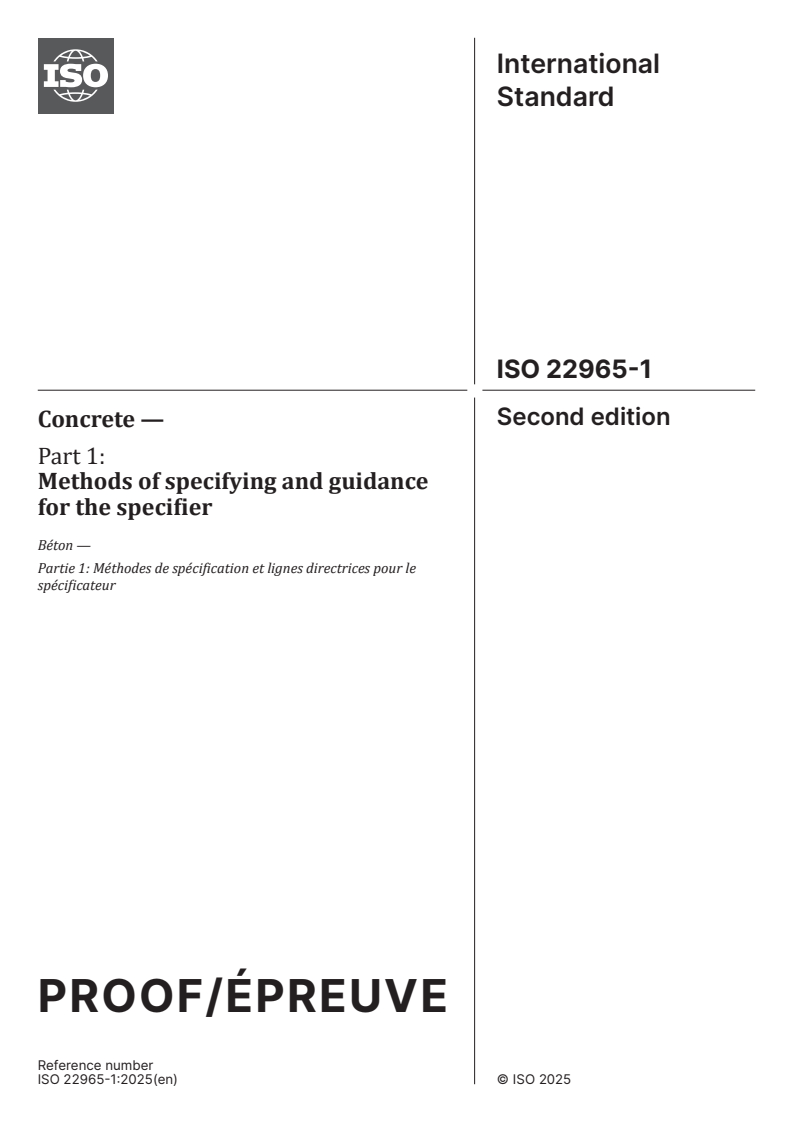
International
Standard
ISO 22965-1
Second edition
Concrete —
Part 1:
Methods of specifying and guidance
for the specifier
Béton —
Partie 1: Méthodes de spécification et lignes directrices pour le
spécificateur
PROOF/ÉPREUVE
Reference number
ISO 22965-1:2025(en) © ISO 2025
ISO 22965-1:2025(en)
© ISO 2025
All rights reserved. Unless otherwise specified, or required in the context of its implementation, no part of this publication may
be reproduced or utilized otherwise in any form or by any means, electronic or mechanical, including photocopying, or posting on
the internet or an intranet, without prior written permission. Permission can be requested from either ISO at the address below
or ISO’s member body in the country of the requester.
ISO copyright office
CP 401 • Ch. de Blandonnet 8
CH-1214 Vernier, Geneva
Phone: +41 22 749 01 11
Email: copyright@iso.org
Website: www.iso.org
Published in Switzerland
PROOF/ÉPREUVE
ii
ISO 22965-1:2025(en)
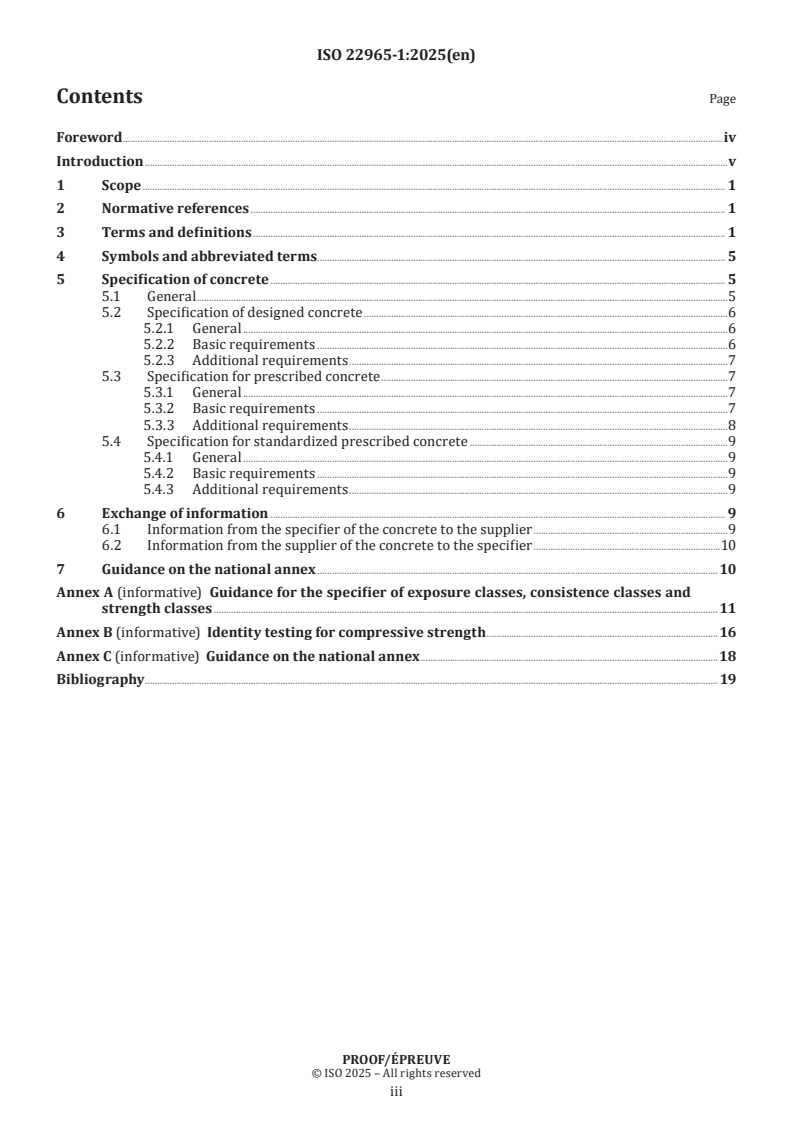
Contents Page
Foreword .iv
Introduction .v
1 Scope . 1
2 Normative references . 1
3 Terms and definitions . 1
4 Symbols and abbreviated terms. 5
5 Specification of concrete . 5
5.1 General .5
5.2 Specification of designed concrete .6
5.2.1 General .6
5.2.2 Basic requirements .6
5.2.3 Additional requirements .7
5.3 Specification for prescribed concrete .7
5.3.1 General .7
5.3.2 Basic requirements .7
5.3.3 Additional requirements .8
5.4 Specification for standardized prescribed concrete .9
5.4.1 General .9
5.4.2 Basic requirements .9
5.4.3 Additional requirements .9
6 Exchange of information . 9
6.1 Information from the specifier of the concrete to the supplier .9
6.2 Information from the supplier of the concrete to the specifier .10
7 Guidance on the national annex . 10
Annex A (informative) Guidance for the specifier of exposure classes, consistence classes and
strength classes .11
Annex B (informative) Identity testing for compressive strength .16
Annex C (informative) Guidance on the national annex .18
Bibliography . 19
PROOF/ÉPREUVE
iii
ISO 22965-1:2025(en)
Foreword
ISO (the International Organization for Standardization) is a worldwide federation of national standards
bodies (ISO member bodies). The work of preparing International Standards is normally carried out through
ISO technical committees. Each member body interested in a subject for which a technical committee
has been established has the right to be represented on that committee. International organizations,
governmental and non-governmental, in liaison with ISO, also take part in the work. ISO collaborates closely
with the International Electrotechnical Commission (IEC) on all matters of electrotechnical standardization.
The procedures used to develop this document and those intended for its further maintenance are described
in the ISO/IEC Directives, Part 1. In particular, the different approval criteria needed for the different types
of ISO document should be noted. This document was drafted in accordance with the editorial rules of the
ISO/IEC Directives, Part 2 (see www.iso.org/directives).
ISO draws attention to the possibility that the implementation of this document may involve the use of (a)
patent(s). ISO takes no position concerning the evidence, validity or applicability of any claimed patent
rights in respect thereof. As of the date of publication of this document, ISO had not received notice of (a)
patent(s) which may be required to implement this document. However, implementers are cautioned that
this may not represent the latest information, which may be obtained from the patent database available at
www.iso.org/patents. ISO shall not be held responsible for identifying any or all such patent rights.
Any trade name used in this document is information given for the convenience of users and does not
constitute an endorsement.
For an explanation of the voluntary nature of standards, the meaning of ISO specific terms and expressions
related to conformity assessment, as well as information about ISO's adherence to the World Trade
Organization (WTO) principles in the Technical Barriers to Trade (TBT), see www.iso.org/iso/foreword.html.
This document was prepared by Technical Committee ISO/TC 71, Concrete, reinforced concrete and pre-
stressed concrete, Subcommittee SC 3, Concrete production and execution of concrete.
This second edition cancels and replaces the first edition (ISO 22965-1:2007), which has been technically
revised.
The main changes are as follows:
— addition of references reflecting relevant new developments (i.e. the ISO 13315 series);
— addition of exposure classes (see Annex A), in order to reflect the diversity of environments in which
structures are located;
— alignment with the class of slump with ISO 1920-2 (see Annex A).
A list of all parts in the ISO 22965 series can be found on the ISO website.
Any feedback or questions on this document should be directed to the user’s national standards body. A
complete listing of these bodies can be found at www.iso.org/members.html.
PROOF/ÉPREUVE
iv
ISO 22965-1:2025(en)
Introduction
This document is intended for nations that have no national concrete standard. It sets out a framework
of principles for nations revising their national standards. This document can also be applied to specific
projects where a project specification supplements the standards in lieu of a national annex applicable at the
place of use.
This document is applied under various climatic and geographical conditions, various levels of protection
and under different established regional traditions and experience. Consequently, this document includes
classes for concrete with different properties to cover the most frequent and typical situations. For certain
uses of concrete, additional or deviating rules can be necessary. The national provisions, preferably given
in a national annex to this document, or the project specification can specify any additional or deviating
requirements.
Some ISO member bodies have developed local tests and criteria for performance-based specifications. This
document does not exclude the continuation and development of such practices valid in the place of use of
the concrete as an alternative to the prescriptive approach. These requirements must be specified in the
national annex or national complementary provisions. The Model Code for Service Limit Design (MC-SLD)
was published as ISO 16204 in 2012.
This document incorporates rules for the use of constituents that are covered by International Standards.
For materials for which International Standards have not yet been published, the standards cited in the
national annex (often the regional or national standards) apply (see 5.1). In particular, documents in current
use for by-products of industrial processes, recycled materials, etc. are based on local experience. Until
international specifications for these materials are available, this document does not provide rules for their
use, but instead refers to the national annex.
This document defines the two parties involved in the ordering and the supply of concrete, which are
hereinafter referred to as specifier and supplier. In practice, there can be several parties specifying
requirements at various stages of the design and construction process, e.g. the client, the designer, the
quantity surveyor, the constructor and the concreting subcontractor. Each is expected to pass the specified
requirements, together with any additional requirements, to the next party in the chain until they reach the
supplier. In the terms of this document, this final compilation of requirements is known as the “concrete
specification”. In some cases, the specifier and the supplier are the same party (e.g. a constructor doing
design, production and execution). In the case of ready-mixed concrete, the purchaser is the specifier.
This document also gives rules for the exchange of information between the parties. Contractual matters are
not covered by this document. Other International Standards for specific products, e. g. pre-cast products,
or for processes within the field of the scope of this document, can require or permit deviations from this
document.
PROOF/ÉPREUVE
v
International Standard ISO 22965-1:2025(en)
Concrete —
Part 1:
Methods of specifying and guidance for the specifier
1 Scope
This document specifies requirements for the specification of concrete and gives guidelines for the exchange
of information between the specifier and supplier. Annex A gives general guidance on specification. More
specific guidance on specification related to the local conditions can be given in a national annex.
This document applies to concrete for structures cast in situ, pre-cast structures and structural pre-cast
products for buildings and civil engineering structures. The concrete can be mixed on site, ready-mixed
concrete or produced in a plant for pre-cast concrete products.
This document applies to concrete compacted to retain no appreciable amount of entrapped air other than
entrained air and to normal-weight, heavy-weight, and light-weight concrete.
This document does not apply to:
— concrete with a maximum aggregate size equal to or less than 4 mm or 5 mm (mortar);
— aerated concrete;
— foamed concrete;
— concrete with an open structure (“no-fine aggregate” concrete);
— concrete with a density less than 800 kg/m ;
— refractory concrete.
This document does not cover health and safety requirements for the protection of workers during
production and delivery of concrete.
2 Normative references
The following documents are referred to in the text in such a way that some or all of their content constitutes
requirements of this document. For dated references, only the edition cited applies. For undated references,
the latest edition of the referenced document (including any amendments) applies.
ISO 22965-2, Concrete — Part 2: Specification of constituent materials, production of concrete and conformance
of concrete
3 Terms and definitions
For the purposes of this document, the following terms and definitions apply.
ISO and IEC maintain terminology databases for use in standardization at the following addresses:
— ISO Online browsing platform: available at https:// www .iso .org/ obp
— IEC Electropedia: available at https:// www .electropedia .org/
PROOF/ÉPREUVE
ISO 22965-1:2025(en)
3.1
addition
finely divided or ground material used in concrete (3.7) to improve certain properties or to achieve special
properties
Note 1 to entry: This document deals with two types of additions:
— nearly inert additions (type I);
— pozzolanic or latent hydraulic additions (type II).
3.2
admixture
material added during the mixing process of concrete (3.7) in small quantities relative to the mass of cement
to modify the properties of fresh concrete (3.14) or hardened concrete (3.15)
3.3
aggregate
granular mineral material suitable for use in concrete (3.7)
Note 1 to entry: Aggregates can be natural, artificial, or recycled from material previously used in construction, e.g.,
recycled concrete aggregate.
3.4
batch
quantity of fresh concrete (3.14) produced in one cycle of operations of a mixer, or the quantity discharged
during 1 min from a continuous mixer or quantity of concrete (3.7) transported in a vehicle
Note 1 to entry: For testing to be performed at site, the concrete transported as one load in a vehicle can be considered
as one batch.
3.5
cement
finely ground inorganic material that, when mixed with water, forms a paste that sets
and hardens by means of hydration reactions and processes and that, after hardening, retains its strength
and stability even under water
3.6
characteristic strength
value of strength below which 5 % of the population of all possible strength determinations of the volume of
concrete (3.7) under consideration are expected to fall
3.7
concrete
material formed by mixing cement (3.5), coarse and fine aggregate (3.3) and water, with or without the
incorporation of admixtures (3.2) and additions (3.1), which develops its properties by hydration of the
cement (3.5)
Note 1 to entry: International Standards for aggregate can define aggregates larger than 4 mm or 5 mm as coarse. In
concrete for general-purpose use, the coarse aggregate should normally have a maximum aggregate size of at least 16 mm.
3.8
conformance test
test performed to verify that the concrete (3.7) conforms to some aspect of the specification (3.28)
3.9
delivery
process of handing over the fresh concrete (3.14) by the producer (3.23)
PROOF/ÉPREUVE
ISO 22965-1:2025(en)
3.10
designed concrete
concrete (3.7) for which the minimum characteristic strength (3.6), other required properties and additional
characteristics are specified to the supplier (3.31) who is responsible for providing a concrete (3.7)
conforming to the specified minimum characteristic strength (3.6), any other specified properties and any
specified additional characteristics
3.11
entrained air
microscopic air bubbles, typically between 10 µm and 300 µm in diameter and spherical or nearly so,
intentionally incorporated in concrete (3.7) during mixing, usually by use of a surface-active agent
3.12
entrapped air
air voids in concrete (3.7) that are not purposely entrained
3.13
environmental actions
chemical and physical actions to which the concrete (3.7) is exposed that result in effects on the concrete
(3.7) or reinforcement or embedded metal that are not considered as loads in structural design
3.14
fresh concrete
fully mixed concrete that is still capable of being compacted by the intended method
3.15
hardened concrete
concrete that is in a solid state and which has developed a certain strength
3.16
heavy-weight concrete
concrete having an oven-dry density greater than 2 600 kg/m
3.17
identity test
test to determine whether the concrete represented by one or more batches (3.4) comes from a conforming
population
3.18
light-weight aggregate
aggregate (3.3) of mineral origin having an oven-dry particle density ≦ 2 000 kg/m or in case oven-dry
particle density cannot be measured, a loose oven-dry bulk density ≦ 1 200 kg/m
3.19
light-weight concrete
3 3
concrete (3.7) having an oven-dry density of not less than 800 kg/m and not more than 2 000 kg/m
Note 1 to entry: It is produced using light-weight aggregate for all or part of the total aggregate.
3.20
maximum aggregate size
largest aggregate size used in the concrete (3.7)
Note 1 to entry: The requirements for aggregate size in standards often allow a small percentage to be retained on the
upper sieve size.
3.21
pre-cast concrete product
concrete product cast and cured in a place other than the final location of use
PROOF/ÉPREUVE
ISO 22965-1:2025(en)
3.22
prescribed concrete
concrete (3.7) for which the composition of the concrete and the constituents to be used are specified to the
supplier (3.31) who is responsible for providing a concrete with the specified composition
3.23
producer
person or body producing fresh concrete (3.14)
Note 1 to entry: This document uses the terms “producer” and “supplier” in order to be able to distinguish between
the technical and commercial sides. In the case of ready-mixed concrete, the practices can vary between countries, but
in most cases, the producer and the supplier are the same.
3.24
ready-mixed concrete
concrete delivered in a fresh state to the site (3.25) by a supplier (3.31) to a specifier (3.29) who is the
purchaser
3.25
site
area where the construction work is undertaken, including any land immediately adjacent to the construction
specifically used for the purpose of setting up a batching plant
3.26
site-mixed concrete
concrete (3.7) produced on the site (3.25)
3.27
specific suitability
suitable for use in the specified concrete
3.28
specification
all documented technical requirements necessary to produce and deliver the concrete (3.7)
3.29
specifier
person or body specifying fresh concrete (3.14) for the execution of a construction or a component
3.30
standardized prescribed concrete
concrete (3.7) for which the composition is given in a standard valid in the place of use of the concrete (3.7)
3.31
supplier
person or body supplying ready-mixed concrete (3.24)
3.32
user
person or body using fresh concrete (3.14)
3.33
water/cement ratio
ratio of the effective water content to cement (3.5) content by mass in the fresh concrete (3.14)
Note 1 to entry: Effective water content is the difference between the total water present in the fresh concrete and the
water absorbed by the aggregates.
Note 2 to entry: Total water content is the added water plus water already contained in the aggregates and on the
surface of the aggregates plus water in the admixtures and in additions used in the form of a slurry and water resulting
from any added ice or steam heating.
PROOF/ÉPREUVE
ISO 22965-1:2025(en)
4 Symbols and abbreviated terms
B compressive strength classes for normal and heavy-weight concrete
D maximum aggregate size
max
f characteristic strength of concrete expressed in newtons per square millimetre
ck
f mean of n measurements of the compressive strength of concrete expressed in newtons per
cm
square millimetre
F1 to F6 consistence classes expressed by flow diameter
LB compressive strength class of light-weight concrete
SF1 to SF4 consistence classes expressed by slump flow diameter
S1 to S4 consistence classes expressed by slump
XA exposure classes for chemical attack
XC exposure classes for risk of corrosion induced by carbonation
XD exposure classes for risk of corrosion induced by chlorides other than from sea water
XF exposure classes for freeze/thaw attack
XS exposure classes for risk of corrosion induced by chlorides from sea water
X0 exposure class for no risk of corrosion or attack
5 Specification of concrete
5.1 General
For the use of constituents that are covered by International Standards, requirements contained in the
International Standards apply. For materials for which there are not yet International Standards, the
standards cited in the national annex (often regional or national standards, see Annex C) apply.
All relevant requirements for the concrete shall be given in the concrete specification, including any
properties or mix limitations that are necessary for transportation after delivery, placing, compaction,
curing or further treatment.
The required properties of concrete in the structure are generally achieved only if the intended and specified
execution procedures on the fresh concrete are carried out at the place of use. Therefore, the requirements
for transportation, placing, compaction, curing and further treatment shall also be taken into account before
specifying the concrete (see relevant standard for execution of work). Many of these requirements are often
interdependent. If all these requirements are satisfied, any difference in concrete properties between the
concrete in the structure and standardized test specimens is adequately covered by the partial safety factor
for concrete.
When preparing the concrete specification, the following aspects shall be taken into consideration:
— application of the fresh and hardened concrete;
— curing conditions;
— dimensions of the structure (the heat development);
— environmental actions to which the structure is to be exposed (see Clause A.2);
PROOF/ÉPREUVE
ISO 22965-1:2025(en)
— any requirements for exposed aggregate or tooled concrete finishes;
— any requirements related to the cover to reinforcement or minimum section width, e.g. maximum
aggregate size;
— any requirements related to the environmental management for concrete and concrete structures;
— any restrictions on the use of constituents with established suitability, e.g. inappropriate for the identified
exposure classes.
The national annex or provisions valid in the place of use of the concrete should contain recommendations
or guidance for these considerations. However, they only become requirements if specifically cited in the
specification.
The maximum aggregate size, D , shall be selected taking into account the cover to reinforcement, the
max
spacing of the reinforcement and the minimum section width.
Concrete shall be specified as either a designed concrete (see 5.2), a prescribed concrete (see 5.3) or a
standardized prescribed concrete (see 5.4).
The classifications given in Clause A.3 or the national annex may be used for the concrete specification.
Requirements for durability may be specified in terms of performance-related parameters, e.g. scaling of
concrete in a freezing and thawing test. Guidance on the use of a performance-related specification method
with respect to durability is given in ISO 16204.
Requirements related to environmental aspects may be set on the constituents, mix proportions, etc.
ISO 13315-1 and ISO 13315-4 give guidance on the environmental design of concrete str
...
ISO/TC 71/SC 3/WG 1
Date: 2025-02-10
Secretariat: SN
Date: 2025-03-25
Concrete —
Part 1:
Methods of specifying and guidance for the specifier
Béton —
Partie 1: Méthodes de spécification et lignes directrices pour le spécificateur
PROOF
All rights reserved. Unless otherwise specified, or required in the context of its implementation, no part of this publication
may be reproduced or utilized otherwise in any form or by any means, electronic or mechanical, including photocopying,
or posting on the internet or an intranet, without prior written permission. Permission can be requested from either ISO
at the address below or ISO’s member body in the country of the requester.
ISO copyright office
CP 401 • Ch. de Blandonnet 8
CH-1214 Vernier, Geneva
Phone: + 41 22 749 01 11
EmailE-mail: copyright@iso.org
Website: www.iso.org
Published in Switzerland
ii
ISO/DISPRF 22965-1:2025(en)
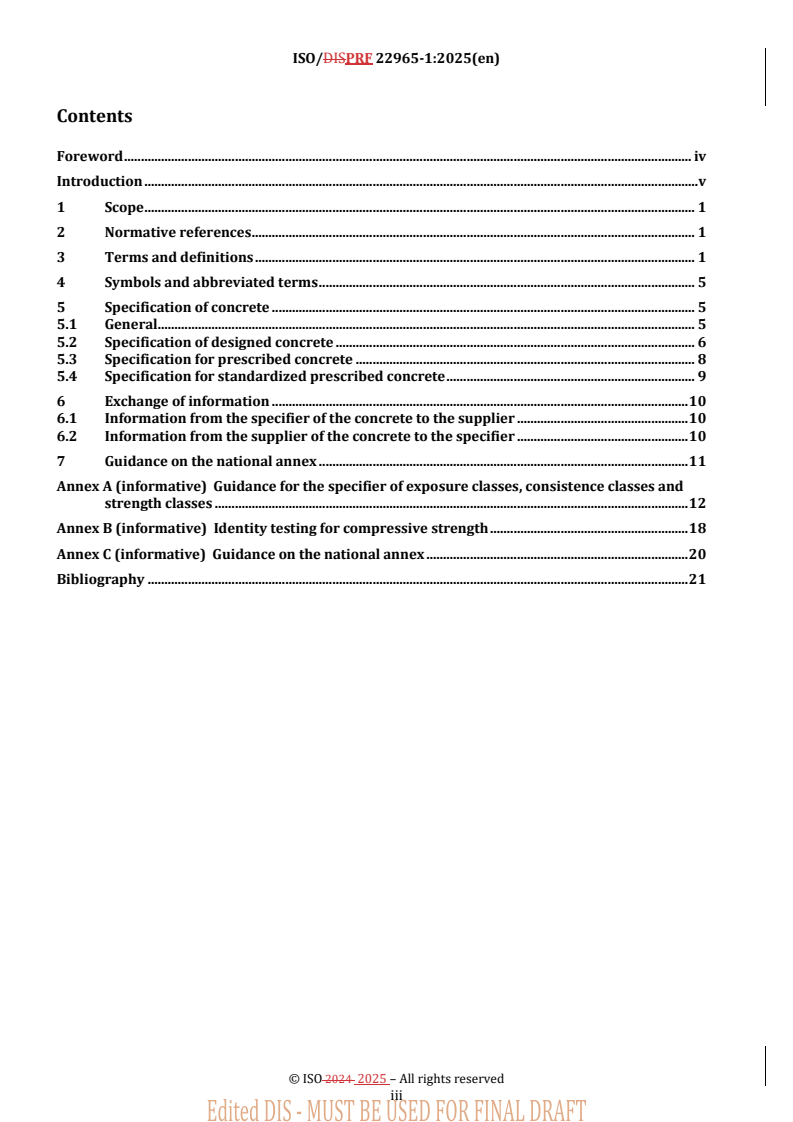
Contents
Foreword . iv
Introduction . v
1 Scope . 1
2 Normative references . 1
3 Terms and definitions . 1
4 Symbols and abbreviated terms . 5
5 Specification of concrete . 5
5.1 General. 5
5.2 Specification of designed concrete . 6
5.3 Specification for prescribed concrete . 8
5.4 Specification for standardized prescribed concrete . 9
6 Exchange of information . 10
6.1 Information from the specifier of the concrete to the supplier . 10
6.2 Information from the supplier of the concrete to the specifier . 10
7 Guidance on the national annex . 11
Annex A (informative) Guidance for the specifier of exposure classes, consistence classes and
strength classes . 12
Annex B (informative) Identity testing for compressive strength . 18
Annex C (informative) Guidance on the national annex . 20
Bibliography . 21
iii
Foreword
ISO (the International Organization for Standardization) is a worldwide federation of national standards
bodies (ISO member bodies). The work of preparing International Standards is normally carried out through
ISO technical committees. Each member body interested in a subject for which a technical committee has been
established has the right to be represented on that committee. International organizations, governmental and
non-governmental, in liaison with ISO, also take part in the work. ISO collaborates closely with the
International Electrotechnical Commission (IEC) on all matters of electrotechnical standardization.
The procedures used to develop this document and those intended for its further maintenance are described
in the ISO/IEC Directives, Part 1. In particular, the different approval criteria needed for the different types of
ISO document should be noted. This document was drafted in accordance with the editorial rules of the
ISO/IEC Directives, Part 2 (see www.iso.org/directives).
ISO draws attention to the possibility that the implementation of this document may involve the use of (a)
patent(s). ISO takes no position concerning the evidence, validity or applicability of any claimed patent rights
in respect thereof. As of the date of publication of this document, ISO [had/had not] received notice of (a)
patent(s) which may be required to implement this document. However, implementers are cautioned that this
may not represent the latest information, which may be obtained from the patent database available at
www.iso.org/patents. ISO shall not be held responsible for identifying any or all such patent rights.
Any trade name used in this document is information given for the convenience of users and does not
constitute an endorsement.
For an explanation of the voluntary nature of standards, the meaning of ISO specific terms and expressions
related to conformity assessment, as well as information about ISO's adherence to the World Trade
Organization (WTO) principles in the Technical Barriers to Trade (TBT), see www.iso.org/iso/foreword.html.
This document was prepared by Technical Committee ISO/TC 71, Concrete, reinforced concrete and pre-
stressed concrete, Subcommittee SC 3, Concrete production and execution of concrete structures.
This second edition cancels and replaces the first edition (ISO 22965-1:2007), which has been technically
revised.
The main changes are as follows:
— — addition of references reflecting relevant new developments (i.e. the ISO 13315 series);
— — addition of exposure classes (see Annex AAnnex A),), in order to reflect the diversity of environments
in which structures are located;
— — alignment with the class of slump with ISO 1920-2 (see Annex AAnnex A).).
A list of all parts in the ISO 22965 series can be found on the ISO website.
Any feedback or questions on this document should be directed to the user’s national standards body. A
complete listing of these bodies can be found at www.iso.org/members.html.
iv
ISO/DISPRF 22965-1:2025(en)
Introduction
This document is intended for nations that have no national concrete standard. It sets out a framework of
principles for nations revising their national standards. This document can also be applied to specific projects
where a project specification supplements the standards in lieu of a national annex applicable at the place of
use.
This document is applied under various climatic and geographical conditions, various levels of protection and
under different established regional traditions and experience. Consequently, this document includes classes
for concrete with different properties to cover the most frequent and typical situations. For certain uses of
concrete, additional or deviating rules can be necessary. The national provisions, preferably given in a national
annex to this document, or the project specification can specify any additional or deviating requirements.
Some ISO member bodies have developed local tests and criteria for performance-based specifications. This
document does not exclude the continuation and development of such practices valid in the place of use of the
concrete as an alternative to the prescriptive approach. These requirements must be specified in the national
annex or national complementary provisions. The Model Code for Service Limit Design (MC-SLD) was
published as ISO 16204 in 2012.
This document incorporates rules for the use of constituents that are covered by International Standards. For
materials for which International Standards have not yet been published, the standards cited in the national
annex (often the regional or national standards) apply (see 5.15.1).). In particular, documents in current use
for by-products of industrial processes, recycled materials, etc. are based on local experience. Until
international specifications for these materials are available, this document does not provide rules for their
use, but instead refers to the national annex.
This document defines the two parties involved in the ordering and the supply of concrete, which are
hereinafter referred to as specifier and supplier. In practice, there can be several parties specifying
requirements at various stages of the design and construction process, e.g. the client, the designer, the quantity
surveyor, the constructor and the concreting subcontractor. Each is expected to pass the specified
requirements, together with any additional requirements, to the next party in the chain until they reach the
supplier. In the terms of this document, this final compilation of requirements is known as the “concrete
specification”. In some cases, the specifier and the supplier are the same party (e.g. a constructor doing design,
production and execution). In the case of ready-mixed concrete, the purchaser is the specifier.
This document also gives rules for the exchange of information between the parties. Contractual matters are
not covered by this document. Other International Standards for specific products, e. g. pre-cast products, or
for processes within the field of the scope of this document, can require or permit deviations from this
document.
v
DRAFT International Standard ISO/DIS 22965-1:2025(en)
Concrete —
Part 1:
Methods of specifying and guidance for the specifier
1 Scope
This document specifies requirements for the specification of concrete and gives guidelines for the exchange
of information between the specifier and supplier. Annex AAnnex A gives general guidance on specification.
More specific guidance on specification related to the local conditions can be given in a national annex.
This document applies to concrete for structures cast in situ, pre-cast structures and structural pre-cast
products for buildings and civil engineering structures. The concrete can be mixed on site, ready-mixed
concrete or produced in a plant for pre-cast concrete products.
This document applies to concrete compacted to retain no appreciable amount of entrapped air other than
entrained air and to normal-weight, heavy-weight, and light-weight concrete.
This document does not apply to:
— — concrete with a maximum aggregate size equal to or less than 4 mm or 5 mm (mortar);
— — aerated concrete;
— — foamed concrete;
— — concrete with an open structure (“no-fine aggregate” concrete);
— — concrete with a density less than 800 kg/m ;
— — refractory concrete.
This document does not cover health and safety requirements for the protection of workers during production
and delivery of concrete.
2 Normative references
The following documents are referred to in the text in such a way that some or all of their content constitutes
requirements of this document. For dated references, only the edition cited applies. For undated references,
the latest edition of the referenced document (including any amendments) applies.
ISO 22965--2, Concrete — Part 2: Specification of constituent materials, production of concrete and conformance
of concrete
3 Terms and definitions
For the purposes of this document, the following terms and definitions apply.
ISO and IEC maintain terminology databases for use in standardization at the following addresses:
— — ISO Online browsing platform: available at https://www.iso.org/obp
— — IEC Electropedia: available at https://www.electropedia.org/
3.1 3.1
addition
finely divided or ground material used in concrete (3.7(3.7)) to improve certain properties or to achieve
special properties
Note 1 to entry: This document deals with two types of additions:
— — nearly inert additions (type I);
— — pozzolanic or latent hydraulic additions (type II).
3.2 3.2
admixture
material added during the mixing process of concrete (3.7(3.7)) in small quantities relative to the mass of
cement to modify the properties of fresh concrete (3.14(3.14)) or hardened concrete (3.15(3.15))
3.3 3.3
aggregate
granular mineral material suitable for use in concrete (3.7(3.7))
Note 1 to entry: Aggregates can be natural, artificial, or recycled from material previously used in construction, e.g.,
recycled concrete aggregate.
3.4 3.4
batch
quantity of fresh concrete (3.14(3.14)) produced in one cycle of operations of a mixer, or the quantity
discharged during 1 min from a continuous mixer or quantity of concrete (3.7(3.7)) transported in a vehicle
Note 1 to entry: For testing to be performed at site, the concrete transported as one load in a vehicle can be considered
as one batch.
3.5 3.5
cement
finely ground inorganic material that, when mixed with water, forms a paste that sets and
hardens by means of hydration reactions and processes and that, after hardening, retains its strength and
stability even under water
3.6 3.6
characteristic strength
value of strength below which 5 % of the population of all possible strength determinations of the volume of
concrete (3.7(3.7)) under consideration are expected to fall
3.7 3.7
concrete
material formed by mixing cement (3.5(3.5),), coarse and fine aggregate (3.3(3.3)) and water, with or without
the incorporation of admixtures (3.2(3.2)) and additions (3.1(3.1),), which develops its properties by
hydration of the cement (3.5(3.5))
Note 1 to entry: International Standards for aggregate can define aggregates larger than 4 mm or 5 mm as coarse. In
concrete for general-purpose use, the coarse aggregate should normally have a maximum aggregate size of at least
16 mm.
ISO/DISPRF 22965-1:2025(en)
3.8 3.8
conformance test
test performed to verify that the concrete (3.7(3.7)) conforms to some aspect of the specification (3.28(3.28))
3.9 3.9
delivery
process of handing over the fresh concrete (3.14(3.14)) by the producer (3.23(3.23))
3.10 3.10
designed concrete
concrete (3.7(3.7)) for which the minimum characteristic strength (3.6(3.6),), other required properties and
additional characteristics are specified to the supplier (3.31(3.31)) who is responsible for providing a concrete
(3.7(3.7)) conforming to the specified minimum characteristic strength (3.6(3.6),), any other specified
properties and any specified additional characteristics
3.11 3.11
entrained air
microscopic air bubbles, typically between 10 µm and 300 µm in diameter and spherical or nearly so,
intentionally incorporated in concrete (3.7(3.7)) during mixing, usually by use of a surface-active agent
3.12 3.12
entrapped air
air voids in concrete (3.7(3.7)) that are not purposely entrained
3.13 3.13
environmental actions
chemical and physical actions to which the concrete (3.7(3.7)) is exposed that result in effects on the concrete
(3.7(3.7)) or reinforcement or embedded metal that are not considered as loads in structural design
3.14 3.14
fresh concrete
fully mixed concrete that is still capable of being compacted by the intended method
3.15 3.15
hardened concrete
concrete that is in a solid state and which has developed a certain strength
3.16 3.16
heavy-weight concrete
concrete having an oven-dry density greater than 2 600 kg/m
3.17 3.17
identity test
test to determine whether the concrete represented by one or more batches (3.4(3.4)) comes from a
conforming population
3.18 3.18
light-weight aggregate
aggregate (3.3(3.3)) of mineral origin having an oven-dry particle density ≦ 2 000 kg/m or in case oven-dry
particle density cannot be measured, a loose oven-dry bulk density ≦ 1 200 kg/m
3.19 3.19
light-weight concrete
3 3
concrete (3.7(3.7)) having an oven-dry density of not less than 800 kg/m and not more than 2 000 kg/m
Note 1 to entry: It is produced using light-weight aggregate for all or part of the total aggregate.
3.20 3.20
maximum aggregate size
largest aggregate size used in the concrete (3.7(3.7))
Note 1 to entry: The requirements for aggregate size in standards often allow a small percentage to be retained on the
upper sieve size.
3.21 3.21
pre-cast concrete product
concrete product cast and cured in a place other than the final location of use
3.22 3.22
prescribed concrete
concrete (3.7(3.7)) for which the composition of the concrete and the constituents to be used are specified to
the supplier (3.31(3.31)) who is responsible for providing a concrete with the specified composition
3.23 3.23
producer
person or body producing fresh concrete (3.14(3.14))
Note 1 to entry: This document uses the terms “producer” and “supplier” in order to be able to distinguish between the
technical and commercial sides. In the case of ready-mixed concrete, the practices can vary between countries, but in
most cases, the producer and the supplier are the same.
3.24 3.24
ready-mixed concrete
concrete delivered in a fresh state to the site (3.25(3.25)) by a supplier (3.31(3.31)) to a specifier (3.29(3.29))
who is the purchaser
3.25 3.25
site
area where the construction work is undertaken, including any land immediately adjacent to the construction
specifically used for the purpose of setting up a batching plant
3.26 3.26
site-mixed concrete
concrete (3.7(3.7)) produced on the site (3.25(3.25))
3.27 3.27
specific suitability
suitable for use in the specified concrete
3.28 3.28
specification
all documented technical requirements necessary to produce and deliver the concrete (3.7(3.7))
3.29 3.29
specifier
person or body specifying fresh concrete (3.14(3.14)) for the execution of a construction or a component
3.30 3.30
standardized prescribed concrete
concrete (3.7(3.7)) for which the composition is given in a standard valid in the place of use of the concrete
(3.7(3.7))
ISO/DISPRF 22965-1:2025(en)
3.31 3.31
supplier
person or body supplying ready-mixed concrete (3.24(3.24))
3.32 3.32
user
person or body using fresh concrete (3.14(3.14))
3.33 3.33
water/cement ratio
ratio of the effective water content to cement (3.5(3.5)) content by mass in the fresh concrete (3.14(3.14))
Note 1 to entry: Effective water content is the difference between the total water present in the fresh concrete and the
water absorbed by the aggregates.
Note 2 to entry: Total water content is the added water plus water already contained in the aggregates and on the surface
of the aggregates plus water in the admixtures and in additions used in the form of a slurry and water resulting from any
added ice or steam heating.
4 Symbols and abbreviated terms
B compressive strength classes for normal and heavy-weight concrete
D maximum aggregate size
max
f characteristic strength of concrete expressed in newtons per square millimetre
ck
f mean of n measurements of the compressive strength of concrete expressed in newtons per
cm
square millimetre
F1 to F6 consistence classes expressed by flow diameter
LB compressive strength class of light-weight concrete
SF1 to SF4 consistence classes expressed by slump flow diameter
S1 to S4 consistence classes expressed by slump
XA exposure classes for chemical attack
XC exposure classes for risk of corrosion induced by carbonation
XD exposure classes for risk of corrosion induced by chlorides other than from sea water
XF exposure classes for freeze/thaw attack
XS exposure classes for risk of corrosion induced by chlorides from sea water
X0 exposure class for no risk of corrosion or attack
5 Specification of concrete
5.1 General
For the use of constituents that are covered by International Standards, requirements contained in the
International Standards apply. For materials for which there are not yet International Standards, the
standards cited in the national annex (often regional or national standards, see Annex CAnnex C)) apply.
All relevant requirements for the concrete shall be given in the concrete specification, including any properties
or mix limitations that are necessary for transportation after delivery, placing, compaction, curing or further
treatment.
The required properties of concrete in the structure are generally achieved only if the intended and specified
execution procedures on the fresh concrete are carried out at the place of use. Therefore, the requirements for
transportation, placing, compaction, curing and further treatment shall also be taken into account before
specifying the concrete (see relevant standard for execution of work). Many of these requirements are often
interdependent. If all these requirements are satisfied, any difference in concrete properties between the
concrete in the structure and standardized test specimens is adequately covered by the partial safety factor
for concrete.
When preparing the concrete specification, the following aspects shall be taken into consideration:
— — application of the fresh and hardened concrete;
— — curing conditions;
— — dimensions of the structure (the heat development);
— — environmental actions to which the structure is to be exposed (see Clause A.2Clause A.2););
— — any requirements for exposed aggregate or tooled concrete finishes;
— — any requirements related to the cover to reinforcement or minimum section width, e.g. maximum
aggregate size;
— — any requirements related to the environmental management for concrete and concrete structures;
— — any restrictions on the use of constituents with established suitability, e.g. inappropriate for the
identified exposure classes.
The national annex or provisions valid in the place of use of the concrete should contain recommendations or
guidance for these considerations. However, they only become requirements if specifically cited in the
specification.
The maximum aggregate size, D , shall be selected taking into account the cover to reinforcement, the
max
spacing of the reinforcement and the minimum section width.
Concrete shall be specified as either a designed concrete (see 5.25.2),), a prescribed concrete (see 5.35.3)) or
a standardized prescribed concrete (see 5.45.4).).
The classifications given in Clause A.3Clause A.3 or the national annex may be used for the concrete
specification.
Requirements for durability may be specified in terms of performance-related parameters, e.g. scaling of
concrete in a freezing and thawing test. Guidance on the use of a performance-related specification method
with respect to durability is given in ISO 16204.
Requirements related to environmental aspects may be set on the constituents, mix proportions, etc. ISO
13315-1 and ISO 13315-4 give guidance on the environmental design of concrete structures.
Any requirement for artificial cooling or heating of the concrete prior to delivery shall be specified.
5.2 Specification of designed concrete
5.2.1 General
The specification for designed concrete shall contain:
ISO/DISPRF 22965-1:2025(en)
a) a) the basic requirements given in 5.2.25.2.2;;
b) b) the additional requirements given in 5.2.35.2.3,, where required.
5.2.2 Basic requirements
The specification shall contain:
a) a) a requirement to conform to ISO 22965-2;
b) b) compressive strength class, if not covered by the designation; see c);
c) c) concrete designation or limiting values, e.g. maximum water/cement ratio;
d) d) maximum aggregate size;
e) e) maximum chloride content;
f) f) where a designation has not been specified, constituents with specific suitability;
NOTE 1 The k-value concept for the use of additions is given in ISO 22965-2:2025, Annex F.
NOTE 2 Requirements for preventing damaging alkali-aggregate reaction are given in ISO 16204.
g) g) where the concrete producer does not hold a current accredited third-party quality certification, the
method used to assess the conformity of strength (e.g. ISO 22965-2:2025, 9.4);
h) h) target density (only for light-weight and heavy-weight concrete);
i) i) consistence class or target value for consistence taking into account the possible loss of fluidity during
transporting and pumping, etc. subsequent to the delivery (only for ready-mixed concrete and site-mixed
concrete).
5.2.3 Additional requirements
In addition to the basic requirements (see 5.2.25.2.2),), the specification for designed concrete shall contain
a
...
Questions, Comments and Discussion
Ask us and Technical Secretary will try to provide an answer. You can facilitate discussion about the standard in here.