

ISO 15166-2:2000
(Main)Adhesives — Methods of preparing bulk specimens — Part 2: Elevated-temperature-curing one-part systems
General Information
- Abstract
This part of ISO 15166 describes methods for the preparation of bulk specimens of adhesives. The procedures described are suitable for elevated-temperature, one-part adhesives such as epoxies. They are not suitable for adhesives where the cure requires the evaporation of solvents or liberation of gas.
- Status
- Published
- Publication Date
- 06-Dec-2000
- Technical Committee
- ISO/TC 61/SC 11 - Products
- Drafting Committee
- ISO/TC 61/SC 11/WG 5 - Polymeric adhesives
- Current Stage
- 9093 - International Standard confirmed
- Start Date
- 08-Dec-2025
- Completion Date
- 29-Aug-2026
Buy Documents
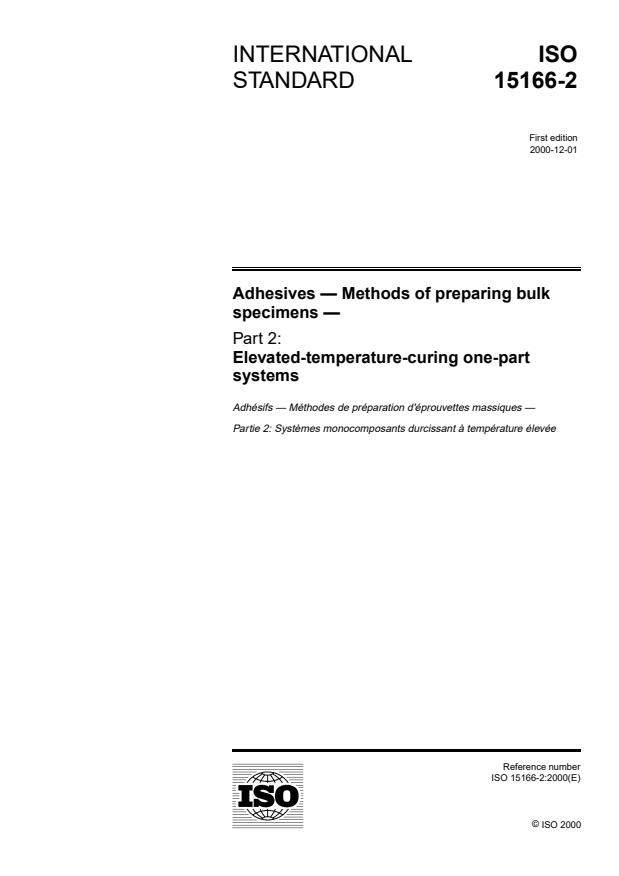
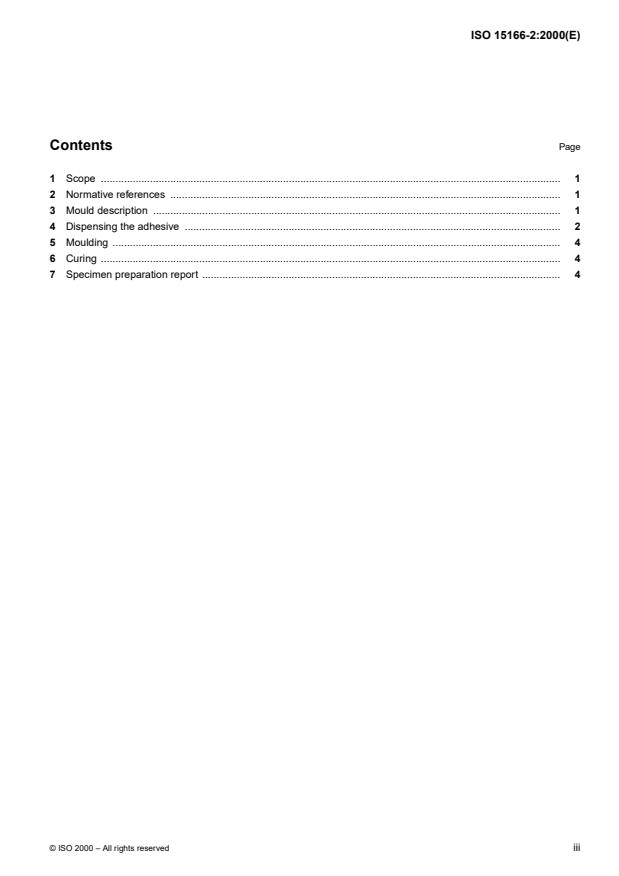
ISO 15166-2:2000 - Adhesives — Methods of preparing bulk specimens — Part 2: Elevated-temperature-curing one-part systems Released:12/7/2000
ISO 15166-2:2000 - Adhésifs — Méthodes de préparation d'éprouvettes massiques — Partie 2: Systemes monocomposants durcissant a température élevée Released:12/7/2000
Overview
ISO 15166-2:2000 specifies reproducible methods for preparing bulk specimens of elevated‑temperature‑curing one‑part adhesive systems (for example, many epoxy adhesives). It covers mould design, adhesive application, moulding, curing and reporting requirements for producing bulk test material representative of adhesive used in structural joints. This part does not apply to adhesives whose cure requires solvent evaporation or gas liberation.
Key topics and technical requirements
Mould construction
- Two metal plates separated by a frame; plate thickness ≥ 5 mm to provide heat capacity and dimensional stability.
- Copper or brass plates are suggested for thermal conduction; surfaces must prevent adhesion (PTFE film or release agent).
- Frame height defines specimen thickness and must be uniform within ±0.5%; 2–3 mm is adequate for most tests.
- For low‑viscosity adhesives that flow, use a continuous frame to prevent leakage.
Adhesive preparation and application
- Minimise entrained air (degassing under vacuum) - consult the manufacturer about volatile loss risks.
- Non‑flowing adhesives: dispense from a cartridge nozzle with continuous flow; keep nozzle immersed and move steadily (recommended nozzle angle ~30°).
- Flowing adhesives: pour gently into the mould centre from a degassed container or use a continuous‑frame cartridge technique.
Moulding and curing
- Close mould, apply sufficient pressure to avoid leaks, and place at 45°–90° inclination in the curing oven.
- Cure according to the adhesive manufacturer’s instructions; monitor exotherms for fast, exothermic systems.
- Excessive centre temperatures are unlikely for mould thickness ≤ 2 mm; for thicknesses > 3 mm install calibrated temperature probes to check internal temperature and consider lower cure temperatures with longer times and post‑cure as recommended.
Documentation
- Report must include reference to ISO 15166‑2, adhesive ID (manufacturer, lot), moulding date/time, curing parameters (temperature, duration), mould/release agents, any post‑cure and storage conditions.
Applications and users
ISO 15166‑2 is intended for:
- Adhesive manufacturers (materials characterization and QC)
- Test laboratories and quality assurance teams preparing bulk specimens for mechanical testing
- R&D engineers and formulators validating cure schedules and thermal behaviour (exotherm control)
- Designers needing accurate adhesive property data for joint stress analysis
Using standardized bulk specimens enables consistent mechanical testing (uniaxial, shear) and better comparison of adhesive performance across labs and products.
Related standards
- ISO 15166‑1 - Adhesives: Methods of preparing bulk specimens - Part 1: Two‑part systems
- ISO 2818 - Plastics: Preparation of test specimens by machining
- ISO 3167 - Plastics: Multipurpose test specimens
Keywords: ISO 15166-2, adhesives bulk specimens, elevated‑temperature‑curing, one‑part systems, epoxy specimen preparation, moulding and curing procedures.
Buy Documents
ISO 15166-2:2000 - Adhesives — Methods of preparing bulk specimens — Part 2: Elevated-temperature-curing one-part systems Released:12/7/2000
ISO 15166-2:2000 - Adhésifs — Méthodes de préparation d'éprouvettes massiques — Partie 2: Systemes monocomposants durcissant a température élevée Released:12/7/2000
Get Certified
Connect with accredited certification bodies for this standard

DIN CERTCO
DIN Group product certification.

Smithers Quality Assessments
US management systems and product certification.
Sponsored listings
Frequently Asked Questions
ISO 15166-2:2000 is a standard published by the International Organization for Standardization (ISO). Its full title is "Adhesives — Methods of preparing bulk specimens — Part 2: Elevated-temperature-curing one-part systems". This standard covers: This part of ISO 15166 describes methods for the preparation of bulk specimens of adhesives. The procedures described are suitable for elevated-temperature, one-part adhesives such as epoxies. They are not suitable for adhesives where the cure requires the evaporation of solvents or liberation of gas.
This part of ISO 15166 describes methods for the preparation of bulk specimens of adhesives. The procedures described are suitable for elevated-temperature, one-part adhesives such as epoxies. They are not suitable for adhesives where the cure requires the evaporation of solvents or liberation of gas.
ISO 15166-2:2000 is classified under the following ICS (International Classification for Standards) categories: 83.180 - Adhesives. The ICS classification helps identify the subject area and facilitates finding related standards.
ISO 15166-2:2000 is available in PDF format for immediate download after purchase. The document can be added to your cart and obtained through the secure checkout process. Digital delivery ensures instant access to the complete standard document.
Standards Content (Sample)
INTERNATIONAL ISO
STANDARD 15166-2
First edition
2000-12-01
Adhesives — Methods of preparing bulk
specimens —
Part 2:
Elevated-temperature-curing one-part
systems
Adhésifs — Méthodes de préparation d'éprouvettes massiques —
Partie 2: Systèmes monocomposants durcissant à température élevée
Reference number
PDF disclaimer
This PDF file may contain embedded typefaces. In accordance with Adobe's licensing policy, this file may be printed or viewed but shall not be
edited unless the typefaces which are embedded are licensed to and installed on the computer performing the editing. In downloading this file,
parties accept therein the responsibility of not infringing Adobe's licensing policy. The ISO Central Secretariat accepts no liability in this area.
Adobe is a trademark of Adobe Systems Incorporated.
Details of the software products used to create this PDF file can be found in the General Info relative to the file; the PDF-creation parameters
were optimized for printing. Every care has been taken to ensure that the file is suitable for use by ISO member bodies. In the unlikely event
that a problem relating to it is found, please inform the Central Secretariat at the address given below.
All rights reserved. Unless otherwise specified, no part of this publication may be reproduced or utilized in any form or by any means, elec-
tronic or mechanical, including photocopying and microfilm, without permission in writing from either ISO at the address below or ISO's mem-
ber body in the country of the requester.
ISO copyright office
Case postale 56 • CH-1211 Geneva 20
Tel. + 41 22 749 01 11
Fax + 41 22 749 09 47
E-mail copyright@iso.ch
Web www.iso.ch
Printed in Switzerland
©
ii ISO 2000 – All rights reserved
Contents Page
1 Scope . 1
2 Normative references . 1
3 Mould description . 1
4 Dispensing the adhesive . 2
5 Moulding . 4
6 Curing . 4
7 Specimen preparation report . 4
©
ISO 2000 – All rights reserved iii
Foreword
ISO (the International Organization for Standardization) is a worldwide federation of national standards bodies (ISO
member bodies). The work of preparing International Standards is normally carried out through ISO technical com-
mittees. Each member body interested in a subject for which a technical committee has been established has the
right to be represented on that committee. International organizations, governmental and non-governmental, in liai-
son with ISO, also take part in the work. ISO collaborates closely with the International Electrotechnical Commission
(IEC) on all matters of electrotechnical standardization.
International Standards are drafted in accordance with the rules given in the ISO/IEC Directives, Part 3.
Draft International Standards adopted by the technical committees are circulated to the member bodies for voting.
Publication as an International Standard requires approval by at least 75 % of the member bodies casting a vote.
Attention is drawn to the possibility that some of the elements of this part of ISO 15166 may be the subject of patent
rights. ISO shall not be held responsible for identifying any or all such patent rights.
International Standard ISO 15166-2 was prepared by Technical Committee ISO/TC 61, Plastics, Subcommittee
SC 11, Products.
ISO 15166 consists of the following parts, under the general title Adhesives — Methods of preparing bulk
specimens:
— Part 1: Two-part systems
— Part 2: Elevated-temperature-curing one-part systems
©
iv ISO 2000 – All rights reserved
Introduction
Accurate values for the mechanical properties of structural adhesives are needed in the design of bonded joints to
enable calculations of the stress distribution in the loaded joint and to determine failure criteria for the adhesive
material. The use of test methods that employ specimens in the form of a bonded joint for the measurement of these
properties is not ideal. This is because the thickness dimension of the bond constitutes the gauge length of the spec-
imen for the measurement of strain and, since the thickness is small (typically< 1mm), strains cannot be routinely
determined with high accuracy. Furthermore, the failure of a joint specimen usually arises under a multiaxial stress
state, the complexity of which depends upon many factors such as the geometry of the joint, the dimensions and
properties of the adherends and the geometry of any fillets. The failure data derived from these specimens may be
informative for design purposes but additional data are needed corresponding to deformation and failure under more
simple stress states such as shear and uniaxial tension.
The availability of bulk specimens with suitable dimensions will enable mechanical properties under different loading
conditions and environments to be measured using methods developed and standardized for engineering plastics.
These are both accurate and relatively inexpensive.
Procedures are described that will enable specimens to be obtained that have structures and properties comparable
with those for the adhesive in a bonded joint. Additional tests on joint specimens will be necessary to give information
relating to the performance of the bond between the adhesive and the adherend.
©
ISO 2000 – All rights reserved v
INTERNATIONAL STANDARD ISO 15166-2:2000(E)
Adhesives — Methods of preparing bulk specimens —
Part 2:
Elevated-temperature-curing one-part systems
1 Scope
This part of ISO 15166 describes methods for the preparation of bulk specimens of adhesives.
The procedures described are suitable for elevated-temperature, one-part adhesives such as epoxies. They are not
suitable for adhesives where the cure requires the evaporation of solvents or liberation of gas.
2 Normative references
The following normative documents contain provisions which, through reference in this text, constitute provisions of
this part of ISO 15166. For dated references, subsequent amendments to, or revisions of, any of these publications
do not apply. However, parties to agreements based on this part of ISO 15166 are encouraged to investigate the
possibility of applying the most recent editions of the normative documents indicated below. For undated r
...
NORME ISO
INTERNATIONALE 15166-2
Première édition
2000-12-01
Adhésifs — Méthodes de préparation
d'éprouvettes massiques —
Partie 2:
Systèmes monocomposants durcissant à
température élevée
Adhesives — Methods of preparing bulk specimens —
Part 2: Elevated-temperature-curing one-part systems
Numéro de référence
PDF — Exonération de responsabilité
Le présent fichier PDF peut contenir des polices de caractères intégrées. Conformément aux conditions de licence d'Adobe, ce fichier peut
être imprimé ou visualisé, mais ne doit pas être modifié à moins que l'ordinateur employé à cet effet ne bénéficie d'une licence autorisant l'uti-
lisation de ces polices et que celles-ci y soient installées. Lors du téléchargement de ce fichier, les parties concernées acceptent de fait la res-
ponsabilité de ne pas enfreindre les conditions de licence d'Adobe. Le Secrétariat central de l'ISO décline toute responsabilité en la matière.
Adobe est une marque déposée d'Adobe Systems Incorporated.
Les détails relatifs aux produits logiciels utilisés pour la création du présent fichier PDF sont disponibles dans la rubrique General Info du fi-
chier; les paramètres de création PDF ont été optimisés pour l'impression. Toutes les mesures ont été prises pour garantir l'exploitation de ce
fichier par les comités membres de l'ISO. Dans le cas peu probable où surviendrait un problème d'utilisation, veuillez en informer le Secréta-
riat central à l'adresse donnée ci-dessous.
Droits de reproduction réservés. Sauf prescription différente, aucune partie de cette publication ne peut être reproduite ni utilisée sous quel-
que forme que ce soit et par aucun procédé, électronique ou mécanique, y compris la photocopie et les microfilms, sans l'accord écrit de l'ISO
à l'adresse ci-après ou au comité membre de l'ISO dans le pays du demandeur.
ISO copyright office
Case postale 56 • CH-1211 Geneva 20
Tel. + 41 22 749 01 11
Fax + 41 22 749 09 47
E-mail copyright@iso.ch
Web www.iso.ch
ImpriméenSuisse
©
ii ISO 2000 – Tous droits réservés
Sommaire Page
1 Domaine d'application . 1
2 Références normatives . 1
3 Description du moule . 1
4 Application de l'adhésif . 3
5 Moulage . 4
6 Durcissement . 4
7 Rapport sur la préparation de l’éprouvette . 4
©
ISO 2000 – Tous droits réservés iii
Avant-propos
L'ISO (Organisation internationale de normalisation) est une fédération mondiale d'organismes nationaux de norma-
lisation (comités membres de l'ISO). L'élaboration des Normes internationales est en général confiée aux comités
techniques de l'ISO. Chaque comité membre intéressé par une étude a le droit de faire partie du comité technique
créé à cet effet. Les organisations internationales, gouvernementales et non gouvernementales, en liaison avec
l'ISO participent également aux travaux. L'ISO collabore étroitement avec la Commission électrotechnique interna-
tionale (CEI) en ce qui concerne la normalisation électrotechnique.
Les Normes internationales sont rédigées conformément aux règles données dans les Directives ISO/CEI, Partie 3.
Les projets de Normes internationales adoptés par les comités techniques sont soumis aux comités membres pour
vote. Leur publication comme Normes internationales requiert l'approbation de 75 % au moins des comités membres
votants.
L'attention est appelée sur le fait que certains des éléments de la présente partie de l'ISO 15166 peuvent faire l'objet
de droits de propriété intellectuelle ou de droits analogues. L'ISO ne saurait être tenue pour responsable de ne pas
avoir identifié de tels droits de propriété et averti de leur existence.
La Norme internationale ISO 15166-2 a été élaborée par le comité technique ISO/TC 61, Plastiques, sous-comité
SC 11, Produits.
L'ISO 15166 comprend les parties suivantes, présentées sous le titre général Adhésifs — Méthodes de préparation
d'éprouvettes massiques:
— Partie 1: Systèmes bicomposants
— Partie 2: Systèmes monocomposants durcissant à température élevée
©
iv ISO 2000 – Tous droits réservés
Introduction
La conception de joints collés nécessite des valeurs précises pour les propriétés mécaniques des adhésifs structu-
raux, afin de pouvoir effectuer les calculs de la distribution des contraintes dans le joint sollicité et de déterminer les
critères de rupture du matériau adhésif. Il n’est pas judicieux d’utiliser des méthodes d’essai nécessitant l’emploi
d’éprouvettes sous la forme d’un joint collé pour la mesure de ces propriétés. Ceci s’explique par le fait que l’épais-
seur du joint constitue la longueur de référence de l’éprouvette pour la mesure de déformation et, du fait que cette
épaisseur est faible (< 1mm en général), les déformations ne peuvent systématiquement pas être déterminées
avec grande exactitude. De plus, comme la rupture d’une éprouvette de joint se produit généralement selon un mode
de contrainte multiaxiale, dont la complexité dépend de nombreux facteurs tels que la géométrie du joint, la dimen-
sion et les propriétés des supports et la géométrie des filets (bourrelet correspondant à l’excès d’adhésif formé au
bord du joint de l’éprouvette). Les données de rupture dérivées de telles éprouvettes peuvent fournir des éléments
informatifs pour la conception, mais des données supplémentaires, correspondant à la déformation et à la rupture
pour des états de contrainte plus simples, tels que les tensions uniaxiales et de cisaillement, sont nécessaires.
La mise à disposition d’éprouvette massiques de dimensions adéquates permettra la mesure des propriétés méca-
niques dans différents milieux et conditions de contraintes, en utilisant des méthodes développées et normalisées
pour le travail des matières plastiques. Elles sont à la fois précises et relativement peu chères.
Des procédés sont décrits qui permettront l'obtention d'éprouvettes ayant des structures et des propriétés compara-
bles à celles d'un adhésif dans un joint collé. Des essais supplémentaires sur des éprouvettes collées seront néces-
saires pour obtenir les informations relatives à la performance des joints entre l'adhésif et le support.
©
ISO 2000 – Tous droits réservés v
NORME INTERNATIONALE ISO 15166-2:2000(F)
Adhésifs — Méthodes de préparation d'éprouvettes massiques —
Partie 2:
Systèmes monocomposants durcissant à température élevée
1 Domaine d'application
La présente partie de l'ISO 15166 décrit des méthodes de préparation d'éprouvettes massiques d'adhésifs.
Les méthodes décrites ne sont pas valables pour des adhésifs monocomposants durcissant à température élevée
tels que les époxy. Elles ne sont pas valables pour les adhésifs dont le durcissement nécessite l'évaporation de sol-
vantsoulalibérationd'ungaz.
2 Références normatives
Les documents normatifs suivants contiennent des dispositions qui, par suite de la référence qui y est faite, consti-
tuent des dispositions valables pour la présente partie de l'ISO 15166. Pour les références datées, les amendements
ultérieurs ou les révisions de ces publications ne s'appliquent pas. Toutefois, les parties prenantes aux accords fon-
dés sur la présente partie de l'ISO 15166 sont invitées à rechercher la possibilité d'appliquer les éditions les plus ré-
centes des documents normatifs indiqués ci-apr
...