

ISO 6270-3:2018
(Main)Paints and varnishes — Determination of resistance to humidity — Part 3: Condensation (in-cabinet exposure with heated, bubbling water reservoir)
General Information
- Abstract
ISO 6270-3:2018 specifies the general conditions and procedures to be observed when testing coated test specimens in constant condensation water atmospheres in order to ensure that the results of tests carried out in different laboratories are reproducible. NOTE The shape and preparation of the test specimens, the duration of the test and the assessment of the test results are not covered in this document.
- Status
- Published
- Publication Date
- 07-Jan-2018
- Technical Committee
- ISO/TC 35/SC 9 - General test methods for paints and varnishes
- Drafting Committee
- ISO/TC 35/SC 9/WG 31 - Properties after application
- Current Stage
- 9093 - International Standard confirmed
- Start Date
- 08-Aug-2023
- Completion Date
- 29-Aug-2026
Buy Documents
ISO 6270-3:2018 - Paints and varnishes -- Determination of resistance to humidity
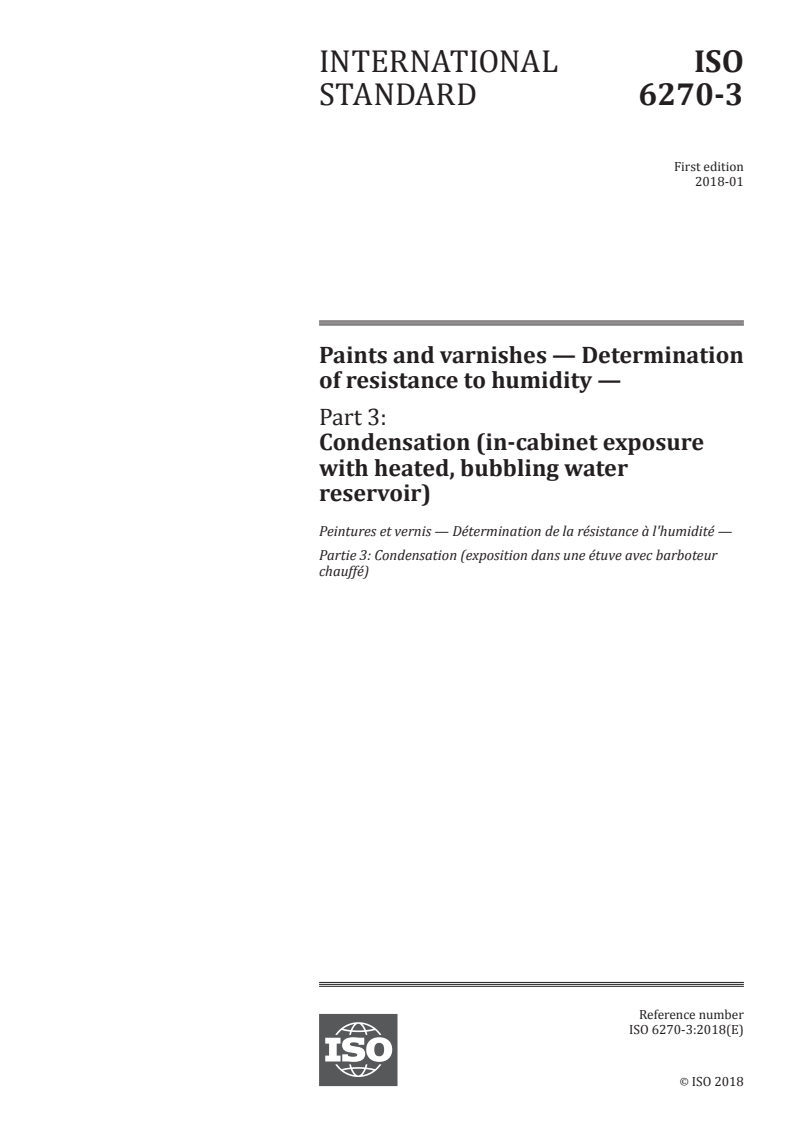
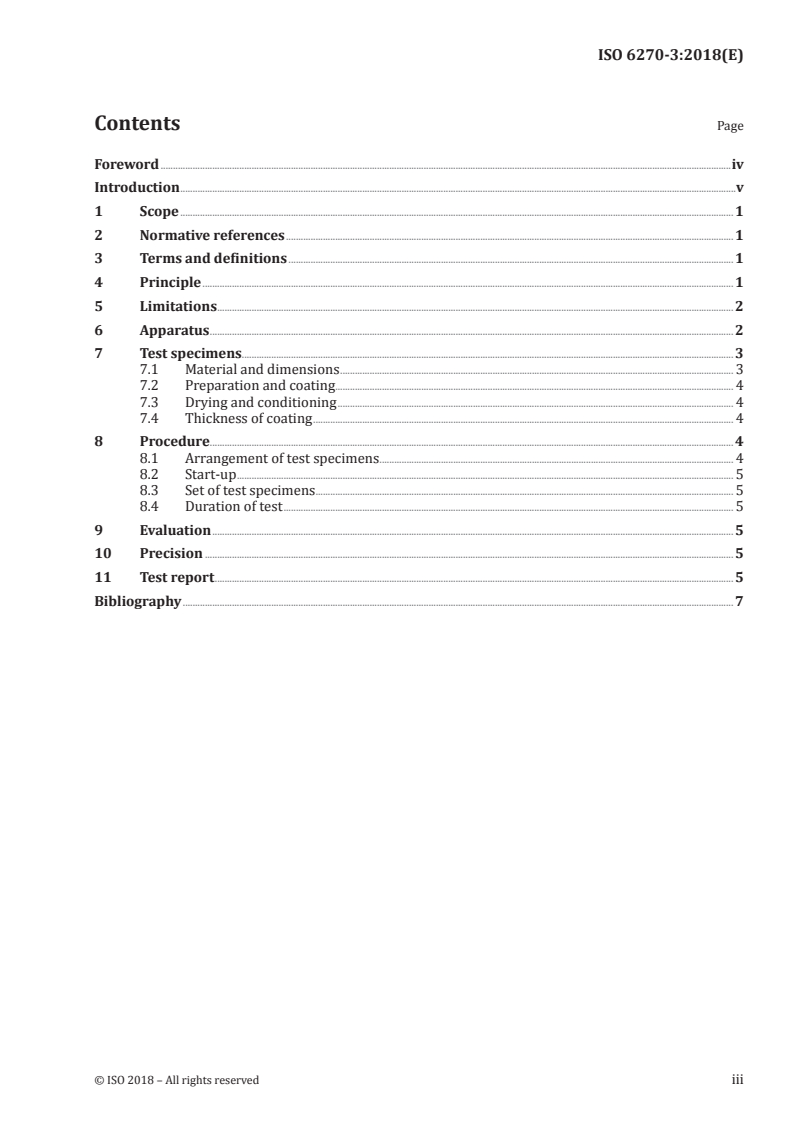
ISO 6270-3:2018 - Paints and varnishes — Determination of resistance to humidity — Part 3: Condensation (in-cabinet exposure with heated, bubbling water reservoir)/8/2018
Overview
ISO 6270-3:2018 - Paints and varnishes - Determination of resistance to humidity - Part 3: Condensation (in-cabinet exposure with heated, bubbling water reservoir) defines standardized conditions and procedures for subjecting coated test specimens to a constant condensation water atmosphere. The document establishes reproducible test atmospheres (supersaturated vapor produced by bubbling compressed air through heated water) and apparatus requirements to produce continuous condensation on coated surfaces. Note: specimen shape/preparation, test duration and final assessment methods are not prescribed by this part.
Key topics and technical requirements
- Principle: Compressed air is bubbled through heated water to introduce saturated vapour into a chamber, creating continuous condensation on specimens; rotation promotes uniform deposition.
- Apparatus components: chamber, heated water reservoir (deionized/distilled water), air supplier and filter, specimen rack (fixed or rotating), temperature control, condensate drip pan and corrosion‑resistant construction.
- Control parameters:
- Typical test temperature: 49 ± 2 °C (alternative 80 ± 2 °C by agreement).
- Relative humidity: >95% (supersaturated conditions).
- Water reservoir level: 205 ± 5 mm.
- Rotating rack speed (if used): 0.33 ± 0.02 r/min.
- Air mass flow: typically about 3 × chamber volume per hour; compressed air must be oil‑free.
- Specimens: default substrate burnished steel per ISO 1514; typical dimensions 75 × 150 mm; coating thickness measured per ISO 2808; condition specimens per ISO 3270.
- Test conduct: mount specimens (use substitutes for empty slots), avoid drips from chamber walls, do not interrupt the prescribed test period.
- Evaluation & reporting: evaluate deterioration using appropriate methods such as ISO 4628; required test report items include product ID, apparatus type, temperature/humidity, coating thickness, drying/ageing conditions, deviations and results.
Practical applications and users
ISO 6270-3:2018 is used for:
- Objective humidity/condensation stress testing of protective coatings and varnishes.
- Comparative laboratory testing for quality control, R&D and product specifications.
- Assessing coating performance relevant to corrosion protection in humid environments.
Typical users:
- Coating manufacturers, R&D laboratories and QC teams
- Automotive, marine, construction and industrial specifiers evaluating humidity resistance
- Test laboratories performing standardized environmental exposure tests
Related standards
- ISO 1514 - Standard panels for testing
- ISO 2808 - Determination of film thickness
- ISO 3270 - Temperatures and humidities for conditioning and testing
- ISO 4618 - Terms and definitions for paints and varnishes
Keywords: ISO 6270-3:2018, paints and varnishes, condensation testing, humidity resistance test, in-cabinet exposure, heated bubbling water reservoir, rotating specimen rack, corrosion protection testing.
Buy Documents
ISO 6270-3:2018 - Paints and varnishes -- Determination of resistance to humidity
ISO 6270-3:2018 - Paints and varnishes — Determination of resistance to humidity — Part 3: Condensation (in-cabinet exposure with heated, bubbling water reservoir)/8/2018
Frequently Asked Questions
ISO 6270-3:2018 is a standard published by the International Organization for Standardization (ISO). Its full title is "Paints and varnishes — Determination of resistance to humidity — Part 3: Condensation (in-cabinet exposure with heated, bubbling water reservoir)". This standard covers: ISO 6270-3:2018 specifies the general conditions and procedures to be observed when testing coated test specimens in constant condensation water atmospheres in order to ensure that the results of tests carried out in different laboratories are reproducible. NOTE The shape and preparation of the test specimens, the duration of the test and the assessment of the test results are not covered in this document.
ISO 6270-3:2018 specifies the general conditions and procedures to be observed when testing coated test specimens in constant condensation water atmospheres in order to ensure that the results of tests carried out in different laboratories are reproducible. NOTE The shape and preparation of the test specimens, the duration of the test and the assessment of the test results are not covered in this document.
ISO 6270-3:2018 is classified under the following ICS (International Classification for Standards) categories: 87.040 - Paints and varnishes. The ICS classification helps identify the subject area and facilitates finding related standards.
ISO 6270-3:2018 is available in PDF format for immediate download after purchase. The document can be added to your cart and obtained through the secure checkout process. Digital delivery ensures instant access to the complete standard document.
Standards Content (Sample)
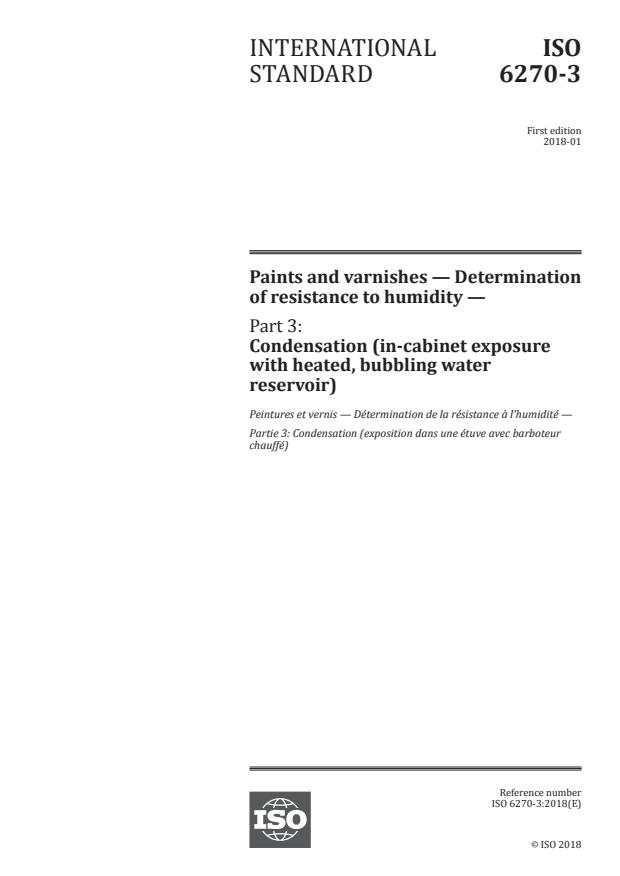
INTERNATIONAL ISO
STANDARD 6270-3
First edition
2018-01
Paints and varnishes — Determination
of resistance to humidity —
Part 3:
Condensation (in-cabinet exposure
with heated, bubbling water
reservoir)
Peintures et vernis — Détermination de la résistance à l'humidité —
Partie 3: Condensation (exposition dans une étuve avec barboteur
chauffé)
Reference number
©
ISO 2018
© ISO 2018
All rights reserved. Unless otherwise specified, or required in the context of its implementation, no part of this publication may
be reproduced or utilized otherwise in any form or by any means, electronic or mechanical, including photocopying, or posting
on the internet or an intranet, without prior written permission. Permission can be requested from either ISO at the address
below or ISO’s member body in the country of the requester.
ISO copyright office
CP 401 • Ch. de Blandonnet 8
CH-1214 Vernier, Geneva, Switzerland
Tel. +41 22 749 01 11
Fax +41 22 749 09 47
copyright@iso.org
www.iso.org
Published in Switzerland
ii © ISO 2018 – All rights reserved
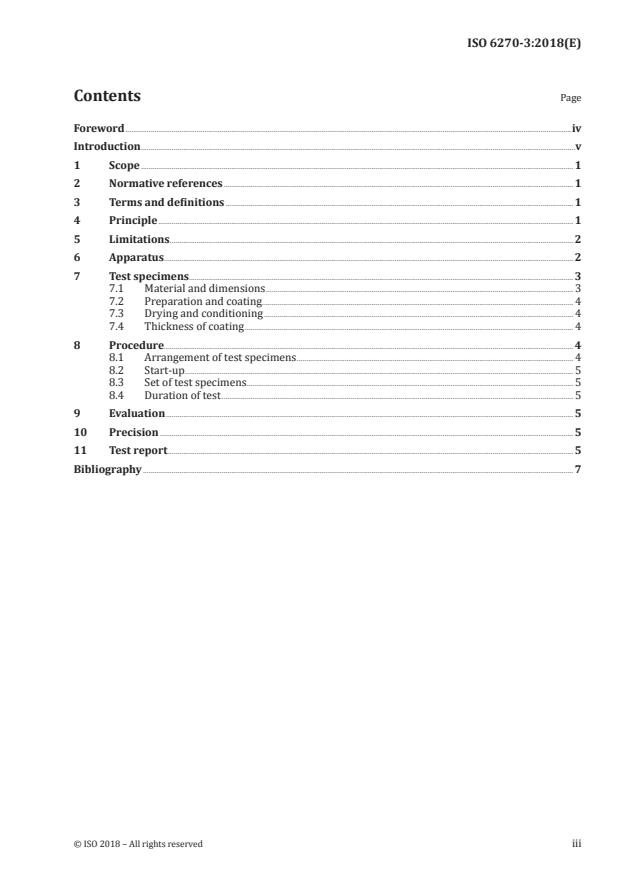
Contents Page
Foreword .iv
Introduction .v
1 Scope . 1
2 Normative references . 1
3 Terms and definitions . 1
4 Principle . 1
5 Limitations . 2
6 Apparatus . 2
7 Test specimens. 3
7.1 Material and dimensions . 3
7.2 Preparation and coating . . 4
7.3 Drying and conditioning . 4
7.4 Thickness of coating . 4
8 Procedure. 4
8.1 Arrangement of test specimens . 4
8.2 Start-up . 5
8.3 Set of test specimens . 5
8.4 Duration of test . 5
9 Evaluation . 5
10 Precision . 5
11 Test report . 5
Bibliography . 7
Foreword
ISO (the International Organization for Standardization) is a worldwide federation of national standards
bodies (ISO member bodies). The work of preparing International Standards is normally carried out
through ISO technical committees. Each member body interested in a subject for which a technical
committee has been established has the right to be represented on that committee. International
organizations, governmental and non-governmental, in liaison with ISO, also take part in the work.
ISO collaborates closely with the International Electrotechnical Commission (IEC) on all matters of
electrotechnical standardization.
The procedures used to develop this document and those intended for its further maintenance are
described in the ISO/IEC Directives, Part 1. In particular the different approval criteria needed for the
different types of ISO documents should be noted. This document was drafted in accordance with the
editorial rules of the ISO/IEC Directives, Part 2 (see www.iso.org/directives).
Attention is drawn to the possibility that some of the elements of this document may be the subject of
patent rights. ISO shall not be held responsible for identifying any or all such patent rights. Details of
any patent rights identified during the development of the document will be in the Introduction and/or
on the ISO list of patent declarations received (see www.iso.org/patents).
Any trade name used in this document is information given for the convenience of users and does not
constitute an endorsement.
For an explanation on the voluntary nature of standards, the meaning of ISO specific terms and
expressions related to conformity assessment, as well as information about ISO's adherence to the
World Trade Organization (WTO) principles in the Technical Barriers to Trade (TBT) see the following
URL: www.iso.org/iso/foreword.html.
This document was prepared by Technical Committee ISO/TC 35, Paints and varnishes, Subcommittee
SC 9, General test methods for paints and varnishes.
A list of all parts in the ISO 6270 series can be found on the ISO website.
iv © ISO 2018 – All rights reserved
Introduction
This document is intended to give consistent conditions and procedures for the conditioning of pre-
prepared test specimens which are to be evaluated for defects which can develop when they are
subjected to humid ambient atmospheres such as constant condensation-water atmospheres or
alternating condensation-water atmospheres.
The tests are designed to clarify the behaviour of the test specimens in humid ambient atmospheres,
and to pinpoint any defects in the protection of the test specimens against corrosion. The testing of
coatings in these atmospheres does not necessarily give lifetime prediction data.
After conditioning, the test specimens are evaluated either in accordance with documents, such as the
appropriate part(s) of ISO 4628, or by procedures agreed between the interested parties.
INTERNATIONAL STANDARD ISO 6270-3:2018(E)
Paints and varnishes — Determination of resistance to
humidity —
Part 3:
Condensation (in-cabinet exposure with heated, bubbling
water reservoir)
1 Scope
This document specifies the general conditions and procedures to be observed when testing coated
test specimens in constant condensation water atmospheres in order to ensure that the results of tests
carried out in different laboratories are reproducible.
NOTE The shape and preparation of the test specimens, the duration of the test and the assessment of the
test results are not covered in this document.
2 Normative references
The following
...
INTERNATIONAL ISO
STANDARD 6270-3
First edition
2018-01
Paints and varnishes — Determination
of resistance to humidity —
Part 3:
Condensation (in-cabinet exposure
with heated, bubbling water
reservoir)
Peintures et vernis — Détermination de la résistance à l'humidité —
Partie 3: Condensation (exposition dans une étuve avec barboteur
chauffé)
Reference number
©
ISO 2018
© ISO 2018
All rights reserved. Unless otherwise specified, or required in the context of its implementation, no part of this publication may
be reproduced or utilized otherwise in any form or by any means, electronic or mechanical, including photocopying, or posting
on the internet or an intranet, without prior written permission. Permission can be requested from either ISO at the address
below or ISO’s member body in the country of the requester.
ISO copyright office
CP 401 • Ch. de Blandonnet 8
CH-1214 Vernier, Geneva, Switzerland
Tel. +41 22 749 01 11
Fax +41 22 749 09 47
copyright@iso.org
www.iso.org
Published in Switzerland
ii © ISO 2018 – All rights reserved
Contents Page
Foreword .iv
Introduction .v
1 Scope . 1
2 Normative references . 1
3 Terms and definitions . 1
4 Principle . 1
5 Limitations . 2
6 Apparatus . 2
7 Test specimens. 3
7.1 Material and dimensions . 3
7.2 Preparation and coating . . 4
7.3 Drying and conditioning . 4
7.4 Thickness of coating . 4
8 Procedure. 4
8.1 Arrangement of test specimens . 4
8.2 Start-up . 5
8.3 Set of test specimens . 5
8.4 Duration of test . 5
9 Evaluation . 5
10 Precision . 5
11 Test report . 5
Bibliography . 7
Foreword
ISO (the International Organization for Standardization) is a worldwide federation of national standards
bodies (ISO member bodies). The work of preparing International Standards is normally carried out
through ISO technical committees. Each member body interested in a subject for which a technical
committee has been established has the right to be represented on that committee. International
organizations, governmental and non-governmental, in liaison with ISO, also take part in the work.
ISO collaborates closely with the International Electrotechnical Commission (IEC) on all matters of
electrotechnical standardization.
The procedures used to develop this document and those intended for its further maintenance are
described in the ISO/IEC Directives, Part 1. In particular the different approval criteria needed for the
different types of ISO documents should be noted. This document was drafted in accordance with the
editorial rules of the ISO/IEC Directives, Part 2 (see www.iso.org/directives).
Attention is drawn to the possibility that some of the elements of this document may be the subject of
patent rights. ISO shall not be held responsible for identifying any or all such patent rights. Details of
any patent rights identified during the development of the document will be in the Introduction and/or
on the ISO list of patent declarations received (see www.iso.org/patents).
Any trade name used in this document is information given for the convenience of users and does not
constitute an endorsement.
For an explanation on the voluntary nature of standards, the meaning of ISO specific terms and
expressions related to conformity assessment, as well as information about ISO's adherence to the
World Trade Organization (WTO) principles in the Technical Barriers to Trade (TBT) see the following
URL: www.iso.org/iso/foreword.html.
This document was prepared by Technical Committee ISO/TC 35, Paints and varnishes, Subcommittee
SC 9, General test methods for paints and varnishes.
A list of all parts in the ISO 6270 series can be found on the ISO website.
iv © ISO 2018 – All rights reserved
Introduction
This document is intended to give consistent conditions and procedures for the conditioning of pre-
prepared test specimens which are to be evaluated for defects which can develop when they are
subjected to humid ambient atmospheres such as constant condensation-water atmospheres or
alternating condensation-water atmospheres.
The tests are designed to clarify the behaviour of the test specimens in humid ambient atmospheres,
and to pinpoint any defects in the protection of the test specimens against corrosion. The testing of
coatings in these atmospheres does not necessarily give lifetime prediction data.
After conditioning, the test specimens are evaluated either in accordance with documents, such as the
appropriate part(s) of ISO 4628, or by procedures agreed between the interested parties.
INTERNATIONAL STANDARD ISO 6270-3:2018(E)
Paints and varnishes — Determination of resistance to
humidity —
Part 3:
Condensation (in-cabinet exposure with heated, bubbling
water reservoir)
1 Scope
This document specifies the general conditions and procedures to be observed when testing coated
test specimens in constant condensation water atmospheres in order to ensure that the results of tests
carried out in different laboratories are reproducible.
NOTE The shape and preparation of the test specimens, the duration of the test and the assessment of the
test results are not covered in this document.
2 Normative references
The following
...