


ISO 44002:2019
(Main)Collaborative business relationship management systems — Guidelines on the implementation of ISO 44001
Collaborative business relationship management systems — Guidelines on the implementation of ISO 44001
This document gives guidelines for organizations on implementing ISO 44001 (see Figure 3) in order to achieve successful collaborative business relationships, as well as helping organizations use and implement the framework specification effectively. This document explains what is intended by each requirement of ISO 44001, why each is important, and recommends approaches to take for their practical implementation. How to meet the requirements is individually evaluated and applied in the context of each organization. This document is applicable to any organization.
Systèmes de management collaboratif d'une relation d'affaire — Lignes directrices pour l'implementation de l'ISO 44001
General Information
- Status
- Published
- Publication Date
- 30-Sep-2019
- Technical Committee
- ISO/TC 286 - Collaborative business relationship management
- Drafting Committee
- ISO/TC 286 - Collaborative business relationship management
- Current Stage
- 9092 - International Standard to be revised
- Start Date
- 26-Nov-2025
- Completion Date
- 14-Feb-2026
Overview
ISO 44002:2019 - Collaborative business relationship management systems - Guidelines on the implementation of ISO 44001 - provides practical guidance for organizations that want to implement the ISO 44001 collaborative relationship management framework. Rather than replacing ISO 44001, ISO 44002 explains what each requirement means, why it matters and how to implement it in the context of an individual organization. The guidance is applicable to any organization seeking more effective, structured collaboration with partners, suppliers, customers and other stakeholders.
Key topics and requirements
ISO 44002 closely follows the structure of ISO management system standards and provides “what / why / how” advice across the core clauses:
- Context of the organization: understanding internal/external factors, stakeholder needs and defining the scope of collaborative relationship management.
- Leadership and governance: roles, senior executive responsibility, collaborative policy and organizational governance structures.
- Planning: identifying risks and opportunities, setting collaborative objectives, and prioritizing relationships for value creation.
- Support: resources, competence and behaviour, awareness, communication and documented information (including corporate RMP and records).
- Operation: operational planning and control, staged implementation (Operational Awareness, Knowledge, Internal Assessment, Partner Selection) and deployment of relationship management practices.
- Risk, knowledge and value analysis: guidance for initial risk assessment, knowledge management, business-case development and incorporation into the relationship management plan.
- Partner selection and implementation: criteria, nomination and validation of collaborative partners and ongoing assessment of capabilities.
Keywords: ISO 44002, ISO 44001, collaborative business relationship management, implementation guidance, governance, partner selection, relationship management.
Practical applications
- Establishing a consistent, auditable approach to collaboration across projects, supply chains and alliances.
- Designing a governance and accountability model for strategic partnerships.
- Creating documented processes (RMPs), competency frameworks and communication plans to improve partner performance and risk sharing.
- Prioritizing collaborative opportunities that create measurable value and mitigating collaboration-specific risks.
Who should use this standard
- Organizations implementing or planning to implement ISO 44001
- Business development, alliance and partnership managers
- Procurement and supply chain leaders working with strategic suppliers
- Senior executives responsible for collaborative strategy and governance
- Consultants and auditors supporting collaboration programs
Related standards
- ISO 44001 (framework specification for collaborative business relationships)
- Guidance is compatible with other ISO management system standards and can be integrated into existing management-system approaches.
ISO 44002 is practical, role-focused guidance to help organizations turn the ISO 44001 framework into repeatable, value-driven collaboration practices.
Buy Documents


ISO 44002:2019 - Collaborative business relationship management systems -- Guidelines on the implementation of ISO 44001

ISO 44002:2019 - Collaborative business relationship management systems — Guidelines on the implementation of ISO 44001 Released:10/1/2019
Get Certified
Connect with accredited certification bodies for this standard

BSI Group
BSI (British Standards Institution) is the business standards company that helps organizations make excellence a habit.

Bureau Veritas
Bureau Veritas is a world leader in laboratory testing, inspection and certification services.

DNV
DNV is an independent assurance and risk management provider.
Sponsored listings
Frequently Asked Questions
ISO 44002:2019 is a standard published by the International Organization for Standardization (ISO). Its full title is "Collaborative business relationship management systems — Guidelines on the implementation of ISO 44001". This standard covers: This document gives guidelines for organizations on implementing ISO 44001 (see Figure 3) in order to achieve successful collaborative business relationships, as well as helping organizations use and implement the framework specification effectively. This document explains what is intended by each requirement of ISO 44001, why each is important, and recommends approaches to take for their practical implementation. How to meet the requirements is individually evaluated and applied in the context of each organization. This document is applicable to any organization.
This document gives guidelines for organizations on implementing ISO 44001 (see Figure 3) in order to achieve successful collaborative business relationships, as well as helping organizations use and implement the framework specification effectively. This document explains what is intended by each requirement of ISO 44001, why each is important, and recommends approaches to take for their practical implementation. How to meet the requirements is individually evaluated and applied in the context of each organization. This document is applicable to any organization.
ISO 44002:2019 is classified under the following ICS (International Classification for Standards) categories: 03.100.01 - Company organization and management in general; 03.100.70 - Management systems. The ICS classification helps identify the subject area and facilitates finding related standards.
ISO 44002:2019 is available in PDF format for immediate download after purchase. The document can be added to your cart and obtained through the secure checkout process. Digital delivery ensures instant access to the complete standard document.
Standards Content (Sample)
INTERNATIONAL ISO
STANDARD 44002
First edition
2019-10
Collaborative business relationship
management systems — Guidelines on
the implementation of ISO 44001
Systèmes de management collaboratif d'une relation d'affaire —
Lignes directrices pour l'implementation de l'ISO 44001
Reference number
©
ISO 2019
© ISO 2019
All rights reserved. Unless otherwise specified, or required in the context of its implementation, no part of this publication may
be reproduced or utilized otherwise in any form or by any means, electronic or mechanical, including photocopying, or posting
on the internet or an intranet, without prior written permission. Permission can be requested from either ISO at the address
below or ISO’s member body in the country of the requester.
ISO copyright office
CP 401 • Ch. de Blandonnet 8
CH-1214 Vernier, Geneva
Phone: +41 22 749 01 11
Fax: +41 22 749 09 47
Email: copyright@iso.org
Website: www.iso.org
Published in Switzerland
ii © ISO 2019 – All rights reserved
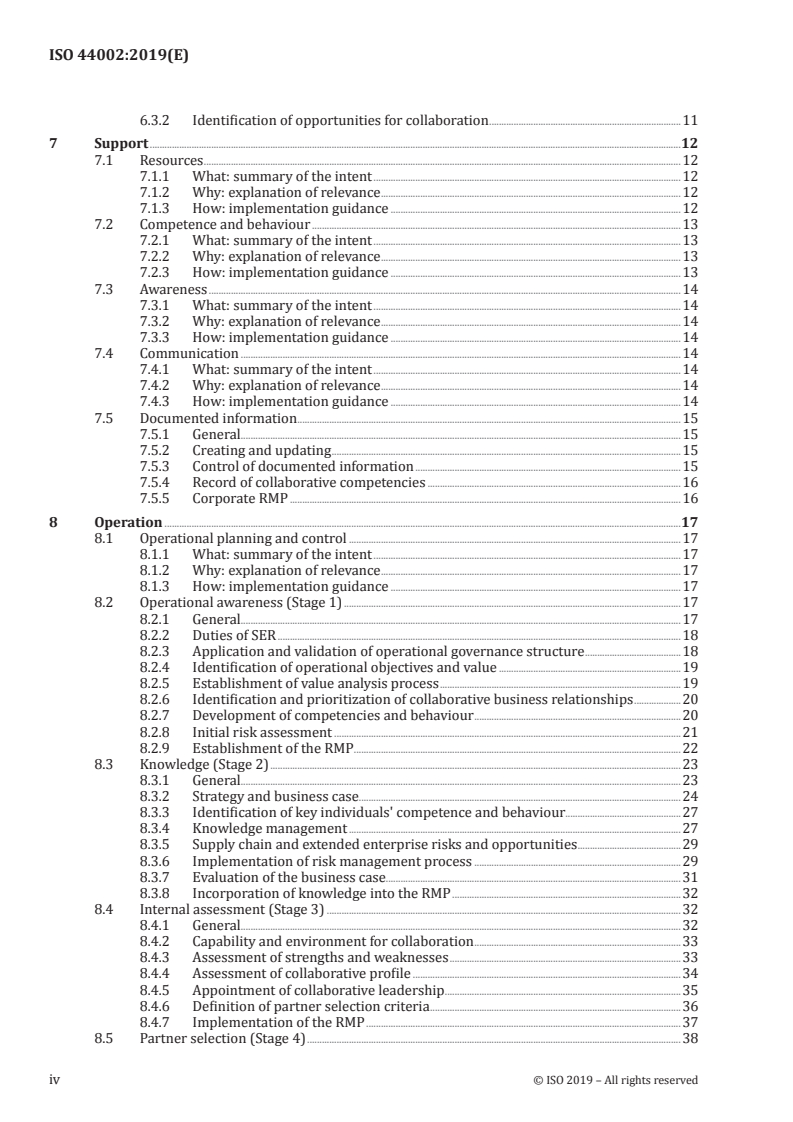
Contents Page
Foreword .vii
Introduction .viii
1 Scope . 1
2 Normative references . 1
3 Terms, definitions and abbreviated terms . 2
3.1 Terms and definitions . 2
3.2 Abbreviated terms . 2
4 Context of the organization . 2
4.1 Understanding the organization and its context . 2
4.1.1 What: summary of the intent . 2
4.1.2 Why: explanation of relevance . 2
4.1.3 How: implementation guidance . 2
4.2 Understanding the needs and expectations of stakeholders . 3
4.2.1 What: summary of the intent . 3
4.2.2 Why: explanation of relevance . 3
4.2.3 How: implementation guidance . 3
4.3 Determining the scope of the collaborative business relationship management system . 3
4.3.1 What: summary of the intent . 3
4.3.2 Why: explanation of relevance . 3
4.3.3 How: implementation guidance . 3
4.4 Collaborative business relationship management system . 4
4.4.1 What: summary of the intent . 4
4.4.2 Why: explanation of relevance . 4
4.4.3 How: implementation guidance . 4
4.5 Creation of value . 4
4.5.1 What: summary of the intent . 4
4.5.2 Why: explanation of relevance . 4
4.5.3 How: implementation guidance . 4
5 Leadership . 5
5.1 Leadership and commitment . 5
5.1.1 What: summary of the intent . 5
5.1.2 Why: explanation of relevance . 5
5.1.3 How: implementation guidance . 5
5.2 Policy . 6
5.2.1 What: summary of the intent . 6
5.2.2 Why: explanation of relevance . 6
5.2.3 How: implementation guidance . 6
5.3 Organization roles, responsibilities and authorities . 7
5.3.1 Top management . 7
5.3.2 Establishment of an organizational governance structure . 7
5.3.3 Senior executive responsible . 8
6 Planning . 9
6.1 Actions to address risks and opportunities . 9
6.1.1 What: summary of the intent . 9
6.1.2 Why: explanation of relevance . 9
6.1.3 How: implementation guidance . 9
6.2 Collaborative business relationship objectives and planning to achieve them . 9
6.2.1 What: summary of the intent . 9
6.2.2 Why: explanation of relevance . 9
6.2.3 How: implementation guidance .10
6.3 Identification and prioritization of collaborative business relationships .10
6.3.1 General.10
6.3.2 Identification of opportunities for collaboration .11
7 Support .12
7.1 Resources .12
7.1.1 What: summary of the intent .12
7.1.2 Why: explanation of relevance .12
7.1.3 How: implementation guidance .12
7.2 Competence and behaviour .13
7.2.1 What: summary of the intent .13
7.2.2 Why: explanation of relevance .13
7.2.3 How: implementation guidance .13
7.3 Awareness .14
7.3.1 What: summary of the intent .14
7.3.2 Why: explanation of relevance .14
7.3.3 How: implementation guidance .14
7.4 Communication .14
7.4.1 What: summary of the intent .14
7.4.2 Why: explanation of relevance .14
7.4.3 How: implementation guidance .14
7.5 Documented information .15
7.5.1 General.15
7.5.2 Creating and updating .15
7.5.3 Control of documented information .15
7.5.4 Record of collaborative competencies .16
7.5.5 Corporate RMP .16
8 Operation .17
8.1 Operational planning and control .17
8.1.1 What: summary of the intent .17
8.1.2 Why: explanation of relevance .17
8.1.3 How: implementation guidance .17
8.2 Operational awareness (Stage 1) .17
8.2.1 General.17
8.2.2 Duties of SER .18
8.2.3 Application and validation of operational governance structure .18
8.2.4 Identification of operational objectives and value .19
8.2.5 Establishment of value analysis process .19
8.2.6 Identification and prioritization of collaborative business relationships .20
8.2.7 Development of competencies and behaviour .20
8.2.8 Initial risk assessment .21
8.2.9 Establishment of the RMP .22
8.3 Knowledge (Stage 2) .23
8.3.1 General.23
8.3.2 Strategy and business case.24
8.3.3 Identification of key individuals' competence and behaviour.27
8.3.4 Knowledge management .27
8.3.5 Supply chain and extended enterprise risks and opportunities .29
8.3.6 Implementation of risk management process .29
8.3.7 Evaluation of the business case . .31
8.3.8 Incorporation of knowledge into the RMP .32
8.4 Internal assessment (Stage 3) .32
8.4.1 General.32
8.4.2 Capability and environment for collaboration .33
8.4.3 Assessment of strengths and weaknesses .33
8.4.4 Assessment of collaborative profile .34
8.4.5 Appointment of collaborative leadership .35
8.4.6 Definition of partner selection criteria .36
8.4.7 Implementation of the RMP .37
8.5 Partner selection (Stage 4) .38
iv © ISO 2019 – All rights reserved
8.5.1 General.38
8.5.2 Nomination of potential collaborative partners .38
8.5.3 Partner evaluation and selection .39
8.5.4 Development of engagement and negotiation strategy for collaboration .40
8.5.5 Initial engagement with potential partners .41
8.5.6 Assessment of joint objectives .41
8.5.7 Assessment of joint exit strategy .42
8.5.8 Selection of preferred partners .42
8.5.9 Initiation of joint RMP .43
8.6 Working together (Stage 5) .43
8.6.1 General.43
8.6.2 Establishment of the joint governance structure .44
8.6.3 Joint knowledge management process .49
8.6.4 Establish joint risk management process .50
8.6.5 Operational process and systems review .51
8.6.6 Measurement of delivery and performance .52
8.6.7 Improvement of organizational collaborative competence .52
8.6.8 Establishment of a joint issue resolution process .54
8.6.9 Establishment of a joint exit strategy .55
8.6.10 Agreements or contracting arrangements .57
8.6.11 Establishment and implementation of the joint RMP .60
8.7 Value creation (Stage 6) .60
8.7.1 General.60
8.7.2 Establishment of the value creation process .61
8.7.3 Identification of improvement and setting of targets .62
8.7.4 Use of learning from experience .63
8.7.5 Updating of the joint RMP .64
8.8 Staying together (Stage 7) .64
8.8.1 General.64
8.8.2 Oversight by the SERs .65
8.8.3 Management of the joint relationship .65
8.8.4 Implementation of monitoring of behaviour and trust indicators .66
8.8.5 Continual value creation .68
8.8.6 Delivery of joint objectives .68
8.8.7 Analysis of results .69
8.8.8 Issue resolution.69
8.8.9 Maintenance of the joint exit strategy .70
8.8.10 Maintenance of the joint RMP .71
8.9 Exit strategy activation (Stage 8) .72
8.9.1 General.72
8.9.2 Initiation of disengagement .73
8.9.3 Business continuity .73
8.9.4 Evaluation of the relationship .74
8.9.5 Future opportunities .75
8.9.6 Review and updating of the RMPs .75
9 Performance evaluation .76
9.1 Monitoring, measurement, analysis and evaluation .76
9.1.1 General.76
9.1.2 Exit evaluation .76
9.2 Internal audit .77
9.2.1 General.77
9.2.2 Conduct internal audits/planning and maintaining audit programmes .77
9.3 Management review .78
9.3.1 What: summary of the intent .78
9.3.2 Why: explanation of relevance .78
9.3.3 How: implementation guidance .78
10 Improvement .78
10.1 Nonconformity and corrective action .78
10.1.1 What: summary of the intent .78
10.1.2 Why: explanation of relevance .79
10.1.3 How: implementation guidance .79
10.2 Continual improvement .79
10.2.1 What: summary of the intent .79
10.2.2 Why: explanation of relevance .79
10.2.3 How: implementation guidance .79
Bibliography .80
vi © ISO 2019 – All rights reserved
Foreword
ISO (the International Organization for Standardization) is a worldwide federation of national standards
bodies (ISO member bodies). The work of preparing International Standards is normally carried out
through ISO technical committees. Each member body interested in a subject for which a technical
committee has been established has the right to be represented on that committee. International
organizations, governmental and non-governmental, in liaison with ISO, also take part in the work.
ISO collaborates closely with the International Electrotechnical Commission (IEC) on all matters of
electrotechnical standardization.
The procedures used to develop this document and those intended for its further maintenance are
described in the ISO/IEC Directives, Part 1. In particular, the different approval criteria needed for the
different types of ISO documents should be noted. This document was drafted in accordance with the
editorial rules of the ISO/IEC Directives, Part 2 (see www .iso .org/directives).
Attention is drawn to the possibility that some of the elements of this document may be the subject of
patent rights. ISO shall not be held responsible for identifying any or all such patent rights. Details of
any patent rights identified during the development of the document will be in the Introduction and/or
on the ISO list of patent declarations received (see www .iso .org/patents).
Any trade name used in this document is information given for the convenience of users and does not
constitute an endorsement.
For an explanation of the voluntary nature of standards, the meaning of ISO specific terms and
expressions related to conformity assessment, as well as information about ISO's adherence to the
World Trade Organization (WTO) principles in the Technical Barriers to Trade (TBT) see www .iso
.org/iso/foreword .html.
This document was prepared by Technical Committee ISO/TC 286, Collaborative business relationship
management.
Any feedback or questions on this document should be directed to the user’s national standards body. A
complete listing of these bodies can be found at www .iso .org/members .html.
Introduction
0.1 General
This document provides guidance that supports the effective implementation of ISO 44001 in order
to establish and improve collaborative business relationship management systems (CBRMSs) in
organizations of all sizes. This document contains no additional requirements. It is aimed at readers
who seek to gain in-depth knowledge and understanding about the requirements in ISO 44001, e.g. for
the purpose of aiding an organization’s implementation process.
The case for the significant business value and benefits to be derived from collaborative working was
made in ISO 44001.
This document has been developed using pan-industry best practice, including early adopters of
ISO 44001. It is intended to help organizations understand why each element of ISO 44001 is important,
and to recommend approaches to be taken for practical implementation. How to meet the requirements
has to be individually evaluated and applied in the context of each organization.
In ISO 44001, the multi-dimensional nature of collaborative relationships was specified. Many of
these relationships have an outward focus, emphasizing the importance of collaboration in managing
different goals, objectives, expectations, cultures and behaviours between organizations.
Collaboration can also be used to focus on internal interfaces to optimize existing activities, consolidate
internal changes or to speed up the process of integration during acquisitions and mergers. In these
circumstances, the guidance in this document is also relevant. In a collaborative relationship, effective
operation relies on specific mutually agreed joint objectives, structures, resources, processes, roles
and responsibilities and can require specific variations to established processes. The structure of
this document has been developed to align with ISO 44001, using the high level structure (HLS)
for management systems standards (MSS). In developing a standard for collaborative business
relationships, the detailed specific requirements for establishing, developing and managing third-
party relationships utilizing the eight-stage life cycle model (see Figure 1) have been addressed within
Clause 8 (Operations). In a collaborative relationship, effective operation relies on specific mutually
agreed joint interfaces, processes, roles and responsibilities and can require specific variations to
established processes.
Figure 1 — Relationship between corporate and operational systems
viii © ISO 2019 – All rights reserved
0.2 How to use this guidance
This document has been structured so that the clause numbering mirrors those used for the
corresponding clauses in ISO 44001.
The stages described in Clause 8 are introduced by commentary that explains more about the purpose
and aims of each stage. A flowchart is included to illustrate the path through the steps within each stage.
Each box within the flowchart represents both the clauses contained in ISO 44001 and the supporting
clauses in this document.
Each of the subclauses is structured in the same simple format as follows:
a) first, a summary of the intent of the corresponding clause in ISO 44001;
b) then, an explanation of the relevance and importance of supporting the development of effective
collaborative working;
c) finally, guidance on how to implement the matching clause in ISO 44001, e.g. suggested approaches
and areas for consideration.
Where appropriate, the clauses are supported by tables, figures and models and methods that can be
used in implementation.
For clarity and increased understanding, it is recommended that ISO 44001 and this document are read
together. Further useful information is provided in the annexes to ISO 44001.
It could appear that certain requirements in ISO 44001 are duplicated. However, in these cases they are
a reflection of the evolution of processes throughout the relationship life cycle. The HLS describes those
requirements that occur at an organizational level, while the subclauses in Clause 8 describe similar
requirements that apply to a specific collaboration.
The guidance provided by this document enables the integration of the ISO 44001 framework into an
organization’s established operations, activities, processes and procedures to optimize the benefits
of collaboration between organizations. In this context, the adoption of this collaborative approach
enhances and does not detract from the obligations and responsibilities agreed between the parties
and its application is commensurate to the size and complexity of the organizations involved.
The following additional considerations are included to support requirements and third-party
engagements.
0.3 Common principles of relationship management
0.3.1 The life cycle framework
The life cycle framework addresses a number of themes that cascade from the high-level management
system and vary within the context and maturity of a specific relationship life cycle. These evolving
themes impact the behaviours and organizational culture of collaborating organizations to ensure
they are effective, optimized and deliver enhanced benefit to the stakeholders through collaborative
approaches (see Figure 2).
Figure 2 — Overview of the principal components of successful collaborative business
relationships
In the context of collaborative relationships, the life cycle model outlines the key steps to an effective
management process from concept adoption to disengagement. The eight stages are:
a) operational awareness: establishing the operation's propensity for collaboration;
b) knowledge: evaluating specific collaborative benefits and business case;
c) internal assessment: assessing the operation's capability to collaborate;
d) partner selection: establishing an appropriate selection process;
e) working together: establishing a joint governance model for collaboration;
f) value creation: establishing a joint process for continual improvement;
g) staying together: managing, monitoring and measuring the relationship over time;
h) exit strategy activation: establishing a joint approach to disengagement and/or future.
0.3.2 The sequence of stages
While Clause 8 follows an eight-stage process, it is recognized that the entry point for any specific
collaborative relationship can vary.
x © ISO 2019 – All rights reserved
INTERNATIONAL STANDARD ISO 44002:2019(E)
Collaborative business relationship management
systems — Guidelines on the implementation of ISO 44001
1 Scope
This document gives guidelines for organizations on implementing ISO 44001 (see Figure 3) in order
to achieve successful collaborative business relationships, as well as helping organizations use and
implement the framework specification effectively.
This document explains what is intended by each requirement of ISO 44001, why each is important, and
recommends approaches to take for their practical implementation. How to meet the requirements is
individually evaluated and applied in the context of each organization.
This document is applicable to any organization.
Figure 3 — High-level implementation flow for ISO 44001
2 Normative references
The following documents are referred to in the text in such a way that some or all of their content
constitutes requirements of this document. For dated references, only the edition cited applies. For
undated references, the latest edition of the referenced document (including any amendments) applies.
ISO 44001:2017, Collaborative business relationship management systems — Requirements and framework
3 Terms, definitions and abbreviated terms
3.1 Terms and definitions
For the purposes of this document, the terms and definitions given in ISO 44001 apply.
ISO and IEC maintain terminological databases for use in standardization at the following addresses:
— ISO Online browsing platform: available at https: //www .iso .org/obp
— IEC Electropedia: available at http: //www .electropedia .org/
3.2 Abbreviated terms
CBRMS collaborative business relationship management system
IPR intellectual property right
KPI key performance indicator
MAP maturity assessment profile
OLA operating level agreement
RMP relationship management plan
SER senior executive responsible
SLA service level agreement
4 Context of the organization
4.1 Understanding the organization and its context
NOTE Further information on the context of the organization can be found in ISO/TS 9002:2016, Clause 4.
4.1.1 What: summary of the intent
The organization should clearly establish the linkage between the activities, intended outcomes of the
organization and the potential role for collaboration in supporting those outcomes.
4.1.2 Why: explanation of relevance
Collaboration might not be appropriate for all business relationships and the focus should be directed
to where it a collaborative relationship can add value. Organizations may find that working in a
collaborative relationship could introduce challenges to existing operating structures. It is therefore
essential that internal stakeholders see that collaborative working approaches overall are seen to be
beneficial.
4.1.3 How: implementation guidance
In many organizations the adoption of collaborative working initiatives requires a strategic decision by
top management to ensure that, when appropriate, it is effectively integrated and supported throughout
its functions and teams.
2 © ISO 2019 – All rights reserved
4.2 Understanding the needs and expectations of stakeholders
4.2.1 What: summary of the intent
The organization should identify its external stakeholders that can be affected by the adoption of
collaborative working to ensure their needs and expectations are clearly understood.
4.2.2 Why: explanation of relevance
The successful adoption of collaborative approaches should be anchored in the ability of initiatives
to deliver defined objectives and outcomes that are integrated with those of the organizations
and stakeholders involved. These might not always be fully aligned but should be, as a minimum,
complementary or neutral in terms of the key objectives. It is also important to ensure these objectives
are reviewed at regular intervals to assess changes.
In some cases, a collaborative opportunity can be initiated by stakeholders or there can be a need to
meet stakeholder requirements through specialized partners or suppliers. The stakeholder can be part
of the collaboration. In fact, an important aspect in optimizing performance through collaboration is
that partners can interact directly with stakeholders and develop better stakeholder relationships. It is
also possible that the stakeholder's acceptance of collaboration or of specific collaborative partners can
be a crucial factor in developing the right approach.
4.2.3 How: implementation guidance
The organization should identify all potential stakeholders, understand their needs and expectations and
develop a plan to address them. Stakeholder mapping is an established tool used in many organizations,
but this should extend beyond the traditional influencers and blockers to take into account all points of
contact that can directly or indirectly influence collaborative initiatives and outcomes.
4.3 Determining the scope of the collaborative business relationship management
system
4.3.1 What: summary of the intent
The organization should assess its strategic objectives and operational activities to identify where it is
appropriate or beneficial to imple
...
INTERNATIONAL ISO
STANDARD 44002
First edition
2019-10
Collaborative business relationship
management systems — Guidelines on
the implementation of ISO 44001
Systèmes de management collaboratif d'une relation d'affaire —
Lignes directrices pour l'implementation de l'ISO 44001
Reference number
©
ISO 2019
© ISO 2019
All rights reserved. Unless otherwise specified, or required in the context of its implementation, no part of this publication may
be reproduced or utilized otherwise in any form or by any means, electronic or mechanical, including photocopying, or posting
on the internet or an intranet, without prior written permission. Permission can be requested from either ISO at the address
below or ISO’s member body in the country of the requester.
ISO copyright office
CP 401 • Ch. de Blandonnet 8
CH-1214 Vernier, Geneva
Phone: +41 22 749 01 11
Fax: +41 22 749 09 47
Email: copyright@iso.org
Website: www.iso.org
Published in Switzerland
ii © ISO 2019 – All rights reserved
Contents Page
Foreword .vii
Introduction .viii
1 Scope . 1
2 Normative references . 1
3 Terms, definitions and abbreviated terms . 2
3.1 Terms and definitions . 2
3.2 Abbreviated terms . 2
4 Context of the organization . 2
4.1 Understanding the organization and its context . 2
4.1.1 What: summary of the intent . 2
4.1.2 Why: explanation of relevance . 2
4.1.3 How: implementation guidance . 2
4.2 Understanding the needs and expectations of stakeholders . 3
4.2.1 What: summary of the intent . 3
4.2.2 Why: explanation of relevance . 3
4.2.3 How: implementation guidance . 3
4.3 Determining the scope of the collaborative business relationship management system . 3
4.3.1 What: summary of the intent . 3
4.3.2 Why: explanation of relevance . 3
4.3.3 How: implementation guidance . 3
4.4 Collaborative business relationship management system . 4
4.4.1 What: summary of the intent . 4
4.4.2 Why: explanation of relevance . 4
4.4.3 How: implementation guidance . 4
4.5 Creation of value . 4
4.5.1 What: summary of the intent . 4
4.5.2 Why: explanation of relevance . 4
4.5.3 How: implementation guidance . 4
5 Leadership . 5
5.1 Leadership and commitment . 5
5.1.1 What: summary of the intent . 5
5.1.2 Why: explanation of relevance . 5
5.1.3 How: implementation guidance . 5
5.2 Policy . 6
5.2.1 What: summary of the intent . 6
5.2.2 Why: explanation of relevance . 6
5.2.3 How: implementation guidance . 6
5.3 Organization roles, responsibilities and authorities . 7
5.3.1 Top management . 7
5.3.2 Establishment of an organizational governance structure . 7
5.3.3 Senior executive responsible . 8
6 Planning . 9
6.1 Actions to address risks and opportunities . 9
6.1.1 What: summary of the intent . 9
6.1.2 Why: explanation of relevance . 9
6.1.3 How: implementation guidance . 9
6.2 Collaborative business relationship objectives and planning to achieve them . 9
6.2.1 What: summary of the intent . 9
6.2.2 Why: explanation of relevance . 9
6.2.3 How: implementation guidance .10
6.3 Identification and prioritization of collaborative business relationships .10
6.3.1 General.10
6.3.2 Identification of opportunities for collaboration .11
7 Support .12
7.1 Resources .12
7.1.1 What: summary of the intent .12
7.1.2 Why: explanation of relevance .12
7.1.3 How: implementation guidance .12
7.2 Competence and behaviour .13
7.2.1 What: summary of the intent .13
7.2.2 Why: explanation of relevance .13
7.2.3 How: implementation guidance .13
7.3 Awareness .14
7.3.1 What: summary of the intent .14
7.3.2 Why: explanation of relevance .14
7.3.3 How: implementation guidance .14
7.4 Communication .14
7.4.1 What: summary of the intent .14
7.4.2 Why: explanation of relevance .14
7.4.3 How: implementation guidance .14
7.5 Documented information .15
7.5.1 General.15
7.5.2 Creating and updating .15
7.5.3 Control of documented information .15
7.5.4 Record of collaborative competencies .16
7.5.5 Corporate RMP .16
8 Operation .17
8.1 Operational planning and control .17
8.1.1 What: summary of the intent .17
8.1.2 Why: explanation of relevance .17
8.1.3 How: implementation guidance .17
8.2 Operational awareness (Stage 1) .17
8.2.1 General.17
8.2.2 Duties of SER .18
8.2.3 Application and validation of operational governance structure .18
8.2.4 Identification of operational objectives and value .19
8.2.5 Establishment of value analysis process .19
8.2.6 Identification and prioritization of collaborative business relationships .20
8.2.7 Development of competencies and behaviour .20
8.2.8 Initial risk assessment .21
8.2.9 Establishment of the RMP .22
8.3 Knowledge (Stage 2) .23
8.3.1 General.23
8.3.2 Strategy and business case.24
8.3.3 Identification of key individuals' competence and behaviour.27
8.3.4 Knowledge management .27
8.3.5 Supply chain and extended enterprise risks and opportunities .29
8.3.6 Implementation of risk management process .29
8.3.7 Evaluation of the business case . .31
8.3.8 Incorporation of knowledge into the RMP .32
8.4 Internal assessment (Stage 3) .32
8.4.1 General.32
8.4.2 Capability and environment for collaboration .33
8.4.3 Assessment of strengths and weaknesses .33
8.4.4 Assessment of collaborative profile .34
8.4.5 Appointment of collaborative leadership .35
8.4.6 Definition of partner selection criteria .36
8.4.7 Implementation of the RMP .37
8.5 Partner selection (Stage 4) .38
iv © ISO 2019 – All rights reserved
8.5.1 General.38
8.5.2 Nomination of potential collaborative partners .38
8.5.3 Partner evaluation and selection .39
8.5.4 Development of engagement and negotiation strategy for collaboration .40
8.5.5 Initial engagement with potential partners .41
8.5.6 Assessment of joint objectives .41
8.5.7 Assessment of joint exit strategy .42
8.5.8 Selection of preferred partners .42
8.5.9 Initiation of joint RMP .43
8.6 Working together (Stage 5) .43
8.6.1 General.43
8.6.2 Establishment of the joint governance structure .44
8.6.3 Joint knowledge management process .49
8.6.4 Establish joint risk management process .50
8.6.5 Operational process and systems review .51
8.6.6 Measurement of delivery and performance .52
8.6.7 Improvement of organizational collaborative competence .52
8.6.8 Establishment of a joint issue resolution process .54
8.6.9 Establishment of a joint exit strategy .55
8.6.10 Agreements or contracting arrangements .57
8.6.11 Establishment and implementation of the joint RMP .60
8.7 Value creation (Stage 6) .60
8.7.1 General.60
8.7.2 Establishment of the value creation process .61
8.7.3 Identification of improvement and setting of targets .62
8.7.4 Use of learning from experience .63
8.7.5 Updating of the joint RMP .64
8.8 Staying together (Stage 7) .64
8.8.1 General.64
8.8.2 Oversight by the SERs .65
8.8.3 Management of the joint relationship .65
8.8.4 Implementation of monitoring of behaviour and trust indicators .66
8.8.5 Continual value creation .68
8.8.6 Delivery of joint objectives .68
8.8.7 Analysis of results .69
8.8.8 Issue resolution.69
8.8.9 Maintenance of the joint exit strategy .70
8.8.10 Maintenance of the joint RMP .71
8.9 Exit strategy activation (Stage 8) .72
8.9.1 General.72
8.9.2 Initiation of disengagement .73
8.9.3 Business continuity .73
8.9.4 Evaluation of the relationship .74
8.9.5 Future opportunities .75
8.9.6 Review and updating of the RMPs .75
9 Performance evaluation .76
9.1 Monitoring, measurement, analysis and evaluation .76
9.1.1 General.76
9.1.2 Exit evaluation .76
9.2 Internal audit .77
9.2.1 General.77
9.2.2 Conduct internal audits/planning and maintaining audit programmes .77
9.3 Management review .78
9.3.1 What: summary of the intent .78
9.3.2 Why: explanation of relevance .78
9.3.3 How: implementation guidance .78
10 Improvement .78
10.1 Nonconformity and corrective action .78
10.1.1 What: summary of the intent .78
10.1.2 Why: explanation of relevance .79
10.1.3 How: implementation guidance .79
10.2 Continual improvement .79
10.2.1 What: summary of the intent .79
10.2.2 Why: explanation of relevance .79
10.2.3 How: implementation guidance .79
Bibliography .80
vi © ISO 2019 – All rights reserved
Foreword
ISO (the International Organization for Standardization) is a worldwide federation of national standards
bodies (ISO member bodies). The work of preparing International Standards is normally carried out
through ISO technical committees. Each member body interested in a subject for which a technical
committee has been established has the right to be represented on that committee. International
organizations, governmental and non-governmental, in liaison with ISO, also take part in the work.
ISO collaborates closely with the International Electrotechnical Commission (IEC) on all matters of
electrotechnical standardization.
The procedures used to develop this document and those intended for its further maintenance are
described in the ISO/IEC Directives, Part 1. In particular, the different approval criteria needed for the
different types of ISO documents should be noted. This document was drafted in accordance with the
editorial rules of the ISO/IEC Directives, Part 2 (see www .iso .org/directives).
Attention is drawn to the possibility that some of the elements of this document may be the subject of
patent rights. ISO shall not be held responsible for identifying any or all such patent rights. Details of
any patent rights identified during the development of the document will be in the Introduction and/or
on the ISO list of patent declarations received (see www .iso .org/patents).
Any trade name used in this document is information given for the convenience of users and does not
constitute an endorsement.
For an explanation of the voluntary nature of standards, the meaning of ISO specific terms and
expressions related to conformity assessment, as well as information about ISO's adherence to the
World Trade Organization (WTO) principles in the Technical Barriers to Trade (TBT) see www .iso
.org/iso/foreword .html.
This document was prepared by Technical Committee ISO/TC 286, Collaborative business relationship
management.
Any feedback or questions on this document should be directed to the user’s national standards body. A
complete listing of these bodies can be found at www .iso .org/members .html.
Introduction
0.1 General
This document provides guidance that supports the effective implementation of ISO 44001 in order
to establish and improve collaborative business relationship management systems (CBRMSs) in
organizations of all sizes. This document contains no additional requirements. It is aimed at readers
who seek to gain in-depth knowledge and understanding about the requirements in ISO 44001, e.g. for
the purpose of aiding an organization’s implementation process.
The case for the significant business value and benefits to be derived from collaborative working was
made in ISO 44001.
This document has been developed using pan-industry best practice, including early adopters of
ISO 44001. It is intended to help organizations understand why each element of ISO 44001 is important,
and to recommend approaches to be taken for practical implementation. How to meet the requirements
has to be individually evaluated and applied in the context of each organization.
In ISO 44001, the multi-dimensional nature of collaborative relationships was specified. Many of
these relationships have an outward focus, emphasizing the importance of collaboration in managing
different goals, objectives, expectations, cultures and behaviours between organizations.
Collaboration can also be used to focus on internal interfaces to optimize existing activities, consolidate
internal changes or to speed up the process of integration during acquisitions and mergers. In these
circumstances, the guidance in this document is also relevant. In a collaborative relationship, effective
operation relies on specific mutually agreed joint objectives, structures, resources, processes, roles
and responsibilities and can require specific variations to established processes. The structure of
this document has been developed to align with ISO 44001, using the high level structure (HLS)
for management systems standards (MSS). In developing a standard for collaborative business
relationships, the detailed specific requirements for establishing, developing and managing third-
party relationships utilizing the eight-stage life cycle model (see Figure 1) have been addressed within
Clause 8 (Operations). In a collaborative relationship, effective operation relies on specific mutually
agreed joint interfaces, processes, roles and responsibilities and can require specific variations to
established processes.
Figure 1 — Relationship between corporate and operational systems
viii © ISO 2019 – All rights reserved
0.2 How to use this guidance
This document has been structured so that the clause numbering mirrors those used for the
corresponding clauses in ISO 44001.
The stages described in Clause 8 are introduced by commentary that explains more about the purpose
and aims of each stage. A flowchart is included to illustrate the path through the steps within each stage.
Each box within the flowchart represents both the clauses contained in ISO 44001 and the supporting
clauses in this document.
Each of the subclauses is structured in the same simple format as follows:
a) first, a summary of the intent of the corresponding clause in ISO 44001;
b) then, an explanation of the relevance and importance of supporting the development of effective
collaborative working;
c) finally, guidance on how to implement the matching clause in ISO 44001, e.g. suggested approaches
and areas for consideration.
Where appropriate, the clauses are supported by tables, figures and models and methods that can be
used in implementation.
For clarity and increased understanding, it is recommended that ISO 44001 and this document are read
together. Further useful information is provided in the annexes to ISO 44001.
It could appear that certain requirements in ISO 44001 are duplicated. However, in these cases they are
a reflection of the evolution of processes throughout the relationship life cycle. The HLS describes those
requirements that occur at an organizational level, while the subclauses in Clause 8 describe similar
requirements that apply to a specific collaboration.
The guidance provided by this document enables the integration of the ISO 44001 framework into an
organization’s established operations, activities, processes and procedures to optimize the benefits
of collaboration between organizations. In this context, the adoption of this collaborative approach
enhances and does not detract from the obligations and responsibilities agreed between the parties
and its application is commensurate to the size and complexity of the organizations involved.
The following additional considerations are included to support requirements and third-party
engagements.
0.3 Common principles of relationship management
0.3.1 The life cycle framework
The life cycle framework addresses a number of themes that cascade from the high-level management
system and vary within the context and maturity of a specific relationship life cycle. These evolving
themes impact the behaviours and organizational culture of collaborating organizations to ensure
they are effective, optimized and deliver enhanced benefit to the stakeholders through collaborative
approaches (see Figure 2).
Figure 2 — Overview of the principal components of successful collaborative business
relationships
In the context of collaborative relationships, the life cycle model outlines the key steps to an effective
management process from concept adoption to disengagement. The eight stages are:
a) operational awareness: establishing the operation's propensity for collaboration;
b) knowledge: evaluating specific collaborative benefits and business case;
c) internal assessment: assessing the operation's capability to collaborate;
d) partner selection: establishing an appropriate selection process;
e) working together: establishing a joint governance model for collaboration;
f) value creation: establishing a joint process for continual improvement;
g) staying together: managing, monitoring and measuring the relationship over time;
h) exit strategy activation: establishing a joint approach to disengagement and/or future.
0.3.2 The sequence of stages
While Clause 8 follows an eight-stage process, it is recognized that the entry point for any specific
collaborative relationship can vary.
x © ISO 2019 – All rights reserved
INTERNATIONAL STANDARD ISO 44002:2019(E)
Collaborative business relationship management
systems — Guidelines on the implementation of ISO 44001
1 Scope
This document gives guidelines for organizations on implementing ISO 44001 (see Figure 3) in order
to achieve successful collaborative business relationships, as well as helping organizations use and
implement the framework specification effectively.
This document explains what is intended by each requirement of ISO 44001, why each is important, and
recommends approaches to take for their practical implementation. How to meet the requirements is
individually evaluated and applied in the context of each organization.
This document is applicable to any organization.
Figure 3 — High-level implementation flow for ISO 44001
2 Normative references
The following documents are referred to in the text in such a way that some or all of their content
constitutes requirements of this document. For dated references, only the edition cited applies. For
undated references, the latest edition of the referenced document (including any amendments) applies.
ISO 44001:2017, Collaborative business relationship management systems — Requirements and framework
3 Terms, definitions and abbreviated terms
3.1 Terms and definitions
For the purposes of this document, the terms and definitions given in ISO 44001 apply.
ISO and IEC maintain terminological databases for use in standardization at the following addresses:
— ISO Online browsing platform: available at https: //www .iso .org/obp
— IEC Electropedia: available at http: //www .electropedia .org/
3.2 Abbreviated terms
CBRMS collaborative business relationship management system
IPR intellectual property right
KPI key performance indicator
MAP maturity assessment profile
OLA operating level agreement
RMP relationship management plan
SER senior executive responsible
SLA service level agreement
4 Context of the organization
4.1 Understanding the organization and its context
NOTE Further information on the context of the organization can be found in ISO/TS 9002:2016, Clause 4.
4.1.1 What: summary of the intent
The organization should clearly establish the linkage between the activities, intended outcomes of the
organization and the potential role for collaboration in supporting those outcomes.
4.1.2 Why: explanation of relevance
Collaboration might not be appropriate for all business relationships and the focus should be directed
to where it a collaborative relationship can add value. Organizations may find that working in a
collaborative relationship could introduce challenges to existing operating structures. It is therefore
essential that internal stakeholders see that collaborative working approaches overall are seen to be
beneficial.
4.1.3 How: implementation guidance
In many organizations the adoption of collaborative working initiatives requires a strategic decision by
top management to ensure that, when appropriate, it is effectively integrated and supported throughout
its functions and teams.
2 © ISO 2019 – All rights reserved
4.2 Understanding the needs and expectations of stakeholders
4.2.1 What: summary of the intent
The organization should identify its external stakeholders that can be affected by the adoption of
collaborative working to ensure their needs and expectations are clearly understood.
4.2.2 Why: explanation of relevance
The successful adoption of collaborative approaches should be anchored in the ability of initiatives
to deliver defined objectives and outcomes that are integrated with those of the organizations
and stakeholders involved. These might not always be fully aligned but should be, as a minimum,
complementary or neutral in terms of the key objectives. It is also important to ensure these objectives
are reviewed at regular intervals to assess changes.
In some cases, a collaborative opportunity can be initiated by stakeholders or there can be a need to
meet stakeholder requirements through specialized partners or suppliers. The stakeholder can be part
of the collaboration. In fact, an important aspect in optimizing performance through collaboration is
that partners can interact directly with stakeholders and develop better stakeholder relationships. It is
also possible that the stakeholder's acceptance of collaboration or of specific collaborative partners can
be a crucial factor in developing the right approach.
4.2.3 How: implementation guidance
The organization should identify all potential stakeholders, understand their needs and expectations and
develop a plan to address them. Stakeholder mapping is an established tool used in many organizations,
but this should extend beyond the traditional influencers and blockers to take into account all points of
contact that can directly or indirectly influence collaborative initiatives and outcomes.
4.3 Determining the scope of the collaborative business relationship management
system
4.3.1 What: summary of the intent
The organization should assess its strategic objectives and operational activities to identify where it is
appropriate or beneficial to imple
...
Questions, Comments and Discussion
Ask us and Technical Secretary will try to provide an answer. You can facilitate discussion about the standard in here.
Loading comments...