

ISO 11752:2000/Amd 1:2006
(Amendment)Flexible cellular polymeric materials — Moulded and extruded sponge or expanded cellular rubber products — Compressibility test on finished parts — Amendment 1
General Information
- Abstract
- Status
- Published
- Publication Date
- 17-Sep-2006
- Technical Committee
- ISO/TC 45/SC 4 - Products (other than hoses)
- Drafting Committee
- ISO/TC 45/SC 4/WG 8 - Flexible and semi-rigid cellular material
- Current Stage
- 6060 - International Standard published
- Start Date
- 18-Sep-2006
- Due Date
- 28-Oct-2008
- Completion Date
- 28-Oct-2008

Overview
ISO 11752:2000/Amd 1:2006 is an important amendment to the international standard focusing on flexible cellular polymeric materials, specifically moulded and extruded sponge or expanded cellular rubber products. This document outlines updated procedures for the compressibility testing of finished parts, ensuring improved accuracy and consistency in material performance evaluation. The amendment reflects advancements in test equipment specifications and calibration standards, enhancing the reliability of compression tests used in quality control.
Key Topics
- Scope of Materials: Covers flexible cellular polymeric materials including sponge and expanded cellular rubber products that are moulded or extruded.
- Compressibility Test Method: Specifies the test procedure to assess compressibility on finished products, crucial for applications requiring resilience and cushioning properties.
- Updated Normative References:
- Replaces older standards such as ISO 471 with ISO 23529 for general test piece preparation and conditioning.
- Updates specifications for test equipment, referencing ISO 5893:2002 and ISO 7500-1:2004, establishing classes for force and deflection measurement that enhance accuracy.
- Test Equipment Calibration: Emphasizes verification and calibration of testing machines according to ISO 7500-1:2004 to ensure test force measurement reliability.
- Measurement Tolerance Changes: Adjusts or removes previous error limits, reflecting the adoption of more precise equipment standards.
Applications
The ISO 11752:2000/Amd 1:2006 standard is vital for industries utilizing flexible cellular polymers where compressive properties impact product performance, including:
- Automotive and Transportation: Components like seals, gaskets, and vibration dampers require validated compressibility to ensure durability and safety.
- Footwear Manufacturing: Shoe soles and cushioning layers depend on reliable compression characteristics for comfort and longevity.
- Construction and Insulation: Sponge rubber used in sealing and insulation benefits from standardized compressibility data to meet performance criteria.
- Medical Devices: Pads and cushioning materials must meet strict compressibility parameters to ensure functionality.
- Consumer Goods: Products such as protective packaging utilize expanded cellular rubber needing consistent compression behavior.
Adherence to this updated standard enhances quality assurance processes, enabling manufacturers to deliver finished parts that meet defined compressibility criteria and perform predictably under load.
Related Standards
- ISO 23529 – Rubber: General procedures for preparing and conditioning test pieces for physical test methods, replacing ISO 471.
- ISO 5893:2002 – Rubber and plastics test equipment: Specification for tensile, flexural, and compression test machines, defining performance requirements for deflection measurement.
- ISO 7500-1:2004 – Metallic materials: Verification and calibration of force-measuring systems in tension/compression testing machines, ensuring test equipment accuracy.
- ISO 11752:2000 – Original standard covering compressibility test methods for flexible cellular polymeric materials before amendment.
These related standards collectively facilitate accurate, repeatable testing and support industries in maintaining international quality benchmarks for cellular rubber products.
By following the revised testing methodologies and calibration requirements set forth in ISO 11752:2000/Amd 1:2006, organizations involved in the production and application of flexible cellular rubber materials can assure customers of product performance while aligning with globally recognized quality standards.
Relations
- Effective Date
- 06-Jun-2022
- Effective Date
- 15-Apr-2008
Get Certified
Connect with accredited certification bodies for this standard

DIN CERTCO
DIN Group product certification.

Smithers Quality Assessments
US management systems and product certification.
Sponsored listings
Frequently Asked Questions
ISO 11752:2000/Amd 1:2006 is a standard published by the International Organization for Standardization (ISO). Its full title is "Flexible cellular polymeric materials — Moulded and extruded sponge or expanded cellular rubber products — Compressibility test on finished parts — Amendment 1". This standard covers: Flexible cellular polymeric materials — Moulded and extruded sponge or expanded cellular rubber products — Compressibility test on finished parts — Amendment 1
Flexible cellular polymeric materials — Moulded and extruded sponge or expanded cellular rubber products — Compressibility test on finished parts — Amendment 1
ISO 11752:2000/Amd 1:2006 is classified under the following ICS (International Classification for Standards) categories: 83.100 - Cellular materials. The ICS classification helps identify the subject area and facilitates finding related standards.
ISO 11752:2000/Amd 1:2006 has the following relationships with other standards: It is inter standard links to ISO 11752:2000; is excused to ISO 11752:2000. Understanding these relationships helps ensure you are using the most current and applicable version of the standard.
ISO 11752:2000/Amd 1:2006 is available in PDF format for immediate download after purchase. The document can be added to your cart and obtained through the secure checkout process. Digital delivery ensures instant access to the complete standard document.
Standards Content (Sample)
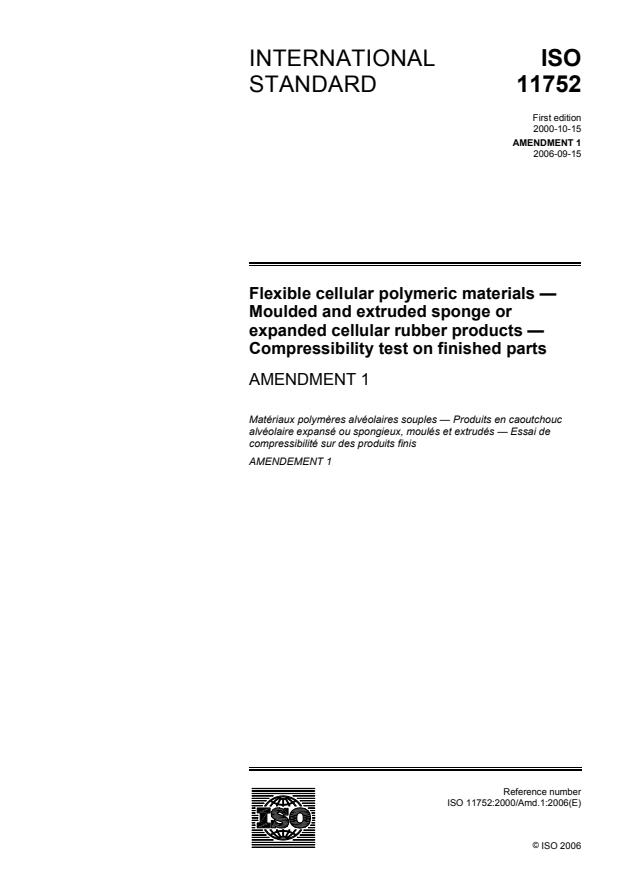
INTERNATIONAL ISO
STANDARD 11752
First edition
2000-10-15
AMENDMENT 1
2006-09-15
Flexible cellular polymeric materials —
Moulded and extruded sponge or
expanded cellular rubber products —
Compressibility test on finished parts
AMENDMENT 1
Matériaux polymères alvéolaires souples — Produits en caoutchouc
alvéolaire expansé ou spongieux, moulés et extrudés — Essai de
compressibilité sur des produits finis
AMENDEMENT 1
Reference number
ISO 11752:2000/Amd.1:2006(E)
©
ISO 2006
ISO 11752:2000/Amd.1:2006(E)
PDF disclaimer
This PDF file may contain embedded typefaces. In accordance with Adobe's licensing policy, this file may be printed or viewed but
shall not be edited unless the typefaces which are embedded are licensed to and installed on the computer performing the editing. In
downloading this file, parties accept therein the responsibility of not infringing Adobe's licensing policy. The ISO Central Secretariat
accepts no liability in this area.
Adobe is a trademark of Adobe Systems Incorporated.
Details of the software products used to create this PDF file can be found in the General Info relative to the file; the PDF-creation
parameters were optimized for printing. Every care has been taken to ensure that the file is suitable for use by ISO member bodies. In
the unlikely event that a problem relating to it is found, please inform the Central Secretariat at the address given below.
© ISO 2006
All rights reserved. Unless otherwise specified, no part of this publication may be reproduced or utilized in any form or by any means,
electronic or mechanical, including photocopying and microfilm, without permission in writing from either ISO at the address below or
ISO's member body in the country of the requester.
ISO copyright office
Case postale 56 • CH-1211 Geneva 20
Tel. + 41 22 749 01 11
Fax + 41 22 749 09 47
E-mail copyright@iso.org
Web www.iso.org
Published in Switzerland
ii © ISO 2006 – All rights reserved
ISO 11752:2000/Amd.1:2006(E)
Foreword
ISO (the International Organization for Standardization) is a worldwide federation of national standards bodies
(ISO member bodies). The work of preparing International Standards is normally carried out through ISO
technical committees. Each member body interested in a subject for which a technical committee has been
established has the right to be represented on that committee. International organizations,
...