

ISO 7718-2:2025
(Main)Aircraft — Passenger doors interface requirements for connection of passenger boarding bridge or passenger transfer vehicle — Part 2: Upper deck doors
General Information
- Abstract
This document specifies minimum requirements for dimensions and unobstructed space around upper deck passenger doors on the outer skin of civil transport aircraft, applicable when these doors are designed to accept the connection of existing passenger boarding bridges or transfer vehicles. This document is not applicable to existing models of civil transport aircraft, or derivative models with entry into service up to the year 2000 with the same fuselage, for which the aircraft-mating section of passenger boarding bridges or passenger transfer vehicles is expected to be compatible with ISO 16004.
- Status
- Published
- Publication Date
- 05-Feb-2025
- Technical Committee
- ISO/TC 20/SC 9 - Air cargo and ground equipment
- Drafting Committee
- ISO/TC 20/SC 9 - Air cargo and ground equipment
- Current Stage
- 6060 - International Standard published
- Start Date
- 06-Feb-2025
- Due Date
- 01-Aug-2025
- Completion Date
- 06-Feb-2025

Overview
ISO 7718-2:2025 is the international standard that defines the minimum requirements for dimensions and unobstructed space around upper deck passenger doors on the outer skin of civil transport aircraft. Its primary focus is ensuring compatibility between aircraft upper deck doors and existing passenger boarding bridges or passenger transfer vehicles. This standard, issued by the International Organization for Standardization (ISO), does not apply to aircraft models or their derivatives introduced before the year 2000, which are expected to comply with the legacy specification, ISO 16004.
By establishing clear guidelines for unobstructed space and door interface requirements, ISO 7718-2:2025 streamlines the design and operational compatibility of aircraft with ground support equipment, contributing to enhanced safety, efficiency, and interoperability at airports.
Key Topics
- Dimensional Requirements
Specifies the minimum unobstructed area around upper deck doors to enable safe and efficient connection of passenger boarding bridges or transfer vehicles. - Fuselage Clearance
Details exclusions and required free-of-obstruction zones where no exterior features (such as sensors, drains, or access panels) are permitted within the service area. - Fuselage Radius
Recommends a minimum cross-section radius for the fuselage in the interface area, supporting smooth bridge alignment. - Door Sill Height Limits
Addresses the maximum allowable height for passenger door sills to ensure compatibility with standard boarding equipment. - Compatibility with Main Deck Bridges
Notes that boarding bridges serving both upper and main decks must comply with both ISO 7718-1 and ISO 7718-2 requirements. - Non-Applicability to Existing Aircraft
Clarifies that aircraft models or derivatives with entry into service up to 2000 follow the specifications laid out in ISO 16004.
Applications
Adoption of ISO 7718-2:2025 benefits multiple stakeholders across the aviation industry:
- Aircraft Manufacturers
Ensures new aircraft designs have well-defined boarding bridge access points on the upper deck, minimizing complicated or custom airport infrastructure modifications. - Airport Planning and Ground Support Equipment Providers
Facilitates investment decisions and maintenance planning by harmonizing passenger boarding bridge specifications for new-generation aircraft. - Aircraft Operators and Airlines
Reduces risk of operational delays or incompatibilities when introducing new aircraft to the fleet, ensuring seamless boarding and passenger transfer processes. - Airport Authorities
Guides long-term infrastructure planning for boarding bridges and passenger transfer vehicles, supporting efficient passenger flow and improved ground handling safety. - Standards Conformance and Safety
Promotes a standardized approach for unobstructed access, helping prevent ground damage and optimizing passenger service workflows.
Related Standards
- ISO 7718-1: Aircraft - Passenger doors interface requirements for connection of passenger boarding bridge - Part 1: Main deck doors
Specifies interface requirements for main deck passenger doors. - ISO 16004: Aircraft ground equipment - Passenger boarding bridge or transfer vehicle - Interface requirements with aircraft doors
Pertains to interface requirements for passenger boarding bridges compatible with older aircraft models. - SAE AS 6896: Aircraft Markings for Ground Support Equipment Alignment
Provides guidelines on aircraft markings to support precise docking of ground support equipment.
By adhering to ISO 7718-2:2025, organizations in the aviation industry ensure that evolving aircraft and ground infrastructure remain functionally compatible, operationally efficient, and safe for passengers and personnel.
Relations
- Effective Date
- 10-Jun-2023
Get Certified
Connect with accredited certification bodies for this standard

BUREAU VERITAS Certification Germany
Bureau Veritas certification in Germany.

Element Materials Technology
Materials testing and product certification.

AQMS Ltd.
AQMS provides ISO certification to SMEs across the UK.
Sponsored listings
Frequently Asked Questions
ISO 7718-2:2025 is a standard published by the International Organization for Standardization (ISO). Its full title is "Aircraft — Passenger doors interface requirements for connection of passenger boarding bridge or passenger transfer vehicle — Part 2: Upper deck doors". This standard covers: This document specifies minimum requirements for dimensions and unobstructed space around upper deck passenger doors on the outer skin of civil transport aircraft, applicable when these doors are designed to accept the connection of existing passenger boarding bridges or transfer vehicles. This document is not applicable to existing models of civil transport aircraft, or derivative models with entry into service up to the year 2000 with the same fuselage, for which the aircraft-mating section of passenger boarding bridges or passenger transfer vehicles is expected to be compatible with ISO 16004.
This document specifies minimum requirements for dimensions and unobstructed space around upper deck passenger doors on the outer skin of civil transport aircraft, applicable when these doors are designed to accept the connection of existing passenger boarding bridges or transfer vehicles. This document is not applicable to existing models of civil transport aircraft, or derivative models with entry into service up to the year 2000 with the same fuselage, for which the aircraft-mating section of passenger boarding bridges or passenger transfer vehicles is expected to be compatible with ISO 16004.
ISO 7718-2:2025 is classified under the following ICS (International Classification for Standards) categories: 49.100 - Ground service and maintenance equipment. The ICS classification helps identify the subject area and facilitates finding related standards.
ISO 7718-2:2025 has the following relationships with other standards: It is inter standard links to ISO 7718-2:2016. Understanding these relationships helps ensure you are using the most current and applicable version of the standard.
ISO 7718-2:2025 is available in PDF format for immediate download after purchase. The document can be added to your cart and obtained through the secure checkout process. Digital delivery ensures instant access to the complete standard document.
Standards Content (Sample)
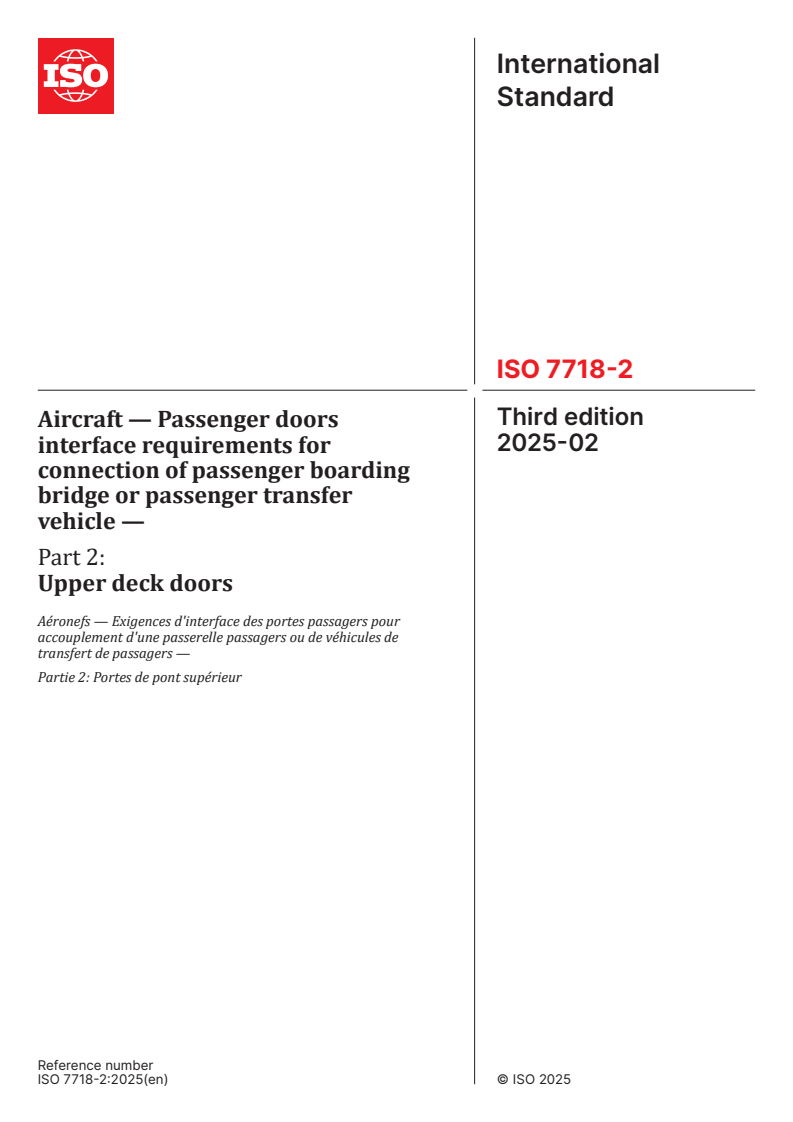
International
Standard
ISO 7718-2
Third edition
Aircraft — Passenger doors
2025-02
interface requirements for
connection of passenger boarding
bridge or passenger transfer
vehicle —
Part 2:
Upper deck doors
Aéronefs — Exigences d'interface des portes passagers pour
accouplement d'une passerelle passagers ou de véhicules de
transfert de passagers —
Partie 2: Portes de pont supérieur
Reference number
© ISO 2025
All rights reserved. Unless otherwise specified, or required in the context of its implementation, no part of this publication may
be reproduced or utilized otherwise in any form or by any means, electronic or mechanical, including photocopying, or posting on
the internet or an intranet, without prior written permission. Permission can be requested from either ISO at the address below
or ISO’s member body in the country of the requester.
ISO copyright office
CP 401 • Ch. de Blandonnet 8
CH-1214 Vernier, Geneva
Phone: +41 22 749 01 11
Email: copyright@iso.org
Website: www.iso.org
Published in Switzerland
ii
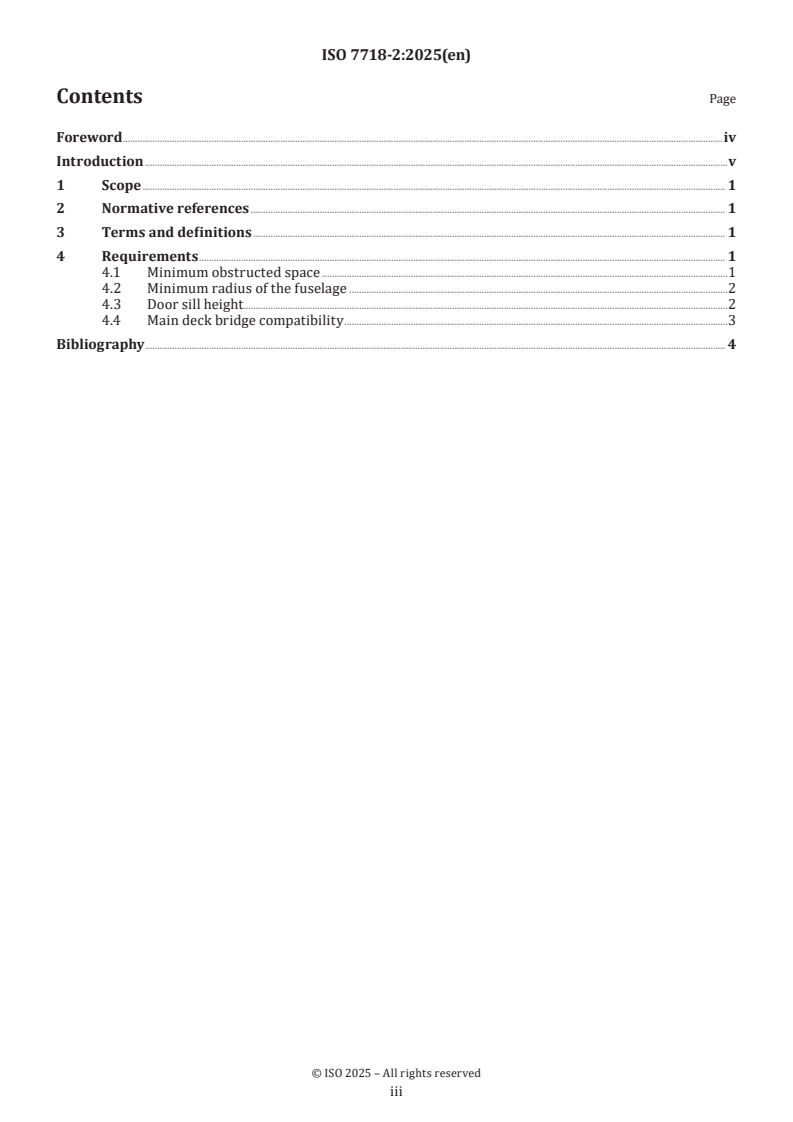
Contents Page
Foreword .iv
Introduction .v
1 Scope . 1
2 Normative references . 1
3 Terms and definitions . 1
4 Requirements . 1
4.1 Minimum obstructed space .1
4.2 Minimum radius of the fuselage .2
4.3 Door sill height.2
4.4 Main deck bridge compatibility .3
Bibliography . 4
iii
Foreword
ISO (the International Organization for Standardization) is a worldwide federation of national standards
bodies (ISO member bodies). The work of preparing International Standards is normally carried out through
ISO technical committees. Each member body interested in a subject for which a technical committee
has been established has the right to be represented on that committee. International organizations,
governmental and non-governmental, in liaison with ISO, also take part in the work. ISO collaborates closely
with the International Electrotechnical Commission (IEC) on all matters of electrotechnical standardization.
The procedures used to develop this document and those intended for its further maintenance are described
in the ISO/IEC Directives, Part 1. In particular, the different approval criteria needed for the different types
of ISO document should be noted. This document was drafted in accordance with the editorial rules of the
ISO/IEC Directives, Part 2 (see www.iso.org/directives).
ISO draws attention to the possibility that the implementation of this document may involve the use of (a)
patent(s). ISO takes no position concerning the evidence, validity or applicability of any claimed patent
rights in respect thereof. As of the date of publication of this document, ISO had not received notice of (a)
patent(s) which may be required to implement this document. However, implementers are cautioned that
this may not represent the latest information, which may be obtained from the patent database available at
www.iso.org/patents. ISO shall not be held responsible for identifying any or all such patent rights.
Any trade name used in this document is information given for the convenience of users and does not
constitute an endorsement.
For an explanation of the voluntary nature of standards, the meaning of ISO specific terms and expressions
related to conformity assessment, as well as information about ISO's adherence to the World Trade
Organization (WTO) principles in the Technical Barriers to Trade (TBT), see www.iso.org/iso/foreword.html.
This document was prepared by Technical Committee ISO/TC 20, Aircraft and space vehicles, Subcommittee
SC 9, Air cargo and ground equipment.
This third edition cancels and replaces the second edition (ISO 7718-2:2016), which has been technically
revised.
The main changes are as follows:
— the requirements have been revised to be more precise.
A list of all parts in the ISO 7718 series can be found on th
...