

ISO 714:1975
(Main)Zinc — Determination of iron content — Photometric method
General Information
- Abstract
The method is applicable to all zinc types provided that their copper content is 0,01 % maximum. The determination is suitable for iron contents between 0,001 and 0,01 %. This standard specifies principle, reagents, apparatus, sampling, procedure, expression of results and test report.
- Status
- Published
- Publication Date
- 30-Jun-1975
- Technical Committee
- ISO/TC 18 - Zinc and zinc alloys
- Drafting Committee
- ISO/TC 18 - Zinc and zinc alloys
- Current Stage
- 9093 - International Standard confirmed
- Start Date
- 14-Mar-2025
- Completion Date
- 29-Aug-2026
Buy Documents

ISO 714:1975 - Zinc — Determination of iron content — Photometric method Released:7/1/1975

ISO 714:1975 - Zinc — Dosage du fer — Méthode photométrique Released:7/1/1975

ISO 714:1975 - Zinc — Dosage du fer — Méthode photométrique Released:7/1/1975
Overview
ISO 714:1975 - Zinc - Determination of Iron Content - Photometric Method is an international standard developed by ISO for accurately measuring iron content in zinc using a photometric process. This standard ensures consistent and reliable analytical results across laboratories and industries. It applies to all types of zinc provided that their copper content does not exceed 0.01%. The recommended method is suitable for determining iron concentrations between 0.001% and 0.01%, making it essential for quality control in zinc production and processing.
Key Topics
- Scope and Applicability: Defines that the standard method is applicable to multiple grades of zinc with low copper content, covering a critical range of iron concentrations.
- Photometric Methodology: Utilizes the yellow color complex formed by sulphosalicylic acid and ferric iron in an ammoniacal solution to determine iron via photometric measurement at 425 nm.
- Required Reagents and Apparatus:
- High-purity reagents such as hydrochloric acid, ammonia solution, hydrogen peroxide, and sulphosalicylic acid
- Standard and blank preparation solutions
- Photometer with 1 cm cells, calibrated at 425 nm
- Sampling and Preparation: Sampling must be conducted according to ISO 3751, ensuring representativeness of zinc material.
- Procedural Steps: Detailed procedures for sample dissolution, reagent addition, calibration curve plotting, and test portion handling to ensure precise results.
- Result Expression and Reporting: Guidance on calculating and reporting results, including identification of the sample and notation of any deviations from the standard procedure.
Applications
The ISO 714:1975 standard is essential for:
- Zinc Refining and Manufacturing: Ensuring iron impurities in zinc ingots and products are within specified tolerances, vital for quality and end-use performance.
- Quality Assurance Laboratories: Standardizing chemical analysis processes for iron detection in zinc to guarantee consistency across production batches and facilities.
- Industry Compliance: Supporting companies in meeting customer and regulatory requirements by providing reliable iron content data.
- Research and Development: Enabling precise measurement of trace iron in R&D settings for new zinc applications and alloys.
By implementing the photometric method outlined in ISO 714:1975, laboratories maintain analytical accuracy, facilitate international trade, and enhance overall product quality control in metallurgy and materials science.
Related Standards
For comprehensive zinc and metal analysis, consider the following ISO standards:
- ISO/R 752 - Zinc ingots: Defines the types of zinc applicable for iron content analysis.
- ISO 3751 - Selection and preparation of samples for chemical analysis of zinc ingots: Ensures proper sampling methodology for accurate test results.
- Other ISO photometric and chemical analysis standards: Useful for complementary analysis of metals, including copper or other impurities in zinc.
Keywords: ISO 714:1975, zinc analysis, iron determination, photometric method, zinc quality control, iron content, laboratory standards, ISO zinc, trace metal analysis, zinc ingot testing, analytical chemistry.
Conclusion: Using ISO 714:1975 supports standardized, precise, and reliable measurement of iron content in zinc, which is crucial for maintaining product integrity and meeting industry specifications.
Buy Documents
ISO 714:1975 - Zinc — Determination of iron content — Photometric method Released:7/1/1975
ISO 714:1975 - Zinc — Dosage du fer — Méthode photométrique Released:7/1/1975
ISO 714:1975 - Zinc — Dosage du fer — Méthode photométrique Released:7/1/1975
Get Certified
Connect with accredited certification bodies for this standard

Element Materials Technology
Materials testing and product certification.

Inštitut za kovinske materiale in tehnologije
Institute of Metals and Technology. Materials testing, metallurgical analysis, NDT.
Sponsored listings
Frequently Asked Questions
ISO 714:1975 is a standard published by the International Organization for Standardization (ISO). Its full title is "Zinc — Determination of iron content — Photometric method". This standard covers: The method is applicable to all zinc types provided that their copper content is 0,01 % maximum. The determination is suitable for iron contents between 0,001 and 0,01 %. This standard specifies principle, reagents, apparatus, sampling, procedure, expression of results and test report.
The method is applicable to all zinc types provided that their copper content is 0,01 % maximum. The determination is suitable for iron contents between 0,001 and 0,01 %. This standard specifies principle, reagents, apparatus, sampling, procedure, expression of results and test report.
ISO 714:1975 is classified under the following ICS (International Classification for Standards) categories: 77.120.60 - Lead, zinc, tin and their alloys. The ICS classification helps identify the subject area and facilitates finding related standards.
ISO 714:1975 is available in PDF format for immediate download after purchase. The document can be added to your cart and obtained through the secure checkout process. Digital delivery ensures instant access to the complete standard document.
Standards Content (Sample)
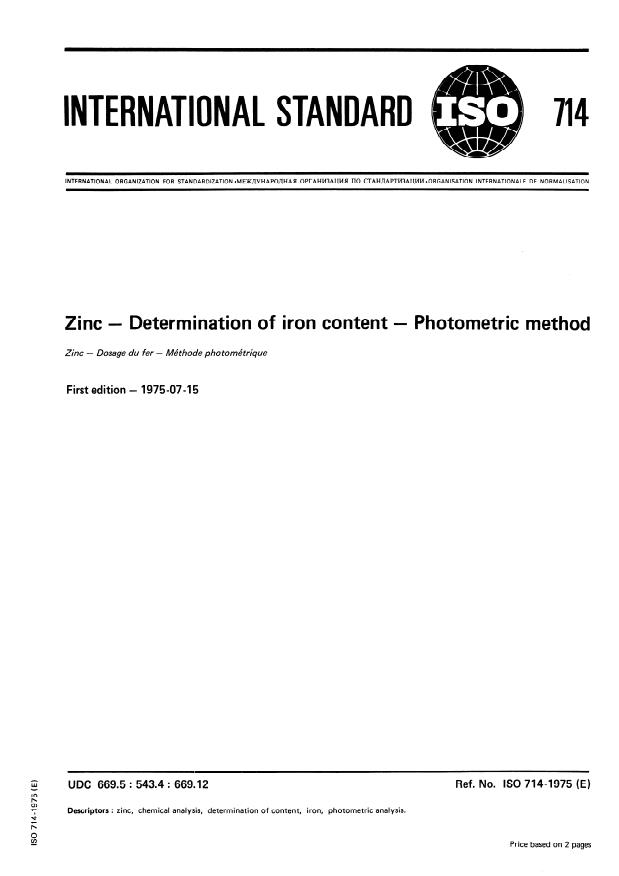
INTERNATIONAL STANDARD 714
INTERNATIONAL ORGANIZATION FOR STANDARDIZATION l MEXAYHAPOAHAII OPTAHM3ALWII I-IO CTAHAAPTM3ALJWi.ORGANISATION INTERNATIONALE DE NORMALISATION
Zinc - Determination of iron content - Photometric method
Zinc - Dosage du fer - M&hode pho tome’trique
First edition - 1975-07-15
Ref. No. IS0 714-1975 (E)
UDC 669.5 : 543.4 : 669.12
Descriptors : zinc, chemical analysis, determination of content, iron, photometric analysis.
Price based on 2 pages
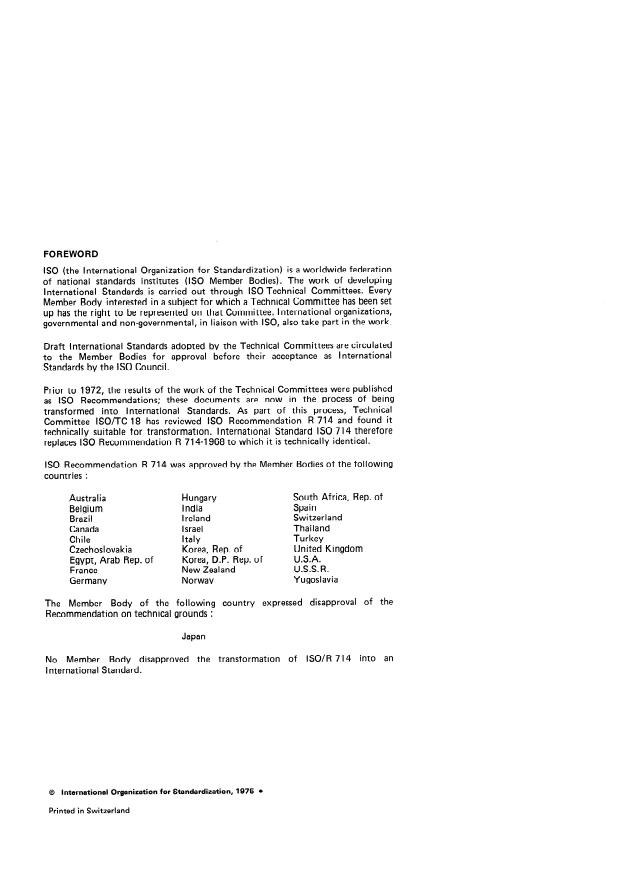
FOREWORD
IS0 (the International Organization for Standardization) is a worldwide federation
of national standards institutes (IS0 Member Bodies). The work of developing
International Standards is carried out through IS0 Technical Committees. Every
Member Body interested in a subject for which a Technical Committee has been set
up has the right to be represented on that Committee. International organizations,
governmental and non-governmental, in liaison with ISO, also take part in the work.
Draft International Standards adopted by the Technical Committees are circulated
to the Member Bodies for approval before their acceptance as International
Standards by the IS0 Council.
Prior to 1972, the results of the work of the Technical Committees were published
as lS0 Recommendations; these documents are now in the process of being
transformed into International Standards. As part of this process, Technical
Committee ISO/TC 18 has reviewed IS0 Recommendation R 714 and found it
International Standard IS0 714 therefore
technically suitable for transformation.
replaces IS0 Recommendation R 714-I 968 to which it is technically identical.
IS0 Recommendation R 714 was approved by the Member Bodies of the following
countries :
South Africa, Rep. of
Australia Hungary
Belgium India Spain
Brazil Ireland Switzerland
Canada Israel Thai land
Chile Italy Turkey
Czechoslovakia Korea, Rep. of United Kingdom
Egypt, Arab Rep. of Korea, D.P. Rep. of U.S.A.
U.S.S.R.
France New Zealand
Germany Norway Yugoslavia
The Member Body of the following country expressed disapproval of the
Recommendation on technical grounds :
Japan
No Member Body disapproved the transformation of lSO/R 714 into an
International Standard.
0 International Organization for Standardization, 1975 l
Printed in Switzerland
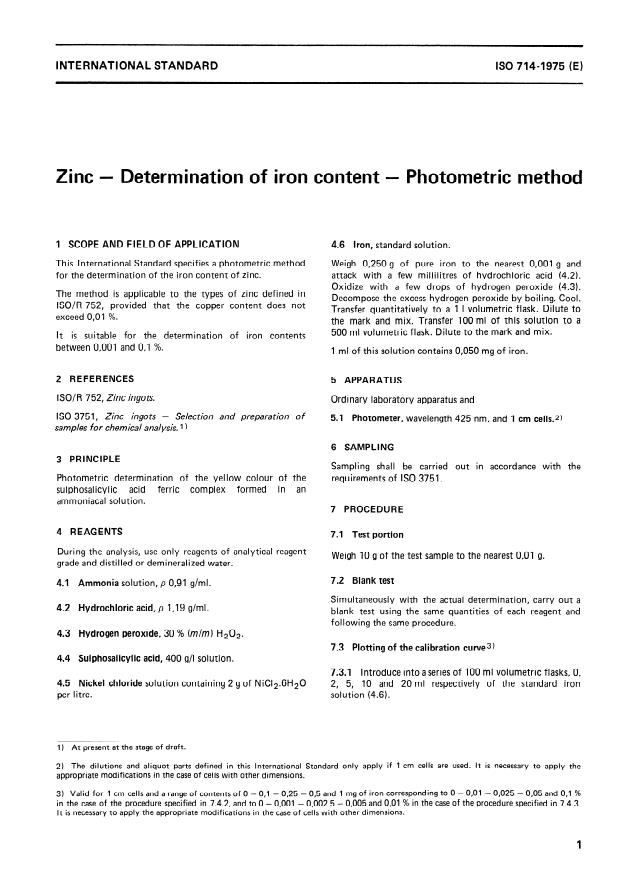
INTERNATIONAL STANDARD IS0 714-1975 (E)
Zinc - Determination of iron content - Photometric method
1 SCOPE AND FIELD OF APPLICATION 4.6 Iron, standard solution.
This International Standard specifies a photometric method Weigh 0,250 g of pure iron to the nearest 0,001 g and
for the determination of the iron content of zinc. attack with a few millilitres of hydrochloric acid (4.2).
Oxidize with a few drops of hydrogen peroxide (4.3).
The method is applicable to the types of zinc defined in
Decompose the excess hydrogen peroxide by boiling. Cool.
ISO/R 752, provided that the copper content does not
Transfer quantitatively to a 1 I volumetric flask. Dilute to
exceed 0,Ol %.
the mark and mix. Transfer 100 ml of this solution to a
500 ml volumetric flask. Dilute to the mark and mix.
It is suitable for the determination of iron contents
between 0,001 and 0,l %.
1 ml of this solution contains 0,050 mg of iron.
2 REFERENCES
5 APPARATUS
ISO/R 752, Zinc ingots.
Ordinary laboratory apparatus and
IS0 3751, Zinc ingots - Selection and preparation of
5.1 Photometer, wavelength 425 nm, and I cm cells.*)
samples for chemical analysis. 1)
6 SAlVlPLING
3 PRINCIPLE
Sampling shall be carried out in accordance with the
Photometric determination of the yellow colour of the requirements of IS0 3751.
sulphosalicylic acid ferric com
...
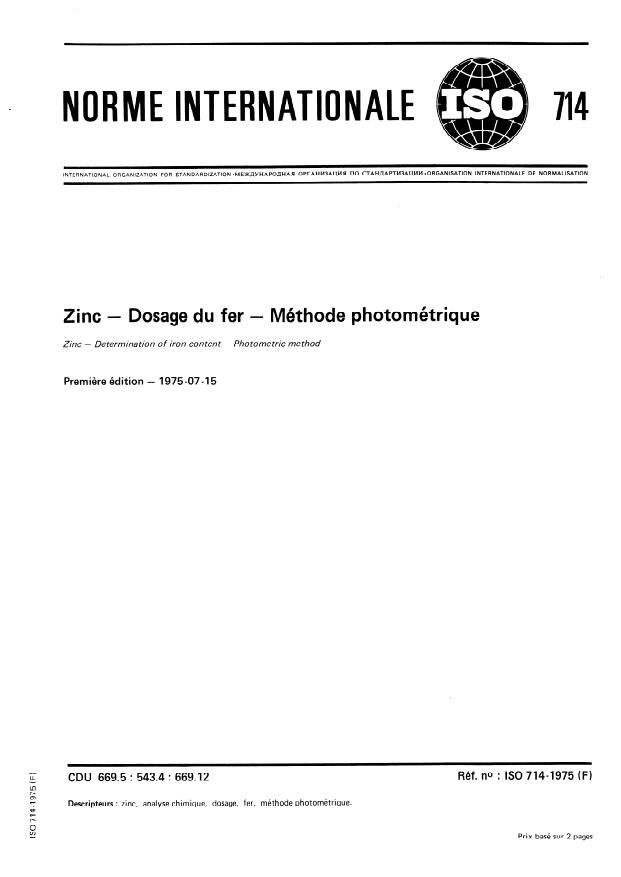
NORME INTERNATIONALE
INTERNATIONAL ORGANIZATION FOR STANDARDIZATION l MEXAYHAPOAHAfi OPI-AHM3AUMII l-l0 CTAHAAPTM3ALWM*ORGANISATION INTERNATIONALE DE NORMALISATION
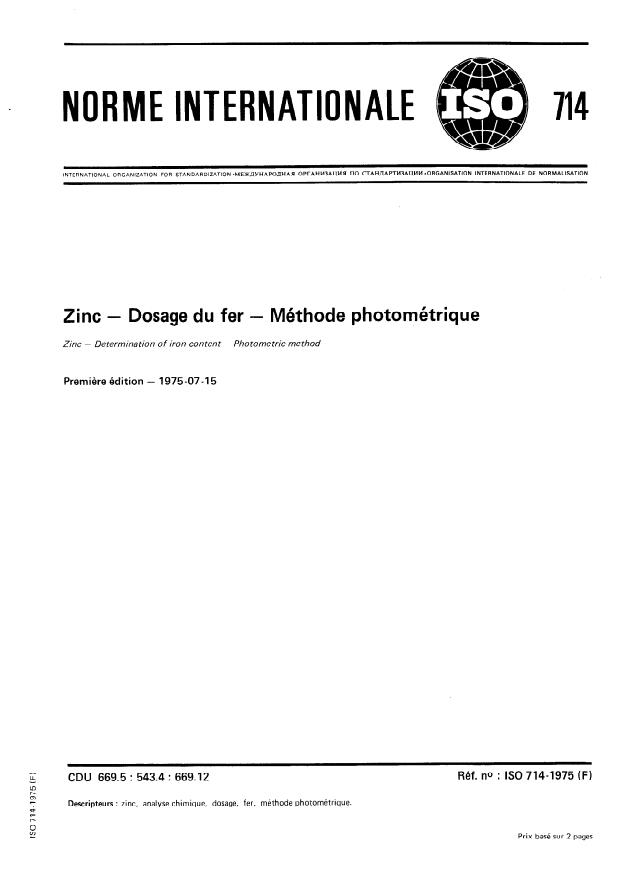
Zinc - Dosage du fer - Méthode photométrique
Zinc - Determination of iron content - Photometric method
Première édition - 1975-07-15
u: Réf. no : ISO 714-1975 (F)
CDU 669.5 : 543.4 : 669.12
Y
zinc, analyse chimique, dosage, fer, méthode photométrique.
Descripteurs :
5:
Prix basé sur 2 pages
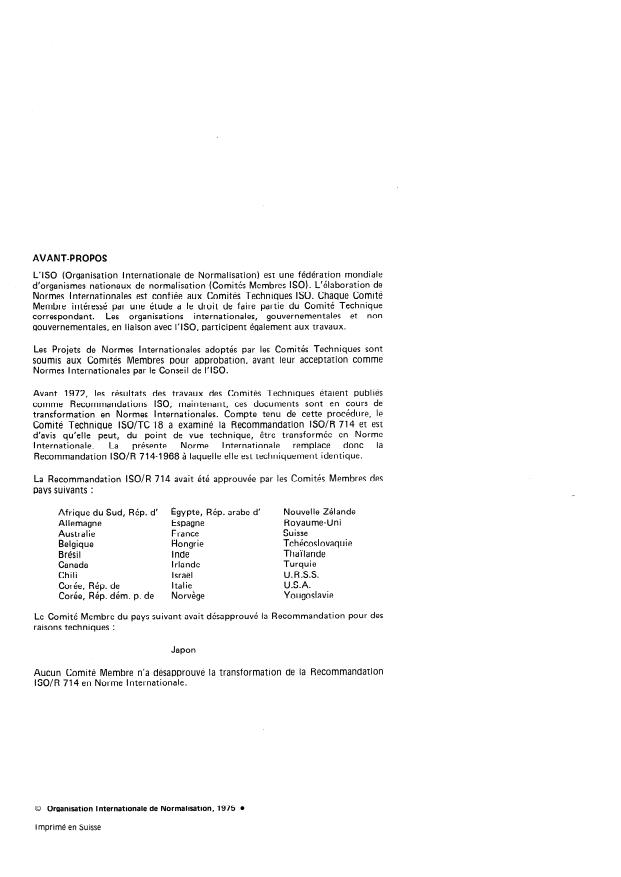
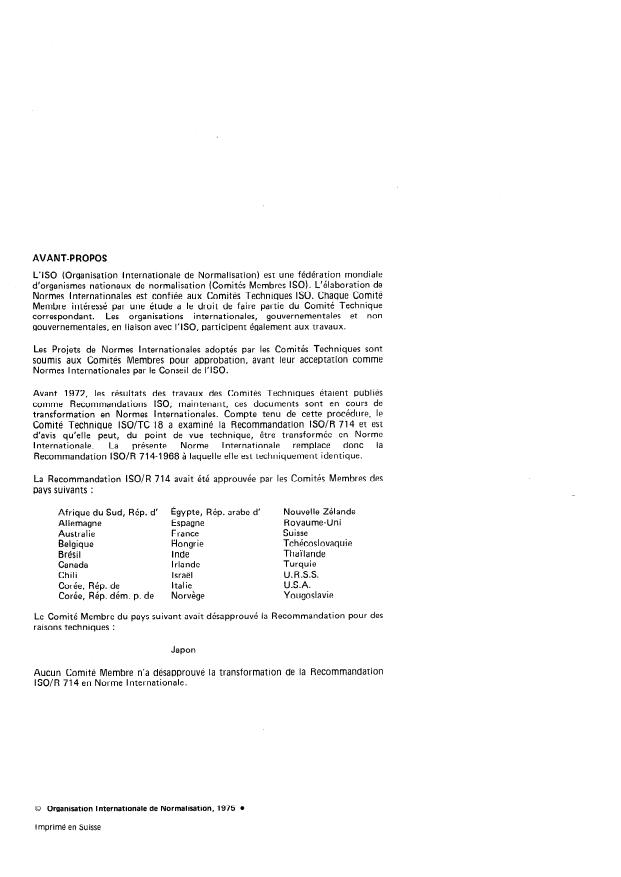
AVANT-PROPOS
L’ISO (Organisation Internationale de Normalisation) est une fédération mondiale
d’organismes nationaux de normalisation (Comités Membres ISO). L’élaboration de
Normes Internationales est confiée aux Comités Techniques ISO. Chaque Comité
Membre intéressé par une étude a le droit de faire partie du Comité Technique
correspondant. Les organisations internationales, gouvernementales et non
gouvernementales, en liaison avec I’ISO, participent également aux travaux.
Les Projets de Normes Internationales adoptés par les Comités Techniques sont
soumis aux Comités Membres pour approbation, avant leur acceptation comme
Normes Internationales par le Conseil de I’ISO.
Avant 1972, les résultats des travaux des Comités Techniques étaient publiés
comme Recommandations ISO; maintenant, ces documents sont en cours de
transformation en Normes Internationales. Compte tenu de cette procédure, le
Comité Technique ISO/TC 18 a examiné la Recommandation lSO/R 714 et est
être transformée en Norme
d’avis qu’elle peut, du point de vue technique,
Internationale remplace donc la
Internationale. La présente Norme
Recommandation ISO/R 714-I 968 à laquelle elle est techniquement identique.
La Recommandation lSO/R 714 avait été approuvée par les Comités Membres des
pays suivants :
Égypte, Rép. arabe d’ Nouvel le Zélande
Afrique du Sud, Rép. d’
Allemagne Espagne Royaume-Uni
Australie France Suisse
Tchécoslovaquie
Belgique Hongrie
Brésil Inde Thaïlande
Turquie
Canada I rla nde
U.R.S.S.
Chili Israël
Corée, Rép. de Italie U.S.A.
Yougoslavie
Corée, Rép. dém. p. de Norvège
Le Comité Membre du pays suivant avait désapprouvé la Recommandation pour des
raisons techniques :
Japon
Aucun Comité Membre n’a désapprouvé la transformation de la Recommandation
lSO/R 714 en Norme Internationale.
0 Organisation Internationale de Normalisation, 1975 l
Imprimé en Suisse
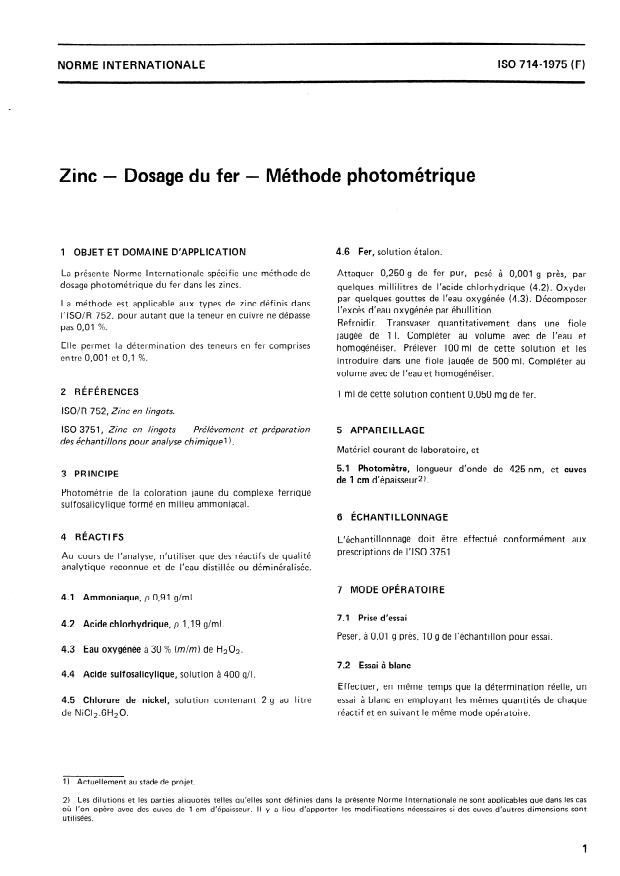
ISO 714-1975 (F)
NORME INTERNATIONALE
Méthode photométrique
Zinc - Dosage du fer -
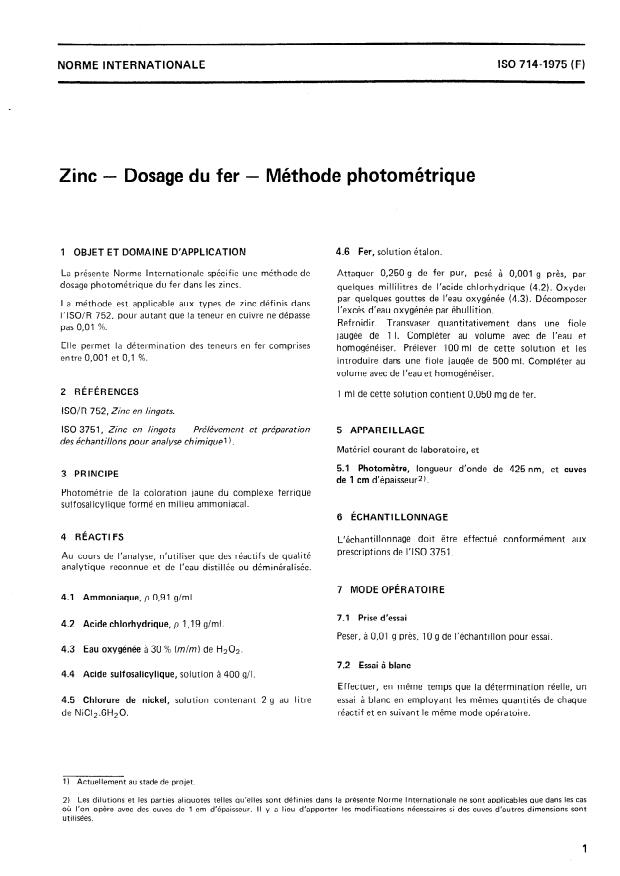
4.6 Fer, solution étalon.
1 OBJET ET DOMAINE D’APPLICATION
La présente Norme Internationale spécifie une méthode de Attaquer 0,250 g de fer pur, pesé à 0,001 g près, par
dosage photométrique du fer dans les zincs.
quelques millilitres de l’acide chlorhydrique (4.2). Oxyder
par quelques gouttes de l’eau oxygénée (4.3). Décomposer
La méthode est applicable aux types de zinc définis dans
l’excès d’eau oxygénée par ébullition.
I’ISO/R 752, pour autant que la teneur en cuivre ne dépasse
Refroidir. Transvaser quantitativement dans une fiole
pas 0,Ol %.
jaugée de 1 1. Compléter au volume avec de l’eau et
Elle permet la détermination des teneurs en fer comprises
homogénéiser. Prélever 100 ml de cette solution et les
entre 0,001 et 0,l %.
introduire dans une fiole jaugée de 500 ml. Compléter au
volume avec de l’eau et homogénéiser.
2 RÉFÉRENCES
1 ml de cette solution contient 0,050 mg de fer.
lSO/R 752, Zinc en lingots.
ISO 3751, Zinc en lingots - Prélèvement et préparation
5 APPAREILLAGE
des échantillons pour analyse chimique’ 1.
Matériel courant de laboratoire, et
5.1 Photomètre, longueur d’onde de 425 nm, et cuves
3 PRINCIPE
de 1 cm d’épaisseur2).
Photométrie de la coloration jaune du complexe ferrique
sulfosalicylique formé en milieu ammoniacal.
6 ÉCHANTILLONNAGE
4 RÉACTIFS
L’échantillonnage doit être effectué conformément aux
prescriptions de I’ISO 3751.
Au cours de l’analyse, n’utiliser que des réactifs de qualité
analytique reconnue et de l’eau distillée ou déminéralisée.
7 MODE OPÉRATOI
...
NORME INTERNATIONALE
INTERNATIONAL ORGANIZATION FOR STANDARDIZATION l MEXAYHAPOAHAfi OPI-AHM3AUMII l-l0 CTAHAAPTM3ALWM*ORGANISATION INTERNATIONALE DE NORMALISATION
Zinc - Dosage du fer - Méthode photométrique
Zinc - Determination of iron content - Photometric method
Première édition - 1975-07-15
u: Réf. no : ISO 714-1975 (F)
CDU 669.5 : 543.4 : 669.12
Y
zinc, analyse chimique, dosage, fer, méthode photométrique.
Descripteurs :
5:
Prix basé sur 2 pages
AVANT-PROPOS
L’ISO (Organisation Internationale de Normalisation) est une fédération mondiale
d’organismes nationaux de normalisation (Comités Membres ISO). L’élaboration de
Normes Internationales est confiée aux Comités Techniques ISO. Chaque Comité
Membre intéressé par une étude a le droit de faire partie du Comité Technique
correspondant. Les organisations internationales, gouvernementales et non
gouvernementales, en liaison avec I’ISO, participent également aux travaux.
Les Projets de Normes Internationales adoptés par les Comités Techniques sont
soumis aux Comités Membres pour approbation, avant leur acceptation comme
Normes Internationales par le Conseil de I’ISO.
Avant 1972, les résultats des travaux des Comités Techniques étaient publiés
comme Recommandations ISO; maintenant, ces documents sont en cours de
transformation en Normes Internationales. Compte tenu de cette procédure, le
Comité Technique ISO/TC 18 a examiné la Recommandation lSO/R 714 et est
être transformée en Norme
d’avis qu’elle peut, du point de vue technique,
Internationale remplace donc la
Internationale. La présente Norme
Recommandation ISO/R 714-I 968 à laquelle elle est techniquement identique.
La Recommandation lSO/R 714 avait été approuvée par les Comités Membres des
pays suivants :
Égypte, Rép. arabe d’ Nouvel le Zélande
Afrique du Sud, Rép. d’
Allemagne Espagne Royaume-Uni
Australie France Suisse
Tchécoslovaquie
Belgique Hongrie
Brésil Inde Thaïlande
Turquie
Canada I rla nde
U.R.S.S.
Chili Israël
Corée, Rép. de Italie U.S.A.
Yougoslavie
Corée, Rép. dém. p. de Norvège
Le Comité Membre du pays suivant avait désapprouvé la Recommandation pour des
raisons techniques :
Japon
Aucun Comité Membre n’a désapprouvé la transformation de la Recommandation
lSO/R 714 en Norme Internationale.
0 Organisation Internationale de Normalisation, 1975 l
Imprimé en Suisse
ISO 714-1975 (F)
NORME INTERNATIONALE
Méthode photométrique
Zinc - Dosage du fer -
4.6 Fer, solution étalon.
1 OBJET ET DOMAINE D’APPLICATION
La présente Norme Internationale spécifie une méthode de Attaquer 0,250 g de fer pur, pesé à 0,001 g près, par
dosage photométrique du fer dans les zincs.
quelques millilitres de l’acide chlorhydrique (4.2). Oxyder
par quelques gouttes de l’eau oxygénée (4.3). Décomposer
La méthode est applicable aux types de zinc définis dans
l’excès d’eau oxygénée par ébullition.
I’ISO/R 752, pour autant que la teneur en cuivre ne dépasse
Refroidir. Transvaser quantitativement dans une fiole
pas 0,Ol %.
jaugée de 1 1. Compléter au volume avec de l’eau et
Elle permet la détermination des teneurs en fer comprises
homogénéiser. Prélever 100 ml de cette solution et les
entre 0,001 et 0,l %.
introduire dans une fiole jaugée de 500 ml. Compléter au
volume avec de l’eau et homogénéiser.
2 RÉFÉRENCES
1 ml de cette solution contient 0,050 mg de fer.
lSO/R 752, Zinc en lingots.
ISO 3751, Zinc en lingots - Prélèvement et préparation
5 APPAREILLAGE
des échantillons pour analyse chimique’ 1.
Matériel courant de laboratoire, et
5.1 Photomètre, longueur d’onde de 425 nm, et cuves
3 PRINCIPE
de 1 cm d’épaisseur2).
Photométrie de la coloration jaune du complexe ferrique
sulfosalicylique formé en milieu ammoniacal.
6 ÉCHANTILLONNAGE
4 RÉACTIFS
L’échantillonnage doit être effectué conformément aux
prescriptions de I’ISO 3751.
Au cours de l’analyse, n’utiliser que des réactifs de qualité
analytique reconnue et de l’eau distillée ou déminéralisée.
7 MODE OPÉRATOI
...