

ISO 23952:2020
(Main)Automation systems and integration — Quality information framework (QIF) — An integrated model for manufacturing quality information
General Information
- Abstract
This document describes the general content and structure of the entire QIF information model. It describes the highest level data structures of QIF, that are expanded in Clauses 6 through 12 using data dictionaries and XML schema files. All QIF XML schema files can be found at www.qifstandards.org. This document also describes practices for forming QIF instance files, called "documents," that support quality workflow scenarios. Its focus is to show how the QIF information model, and data formed into XML instance files, support the entire scope of model based definition manufacturing quality workflow. It describes how the information model is partitioned among the XML schema files and contains all terms used in the subject area clauses. The purpose of this document is to orient potential users of QIF to the organization of the information model to make their study of the details more rewarding and efficient. It should also help solution providers and users to evaluate QIF for their uses, without needing to go to the lowest technical details of the XML schemas. The information model narrative focuses on the approach to modeling the core data structures of QIF, which model the content of ASME GD&T and ISO GPS, and the plans and results data elements defined in Dimensional Measuring Interface Standards (DMSI) ISO 22093 and ANSI/DMSC DMIS 5.3. The material on XML practices describes consistent design practices to be used by QIF working groups who will be designing new schemas. It should also help data processing experts to write software that writes and reads manufacturing quality data using the XML schemas.
- Status
- Published
- Publication Date
- 30-Jul-2020
- Technical Committee
- ISO/TC 184/SC 4 - Industrial data
- Drafting Committee
- ISO/TC 184/SC 4/WG 15 - Digital manufacturing
- Current Stage
- 9093 - International Standard confirmed
- Start Date
- 14-Jun-2026
- Completion Date
- 29-Aug-2026
Buy Documents


ISO 23952:2020 - Automation systems and integration -- Quality information framework (QIF) -- An integrated model for manufacturing quality information

ISO 23952:2020 - Automation systems and integration — Quality information framework (QIF) — An integrated model for manufacturing quality information/31/2020
Overview
ISO 23952:2020 - Automation systems and integration - Quality information framework (QIF) - defines an integrated information model for manufacturing quality information. It documents the general content and structure of the entire QIF information model, describes the highest‑level data structures, and explains how those structures are partitioned among QIF XML schema files (see www.qifstandards.org). The standard also provides guidance for forming QIF instance files (called “documents”) that support end‑to‑end, model‑based definition (MBD) manufacturing quality workflows.
Key topics and technical requirements
- Information model structure: Describes the top‑level architecture of QIF and orients users to how data domains are organized across the specification.
- Data dictionaries and XML schemas: Clauses 6–12 expand the model using formal data dictionaries and XML schema files; the standard explains how the model is split among those schema documents.
- Instance file practices: Provides recommended practices for creating QIF instance files (documents) to represent plans, results and related quality data for workflow scenarios.
- Modeling scope: Focuses on core data structures that represent content from ASME GD&T and ISO GPS and the plans/results elements defined in DMSI (ISO 22093) and ANSI/DMSC DMIS 5.3.
- Terminology and conformance: Includes extensive terms and definitions to ensure consistent interpretation, and outlines conformance concepts so implementers can evaluate QIF applicability without delving into low‑level schema syntax.
- XML design practices: Presents consistent schema design practices to guide future QIF working groups and help software developers reliably read/write QIF XML.
Practical applications and who should use it
ISO 23952:2020 is intended for:
- Quality engineers and metrologists implementing model‑based inspection and measurement workflows.
- Software developers and integrators building tools that write or consume QIF XML (e.g., inspection planning, CMM programming, results aggregation).
- Solution providers and system architects evaluating QIF for interoperability and data exchange across CAD, CAI, CMM, and quality management systems.
- Standards evaluators and procurement teams who need to understand QIF organization before assessing detailed schemas.
Practical benefits include improved interoperability, standardized representation of GD&T and measurement data, streamlined data exchange across inspection equipment and enterprise systems, and a clear path to automate quality workflows using MBD.
Related standards
- ANSI/DMSC QIF 3.0 (basis for ISO 23952:2020)
- ASME GD&T (geometric dimensioning and tolerancing)
- ISO GPS (geometrical product specification)
- ISO 22093 (DMSI - Dimensional Measuring Interface Standards)
- ANSI/DMSC DMIS 5.3
For schema downloads and implementation resources, see www.qifstandards.org.
Buy Documents
ISO 23952:2020 - Automation systems and integration -- Quality information framework (QIF) -- An integrated model for manufacturing quality information
ISO 23952:2020 - Automation systems and integration — Quality information framework (QIF) — An integrated model for manufacturing quality information/31/2020
Get Certified
Connect with accredited certification bodies for this standard

DVS-ZERT GmbH
German welding certification society.
CARES (UK Certification Authority for Reinforcing Steels)
UK certification for reinforcing steels and construction.
EWF/IIW (European/International Welding Federation)
International welding personnel certification.
Sponsored listings
Frequently Asked Questions
ISO 23952:2020 is a standard published by the International Organization for Standardization (ISO). Its full title is "Automation systems and integration — Quality information framework (QIF) — An integrated model for manufacturing quality information". This standard covers: This document describes the general content and structure of the entire QIF information model. It describes the highest level data structures of QIF, that are expanded in Clauses 6 through 12 using data dictionaries and XML schema files. All QIF XML schema files can be found at www.qifstandards.org. This document also describes practices for forming QIF instance files, called "documents," that support quality workflow scenarios. Its focus is to show how the QIF information model, and data formed into XML instance files, support the entire scope of model based definition manufacturing quality workflow. It describes how the information model is partitioned among the XML schema files and contains all terms used in the subject area clauses. The purpose of this document is to orient potential users of QIF to the organization of the information model to make their study of the details more rewarding and efficient. It should also help solution providers and users to evaluate QIF for their uses, without needing to go to the lowest technical details of the XML schemas. The information model narrative focuses on the approach to modeling the core data structures of QIF, which model the content of ASME GD&T and ISO GPS, and the plans and results data elements defined in Dimensional Measuring Interface Standards (DMSI) ISO 22093 and ANSI/DMSC DMIS 5.3. The material on XML practices describes consistent design practices to be used by QIF working groups who will be designing new schemas. It should also help data processing experts to write software that writes and reads manufacturing quality data using the XML schemas.
This document describes the general content and structure of the entire QIF information model. It describes the highest level data structures of QIF, that are expanded in Clauses 6 through 12 using data dictionaries and XML schema files. All QIF XML schema files can be found at www.qifstandards.org. This document also describes practices for forming QIF instance files, called "documents," that support quality workflow scenarios. Its focus is to show how the QIF information model, and data formed into XML instance files, support the entire scope of model based definition manufacturing quality workflow. It describes how the information model is partitioned among the XML schema files and contains all terms used in the subject area clauses. The purpose of this document is to orient potential users of QIF to the organization of the information model to make their study of the details more rewarding and efficient. It should also help solution providers and users to evaluate QIF for their uses, without needing to go to the lowest technical details of the XML schemas. The information model narrative focuses on the approach to modeling the core data structures of QIF, which model the content of ASME GD&T and ISO GPS, and the plans and results data elements defined in Dimensional Measuring Interface Standards (DMSI) ISO 22093 and ANSI/DMSC DMIS 5.3. The material on XML practices describes consistent design practices to be used by QIF working groups who will be designing new schemas. It should also help data processing experts to write software that writes and reads manufacturing quality data using the XML schemas.
ISO 23952:2020 is classified under the following ICS (International Classification for Standards) categories: 25.040.40 - Industrial process measurement and control. The ICS classification helps identify the subject area and facilitates finding related standards.
ISO 23952:2020 is available in PDF format for immediate download after purchase. The document can be added to your cart and obtained through the secure checkout process. Digital delivery ensures instant access to the complete standard document.
Standards Content (Sample)
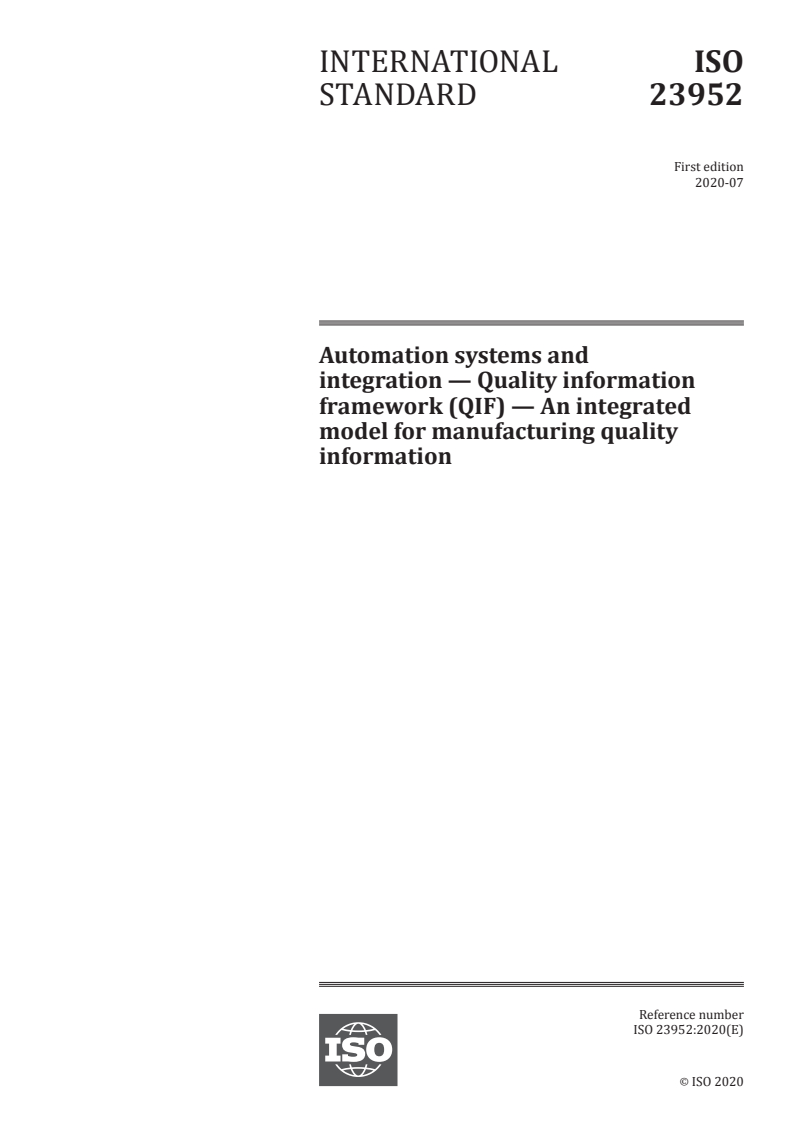
INTERNATIONAL ISO
STANDARD 23952
First edition
2020-07
Automation systems and
integration — Quality information
framework (QIF) — An integrated
model for manufacturing quality
information
Reference number
©
ISO 2020
© ISO 2020
All rights reserved. Unless otherwise specified, or required in the context of its implementation, no part of this publication may
be reproduced or utilized otherwise in any form or by any means, electronic or mechanical, including photocopying, or posting
on the internet or an intranet, without prior written permission. Permission can be requested from either ISO at the address
below or ISO’s member body in the country of the requester.
ISO copyright office
CP 401 • Ch. de Blandonnet 8
CH-1214 Vernier, Geneva
Phone: +41 22 749 01 11
Fax: +41 22 749 09 47
Email: copyright@iso.org
Website: www.iso.org
Published in Switzerland
ii © ISO 2020 – All rights reserved
Foreword
ISO (the International Organization for Standardization) is a worldwide federation of national standards
bodies (ISO member bodies). The work of preparing International Standards is normally carried out
through ISO technical committees. Each member body interested in a subject for which a technical
committee has been established has the right to be represented on that committee. International
organizations, governmental and non-governmental, in liaison with ISO, also take part in the work. ISO
collaborates closely with the International Electrotechnical Commission (IEC) on all matters of
electrotechnical standardization.
The procedures used to develop this document and those intended for its further maintenance are
described in the ISO/IEC Directives, Part 1. In particular, the different approval criteria needed for the
different types of ISO documents should be noted (www.iso.org/directives).
Attention is drawn to the possibility that some of the elements of this document may be the subject of
patent rights. ISO shall not be held responsible for identifying any or all such patent rights. Details of any
patent rights identified during the development of the document will be in the Introduction and/or on
the ISO list of patent declarations received (www.iso.org/patents).
Any trade name used in this document is information given for the convenience of users and does not
constitute an endorsement.
For an explanation of the voluntary nature of standards, the meaning of ISO specific terms and
expressions related to conformity assessment, as well as information about ISO's adherence to the World
Trade Organization (WTO) principles in the Technical Barriers to Trade (TBT), see
www.iso.org/iso/foreword.html.
This document was prepared by the Digital Metrology Standards Consortium (DMSC) (as ANSI QIF 3.0 -
2018) and drafted in accordance with its editorial rules. It was assigned to Technical Committee ISO/TC
184, Automation systems and integration, Subcommittee SC 4, Industrial data, and adopted under the
“fast-track procedure”.
Any feedback or questions on this document should be directed to the user’s national standards body. A
.
complete listing of these bodies can be found at www.iso.org/members.html
QIF 3.0 ANSI/DMSC QIF 3.0 - 2018
Contents
Foreword . xxii
Introduction . xxiv
1 Scope of the integrated model and fundamental principles . 1
1.1 Contents of this document . 1
1.2 Scope of the QIF Version 3.0 information model . 1
1.3 Conformance . 3
2 Normative references . 4
3 Terms and definitions . 6
3.1 Terms defined in ISO 22093:2011 and ANSI/DMIS 105.3-2016, Part 1 . 6
3.1.1 actual . 6
3.1.2 dimensional measuring equipment (DME) . 6
3.1.3 nominal . 6
3.1.4 measurement. 6
3.1.5 part coordinate system (PCS) . 6
3.2 Terms defined in XML Schema Part 0: Primer Second Edition, W3C Recommendation 28
October 2004 . 6
3.2.1 attribute . 6
3.2.2 complexType . 6
3.2.3 element. 6
3.2.4 instance file . 7
3.3 Terms defined in XML Schema Part 1: Structures Second Edition, W3C Recommendation
28 October 2004 . 7
3.3.1 attribute information item . 7
3.3.2 element information item . 7
3.3.3 enumeration . 7
3.3.4 extension . 7
3.3.5 key . 7
3.3.6 keyref . 7
3.3.7 schema (or XML schema) . 7
3.3.8 schema document (or schema file) . 7
3.3.9 simple type . 8
3.3.10 string . 8
QIF 3.0 ANSI/DMSC QIF 3.0 - 2018
3.3.11 token . 8
3.4 Terms defined in the QIF standard . 8
3.4.1 accuracy test . 8
3.4.2 action . 8
3.4.3 action group . 8
3.4.4 action method . 8
3.4.5 actual component . 8
3.4.6 actual component set . 8
3.4.7 application area . 9
3.4.8 articulating arm CMM . 9
3.4.9 aspect . 9
3.4.10 definition aspect . 9
3.4.11 nominal aspect . 9
3.4.12 item aspect . 9
3.4.13 measured aspect . 9
3.4.14 assembly . 9
3.4.15 assembly path . 9
3.4.16 assignable cause . 9
3.4.17 attribute characteristic . 9
3.4.18 attribute data . 10
3.4.19 autocollimator . 10
3.4.20 bias . 10
3.4.21 bill of characteristics (BoC) . 10
3.4.22 boolean condition . 10
3.4.23 calibration . 10
3.4.24 caliper . 10
3.4.25 capability . 10
3.4.26 capacitive sensor . 10
3.4.27 carriage . 10
3.4.28 Cartesian CMM . 10
3.4.29 characteristic . 10
3.4.30 characteristic item . 11
3.4.31 charge coupled device camera sensor . 11
3.4.32 checked . 11
3.4.33 clipping plane . 11
iv © ISO 2020 – All rights reserved
QIF 3.0 ANSI/DMSC QIF 3.0 - 2018
3.4.34 complex tactile probe sensor . 11
3.4.35 component . 11
3.4.36 composite feature . 11
3.4.37 computed tomography . 11
3.4.38 confocal chromatic sensor . 11
3.4.39 constructed feature . 11
3.4.40 control limits . 11
3.4.41 control points . 11
3.4.42 coordinate measuring machine . 12
3.4.43 control polygon . 12
3.4.44 corrective action . 12
3.4.45 corrective action plan . 12
3.4.46 data/information quality . 12
3.4.47 datum definition . 12
3.4.48 datum reference frame . 12
3.4.49 dial caliper . 12
3.4.50 digital caliper . 12
3.4.51 digital micrometer . 12
3.4.52 draw wire sensor . 12
3.4.53 DVRT sensor . 12
3.4.54 eddy current sensor . 13
3.4.55 entity . 13
3.4.56 evaluation . 13
3.4.57 event . 13
3.4.58 external product definition . 13
3.4.59 feature . 13
3.4.60 file unit . 13
3.4.61 fixture . 13
3.4.62 gage . 13
3.4.63 gage repeatability and reproduceability (gage R&R) . 14
3.4.64 generatrix . 14
3.4.65 generic feature. 14
3.4.66 geometric . 14
3.4.67 geometric characteristic . 14
3.4.68 inspection . 14
3.4.69 inspection traceability . 14
QIF 3.0 ANSI/DMSC QIF 3.0 - 2018
3.4.70 internal product definition . 14
3.4.71 item . 14
3.4.72 key characteristic . 15
3.4.73 knot vector . 15
3.4.74 laser radar . 15
3.4.75 laser tracker . 15
3.4.76 laser triangulation sensor . 15
3.4.77 light pen CMM . 15
3.4.78 linearity . 15
3.4.79 Long Term Archiving and Retrieval . 15
3.4.80 LVDT sensor . 15
3.4.81 magneto-inductive sensor . 15
3.4.82 manufacturing traceability . 16
3.4.83 measurand . 16
3.4.84 measure feature method . 16
3.4.85 measurement. 16
3.4.86 measurement device . 16
3.4.87 measurement plan . 16
3.4.88 measurement resource . 16
3.4.89 measurement result . 16
3.4.90 measurement room . 16
3.4.91 mesh . 16
3.4.92 micrometer . 17
3.4.93 microscope . 17
3.4.94 multiple carriage CMM . 17
3.4.95 non-dimensional quality data . 17
3.4.96 normal . 17
3.4.97 normal vector . 17
3.4.98 notable event . 17
3.4.99 note . 17
3.4.100 noted event . 17
3.4.101 optical comparator. 17
3.4.102 parallel link CMM . 17
3.4.103 part . 17
3.4.104 persistent identifier . 18
vi © ISO 2020 – All rights reserved
QIF 3.0 ANSI/DMSC QIF 3.0 - 2018
3.4.105 plan element . 18
3.4.106 plan note . 18
3.4.107 plan root . 18
3.4.108 point sampling strategy . 18
3.4.109 process variation . 18
3.4.110 product . 18
3.4.111 product and manufacturing information (PMI) . 18
3.4.112 production . 18
3.4.113 QIF persistent identifier (QPId) . 18
3.4.114 qualification . 18
3.4.115 rule . 19
3.4.116 sampling category . 19
3.4.117 sampling method . 19
3.4.118 sensor . 19
3.4.119 sensor qualification . 19
3.4.120 set . 19
3.4.121 simple tactile probe . 19
3.4.122 sine bar . 19
3.4.123 stability . 19
3.4.124 standard deviation . 19
3.4.125 statistical study plan . 20
3.4.126 statistical study results . 20
3.4.127 structured light sensor . 20
3.4.128 tactile probe sensor . 20
3.4.129 theodolite . 20
3.4.130 thread specification . 20
3.4.131 tolerance . 20
3.4.132 tool . 20
3.4.133 touch probe . 20
3.4.134 traceability . 21
3.4.135 trimming contour . 21
3.4.136 ultrasonic sensor . 21
3.4.137 universal length measuring machine . 21
3.4.138 version . 21
3.4.139 weld characteristic. 21
3.4.140 weld symbol . 21
QIF 3.0 ANSI/DMSC QIF 3.0 - 2018
3.4.141 wire-frame . 21
3.4.142 work instruction . 21
3.4.143 workpiece . 21
4 Symbols and abbreviated terms . 22
5 Overview of the Quality Information Framework (QIF) information model . 24
5.1 Purpose . 24
5.2 Model based definition manufacturing quality workflow . 24
5.3 QIF design requirements . 27
5.4 QIF Data Quality . 28
5.4.1 XML implementation . 28
5.4.2 Redundancy Checks. 31
5.4.3 Product Data Quality. 31
5.4.4 Digital Signature . 31
5.4.5 Long Term Archiving and Retrieval . 32
5.5 QIF manufacturing functional requirements . 33
5.6 QIF and STEP . 33
5.7 QIF information model design guidelines . 34
5.8 Overview of XML schema file modularity . 34
5.9 Data structures . 35
5.9.1 The QIFDocument element . 35
5.9.2 Four aspects of features data . 40
5.9.3 Four aspects of characteristics . 45
5.9.4 Default tolerances and characteristics . 48
5.9.5 Relationships between the aspects . 50
5.10 Hierarchy of required information . 55
5.10.1 QIF use of optional elements . 55
5.10.2 Example: diameter characteristic . 55
5.10.3 ScaleCoefficient . 58
5.11 Actual parts and assemblies . 58
5.12 Checking connections between data objects . 60
5.13 Tracking information through the product lifecycle . 63
5.13.1 Persistent Identifiers . 63
viii © ISO 2020 – All rights reserved
QIF 3.0 ANSI/DMSC QIF 3.0 - 2018
5.13.2 UUIDs and QPIds . 63
5.13.3 External File References . 64
5.13.4 QIF data flow . 65
5.13.5 Using QPIds in QIF . 66
5.14 Linking PMI information to product shape models . 69
5.15 Welding Characteristics and Symbols . 71
5.15.1 Base parameters . 72
5.15.2 Location Significance parameter . 72
5.15.3 Weld Characteristic parameters . 72
5.15.4 Supplementary parameters . 75
5.15.5 Non-Destructive Testing types . 75
5.15.6 Compound Welds . 75
5.16 QIF handling of transforms, transformations, and coordinate systems . 76
5.16.1 Coordinate Spaces . 76
5.16.2 Transformation matrix . 76
5.16.3 Transforms . 82
5.16.4 Coordinate systems . 82
5.16.5 CAD coordinate systems . 85
5.16.6 Coordinate system lists . 85
5.17 Feature control frames . 86
5.17.1 Geometric tolerance characteristic types . 86
5.17.2 Tolerance zone size. 87
5.17.3 Zone shape . 88
5.17.4 Zone extents . 88
5.17.5 Other zone modifiers . 89
5.17.6 Datum reference frames . 89
5.18 QIF handling of units . 91
5.18.1 Introduction . 91
5.18.2 PMI units . 92
5.18.3 Default units . 93
5.18.4 Other units . 93
5.19 Modeling slots in QIF . 94
5.19.1 Introduction . 94
5.19.2 Internal and external . 94
QIF 3.0 ANSI/DMSC QIF 3.0 - 2018
5.19.3 Location and size . 94
5.19.4 End types . 96
5.19.5 Bottom types . 99
5.19.6 Taper . 99
5.19.7 Draft . 99
5.19.8 Feature measurement . 100
5.20 Modeling cones and conical segments in QIF . 100
5.20.1 Introduction . 100
5.20.2 Location, orientation and angle . 101
5.20.3 Linear extents . 102
5.21 Modeling pattern features in QIF. 105
5.21.1 Circular pattern feature . 106
5.21.2 Circular arc pattern feature . 107
5.21.3 Linear pattern feature . 108
5.21.4 Parallelogram pattern feature . 109
5.22 Modeling threads in QIF . 109
5.22.1 Thread specification types . 110
5.23 Feature measurement determination . 110
5.23.1 Checked and set features . 110
5.23.2 Measurement and construction . 111
5.23.3 Measurement points . 111
5.23.4 Construction methods . 111
5.24 CharacteristicDesignators - encoding "balloon" numbers in QIF . 113
5.25 Attributes and Part Notes . 114
5.26 Detailed requirements . 116
5.26.1 XML naming and design rules (NDR) . 116
5.26.2 Annotation conventions . 118
6 QIF Library . 120
6.1 Introduction . 120
6.1.1 Changes in the QIF Library from QIF Version 2.1 . 121
6.2 Auxiliary.xsd . 121
6.3 Characteristics.xsd . 122
6.3.1 Characteristics element . 122
x © ISO 2020 – All rights reserved
QIF 3.0 ANSI/DMSC QIF 3.0 - 2018
6.3.2 Characteristic definitions, nominals, items, and measurements . 122
6.3.3 DefaultCharacteristicDefinitions . 126
6.3.4 DefaultToleranceDefinitions . 126
6.3.5 CharacteristicGroups . 126
6.3.6 Constraint checking for characteristics . 126
6.3.7 ToleranceZones . 127
6.3.8 Substitution groups in Characteristics.xsd . 127
6.4 Expressions.xsd . 127
6.4.1 Types Defined in Expressions.xsd . 128
6.4.2 Substitution groups in Expressions.xsd. 128
6.5 Features.xsd . 128
6.5.1 Features element . 128
6.5.2 Feature types . 129
6.5.3 Constraint checking for features . 132
6.5.4 Feature construction methods . 132
6.5.5 Substitution groups for features . 133
6.6 GenericExpressions.xsd . 133
6.6.1 Arithmetic Expressions . 133
6.6.2 String Expressions . 133
6.6.3 Boolean Expressions . 134
6.7 Geometry.xsd . 134
6.8 IntermediatesPMI.xsd . 136
6.9 Primitives.xsd . 137
6.10 PrimitivesPD.xsd . 138
6.11 PrimitivesPMI.xsd . 138
6.12 Statistics.xsd. 138
6.12.1 Basic Statistics Types . 138
6.12.2 Characteristic Statistics Evaluation Types . 140
6.13 Topology.xsd . 142
6.14 Traceability.xsd . 143
6.14.1 InspectionTraceabilityType . 144
6.14.2 PreInspectionTraceabilityType . 144
6.14.3 ProductTraceabilityType . 145
QIF 3.0 ANSI/DMSC QIF 3.0 - 2018
6.14.4 ActualProductTraceabilityType . 145
6.14.5 ManufacturingProcessTraceabilityType . 146
6.15 Units.xsd . 147
6.15.1 FileUnits . 147
6.15.2 Conversions . 148
6.15.3 FileUnitsExample . 149
6.15.4 Instance File Example Using Units . 150
6.16 Visualization.xsd . 151
7 QIF Model Based Definition (MBD) information model . 154
7.1 Foreword . 154
7.2 Introduction . 154
7.3 Scope . 154
7.3.1 Contents of this clause . 154
7.3.2 QIF MBD Information Model Application Architecture . 155
7.4 QIF MBD information model requirements . 157
7.5 Overview of the product data model .
...
INTERNATIONAL ISO
STANDARD 23952
First edition
2020-07
Automation systems and
integration — Quality information
framework (QIF) — An integrated
model for manufacturing quality
information
Reference number
©
ISO 2020
© ISO 2020
All rights reserved. Unless otherwise specified, or required in the context of its implementation, no part of this publication may
be reproduced or utilized otherwise in any form or by any means, electronic or mechanical, including photocopying, or posting
on the internet or an intranet, without prior written permission. Permission can be requested from either ISO at the address
below or ISO’s member body in the country of the requester.
ISO copyright office
CP 401 • Ch. de Blandonnet 8
CH-1214 Vernier, Geneva
Phone: +41 22 749 01 11
Fax: +41 22 749 09 47
Email: copyright@iso.org
Website: www.iso.org
Published in Switzerland
ii © ISO 2020 – All rights reserved
Foreword
ISO (the International Organization for Standardization) is a worldwide federation of national standards
bodies (ISO member bodies). The work of preparing International Standards is normally carried out
through ISO technical committees. Each member body interested in a subject for which a technical
committee has been established has the right to be represented on that committee. International
organizations, governmental and non-governmental, in liaison with ISO, also take part in the work. ISO
collaborates closely with the International Electrotechnical Commission (IEC) on all matters of
electrotechnical standardization.
The procedures used to develop this document and those intended for its further maintenance are
described in the ISO/IEC Directives, Part 1. In particular, the different approval criteria needed for the
different types of ISO documents should be noted (www.iso.org/directives).
Attention is drawn to the possibility that some of the elements of this document may be the subject of
patent rights. ISO shall not be held responsible for identifying any or all such patent rights. Details of any
patent rights identified during the development of the document will be in the Introduction and/or on
the ISO list of patent declarations received (www.iso.org/patents).
Any trade name used in this document is information given for the convenience of users and does not
constitute an endorsement.
For an explanation of the voluntary nature of standards, the meaning of ISO specific terms and
expressions related to conformity assessment, as well as information about ISO's adherence to the World
Trade Organization (WTO) principles in the Technical Barriers to Trade (TBT), see
www.iso.org/iso/foreword.html.
This document was prepared by the Digital Metrology Standards Consortium (DMSC) (as ANSI QIF 3.0 -
2018) and drafted in accordance with its editorial rules. It was assigned to Technical Committee ISO/TC
184, Automation systems and integration, Subcommittee SC 4, Industrial data, and adopted under the
“fast-track procedure”.
Any feedback or questions on this document should be directed to the user’s national standards body. A
.
complete listing of these bodies can be found at www.iso.org/members.html
QIF 3.0 ANSI/DMSC QIF 3.0 - 2018
Contents
Foreword . xxii
Introduction . xxiv
1 Scope of the integrated model and fundamental principles . 1
1.1 Contents of this document . 1
1.2 Scope of the QIF Version 3.0 information model . 1
1.3 Conformance . 3
2 Normative references . 4
3 Terms and definitions . 6
3.1 Terms defined in ISO 22093:2011 and ANSI/DMIS 105.3-2016, Part 1 . 6
3.1.1 actual . 6
3.1.2 dimensional measuring equipment (DME) . 6
3.1.3 nominal . 6
3.1.4 measurement. 6
3.1.5 part coordinate system (PCS) . 6
3.2 Terms defined in XML Schema Part 0: Primer Second Edition, W3C Recommendation 28
October 2004 . 6
3.2.1 attribute . 6
3.2.2 complexType . 6
3.2.3 element. 6
3.2.4 instance file . 7
3.3 Terms defined in XML Schema Part 1: Structures Second Edition, W3C Recommendation
28 October 2004 . 7
3.3.1 attribute information item . 7
3.3.2 element information item . 7
3.3.3 enumeration . 7
3.3.4 extension . 7
3.3.5 key . 7
3.3.6 keyref . 7
3.3.7 schema (or XML schema) . 7
3.3.8 schema document (or schema file) . 7
3.3.9 simple type . 8
3.3.10 string . 8
QIF 3.0 ANSI/DMSC QIF 3.0 - 2018
3.3.11 token . 8
3.4 Terms defined in the QIF standard . 8
3.4.1 accuracy test . 8
3.4.2 action . 8
3.4.3 action group . 8
3.4.4 action method . 8
3.4.5 actual component . 8
3.4.6 actual component set . 8
3.4.7 application area . 9
3.4.8 articulating arm CMM . 9
3.4.9 aspect . 9
3.4.10 definition aspect . 9
3.4.11 nominal aspect . 9
3.4.12 item aspect . 9
3.4.13 measured aspect . 9
3.4.14 assembly . 9
3.4.15 assembly path . 9
3.4.16 assignable cause . 9
3.4.17 attribute characteristic . 9
3.4.18 attribute data . 10
3.4.19 autocollimator . 10
3.4.20 bias . 10
3.4.21 bill of characteristics (BoC) . 10
3.4.22 boolean condition . 10
3.4.23 calibration . 10
3.4.24 caliper . 10
3.4.25 capability . 10
3.4.26 capacitive sensor . 10
3.4.27 carriage . 10
3.4.28 Cartesian CMM . 10
3.4.29 characteristic . 10
3.4.30 characteristic item . 11
3.4.31 charge coupled device camera sensor . 11
3.4.32 checked . 11
3.4.33 clipping plane . 11
iv © ISO 2020 – All rights reserved
QIF 3.0 ANSI/DMSC QIF 3.0 - 2018
3.4.34 complex tactile probe sensor . 11
3.4.35 component . 11
3.4.36 composite feature . 11
3.4.37 computed tomography . 11
3.4.38 confocal chromatic sensor . 11
3.4.39 constructed feature . 11
3.4.40 control limits . 11
3.4.41 control points . 11
3.4.42 coordinate measuring machine . 12
3.4.43 control polygon . 12
3.4.44 corrective action . 12
3.4.45 corrective action plan . 12
3.4.46 data/information quality . 12
3.4.47 datum definition . 12
3.4.48 datum reference frame . 12
3.4.49 dial caliper . 12
3.4.50 digital caliper . 12
3.4.51 digital micrometer . 12
3.4.52 draw wire sensor . 12
3.4.53 DVRT sensor . 12
3.4.54 eddy current sensor . 13
3.4.55 entity . 13
3.4.56 evaluation . 13
3.4.57 event . 13
3.4.58 external product definition . 13
3.4.59 feature . 13
3.4.60 file unit . 13
3.4.61 fixture . 13
3.4.62 gage . 13
3.4.63 gage repeatability and reproduceability (gage R&R) . 14
3.4.64 generatrix . 14
3.4.65 generic feature. 14
3.4.66 geometric . 14
3.4.67 geometric characteristic . 14
3.4.68 inspection . 14
3.4.69 inspection traceability . 14
QIF 3.0 ANSI/DMSC QIF 3.0 - 2018
3.4.70 internal product definition . 14
3.4.71 item . 14
3.4.72 key characteristic . 15
3.4.73 knot vector . 15
3.4.74 laser radar . 15
3.4.75 laser tracker . 15
3.4.76 laser triangulation sensor . 15
3.4.77 light pen CMM . 15
3.4.78 linearity . 15
3.4.79 Long Term Archiving and Retrieval . 15
3.4.80 LVDT sensor . 15
3.4.81 magneto-inductive sensor . 15
3.4.82 manufacturing traceability . 16
3.4.83 measurand . 16
3.4.84 measure feature method . 16
3.4.85 measurement. 16
3.4.86 measurement device . 16
3.4.87 measurement plan . 16
3.4.88 measurement resource . 16
3.4.89 measurement result . 16
3.4.90 measurement room . 16
3.4.91 mesh . 16
3.4.92 micrometer . 17
3.4.93 microscope . 17
3.4.94 multiple carriage CMM . 17
3.4.95 non-dimensional quality data . 17
3.4.96 normal . 17
3.4.97 normal vector . 17
3.4.98 notable event . 17
3.4.99 note . 17
3.4.100 noted event . 17
3.4.101 optical comparator. 17
3.4.102 parallel link CMM . 17
3.4.103 part . 17
3.4.104 persistent identifier . 18
vi © ISO 2020 – All rights reserved
QIF 3.0 ANSI/DMSC QIF 3.0 - 2018
3.4.105 plan element . 18
3.4.106 plan note . 18
3.4.107 plan root . 18
3.4.108 point sampling strategy . 18
3.4.109 process variation . 18
3.4.110 product . 18
3.4.111 product and manufacturing information (PMI) . 18
3.4.112 production . 18
3.4.113 QIF persistent identifier (QPId) . 18
3.4.114 qualification . 18
3.4.115 rule . 19
3.4.116 sampling category . 19
3.4.117 sampling method . 19
3.4.118 sensor . 19
3.4.119 sensor qualification . 19
3.4.120 set . 19
3.4.121 simple tactile probe . 19
3.4.122 sine bar . 19
3.4.123 stability . 19
3.4.124 standard deviation . 19
3.4.125 statistical study plan . 20
3.4.126 statistical study results . 20
3.4.127 structured light sensor . 20
3.4.128 tactile probe sensor . 20
3.4.129 theodolite . 20
3.4.130 thread specification . 20
3.4.131 tolerance . 20
3.4.132 tool . 20
3.4.133 touch probe . 20
3.4.134 traceability . 21
3.4.135 trimming contour . 21
3.4.136 ultrasonic sensor . 21
3.4.137 universal length measuring machine . 21
3.4.138 version . 21
3.4.139 weld characteristic. 21
3.4.140 weld symbol . 21
QIF 3.0 ANSI/DMSC QIF 3.0 - 2018
3.4.141 wire-frame . 21
3.4.142 work instruction . 21
3.4.143 workpiece . 21
4 Symbols and abbreviated terms . 22
5 Overview of the Quality Information Framework (QIF) information model . 24
5.1 Purpose . 24
5.2 Model based definition manufacturing quality workflow . 24
5.3 QIF design requirements . 27
5.4 QIF Data Quality . 28
5.4.1 XML implementation . 28
5.4.2 Redundancy Checks. 31
5.4.3 Product Data Quality. 31
5.4.4 Digital Signature . 31
5.4.5 Long Term Archiving and Retrieval . 32
5.5 QIF manufacturing functional requirements . 33
5.6 QIF and STEP . 33
5.7 QIF information model design guidelines . 34
5.8 Overview of XML schema file modularity . 34
5.9 Data structures . 35
5.9.1 The QIFDocument element . 35
5.9.2 Four aspects of features data . 40
5.9.3 Four aspects of characteristics . 45
5.9.4 Default tolerances and characteristics . 48
5.9.5 Relationships between the aspects . 50
5.10 Hierarchy of required information . 55
5.10.1 QIF use of optional elements . 55
5.10.2 Example: diameter characteristic . 55
5.10.3 ScaleCoefficient . 58
5.11 Actual parts and assemblies . 58
5.12 Checking connections between data objects . 60
5.13 Tracking information through the product lifecycle . 63
5.13.1 Persistent Identifiers . 63
viii © ISO 2020 – All rights reserved
QIF 3.0 ANSI/DMSC QIF 3.0 - 2018
5.13.2 UUIDs and QPIds . 63
5.13.3 External File References . 64
5.13.4 QIF data flow . 65
5.13.5 Using QPIds in QIF . 66
5.14 Linking PMI information to product shape models . 69
5.15 Welding Characteristics and Symbols . 71
5.15.1 Base parameters . 72
5.15.2 Location Significance parameter . 72
5.15.3 Weld Characteristic parameters . 72
5.15.4 Supplementary parameters . 75
5.15.5 Non-Destructive Testing types . 75
5.15.6 Compound Welds . 75
5.16 QIF handling of transforms, transformations, and coordinate systems . 76
5.16.1 Coordinate Spaces . 76
5.16.2 Transformation matrix . 76
5.16.3 Transforms . 82
5.16.4 Coordinate systems . 82
5.16.5 CAD coordinate systems . 85
5.16.6 Coordinate system lists . 85
5.17 Feature control frames . 86
5.17.1 Geometric tolerance characteristic types . 86
5.17.2 Tolerance zone size. 87
5.17.3 Zone shape . 88
5.17.4 Zone extents . 88
5.17.5 Other zone modifiers . 89
5.17.6 Datum reference frames . 89
5.18 QIF handling of units . 91
5.18.1 Introduction . 91
5.18.2 PMI units . 92
5.18.3 Default units . 93
5.18.4 Other units . 93
5.19 Modeling slots in QIF . 94
5.19.1 Introduction . 94
5.19.2 Internal and external . 94
QIF 3.0 ANSI/DMSC QIF 3.0 - 2018
5.19.3 Location and size . 94
5.19.4 End types . 96
5.19.5 Bottom types . 99
5.19.6 Taper . 99
5.19.7 Draft . 99
5.19.8 Feature measurement . 100
5.20 Modeling cones and conical segments in QIF . 100
5.20.1 Introduction . 100
5.20.2 Location, orientation and angle . 101
5.20.3 Linear extents . 102
5.21 Modeling pattern features in QIF. 105
5.21.1 Circular pattern feature . 106
5.21.2 Circular arc pattern feature . 107
5.21.3 Linear pattern feature . 108
5.21.4 Parallelogram pattern feature . 109
5.22 Modeling threads in QIF . 109
5.22.1 Thread specification types . 110
5.23 Feature measurement determination . 110
5.23.1 Checked and set features . 110
5.23.2 Measurement and construction . 111
5.23.3 Measurement points . 111
5.23.4 Construction methods . 111
5.24 CharacteristicDesignators - encoding "balloon" numbers in QIF . 113
5.25 Attributes and Part Notes . 114
5.26 Detailed requirements . 116
5.26.1 XML naming and design rules (NDR) . 116
5.26.2 Annotation conventions . 118
6 QIF Library . 120
6.1 Introduction . 120
6.1.1 Changes in the QIF Library from QIF Version 2.1 . 121
6.2 Auxiliary.xsd . 121
6.3 Characteristics.xsd . 122
6.3.1 Characteristics element . 122
x © ISO 2020 – All rights reserved
QIF 3.0 ANSI/DMSC QIF 3.0 - 2018
6.3.2 Characteristic definitions, nominals, items, and measurements . 122
6.3.3 DefaultCharacteristicDefinitions . 126
6.3.4 DefaultToleranceDefinitions . 126
6.3.5 CharacteristicGroups . 126
6.3.6 Constraint checking for characteristics . 126
6.3.7 ToleranceZones . 127
6.3.8 Substitution groups in Characteristics.xsd . 127
6.4 Expressions.xsd . 127
6.4.1 Types Defined in Expressions.xsd . 128
6.4.2 Substitution groups in Expressions.xsd. 128
6.5 Features.xsd . 128
6.5.1 Features element . 128
6.5.2 Feature types . 129
6.5.3 Constraint checking for features . 132
6.5.4 Feature construction methods . 132
6.5.5 Substitution groups for features . 133
6.6 GenericExpressions.xsd . 133
6.6.1 Arithmetic Expressions . 133
6.6.2 String Expressions . 133
6.6.3 Boolean Expressions . 134
6.7 Geometry.xsd . 134
6.8 IntermediatesPMI.xsd . 136
6.9 Primitives.xsd . 137
6.10 PrimitivesPD.xsd . 138
6.11 PrimitivesPMI.xsd . 138
6.12 Statistics.xsd. 138
6.12.1 Basic Statistics Types . 138
6.12.2 Characteristic Statistics Evaluation Types . 140
6.13 Topology.xsd . 142
6.14 Traceability.xsd . 143
6.14.1 InspectionTraceabilityType . 144
6.14.2 PreInspectionTraceabilityType . 144
6.14.3 ProductTraceabilityType . 145
QIF 3.0 ANSI/DMSC QIF 3.0 - 2018
6.14.4 ActualProductTraceabilityType . 145
6.14.5 ManufacturingProcessTraceabilityType . 146
6.15 Units.xsd . 147
6.15.1 FileUnits . 147
6.15.2 Conversions . 148
6.15.3 FileUnitsExample . 149
6.15.4 Instance File Example Using Units . 150
6.16 Visualization.xsd . 151
7 QIF Model Based Definition (MBD) information model . 154
7.1 Foreword . 154
7.2 Introduction . 154
7.3 Scope . 154
7.3.1 Contents of this clause . 154
7.3.2 QIF MBD Information Model Application Architecture . 155
7.4 QIF MBD information model requirements . 157
7.5 Overview of the product data model .
...