

ISO/IEC 23090-24:2025/PRF Amd 1
(Amendment)Information technology — Coded representation of immersive media — Part 24: Conformance and reference software for scene description — Amendment 1: Conformance and reference software for scene description on haptics, augmented reality, avatar integration, interactivity and lighting
General Information
- Abstract
- Status
- Not Published
- Current Stage
- 5020 - FDIS ballot initiated: 2 months. Proof sent to secretariat
- Start Date
- 07-Sep-2026
- Completion Date
- 26-Sep-2026
Buy Documents
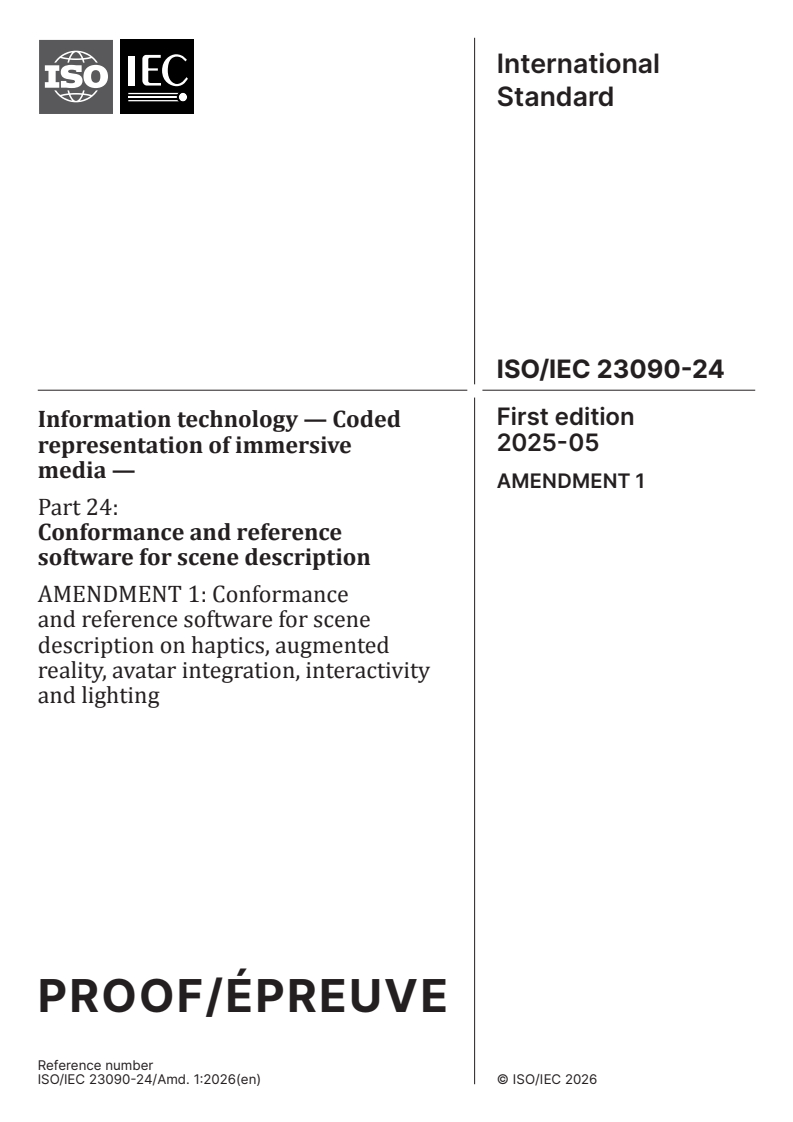



ISO/IEC 23090-24:2025/PRF Amd 1 - Information technology — Coded representation of immersive media — Part 24: Conformance and reference software for scene description — Amendment 1: Conformance and reference software for scene description on haptics, augmented reality, avatar integration, interactivity and lighting
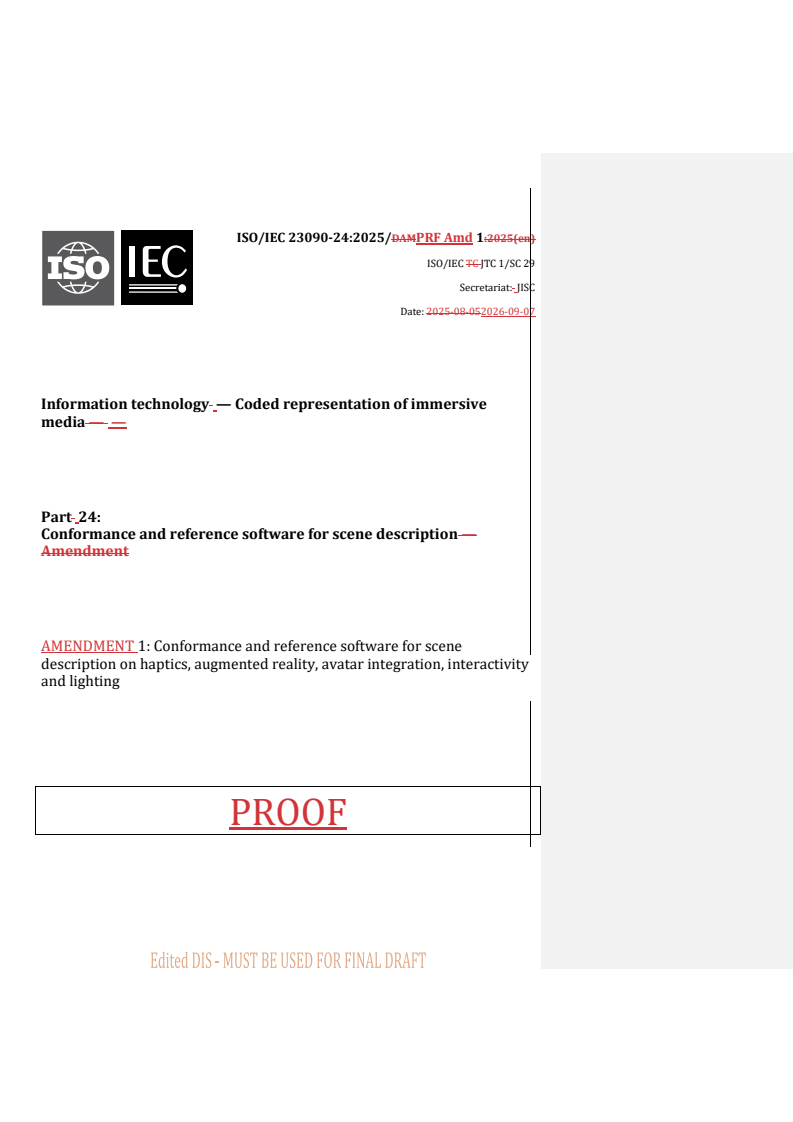

REDLINE ISO/IEC 23090-24:2025/PRF Amd 1 - Information technology — Coded representation of immersive media — Part 24: Conformance and reference software for scene description — Amendment 1: Conformance and reference software for scene description on haptics, augmented reality, avatar integration, interactivity and lighting
Overview
ISO/IEC 23090-24:2025/PRF Amd 1 is a key amendment to the ISO/IEC 23090-24 standard, focusing on the coded representation of immersive media. This amendment expands the conformance and reference software for scene description, specifically addressing advanced features such as haptics, augmented reality (AR), avatar integration, interactivity, and lighting. By providing updated methods and tools for scene description validation, this standard supports consistent and interoperable immersive media experiences across a variety of platforms.
Developed through the collaborative efforts of the ISO/IEC JTC 1/SC 29 technical committee, the amendment delivers a robust framework and software suite to ensure that immersive media content and applications conform to the latest requirements for next-generation media environments.
Key Topics
1. Advanced Scene Description Features
- Haptics: Enables tactile feedback integration within virtual scenes.
- Augmented Reality (AR): Provides mechanisms for overlaying digital content onto the real world with precise anchoring.
- Avatar Integration: Facilitates inclusion and control of digital avatars in immersive environments.
- Interactivity: Enables complex behaviors and interactions between users and scene elements.
- Lighting: Supports realistic rendering by defining lighting properties and extensions.
2. Reference Software and Extensions
- The reference implementation, named pympegsd (version 3.0), is a Python module supporting the latest MPEG-I scene description extensions.
- Includes support for scene anchoring, node interactivity, YCbCr sampling, texture-based lighting, V3C primitives, and avatar features through dedicated MPEG_* extensions.
3. Conformance Testing
- Provides detailed procedures for testing advanced scene features, ensuring interoperability.
- Includes comprehensive unit tests for validating media, sampling, and primitives extensions in glTF files.
- Assets and test files are provided for validating anchoring and interactivity.
4. Open-Source and Industry Collaboration
- Details reference implementations and resources from industry initiatives like the 5G-Media Action Group (5G-MAG).
- Showcases integration of XR media over 5G networks using open-source tools and assets.
Applications
The enhanced capabilities provided by ISO/IEC 23090-24:2025/PRF Amd 1 are crucial for a wide range of modern digital experiences:
- Immersive Media Production: Enables consistent, standards-based development of complex scenes for VR, AR, and XR applications.
- Interoperability Across Devices: By adhering to standardized conformance requirements, developers ensure content functions across diverse hardware and operating systems.
- Quality Assurance: Automated unit testing helps identify integration issues early, improving code quality and reliability.
- Research and Prototyping: Reference software and test assets accelerate development and testing in academic, research, and commercial environments.
- 5G Integration: Supports the creation and distribution of immersive media using 5G networks, as demonstrated by 5G-MAG implementations.
Related Standards
This amendment builds upon and interconnects with several related ISO standards:
- ISO/IEC 23090-14:2025 – Defines key MPEG-I extensions for scene description.
- ISO/IEC 23090-24 (main standard): The foundational standard for scene description conformance and reference software.
- glTF (Graphics Language Transmission Format): Used as the primary asset file format for scene representation.
- 5G-Media Action Group resources: Open-source tools and sample assets aligned to ISO/IEC 23090-14 features and extensions.
For comprehensive information on related conformance software, implementation references, and supporting materials, visit ISO Standards Catalogue, the official asset repository, and the 5G-MAG documentation hub.
Keywords: immersive media, scene description, ISO/IEC 23090-24, haptics, augmented reality, avatar integration, interactivity, lighting, conformance, reference software, pympegsd, 5G-MAG, glTF, MPEG extensions.
Relations
- Effective Date
- 12-Aug-2023
Buy Documents
ISO/IEC 23090-24:2025/PRF Amd 1 - Information technology — Coded representation of immersive media — Part 24: Conformance and reference software for scene description — Amendment 1: Conformance and reference software for scene description on haptics, augmented reality, avatar integration, interactivity and lighting
REDLINE ISO/IEC 23090-24:2025/PRF Amd 1 - Information technology — Coded representation of immersive media — Part 24: Conformance and reference software for scene description — Amendment 1: Conformance and reference software for scene description on haptics, augmented reality, avatar integration, interactivity and lighting
Get Certified
Connect with accredited certification bodies for this standard

BSI Group
BSI (British Standards Institution) is the business standards company that helps organizations make excellence a habit.

NYCE
Mexican standards and certification body.
Sponsored listings
Frequently Asked Questions
ISO/IEC 23090-24:2025/PRF Amd 1 is a draft published by the International Organization for Standardization (ISO). Its full title is "Information technology — Coded representation of immersive media — Part 24: Conformance and reference software for scene description — Amendment 1: Conformance and reference software for scene description on haptics, augmented reality, avatar integration, interactivity and lighting". This standard covers: Information technology — Coded representation of immersive media — Part 24: Conformance and reference software for scene description — Amendment 1: Conformance and reference software for scene description on haptics, augmented reality, avatar integration, interactivity and lighting
Information technology — Coded representation of immersive media — Part 24: Conformance and reference software for scene description — Amendment 1: Conformance and reference software for scene description on haptics, augmented reality, avatar integration, interactivity and lighting
ISO/IEC 23090-24:2025/PRF Amd 1 is classified under the following ICS (International Classification for Standards) categories: 35.040.40 - Coding of audio, video, multimedia and hypermedia information. The ICS classification helps identify the subject area and facilitates finding related standards.
ISO/IEC 23090-24:2025/PRF Amd 1 has the following relationships with other standards: It is inter standard links to ISO/IEC 23090-24:2025. Understanding these relationships helps ensure you are using the most current and applicable version of the standard.
ISO/IEC 23090-24:2025/PRF Amd 1 is available in PDF format for immediate download after purchase. The document can be added to your cart and obtained through the secure checkout process. Digital delivery ensures instant access to the complete standard document.
Standards Content (Sample)
International
Standard
ISO/IEC 23090-24
First edition
Information technology — Coded
2025-05
representation of immersive
media —
AMENDMENT 1
Part 24:
Conformance and reference
software for scene description
AMENDMENT 1: Conformance
and reference software for scene
description on haptics, augmented
reality, avatar integration, interactivity
and lighting
PROOF/ÉPREUVE
Reference number
ISO/IEC 23090-24/Amd. 1:2026(en) © ISO/IEC 2026
ISO/IEC 23090-24/Amd. 1:2026(en)
© ISO/IEC 2026
All rights reserved. Unless otherwise specified, or required in the context of its implementation, no part of this publication may
be reproduced or utilized otherwise in any form or by any means, electronic or mechanical, including photocopying, or posting on
the internet or an intranet, without prior written permission. Permission can be requested from either ISO at the address below
or ISO’s member body in the country of the requester.
ISO copyright office
CP 401 • Ch. de Blandonnet 8
CH-1214 Vernier, Geneva
Phone: +41 22 749 01 11
Email: copyright@iso.org
Website: www.iso.org
Published in Switzerland
PROOF/ÉPREUVE
© ISO/IEC 2026 – All rights reserved
ii
ISO/IEC 23090-24/Amd. 1:2026(en)
Foreword
ISO (the International Organization for Standardization) and IEC (the International Electrotechnical
Commission) form the specialized system for worldwide standardization. National bodies that are
members of ISO or IEC participate in the development of International Standards through technical
committees established by the respective organization to deal with particular fields of technical activity.
ISO and IEC technical committees collaborate in fields of mutual interest. Other international organizations,
governmental and non-governmental, in liaison with ISO and IEC, also take part in the work.
The procedures used to develop this document and those intended for its further maintenance are described
in the ISO/IEC Directives, Part 1. In particular, the different approval criteria needed for the different types
of document should be noted. This document was drafted in accordance with the editorial rules of the ISO/
IEC Directives, Part 2 (see www.iso.org/directives or www.iec.ch/members_experts/refdocs).
ISO and IEC draw attention to the possibility that the implementation of this document may involve the
use of (a) patent(s). ISO and IEC take no position concerning the evidence, validity or applicability of any
claimed patent rights in respect thereof. As of the date of publication of this document, ISO and IEC had not
received notice of (a) patent(s) which may be required to implement this document. However, implementers
are cautioned that this may not represent the latest information, which may be obtained from the patent
database available at www.iso.org/patents and https://patents.iec.ch. ISO and IEC shall not be held
responsible for identifying any or all such patent rights.
Any trade name used in this document is information given for the convenience of users and does not
constitute an endorsement.
For an explanation of the voluntary nature of standards, the meaning of ISO specific terms and expressions
related to conformity assessment, as well as information about ISO's adherence to the World Trade
Organization (WTO) principles in the Technical Barriers to Trade (TBT) see www.iso.org/iso/foreword.html.
In the IEC, see www.iec.ch/understanding-standards.
This document was prepared by Joint Technical Committee ISO/IEC JTC 1, Information technology,
Subcommittee SC 29, Coding of audio, picture, multimedia and hypermedia information.
A list of all parts in the ISO/IEC 23090 series can be found on the ISO and IEC websites.
Any feedback or questions on this document should be directed to the user’s national standards
body. A complete listing of these bodies can be found at www.iso.org/members.html and
www.iec.ch/national-committees.
PROOF/ÉPREUVE
© ISO/IEC 2026 – All rights reserved
iii
ISO/IEC 23090-24/Amd. 1:2026(en)
Information technology — Coded representation of
immersive media —
Part 24:
Conformance and reference software for scene description
AMENDMENT 1: Conformance and reference software for scene
description on haptics, augmented reality, avatar integration,
interactivity and lighting
3.2
Add the following terminological entry:
3.2
unit test
software testing technique in which individual units or components of a software application are tested in
isolation
Note 1 to entry: This process helps in identifying issues in the development cycle and enhancing code quality thus
promoting the reliability of the code.
4.2
Remove Table 1 from subclause 4.2 and renumber Table 2 as Table 1.
Replace the first paragraph of subclause 4.2 with the following:
The MPEG scene description reference software is a standalone python module called pympegsd. The
module contains the reference implementation for MPEG-I scene description extensions as specified
in ISO/IEC 23090-14:2025. The implementation in pympegsd supports features which are defined as
glTF extensions under MPEG namespace, for details see ISO/IEC 23090-14:2025, Clause 5. pympegsd is
implemented using Python language.
Another implementation of MPEG scene description is described in Annex A.
Add the following paragraphs at the end of subclause 4.2:
The reference software version 3.0 with advance features such as haptics, augmented reality, avatars,
interactivity and lighting is available in https:// standards .iso .org/ iso -iec/ 23090/ -24/ ed -1/ en/ amd/ 1/ . The
reference software ‘pympegsd’ is released with a tag version 3.0. The version 3.0 of the reference software
contains implementation for the following extensions.
— Anchoring extensions: MPEG_node_anchor and MPEG_anchor
— Interactivity extensions: MPEG_scene_interactivity and MPEG_node_interactivity
PROOF/ÉPREUVE
© ISO/IEC 2026 – All rights reserved
ISO/IEC 23090-24/Amd. 1:2026(en)
— Sampler extension: MPEG_sampler_YCbCr
— Lighting extension: MPEG_lights_texture_based
— V3C extension: MPEG_primitive_V3C
— Avatar extension: MPEG_node_avatar
The version 3.0 of the reference software supports parsing of “targetSampleRate” property on audio sources
with MPEG_audio_spatial extension as specified in ISO/IEC 23090-14:2025.
The version 3.0 of the reference software supports parsing of “media.alternative.track” property in
MPEG_media extension. When parsing fails, a default track id with value 0 is passed to the MAF pipeline. This
ensures compatibility with test assets that refer to media files with extension such as “mp3”.
4.10
Add a new subclause 4.10:
4.10 MPEG_anchor extension testing
The assets are provided with the anchoring extensions which are specified in ISO/IEC 23090-14:2025,
subclause 7.1.
For all test cases, start the render without the animations i.e. no “-a” argument when running the pympegsd
renderer and pressing the key "c" to start the anchoring.
There are in total sixteen test files to validate the function of MPEG_anchor extension. The test files are
available as mentioned in section 7.1. A base of five assets is used to build the files as shown in Table 4. The
different configurations allow testing of the eight different trackables and MPEG_anchor extension in glTF at
node or at scene level.
Only trackable of type “TRACKABLE_FLOOR” and “TRACKABLE_MARKER_2D” are simulated in the example
files.
Table 3 — glTF files with Anchoring extension
glTF file Trackable type Extension level
anchorTest_v0 TRACKABLE_FLOOR glTF and scene
anchorTest_v1 TRACKABLE_FLOOR glTF and node
anchorTest_v2 TRACKABLE_VIEWER glTF and scene
anchorTest_v3 TRACKABLE_VIEWER glTF and node
anchorTest_v4 TRACKABLE_CONTROLLER glTF and scene
anchorTest_v5 TRACKABLE_CONTROLLER glTF and node
anchorTest_v6 TRACKABLE_GEOMETRIC glTF and scene
anchorTest_v7 TRACKABLE_GEOMETRIC glTF and node
anchorTest_v8 TRACKABLE_MARKER_2D glTF and scene
anchorTest_v9 TRACKABLE_MARKER_2D glTF and node
anchorTest_v10 TRACKABLE_MARKER_3D glTF and scene
anchorTest_v11 TRACKABLE_MARKER_3D glTF and node
anchorTest_v12 TRACKABLE_MARKER_GEO glTF and scene
anchorTest_v13 TRACKABLE_MARKER_GEO glTF and node
anchorTest_v14 TRACKABLE_APPLICATION glTF and scene
anchorTest_v15 TRACKABLE_APPLICATION glTF and node
PROOF/ÉPREUVE
© ISO/IEC 2026 – All rights reserved
ISO/IEC 23090-24/Amd. 1:2026(en)
Each glTF file includes 5 assets represented by different nodes in a scene. A node in a scene is mapped to an
asset. The list of assets in the scene is shown in Table 3 .
Table 4 — glTF file with nodes describing different elements in the scene
Node0 Floor Real Element
Node1 Image Real Element
Node2 Camera Real Element
Node3 Blue Cube Children
Node4 Red Cone Root
The floor and image nodes are used as real elements by simulation software. The camera property is
included in the glTF file as the user camera. The virtual scene is composed of two elements, a red cone i.e.
Node4 as shown in Table 4 and a blue cube i.e. Node3 as shown in Table 4.
When the MPEG_anchor extension is present at scene level, all the root nodes of the scene are anchored. As
some nodes are used as real element for the simulation, these nodes must be excluded from the anchoring
process e.g. nodes corresponding to Floor (Node0 element), Image (Node1 element) and Camera(Node2
element) assets as indicated in Table 4.
The reference software has a folder named “simulation”. In this folder, a simulation.ini file allows to identify
which root nodes to be anchored in the scene array.
The simulation folder contains source code and data to simulate the trackable. The simulation.ini file in the
simulation/data folder contains parameters for the simulation.
For TRACKABLE_MARKER_2D, the size of the maker must be given as follows:
[TRACKABLE_MARKER_2D]
marker_width = 6.181522
marker_height = 4.71872
For TRACKABLE_MARKER_2D, the index of the node used as floor plane must be given as follows:
[TRACKABLE_FLOOR]
floor_node = 0
For MPEG_scene_anchor extension, the index of the root node must be given as follows:
[root_node_in_scene]
root_node = 4
For TRACKABLE_FLOOR (anchorTest_v0, anchorTest_v1), the detection of the floor plane is not implemented.
Instead, a mesh is referenced by a node indicating the floor, i.e. Node0 as shown in Table 4, of the glTF file as a
result of
...
ISO/IEC 23090-24:2025/DAMPRF Amd 1:2025(en)
ISO/IEC TC JTC 1/SC 29
Secretariat: JISC
Date: 2025-08-052026-09-07
Information technology — Coded representation of immersive
media — —
Part 24:
Conformance and reference software for scene description —
Amendment
AMENDMENT 1: Conformance and reference software for scene
description on haptics, augmented reality, avatar integration, interactivity
and lighting
PROOF
All rights reserved. Unless otherwise specified, or required in the context of its implementation, no part of
this publication may be reproduced or utilized otherwise in any form or by any means, electronic or
mechanical, including photocopying, or posting on the internet or an intranet, without prior written
permission. Permission can be requested from either ISO at the address below or ISO’s member body in
the country of the requester.
ISO copyright office
CP 401 • Ch. de Blandonnet 8
CH-1214 Vernier, Geneva
Phone: + 41 22 749 01 11
EmailE-mail: copyright@iso.org
Website: www.iso.orgwww.iso.org
Published in Switzerland
© ISO/IEC 2026 – All rights reserved
iii
Foreword
ISO (the International Organization for Standardization) and IEC (the International Electrotechnical
Commission) form the specialized system for worldwide standardization. National bodies that are members
of ISO or IEC participate in the development of International Standards through technical committees
established by the respective organization to deal with particular fields of technical activity. ISO and IEC
technical committees collaborate in fields of mutual interest. Other international organizations, governmental
and non-governmental, in liaison with ISO and IEC, also take part in the work.
The procedures used to develop this document and those intended for its further maintenance are described
in the ISO/IEC Directives, Part 1. In particular, the different approval criteria needed for the different types of
document should be noted. This document was drafted in accordance with the editorial rules of the ISO/IEC
Directives, Part 2 (see www.iso.org/directiveswww.iso.org/directives or
www.iec.ch/members_experts/refdocs).
Field Code Changed
ISO and IEC draw attention to the possibility that the implementation of this document may involve the use of
(a) patent(s). ISO and IEC take no position concerning the evidence, validity or applicability of any claimed
patent rights in respect thereof. As of the date of publication of this document, ISO and IEC had not received
notice of (a) patent(s) which may be required to implement this document. However, implementers are
cautioned that this may not represent the latest information, which may be obtained from the patent database
available at www.iso.org/patents and https://patents.iec.ch.www.iso.org/patents and https://patents.iec.ch.
ISO and IEC shall not be held responsible for identifying any or all such patent rights.
Any trade name used in this document is information given for the convenience of users and does not
constitute an endorsement.
For an explanation of the voluntary nature of standards, the meaning of ISO specific terms and expressions
related to conformity assessment, as well as information about ISO's adherence to the World Trade
Organization (WTO) principles in the Technical Barriers to Trade (TBT) see
www.iso.org/iso/foreword.html.www.iso.org/iso/foreword.html. In the IEC, see www.iec.ch/understanding-
Field Code Changed
standards.
This document was prepared by Joint Technical Committee ISO/IEC JTC 1, Information technology,
Subcommittee SC 29, Coding of audio, picture, multimedia and hypermedia information.
A list of all parts in the ISO/IEC 23090 series can be found on the ISO and IEC websites.
Any feedback or questions on this document should be directed to the user’s national standards body. A
complete listing of these bodies can be found at www.iso.org/members.htmlwww.iso.org/members.html and
www.iec.ch/national-committees.
Field Code Changed
© ISO/IEC 2026 – All rights reserved
iv
ISO/IEC 23090-24:2025/DAM 1:2025(en)
Information technology — Coded representation of immersive media
— —
Part 24:
Conformance and reference software for scene description —
Amendment
AMENDMENT 1: Conformance and reference software for scene
description on haptics, augmented reality, avatar integration,
interactivity and lighting
Clause 3
3.2
Add the following term and definition.terminological entry:
3.2
3.2 unit test
software testing technique in which individual units or components of a software application are tested in
isolation.
Note 1 to entry: This process helps in identifying issues in the development cycle and enhancing code quality thus
promoting the reliability of the code.
4.2
Remove Table 1 in sub-clause 4.2. from subclause 4.2 and renumber Table 2 as Table 1.
Replace the first paragraph in sub-clauseof subclause 4.2. with the following :
The MPEG scene description reference software is a standalone python module called pympegsd. The module
contains the reference implementation for MPEG-I scene description extensions as specified in ISO/IEC
nd
23090-14:2025/2 edition. The implementation in pympegsd supports features which are defined as glTF
nd
extensions under MPEG namespace, for details see clause 5 in ISO/IEC 23090-14:2025/2 edition, Clause 5.
pympegsd is implemented using Python language.
Another implementation of MPEG scene description is described in Annex A.
Add the following paragraphs at the end of sub-clausesubclause 4.2. :
The reference software version 3.0 with advance features such as haptics, augmented reality, avatars,
interactivity and lighting is available in https://standards.iso.org/iso-iec/23090/-24/ed-
1/en/amd/1/.https://standards.iso.org/iso-iec/23090/-24/ed-1/en/amd/1/. The reference software
‘pympegsd’ is released with a tag version 3.0. The version 3.0 of the reference software contains
implementation for the following extensions.
— — Anchoring extensions: MPEG_node_anchor and MPEG_anchor
— — Interactivity extensions: MPEG_scene_interactivity and MPEG_node_interactivity
— — Sampler extension: MPEG_sampler_YCbCr
— — Lighting extension: MPEG_lights_texture_based
— — V3C extension: MPEG_primitive_V3C
— — Avatar extension: MPEG_node_avatar
The version 3.0 of the reference software supports parsing of “targetSampleRate” property on audio
nd
sources with MPEG_audio_spatial extension as specified in ISO/IEC 23090-14:2025/ 2 edition.
The version 3.0 of the reference software supports parsing of “media.alternative.track” property in
MPEG_media extension. When parsing fails, a default track id with value 0 is passed to the MAF pipeline. This
ensures compatibility with test assets that refer to media files with extension such as “mp3”.
Change index value for Table 2 to Table 1.
4.10
Add a new subclause 4.10 :
4.10 MPEG_anchor extension testing
The assets are provided with the anchoring extensions which are specified in sub-clause 7.1 of ISO/IEC 23090-
nd
14:2025/2 edition, subclause 7.1.
For all test cases, start the render without the animations i.e. no “-a” argument when running the pympegsd
renderer and pressing the key "c" to start the anchoring.
There are in total sixteen test files to validate the function of MPEG_anchor extension. The test files are
available as mentioned in section 7.1. A base of five assets is used to build the files as shown in Table 4. The
different configurations allow testing of the eight different trackables and MPEG_anchor extension in glTF at
node or at scene level.
Only trackable of type “TRACKABLE_FLOOR” and “TRACKABLE_MARKER_2D” are simulated in the example
files.
© ISO/IEC 2026 – All rights reserved
ISO/IEC 23090-24:2025/DAMPRF Amd 1:2025(en)
Table 3 — glTF files with Anchoring extension
glTF file Trackable type Extension level
anchorTest_v0 TRACKABLE_FLOOR glTF and scene
anchorTest_v1 TRACKABLE_FLOOR glTF and node
anchorTest_v2 TRACKABLE_VIEWER glTF and scene
anchorTest_v3 TRACKABLE_VIEWER glTF and node
anchorTest_v4 TRACKABLE_CONTROLLER glTF and scene
anchorTest_v5 TRACKABLE_CONTROLLER glTF and node
anchorTest_v6 TRACKABLE_GEOMETRIC glTF and scene
anchorTest_v7 TRACKABLE_GEOMETRIC glTF and node
anchorTest_v8 TRACKABLE_MARKER_2D glTF and scene
anchorTest_v9 TRACKABLE_MARKER_2D glTF and node
anchorTest_v10 TRACKABLE_MARKER_3D glTF and scene
anchorTest_v11 TRACKABLE_MARKER_3D glTF and node
anchorTest_v12 TRACKABLE_MARKER_GEO glTF and scene
anchorTest_v13 TRACKABLE_MARKER_GEO glTF and node
anchorTest_v14 TRACKABLE_APPLICATION glTF and scene
anchorTest_v15 TRACKABLE_APPLICATION glTF and node
Each glTF file includes 5 assets represented by different nodes in a scene. A node in a scene is mapped to an
asset. The list of assets in the scene is shown in Table 3 .
Table 4 — glTF file with nodes describing different elements in the scene
Node0 Floor Real Element
Node1 Image Real Element
Node2 Camera Real Element
Node3 Blue Cube Children
Node4 Red Cone Root
The floor and image nodes are used as real elements by simulation software. The camera property is included
in the glTF file as the user camera. The virtual scene is composed of two elements, a red cone i.e. Node4 as
shown in Table 4 and a blue cube i.e. Node3 as shown in Table 4.
When the MPEG_anchor extension is present at scene level, all the root nodes of the scene are anchored. As
some nodes are used as real element for the simulation, these nodes must be excluded from the anchoring
process e.g. nodes corresponding to Floor (Node0 element), Image (Node1 element) and Camera(Node2
element) assets as indicated in Table 4.
The reference software has a folder named “simulation”. In this folder, a simulation.ini file allows to identify
which root nodes to be anchored in the scene array.
The simulation folder contains source code and data to simulate the trackable. The simulation.ini file in the
simulation/data folder contains parameters for the simulation.
For TRACKABLE_MARKER_2D, the size of the maker must be given as follows:
[TRACKABLE_MARKER_2D]
marker_width = 6.181522
marker_height = 4.71872
For TRACKABLE_MARKER_2D, the index of the node used as floor plane must be given as follows:
[TRACKABLE_FLOOR]
floor_node = 0
For MPEG_scene_anchor extension, the index of the root node must be given as follows:
[root_node_in_scene]
root_node = 4
For TRACKABLE_FLOOR (anchorTest_v0, anchorTest_v1), the detection of the floor plane is not implemented.
Instead, a mesh is referenced by a node indicating the floor, i.e. Node0 as shown in Table 4, of the glTF file as
a result of the floor plane detection. Tracking is not implemented.
The common a
...