


ISO/FDIS 6599-1
(Main)Packaging — Conditioning for testing — Part 1: Paper sacks
Packaging — Conditioning for testing — Part 1: Paper sacks
This document specifies the conditioning atmospheres and the method for conditioning samples of intact, empty paper sacks before and during testing.
Emballages — Conditionnement pour essais — Partie 1: Sacs en papier
La présente partie de l'ISO 6599 spécifie les atmosphères et la méthode de conditionnement des échantillons de sacs en papier, intacts et vides, avant et au cours des essais. Si uniquement des essais conventionnels sur papier doivent être faits sur le matériau du sac, des échantillons de matériau doivent être découpés et conditionnés comme spécifié dans l'ISO 187. La présente partie de l'ISO 6599 est applicable à tous les types de sacs en papier, vides, tels que spécifiés dans l'ISO 6590/1.
General Information
- Status
- Not Published
- Technical Committee
- ISO/TC 122/SC 3 - Performance requirements and tests for means of packaging, packages and unit loads (as required by ISO/TC 122)
- Drafting Committee
- ISO/TC 122/SC 3/WG 11 - Paper bags and paper sacks
- Current Stage
- 5020 - FDIS ballot initiated: 2 months. Proof sent to secretariat
- Start Date
- 30-Apr-2026
- Completion Date
- 30-Apr-2026
Relations
- Consolidates
FprEN ISO 6599-1 - Packaging - Conditioning for testing - Part 1: Paper sacks (ISO/FDIS 6599-1:2026) - Effective Date
- 12-Feb-2026
- Effective Date
- 28-Jun-2025
- Effective Date
- 21-Jun-2025
Overview
ISO/FDIS 6599-1:2026 is an international standard developed by ISO that provides clear guidelines for conditioning paper sacks prior to testing. Proper conditioning ensures that physical testing of empty, intact paper sacks yields accurate, consistent, and comparable results. The standard defines the required atmospheres (temperature and humidity), describes the appropriate equipment, specifies procedures for conditioning, and outlines the minimum time periods needed for equilibrium before testing is performed.
Standardized conditioning is critical because the physical properties of paper sacks, including strength and durability, are highly sensitive to moisture content. Achieving temperature and moisture equilibrium under controlled conditions allows for reliable quality assessment and comparison across different production batches or supplier sources.
Key Topics
Conditioning Atmospheres:
Specifies standard atmospheres (temperature and relative humidity) for conditioning, such as:- 23°C ± 1 / 50% RH ± 2% (preferred)
- 27°C ± 1 / 65% RH ± 2%
- 20°C ± 1 / 65% RH ± 2%
Equipment Requirements:
Calls for use of controlled-environment rooms equipped with automatic temperature and humidity regulators and continuous monitoring equipment, such as calibrated recording hygrometers.Conditioning Methods:
- Suspension of sacks during conditioning to ensure even air exposure.
- Omission of preconditioning to reduce potential errors, especially for specific construction types.
- Distinct minimum conditioning periods:
- 24 hours for sacks without barrier plies
- 7 days for sacks with barrier plies
Test Reporting:
Provides a checklist of information to be included in conditioning and test reports, such as sample details, atmospheric conditions, conditioning duration, standard references, detailed results, deviations, features observed, and test date.
Applications
Quality Control:
Enables manufacturers and testing laboratories to establish consistent baseline conditions for testing paper sacks, removing environmental variables that could affect test outcomes.Procurement and Supplier Qualification:
Ensures that buyers can objectively compare performance data for paper sacks from different suppliers, fostering a fair and transparent supply chain.Compliance and Certification:
Used as part of product certification processes to demonstrate adherence to international best practices in packaging material testing.Product Development:
Provides a standardized approach for research and development teams to evaluate and improve the performance of new paper sack designs or materials.Global Trade:
Harmonized conditioning and testing practices help remove technical barriers in international trade by aligning requirements across regions.
Related Standards
ISO 187:2022
Paper, board and pulps - Standard atmosphere for conditioning and testing and procedure for monitoring the atmosphere and conditioning of samples. This underlying standard is referenced for its guidelines on environmental control and monitoring.ISO 6590-1
Packaging - Vocabulary - Part 1: Paper sacks. Defines terminology relevant to paper sack packaging, facilitating clear communication.EN ISO 6590-1
The European equivalent aligns terminology and definitions with ISO, supporting cross-regional standardization.
Implementing ISO/FDIS 6599-1:2026 helps companies in the packaging industry achieve robust, repeatable testing methods, ultimately resulting in safer, more reliable paper sack products that meet global quality and regulatory expectations.
Buy Documents
ISO/FDIS 6599-1 - Packaging — Conditioning for testing — Part 1: Paper sacks
REDLINE ISO/FDIS 6599-1 - Packaging — Conditioning for testing — Part 1: Paper sacks

ISO/FDIS 6599-1 - Emballages — Conditionnement pour essais — Partie 1: Sacs en papier
Get Certified
Connect with accredited certification bodies for this standard

BRCGS (Brand Reputation Compliance Global Standards)
Global food safety and quality standards owner.
Sponsored listings
Frequently Asked Questions
ISO/FDIS 6599-1 is a draft published by the International Organization for Standardization (ISO). Its full title is "Packaging — Conditioning for testing — Part 1: Paper sacks". This standard covers: This document specifies the conditioning atmospheres and the method for conditioning samples of intact, empty paper sacks before and during testing.
This document specifies the conditioning atmospheres and the method for conditioning samples of intact, empty paper sacks before and during testing.
ISO/FDIS 6599-1 is classified under the following ICS (International Classification for Standards) categories: 55.080 - Sacks. Bags. The ICS classification helps identify the subject area and facilitates finding related standards.
ISO/FDIS 6599-1 has the following relationships with other standards: It is inter standard links to FprEN ISO 6599-1, ISO/IEC TR 63306-2:2021, ISO 6599-1:1983. Understanding these relationships helps ensure you are using the most current and applicable version of the standard.
ISO/FDIS 6599-1 is available in PDF format for immediate download after purchase. The document can be added to your cart and obtained through the secure checkout process. Digital delivery ensures instant access to the complete standard document.
Standards Content (Sample)
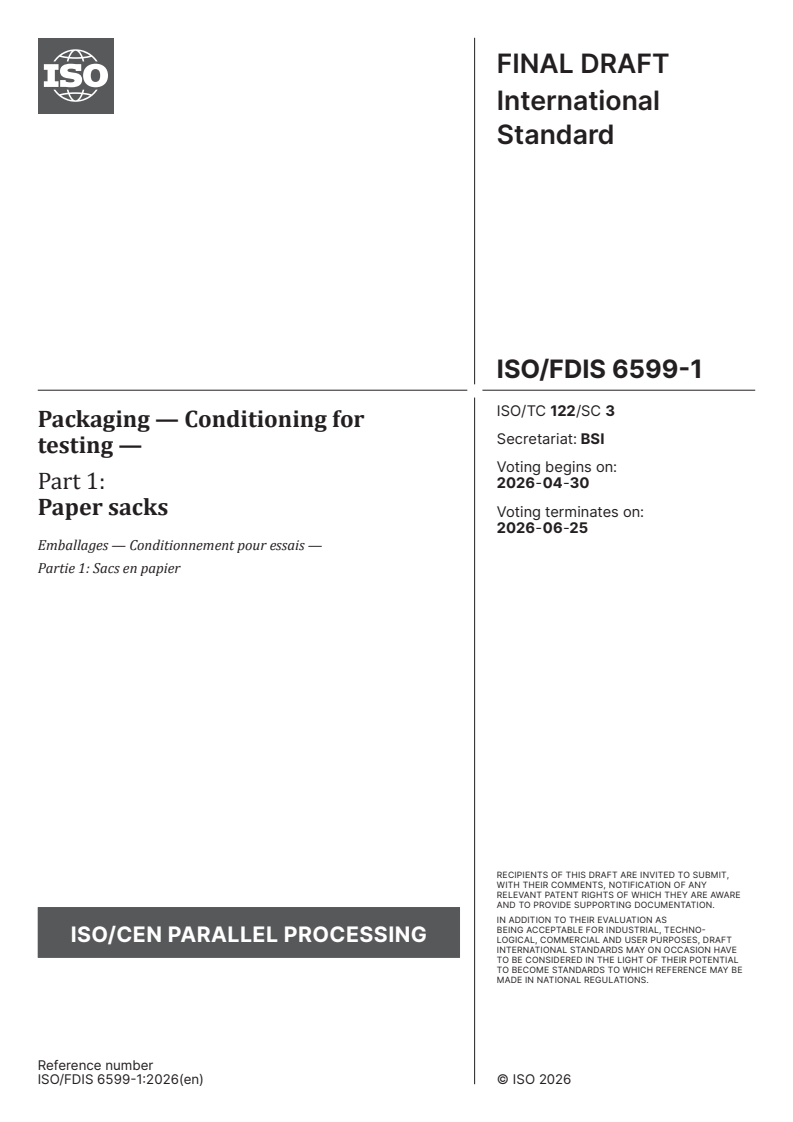
FINAL DRAFT
International
Standard
ISO/TC 122/SC 3
Packaging — Conditioning for
Secretariat: BSI
testing —
Voting begins on:
2026-04-30
Part 1:
Paper sacks
Voting terminates on:
2026-06-25
Emballages — Conditionnement pour essais —
Partie 1: Sacs en papier
RECIPIENTS OF THIS DRAFT ARE INVITED TO SUBMIT,
WITH THEIR COMMENTS, NOTIFICATION OF ANY
RELEVANT PATENT RIGHTS OF WHICH THEY ARE AWARE
AND TO PROVIDE SUPPOR TING DOCUMENTATION.
IN ADDITION TO THEIR EVALUATION AS
BEING ACCEPTABLE FOR INDUSTRIAL, TECHNO-
ISO/CEN PARALLEL PROCESSING LOGICAL, COMMERCIAL AND USER PURPOSES, DRAFT
INTERNATIONAL STANDARDS MAY ON OCCASION HAVE
TO BE CONSIDERED IN THE LIGHT OF THEIR POTENTIAL
TO BECOME STAN DARDS TO WHICH REFERENCE MAY BE
MADE IN NATIONAL REGULATIONS.
Reference number
FINAL DRAFT
International
Standard
ISO/TC 122/SC 3
Packaging — Conditioning for
Secretariat: BSI
testing —
Voting begins on:
Part 1:
Paper sacks
Voting terminates on:
Emballages — Conditionnement pour essais —
Partie 1: Sacs en papier
RECIPIENTS OF THIS DRAFT ARE INVITED TO SUBMIT,
WITH THEIR COMMENTS, NOTIFICATION OF ANY
RELEVANT PATENT RIGHTS OF WHICH THEY ARE AWARE
AND TO PROVIDE SUPPOR TING DOCUMENTATION.
© ISO 2026
IN ADDITION TO THEIR EVALUATION AS
All rights reserved. Unless otherwise specified, or required in the context of its implementation, no part of this publication may
BEING ACCEPTABLE FOR INDUSTRIAL, TECHNO-
ISO/CEN PARALLEL PROCESSING
LOGICAL, COMMERCIAL AND USER PURPOSES, DRAFT
be reproduced or utilized otherwise in any form or by any means, electronic or mechanical, including photocopying, or posting on
INTERNATIONAL STANDARDS MAY ON OCCASION HAVE
the internet or an intranet, without prior written permission. Permission can be requested from either ISO at the address below
TO BE CONSIDERED IN THE LIGHT OF THEIR POTENTIAL
or ISO’s member body in the country of the requester.
TO BECOME STAN DARDS TO WHICH REFERENCE MAY BE
MADE IN NATIONAL REGULATIONS.
ISO copyright office
CP 401 • Ch. de Blandonnet 8
CH-1214 Vernier, Geneva
Phone: +41 22 749 01 11
Email: copyright@iso.org
Website: www.iso.org
Published in Switzerland Reference number
ii
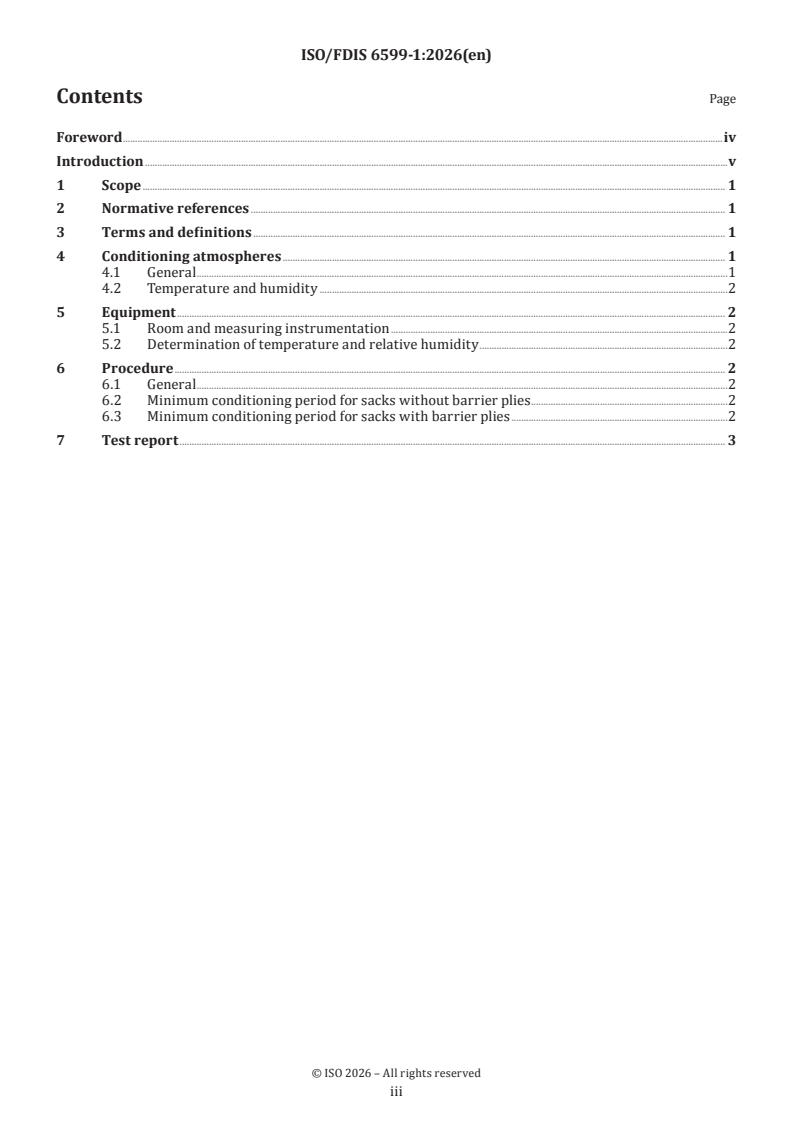
Contents Page
Foreword .iv
Introduction .v
1 Scope . 1
2 Normative references . 1
3 Terms and definitions . 1
4 Conditioning atmospheres . 1
4.1 General .1
4.2 Temperature and humidity .2
5 Equipment . 2
5.1 Room and measuring instrumentation .2
5.2 Determination of temperature and relative humidity .2
6 Procedure . 2
6.1 General .2
6.2 Minimum conditioning period for sacks without barrier plies .2
6.3 Minimum conditioning period for sacks with barrier plies .2
7 Test report . 3
iii
Foreword
ISO (the International Organization for Standardization) is a worldwide federation of national standards
bodies (ISO member bodies). The work of preparing International Standards is normally carried out through
ISO technical committees. Each member body interested in a subject for which a technical committee
has been established has the right to be represented on that committee. International organizations,
governmental and non-governmental, in liaison with ISO, also take part in the work. ISO collaborates closely
with the International Electrotechnical Commission (IEC) on all matters of electrotechnical standardization.
The procedures used to develop this document and those intended for its further maintenance are described
in the ISO/IEC Directives, Part 1. In particular, the different approval criteria needed for the different types
of ISO document should be noted. This document was drafted in accordance with the editorial rules of the
ISO/IEC Directives, Part 2 (see www.iso.org/directives).
ISO draws attention to the possibility that the implementation of this document may involve the use of (a)
patent(s). ISO takes no position concerning the evidence, validity or applicability of any claimed patent
rights in respect thereof. As of the date of publication of this document, ISO had not received notice of
...
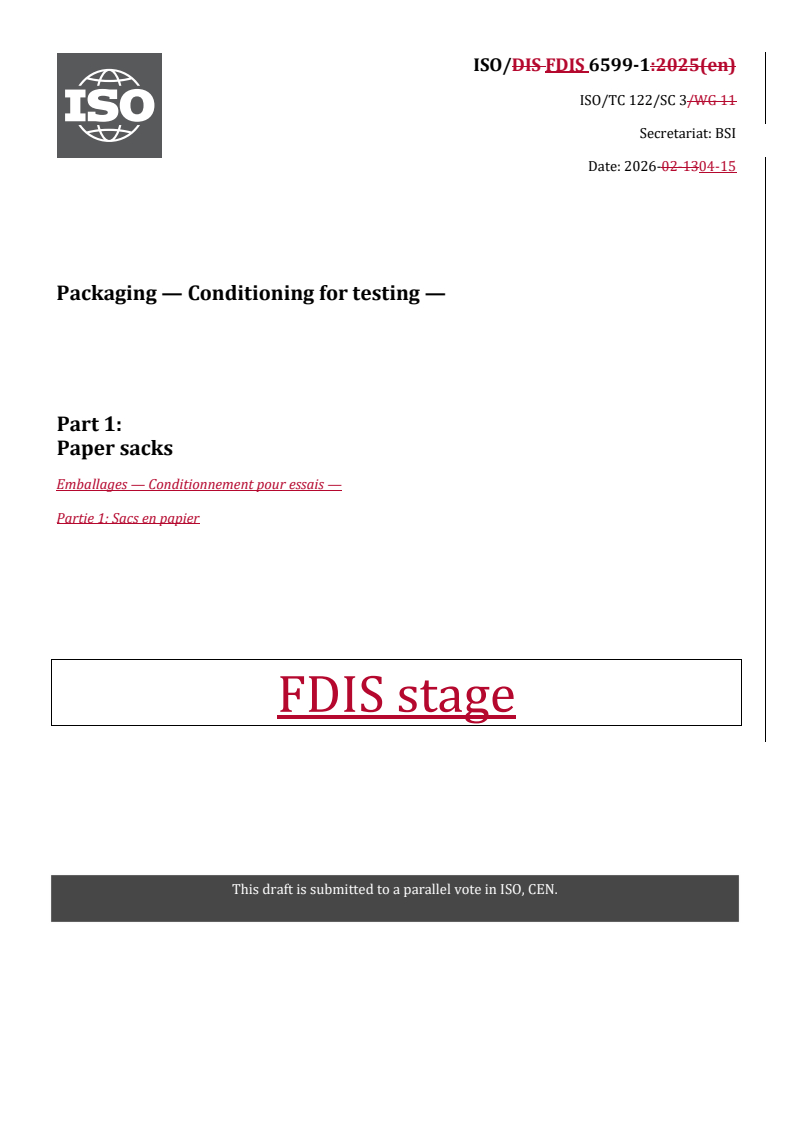
ISO/DIS FDIS 6599-1:2025(en)
ISO/TC 122/SC 3/WG 11
Secretariat: BSI
Date: 2026-02-1304-15
Packaging — Conditioning for testing —
Part 1:
Paper sacks
Emballages — Conditionnement pour essais —
Partie 1: Sacs en papier
FDIS stage
TTTTTThhhhhhiiiiiis drs drs drs drs drs draaaaaafffffftttttt i i i i i is s s s s s susususususubbbbbbmmmmmmiiiiiitttttttttttteeeeeed d d d d d ttttttoooooo aaaaaa ppppppaaaaaarrrrrraaaaaallellellellellellel l l l l l vvvvvvooooootttttteeeeee i i i i i innnnnn IIIIIISSSSSSOOOOOO,,,,,, CCCCCCEEEEEEN.N.N.N.N.N.
ISO #####-#:####(X/FDIS 6599-1:2026(en)
All rights reserved. Unless otherwise specified, or required in the context of its implementation, no part of this publication
may be reproduced or utilized otherwise in any form or by any means, electronic or mechanical, including photocopying,
or posting on the internet or an intranet, without prior written permission. Permission can be requested from either ISO
at the address below or ISO’s member body in the country of the requester.
ISO copyright office
CP 401 • Ch. de Blandonnet 8
CH-1214 Vernier, Geneva
Phone: + 41 22 749 01 11
EmailE-mail: copyright@iso.org
Website: www.iso.org
Published in Switzerland
© ISO #### 2026 – All rights reserved
ii
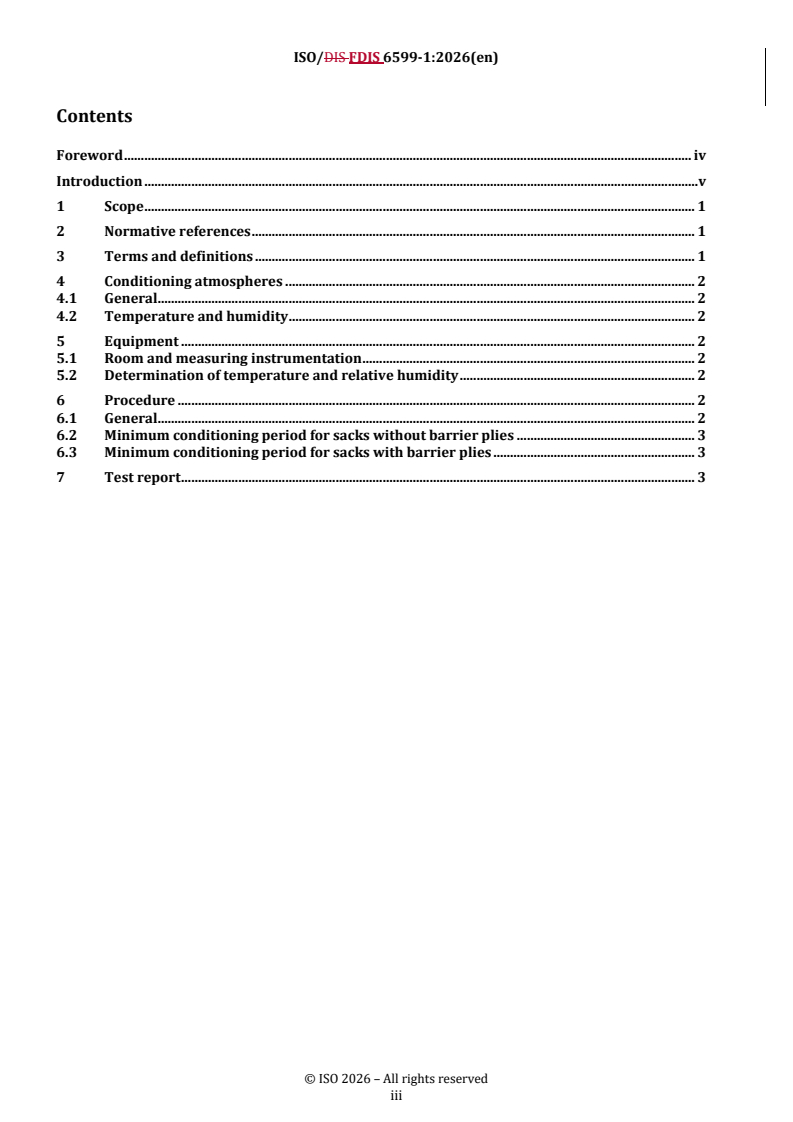
ISO/DIS FDIS 6599-1:2026(en)
Contents
Foreword . iv
Introduction . v
1 Scope . 1
2 Normative references . 1
3 Terms and definitions . 1
4 Conditioning atmospheres . 2
4.1 General . 2
4.2 Temperature and humidity . 2
5 Equipment . 2
5.1 Room and measuring instrumentation . 2
5.2 Determination of temperature and relative humidity . 2
6 Procedure . 2
6.1 General . 2
6.2 Minimum conditioning period for sacks without barrier plies . 3
6.3 Minimum conditioning period for sacks with barrier plies . 3
7 Test report . 3
iii
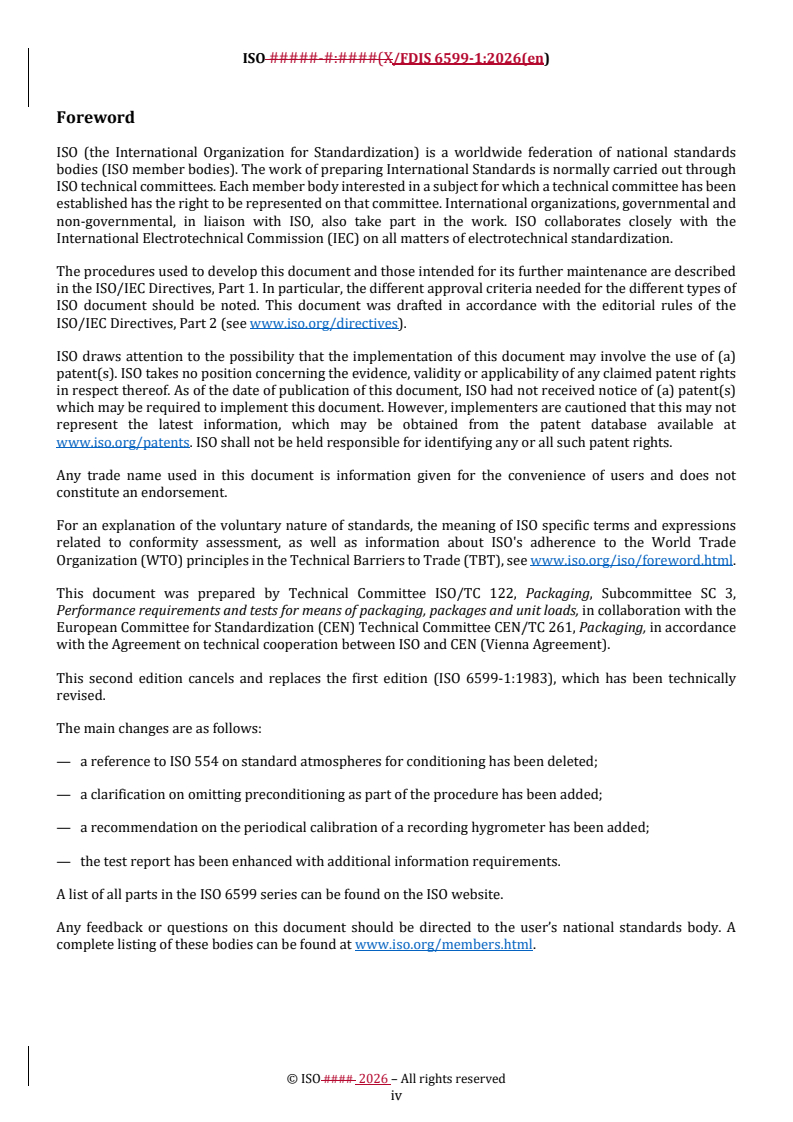
ISO #####-#:####(X/FDIS 6599-1:2026(en)
Foreword
ISO (the International Organization for Standardization) is a worldwide federation of national standards
bodies (ISO member bodies). The work of preparing International Standards is normally carried out through
ISO technical committees. Each member body interested in a subject for which a technical committee has been
established has the right to be represented on that committee. International organizations, governmental and
non-governmental, in liaison with ISO, also take part in the work. ISO collaborates closely with the
International Electrotechnical Commission (IEC) on all matters of electrotechnical standardization.
The procedures used to develop this document and those intended for its further maintenance are described
in the ISO/IEC Directives, Part 1. In particular, the different approval criteria needed for the different types of
ISO document should be noted. This document was drafted in accordance with the editorial rules of the
ISO/IEC Directives, Part 2 (see www.iso.org/directives).
ISO draws attention to the possibility that the implementation of this document may involve the use of (a)
patent(s). ISO takes no position concerning the evidence, validity or applicability of any claimed patent rights
in respect thereof. As of the date of publication of this document, ISO had not received notice of (a) patent(s)
which may be required to implement this document. However, implementers are cautioned that this may not
represent the latest information, which may be obtained from the patent database available at
www.iso.org/patents. ISO shall not be held responsible for identifying any or all such patent rights.
Any trade name used in this document is information given for the convenience of users and does not
constitute an endorsement.
For an explanation of the voluntary nature of standards, the meaning of ISO specific terms and expressions
related to conformity assessment, as well as information about ISO's adherence to the World Trade
Organization (WTO) principles in the Technical Barriers to Trade (TBT), see www.iso.org/iso/foreword.html.
This document was prepared by Technical Committee ISO/TC 122, Packaging, Subcommittee SC 3,
Performance requirements and tests for means of packaging, packages and unit loads, in collaboration with the
...
PROJET FINAL
Norme
internationale
ISO/TC 122/SC 3
Emballages — Conditionnement
Secrétariat: BSI
pour essais —
Début de vote:
2026-04-30
Partie 1:
Sacs en papier
Vote clos le:
2026-06-25
Packaging — Conditioning for testing —
Part 1: Paper sacks
LES DESTINATAIRES DU PRÉSENT PROJET SONT
INVITÉS À PRÉSENTER, AVEC LEURS OBSERVATIONS,
NOTIFICATION DES DROITS DE PROPRIÉTÉ DONT ILS
AURAIENT ÉVENTUELLEMENT CONNAISSANCE ET À
FOURNIR UNE DOCUMENTATION EXPLICATIVE.
OUTRE LE FAIT D’ÊTRE EXAMINÉS POUR
ÉTABLIR S’ILS SONT ACCEPTABLES À DES FINS
INDUSTRIELLES, TECHNOLOGIQUES ET COM-MERCIALES,
AINSI QUE DU POINT DE VUE DES UTILISATEURS, LES
PROJETS DE NORMES
TRAITEMENT PARALLÈLE ISO/CEN
INTERNATIONALES DOIVENT PARFOIS ÊTRE CONSIDÉRÉS
DU POINT DE VUE DE LEUR POSSI BILITÉ DE DEVENIR DES
NORMES POUVANT
SERVIR DE RÉFÉRENCE DANS LA RÉGLEMENTATION
NATIONALE.
Numéro de référence
PROJET FINAL
Norme
internationale
ISO/TC 122/SC 3
Emballages — Conditionnement
Secrétariat: BSI
pour essais —
Début de vote:
2026-04-30
Partie 1:
Sacs en papier
Vote clos le:
2026-06-25
Packaging — Conditioning for testing —
Part 1: Paper sacks
LES DESTINATAIRES DU PRÉSENT PROJET SONT
INVITÉS À PRÉSENTER, AVEC LEURS OBSERVATIONS,
NOTIFICATION DES DROITS DE PROPRIÉTÉ DONT ILS
DOCUMENT PROTÉGÉ PAR COPYRIGHT AURAIENT ÉVENTUELLEMENT CONNAISSANCE ET À
FOURNIR UNE DOCUMENTATION EXPLICATIVE.
OUTRE LE FAIT D’ÊTRE EXAMINÉS POUR
© ISO 2026
ÉTABLIR S’ILS SONT ACCEPTABLES À DES FINS
Tous droits réservés. Sauf prescription différente ou nécessité dans le contexte de sa mise en œuvre, aucune partie de cette
INDUSTRIELLES, TECHNOLOGIQUES ET COM-MERCIALES,
AINSI QUE DU POINT DE VUE DES UTILISATEURS, LES
publication ne peut êtr
...
Questions, Comments and Discussion
Ask us and Technical Secretary will try to provide an answer. You can facilitate discussion about the standard in here.
Loading comments...