


ISO 7503-2:2016
(Main)Measurement of radioactivity - Measurement and evaluation of surface contamination — Part 2: Test method using wipe-test samples
Measurement of radioactivity - Measurement and evaluation of surface contamination — Part 2: Test method using wipe-test samples
ISO 7503 (all parts) and ISO 8769 are addressed to the people responsible for measuring the radioactivity present on solid surfaces. ISO 7503-2:2016 applies to the evaluation of contamination on surfaces in terms of activity per unit area by an indirect method of measurement. ISO 7503-2:2016 is applicable to well-defined surfaces, such as those of equipment and facilities, containers of radioactive materials, sealed sources and buildings or land. ISO 7503-2:2016 can be used for laboratory and equipment/installation control and for remediation and monitoring activities to comply with release criteria. ISO 7503-2:2016 also refers to institutions/authorities controlling nuclear material transports or material/equipment clearance according to national legislation guideline values or international convention limits. ISO 7503-2:2016 does not apply to contamination of the skin, clothing or loose material, such as gravel. NOTE Direct evaluation of surface contamination from alpha-emitters, beta-emitters and photon emitters is dealt with in ISO 7503-1. The calibration of instruments for the evaluation of radioactive surface contaminations is dealt with in ISO 7503-3.
Mesurage de la radioactivité — Mesurage et évaluation de la contamination de surface — Partie 2: Méthode d'essai utilisant des échantillons d'essai de frottis
L'ISO 7503 (toutes les parties) et l'ISO 8769 s'adressent aux personnes chargées de mesurer la radioactivité présente sur des surfaces solides. ISO 7503-2:2017 de l'ISO 7503 s'applique à l'évaluation de la contamination des surfaces en termes d'activité surfacique, par une méthode de mesure indirecte. ISO 7503-2:2017 est applicable aux surfaces bien définies, telles que celles des équipements et des installations, des conteneurs de matières radioactives, des sources scellées et des bâtiments ou des sols. ISO 7503-2:2017 peut être utilisée pour le contrôle en laboratoire et des équipements/installations ainsi que pour les activités de réhabilitation et de surveillance visant à établir la conformité aux critères de libération. ISO 7503-2:2017 se réfère également aux institutions/autorités chargées du contrôle des transports de matières nucléaires ou de la déclassification des matériels/équipements conformément aux valeurs indicatives des législations nationales ou aux limites des conventions internationales. ISO 7503-2:2017 ne s'applique pas à la contamination de la peau, des vêtements ou des matériaux en vrac (gravier, par exemple). NOTE L'évaluation directe de la contamination de surface par les émetteurs alpha, bêta et photoniques est traitée dans l'ISO 7503‑1. L'étalonnage des instruments utilisés pour l'évaluation de la contamination des surfaces radioactives est traité dans l'ISO 7503‑3.
Merjenje radioaktivnosti - Merjenje in vrednotenje površinske kontaminacije - 2. del: Preizkusna metoda z odvzemom brisa
Standarda ISO 7503 (vsi deli) in ISO 8769 sta namenjena osebam, ki so odgovorne za merjenje prisotnosti radioaktivnosti na trdnih površinah.
Ta del standarda ISO 7503 se uporablja za vrednotenje kontaminacije na površinah v smislu aktivnosti na enoto
površine s posredno metodo merjenja.
Ta del standarda ISO 7503 se uporablja za natančno opredeljene površine, kot so površine opreme in objektov, vsebnikov radioaktivnih materialov, zaprtih virov ter zgradb ali zemljišč.
Ta del standarda ISO 7503 je mogoče uporabljati za nadzorovanje laboratorija in opreme/naprav ter za dejavnosti sanacije in spremljanja, da so izpolnjena merila za sprostitev.
Ta del standarda ISO 7503 se navezuje tudi na institucije/organe, ki nadzorujejo prevoze jedrskega materiala ali carinske postopke za material/opremo v skladu z orientacijskimi vrednostmi nacionalne zakonodaje ali omejitvami mednarodnih konvencij.
Ta del standarda ISO 7503 se ne uporablja za kontaminacijo kože, oblačil ali sipkega materiala, kot je gramoz.
OPOMBA: Neposredno vrednotenje površinske kontaminacije iz alfa in beta oddajnikov ter fotonskih oddajnikov je obravnavano v standardu ISO 7503-1. Umerjanje instrumentov za vrednotenje površinske radioaktivne kontaminacije je obravnavano v standardu ISO 7503-3.
General Information
Relations




Standards Content (Sample)
SLOVENSKI STANDARD
01-januar-2025
Merjenje radioaktivnosti - Merjenje in vrednotenje površinske kontaminacije - 2.
del: Preskusna metoda z uporabo vzorcev za brisanje
Measurement of radioactivity - Measurement and evaluation of surface contamination -
Part 2: Test method using wipe-test samples
Mesurage de la radioactivité — Mesurage et évaluation de la contamination de surface
— Partie 2: Méthode d'essai utilisant des échantillons d'essai de frottis
Ta slovenski standard je istoveten z: ISO 7503-2:2016
ICS:
13.280 Varstvo pred sevanjem Radiation protection
2003-01.Slovenski inštitut za standardizacijo. Razmnoževanje celote ali delov tega standarda ni dovoljeno.
INTERNATIONAL ISO
STANDARD 7503-2
Second edition
2016-01-15
Measurement of radioactivity -
Measurement and evaluation of
surface contamination —
Part 2:
Test method using wipe-test samples
Mesurage de la radioactivité — Mesurage et évaluation de la
contamination de surface —
Partie 2: Méthode d’essai utilisant des échantillons d’essai de frottis
Reference number
©
ISO 2016
© ISO 2016, Published in Switzerland
All rights reserved. Unless otherwise specified, no part of this publication may be reproduced or utilized otherwise in any form
or by any means, electronic or mechanical, including photocopying, or posting on the internet or an intranet, without prior
written permission. Permission can be requested from either ISO at the address below or ISO’s member body in the country of
the requester.
ISO copyright office
Ch. de Blandonnet 8 • CP 401
CH-1214 Vernier, Geneva, Switzerland
Tel. +41 22 749 01 11
Fax +41 22 749 09 47
copyright@iso.org
www.iso.org
ii © ISO 2016 – All rights reserved
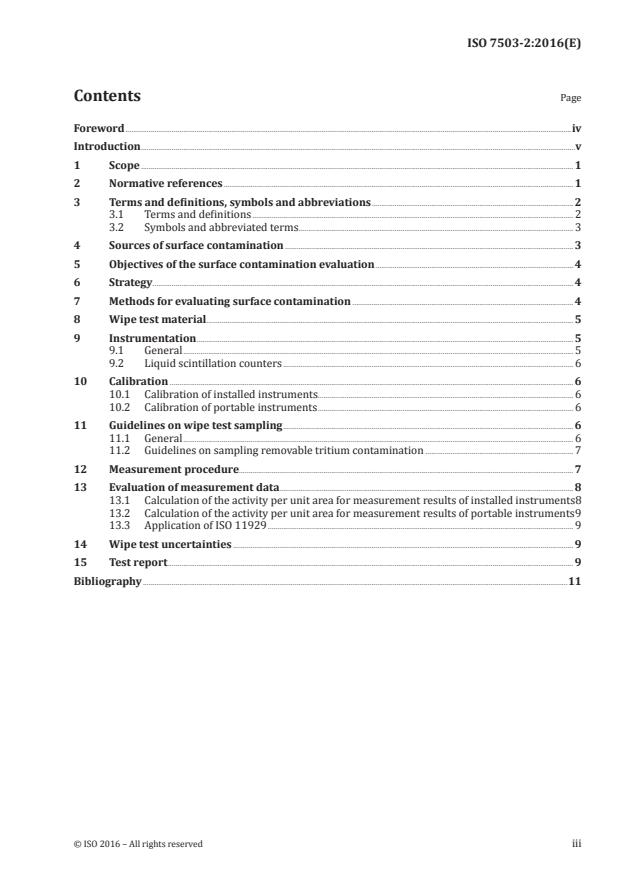
Contents Page
Foreword .iv
Introduction .v
1 Scope . 1
2 Normative references . 1
3 Terms and definitions, symbols and abbreviations . 2
3.1 Terms and definitions . 2
3.2 Symbols and abbreviated terms. 3
4 Sources of surface contamination . 3
5 Objectives of the surface contamination evaluation . 4
6 Strategy. 4
7 Methods for evaluating surface contamination . 4
8 Wipe test material . 5
9 Instrumentation . 5
9.1 General . 5
9.2 Liquid scintillation counters . 6
10 Calibration . 6
10.1 Calibration of installed instruments. 6
10.2 Calibration of portable instruments . 6
11 Guidelines on wipe test sampling . 6
11.1 General . 6
11.2 Guidelines on sampling removable tritium contamination . 7
12 Measurement procedure . 7
13 Evaluation of measurement data. 8
13.1 Calculation of the activity per unit area for measurement results of installed instruments 8
13.2 Calculation of the activity per unit area for measurement results of portable instruments 9
13.3 Application of ISO 11929 . 9
14 Wipe test uncertainties . 9
15 Test report . 9
Bibliography .11
Foreword
ISO (the International Organization for Standardization) is a worldwide federation of national standards
bodies (ISO member bodies). The work of preparing International Standards is normally carried out
through ISO technical committees. Each member body interested in a subject for which a technical
committee has been established has the right to be represented on that committee. International
organizations, governmental and non-governmental, in liaison with ISO, also take part in the work.
ISO collaborates closely with the International Electrotechnical Commission (IEC) on all matters of
electrotechnical standardization.
The procedures used to develop this document and those intended for its further maintenance are
described in the ISO/IEC Directives, Part 1. In particular the different approval criteria needed for the
different types of ISO documents should be noted. This document was drafted in accordance with the
editorial rules of the ISO/IEC Directives, Part 2 (see www.iso.org/directives).
Attention is drawn to the possibility that some of the elements of this document may be the subject of
patent rights. ISO shall not be held responsible for identifying any or all such patent rights. Details of
any patent rights identified during the development of the document will be in the Introduction and/or
on the ISO list of patent declarations received (see www.iso.org/patents).
Any trade name used in this document is information given for the convenience of users and does not
constitute an endorsement.
For an explanation on the meaning of ISO specific terms and expressions related to conformity
assessment, as well as information about ISO’s adherence to the WTO principles in the Technical
Barriers to Trade (TBT) see the following URL: Foreword - Supplementary information
The committee responsible for this document is Technical Committee ISO/TC 85, Nuclear energy, nuclear
technologies, and radiological protection, Subcommittee SC 2, Radiological protection.
This second edition cancels and replaces the first edition (ISO 7503-2:1988), which has been
technically revised.
ISO 7503 consists of the following parts, under the general title Measurement of radioactivity —
Measurement and evaluation of surface contamination:
— Part 1: General principles
— Part 2: Test method using wipe-test samples
— Part 3: Apparatus calibration
iv © ISO 2016 – All rights reserved
Introduction
ISO 7503 gives guidance on the measurement of surface contamination. This International Standard is
applicable to many situations where radioactive contamination can occur. Contamination arises from
the release of radioactivity into the local environment. In most circumstances, the release is inadvertent
but, on occasion, may be deliberate. Although the purpose and scope of the investigation may differ, the
approaches taken to measure the levels and extent of the contamination are essentially similar.
Radioactive contamination can arise from a number of activities or events such as the following:
— routine laboratory use of radiochemicals;
— medical treatments;
— industrial applications;
— transport accidents;
— equipment malfunctions;
— malevolent incidents;
— nuclear accidents.
Without process knowledge or documentation, it is not always possible to identify or distinguish the
different radionuclides constituting a surface contamination, and the evaluation of such contamination
cannot be made on a quantitative basis. Instead of using instruments with nuclide specific calibrations,
it may be necessary to use other instruments which are fit for such a purpose.
However, there may be cases (e.g. a contaminated fuel material transport container) where the
radionuclide or the radionuclide mixture can be clearly characterized. A surface contamination
evaluation exceeding a pure qualitative assessment of fixed and removable surface contamination
may then be needed. Moreover, following requirements laid down in national regulations and in
international conventions, a measured surface contamination activity per unit area has to be compared
with surface contamination guideline values or surface contamination limits.
Surface contamination guideline values are radionuclide-specific and thus require complex
radionuclide-specific calibrations of measurement equipment. Calibration quality assurance is crucial
in order to avoid non-detection (i.e. type II decision errors) leading to incorrectly assuming compliance
with given surface contamination guideline values or limits. Evaluation of surfaces contaminated by a
mixture of radionuclides with known ratios requires respectively proportionated calibration factors.
ISO 7503 is concerned with the measurement and estimation of radioactivity levels. It does not provide
advice on decommissioning, planning and surveillance techniques.
Surface contamination is specified in terms of activity per unit area and the limits are based on the
recommendations by the International Commission on Radiological Protection (ICRP 103).
This part of ISO 7503 deals with the evaluation of surface contamination by indirect measurement
using a wipe test.
INTERNATIONAL STANDARD ISO 7503-2:2016(E)
Measurement of radioactivity - Measurement and
evaluation of surface contamination —
Part 2:
Test method using wipe-test samples
1 Scope
ISO 7503 (all parts) and ISO 8769 are addressed to the people responsible for measuring the
radioactivity present on solid surfaces.
This part of ISO 7503 applies to the evaluation of contamination on surfaces in terms of activity per unit
area by an indirect method of measurement.
This part of ISO 7503 is applicable to well-defined surfaces, such as those of equipment and facilities,
containers of radioactive materials, sealed sources and buildings or land.
This part of ISO 7503 can be used for laboratory and equipment/installation control and for remediation
and monitoring activities to comply with release criteria.
This part of ISO 7503 also refers to institutions/authorities controlling nuclear material transports
or material/equipment clearance according to national legislation guideline values or international
convention limits.
This part of ISO 7503 does not apply to contamination of the skin, clothing or loose material, such as gravel.
NOTE Direct evaluation of surface contamination from alpha-emitters, beta-emitters and photon emitters is
dealt with in ISO 7503-1. The calibration of instruments for the evaluation of radioactive surface contaminations
is dealt with in ISO 7503-3.
2 Normative references
The following documents, in whole or in part, are normatively referenced in this document and are
indispensable for its application. For dated references, only the edition cited applies. For undated
references, the latest edition of the referenced document (including any amendments) applies.
ISO 8769, Reference sources — Calibration of surface contamination monitors — Alpha-, beta- and
photon emitters
ISO 9698, Water quality — Determination of tritium activity concentration — Liquid scintillation
counting method
ISO 11929, Determination of the characteristic limits (decision threshold, detection limit and limits of the
confidence interval) for measurements of ionizing radiation — Fundamentals and application
ISO 18589-2, Measurement of radioactivity in the environment — Soil — Part 2: Guidance for the selection
of the sampling strategy, sampling and pre-treatment of samples
ISO/IEC 17025, General requirements for the competence of testing and calibration laboratories
IEC 60325, Radiation protection instrumentation — Alpha, beta and alpha/beta (beta energy >60 keV)
contamination meters and monitors
3 Terms and definitions, symbols and abbreviations
3.1 Terms and definitions
For the purposes of this document, the following terms and definitions and those given in ISO 7503-1
apply.
3.1.1
removable surface contamination
radioactive material that can be removed from surfaces by non-destructive means, including casual
contact, wiping, or washing
Note 1 to entry: It should be noted that under the influence of moisture, chemicals, etc., or as a result of corrosion
or diffusion, fixed contamination may become removable or vice versa without any human action. Furthermore,
surface contaminations may decrease due to evaporation and volatilization.
Note 2 to entry: It should be emphasized that the ratio between fixed and removable contamination can vary
over time, and that some decisions, such as those related to clearance, should be based on total activity with the
potential to become removable over time, not just the amount that is removable at the time of a survey.
3.1.2
wipe test
test to determine if removable contamination is present through wiping the surface with a dry or wet
material, followed by evaluation of the wipe material for removable contamination
Note 1 to entry: The type of wipe test, wet or dry, needs to be assessed by a competent person. In some instances
(e.g. tritium contamination) a wet wipe may be preferred. In others, it may be more practical or advisable to
use a dry wipe.
3.1.3
wiping efficiency
ratio of the activity of the radionuclides removed from the surface by one wipe sample to the activity of
the radionuclides of the removable surface contamination prior to this sampling
Note 1 to entry: The wiping efficiency is defined by the following relationship:
a
R
ε =
w
a
T
where
a is the activity of the radionuclides removed by wipe test;
R
a is the total removable activity of the radionuclides present on the wiped area.
T
Note 2 to entry: In practice, it is almost impossible to measure the total amount of removable activity on the
surface; and in most cases, a value for “wiping efficiency” cannot be assessed but can only be estimated.
Note 3 to entry: For important combinations of contaminant and surface material, the wiping efficiency can be
determined experimentally using the method of “exhaustive removal by repetitive wipe tests”. The step-by-step
addition of the removed activities results in an approximation of the total removable activity (a ), to which the
T
activity removed by the first wipe test (a ) can then be related to yield the wiping efficiency.
R
Note 4 to entry: The method of “exhaustive removal by repetitive wipe tests” is only applicable if it can be
guaranteed that exactly the same area is wiped on each occasion and exactly the same pressure is maintained
uniformly over the area wiped. Moreover, results of this method are only valid for a specific nature and structure
of a surface and are not transferable to other surface structures.
3.1.4
tritium surface contamination
total activity of tritium adsorbed upon and absorbed into the surface
2 © ISO 2016 – All rights reserved
3.1.5
removable tritium surface contamination
fraction of surface contamination which is removable or transferable under normal working conditions
Note 1 to entry: It should be noted that
a) under external influences of a chemical nature (e.g. moisture, corrosion) or of a physical nature (e.g. ambient
pressure or temperature changes, vibration, impact, expansion and contraction), and also as a result of
diffusion, the total tritium activity may be transformed into removable contamination or non-removable.
The state is reversible multiple times,
b) tritium surface contamination may be volatile or contain volatile fractions which may volatilize under
normal working conditions - this also contributes to the removable contamination and should be evaluated
appropriately (see also Clause 7), and
c) as a result of diffusion of tritium into the surface structure, removal of the tritium surface contamination by
exhaustive wipes may be without effect as the removed tritium contamination may be replaced in short time
(see also Clause 7).
3.1.6
indirect evaluation of removable tritium surface contamination
evaluation of the removable tritium activity by means of a wipe test
Note 1 to entry: Any wipe used for tritium can only be analysed reliably using liquid scintillation counting. Direct
measurements of tritium contaminated wipes may have large uncertainties or are not possible.
3.2 Symbols and abbreviated terms
For the purposes of this part of ISO 7503, the following symbols and those given in ISO 7503-1 apply:
ε wiping efficiency
w
a activity of the radionuclides removed by wipe test in Bq
R
a total removable activity of the radionuclides present on the wiped area in Bq
T
–2
a activity per unit area of the removable contamination of the wiped surface in Bq·cm
r
a activity of the wipe sample in Bq
w
S wiped surface area in cm
w
ind –2 −1
C(A) activity calibration factor for wipe sample in (Bq·cm )/s
4 Sources of surface contamination
A surface can be contaminated with naturally occurring or man-made radionuclides.
40 238 232
The main natural radionuclides are K and radionuclides originating from U and Th decay
series. Natural radioactivity may vary considerably from one type of natural material to another (e.g.
building materials).
Laboratories that intentionally handle naturally occ
...
SLOVENSKI STANDARD
01-januar-2025
Merjenje radioaktivnosti - Merjenje in vrednotenje površinske kontaminacije - 2.
del: Preizkusna metoda z odvzemom brisa
Measurement of radioactivity - Measurement and evaluation of surface contamination -
Part 2: Test method using wipe-test samples
Mesurage de la radioactivité — Mesurage et évaluation de la contamination de surface
— Partie 2: Méthode d'essai utilisant des échantillons d'essai de frottis
Ta slovenski standard je istoveten z: ISO 7503-2:2016
ICS:
13.280 Varstvo pred sevanjem Radiation protection
2003-01.Slovenski inštitut za standardizacijo. Razmnoževanje celote ali delov tega standarda ni dovoljeno.
INTERNATIONAL ISO
STANDARD 7503-2
Second edition
2016-01-15
Measurement of radioactivity -
Measurement and evaluation of
surface contamination —
Part 2:
Test method using wipe-test samples
Mesurage de la radioactivité — Mesurage et évaluation de la
contamination de surface —
Partie 2: Méthode d’essai utilisant des échantillons d’essai de frottis
Reference number
©
ISO 2016
© ISO 2016, Published in Switzerland
All rights reserved. Unless otherwise specified, no part of this publication may be reproduced or utilized otherwise in any form
or by any means, electronic or mechanical, including photocopying, or posting on the internet or an intranet, without prior
written permission. Permission can be requested from either ISO at the address below or ISO’s member body in the country of
the requester.
ISO copyright office
Ch. de Blandonnet 8 • CP 401
CH-1214 Vernier, Geneva, Switzerland
Tel. +41 22 749 01 11
Fax +41 22 749 09 47
copyright@iso.org
www.iso.org
ii © ISO 2016 – All rights reserved
Contents Page
Foreword .iv
Introduction .v
1 Scope . 1
2 Normative references . 1
3 Terms and definitions, symbols and abbreviations . 2
3.1 Terms and definitions . 2
3.2 Symbols and abbreviated terms. 3
4 Sources of surface contamination . 3
5 Objectives of the surface contamination evaluation . 4
6 Strategy. 4
7 Methods for evaluating surface contamination . 4
8 Wipe test material . 5
9 Instrumentation . 5
9.1 General . 5
9.2 Liquid scintillation counters . 6
10 Calibration . 6
10.1 Calibration of installed instruments. 6
10.2 Calibration of portable instruments . 6
11 Guidelines on wipe test sampling . 6
11.1 General . 6
11.2 Guidelines on sampling removable tritium contamination . 7
12 Measurement procedure . 7
13 Evaluation of measurement data. 8
13.1 Calculation of the activity per unit area for measurement results of installed instruments 8
13.2 Calculation of the activity per unit area for measurement results of portable instruments 9
13.3 Application of ISO 11929 . 9
14 Wipe test uncertainties . 9
15 Test report . 9
Bibliography .11
Foreword
ISO (the International Organization for Standardization) is a worldwide federation of national standards
bodies (ISO member bodies). The work of preparing International Standards is normally carried out
through ISO technical committees. Each member body interested in a subject for which a technical
committee has been established has the right to be represented on that committee. International
organizations, governmental and non-governmental, in liaison with ISO, also take part in the work.
ISO collaborates closely with the International Electrotechnical Commission (IEC) on all matters of
electrotechnical standardization.
The procedures used to develop this document and those intended for its further maintenance are
described in the ISO/IEC Directives, Part 1. In particular the different approval criteria needed for the
different types of ISO documents should be noted. This document was drafted in accordance with the
editorial rules of the ISO/IEC Directives, Part 2 (see www.iso.org/directives).
Attention is drawn to the possibility that some of the elements of this document may be the subject of
patent rights. ISO shall not be held responsible for identifying any or all such patent rights. Details of
any patent rights identified during the development of the document will be in the Introduction and/or
on the ISO list of patent declarations received (see www.iso.org/patents).
Any trade name used in this document is information given for the convenience of users and does not
constitute an endorsement.
For an explanation on the meaning of ISO specific terms and expressions related to conformity
assessment, as well as information about ISO’s adherence to the WTO principles in the Technical
Barriers to Trade (TBT) see the following URL: Foreword - Supplementary information
The committee responsible for this document is Technical Committee ISO/TC 85, Nuclear energy, nuclear
technologies, and radiological protection, Subcommittee SC 2, Radiological protection.
This second edition cancels and replaces the first edition (ISO 7503-2:1988), which has been
technically revised.
ISO 7503 consists of the following parts, under the general title Measurement of radioactivity —
Measurement and evaluation of surface contamination:
— Part 1: General principles
— Part 2: Test method using wipe-test samples
— Part 3: Apparatus calibration
iv © ISO 2016 – All rights reserved
Introduction
ISO 7503 gives guidance on the measurement of surface contamination. This International Standard is
applicable to many situations where radioactive contamination can occur. Contamination arises from
the release of radioactivity into the local environment. In most circumstances, the release is inadvertent
but, on occasion, may be deliberate. Although the purpose and scope of the investigation may differ, the
approaches taken to measure the levels and extent of the contamination are essentially similar.
Radioactive contamination can arise from a number of activities or events such as the following:
— routine laboratory use of radiochemicals;
— medical treatments;
— industrial applications;
— transport accidents;
— equipment malfunctions;
— malevolent incidents;
— nuclear accidents.
Without process knowledge or documentation, it is not always possible to identify or distinguish the
different radionuclides constituting a surface contamination, and the evaluation of such contamination
cannot be made on a quantitative basis. Instead of using instruments with nuclide specific calibrations,
it may be necessary to use other instruments which are fit for such a purpose.
However, there may be cases (e.g. a contaminated fuel material transport container) where the
radionuclide or the radionuclide mixture can be clearly characterized. A surface contamination
evaluation exceeding a pure qualitative assessment of fixed and removable surface contamination
may then be needed. Moreover, following requirements laid down in national regulations and in
international conventions, a measured surface contamination activity per unit area has to be compared
with surface contamination guideline values or surface contamination limits.
Surface contamination guideline values are radionuclide-specific and thus require complex
radionuclide-specific calibrations of measurement equipment. Calibration quality assurance is crucial
in order to avoid non-detection (i.e. type II decision errors) leading to incorrectly assuming compliance
with given surface contamination guideline values or limits. Evaluation of surfaces contaminated by a
mixture of radionuclides with known ratios requires respectively proportionated calibration factors.
ISO 7503 is concerned with the measurement and estimation of radioactivity levels. It does not provide
advice on decommissioning, planning and surveillance techniques.
Surface contamination is specified in terms of activity per unit area and the limits are based on the
recommendations by the International Commission on Radiological Protection (ICRP 103).
This part of ISO 7503 deals with the evaluation of surface contamination by indirect measurement
using a wipe test.
INTERNATIONAL STANDARD ISO 7503-2:2016(E)
Measurement of radioactivity - Measurement and
evaluation of surface contamination —
Part 2:
Test method using wipe-test samples
1 Scope
ISO 7503 (all parts) and ISO 8769 are addressed to the people responsible for measuring the
radioactivity present on solid surfaces.
This part of ISO 7503 applies to the evaluation of contamination on surfaces in terms of activity per unit
area by an indirect method of measurement.
This part of ISO 7503 is applicable to well-defined surfaces, such as those of equipment and facilities,
containers of radioactive materials, sealed sources and buildings or land.
This part of ISO 7503 can be used for laboratory and equipment/installation control and for remediation
and monitoring activities to comply with release criteria.
This part of ISO 7503 also refers to institutions/authorities controlling nuclear material transports
or material/equipment clearance according to national legislation guideline values or international
convention limits.
This part of ISO 7503 does not apply to contamination of the skin, clothing or loose material, such as gravel.
NOTE Direct evaluation of surface contamination from alpha-emitters, beta-emitters and photon emitters is
dealt with in ISO 7503-1. The calibration of instruments for the evaluation of radioactive surface contaminations
is dealt with in ISO 7503-3.
2 Normative references
The following documents, in whole or in part, are normatively referenced in this document and are
indispensable for its application. For dated references, only the edition cited applies. For undated
references, the latest edition of the referenced document (including any amendments) applies.
ISO 8769, Reference sources — Calibration of surface contamination monitors — Alpha-, beta- and
photon emitters
ISO 9698, Water quality — Determination of tritium activity concentration — Liquid scintillation
counting method
ISO 11929, Determination of the characteristic limits (decision threshold, detection limit and limits of the
confidence interval) for measurements of ionizing radiation — Fundamentals and application
ISO 18589-2, Measurement of radioactivity in the environment — Soil — Part 2: Guidance for the selection
of the sampling strategy, sampling and pre-treatment of samples
ISO/IEC 17025, General requirements for the competence of testing and calibration laboratories
IEC 60325, Radiation protection instrumentation — Alpha, beta and alpha/beta (beta energy >60 keV)
contamination meters and monitors
3 Terms and definitions, symbols and abbreviations
3.1 Terms and definitions
For the purposes of this document, the following terms and definitions and those given in ISO 7503-1
apply.
3.1.1
removable surface contamination
radioactive material that can be removed from surfaces by non-destructive means, including casual
contact, wiping, or washing
Note 1 to entry: It should be noted that under the influence of moisture, chemicals, etc., or as a result of corrosion
or diffusion, fixed contamination may become removable or vice versa without any human action. Furthermore,
surface contaminations may decrease due to evaporation and volatilization.
Note 2 to entry: It should be emphasized that the ratio between fixed and removable contamination can vary
over time, and that some decisions, such as those related to clearance, should be based on total activity with the
potential to become removable over time, not just the amount that is removable at the time of a survey.
3.1.2
wipe test
test to determine if removable contamination is present through wiping the surface with a dry or wet
material, followed by evaluation of the wipe material for removable contamination
Note 1 to entry: The type of wipe test, wet or dry, needs to be assessed by a competent person. In some instances
(e.g. tritium contamination) a wet wipe may be preferred. In others, it may be more practical or advisable to
use a dry wipe.
3.1.3
wiping efficiency
ratio of the activity of the radionuclides removed from the surface by one wipe sample to the activity of
the radionuclides of the removable surface contamination prior to this sampling
Note 1 to entry: The wiping efficiency is defined by the following relationship:
a
R
ε =
w
a
T
where
a is the activity of the radionuclides removed by wipe test;
R
a is the total removable activity of the radionuclides present on the wiped area.
T
Note 2 to entry: In practice, it is almost impossible to measure the total amount of removable activity on the
surface; and in most cases, a value for “wiping efficiency” cannot be assessed but can only be estimated.
Note 3 to entry: For important combinations of contaminant and surface material, the wiping efficiency can be
determined experimentally using the method of “exhaustive removal by repetitive wipe tests”. The step-by-step
addition of the removed activities results in an approximation of the total removable activity (a ), to which the
T
activity removed by the first wipe test (a ) can then be related to yield the wiping efficiency.
R
Note 4 to entry: The method of “exhaustive removal by repetitive wipe tests” is only applicable if it can be
guaranteed that exactly the same area is wiped on each occasion and exactly the same pressure is maintained
uniformly over the area wiped. Moreover, results of this method are only valid for a specific nature and structure
of a surface and are not transferable to other surface structures.
3.1.4
tritium surface contamination
total activity of tritium adsorbed upon and absorbed into the surface
2 © ISO 2016 – All rights reserved
3.1.5
removable tritium surface contamination
fraction of surface contamination which is removable or transferable under normal working conditions
Note 1 to entry: It should be noted that
a) under external influences of a chemical nature (e.g. moisture, corrosion) or of a physical nature (e.g. ambient
pressure or temperature changes, vibration, impact, expansion and contraction), and also as a result of
diffusion, the total tritium activity may be transformed into removable contamination or non-removable.
The state is reversible multiple times,
b) tritium surface contamination may be volatile or contain volatile fractions which may volatilize under
normal working conditions - this also contributes to the removable contamination and should be evaluated
appropriately (see also Clause 7), and
c) as a result of diffusion of tritium into the surface structure, removal of the tritium surface contamination by
exhaustive wipes may be without effect as the removed tritium contamination may be replaced in short time
(see also Clause 7).
3.1.6
indirect evaluation of removable tritium surface contamination
evaluation of the removable tritium activity by means of a wipe test
Note 1 to entry: Any wipe used for tritium can only be analysed reliably using liquid scintillation counting. Direct
measurements of tritium contaminated wipes may have large uncertainties or are not possible.
3.2 Symbols and abbreviated terms
For the purposes of this part of ISO 7503, the following symbols and those given in ISO 7503-1 apply:
ε wiping efficiency
w
a activity of the radionuclides removed by wipe test in Bq
R
a total removable activity of the radionuclides present on the wiped area in Bq
T
–2
a activity per unit area of the removable contamination of the wiped surface in Bq·cm
r
a activity of the wipe sample in Bq
w
S wiped surface area in cm
w
ind –2 −1
C(A) activity calibration factor for wipe sample in (Bq·cm )/s
4 Sources of surface contamination
A surface can be contaminated with naturally occurring or man-made radionuclides.
40 238 232
The main natural radionuclides are K and radionuclides originating from U and Th decay
series. Natural radioactivity may vary considerably from one type of natural material to another (e.g.
building materials).
Laboratories that intentionally handle naturally occurring
...
INTERNATIONAL ISO
STANDARD 7503-2
Second edition
2016-01-15
Measurement of radioactivity -
Measurement and evaluation of
surface contamination —
Part 2:
Test method using wipe-test samples
Mesurage de la radioactivité — Mesurage et évaluation de la
contamination de surface —
Partie 2: Méthode d’essai utilisant des échantillons d’essai de frottis
Reference number
©
ISO 2016
© ISO 2016, Published in Switzerland
All rights reserved. Unless otherwise specified, no part of this publication may be reproduced or utilized otherwise in any form
or by any means, electronic or mechanical, including photocopying, or posting on the internet or an intranet, without prior
written permission. Permission can be requested from either ISO at the address below or ISO’s member body in the country of
the requester.
ISO copyright office
Ch. de Blandonnet 8 • CP 401
CH-1214 Vernier, Geneva, Switzerland
Tel. +41 22 749 01 11
Fax +41 22 749 09 47
copyright@iso.org
www.iso.org
ii © ISO 2016 – All rights reserved
Contents Page
Foreword .iv
Introduction .v
1 Scope . 1
2 Normative references . 1
3 Terms and definitions, symbols and abbreviations . 2
3.1 Terms and definitions . 2
3.2 Symbols and abbreviated terms. 3
4 Sources of surface contamination . 3
5 Objectives of the surface contamination evaluation . 4
6 Strategy. 4
7 Methods for evaluating surface contamination . 4
8 Wipe test material . 5
9 Instrumentation . 5
9.1 General . 5
9.2 Liquid scintillation counters . 6
10 Calibration . 6
10.1 Calibration of installed instruments. 6
10.2 Calibration of portable instruments . 6
11 Guidelines on wipe test sampling . 6
11.1 General . 6
11.2 Guidelines on sampling removable tritium contamination . 7
12 Measurement procedure . 7
13 Evaluation of measurement data. 8
13.1 Calculation of the activity per unit area for measurement results of installed instruments 8
13.2 Calculation of the activity per unit area for measurement results of portable instruments 9
13.3 Application of ISO 11929 . 9
14 Wipe test uncertainties . 9
15 Test report . 9
Bibliography .11
Foreword
ISO (the International Organization for Standardization) is a worldwide federation of national standards
bodies (ISO member bodies). The work of preparing International Standards is normally carried out
through ISO technical committees. Each member body interested in a subject for which a technical
committee has been established has the right to be represented on that committee. International
organizations, governmental and non-governmental, in liaison with ISO, also take part in the work.
ISO collaborates closely with the International Electrotechnical Commission (IEC) on all matters of
electrotechnical standardization.
The procedures used to develop this document and those intended for its further maintenance are
described in the ISO/IEC Directives, Part 1. In particular the different approval criteria needed for the
different types of ISO documents should be noted. This document was drafted in accordance with the
editorial rules of the ISO/IEC Directives, Part 2 (see www.iso.org/directives).
Attention is drawn to the possibility that some of the elements of this document may be the subject of
patent rights. ISO shall not be held responsible for identifying any or all such patent rights. Details of
any patent rights identified during the development of the document will be in the Introduction and/or
on the ISO list of patent declarations received (see www.iso.org/patents).
Any trade name used in this document is information given for the convenience of users and does not
constitute an endorsement.
For an explanation on the meaning of ISO specific terms and expressions related to conformity
assessment, as well as information about ISO’s adherence to the WTO principles in the Technical
Barriers to Trade (TBT) see the following URL: Foreword - Supplementary information
The committee responsible for this document is Technical Committee ISO/TC 85, Nuclear energy, nuclear
technologies, and radiological protection, Subcommittee SC 2, Radiological protection.
This second edition cancels and replaces the first edition (ISO 7503-2:1988), which has been
technically revised.
ISO 7503 consists of the following parts, under the general title Measurement of radioactivity —
Measurement and evaluation of surface contamination:
— Part 1: General principles
— Part 2: Test method using wipe-test samples
— Part 3: Apparatus calibration
iv © ISO 2016 – All rights reserved
Introduction
ISO 7503 gives guidance on the measurement of surface contamination. This International Standard is
applicable to many situations where radioactive contamination can occur. Contamination arises from
the release of radioactivity into the local environment. In most circumstances, the release is inadvertent
but, on occasion, may be deliberate. Although the purpose and scope of the investigation may differ, the
approaches taken to measure the levels and extent of the contamination are essentially similar.
Radioactive contamination can arise from a number of activities or events such as the following:
— routine laboratory use of radiochemicals;
— medical treatments;
— industrial applications;
— transport accidents;
— equipment malfunctions;
— malevolent incidents;
— nuclear accidents.
Without process knowledge or documentation, it is not always possible to identify or distinguish the
different radionuclides constituting a surface contamination, and the evaluation of such contamination
cannot be made on a quantitative basis. Instead of using instruments with nuclide specific calibrations,
it may be necessary to use other instruments which are fit for such a purpose.
However, there may be cases (e.g. a contaminated fuel material transport container) where the
radionuclide or the radionuclide mixture can be clearly characterized. A surface contamination
evaluation exceeding a pure qualitative assessment of fixed and removable surface contamination
may then be needed. Moreover, following requirements laid down in national regulations and in
international conventions, a measured surface contamination activity per unit area has to be compared
with surface contamination guideline values or surface contamination limits.
Surface contamination guideline values are radionuclide-specific and thus require complex
radionuclide-specific calibrations of measurement equipment. Calibration quality assurance is crucial
in order to avoid non-detection (i.e. type II decision errors) leading to incorrectly assuming compliance
with given surface contamination guideline values or limits. Evaluation of surfaces contaminated by a
mixture of radionuclides with known ratios requires respectively proportionated calibration factors.
ISO 7503 is concerned with the measurement and estimation of radioactivity levels. It does not provide
advice on decommissioning, planning and surveillance techniques.
Surface contamination is specified in terms of activity per unit area and the limits are based on the
recommendations by the International Commission on Radiological Protection (ICRP 103).
This part of ISO 7503 deals with the evaluation of surface contamination by indirect measurement
using a wipe test.
INTERNATIONAL STANDARD ISO 7503-2:2016(E)
Measurement of radioactivity - Measurement and
evaluation of surface contamination —
Part 2:
Test method using wipe-test samples
1 Scope
ISO 7503 (all parts) and ISO 8769 are addressed to the people responsible for measuring the
radioactivity present on solid surfaces.
This part of ISO 7503 applies to the evaluation of contamination on surfaces in terms of activity per unit
area by an indirect method of measurement.
This part of ISO 7503 is applicable to well-defined surfaces, such as those of equipment and facilities,
containers of radioactive materials, sealed sources and buildings or land.
This part of ISO 7503 can be used for laboratory and equipment/installation control and for remediation
and monitoring activities to comply with release criteria.
This part of ISO 7503 also refers to institutions/authorities controlling nuclear material transports
or material/equipment clearance according to national legislation guideline values or international
convention limits.
This part of ISO 7503 does not apply to contamination of the skin, clothing or loose material, such as gravel.
NOTE Direct evaluation of surface contamination from alpha-emitters, beta-emitters and photon emitters is
dealt with in ISO 7503-1. The calibration of instruments for the evaluation of radioactive surface contaminations
is dealt with in ISO 7503-3.
2 Normative references
The following documents, in whole or in part, are normatively referenced in this document and are
indispensable for its application. For dated references, only the edition cited applies. For undated
references, the latest edition of the referenced document (including any amendments) applies.
ISO 8769, Reference sources — Calibration of surface contamination monitors — Alpha-, beta- and
photon emitters
ISO 9698, Water quality — Determination of tritium activity concentration — Liquid scintillation
counting method
ISO 11929, Determination of the characteristic limits (decision threshold, detection limit and limits of the
confidence interval) for measurements of ionizing radiation — Fundamentals and application
ISO 18589-2, Measurement of radioactivity in the environment — Soil — Part 2: Guidance for the selection
of the sampling strategy, sampling and pre-treatment of samples
ISO/IEC 17025, General requirements for the competence of testing and calibration laboratories
IEC 60325, Radiation protection instrumentation — Alpha, beta and alpha/beta (beta energy >60 keV)
contamination meters and monitors
3 Terms and definitions, symbols and abbreviations
3.1 Terms and definitions
For the purposes of this document, the following terms and definitions and those given in ISO 7503-1
apply.
3.1.1
removable surface contamination
radioactive material that can be removed from surfaces by non-destructive means, including casual
contact, wiping, or washing
Note 1 to entry: It should be noted that under the influence of moisture, chemicals, etc., or as a result of corrosion
or diffusion, fixed contamination may become removable or vice versa without any human action. Furthermore,
surface contaminations may decrease due to evaporation and volatilization.
Note 2 to entry: It should be emphasized that the ratio between fixed and removable contamination can vary
over time, and that some decisions, such as those related to clearance, should be based on total activity with the
potential to become removable over time, not just the amount that is removable at the time of a survey.
3.1.2
wipe test
test to determine if removable contamination is present through wiping the surface with a dry or wet
material, followed by evaluation of the wipe material for removable contamination
Note 1 to entry: The type of wipe test, wet or dry, needs to be assessed by a competent person. In some instances
(e.g. tritium contamination) a wet wipe may be preferred. In others, it may be more practical or advisable to
use a dry wipe.
3.1.3
wiping efficiency
ratio of the activity of the radionuclides removed from the surface by one wipe sample to the activity of
the radionuclides of the removable surface contamination prior to this sampling
Note 1 to entry: The wiping efficiency is defined by the following relationship:
a
R
ε =
w
a
T
where
a is the activity of the radionuclides removed by wipe test;
R
a is the total removable activity of the radionuclides present on the wiped area.
T
Note 2 to entry: In practice, it is almost impossible to measure the total amount of removable activity on the
surface; and in most cases, a value for “wiping efficiency” cannot be assessed but can only be estimated.
Note 3 to entry: For important combinations of contaminant and surface material, the wiping efficiency can be
determined experimentally using the method of “exhaustive removal by repetitive wipe tests”. The step-by-step
addition of the removed activities results in an approximation of the total removable activity (a ), to which the
T
activity removed by the first wipe test (a ) can then be related to yield the wiping efficiency.
R
Note 4 to entry: The method of “exhaustive removal by repetitive wipe tests” is only applicable if it can be
guaranteed that exactly the same area is wiped on each occasion and exactly the same pressure is maintained
uniformly over the area wiped. Moreover, results of this method are only valid for a specific nature and structure
of a surface and are not transferable to other surface structures.
3.1.4
tritium surface contamination
total activity of tritium adsorbed upon and absorbed into the surface
2 © ISO 2016 – All rights reserved
3.1.5
removable tritium surface contamination
fraction of surface contamination which is removable or transferable under normal working conditions
Note 1 to entry: It should be noted that
a) under external influences of a chemical nature (e.g. moisture, corrosion) or of a physical nature (e.g. ambient
pressure or temperature changes, vibration, impact, expansion and contraction), and also as a result of
diffusion, the total tritium activity may be transformed into removable contamination or non-removable.
The state is reversible multiple times,
b) tritium surface contamination may be volatile or contain volatile fractions which may volatilize under
normal working conditions - this also contributes to the removable contamination and should be evaluated
appropriately (see also Clause 7), and
c) as a result of diffusion of tritium into the surface structure, removal of the tritium surface contamination by
exhaustive wipes may be without effect as the removed tritium contamination may be replaced in short time
(see also Clause 7).
3.1.6
indirect evaluation of removable tritium surface contamination
evaluation of the removable tritium activity by means of a wipe test
Note 1 to entry: Any wipe used for tritium can only be analysed reliably using liquid scintillation counting. Direct
measurements of tritium contaminated wipes may have large uncertainties or are not possible.
3.2 Symbols and abbreviated terms
For the purposes of this part of ISO 7503, the following symbols and those given in ISO 7503-1 apply:
ε wiping efficiency
w
a activity of the radionuclides removed by wipe test in Bq
R
a total removable activity of the radionuclides present on the wiped area in Bq
T
–2
a activity per unit area of the removable contamination of the wiped surface in Bq·cm
r
a activity of the wipe sample in Bq
w
S wiped surface area in cm
w
ind –2 −1
C(A) activity calibration factor for wipe sample in (Bq·cm )/s
4 Sources of surface contamination
A surface can be contaminated with naturally occurring or man-made radionuclides.
40 238 232
The main natural radionuclides are K and radionuclides originating from U and Th decay
series. Natural radioactivity may vary considerably from one type of natural material to another (e.g.
building materials).
Laboratories that intentionally handle naturally occurring radioactive material, such as radium or
thorium, should anticipate surface contamination from these radionuclides.
The sources of surface contamination by man-made radionuclides can arise from a number of activities
such as the following:
— routine laboratory use of radio chemicals;
— medical treatments;
— industrial applications;
— transport accidents;
— equipment malfunctions;
— malevolent incidents;
— nuclear acc
...
NORME ISO
INTERNATIONALE 7503-2
Deuxième édition
2016-01-15
Mesurage de la radioactivité —
Mesurage et évaluation de la
contamination de surface —
Partie 2:
Méthode d’essai utilisant des
échantillons d’essai de frottis
Measurement of radioactivity - Measurement and evaluation of
surface contamination —
Part 2: Test method using wipe-test samples
Numéro de référence
©
ISO 2016
DOCUMENT PROTÉGÉ PAR COPYRIGHT
© ISO 2016, Publié en Suisse
Droits de reproduction réservés. Sauf indication contraire, aucune partie de cette publication ne peut être reproduite ni utilisée
sous quelque forme que ce soit et par aucun procédé, électronique ou mécanique, y compris la photocopie, l’affichage sur
l’internet ou sur un Intranet, sans autorisation écrite préalable. Les demandes d’autorisation peuvent être adressées à l’ISO à
l’adresse ci-après ou au comité membre de l’ISO dans le pays du demandeur.
ISO copyright office
Ch. de Blandonnet 8 • CP 401
CH-1214 Vernier, Geneva, Switzerland
Tel. +41 22 749 01 11
Fax +41 22 749 09 47
copyright@iso.org
www.iso.org
ii © ISO 2016 – Tous droits réservés
Sommaire Page
Avant-propos .iv
Introduction .v
1 Domaine d’application . 1
2 Références normatives . 1
3 Termes et définitions, symboles et abréviations . 2
3.1 Termes et définitions . 2
3.2 Symboles et abréviations . 3
4 Sources de contamination de surface . 3
5 Objectifs de l’évaluation de la contamination de surface . 4
6 Stratégie . 4
7 Méthodes pour évaluer la contamination de surface . 5
8 Matériau de prélèvement par frottis . 5
9 Instrumentation . 6
9.1 Généralités . 6
9.2 Compteurs à scintillation liquide . 6
10 Étalonnage . 7
10.1 Étalonnage des instruments fixes . 7
10.2 Étalonnage des instruments portatifs. 7
11 Lignes directrices pour le prélèvement par frottis . 7
11.1 Généralités . 7
11.2 Lignes directrices pour le prélèvement de la contamination par le tritium non fixée. 7
12 Mode opératoire de mesure . 8
13 Évaluation des données de mesure . 9
13.1 Calcul de l’activité surfacique pour les résultats de mesure des instruments fixes . 9
13.2 Calcul de l’activité surfacique pour les résultats de mesure des instruments portatifs . 9
13.3 Application de l’ISO 11929 .10
14 Incertitude des essais par frottis .10
15 Rapport d’essai .10
Bibliographie .12
Avant-propos
L’ISO (Organisation internationale de normalisation) est une fédération mondiale d’organismes
nationaux de normalisation (comités membres de l’ISO). L’élaboration des Normes internationales est
en général confiée aux comités techniques de l’ISO. Chaque comité membre intéressé par une étude
a le droit de faire partie du comité technique créé à cet effet. Les organisations internationales,
gouvernementales et non gouvernementales, en liaison avec l’ISO participent également aux travaux.
L’ISO collabore étroitement avec la Commission électrotechnique internationale (IEC) en ce qui
concerne la normalisation électrotechnique.
Les procédures utilisées pour élaborer le présent document et celles destinées à sa mise à jour sont
décrites dans les Directives ISO/IEC, Partie 1. Il convient, en particulier de prendre note des différents
critères d’approbation requis pour les différents types de documents ISO. Le présent document a été
rédigé conformément aux règles de rédaction données dans les Directives ISO/IEC, Partie 2 (voir www.
iso.org/directives).
L’attention est appelée sur le fait que certains des éléments du présent document peuvent faire l’objet de
droits de propriété intellectuelle ou de droits analogues. L’ISO ne saurait être tenue pour responsable
de ne pas avoir identifié de tels droits de propriété et averti de leur existence. Les détails concernant
les références aux droits de propriété intellectuelle ou autres droits analogues identifiés lors de
l’élaboration du document sont indiqués dans l’Introduction et/ou dans la liste des déclarations de
brevets reçues par l’ISO (voir www.iso.org/brevets).
Les appellations commerciales éventuellement mentionnées dans le présent document sont données
pour information, par souci de commodité, à l’intention des utilisateurs et ne sauraient constituer un
engagement.
Pour une explication de la nature volontaire des normes, la signification des termes et expressions
spécifiques de l’ISO liés à l’évaluation de la conformité, ou pour toute information au sujet de l’adhésion
de l’ISO aux principes de l’OMC concernant les obstacles techniques au commerce (OTC), voir le lien
suivant: www.iso.org/iso/fr/foreword.html.
Le comité chargé de l’élaboration du présent document est l’ISO/TC 85, Énergie nucléaire, technologies
nucléaires et radioprotection, Sous-comité SC 2, Radioprotection.
Cette deuxième édition annule et remplace la première édition (ISO 7503-2:1988), qui a fait l’objet d’une
révision technique.
L’ISO 7503 comprend les parties suivantes, présentées sous le titre général Mesurage de la radioactivité —
Mesurage et évaluation de la contamination de surface:
— Partie 1: Principes généraux
— Partie 2: Méthode d’essai utilisant des échantillons d’essai de frottis
— Partie 3: Étalonnage de l’appareillage
iv © ISO 2016 – Tous droits réservés
Introduction
L’ISO 7503 fournit des lignes directrices pour le mesurage de la contamination de surface. La présente
Norme internationale est applicable à de nombreuses situations où peut survenir une contamination
radioactive résultant d’un rejet radioactif dans l’environnement local. Dans la majorité des cas, ce rejet
est accidentel mais il peut parfois être délibéré. Bien que le but et le domaine d’application de l’étude
puissent différer, les approches adoptées pour mesurer les niveaux et l’étendue de la contamination
sont sensiblement similaires.
La contamination radioactive peut résulter d’un certain nombre d’activités ou d’événements tels que:
— l’utilisation régulière de produits radiochimiques en laboratoire;
— les traitements médicaux;
— les applications industrielles;
— les accidents de transport;
— les dysfonctionnements d’équipements;
— les incidents malveillants;
— les accidents nucléaires.
Sans connaissance des processus ni documentation, il n’est pas toujours possible d’identifier ou de
distinguer les différents radionucléides constituant une contamination de surface et cette contamination
ne peut pas être évaluée sur une base quantitative. Au lieu d’utiliser des instruments dont l’étalonnage est
spécifique à un nucléide, il peut être nécessaire d’utiliser des instruments spécialement conçus à cet effet.
Cependant, il peut exister certaines situations (contamination d’un conteneur de transport de
combustible, par exemple) où le radionucléide ou le mélange de radionucléides peut être clairement
caractérisé. Une évaluation de la contamination de surface allant au-delà d’une pure évaluation
qualitative de la contamination de surface fixée et non fixée peut alors être requise. En outre, sur la base
des exigences exposées dans les réglementations nationales et dans les conventions internationales, une
activité surfacique de la contamination de surface mesurée doit être comparée à des valeurs indicatives
et des limites de contamination de surface.
Les valeurs indicatives de contamination de surface sont spécifiques aux radionucléides et peuvent
donc nécessiter un étalonnage spécifique complexe des radionucléides de l’équipement de mesure.
L ‘assurance qualité de l’étalonnage est cruciale pour éviter une non-détection (c’est-à-dire les erreurs
de décision de type II) conduisant à supposer, à tort, la conformité aux valeurs indicatives ou aux
limites données de contamination de surface. L’évaluation des surfaces contaminées par un mélange
de radionucléides dont les rapports sont connus nécessite des facteurs d’étalonnage respectivement
proportionnels.
L’ISO 7503 porte sur le mesurage et l’estimation des niveaux de radioactivité. Elle ne donne aucun
conseil sur les techniques de déclassement, de planification et de surveillance.
La contamination de surface est spécifiée en termes d’activité surfacique et les limites sont fondées sur
les recommandations de la Commission Internationale de Protection Radiologique (ICRP 103).
La présente partie de l’ISO 7503 traite de l’évaluation de la contamination de surface par mesurage
indirect en utilisant un essai par frottis.
NORME INTERNATIONALE ISO 7503-2:2016(F)
Mesurage de la radioactivité — Mesurage et évaluation de
la contamination de surface —
Partie 2:
Méthode d’essai utilisant des échantillons d’essai de frottis
1 Domaine d’application
L’ISO 7503 (toutes les parties) et l’ISO 8769 s’adressent aux personnes chargées de mesurer la
radioactivité présente sur des surfaces solides.
La présente partie de l’ISO 7503 s’applique à l’évaluation de la contamination des surfaces en termes
d’activité surfacique, par une méthode de mesure indirecte.
La présente partie de l’ISO 7503 est applicable aux surfaces bien définies, telles que celles des
équipements et des installations, des conteneurs de matières radioactives, des sources scellées et des
bâtiments ou des sols.
La présente partie de l’ISO 7503 peut être utilisée pour le contrôle en laboratoire et des
équipements/installations ainsi que pour les activités de réhabilitation et de surveillance visant à
établir la conformité aux critères de libération.
La présente partie de l’ISO 7503 se réfère également aux institutions/autorités chargées du contrôle des
transports de matières nucléaires ou de la déclassification des matériels/équipements conformément
aux valeurs indicatives des législations nationales ou aux limites des conventions internationales.
La présente partie de l’ISO 7503 ne s’applique pas à la contamination de la peau, des vêtements ou des
matériaux en vrac (gravier, par exemple).
NOTE L’évaluation directe de la contamination de surface par les émetteurs alpha, bêta et photoniques est
traitée dans l’ISO 7503-1. L’étalonnage des instruments utilisés pour l’évaluation de la contamination des surfaces
radioactives est traité dans l’ISO 7503-3.
2 Références normatives
Les documents ci-après, dans leur intégralité ou non, sont des références normatives indispensables à
l’application du présent document. Pour les références datées, seule l’édition citée s’applique. Pour les
références non datées, la dernière édition du document de référence s’applique (y compris les éventuels
amendements).
ISO 8769, Sources de référence — Étalonnage des contrôleurs de contamination de surface — Émetteurs
alpha, bêta et photoniques
ISO 9698, Qualité de l’eau — Détermination de l’activité volumique du tritium — Méthode par comptage
des scintillations en milieu liquide
ISO 11929, Détermination des limites caractéristiques (seuil de décision, limite de détection et extrémités
de l’intervalle de confiance) pour mesurages de rayonnements ionisants — Principes fondamentaux et
applications
ISO 18589-2, Mesurage de la radioactivité dans l’environnement — Sol — Partie 2: Lignes directrices pour
la sélection de la stratégie d’échantillonnage, l’échantillonnage et le prétraitement des échantillons
ISO/IEC 17025, Exigences générales concernant la compétence des laboratoires d’étalonnages et d’essais
IEC 60325, Instrumentation pour la radioprotection — Contaminamètres et moniteurs de contamination
alpha, bêta et alpha/bêta (énergie des bêta >60 keV)
3 Termes et définitions, symboles et abréviations
3.1 Termes et définitions
Pour les besoins du présent document, les termes et définitions suivants s’appliquent ainsi que ceux de
l’ISO 7503-1.
3.1.1
contamination de surface non fixée
matière radioactive qui peut être retirée des surfaces par des moyens non destructifs, tels qu’un simple
contact, un frottis ou un lavage
Note 1 à l’article: Il convient de noter que sous l’effet de l’humidité, de produits chimiques, etc., ou sous l’effet
de phénomènes de corrosion ou de diffusion, une contamination fixée peut devenir non fixée ou vice versa sans
aucune action humaine. De plus, la contamination de surface peut également diminuer en raison de l’évaporation
et de la volatilisation.
Note 2 à l’article: Il convient de souligner que le rapport entre les contaminations fixée et non fixée peut varier
dans le temps et que certaines décisions, telles que celles liées aux déclassements, doivent être fondées sur
l’activité totale qui pourrait devenir non fixée au fil du temps, et non simplement sur la quantité qui n’est pas
fixée au moment de l’étude.
3.1.2
essai par frottis
essai consistant à frotter la surface avec un matériau sec ou humide afin de déterminer la présence
éventuelle de contamination non fixée, suivi d’une évaluation de la contamination non fixée sur le
matériau utilisé pour frotter la surface
Note 1 à l’article: Le type d’essai par frottis (sec ou humide) doit être évalué par une personne compétente. Dans
certains cas (contamination par le tritium, par exemple), un frottis humide peut être préféré. Dans d’autres, un
frottis sec peut être privilégié pour des raisons de commodité ou autres.
3.1.3
rendement du frottis
rapport entre l’activité des radionucléides retirés de la surface en un seul frottis, et l’activité des
radionucléides de la contamination de surface non fixée avant ce prélèvement
Note 1 à l’article: Le rendement du frottis est défini par la relation suivante:
a
R
ε =
w
a
T
où
a est l’activité des radionucléides retirés avec l’essai par frottis;
R
a est l’activité totale non fixée des radionucléides présents sur la surface frottée.
T
Note 2 à l’article: Dans la pratique, il est presque impossible de mesurer la quantité totale d’activité non fixée à la
surface et dans la majorité des cas, la valeur de rendement du frottis ne peut pas être évaluée et peut uniquement
être estimée.
Note 3 à l’article: Pour des combinaisons importantes de contaminant et de matériau de surface, le rendement
du frottis peut être déterminé expérimentalement en utilisant la méthode du «prélèvement total par frottis
répétitifs». L’addition, étape par étape, des activités prélevées conduit à une approximation de l’activité totale
non fixée (a ) à laquelle l’activité prélevée par le premier frottis (a ) peut ensuite être reliée pour déterminer le
T R
rendement du frottis.
2 © ISO 2016 – Tous droits réservés
Note 4 à l’article: La méthode du «prélèvement total par frottis répétitifs» n’est applicable que s’il est possible de
garantir que l’aire de surface couverte est exactement la même pour chaque frottis et que la même pression sur
la surface frottée est maintenue uniforme. En outre, les résultats obtenus par cette méthode sont uniquement
valables pour une nature et une structure spécifiques d’une surface et ne sont pas transposables à d’autres
structures de surface.
3.1.4
contamination de surface par le tritium
activité totale du tritium adsorbé sur et absorbé dans la surface
3.1.5
contamination de surface par le tritium non fixée
fraction de la contamination de surface pouvant être déplacée ou transférée dans des conditions de
travail normales
Note 1 à l’article: Il convient de noter que:
a) sous l’effet d’influences externes de nature chimique (humidité, corrosion, par exemple) ou physique
(variations de pression ou de température ambiantes, vibrations, impact, expansion et contraction, par
exemple) ainsi que par diffusion, l’activité totale du tritium peut se transformer en contamination non fixée
ou fixée. Cet état est plusieurs fois réversible;
b) la contamination de surface par le tritium peut être volatile ou contenir des fractions volatiles qui peuvent
se volatiliser dans les conditions de travail normales - cette volatilisation contribue également à la
contamination non fixée et il convient de l’évaluer de façon appropriée (voir aussi l’Article 7); et
c) suite à la diffusion du tritium dans la structure de la surface, le prélèvement total de la contamination de
surface par le tritium par des frottis peut rester sans effet car la contamination prélevée peut être remplacée
en un court laps de temps (voir aussi l’Article 7).
3.1.6
évaluation indirecte de la contamination de surface par le tritium non fixée
évaluation de l’activité non fixée du tritium au moyen d’un essai par frottis
Note 1 à l’article: Tout frottis utilisé pour le tritium ne peut être analysé de manière fiable qu’en utilisant un
comptage par scintillation liquide. Les mesurages directs des frottis contaminés par le tritium peuvent engendrer
de grandes incertitudes ou sont impossibles.
3.2 Symboles et abréviations
Pour les besoins de la présente partie de l’ISO 7503, les symboles suivants s’appliquent ainsi que ceux
de l’ISO 7503-1:
ε Rendement du frottis
w
a Activité des radionucléides prélevés avec l’essai par frottis, en Bq
R
a Activité totale non fixée des radionucléides présents sur l’aire de surface frottée, en Bq
T
–2
a Activité surfacique de la contamination non fixée de la surface frottée, en Bq·cm
r
a Activité du frottis, en Bq
w
S Aire de surface frottée en cm
w
ind −2 −1
C(A) Facteur d’étalonnage pour une activité du frottis, en (Bq·cm )/s
4 Sources de contamination de surface
Une surface peut être contaminée par des radionucléides naturels ou artificiels.
Les principaux radionucléides naturels sont le K et les radionucléides issus des séries de décroissance
238 232
de l’ U et du Th. La radioactivité naturelle peut considérablement varier d’un type de matériau
naturel à un autre (matériaux de construction, par exemple).
Dans les laboratoires habilités à manipuler intentionnellement des substances radioactives naturelles
(telles que du radium ou du thorium), il convient d’anticiper une contamination de surface par ces
radionucléides.
Les sources de contamination de surface par les radionucléides artificiels peuvent résulter d’un certain
nombre d’activités telles que:
— l’utilisation régulière de produits chimiques radioactifs en laboratoire;
— les traitements médicaux;
— les applications industrielles;
— les accidents de transport;
— les dysfonctionnements d’équipements;
— les incidents malveillants;
— les accidents nucléaires.
5 Objectifs de l’évaluation de la contamination de surface
Le but final est de protéger les travailleurs et l’ensemble de la population directement et indirectement
exposés aux rayonnements (inhalation, ingestion, contact avec la peau et voies d’absorption par la
peau), en mesurant la contamination de surface afin d’évaluer l’impact du rejet et d’éviter la remise en
suspension et la remobilisation de matières radioactives.
La radioprotection dépend de la connaissance de l’activité de surface et de la fraction d’activité non fixée.
La fraction non fixée peut varier au fil du temps (voir l’Article 7) et il convient d
...
SL OVEN SK I SIST ISO 7503-2
S T A NDA RD
januar 2025
Merjenje radioaktivnosti – Merjenje in vrednotenje površinske
kontaminacije – 2. del: Preizkusna metoda z odvzemom brisa
Measurement of radioactivity – Measurement and evaluation of surface
contamination – Part 2: Test method using wipe-test samples
Mesurage de la radioactivité – Mesurage et évaluation de la contamination de
surface – Partie 2: Méthode d'essai utilisant des échantillons d'essai de frottis
Referenčna oznaka
ICS 13.280 SIST ISO 7503-2:2025 (sl)
Nadaljevanje na straneh 2 do 16
© 2026-01. Slovenski inštitut za standardizacijo. Razmnoževanje celote ali delov tega standarda ni dovoljeno.
SIST ISO 7503-2 : 2025
NACIONALNI UVOD
Standard SIST ISO 7503-2 (sl), Merjenje radioaktivnosti – Merjenje in vrednotenje površinske
kontaminacije – 2. del: Preizkusna metoda z odvzemom brisa, 2025, ima status slovenskega standarda
in je istoveten z mednarodnim standardom ISO 7503-2 (en), Measurement of radioactivity –
Measurement and evaluation of surface contamination – Part 2: Test method using wipe-test samples,
2016.
NACIONALNI PREDGOVOR
Mednarodni standard ISO 7503-2:2016 je pripravil tehnični odbor Mednarodne organizacije za
standardizacijo ISO/TC 85 Jedrska energija, jedrska tehnologija in radiološka zaščita, pododbor SC 2
Radiološka zaščita.
Slovenski standard SIST ISO 7503-2:2025 je prevod mednarodnega standarda ISO 7503-2:2016. V
primeru spora glede besedila slovenskega prevoda v tem standardu je odločilen izvirni mednarodni
standard v angleškem jeziku.
Odločitev za izdajo tega prevoda standarda je 26. novembra 2024 sprejel Strokovni svet SIST za
splošno področje.
ZVEZA S STANDARDI
S privzemom tega mednarodnega standarda veljajo za omejeni namen referenčnih standardov vsi
standardi, navedeni v izvirniku, razen standardov, ki so že sprejeti v nacionalno standardizacijo:
SIST EN ISO 8769:2023 Merjenje radioaktivnosti – Radionuklidi, ki oddajajo alfa in beta žarke
ter fotone – Specifikacije referenčnega merilnega standarda za
kalibracijo merilnikov površinske kontaminacije (ISO 8769:2020)
SIST EN ISO 9698:2019 Kakovost vode – Tritij – Preskusna metoda s štetjem s tekočinskim
scintilatorjem (ISO 9698:2019)
SIST EN ISO 18589-2:2024 Merjenje radioaktivnosti v okolju – Tla – 2. del: Navodila za izbiro
strategije vzorčenja, vzorčenje in pripravo vzorcev (ISO 18589-
2:2022)
SIST EN ISO/IEC 17025:2017 Splošne zahteve za usposobljenost preskuševalnih in kalibracijskih
laboratorijev (ISO/IEC 17025:2017)
OSNOVA ZA IZDAJO STANDARDA
– privzem standarda ISO 7503-2:2016
OPOMBI:
– Povsod, kjer se v besedilu standarda uporablja izraz "mednarodni standard", v SIST ISO 7503-
2:2025 to pomeni "slovenski standard".
– Nacionalni uvod in nacionalni predgovor nista sestavni del standarda.
SIST ISO 7503-2 : 2025
Vsebina Stran
Predgovor . 4
Uvod . 5
1 Področje uporabe . 6
2 Zveze s standardi . 6
3 Izrazi in definicije . 7
3.1 Izrazi in definicije . 7
3.2 Simboli in okrajšave . 8
4 Viri površinske kontaminacije . 8
5 Cilji vrednotenja površinske kontaminacije . 9
6 Strategija . 9
7 Metode vrednotenja površinske kontaminacije . 9
8 Material za preizkus z odvzemom brisa . 10
9 Instrumenti . 10
9.1 Splošno . 10
9.2 Tekočinski scintilacijski števci . 11
10 Umerjanje . 11
10.1 Umerjanje stacionarnih instrumentov . 11
10.2 Umerjanje prenosnih instrumentov . 11
11 Smernice za vzorčenje pri preizkusu z odvzemom brisa . 11
11.1 Splošno . 11
11.2 Smernice za vzorčenje odstranljive kontaminacije s tritijem . 12
12 Postopek merjenja . 12
13 Vrednotenje podatkov merjenja . 13
13.1 Izračun aktivnosti na enoto površine za rezultate merjenja stacionarnih instrumentov . 13
13.2 Izračun aktivnosti na enoto površine za rezultate merjenja prenosnih instrumentov . 13
13.3 Uporaba standarda ISO 11929 . 14
14 Negotovosti pri preizkusu z odvzemom brisa . 14
15 Poročilo o preizkusu . 14
Viri in literatura . 16
SIST ISO 7503-2 : 2025
Predgovor
ISO (Mednarodna organizacija za standardizacijo) je svetovna zveza nacionalnih organov za standarde
(članov ISO). Mednarodne standarde navadno pripravljajo tehnični odbori ISO. Vsak član, ki želi delovati
na določenem področju, za katero je bil ustanovljen tehnični odbor, ima pravico biti zastopan v tem
odboru. Pri delu sodelujejo tudi mednarodne vladne in nevladne organizacije, povezane z ISO. V vseh
zadevah, ki so povezane s standardizacijo na področju elektrotehnike, ISO tesno sodeluje z
Mednarodno elektrotehniško komisijo (IEC).
Postopki, uporabljeni pri pripravi tega dokumenta, in predvideni postopki za njegovo vzdrževanje so
opisani v 1. delu direktiv ISO/IEC. Posebna pozornost naj se nameni različnim kriterijem odobritve,
potrebnim za različne vrste dokumentov ISO. Ta dokument je bil zasnovan v skladu z uredniškimi pravili
direktiv ISO/IEC, 2. del (glej www.iso.org/directives).
Opozoriti je treba na možnost, da za nekatere elemente tega dokumenta lahko veljajo patentne pravice.
ISO ne prevzema odgovornosti za identifikacijo katerihkoli ali vseh takih patentnih pravic. Podrobnosti
o morebitnih patentnih pravicah, ki so bile identificirane med pripravo tega dokumenta, bodo navedene
v uvodu in/ali na seznamu ISO s prejetimi patentnimi izjavami (glej www.iso.org/patents).
Trgovska imena, uporabljena v tem dokumentu, so informacije za uporabnike in ne pomenijo podpore
blagovni znamki.
Za razlago pomena specifičnih terminov in izrazov ISO, povezanih z ugotavljanjem skladnosti, ter
informacije o tem, kako ISO upošteva načela WTO o tehničnih ovirah pri trgovanju (TBT), glej naslednjo
povezavo: Predgovor - Dodatne informacije
Za ta dokument je pristojen tehnični odbor ISO/TC 85 Jedrska energija, jedrska tehnologija in varstvo
pred sevanji, pododbor SC 2 Varstvo pred sevanji.
Ta druga izdaja razveljavlja in nadomešča prvo izdajo (ISO 7503-2:1988), ki je bila strokovno revidirana.
Standard ISO 7503 sestavljajo naslednji deli pod skupnim naslovom Merjenje radioaktivnosti – Merjenje
in vrednotenje površinske kontaminacije:
– 1. del: Splošna načela
– 2. del: Preizkusna metoda z odvzemom brisa
– 3. del: Umerjanje naprave
SIST ISO 7503-2 : 2025
Uvod
ISO 7503 vsebuje navodila za merjenje površinske kontaminacije. Ta mednarodni standard se uporablja
v številnih primerih, v katerih lahko pride do radioaktivne kontaminacije. Kontaminacija nastane pri
sproščanju radioaktivnosti v lokalno okolje. V večini primerov je sproščanje nenamerno, včasih pa je
lahko tudi namerno. Čeprav se namen in obseg preiskave lahko razlikujeta, so pristopi za merjenje ravni
in obsega kontaminacije v osnovi podobni.
Radioaktivna kontaminacija lahko nastane zaradi številnih dejavnosti ali dogodkov, kot so:
– rutinska uporaba radioaktivnih kemikalij v laboratoriju,
– medicinski posegi,
– industrijska uporaba,
– nesreče pri prevozu,
– nepravilno delovanje opreme,
– zlonamerni dogodki,
– jedrske nesreče.
Brez poznavanja procesa ali dokumentacije ni vedno mogoče prepoznati različnih radionuklidov, ki
predstavljajo površinsko kontaminacijo, oziroma med njimi razlikovati ter takšne kontaminacije ni
mogoče ovrednotiti na kvantitativni osnovi. Namesto instrumentov, posebej umerjenih za nuklide, je
morda treba uporabiti druge instrumente, ki so primerni za tak namen.
V nekaterih primerih (npr. transportni zabojnik za kontaminirano gorivo) je mogoče radionuklid ali
mešanico radionuklidov jasno določiti, pri čemer je morda potrebno vrednotenje površinske
kontaminacije, ki presega izključno kvalitativno oceno fiksne in odstranljive površinske kontaminacije.
Poleg tega je treba v skladu z zahtevami iz nacionalnih predpisov in mednarodnih konvencij izmerjeno
aktivnost površinske kontaminacije na enoto površine primerjati s priporočenimi ali mejnimi vrednostmi
površinske kontaminacije.
Priporočene vrednosti površinske kontaminacije so specifične za radionuklide, zato zahtevajo
kompleksno merilno opremo, ki je posebej umerjena za radionuklide. Zagotavljanje kakovosti umerjanja
je ključnega pomena, da se prepreči nezaznavanje (tj. napake tipa II), posledica česar so napačne
predpostavke o skladnosti z danimi priporočenimi ali mejnimi vrednostmi površinske kontaminacije. Za
vrednotenje površin, kontaminiranih z mešanico radionuklidov z znanimi razmerji, je potrebna uporaba
ustreznih sorazmernih kalibracijskih faktorjev.
Standard ISO 7503 obravnava merjenje in vrednotenje stopenj radioaktivnosti. Ne daje nasvetov o
tehnikah razgradnje, načrtovanja in nadzora.
Površinska kontaminacija je določena z aktivnostjo na enoto površine, mejne vrednosti pa temeljijo na
priporočilih Mednarodne komisije za varstvo pred sevanji (ICRP 103).
Ta del standarda ISO 7503 obravnava vrednotenje površinske kontaminacije s posredno meritvijo, in
sicer s preizkusom z odvzemom brisa.
SIST ISO 7503-2 : 2025
Merjenje radioaktivnosti – Merjenje in vrednotenje površinske kontaminacije –
2. del: Preizkusna metoda z odvzemom brisa
1 Področje uporabe
Standarda ISO 7503 (vsi deli) in ISO 8769 sta namenjena osebam, ki so odgovorne za merjenje
prisotnosti radioaktivnosti na trdnih površinah.
Ta del standarda ISO 7503 se uporablja za vrednotenje kontaminacije na površinah v smislu aktivnosti
na enoto površine s posredno metodo merjenja.
Ta del standarda ISO 7503 se uporablja za dobro opredeljene površine, kot so površine opreme in
objektov, vsebnikov radioaktivnih materialov, zaprtih virov in zgradb ali zemljišč.
Ta del standarda ISO 7503 je mogoče uporabljati za nadzorovanje laboratorija in opreme/naprav ter za
dejavnosti sanacije in monitoringa, da so izpolnjena merila za opustitev nadzora.
Ta del standarda ISO 7503 se navezuje tudi na institucije/organe, ki nadzorujejo prevoze jedrskega
materiala ali carinske postopke za material/opremo v skladu z orientacijskimi vrednostmi nacionalne
zakonodaje ali omejitvami mednarodnih konvencij.
Ta del standarda ISO 7503 se ne uporablja za kontaminacijo kože, oblačil ali sipkega materiala, kot je
gramoz.
OPOMBA: Neposredno vrednotenje površinske kontaminacije iz sevalcev alfa in beta ter virov, ki oddajajo fotone, je
obravnavano v ISO 7503-1. Umerjanje instrumentov za vrednotenje površinske radioaktivne kontaminacije je
obravnavano v ISO 7503-3.
2 Zveze s standardi
Ta dokument se v celoti ali v delih normativno sklicuje na naslednje dokumente, ki so nepogrešljivi pri
njegovi uporabi. Pri datiranih sklicevanjih se uporablja zgolj navedena izdaja. Pri nedatiranih sklicevanjih
se uporablja zadnja izdaja navedenega dokumenta (vključno z dopolnili).
ISO 8769 Referenčni viri – Umerjanje merilnikov površinske kontaminacije – Alfa in
beta sevalci ter viri, ki oddajajo fotone
ISO 9698 Kakovost vode – Določevanje koncentracije aktivnosti tritija – Metoda
tekočinskega scintilacijskega štetja
ISO 11929 Ugotavljanje karakterističnih mej (odločitveni prag, meja zaznavnosti in meje
intervala zaupanja) pri meritvah ionizirnega sevanja – Osnove in uporaba
ISO 18589-2 Merjenje radioaktivnosti v okolju – Tla – 2. del: Navodila za izbiro strategije
vzorčenja, vzorčenje in pripravo vzorcev
ISO/IEC 17025 Splošne zahteve za usposobljenost preskuševalnih in kalibracijskih
laboratorijev
IEC 60325 Oprema za zaščito pred sevanjem – Merilniki in monitorji za nadzorovanje
kontaminacije z alfa, beta in alfa/beta sevanjem (energija beta > 60 keV)
SIST ISO 7503-2 : 2025
3 Izrazi in definicije
3.1 Izrazi in definicije
V tem dokumentu se uporabljajo spodaj navedeni izrazi in definicije ter izrazi in definicije, ki so podani
v ISO 7503-1.
3.1.1
odstranljiva površinska kontaminacija
radioaktivni material, ki ga je mogoče odstraniti s površin brez njihovega uničenja, vključno z naključnim
stikom, brisanjem ali pranjem.
OPOMBA 1: Pod vplivom vlage, kemikalij itd. ali zaradi korozije ali difuzije lahko fiksna kontaminacija postane odstranljiva (ali
obratno) brez posredovanja človeka. Površinska kontaminacija se lahko zmanjša tudi zaradi izhlapevanja in
hlapnosti.
OPOMBA 2: Razmerje med fiksno in odstranljivo kontaminacijo se lahko sčasoma spremeni, zato naj bi nekatere odločitve, na
primer v zvezi s potrditvijo stanja (clearance), temeljile na celotni aktivnosti, ki lahko sčasoma postane odstranljiva,
ne zgolj na količini, ki je odstranljiva v času meritve.
3.1.2
preizkus z odvzemom brisa
preizkus, s katerim se ugotavlja prisotnost odstranljive kontaminacije z brisanjem površine s suhim ali
mokrim materialom, čemur sledi vrednotenje materiala za brisanje glede na prisotnost kontaminacije
OPOMBA 1: Vrsto preizkusa z odvzemom brisa (mokrega ali suhega) mora oceniti usposobljena oseba. V nekaterih primerih
(npr. kontaminacija s tritijem) je priporočljiva uporaba mokrega brisa. V drugih primerih je morda bolj praktično ali
priporočljivo uporabljati suh bris.
3.1.3
učinkovitost odvzema brisa
razmerje med aktivnostjo radionuklidov, odstranjenih s površine z enim vzorcem brisa, in aktivnostjo
radionuklidov odstranljive površinske kontaminacije pred tem vzorčenjem
OPOMBA 1: Učinkovitost odvzema brisa je opredeljena z naslednjim razmerjem:
𝑎𝑎
𝑅𝑅
𝜀𝜀 =
𝑤𝑤
𝑎𝑎
𝑇𝑇
kjer sta:
a aktivnost radionuklidov, odstranjenih s preizkusom z odvzemom brisa
R
a skupna odstranljiva aktivnost radionuklidov, prisotnih na obrisanem območju
T
OPOMBA 2: V praksi je skupno količino odstranljive aktivnosti na površini skoraj nemogoče izmeriti in v večini primerov je
mogoče podati le oceno vrednosti "učinkovitosti odvzema brisa".
OPOMBA 3: Pri pomembnih kombinacijah kontaminacije in materiala površine je mogoče učinkovitost odvzema brisa določiti
eksperimentalno, z metodo "izčrpnega odstranjevanja s ponavljanjem preizkusov z odvzemom brisa". Z
zaporednim dodajanjem odstranjenih aktivnosti se dobi približek skupne odstranljive aktivnosti (a ). Aktivnost,
T
odstranjena s prvim preizkusom z odvzemom brisa (a ), se nato lahko primerja s to vrednostjo, da se določi
R
učinkovitost odvzema brisa.
OPOMBA 4: Metoda "izčrpnega odstranjevanja s ponavljanjem preizkusov z odvzemom brisa" se uporablja le, če je mogoče
zagotoviti, da se bris vsakič odvzame na isti površini in da se enak pritisk enakomerno ohranja na celotni površini
na kateri je odvzet bris. Poleg tega so rezultati te metode veljavni le za specifično vrsto in strukturo površine in jih
ni mogoče prenesti na druge strukture površin.
3.1.4
površinska kontaminacija s tritijem
skupna aktivnost tritija, adsorbirana na površini in absorbirana v strukturo površine
SIST ISO 7503-2 : 2025
3.1.5
odstranljiva površinska kontaminacija s tritijem
delež površinske kontaminacije, ki ga je v običajnih delovnih razmerah mogoče odstraniti ali prenesti
OPOMBA 1: Upošteva naj se naslednje:
a) ob zunanjih vplivih kemične narave (npr. vlaga, korozija) ali fizične narave (npr. okoljski tlak ali temperaturne
spremembe, tresljaji, udarci, raztezanje in krčenje) ali zaradi difuzije se lahko skupna aktivnost tritija
prenese v odstranljivo ali neodstranljivo kontaminacijo. To stanje je večkratno reverzibilno,
b) površinska kontaminacija s tritijem je lahko hlapna ali vsebuje hlapne deleže, ki lahko v običajnih delovnih
razmerah izhlapijo – tudi to prispeva k odstranljivi kontaminaciji in je treba ustrezno ovrednotiti (glej tudi
točko 7), in
c) zaradi difuzije tritija v strukturo površine je lahko odstranjevanje površinske kontaminacije s tritijem z
izčrpnim odvzemom brisov neučinkovito, ker se lahko odstranjena kontaminacija s tritijem v kratkem času
nadomesti (glej tudi točko 7).
3.1.6
posredno vrednotenje odstranljive površinske kontaminacije s tritijem
vrednotenje odstranljive aktivnosti tritija s preizkusom z odvzemom brisa
OPOMBA 1: Brise, uporabljene za tritij, je mogoče zanesljivo analizirati le s tekočinskim scintilacijskim štetjem. Neposredne
meritve brisov, kontaminiranih s tritijem, so lahko zelo negotove ali pa jih ni mogoče izvesti.
3.2 Simboli in okrajšave
V tem delu standarda ISO 7503 se uporabljajo spodaj navedeni simboli in simboli, podani v ISO 7503-1:
ε učinkovitost odvzema brisa
w
a aktivnost radionuklidov, odstranjenih s preizkusom z odvzemom brisa, izražena v Bq
R
a skupna odstranljiva aktivnost radionuklidov, prisotnih na površini, kjer je bil odvzet bris, izražena
T
v Bq
a aktivnost na enoto površine odstranljive kontaminacije površine, na kateri je bil odvzet bris,
r
–2
izražena v Bqcm
a aktivnost (vzorca) brisa, izražena v Bq
w
S velikost površine, na kateri je bil odvzet bris, izražena v cm
w
ind -2 -1
C(A) kalibracijski faktor aktivnosti za vzorec brisa, izražen v (Bqcm )/s
4 Viri površinske kontaminacije
Površina je lahko kontaminirana z naravnimi ali umetnimi radionuklidi.
40 238 232
Glavni naravni radionuklidi so K ter radionuklidi, ki izvirajo iz razpadnih serij U in Th. Naravna
radioaktivnost se lahko med različnimi vrstami naravnih materialov (npr. gradbeni material) znatno
razlikuje.
V laboratorijih, v katerih se namenoma rokuje z naravnim radioaktivnim materialom, na primer radijem
ali torijem, naj se pričakuje površinska kontaminacija s temi radionuklidi.
Viri površinske kontaminacije z umetnimi radionuklidi lahko nastanejo pri številnih aktivnostih, na primer
pri:
– rutinski uporabi radioaktivnih kemikalij v laboratoriju,
– medicinskih posegih,
– industrijski uporabi,
– nesrečah pri prevozu,
SIST ISO 7503-2 : 2025
– nepravilnem
...
Questions, Comments and Discussion
Ask us and Technical Secretary will try to provide an answer. You can facilitate discussion about the standard in here.