


ISO 13647
(Main)Water quality — Enumeration of culturable microorganisms — Colony count by spread plate inoculation on R2A medium
General Information
- Abstract
This document specifies a method for the enumeration of culturable microorganisms in water by counting the colonies on a low-nutrient agar culture medium after incubation at 22 °C for 7 d. The method is intended to measure the operational efficiency of the treatment process of public drinking water supplies, including the water in distribution systems and containers. The method is particularly suitable to monitor water for human consumption which is low in nutrients and is distributed in temperatures below 20 °C. The method can be applied to all types of water, including pool and spa waters. NOTE 1 The low-nutrient agar in use in this document usually gives higher colony counts from water samples than nutrient-rich formulations of culture media typically used for enumeration of culturable microorganisms. NOTE 2 The method is also applicable for waters of very low nutrient content such as de-ionised, distilled or reverse osmosis waters. NOTE 3 This document describes the use of R2A medium. There are other formulations available, e.g. R3A medium that might be suitable for certain applications but go beyond the scope of this document.
- Status
- Not Published
- Technical Committee
- ISO/TC 147/SC 4 - Microbiological methods
- Drafting Committee
- ISO/TC 147/SC 4 - Microbiological methods
- Current Stage
- 6000 - International Standard under publication
- Start Date
- 10-Jul-2026
- Completion Date
- 11-Jul-2026
Buy Documents
ISO/FDIS 13647 - Water quality — Enumeration of culturable microorganisms — Colony count by spread plate inoculation on R2A medium
REDLINE ISO/FDIS 13647 - Water quality — Enumeration of culturable microorganisms — Colony count by spread plate inoculation on R2A medium
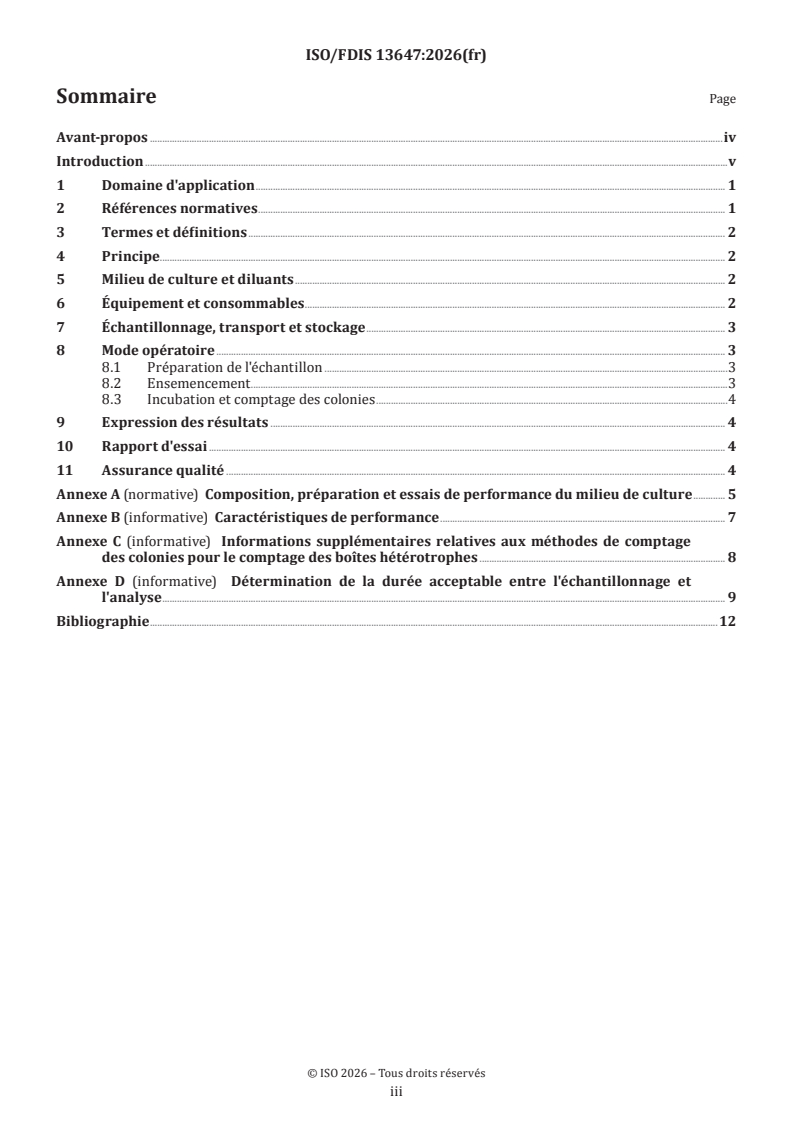
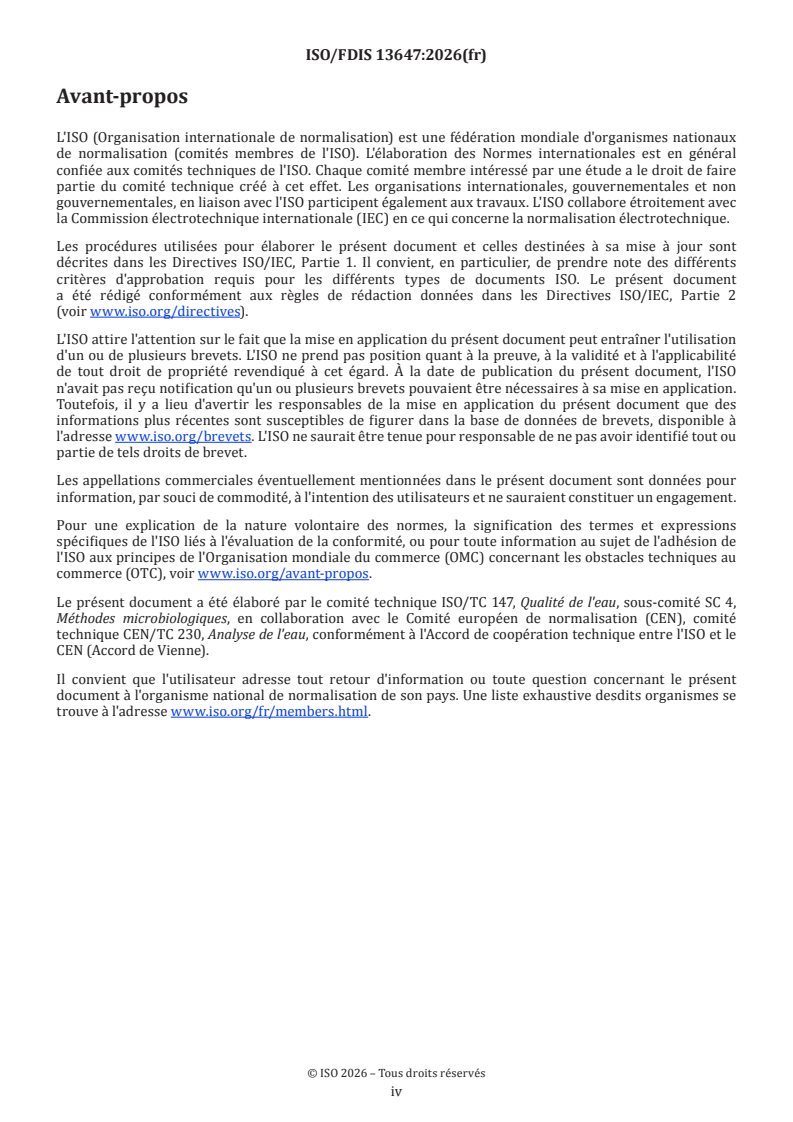
ISO/FDIS 13647 - Qualité de l'eau — Dénombrement des micro-organismes revivifiables — Comptage des colonies par ensemencement par étalement sur un milieu gélosé R2A
Overview
ISO 13647: Water quality – Enumeration of culturable microorganisms – Colony count by spread plate inoculation on R2A medium sets out an internationally recognized method for quantifying culturable microorganisms in water samples. This standard adopts the spread plate technique on R2A, a low-nutrient agar, with incubation at 22 °C for 7 days. ISO 13647 is particularly valuable for assessing water with low nutrient levels, such as treated drinking water, well water, and bottled water. Its methodology is instrumental in monitoring the efficacy of water treatment and the integrity of distribution systems, providing a sensitive indication of changes in microbial water quality.
Key Topics
- Spread Plate Enumeration: Involves inoculating 0.1 ml of water sample onto R2A agar, spreading it uniformly, and incubating the plate to enable visible colony growth.
- R2A Medium: A low-nutrient agar supporting the recovery of slow-growing bacteria that may not thrive on richer media, resulting in higher and more representative colony counts from nutrient-poor water.
- Incubation Conditions: Plates are incubated at 22 °C for 7 days, accommodating the growth of a broader spectrum of culturable bacteria commonly found in treated and distributed waters.
- Sample Handling & Transport: Samples are collected according to ISO 19458 and ISO 5667-5 and should be analyzed promptly, ideally within 24 hours, after storage at 5 °C to minimize changes in microbial populations.
- Result Expression: Colony counts are reported as colony-forming units per milliliter (cfu/ml), following the best practices and calculations described in ISO 8199.
Applications
ISO 13647 delivers practical value in water quality monitoring and management for various sectors:
- Drinking Water Utilities: Essential for tracking microbial water quality in distribution networks, treatment plants, storage facilities, and bottled water operations to ensure compliance with national and international health standards.
- Environmental Laboratories: Supports the evaluation of well water, process water, and other water matrices, providing data for risk assessment and public health protection.
- Swimming Pools and Spas: Suitable for monitoring pool and spa waters, verifying that microbial loads remain within acceptable limits for user safety.
- Quality Control: Used to confirm the effectiveness of water treatment processes and detect anomalies, such as treatment failures or contamination events.
- Research and Validation: Serves as a standardized baseline for studies on waterborne microorganisms and the performance of new water treatment or distribution technologies.
ISO 13647 is especially beneficial for water characterized by low nutrient content and cooler distribution conditions (below 20 °C), where traditional nutrient-rich media may underestimate microbial presence.
Related Standards
For comprehensive water microbiological assessment and ensuring cohesive laboratory practices, consider the following ISO standards related to ISO 13647:
- ISO 5667-5: Guidance on the sampling of drinking water from treatment works and distribution systems.
- ISO 8199: General requirements and guidance for microbiological examinations by culture.
- ISO 11133: Preparation, production, storage, and performance testing of culture media.
- ISO 19458: Sampling for microbiological analysis.
- ISO 6222: Enumeration of culturable microorganisms on nutrient agar at different temperatures and incubation times.
- ISO 29201: Addresses variability, test result expression, and measurement uncertainty in microbiological enumeration.
- ISO 13843 and ISO 17994: Provide requirements for establishing and comparing the performance characteristics of quantitative microbiological methods.
By adhering to ISO 13647 and its related standards, laboratories and water industry professionals can ensure consistent, reliable, and internationally accepted approaches to water quality monitoring and public health protection.
Relations
- Effective Date
- 12-Feb-2026
- Effective Date
- 06-May-2023
Buy Documents
ISO/FDIS 13647 - Water quality — Enumeration of culturable microorganisms — Colony count by spread plate inoculation on R2A medium
REDLINE ISO/FDIS 13647 - Water quality — Enumeration of culturable microorganisms — Colony count by spread plate inoculation on R2A medium
ISO/FDIS 13647 - Qualité de l'eau — Dénombrement des micro-organismes revivifiables — Comptage des colonies par ensemencement par étalement sur un milieu gélosé R2A
Frequently Asked Questions
ISO 13647 is a draft published by the International Organization for Standardization (ISO). Its full title is "Water quality — Enumeration of culturable microorganisms — Colony count by spread plate inoculation on R2A medium". This standard covers: This document specifies a method for the enumeration of culturable microorganisms in water by counting the colonies on a low-nutrient agar culture medium after incubation at 22 °C for 7 d. The method is intended to measure the operational efficiency of the treatment process of public drinking water supplies, including the water in distribution systems and containers. The method is particularly suitable to monitor water for human consumption which is low in nutrients and is distributed in temperatures below 20 °C. The method can be applied to all types of water, including pool and spa waters. NOTE 1 The low-nutrient agar in use in this document usually gives higher colony counts from water samples than nutrient-rich formulations of culture media typically used for enumeration of culturable microorganisms. NOTE 2 The method is also applicable for waters of very low nutrient content such as de-ionised, distilled or reverse osmosis waters. NOTE 3 This document describes the use of R2A medium. There are other formulations available, e.g. R3A medium that might be suitable for certain applications but go beyond the scope of this document.
This document specifies a method for the enumeration of culturable microorganisms in water by counting the colonies on a low-nutrient agar culture medium after incubation at 22 °C for 7 d. The method is intended to measure the operational efficiency of the treatment process of public drinking water supplies, including the water in distribution systems and containers. The method is particularly suitable to monitor water for human consumption which is low in nutrients and is distributed in temperatures below 20 °C. The method can be applied to all types of water, including pool and spa waters. NOTE 1 The low-nutrient agar in use in this document usually gives higher colony counts from water samples than nutrient-rich formulations of culture media typically used for enumeration of culturable microorganisms. NOTE 2 The method is also applicable for waters of very low nutrient content such as de-ionised, distilled or reverse osmosis waters. NOTE 3 This document describes the use of R2A medium. There are other formulations available, e.g. R3A medium that might be suitable for certain applications but go beyond the scope of this document.
ISO 13647 is classified under the following ICS (International Classification for Standards) categories: 07.100.20 - Microbiology of water. The ICS classification helps identify the subject area and facilitates finding related standards.
ISO 13647 has the following relationships with other standards: It is inter standard links to FprEN ISO 13647, ISO/IEC 18033-4:2011/Amd 1:2020. Understanding these relationships helps ensure you are using the most current and applicable version of the standard.
ISO 13647 is available in PDF format for immediate download after purchase. The document can be added to your cart and obtained through the secure checkout process. Digital delivery ensures instant access to the complete standard document.
Standards Content (Sample)
FINAL DRAFT
International
Standard
ISO/FDIS 13647
ISO/TC 147/SC 4
Water quality — Enumeration
Secretariat: DIN
of culturable microorganisms
Voting begins on:
— Colony count by spread plate
2026-05-14
inoculation on R2A medium
Voting terminates on:
2026-07-09
Qualité de l'eau — Dénombrement des micro-organismes
revivifiables — Comptage des colonies par ensemencement par
étalement sur un milieu gélosé R2A
RECIPIENTS OF THIS DRAFT ARE INVITED TO SUBMIT,
WITH THEIR COMMENTS, NOTIFICATION OF ANY
RELEVANT PATENT RIGHTS OF WHICH THEY ARE AWARE
AND TO PROVIDE SUPPOR TING DOCUMENTATION.
IN ADDITION TO THEIR EVALUATION AS
BEING ACCEPTABLE FOR INDUSTRIAL, TECHNO
ISO/CEN PARALLEL PROCESSING LOGICAL, COMMERCIAL AND USER PURPOSES, DRAFT
INTERNATIONAL STANDARDS MAY ON OCCASION HAVE
TO BE CONSIDERED IN THE LIGHT OF THEIR POTENTIAL
TO BECOME STAN DARDS TO WHICH REFERENCE MAY BE
MADE IN NATIONAL REGULATIONS.
Reference number
ISO/FDIS 13647:2026(en) © ISO 2026
FINAL DRAFT
ISO/FDIS 13647:2026(en)
International
Standard
ISO/FDIS 13647
ISO/TC 147/SC 4
Water quality — Enumeration
Secretariat: DIN
of culturable microorganisms
Voting begins on:
— Colony count by spread plate
inoculation on R2A medium
Voting terminates on:
Qualité de l'eau — Dénombrement des micro-organismes
revivifiables — Comptage des colonies par ensemencement par
étalement sur un milieu gélosé R2A
RECIPIENTS OF THIS DRAFT ARE INVITED TO SUBMIT,
WITH THEIR COMMENTS, NOTIFICATION OF ANY
RELEVANT PATENT RIGHTS OF WHICH THEY ARE AWARE
AND TO PROVIDE SUPPOR TING DOCUMENTATION.
© ISO 2026
IN ADDITION TO THEIR EVALUATION AS
All rights reserved. Unless otherwise specified, or required in the context of its implementation, no part of this publication may
BEING ACCEPTABLE FOR INDUSTRIAL, TECHNO
ISO/CEN PARALLEL PROCESSING
LOGICAL, COMMERCIAL AND USER PURPOSES, DRAFT
be reproduced or utilized otherwise in any form or by any means, electronic or mechanical, including photocopying, or posting on
INTERNATIONAL STANDARDS MAY ON OCCASION HAVE
the internet or an intranet, without prior written permission. Permission can be requested from either ISO at the address below
TO BE CONSIDERED IN THE LIGHT OF THEIR POTENTIAL
or ISO’s member body in the country of the requester.
TO BECOME STAN DARDS TO WHICH REFERENCE MAY BE
MADE IN NATIONAL REGULATIONS.
ISO copyright office
CP 401 • Ch. de Blandonnet 8
CH-1214 Vernier, Geneva
Phone: +41 22 749 01 11
Email: copyright@iso.org
Website: www.iso.org
Published in Switzerland Reference number
ISO/FDIS 13647:2026(en) © ISO 2026
ii
ISO/FDIS 13647:2026(en)
Contents Page
Foreword .iv
Introduction .v
1 Scope . 1
2 Normative references . 1
3 Terms and definitions . 1
4 Principle . 2
5 Culture medium and diluents . 2
6 Equipment and consumables . 2
7 Sampling, transport and storage . . 3
8 Procedure . 3
8.1 Preparation of the sample .3
8.2 Inoculation .3
8.3 Incubation and counting of colonies .3
9 Expression of results . 3
10 Test report . 4
11 Quality assurance . 4
Annex A (normative) Composition, preparation and performance testing of culture medium . 5
Annex B (informative) Performance characteristics . 7
Annex C (informative) Additional information about colony counting methods for heterotrophic
plate counting . 8
Annex D (informative) Determination of acceptable time between sampling and analysis . 9
Bibliography .11
iii
ISO/FDIS 13647:2026(en)
Foreword
ISO (the International Organization for Standardization) is a worldwide federation of national standards
bodies (ISO member bodies). The work of preparing International Standards is normally carried out through
ISO technical committees. Each member body interested in a subject for which a technical committee
has been established has the right to be represented on that committee. International organizations,
governmental and non-governmental, in liaison with ISO, also take part in the work. ISO collaborates closely
with the International Electrotechnical Commission (IEC) on all matters of electrotechnical standardization.
The procedures used to develop this document and those intended for its further maintenance are described
in the ISO/IEC Directives, Part 1. In particular, the different approval criteria needed for the different types
of ISO document should be noted. This document was drafted in accordance with the editorial rules of the
ISO/IEC Directives, Part 2 (see www.iso.org/directives).
ISO draws attention to the possibility that the implementation of this document may involve the use of (a)
patent(s). ISO takes no position concerning the evidence, validity or applicability of any claimed patent
rights in respect thereof. As of the date of publication of this document, ISO had not received notice of (a)
patent(s) which may be required to implement this document. However, implementers are cautioned that
this may not represent the latest information, which may be obtained from the patent database available at
www.iso.org/patents. ISO shall not be held responsible for identifying any or all such patent rights.
Any trade name used in this document is information given for the convenience of users and does not
constitute an endorsement.
For an explanation of the voluntary nature of standards, the meaning of ISO specific terms and expressions
related to conformity assessment, as well as information about ISO's adherence to the World Trade
Organization (WTO) principles in the Technical Barriers to Trade (TBT), see www.iso.org/iso/foreword.html.
This document was prepared by Technical Committee ISO/TC 147, Water quality, Subcommittee SC 4,
Microbiological methods, in collaboration with the European Committee for Standardization (CEN) Technical
Committee CEN/TC 230, Water analysis, in accordance with the Agreement on technical cooperation between
ISO and CEN (Vienna Agreement).
Any feedback or questions on this document should be directed to the user’s national standards body. A
complete listing of these bodies can be found at www.iso.org/members.html.
iv
ISO/FDIS 13647:2026(en)
Introduction
Treated drinking water contains a variety of microorganisms derived from various sources, such as raw
water resource, different treatment steps within drinking water production and drinking water distribution
networks.
Enumeration of the overall colony count of culturable microorganisms provides useful information for the
assessment and surveillance of water quality. Colony counts are useful for assessing the raw water quality
and efficiency of water treatment processes and provide an indication of the cleanliness and integrity of the
drinking water distribution systems.
However, the main value of colony counts lies in the detection of changes from the expected values, based
on representative monitoring. The change in colony counts can be caused for various reasons like biofilm
formation, increase in water temperature, presence of microbially available nutrients or decrease in chlorine
concentration. Any substantial increase in count can also be either a warning of potential treatment failure
or contamination.
Nutrient rich tryptone yeast extract agar medium has been used for long time in water microbiology.
ISO 6222 provides a monitoring method for heterotrophic plate counts in tap water quality verification.
However, ISO 6222 only applies to the detection of microorganisms in nutrient rich conditions at 22 °C in 3 d
or at 36 °C in 2 d.
Reasoner’s 2 agar (R2A) medium, which has a low-nutrient composition and long incubation time (7 days
at 22 °C), enables the determination of micro-organisms forming colonies after a longer incubation time.
Furthermore, the low level of nutrients in the medium minimize the colony size and overgrowth. Therefore,
the R2A method is especially suitable for providing more information on the enumeration of heterotrophic
colony counts in water with low colony counts.
The method is well suited for monitoring water for human consumption which is low in nutrients and is
distributed in temperatures below 20 °C (see Reference [1]), for example, to measure the operational
efficiency of the treatment process of public drinking water supplies. The low-nutrient agar specified in this
document for enumeration of culturable microorganisms usually gives higher colony counts from water
samples than typically used nutrient-rich formulations of culture media (see References [2], [3] and [4]).
v
FINAL DRAFT International Standard ISO/FDIS 13647:2026(en)
Water quality — Enumeration of culturable microorganisms
— Colony count by spread plate inoculation on R2A medium
WARNING — Persons using this document should be familiar with normal laboratory practice. This
document does not purport to address all of the safety concerns, if any, associated with its use. It is
the responsibility of the user to establish appropriate safety and health practices.
IMPORTANT — The tests in this document shall be carried out by suitably qualified staff.
1 Scope
This document specifies a method for the enumeration of culturable microorganisms in water by counting
colonies on a low-nutrient agar culture medium by spread plate inoculation after incubation at 22 °C for
7 days.
This document is applicable to:
— water from the treatment process of public drinking water supplies (e.g. process water in the waterworks);
— chlorinated and non-chlorinated tap water in distribution systems and containers;
— bottled water;
— well water intended for human consumption.
For detailed information on the performance characteristics, see Annex B.
This document can be applied to other water matrices if the appropriate validation of performance of this
method has been undertaken by the laboratory prior to use.
2 Normative references
The following documents are referred to in the text in such a way that some or all of their content constitutes
requirements of this document. For dated references, only the edition cited applies. For undated references,
the latest edition of the referenced document (including any amendments) applies.
ISO 5667-5, Water quality — Sampling — Part 5: Guidance on sampling of drinking water from treatment works
and piped distribution systems
ISO 8199:2018, Water quality — General requirements and guidance for microbiological examinations by culture
ISO 11133, Microbiology of food, animal feed and water — Preparation, production, storage and performance
testing of culture media
ISO 19458, Water quality — Sampling for microbiological analysis
3 Terms and definitions
For the purposes of this document, the following terms and definitions apply.
ISO and IEC maintain terminology databases for use in standardization at the following addresses:
— ISO Online browsing platform: available at https:// www .iso .org/ obp
— IEC Electropedia: available at https:// www .electropedia .org/
ISO/FDIS 13647:2026(en)
3.1
culturable microorganism
aerobic bacteria, yeast or mould capable of forming colonies on a culture medium
4 Principle
A test portion of the sample or dilutions of the sample are inoculated on the surface of a specified culture
medium (see Annex A) in Petri dishes by spread plate technique.
Plates are incubated at (22 ± 2) °C for (164 ± 4) h.
All visible colonies are counted using a magnifying equipment as culturable microorganisms. The colony
forming unit (cfu) per millilitre (ml) of the sample is calculated from the number of colonies counted.
NOTE 1 The spread plate technique causes no heat shock and all colonies are on top of the agar surface where they
can be distinguished readily from particles and bubbles.
NOTE 2 The low-nutrient agar in use in this document prevents the plates from becoming overgrown by faster
growing microorganisms and allows the slower growing microorganisms to become apparent due to the longer
incubation time.
NOTE 3 For certain purposes such as for waters with very low nutrient content such as de-ionised, distilled or
reverse osmosis waters (see References [5], [6] and [7]), colony counting can be done with the pour plate technique or
membrane filtration instead of the spread plate technique. For more information, see Annex C and ISO 8199.
5 Culture medium and diluents
Follow good laboratory practices in accordance with ISO 8199. Use ingredients of uniform quality and
chemicals of analytical grade. For composition, preparation and performance testing of culture medium,
follow the instructions given in Annex A and ISO 11133. Alternatively, use commercially available medium
which conforms with the composition given in Annex A and strictly follow the manufacturer’s instructions.
NOTE This document describes the use of R2A medium (see Reference [8]). There are other formulations available,
e.g. R3A medium that can be suitable for certain applications. Laboratories can use other formulations by undertaking
appropriate performance validation of the adapted formulation prior to use but the performance validations of such
media are not covered in this document.
Use diluents presented in ISO 8199:2018, 6.3 for dilutions and follow the formulation, preparation, storage
and performance testing instructions given in ISO 8199:2018, Annex D.
6 Equipment and consumables
Disposable equipment is an acceptable alternative to reusable items if these have the suitable specifications.
The usual microbiological laboratory equipment (see ISO 8199) and, in particular, the following shall be
used:
6.1 Apparatus for sterilization by steam (autoclave), thermostatically controlled at (121 ± 3) °C.
Apparatus and glassware that are not supplied sterile shall be sterilized in accordance with ISO 8199.
6.2 Incubator, thermostatically controlled at (22 ± 2) °C.
6.3 pH meter, with an accuracy of ±0,1 at 20 °C to 25 °C.
6.4 Magnifying equipment, for colony counting with magnitude of at least 2 to 3 times and light above or
under the plate against dark background.
ISO/FDIS 13647:2026(en)
NOTE The use of higher magnification than 2 to 3 times can lower the operational variability of the colony
counting (see Clause 9). In some laboratories, the use of magnifying equipment with magnitude of 6 to 8 times has
been successfully used.
6.5 Laminar flow cabinet (optional).
6.6 Refrigerator, thermostatically controlled at (5 ± 3) °C.
7 Sampling, transport and storage
Take the samples and deliver them to the laboratory in accordance with ISO 19458 and ISO 5667-5.
Samples shall be transported and stored at 5 °C in accordance with 6.6 and IS
...
ISO/FDIS 13647:2026(en)
ISO/TC ISO/FDIS 13647
ISO/TC 147/SC 4
Secretariat: DIN
Water quality — Enumeration of culturable microorganisms — Colony count by spread plate inoculation on
R2A medium
First edition
Date: 2026-02-1204-29
Water quality — Enumeration of culturable microorganisms —
Colony count by spread plate inoculation on R2A medium
Qualité de l'eau — Dénombrement des micro-organismes revivifiables — Comptage des colonies par
ensemencement par étalement sur un milieu gélosé R2A
FDIS stage
TThhiiss dr draafftt i iss susubbmmiitttteed d ttoo aa ppaarraallellel l vvoottee i inn IISSOO,, CCEEN.N.
ISO/FDIS 13647:2026(en)
All rights reserved. Unless otherwise specified, or required in the context of its implementation, no part of this publication
may be reproduced or utilized otherwise in any form or by any means, electronic or mechanical, including photocopying,
or posting on the internet or an intranet, without prior written permission. Permission can be requested from either ISO
at the address below or ISO'sISO’s member body in the country of the requester.
ISO copyright office
CP 401 • Ch. de Blandonnet 8
CH-1214 Vernier, Geneva
Phone: + 41 22 749 01 11
Email: E-mail: copyright@iso.org
Website: www.iso.org
Published in Switzerland.
ii
ISO/FDIS 13647:2026(en)
Contents Page
Foreword . iv
Introduction . v
1 Scope . 1
2 Normative references . 1
3 Terms and definitions . 2
4 Principle . 2
5 Culture medium and diluents . 2
6 Equipment and consumables . 2
7 Sampling, transport and storage . 3
8 Procedure . 3
8.1 Preparation of the sample . 3
8.2 Inoculation . 3
8.3 Incubation and counting of colonies . 4
9 Expression of results . 4
10 Test report . 4
11 Quality assurance . 4
Annex A (normative) Composition, preparation and performance testing of culture medium . 5
Annex B (informative) Performance characteristics . 8
Annex C (informative) Additional information about colony counting methods for
heterotrophic plate counting . 9
Annex D (informative) Determination of acceptable time between sampling and analysis . 10
Bibliography . 13
iii
ISO/FDIS 13647:2026(en)
Foreword
ISO (the International Organization for Standardization) is a worldwide federation of national standards
bodies (ISO member bodies). The work of preparing International Standards is normally carried out through
ISO technical committees. Each member body interested in a subject for which a technical committee has been
established has the right to be represented on that committee. International organizations, governmental and
non-governmental, in liaison with ISO, also take part in the work. ISO collaborates closely with the
International Electrotechnical Commission (IEC) on all matters of electrotechnical standardization.
The procedures used to develop this document and those intended for its further maintenance are described
in the ISO/IEC Directives, Part 1. In particular, the different approval criteria needed for the different types of
ISO document should be noted. This document was drafted in accordance with the editorial rules of the
ISO/IEC Directives, Part 2 (see www.iso.org/directives).
Field Code Changed
ISO draws attention to the possibility that the implementation of this document may involve the use of (a)
patent(s). ISO takes no position concerning the evidence, validity or applicability of any claimed patent rights
in respect thereof. As of the date of publication of this document, ISO had not received notice of (a) patent(s)
which may be required to implement this document. However, implementers are cautioned that this may not
represent the latest information, which may be obtained from the patent database available at
www.iso.org/patents. ISO shall not be held responsible for identifying any or all such patent rights.
Any trade name used in this document is information given for the convenience of users and does not
constitute an endorsement.
For an explanation of the voluntary nature of standards, the meaning of ISO specific terms and expressions
related to conformity assessment, as well as information about ISO's adherence to the World Trade
Organization (WTO) principles in the Technical Barriers to Trade (TBT), see www.iso.org/iso/foreword.html.
Field Code Changed
This document was prepared by Technical Committee ISO/TC 147, Water quality, Subcommittee SC 4,
Microbiological methods, in collaboration with the European Committee for Standardization (CEN) Technical
Committee CEN/TC 230, Water analysis, in accordance with the Agreement on technical cooperation between
ISO and CEN (Vienna Agreement).
Any feedback or questions on this document should be directed to the user’s national standards body. A
complete listing of these bodies can be found at www.iso.org/members.html.
Field Code Changed
iv
ISO/FDIS 13647:2026(en)
Introduction
Treated drinking water contains a variety of microorganisms derived from various sources, such as raw water
resource, different treatment steps within drinking water production and drinking water distribution
networks.
Enumeration of the overall colony count of culturable microorganisms provides useful information for the
assessment and surveillance of water quality. Colony counts are useful for assessing the raw water quality and
efficiency of water treatment processes and provide an indication of the cleanliness and integrity of the
drinking water distribution systems.
However, the main value of colony counts lies in the detection of changes from thosethe expected values, based
on representative monitoring. The change in colony counts can be caused byfor various reasons like biofilm
formation, increase in water temperature, presence of microbially available nutrients or decrease in chlorine
concentration. Any substantial increase in count can also be either a warning of potential treatment failure or
contamination.
Nutrient rich tryptone yeast extract agar medium has been used for long time in water microbiology (see.
ISO 6222). It provides a conformity monitoring method for heterotrophic plate counts in tap water quality
verification. However, ISO 6222 specifiesonly applies to the detection of microorganisms in nutrient rich
conditions at 22 °C in 3 daysd or at 36 °C in 2 daysd.
The use of Reasoner’s 2 agar (R2A) medium that, which has a low-nutrient composition and long incubation
time (7 days at 22 °C) provides an improvement for the enumeration of culturable microorganisms in terms
of enabling), enables the determination of micro-organisms forming colonies only after a longer incubation
time. Further, Furthermore, the low level of nutrients in the nutrient limited conditionsmedium minimize the
colony size and overgrowth. Therefore, the R2A method is especially suitable for providing more information
on the enumeration of heterotrophic colony counts in water with low colony counts.
The method is well suited for monitoring water for human consumption which is low in nutrients and is
distributed in temperatures below 20 °C (see Reference[1] [1]),), for example, to measure the operational
efficiency of the treatment process of public drinking water supplies. The low-nutrient agar specified in this
document for enumeration of culturable microorganisms usually gives higher colony counts from water
samples than typically used nutrient-rich formulations of culture media (see References[2],[3]and[4] [2], [3],
[4]).).
v
ISO/FDIS 13647:2026(en)
Water quality — Enumeration of culturable microorganisms — Colony
count by spread plate inoculation on R2A medium
WARNING — Persons using this document should be familiar with normal laboratory practice. This
document does not purport to address all of the safety concerns, if any, associated with its use. It is the
responsibility of the user to establish appropriate safety and health practices.
IMPORTANT — It is absolutely essential that — The tests conducted in accordance with this document
shall be carried out by suitably qualified staff.
1 Scope
This document specifies a method for the enumeration of culturable microorganisms in water by counting the
colonies on a low-nutrient agar culture medium by spread plate inoculation after incubation at 22 °C for
7 days.
The method can be applied to drinking water, including This document is applicable to:
water from the treatment process of public drinking water supplies, and in distribution systems and
containers.
— NOTE This method has been validated for (e.g. process water fromin the waterworks, bottled water,
);
— chlorinated and non-chlorinated tap water, and for in distribution systems and containers;
— bottled water;
— well water intended for human consumption.
— For detailed information on the performance characteristics, see Annex BAnnex B.
This document can be applied to other water matrices if the appropriate validation of performance of this
method has been undertaken by the laboratory prior to use.
2 Normative references
The following documents are referred to in the text in such a way that some or all of their content constitutes
requirements of this document. For dated references, only the edition cited applies. For undated references,
the latest edition of the referenced document (including any amendments) applies.
ISO 5667--5, Water quality — Sampling — Part 5: Guidance on sampling of drinking water from treatment
works and piped distribution systems
ISO 8199:2018, Water quality — General requirements and guidance for microbiological examinations by
culture
ISO 11133, Microbiology of food, animal feed and water — Preparation, production, storage and performance
testing of culture media
ISO 19458, Water quality — Sampling for microbiological analysis
ISO/FDIS 13647:2026(en)
3 Terms and definitions
For the purposes of this document, the following terms and definitions apply.
ISO and IEC maintain terminology databases for use in standardization at the following addresses:
— — ISO Online browsing platform: available at https://www.iso.org/obp
— — IEC Electropedia: available at https://www.electropedia.org/
3.1 3.1
culturable microorganism
aerobic bacteria, yeast or mould capable of forming colonies on a culture medium
4 Principle
A test portion of the sample or dilutions of the sample are inoculated on the surface of a specified culture
medium (see Annex AAnnex A)) in Petri dishes by spread plate technique.
Plates are incubated at (22 ± 2) °C for (164 ± 4) h.
All visible colonies are counted using a magnifying equipment as culturable microorganisms. The colony
forming unit (cfu) per millilitermillilitre (ml) of the sample is calculated from the number of colonies counted.
NOTE 1 The spread plate technique causes no heat shock and all colonies are on top of the agar surface where they
can be distinguished readily from particles and bubbles.
NOTE 2 The low-nutrient agar in use in this document prevents the plates from becoming overgrown by faster
growing microorganisms and allows the slower growing microorganisms to become apparent due to the longer
incubation time.
NOTE 3 For certain purposes, such as for waters with very low nutrient content such as de-ionised, distilled or reverse
osmosis waters (see References[5],[6]and[7] [5], [6], [7]), instead of spread plate technique, the plate), colony counting
technique by using can be done with the pour plate technique or membrane filtration can be selected for use.instead of
the spread plate technique. For more information, see Annex CAnnex C and the guidance given in ISO 8199.
5 Culture medium and diluents
Follow good laboratory practices in accordance with ISO 8199. Use ingredients of uniform quality and
chemicals of analytical grade. For composition, preparation and performance testing of culture medium,
follow the instructions given in Annex AAnnex A and ISO 11133. Alternatively, use commercially available
medium which conforms with the composition given in Annex AAnnex A and strictly follow the
manufacturer’s instructions.
NOTE This document describes the use of R2A medium (see Reference[8] [8]).). There are other formulations
available, e.g. R3A medium that can be suitable for certain applications. Laboratories can employuse other formulations
by undertaking appropriate performance validation of performance of this the adapted formulation prior to use, but the
performance validations of such employment goes beyond the scope ofmedia are not covered in this document.
Use diluents presented in ISO 8199:2018, 6.3 for dilutions and follow the formulations and theformulation,
preparation, storage and performance testing instructions given in ISO 8199:2018, Annex D.
6 Equipment and consumables
Disposable equipment is an acceptable alternative to reusable items if these have the suitable specifications.
The usual microbiological laboratory equipment (see ISO 8199) and, in particular, the following shall be used:
ISO/FDIS 13647:2026(en)
6.1 6.1 Apparatus for sterilization by steam (autoclave), thermostatically controlled at
(121 ± 3) °C.
Apparatus and glassware that are not supplied sterile shall be sterilized according to the instructions given
inin accordance with ISO 8199.
6.2 6.2 Incubator, thermostatically controlled at (22 ± 2) °C.
6.3 6.3 pH meter, with an accuracy of ±0,1 at 20 °C to 25 °C.
6.4 6.4 Magnifying equipment, for colony counting with magnitude of at least 2 to 3 times and light
above or under the plate against dark background.
NOTE The use of higher magnification than 2 to 3 times can lower the operational variability of the colony counting
(see Clause 9Clause 9).). In some laboratories, the use of magnifying equipment with magnitude of 6 to 8 times has been
successfully used.
6.5 6.5 Laminar flow cabinet (optional).
6.6 6.6 Refrigerator, thermostatically controlled at (5 ± 3) °C.
7 Sampling, transport and storage
Take the samples and deliver them to the laboratory in accordance with ISO 19458 and ISO 5667--5.
Samples shall be transported and stored at 5 °C in accordance with 6.66.6 and ISO 19458. The samples can be
kept at 5 °C for up to 24 h after the sampling prior to examination (see Reference [9] [9]).). The data of
determination of acceptable time between sampling and analysis is described in Annex DAnnex D. It is
recommended to analyse samples. Samples should be analysed as soon as possible.
8 Procedure
8.1 Preparation of the sample
For preparation and dilutingdilution of the sample and inoculation on the culture medium, follow the
instructions given in ISO 8199:2018, 8.2.1 and 9.1.3. As R2A is prone to cross-contamination and, precautions
should be taken if this occursto prevent it. The use of laminar flow cabinets or hoods can decrease the cross-
contamination of R2A plates.
8.2 Inoculation
Use the spread plate technique (given in ISO 8199). Before use, dry the agar plates at room temperature
overnight or alternatively follow the guidance given in ISO 8199 for drying. Inoculate 0,1 ml of the sample or
0,1 ml of a dilution of the sample on the surface of the medium using a Petri dish of 90 mm in diameter. Spread
over the surface with a sterile implement or mechanical device. Leave the plates on the bench until the
inoculum is absorbed, then invert the inoculated agar plates and place them in an incubator. Petri dishes with
other diameters than 90 mm can be used if the performance characteristics for the plates have been
demonstrated.
NOTE 1 The use of duplicate plates and serial dilutions can increase the precision of the method.
NOTE 2 According to ISO 8199, inoculation volume up to a maximum of 0,5 ml can be used.
ISO/FDIS 13647:2026(en)
8.3 Incubation and counting of colonies
Incubate the agar plates at (22 ± 2) °C for (164 ± 4) h. Examine the plates without delay by using magnifying
equipment (6.4(6.4).). If this is not possible, store and examine the plates in accordance with
ISO 8199:2018,
...
PROJET FINAL
Norme
internationale
ISO/FDIS 13647
ISO/TC 147/SC 4
Qualité de l'eau — Dénombrement
Secrétariat: DIN
des micro-organismes revivifiables
Début de vote:
— Comptage des colonies par
2026-05-14
ensemencement par étalement sur
Vote clos le:
un milieu gélosé R2A
2026-07-09
Water quality — Enumeration of culturable microorganisms —
Colony count by spread plate inoculation on R2A medium
LES DESTINATAIRES DU PRÉSENT PROJET SONT
INVITÉS À PRÉSENTER, AVEC LEURS OBSERVATIONS,
NOTIFICATION DES DROITS DE PROPRIÉTÉ DONT ILS
AURAIENT ÉVENTUELLEMENT CONNAISSANCE ET À
FOURNIR UNE DOCUMENTATION EXPLICATIVE.
OUTRE LE FAIT D’ÊTRE EXAMINÉS POUR
ÉTABLIR S’ILS SONT ACCEPTABLES À DES FINS
INDUSTRIELLES, TECHNOLOGIQUES ET COM-MERCIALES,
AINSI QUE DU POINT DE VUE DES UTILISATEURS, LES
PROJETS DE NORMES
TRAITEMENT PARALLÈLE ISO/CEN
INTERNATIONALES DOIVENT PARFOIS ÊTRE CONSIDÉRÉS
DU POINT DE VUE DE LEUR POSSI BILITÉ DE DEVENIR DES
NORMES POUVANT
SERVIR DE RÉFÉRENCE DANS LA RÉGLEMENTATION
NATIONALE.
Numéro de référence
ISO/FDIS 13647:2026(fr) © ISO 2026
PROJET FINAL
ISO/FDIS 13647:2026(fr)
Norme
internationale
ISO/FDIS 13647
ISO/TC 147/SC 4
Qualité de l'eau — Dénombrement
Secrétariat: DIN
des micro-organismes revivifiables
Début de vote:
— Comptage des colonies par
2026-05-14
ensemencement par étalement sur
Vote clos le:
un milieu gélosé R2A
2026-07-09
Water quality — Enumeration of culturable microorganisms —
Colony count by spread plate inoculation on R2A medium
LES DESTINATAIRES DU PRÉSENT PROJET SONT
INVITÉS À PRÉSENTER, AVEC LEURS OBSERVATIONS,
NOTIFICATION DES DROITS DE PROPRIÉTÉ DONT ILS
AURAIENT ÉVENTUELLEMENT CONNAISSANCE ET À
FOURNIR UNE DOCUMENTATION EXPLICATIVE.
DOCUMENT PROTÉGÉ PAR COPYRIGHT
OUTRE LE FAIT D’ÊTRE EXAMINÉS POUR
ÉTABLIR S’ILS SONT ACCEPTABLES À DES FINS
© ISO 2026 INDUSTRIELLES, TECHNOLOGIQUES ET COM-MERCIALES,
AINSI QUE DU POINT DE VUE DES UTILISATEURS, LES
Tous droits réservés. Sauf prescription différente ou nécessité dans le contexte de sa mise en œuvre, aucune partie de cette
PROJETS DE NORMES
TRAITEMENT PARALLÈLE ISO/CEN
INTERNATIONALES DOIVENT PARFOIS ÊTRE CONSIDÉRÉS
publication ne peut être reproduite ni utilisée sous quelque forme que ce soit et par aucun procédé, électronique ou mécanique,
DU POINT DE VUE DE LEUR POSSI BILITÉ DE DEVENIR DES
y compris la photocopie, ou la diffusion sur l’internet ou sur un intranet, sans autorisation écrite préalable. Une autorisation peut
NORMES POUVANT
être demandée à l’ISO à l’adresse ci-après ou au comité membre de l’ISO dans le pays du demandeur.
SERVIR DE RÉFÉRENCE DANS LA RÉGLEMENTATION
NATIONALE.
ISO copyright office
Case postale 401 • Ch. de Blandonnet 8
CH-1214 Vernier, Genève
Tél.: +41 22 749 01 11
E-mail: copyright@iso.org
Web: www.iso.org
Publié en Suisse Numéro de référence
ISO/FDIS 13647:2026(fr) © ISO 2026
ii
ISO/FDIS 13647:2026(fr)
Sommaire Page
Avant-propos .iv
Introduction .v
1 Domaine d'application . 1
2 Références normatives . 1
3 Termes et définitions . 2
4 Principe. 2
5 Milieu de culture et diluants . 2
6 Équipement et consommables . 2
7 Échantillonnage, transport et stockage . 3
8 Mode opératoire . 3
8.1 Préparation de l'échantillon .3
8.2 Ensemencement .3
8.3 Incubation et comptage des colonies .4
9 Expression des résultats . 4
10 Rapport d'essai . 4
11 Assurance qualité . 4
Annexe A (normative) Composition, préparation et essais de performance du milieu de culture . 5
Annexe B (informative) Caractéristiques de performance . 7
Annexe C (informative) Informations supplémentaires relatives aux méthodes de comptage
des colonies pour le comptage des boîtes hétérotrophes . 8
Annexe D (informative) Détermination de la durée acceptable entre l'échantillonnage et
l'analyse . 9
Bibliographie .12
iii
ISO/FDIS 13647:2026(fr)
Avant-propos
L'ISO (Organisation internationale de normalisation) est une fédération mondiale d'organismes nationaux
de normalisation (comités membres de l'ISO). L'élaboration des Normes internationales est en général
confiée aux comités techniques de l'ISO. Chaque comité membre intéressé par une étude a le droit de faire
partie du comité technique créé à cet effet. Les organisations internationales, gouvernementales et non
gouvernementales, en liaison avec l'ISO participent également aux travaux. L'ISO collabore étroitement avec
la Commission électrotechnique internationale (IEC) en ce qui concerne la normalisation électrotechnique.
Les procédures utilisées pour élaborer le présent document et celles destinées à sa mise à jour sont
décrites dans les Directives ISO/IEC, Partie 1. Il convient, en particulier, de prendre note des différents
critères d'approbation requis pour les différents types de documents ISO. Le présent document
a été rédigé conformément aux règles de rédaction données dans les Directives ISO/IEC, Partie 2
(voir www.iso.org/directives).
L'ISO attire l'attention sur le fait que la mise en application du présent document peut entraîner l'utilisation
d'un ou de plusieurs brevets. L'ISO ne prend pas position quant à la preuve, à la validité et à l'applicabilité
de tout droit de propriété revendiqué à cet égard. À la date de publication du présent document, l'ISO
n'avait pas reçu notification qu'un ou plusieurs brevets pouvaient être nécessaires à sa mise en application.
Toutefois, il y a lieu d'avertir les responsables de la mise en application du présent document que des
informations plus récentes sont susceptibles de figurer dans la base de données de brevets, disponible à
l'adresse www.iso.org/brevets. L'ISO ne saurait être tenue pour responsable de ne pas avoir identifié tout ou
partie de tels droits de brevet.
Les appellations commerciales éventuellement mentionnées dans le présent document sont données pour
information, par souci de commodité, à l'intention des utilisateurs et ne sauraient constituer un engagement.
Pour une explication de la nature volontaire des normes, la signification des termes et expressions
spécifiques de l'ISO liés à l'évaluation de la conformité, ou pour toute information au sujet de l'adhésion de
l'ISO aux principes de l'Organisation mondiale du commerce (OMC) concernant les obstacles techniques au
commerce (OTC), voir www.iso.org/avant-propos.
Le présent document a été élaboré par le comité technique ISO/TC 147, Qualité de l'eau, sous-comité SC 4,
Méthodes microbiologiques, en collaboration avec le Comité européen de normalisation (CEN), comité
technique CEN/TC 230, Analyse de l'eau, conformément à l'Accord de coopération technique entre l'ISO et le
CEN (Accord de Vienne).
Il convient que l'utilisateur adresse tout retour d'information ou toute question concernant le présent
document à l'organisme national de normalisation de son pays. Une liste exhaustive desdits organismes se
trouve à l'adresse www.iso.org/fr/members.html.
iv
ISO/FDIS 13647:2026(fr)
Introduction
L'eau potable traitée contient une multitude de micro-organismes provenant de sources diverses, telles que
les ressources en eau brute, les différentes étapes de traitement au sein des réseaux de production et de
distribution d'eau potable.
Le dénombrement du comptage global des colonies de micro-organismes revivifiables fournit des
informations utiles pour l'évaluation et la surveillance de la qualité de l'eau. Les comptages de colonies sont
utiles pour l'évaluation de la qualité de l'eau brute et de l'efficacité des procédés de traitement de l'eau, et
fournissent une indication sur la propreté et l'intégrité des systèmes de distribution d'eau potable.
Cependant, le principal intérêt du comptage de colonies réside dans la possibilité de détecter les variations
par rapport aux valeurs attendues grâce à une surveillance représentative. La variation du comptage de
colonies peut être causée par diverses raisons telles que la formation de biofilm, l'augmentation de la
température de l'eau, la présence de nutriments microbiens disponibles ou la diminution de la concentration
en chlore. Toute augmentation substantielle du nombre obtenu peut également constituer un avertissement
d'une défaillance potentielle du traitement ou d'une contamination.
Le milieu gélosé à l'extrait de levure et au tryptone riche en nutriments est utilisé depuis longtemps dans la
microbiologie de l'eau. L'ISO 6222 fournit une méthode de surveillance de la conformité pour le comptage des
micro-organismes revivifiables dans le cadre de la vérification de la qualité de l'eau du robinet. Cependant,
l'ISO 6222 s'applique seulement à la détection de micro-organismes dans des conditions riches en nutriments
à 22 °C en 3 j ou à 36 °C en 2 j.
Un milieu gélosé Reasoner's 2 Agar (R2A), d'une composition faible en nutriments et avec un long temps
d'incubation (7 jours à 22 °C), permet la détermination des micro-organismes formant des colonies après
un temps d'incubation plus long. De plus, le faible niveau de nutriments dans le milieu gélosé réduit le plus
possible la taille et la prolifération de la colonie. Par conséquent, la méthode R2A est particulièrement
adaptée pour fournir plus d'informations sur les comptages de colonies de micro-organismes revivifiables
dans l'eau à faibles taux de colonies.
La méthode est bien adaptée pour surveiller l'eau destinée à la consommation humaine, qui est faible en
nutriments et distribuée à des températures inférieures à 20 °C (voir Référence [1]), par exemple, pour
mesurer l'efficacité de fonctionnement du procédé de traitement des ressources publiques en eau potable.
La gélose à faible teneur en nutriments spécifiée dans le présent document pour le dénombrement de micro-
organismes revivifiables donne généralement des comptages de colonies plus élevés, à partir d'échantillons
d'eau, que les milieux de culture ayant des formulations riches en nutriments généralement utilisées
(voir Références [2], [3] et [4]).
v
PROJET FINAL Norme internationale ISO/FDIS 13647:2026(fr)
Qualité de l'eau — Dénombrement des micro-organismes
revivifiables — Comptage des colonies par ensemencement
par étalement sur un milieu gélosé R2A
AVERTISSEMENT — Il convient que l'utilisateur du présent document connaisse bien les pratiques
courantes de laboratoire. Le présent document ne prétend pas aborder tous les éventuels problèmes
de sécurité liés à son utilisation. Il est de la responsabilité de l'utilisateur de mettre en place des
mesures de sécurité et d'hygiène appropriées.
IMPORTANT — Les essais du présent document doivent être réalisés par un personnel suffisamment
qualifié.
1 Domaine d'application
Le présent document spécifie une méthode de dénombrement des micro-organismes revivifiables présents
dans l'eau, par comptage de colonies sur un milieu de culture gélosé à faible teneur en nutriments, par
ensemencement par étalement après incubation à 22 °C pendant 7 jours.
Le présent document s'applique à:
— l'eau provenant du procédé de traitement de ressources publiques en eau potable (par exemple, eau
traitée dans les systèmes d'adduction d'eau);
— l'eau du robinet chlorée et non chlorée dans les systèmes de distribution et les réservoirs;
— l'eau embouteillée;
— l'eau de puits destinée à la consommation humaine.
— Pour des informations détaillées sur les caractéristiques de performance, voir Annexe B.
Le présent document peut être appliqué à d'autres matrices d'eau si la validation appropriée des
performances de cette méthode a été entreprise par le laboratoire avant utilisation.
2 Références normatives
Les documents suivants sont cités dans le texte de sorte qu'ils constituent, pour tout ou partie de leur
contenu, des exigences du présent document. Pour les références datées, seule l'édition citée s'applique. Pour
les références non datées, la dernière édition du document de référence s'applique (y compris les éventuels
amendements).
ISO 5667-5, Qualité de l'eau — Échantillonnage — Partie 5: Lignes directrices pour l'échantillonnage de l'eau
potable des usines de traitement et du réseau de distribution
ISO 8199:2018, Qualité de l’eau — Exigences et lignes directrices générales pour les examens microbiologiques
sur milieu de culture
ISO 11133, Microbiologie des aliments, des aliments pour animaux et de l’eau — Préparation, production,
stockage et essais de performance des milieux de culture
ISO 19458, Qualité de l'eau — Échantillonnage pour analyse microbiologique
ISO/FDIS 13647:2026(fr)
3 Termes et définitions
Pour les besoins du présent document, les termes et définitions suivants s'appliquent.
L'ISO et l'IEC tiennent à jour des bases de données terminologiques destinées à être utilisées en normalisation,
consultables aux adresses suivantes:
— ISO Online browsing platform: disponible à l'adresse https:// www .iso .org/ obp
— IEC Electropedia: disponible à l'adresse https:// www .electropedia .org/
3.1
micro-organisme revivifiable
bactérie aérobie, levure ou moisissure, capable de former des colonies sur un milieu de culture
4 Principe
Une prise d'essai de l'échantillon, ou des dilutions de l'échantillon, sont ensemencées sur la surface d'un
milieu de culture spécifié (voir Annexe A) dans des boîtes de Pétri par technique par étalement.
Les boîtes sont incubées à (22 ± 2) °C pendant (164 ± 4) h.
Toutes les colonies visibles sont comptées à l'aide d'un équipement grossissant en tant que micro-organismes
revivifiables. L'unité formant colonie (UFC) par millilitre (ml) d'échantillon est calculée à partir du nombre
de colonies comptées.
NOTE 1 La technique par étalement n'entraîne aucun choc thermique et toutes les colonies sont situées au-dessus
de la surface gélosée, où elles peuvent être facilement différenciées des particules et des bulles.
NOTE 2 La gélose à faible teneur en nutriments utilisée dans le présent document empêche les boîtes d'être
envahies par des micro-organismes à croissance plus rapide et permet aux micro-organismes à croissance plus lente
d'être observables en raison du temps d'incubation plus long.
NOTE 3 Pour certains usages, tels que pour les eaux présentant de très faibles teneurs en nutriments, comme les
eaux déionisées, distillées ou d'osmose inverse (voir Références [5], [6] et [7]), il est possible de privilégier la technique
de comptage des boîtes par incorporation ou par filtration sur membrane à la technique par étalement. Pour plus
d'informations, voir Annexe C et l'ISO 8199.
5 Milieu de culture et diluants
Suivre les bonnes pratiques de laboratoire conformément à l'ISO 8199. Utiliser des composants de qualité
uniforme et des produits chimiques de qualité analytique. Pour la composition, la préparation et les essais
de performance du milieu de culture, suivre les instructions données à l'Annexe A et dans l'ISO 11133. Il
est également possible d'utiliser un milieu disponible dans le commerce qui est conforme à la composition
indiquée à l'Annexe A et de suivre strictement les instructions du fabricant.
NOTE Le présent document décrit l'utilisation du milieu gélosé R2A (voir Référence [8]). D'autres formulations,
telles que le milieu R3A, peuvent être adaptées à certaines applications. Les laboratoires peuvent utiliser d'autres
formulations en procédant avant son utilisation à une validation des performances appropriée de la formulation
adaptée, mais les validations de performances de ces milieux ne sont pas couvertes dans le présent document.
Utiliser les diluants présentés dans l'ISO 8199:2018, 6.3 pour les dilutions et suivre les instructions de
formulation, de préparation, de stockage et d'essai de performance données dans l'ISO 8199:2018, Annexe D.
6 Équipement et consommables
Le matériel jetable constitue une alternative acceptable aux articles réutilisables s'il répond à des
spécifications adaptées. Utiliser un matériel microbiologique de laboratoire (voir l'ISO 8199); en particulier,
il doit être utilisé ce qui suit:
ISO/FDIS 13647:2026(fr)
6.1 Appareillage pour la stérilisation en chaleur humide (autoclave), thermorégulé à (121 ± 3) °C.
Les appareils et la verrerie qui ne sont pas fournis stériles doivent être stérilisés conformément à l'ISO 8199.
6.2 Incubateur, thermorégulé à (22 ± 2) °C.
6.3 pH-mètre, d'une précision de ±0,1 entre 20 °C et 25 °C.
6.4 Équipement grossissant, pour le comptage de colonies avec une amplitude d'au moins 2-3 fois et avec
une lumière au-dessus ou sous la boîte sur fond sombre.
NOTE L'utilisation d'un grossissement supérieur à 2 à 3 fois peut réduire la variabilité opérationnelle du comptage
des colonies (voir l’Article 9). Dans certains laboratoires, un équipement de grossissement d'une amplitude de 6 à 8 fois
a été utilisé avec succès.
6.5 Armoire à flux laminaire (optionnel).
6.6 Réfrigérateur, thermorégulé à (5 ± 3) °C.
7 Échantillonnage, transport et stockage
Prélever les échantillons et les livrer au laboratoire conformément à l'ISO 19458 et à l'ISO 5667-5.
Les échantillons doivent être transportés et conservés à 5 °C conformément à 6.6 et à l'ISO 19458.
Les échantillons avant l'examen peuvent être conservés à 5 °C jusqu'à 24 h après l'échantillonnage
(voir Référence [9]). Les données de détermination de la durée acceptable entre l'échantillonnage et l'analyse
sont décrites à l'Annexe D. Il convien
...