

ISO/FDIS 18400-206
(Main)Soil quality — Sampling — Part 206: Collection, handling and storage of soil under aerobic conditions for the assessment of microbiological processes, biomass and diversity in the laboratory
General Information
- Abstract
This document provides standard procedures for the collection, handling and storage of soil for subsequent biological testing under aerobic conditions in the laboratory. It applies to the collection, handling and storage for assessing the effects of soil on microorganisms, invertebrates (e.g. survival, reproduction, growth, behaviour) and plants (e.g. development, growth). This document is not applicable to the handling of soil where anaerobic conditions need to be maintained throughout. This document describes how to minimize the effects of differences in temperature, water content, and availability of oxygen on aerobic processes as well as the fractionation of soil particles to facilitate reproducible laboratory determinations[1][2]. This document is mainly applicable to temperate soils. Soils collected from extreme climates (e.g. permafrost, tropical soils) can require special handling. NOTE This document does not provide standard procedures on the collection, handling and storage of soil organisms when assessing the structure and function of soil organism communities in the field. Such standard procedures are provided in ISO 23611‑1 to ISO 23611‑6.
- Status
- Not Published
- Technical Committee
- ISO/TC 190/SC 4 - Biological characterization
- Drafting Committee
- ISO/TC 190/SC 4/WG 4 - Effects on soil micro-organisms
- Current Stage
- 5020 - FDIS ballot initiated: 2 months. Proof sent to secretariat
- Start Date
- 15-Sep-2026
- Completion Date
- 15-Sep-2026
Buy Documents


ISO/FDIS 18400-206 - Soil quality — Sampling — Part 206: Collection, handling and storage of soil under aerobic conditions for the assessment of microbiological processes, biomass and diversity in the laboratory
REDLINE ISO/FDIS 18400-206 - Soil quality — Sampling — Part 206: Collection, handling and storage of soil under aerobic conditions for the assessment of microbiological processes, biomass and diversity in the laboratory
Overview
ISO/FDIS 18400-206: Soil quality - Sampling - Part 206: Collection, handling and storage of soil under aerobic conditions for the assessment of microbiological processes, biomass and diversity in the laboratory sets out standardized procedures for the collection, handling, and storage of soil samples intended for biological testing under aerobic laboratory conditions. Developed by the International Organization for Standardization (ISO), this document provides essential guidance to enable the accurate assessment of the effects of soils on microorganisms, invertebrates, and plants. By specifying best practices for soil sampling, preparation, and storage, it helps laboratories obtain reliable and reproducible results when evaluating soil quality-especially for temperate soils.
ISO/FDIS 18400-206 is not intended for use in studies where anaerobic conditions must be preserved or where in-field assessments of soil organism communities are required.
Key Topics
- Sampling Procedures: Selection of representative sampling locations, consideration of site-specific features (e.g., topography, vegetation, contamination), and appropriate statistical methods to ensure data quality.
- Sample Handling: Guidance on minimizing changes in temperature, water content, and oxygen availability during collection, transport, and storage to maintain aerobic conditions critical for laboratory testing.
- Laboratory Preparation: Recommendations for sample processing (e.g., sieving, removal of debris and stones), and storage requirements tailored to the intended analysis, whether assessing microbial activity or effects on higher organisms.
- Storage Conditions: Detailed advice on permissible storage durations and temperatures for various biological endpoints, such as maintaining soil integrity for DNA, RNA, PLFA/PLEL, and enzyme activity analyses.
- Metadata Requirements: Emphasis on thorough documentation, including site characteristics, sampling procedures, and sample handling details to ensure traceability and facilitate data reuse according to FAIR principles.
Applications
The procedures outlined in ISO/FDIS 18400-206 are essential for:
- Ecotoxicological Testing: Supporting laboratory tests that examine the effects of soil on the survival, reproduction, and development of soil organisms, such as earthworms or plants, under controlled aerobic conditions.
- Microbial and Biomass Studies: Enabling accurate measurement of soil microbial processes, diversity, and overall biomass, which are critical for understanding ecosystem health and soil fertility.
- Pollution Assessment: Providing consistent methods for sampling contaminated soils prior to toxicity or bioassay testing, which informs risk assessments and remediation strategies.
- Research and Monitoring: Facilitating comparative research and long-term monitoring by standardizing how soils are collected, processed, and documented.
- Soil Management and Regulatory Compliance: Supporting regulatory agencies and environmental consultants in complying with international best practices for soil sampling and laboratory analysis.
Related Standards
ISO/FDIS 18400-206 is designed to be used in conjunction with other documents from the ISO 18400 series and related standards, including:
- ISO 18400-101: Framework for the preparation and application of a sampling plan
- ISO 18400-102: Selection and application of sampling techniques
- ISO 18400-107: Recording and reporting
- ISO 18400-202: Preliminary investigations
- ISO 18400-205: Procedure for investigation of natural, near-natural, and cultivated sites
- ISO 25177: Field soil description
- ISO 23611-1 to ISO 23611-6: Procedures for field sampling of soil invertebrates
- ISO 18512: Guidance on long and short-term storage of soil samples
For organizations and laboratories involved in soil quality assessment, following the requirements of ISO/FDIS 18400-206 helps ensure the consistency, comparability, and reliability of test results used to inform land management, pollution control, and environmental protection strategies.
Relations
- Effective Date
- 07-Jan-2025
Buy Documents
ISO/FDIS 18400-206 - Soil quality — Sampling — Part 206: Collection, handling and storage of soil under aerobic conditions for the assessment of microbiological processes, biomass and diversity in the laboratory
REDLINE ISO/FDIS 18400-206 - Soil quality — Sampling — Part 206: Collection, handling and storage of soil under aerobic conditions for the assessment of microbiological processes, biomass and diversity in the laboratory
Get Certified
Connect with accredited certification bodies for this standard

CIS Institut d.o.o.
Personal Protective Equipment (PPE) certification body. Notified Body NB-2890 for EU Regulation 2016/425 PPE.

Kiwa BDA Testing
Building and construction product certification.
Kmetijski inštitut Slovenije
Agricultural Institute of Slovenia. Soil testing, plant health, agricultural product analysis.
Sponsored listings
Frequently Asked Questions
ISO/FDIS 18400-206 is a draft published by the International Organization for Standardization (ISO). Its full title is "Soil quality — Sampling — Part 206: Collection, handling and storage of soil under aerobic conditions for the assessment of microbiological processes, biomass and diversity in the laboratory". This standard covers: This document provides standard procedures for the collection, handling and storage of soil for subsequent biological testing under aerobic conditions in the laboratory. It applies to the collection, handling and storage for assessing the effects of soil on microorganisms, invertebrates (e.g. survival, reproduction, growth, behaviour) and plants (e.g. development, growth). This document is not applicable to the handling of soil where anaerobic conditions need to be maintained throughout. This document describes how to minimize the effects of differences in temperature, water content, and availability of oxygen on aerobic processes as well as the fractionation of soil particles to facilitate reproducible laboratory determinations[1][2]. This document is mainly applicable to temperate soils. Soils collected from extreme climates (e.g. permafrost, tropical soils) can require special handling. NOTE This document does not provide standard procedures on the collection, handling and storage of soil organisms when assessing the structure and function of soil organism communities in the field. Such standard procedures are provided in ISO 23611‑1 to ISO 23611‑6.
This document provides standard procedures for the collection, handling and storage of soil for subsequent biological testing under aerobic conditions in the laboratory. It applies to the collection, handling and storage for assessing the effects of soil on microorganisms, invertebrates (e.g. survival, reproduction, growth, behaviour) and plants (e.g. development, growth). This document is not applicable to the handling of soil where anaerobic conditions need to be maintained throughout. This document describes how to minimize the effects of differences in temperature, water content, and availability of oxygen on aerobic processes as well as the fractionation of soil particles to facilitate reproducible laboratory determinations[1][2]. This document is mainly applicable to temperate soils. Soils collected from extreme climates (e.g. permafrost, tropical soils) can require special handling. NOTE This document does not provide standard procedures on the collection, handling and storage of soil organisms when assessing the structure and function of soil organism communities in the field. Such standard procedures are provided in ISO 23611‑1 to ISO 23611‑6.
ISO/FDIS 18400-206 is classified under the following ICS (International Classification for Standards) categories: 13.080.05 - Examination of soils in general. The ICS classification helps identify the subject area and facilitates finding related standards.
ISO/FDIS 18400-206 has the following relationships with other standards: It is inter standard links to ISO 18400-206:2018. Understanding these relationships helps ensure you are using the most current and applicable version of the standard.
ISO/FDIS 18400-206 is available in PDF format for immediate download after purchase. The document can be added to your cart and obtained through the secure checkout process. Digital delivery ensures instant access to the complete standard document.
Standards Content (Sample)
FINAL DRAFT
International
Standard
ISO/TC 190/SC 4
Soil quality — Sampling —
Secretariat: AFNOR
Part 206:
Voting begins on:
2026-09-15
Collection, handling and storage of
soil under aerobic conditions for
Voting terminates on:
2026-11-10
the assessment of microbiological
processes, biomass and diversity in
the laboratory
Qualité du sol — Échantillonnage —
Partie 206: Collecte, manipulation et conservation de sols
destinés à l'évaluation de paramètres biologiques fonctionnels et
structurels en laboratoire
RECIPIENTS OF THIS DRAFT ARE INVITED TO SUBMIT,
WITH THEIR COMMENTS, NOTIFICATION OF ANY
RELEVANT PATENT RIGHTS OF WHICH THEY ARE AWARE
AND TO PROVIDE SUPPOR TING DOCUMENTATION.
IN ADDITION TO THEIR EVALUATION AS
BEING ACCEPTABLE FOR INDUSTRIAL, TECHNO-
LOGICAL, COMMERCIAL AND USER PURPOSES, DRAFT
INTERNATIONAL STANDARDS MAY ON OCCASION HAVE
TO BE CONSIDERED IN THE LIGHT OF THEIR POTENTIAL
TO BECOME STAN DARDS TO WHICH REFERENCE MAY BE
MADE IN NATIONAL REGULATIONS.
Reference number
FINAL DRAFT
International
Standard
ISO/TC 190/SC 4
Soil quality — Sampling —
Secretariat: AFNOR
Part 206:
Voting begins on:
Collection, handling and storage of
soil under aerobic conditions for
Voting terminates on:
the assessment of microbiological
processes, biomass and diversity in
the laboratory
Qualité du sol — Échantillonnage —
Partie 206: Collecte, manipulation et conservation de sols
destinés à l'évaluation de paramètres biologiques fonctionnels et
structurels en laboratoire
RECIPIENTS OF THIS DRAFT ARE INVITED TO SUBMIT,
WITH THEIR COMMENTS, NOTIFICATION OF ANY
RELEVANT PATENT RIGHTS OF WHICH THEY ARE AWARE
AND TO PROVIDE SUPPOR TING DOCUMENTATION.
© ISO 2026
IN ADDITION TO THEIR EVALUATION AS
All rights reserved. Unless otherwise specified, or required in the context of its implementation, no part of this publication may
BEING ACCEPTABLE FOR INDUSTRIAL, TECHNO-
LOGICAL, COMMERCIAL AND USER PURPOSES, DRAFT
be reproduced or utilized otherwise in any form or by any means, electronic or mechanical, including photocopying, or posting on
INTERNATIONAL STANDARDS MAY ON OCCASION HAVE
the internet or an intranet, without prior written permission. Permission can be requested from either ISO at the address below
TO BE CONSIDERED IN THE LIGHT OF THEIR POTENTIAL
or ISO’s member body in the country of the requester.
TO BECOME STAN DARDS TO WHICH REFERENCE MAY BE
MADE IN NATIONAL REGULATIONS.
ISO copyright office
CP 401 • Ch. de Blandonnet 8
CH-1214 Vernier, Geneva
Phone: +41 22 749 01 11
Email: copyright@iso.org
Website: www.iso.org
Published in Switzerland Reference number
ii
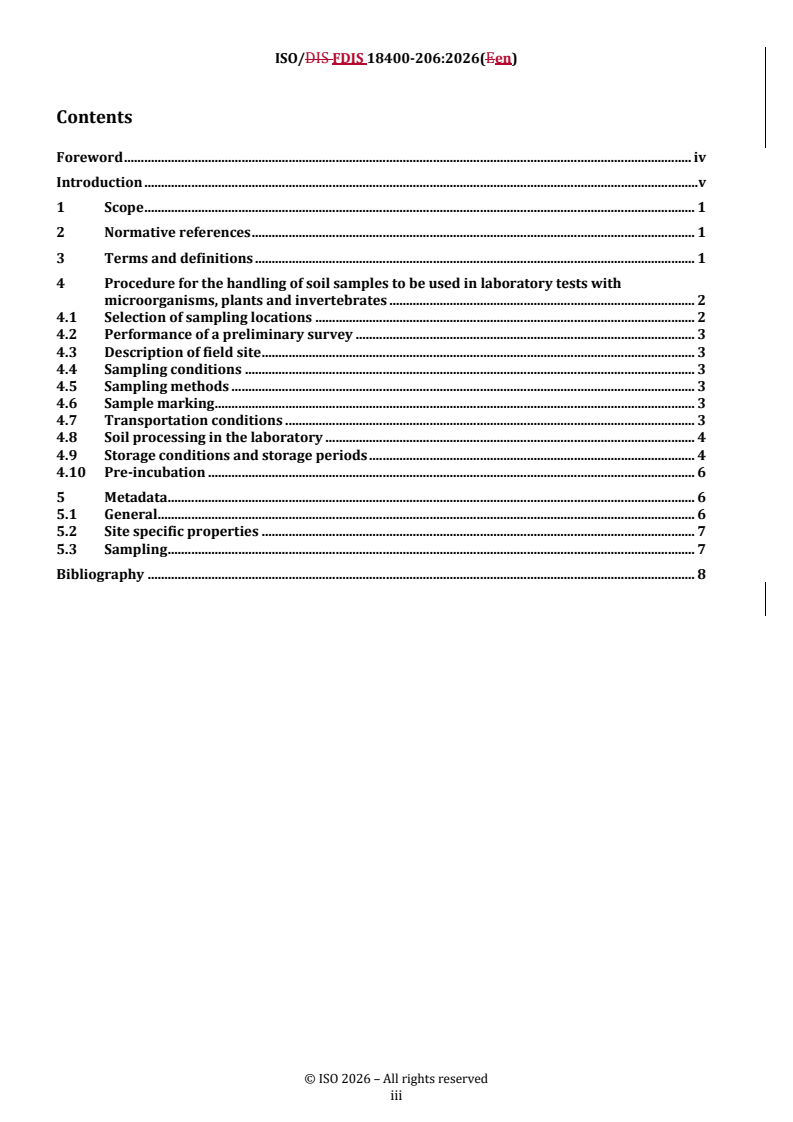
Contents Page
Foreword .iv
Introduction .v
1 Scope . 1
2 Normative references . 1
3 Terms and definitions . 1
4 Procedure for the handling of soil samples to be used in laboratory tests with
microorganisms, plants and invertebrates . 2
4.1 Selection of sampling locations .2
4.2 Performance of a preliminary survey .2
4.3 Description of field site .3
4.4 Sampling conditions .3
4.5 Sampling methods .3
4.6 Sample marking .3
4.7 Transportation conditions .3
4.8 Soil processing in the laboratory .4
4.9 Storage conditions and storage periods .4
4.10 Pre-incubation .6
5 Metadata . 6
5.1 General .6
5.2 Site specific properties . .6
5.3 Sampling .7
Bibliography . 8
iii
Foreword
ISO (the International Organization for Standardization) is a worldwide federation of national standards
bodies (ISO member bodies). The work of preparing International Standards is normally carried out through
ISO technical committees. Each member body interested in a subject for which a technical committee
has been established has the right to be represented on that committee. International organizations,
governmental and non-governmental, in liaison with ISO, also take part in the work. ISO collaborates closely
with the International Electrotechnical Commission (IEC) on all matters of electrotechnical standardization.
The procedures used to develop this document and those intended for its further maintenance are described
in the ISO/IEC Directives, Part 1. In particular, the different approval criteria needed for the different types
of ISO documents should be noted. This document was drafted in accordance with the editorial rules of the
ISO/IEC Directives, Part 2 (see www.iso.org/directives).
ISO draws attention to the possibility that the implementation of this document may involve the use of (a)
patent(s). ISO takes no position concerning the evidence, validity or applicability of any claimed patent
rights in respect thereof. As of the date of publication of this document, ISO had not received notice of (a)
patent(s) which may be required to implement this document. However, implementers are cautioned that
this may not represent the latest information, which may be obtained from the patent database available at
www.iso.org/patents. ISO shall not be held responsible for identifying any or all such patent rights.
Any trade name used in this document is information given for the convenience of users and does not
constitute an endorsement.
For an explanation of the voluntary nature of standards, the meaning of ISO specific terms and expressions
related to conformity assessment, as well as information about ISO’s adherence to the World Trade
Organization (WTO) principles in the Technical Barriers to Trade (TBT), see www.iso.org/iso/foreword.html.
This document was prepared by Technical Committee ISO/TC 190, Soil quality, Subcommittee SC 4, Biological
characterization.
This second edition cancels and replaces the first edition (ISO 18400-206:2018), which has been technically
revised.
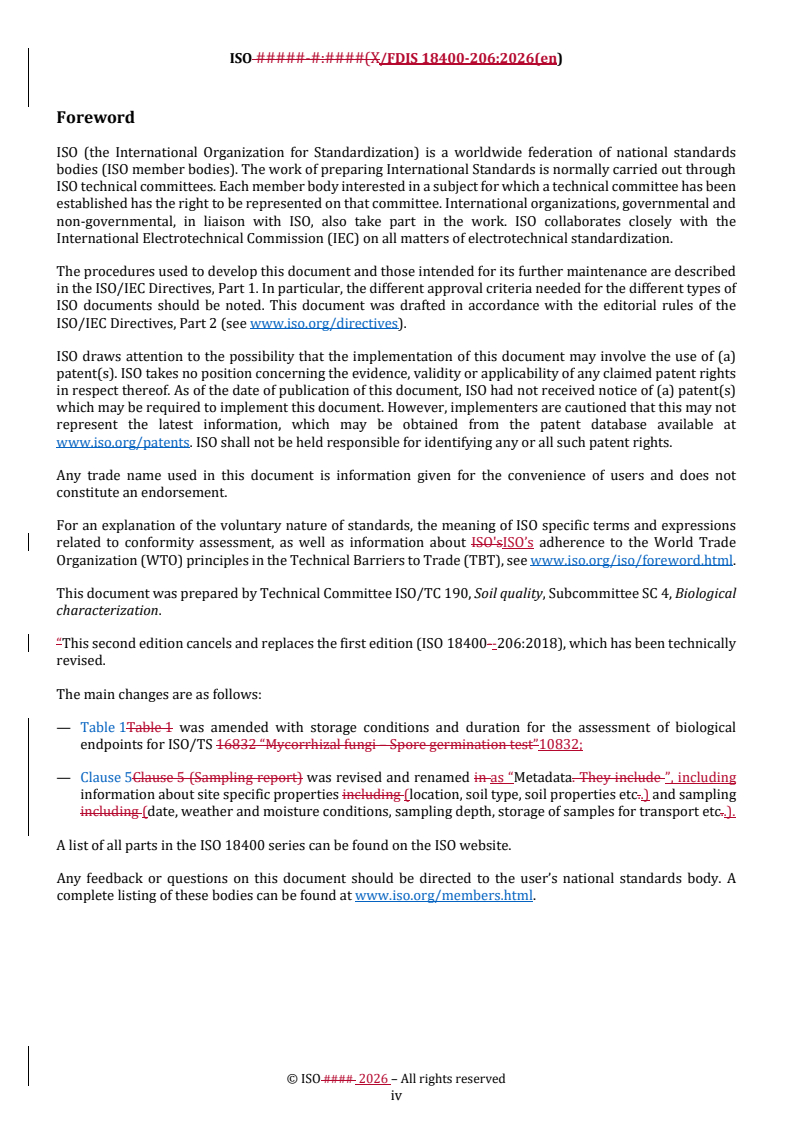
The main changes are as follows:
— Table 1 was amended with storage conditions and duration for the assessment of biological endpoints for
ISO/TS 10832;
— Clause 5 was revised and renamed as “Metadata”, including information about site specific properties
(location, soil type, soil properties etc.) and sampling (date, weather and moisture conditions, sampling
depth, storage of samples for transport etc.).
A list of all parts in the ISO 18400 series can be found on the ISO website.
Any feedback or questions on this document should be directed to the user’s national standards body. A
complete listing of these bodies can be found at www.iso.org/members.html.
iv
Introduction
Soils are both complex and heterogeneous because they consist of both living and non-living components
occurring in different combinations. Therefore, the condition of the soil, from collection to completion of
an experiment, is considered in this document in relation to effects on the soil organism community (i.e.
microorganisms, plants and invertebrates). Temperature, water content, availability of oxygen and duration
of storage are all known to affect these organisms, and thus the processes they mediate.
Soils can however be used effectively in the laboratory to investigate effects on soil organisms. In this context
a distinction is made between microbial communities on the one side and plants and invertebrates on the
other side, since the former are sampled as part of a soil sample, while the latter are added to a soil sample
(usually only a few selected species which have been identified as test species beforehand). Therefore, this
document covers two different issues:
a) It provides standard procedures on the collection, handling and storage of soil for laboratory use where
aerobic microbial activity is the main component of the study. It describes how to minimize the effects
of differences in temperature, water content and availability of oxygen on aerobic processes to facilitate
[1][2]
reproducible laboratory determinations.
b) It also provides guidance on the collection, handling and storage of soil for laboratory use where the
survival, reproduction, behaviour or growth of invertebrates or plants is the main components of the
study. It describes how to minimize the effects of differences in temperature, and the water content as
[1][2]
well as the fractionation of soil particles to facilitate reproducible laboratory determinations.
This document is one of a group of standards dealing with various aspects of site investigation and sampling.
It is intended to be used in conjunction with the other documents in the ISO 18400 series. The role and
position of the standards within the total investigation programme is shown in Figure 1.
v
NOTE 1 The numbers in circles in this figure define the single steps of the investigation programme.
NOTE 2 This figure displays a generic process which can be amended when necessary.
Figure 1 — Links between the essential elements of an investigation programme
vi
FINAL DRAFT International Standard ISO/FDIS 18400-206:2026(en)
Soil quality — Sampling —
Part 206:
Collection, handling and storage of soil under aerobic
conditions for the assessment of microbiological processes,
biomass and diversity in the laboratory
1 Scope
This document provides standard procedures for the collection, handling and storage of soil for subsequent
biological testing under aerobic conditions in the laboratory. It applies to the collection, handling and storage
for assessing the effects of soil on microorganisms, invertebrates (e.g. survival, reproduction, growth,
behaviour) and plants (e.g. development, growth). This document is not applicable to the handling of soil
where anaerobic conditions need to be maintained throughout.
This document describes how to minimize the effects of differences in temperature, water content,
and availability of oxygen on aerobic processes as well as the fractionation of soil particles to facilitate
[1][2]
reproducible laboratory determinations.
This document is mainly applicable to temperate soils. Soils collected from extreme climates (e.g. permafrost,
tropical soils) can require special handling.
NOTE This document does not provide standard procedures on the collection, handling and storage of soil
organisms when assessing the structure and function of soil organism communities in the field. Such standard
procedures are provided in the ISO 23611 series.
2 Normative references
The following documents are referred to in the text in such a way that some or all of their content constitutes
requirements of this document. For dated references, only the edition cited applies. For undated references,
the latest edition of the referenced document (including any amendments) applies.
ISO 18400-101, Soil quality — Sampling — Part 101: Framework for the preparation and application of a
sampling plan
ISO 18400-102, Soil quality — Sampling — Part 102: Selection and application of sampling techniques
ISO 18400-202, Soil quality — Sampling — Part 202: Preliminary investigations
ISO 18400-205, Soil quality — Sampling — Part 205: Guidance on the procedure for investigation of natural,
near-natural and cultivated sites
ISO 25177, Soil quality — Field soil description
3 Terms and definitions
For the purposes of this document, the following terms and definitions apply.
ISO and IEC maintain terminology databases for use in standardization at the following addresses:
— ISO Online browsing platform: available at https:// www .iso .org/ obp
— IEC Electropedia: available at https:// www .electropedia .org/
3.1
aerobic
descriptive of a condition in which molecular oxygen is freely available
[SOURCE: ISO 11074:2025]
3.2
anaerobic
descriptive of a condition in which molecular oxygen is not available
[SOURCE: ISO 11074.2025]
3.3
water content on a dry mass basis
mass of water evaporating from the soil when dried to constant mass at 105 °C divided by the dry mass of
the soil and multiplied by 100
[SOURCE: ISO 11465:2025]
4 Procedure for the handling of soil samples to be used in laboratory tests with
microorganisms, plants and invertebrates
4.1 Selection of sampling locations
The locations of the sites from which samples are taken should be selected according to the purpose of the
study, preliminary information, and on-site conditions. Sampling locations should be representative of the
total area to be sampled. These locations shall be preferably geo-referenced. Sampling patterns can be based
on statistical models, numerical random distributions or systematic patterns as described in ISO 18400-104.
For details on the selection of sampling locations for sampling programmes with soil invertebrates see also
Reference [3].
NOTE It can be helpful to estimate the uncertainty of the measurement when soil sampling. Appropriate statistical
methods depend on the purpose and the design of the sampling (see ISO 18400-104).
Examples of on-site conditions that shall be considered when designing a sampling strategy include local
topography, climatic conditions, vegetation cover (especially trees), soil type or soil physicochemical
characteristics, or both, if appropriate, the location of a contaminant source (point or non-point) or the
direction of contamination. Soil properties as well as soil contamination are often characterized by high
variability in time and space. Thus, different designs and statistical methods shall apply depending on the
respective study objective.
Depending on the objective of the investigation a sampling pattern is chosen when designing the study and
is then applied in the field. Afterwards, preparation of the site includes the establishment of safety measures
(see also ISO 18400-103). When sampling if practicable, the locations shall be marked so that they can be
used for comparative tests or to obtain further samples (e.g. at a later date). This work becomes very time
consuming if it is not possible to take a sample at the planned location due to a variety of reasons (e.g. trees,
rocks, or access difficulties). Contingency plans for dealing with such situations shall be made in advance
(ad hoc decisions in the field can lead to a bias). The action taken depends on the circumstances: the point
can be ignored, or a nearby substitute location (e.g. within 10 % of grid spacing away from the original
location) can be chosen. In every case when a sampling point is re-located, this shall be done in accordance
with ISO 18400-101 and the reason for relocation shall be clearly indicated in the report.
4.2 Performance of a preliminary survey
A preliminary investigation in accordance with ISO 18400-202 shall be carried out prior to any sampling
programme, although the effort devoted to it depends on the objective of the investigation. It should always
comprise a desk-top study and a site visit. In addition, in the specific context of this document, a limited
amount of sampling can be carried out provided that it is safe to do so. The principal objectives of the
preliminary study are to gain knowledge about the present condition of the site, and of past activities on the
site and adjacent land which can have affected it in order to enable the sampling programme to be designed
to be both technically effective and cost effective. In addition, measures shall be identified that protect the
health and safety of the investigating personnel and of the environment (see ISO 18400-103).
4.3 Description of field site
Selection of a soil sampling site depends on the purpose of a particular study, and knowledge of the field
site history is always desirable. The site should be accurately described (inc
...
25177ISO /DIS ISO/FDIS 18400-206:2026(E)
ISO/TC 190/SC 4/WG 4
Secretariat: AFNOR
Date: 2026-03-0908-31
Soil quality — Sampling —
Part 206:
Collection, handling and storage of soil under aerobic conditions for
the assessment of microbiological processes, biomass and diversity
in the laboratory
Qualité du sol — Échantillonnage —
Partie 206: Collecte, manipulation et conservation de sols destinés à l'évaluation de paramètres biologiques
fonctionnels et structurels en laboratoire
FDIS stage
ISO #####-#:####(X/FDIS 18400-206:2026(en)
All rights reserved. Unless otherwise specified, or required in the context of its implementation, no part of this publication
may be reproduced or utilized otherwise in any form or by any means, electronic or mechanical, including photocopying,
or posting on the internet or an intranet, without prior written permission. Permission can be requested from either ISO
at the address below or ISO’s member body in the country of the requester.
ISO copyright office
CP 401 • Ch. de Blandonnet 8
CH-1214 Vernier, Geneva
Phone: + 41 22 749 01 11
EmailE-mail: copyright@iso.org
Website: www.iso.orgwww.iso.org
Published in Switzerland
© ISO #### 2026 – All rights reserved
ii
ISO/DIS FDIS 18400-206:2026(Een)
Contents
Foreword . iv
Introduction . v
1 Scope . 1
2 Normative references . 1
3 Terms and definitions . 1
4 Procedure for the handling of soil samples to be used in laboratory tests with
microorganisms, plants and invertebrates . 2
4.1 Selection of sampling locations . 2
4.2 Performance of a preliminary survey . 3
4.3 Description of field site . 3
4.4 Sampling conditions . 3
4.5 Sampling methods . 3
4.6 Sample marking . 3
4.7 Transportation conditions . 3
4.8 Soil processing in the laboratory . 4
4.9 Storage conditions and storage periods . 4
4.10 Pre-incubation . 6
5 Metadata . 6
5.1 General . 6
5.2 Site specific properties . 7
5.3 Sampling . 7
Bibliography . 8
iii
ISO #####-#:####(X/FDIS 18400-206:2026(en)
Foreword
ISO (the International Organization for Standardization) is a worldwide federation of national standards
bodies (ISO member bodies). The work of preparing International Standards is normally carried out through
ISO technical committees. Each member body interested in a subject for which a technical committee has been
established has the right to be represented on that committee. International organizations, governmental and
non-governmental, in liaison with ISO, also take part in the work. ISO collaborates closely with the
International Electrotechnical Commission (IEC) on all matters of electrotechnical standardization.
The procedures used to develop this document and those intended for its further maintenance are described
in the ISO/IEC Directives, Part 1. In particular, the different approval criteria needed for the different types of
ISO documents should be noted. This document was drafted in accordance with the editorial rules of the
ISO/IEC Directives, Part 2 (see www.iso.org/directives).
ISO draws attention to the possibility that the implementation of this document may involve the use of (a)
patent(s). ISO takes no position concerning the evidence, validity or applicability of any claimed patent rights
in respect thereof. As of the date of publication of this document, ISO had not received notice of (a) patent(s)
which may be required to implement this document. However, implementers are cautioned that this may not
represent the latest information, which may be obtained from the patent database available at
www.iso.org/patents. ISO shall not be held responsible for identifying any or all such patent rights.
Any trade name used in this document is information given for the convenience of users and does not
constitute an endorsement.
For an explanation of the voluntary nature of standards, the meaning of ISO specific terms and expressions
related to conformity assessment, as well as information about ISO'sISO’s adherence to the World Trade
Organization (WTO) principles in the Technical Barriers to Trade (TBT), see www.iso.org/iso/foreword.html.
This document was prepared by Technical Committee ISO/TC 190, Soil quality, Subcommittee SC 4, Biological
characterization.
“This second edition cancels and replaces the first edition (ISO 18400--206:2018), which has been technically
revised.
The main changes are as follows:
— Table 1Table 1 was amended with storage conditions and duration for the assessment of biological
endpoints for ISO/TS 16832 “Mycorrhizal fungi – Spore germination test”10832;
— Clause 5Clause 5 (Sampling report) was revised and renamed in as “Metadata. They include ”, including
information about site specific properties including (location, soil type, soil properties etc.) and sampling
including (date, weather and moisture conditions, sampling depth, storage of samples for transport etc.).
A list of all parts in the ISO 18400 series can be found on the ISO website.
Any feedback or questions on this document should be directed to the user’s national standards body. A
complete listing of these bodies can be found at www.iso.org/members.html.
© ISO #### 2026 – All rights reserved
iv
ISO/DIS FDIS 18400-206:2026(Een)
Introduction
Soils are both complex and heterogeneous because they consist of both living and non-living components
occurring in different combinations. Therefore, the condition of the soil, from collection to completion of an
experiment, is considered in this document in relation to effects on the soil organism community (i.e.
microorganisms, plants and invertebrates). Temperature, water content, availability of oxygen and duration
of storage are all known to affect these organisms, and thus the processes they mediate.
Soils can however be used effectively in the laboratory to investigate effects on soil organisms. In this context
a distinction is made between microbial communities on the one side and plants and invertebrates on the
other side, since the former are sampled as part of a soil sample, while the latter are added to a soil sample
(usually only a few selected species which have been identified as test species beforehand). Therefore, this
document covers two different issues:
a) It provides standard procedures on the collection, handling and storage of soil for laboratory use where
aerobic microbial activity is the main component of the study. It describes how to minimize the effects of
differences in temperature, water content and availability of oxygen on aerobic processes to facilitate
[1] [2]
reproducible laboratory determinations [1][2].
b) It also provides guidance on the collection, handling and storage of soil for laboratory use where the
survival, reproduction, behaviour or growth of invertebrates or plants is the main components of the
study. It describes how to minimize the effects of differences in temperature, and the water content as
[1] [2]
well as the fractionation of soil particles to facilitate reproducible laboratory determinations [1][2].
This document is one of a group of standards dealing with various aspects of site investigation and sampling.
Its useIt is intended to be used in conjunction with the other parts of documents in the ISO 18400 series. The
role/ and position of the standards within the total investigation programme is shown in Figure 1Figure 1.
v
ISO #####-#:####(X/FDIS 18400-206:2026(en)
© ISO #### 2026 – All rights reserved
vi
ISO/DIS FDIS 18400-206:2026(Een)
NOTE 1 The numbers in circles in Figure 1this figure define the single steps of the investigation programme.
NOTE 2 Figure 1This figure displays a generic process which can be amended when necessary.
Figure 1 — Links between the essential elements of an investigation programme
vii
Soil quality — Sampling —
Part 206:
Collection, handling and storage of soil under aerobic conditions for
the assessment of microbiological processes, biomass and diversity in
the laboratory
1 Scope
This document provides standard procedures for the collection, handling and storage of soil for subsequent
biological testing under aerobic conditions in the laboratory. It applies to the collection, handling and storage
for assessing the effects of soil on microorganisms, invertebrates (e.g. survival, reproduction, growth,
behaviour) and plants (e.g. development, growth). This document is not applicable to the handling of soil
where anaerobic conditions need to be maintained throughout.
This document describes how to minimize the effects of differences in temperature, water content, and
availability of oxygen on aerobic processes as well as the fractionation of soil particles to facilitate
[1] [2]
reproducible laboratory determinations [1][2].
This document is mainly applicable to temperate soils. Soils collected from extreme climates (e.g. permafrost,
tropical soils) can require special handling.
NOTE This document does not provide standard procedures on the collection, handling and storage of soil
organisms when assessing the structure and function of soil organism communities in the field. Such standard procedures
are provided in the ISO 23611-1 to ISO 23611-6 series.
2 Normative references
The following documents are referred to in the text in such a way that some or all of their content constitutes
requirements of this document. For dated references, only the edition cited applies. For undated references,
the latest edition of the referenced document (including any amendments) applies.
ISO 18400--101, Soil quality — Sampling — Part 101: Framework for the preparation and application of a
sampling plan
ISO 18400--102, Soil quality — Sampling — Part 102: Selection and application of sampling techniques
ISO 18400-107, Soil quality — Sampling — Part 107: Recording and reporting
ISO 18400--202, Soil quality — Sampling — Part 202: Preliminary investigations
ISO 18400--205, Soil quality — Sampling — Part 205: Guidance on the procedure for investigation of natural,
near-natural and cultivated sites
ISO 25177, Soil quality — Field soil description
3 Terms and definitions
For the purposes of this document, the following terms and definitions apply.
ISO and IEC maintain terminology databases for use in standardization at the following addresses:
— ISO Online browsing platform: available at https://www.iso.org/obp
— IEC Electropedia: available at https://www.electropedia.org/
3.1 3.1
aerobic
descriptive of a condition in which molecular oxygen is freely available
[SOURCE: ISO 11074:2025]
3.2 3.2
anaerobic
descriptive of a condition in which molecular oxygen is not available
[SOURCE: ISO 11074.2025]
3.3 3.3
water content on a dry mass basis
mass of water evaporating from the soil when dried to constant mass at 105 °C divided by the dry mass of the
soil and multiplied by 100
[SOURCE: ISO 11465:2025]
4 Procedure for the handling of soil samples to be used in laboratory tests with
microorganisms, plants and invertebrates
4.1 Selection of sampling locations
The locations of the sites from which samples are taken should be selected according to the purpose of the
study, preliminary information, and on-site conditions. Sampling locations should be representative of the
total area to be sampled. These locations shall be preferably geo-referenced. Sampling patterns can be based
on statistical models, numerical random distributions or systematic patterns as described in ISO 18400--104.
For details on the selection of sampling locations for sampling programmes with soil invertebrates see also
[3]
Reference [3].
NOTE It can be helpful to estimate the uncertainty of the measurement when soil sampling. Appropriate statistical
methods depend on the purpose and the design of the sampling (see ISO 18400--104).
Examples of on-site conditions that shall be considered when designing a sampling strategy include local
topography, climatic conditions, vegetation cover (especially trees), soil type or soil physicochemical
characteristics, or both, if appropriate, the location of a contaminant source (point or non-point) or the
direction of contamination. Soil properties as well as soil contamination are often characterized by high
variability in time and space. Thus, different designs and statistical methods shall apply depending on the
respective study objective.
Depending on the objective of the investigation a sampling pattern is chosen when designing the study and is
then applied in the field. Afterwards, preparation of the site includes the establishment of safety measures
(see also ISO 18400--103). When sampling if practicable, the locations shall be marked so that they can be
used for comparative tests or to obtain further samples (e.g. at a later date). This work becomes very time
consuming if it is not possible to take a sample at the planned location due to a variety of reasons (e.g. trees,
rocks, or access difficulties). Contingency plans for dealing with such situations shall be made in advance (ad
hoc decisions in the field can lead to a bias). The action taken depends on the circumstances: the point can be
ignored, or a nearby substitute location (e.g. within 10 % of grid spacing away from the original location) can
be chosen. In every case when a sampling point is re-located, this shall be done in accordance with ISO 18400--
101 and the reason for relocation shall be clearly indicated in the report.
© ISO #### 2026 – All rights reserved
ISO/DIS FDIS 18400-206:2026(Een)
4.2 Performance of a preliminary survey
A preliminary investigation in accordance with ISO 18400--202 shall be carried out prior to any sampling
programme, although the effort devoted to it depends on the objective of the investigation. It should always
comprise a desk-top study and a site visit. In addition, in the specific context of this document, a limited
amount of sampling can be carried out provided that it is safe to do so. The principal objectives of the
preliminary study are to gain knowledge about the present condition of the site, and of past activities on the
site and adjacent land which can have affected it in order to enable the sampling programme to be designed
to be both technically effective and cost effective. In addition, measures shall be identified that protect the
health and safety of the investigating personnel and of the environment (see ISO 18400--103).
4.3 Description of field site
Selection of a soil sampling site depends on the purpose of a particular study, and knowledge of the field site
history is always desirable. The site should be accurately described (including type and properties of soil,
designation of horizons) and its history given. Details of vegetation cover and where possible previous
vegetation cover extending up to five years previous to sampling, the morphology of the sampling area (e.g.
flat area, slopes, steepness), and of chemical and biological additions or accidental contamination, shall be
recorded and reported in accordance with ISO 18400--107.
4.4 Sampling conditions
Soil required for studies conducted under laboratory conditions should, if practicable, be sampled in the field
with a soil water content which facilitates sieving. Sampling should, unless the purpose of the study requires
otherwise, be avoided during or immediately following long periods (e.g. one month) of drought, freezing or
flooding. If laboratory tests are to be used for field monitoring, conditions existing in the field should be
accepted.
4.5 Sampling methods
The sampling technique depends on the purpose of the study. Appropriate sampling techniques shall be
selected and applied following the guidance in ISO 18400--102 and ISO 18400--205. If aerobi
...