

ISO 7899-2:2000
(Main)Water quality — Detection and enumeration of intestinal enterococci — Part 2: Membrane filtration method
General Information
- Abstract
- Status
- Published
- Publication Date
- 26-Apr-2000
- Technical Committee
- ISO/TC 147/SC 4 - Microbiological methods
- Drafting Committee
- ISO/TC 147/SC 4 - Microbiological methods
- Current Stage
- 9020 - International Standard under periodical review
- Start Date
- 15-Jul-2026
- Completion Date
- 15-Jul-2026
Buy Documents
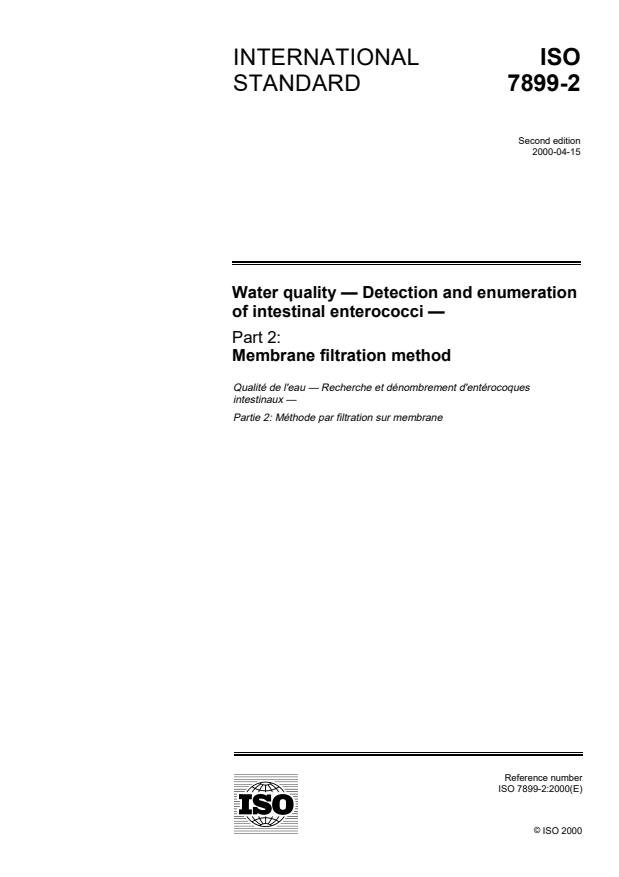
ISO 7899-2:2000 - Water quality — Detection and enumeration of intestinal enterococci — Part 2: Membrane filtration method Released:4/27/2000
ISO 7899-2:2000 - Qualité de l'eau — Recherche et d'énombrement des entérocoques intestinaux — Partie 2: Méthode par filtration sur membrane Released:4/27/2000
Overview
ISO 7899-2:2000 is an internationally recognized standard published by the International Organization for Standardization (ISO) for assessing water quality through the detection and enumeration of intestinal enterococci using the membrane filtration method. This microbiological method plays a vital role in ensuring public health by identifying faecal contamination in various types of water, such as drinking water, swimming pool water, and other disinfected or clean waters. The approach is particularly suitable for large water volumes with low concentrations of enterococci and is integral for routine water monitoring in compliance with regulatory and safety standards.
Key Topics
- Membrane Filtration Technique: This method requires filtering a measured volume of a water sample through a membrane filter with a pore size of 0.45 μm, which retains bacteria. After filtration, the membrane is placed on a selective growth medium.
- Detection and Confirmation: Typical enterococci colonies are identified by their color on selective media, followed by confirmation on a bile-aesculin-azide agar at 44°C.
- Sampling and Preparation: Proper sample collection and handling in accordance with referenced ISO standards ensure accurate and reliable results. Prompt start of analysis after sampling is crucial.
- Quality Assurance: Laboratories must implement defined quality control protocols to validate the suitability of materials, reagents, and techniques used.
- Test Reporting: Results must include detailed sample identification, the number of confirmed enterococci colonies, and any deviations or phenomena observed during testing.
Applications
The ISO 7899-2:2000 standard is widely applied in the following areas:
- Drinking Water Monitoring: Ensures water qualifies as safe for human consumption by detecting faecal pollution indicators.
- Swimming Pool and Recreational Water Testing: Verifies the effectiveness of disinfection processes and the absence of harmful microbiological contamination in public and private pools.
- Clean and Disinfected Water: Assesses water quality in regulated environments, such as bottled water production, food processing, and pharmaceutical industries.
- Environmental Water Analysis: Used by environmental agencies and laboratories to monitor rivers, lakes, and reservoirs for public health protection.
- Regulatory Compliance: Supports adherence to national and international water quality regulations that mandate the detection of intestinal enterococci as a microbial safety indicator.
Related Standards
ISO 7899-2:2000 references several other key international standards to ensure methodological rigor and consistency:
- ISO 3696: Water for analytical laboratory use - Specification and test methods.
- ISO 5667-1, ISO 5667-2, ISO 5667-3: Guidance on sampling, sampling techniques, and handling of water samples.
- ISO 6887-1: Microbiology of food and animal feeding stuffs - Preparation of test samples.
- ISO 8199: General guide to the enumeration of micro-organisms by culture.
- ISO 7704: Evaluation of membrane filters used for microbiological analyses.
- ISO/IEC Guide 2: Standardization and related activities - General vocabulary.
These standards provide comprehensive guidance for all aspects of water sample collection, processing, and analysis, enhancing the practical value of ISO 7899-2:2000 in laboratory and field applications.
Practical Value
Implementing ISO 7899-2:2000 ensures:
- Reliable detection of waterborne pathogens
- Compliance with water quality regulations
- Public health protection through early identification of faecal contamination
- Consistent, reproducible results across laboratories and regulatory frameworks
By following ISO 7899-2:2000, laboratories, water providers, and regulatory bodies can maintain high standards of water safety and regulatory compliance in their water quality monitoring programs.
Relations
- Effective Date
- 12-Feb-2026
- Effective Date
- 06-Jun-2022
- Effective Date
- 12-May-2008
- Effective Date
- 15-Apr-2008
Buy Documents
ISO 7899-2:2000 - Water quality — Detection and enumeration of intestinal enterococci — Part 2: Membrane filtration method Released:4/27/2000
ISO 7899-2:2000 - Qualité de l'eau — Recherche et d'énombrement des entérocoques intestinaux — Partie 2: Méthode par filtration sur membrane Released:4/27/2000
Frequently Asked Questions
ISO 7899-2:2000 is a standard published by the International Organization for Standardization (ISO). Its full title is "Water quality — Detection and enumeration of intestinal enterococci — Part 2: Membrane filtration method". This standard covers: La présente partie de l'ISO 7899 spécifie une méthode pour la recherche et le dénombrement des entérocoques intestinaux dans l'eau par filtration sur membrane. La présente partie de l'ISO 7899 est spécialement adaptée à l'examen des eaux de boisson, des eaux de piscines, et d'autres eaux désinfectées ou propres. Néanmoins, la méthode peut être appliquée à tous types d'eaux, excepté en présence d'une abondance de matières en suspension ou de germes interférents. Elle est particulièrement adaptée à l'examen de grands volumes d'eau contenant peu d'entérocoques intestinaux.
La présente partie de l'ISO 7899 spécifie une méthode pour la recherche et le dénombrement des entérocoques intestinaux dans l'eau par filtration sur membrane. La présente partie de l'ISO 7899 est spécialement adaptée à l'examen des eaux de boisson, des eaux de piscines, et d'autres eaux désinfectées ou propres. Néanmoins, la méthode peut être appliquée à tous types d'eaux, excepté en présence d'une abondance de matières en suspension ou de germes interférents. Elle est particulièrement adaptée à l'examen de grands volumes d'eau contenant peu d'entérocoques intestinaux.
ISO 7899-2:2000 is classified under the following ICS (International Classification for Standards) categories: 07.100.20 - Microbiology of water. The ICS classification helps identify the subject area and facilitates finding related standards.
ISO 7899-2:2000 has the following relationships with other standards: It is inter standard links to EN ISO 7899-2:2000, ISO 5019-1:1984, SIST ISO 7899-2:1998, ISO 7899-2:1984. Understanding these relationships helps ensure you are using the most current and applicable version of the standard.
ISO 7899-2:2000 is available in PDF format for immediate download after purchase. The document can be added to your cart and obtained through the secure checkout process. Digital delivery ensures instant access to the complete standard document.
Standards Content (Sample)
INTERNATIONAL ISO
STANDARD 7899-2
Second edition
2000-04-15
Water quality — Detection and enumeration
of intestinal enterococci —
Part 2:
Membrane filtration method
Qualité de l'eau — Recherche et dénombrement d'entérocoques
intestinaux —
Partie 2: Méthode par filtration sur membrane
Reference number
©
ISO 2000
PDF disclaimer
This PDF file may contain embedded typefaces. In accordance with Adobe's licensing policy, this file may be printed or viewed but shall not
be edited unless the typefaces which are embedded are licensed to and installed on the computer performing the editing. In downloading this
file, parties accept therein the responsibility of not infringing Adobe's licensing policy. The ISO Central Secretariat accepts no liability in this
area.
Adobe is a trademark of Adobe Systems Incorporated.
Details of the software products used to create this PDF file can be found in the General Info relative to the file; the PDF-creation parameters
were optimized for printing. Every care has been taken to ensure that the file is suitable for use by ISO member bodies. In the unlikely event
that a problem relating to it is found, please inform the Central Secretariat at the address given below.
All rights reserved. Unless otherwise specified, no part of this publication may be reproduced or utilized in any form or by any means, electronic
or mechanical, including photocopying and microfilm, without permission in writing from either ISO at the address below or ISO's member body
in the country of the requester.
ISO copyright office
Case postale 56 � CH-1211 Geneva 20
Tel. + 41 22 749 01 11
Fax + 41 22 734 10 79
E-mail copyright@iso.ch
Web www.iso.ch
Printed in Switzerland
ii © ISO 2000 – All rights reserved
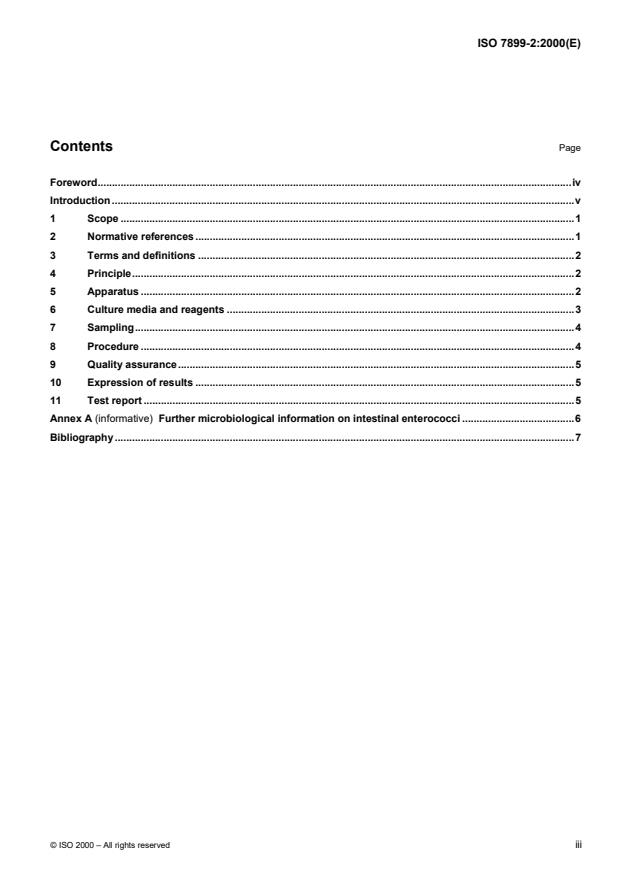
Contents Page
Foreword.iv
Introduction.v
1 Scope .1
2 Normative references .1
3 Terms and definitions .2
4 Principle.2
5 Apparatus .2
6 Culture media and reagents .3
7 Sampling.4
8 Procedure .4
9 Quality assurance.5
10 Expression of results .5
11 Test report .5
Annex A (informative) Further microbiological information on intestinal enterococci .6
Bibliography.7
Foreword
ISO (the International Organization for Standardization) is a worldwide federation of national standards bodies (ISO
member bodies). The work of preparing International Standards is normally carried out through ISO technical
committees. Each member body interested in a subject for which a technical committee has been established has
the right to be represented on that committee. International organizations, governmental and non-governmental, in
liaison with ISO, also take part in the work. ISO collaborates closely with the International Electrotechnical
Commission (IEC) on all matters of electrotechnical standardization.
International Standards are drafted in accordance with the rules given in the ISO/IEC Directives, Part 3.
Draft International Standards adopted by the technical committees are circulated to the member bodies for voting.
Publication as an International Standard requires approval by at least 75 % of the member bodies casting a vote.
Attention is drawn to the possibility that some of the elements of this part of ISO 7899 may be the subject of patent
rights. ISO shall not be held responsible for identifying any or all such patent rights.
International Standard ISO 7899-2 was prepared by Technical Committee ISO/TC 147, Water quality,
Subcommittee SC 4, Microbiological methods.
This second edition cancels and replaces the first edition (ISO 7899-2:1984), which has been technically revised.
ISO 7899 consists of the following parts, under the general title Water quality — Detection and enumeration of
intestinal enterococci:
� Part 1: Miniaturized method (Most Probable Number) for surface and waste water
� Part 2: Membrane filtration method
Annex A of this part of ISO 7899 is for information only.
iv © ISO 2000 – All rights reserved
Introduction
In this part of ISO 7899 a method is described for the isolation of intestinal enterococci. Enterococcus faecalis , E.
faecium, E. durans and E. hirae can be detected and enumerated with the methods described in this part of
ISO 7899. In addition, other Enterococcus species and some species of the genus Streptococcus (namely S. bovis
and S. equinus ) may occasionally be detected. These Streptococcus species do not survive long in water and are
probably not enumerated quantitatively. For purposes of water examination, enterococci can be regarded as
indicators of faecal pollution. However it should be noted that some enterococci found in water can occasionally
also originate from other habitats.
INTERNATIONAL STANDARD ISO 7899-2:2000(E)
Water quality — Detection and enumeration of intestinal
enterococci —
Part 2:
Membrane filtration method
1 Scope
This part of ISO 7899 specifies a method for the detection and enumeration of intestinal enterococci in water by
membrane filtration. This part of ISO 7899 is especially intended for examination of drinking water, water from
swimming pools and other disinfected or clean waters. Nevertheless, the method can be applied to all types of
water, except when a large amount of suspended matter or many interfering microorganisms are present. It is
particularly suitable for the examination of large volumes of water containing only a few intestinal enterococci.
2 Normative references
The following normative documents contain provisions which, through reference in this text, constitute provisions of
this part of ISO 7899. For dated references, subsequent amendments to, or revisions of, any of these publications
do not apply. However, parties to agreements based on this part of ISO 7899 are encouraged to investigate the
possibility of applying the most recent editions of the normative documents indicated below. For undated
references, the latest edition of the normative document referred to applies. Members of ISO and IEC maintain
registers of currently valid International Standards.
ISO 3696:1987, Water for analytical laboratory use — Specification and test methods.
ISO 5667-1:1980, Water quality — Sampling — Part 1: Guidance on the design of samping programmes.
ISO 5667-2:1991, Water quality — Sampling — Part 2: Guidance on sampling techniques.
ISO 5667-3:1994, Water quality — Sampling — Part 3: Guidance on the preservation and handling of samples.
ISO 6887-1:1999, Microbiology of food and animal feeding stuffs — Preparation of test samples, initial suspension
and decimal dilutions for microbiological examination — Part
...
NORME ISO
INTERNATIONALE 7899-2
Deuxième édition
2000-04-15
Qualité de l'eau — Recherche et
dénombrement des entérocoques
intestinaux —
Partie 2:
Méthode par filtration sur membrane
Water quality — Detection and enumeration of intestinal enterococci —
Part 2: Membrane filtration method
Numéro de référence
©
ISO 2000
PDF – Exonération de responsabilité
Le présent fichier PDF peut contenir des polices de caractères intégrées. Conformément aux conditions de licence d'Adobe, ce fichier peut
être imprimé ou visualisé, mais ne doit pas être modifié à moins que l'ordinateur employé à cet effet ne bénéficie d'une licence autorisant
l'utilisation de ces polices et que celles-ci y soient installées. Lors du téléchargement de ce fichier, les parties concernées acceptent de fait la
responsabilité de ne pas enfreindre les conditions de licence d'Adobe. Le Secrétariat central de l'ISO décline toute responsabilité en la
matière.
Adobe est une marque déposée d'Adobe Systems Incorporated.
Les détails relatifs aux produits logiciels utilisés pour la création du présent fichier PDF sont disponibles dans la rubrique General Info du
fichier; les paramètres de création PDF ont été optimisés pour l'impression. Toutes les mesures ont été prises pour garantir l'exploitation de
ce fichier par les comités membres de l'ISO. Dans le cas peu probable où surviendrait un problème d'utilisation, veuillez en informer le
Secrétariat central à l'adresse donnée ci-dessous.
Droits de reproduction réservés. Sauf prescription différente, aucune partie de cette publication ne peut être reproduite ni utilisée sous quelque
forme que ce soit et par aucun procédé, électronique ou mécanique, y compris la photocopie et les microfilms, sans l'accord écrit de l’ISO à
l’adresse ci-après ou du comité membre de l’ISO dans le pays du demandeur.
ISO copyright office
Case postale 56 � CH-1211 Geneva 20
Tel. + 41 22 749 01 11
Fax. + 41 22 734 10 79
E-mail copyright@iso.ch
Web www.iso.ch
ImpriméenSuisse
ii © ISO 2000 – Tous droits réservés
Sommaire Page
Avant-propos.iv
Introduction.v
1 Domaine d'application.1
2 Références normatives .1
3 Termes et définitions.2
4 Principe.2
5 Appareillage .2
6 Milieux de culture et réactifs .3
7 Échantillonnage .4
8 Mode opératoire.5
9 Assurance de qualité.5
10 Expression des résultats .5
11 Rapport d’essai.5
Annexe A (informative) Information complémentaire sur les entérocoques intestinaux.7
Bibliographie .8
Avant-propos
L'ISO (Organisation internationale de normalisation) est une fédération mondiale d'organismes nationaux de
normalisation (comités membres de l'ISO). L'élaboration des Normes internationales est en général confiée aux
comités techniques de l'ISO. Chaque comité membre intéressé par une étude a le droit de faire partie du comité
technique créé à cet effet. Les organisations internationales, gouvernementales et non gouvernementales, en
liaison avec l'ISO participent également aux travaux. L'ISO collabore étroitement avec la Commission
électrotechnique internationale (CEI) en ce qui concerne la normalisation électrotechnique.
Les Normes internationales sont rédigées conformément aux règles données dans les Directives ISO/CEI, Partie 3.
Les projets de Normes internationales adoptés par les comités techniques sont soumis aux comités membres pour
vote. Leur publication comme Normes internationales requiert l'approbation de 75 % au moins des comités
membres votants.
L’attention est appelée sur le fait que certains des éléments de la présente partie de l’ISO 7899 peuvent faire
l’objet de droits de propriété intellectuelle ou de droits analogues. L’ISO ne saurait être tenue pour responsable de
ne pas avoir identifié de tels droits de propriété et averti de leur existence.
La Norme internationale ISO 7899-2 a été élaborée par le comité technique ISO/TC 147, Qualité de l'eau,
sous-comité SC 4, Méthodes microbiologiques.
Cette deuxième édition annule et remplace la première édition (ISO 7899-2:1984), dont elle constitue une révision
technique.
L'ISO 7899 comprend les parties suivantes, présentées sous le titre général Qualité de l'eau — Recherche et
dénombrement des entérocoques intestinaux:
� Partie 1: Méthode miniaturisée (nombre le plus probable) dans les eaux de surface et résiduaires
� Partie 2: Méthode par filtration sur membrane
L’annexe A de la présente partie de l’ISO 7899 est donnée uniquement à titre d’information.
iv © ISO 2000 – Tous droits réservés
Introduction
Dans la présente partie de l’ISO 7899 est décrite une méthode pour la recherche d’entérocoques intestinaux.
Enterococcus faecalis, E. faecium, E. durans et E. hirae peuvent être détectés et dénombrés avec la méthode
décrite dans la présente partie de l’ISO 7899. Par ailleurs, d’autres espèces d’Enterococcus et certaines espèces
du genre Streptococcus (notamment S. bovis et S. equinus) peuvent occasionnellement être détectées. Ces
espèces de Streptococcus ne survivent pas longtemps dans l’eau et ne sont probablement pas dénombrées
quantitativement. Pour les besoins de l’analyse de l’eau, les entérocoques peuvent être considérés comme des
indicateurs de pollution fécale. Il convient néanmoins de noter que certains entérocoques trouvés dans l’eau
peuvent, à l’occasion, provenir d’autres habitats.
NORME INTERNATIONALE ISO 7899-2:2000(F)
Qualité de l'eau — Recherche et dénombrement des entérocoques
intestinaux —
Partie 2:
Méthode par filtration sur membrane
1 Domaine d'application
La présente partie de l’ISO 7899 spécifie une méthode pour la recherche et le dénombrement des entérocoques
intestinaux dans l’eau par filtration sur membrane. La présente partie de l’ISO 7899 est spécialement adaptée à
l’examen des eaux de boisson, des eaux de piscines, et d’autres eaux désinfectées ou propres. Néanmoins, la
méthode peut être appliquée à tous types d’eaux, excepté en présence d’une abondance de matières en
suspension ou de germes interférents. Elle est particulièrement adaptée à l’examen de grands volumes d’eau
contenant peu d’entérocoques intestinaux.
2 Références normatives
Les documents normatifs suivants contiennent des dispositions qui, par suite de la référence qui y est faite,
constituent des dispositions valables pour la présente partie de l'ISO 7899. Pour les références datées, les
amendements ultérieurs ou les révisions de ces publications ne s’appliquent pas. Toutefois, les parties prenantes
aux accords fondés sur la présente partie de l'ISO 7899 sont invitées à rechercher la possibilité d'appliquer les
éditions les plus récentes des documents normatifs indiqués ci-après. Pour les références non datées, la dernière
édition du document normatif en référence s’applique. Les membres de l'ISO et de la CEI possèdent le registre des
Normes internationales en vigueur.
ISO 3696:1987, Eau pour laboratoire à usage analytique — Spécification et méthodes d’essai.
ISO 5667-1:1980, Qualité de l’eau — Échantillonnage — Partie 1: Guide général pour l’établissement des
programmes d’échantillonnage.
ISO 5667-2:1991, Qualité de l’eau — Échantillonnage — Partie 2: Guide général sur les techniques
d’échantillonnage.
ISO 5667-3:1994, Qualité de l’eau — Échantillonnage — Partie 3: Guide général pour la conservation et la
manipulation des échantillons.
ISO 6887-1:1999, Microbiologie des aliments — Préparation des échantillons, de la suspension mère et des
dilutions décimales en vue de l'examen microbiologique — Partie 1: Règles générales pour la préparation de la
suspension mère et des dilutions décimales.
ISO 8199:1988, Qualité de l’eau — Guide général pour le dénombrement des microorganismes sur milieu de
culture.
ISO/CEI Guide 2:1996, Normalisation e
...