

ISO/IEC 21117:2026
(Main)Information technology — Office equipment — Information to be included in specification sheets and related test methods for copying machines and multi-function devices
- Abstract
This document specifies the information to be included in specification sheets for electrophotographic digital copying machines and multi-function devices. This document is applicable to purchasers and users, enabling them to compare the characteristics of different models of copying machines and multi-function devices for easier selection of products that meet their requirements.
- Status
- Published
- Publication Date
- 19-Nov-2026
- Technical Committee
- ISO/IEC JTC 1/SC 28 - Office equipment
- Drafting Committee
- ISO/IEC JTC 1/SC 28/WG 3 - Productivity
- Current Stage
- 6060 - International Standard published
- Start Date
- 20-Nov-2026
- Completion Date
- 20-Nov-2026
ISO/IEC 21117:2026 is an International Standard from ISO and IEC for office equipment specification sheets and related test methods. It covers electrophotographic digital copying machines and multi-function devices, and it tells purchasers and users what information they can compare when selecting a model.
What does ISO/IEC 21117:2026 specify?
ISO/IEC 21117:2026 specifies the information to be included in specification sheets for electrophotographic digital copying machines and multi-function devices. It is written for people who need to compare models on the same basis, so the same kinds of product data are listed in a fixed structure.
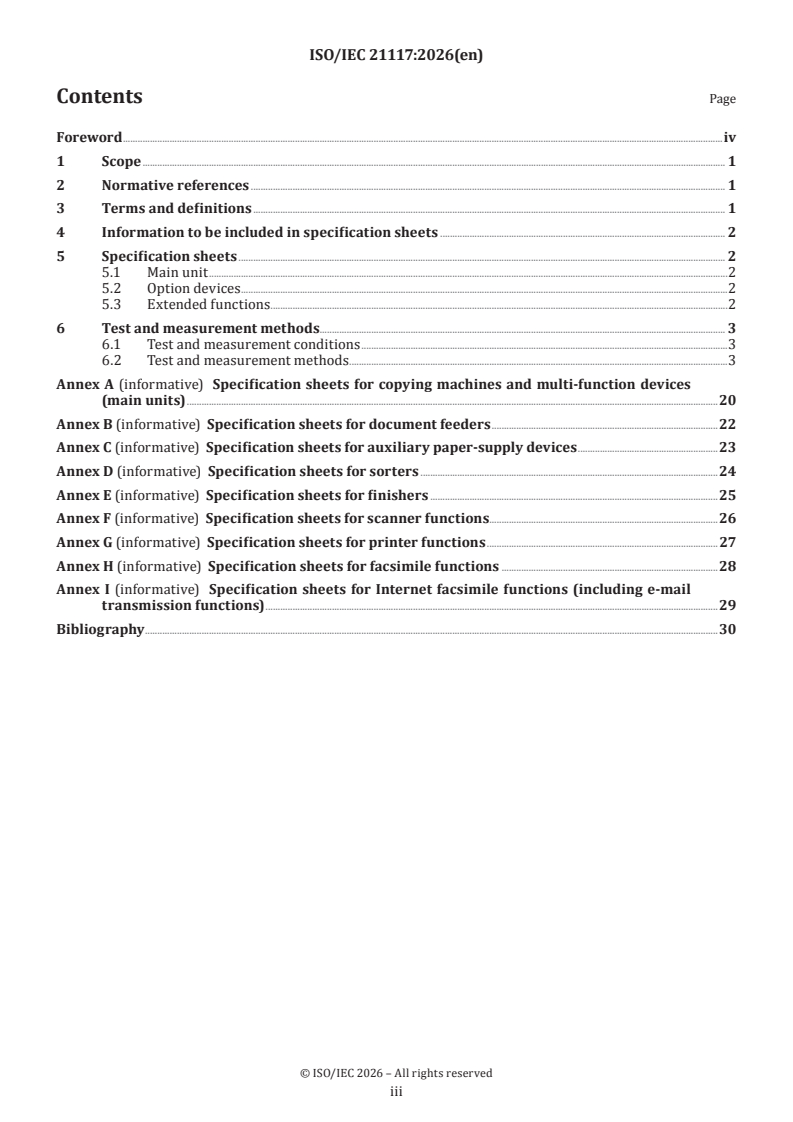
The document is organized into clauses 1 to 6 and informative annexes A to I. Clause 4 defines the required parameter list, clause 5 points to the specification-sheet layouts, and clause 6 gives the test and measurement conditions and methods.
| Annex | What it covers |
|---|---|
| Annex A | Specification sheets for copying machines and multi-function devices, main units |
| Annex B | Specification sheets for document feeders |
| Annex C | Specification sheets for auxiliary paper-supply devices |
| Annex D | Specification sheets for sorters |
| Annex E | Specification sheets for finishers |
| Annex F | Specification sheets for scanner functions |
| Annex G | Specification sheets for printer functions |
| Annex H | Specification sheets for facsimile functions |
| Annex I | Specification sheets for Internet facsimile functions, including e-mail transmission functions |
What are the key requirements of ISO/IEC 21117:2026?
ISO/IEC 21117:2026 requires specification sheets to use the parameter names in Table 1 and to include all applicable parameters in the given order. Parameters that do not function may be omitted. In practice, this gives buyers and users a consistent way to compare products, and it also helps manufacturers present product data in a common format.
The standard also links many parameters to specific measurement methods. Where a measurement method is given, the specification sheet is meant to show values that can be checked in a repeatable way, not just marketing descriptions.
Specification-sheet content and order
Clause 4 and Table 1 define the information to be shown for the main unit, options and extended functions. The note to Table 1 says that when parameters and values are taken into catalogues, there are no special rules on parameter numbers or order. That matters because the standard governs the formal sheet, while catalogues can present the same data more flexibly.
Main unit, options and extended functions
Clause 5 divides the product information into the main unit, option devices and extended functions. Annexes A to I then give the corresponding layout templates for copying machines, feeders, paper-supply devices, sorters, finishers, scanner functions, printer functions, facsimile functions and Internet facsimile functions. This helps users see which data belong to the base machine and which belong to add-on devices or network functions.
Test and measurement conditions
Clause 6.1 sets the test environment used for the methods in the document. If the manufacturer does not specify operating conditions, the standard gives default ranges for temperature, relative humidity, supply voltage, supply frequency, paper size and paper grammage. The paper used in tests must be conditioned under those conditions, and if a paper size other than A4 is used, the specification sheet should state that.
Copying performance
Clause 6.2 ties copying performance entries to the test methods in the document and in related standards. Continuous copying speed is measured under normal usage conditions with A4 paper, 1:1 magnification and standard feed direction, and the speed is based on the time from the first to the 11th ejected copy. First-copy-out time is measured from pressing the Print button to the first copy being fully ejected under the fastest setting.
For copying productivity, the document uses FSOT and ESAT, and it points to ISO/IEC 24735. For a single one-sided original, it uses sFCOT and sESAT and points to ISO/IEC 29183. These entries matter because they let users compare throughput on a defined basis rather than by vendor-specific claims.
Noise, power and safety-related data
Clause 4 also requires acoustical noise, power source, maximum power consumption, power-savings efficiency, safety regulations, safety data sheets, electromagnetic compatibility (EMC), operating environment, dimensions, weight and space required. Acoustical noise is measured according to ISO 7779 and declared in accordance with ISO 9296. Power-savings efficiency is stated for products subject to ENERGY STAR-type TEC and OM methods, so energy-related comparisons can be made in a standard form.
Option-device details
The annex-based entries for feeders, auxiliary paper-supply devices, sorters and finishers require product names, sizes, capacities, paper types, power source, maximum power consumption, dimensions, weight and, where relevant, stapling, hole punching, saddle stitching and folding. In practice, this tells a buyer whether a device fits the intended paper sizes, finishing tasks and installation space.
What terms does ISO/IEC 21117:2026 define?
- Typical electricity consumption (TEC) - the electricity consumed by the device while in typical mode over the week period specified in the ENERGY STAR program.
- Operational mode (OM) - the method used to quantify power consumption of imaging products that do not use the TEC method; the document notes ready, sleep and off values as the key results.
- FSOT - a copying, printing or feature-performance productivity value that the document requires when productivity is reported, together with a pointer to the full test report.
- ESAT - a throughput productivity value reported with FSOT for copying, printing or feature-performance measurements, expressed in image per minute.
- sFCOT - the single-original copy productivity measure used for a single one-sided original, reported in seconds.
- sESAT - the single-original copy productivity throughput measure used with sFCOT, reported in image per minute.
Who uses ISO/IEC 21117:2026?
ISO/IEC 21117:2026 is used by purchasers and users who need to compare copying machines and multi-function devices before selecting a product. It is also useful to manufacturers, product managers and technical writers who prepare specification sheets, and to test laboratories that measure copying, printing, scanning, noise or power-related performance. Procurement teams, quality managers and service organizations can use it to check that the product data they receive are complete and presented in a consistent order.
What changed in ISO/IEC 21117:2026 from the previous edition?
ISO/IEC 21117:2026 is the third edition and it cancels and replaces ISO/IEC 21117:2012. The foreword states that it has been technically revised. The changes named in the document are the addition of ISO/IEC 17629 and ISO/IEC 17991 as normative references.
Which standards are used with ISO/IEC 21117:2026?
| Standard | What it contributes |
|---|---|
| ISO 7779:2018 | Measurement of airborne noise emitted by information technology and telecommunications equipment |
| ISO 9296 | Declared noise emission values for information technology and telecommunications equipment |
| ISO/IEC 24734 | Method for measuring digital printing productivity |
| ISO/IEC 24735 | Method for measuring digital copying productivity |
| ISO/IEC 29183 | Method for measuring digital copying productivity for a single one-sided original |
| ISO/IEC 17629 | Method for measuring first print out time for digital printing devices |
| ISO/IEC 17991:2021 | Method for measuring scanning productivity of digital scanning devices |
| IEC 62368-1:2023 | Safety requirements for audio/video, information and communication technology equipment |
What does the ISO/IEC 21117:2026 document contain?
ISO/IEC 21117:2026 contains Table 1, which lists the parameters to be shown on specification sheets and indicates the measurement method for many of them. It also contains clause 6, which sets the test environment and measurement approach for copying, power and related performance data.
The annexes provide layout templates rather than normative product limits. They show how to present the main unit, feeders, paper-supply devices, sorters, finishers, scanner functions, printer functions, facsimile functions and Internet facsimile functions on a specification sheet.
The document also includes fields for dimensions, weight, space required, operating environment, safety information, EMC, acoustical noise, power source, memory capacity and extended functions. For some items it includes performance metrics such as FSOT, ESAT, sFCOT, sESAT, continuous copying speed, first-copy-out time, warm-up time and recovery time, so the sheet can support both product comparison and test reporting.
Relations
- Effective Date
- 31-Aug-2024
Frequently Asked Questions
ISO/IEC 21117:2026 is a standard published by the International Organization for Standardization (ISO). Its full title is "Information technology — Office equipment — Information to be included in specification sheets and related test methods for copying machines and multi-function devices". This standard covers: This document specifies the information to be included in specification sheets for electrophotographic digital copying machines and multi-function devices. This document is applicable to purchasers and users, enabling them to compare the characteristics of different models of copying machines and multi-function devices for easier selection of products that meet their requirements.
This document specifies the information to be included in specification sheets for electrophotographic digital copying machines and multi-function devices. This document is applicable to purchasers and users, enabling them to compare the characteristics of different models of copying machines and multi-function devices for easier selection of products that meet their requirements.
ISO/IEC 21117:2026 is classified under the following ICS (International Classification for Standards) categories: 37.100.10 - Reproduction equipment. The ICS classification helps identify the subject area and facilitates finding related standards.
ISO/IEC 21117:2026 has the following relationships with other standards: It is inter standard links to ISO/IEC 21117:2012. Understanding these relationships helps ensure you are using the most current and applicable version of the standard.
ISO/IEC 21117:2026 is available in PDF format for immediate download after purchase. The document can be added to your cart and obtained through the secure checkout process. Digital delivery ensures instant access to the complete standard document.
Standards Content (Sample)
International
Standard
ISO/IEC 21117
Third edition
Information technology — Office
2026-11
equipment — Information to be
included in specification sheets and
related test methods for copying
machines and multi-function
devices
Reference number
© ISO/IEC 2026
All rights reserved.
This ISO publication is protected by copyright and is owned by ISO and/or its licensors.
The content of this ISO publication is provided under licence, not sold. Use is subject to the applicable licence terms issued by ISO,
an ISO member body, or an authorized third-party distributor.
Except as required for implementation or expressly permitted by a separate licence, no part of this ISO publication may be
reproduced, distributed, modified, used, or made available in any form or by any means – electronic or mechanical, including
photocopying, scanning, recording, or posting on internal or external digital platforms.
Any use beyond the scope of the granted rights is prohibited and may result in legal action.
ISO copyright office
CP 401 • CH-1214 Vernier, Geneva
Phone: +41 22 749 01 11
Email: copyright@iso.org
Website: www.iso.org
Published in Switzerland
© ISO/IEC 2026 – All rights reserved
ii
Contents Page
Foreword .iv
1 Scope . 1
2 Normative references . 1
3 Terms and definitions . 1
4 Information to be included in specification sheets . 2
5 Specification sheets . 2
5.1 Main unit .2
5.2 Option devices .2
5.3 Extended functions.2
6 Test and measurement methods. 3
6.1 Test and measurement conditions .3
6.2 Test and measurement methods .3
Annex A (informative) Specification sheets for copying machines and multi-function devices
(main units) .20
Annex B (informative) Specification sheets for document feeders .22
Annex C (informative) Specification sheets for auxiliary paper-supply devices .23
Annex D (informative) Specification sheets for sorters .24
Annex E (informative) Specification sheets for finishers .25
Annex F (informative) Specification sheets for scanner functions.26
Annex G (informative) Specification sheets for printer functions .27
Annex H (informative) Specification sheets for facsimile functions .28
Annex I (informative) Specification sheets for Internet facsimile functions (including e-mail
transmission functions) .29
Bibliography .30
© ISO/IEC 2026 – All rights reserved
iii
Foreword
ISO (the International Organization for Standardization) and IEC (the International Electrotechnical
Commission) form the specialized system for worldwide standardization. National bodies that are
members of ISO or IEC participate in the development of International Standards through technical
committees established by the respective organization to deal with particular fields of technical activity.
ISO and IEC technical committees collaborate in fields of mutual interest. Other international organizations,
governmental and non-governmental, in liaison with ISO and IEC, also take part in the work.
The procedures used to develop this document and those intended for its further maintenance are described
in the ISO/IEC Directives, Part 1. In particular, the different approval criteria needed for the different types
of document should be noted. This document was drafted in accordance with the editorial rules of the ISO/
IEC Directives, Part 2 (see www.iso.org/directives or www.iec.ch/members_experts/refdocs).
ISO and IEC draw attention to the possibility that the implementation of this document may involve the
use of (a) patent(s). ISO and IEC take no position concerning the evidence, validity or applicability of any
claimed patent rights in respect thereof. As of the date of publication of this document, ISO and IEC had not
received notice of (a) patent(s) which may be required to implement this document. However, implementers
are cautioned that this may not represent the latest information, which may be obtained from the patent
database available at www.iso.org/patents and https://patents.iec.ch. ISO and IEC shall not be held
responsible for identifying any or all such patent rights.
Any trade name used in this document is information given for the convenience of users and does not
constitute an endorsement.
For an explanation of the voluntary nature of standards, the meaning of ISO specific terms and expressions
related to conformity assessment, as well as information about ISO's adherence to the World Trade
Organization (WTO) principles in the Technical Barriers to Trade (TBT) see www.iso.org/iso/foreword.html.
In the IEC, see www.iec.ch/understanding-standards.
This document was prepared by Joint Technical Committee ISO/IEC JTC 1, Information technology,
Subcommittee SC 28, Office equipment.
This third edition cancels and replaces the second edition (ISO/IEC 21117:2012), which has been technically
revised.
The main changes are as follows:
— ISO/IEC 17629 and ISO/IEC 17991 added as normative references.
Any feedback or questions on this document should be directed to the user’s national standards
body. A complete listing of these bodies can be found at www.iso.org/members.html and
www.iec.ch/national-committees.
© ISO/IEC 2026 – All rights reserved
iv
International Standard ISO/IEC 21117:2026(en)
Information technology — Office equipment — Information to
be included in specification sheets and related test methods
for copying machines and multi-function devices
1 Scope
This document specifies the information to be included in specification sheets for electrophotographic
digital copying machines and multi-function devices. This document is applicable to purchasers and users,
enabling them to compare the characteristics of different models of copying machines and multi-function
devices for easier selection of products that meet their requirements.
2 Normative references
The following documents are referred to in the text in such a way that some or all of their content constitutes
requirements of this document. For dated references, only the edition cited applies. For undated references,
the latest edition of the referenced document (including any amendments) applies.
ISO 7779:2018, Acoustics — Measurement of airborne noise emitted by information technology and
telecommunications equipment
ISO 9296, Acoustics — Declared noise emission values of information technology and telecommunications
equipment
ISO/IEC 24734, Information technology — Office equipment — Method for measuring digital printing
productivity
ISO/IEC 24735, Information technology — Office equipment — Method for measuring digital copying
productivity
ISO/IEC 29183, Information technology — Office equipment — Method for measuring digital copying
productivity for a single one-sided original
ISO/IEC 17629, Information technology — Office equipment — Method for measuring first print out time for
digital printing devices
ISO/IEC 17991:2021, Information technology — Office equipment — Method for measuring scanning
productivity of digital scanning devices
IEC 62368-1:2023, Audio/video, information and communication technology equipment - Part 1: Safety
requirements
3 Terms and definitions
For the purposes of this document, the following terms and definitions apply.
ISO and IEC maintain terminology databases for use in standardization at the following addresses:
— ISO Online browsing platform: available at https:// www .iso .org/ obp
— IEC Electropedia: available at http:// www .electropedia .org
© ISO/IEC 2026 – All rights reserved
3.1
typical electricity consumption
TEC
electricity consumed by the device while in typical mode during a week period of time specified in ENERGY
1)
STAR® program
1)
Note 1 to entry: This mode is specified in the ENERGY STAR® program.
3.2
operational mode
OM
method to quantify the power consumption of imaging products that do not utilize the TEC method specified
in ENERGY STAR® program
1)
Note 1 to entry: This mode is specified in the ENERGY STAR® program
Note 2 to entry: Examples of products that will be tested with this OM method include those that use marking
technologies such as ink jet, dot matrix or impact, as well as scanners and all large-format and small-format devices.
The key results of this test procedure are power values for ready, sleep and off modes.
4 Information to be included in specification sheets
Table 1 defines a name and a short description for each parameter entry. These constitute the information to
be included in specification sheets. Furthermore, test and measurement methods are defined for parameters
where applicable in the “Definitions and methods of measurement” column. Specification sheets shall use
the parameter names listed in Table 1. Specification sheets shall include all applicable parameters in the
given order. Parameters that do not function, however, may be omitted.
NOTE When extracting parameters and specification values from specification sheets for use in catalogues, there
are no particular provisions on the parameter numbers or on the order in which the parameters are listed.
5 Specification sheets
5.1 Main unit
Refer to Annex A.
5.2 Option devices
a) Document feeder: refer to Annex B.
b) Auxiliary paper-supply devices: refer to Annex C.
c) Sorters: refer to Annex D.
d) Finishers: refer to Annex E.
5.3 Extended functions
a) Scanner function: refer to Annex F.
b) Printer function: refer to Annex G.
c) Facsimile function: refer to Annex H.
d) E-mail/Internet facsimile function: refer to Annex I.
1) “ENERGY STAR® is a trademarked certification program administrated by the United States Environmental Protection
Agency (US EPA). This information is given for the convenience of users of this document and does not constitute an
endorsement by ISO”
© ISO/IEC 2026 – All rights reserved
6 Test and measurement methods
6.1 Test and measurement conditions
The test environment, including temperature and humidity, shall be within the ranges recommended by the
manufacturer for operating the device. If no recommendation is available, the following ranges shall apply.
Temperature: 23 °C ± 5 °C;
Relative humidity: (50 ± 20) %;
Supply voltage: rated input voltage;
Supply frequency: rated frequency;
Paper size: A4;
2 2;
Paper grammage: 60 g/m to 90 g/m
If a different paper size other than A4 is used, the size should be stated in the specification sheets. The paper
used in the tests shall be conditioned under the environmental conditions given above.
6.2 Test and measurement methods
Test and measurement method for each parameter is specified in Table 1.
Table 1 — Parameters to be included in specification sheets
Parameter Description of the entry Definitions and methods of
Remarks and examples measurement
1 Main unit Refer to Annex A.
1.1 Name Product name and model number.
1.2 Type States if the machine is a portable,
desktop, or floor-standing (console)
type and if the machine is an all-in-
one or multi-component type.
1.3 Copying method Digital electrophotographic
1.4 Colour States if single-colour or full-colour
copying is supported for machines
that support colour copying.
1.5 Type of photoreceptor Organic material, a-Si or Selenium.
1.6 Scanning light source States the type of light source used
for scanning and its rated power con-
sumption in watts.
1.7 Type of platen Moving or stationary.
If no platen is provided and the origi-
nal is fed into the machine by hand or
with a document carrier, indicate the
platen as “feed-through”.
1.8 Scanning method States the method by which originals
are scanned and the type of scanning
device.
1.9 Writing method States the method by which the latent
image is written to the photoreceptor.
1.10 Developing method Mono or dual components.
© ISO/IEC 2026 – All rights reserved
TTabablele 1 1 ((ccoonnttiinnueuedd))
Parameter Description of the entry Definitions and methods of
Remarks and examples measurement
1.11 Copy density adjustment Manual or automatic.
If manual, indicate the adjustment
method, such as continuous or dis-
crete.
1.12 Fixing method Heat-roller, flash, oven, or pressure
fixing.
1.13 Paper-supply device/paper-sup- States the paper-supply method (au-
ply capacity tomatic or manual) and the number of
cassettes, decks, and trays (attached
to the main unit). Also, indicate the
loading capacity in sheets for each
cassette, deck, and tray for a defined
paper grammage (in g/m ). If there
are multiple pickup trays, indicate the
loading capacity for each pickup tray.
For machines that use roll sheets, list
the width and length of roll sheets.
1.14 Scanning resolution States the main and sub scanning res-
olutions as needed, expressed in “dpi”
or “dpi (number of dots/25,4 mm)”.
If it has resolution enhancement,
should be indicated.
EXAMPLE Optical resolution:
1200 dpi × 1200 dpi
1.15 Writing resolution States the main and sub write res-
olution, expressed in “dpi” or “dpi
(number of dots / 25,4 mm)”. Writing
resolution equals to the print engine's
native addressability.
EXAMPLE 1200 dpi × 1200 dpi
1.16 Scan colours The tones can be specified EXAM-
PLE 24-bit colour (8-bits per colour
plane)
1.17 Acceptable originals Lists sheets, books, computer forms,
and other acceptable originals.
1.18 Copy paper Indicates any specially processed copy
paper that is used.
Also, states the paper grammage that
can be transported in the machine.
The recommended unit is g/m .
1.19 Original sizes States the maximum size in milli-
metres. ISO size such as A3, B4 can
be stated. The specification sheet
should indicate any limitations on the
thickness of originals as well as the
maximum weight that can be placed
on the platen.
1.20 Copying dimensions States the maximum and minimum
dimensions that can be copied in milli-
metres. ISO size such as A3, B4 can be
stated.
If the copying size varies by the
paper-supply method (manual or auto-
matic), this is indicated.
© ISO/IEC 2026 – All rights reserved
TTabablele 1 1 ((ccoonnttiinnueuedd))
Parameter Description of the entry Definitions and methods of
Remarks and examples measurement
1.21 Non-image area Non-image area is the area that cannot The non-image areas at each edge
be copied on when copying an original shall be indicated. The non-image
without margins on a given paper size. areas shall be measured from the
States in millimetres the width of the top, bottom, and sides of the copy
non-copy area at the top, bottom, and paper to the image, copied under
side of the page. normal usage conditions.
1.22 Possible enlargement and reduc- Indicates the possible enlargement
tion and reduction expressed as a normal-
ized ratio to the length of the original.
The ratio is stated for enlarged copies,
reduced copies, and direct (1:1) copies
to two decimal places.
Express the error deviation of direct
(1:1) copying as a percent. The devia-
tion percentage (%) shall be the max-
imum deviation, including variations
between machines of the same model.
1.23 Number of continuous copies Indicates in pages the maximum
number of copies that can be set for
continuous copying when the machine
operates as a copying machine.
1.24 Continuous copying speed States the number in pages/minute The machine shall be set to copy 11
that can be made under normal usage copies under normal usage con-
conditions (A4 paper, 1:1 magnifica- ditions (A4 paper, 1:1 magnifica-
tion, and standard feed direction) in tion, and standard feed direction).
continuous copying mode. Specify if Measure the time (that is, obtain the
copying speeds vary by paper size. value t in seconds) from when the
first copy is fully ejected to when the
For colour copying machines, specify
11th copy is fully ejected. This value
the copying speeds for both colour
shall be converted into the number of
copying and monochrome (black and
copies per minute with the following
white) copying.
equation:
Specify if copying speeds vary by cop- 60 ÷ (t/10) = the number of copies
ying process. Each respective copying per minute
speed should be indicated.
For continuous passed pages, a
The number of copies is expressed in number of pages equivalent to the
copies per minute (CPM) in the follow- number of copies per minute + 1 may
ing formats. be passed.
a) Less than 10 CPM: Round off to two In this case, “10” in the equation
decimal places and express as two above is replaced with “number of
significant figures: X.X passed pages – 1”.
b) 10 CPM to 99 CPM: Express with
either of the methods below:
1) Round off to one decimal place and
express as two significant figures: XX
2) Round off to two decimal places
and express as three significant fig-
ures: XX.X
c) 100 CPM or more: Round off to one
decimal place and express as three
significant figures: XXX
ISO/IEC 24735 can be used to describe
the copying productivity of copier
and MFP devices. (See parameter 1.42
Copying Productivity)
© ISO/IEC 2026 – All rights reserved
TTabablele 1 1 ((ccoonnttiinnueuedd))
Parameter Description of the entry Definitions and methods of
Remarks and examples measurement
1.25 First-copy-out time States in seconds the time from press- The first-copy-out time shall be
ing the Print button to completing the measured in seconds from the mo-
delivery of the first copy with the set- ment the Print button is pressed to
ting that produces the fastest result the time the first copy is fully ejected
under normal usage conditions (A4 with the setting that produces the
paper, 1:1 magnification, and standard fastest result under normal usage
feed direction). conditions.
The specification sheet should also
indicate if the first-copy-out time var-
ies depending on certain conditions,
such as the basic configuration of the
copying machine or the mode of or
attachments to the document feeder.
The specification sheet should also
indicate if the first-copy-out time
varies depending on the use and
modes of options, such as automatic
copy-density adjustment, original-size
detection, and automatic duplex copy-
ing. It should also note these different
values.
ISO/IEC 29183 can be used to describe
the copying productivity for single
originals. (See parameter 1,43 Copy-
ing productivity for a single one-sided
original)
1.26 Warm-up time States the time in minutes or seconds Tests shall be performed on a
from power on to a ready state. If the machine that has been turned off
machine is pre-heated, this is indicat- until its internal temperature can
ed along with the time to pre-heat. be assumed the same as the ambient
temperature. The time from turning
The temperature and relative humid-
on the power switch to a copy-ready
ity during the warm-up-time meas-
state shall be measured.
urement shall also be reported with
the measured value. If the machine The warm-up time should be tested
is pre-heated, this shall be indicated at a temperature of 20 °C.
along with the time to pre-heat.
1.27 Power source Lists the voltage (in volts), frequency
(in hertz), and current (in amperes)
for AC-powered machines.
If the machine can operate at both
50 Hz and 60 Hz, this is indicated. For
DC-powered machines, list the voltage
(in volts) and current (in amperes).
1.28 Maximum power consumption States the maximum power consumed The maximum power consump-
in kW or W when the machine is in tion shall be measured in kilowatts
use. while copying under normal usage
conditions from the time the power is
turned on. Transient power fluctua-
tions, however, are excluded.
Options that can be adjusted, such as
the copy ratio and copy density, shall
be set so the maximum amount of
power is consumed.
© ISO/IEC 2026 – All rights reserved
TTabablele 1 1 ((ccoonnttiinnueuedd))
Parameter Description of the entry Definitions and methods of
Remarks and examples measurement
1.29 Power-savings efficiency States the power-saving efficiency
value with unit of measurement for
machines that is subject to regulations
such as EPA Energy Star® TEC and
OM.
EXAMPLE 9,75 kWh/week (TEC)
1.30 Extended functions States any extended functions that can
be installed, such as facsimile, printer,
scanner, and network functions.
1.31 Memory capacity States the standard-equipped memory
capacity and the maximum extendable
memory capacity, expressed in mega-
bytes (MB) or gigabytes (GB).
EXAMPLE 256 MB standard, 512 MB
maximum, 120 GB hard-disk drive
1.32 Primary options Lists any options not covered above, The copying machine unit shall be
such as duplex copying functions, tested with the options in place while
automatic colour functions, image being operated in accordance with
processing, magnification functions, the operating procedure given in
margin functions, and editing func- catalogues, specification sheets, or
tions. operating manuals. The existence or
absence of malfunctions and other
When listing options, specify the test
required parameters shall be exam-
parameters, test methods, and test
ined.
results.
1.33 Safety regulations States applicable standards.
Indicates the applicable national
deviations.
1.34 Safety data sheets Available/not available
1.35 Electromagnetic compatibility States electromagnetic compatibility
(EMC) according to IEC 62368-1
1.36 Acoustical noise States the sound power levels and Sound power levels and sound
sound pressure levels of noise during pressure levels shall be measured in
standby and while copying. accordance with ISO 7779.
Noise values shall be expressed in Noise shall be measured both during
accordance with ISO 9296. standby and while copying.
a) Method of measuring sound
power levels
1) Many types of measurement
points can be selected when meas-
uring sound power according to
ISO 7779:2018, Clause 7. In this
document, the measurement points
shown in ISO 3744:2010, Figure C.2
(a nine-point measurement on a
parallelepiped measurement surface)
are recommended.
When measuring sound power in a
reverberation room according to ISO
7779:2018, Clause 6, use the meas-
urement points described in Clause 6.
© ISO/IEC 2026 – All rights reserved
TTabablele 1 1 ((ccoonnttiinnueuedd))
Parameter Description of the entry Definitions and methods of
Remarks and examples measurement
2) The distance criteria are as-
sumed to be to each plane of the
hypothetical surface (the reference
box) which is the smallest rectangu-
lar parallelepiped that just encloses
the copying machine.
Protruding sections of the copying
machine (such as cassettes and trays)
that do not appear to contribute to
noise are assumed not to be included
in the reference box mentioned above
because they are considered not to
affect measurement values.
3) Measurements are expressed in
bels (B).
b) Method of measuring sound pres-
sure levels
1) Measurement points are defined in
ISO 7779.
2) The distance between the machine
under measurement and the meas-
urement points is defined as follows:
2.1) Operator distance:
0,25 m ± 0,03 m
2.2) Bystander distance:
1,00 m ± 0,03 m
Measurements are taken at four by-
stander positions at the front, back,
left, and right of the machine.
3) The height of the measure-
ment points from the floor is
1.50 m ± 0.03 m.
The height of 1.50 m ± 0.03 m
assumes a standing operator. If the
operator is seated, choose the most
appropriate operator position from
(b), (c), or (d) in Figure 1 of ISO
7779:2010.
If the operator position cannot be
determined, measurements from the
operator position may be omitted.
4) Measurements are expressed in
decibels (dB).
1.37 Additional features (options) States any extended features that can
be installed on the copying machine.
1.38 Operating environment Specifies the minimum and maximum
ambient temperatures, and related
range of relative humidity.
1.39 Dimensions States the dimensions of the main unit
in either centimetres or millimetres in
the order: width × depth × height.
1.40 Weight States the weight of the main unit in
kilograms.
© ISO/IEC 2026 – All rights reserved
TTabablele 1 1 ((ccoonnttiinnueuedd))
Parameter Description of the entry Definitions and methods of
Remarks and examples measurement
1.41 Space required States the maximum dimensions in
either centimetres or millimetres
of the main unit when the largest
cassette, tray, and delivery unit are
installed in the order: width × depth.
The specification sheet should also list
the space required when accessories
and options are installed, such as au-
tomatic document feeders, sorters, or
large-capacity paper-supply devices.
1.42 Copying productivity States FSOT and ESAT (copying) Refer to ISO/IEC 24735
parameters and a pointer to the full
test report only if copying productiv-
ity is measured. Measured unit is ipm
(image per minute). These parameters
shall be measured according to ISO/
IEC 24735.
1.43 Copying productivity (for a sin- States sFCOT and sESAT (copying) pa- Refer to ISO/IEC 29183
gle one-sided original) rameters and a pointer to the full test
report only if copying productivity is
measured. Measured unit of sFCOT is
second and measured unit of sESAT is
ipm. These parameters shall be meas-
ured according to ISO/IEC 29183.
1.44 Recovery time States time required by a device to
recover from sleep state given by the
difference in FPOT between sleep
state and ready state
1.45 Typical electricity consumption States electricity consumed by the
device while in typical mode during a
week period of time
1.46 Operational mode States quantify the power consump-
tion of imaging products that do not
utilize the TEC method specified in
ENERGY STAR® program
1.47 Other parameters Lists required parameters not covered
between 1.1 and 1.48.
2 Accessories (options)
2.1 Document feeders Refer to Annex B.
2.1.1 Name Lists the product name or model
number.
2.1.2 Type States the feeder class, such as doc-
ument feeder, automatic document
feeder, or automatic duplex document
feeder (document turn over or 1 pass).
If the feeder has a sheet-through feed-
ing function, this is indicated.
2.1.3 Acceptable originals States the maximum and minimum
original sizes in millimetres that the
feeder can accept. If special originals
can be used, their size is indicated.
© ISO/IEC 2026 – All rights reserved
TTabablele 1 1 ((ccoonnttiinnueuedd))
Parameter Description of the entry Definitions and methods of
Remarks and examples measurement
2.1.4 Types of originals States the range of paper thickness,
expressed by weight in grammage (g/
m ), that the feeder can accept. If spe-
cial originals or special paper types
can be used, this is indicated.
2.1.5 Loading capacity States the maximum number of origi-
nals that can be loaded in the feeder at
one time. If the capacity varies by size
or weight of originals, this is indicat-
ed.
2.1.6 Original r
...