

ISO 4059:1978
(Main)Polyethylene (PE) pipes — Pressure drop in mechanical pipe-jointing systems — Method of test and requirements
General Information
- Abstract
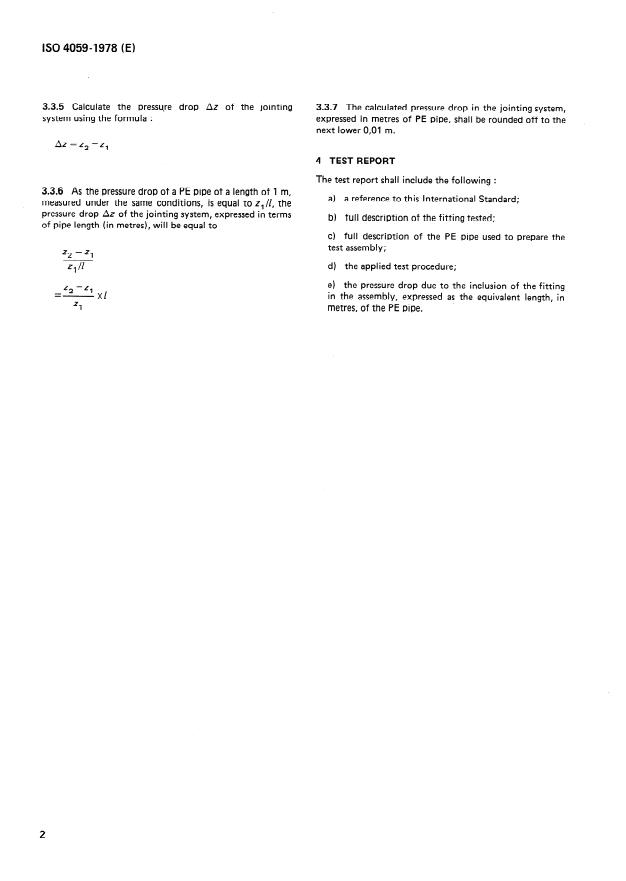
Specification of a laboratory test assembly with the pipe-jointing system to be tested. A water flow of 2 m/s through the pipe assembly is adjusted and the resulting pressure drop is determined.
- Status
- Published
- Publication Date
- 31-Aug-1978
- Current Stage
- 9093 - International Standard confirmed
- Start Date
- 17-Apr-2026
- Completion Date
- 29-Aug-2026
Buy Documents
ISO 4059:1978 - Polyethylene (PE) pipes -- Pressure drop in mechanical pipe-jointing systems -- Method of test and requirements
ISO 4059:1978 - Polyethylene (PE) pipes — Pressure drop in mechanical pipe-jointing systems — Method of test and requirements/1/1978
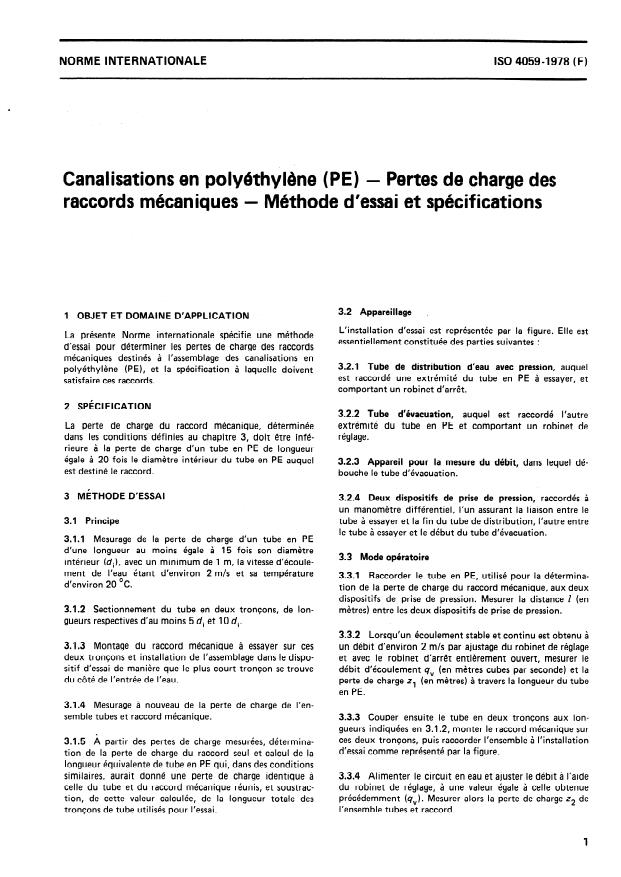
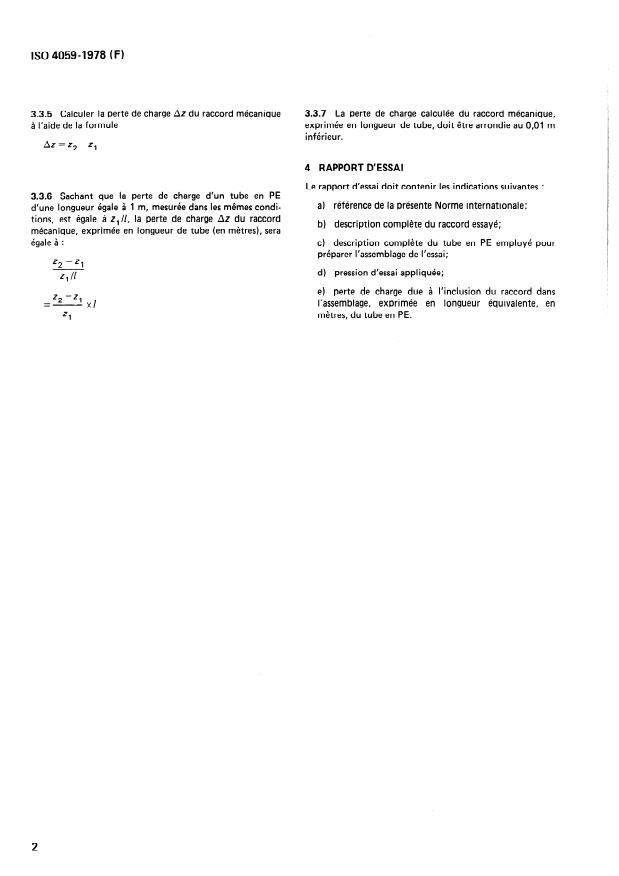
ISO 4059:1978 - Canalisations en polyéthylene (PE) -- Pertes de charge des raccords mécaniques -- Méthode d'essai et spécifications
ISO 4059:1978 - Canalisations en polyéthylène (PE) — Pertes de charge des raccords mécaniques — Méthode d'essai et spécifications/1/1978
ISO 4059:1978 - Canalisations en polyéthylène (PE) — Pertes de charge des raccords mécaniques — Méthode d'essai et spécifications/1/1978
Overview
ISO 4059:1978 specifies the laboratory test method and requirements for determining the pressure drop in mechanical pipe-jointing systems for polyethylene (PE) pipes used in water supply. This international standard, developed by the ISO Technical Committee TC 138 for plastics pipes, fittings, and valves, ensures that PE mechanical joints do not introduce excessive head loss, thereby aligning with quality and performance expectations in water distribution systems. The standard sets out a specific test process where water is passed at a controlled flow rate through a PE pipe assembly, and the resultant pressure drop caused by the jointing fittings is measured and evaluated.
Key Topics
- Pressure Drop Measurement
The core focus is on determining the pressure drop in PE pipes due to mechanical jointing systems using a standardized laboratory procedure. - Test Procedure
- Preparation of a test assembly using PE pipes and the jointing system in question
- Water flow is set to approximately 2 meters per second at a controlled temperature
- Pressure drop across the assembly is measured with precise instrumentation
- Requirements
The measured pressure drop must not exceed the drop produced by a straight PE pipe of specific length, maintaining consistent performance benchmarks. - Reporting
Comprehensive documentation of the test conditions, pipe and fitting descriptions, and calculated results is required for transparency and repeatability.
Applications
ISO 4059:1978 is essential for several practical applications in the plastics piping industry, particularly in the context of water supply systems:
- Quality Assurance
Manufacturers use the standard to confirm that mechanical PE pipe joints meet internationally recognized pressure drop limits, ensuring product reliability and system efficiency. - System Design and Compliance
Engineers and designers reference the standard to select suitable pipe fittings that adhere to acceptable head loss criteria, supporting robust hydraulic calculations and compliance with technical specifications. - Procurement and Specification
Project managers and procurers use ISO 4059 requirements to define acceptance criteria in tender documents, facilitating quality-driven supplier selection. - Research and Development
Product developers employ the standard’s test method to evaluate new pipe-jointing designs, benchmarking against market expectations and regulatory frameworks. - Regulatory Oversight
Regulatory bodies adopt ISO 4059:1978 as a basis for approval processes, helping safeguard drinking water supply performance at the infrastructure level.
Related Standards
For comprehensive evaluation and integration into water supply projects, ISO 4059:1978 should be considered alongside the following standards:
- ISO 4427 (Polyethylene Pipes for Water Supply)
Covers general requirements and performance for PE pipes in water supply networks. - ISO 17885 (Mechanical Fittings for PE Pipes) Specifies requirements for mechanical fittings, complementing pressure drop assessment.
- ISO 3126 (Plastics Piping Systems - Measurement Methods) Describes methods for measuring piping system components, supporting accurate test assembly preparations.
- ISO/TC 138 Standards
Explore the broader family of standards under ISO/TC 138 for plastics pipes, fittings, and valves.
ISO 4059:1978 is a valuable standard for any organization involved in the design, manufacture, or specification of polyethylene piping systems for water. Adherence to its test methods ensures consistent product performance, regulatory compliance, and high-quality infrastructure in water distribution applications.
Relations
- Effective Date
- 08-Apr-2026
- Effective Date
- 06-Jun-2022
Buy Documents
ISO 4059:1978 - Polyethylene (PE) pipes -- Pressure drop in mechanical pipe-jointing systems -- Method of test and requirements
ISO 4059:1978 - Polyethylene (PE) pipes — Pressure drop in mechanical pipe-jointing systems — Method of test and requirements/1/1978
ISO 4059:1978 - Canalisations en polyéthylene (PE) -- Pertes de charge des raccords mécaniques -- Méthode d'essai et spécifications
ISO 4059:1978 - Canalisations en polyéthylène (PE) — Pertes de charge des raccords mécaniques — Méthode d'essai et spécifications/1/1978
ISO 4059:1978 - Canalisations en polyéthylène (PE) — Pertes de charge des raccords mécaniques — Méthode d'essai et spécifications/1/1978
Get Certified
Connect with accredited certification bodies for this standard

Institut za varilstvo d.o.o. (Welding Institute)
Slovenia's leading welding institute since 1952. ISO 3834, EN 1090, pressure equipment certification, NDT personnel, welder qualification. Only IIW Au
Sponsored listings
Frequently Asked Questions
ISO 4059:1978 is a standard published by the International Organization for Standardization (ISO). Its full title is "Polyethylene (PE) pipes — Pressure drop in mechanical pipe-jointing systems — Method of test and requirements". This standard covers: Specification of a laboratory test assembly with the pipe-jointing system to be tested. A water flow of 2 m/s through the pipe assembly is adjusted and the resulting pressure drop is determined.
Specification of a laboratory test assembly with the pipe-jointing system to be tested. A water flow of 2 m/s through the pipe assembly is adjusted and the resulting pressure drop is determined.
ISO 4059:1978 is classified under the following ICS (International Classification for Standards) categories: 23.040.20 - Plastics pipes. The ICS classification helps identify the subject area and facilitates finding related standards.
ISO 4059:1978 has the following relationships with other standards: It is inter standard links to EN 12201-3:2011+A1:2012, ISO 11820:1996. Understanding these relationships helps ensure you are using the most current and applicable version of the standard.
ISO 4059:1978 is available in PDF format for immediate download after purchase. The document can be added to your cart and obtained through the secure checkout process. Digital delivery ensures instant access to the complete standard document.
Standards Content (Sample)
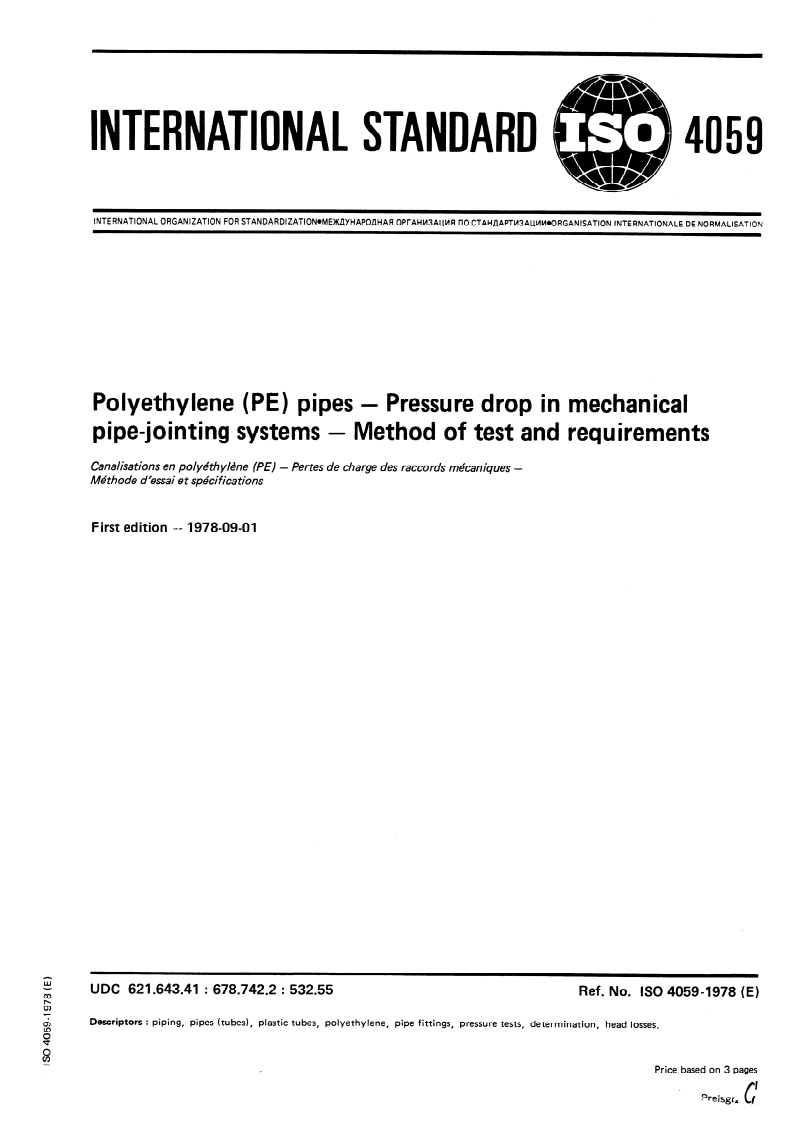
INTERNATIONAL STANDARD
INTERNATIONAL ORGANIZATION FOR STANDARDiZATlONWWK,QYHAPO~HAR OPfAHM3AUMR I-IO CTAH~APTbl3AL&lM*ORGANlSATlON INTERNATIONALE DE NORMALISATION
Polyethylene (PE) pipes - Pressure ~ drop in mechanical
pipe-jointing systems - Method of test and requirements
Canalisations en poiyt!thyl&ne (PE) - Pertes de charge des raccords mkaniques -
Me ’thode d/essai et spkifications
First edition -- 1978-09-01
UDC 621.643.41 : 678.742.2 : 532.55 Ref. No. IS0 4059-1978 (E)
Descriptors : piping, pipes (tubes), plastic tubes, polyethylene, pipe fittings, pressure tests, determination, head losses.
Price based on 3 pages
FOREWORD
IS0 (the International Organization for Standardization) is a worldwide federation
of national standards institutes (IS0 member bodies). The work of developing
International Standards is carried out through IS0 technical committees. Every
member body interested in a subject for which a technical committee has been set
up has the right to be represented on that committee. International organizations,
governmental and non-governmental, in liaison with ISO, also take part in the work.
Draft International Standards adopted by the technical committees are circulated
to the member bodies for approval before their acceptance as International
Standards by the IS0 Council.
International Standard IS0 4059 was developed by Technical Committee
lSO/TC 138, Plastics pipes, fittings and valves for the transport of fluids, and was
circulated to the member bodies in July 1976.
It has been approved by the member bodies of the following countries :
Austria Israel Romania
Belgium Italy Spain
Canada Korea, Rep. of Sweden
Finland Mexico Turkey
France Netherlands United Kingdom
Germany New Zealand U.S.A.
India Norway Yugoslavia
Ireland Poland
The member body of
the following country expressed disapproval of the document
on technical grounds :
Switzerland
@ International Organization for Standardization, 1978 l
Printed in Switzerland
IS0 40594978 (E)
INTERNATIONAL STANDARD
- Pressure . drop in mechanical
Polyethylene (PE) pipes
pipe-jointing systems - Method of test and requirements
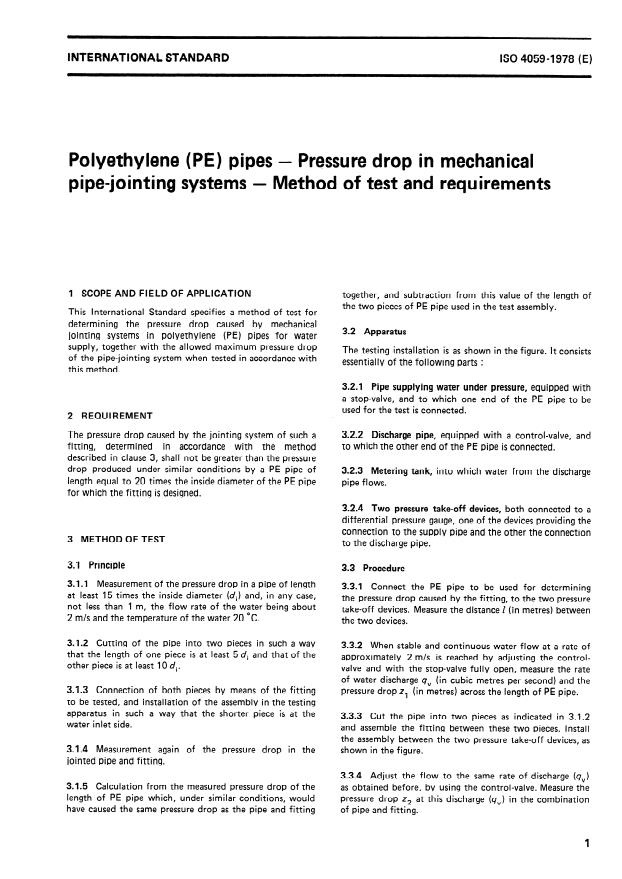
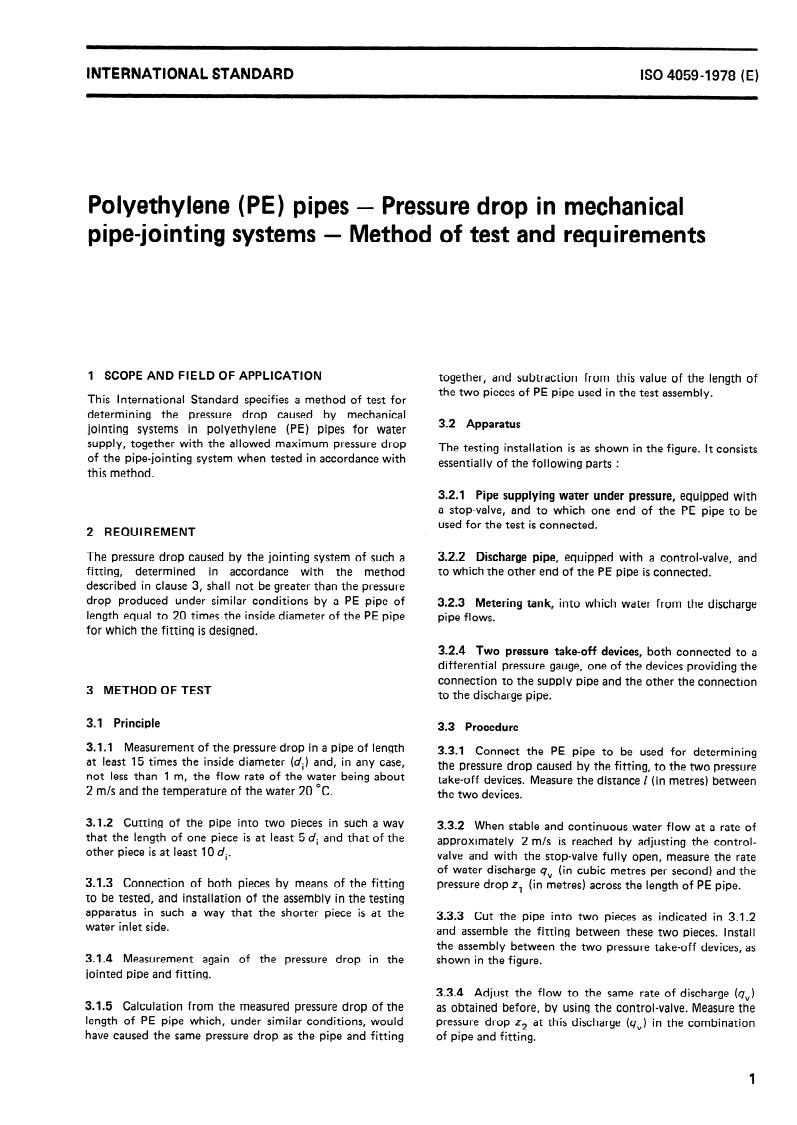
1 SCOPE AND FIELD OF APPLICATION together, and subtraction from this value of the length of
the two pieces of PE pipe used in the test assembly.
This International Standard specifies a method of test for
determining the pressure drop caused by mechanical
3.2 Apparatus
jointing systems in polyethylene (PE) pipes for water
supply, together with the allowed maximum pressure drop
The testing installation is as shown in the figure. It consists
of the pipe-jointing system when tested in accordance with
essentially of the following parts :
this method.
3.2.1 Pipe supplying water under pressure, equipped with
a stop-valve, and to which one end of the PE pipe to be
used for the test is connected.
2 REQUIREMENT
3.2.2 Discharge pipe, equipped with a control-valve, and
The pressure drop caused by the jointing system of such a
to which the other end of the PE pipe is connected.
fitting, determined in accordance with the method
described in clause 3, shall not be greater than the pressure
drop produced under similar conditions by a PE pipe of
3.2.3 Metering tank, into which water from the discharge
length equal to 20 times the ins
...
INTERNATIONAL STANDARD
INTERNATIONAL ORGANIZATION FOR STANDARDiZATlONWWK,QYHAPO~HAR OPfAHM3AUMR I-IO CTAH~APTbl3AL&lM*ORGANlSATlON INTERNATIONALE DE NORMALISATION
Polyethylene (PE) pipes - Pressure ~ drop in mechanical
pipe-jointing systems - Method of test and requirements
Canalisations en poiyt!thyl&ne (PE) - Pertes de charge des raccords mkaniques -
Me ’thode d/essai et spkifications
First edition -- 1978-09-01
UDC 621.643.41 : 678.742.2 : 532.55 Ref. No. IS0 4059-1978 (E)
Descriptors : piping, pipes (tubes), plastic tubes, polyethylene, pipe fittings, pressure tests, determination, head losses.
Price based on 3 pages
FOREWORD
IS0 (the International Organization for Standardization) is a worldwide federation
of national standards institutes (IS0 member bodies). The work of developing
International Standards is carried out through IS0 technical committees. Every
member body interested in a subject for which a technical committee has been set
up has the right to be represented on that committee. International organizations,
governmental and non-governmental, in liaison with ISO, also take part in the work.
Draft International Standards adopted by the technical committees are circulated
to the member bodies for approval before their acceptance as International
Standards by the IS0 Council.
International Standard IS0 4059 was developed by Technical Committee
lSO/TC 138, Plastics pipes, fittings and valves for the transport of fluids, and was
circulated to the member bodies in July 1976.
It has been approved by the member bodies of the following countries :
Austria Israel Romania
Belgium Italy Spain
Canada Korea, Rep. of Sweden
Finland Mexico Turkey
France Netherlands United Kingdom
Germany New Zealand U.S.A.
India Norway Yugoslavia
Ireland Poland
The member body of
the following country expressed disapproval of the document
on technical grounds :
Switzerland
@ International Organization for Standardization, 1978 l
Printed in Switzerland
IS0 40594978 (E)
INTERNATIONAL STANDARD
- Pressure . drop in mechanical
Polyethylene (PE) pipes
pipe-jointing systems - Method of test and requirements
1 SCOPE AND FIELD OF APPLICATION together, and subtraction from this value of the length of
the two pieces of PE pipe used in the test assembly.
This International Standard specifies a method of test for
determining the pressure drop caused by mechanical
3.2 Apparatus
jointing systems in polyethylene (PE) pipes for water
supply, together with the allowed maximum pressure drop
The testing installation is as shown in the figure. It consists
of the pipe-jointing system when tested in accordance with
essentially of the following parts :
this method.
3.2.1 Pipe supplying water under pressure, equipped with
a stop-valve, and to which one end of the PE pipe to be
used for the test is connected.
2 REQUIREMENT
3.2.2 Discharge pipe, equipped with a control-valve, and
The pressure drop caused by the jointing system of such a
to which the other end of the PE pipe is connected.
fitting, determined in accordance with the method
described in clause 3, shall not be greater than the pressure
drop produced under similar conditions by a PE pipe of
3.2.3 Metering tank, into which water from the discharge
length equal to 20 times the ins
...
NORME INTERNATIONALE
INTERNATIONAL ORGANIZATION FOR STANDARDIZATION*MEWYHAPOCIHAR OPrAHM3ALWlR IlO CTAH~APTM3ALWlM.ORGANISATION INTERNATIONALE DE NORMALISATION
Canalisations en polyéthylène (PE) - Pertes de charge des
raccords mécaniques - Méthode d’essai et spécifications
Pressure drop in mechanical pipe-jointing systems -
Polyethylene (PE) pipes -
Method of test and requirements
Première édition - 1978-09-01
îî
Y
Réf. no : ISO 4059-1978 (F)
CDU 621.643.41 : 678.742.2 : 532.55
tuyau, tube en matière plastique, polyéthylène, raccord de tuyauterie, essai à la pression, détermination, perte de
Descripteurs : tuyau terie,
charge.
Prix basé sur 3 pages
AVANT-PROPOS
L’ISO (Organisation internationale de normalisation) est une fédération mondiale
d’organismes nationaux de normalisation (comités membresde I’ISO). L’élaboration
des Normes internationales est confiée aux comités techniques de I’ISO. Chaque
comité membre intéressé par une étude a le droit de faire partie du comité technique
correspondant. Les organisations internationales, gouvernementales et non
gouvernementales, en liaison avec I’ISO, participent également aux travaux.
Les projets de Normes internationales adoptés par les comités techniques sont
soumis aux comités membres pour approbation, avant leur acceptation comme
Normes internationales par le Conseil de I’ISO.
La Norme internationale ISO 4059 a été élaborée par le comité technique
ISO/TC 138, Tubes, raccords et robinetterie en matières plastiques pour le trans-
port des fluides, et a été soumise aux comités membres en juillet 1976.
Les comités membres des pays suivants l’ont approuvée :
Allemagne Inde Pologne
Autriche Irlande Roumanie
Belgique Israël
Royaume-Uni
Canada Italie
Suède
Corée, Rép. de Mexique Turquie
Espagne Norvège U.S.A.
Finlande Nouvelle-Zélande Yougoslavie
France Pays-Bas
Le comité membre du pays suivant l’a désapprouvée pour des raisons techniques :
Suisse
0 Organisation internationale de normalisation, 1978 l
Imprimé en Suisse
NORME INTERNATIONALE ISO 4059-1978 (F)
Canalisations en polyéthylène (PE) - Pertes de charge des
raccords mécaniques - Méthode d’essai et spécifkations
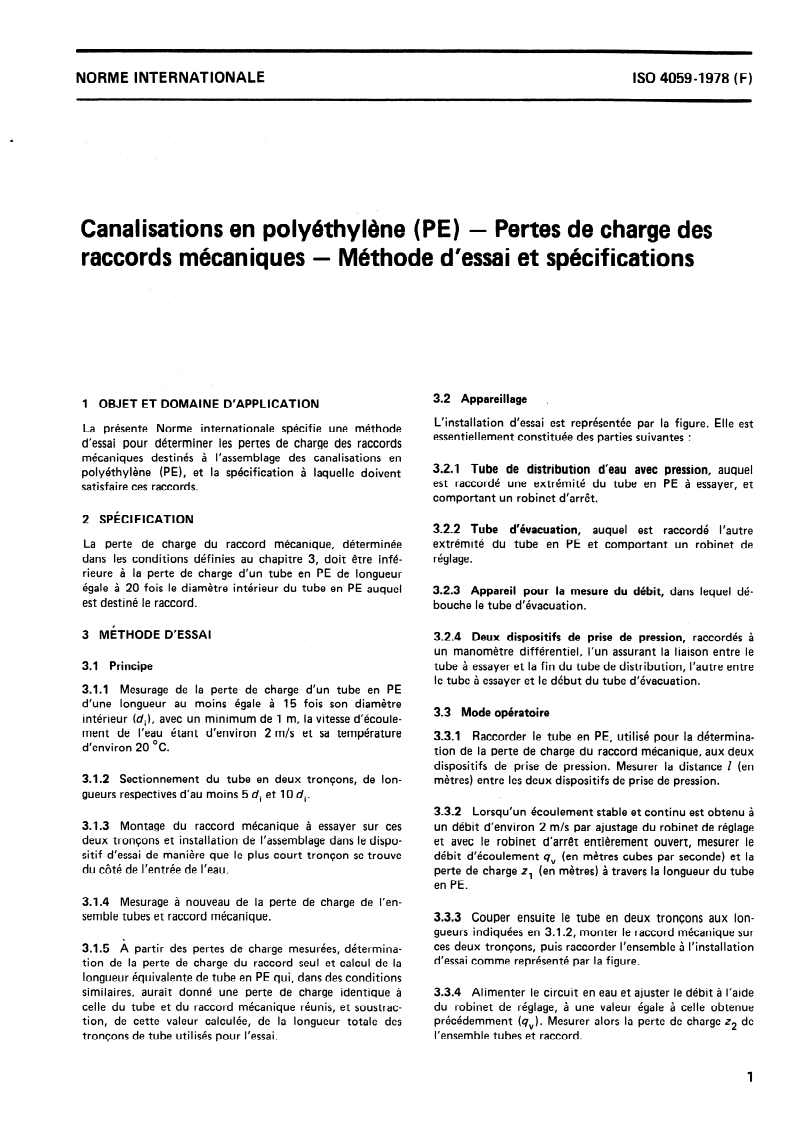
3.2 Appareillage ,
1 OBJET ET DOMAINE D’APPLICATION
L’installation d’essai est représentée par la figure. Elle est
La présente Norme internationale spécifie une méthode
essentiellement constituée des parties suivantes :
d’essai pour déterminer les pertes de charge des raccords
mécaniques destinés à l’assemblage des canalisations en
3.2.1 Tube de distribution d’eau avec pression, auquel
polyéthylène (PE), et la spécification à laquelle doivent
est raccordé une extrémité du tube en PE à essayer, et
satisfaire ces raccords.
comportant un robinet d’arrêt.
2 SPÉCIFICATION
3.2.2 Tube d’évacuation, auquel est raccordé l’autre
La perte de charge du raccord mécanique, déterminée extrémité du tube en PE et comportant un robinet de
dans les conditions définies au chapitre 3, doit être infé- réglage.
rieure à la perte de charge d’un tube en PE de longueur
égale à 20 fois le diamètre intérieur du tube en PE auquel
3.2.3 Appareil pour la mesure du débit, dans lequel dé-
est destiné le raccord.
bouche le tube d’évacuation.
3 MÉTHODE D’ESSAI
3.2.4 Deux dispositifs de prise de pression, raccordés à
un manomètre différentiel, l’un assurant la liaison entre le
3.1 Princip
...
NORME INTERNATIONALE
INTERNATIONAL ORGANIZATION FOR STANDARDIZATION*MEWYHAPOCIHAR OPrAHM3ALWlR IlO CTAH~APTM3ALWlM.ORGANISATION INTERNATIONALE DE NORMALISATION
Canalisations en polyéthylène (PE) - Pertes de charge des
raccords mécaniques - Méthode d’essai et spécifications
Pressure drop in mechanical pipe-jointing systems -
Polyethylene (PE) pipes -
Method of test and requirements
Première édition - 1978-09-01
îî
Y
Réf. no : ISO 4059-1978 (F)
CDU 621.643.41 : 678.742.2 : 532.55
tuyau, tube en matière plastique, polyéthylène, raccord de tuyauterie, essai à la pression, détermination, perte de
Descripteurs : tuyau terie,
charge.
Prix basé sur 3 pages
AVANT-PROPOS
L’ISO (Organisation internationale de normalisation) est une fédération mondiale
d’organismes nationaux de normalisation (comités membresde I’ISO). L’élaboration
des Normes internationales est confiée aux comités techniques de I’ISO. Chaque
comité membre intéressé par une étude a le droit de faire partie du comité technique
correspondant. Les organisations internationales, gouvernementales et non
gouvernementales, en liaison avec I’ISO, participent également aux travaux.
Les projets de Normes internationales adoptés par les comités techniques sont
soumis aux comités membres pour approbation, avant leur acceptation comme
Normes internationales par le Conseil de I’ISO.
La Norme internationale ISO 4059 a été élaborée par le comité technique
ISO/TC 138, Tubes, raccords et robinetterie en matières plastiques pour le trans-
port des fluides, et a été soumise aux comités membres en juillet 1976.
Les comités membres des pays suivants l’ont approuvée :
Allemagne Inde Pologne
Autriche Irlande Roumanie
Belgique Israël
Royaume-Uni
Canada Italie
Suède
Corée, Rép. de Mexique Turquie
Espagne Norvège U.S.A.
Finlande Nouvelle-Zélande Yougoslavie
France Pays-Bas
Le comité membre du pays suivant l’a désapprouvée pour des raisons techniques :
Suisse
0 Organisation internationale de normalisation, 1978 l
Imprimé en Suisse
NORME INTERNATIONALE ISO 4059-1978 (F)
Canalisations en polyéthylène (PE) - Pertes de charge des
raccords mécaniques - Méthode d’essai et spécifkations
3.2 Appareillage ,
1 OBJET ET DOMAINE D’APPLICATION
L’installation d’essai est représentée par la figure. Elle est
La présente Norme internationale spécifie une méthode
essentiellement constituée des parties suivantes :
d’essai pour déterminer les pertes de charge des raccords
mécaniques destinés à l’assemblage des canalisations en
3.2.1 Tube de distribution d’eau avec pression, auquel
polyéthylène (PE), et la spécification à laquelle doivent
est raccordé une extrémité du tube en PE à essayer, et
satisfaire ces raccords.
comportant un robinet d’arrêt.
2 SPÉCIFICATION
3.2.2 Tube d’évacuation, auquel est raccordé l’autre
La perte de charge du raccord mécanique, déterminée extrémité du tube en PE et comportant un robinet de
dans les conditions définies au chapitre 3, doit être infé- réglage.
rieure à la perte de charge d’un tube en PE de longueur
égale à 20 fois le diamètre intérieur du tube en PE auquel
3.2.3 Appareil pour la mesure du débit, dans lequel dé-
est destiné le raccord.
bouche le tube d’évacuation.
3 MÉTHODE D’ESSAI
3.2.4 Deux dispositifs de prise de pression, raccordés à
un manomètre différentiel, l’un assurant la liaison entre le
3.1 Princip
...
NORME INTERNATIONALE
INTERNATIONAL ORGANIZATION FOR STANDARDIZATION*MEWYHAPOCIHAR OPrAHM3ALWlR IlO CTAH~APTM3ALWlM.ORGANISATION INTERNATIONALE DE NORMALISATION
Canalisations en polyéthylène (PE) - Pertes de charge des
raccords mécaniques - Méthode d’essai et spécifications
Pressure drop in mechanical pipe-jointing systems -
Polyethylene (PE) pipes -
Method of test and requirements
Première édition - 1978-09-01
îî
Y
Réf. no : ISO 4059-1978 (F)
CDU 621.643.41 : 678.742.2 : 532.55
tuyau, tube en matière plastique, polyéthylène, raccord de tuyauterie, essai à la pression, détermination, perte de
Descripteurs : tuyau terie,
charge.
Prix basé sur 3 pages
AVANT-PROPOS
L’ISO (Organisation internationale de normalisation) est une fédération mondiale
d’organismes nationaux de normalisation (comités membresde I’ISO). L’élaboration
des Normes internationales est confiée aux comités techniques de I’ISO. Chaque
comité membre intéressé par une étude a le droit de faire partie du comité technique
correspondant. Les organisations internationales, gouvernementales et non
gouvernementales, en liaison avec I’ISO, participent également aux travaux.
Les projets de Normes internationales adoptés par les comités techniques sont
soumis aux comités membres pour approbation, avant leur acceptation comme
Normes internationales par le Conseil de I’ISO.
La Norme internationale ISO 4059 a été élaborée par le comité technique
ISO/TC 138, Tubes, raccords et robinetterie en matières plastiques pour le trans-
port des fluides, et a été soumise aux comités membres en juillet 1976.
Les comités membres des pays suivants l’ont approuvée :
Allemagne Inde Pologne
Autriche Irlande Roumanie
Belgique Israël
Royaume-Uni
Canada Italie
Suède
Corée, Rép. de Mexique Turquie
Espagne Norvège U.S.A.
Finlande Nouvelle-Zélande Yougoslavie
France Pays-Bas
Le comité membre du pays suivant l’a désapprouvée pour des raisons techniques :
Suisse
0 Organisation internationale de normalisation, 1978 l
Imprimé en Suisse
NORME INTERNATIONALE ISO 4059-1978 (F)
Canalisations en polyéthylène (PE) - Pertes de charge des
raccords mécaniques - Méthode d’essai et spécifkations
3.2 Appareillage ,
1 OBJET ET DOMAINE D’APPLICATION
L’installation d’essai est représentée par la figure. Elle est
La présente Norme internationale spécifie une méthode
essentiellement constituée des parties suivantes :
d’essai pour déterminer les pertes de charge des raccords
mécaniques destinés à l’assemblage des canalisations en
3.2.1 Tube de distribution d’eau avec pression, auquel
polyéthylène (PE), et la spécification à laquelle doivent
est raccordé une extrémité du tube en PE à essayer, et
satisfaire ces raccords.
comportant un robinet d’arrêt.
2 SPÉCIFICATION
3.2.2 Tube d’évacuation, auquel est raccordé l’autre
La perte de charge du raccord mécanique, déterminée extrémité du tube en PE et comportant un robinet de
dans les conditions définies au chapitre 3, doit être infé- réglage.
rieure à la perte de charge d’un tube en PE de longueur
égale à 20 fois le diamètre intérieur du tube en PE auquel
3.2.3 Appareil pour la mesure du débit, dans lequel dé-
est destiné le raccord.
bouche le tube d’évacuation.
3 MÉTHODE D’ESSAI
3.2.4 Deux dispositifs de prise de pression, raccordés à
un manomètre différentiel, l’un assurant la liaison entre le
3.1 Princip
...