


ISO/FDIS 22353
(Main)Security and resilience — Guidelines for crowd management
Security and resilience — Guidelines for crowd management
The document gives guidance on crowd management at events and mass gatherings. It provides principles applicable to any event but mainly to events gathering crowds. This document will help hosts and organizers to plan and execute safe and successful crowd management by: • introducing a set of principles and best practices for crowd management at events and mass gatherings; • establishing processes to understand, assess and handle crowd management risks; • establishing plans and execution of sufficient crowd movement in all phases (arrival/ingress, event circulation, egress/departure); • providing stakeholder engagement and involvement of public and private interested parties. This document is applicable both in normal and emergency situations.
Sécurité et résilience — Lignes directrices relatives à la gestion des foules
General Information
- Status
- Not Published
- Technical Committee
- ISO/TC 292 - Security and resilience
- Drafting Committee
- ISO/TC 292 - Security and resilience
- Current Stage
- 5020 - FDIS ballot initiated: 2 months. Proof sent to secretariat
- Start Date
- 01-May-2026
- Completion Date
- 01-May-2026
Buy Documents

ISO/FDIS 22353 - Security and resilience — Guidelines for crowd management
REDLINE ISO/FDIS 22353 - Security and resilience — Guidelines for crowd management
Overview
ISO/FDIS 22353: Security and resilience - Guidelines for crowd management is a comprehensive international standard developed by ISO to provide guidance on managing crowds at events and mass gatherings. Applicable to a broad range of events-whether open-air concerts, sports matches, festivals, or citywide celebrations-this standard supports event organizers, venue managers, and public authorities in ensuring the safety, security, and positive experience of attendees.
ISO/FDIS 22353 sets out key principles and best practices for planning, executing, and continually improving crowd management processes. It helps stakeholders understand crowd risks, establish clear responsibilities, and implement strategies during all event phases-from ingress and event circulation to egress and emergency situations. The guidelines encourage engagement with relevant public and private stakeholders, integrating crowd management into wider security and resilience frameworks.
Key Topics
Principles of Crowd Management
The standard outlines foundational principles to guide effective crowd management, including:- Governance and role clarity
- Ensuring free movement of individuals
- Providing clear visitor guidance and information
- Accounting for influencing factors such as venue design and crowd behavior
- Applying systematic, continual improvement cycles
Risk Assessment and Management
ISO/FDIS 22353 emphasizes the need for:- Comprehensive crowd risk assessments tailored to each event
- Integration with existing risk management systems and frameworks (aligned with ISO 31000)
- Documentation and ongoing review of identified risks and implemented measures
Phased Approach to Crowd Management
The guidelines cover all event phases:- Arrival/Ingress: Managing entry and initial flow
- Event Circulation: Ensuring orderly movement within the venue
- Egress/Departure: Safe and efficient crowd dispersal Plans should account for normal operations as well as emergency scenarios, including evacuation procedures.
Stakeholder Engagement
Effective crowd management involves:- Early and ongoing communication with relevant authorities, emergency services, and the public
- Clarification of legal/regulatory frameworks and responsibilities
- Coordinated planning with public transport and property owners
Performance Evaluation and Continuous Improvement
The standard calls for:- Regular collection of data and lessons learned
- Periodic review and updating of crowd management arrangements
- Documentation of findings for ongoing improvement
Applications
ISO/FDIS 22353 is designed for practical application in a wide range of scenarios, including:
- Large-scale events and mass gatherings: Sporting events, concerts, religious gatherings, and public celebrations
- Venue operation: Stadiums, arenas, convention centers, and other places hosting large crowds
- Event planning and hosting: Organizations responsible for one-off or recurring events
- Public emergency planning: Integration into broader city or regional resilience strategies
- Multi-venue or multi-phase events: Coordinating crowd management at complex, distributed events
By adhering to these guidelines, event organizers and venue operators can enhance safety, reduce the risk of crowd-related incidents, and ensure a positive, secure experience for all attendees.
Related Standards
For comprehensive security and resilience management, ISO/FDIS 22353 references and aligns with several other international standards:
- ISO 20121:2024 Event sustainability management systems - Requirements with guidance for use
- ISO 22300:2025 Security and resilience - Vocabulary
- ISO 22379:2022 Security and resilience - Guidelines for hosting and organizing citywide or regional events
- ISO 31000: Risk management - Guidelines
Utilizing these related standards together provides a robust framework for safe and sustainable crowd management at any scale, fostering public confidence and organizational resilience.
Buy Documents
ISO/FDIS 22353 - Security and resilience — Guidelines for crowd management
REDLINE ISO/FDIS 22353 - Security and resilience — Guidelines for crowd management
Get Certified
Connect with accredited certification bodies for this standard

Great Wall Tianjin Quality Assurance Center
Established 1993, first batch to receive national accreditation with IAF recognition.
Hong Kong Quality Assurance Agency (HKQAA)
Hong Kong's leading certification body.

Innovative Quality Certifications Pvt. Ltd. (IQCPL)
Known for integrity, providing ethical & impartial Assessment & Certification. CMMI Institute Partner.
Sponsored listings
Frequently Asked Questions
ISO/FDIS 22353 is a draft published by the International Organization for Standardization (ISO). Its full title is "Security and resilience — Guidelines for crowd management". This standard covers: The document gives guidance on crowd management at events and mass gatherings. It provides principles applicable to any event but mainly to events gathering crowds. This document will help hosts and organizers to plan and execute safe and successful crowd management by: • introducing a set of principles and best practices for crowd management at events and mass gatherings; • establishing processes to understand, assess and handle crowd management risks; • establishing plans and execution of sufficient crowd movement in all phases (arrival/ingress, event circulation, egress/departure); • providing stakeholder engagement and involvement of public and private interested parties. This document is applicable both in normal and emergency situations.
The document gives guidance on crowd management at events and mass gatherings. It provides principles applicable to any event but mainly to events gathering crowds. This document will help hosts and organizers to plan and execute safe and successful crowd management by: • introducing a set of principles and best practices for crowd management at events and mass gatherings; • establishing processes to understand, assess and handle crowd management risks; • establishing plans and execution of sufficient crowd movement in all phases (arrival/ingress, event circulation, egress/departure); • providing stakeholder engagement and involvement of public and private interested parties. This document is applicable both in normal and emergency situations.
ISO/FDIS 22353 is classified under the following ICS (International Classification for Standards) categories: 03.080.01 - Services in general; 97.200.10 - Theatre, stage and studio equipment. The ICS classification helps identify the subject area and facilitates finding related standards.
ISO/FDIS 22353 is available in PDF format for immediate download after purchase. The document can be added to your cart and obtained through the secure checkout process. Digital delivery ensures instant access to the complete standard document.
Standards Content (Sample)
FINAL DRAFT
International
Standard
ISO/TC 292
Security and resilience —
Secretariat: SIS
Guidelines for crowd management
Voting begins on:
2026-05-01
Voting terminates on:
2026-06-26
RECIPIENTS OF THIS DRAFT ARE INVITED TO SUBMIT,
WITH THEIR COMMENTS, NOTIFICATION OF ANY
RELEVANT PATENT RIGHTS OF WHICH THEY ARE AWARE
AND TO PROVIDE SUPPOR TING DOCUMENTATION.
IN ADDITION TO THEIR EVALUATION AS
BEING ACCEPTABLE FOR INDUSTRIAL, TECHNO
LOGICAL, COMMERCIAL AND USER PURPOSES, DRAFT
INTERNATIONAL STANDARDS MAY ON OCCASION HAVE
TO BE CONSIDERED IN THE LIGHT OF THEIR POTENTIAL
TO BECOME STAN DARDS TO WHICH REFERENCE MAY BE
MADE IN NATIONAL REGULATIONS.
Reference number
FINAL DRAFT
International
Standard
ISO/TC 292
Security and resilience —
Secretariat: SIS
Guidelines for crowd management
Voting begins on:
Voting terminates on:
RECIPIENTS OF THIS DRAFT ARE INVITED TO SUBMIT,
WITH THEIR COMMENTS, NOTIFICATION OF ANY
RELEVANT PATENT RIGHTS OF WHICH THEY ARE AWARE
AND TO PROVIDE SUPPOR TING DOCUMENTATION.
© ISO 2026
IN ADDITION TO THEIR EVALUATION AS
All rights reserved. Unless otherwise specified, or required in the context of its implementation, no part of this publication may
BEING ACCEPTABLE FOR INDUSTRIAL, TECHNO
LOGICAL, COMMERCIAL AND USER PURPOSES, DRAFT
be reproduced or utilized otherwise in any form or by any means, electronic or mechanical, including photocopying, or posting on
INTERNATIONAL STANDARDS MAY ON OCCASION HAVE
the internet or an intranet, without prior written permission. Permission can be requested from either ISO at the address below
TO BE CONSIDERED IN THE LIGHT OF THEIR POTENTIAL
or ISO’s member body in the country of the requester.
TO BECOME STAN DARDS TO WHICH REFERENCE MAY BE
MADE IN NATIONAL REGULATIONS.
ISO copyright office
CP 401 • Ch. de Blandonnet 8
CH-1214 Vernier, Geneva
Phone: +41 22 749 01 11
Email: copyright@iso.org
Website: www.iso.org
Published in Switzerland Reference number
ii
Contents Page
Foreword .v
Introduction .vi
1 Scope . 1
2 Normative references . 1
3 Terms and definitions . 1
4 Framework . 3
4.1 General .3
4.2 Supportive .3
4.3 Integrated .3
4.4 Sufficient .4
4.5 Adaptive .4
4.6 Professional .4
5 Principles . 4
5.1 General .4
5.2 Governance .5
5.2.1 General .5
5.2.2 Clarification of roles and responsibility .5
5.2.3 Clarification of legal and regulatory framework .5
5.2.4 Clarification of the area of responsibility for crowd management .5
5.2.5 Resources and competence .6
5.2.6 Approval and commitment.6
5.3 Free movement .6
5.4 Visitor guidance .7
5.5 Influencing factors .7
5.5.1 General .7
5.5.2 Design .7
5.5.3 Information .8
5.5.4 Management .9
5.6 Influencing phases .9
5.6.1 General .9
5.6.2 Ingress .9
5.6.3 Circulation . .10
5.6.4 Egress .10
5.7 Systematic work .10
5.8 Continual improvement .10
6 Crowd assessment process . 10
6.1 General .10
6.2 Communication and consultation.11
6.2.1 General .11
6.2.2 Officials and owners .11
6.2.3 Event involved parties .11
6.2.4 Experts, consultants and auditors . 12
6.3 Assessment scope, context and criteria . 12
6.3.1 General . 12
6.3.2 Assessment scope . 12
6.3.3 Assessment context . 12
6.3.4 Assessment criteria . 13
6.4 Analysis . 13
6.4.1 General . 13
6.4.2 Profiling . 13
6.4.3 Influencing phases . 15
6.4.4 Influencing factors .16
6.4.5 Crowd capacities .18
iii
6.4.6 Crowd management plan .18
6.4.7 Risk assessment of the implementation of the crowd management plan .18
6.4.8 Risk treatment of the crowd management plan .19
6.5 Evaluation and conformity . 20
6.6 Documentation and implementation . 20
6.6.1 General . 20
6.6.2 Crowd management plan . 20
6.6.3 Crowd management contingency plan.21
6.7 Monitoring and review . 22
6.7.1 General . 22
6.7.2 Recording and reporting . 22
7 Execution .23
7.1 General . 23
7.2 Execution of plans. 23
7.3 Organization . 23
7.4 Preparation . 23
7.5 Coordination and cooperation . 23
7.6 Surveillance and intelligence .24
7.7 Adaptation and correction .24
8 Performance evaluation and continual improvement .25
8.1 General . 25
8.2 Information gathering . 25
8.3 Assessment . 25
8.4 Lessons learned . 25
8.5 Documentation and lessons learned . 25
Bibliography .27
iv
Foreword
ISO (the International Organization for Standardization) is a worldwide federation of national standards
bodies (ISO member bodies). The work of preparing International Standards is normally carried out through
ISO technical committees. Each member body interested in a subject for which a technical committee
has been established has the right to be represented on that committee. International organizations,
governmental and non-governmental, in liaison with ISO, also take part in the work. ISO collaborates closely
with the International Electrotechnical Commission (IEC) on all matters of electrotechnical standardization.
The procedures used to develop this document and those intended for its further maintenance are described
in the ISO/IEC Directives, Part 1. In particular, the different approval criteria needed for the different types
of ISO document should be noted. This document was drafted in accordance with the editorial rules of the
ISO/IEC Directives, Part 2 (see www.iso.org/directives).
ISO draws attention to the possibility that the implementation of this document may involve the use of (a)
patent(s). ISO takes no position concerning the evidence, validity or applicability of any claimed patent
rights in respect thereof. As of the date of publication of this document, ISO had not received notice of (a)
patent(s) which may be required to implement this document. However, implementers are cautioned that
this may not represent the latest information, which may be obtained from the patent database available at
www.iso.org/patents. ISO shall not be held responsible for identifying any or all such patent rights.
Any trade name used in this document is information given for the convenience of users and does not
constitute an endorsement. For an explanation of the voluntary nature of standards, the meaning of ISO
specific terms and expressions related to conformity assessment, as well as information about ISO's
adherence to the World Trade Organization (WTO) principles in the Technical Barriers to Trade (TBT), see
www.iso.org/iso/foreword.html.
This document was prepared by Technical Committee ISO/TC 292, Security and resilience.
Any feedback or questions on this document should be directed to the user’s national standards body. A
complete listing of these bodies can be found at www.iso.org/members.html.
v
Introduction
Crowd accidents and disasters frequently occur at events, venues, mass gatherings and crowded places
worldwide. Investigations and evaluations conclude that many of these incidents could have been prevented
with systematic and adequate crowd management.
This document supports event organizers, event rights holders, event hosts, venue operators and emergency
services in ensuring effective, successful, and safe crowd management to provide a safer environment for
those attending events.
This document supports users in implementing safety and security measures to prevent crowd-related
incidents for both spectators and participants.
This document support event organizers and events hosts in communication with relevant interested
parties and the public throughout every stage of event preparation and execution.
This document encourages event organizers and event hosts to ensure that the execution of the event aligns
with:
[1]
— the United Nations Universal Declaration of Human Rights ;
— the United Nations Sustainable Development Goals, as specified in Transforming our world: The 2030
[2]
Agenda for Sustainable Development .
vi
FINAL DRAFT International Standard ISO/FDIS 22353:2026(en)
Security and resilience — Guidelines for crowd management
1 Scope
This document provides guidelines for crowd management at events, mass gatherings and crowded places.
It is designed to assist event organizers, event rights holders, event hosts, venue operators and emergency
services in planning and executing effective, successful and safe crowd management by ensuring:
— implementation of the framework and principles for crowd management;
— necessary event and crowd profiling to understand the crowd management risk;
— available spaces for expected crowds using crowd capacity assessments;
— sufficient crowd management in the ingress, event circulation, and egress phases;
— safe and secure venues, spaces, and pathways for crowds in all phases and situations;
— sufficient crowd management plans both for planned execution and in emergencies;
— necessary engagement and involvement of public and private interested parties;
— continual improvement through systematic evaluation of crowd management arrangements.
This document does not address crowd control or situations that require intervention to manage crowds
that display undesirable or dangerous behaviours.
2 Normative references
The following documents are referred to in the text in such a way that some or all of their content constitutes
requirements of this document. For dated references, only the edition cited applies. For undated references,
the latest edition of the referenced document (including any amendments) applies.
ISO 20121, Event sustainability management systems — Requirements with guidance for use
ISO 22300, Security and resilience — Vocabulary
ISO 22379, Security and resilience — Guidelines for hosting and organizing citywide or regional events
3 Terms and definitions
For the purposes of this document, the terms and definitions given in ISO 22300, ISO 22379, ISO 20121 and
the following apply.
ISO and IEC maintain terminology databases for use in standardization at the following addresses:
— ISO Online browsing platform: available at https:// www .iso .org/ obp
— IEC Electropedia: available at https:// www .electropedia .org/
3.1
crowd
large gathering of people
3.2
crowd management
systematic process of planning, organizing, monitoring and guidance of large gatherings of people
Note 1 to entry: The objective of crowd management is to facilitate a positive event experience, while establishing
a safe and secure environment for large gatherings of people, by maintaining adequate space to avoid undesirable
crowd movement and behaviours.
3.3
event
planned physical, digital or hybrid gathering with respect to time and a place where an experience is created
and/or a message is communicated
Note 1 to entry: The term "event" will also include mass gatherings and crowded places.
[3]
[SOURCE: ISO 20121:2012 , 3.7, modified — note 1 to entry has been added.]
3.4
event organizer
private or public entity or organization responsible to ensure that the event (3.3) is executed as planned and
in compliance with current legislations, guidelines and agreements
[4]
[SOURCE: ISO 22379:2022 , 3.3, modified — "event" has been added to the term.]
3.5
event rights holder
legal entity either holding or authorized to use one or more intellectual property rights
[4]
[SOURCE: ISO 22379:2022 , 3.9]
3.6
event host
public entity or organization responsible to ensure that the event (3.3) is executed in surroundings
sufficiently prepared for the event as planned and in compliance with current legislations, guidelines and
agreements
[4]
[SOURCE: ISO 22379:2022 , 3.1, modified — "event" has been added to the term.]
3.7
crowd management arrangements
activities and measures implemented to manage large gatherings of people
3.8
crowd control
actions taken to control large gatherings of people once behaviours become undesirable
3.9
venue
physical location where an event is held
3.10
pedestrian flow rate
number of pedestrians that can pass through a process or an area in a set amount of time
3.11
risk
effect of uncertainty on objectives
Note 1 to entry: An effect is a deviation from the expected — positive or negative.
Note 2 to entry: Uncertainty is the state, even partial, of deficiency of information related to, understanding or
knowledge of, an event, its consequence, or likelihood.
Note 3 to entry: Risk is often characterized by reference to potential events and consequences, or a combination of
these.
Note 4 to entry: Risk is often expressed in terms of a combination of the consequences of an event (including changes
in circumstances) and the associated likelihood of occurrence.
[5]
[SOURCE: ISO 31000:2018 , 3.1, modified — notes to entry have been modified; note 4 to entry has been
added.]
3.12
Zone Ex
areas surrounding a venue
Note 1 to entry: Zone Ex can be an integral part of the overall crowd management arrangements (3.7).
Note 2 to entry: Zone Ex can include streets, concourses, transport hubs, and parking areas where crowds gather
outside of direct venue`s control.
4 Framework
4.1 General
Crowd management has two main objectives:
— to enhance a successful and positive event experience;
— to ensure safe and secure conditions for people included in or impacted by the event.
To achieve these objectives, crowd management should follow this framework and be:
— supportive;
— integrated;
— sufficient;
— adaptive;
— professional.
The characteristics of effective and efficient crowd management are described in 4.2 to 4.6
NOTE People impacted by an event include, but are not limited to, participants, spectators, staff, emergency
personnel, residents and bystanders.
4.2 Supportive
The organization, process and arrangements of crowd management should align with and support the
objectives, goals and needs of the event organizer as much as possible.
Crowd management plays a significant role in the execution, experience and perception of an event.
Therefore, the implemented crowd management arrangements should be tailored to suit the specific
purpose of the event to the greatest extent possible.
4.3 Integrated
The organization, process and arrangements of crowd management should be integrated into the event
organizer's organization and event risk management procedures.
Crowd management significantly influences the overall risk and mitigation strategies during an event.
Therefore, crowd management risks and risk treatment should, where possible, be integrated into the
broader event risk management.
The crowd management organization should ensure that the crowd management process and arrangements
are in alignment with implemented event safety concepts and preventive measures.
[6]
Risk management should be conducted in alignment with ISO 31000 .
4.4 Sufficient
The organization, process, and arrangements of crowd management should be proportionate to the extent
of the event and anticipated crowd size and behaviours.
At events with multiple venues, the main event should provide governing crowd management objectives, but
each venue should have a separate crowd management organization, process and arrangements.
4.5 Adaptive
The organization, process, and arrangements of crowd management should be adaptable to potential
changes in the event environment, event execution, and crowd behaviour.
A plan to ensure the ability to adapt the crowd management organization, process and arrangements should
be included in both the crowd management plan and the contingency planning.
NOTE 1 The event environment can include, but is not limited to, venues, infrastructure, capacity, emergency
services and weather.
NOTE 2 Event execution can include, but is not limited to, time, content and event capacity.
NOTE 3 Crowd behaviour can include, but is not limited to, numbers, composition, aggression, health status and
liquidity.
4.6 Professional
The crowd management should be conducted by a competent organization with crowd management
expertise and experience suitable to the event's size, complexity and risk.
Events of varying sizes, complexities and risks should be managed according to their specific crowd
management needs, based on their specific event profile and the need for professional handling.
5 Principles
5.1 General
The main purpose of crowd management is to facilitate a positive, safe and secure event experience for
spectators, participants and staff during an event.
The event experience begins with the journey of spectators and participants towards the event, continues
throughout the event, and concludes with their travel away from the event.
To support and enhance a positive, safe, and secure event experience, crowd management should be
conducted using the following principles:
— governance;
— free movement;
— visitor guidance;
— influencing factors: design, information, management;
— influencing phases: ingress, circulation, egress;
— systematic approach;
— continual improvement.
5.2 Governance
5.2.1 General
The event organizer should establish a sufficient and competent crowd management organization as early
as possible in the event planning process, ensuring:
— clarification of roles and responsibility;
— clarification of the legal and regulatory framework;
— clarification of the areas of responsibility for crowd management;
— resources and competence;
— approval and commitment.
5.2.2 Clarification of roles and responsibility
The event organizer should clearly define and document the roles and responsibilities for crowd management
between the event organizer, the event host and the authorities.
The event organizer should designate the role responsible for crowd management within their organization
and clearly document the associated responsibilities.
NOTE The responsibility for crowd management can be designated to an existing role.
5.2.3 Clarification of legal and regulatory framework
The event organizer should clarify the legal and regulatory framework applicable to crowd management and
ensure and document compliance with the relevant framework.
Legal and regulatory frameworks can include, but are not limited to:
— legal and regulatory requirements for crowd management;
— limitations to authority over crowds or venues;
— limitations to crowd management arrangements.
NOTE Legal and regulatory requirements can include health and safety regulations and building codes.
5.2.4 Clarification of the area of responsibility for crowd management
The event organizer should clarify the extent of their responsibility for crowd management in terms of:
— time;
— scope;
— contingency;
— space.
The event organizer should clarify the responsibilities for crowd management with the following interested
parties, including but not limited to:
— relevant authorities;
— public emergency services;
— public transport providers;
— property owners;
— other relevant involved organizations.
5.2.5 Resources and competence
The event organizer should ensure that their crowd management organization is robust and resilient.
The crowd management organization should have the necessary resources and competencies to plan and
execute a professional, safe and secure crowd management according to the event size, complexity and
associated risks.
5.2.6 Approval and commitment
The event organizer should obtain and document approval for the crowd management planning, execution,
and arrangements from the following interested parties, including but not limited to:
— relevant authorities;
— public emergency services;
— public transport providers;
— property owners.
The event organizer should obtain and document commitment, with regard to the crowd management
planning, execution and arrangements, from the following interested parties, including but not limited to:
— the event organizer management team;
— relevant authorities;
— public emergency services
— public transport providers;
— property owners;
— other relevant involved organizations.
5.3 Free movement
In their crowd management planning and execution, the event organizer should ensure that individuals
attending the event at all times have:
— the ability to move freely within their designated area and exit the area without being confined;
— the ability to move freely within their designated area without danger, and by their own decision.
NOTE In the event that an incident occurs, free movement can be limited temporarily or permanently.
5.4 Visitor guidance
In their crowd management planning and execution, the event organizer should ensure that individuals
attending the event always have:
— necessary information available to make decisions and act according to the planned and desired crowd
movement and behaviour;
— sufficient guidance in the design of their designated area to support movement and behavior according
to the planned and desired crowd movement and behaviour.
Necessary and sufficient visitor guidance should be available and implemented for both normal operations
and emergency situations, such as evacuations.
5.5 Influencing factors
5.5.1 General
The following influencing factors can be used to guide and influence a crowd before, during and after an
event:
— design;
— information;
— management.
5.5.2 Design
Design comprises the arrangement and utilization of physical space, including objects contained within it:
— spatial designing of where the crowd is supposed to move:
— placement and arrangement of internal features, referred to as internal focal points, such as stages,
spectator stands, entrances, exits, vendors and toilets;
— placement and arrangement of external features, referred to as external focal points, such as public
transport stations, parking spaces and city centres;
— preferred routes between focal points, referred to as focal routes;
— spatial designing of where the crowd can move:
— buildings, walls and other structures that influence or set conditions for movement;
— sight lines that set conditions for the vision of the crowd;
— focal points that determine the approach angles, setting the conditions for how a space is filled;
— access control, ticketing, accreditation, security checkpoints;
— venue intuitiveness that affects the crowd's ability to understand and navigate the space;
— spatial designing of how the crowd can move:
— pedestrian flow rates, accounting for bottlenecks and other features that can restrict movement;
— areas allocated for standing or queuing;
— corners and angles that influence the movement of the crowd;
— surface conditions and terrain slope;
— lightning conditions, natural or installed.
NOTE 1 Spatial design can include guiding or limiting elements such as grids, fences and barriers.
NOTE 2 It is advantageous if areas are set aside for emergency services to ensure that they do not cross paths with
streams of visitors.
5.5.3 Information
Information comprises the available information or communication directed at the crowd and involved
parties, with the purpose of influencing their expectations, understanding and knowledge necessary
to navigate and conduct safe movement before, during and after the event. This includes the clarity,
comprehensiveness, and distribution of the information, and the ability to engage the audience effectively.
Locations or channels for the distribution of information before, during, and after the event can include, but
are not limited to:
— upon purchase or registration of access to the event;
— on tickets or other items confirming access;
— the event website;
— the internet and social media;
— event-specific apps;
— media coverage, such as formal press releases, including text, video and audio;
— screens, posters or signage;
— public address (PA) systems and loudspeakers;
— knowledgeable and informative staff;
— professional announcers;
— fire alarm systems and other alarm systems;
— predefined safety announcement systems;
— crowd directed text messages.
Information distributed before, during and after the event can include, but is not limited to:
— information about the event, i.e. time, place and content;
— weather forecast;
— transport to and from the event;
— service provided before, during and after the event;
— conditions of entry to the event;
— event plans;
— contingency plans, including evacuation routes.
Ad hoc information on changes related to the event or emergency announcements can be distributed before,
during and after the event to:
— adjust expectations;
— change audience behaviour;
— increase understanding or knowledge about a situation;
— stop a performance or event;
— initiate evacuation or lockdown.
Information can be distributed on the way to or from the event, outside or inside the venue.
5.5.4 Management
Management comprises the configuration and execution of the event, including scheduling the event,
establishing rules, organizing workflows, working methods, and developing procedures, plans, maps and
equivalent.
Management includes, but is not limited to:
— temporal aspects of the event:
— the timing and time frame of the event;
— scheduling the programme of event, including breaks;
— facilitation of crowd movement:
— rules and guidelines for the crowd;
— staff working methods and competence;
— sufficiency, efficiency and adaptiveness of the organization.
— management of the crowd:
— methods for monitoring of the crowd;
— methods for communicating crowd movement and crowd risks;
— methods for managing the crowd;
— possibility and preparedness to change the crowd behaviour to fit the event situation;
— possibility and preparedness to change the event situation to fit the crowd behaviour.
5.6 Influencing phases
5.6.1 General
The influencing phases represent the three main phases of crowd movement and activities before, during
and after an event, as crowd motivation, priorities and behaviour differ across these phases.
Crowd dynamics and behaviour can be divided into the following three phases:
— ingress;
— circulation;
— egress.
5.6.2 Ingress
Ingress refers to the phase during which the crowd is en route to the event and when they enter the venue.
The ingress phase should be managed in consideration of the crowd management responsibilities outlined
in 5.2.4.
The ingress phase can be referred to as the arrival phase.
5.6.3 Circulation
Circulation refers to the phase during which the crowd moves individually or in groups while participating
in the event at the venue.
5.6.4 Egress
Egress refers to the phase during which the crowd prepares to leave the event and departs from the venue.
The egress phase should be managed in consideration of the crowd management responsibilities outlined in
5.2.4 .
The egress phase can be referred to as the departure phase.
5.7 Systematic work
The event organizer should conduct crowd management planning, execution and evaluation in a systematic
manner, including the following:
— conducting a crowd assessment to gather and analyse information regarding the event;
— developing a crowd management plan based on the findings from the crowd assessment;
— conducting a risk assessment to identify possibilities and challenges related to the crowd management
plan;
— finalizing the crowd management plan based on the findings from the risk assessment;
— developing a crowd management contingency plan based on the findings from the risk assessment;
— ensuring that the crowd management arrangements are integrated with the event risk management and
event safety arrangements;
— implementing and executing the crowd management plan, or the crowd management contingency plan,
as intended, and adjust if necessary;
— evaluating the effectiveness of the crowd management plan, or the crowd management contingency plan,
and identify areas for improvement.
5.8 Continual improvement
The event organizer should ensure that lessons learned from events are used to drive the continual
improvement of their crowd management, both:
— internally, during and between events, to improve performance based on lessons learned;
— externally, after events, by sharing lessons learned with interested parties involved in similar events.
6 Crowd assessment process
6.1 General
The crowd assessment process involves the following aspects:
— communication and consultation with interested parties 6.2;
— application of criteria for crowd management evaluation 6.3;
— identification of event characteristics, development of crowd management plans and crowd risk
treatment 6.4;
— evaluation of the anticipated effectiveness of the crowd management plans and their conformity to the
criteria for crowd management evaluation 6.5;
— implementation of the crowd management plans 6.6;
— review for continual improvement of the crowd management plans 6.7.
6.2 Communication and consultation
6.2.1 General
The purpose of communication and consultation is to help all relevant interested parties understand the
crowd risk, as well as the rationale behind the content and scope of the crowd risk treatment and crowd
management plans.
Communication aims to promote awareness and understanding of crowd risk, whereas consultation involves
obtaining feedback and information to support decision-making regarding crowd management.
Communication and consultation with internal and external interested parties should occur throughout
all steps of the crowd management process, fostering a sense of inclusivenes
...
Style Definition: Heading 1: Indent: Left: 0 cm, First
ISO/DISFDIS 22353
line: 0 cm
ISO/TC 292
Style Definition: Heading 2: Font: Bold, Indent: Left: 0
cm, First line: 0 cm
Secretariat: SIS
Style Definition: Heading 3: Font: Bold, Indent: Left: 0
cm, First line: 0 cm
Date: 2026-02-2704-17
Style Definition: Heading 4: Font: Bold, Indent: Left: 0
cm, First line: 0 cm
Style Definition: Heading 5: Font: Bold, Indent: Left: 0
cm, First line: 0 cm
Style Definition: Heading 6: Font: Bold
Style Definition: IntroHeading1: Font: Bold, Indent:
Security and resilience — Guidelines for crowd management
Left: 0 cm, First line: 0 cm
Style Definition: IntroHeading2: Font: Bold, Indent:
Left: 0 cm, First line: 0 cm
Style Definition: IntroHeading3: Font: Bold, Indent:
Left: 0 cm, First line: 0 cm
Style Definition: IntroHeading4: Font: Bold, Indent:
Left: 0 cm, First line: 0 cm
Style Definition: IntroHeading5: Font: Bold, Indent:
Left: 0 cm, First line: 0 cm
Style Definition: IntroHeading6
DISFDIS stage
Style Definition: IntroHeading7
Style Definition: IntroHeading8
Style Definition: IntroHeading9
Style Definition: Key Text
Style Definition: Key Title
Style Definition: List Continue 1
Style Definition: List Continue 2
Style Definition: TermNum2: Font: Bold, Indent: Left:
0 cm, First line: 0 cm
Style Definition: TermNum3: Font: Bold, Indent: Left:
0 cm, First line: 0 cm
Style Definition: TermNum4: Font: Bold, Indent: Left:
0 cm, First line: 0 cm
Style Definition: TermNum5: Font: Bold, Indent: Left:
0 cm, First line: 0 cm
Style Definition: TermNum6: Font: Bold
Style Definition: Body Text
Style Definition: boxedText
Style Definition: Boxed List Continue 1
Style Definition: boxedTitle
Voting begins on: 2025-07-09
Style Definition: FooterCentered
Voting terminates on: 2025-10-01
Style Definition: FooterPageNumber
Style Definition: FooterPageRomanNumber
Style Definition: FooterCenteredContinued
Style Definition: TPS Markup Base
ISO/DISFDIS 22353:2026(en)
All rights reserved. Unless otherwise specified, or required in the context of its implementation, no part of this publication
may be reproduced or utilized otherwise in any form or by any means, electronic or mechanical, including photocopying,
or posting on the internet or an intranet, without prior written permission. Permission can be requested from either ISO
at the address below or ISO’s member body in the country of the requester.
ISO copyright office
CP 401 • Ch. de Blandonnet 8
CH-1214 Vernier, Geneva
Phone: + 41 22 749 01 11
Formatted: English (United States)
E-mail: copyright@iso.org
Formatted: German (Germany)
Website: www.iso.org
Formatted: German (Germany)
Published in Switzerland
Formatted: German (Germany)
ii
ISO/DISFDIS 22353:2026(en)
Contents
Foreword . iii
Introduction . iii
Scope . iii
Normative references . iii
Terms and definitions . iii
Framework . iii
General . iii
Supportive . iii
Integrated . iii
Sufficient . iii
Adaptive . iii
Professional . iii
Principles. iii
General . iii
Governance . iii
Free movement . iii
Visitor guidance . iii
Influencing factors . iii
Influencing phases . iii
Systematic work . iii
Continual improvement . iii
Crowd assessment process . iii
General . iii
Communication and consultation . iii
Assessment scope, context and criteria . iii
Analysis . iii
Evaluation and compliance . iii
Documentation and implementation . iii
Monitoring and review . iii
Execution . iii
General . iii
Execution of plans . iii
Organization . iii
Preparation. iii
Coordination and cooperation. iii
Surveillance and intelligence . iii
Adaptation and correction . iii
Performance evaluation and continual improvement . iii
General . iii
Information gathering . iii
Assessment . iii
Lessons learned. iii
Documentation and lessons learned . iii
Bibliography . iii
Foreword . v
Introduction . vi
iii
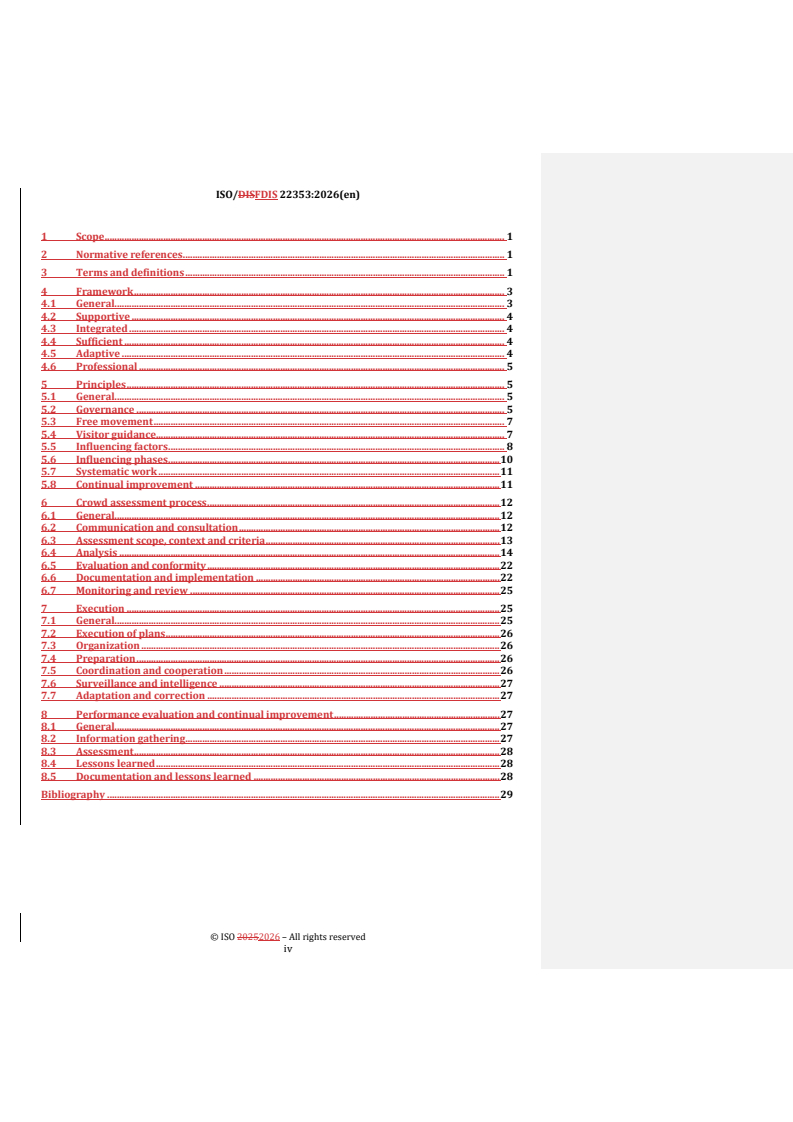
ISO/DISFDIS 22353:2026(en)
1 Scope . 1
2 Normative references . 1
3 Terms and definitions . 1
4 Framework . 3
4.1 General. 3
4.2 Supportive . 4
4.3 Integrated . 4
4.4 Sufficient . 4
4.5 Adaptive . 4
4.6 Professional . 5
5 Principles . 5
5.1 General. 5
5.2 Governance . 5
5.3 Free movement . 7
5.4 Visitor guidance . 7
5.5 Influencing factors . 8
5.6 Influencing phases . 10
5.7 Systematic work . 11
5.8 Continual improvement . 11
6 Crowd assessment process . 12
6.1 General. 12
6.2 Communication and consultation . 12
6.3 Assessment scope, context and criteria . 13
6.4 Analysis . 14
6.5 Evaluation and conformity . 22
6.6 Documentation and implementation . 22
6.7 Monitoring and review . 25
7 Execution . 25
7.1 General. 25
7.2 Execution of plans . 26
7.3 Organization . 26
7.4 Preparation . 26
7.5 Coordination and cooperation . 26
7.6 Surveillance and intelligence . 27
7.7 Adaptation and correction . 27
8 Performance evaluation and continual improvement . 27
8.1 General. 27
8.2 Information gathering . 27
8.3 Assessment . 28
8.4 Lessons learned . 28
8.5 Documentation and lessons learned . 28
Bibliography . 29
iv
ISO/DISFDIS 22353:2026(en)
Foreword
ISO (the International Organization for Standardization) is a worldwide federation of national standards
bodies (ISO member bodies). The work of preparing International Standards is normally carried out through
ISO technical committees. Each member body interested in a subject for which a technical committee has been
established has the right to be represented on that committee. International organizations, governmental and
non-governmental, in liaison with ISO, also take part in the work. ISO collaborates closely with the
International Electrotechnical Commission (IEC) on all matters of electrotechnical standardization.
The procedures used to develop this document and those intended for its further maintenance are described
in the ISO/IEC Directives, Part 1. In particular, the different approval criteria needed for the different types
of ISO documentsdocument should be noted. This document was drafted in accordance with the editorial rules
of the ISO/IEC Directives, Part 2 (see www.iso.org/directives).
Attention is drawnISO draws attention to the possibility that some of the elementsimplementation of this
document may beinvolve the subjectuse of (a) patent(s). ISO takes no position concerning the evidence,
validity or applicability of any claimed patent rights. in respect thereof. As of the date of publication of this
document, ISO had not received notice of (a) patent(s) which may be required to implement this document.
However, implementers are cautioned that this may not represent the latest information, which may be
obtained from the patent database available at www.iso.org/patents. ISO shall not be held responsible for
identifying any or all such patent rights. Details of any patent rights identified during the development of the
document will be in the Introduction and/or on the ISO list of patent declarations received (see
www.iso.org/patents).
Any trade name used in this document is information given for the convenience of users and does not
constitute an endorsement.
For an explanation onof the voluntary nature of standards, the meaning of ISO specific terms and expressions
related to conformity assessment, as well as information about ISO's adherence to the World Trade
Organization (WTO) principles in the Technical Barriers to Trade (TBT)), see the following URL:
www.iso.org/iso/foreword.html.
This document was prepared by Technical Committee ISO/TC 292 , Security and resilience.
Any feedback or questions on this document should be directed to the user’s national standards body. A
complete listing of these bodies can be found at www.iso.org/members.html.
v
ISO/DISFDIS 22353:2026(en)
Introduction
Crowd accidents and disasters frequently occur at events, venues, mass gatherings and crowded places
worldwide. Investigations and evaluations conclude that many of these incidents could have been prevented
with systematic and adequate crowd management.
This document supports event organizers, event rights holders, event hosts, venue operators, and emergency
services in ensuring effective, successful, and safe crowd management to provide a safer environment for
those attending events.
This document supports users in implementing safety and security measures to prevent crowd-related
incidents for both spectators and participants.
This document support event organizers and events hosts in communication with relevant interested parties
and the public throughout every stage of event preparation and execution.
This document encourages event organizers and event hosts to ensure that the execution of the event aligns
with:
[1][1]
— — the United Nations. (1948). Universal Declaration of Human Rights ;
Formatted: List Continue 1
— — the United Nations. (2015). Sustainable Development Goals, as specified in Transforming our world:
[2] [2]
The 2030 Agenda for Sustainable Development ; .
vi
ISO/DISFDIS 22353:2026(en)
Security and resilience — Guidelines for crowd management
1 Scope
This document provides guidelines for crowd management at events, mass gatherings and crowded places. It
is designed to assist event organizers, event rights holders, event hosts, venue operators, and emergency
services in planning and executing effective, successful, and safe crowd management by ensuring:
— implementation of the framework and principles for crowd management;
— necessary event and crowd profiling to understand the crowd management risk;
— available spaces for expected crowds using crowd capacity assessments;
— sufficient crowd management in the ingress, event circulation, and egress phases;
— safe and secure venues, spaces, and pathways for crowds in all phases and situations;
— sufficient crowd management plans both for planned execution and in emergencies;
— necessary engagement and involvement of public and private interested parties;
— continual improvement through systematic evaluation of crowd management arrangements.
This document does not address crowd control or situations that require intervention to manage crowds that
display undesirable or dangerous behaviours.
2 Normative references
The following documents are referred to in the text in such a way that some or all of their content constitutes
requirements of this document. For dated references, only the edition cited applies. For undated references,
the latest edition of the referenced document (including any amendments) applies.
ISO 20121:2024, Event sustainability management systems — Requirements with guidance for use
ISO 22300:2025, Security and resilience — Vocabulary
ISO 22379:2022, Security and resilience — Guidelines for hosting and organizing citywide or regional events
3 Terms and definitions
For the purposes of this document, the terms and definitions given in ISO 22300:2025 , ISO 22379:2022 , ISO
20121:2024 and the following apply.
ISO and IEC maintain terminology databases for use in standardization at the following addresses:
— ISO Online browsing platform: available at https://www.iso.org/obp
— IEC Electropedia: available at https://www.electropedia.org/
ISO/DISFDIS 22353:2026(en)
3.1
crowd
large gathering of people
3.2
crowd management
systematic process of planning, organizing, monitoring and guidance of large gatherings of people
Note 1 to entry: The objective of crowd management is to facilitate a positive event experience, while establishing a safe
and secure environment for large gatherings of people, by maintaining adequate space to avoid undesirable crowd
movement and behaviours.
3.3
event
planned physical, digital or hybrid gathering with respect to time and a place where an experience is created
and/or a message is communicated
Note 1 to entry: The term "event" will also include mass gatherings and crowded places.
[SOURCE: ISO 20121:2012, 3.7]
[SOURCE: ISO 20121:2012, 3.7, modified — note 1 to entry has been added.]
3.4
event organizer
private or public entity or organization responsible to ensure that the event (3.3) is executed as planned and
in compliance with current legislations, guidelines and agreements
[SOURCE: ISO 22379:2022,ISO 22379:2022, 3.3, modified -— "event" has been added to the term.)].]
3.5
event rights holder
legal entity either holding or authorized to use one or more intellectual property rights
[SOURCE: ISO 22379:2022,ISO 22379:2022, 3.9]
3.6
event host
public entity or organization responsible to ensure that the event (3.3)(3.3) is executed in surroundings
sufficiently prepared for the event as planned and in compliance with current legislations, guidelines and
agreements
[SOURCE: ISO 22379:2022,ISO 22379:2022, 3.1, modified -— "event" has been added to the term.)].]
3.7
crowd management arrangements
activities and measures implemented to manage large gatherings of people
3.8
crowd control
actions taken to control large gatherings of people once behaviours become undesirable
3.9
venue
physical location where an event is held
ISO/DISFDIS 22353:2026(en)
3.10
pedestrian flow rate
number of pedestrians that can pass through a process or an area in a set amount of time
3.11
risk
effect of uncertainty on objectives
Note 1 to entry: An effect is a deviation from the expected — positive or negative.
Note 2 to entry: Uncertainty is the state, even partial, of deficiency of information related to, understanding or knowledge
of, an event, its consequence, or likelihood.
Note 3 to entry: Risk is often characterized by reference to potential events (as defined in ISO Guide 73) and
consequences (as defined in ISO Guide 73),, or a combination of these.
Note 4 to entry: Risk is often expressed in terms of a combination of the consequences of an event (including changes in
circumstances) and the associated likelihood (as defined in ISO Guide 73) of occurrence.
Note 5 to entry: In Notes 2, 3 and 4 to entry, the term “event” does not refer to the term “event” as defined in 3.7.
[SOURCE: ISO 31000:2018, 3.1)]
3.12
zone ex
[SOURCE: ISO 31000:2018, 3.1, modified — notes to entry have been modified; note 4 to entry has been
added.]
3.12
Zone Ex
areas surrounding a venue
Note 1 to entry: Zone Ex can be an integral part of the overall crowd management arrangements. (3.7).
Formatted: Font: Italic
Note 2 to entry: Zone Ex can include streets, concourses, transport hubs, and parking areas where crowds gather outside
of direct venue`s control.
4 Framework
4.1 General
Crowd management has two main objectives:
— to enhance a successful and positive event experience;
— to ensure safe and secure conditions for people included in or impacted by the event.
To achieve these objectives, crowd management should follow this framework and be:
— supportive;
— integrated;
— sufficient;
— adaptive;
ISO/DISFDIS 22353:2026(en)
— professional.
The characteristics of effective and efficient crowd management are described in 4.2 to 4.6
Field Code Changed
NOTE People impacted by an event include, but are not limited to, participants, spectators, staff, emergency
personnel, residents and bystanders.
4.2 Supportive
The organization, process, and arrangements of crowd management should align with and support the
objectives, goals, and needs of the event organizer as much as possible.
Crowd management plays a significant role in the execution, experience and perception of an event. Therefore,
the implemented crowd management arrangements should be tailored to suit the specific purpose of the event
to the greatest extent possible.
4.3 Integrated
The organization, process and arrangements of crowd management should be integrated into the event
organizer's organization and event risk management procedures.
Crowd management significantly influences the overall risk and mitigation strategies during an event.
Therefore, crowd management risks and risk treatment should, where possible, be integrated into the broader
event risk management.
The crowd management organization should ensure that the crowd management process and arrangements
are in alignment with implemented event safety concepts and preventive measures.
Risk management should be conducted in alignment with ISO 31000[3]ISO 31000.
4.4 Sufficient
The organization, process, and arrangements of crowd management should be proportionate to the extent of
the event and anticipated crowd size and behaviours.
At events with multiple venues, the main event should provide governing crowd management objectives, but
each venue should have a separate crowd management organization, process and arrangements.
4.5 Adaptive
The organization, process, and arrangements of crowd management should be adaptable to potential changes
in the event environment, event execution, and crowd behaviour.
A plan to ensure the ability to adapt the crowd management organization, process, and arrangements should
be included in both the crowd management plan and the contingency planning.
NOTE 1 The event environment can include, but is not limited to, venues, infrastructure, capacity, emergency services
and weather.
NOTE 2 Event execution can include, but is not limited to, time, content and event capacity.
NOTE 3 Crowd behaviour can include, but is not limited to, numbers, composition, aggression, health status and
liquidity.
ISO/DISFDIS 22353:2026(en)
4.6 Professional
The crowd management should be conducted by a competent organization with crowd management expertise
and experience suitable to the event's size, complexity and risk.
Events of varying sizes, complexities and risks should be managed according to their specific crowd
management needs, based on their specific event profile and the need for professional handling.
5 Principles
5.1 General
The main purpose of crowd management is to facilitate a positive, safe, and secure event experience for
spectators, participants and staff during an event.
The event experience begins with the journey of spectators and participants towards the event, continues
throughout the event, and concludes with their travel away from the event.
To support and enhance a positive, safe, and secure event experience, crowd management should be
conducted using the following principles:
— governance;
— free movement;
— visitor guidance;
— influencing factors: design, information, management;
— influencing phases: ingress, circulation, egress;
— systematic approach;
— continual improvement.
5.2 Governance
5.2.1 General
The event organizer should establish a sufficient and competent crowd management organization as early as
possible in the event planning process, ensuring:
— clarification of roles and responsibility;
— clarification of the legal and regulatory framework;
— clarification of the areas of responsibility for crowd management;
— resources and competence;
— approval and commitment.
ISO/DISFDIS 22353:2026(en)
5.2.2 Clarification of roles and responsibility
The event organizer should clearly define and document the roles and responsibilities for crowd management
between the event organizer, the event host and the authorities.
The event organizer should designate the role responsible for crowd management within their organization,
and clearly document the associated responsibilities.
NOTE The responsibility for crowd management can be designated to an existing role.
5.2.3 Clarification of legal and regulatory framework
The event organizer should clarify the legal and regulatory framework applicable to crowd management and
ensure and document compliance therofwith the relevant framework.
Legal and regulatory frameworkframeworks can include, but are not limited to:
— legal and regulatory requirements for crowd management;
— limitations to authority over crowds or venues;
— limitations to crowd management arrangements.
NOTE Legal and regulatory requirements can include health and safety regulations and building codes.
5.2.4 Clarification of the area of responsibility for crowd management
The event organizer should clarify the extent of their responsibility for crowd management in terms of:
— time;
— scope;
— contingency;
— space.
The event organizer should clarify the responsibilities for crowd management with the following interested
parties, including but not limited to:
— relevant authorities;
— public emergency services;
— public transport providers;
— property owners;
— other relevant involved organizations.
5.2.5 Resources and competence
The event organizer should ensure that their crowd management organization is robust and resilient.
The crowd management organization should have the necessary resources and competencecompetencies to
plan and execute a professional, safe, and secure crowd management in accordanceaccording to the event size,
complexity, and associated risks.
ISO/DISFDIS 22353:2026(en)
5.2.6 Approval and commitment
The event organizer should obtain and document approval for the crowd management planning, execution,
and arrangements from the following interested parties, including but not limited to:
— relevant authorities;
— public emergency services;
— public transport providers;
— property owners.
The event organizer should obtain and document commitment, with regard to the crowd management
planning, execution, and arrangements, from the following interested parties, including but not limited to:
— the event organizer management team;
— relevant authorities;
— public emergency services
— public transport providers;
— property owners;
— other relevant involved organizations.
5.3 Free movement
In their crowd management planning and execution, the event oganizerorganizer should ensure that
individuals attending the event at all times have:
— the ability to move freely within their designated area and exit the area without being confined;
— the ability to move freely within their designated area without danger, and by their own decision.
NOTE In the event that an incident occurs, free movement can be limited temporarily or permanently.
5.4 Visitor guidance
In their crowd management planning and execution, the event organizer should ensure that individuals
attending the event always have:
— necessary information available to make decisions and act in accordance withaccording to the planned
and desired crowd movement and behaviour;
— sufficient guidance in the design of their designated area to support movement and behavior in accordance
withaccording to the planned and desired crowd movement and behaviour.
Necessary and sufficient visitor guidance should be available and implemented for both normal operations
and emergency situations, such as evacuations.
ISO/DISFDIS 22353:2026(en)
5.5 Influencing factors
5.5.1 General
The following influencing factors can be used to guide and influence a crowd before, during and after an event:
— design;
— information;
— management.
5.5.2 Design
Design comprises the arrangement and utilization of physical space, including objects contained within it:
— spatial designing of where the crowd is supposed to move:
— placement and arrangement of internal features, referred to as internal focal points, such as stages,
spectator stands, entrances, exits, vendors, and toilets;
— placement and arrangement of external features, referedreferred to as external focal points, such as
public transport stations, parking spaces, and city centres;
— preferred routes between focal points, referedreferred to as focal routes.;
— spatial designing of where the crowd can move:
— buildings, walls, and other structures that influence or set conditions for movement;
— sightlinessight lines that set conditions for the vision of the crowd;
— focal points that determine the approach angles, setting the conditions for how a space is filled;
— access control, ticketing, accreditation, security checkpoints;
— venue intuitiveness that affects the crowd's ability to understand and navigate the space.;
— spatial designing of how the crowd can move:
— pedestrian flow rates, accounting for bottlenecks and other features that can restrict movement;
— areas allocated for standing or queuing;
— corners and angles that influence the movement of the crowd;
— surface conditions and terrain slope;
— lightning conditions, natural or installed.
NOTE 1 Spatial design can include guiding or limiting elements such as grids, fences and barriers.
NOTE 2 It is advantageous if areas are set aside for emergency services to ensure that they do not cross paths with
streams of visitors.
ISO/DISFDIS 22353:2026(en)
5.5.3 Information
Information comprises the available information or communication directed at the crowd and involved
parties, with the purpose of influencing their expectations, understanding, and knowledge necessary to
navigate and conduct safe movement before, during, and after the event. This includes the clarity,
comprehensiveness, and distribution of the information, and the ability to engage the audience effectively.
Locations or channels for the distribution of information before, during, and after the event can include, but
are not limited to:
— upon purchase or registration of access to the event;
— on tickets or other items confirming access;
— the event website;
— the internet and social media;
— event -specific apps;
— media coverage, such as formal press releases, including text, video, and audio;
— screens, posters, or signage;
— public address (PA-) systems (Public Address system) and loudspeakers;
— knowledgeable and informative staff;
— professional announcers;
— fire alarm systems and other alarm systems;
— predefined safety announcement systems;
— crowd directed text messages.
Information distributed before, during, and after the event can include, but is not limited to:
— information about the event;, i.e. time, place, and content;
— weather forecast;
— transport to and from the event;
— service provided before, during, and after the event;
— conditions of entry to the event;
— event plans;
— contingency plans, including evacuation routes.
Ad hoc information on changes related to the event or emergency announcements can be distributed before,
during, and after the event to:
— adjust expectations;
ISO/DISFDIS 22353:2026(en)
— change audience behaviour;
— increase understanding or knowledge about a situation;
— stop a performance or event;
— initiate evacuation or lockdown.
Information can be distributed on the way to or from the event, outside or inside the venue.
5.5.4 Management
Management comprises the configuration and execution of the event, including scheduling the event,
establishing rules, organizing workflows, working methods, and developing procedures, plans, maps and
equivalent.
Management includes, but is not limited to:
— temporal aspects of the event:
— the timing and time frame of the event;
— scheduling the programme of event, including breaks.;
— facilitation of crowd movement:
— rules and guidelines for the crowd;
— staff working methods and competence;
— sufficiency, efficiency and adaptiveness of the organization.
— management of the crowd:
— methods for monitoring of the crowd;
— methods for communicating crowd movement and crowd risks;
— methods for managing the crowd;
— possibility and preparedness to change the crowd behaviour to fit the event situation;
— possibility and preparedness to change the event situation to fit the crowd behaviour.
5.6 Influencing phases
5.6.1 General
The influencing phases represent the three main phases of crowd movement and activities before, during, and
after an event, as crowd motivation, priorities, and behaviour differ across these phases.
Crowd dynamics and behaviour can be divided into the following three phases:
— ingress;
— circulation;
ISO/DISFDIS 22353:2026(en)
— egress.
5.6.2 Ingress
Ingress refers to the phase during which the crowd is en route to the event, and when they enter the venue.
The ingress phase should beginbe managed in accordance with consideration of the clarification of crowd
management responsibilityresponsibilities outlined in 5.2.4.
The ingress phase can be referred to as the arrival phase.
5.6.3 Circulation
Circulation refers to the phase during which the crowd moves individually or in groups while participating in
the event at the venue.
5.6.4 Egress
Egress refers to the phase during which the crowd prepares to leave the event and departs from the venue.
The egress phase should endbe managed in accordance with consideration of the clarification of crowd
management responsibilityresponsibilities outlined in 5.2.4 .
The egress phase can be referred to as the departure phase.
5.7 Systematic work
The event organizer should conduct crowd management planning, execution, and evaluation in a systematic
manner, including the following:
— conducting a crowd assessment to gather and analyse information regarding the event;
— developing a crowd management plan based on the findings from the crowd assessment;
— conducting a risk assessment to identify possibilities and challenges related to the crowd management
plan;
— finalizing the crowd management plan based on the findings from the risk assessment;
— developing a crowd management contingency plan based on the findings from the risk assessment;
— ensuring that the crowd management arrangements are integrated with the event risk management and
event safety arrangements;
— implementing and executeexecuting the crowd management according to plan, or the crowd management
contingency plan, as intended, and adjust if necessary;
— evaluating the effectiveness of the conducted crowd management plan, or the crowd management
contingency plan, and identify areas for improvement.
5.8 Continual improvement
The event organizer should ensure that lessons learned from events are used to drive the continual
improvement of their crowd management, both:
ISO/DISFDIS 22353:2026(en)
— internally, during and between events, to improve performance based on lessons learned;
— externally, after events, by sharing lessons learned with interested parties involved in similar events.
6 Crowd assessment process
6.1 General
The crowd assessment process involves the following aspects:
— communication and consultation with interested parties 6.2;
Field Code Changed
— application of criteria for crowd management evaluation 6.3;
Field Code Changed
— identification of event characteristics, development of crowd management plans, and crowd risk
treatment 6.4;
— evaluation of the anticipated effectiveness of the crowd management plans and their compliance
withconformity to the criteria for crowd management evaluation 6.5;
— implementation of the crowd management plans 6.6;
Field Code Changed
— review for continual improvement of the crowd management plans 6.7.
Field Code Changed
6.2 Communication and consultation
6.2.1 General
The purpose of communication and consultation is to help all relevant interested parties understand the
crowd risk, a
...