

ISO 2394:2015
(Main)General principles on reliability for structures
General Information
- Abstract
ISO 2394:2015 constitutes a risk- and reliability-informed foundation for decision making concerning design and assessment of structures both for the purpose of code making and in the context of specific projects.
- Status
- Published
- Publication Date
- 03-Mar-2015
- Technical Committee
- ISO/TC 98/SC 2 - Reliability of structures
- Drafting Committee
- ISO/TC 98/SC 2 - Reliability of structures
- Current Stage
- 9093 - International Standard confirmed
- Start Date
- 15-May-2026
- Completion Date
- 29-Aug-2026

Overview - ISO 2394:2015 (General principles on reliability for structures)
ISO 2394:2015 establishes a risk- and reliability-informed foundation for decisions on the design, assessment and lifetime management of structures. It sets out general principles, terminology and conceptual approaches that support code makers, structural engineers, asset owners and risk managers when moving from prescriptive rules to reliability-based and risk-informed practice.
Key topics and technical content
ISO 2394 does not prescribe detailed design values; instead it provides a framework covering:
- Fundamentals - aims and functional requirements for structures, target performance levels and the limit state concept.
- Performance modelling - performance indicators, limit states (ultimate, serviceability, condition), time-dependent and system aspects.
- Uncertainty representation - types of uncertainty, probabilistic models, hierarchical modelling, model updating and interpretation of probability.
- Risk-informed decision making - system identification, modelling, risk quantification, decision optimization and acceptance criteria.
- Reliability-based decision making - target failure probabilities, probability of failure calculation, time-variant problems and implementation.
- Semi-probabilistic methods - partial factor method, design-value method and verification approaches for cumulative damage.
- Informative annexes - quality management, lifetime integrity management, design based on observations/experimental models, geotechnical reliability, code calibration, structural robustness and life-safety optimization.
Practical applications - who uses ISO 2394 and why
ISO 2394 is useful to a wide range of stakeholders who need a consistent reliability basis:
- Standards bodies and code committees - for calibrating safety formats and integrating probabilistic principles into national/regional codes.
- Structural and geotechnical engineers - to develop consistent performance models, limit state definitions and to apply reliability calculations or semi-probabilistic methods.
- Asset owners and infrastructure managers - for lifetime management, inspection planning and risk-informed maintenance strategies.
- Researchers and consultants - for developing probabilistic models, experimental-model-based design and robustness assessments.
- Risk managers and decision-makers - to quantify structural risks and optimize risk acceptance and mitigation measures.
Related standards and integration
ISO 2394 is a primer and conceptual foundation that complements national building codes, ISO structural standards and other technical standards addressing material properties, seismic design, geotechnics or inspection. It supports harmonization of structural reliability, risk-informed design, and code calibration across regulatory and professional practice.
Keywords: ISO 2394:2015, structural reliability, risk-informed decision making, limit states, probabilistic models, partial factor method, code calibration, lifetime management.
Relations
- Effective Date
- 20-Feb-2026
- Effective Date
- 20-Feb-2026
- Effective Date
- 20-Feb-2026
- Effective Date
- 20-Feb-2026
- Effective Date
- 20-Feb-2026
- Effective Date
- 09-Feb-2026
- Effective Date
- 09-Feb-2026
- Effective Date
- 09-Feb-2026
- Effective Date
- 09-Feb-2026
- Effective Date
- 15-Jan-2011
Get Certified
Connect with accredited certification bodies for this standard

DIBt (Deutsches Institut für Bautechnik)
German Institute for Building Technology.
DIN CERTCO
DIN Group product certification.

Aboma Certification B.V.
Specialized in construction, metal, and transport sectors.
Sponsored listings
Frequently Asked Questions
ISO 2394:2015 is a standard published by the International Organization for Standardization (ISO). Its full title is "General principles on reliability for structures". This standard covers: ISO 2394:2015 constitutes a risk- and reliability-informed foundation for decision making concerning design and assessment of structures both for the purpose of code making and in the context of specific projects.
ISO 2394:2015 constitutes a risk- and reliability-informed foundation for decision making concerning design and assessment of structures both for the purpose of code making and in the context of specific projects.
ISO 2394:2015 is classified under the following ICS (International Classification for Standards) categories: 91.080.01 - Structures of buildings in general. The ICS classification helps identify the subject area and facilitates finding related standards.
ISO 2394:2015 has the following relationships with other standards: It is inter standard links to EN IEC 61400-3-2:2025, EN IEC 61400-5:2020, EN IEC 61400-1:2019, EN IEC 61400-6:2020, EN IEC 61400-8:2024, EN 12159:2024, EN 13001-1:2015, EN ISO 23856:2021, EN 12158-1:2021, ISO 2394:1998. Understanding these relationships helps ensure you are using the most current and applicable version of the standard.
ISO 2394:2015 is available in PDF format for immediate download after purchase. The document can be added to your cart and obtained through the secure checkout process. Digital delivery ensures instant access to the complete standard document.
Standards Content (Sample)
INTERNATIONAL ISO
STANDARD 2394
Fourth edition
2015-03-01
General principles on reliability for
structures
Principes généraux de la fiabilité des constructions
Reference number
©
ISO 2015
© ISO 2015
All rights reserved. Unless otherwise specified, no part of this publication may be reproduced or utilized otherwise in any form
or by any means, electronic or mechanical, including photocopying, or posting on the internet or an intranet, without prior
written permission. Permission can be requested from either ISO at the address below or ISO’s member body in the country of
the requester.
ISO copyright office
Case postale 56 • CH-1211 Geneva 20
Tel. + 41 22 749 01 11
Fax + 41 22 749 09 47
E-mail copyright@iso.org
Web www.iso.org
Published in Switzerland
ii © ISO 2015 – All rights reserved
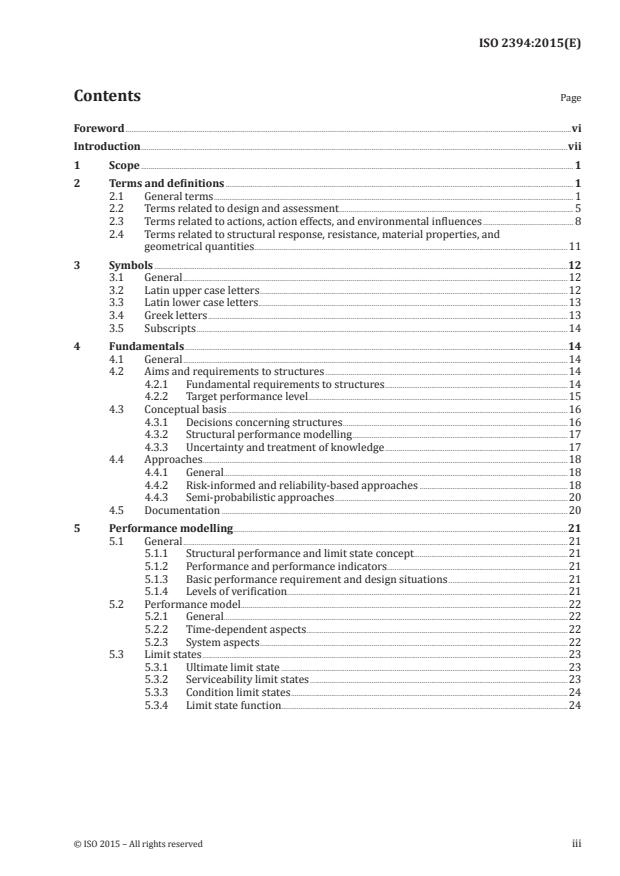
Contents Page
Foreword .vi
Introduction .vii
1 Scope . 1
2 Terms and definitions . 1
2.1 General terms . 1
2.2 Terms related to design and assessment . . 5
2.3 Terms related to actions, action effects, and environmental influences . 8
2.4 Terms related to structural response, resistance, material properties, and
geometrical quantities .11
3 Symbols .12
3.1 General .12
3.2 Latin upper case letters .12
3.3 Latin lower case letters.13
3.4 Greek letters .13
3.5 Subscripts .14
4 Fundamentals .14
4.1 General .14
4.2 Aims and requirements to structures .14
4.2.1 Fundamental requirements to structures .14
4.2.2 Target performance level .15
4.3 Conceptual basis .16
4.3.1 Decisions concerning structures .16
4.3.2 Structural performance modelling .17
4.3.3 Uncertainty and treatment of knowledge .17
4.4 Approaches.18
4.4.1 General.18
4.4.2 Risk-informed and reliability-based approaches .18
4.4.3 Semi-probabilistic approaches .20
4.5 Documentation .20
5 Performance modelling .21
5.1 General .21
5.1.1 Structural performance and limit state concept.21
5.1.2 Performance and performance indicators .21
5.1.3 Basic performance requirement and design situations .21
5.1.4 Levels of verification.21
5.2 Performance model .22
5.2.1 General.22
5.2.2 Time-dependent aspects .22
5.2.3 System aspects .22
5.3 Limit states .23
5.3.1 Ultimate limit state .23
5.3.2 Serviceability limit states .23
5.3.3 Condition limit states .24
5.3.4 Limit state function.24
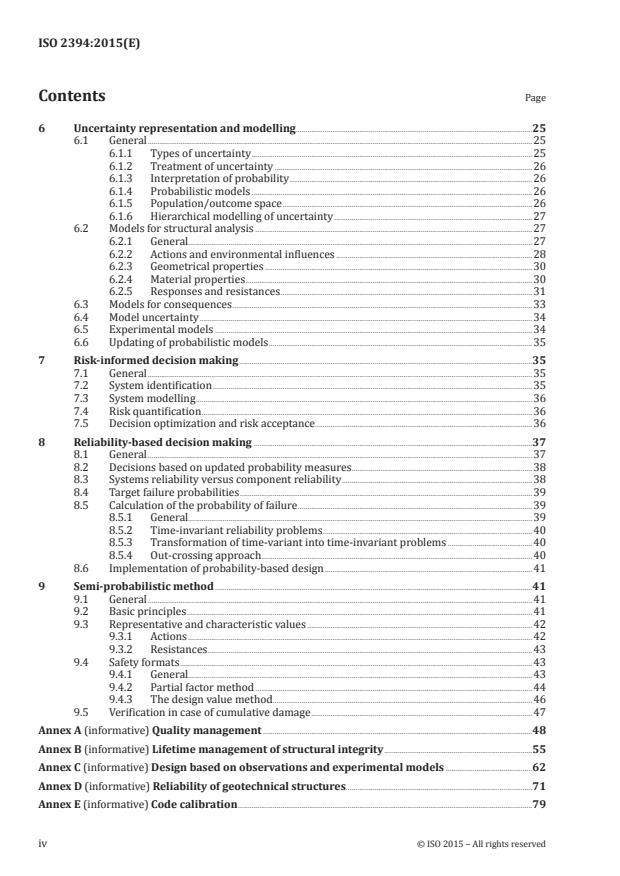
Contents Page
6 Uncertainty representation and modelling .25
6.1 General .25
6.1.1 Types of uncertainty .25
6.1.2 Treatment of uncertainty .26
6.1.3 Interpretation of probability .26
6.1.4 Probabilistic models .26
6.1.5 Population/outcome space .26
6.1.6 Hierarchical modelling of uncertainty .27
6.2 Models for structural analysis .27
6.2.1 General.27
6.2.2 Actions and environmental influences .28
6.2.3 Geometrical properties .30
6.2.4 Material properties .30
6.2.5 Responses and resistances .31
6.3 Models for consequences .33
6.4 Model uncertainty .34
6.5 Experimental models .34
6.6 Updating of probabilistic models .35
7 Risk-informed decision making .35
7.1 General .35
7.2 System identification .35
7.3 System modelling .36
7.4 Risk quantification .36
7.5 Decision optimization and risk acceptance.36
8 Reliability-based decision making .37
8.1 General .37
8.2 Decisions based on updated probability measures .38
8.3 Systems reliability versus component reliability .38
8.4 Target failure probabilities .39
8.5 Calculation of the probability of failure .39
8.5.1 General.39
8.5.2 Time-invariant reliability problems .40
8.5.3 Transformation of time-variant into time-invariant problems .40
8.5.4 Out-crossing approach . .40
8.6 Implementation of probability-based design .41
9 Semi-probabilistic method .41
9.1 General .41
9.2 Basic principles.41
9.3 Representative and characteristic values .42
9.3.1 Actions .42
9.3.2 Resistances . . .43
9.4 Safety formats .43
9.4.1 General.43
9.4.2 Partial factor method .44
9.4.3 The design value method .46
9.5 Verification in case of cumulative damage .47
Annex A (informative) Quality management .48
Annex B (informative) Lifetime management of structural integrity .55
Annex C (informative) Design based on observations and experimental models .62
Annex D (informative) Reliability of geotechnical structures .71
Annex E (informative) Code calibration .79
iv © ISO 2015 – All rights reserved
Contents Page
Annex F (informative) Structural robustness .88
Annex G (informative) Optimization and criterion on life safety .100
Bibliography .110
Foreword
ISO (the International Organization for Standardization) is a worldwide federation of national standards
bodies (ISO member bodies). The work of preparing International Standards is normally carried out
through ISO technical committees. Each member body interested in a subject for which a technical
committee has been established has the right to be represented on that committee. International
organizations, governmental and non-governmental, in liaison with ISO, also take part in the work.
ISO collaborates closely with the International Electrotechnical Commission (IEC) on all matters of
electrotechnical standardization.
The procedures used to develop this document and those intended for its further maintenance are
described in the ISO/IEC Directives, Part 1. In particular the different approval criteria needed for the
different types of ISO documents should be noted. This document was drafted in accordance with the
editorial rules of the ISO/IEC Directives, Part 2 (see www.iso.org/directives).
Attention is drawn to the possibility that some of the elements of this document may be the subject of
patent rights. ISO shall not be held responsible for identifying any or all such patent rights. Details of any
patent rights identified during the development of the document will be in the Introduction and/or on
the ISO list of patent declarations received (see www.iso.org/patents).
Any trade name used in this document is information given for the convenience of users and does not
constitute an endorsement.
For an explanation on the meaning of ISO specific terms and expressions related to conformity
assessment, as well as information about ISO’s adherence to the WTO principles in the Technical Barriers
to Trade (TBT), see the following URL: Foreword — Supplementary information.
The committee responsible for this document is ISO/TC 98, Bases for design of structures, SC 2, Reliability
of structures.
This fourth edition cancels and replaces the third edition (ISO 2394:1998), which has been technically
revised.
vi © ISO 2015 – All rights reserved
Introduction
The present fourth edition of this International Standard is intended to reflect advances in the common
basis for decision making related to load-bearing structures relevant to the construction industry.
Advances range from the development of systematic and rational treatment of risk to implementation of
reliability-based design through codes and standards.
Compliance with this International Standard should therefore promote harmonization of design practice
internationally and unification between the respective codes and standards such as for actions and
resistances for the respective structural materials.
The principles and appropriate instruments to ensure adequate levels of reliability provide for special classes
of structures or projects where the common experience base need to be extended in a rational manner.
In particular, a risk framework has been introduced which is scenario based, facilitates unified modelling
approaches over different applications, accounts for consequences of both a direct and indirect nature,
and has emphasis on robustness.
Whereas requirements to safety and reliability in the previous edition of this International Standard
took their basis in efficiency requirements of a heuristic character, these are now based on risk
considerations and socio-economics. This, in turn, facilitates a more relevant use of the International
Standard in the context of sustainable societal developments and adaptation for application of the
International Standard in different nation states in accordance with economic capacity and preferences.
The present International Standard, thus, enables the possibility to regulate, verify, and document the
adequate safe performance of structures and also to consider them in a broader sense as part of societal
systems. The International Standard provides for approaches at three levels, namely the following:
— risk informed;
— reliability based;
— semi-probabilistic.
[8]
The methodical basis for this edition of ISO 2394 is described in the Probabilistic Model Code and
[9]
Risk Assessment in Engineering — Principles, System Representation and Risk Criteria by the Joint
Committee on Structural Safety (JCSS), and EN 1990 (2007), where the reader will find additional
information of relevance for its use.
Informative Annexes are included to this International Standard as a support to its users in the
interpretations and use of the principles contained in its clauses.
INTERNATIONAL STANDARD ISO 2394:2015(E)
General principles on reliability for structures
1 Scope
This International Standard constitutes a risk- and reliability-informed foundation for decision making
concerning design and assessment of structures both for the purpose of code making and in the context
of specific projects.
The principles presented in this International Standard cover the majority of buildings, infrastructure,
and civil engineering works, whatever the nature of their application and use or combination of the
1)
materials used . The application of this International Standard will require specific adaptation and
2)
detailing in special cases where there are potentially extreme consequences of failure .
This International Standard is intended to serve as a basis for those committees responsible for the task
of preparing international standards, national standards, or codes of practice in accordance with given
objectives and context in a particular country.
The present International Standard describes how the principles of risk and reliability can be utilized to
support decisions related to the design and assessment of structures and systems involving structures
over their service life. Three different but related levels of approach are facilitated, namely, a risk-
informed, a reliability-based, and a semi-probabilistic approach.
The general principles are applicable to the design of complete structures (buildings, bridges, industrial
structures, etc.), the structural elements and joints making up the structures and the foundations. The
principles of this International Standard are also applicable to the successive stages in construction,
the handling of structural elements, their erection, and all work on-site, as well as the use of structures
during their design working life, including maintenance and rehabilitation, and decommissioning.
Risk and reliability are concepts accounting for and describing actions, structural response, durability,
life-cycle performance, consequences, design rules, workmanship, quality control procedures, and
national requirements, all of which are mutually dependent.
The application of this International Standard necessitates knowledge beyond what is contained in
the Clauses and the Annexes. It is the responsibility of the user to ensure that this knowledge is
available and applied.
2 Terms and definitions
2.1 General terms
2.1.1
structure
organized combination of connected parts including geotechnical structures designed to provide
resistance and rigidity against various actions
2.1.2
structural member
physically distinguishable part of a structure, e.g. column, beam, plate, foundation
1) The present International Standard is completely general from the perspective of basic principles and can be
applied for any structure below, on, and over the surface of the Earth.
2) This concerns, for example, structures of nuclear power plants and offshore oil and gas facilities in highly
sensitive environments.
2.1.3
system
bounded group of interrelated, interdependent, or interacting members forming an entity that achieves
a defined objective in its environment through interaction of its parts and interactions of its parts with
the environment
2.1.4
structural system
load-bearing members of a building or civil engineering structure and the way in which these members
function together and interact with the environment
2.1.5
requirement
demand with respect to structural aspects like safety for people and environment, functionality, usage,
and commitment of resources and cost efficiency
2.1.6
compliance
fulfilment of specified requirements
2.1.7
life cycle
life cycle incorporates initiation, project definition, design, construction, commissioning, operation,
maintenance, refurbishment, replacement, deconstruction, and ultimate disposal, recycling, or re-use
of the structure (or parts thereof), including its components, systems, and building services
2.1.8
reliability
ability of a structure or structural member to fulfil the specified requirements, during the working life,
for which it has been designed.
Note 1 to entry: Reliability is often expressed in terms of probability.
Note 2 to entry: Reliability covers safety, serviceability, and durability of a structure.
2.1.9
structural safety
ability (of a structure or structural member) to avoid exceedance of ultimate limit states, including the effects
of specified accidental phenomena, with a specified level of reliability, during a specified period of time
2.1.10
durability
capability of a structure or any structural member to satisfy with planned maintenance the design
performance requirements over a specified period of time under the influence of the environmental actions
2.1.11
exposure events
events which may cause damage or otherwise affect the performance indicators for the structure
2.1.12
assessment
total set of activities performed in order to verify the reliability of an existing structure
2.1.13
upgrading
modifications of an existing structure, construction works, and procedures to improve its structural
performance or facilitate its use for new purposes
2.1.14
repair (of a structure)
restoring the condition of a structure that has been damaged or deteriorated
2 © ISO 2015 – All rights reserved
2.1.15
rehabilitation
repairing or upgrading of an existing structure
2.1.16
monitoring
frequent or continuous, normally long-term, observation or measurement of structural conditions or
actions or structural response
2.1.17
inspection
on-site examination within the scope of quality control and condition assessment aiming to assess the
present condition of a structure
2.1.18
constituent events
events associated with damage or failure of structural members or parts of these, such as individual
cross sections and joints
2.1.19
reliability-based design
design procedure that is subjected to prescribed reliability level of the structure
2.1.20
member reliability
reliability of a single structural member which has one single dominating failure mode
2.1.21
system reliability
reliability of a system of more than one relevant structural member or a structural member which has
more than one relevant failure mode
2.1.22
population
set of entities for which the same probabilistic descriptions (mean values, etc.) are valid
2.1.23
outcome space
set of all possible outcomes of a random phenomenon
2.1.24
constituent
component or ingredient contributing to a certain performance
2.1.25
performance indicator
parameter describing a certain property of the structure or a certain characteristic of the structural
behaviour
2.1.26
structural performance
qualitative or quantitative representation of the behaviour of a structure (e.g. load bearing capacity,
stiffness, etc.) related to its safety and serviceability, durability, and robustness
2.1.27
resistance
ability of a structure (or a part of it) to withstand actions without failure
2.1.28
quality control
activities to control quality of design, execution, use, and decommissioning of a structure
2.1.29
damage
unfavourable change in the condition of a structure that can affect the structural performance unfavourably
2.1.30
collapse
development of failure mechanisms in a structure to a degree involving disintegration and falling (parts
of) structural members
2.1.31
deterioration
process that adversely affects the structural performance including reliability over time
Note 1 to entry: Deterioration may be caused by naturally occurring chemical, physical, or biological actions,
normal or severe environmental actions, repeated actions such as those causing fatigue, wear due to use, and
improper operation and maintenance of the structure.
2.1.32
serviceability
ability of a structure or structural member to perform adequately for a normal use under all expected actions
2.1.33
scenario description
determination of different sequences of events which affect the performance indicators, taking into
account the likelihood of occurrence
2.1.34
consequence class
categorization of the consequences of structural failure
2.1.35
reliability class
class of structures or structural members for which a particular specified degree of reliability is required
2.1.36
reliability differentiation
socio-economic optimization of the resources to be used to build construction works, taking into account
all the expected consequences of failures and the cost of the construction
2.1.37
hazard scenario
set of situations, transient in time, that a system might happen to undergo and which may endanger the
system itself, the people, and the environment
2.1.38
risk-informed design
design optimized with due consideration of the total risks, including loss of lives and injuries, damages
to the qualities of the environment, and monetary losses
Note 1 to entry: Risk-based design is presently not generally accepted by all national standards and codes.
2.1.39
safety plan
plan specifying the performance objectives, the hazard scenarios to be considered for the structure,
and all present and future measures (design, construction, or operation, e.g. monitoring) to ensure the
safety of the structure
4 © ISO 2015 – All rights reserved
2.1.40
risk
effect of uncertainty on the objectives
Note 1 to entry: From the view point of the decision theory, risk is the expected value of all undesirable
consequences, i.e. the sum of all the products of the possible consequences of an event and the corresponding
probabilities.
2.1.41
marginal lifesaving cost
increment of cost associated with saving one additional life through additional safety measures
2.1.42
risk screening
investigation into and classification of risks identified for all the hazard situations
2.1.43
Life Quality Index
LQI
indicator of the societal preference and capacity for investments into life safety expressed as a function
of GDP, life expectancy at birth, and ratio between leisure to working time
2.1.44
utilisation plan
plan containing the intended use (or uses) of the structure and listing the operational conditions of the
structure including maintenance requirements and the corresponding performance requirements
2.1.45
reliability target
specified average acceptable failure probability that is to be reached as close as possible
Note 1 to entry: Reliability targets are generally model dependent and need to be set for each case considered
based on the models used.
2.1.46
robustness
damage insensitivity
ability of a structure to withstand adverse and unforeseen events (like fire, explosion, impact) or
consequences of human errors without being damaged to an extent disproportionate to the original cause
2.1.47
hazard
unusual and severe threat, e.g. a possible abnormal action or environmental influence, insufficient
strength or stiffness, or excessive detrimental deviation from intended dimensions
2.2 Terms related to design and assessment
2.2.1
design/assessment situations
set of physical conditions representing a certain time interval for which it shall be demonstrated that
relevant limit states are not exceeded
2.2.2
persistent design situation
normal condition of use for the structure
2.2.3
transient design situations
provisional condition of use or exposure for the structure, for example, during its construction or repair,
representing a time period much shorter than the design working life
2.2.4
accidental design situations
design situation involving possible exceptional conditions for the structure in use or exposure, including
flooding, fire, explosion, impact, mal-operation of systems, or local failure
2.2.5
seismic design situation
design situation involving the exceptional conditions when the structure is subjected to a seismic event
2.2.6
failure
insufficient load-bearing capacity or inadequate serviceability of a structure or structural member, or
rupture or excessive deformation of the ground, in which the strengths of soil or rock are significant in
providing resistance
2.2.7
limit states
state beyond which a structure no longer satisfies the design criteria
2.2.8
ultimate limit states
limit states concerning the maximum load-bearing capacity
2.2.9
design criteria
quantitative formulations describing the conditions to be fulfilled for each limit state
2.2.10
serviceability limit states
limit state concerning the criteria governing the functionalities related to normal use
2.2.11
irreversible limit states
limit states which will remain permanently exceeded when the actions which caused the exceedance
are no longer present
2.2.12
reversible limit states
limit states which will not be exceeded when the actions which caused the exceedance are no longer present
2.2.13
condition limit state
well-defined and controllable limit state without direct negative consequences, which is often an
approximation to a real limit state that cannot be well defined or is difficult to calculate
Note 1 to entry: In applications relating to durability aspects, the condition limit state is often referred to as the
durability limit state.
2.2.14
limit state function
function gX(,XX,., ) of the basic variables, which characterizes a limit state when gX(,XX,., )=0
12 n 12 n
2.2.15
basic variables
variables representing physical quantities which characterize actions and environmental influences,
material and soil properties, and geometrical quantities
2.2.16
design service life
assumed period for which a structure or a structural member is to be used for its intended purpose with
anticipated maintenance, but without substantial repair being necessary
6 © ISO 2015 – All rights reserved
2.2.17
model uncertainty
basic variable related to the accuracy of physical or statistical models
2.2.18
aleatory uncertainty
inherent variability typically associated with the loading environment, the geometry of the structure,
and the material properties
2.2.19
epistemic uncertainty
lack of knowledge that, in principle, can be reduced by measurements or improved theories
Note 1 to entry: The exact borderline between aleatory and epistemic is not always unambiguous.
2.2.20
hierarchical modelling of uncertainty
random variable is a function of other random variables
2.2.21
probabilistic methods
verification methods in which the relevant basic variables are treated as random variables, random
processes, and random fields, discrete or continuous
2.2.22
reliability index
β
-1 -1
substitute for the failure probability β = -Φ (p ) where Φ is the inverse standardized normal distribution
f
2.2.23
target reliability (index)
reliability (index) corresponding to acceptable safety or serviceability
2.2.24
semi-probabilistic or partial factors methods
verification method in which allowance is made for the uncertainties and variability assigned to the
basic variables by means of representative values, partial factors and, if relevant, additive quantities
Note 1 to entry: Partial factors may be related to individual random variables or global variables.
2.2.25
structural model
idealisation of the structure, physical, mathematical, or numerical, used for the purposes of analysis,
design, and verification
2.2.26
static system
idealisation of the structure, used for the purposes of static analysis, design, and verification
2.2.27
levels of verification
levels of the verification used to assess the compliance with the objectives for all design/assessment situations
Note 1 to entry: The following levels are commonly recognised: the risk level, the probabilistic reliability level,
and the semi-probabilistic level.
2.2.28
First/Second Order Reliability Methods
FORM/SORM
numerical methods used for determination of the reliability index β
2.2.29
reliability elements
numerical quantities used in the partial factors format, by which the specified target reliability is
assumed to be reached
Note 1 to entry: The reliability elements include partial factors and load combination factors.
2.2.30
characteristic value
value specified preferably on statistical bases, so it can be considered to have a prescribed probability
of not being exceeded
Note 1 to entry: For variable actions, the characteristic value corresponds to either of the following:
— an upper value with an intended probability of not being exceeded or a lower value with an intended
probability of being achieved, during some specific reference period;
— a nominal value, which may be specified in cases where a statistical distribution is not known.
2.2.31
reference period
period of time used as a basis for assessing the design value of variable and/or accidental actions
2.2.32
nominal value
value fixed on a non-statistical basis, for instance, on acquired experience or on physical constraints
2.2.33
alternative load path
ALP
alternative for a load to be transferred from a point of application to a point of resistance
2.2.34
consequence reducing measures
measure aiming at reducing the direct and indirect consequences of failure and thus the total risk
2.2.35
key element
structural member upon which the ultimate limit state performance of the structure depends
2.2.36
code calibration
determination of the reliability elements in a given code format in order to reach the reliability target
2.2.37
load testing
test of the structure (or part of it) by loading to evaluate its behaviour or properties or to predict its load
bearing capacity
2.3 Terms related to actions, action effects, and environmental influences
2.3.1
action
assembly of concentrated or distributed forces acting on a structure (direct actions), displacements
or thermal effects imposed to the structure, or constrained in it or environmental influences that may
cause changes with time in the material properties or in the dimensions of a structure
2.3.2
individual action
single action
action which can be assumed to be independent in time and space of any other action acting on the structure
8 © ISO 2015 – All rights reserved
2.3.3
permanent action
action which is likely to act continuously throughout the design working life and for which variations in
magnitude with time are small compared with the mean value
2.3.4
variable action
action which is likely to act during a given design working life and for which the variation in magnitude
with time is neither negligible nor monotonic
2.3.5
accidental action
action which is unlikely to occur with a significant value during the design working life of the structure
2.3.6
fixed action
action which has a fixed distribution on a structure such as its magnitude and direction are determined
unambiguously for the whole structure when determined at one point of the structure
2.3.7
free action
action that may have an arbitrary spatial distribution over the structure within certain limits
2.3.8
dynamic action
action that may cause significant acceleration of the structure or structural members
2.3.9
static action
action that will not cause significant acceleration of the structure or structural members
2.3.10
bounded action
action that has a limiting value which cannot be exceeded and which is exactly or approximately known
2.3.11
design value of an action
F
d
value of an action used in semi-probabilistic verification calibrated to the reliability target
Note 1 to entry: In the partial factor method, the value is obtained by multiplying the representative value by the
partial factor γ .
F
2.3.12
effect of actions
effect of actions (or action effect) is a result of actions on a structural member (e.g. internal force,
moment, stress, strain) or on the whole structure (e.g. deflection, rotation)
2.3.13
prestress
force applied intentionally to a structure by imposing deformations
2.3.14
geotechnical action
action transmitted to the structure by the ground, fill, or groundwater
2.3.15
seismic action
action caused by earthquake ground motions
2.3.16
imposed load
load resulting from occupancy in buildings
2.3.17
construction load
load specifically related to execution activities
2.3.18
environmental influences
physical, chemical, or biological influences which may deteriorate the materials constituting a structure,
which in turn may affect its serviceability and safety in an unfavourable way
2.3.19
load arrangement
identification of the position, magnitude, and direction of a free action
2.3.20
repr
...