

ISO 8397:1988
(Main)Solid fertilizers and soil conditioners — Test sieving
General Information
- Abstract
Specifies a method for the determination of a particle size distribution, consisting in mechanical dry sieving of a sample with one or more test sieves.The second edition cancels and replaces the first edition (1986), clause 10 of which has been amended.
- Status
- Published
- Publication Date
- 27-Jan-1988
- Technical Committee
- ISO/TC 134 - Fertilizers, soil conditioners and beneficial substances
- Drafting Committee
- ISO/TC 134 - Fertilizers, soil conditioners and beneficial substances
- Current Stage
- 9093 - International Standard confirmed
- Start Date
- 10-Sep-2024
- Completion Date
- 29-Aug-2026
Buy Documents

ISO 8397:1988 - Solid fertilizers and soil conditioners — Test sieving Released:1/28/1988
ISO 8397:1988 - Matieres fertilisantes solides — Tamisage de contrôle Released:1/28/1988

ISO 8397:1988 - Matieres fertilisantes solides — Tamisage de contrôle Released:1/28/1988
Overview - ISO 8397:1988 (Test sieving for solid fertilizers and soil conditioners)
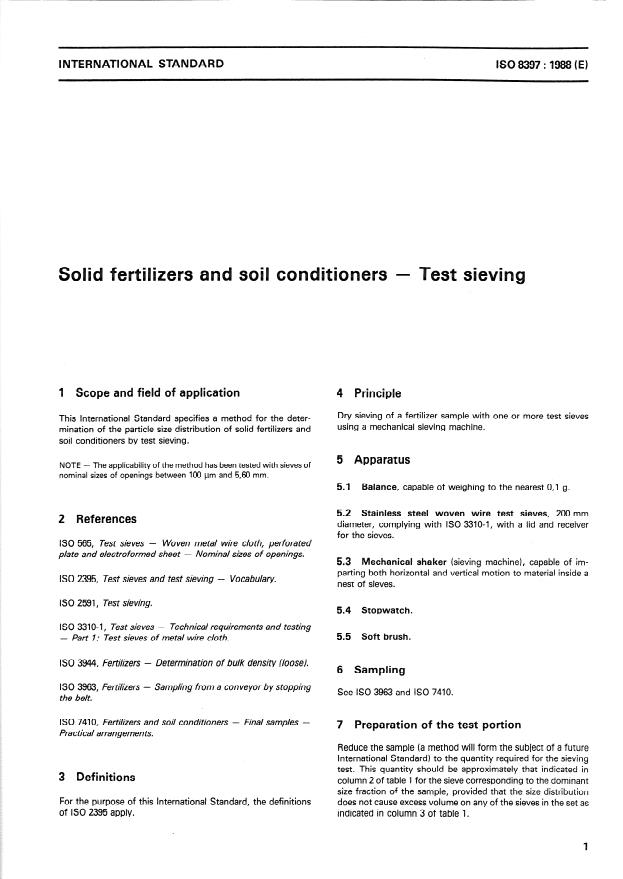
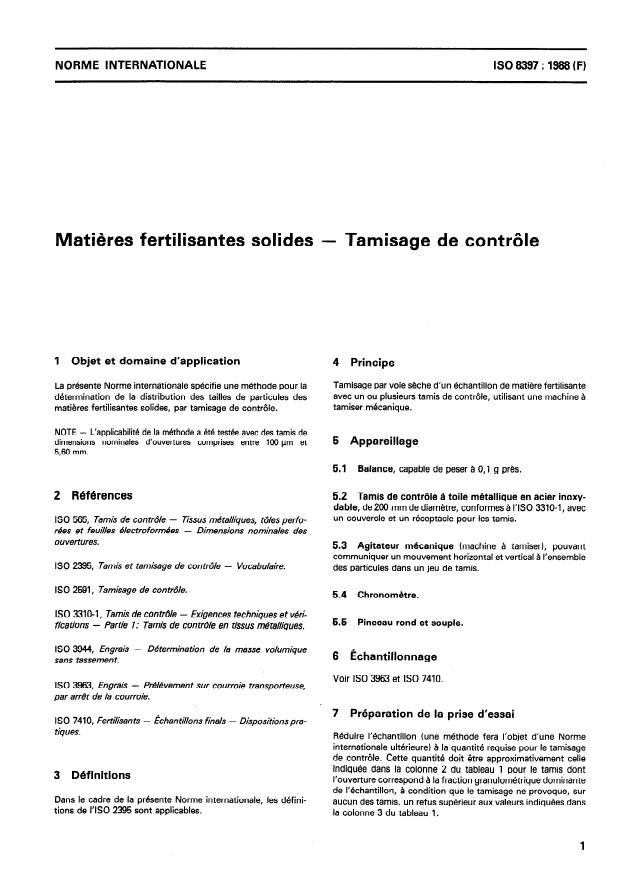
ISO 8397:1988 specifies a laboratory method for determining particle size distribution of solid fertilizers and soil conditioners by mechanical dry test sieving. The standard defines the procedure for dry sieving one or more test sieves using a mechanical sieve shaker, describes required apparatus and sample preparation, and sets criteria for reporting and for the statistical fidelity of results (repeatability and reproducibility). The method has been validated for sieve openings in the nominal range from about 100 µm to 5.60 mm.
Key topics and technical requirements
- Scope and principle: Mechanical dry sieving of an accurately weighed test portion through a stack of sieves to obtain the mass of material retained by each sieve and the pan (tamisat).
- Apparatus:
- Analytical balance with 0.1 g precision.
- Test sieves: 200 mm diameter stainless-steel woven wire sieves conforming to ISO 3310‑1.
- Mechanical sieve shaker capable of horizontal and vertical motion.
- Stopwatch and a soft round brush for clearing meshes.
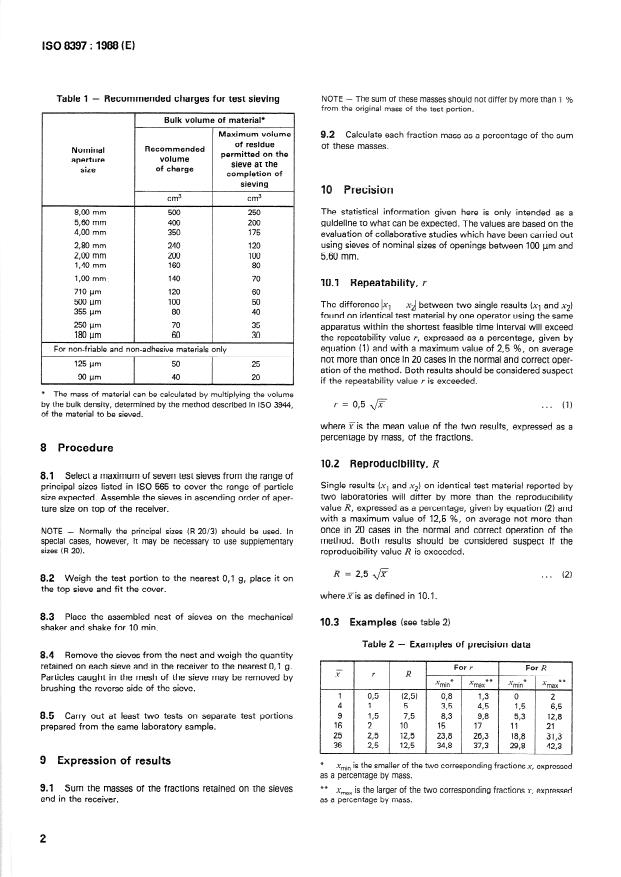
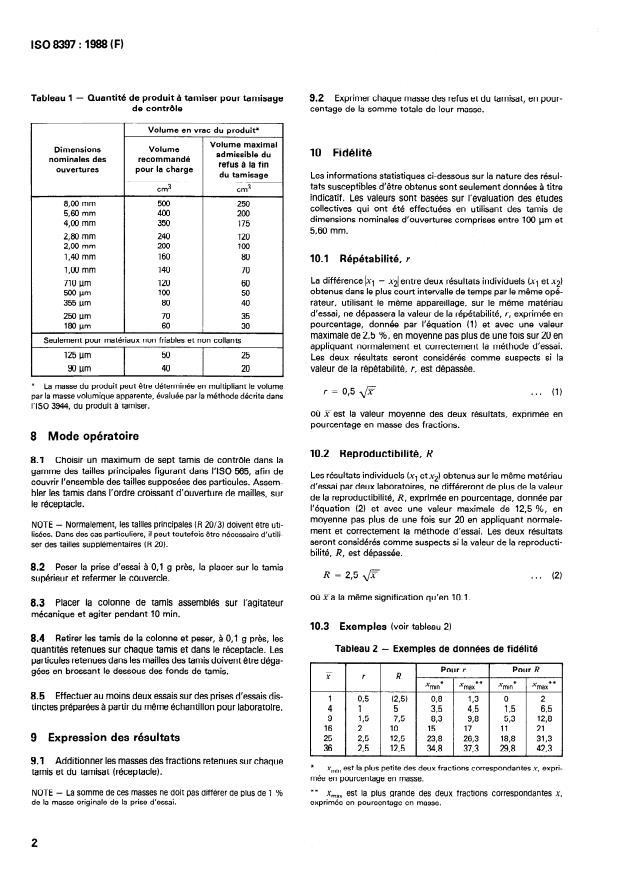
- Sample preparation and quantities: The standard provides recommended sample masses/volumes relative to the dominant fraction and sieve opening (see its Table 1). Sample reduction methods are referenced and two independent test portions are required per laboratory.
- Procedure:
- Select up to seven sieves in ascending mesh size.
- Assemble, weigh the test portion to 0.1 g, sieve for 10 minutes, then collect and weigh retained fractions and pan.
- Clean mesh surfaces by brushing before weighing.
- Results and statistics:
- Express each retained mass as a percentage of total test portion.
- ISO 8397 gives statistical limits for repeatability (r) and reproducibility (R); empirical maximums cited are about 2.5% (r) and 12.5% (R) for typical fractions. Example fidelity data are provided.
- Test report requirements: Must include method reference (ISO 8397), sample identification, nominal sieve openings used, masses retained, mean percentage retained per sieve, and any operational details or incidents.
Applications and users
ISO 8397 is used for sieve analysis and granulometric characterization in:
- Fertilizer and soil conditioner quality control laboratories
- Production and R&D teams in fertilizer manufacturing
- Agricultural laboratories validating product compliance with specifications
- Third‑party testing and certification bodies
Keywords: ISO 8397, test sieving, solid fertilizers, soil conditioners, particle size distribution, sieve analysis, granulometric analysis, mechanical sieve shaker.
Related standards
- ISO 3310‑1 (test sieve technical requirements)
- ISO 565 (nominal sieve openings)
- ISO 2591 (sieving methods and recording)
- ISO 2335 (vocabulary for sieving)
- ISO 3963 / ISO 7410 (sampling practical arrangements)
- ISO 3944 (bulk density determination)
Relations
- Effective Date
- 15-Apr-2008
Buy Documents
ISO 8397:1988 - Solid fertilizers and soil conditioners — Test sieving Released:1/28/1988
ISO 8397:1988 - Matieres fertilisantes solides — Tamisage de contrôle Released:1/28/1988
ISO 8397:1988 - Matieres fertilisantes solides — Tamisage de contrôle Released:1/28/1988
Get Certified
Connect with accredited certification bodies for this standard

Control Union Certifications
Global certification for agriculture and sustainability.

ECOCERT
Organic and sustainability certification.

FSC International
Forest Stewardship Council certification.
Sponsored listings
Frequently Asked Questions
ISO 8397:1988 is a standard published by the International Organization for Standardization (ISO). Its full title is "Solid fertilizers and soil conditioners — Test sieving". This standard covers: Specifies a method for the determination of a particle size distribution, consisting in mechanical dry sieving of a sample with one or more test sieves.The second edition cancels and replaces the first edition (1986), clause 10 of which has been amended.
Specifies a method for the determination of a particle size distribution, consisting in mechanical dry sieving of a sample with one or more test sieves.The second edition cancels and replaces the first edition (1986), clause 10 of which has been amended.
ISO 8397:1988 is classified under the following ICS (International Classification for Standards) categories: 65.080 - Fertilizers. The ICS classification helps identify the subject area and facilitates finding related standards.
ISO 8397:1988 has the following relationships with other standards: It is inter standard links to ISO 8397:1986. Understanding these relationships helps ensure you are using the most current and applicable version of the standard.
ISO 8397:1988 is available in PDF format for immediate download after purchase. The document can be added to your cart and obtained through the secure checkout process. Digital delivery ensures instant access to the complete standard document.
Standards Content (Sample)
Second edition
1988-02-0 1
INTERNATIONAL QRGANIZATION FOR STANDARDIZATBON
ORGANISATION INTERNATIONALE DE NORMALISATDON
MEXJJYHAPOAHAR OPTAHM3AiJMR fl0 CTAH~APTM3AlJWl
est sievin
lamisage de con tro/e
Ma tikres derti/isan tes solides -
Reference number
ISO 8397 : 1988 (E)
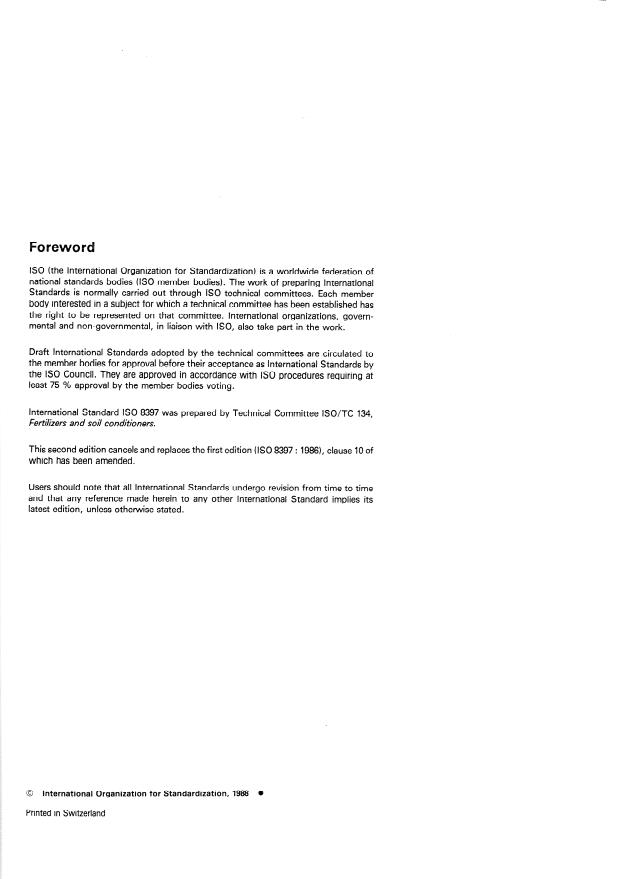
ISO (the International Organkation for Standardkation) is a worldwide federation of
national Standards bodies US0 member bedies). The work sf preparing International
Standards is normally carried out through EO technical committees. Esch member
body interested in a subject for which a technical committee has been established has
the right to be represented on that committee. International organizations, govern-
mental and non-governmental, in Iiaison with ISO, also take part in the werk.
Draft International Standards adopted by the technicat committees are circulated to
the member bodies for approval before their acceptance as International Standards by
the ISO Council. They are approved in accordance with ISO procedures requiring at
least 75 % approval by the member bodies voting.
International Standard ISO 8397 was prepared by Technical Committee ISO/TC 134,
Fertilizers and sei! conditioners.
Chis second edition cancels and replaces the first edition (ISO $397 : 19861, clause 10 sf
which has been amended.
Users should note that all International Standar ndergo revision fro
and that any reference made herein to any other International Standard impfies its
latest edition, uniess otherwise stated.
0 International Organization dar Standardisation, 19
Printed in Switzerland
AL STANDARD
ev
S C
4 Principle
1 Scope and fieid of application
Dry sieving of a fertilizer Sample with one or more test sieves
This International Standard specifies a method for the deter-
using a mechanical sieving machine.
mination of the particle size distribution of solid fertilizers and
soil conditioners by test sieving.
5 Apparatus
NOTE - The applicability of the method has been tested with sieves of
nominal sizes sf openings between 100 Pm and 5,60 mm.
Balance, capable of weighing to the nearest 0,l g.
5.1
5.2 Stainless steel woven wire test siewes, 200 mm
2 eferences
diameter, complying with ISO 3310-1, with a lid and receiver
for the sieves.
Woven metal wire cloth, perforated
ISO 565, Test sieves -
plate and electroformed sheet - Nominal skes of openings.
5.3 anical shaker (sieving machine), capable sf im-
horizontal and vertical motion to material inside a
partin
ISO 2395, Test sieves and test sieving - Vocabulary.
nest of sieves.
ISO 2591, Test sieving.
5.4 Stopwatch.
Technical reguiremen ts and testing
ISO 3310-1, Test sieves -
5.5 Soft brush.
- Part 7: Test sieves of metal wire cIoth.
Determination o f bulk density Uoosel.
ISO 3944, Fertizers -
6 Sampling
Sampkng from a conve yor b y stopping
ISO 3963, FerMizers -
See ISO 3963 and ISO 74110.
the belt.
ISO 7410, FerMizers and seil conditioners - Final samples -
7 Preparation of the test Portion
Practical arrangemen ts.
Reduce the Sample (a method will form the subject of a future
International Standard) to the quantity required for the sieving
test. Chis quantity should be approximately that indicated in
3 Definitions
column 2 of t
...
ISO
NORME INTERNATIONALE
Deuxième édition
1988-02-o 1
INTERNATIONAL ORGANIZATION FOR STANDARDIZATION
ORGANISATION INTERNATIONALE DE NORMALISATION
MEXAYHAPOJJHAR OPTAHM3A~MR IlO CTAH~APTM3A~W
Matières fertilisantes solides - Tamisage de contrôle
Solid fertilizers and soif conditioners - Test sieving
Numéro de référence
lS0 8397: 1988 (F)
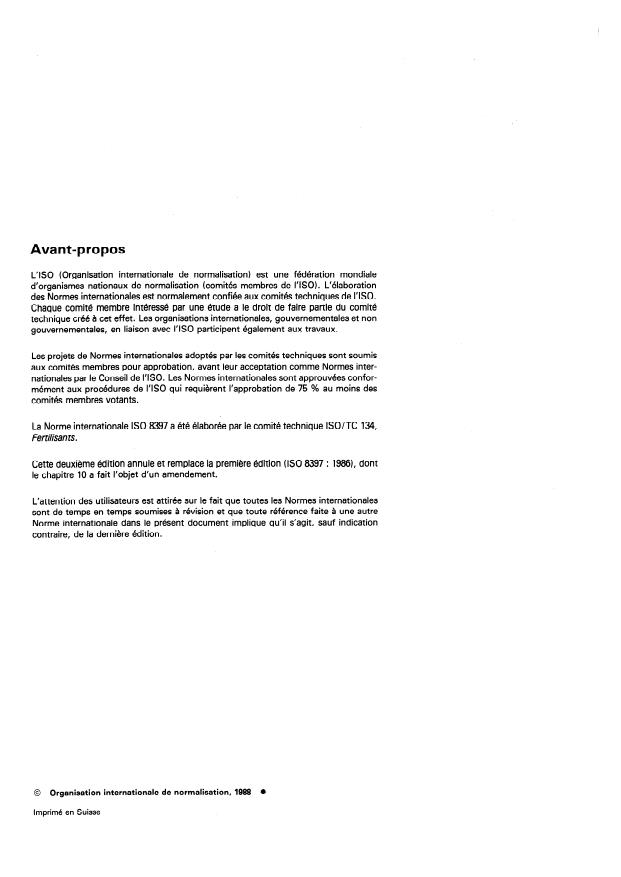
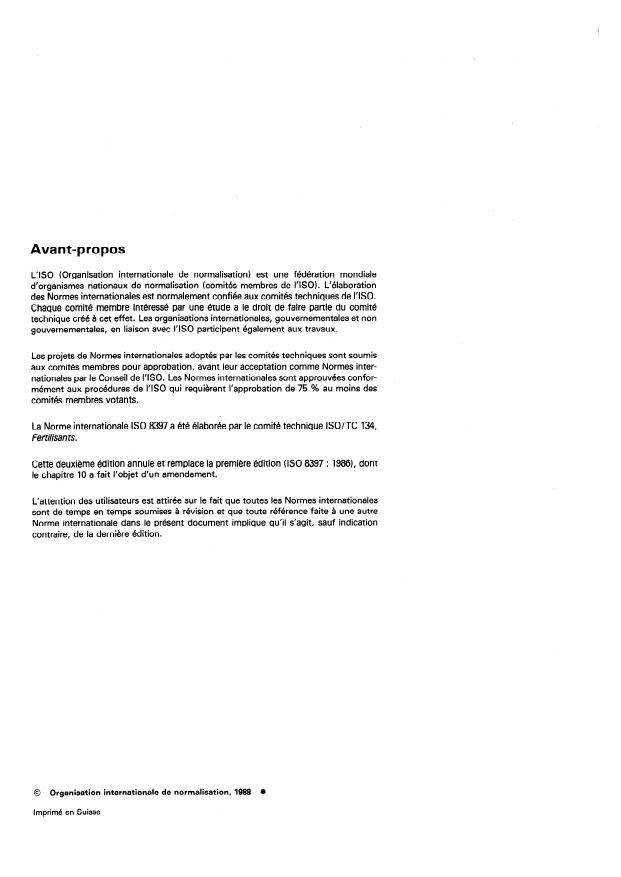
Avant-propos
L’ISO (Organisation internationale de normalisation) est une fédération mondiale
d’organismes nationaux de normalisation (comités membres de I’ISO). L’élaboration
des Normes internationales est normalement confiée aux comités techniques de I’ISO.
Chaque comité membre intéressé par une étude a le droit de faire partie du comité
technique créé à cet effet. Les organisations internationales, gouvernementales et non
gouvernementales, en liaison avec I’ISO participent également aux travaux.
Les projets de Normes internationales adoptés par les comités techniques sont soumis
aux comités membres pour approbation, avant leur acceptation comme Normes inter-
nationales par le Conseil de I’ISO. Les Normes internationales sont approuvées confor-
mément aux procédures de I’ISO qui requièrent l’approbation de 75 % au moins des
comités membres votants.
La Norme internationale ISO 8397 a été élaborée par le comité technique ISO/TC 134,
Ferdisan ts .
Cette deuxiéme édition annule et remplace la première édition (ISO 8397 : 1986), dont
le chapitre 10 a fait l’objet d’un amendement.
L’attention des utilisateurs est attirée sur le fait que toutes les Normes internationales
sont de temps en temps soumises à révision et que toute référence faite à une autre
Norme internationale dans le présent document implique qu’il s’agit, sauf indication
contraire, de la derniére édition.
0 Organisation internationale de normalisation, 1988
Imprimé en Suisse
ISO 6397 : 1988 (F)
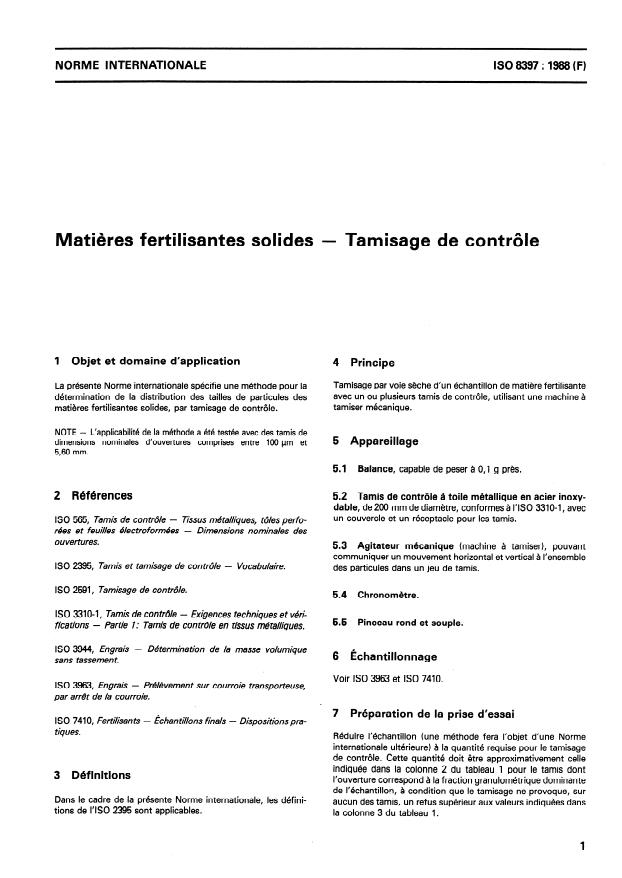
NORME INTERNATIONALE
Matières fertilisantes solides - Tamisage de contrôle
1 Objet et domaine d’application 4 Principe
Tamisage par voie séche d’un échantillon de matière fertilisante
La présente Norme internationale spécifie une méthode pour la
avec un ou plusieurs tamis de contrôle, utilisant une machine à
détermination de la distribution des tailles de particules des
tamiser mécanique.
matières fertilisantes solides, par tamisage de contrôle.
- L’applicabilité de la méthode a été testée avec des tamis de
NOTE
5 Appareillage
dimensions nominales d’ouvertures comprises entre 100 prn et
5,60 mm.
5.1 Balance, capable de peser à 0,l g prés.
5.2 Tamis de contrôle à toile métallique en acier inoxy-
2 Références
dable, de 200 mm de diamètre, conformes à I’ISO 3310-1, avec
un couvercle et un réceptacle pour les tamis.
TISSUS métalliques, tôles perfo-
ISO 565, Tamis de contrôle -
rees et feuilles électroformées - Dimensions nominales des
ouvertures.
5.3 Agitateur mécanique (machine à tamiser), pouvant
communiquer un mouvement horizontal et vertical à l’ensemble
ISO 2335, Tamis et tamisage de contrôle - Vocabulaire.
des particules dans un jeu de tamis.
ISO 2591, Tamisage de contrôle.
5.4 Chronomètre.
ISO 3310-1, Tamis de controle - Exigences techniques et veri-
Pinceau rond et souple.
5.5
- Partie 7: Tamis de controie en tissus métalliques.
fica tions
ISO 3944, Engrais - Détermination de la masse volumique
6 Échantillonnage
sans tassement.
Voir ISO 3963 et ISO 7410.
Prelevement sur courroie transporteuse,
ISO 3963, Engrais -
par arrêt de la courroie.
7 Préparation de la prise d’essai
I SO 7410, Fertlisan ts - &han tillons fr’nals - Dispositions pra-
tiques.
Réduire l’échantillon (une méthode fera l’objet d’une Norme
internationale ultérieure) à la quantité requise pour le tamisage
de contrôle. Cette quantité doit être approximativement celle
indiquée dans la colonne 2 du tableau 1 pour le tamis dont
3 Définitions
l’ouverture correspond à la fraction granulométrique dominante
de l’échantillon, à condition que le tamisage ne provoque, sur
Dans le cadre de la présente Norme internationale, les défini-
aucun des tamis, un refus supérieur aux valeurs indiquées dans
tions de I’ISO 2395 sont applicables.
la colonne 3 du tableau 1.
60 8397 : 1988 (FI
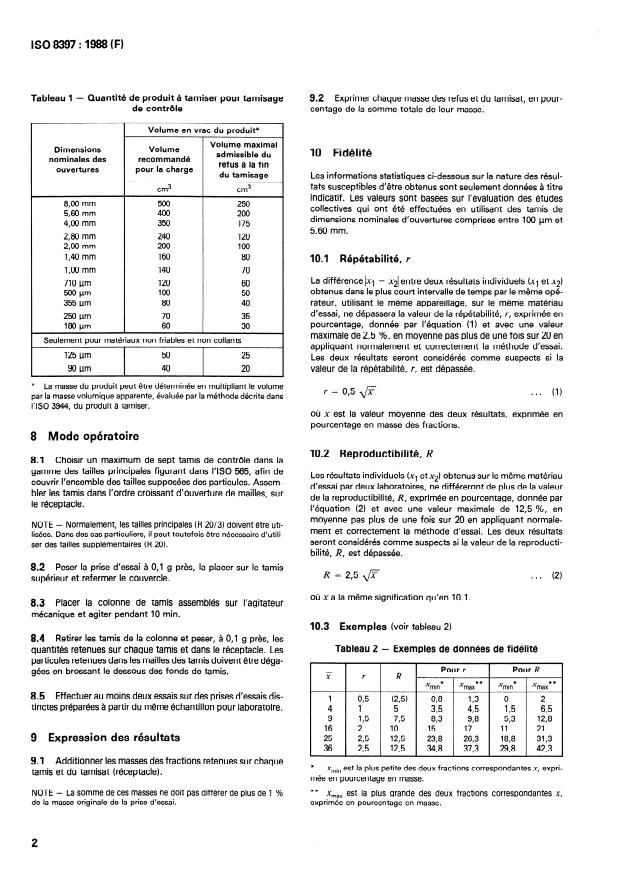
Tableau 1 - Quantité de produit à tamiser pour tamisage 9.2 Exprimer chaque masse des refus et du tamisat, en pour-
de contrôle
centage de la somme totale de leur masse.
Volume en vrac du produit*
Volume maximal
Volume
Dimensions
10 Fidélité
admissible du
nominales des recommandé
refus à la fin
ouvertures pour la charge
du tamisage
Les informations statistiques ci-dessous sur la nature des résul-
tats susceptibles d’être obtenus sont seulement données à titre
cm3 cm3
indicatif. Les valeurs sont basées sur l’évaluation des
...
ISO
NORME INTERNATIONALE
Deuxième édition
1988-02-o 1
INTERNATIONAL ORGANIZATION FOR STANDARDIZATION
ORGANISATION INTERNATIONALE DE NORMALISATION
MEXAYHAPOJJHAR OPTAHM3A~MR IlO CTAH~APTM3A~W
Matières fertilisantes solides - Tamisage de contrôle
Solid fertilizers and soif conditioners - Test sieving
Numéro de référence
lS0 8397: 1988 (F)
Avant-propos
L’ISO (Organisation internationale de normalisation) est une fédération mondiale
d’organismes nationaux de normalisation (comités membres de I’ISO). L’élaboration
des Normes internationales est normalement confiée aux comités techniques de I’ISO.
Chaque comité membre intéressé par une étude a le droit de faire partie du comité
technique créé à cet effet. Les organisations internationales, gouvernementales et non
gouvernementales, en liaison avec I’ISO participent également aux travaux.
Les projets de Normes internationales adoptés par les comités techniques sont soumis
aux comités membres pour approbation, avant leur acceptation comme Normes inter-
nationales par le Conseil de I’ISO. Les Normes internationales sont approuvées confor-
mément aux procédures de I’ISO qui requièrent l’approbation de 75 % au moins des
comités membres votants.
La Norme internationale ISO 8397 a été élaborée par le comité technique ISO/TC 134,
Ferdisan ts .
Cette deuxiéme édition annule et remplace la première édition (ISO 8397 : 1986), dont
le chapitre 10 a fait l’objet d’un amendement.
L’attention des utilisateurs est attirée sur le fait que toutes les Normes internationales
sont de temps en temps soumises à révision et que toute référence faite à une autre
Norme internationale dans le présent document implique qu’il s’agit, sauf indication
contraire, de la derniére édition.
0 Organisation internationale de normalisation, 1988
Imprimé en Suisse
ISO 6397 : 1988 (F)
NORME INTERNATIONALE
Matières fertilisantes solides - Tamisage de contrôle
1 Objet et domaine d’application 4 Principe
Tamisage par voie séche d’un échantillon de matière fertilisante
La présente Norme internationale spécifie une méthode pour la
avec un ou plusieurs tamis de contrôle, utilisant une machine à
détermination de la distribution des tailles de particules des
tamiser mécanique.
matières fertilisantes solides, par tamisage de contrôle.
- L’applicabilité de la méthode a été testée avec des tamis de
NOTE
5 Appareillage
dimensions nominales d’ouvertures comprises entre 100 prn et
5,60 mm.
5.1 Balance, capable de peser à 0,l g prés.
5.2 Tamis de contrôle à toile métallique en acier inoxy-
2 Références
dable, de 200 mm de diamètre, conformes à I’ISO 3310-1, avec
un couvercle et un réceptacle pour les tamis.
TISSUS métalliques, tôles perfo-
ISO 565, Tamis de contrôle -
rees et feuilles électroformées - Dimensions nominales des
ouvertures.
5.3 Agitateur mécanique (machine à tamiser), pouvant
communiquer un mouvement horizontal et vertical à l’ensemble
ISO 2335, Tamis et tamisage de contrôle - Vocabulaire.
des particules dans un jeu de tamis.
ISO 2591, Tamisage de contrôle.
5.4 Chronomètre.
ISO 3310-1, Tamis de controle - Exigences techniques et veri-
Pinceau rond et souple.
5.5
- Partie 7: Tamis de controie en tissus métalliques.
fica tions
ISO 3944, Engrais - Détermination de la masse volumique
6 Échantillonnage
sans tassement.
Voir ISO 3963 et ISO 7410.
Prelevement sur courroie transporteuse,
ISO 3963, Engrais -
par arrêt de la courroie.
7 Préparation de la prise d’essai
I SO 7410, Fertlisan ts - &han tillons fr’nals - Dispositions pra-
tiques.
Réduire l’échantillon (une méthode fera l’objet d’une Norme
internationale ultérieure) à la quantité requise pour le tamisage
de contrôle. Cette quantité doit être approximativement celle
indiquée dans la colonne 2 du tableau 1 pour le tamis dont
3 Définitions
l’ouverture correspond à la fraction granulométrique dominante
de l’échantillon, à condition que le tamisage ne provoque, sur
Dans le cadre de la présente Norme internationale, les défini-
aucun des tamis, un refus supérieur aux valeurs indiquées dans
tions de I’ISO 2395 sont applicables.
la colonne 3 du tableau 1.
60 8397 : 1988 (FI
Tableau 1 - Quantité de produit à tamiser pour tamisage 9.2 Exprimer chaque masse des refus et du tamisat, en pour-
de contrôle
centage de la somme totale de leur masse.
Volume en vrac du produit*
Volume maximal
Volume
Dimensions
10 Fidélité
admissible du
nominales des recommandé
refus à la fin
ouvertures pour la charge
du tamisage
Les informations statistiques ci-dessous sur la nature des résul-
tats susceptibles d’être obtenus sont seulement données à titre
cm3 cm3
indicatif. Les valeurs sont basées sur l’évaluation des
...