

ISO 1420:2016
(Main)Rubber- or plastics-coated fabrics — Determination of resistance to penetration by water
General Information
- Abstract
ISO 1420:2016 specifies two methods for the determination of the resistance of rubber- or plastics-coated fabrics to water penetration (hydrostatic resistance) when subjected to a specific hydrostatic pressure over a fixed period of time. Method A specifies the procedure for a low and high hydrostatic pressure and Method B for a low hydrostatic pressure.
- Status
- Published
- Publication Date
- 22-Jun-2016
- Technical Committee
- ISO/TC 45/SC 4 - Products (other than hoses)
- Drafting Committee
- ISO/TC 45/SC 4/WG 13 - Coated fabrics
- Current Stage
- 9093 - International Standard confirmed
- Start Date
- 25-Jun-2026
- Completion Date
- 29-Aug-2026
Buy Documents

ISO 1420:2016 - Rubber- or plastics-coated fabrics -- Determination of resistance to penetration by water
ISO 1420:2016 - Rubber- or plastics-coated fabrics — Determination of resistance to penetration by water/23/2016
Overview
ISO 1420:2016 defines laboratory methods to determine the resistance to penetration by water (hydrostatic resistance) of rubber- or plastics-coated fabrics. The standard specifies two test methods (Method A and Method B) that subject a coated-fabric test piece to a controlled hydrostatic pressure for a fixed time, then inspect for water penetration. Tests are conducted at ambient temperature and the results are used to assess waterproofing performance under defined pressure conditions.
Key topics and technical requirements
- Two test methods
- Method A - for low and high hydrostatic pressures (system capable of up to 500 kPa). Typical application pressure examples are 200 kPa (apparel) and 300 kPa (industrial), with pressure maintained for a specified time.
- Method B - for low hydrostatic pressures (less than 100 kPa); includes manometer or pressure-gauge measurement and retaining mesh for the specimen.
- Apparatus and measurement
- Pressure gauge capable of at least 600 kPa for Method A; manometer or gauge up to 100 kPa for Method B.
- Test mouth/test area standardized (e.g., 100 mm diameter opening or 100 cm2 area).
- Sealing gaskets, retaining mesh and test-piece support plate to avoid damage under pressure.
- Specimen preparation
- Test-piece shapes and sizes specified: Method A square ~150 mm (or circular 130–200 mm), Method B square ~200 mm (or circular 130–200 mm).
- Number of specimens: Method A - three; Method B - five.
- Conditioning per ISO 2231 (Method 1): minimum 16 h for single-sided coated fabrics, 24 h for double-sided.
- Timing and reporting
- Minimum interval between manufacture and test: 16 h. For non-product tests a maximum of 4 weeks; for products typically not more than 3 months unless agreed otherwise.
- Test report and expression of results are specified (pressure, duration, observations of leakage or abnormalities).
Applications and users
ISO 1420:2016 is used to:
- Verify waterproof performance of coated fabrics used in garments, rainwear, tarpaulins, industrial covers, inflatable products, and protective equipment.
- Support quality control, product specification, acceptance testing and comparative evaluations between materials and coatings. Primary users:
- Coated-fabric manufacturers and converters
- Textile testing laboratories and QA teams
- Product designers, specifiers and procurement specialists
- Regulatory bodies and standards committees
Related standards
- ISO 2231 - conditioning and testing atmospheres for coated fabrics (referenced for specimen conditioning)
- ISO 2286-1 - determination of roll characteristics (usable width, mass)
Keywords: ISO 1420:2016, hydrostatic resistance, water penetration test, rubber- or plastics-coated fabrics, Method A, Method B, coated-fabric testing, ISO 2231.
Relations
- Effective Date
- 17-Mar-2012
Buy Documents
ISO 1420:2016 - Rubber- or plastics-coated fabrics -- Determination of resistance to penetration by water
ISO 1420:2016 - Rubber- or plastics-coated fabrics — Determination of resistance to penetration by water/23/2016
Get Certified
Connect with accredited certification bodies for this standard

Control Union Certifications
Global certification for agriculture and sustainability.

Hohenstein Institut
Textile testing and certification.

Bureau Veritas Bangladesh
Bureau Veritas certification services in Bangladesh.
Sponsored listings
Frequently Asked Questions
ISO 1420:2016 is a standard published by the International Organization for Standardization (ISO). Its full title is "Rubber- or plastics-coated fabrics — Determination of resistance to penetration by water". This standard covers: ISO 1420:2016 specifies two methods for the determination of the resistance of rubber- or plastics-coated fabrics to water penetration (hydrostatic resistance) when subjected to a specific hydrostatic pressure over a fixed period of time. Method A specifies the procedure for a low and high hydrostatic pressure and Method B for a low hydrostatic pressure.
ISO 1420:2016 specifies two methods for the determination of the resistance of rubber- or plastics-coated fabrics to water penetration (hydrostatic resistance) when subjected to a specific hydrostatic pressure over a fixed period of time. Method A specifies the procedure for a low and high hydrostatic pressure and Method B for a low hydrostatic pressure.
ISO 1420:2016 is classified under the following ICS (International Classification for Standards) categories: 59.080.40 - Coated fabrics. The ICS classification helps identify the subject area and facilitates finding related standards.
ISO 1420:2016 has the following relationships with other standards: It is inter standard links to ISO 1420:2001. Understanding these relationships helps ensure you are using the most current and applicable version of the standard.
ISO 1420:2016 is available in PDF format for immediate download after purchase. The document can be added to your cart and obtained through the secure checkout process. Digital delivery ensures instant access to the complete standard document.
Standards Content (Sample)
INTERNATIONAL ISO
STANDARD 1420
Fourth edition
2016-07-01
Rubber- or plastics-coated fabrics —
Determination of resistance to
penetration by water
Supports textiles revêtus de caoutchouc ou de plastique —
Détermination de la résistance à la pénétration de l’eau
Reference number
©
ISO 2016
© ISO 2016, Published in Switzerland
All rights reserved. Unless otherwise specified, no part of this publication may be reproduced or utilized otherwise in any form
or by any means, electronic or mechanical, including photocopying, or posting on the internet or an intranet, without prior
written permission. Permission can be requested from either ISO at the address below or ISO’s member body in the country of
the requester.
ISO copyright office
Ch. de Blandonnet 8 • CP 401
CH-1214 Vernier, Geneva, Switzerland
Tel. +41 22 749 01 11
Fax +41 22 749 09 47
copyright@iso.org
www.iso.org
ii © ISO 2016 – All rights reserved
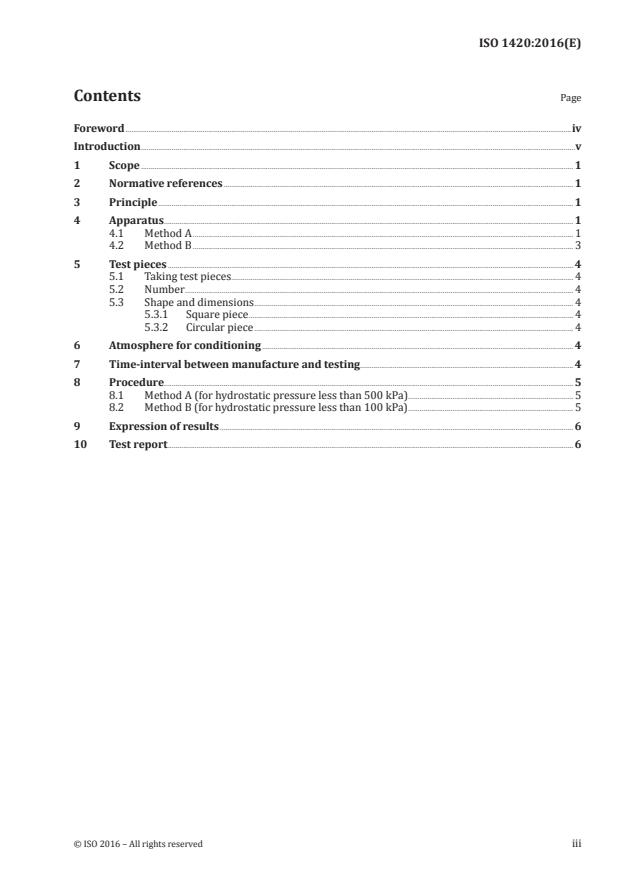
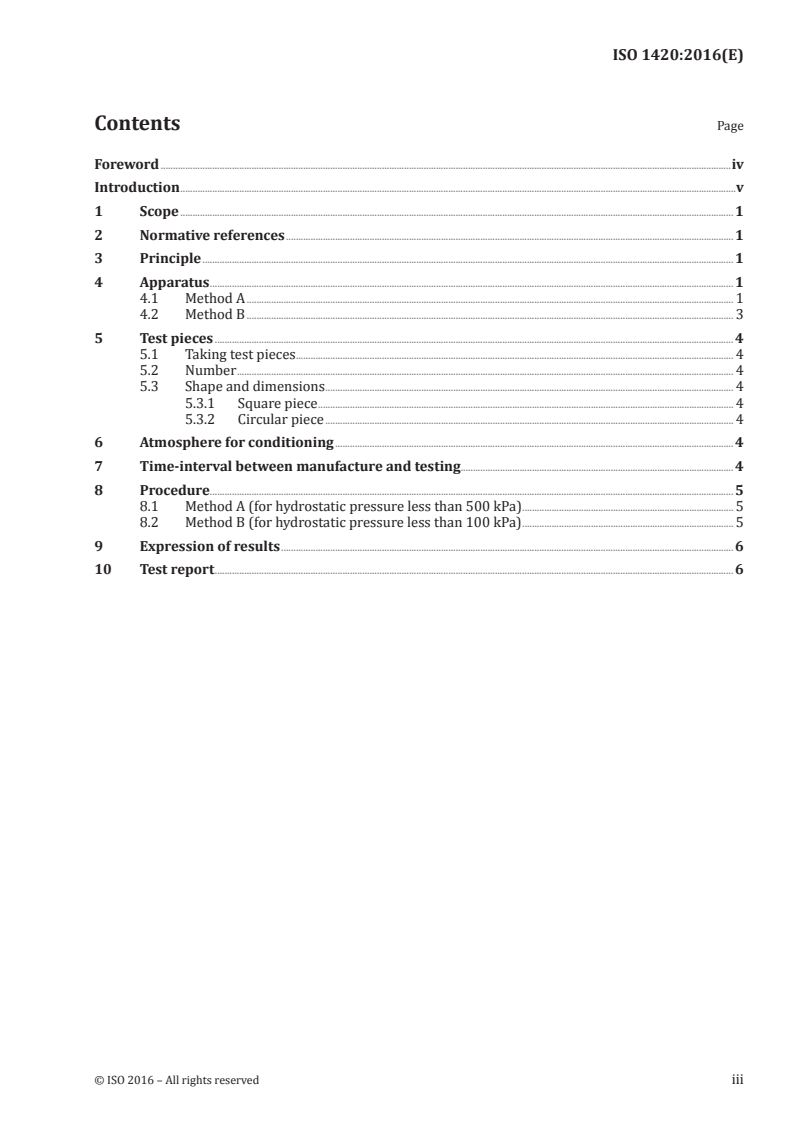
Contents Page
Foreword .iv
Introduction .v
1 Scope . 1
2 Normative references . 1
3 Principle . 1
4 Apparatus . 1
4.1 Method A . 1
4.2 Method B . 3
5 Test pieces . 4
5.1 Taking test pieces . 4
5.2 Number . 4
5.3 Shape and dimensions . 4
5.3.1 Square piece . 4
5.3.2 Circular piece . 4
6 Atmosphere for conditioning . 4
7 Time-interval between manufacture and testing. 4
8 Procedure. 5
8.1 Method A (for hydrostatic pressure less than 500 kPa) . 5
8.2 Method B (for hydrostatic pressure less than 100 kPa) . 5
9 Expression of results . 6
10 Test report . 6
Foreword
ISO (the International Organization for Standardization) is a worldwide federation of national standards
bodies (ISO member bodies). The work of preparing International Standards is normally carried out
through ISO technical committees. Each member body interested in a subject for which a technical
committee has been established has the right to be represented on that committee. International
organizations, governmental and non-governmental, in liaison with ISO, also take part in the work.
ISO collaborates closely with the International Electrotechnical Commission (IEC) on all matters of
electrotechnical standardization.
The procedures used to develop this document and those intended for its further maintenance are
described in the ISO/IEC Directives, Part 1. In particular the different approval criteria needed for the
different types of ISO documents should be noted. This document was drafted in accordance with the
editorial rules of the ISO/IEC Directives, Part 2. www.iso.org/directives
Attention is drawn to the possibility that some of the elements of this document may be the subject of
patent rights. ISO shall not be held responsible for identifying any or all such patent rights. Details of
any patent rights identified during the development of the document will be in the Introduction and/or
on the ISO list of patent declarations received. www.iso.org/patents
Any trade name used in this document is information given for the convenience of users and does not
constitute an endorsement.
For an explanation on the meaning of ISO specific terms and expressions related to conformity
assessment, as well as information about ISO’s adherence to the WTO principles in the Technical
Barriers to Trade (TBT), see the following URL: Foreword - Supplementary information
The committee responsible for this document is ISO/TC 45, Rubber and rubber products, Subcommittee
SC 4, Products (other than hoses).
This fourth edition cancels and replaces the third edition (ISO 1420:2001), which has been technically
revised.
iv © ISO 2016 – All rights reserved
Introduction
The resistance to penetration by water is often used as a measure of the water-proofing of rubber-
or plastics-coated fabrics when a product made from the coated fabric is exposed to various service
conditions in the field. There are some environmental factors that affect the resistance to water
penetration such as temperature, pressure or chemicals in water, however, the methods in this
International Standard only measure the property at a low to high hydrostatic pressure level at ambient
temperature.
INTERNATIONAL STANDARD ISO 1420:2016(E)
Rubber- or plastics-coated fabrics — Determination of
resistance to penetration by water
WARNING — Persons using this International Standard should be familiar with normal
laboratory practice. This International Standard does not purport to address all of the
safety problems, if any, associated with its use. It is the responsibility of the user to establish
appropriate safety and health practices and to ensure compliance with any national regulatory
conditions.
1 Scope
This International Standard specifies two methods for the determination of the resistance of rubber-
or plastics-coated fabrics to water penetration (hydrostatic resistance) when subjected to a specific
hydrostatic pressure over a fixed period of time. Method A specifies the procedure for a low and high
hydrostatic pressure and Method B for a low hydrostatic pressure.
2 Normative references
The following documents, in whole or in part, are normatively referenced in this document and are
indispensable for its application. For dated references, only the edition cited applies. For undated
references, the latest edition of the referenced document (including any amendments) applies.
ISO 2231:1989, Rubber- or plastics-coated fabrics — Standard atmospheres for conditioning and testing
ISO 2286-1, Rubber- or plastics-coated fabrics — Determination of roll characteristics — Part 1: Methods
for determination of length, width and net mass
3 Principle
A test piece of coated fabric is subjected to an increasing pressure of water on one face, under standard
conditions, until a predetermined pressure specified in the coated-fabric specification is obtained. The
required pressure is maintained for a specified time or until penetration occurs, w
...
INTERNATIONAL ISO
STANDARD 1420
Fourth edition
2016-07-01
Rubber- or plastics-coated fabrics —
Determination of resistance to
penetration by water
Supports textiles revêtus de caoutchouc ou de plastique —
Détermination de la résistance à la pénétration de l’eau
Reference number
©
ISO 2016
© ISO 2016, Published in Switzerland
All rights reserved. Unless otherwise specified, no part of this publication may be reproduced or utilized otherwise in any form
or by any means, electronic or mechanical, including photocopying, or posting on the internet or an intranet, without prior
written permission. Permission can be requested from either ISO at the address below or ISO’s member body in the country of
the requester.
ISO copyright office
Ch. de Blandonnet 8 • CP 401
CH-1214 Vernier, Geneva, Switzerland
Tel. +41 22 749 01 11
Fax +41 22 749 09 47
copyright@iso.org
www.iso.org
ii © ISO 2016 – All rights reserved
Contents Page
Foreword .iv
Introduction .v
1 Scope . 1
2 Normative references . 1
3 Principle . 1
4 Apparatus . 1
4.1 Method A . 1
4.2 Method B . 3
5 Test pieces . 4
5.1 Taking test pieces . 4
5.2 Number . 4
5.3 Shape and dimensions . 4
5.3.1 Square piece . 4
5.3.2 Circular piece . 4
6 Atmosphere for conditioning . 4
7 Time-interval between manufacture and testing. 4
8 Procedure. 5
8.1 Method A (for hydrostatic pressure less than 500 kPa) . 5
8.2 Method B (for hydrostatic pressure less than 100 kPa) . 5
9 Expression of results . 6
10 Test report . 6
Foreword
ISO (the International Organization for Standardization) is a worldwide federation of national standards
bodies (ISO member bodies). The work of preparing International Standards is normally carried out
through ISO technical committees. Each member body interested in a subject for which a technical
committee has been established has the right to be represented on that committee. International
organizations, governmental and non-governmental, in liaison with ISO, also take part in the work.
ISO collaborates closely with the International Electrotechnical Commission (IEC) on all matters of
electrotechnical standardization.
The procedures used to develop this document and those intended for its further maintenance are
described in the ISO/IEC Directives, Part 1. In particular the different approval criteria needed for the
different types of ISO documents should be noted. This document was drafted in accordance with the
editorial rules of the ISO/IEC Directives, Part 2. www.iso.org/directives
Attention is drawn to the possibility that some of the elements of this document may be the subject of
patent rights. ISO shall not be held responsible for identifying any or all such patent rights. Details of
any patent rights identified during the development of the document will be in the Introduction and/or
on the ISO list of patent declarations received. www.iso.org/patents
Any trade name used in this document is information given for the convenience of users and does not
constitute an endorsement.
For an explanation on the meaning of ISO specific terms and expressions related to conformity
assessment, as well as information about ISO’s adherence to the WTO principles in the Technical
Barriers to Trade (TBT), see the following URL: Foreword - Supplementary information
The committee responsible for this document is ISO/TC 45, Rubber and rubber products, Subcommittee
SC 4, Products (other than hoses).
This fourth edition cancels and replaces the third edition (ISO 1420:2001), which has been technically
revised.
iv © ISO 2016 – All rights reserved
Introduction
The resistance to penetration by water is often used as a measure of the water-proofing of rubber-
or plastics-coated fabrics when a product made from the coated fabric is exposed to various service
conditions in the field. There are some environmental factors that affect the resistance to water
penetration such as temperature, pressure or chemicals in water, however, the methods in this
International Standard only measure the property at a low to high hydrostatic pressure level at ambient
temperature.
INTERNATIONAL STANDARD ISO 1420:2016(E)
Rubber- or plastics-coated fabrics — Determination of
resistance to penetration by water
WARNING — Persons using this International Standard should be familiar with normal
laboratory practice. This International Standard does not purport to address all of the
safety problems, if any, associated with its use. It is the responsibility of the user to establish
appropriate safety and health practices and to ensure compliance with any national regulatory
conditions.
1 Scope
This International Standard specifies two methods for the determination of the resistance of rubber-
or plastics-coated fabrics to water penetration (hydrostatic resistance) when subjected to a specific
hydrostatic pressure over a fixed period of time. Method A specifies the procedure for a low and high
hydrostatic pressure and Method B for a low hydrostatic pressure.
2 Normative references
The following documents, in whole or in part, are normatively referenced in this document and are
indispensable for its application. For dated references, only the edition cited applies. For undated
references, the latest edition of the referenced document (including any amendments) applies.
ISO 2231:1989, Rubber- or plastics-coated fabrics — Standard atmospheres for conditioning and testing
ISO 2286-1, Rubber- or plastics-coated fabrics — Determination of roll characteristics — Part 1: Methods
for determination of length, width and net mass
3 Principle
A test piece of coated fabric is subjected to an increasing pressure of water on one face, under standard
conditions, until a predetermined pressure specified in the coated-fabric specification is obtained. The
required pressure is maintained for a specified time or until penetration occurs, w
...