

ISO/DTS 1999
(Main)Acoustics — Estimation of noise-induced hearing loss
General Information
- Abstract
See Annex.
- Status
- Withdrawn
- Technical Committee
- ISO/TC 43 - Acoustics
- Drafting Committee
- ISO/TC 43 - Acoustics
- Current Stage
- 5098 - Project deleted
- Start Date
- 02-Oct-2025
- Completion Date
- 29-Aug-2026
Buy Documents
ISO/DTS 1999 - Acoustics — Estimation of noise-induced hearing loss Released:16. 04. 2025
REDLINE ISO/DTS 1999 - Acoustics — Estimation of noise-induced hearing loss Released:16. 04. 2025
Overview
ISO/DTS 1999 - Acoustics - Estimation of noise-induced hearing loss is a technical specification from ISO/TC 43 that provides a statistical framework for predicting the effects of noise exposure on population hearing. The document (fourth edition, replacing ISO 1999:2013) links measured or estimated noise exposure to expected shifts in hearing threshold levels, using age-related hearing threshold databases (HTLA) and a defined effect of noise (N) metric. It also introduces a kurtosis-based adjustment to account for impulse/impact noise.
Key topics
- Statistical prediction of hearing threshold shifts: Procedures to estimate hearing threshold levels for noise-exposed populations versus comparable non-exposed populations.
- Databases for HTLA: Two main database types (Database A and Database B) give reference hearing threshold levels associated with age; these are used to separate age-related and noise-induced effects.
- Effect of noise (N): Tabulated values and interpolation methods are provided to quantify the noise component of hearing change. The document derives N from combined hearing threshold relationships using the formula:
- H' = H + N – (H × N / 120)
- Rearranged: N = (H' – H) / (1 – H/120) (H = age-related component, H' = observed threshold)
- Measurement and description of noise exposure: Guidance on how noise exposure should be characterized for prediction calculations (see Clause 5).
- Kurtosis adjustment (Annex E): An adjustment to the exposure metric to improve predictions for noise containing substantial impulse/impact components, using waveform kurtosis.
- Assessment and risk estimation: Methods to calculate hearing loss, hearing impairment, and risk of impairment (Clauses 6–7 and Annexes C–D).
- Informative annexes: Examples, derivations and worked calculations (Annexes A–F) to support implementation.
Applications
ISO/DTS 1999 is intended for use in:
- Occupational health and safety: Designing hearing conservation programs, setting medical surveillance priorities, and evaluating long-term risk from workplace noise.
- Audiology and epidemiology research: Estimating population-level noise-induced hearing loss (NIHL) and comparing exposed vs non-exposed cohorts.
- Acoustical consulting and industrial hygiene: Assessing the long-term hearing consequences of measured noise exposures, including complex impulse noise environments.
- Regulatory and standards bodies: Informing policy, exposure criteria, and normative limits for noise control.
Who should use it
Occupational hygienists, audiologists, hearing conservation program managers, acoustical engineers, researchers, and regulatory agencies involved in noise exposure assessment and NIHL risk estimation.
Related standards
- Previous edition: ISO 1999:2013 (cancelled and replaced by this edition).
- Prepared by ISO/TC 43 (Acoustics) - consult national member bodies or ISO for related acoustics standards and implementation guidance.
Relations
- Effective Date
- 06-Jun-2022
Buy Documents
ISO/DTS 1999 - Acoustics — Estimation of noise-induced hearing loss Released:16. 04. 2025
REDLINE ISO/DTS 1999 - Acoustics — Estimation of noise-induced hearing loss Released:16. 04. 2025
Get Certified
Connect with accredited certification bodies for this standard

CIS Institut d.o.o.
Personal Protective Equipment (PPE) certification body. Notified Body NB-2890 for EU Regulation 2016/425 PPE.

Kiwa BDA Testing
Building and construction product certification.
Kmetijski inštitut Slovenije
Agricultural Institute of Slovenia. Soil testing, plant health, agricultural product analysis.
Sponsored listings
Frequently Asked Questions
ISO/DTS 1999 is a draft published by the International Organization for Standardization (ISO). Its full title is "Acoustics — Estimation of noise-induced hearing loss". This standard covers: See Annex.
See Annex.
ISO/DTS 1999 is classified under the following ICS (International Classification for Standards) categories: 13.140 - Noise with respect to human beings. The ICS classification helps identify the subject area and facilitates finding related standards.
ISO/DTS 1999 has the following relationships with other standards: It is inter standard links to ISO 1999:2013. Understanding these relationships helps ensure you are using the most current and applicable version of the standard.
ISO/DTS 1999 is available in PDF format for immediate download after purchase. The document can be added to your cart and obtained through the secure checkout process. Digital delivery ensures instant access to the complete standard document.
Standards Content (Sample)
FINAL DRAFT
Technical
Specification
ISO/TC 43
Acoustics — Estimation of noise-
Secretariat: DIN
induced hearing loss
Voting begins on:
Acoustique — Estimation de la perte auditive induite par le bruit 2025-04-30
Voting terminates on:
2025-06-25
RECIPIENTS OF THIS DRAFT ARE INVITED TO SUBMIT,
WITH THEIR COMMENTS, NOTIFICATION OF ANY
RELEVANT PATENT RIGHTS OF WHICH THEY ARE AWARE
AND TO PROVIDE SUPPOR TING DOCUMENTATION.
IN ADDITION TO THEIR EVALUATION AS
BEING ACCEPTABLE FOR INDUSTRIAL, TECHNO
LOGICAL, COMMERCIAL AND USER PURPOSES, DRAFT
INTERNATIONAL STANDARDS MAY ON OCCASION HAVE
TO BE CONSIDERED IN THE LIGHT OF THEIR POTENTIAL
TO BECOME STAN DARDS TO WHICH REFERENCE MAY BE
MADE IN NATIONAL REGULATIONS.
Reference number
FINAL DRAFT
Technical
Specification
ISO/TC 43
Acoustics — Estimation of noise-
Secretariat: DIN
induced hearing loss
Voting begins on:
Acoustique — Estimation de la perte auditive induite par le bruit
Voting terminates on:
RECIPIENTS OF THIS DRAFT ARE INVITED TO SUBMIT,
WITH THEIR COMMENTS, NOTIFICATION OF ANY
RELEVANT PATENT RIGHTS OF WHICH THEY ARE AWARE
AND TO PROVIDE SUPPOR TING DOCUMENTATION.
© ISO 2025
IN ADDITION TO THEIR EVALUATION AS
All rights reserved. Unless otherwise specified, or required in the context of its implementation, no part of this publication may
BEING ACCEPTABLE FOR INDUSTRIAL, TECHNO
LOGICAL, COMMERCIAL AND USER PURPOSES, DRAFT
be reproduced or utilized otherwise in any form or by any means, electronic or mechanical, including photocopying, or posting on
INTERNATIONAL STANDARDS MAY ON OCCASION HAVE
the internet or an intranet, without prior written permission. Permission can be requested from either ISO at the address below
TO BE CONSIDERED IN THE LIGHT OF THEIR POTENTIAL
or ISO’s member body in the country of the requester.
TO BECOME STAN DARDS TO WHICH REFERENCE MAY BE
MADE IN NATIONAL REGULATIONS.
ISO copyright office
CP 401 • Ch. de Blandonnet 8
CH-1214 Vernier, Geneva
Phone: +41 22 749 01 11
Email: copyright@iso.org
Website: www.iso.org
Published in Switzerland Reference number
ii
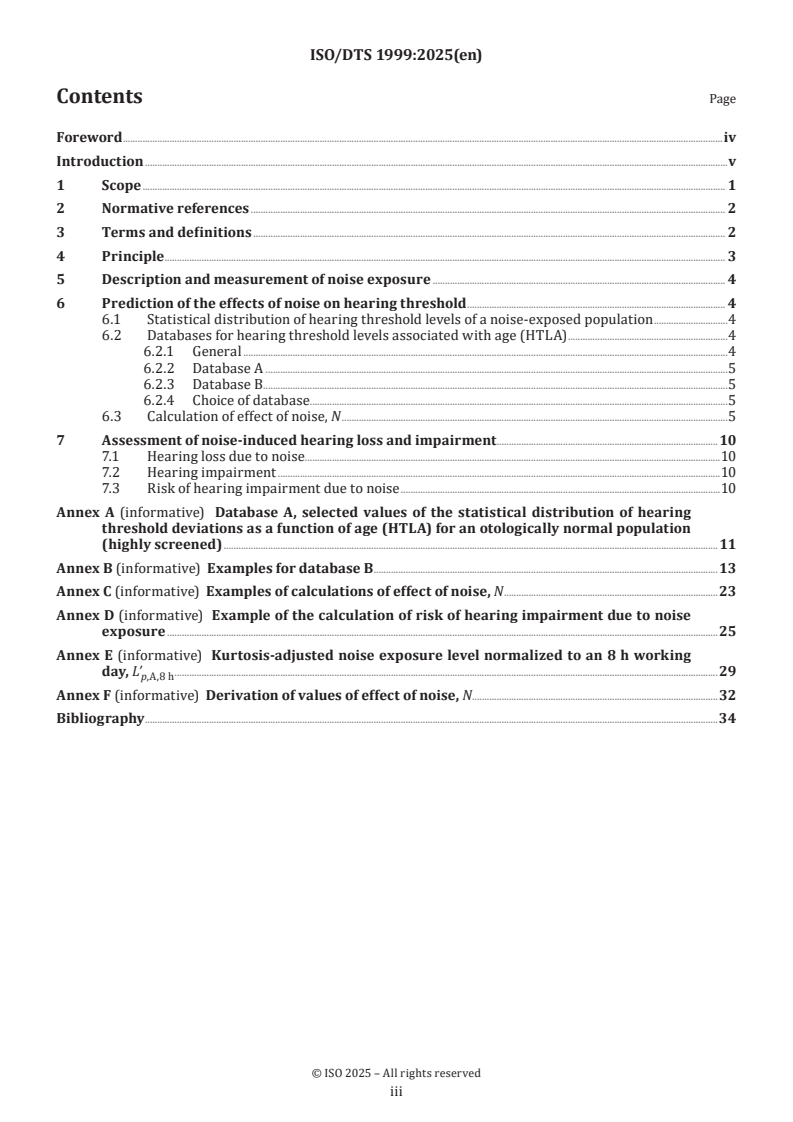
Contents Page
Foreword .iv
Introduction .v
1 Scope . 1
2 Normative references . 2
3 Terms and definitions . 2
4 Principle . 3
5 Description and measurement of noise exposure . 4
6 Prediction of the effects of noise on hearing threshold . 4
6.1 Statistical distribution of hearing threshold levels of a noise-exposed population .4
6.2 Databases for hearing threshold levels associated with age (HTLA) .4
6.2.1 General .4
6.2.2 Database A .5
6.2.3 Database B.5
6.2.4 Choice of database.5
6.3 Calculation of effect of noise, N .5
7 Assessment of noise-induced hearing loss and impairment .10
7.1 Hearing loss due to noise .10
7.2 Hearing impairment .10
7.3 Risk of hearing impairment due to noise .10
Annex A (informative) Database A, selected values of the statistical distribution of hearing
threshold deviations as a function of age (HTLA) for an otologically normal population
(highly screened) .11
Annex B (informative) Examples for database B .13
Annex C (informative) Examples of calculations of effect of noise, N .23
Annex D (informative) Example of the calculation of risk of hearing impairment due to noise
exposure .25
Annex E (informative) Kurtosis-adjusted noise exposure level normalized to an 8 h working
day, L’ .29
p,A,8 h
Annex F (informative) Derivation of values of effect of noise, N.32
Bibliography .34
iii
Foreword
ISO (the International Organization for Standardization) is a worldwide federation of national standards
bodies (ISO member bodies). The work of preparing International Standards is normally carried out through
ISO technical committees. Each member body interested in a subject for which a technical committee
has been established has the right to be represented on that committee. International organizations,
governmental and non-governmental, in liaison with ISO, also take part in the work. ISO collaborates closely
with the International Electrotechnical Commission (IEC) on all matters of electrotechnical standardization.
The procedures used to develop this document and those intended for its further maintenance are described
in the ISO/IEC Directives, Part 1. In particular, the different approval criteria needed for the different types
of ISO document should be noted. This document was drafted in accordance with the editorial rules of the
ISO/IEC Directives, Part 2 (see www.iso.org/directives).
ISO draws attention to the possibility that the implementation of this document may involve the use of (a)
patent(s). ISO takes no position concerning the evidence, validity or applicability of any claimed patent
rights in respect thereof. As of the date of publication of this document, ISO had not received notice of (a)
patent(s) which may be required to implement this document. However, implementers are cautioned that
this may not represent the latest information, which may be obtained from the patent database available at
www.iso.org/patents. ISO shall not be held responsible for identifying any or all such patent rights.
Any trade name used in this document is information given for the convenience of users and does not
constitute an endorsement.
For an explanation of the voluntary nature of standards, the meaning of ISO specific terms and expressions
related to conformity assessment, as well as information about ISO's adherence to the World Trade
Organization (WTO) principles in the Technical Barriers to Trade (TBT), see www.iso.org/iso/foreword.html.
This document was prepared by Technical Committee ISO/TC 43, Acoustics.
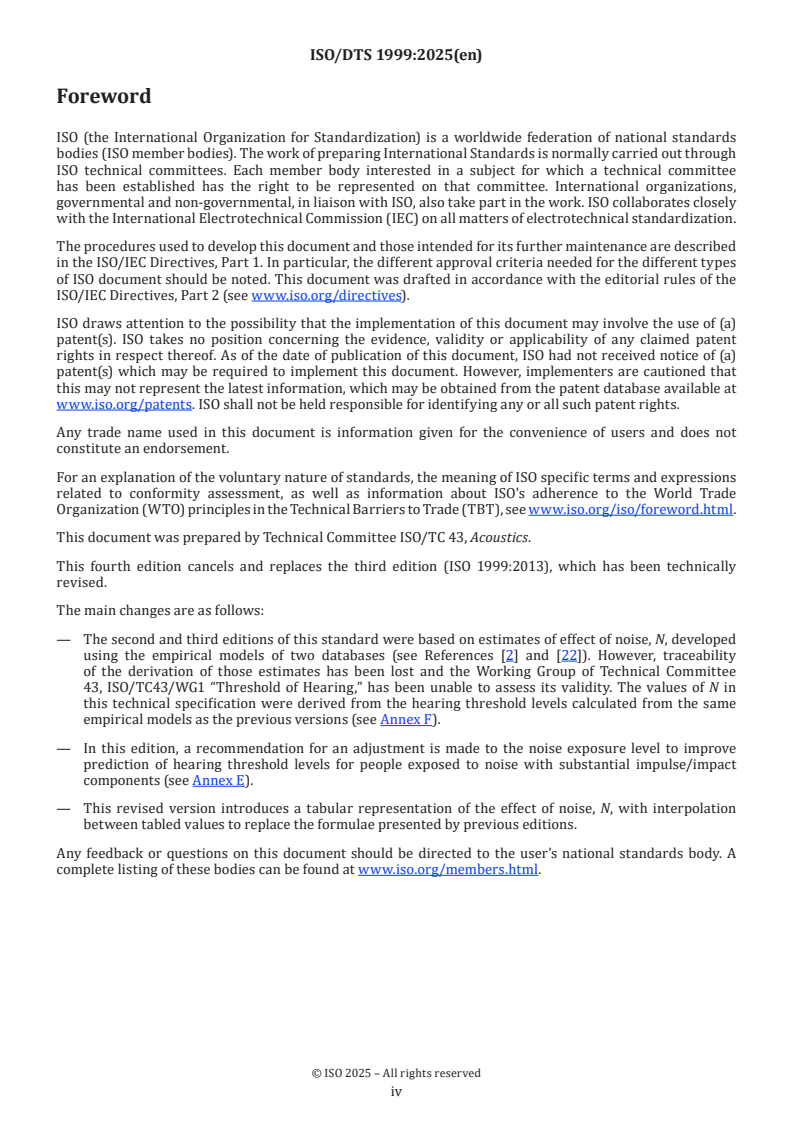
This fourth edition cancels and replaces the third edition (ISO 1999:2013), which has been technically
revised.
The main changes are as follows:
— The second and third editions of this standard were based on estimates of effect of noise, N, developed
using the empirical models of two databases (see References [2] and [22]). However, traceability
of the derivation of those estimates has been lost and the Working Group of Technical Committee
43, ISO/TC43/WG1 “Threshold of Hearing,” has been unable to assess its validity. The values of N in
this technical specification were derived from the hearing threshold levels calculated from the same
empirical models as the previous versions (see Annex F).
— In this edition, a recommendation for an adjustment is made to the noise exposure level to improve
prediction of hearing threshold levels for people exposed to noise with substantial impulse/impact
components (see Annex E).
— This revised version introduces a tabular representation of the effect of noise, N, with interpolation
between tabled values to replace the formulae presented by previous editions.
Any feedback or questions on this document should be directed to the user’s national standards body. A
complete listing of these bodies can be found at www.iso.org/members.html.
iv
Introduction
This document presents, in statistical terms, the relationship between noise exposure, unprotected unless
otherwise stated, and its effect on hearing threshold levels in people of various ages. This document provides
procedures for estimating the hearing loss due to noise exposure in populations by comparison to various
non-noise exposed populations. For any given noise exposure, effect of noise, N, has a range of positive values
reflecting the variability of susceptibility to noise-induced hearing loss among individuals.
Persons regularly exposed to noise can develop hearing loss of varying severity. Due to hearing loss, their
understanding of speech, perception of everyday acoustic signals, or appreciation of music can be impaired.
With the exception of traumatic damage to the ear caused by exposure to blast, high-impulse noise and
extremely high levels of steady-state noise, permanent impairment of the hearing organ takes time and
is progressive over months, years, or decades of exposure. For a single individual, it is not possible to
determine precisely which changes in hearing threshold level are caused by noise and which changes are
caused by other factors. However, for a sufficiently large population exposed to a specific noise, changes in
the statistical distributions of hearing threshold levels can be determined. Predictions from this technical
specification can be used to describe differences in hearing threshold levels between two populations that
are similar in all relevant respects except that one population has had a well-defined (usually occupational)
noise exposure.
Researchers have for many years found that noise with substantial impulse/impact components is more
hazardous to hearing than noise at similar sound pressure levels without substantial impulse/impact
components. In this edition, an adjustment is made to the noise exposure level to improve prediction of
hearing threshold levels for people exposed to noise with substantial impulse/impact components. The
adjustment is based on the distribution of values in the sound pressure waveform using the statistical
measure kurtosis (see Annex E).
This document was derived from the hearing threshold levels calculated from the same empirical models as
the previous versions (References [2] and [22]; see Annex F). document uses the formula H’ = H + N – (H x N
/120) to calculate expected hearing threshold level (H’) from the combination of components due to noise
(N) and other factors, principally age (H). In order to derive the noise-induced component, this formula was
rearranged to calculate the values of N shown in Tables 1 and 2of this revision: N = (H’ – H)/(1- H/120),
where each value of N was calculated using the unweighted arithmetic mean, or average, of the two values of
H’ and the two values of H in the two databases at each frequency, noise level, duration and percentile value
shown in the table. Interpolation between values of N in Tables 1 and 2 enables calculation of values of N
not included in the table. The formulation was validated by comparison with a broader set of published data
on noise-induced hearing loss, as compiled in Reference [26]. A Hearing Threshold Level Calculator is also
provided with this revision so that hearing threshold levels can be readily determined.
This document can be applied to the calculation of the risk of hearing impairment due to regular occupational
noise exposure or due to any daily repeated noise exposure. In some countries, hearing loss caused by
occupational noise exposure can have legal consequences with respect to responsibility and compensation.
The hearing threshold level at the various frequencies, at which a hearing impairment is deemed to exist
(fence), depends not only on the hearing loss per se, but frequently on legal definitions and interpretations
based on social and economic considerations. In addition, the definition of a hearing impairment depends
on the quality of speech recognition desired, the average level of background noise and with respect to the
relative importance of the various frequencies, perhaps even on the language. Consequently, this document
does not stipulate (in contrast to the first edition of ISO 1999) a specific formula for assessment of the risk of
impairment, but specifies methods for the prediction of hearing threshold levels, which can be used for the
assessment of impairment according to the formula desired or stipulated in a specific country.
The selection of maximum tolerable or maximum permissible noise exposures and protection requirements,
as well as the selection of specific formulae for impairment risk assessment or compensation purposes,
require consideration of ethical, social, economic and political factors not amenable to international
standardization. Individual countries differ in their interpretation of these factors and these factors are
therefore considered outside the scope of this document.
v
For reasons given above, this document, by itself, does not comprise a complete guide for risk assessment
and protection requirements, and for practical use, it has to be complemented by national standards or
codes of practice delineating the factors which are here left open.
vi
FINAL DRAFT Technical Specification ISO/DTS 1999:2025(en)
Acoustics — Estimation of noise-induced hearing loss
1 Scope
This document specifies a method for calculating the expected hearing threshold levels of adult populations
due to various levels and durations of noise exposure; it provides the basis for calculating the risk of hearing
impairment according to various formulae when the hearing threshold levels at commonly measured
audiometric frequencies, or combinations of such frequencies, exceed some certain values.
This document is based on statistical data and therefore cannot be applied to the prediction of the hearing
loss of individual persons.
NOTE 1 This document does not specify frequencies, frequency combinations, nor weighted combinations used
for the evaluation of hearing impairment; nor does it specify a hearing threshold level (fence) which it is necessary
to exceed for hearing impairment to exist. Quantitative selection of these parameters is left to the user. All sound
pressure levels stated in this document do not consider the effect of hearing protectors which would reduce effective
exposure levels and modify the frequency spectrum at the ear. Because there is evidence indicating a transition
between metabolic exhaustion and mechanical damage in the inner ear, application of this technical specification to
exposures involving sound pressures exceeding 200 Pa (140 dB relative to 20 μPa) is not recommended.
The measure of exposure to noise for a population at risk is the equivalent continuous A-weighted sound
pressure level normalized to an 8 h working day, or A-weighted noise exposure level, L , for a number
p,,Ah8
of years of exposure. This document applies to noise at frequencies less than 10 kHz that is steady-state,
intermittent, fluctuating, irregular, or complex with A-weighted noise exposure levels between 75 and
3 3 2
100 dB (daily A-weighted sound exposures between 0,115 × 10 and 115 × 10 Pa s).
Formulae are presented to calculate the statistical distributions of hearing threshold levels at a range of
audiometric frequencies due to exposure to noise as a function of level of noise exposure and duration of
exposure (in years). Values of effect of noise, N, do not distinguish between male and female populations. The
database for values of N in Tables 1 and 2 was derived from people who typically started work around age 20
and whose noise exposures continued for many years; thus, this database is most accurate for populations of
workers whose age minus years of exposure is about 20.
NOTE 2 Although the models of hearing loss are based on data assumed to stem primarily from populations
exposed to occupational noise, they can be used, with some caution, for estimating the effects of comparable non-
occupational exposures.
NOTE 3 The prediction method for L presented is based primarily on data collected with essentially
p,,A8h
broadband, steady-state, non-tonal noise. A recommended prediction method for noise environments which include
substantial impulsive/impact noise uses a kurtosis-adjusted noise exposure level normalized to an 8 h working day
(see Annex E).
To calculate hearing threshold levels and also to calculate the risk of acquiring hearing impairment due to
noise exposure, it is necessary to make use of a database for age-associated hearing threshold levels for a
comparable population. This document includes a highly screened otologically normal population (according
to ISO 7029) and examples of relatively unscreened populations of five typical industrialized societies. The
users of this document may choose a comparable population according to their particular requirements.
NOTE 4 All data and procedures presented in this document are based on deliberate simplifications of experimental
data where the daily sound exposure duration did not exceed 12 h. The resulting approximations restrict the validity
to the stated ranges of the variables, percentiles, sound exposure levels and frequency ranges.
2 Normative references
The following documents are referred to in the text in such a way that some or all of their content constitutes
requirements of this document. For dated references, only the edition cited applies. For undated references,
the latest edition of the referenced document (including any amendments) applies.
ISO 9612, Acoustics — Determination of occupational noise exposure —Engineering method
ISO/TR 25417, Acoustics — Definitions of basic quantities and terms
ISO 80000-8, Quantities and units — Part 8: Acoustics
3 Terms and definitions
For the purposes of this document, the terms and definitions given in ISO/TR 25417 and ISO 80000-8 apply.
ISO and IEC maintain terminology databases for use in standardization at the following addresses:
— ISO Online browsing platform: available at https:// www .iso .org/ obp
— IEC Electropedia: available at https:// www .electropedia .org/
NOTE Within this document, all sound pressure levels are relative to 20 μPa. The reference value for hearing
threshold levels depends on audiometric frequency and is defined in ISO 389 series.
3.1
A-weighted noise exposure level normalized to an 8 h working day
L
p,,A8h
T
e
LL=+10lg dB
pp,,Ah8 ,,AeqT
e
T
where
L is the equivalent continuous A-weighted sound pressure level for T ;
pT,,Aeq e
e
T is the effective duration of the working day in hours; and
e
T is the reference duration (T = 8 h).
0 0
Note 1 to entry: The quantity “noise exposure level normalized to an 8 h working day” may also be called “daily noise
exposure level.”
Note 2 to entry: Noise exposure level is usually calculated on a daily basis, but there may be circumstances where
a weekly noise exposure period is considered to be more appropriate. In such circumstances, noise exposure is
normalized to an 8 h working day. A working day depends on work patterns and may be a synthesized working day,
including fragments of different real days of a week. The objective is for the working day to be representative of the
overall work cycle. The same principle may be applied to the recommended kurtosis-adjusted noise exposure level
presented in Annex E.
Note 3 to entry: If noise exposure representing a work pattern of more than one day, normalized over an 8 h working
day, is desired, the following formula may be used:
1 X 01, ⋅L
p,,Ah8 ,i
L =10lg 10 dB
p,A,8h ∑
i=1
X
where L is the daily noise exposure level for day i and X is the total number of days.
p,,Ah8 ,i
For example, X = 5 leads to a daily noise exposure level normalized to a week of five 8 h working days. X should not
normally be greater than 5.
Note 4 to entry: In some cases, L specified by ISO 9612 may be used instead of L .
EX,8 h p,A,8h
3.2
hearing loss
increase in the threshold of hearing in decibels from normal
3.3
hearing impairment
hearing loss (3.2) sufficient to adversely affect the activities of daily living
[31]
Note 1 to entry: This is sometimes called “activity limitation ”.
3.5
fence
F
hearing threshold level in decibels for a specified combination of audiometric frequencies above which
hearing impairment (3.3) is deemed to exist
3.6
risk of hearing impairment due to noise
percentage of a noise-exposed population with a hearing impairment (3.3) minus the percentage of a
population not exposed to noise with a hearing impairment (3.3) but otherwise equivalent to the noise-
exposed population
3.7
hearing threshold level associated with age
HTLA
H
for a specified fraction of a population, the hearing threshold level in decibels observed as a function of age
and sex without any exposure to occupational noise
3.8
effect of noise
N
for a specified fraction of a population, the effect in decibels on hearing threshold level estimated to be
caused solely by exposure to noise, in the absence of other causes
Note 1 to entry: In ISO 1999:1990 and in ISO 1999:2013, the terms N and NIPTS (noise-induced permanent threshold
shift) were defined to be the same thing. Many studies have calculated NIPTS as H’ – H, but this is not the same as N.
From Formula (1), H’ – H = N – (H x N /120). To avoid confusion, NIPTS has not been used in this revision. See NOTE in
Annex F.
3.9
hearing threshold level associated with age and noise
HTLAN
H'
for a specified fraction of a population, the permanent hearing threshold level in decibels for a given age, sex
and noise exposure
Note 1 to entry: Hearing threshold levels (HTL), as defined in ISO 8253-2, are expressed in decibels.
Note 2 to entry: The value HTLAN is a combination of the components associated with age (HTLA) and noise (N), as
defined in 6.1.
4 Principle
This document provides a method for calculation of the statistical distribution of hearing threshold levels
of a noise-exposed population using values of effect of noise, N, and hearing threshold levels associated with
age, H. The values of H and N are combined to yield hearing threshold levels expected in the noise-exposed
population using the formula given in 6.1.
The effect of noise depends on the A-weighted noise exposure level normalized to an 8 h working day and
the number of years of exposure. It is calculated separately for each audiometric frequency and according to
the required percentile of the population using methods described in 6.3.
The A-weighted noise exposure level may be adjusted according to the kurtosis of the noise, measured using
the method described in Annex E. This reflects the finding that noise with substantial impact or impulse
components tends to have a greater adverse effect on hearing than noise having the same sound pressure
level without those components. This adjustment has not been included in previous versions of the standard.
Hearing threshold levels associated with age, H, may be obtained using databases tabulated in Annex A
or Annex B. Annex A gives the procedure for calculating the statistical distribution of hearing threshold
levels as a function of age for highly screened otologically normal males and females in accordance with
ISO 7029. Annex B gives five examples representing the statistical distributions of hearing threshold levels
as a function of age for unscreened males and females of five typical industrialized societies.
This document is accompanied by a calculator that allows computation of expected hearing threshold levels
at standard audiometric frequencies for a given percentile of the statistical distribution. Calculations are
performed for a given age, sex, noise exposure level and exposure duration.
5 Description and measurement of noise exposure
Methods for the determination of occupational noise exposure are specified in ISO 9612.
6 Prediction of the effects of noise on hearing threshold
6.1 Statistical distribution of hearing threshold levels of a noise-exposed population
The hearing threshold level associated with age and noise (HTLAN), in decibels, H', of a noise-exposed
population is calculated, for the purposes of this document, by using Formula (1):
H’ = H + N – (H × N/120) (1)
where
H is the hearing threshold level associated with age (HTLA) expressed in decibels;
N is the predicted effect of noise expressed in decibels.
This formula is applicable only to corresponding (same percentile) values of H', H and N.
NOTE The above relationship is an approximation to the biological processes occurring in the ear.
Values of H’ may be found using the Annex A or Annex B tables discussed in 6.2 to find values of H. Values of N
may be derived from Tables 1 and 2, as discussed in 6.3. Alternatively, the hearing threshold level calculator
may be used.
6.2 Databases for hearing threshold levels associated with age (HTLA)
6.2.1 General
The hearing of a non-noise-exposed population as a function of age depends on the degree to which other
factors are inadvertently included: diseases, history of exposure to ototoxic substances and unknown
noise exposure of occupational or non-occupational origin may modify the HTLA. Different approaches
to screening such data have been used and the selection of the most appropriate database depends on the
purpose of the application (see 6.2.4). This document includes two databases (databases A and B) to be
used for HTLA in 6.1. Database A is fully specified, whereas database B is at the discretion of the user. Five
examples of database B are presented.
NOTE 1 A decrease in hearing ability is not necessarily caused by ageing itself, but by many injurious influences
during a lifetime, which are not known in detail.
NOTE 2 The databases presented in Annexes A and B are from populations of European, North American and Asian
countries. These populations are not necessarily representative for the populations of other geographical areas.
Even if there are no differences between different ethnic populations, differences in lifestyle, non-occupational noise
exposure, incidence of disease and exposure to ototoxic substances are nevertheless liable to occur.
6.2.2 Database A
Database A derives from otologically normal persons: in a normal state of health who are free from all signs
or symptoms of ear disease, with no obstructing wax in the ear canals, with no history of undue exposure to
noise, with no exposure to potentially ototoxic substances and with no familial hearing loss. The statistical
distributions of the threshold deviations of such highly screened populations have been standardized
in ISO 7029 separately for male and female populations. Selected values of the statistical distribution of
hearing threshold levels (in decibels) using database A can be obtained from Annex A.
6.2.3 Database B
For database B, a set of data usually collected on a control population not occupationally exposed to noise
of the country under consideration, but exposed to other risk factors to a degree similar to occupationally
exposed populations, is recommended. When such an ideal control population is unavailable and in countries
where risk factors such as non-occupational noise are more prevalent in occupationally exposed populations
than in the general population, a totally unscreened control population can be preferable.
A separate HTLA database for both men and women is required unless it can be shown that there are no
substantial differences. It is essential that the sample size be large enough to allow calculations of a valid
statistical distribution.
Therefore, the user should apply appropriate selection criteria to compile a database of hearing threshold
levels to compare to the levels given in Annex B of this document. For instance, the HTLA for data based on
the average of left and right ears, the better or more sensitive of left and right ears, using both left and right
ears or the ear showing the greatest hearing loss, can be taken as the basis for database B.
It is emphasized that for practical situations the accuracy of the prediction of the hearing threshold level of a
noise-exposed population will largely be a function of the accuracy of the selected database for HTLA. Since
audiometric measurement techniques affect threshold measurements, the same measurement technique
should be used in the establishment of a specific HTLA database as might be used to obtain or verify the
threshold of hearing of the noise-exposed population.
6.2.4 Choice of database
The choice of database from Annex A or Annex B should aim to match the database to the target population
of noise-exposed people. Whether database A or B is the more appropriate (or whether the numerical
examples for database B in Annex B are suitable) depends on what question is to be answered. When the
occupationally exposed population is not highly screened, unscreened populations will form the more
appropriate databases.
6.3 Calculation of effect of noise, N
Effect of noise, N, to be used in 6.1 is a function of the A-weighted noise exposure level, exposure duration,
percentage of the population and audiometric frequency. Values of N are found for values of L, D and Q:
is the A-weighted noise exposure level, L , normalized to an 8-hour working day (see
L
p,A,8h
3.2), expressed in decibels;
D is the exposure duration, expressed in years (typically 8 h/day, 5 days/week);
N
is the value of N, expressed in decibels, for L, D and Q; and
LD,,Q
is the percentage of the population exceeding N
Q
LD,,Q
Tables 1 and 2 include values of N for L = 75, 80, 85, 90, 95 and 100 dB; D = 10, 20, 30 and 40 years; Q =
L,D,Q
5, 10, 25, 50, 75, 90 and 95 %; and audiometric frequencies 0,5, 1, 2, 3, 4 and 6 kHz. Tails of the statistical
distributions for 0 % < Q < 5 % and for 95 % < Q < 100 % are unreliable and should not be estimated since
few experimental data exist to validate these ranges. If L, D and Q are given in Tables 1 and 2, then N can
L,D,Q
be read from Tables 1 and 2.
If necessary, additional values of N may be calculated using Formula (2) and by linear interpolation using
Formulae (3), (4) and (5), where L and L are exposure levels ()LL< from Tables 1 and 2 below and
1 2 12
above the required value of L, D and D are durations ()DD< from Tables 1 and 2 below and above the
1 2 12
required value of D, and Q and Q are percentiles ()QQ> from Tables 1 and 2 above and below the
1 2 12
required value of Q(percentiles go from high to low):
If D<10, then N is tapered towards zero using N in Table 1, and
LD,,Q LQ,,10
ND=+lg()11/lg()1 ×N (2)
LD,,QL,,10Q
If L is between L and L , N is calculated using N . and N in Tables 1 and 2, and
1 2 LD,,Q LD,Q LD,Q
1, 2,
NN=+ LL− / LL− ×−NN (3)
() ()
()
LD,,QL ,,DQ 12 1 LD,,QL ,,DQ
12 1
If D is between D and D , then N is calculated using N and N in Tables 1 and 2, and
1 2 LD,,Q LD,,Q LD,,Q
1 2
NN=+ DD− / DD− ×−NN (4)
() ()
()
LD,,QL,,DQ 12 1 LD,,QL,,DQ
12 1
If Q is between Q and Q , then Nis calculated using N and N in Tables 1 and 2, and
1 2 LD,,Q LD,Q LD,Q
, 1 , 2
NN=+ QQ− / QQ− ×−NN (5)
() ()
()
LD,,QL,,DQ 11 2 LD,,QL,,DQ
12 1
If D≥10 and interpolation is required on L, D or Q, repeated application of Formulae (3), (4) or (5) can be
required. For example, if interpolation is required on L and D and Q, the following procedure may be used.
First, apply Formula (3) four times to interpolate on L between L and L using values of N at DQ , DQ ,
1 2 11 21
DQ and DQ in Tables 1 and 2. That will yield four intermediate interpolated values, N , N ,
12 22 LD,,Q LD,,Q
11 21
NN, . Second, apply Formula (4) twice to interpolate on D between N and N and
LD,,QL,,DQ LD,,Q LD,,Q
12 22 11 21
between N and N to yield two further intermediate interpolated values, N and N .
LD,,Q LD,,Q LD,,Q LD,,Q
12 22 1 2
Finally, apply Formula (5) to interpolate on Q to yield the required value of N .
LD,,Q
If D<10 and interpolation is required on L or Q, repeated application of Formula (3) or (5) can be required.
For example, if interpolation is required on L and Q, the following procedure may be used. First, using D=10,
apply Formula (3) twice to interpolate on L between L and L using values of N at Q and Q in Table 1.
1 2 1 2
That will yield two intermediate interpolated values, N and N . Second, apply Formula (5) to
LQ,,10 LQ,,10
1 2
interpolate on Q to yield N . Finally, apply Formula (2) to yield the required value of N .
LQ,,10 LD,,Q
For the purposes of this document, hearing threshold levels associated with age shall be obtained from the
values tabulated in Annex A or Annex B. For combinations of age and percentile not listed in the tables,
linear interpolation between adjacent values shall be used.
The hearing threshold level calculator provided with this document (https:// standards .iso .org/ iso/ ts/ 1999/
ed -4/ en) uses the above procedures. Example calculations of N are shown in Annex C.
LD,,Q
NOTE 1 Calculation of N by linear interpolations between values in Tables 1 and 2 does not depend on the order
L,D,Q
of the interpolations made.
NOTE 2 Exposure durations of more than 40 years represent an extrapolation from the source data that has not
been validated.
NOTE 3 Near the tails of the statistical distributions and for longer durations, the reliability of the estimates of N is
reduced.
NOTE 4 Formula (3) and Formula (4) have the same structure, because N increases with increasing L or increasing D.
Formula (5) has a slightly different structure because N decreases with increasing Q.
Table 1 — Values of effect of noise, N , by A-weighted noise exposure level (L), 75 dB, 80 dB,
LD,,Q
85 dB, 90 dB, 95 dB and 100 dB, exposure duration (D), 10 and 20 years and percentage of the
population (Q %) exceeding N
LD,,Q
Level L Duration D
10 20
dB years
Frequency
0,5 1 2 3 4 6 0,5 1 2 3 4 6
kHz
95 % 0 0 0 0 0 0 0 0 0 0 0 0
90 % 0 0 0 0 0 0 0 0 0 0 0 0
75 % 0 0 0 0 0 0 0 0 0 0 1 0
75 50 % 0 0 0 1 1 0 0 0 0 1 1 1
25 % 0 0 0 1 1 1 0 0 1 1 2 1
10 % 0 0 1 2 2 1 0 0 1 2 3 2
5 % 0 0 1 2 3 2 0 1 2 3 4 3
Frequency
0,5 1 2 3 4 6 0,5 1 2 3 4 6
kHz
95 % 0 0 0 0 0 0 0 0 0 2 0 2
90 % 0 0 0 0 0 0 0 0 0 2 1 2
75 % 0 0 0 1 1 1 0 0 0 3 2 2
80 50 % 0 0 0 3 4 2 0 0 1 3 5 3
25 % 0 1 1 4 7 4 0 1 1 4 8 4
10 % 1 1 2 6 11 6 1 1 2 6 11 6
5 % 1 1 3 7 13 7 1 1 3 8 14 7
Frequency
0,5 1 2 3 4 6 0,5 1 2 3 4 6
kHz
95 % 0 0 0 1 0 0 0 0 1 3 3 2
90 % 0 0 0 2 2 1 0 0 1 4 4 3
75 % 0 0 0 3 4 3 0 0 1 5 6 4
85 50 % 0 0 1 5 7 5 0 1 2 6 9 6
25 % 1 1 3 7 11 8 1 1 4 8 13 9
10 % 2 2 6 10 16 11 2 3 6 11 17 12
5 % 2 3 8 12 19 14 2 3 8 13 21 15
Frequency
0,5 1 2 3 4 6 0,5 1 2 3 4 6
kHz
TTabablele 1 1 ((ccoonnttiinnueuedd))
Level L Duration D
10 20
dB years
95 % 0 0 0 3 5 0 0 0 1 5 7 3
90 % 0 0 0 4 6 2 0 0 2 7 8 4
75 % 0 0 1 6 9 5 0 1 3 9 11 7
90 50 % 0 1 3 10 13 9 1 1 4 12 15 11
25 % 1 2 6 15 18 14 2 2 8 17 20 16
10 % 3 3 9 20 23 19 3 4 11 23 26 21
5 % 4 5 12 24 27 22 4 5 14 27 30 25
Frequency
0,5 1 2 3 4 6 0,5 1 2 3 4 6
kHz
95 % 0 1 0 6 11 2 0 2 3 10 14 5
90 % 0 1 0 8 13 4 0 2 4 11 16 7
75 % 0 2 3 12 17 9 1 3 6 15 20 11
95 50 % 1 3 6 17 21 14 1 4 9 21 25 17
25 % 2 4 11 24 27 21 3 6 15 28 31 24
10 % 4 7 16 31 33 28 5 8 20 35 37 31
5 % 5 8 20 36 37 32 6 10 24 40 41 36
Frequency
0,5 1 2 3 4 6 0,5 1 2 3 4 6
kHz
95 % 1 2 0 13 19 6 2 4 4 17 23 10
90 % 2 3 1 15 21 9 3 5 6 20 25 13
75 % 3 4 5 20 26 14 4 6 10 25 30 19
100 50 % 4 6 9 26 31 21 5 8 15 32 36 26
25 % 6 9 16 34 38 29 8 11 23 40 42 35
10 % 8 12 24 42 44 37 10 15 31 48 48 43
5 % 10 14 29 47 48 42 12 18 36 52 51 48
Table 2 — Values of effect of noise, N , by A-weighted noise exposure level (L), 75 dB, 80 dB,
LD,,Q
85 dB, 90 dB, 95 dB and 100 dB, exposure duration (D), 30 and 40 years, and percentage of the
population (Q %) exceeding N
LD,,Q
Level L Duration D
10 20
dB years
Frequency
0,5 1 2 3 4 6 0,5 1 2 3 4 6
kHz
95 % 0 0 0 0 0 0 0 0 0 0 0 0
90 % 0 0 0 0 0 0 0 0 0 0 1 0
75 % 0 0 0 1 1 1 0 0 0 1 1 1
75 50 % 0 0 1 1 1 1 0 0 1 1 2 1
25 % 0 0 1 2 3 2 0 0 1 2 3 2
10 % 0 1 1 3 4 3 0 1 2 4 5 4
5 % 1 1 2 4 6 4 1 1 3 5 7 6
Frequency
0,5 1 2 3 4 6 0,5 1 2 3 4 6
kHz
TTabablele 2 2 ((ccoonnttiinnueuedd))
Level L Duration D
10 20
dB years
95 % 0 0 1 4 2 4 1 1 2 6 4 6
90 % 0 0 1 4 2 4 1 1 2 6 4 6
75 % 0 0 1 4 4 4 1 1 2 5 5 5
80 50 % 0 0 1 4 6 4 0 0 1 5 7 5
25 % 0 0 1 5 8 4 0 0 1 5 9 5
10 % 0 1 2 6 12 6 0 1 1 6 13 6
5 % 0 1 2 8 15 7 0 1 1 7 16 7
Frequency
0,5 1 2 3 4 6 0,5 1 2 3 4 6
kHz
95 % 0 1 2 6 5 4 1 1 3 8 7 7
90 % 0 1 2 6 6 5 1 1 3 8 8 7
75 % 0 1 2 6 7 6 1 1 3 8 9 8
85 50 % 0 1 2 8 10 8 1 1 3 9 12 9
25 % 1 2 4 10 14 10 1 2 4 11 16 12
10 % 1 3 7 12 19 14 1 3 7 13 21 15
5 % 2 3 9 14 23 16 2 4 8 16 25 18
Frequency
0,5 1 2 3 4 6 0,5 1 2 3 4 6
kHz
95 % 1 1 3 8 10 5 1 1 5 11 13 7
90 % 1 1 4 9 11 6 1 1 6 12 14 9
75 % 1 1 5 11 14 9 1 1 6 14 16 11
90 50 % 1 1 6 15 18 13 1 2 8 17 20 15
25 % 2 3 9 20 23 18 2 3 11 23 26 21
10 % 3 4 13 25 29 24 3 5 15 28 33 27
5 % 4 6 16 29 33 28 4 6 18 33 37 32
Frequency
0,5 1 2 3 4 6 0,5 1 2 3 4 6
kHz
95 % 0 3 6 13 18 7 1 4 10 17 21 10
90 % 1 3 7 15 19 9 1 4 11 19 23 13
75 % 1 4 10 19 23 14 1 5 13 23 27 17
95 50 % 2 5 13 24 28 20 2 6 17 28 33 24
25 % 3 7 19 32 35 28 4 8 23 36 39 32
10 % 5 10 25 40 41 35 6 11 29 45 46 41
5 % 7 12 29 45 45 40 7 13 33 50 50 46
Frequency
0,5 1 2 3 4 6 0,5 1 2 3 4 6
kHz
95 % 3 5 10 22 27 15 4 8 15 27 31 20
90 % 4 6 12 25 29 18 5 8 17 30 34 23
75 % 5 8 16 30 34 24 6 10 22 35 39 30
100 50 % 6 10 21 37 40 32 8 12 28 42 45 38
25 % 9 14 29 45 46 41 10 16 36 51 52 48
10 % 12 18 37 53 52 49 13 20 44 60 58 58
5 % 14 21 42 58 56 55 16 23 49 65 62 64
7 Assessment of noise-induced hearing loss and impairment
7.1 Hearing loss due to noise
Potential hearing loss due to occupational exposure to noise is assessed by calculating hearing threshold
level, H’, in accordance with 6.1 for the exposure conditions and populations under consideration from
which a hearing threshold level associated with age, H, is subtracted to give the noise-induced hearing loss.
This loss can be
a) considered separately for each frequency of interest,
b) added for a certain number of frequencies to result in a “total” hearing loss, and
c) averaged for a number of selected frequencies usually representing the main speech intelligibility
frequency range (see 7.2).
7.2 Hearing impairment
For the calculation of hearing impairment, a combination of hearing threshold levels at specified frequencies
shall be used. The hearing threshold levels for the populations shall be calculated in accordance with
Clause 6.
Users should consult national guidelines or criteria to determine how to assess hearing impairment.
7.3 Risk of hearing impairment due to noise
The risk of hearing impairment due to noise exposure is a frequently used measure of the harmful effects
of noise exposure on a population. A fence may be selected, consisting of a specified hearing threshold
level for a combination of audiometric frequencies, above which a hearing impairment is deemed to exist.
The percentage of the population having hearing threshold levels equal to or exceeding this fence is the
percentage of the population considered to have a hearing impairment. The risk of hearing impairment
due to noise is calculated as the percentage of a noise-exposed population exceeding the fence minus the
percentage of a population not exposed to noise exceeding the fence but otherwise equivalent to the noise-
exposed population. An example of the calculation of risk of hearing impairment due to occupational noise
exposure is shown in Annex D.
The risk of hearing impairment due to noise should not be regarded as an unambiguous descriptor. It varies
with choice of frequency combination, choice of fence and choice of HTLA. When quoting the risk of hearing
impairment due to noise, details of these parameters should also be provided.
NOTE 1 The risk of hearing impairment due to noise gives the
...
Formatted
...
Style Definition
...
Style Definition
...
Style Definition
...
Style Definition
...
Style Definition
...
ISO/TC 43
Style Definition
...
Style Definition
...
Secretariat: DIN
Style Definition
...
Date: 2025-03-26xx
Style Definition
...
Style Definition
...
Style Definition
...
Style Definition
...
Style Definition
...
Style Definition
...
Acoustics — Estimation of noise-induced hearing loss
Style Definition
...
Acoustique — Estimation de la perte auditive induite par le bruit
Style Definition
...
Style Definition
...
Style Definition
...
Style Definition
...
Style Definition
...
Style Definition
...
Style Definition
...
Style Definition
...
Style Definition
...
Style Definition
...
Style Definition
...
Style Definition
...
Style Definition
...
Style Definition
...
Style Definition
...
Style Definition
...
Style Definition
...
Style Definition
...
Style Definition
...
Style Definition
...
Style Definition
...
Style Definition
...
Style Definition
...
Style Definition
...
Style Definition
...
Style Definition
...
Style Definition
...
Style Definition
...
Style Definition
...
Style Definition
...
Style Definition
...
Style Definition
...
Style Definition
...
Style Definition
...
Style Definition
...
Style Definition
...
Style Definition
...
Style Definition
...
Style Definition
...
Style Definition
...
Style Definition
...
Style Definition
...
Style Definition
...
Style Definition
...
Style Definition
...
Style Definition
...
Style Definition
...
Style Definition
...
Formatted
...
Formatted
...
Formatted: Font: Bold
Formatted: HeaderCentered
Commented [eXtyles1]: The reference "ISO 2025" is to a
withdrawn standard
All rights reserved. Unless otherwise specified, or required in the context of its implementation, no part of this publication
Formatted: Default Paragraph Font
may be reproduced or utilized otherwise in any form or by any means, electronic or mechanical, including photocopying,
or posting on the internet or an intranet, without prior written permission. Permission can be requested from either ISO Formatted: Default Paragraph Font
at the address below or ISO’s member body in the country of the requester.
Formatted: Adjust space between Latin and Asian text,
Adjust space between Asian text and numbers
ISO copyright office
CP 401 • Ch. de Blandonnet 8
CH-1214 Vernier, Geneva
Phone: + 41 22 749 01 11
Formatted: French (France)
EmailE-mail: copyright@iso.org
Formatted: French (France)
Website: www.iso.orgwww.iso.org
Formatted: French (France)
Published in Switzerland
Formatted: Font: 10 pt
Formatted: Font: 10 pt
Formatted: Font: 10 pt
Formatted: Font: 11 pt
Formatted: FooterPageRomanNumber, Space After: 0
pt, Line spacing: single
ii © ISO 2025 – All rights reserved
ii
Formatted: Font: 11 pt, Bold
Formatted: Font: Bold
Contents
Formatted: HeaderCentered, Left
Formatted: Adjust space between Latin and Asian text,
Foreword . v
Adjust space between Asian text and numbers
Introduction . vi
1 Scope . 1
2 Normative references . 2
3 Terms and definitions . 2
4 Principle . 4
5 Description and measurement of noise exposure . 4
6 Prediction of the effects of noise on hearing threshold . 5
6.1 Statistical distribution of hearing threshold levels of a noise-exposed population . 5
6.2 Databases for hearing threshold levels associated with age (HTLA) . 5
6.3 Calculation of effect of noise, N . 6
7 Assessment of noise-induced hearing loss and impairment . 11
7.1 Hearing loss due to noise . 11
7.2 Hearing impairment . 11
7.3 Risk of hearing impairment due to noise . 12
Annex A (informative) Database A, selected values of the statistical distribution of hearing
threshold deviations as a function of age (HTLA) for an otologically normal population
(highly screened) . 13
Annex B (informative) Examples for database B . 15
Annex C (informative) Examples of calculations of effect of noise, N . 25
Annex D (informative) Example of the calculation of risk of hearing impairment due to noise
exposure . 28
Annex E (informative) Kurtosis-adjusted noise exposure level normalized to an 8 h working
day, L’p,A,8 h . 33
Annex F (informative) Derivation of values of effect of noise, N . 36
Bibliography . 38
Foreword . iv
Introduction . v
1 Scope . 1
2 Normative references . 1
3 Terms and definitions . 2
4 Principle . 5
Formatted: Font: 10 pt
5 Description and measurement of noise exposure . 5
Formatted: Font: 10 pt
6 Prediction of the effects of noise on hearing threshold . 5
Formatted: Font: 10 pt
6.1 Statistical distribution of hearing threshold levels of a noise-exposed population . 5
Formatted: FooterCentered, Left, Space Before: 0 pt,
Tab stops: Not at 17.2 cm
6.2 Databases for hearing threshold levels associated with age (HTLA) . 5
Formatted: Font: 11 pt
6.2.1 General. 5
Formatted: FooterPageRomanNumber, Left, Space
6.2.2 Database A . 6
After: 0 pt, Tab stops: Not at 17.2 cm
© ISO 2025 – All rights reserved
iii
Formatted: Font: Bold
Formatted: HeaderCentered
6.2.3 Database B . 6
6.2.4 Choice of database . 6
6.3 Calculation of effect of noise, N
7 Assessment of noise-induced hearing loss and impairment . 12
7.1 Hearing loss due to noise . 12
7.2 Hearing impairment . 12
7.3 Risk of hearing impairment due to noise
Annex A (informative) Database A, selected values of the statistical distribution of hearing
threshold deviations as a function of age (HTLA) for an otologically normal population
(highly screened) . 1313
Annex B (informative) Examples for database B . 215
B.1 Selected values from database B.1 . 215
B.2 Selected values from database B.2 . 417
B.3 Selected values from database B.3 . 619
B.4 Selected values from database B.4 . 821
B.5 Selected values from database B.5 . 1023
Annex C (informative) Examples of calculations of effect of noise, N
Annex D (informative) Example of the calculation of risk of hearing impairment due to noise
exposure . 1326
Annex E (informative) Kurtosis-adjusted noise exposure level normalized to an 8 h working day,
'
L
p,A,8h
Annex F (informative) Derivation of values of effect of noise, N
Bibliography . 1831
Formatted: Font: 10 pt
Formatted: Font: 10 pt
Formatted: Font: 10 pt
Formatted: Font: 11 pt
Formatted: FooterPageRomanNumber, Space After: 0
pt, Line spacing: single
iv © ISO 2025 – All rights reserved
iv
Formatted: Font: 11 pt, Bold
Formatted: Font: Bold
Foreword
Formatted: HeaderCentered, Left
ISO (the International Organization for Standardization) is a worldwide federation of national standards Formatted: Adjust space between Latin and Asian text,
bodies (ISO member bodies). The work of preparing International Standards is normally carried out through Adjust space between Asian text and numbers
ISO technical committees. Each member body interested in a subject for which a technical committee has been
established has the right to be represented on that committee. International organizations, governmental and
non-governmental, in liaison with ISO, also take part in the work. ISO collaborates closely with the
International Electrotechnical Commission (IEC) on all matters of electrotechnical standardization.
The procedures used to develop this document and those intended for its further maintenance are described
in the ISO/IEC Directives, Part 1. In particular, the different approval criteria needed for the different types of
ISO document should be noted. This document was drafted in accordance with the editorial rules of the
ISO/IEC Directives, Part 2 (see www.iso.org/directives).
Formatted: English (United Kingdom)
ISO draws attention to the possibility that the implementation of this document may involve the use of (a)
patent(s). ISO takes no position concerning the evidence, validity or applicability of any claimed patent rights
in respect thereof. As of the date of publication of this document, ISO had not received notice of (a) patent(s)
which may be required to implement this document. However, implementers are cautioned that this may not
represent the latest information, which may be obtained from the patent database available at
www.iso.org/patents.www.iso.org/patents. ISO shall not be held responsible for identifying any or all such
patent rights.
Any trade name used in this document is information given for the convenience of users and does not
constitute an endorsement.
For an explanation of the voluntary nature of standards, the meaning of ISO specific terms and expressions
related to conformity assessment, as well as information about ISO's adherence to the World Trade
Organization (WTO) principles in the Technical Barriers to Trade (TBT), see
www.iso.org/iso/foreword.htmlwww.iso.org/iso/foreword.html.
This document was prepared by Technical Committee ISO/TC 43, Acoustics.
Formatted: Adjust space between Latin and Asian text,
Adjust space between Asian text and numbers
This fourth edition cancels and replaces the third edition (ISO 1999:2013), which has been technically revised.
Formatted: Default Paragraph Font
Formatted: Default Paragraph Font
The main changes are as follows:
Formatted: Default Paragraph Font
— The second and third editions of this standard were based on estimates of effect of noise, N, developed
using the empirical models of two databases (see References [2] and [22]).[0] and [0]). However,
traceability of the derivation of those estimates has been lost and the Working Group of Technical
Committee 43, ISO-/TC43-/WG1 “Threshold of Hearing,” has been unable to assess its validity. The values
Formatted: List Continue 1, Adjust space between Latin
of N in this technical specification were derived from the hearing threshold levels calculated from the same
and Asian text, Adjust space between Asian text and
empirical models as the previous versions (see Annex F). Annex F).
numbers
Commented [eXtyles2]: The URL
— In this edition, a recommendation for an adjustment is made to the noise exposure level to improve
https://www.iso.org/members.html has been redirected to
prediction of hearing threshold levels for people exposed to noise with substantial impulse/impact
http://www.iso.org/about/members. Please verify the URL.
components (see Annex E). Annex E).
Formatted: Font: 10 pt
— This revised version introduces a tabular representation of the effect of noise, N, with interpolation
Formatted: Font: 10 pt
between tabled values to replace the formulae presented by previous editions.
Formatted: Font: 10 pt
Formatted: FooterCentered, Left, Space Before: 0 pt,
Any feedback or questions on this document should be directed to the user’s national standards body. A
Tab stops: Not at 17.2 cm
complete listing of these bodies can be found at www.iso.org/members.html.www.iso.org/members.html.
Formatted: Font: 11 pt
Formatted: FooterPageRomanNumber, Left, Space
After: 0 pt, Tab stops: Not at 17.2 cm
© ISO 2025 – All rights reserved
v
Formatted: Font: Bold
Formatted: HeaderCentered
Introduction
This document presents, in statistical terms, the relationship between noise exposure, unprotected unless
otherwise stated, and its effect on hearing threshold levels in people of various ages. This document provides
procedures for estimating the hearing loss due to noise exposure in populations by comparison to various
non-noise exposed populations. For any given noise exposure, effect of noise, N, has a range of positive values
reflecting the variability of susceptibility to noise-induced hearing loss among individuals.
Persons regularly exposed to noise can develop hearing loss of varying severity. Due to hearing loss, their
understanding of speech, perception of everyday acoustic signals, or appreciation of music can be impaired.
With the exception of traumatic damage to the ear caused by exposure to blast, high-impulse noise and
extremely high levels of steady-state noise, permanent impairment of the hearing organ takes time and is
progressive over months, years, or decades of exposure. For a single individual, it is not possible to determine
precisely which changes in hearing threshold level are caused by noise and which changes are caused by other
factors. However, for a sufficiently large population exposed to a specific noise, changes in the statistical
distributions of hearing threshold levels can be determined. Predictions from this technical specification can
be used to describe differences in hearing threshold levels between two populations that are similar in all
relevant respects except that one population has had a well-defined (usually occupational) noise exposure.
Researchers have for many years found that noise with substantial impulse/impact components is more
hazardous to hearing than noise at similar sound pressure levels without substantial impulse/impact
components. In this edition, an adjustment is made to the noise exposure level to improve prediction of
hearing threshold levels for people exposed to noise with substantial impulse/impact components. The
adjustment is based on the distribution of values in the sound pressure waveform using the statistical measure
kurtosis (see Annex E).Annex E).
This document was derived from the hearing threshold levels calculated from the same empirical models as
the previous versions (References [2] and [22]; see Annex F).[0] and [0]; see Annex F). document uses the
formula H’ = H + N – (H x N /120) to calculate expected hearing threshold level (H’) from the combination of
components due to noise (N) and other factors, principally age (H). In order to derive the noise-induced
component, this formula was rearranged to calculate the values of N shown in Tables 1Tables 1 and 2of this
revision: N = (H’ – H)/(1- H/120), where each value of N was calculated using the unweighted arithmetic mean,
or average, of the two values of H’ and the two values of H in the two databases at each frequency, noise level,
duration and percentile value shown in the table. Interpolation between values of N in Tables 1 and 2Tables 1
and 2 enables calculation of values of N not included in the table. The formulation was validated by comparison
with a broader set of published data on noise-induced hearing loss, as compiled in Reference [26].[0]. A
Hearing Threshold Level Calculator is also provided with this revision so that hearing threshold levels can be
readily determined.
This document can be applied to the calculation of the risk of hearing impairment due to regular occupational
noise exposure or due to any daily repeated noise exposure. In some countries, hearing loss caused by
occupational noise exposure can have legal consequences with respect to responsibility and compensation.
The hearing threshold level at the various frequencies, at which a hearing impairment is deemed to exist
(fence), depends not only on the hearing loss per se, but frequently on legal definitions and interpretations
based on social and economic considerations. In addition, the definition of a hearing impairment depends on
Formatted: Default Paragraph Font
the quality of speech recognition desired, the average level of background noise and with respect to the
relative importance of the various frequencies, perhaps even on the language. Consequently, this document Formatted: Default Paragraph Font
does not stipulate (in contrast to the first edition of ISO 1999) a specific formula for assessment of the risk of
Formatted: Font: 10 pt
impairment, but specifies methods for the prediction of hearing threshold levels, which can be used for the
Formatted: Font: 10 pt
assessment of impairment according to the formula desired or stipulated in a specific country.
Formatted: Font: 10 pt
The selection of maximum tolerable or maximum permissible noise exposures and protection requirements,
Formatted: Font: 11 pt
as well as the selection of specific formulae for impairment risk assessment or compensation purposes,
Formatted: FooterPageRomanNumber, Space After: 0
require consideration of ethical, social, economic and political factors not amenable to international
pt, Line spacing: single
vi © ISO 2025 – All rights reserved
vi
Formatted: Font: 11 pt, Bold
Formatted: Font: Bold
standardization. Individual countries differ in their interpretation of these factors and these factors are
Formatted: HeaderCentered, Left
therefore considered outside the scope of this document.
For reasons given above, this document, by itself, does not comprise a complete guide for risk assessment and
protection requirements, and for practical use, it has to be complemented by national standards or codes of
practice delineating the factors which are here left open.
Formatted: Font: 10 pt
Formatted: Font: 10 pt
Formatted: Font: 10 pt
Formatted: FooterCentered, Left, Space Before: 0 pt,
Tab stops: Not at 17.2 cm
Formatted: Font: 11 pt
Formatted: FooterPageRomanNumber, Left, Space
After: 0 pt, Tab stops: Not at 17.2 cm
© ISO 2025 – All rights reserved
vii
FINAL DRAFT Technical Specification ISO/DTS 1999:2025(en)
Formatted: Left
Acoustics — Estimation of noise-induced hearing loss
1 Scope
This document specifies a method for calculating the expected hearing threshold levels of adult populations
due to various levels and durations of noise exposure; it provides the basis for calculating the risk of hearing
impairment according to various formulae when the hearing threshold levels at commonly measured
audiometric frequencies, or combinations of such frequencies, exceed some certain values.
This document is based on statistical data and therefore cannot be applied to the prediction of the hearing loss
of individual persons.
NOTE 1 This document does not specify frequencies, frequency combinations, nor weighted combinations used for
Formatted: Adjust space between Latin and Asian text,
the evaluation of hearing impairment; nor does it specify a hearing threshold level (fence) which it is necessary to exceed
Adjust space between Asian text and numbers, Tab
for hearing impairment to exist. Quantitative selection of these parameters is left to the user. All sound pressure levels
stops: Not at 0.7 cm + 1.4 cm + 2.1 cm + 2.8 cm +
stated in this document do not consider the effect of hearing protectors which would reduce effective exposure levels
3.5 cm + 4.2 cm + 4.9 cm + 5.6 cm + 6.3 cm + 7 cm
and modify the frequency spectrum at the ear. Because there is evidence indicating a transition between metabolic
exhaustion and mechanical damage in the inner ear, application of this technical specification to exposures involving
sound pressures exceeding 200 Pa (140 dB relative to 20 μPa) is not recommended.
The measure of exposure to noise for a population at risk is the equivalent continuous A-weighted sound
Formatted: Adjust space between Latin and Asian text,
pressure level normalized to an 8 h working day, or A-weighted noise exposure level, L ,𝐿 , for a Adjust space between Asian text and numbers
𝑝,A,8 h
p,A ,8 h
number of years of exposure. This document applies to noise at frequencies less than 10 kHz that is steady-
state, intermittent, fluctuating, irregular, or complex with A-weighted noise exposure levels between 75 and
3 3 2
100 dB (daily A-weighted sound exposures between 0,115 × 10 and 115 × 10 Pa s).
Formulae are presented to calculate the statistical distributions of hearing threshold levels at a range of
audiometric frequencies due to exposure to noise as a function of level of noise exposure and duration of
exposure (in years). Values of effect of noise, N, do not distinguish between male and female populations. The
database for values of N in Tables 1Tables 1 and 22 was derived from people who typically started work
Formatted: Default Paragraph Font
around age 20 and whose noise exposures continued for many years; thus, this database is most accurate for
populations of workers whose age minus years of exposure is about 20.
NOTE 2 Although the models of hearing loss are based on data assumed to stem primarily from populations exposed
Formatted: Adjust space between Latin and Asian text,
to occupational noise, they can be used, with some caution, for estimating the effects of comparable non-occupational
Adjust space between Asian text and numbers, Tab
exposures.
stops: Not at 0.7 cm + 1.4 cm + 2.1 cm + 2.8 cm +
3.5 cm + 4.2 cm + 4.9 cm + 5.6 cm + 6.3 cm + 7 cm
NOTE 3 The prediction method for L 𝐿 presented is based primarily on data collected with essentially
𝑝,A,8 ℎ
ph,A ,8
broadband, steady-state, non-tonal noise. A recommended prediction method for noise environments which include
substantial impulsive/impact noise uses a kurtosis-adjusted noise exposure level normalized to an 8 h working day (see
Formatted: Adjust space between Latin and Asian text,
informative Annex E).Annex E).
Adjust space between Asian text and numbers
Formatted: Default Paragraph Font
To calculate hearing threshold levels and also to calculate the risk of acquiring hearing impairment due to
noise exposure, it is necessary to make use of a database for age-associated hearing threshold levels for a
Formatted: Default Paragraph Font
comparable population. This document includes a highly screened otologically normal population (according
Formatted: Adjust space between Latin and Asian text,
to ISO 7029) and examples of relatively unscreened populations of five typical industrialized societies. The
Adjust space between Asian text and numbers, Tab
users of this document may choose a comparable population according to their particular requirements.
stops: Not at 0.7 cm + 1.4 cm + 2.1 cm + 2.8 cm +
3.5 cm + 4.2 cm + 4.9 cm + 5.6 cm + 6.3 cm + 7 cm
NOTE 4 All data and procedures presented in this document are based on deliberate simplifications of experimental
data where the daily sound exposure duration did not exceed 12 h. The resulting approximations restrict the validity to Formatted: Footer, Left, Space After: 0 pt, Tab stops:
the stated ranges of the variables, percentiles, sound exposure levels and frequency ranges.
Not at 17.2 cm
Formatted: Font: Bold
Formatted: HeaderCentered
2 Normative references
Formatted: Adjust space between Latin and Asian text,
Adjust space between Asian text and numbers
The following documents are referred to in the text in such a way that some or all of their content constitutes
requirements of this document. For dated references, only the edition cited applies. For undated references,
the latest edition of the referenced document (including any amendments) applies.
Commented [eXtyles3]: ISO 9612: current stage is 60.00
ISO 9612, Acoustics — Determination of occupational noise exposure —Engineering method
Formatted: Adjust space between Latin and Asian text,
Adjust space between Asian text and numbers
ISO 9612, Acoustics — Determination of occupational noise exposure —Engineering method
Formatted: Default Paragraph Font
ISO/TR 25417, Acoustics — Definitions of basic quantities and terms
Formatted: Default Paragraph Font
Formatted: Default Paragraph Font
ISO 80000-8, Quantities and units — Part 8: Acoustics
Formatted: Default Paragraph Font
3 Terms and definitions
Formatted: Default Paragraph Font
Formatted: Default Paragraph Font
3.1 General
Formatted: Adjust space between Latin and Asian text,
For the purposes of this document, the terms and definitions given in ISO/TR 25417 and ISO 80000-8 apply.
Adjust space between Asian text and numbers
Commented [eXtyles4]: The URL
ISO and IEC maintain terminology databases for use in standardization at the following addresses:
https://www.iso.org/obp has been redirected to
https://www.iso.org/obp/ui. Please verify the URL.
— — ISO Online browsing platform: available at https://www.iso.org/obphttps://www.iso.org/obp
Formatted: Adjust space between Latin and Asian text,
Adjust space between Asian text and numbers, Tab
— — IEC Electropedia: available at https://www.electropedia.org/https://www.electropedia.org/
stops: Not at 0.7 cm + 1.4 cm + 2.1 cm + 2.8 cm +
3.5 cm + 4.2 cm + 4.9 cm + 5.6 cm + 6.3 cm + 7 cm
NOTE Within this document, all sound pressure levels are relative to 20 μPa. The reference value for hearing
threshold levels depends on audiometric frequency and is defined in ISO 389 series. Formatted: Default Paragraph Font
Formatted: Default Paragraph Font
3.1 3.2
Formatted: TermNum2
A-weighted noise exposure level normalized to an 8 h working day
L
Formatted: Adjust space between Latin and Asian text,
p,,A 8 h
Adjust space between Asian text and numbers
Formatted: Adjust space between Latin and Asian text,
Adjust space between Asian text and numbers
T
e
L =+L 10 lg dB
p,A ,8 h p,Aeq ,T
e
T Formatted: Table body (+), Adjust space between Latin
and Asian text, Adjust space between Asian text and
numbers, Tab stops: Not at 0.76 cm + 1.52 cm
𝐿
𝑝,𝐴,8 ℎ
Formatted: Table body (+), Adjust space between Latin
and Asian text, Adjust space between Asian text and
𝑇 numbers
𝑒
𝐿 = 𝐿 + 10 𝑙𝑔( ) dB
𝑝,A,8 h 𝑝,𝐴𝑒𝑞,𝑇
𝑒
𝑇
Formatted Table
Formatted: Table body (+), Adjust space between Latin
where
and Asian text, Adjust space between Asian text and
numbers
L is the equivalent continuous A-weighted sound pressure level for Te;
pT,Aeq ,
e
Formatted
...
𝐿
𝑝,Aeq,𝑇
𝑒
Formatted
...
T is the effective duration of the working day in hours; and
e
Formatted: Font: 10 pt
T0 is the reference duration (T0 = 8 h).
Formatted: Font: 10 pt
Formatted: Font: 10 pt
Note 1 to entry: The quantity “noise exposure level normalized to an 8 h working day” may also be called “daily noise
exposure level.”
Formatted: Font: 11 pt
Formatted
...
2 © ISO 2025 – All rights reserved
Formatted: Font: 11 pt, Bold
Formatted: Font: Bold
Note 2 to entry: Noise exposure level is usually calculated on a daily basis, but there may be circumstances where a
Formatted: HeaderCentered, Left
weekly noise exposure period is considered to be more appropriate. In such circumstances, noise exposure is normalized
to an 8 h working day. A working day depends on work patterns and may be a synthesized working day, including
fragments of different real days of a week. The objective is for the working day to be representative of the overall work
cycle. The same principle may be applied to the recommended kurtosis-adjusted noise exposure level presented in
Annex E.Annex E.
Note 3 to entry: If noise exposure representing a work pattern of more than one day, normalized over an 8 h working
day, is desired, the following formula may be used:
1 X 0,1L
p ,A ,8 h ,i
L = 10 lg 10 dB
p,A,8 h
i=1
X
𝑋
0,1⋅𝐿
𝑝,A,8 h,𝑖
𝐿 = 10 lg[ 10 ] dB
∑
𝑝,A,8 h
𝑋 𝑖=1
where L 𝐿 is the daily noise exposure level for day i and X is the total number of days.
Formatted: Note, Adjust space between Latin and
p,A ,8 h,i 𝑝,A,8 h,𝑖
Asian text, Adjust space between Asian text and
numbers, Tab stops: Not at 0.7 cm + 1.4 cm + 2.1 cm
For example, X = 5 leads to a daily noise exposure level normalized to a week of five 8 h working days. X should not
+ 2.8 cm + 3.5 cm + 4.2 cm + 4.9 cm + 5.6 cm + 6.3
normally be greater than 5.
Note 4 to entry: In some cases, LEX,8 h specified by ISO 9612 may be used instead of L .𝐿 .
𝑝,A,8 ℎ Commented [eXtyles5]: ISO 9612: current stage is 60.00
ph,A,8
Formatted: Default Paragraph Font
3.2 3.3
Formatted: Default Paragraph Font
hearing loss
Formatted: TermNum2, Adjust space between Latin
increase in the threshold of hearing in decibels from normal
and Asian text, Adjust space between Asian text and
numbers
3.3 3.4
hearing impairment
hearing loss (3.3)(3.2) sufficient to adversely affect the activities of daily living
[31] [ ]
Note 1 to entry: This is sometimes called “activity limitation ” 0 ”.
Formatted: Adjust space between Latin and Asian text,
Adjust space between Asian text and numbers, Tab
3.4 3.5
stops: Not at 0.7 cm + 1.4 cm + 2.1 cm + 2.8 cm +
fence
3.5 cm + 4.2 cm + 4.9 cm + 5.6 cm + 6.3 cm + 7 cm
F
Formatted: TermNum2, Adjust space between Latin
hearing threshold level in decibels for a specified combination of audiometric frequencies above which
and Asian text, Adjust space between Asian text and
hearing impairment (3.4)(3.3) is deemed to exist
numbers
3.5 3.6
risk of hearing impairment due to noise
percentage of a noise-exposed population with a hearing impairment (3.4)(3.3) minus the percentage of a
population not exposed to noise with a hearing impairment (3.4)(3.3) but otherwise equivalent to the noise-
exposed population
3.6 3.7
Formatted: Regular Italic, Font: Bold, Not Italic
hearing threshold level associated with age
Formatted: Font: 10 pt
HTLA
H Formatted: Font: 10 pt
for a specified fraction of a population, the hearing threshold level in decibels observed as a function of age
Formatted: Font: 10 pt
and sex without any exposure to occupational noise
Formatted: FooterCentered, Left, Space Before: 0 pt,
Tab stops: Not at 17.2 cm
Formatted: Font: 11 pt
Formatted: FooterPageNumber, Left, Space After: 0 pt,
Tab stops: Not at 17.2 cm
© ISO 2025 – All rights reserved
Formatted: Font: Bold
Formatted: HeaderCentered
3.7 3.8
effect of noise
N
Formatted: Regular Italic, Font: Bold, Not Italic
for a specified fraction of a population, the effect in decibels on hearing threshold level estimated to be caused
solely by exposure to noise, in the absence of other causes
Note 1 to entry: In ISO 1999:1990 and in ISO 1999:2013, the terms N and NIPTS (noise-induced permanent threshold
Commented [eXtyles6]: The reference is to a withdrawn
shift) arewere defined to be the same thing. Many studies have calculated NIPTS as H’ – H, but this is not the same as N. standard which has been replaced
From Formula (1),From Formula (1), H’ – H = N – (H x N /120). To avoid confusion, NIPTS has not been used in this
ISO 1999:2013, Acoustics — Estimation of noise-induced
revision. See NOTE in Annex F.Annex F.
hearing loss
3.8 3.9
Formatted: Default Paragraph Font
hearing threshold level associated with age and noise
Formatted: Default Paragraph Font
HTLAN
Formatted: Default Paragraph Font
H'
for a specified fraction of a population, the permanent hearing threshold level in decibels for a given age, sex
Formatted: Adjust space between Latin and Asian text,
and noise exposure
Adjust space between Asian text and numbers, Tab
stops: Not at 0.7 cm + 1.4 cm + 2.1 cm + 2.8 cm +
Note 1 to entry: Hearing threshold levels (HTL), as defined in ISO 8253-2, are expressed in decibels.
3.5 cm + 4.2 cm + 4.9 cm + 5.6 cm + 6.3 cm + 7 cm
Formatted: TermNum2, Adjust space between Latin
Note 2 to entry: The value HTLAN is a combination of the components associated with age (HTLA) and noise (N), as
and Asian text, Adjust space between Asian text and
defined in 6.1.6.1.
numbers
Formatted: Regular Italic, Font: Bold, Not Italic
4 Principle
Formatted: Default Paragraph Font
This document provides a method for calculation of the statistical distribution of hearing threshold levels of a
Formatted: Default Paragraph Font
noise-exposed population using values of effect of noise, N, and hearing threshold levels associated with age,
Formatted: Default Paragraph Font
H. The values of H and N are combined to yield hearing threshold levels expected in the noise-exposed
population using the formula given in 6.1.6.1.
Formatted: Adjust space between Latin and Asian text,
Adjust space between Asian text and numbers, Tab
The effect of noise depends on the A-weighted noise exposure level normalized to an 8 h working day and the
stops: Not at 0.7 cm + 1.4 cm + 2.1 cm + 2.8 cm +
number of years of exposure. It is calculated separately for each audiometric frequency and according to the
3.5 cm + 4.2 cm + 4.9 cm + 5.6 cm + 6.3 cm + 7 cm
required percentile of the population using methods described in 6.3.6.3.
Formatted: Adjust space between Latin and Asian text,
Adjust space between Asian text and numbers
The A-weighted noise exposure level may be adjusted according to the kurtosis of the noise, measured using
the method described in Annex E.Annex E. This reflects the finding that noise with substantial impact or
impulse components tends to have a greater adverse effect on hearing than noise having the same sound
pressure level without those components. This adjustment has not been included in previous versions of the
standard.
Hearing threshold levels associated with age, H, may be obtained using databases tabulated in Annex A or
Annex B. Annex AAnnex A or Annex B. Annex A gives the procedure for calculating the statistical distribution Formatted: Default Paragraph Font
of hearing threshold levels as a function of age for highly screened otologically normal males and females in
Formatted: Adjust space between Latin and Asian text,
accordance with ISO 7029. Annex B 7029. Annex B gives five examples representing the statistical
Adjust space between Asian text and numbers
distributions of hearing threshold levels as a function of age for unscreened males and females of five typical
Commented [eXtyles7]: ISO 9612: current stage is 60.00
industrialized societies.
Formatted: Default Paragraph Font
This document is accompanied by a calculator that allows computation of expected hearing threshold levels
Formatted: Default Paragraph Font
at standard audiometric frequencies for a given percentile of the statistical distribution. Calculations are
Formatted: Font: 10 pt
performed for a given age, sex, noise exposure level and exposure duration.
Formatted: Font: 10 pt
5 Description and measurement of noise exposure
Formatted: Font: 10 pt
Formatted: Font: 11 pt
Methods for the determination of occupational noise exposure are specified in ISO 9612.
Formatted: FooterPageNumber, Space After: 0 pt, Line
spacing: single
4 © ISO 2025 – All rights reserved
Formatted: Font: 11 pt, Bold
Formatted: Font: Bold
6 Prediction of the effects of noise on hearing threshold
Formatted: HeaderCentered, Left
6.1 Statistical distribution of hearing threshold levels of a noise-exposed population
Formatted: Adjust space between Latin and Asian text,
Adjust space between Asian text and numbers
The hearing threshold level associated with age and noise (HTLAN), in decibels, H', of a noise-exposed
Formatted: Adjust space between Latin and Asian text,
population is calculated, for the purposes of this document, by using Formula (1):Formula (1):
Adjust space between Asian text and numbers, Tab
stops: Not at 0.71 cm
H’ = H + N – (H × N/120) (1)
Formatted: label
where
Formatted: Adjust space between Latin and Asian text,
Adjust space between Asian text and numbers, Tab
H H is the hearing threshold level associated with age (HTLA) expressed in decibels;
stops: Not at 0.7 cm + 1.4 cm + 2.1 cm + 2.8 cm +
3.5 cm + 4.2 cm + 4.9 cm + 5.6 cm + 6.3 cm + 7 cm
N N is the predicted effect of noise expressed in decibels.
Formatted: where_keep-with-next, Adjust space
between Latin and Asian text, Adjust space between
Asian text and numbers
This formula is applicable only to corresponding (same percentile) values of H', H and N.
Formatted: Font: Not Italic
NOTE The above relationship is an approximation to the biological processes occurring in the ear.
Formatted Table
Formatted: Font: Not Italic
Values of H’ may be found using the Annex AAnnex A or Annex BAnnex B tables discussed in 6.26.2 to find
values of H. Values of N may be derived from Tables 1Tables 1 and 2,2, as discussed in 6.3.6.3. Alternatively,
Formatted: Adjust space between Latin and Asian text,
the hearing threshold level calculator may be used.
Adjust space between Asian text and numbers
Formatted: Space Before: 12 pt, Adjust space between
6.2 Databases for hearing threshold levels associated with age (HTLA)
Latin and Asian text, Adjust space between Asian text
and numbers
6.2.1 General
Formatted: Adjust space between Latin and Asian text,
Adjust space between Asian text and numbers, Tab
The hearing of a non-noise-exposed population as a function of age depends on the degree to which other
stops: Not at 0.7 cm + 1.4 cm + 2.1 cm + 2.8 cm +
factors are inadvertently included: diseases, history of exposure to ototoxic substances and unknown noise
3.5 cm + 4.2 cm + 4.9 cm + 5.6 cm + 6.3 cm + 7 cm
exposure of occupational or non-occupational origin may modify the HTLA. Different approaches to screening
such data have been used and the selection of the most appropriate database depends on the purpose of the
Formatted: Default Paragraph Font
application (see 6.2.4).6.2.4). This document includes two databases (databases A and B) to be used for HTLA
Formatted
...
in 6.1.6.1. Database A is fully specified, whereas database B is at the discretion of the user. Five examples of
Formatted
database B are presented. .
NOTE 1 A decrease in hearing ability is not necessarily caused by ageing itself, but by many injurious influences during
Formatted
...
a lifetime, which are not known in detail.
NOTE 2 The databases presented in Annexes AAnnexes A and BB are from populations of European, North American
Formatted: Default Paragraph Font
and Asian countries. These populations are not necessarily representative for the populations of other geographical
areas. Even if there are no differences between different ethnic populations, differences in lifestyle, non-occupational
noise exposure, incidence of disease and exposure to ototoxic substances are nevertheless liable to occur.
Formatted
...
6.2.2 Database A
Formatted: Default Paragraph Font
Database A derives from otologically normal persons: in a normal state of health who are free from all signs
Formatted: Default Paragraph Font
or symptoms of ear disease, with no obstructing wax in the ear canals, with no history of undue exposure to
Formatted
...
noise, with no exposure to potentially ototoxic substances and with no familial hearing loss. The statistical
distributions of the threshold deviations of such highly screened populations have been standardized in
Formatted: Font: 10 pt
ISO 7029 separately for male and female populations. Selected values of the statistical distribution of hearing
Formatted: Font: 10 pt
threshold levels (in decibels) using database A can be obtained from Annex A.Annex A.
Formatted: Font: 10 pt
6.2.3 Database B
Formatt
...