

ISO/IEC 19763-3:2020
(Main)Information technology — Metamodel framework for interoperability (MFI) — Part 3: Metamodel for ontology registration
General Information
- Abstract
This document specifies the metamodel that provides a facility to register administrative and evolution information related to ontologies. The metamodel is intended to promote interoperability among application systems, by providing administrative and evolution information related to ontologies, accompanied with standardized ontology repositories that register ontologies themselves in specific languages. This document does not specify the metamodels of ontologies expressed in specific languages and the mappings among them.
- Status
- Published
- Publication Date
- 22-Oct-2020
- Technical Committee
- ISO/IEC JTC 1/SC 32 - Data management and interchange
- Drafting Committee
- ISO/IEC JTC 1/SC 32/WG 2 - MetaData
- Current Stage
- 9093 - International Standard confirmed
- Start Date
- 06-Mar-2026
- Completion Date
- 29-Aug-2026


Overview
ISO/IEC 19763-3:2020 - part of the Metamodel Framework for Interoperability (MFI) - defines a metamodel for ontology registration. The standard specifies a language-independent framework to register administrative and evolution information about ontologies, enabling interoperability among application systems via standardized ontology repositories. It focuses on registration of ontology metadata (administration, versions, evolution) and does not define metamodels for ontologies in particular ontology languages or mappings between language-specific ontology metamodels.
Key topics and requirements
- Metamodel scope: Provides a generic registration model to capture administrative and evolution information related to ontologies (e.g., identity, provenance, authoritative extent, evolution events).
- Package structure:
- Basic_Model - core constructs such as Authoritative_Extent, Local_Item, Ontology_Language, Ontology_Whole, Ontology_Component, Ontology_Atomic_Construct, and corresponding Registered_, Reference_Registered_ and Local_Registered_* variants.
- Evolution_Model - constructs to record changes and lifecycle/evolution of registered ontologies and their components.
- Conformance: Two conformance levels - Level 1 (Basic_Model support) and Level 2 (Basic_Model + Evolution_Model). Implementations must state conformance in an Implementation Conformance Statement (ICS).
- Language independence: Designed to work with ontologies expressed in different languages (OWL, KIF, ODM etc.); Annex A lists ontology languages and other informative annexes provide examples and mappings from the 2010 edition.
- Interoperability focus: Emphasizes standardized registration to make ontologies shareable as reference registered ontologies (community-level) or local registered ontologies (specialized application-level).
Applications and practical value
- Design and implement ontology registries and repositories that store administrative metadata and versioning/evolution history.
- Support enterprise semantic governance, ontology lifecycle management, provenance tracking and reuse across heterogeneous systems.
- Enable system integration and data interchange where consistent ontology identification, registration and evolution metadata reduce ambiguity and improve machine-processable interoperability.
- Useful for building tooling for ontology catalogues, metadata registries, registry-driven APIs, and compliance with interoperability governance.
Who should use this standard
- Ontology engineers, metadata registry designers, enterprise data architects, and systems integrators.
- Software vendors creating ontology repository platforms and semantic middleware.
- Standards bodies and organizations implementing ontology governance, reuse and lifecycle processes.
Related standards
- ISO/IEC 19763-1 (MFI framework)
- ISO/IEC 19763-10 (Core model and basic mapping)
- ISO/IEC 11179-3 (Metadata registry metamodel)
Keywords: ISO/IEC 19763-3:2020, metamodel for ontology registration, ontology registry, MFI, ontology evolution, interoperability, metadata registry.
Relations
- Effective Date
- 07-Jul-2022
- Effective Date
- 23-Apr-2020
Get Certified
Connect with accredited certification bodies for this standard

BSI Group
BSI (British Standards Institution) is the business standards company that helps organizations make excellence a habit.

NYCE
Mexican standards and certification body.
Sponsored listings
Frequently Asked Questions
ISO/IEC 19763-3:2020 is a standard published by the International Organization for Standardization (ISO). Its full title is "Information technology — Metamodel framework for interoperability (MFI) — Part 3: Metamodel for ontology registration". This standard covers: This document specifies the metamodel that provides a facility to register administrative and evolution information related to ontologies. The metamodel is intended to promote interoperability among application systems, by providing administrative and evolution information related to ontologies, accompanied with standardized ontology repositories that register ontologies themselves in specific languages. This document does not specify the metamodels of ontologies expressed in specific languages and the mappings among them.
This document specifies the metamodel that provides a facility to register administrative and evolution information related to ontologies. The metamodel is intended to promote interoperability among application systems, by providing administrative and evolution information related to ontologies, accompanied with standardized ontology repositories that register ontologies themselves in specific languages. This document does not specify the metamodels of ontologies expressed in specific languages and the mappings among them.
ISO/IEC 19763-3:2020 is classified under the following ICS (International Classification for Standards) categories: 35.040.50 - Automatic identification and data capture techniques. The ICS classification helps identify the subject area and facilitates finding related standards.
ISO/IEC 19763-3:2020 has the following relationships with other standards: It is inter standard links to ISO/IEC 19763-3:2020/Amd 1:2024, ISO/IEC 19763-3:2010. Understanding these relationships helps ensure you are using the most current and applicable version of the standard.
ISO/IEC 19763-3:2020 is available in PDF format for immediate download after purchase. The document can be added to your cart and obtained through the secure checkout process. Digital delivery ensures instant access to the complete standard document.
Standards Content (Sample)
INTERNATIONAL ISO/IEC
STANDARD 19763-3
Third edition
2020-10
Information technology —
Metamodel framework for
interoperability (MFI) —
Part 3:
Metamodel for ontology registration
Technologies de l'information — Cadre du métamodèle pour
l'interopérabilité (MFI) —
Partie 3: Métamodèle pour l'enregistrement de l'ontologie
Reference number
©
ISO/IEC 2020
© ISO/IEC 2020
All rights reserved. Unless otherwise specified, or required in the context of its implementation, no part of this publication may
be reproduced or utilized otherwise in any form or by any means, electronic or mechanical, including photocopying, or posting
on the internet or an intranet, without prior written permission. Permission can be requested from either ISO at the address
below or ISO’s member body in the country of the requester.
ISO copyright office
CP 401 • Ch. de Blandonnet 8
CH-1214 Vernier, Geneva
Phone: +41 22 749 01 11
Email: copyright@iso.org
Website: www.iso.org
Published in Switzerland
ii © ISO/IEC 2020 – All rights reserved
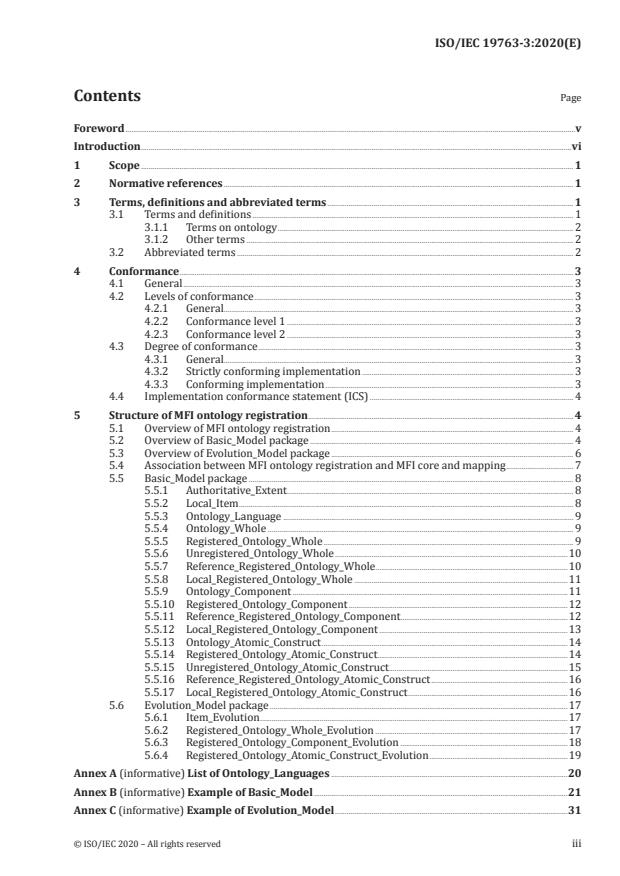
Contents Page
Foreword .v
Introduction .vi
1 Scope . 1
2 Normative references . 1
3 Terms, definitions and abbreviated terms . 1
3.1 Terms and definitions . 1
3.1.1 Terms on ontology . 2
3.1.2 Other terms . 2
3.2 Abbreviated terms . 2
4 Conformance . 3
4.1 General . 3
4.2 Levels of conformance . 3
4.2.1 General. 3
4.2.2 Conformance level 1 . 3
4.2.3 Conformance level 2 . 3
4.3 Degree of conformance . 3
4.3.1 General. 3
4.3.2 Strictly conforming implementation . 3
4.3.3 Conforming implementation . 3
4.4 Implementation conformance statement (ICS) . 4
5 Structure of MFI ontology registration . 4
5.1 Overview of MFI ontology registration . 4
5.2 Overview of Basic_Model package . 4
5.3 Overview of Evolution_Model package . 6
5.4 Association between MFI ontology registration and MFI core and mapping . 7
5.5 Basic_Model package . 8
5.5.1 Authoritative_Extent . 8
5.5.2 Local_Item . 8
5.5.3 Ontology_Language . 9
5.5.4 Ontology_Whole . 9
5.5.5 Registered_Ontology_Whole . 9
5.5.6 Unregistered_Ontology_Whole .10
5.5.7 Reference_Registered_Ontology_Whole .10
5.5.8 Local_Registered_Ontology_Whole .11
5.5.9 Ontology_Component .11
5.5.10 Registered_Ontology_Component .12
5.5.11 Reference_Registered_Ontology_Component.12
5.5.12 Local_Registered_Ontology_Component .13
5.5.13 Ontology_Atomic_Construct .14
5.5.14 Registered_Ontology_Atomic_Construct.14
5.5.15 Unregistered_Ontology_Atomic_Construct .15
5.5.16 Reference_Registered_Ontology_Atomic_Construct .16
5.5.17 Local_Registered_Ontology_Atomic_Construct .16
5.6 Evolution_Model package .17
5.6.1 Item_Evolution .17
5.6.2 Registered_Ontology_Whole_Evolution .17
5.6.3 Registered_Ontology_Component_Evolution .18
5.6.4 Registered_Ontology_Atomic_Construct_Evolution .19
Annex A (informative) List of Ontology_Languages .20
Annex B (informative) Example of Basic_Model .21
Annex C (informative) Example of Evolution_Model .31
© ISO/IEC 2020 – All rights reserved iii
Annex D (informative) Mapping from ISO/IEC 19763-3:2010 to ISO/IEC 19763-3:2020 .36
Bibliography .37
iv © ISO/IEC 2020 – All rights reserved
Foreword
ISO (the International Organization for Standardization) and IEC (the International Electrotechnical
Commission) form the specialized system for worldwide standardization. National bodies that
are members of ISO or IEC participate in the development of International Standards through
technical committees established by the respective organization to deal with particular fields of
technical activity. ISO and IEC technical committees collaborate in fields of mutual interest. Other
international organizations, governmental and non-governmental, in liaison with ISO and IEC, also
take part in the work.
The procedures used to develop this document and those intended for its further maintenance are
described in the ISO/IEC Directives, Part 1. In particular, the different approval criteria needed for
the different types of document should be noted. This document was drafted in accordance with the
editorial rules of the ISO/IEC Directives, Part 2 (see www .iso .org/ directives).
Attention is drawn to the possibility that some of the elements of this document may be the subject
of patent rights. ISO and IEC shall not be held responsible for identifying any or all such patent
rights. Details of any patent rights identified during the development of the document will be in the
Introduction and/or on the ISO list of patent declarations received (see www .iso .org/ patents) or the IEC
list of patent declarations received (see http:// patents .iec .ch).
Any trade name used in this document is information given for the convenience of users and does not
constitute an endorsement.
For an explanation of the voluntary nature of standards, the meaning of ISO specific terms and
expressions related to conformity assessment, as well as information about ISO's adherence to
the World Trade Organization (WTO) principles in the Technical Barriers to Trade (TBT) see
www .iso .org/ iso/ foreword .html.
This document was prepared by Joint Technical Committee ISO/IEC JTC 1, Information technology,
Subcommittee SC 32, Data management and interchange.
This third edition cancels and replaces the second edition (ISO/IEC 19763-3:2010), which has been
technically revised.
The main changes compared to the previous edition are as follows:
— no direct inheritance from Administered Item of ISO/IEC 11179-3 in 5.2 and 5.4 to align with
ISO/IEC 19763-10;
— clarification in 5.4 that "Ontology_Language", "Ontology_Whole", "Ontology_Component" and
"Ontology_Atomic_Construct" are inherited from "Modelling_Language", "Model" or "Model_
Element" of ISO/IEC 19763-10;
— changes of attribute and reference names in 5.4 and 5.5 to align with ISO/IEC 19763-10 (see Annex D);
— editorial changes throughout the document to fully align with ISO/IEC Directives Part 2.
A list of all parts in the ISO/IEC 19763 series can be found on the ISO website.
Any feedback or questions on this document should be directed to the user’s national standards body. A
complete listing of these bodies can be found at www .iso .org/ members .html.
© ISO/IEC 2020 – All rights reserved v
Introduction
Interoperability among heterogeneous application systems serves to improve business performance.
To promote it, unambiguous and formal specifications of the systems, especially of their inputs and
outputs, are indispensable. Ontologies have a key role for that.
Several efforts to establish standards associated with ontologies have been made. But, most of
them specify languages or are based on some particular language. To promote ontology-based
interoperability, in addition to them, a generic framework for registering administrative and evolution
information related to ontologies, independent of languages, is necessary.
This document provides a generic framework for registering administrative and evolution information
related to ontologies.
The metamodels of ontologies expressed in specific languages and the mappings among them are
specified in other specifications such as Reference [1].
Figure 1 illustrates the MFI ontology registration specified in this document.
Key
specifies
information flow
Figure 1 — MFI ontology registration
vi © ISO/IEC 2020 – All rights reserved
INTERNATIONAL STANDARD ISO/IEC 19763-3:2020(E)
Information technology — Metamodel framework for
interoperability (MFI) —
Part 3:
Metamodel for ontology registration
1 Scope
This document specifies the metamodel that provides a facility to register administrative and evolution
information related to ontologies.
The metamodel is intended to promote interoperability among application systems, by providing
administrative and evolution information related to ontologies, accompanied with standardized
ontology repositories that register ontologies themselves in specific languages.
This document does not specify the metamodels of ontologies expressed in specific languages and the
mappings among them.
2 Normative references
The following documents are referred to in the text in such a way that some or all of their content
constitutes requirements of this document. For dated references, only the edition cited applies. For
undated references, the latest edition of the referenced document (including any amendments) applies.
ISO/IEC 11179-3, Information technology — Metadata registries (MDR) — Part 3: Registry metamodel
and basic attributes
ISO/IEC 19763-1, Information technology — Metamodel framework for interoperability (MFI) — Part 1:
Framework
ISO/IEC 19763-10, Information technology — Metamodel framework for interoperability (MFI) — Part 10:
Core model and basic mapping
3 Terms, definitions and abbreviated terms
3.1 Terms and definitions
For the purposes of this document, the terms and definitions given in ISO/IEC 11179-3, ISO/IEC 19763-1
and ISO/IEC 19763-10 and the following apply.
ISO and IEC maintain terminological databases for use in standardization at the following addresses:
— ISO Online browsing platform: available at https:// www .iso .org/ obp
— IEC Electropedia: available at http:// www .electropedia .org/
© ISO/IEC 2020 – All rights reserved 1
3.1.1 Terms on ontology
3.1.1.1
ontology
specification of concrete or abstract things, and the relationships among them, in a prescribed domain
of knowledge
Note 1 to entry: The specification should be computer processable.
3.1.1.2
reference registered ontology
ontology (3.1.1.1) that is registered in a registry that conforms to MFI ontology registration and that is
usable and sharable by a community of interest
3.1.1.3
local registered ontology
ontology (3.1.1.1) that is registered in a registry that conforms to MFI ontology registration and that is
specialized for defined applications
3.1.2 Other terms
3.1.2.1
sentence
statement that has a truth value
3.1.2.2
symbol
most primitive lexical construct that is a part of a sentence (3.1.2.1)
3.1.2.3
logical symbol
symbol (3.1.2.2) whose meaning is defined by its language
EXAMPLE In KIF, "not" and "or" are logical symbols.
3.1.2.4
authoritative extent
extent that determines whether a thing can use another thing
Note 1 to entry: A thing can use another thing if and only if the authoritative extent of the former is less than or
equal to the authoritative extent of the latter because the usage of the latter by the former does not affect the
authoritative extent of the former since the authoritative level of the latter is greater than or equal to the one of
the former.
EXAMPLE A product with some authoritative extent can only use as its component a part with an
authoritative extent which is greater than or equal to the one of it, to keep its authoritative extent.
Note 2 to entry: In this document, an authoritative extent is used to determine whether a Local_Item can consist
of or use another Local_Item. See 5.5.2 Local_Item.
3.2 Abbreviated terms
IRI internationalized resource identifier (see Reference [2])
KIF knowledge interchange format (see Reference [3])
MDR metadata registry
MFI metamodel framework for interoperability
2 © ISO/IEC 2020 – All rights reserved
ODM ontology definition metamodel (see Reference [1])
OWL web ontology language (see Reference [4])
UML unified modeling language (see Reference [12])
4 Conformance
4.1 General
An implementation claiming conformance to this document shall support one or both of the metamodels
specified in this document and may or shall not support any extensions, depending on which level of
conformance and which degree of conformance it claims.
4.2 Levels of conformance
4.2.1 General
An implementation may conform to either of the two levels of conformance to this document, depending
on what packages it supports.
4.2.2 Conformance level 1
The metamodel specified in subclause 5.5 is supported.
4.2.3 Conformance level 2
The metamodels specified in subclauses 5.5 and 5.6 are supported.
4.3 Degree of conformance
4.3.1 General
In each conformance level, the distinction between "strictly conforming" and "conforming"
implementations is necessary to address the simultaneous needs for interoperability and extensions.
This document describes specifications that promote interoperability. Extensions are motivated by
needs of users, vendors, institutions and industries, but are not specified by this document.
A strictly conforming implementation can be limited in usefulness but is maximally interoperable with
respect to this document. A conforming implementation can be more useful but can be less interoperable
with respect to this document.
4.3.2 Strictly conforming implementation
A strictly conforming implementation for some conformance level:
a) shall support the metamodels required in the conformance level;
b) shall not support any extensions to the metamodels required in the conformance level.
4.3.3 Conforming implementation
A conforming implementation:
a) shall support the metamodels required in the conformance level;
© ISO/IEC 2020 – All rights reserved 3
b) may support extensions to the metamodels required in the conformance level, and the extensions
shall be consistent with the metamodels required in the conformance level.
4.4 Implementation conformance statement (ICS)
An implementation claiming conformance to this document shall include an implementation
conformance statement stating:
a) which conformance level it claims (4.2);
b) whether it is a strictly conforming implementation or a conforming implementation (4.3);
c) what extensions are supported if it is a conforming implementation.
5 Structure of MFI ontology registration
5.1 Overview of MFI ontology registration
MFI ontology registration consists of two packages: Basic_Model package and Evolution_Model package.
Figure 2 shows the package structure of MFI ontology registration.
Figure 2 — Package structure of MFI ontology registration
The Basic_Model package is used to register administrative information related to ontologies,
independently of the languages that are used to express them. The basic idea is that almost any
ontology consists of several sentences and that each sentence uses several non-logical symbols. The
metaclasses in Basic_Model package include Ontology_Whole, Ontology_Component and Ontology_
Atomic_Construct, which have administrative information of ontologies, sentences and non-logical
symbols respectively. Since an ontology evolves, Basic_Model package can register as many versions
of an ontology as necessary. But, in Basic_Model package, each version of an ontology is treated as a
different ontology.
The Evolution_Model package is used to register information on how an ontology evolves from one
version to another. Evolution_Model package basically consists of three metaclasses, Registered_
Ontology_Whole_Evolution, Registered_Ontology_Component_Evolution and Registered_Ontology_
Atomic_Construct_Evolution, which have evolution information on Registered_Ontology_Whole,
Registered_Ontology_Component and Registered_Ontology_Atomic_Construct respectively.
5.2 Overview of Basic_Model package
Figure 3 shows the metamodel in Basic_Model package.
4 © ISO/IEC 2020 – All rights reserved
NOTE Metaclasses whose names are italicized are abstract metaclasses.
Figure 3 — Metamodel in Basic_Model package
Ontology_Whole is an abstract metaclass that represents an ontology and contains the associated
administrative information. Ontology_Language is used as the reference "expressing_language"
of Ontology_Whole to indicate a language that is used to express an ontology that is represented by
Ontology_Whole. Ontology_Component is an abstract metaclass that represents a sentence contained
in ontologies and contains the associated administrative information. The granularity of a sentence is
not specified but is a user’s choice. Ontology_Atomic_Construct is an abstract metaclass that represents
a non-logical symbol that is used in sentences and contains the associated administrative information.
Ontology_Whole has two direct subclasses, Registered_Ontology_Whole and Unregistered_Ontology_
Whole. Registered_Ontology_Whole is an abstract metaclass that represents an ontology that is
registered in a registry that conforms to MFI ontology registration. Unregistered_Ontology_Whole
is a metaclass that represents an ontology that is not registered but imported by an ontology that is
registered in a registry that conforms to MFI ontology registration.
Ontology_Component has only one direct subclass Registered_Ontology_Component. Registered_
Ontology_Component is an abstract metaclass that represents an ontology that is registered in a registry
that conforms to MFI ontology registration. Any instance of Ontology_Component is a Registered_
Ontology_Component since a sentence that is not registered in a registry that conforms to MFI ontology
registration is out of scope.
Similar to Ontology_Whole, Ontology_Atomic_Construct has two direct subclasses, Registered_
Ontology_Atomic_Construct and Unregistered_Ontology_Atomic_Construct. Registered_Ontology_
Atomic_Construct is an abstract metaclass that represents a non-logical symbol that is registered in
a registry that conforms to MFI ontology registration. Unregistered_Ontology_Atomic_Construct is a
metaclass that represents a non-logical symbol that is not registered but used by a sentence that is
registered in a registry that conforms to MFI ontology registration.
Registered_Ontology_Whole has two direct subclasses, Reference_Registered_Ontology_Whole and
Local_Registered_Ontology_Whole. Reference_Registered_Ontology_Whole represents a reference
registered ontology and Local_Registered_Ontology_Whole represents a local registered ontology.
© ISO/IEC 2020 – All rights reserved 5
Similarly, Registered_Ontology_Component has two direct subclasses, Reference_Registered_Ontology_
Component and Local_Registered_Ontology_Component. Reference_Registered_Ontology_Component
represents a sentence contained in ontologies that are represented by Reference_Registered_Ontology_
Whole. Local_Registered_Ontology_Component represents a sentence contained in ontologies
that are represented by Local_Registered_Ontology_Whole. A sentence that is represented by
Reference_Registered_Ontology_Component may also be contained in ontologies that are represented
by Local_Registered_Ontology_Whole, but a sentence that is represented by Local_Registered_
Ontology_Component cannot be contained in ontologies that are represented by Reference_Registered_
Ontology_Whole.
Similarly, Registered_Ontology_Atomic_Construct also has two direct subclasses, Reference_
Registered_Ontology_Atomic_Construct and Local_Registered_Ontology_Atomic_Construct.
Reference_Registered_Ontology_Atomic_Construct represents a non-logical symbol that is used in
sentences that are represented by Reference_Registered_Ontology_Component. Local_Registered_
Ontology_Atomic_Construct represents a non-logical symbol that is used in sentences that are
represented by Local_Registered_Ontology_Component. A non-logical symbol that is represented by
Reference_Registered_Ontology_Atomic_Construct may also be used in sentences that are represented
by Local_Registered_Ontology_Component, but a non-logical symbol that is represented by Local_
Registered_Ontology_Atomic_Construct cannot be used in sentences that are represented by Reference_
Registered_Ontology_Component.
Local_Item is an abstract metaclass that is a collectively exhaustive superclass of Local_Registered_
Ontology_Whole, Local_Registered_Ontology_Component and Local_Registered_Ontology_Atomic_
Construct. Authoritative_Extent is used as the reference "authoritative_level" of Local_Item to indicate
whether a Local_Item can consist of or use another Local_Item. A sentence that is represented by
Local_Registered_Ontology_Component may also be contained in ontologies that are represented by
Local_Registered_Ontology_Whole whose value of "authoritative_level" is less than or equal to the
value of "authoritative_level" of this Local_Registered_Ontology_Component. A non-logical symbol that
is represented by Local_Registered_Ontology_Atomic_Construct may also be used in sentences that are
represented by Local_Registered_Ontology_Component whose value of "authoritative_level" is less than
or equal to the value of "authoritative_level" of this Local_Registered_Ontology_Atomic_Construct.
The exact specification of each metaclass in Basic_Model package is given in subclause 5.5. Annex B
shows how each metaclass in Basic_Model package is used for registering administrative information
related to ontologies.
5.3 Overview of Evolution_Model package
Figure 4 shows the metamodel in Evolution_Model package.
Item_Evolution is an abstract metaclass that is a collectively exhaustive superclass of Registered_
Ontology_Whole_Evolution, Registered_Ontology_Component_Evolution and Registered_Ontology_
Atomic_Construct_Evolution. Registered_Ontology_Whole_Evolution is a metaclass that indicates what
a Registered_Ontology_Whole evolves to and is possibly composed of Registered_Ontology_Component_
Evolution. Registered_Ontology_Component_Evolution is a metaclass that indicates what a Registered_
Ontology_Component evolves to and is possibly composed of Registered_Ontology_Atomic_Construct_
Evolution. Registered_Ontology_Atomic_Construct_Evolution is a metaclass that indicates what a
Registered_Ontology_Atomic_Construct evolves to. Evolution information on Unregistered_Ontology_
Whole and Unregistered_Ontology_Atomic_Construct is out of scope since they are not registered.
The exact specification of each metaclass in Evolution_Model package is given in subclause 5.6. Annex C
shows how each metaclass in Evolution_Model package is used for registering information on how an
ontology evolves from one version to another.
6 © ISO/IEC 2020 – All rights reserved
NOTE Metaclasses whose names are italicized are abstract metaclasses.
Figure 4 — Metamodel in Evolution_Model package
5.4 Association between MFI ontology registration and MFI core and mapping
The associations between the metaclasses in MFI ontology registration and the metaclasses in MFI core
and mapping are shown in Figure 5.
Figure 5 — The associations between MFI ontology registration and MFI core and mapping
© ISO/IEC 2020 – All rights reserved 7
5.5 Basic_Model package
5.5.1 Authoritative_Extent
Authoritative_Extent is a metaclass each instance of which represents authoritative extent and
composes a partially ordered set in terms of the reference "less_than_or_equal_to".
Superclass
[None]
Attribute DataType Multiplicity Description
authoritative_ String 1.1 The string represents the authoritative extent of this
extent Authoritative_Extent
Reference Class Multiplicity Description Inverse Precedence
less_than_or_ Authoritative 0.* The set of authoritative_ greater_than_ Yes
equal_to _Extent extents that this or_equal_to
authoritative_extent is less
than or equal to
authoritative_ Local_Item 0.* The set of instances of authoritative_ No
extent_local_ Local_Item, each level
item authoritative level of
which is this
Authoritative_Extent
greater_than_ Authoritative 0.* The set of authoritative_ less_than_or_ No
or_equal_to _Extent extents that this equal_to
authoritative_extent is
greater than or equal to
Constraints
The value of the attribute "authoritative_extent" shall be unique in this metaclass.
NOTE Authoritative_Extent is used by Local_Item. See NOTE in subclause 5.5.2.
5.5.2 Local_Item
Local_Item is an abstract metaclass that is a collectively exhaustive superclass of Local_Registered_
Ontology_Whole, Local_Registered_Ontology_Component and Local_Registered_Ontology_Atomic_
Construct.
Superclass
[None]
Attribute DataType Multiplicity Description
[None]
Reference Class Multiplicity Description Inverse Precedence
authoritative_ Authoritative_ 1.1 The authoritative extent of authoritative_ Yes
level Extent this Local_Item extent_local_
item
Constraints
[None]
NOTE Local_Item X can consist of or use Local_Item Y if and only if the authoritative_level of X is less than or
equal to the authoritative_level of Y. For more details, see constraints in subclauses 5.5.8 and 5.5.12.
8 © ISO/IEC 2020 – All rights reserved
5.5.3 Ontology_Language
Ontology_Language is a metaclass each instance of which represents an ontology expression language.
Superclass
Modelling_Language (from MFI Core and mapping)
Attribute DataType Multiplicity Description
name String 1.1 A name of the ontology expression language.
Reference Class Multiplicity Description Inverse Precedence
expressed_ Ontology 0.* The set of ontologies expressing_language No
ontology _Whole expressed by this
ontology language
Constraints
The value of the attribute "name" shall be unique in this metaclass.
NOTE Annex A suggests a means of deciding the value of the attribute.
5.5.4 Ontology_Whole
Ontology_Whole is an abstract metaclass that is a collectively exhaustive superclass of Registered_
Ontology_Whole and Unregistered_Ontology_Whole.
Superclass
Model (from MFI Core and mapping)
Attribute DataType Multiplicity Description
IRI String 1.1 An IRI that identifies the corresponding ontology
name String 1.1 A name of the corresponding ontology
Reference Class Multiplicity Description Inverse Precedence
expressing_ Ontology_ 1.1 The ontology expression Authoritative Yes
language Language language that is used to _extent_
express the corresponding local_item
ontology
Constraints
The value of the attribute "IRI" shall be unique in this metaclass.
5.5.5 Registered_Ontology_Whole
Registered_Ontology_Whole is an abstract metaclass that is a collectively exhaustive superclass of
Reference_Registered_Ontology_Whole and Local_Registered_Ontology_Whole.
Superclass
Ontology_Whole
Attribute DataType Multiplicity Description
[None]
Reference Class Multiplicity Description Inverse Precedence
imported_ Unregistered_ 0.* The set of instances of importing_ Yes
ontology Ontology_ Unregistered_Ontology_Whole ontology
Whole each of which represents an
unregistered ontology that is
imported by the corresponding
ontology
© ISO/IEC 2020 – All rights reserved 9
registered_ Registered_ 0.* The set of instances of previous_ No
ontology_ Ontology_ Registered_Ontology_Whole_ version
whole_ Whole_ Evolution each of which
evolution_ Evolution represents information on
from the evolution from the
corresponding ontology
registered_ Registered_ 1.1 The instance of Registered_ new_ No
ontology_ Ontology_ Ontology_Whole_Evolution version
whole_ Whole_ that represents information on
evolution_ Evolution the evolution to the
to corresponding ontology
Constraints
[None]
5.5.6 Unregistered_Ontology_Whole
Unregistered_Ontology_Whole is a metaclass each instance of which represents an ontology that is not
registered but imported by an ontology that is registered in a registry that conforms to MFI ontology
registration.
Superclass
Ontology_Whole
Attribute DataType Multiplicity Description
[None]
Reference Class Multiplicity Description Inverse Precedence
importing_ Registered_ 1.* The set of instances of imported_ No
ontology Ontology_ Registered_Ontology_Whole ontology
Whole each of which represents
registered ontology that
imports the corresponding
unregistered ontology
Constraints
[None]
5.5.7 Reference_Registered_Ontology_Whole
Reference_Registered_Ontology_Whole is a metaclass each instance of which represents a reference
registered ontology.
Superclass
Registered_Ontology_Whole
Attribute DataType Multiplicity Description
[None]
Reference Class Multiplicity Description Inverse Precedence
used_ Reference_ 1.* The set of instances of using_ Yes
reference_ Registered_ Reference_Registered_ reference_
registered_ Ontology_ Ontology_Component each of registered_
ontology_ Component which represents the sentence ontology_
component contained in the ontology whole
represented by this Reference_
Registered_Ontology_Whole
Constraints
[None]
10 © ISO/IEC 2020 – All rights reserved
5.5.8 Local_Registered_Ontology_Whole
Local_Registered_Ontology_Whole is a metaclass each instance of which represents a local registered
ontology.
Superclass
Registered_Ontology_Whole, Local_Item
Attribute DataType Multiplicity Description
[None]
Reference Class Multiplicity Description Inverse Precedence
used_ Reference_ 0.* The set of instances of using_local_ Yes
reference_ Registered_ Reference_Registered_ registered_
registered_ Ontology_ Ontology_Component each of ontology_
ontology_ Component which represents the sentence whole
component contained in the ontology
represented by this
Reference_Registered_
Ontology_Whole
used_local_ Local_ 1.* The set of instances of Local_ using_local_ Yes
registered_ Registered_ Registered_Ontology_Component registered_
ontology_ Ontology_ each of which represents the ontology_
component Component sentence contained in the whole
ontology represented by this
Reference_Registered_
Ontology_Whole
Constraints
The value of the attribute "authoritative_level" (inherited from Local_Item) of this Local_Registered_Ontology_Whole
shall be "less_than_or_equal_to" the value of the attribute "authoritative_level" (inherited from Local_Item) of
the Local_Registered_Ontology_Component that is the value of the reference "used_local_registered_ontology_
component" of this Local_Registered_Ontology_Whole.
NOTE It is a good practice that a Local_Registered_Ontology_Whole consists of some Reference_Registered_
Ontology_Components as it evolves.
5.5.9 Ontology_Component
Ontology_Component is an abstract metaclass that is a collectively exhaustive superclass of Registered_
Ontology_Component.
Superclass
Model_Element (from MFI Core and mapping)
Attribute DataType Multiplicity Description
namespace String 1.1 An IRI where the value of the sentenceIdentifier is uniquely
identified
sentence_identifier String 1.1 An identifier of the corresponding sentence within the namespace
Reference Class Multiplicity Description Inverse Precedence
[None]
Constraints
a) The value of the attribute "sentence_identifier" prefixed by the value of the attribute "namespace" shall be
unique in this metaclass.
b) The value of the attribute "sentence_identifier" prefixed by the value of the attribute "namespace" shall
identify the corresponding sentence.
© ISO/IEC 2020 – All rights reserved 11
5.5.10 Registered_Ontology_Component
Registered_Ontology_Component is an abstract metaclass representing a sentence contained in an
ontology that is represented by Registered_Ontology_Whole. Granularity of a sentence is not specified
in this document.
Superclass
Ontology_Component
Attribute DataType Multiplicity Description
[None]
Reference Class Multiplicity Description Inverse Precedence
same_as Registered_ 0.* The set of instances of same_as Yes
Ontology_ Registered_Ontology_
Component Component each of which
represents the sentence that is
interpreted exactly the same as
the sentence represented by this
Registered_Ontology_
Component
registered_ Registered_ 0.* The set of instances of previous_ No
ontology_ Ontology_ Registered_Ontology_ version
component Component_ Component_Evolution each of
_evolution_ Evolution which represents information on
from the evolution from the sentence
represented by this Registered_
Ontology_Component
registered_ Registered_ 1.1 The instance of Registered_ new_ No
ontology_ Ontology_ Ontology_Component_ version
component Component_ Evolution that represents
_evolution_ Evolution information on the evolution to
to the sentence represented by this
Registered_Ontology_Component
Constraints
[None]
5.5.11 Reference_Registered_Ontology_Component
Reference_Registered_Ontology_Component is a metaclass each instance of which represents a sentence
contained in an ontology that is represented by an instance of Reference_Registered_Ontology_Whole.
Superclass
Registered_Ontology_Component
Attribute DataType Multiplicity Description
[None]
Reference Class Multiplicity Description Inverse Precedence
used_ Unregistered_ 0.* The set of instances using_ Yes
unregistred_ Ontology_ Unregistered_Ontology_ reference_
ontology_ Atomic_ Atomic_Constructs, each of registered_
atomic_ Construct which represents the non- ontology_
construct logical symbol that is used in component
the sentence represented by
this Reference_Registered_
Ontology_Component
12 © ISO/IEC 2020 – All rights reserved
used_ Reference_ 0.* The set of instances of using_ Yes
reference_ Registered_ Reference_Registered_ reference_
registered_ Ontology_ Ontology_Atomic_Constructs, registered_
ontology_ Atomic_ each of which represents the ontology_
atomic_ Construct non-logical symbol that is used component
construct in the sentence represented by
this Reference_Registered_
Ontology_Component
using_ Reference_ 1.* The set of instances of used_ No
reference_ Registered_ Reference_Registered_ reference_
registered_ Ontology_ Ontology_Component each of registered_
ontology_ Whole which represents the sentence ontology_
whole contained in the ontology component
represented by this
Reference_Registered_
Ontology_Whole
using_local_ Local_ 0.* The set of instances of Local_ used_local_ No
registered_ Registered_ Registered_Ontology_ registered_
ontology_ Ontology_ Whole each of which ontology_
whole Whole represents a local registered component
ontology that uses a sentence
represented by this
Reference_Registered_
Ontology_Component
Constraints
The range of the attribute "same_as" (inherited from Registered_Ontology_Component) shall be within
Reference_Registered_Ontology_Component.
5.5.12 Local_Registered_Ontology_Component
Local_Registered_Ontology_Component is a metaclass each instance of which represents a sentence
contained in an ontology that is represented by an instance of Local_Registered_Ontology_Whole.
Superclass
Registered_Ontology_Component, Local_Item
Attribute DataType Multiplicity Description
[None]
Reference Class Multiplicity Description Inverse Precedence
used_ Unregistered_ 0.* The set of instances of using_ Yes
unregistered Ontology_ Unregistered_Ontology_Atomic_ local_
_ontology_ Atomic_ Constructs each of which registered_
atomic_ Construct represents the non-logical symbol ontology_
construct that is used in the sentence component
represented by this Local_
Registered_Ontology_Component
used_ Reference_ 0.* The set of instances of using_ Yes
reference_ Registered_ Reference_Registered_Ontology_ local_
registered_ Ontology_ Atomic_Construct each of which registered_
ontology_ Atomic_ represents the non-logical symbol ontology_
atomic_ Construct that is used in the sentence component
construct represented by this Local_
Registered_Ontology_Component
© ISO/IEC 2020 – All rights reserved 13
used_local_ Local_ 0.* The set of instances of Local_ using_ Yes
registered_ Registered_ Registered_Ontology_Atomic_ local_
ontology_ Ontology_ Construct each of which registered_
atomic_ Atomic_ represents the non-logical symbol ontology_
construct Construct that is used in the sentence component
represented by this Local_
Registered_Ontology_Component
using_local_ Local_ 1.* The set of instances of Local_ used_ No
registered_ Registered_ Registered_Ontology_Whole each local_
ontology_ Ontology_ of which represents the local registered_
whole Whole registered ontology that uses the ontology_
sentence represented by this component
Local_Registered_Ontology_
Component
Constraints
a) The value of the attribute "authoritative_level" (inherited from Local_Item) of this Local_Registered_
Ontology_Component shall be "less_than_or_equal_to" the value of the attribute "authoritative_level"
(inherited from Local_Item) of the Local_Registered_Ontology_Atomic_Construct that is the value of
the reference "used_local_registered_ontology_atomic_construct" of this Local_Registered_Ontology_
Component.
b) If a value of the attribute "same_as" (inherited
...