

ISO/TS 3691-8:2019
(Main)Industrial trucks — Safety requirements and verification — Part 8: Regional requirements for countries outside the European Community
General Information
- Abstract
This document gives regional requirements for specific countries outside the European Community (EC) and European Economic Area (EEA) for the types of industrial trucks specified in the scopes of ISO 3691-1, ISO 3691-2, ISO 3691-3, ISO 3691-4 and ISO 3691-6.
- Status
- Published
- Publication Date
- 02-Jun-2019
- Technical Committee
- ISO/TC 110/SC 2 - Safety of powered industrial trucks
- Drafting Committee
- ISO/TC 110/SC 2/WG 2 - Safety code
- Current Stage
- 9092 - International Standard to be revised
- Start Date
- 30-Oct-2023
- Completion Date
- 29-Aug-2026
Buy Documents
ISO/TS 3691-8:2019 - Industrial trucks — Safety requirements and verification — Part 8: Regional requirements for countries outside the European Community Released:6/3/2019
ISO/TS 3691-8:2019 - Industrial trucks — Safety requirements and verification — Part 8: Regional requirements for countries outside the European Community/3/2019
Overview
ISO/TS 3691-8:2019 specifies the regional safety requirements and verification procedures for industrial trucks operating in countries outside the European Community (EC) and European Economic Area (EEA). This technical specification builds upon the safety and verification principles established in the ISO 3691 series. It ensures that powered industrial trucks such as forklifts, pedestrian-controlled trucks, and order-pickers, comply with relevant national and regional regulations, bridging variations where international harmonization has not been fully achieved.
By aligning safety requirements with local legislation and regulatory standards, ISO/TS 3691-8:2019 supports manufacturers, operators, and safety professionals in meeting compliance needs for industrial trucks used in Australia, North America, Japan, South Africa, and other regions outside the EC/EEA.
Key Topics
ISO/TS 3691-8:2019 addresses several crucial aspects of industrial truck safety:
- Electrical Requirements: Specifications for power system certification referencing standards such as ANSI/NFPA 505 (North America), UL 558, UL 583, EN 1175 (Australia), and ISO 20898 elsewhere.
- Travel Speed: Rules for maximum permissible speed for different truck types and regions, ensuring safer operation.
- Braking Systems: Stopping distances and parking brake capabilities, with detailed requirements for countries like Japan.
- Coasting Operation: Safety specifications when controlling the truck from alongside, including performance and marking requirements.
- LPG Trucks: Guidelines for installation of LPG components in accordance with local standards, such as AS 4983 in Australia.
- Lift Chains and Fork Arms: Minimum safety factors tailored to regional practices, including references to standards like ISO 2330 and ANSI/ITSDF B56.
- Operator Restraints: Mandates on seat belts, interlocks, and operator protection, particularly in regions with tipping risks.
- Electromagnetic Compatibility (EMC): Emission requirements referencing EN 12895 (Australia) and ICES-002 (Canada).
- Visibility and Marking: Measures to ensure clear visibility for operators and correct marking information based on regional standards.
- Noise Emissions: Testing and disclosure requirements, such as those aligning with EN 12053.
- Fall Protection and Operator Platforms: Guarding, harnessing, and anchorage standards for elevated platforms.
Applications
ISO/TS 3691-8:2019 is critical for organizations involved in the manufacturing, import, export, and operation of industrial trucks outside the EC/EEA. The specification is particularly valuable for:
- Truck Manufacturers and Designers: Ensuring compliance with localized safety requirements, reducing liability, and addressing customer demands across multiple markets.
- Warehouse Operators and Logistics Providers: Procuring and operating trucks that meet regionally mandated safety performance, reducing worker risk, and supporting regulatory audits.
- Regulatory Authorities and Inspectors: Harmonizing enforcement with internationally recognized benchmarks tailored to local needs.
- Safety and Maintenance Teams: Implementing proper procedures for modifications, verifying marking and documentation, and maintaining compliance through lifecycle management.
- Training Providers: Developing operator training programs that reflect specific regional risks and regulations.
Adoption of ISO/TS 3691-8:2019 improves safety for truck operators and bystanders, facilitates cross-border equipment supply, and ensures that organizations address the specific safety needs dictated by their jurisdiction.
Related Standards
ISO/TS 3691-8:2019 is designed for use in conjunction with the following standards:
- ISO 3691-1: Self-propelled industrial trucks
- ISO 3691-2: Self-propelled variable-reach trucks
- ISO 3691-3: Trucks with elevating operator position and elevated load travel capabilities
- ISO 3691-4: Driverless industrial trucks and their systems
- ISO 3691-6: Burden and personnel carriers
- ISO 20898: Electrical requirements for industrial trucks
- ISO 2330: Fork arms characteristics and testing
- ANSI/ITSDF B56 (various parts): North American safety standards for low and high lift trucks
- AS 2359-2, AS 4983 (Australia): National guidelines for truck operation and LPG installation
ISO/TS 3691-7 covers regional requirements within the European Community and complements this technical specification.
For more information, consult the ISO website or contact your national standards body for localized guidance and the most current updates.
Relations
- Effective Date
- 09-Feb-2026
- Effective Date
- 20-Jan-2024
- Effective Date
- 13-Feb-2016
Buy Documents
ISO/TS 3691-8:2019 - Industrial trucks — Safety requirements and verification — Part 8: Regional requirements for countries outside the European Community Released:6/3/2019
ISO/TS 3691-8:2019 - Industrial trucks — Safety requirements and verification — Part 8: Regional requirements for countries outside the European Community/3/2019
Frequently Asked Questions
ISO/TS 3691-8:2019 is a technical specification published by the International Organization for Standardization (ISO). Its full title is "Industrial trucks — Safety requirements and verification — Part 8: Regional requirements for countries outside the European Community". This standard covers: This document gives regional requirements for specific countries outside the European Community (EC) and European Economic Area (EEA) for the types of industrial trucks specified in the scopes of ISO 3691-1, ISO 3691-2, ISO 3691-3, ISO 3691-4 and ISO 3691-6.
This document gives regional requirements for specific countries outside the European Community (EC) and European Economic Area (EEA) for the types of industrial trucks specified in the scopes of ISO 3691-1, ISO 3691-2, ISO 3691-3, ISO 3691-4 and ISO 3691-6.
ISO/TS 3691-8:2019 is classified under the following ICS (International Classification for Standards) categories: 53.060 - Industrial trucks. The ICS classification helps identify the subject area and facilitates finding related standards.
ISO/TS 3691-8:2019 has the following relationships with other standards: It is inter standard links to EN ISO 3691-4:2020, ISO/TS 3691-8, ISO/TS 3691-8:2012. Understanding these relationships helps ensure you are using the most current and applicable version of the standard.
ISO/TS 3691-8:2019 is available in PDF format for immediate download after purchase. The document can be added to your cart and obtained through the secure checkout process. Digital delivery ensures instant access to the complete standard document.
Standards Content (Sample)
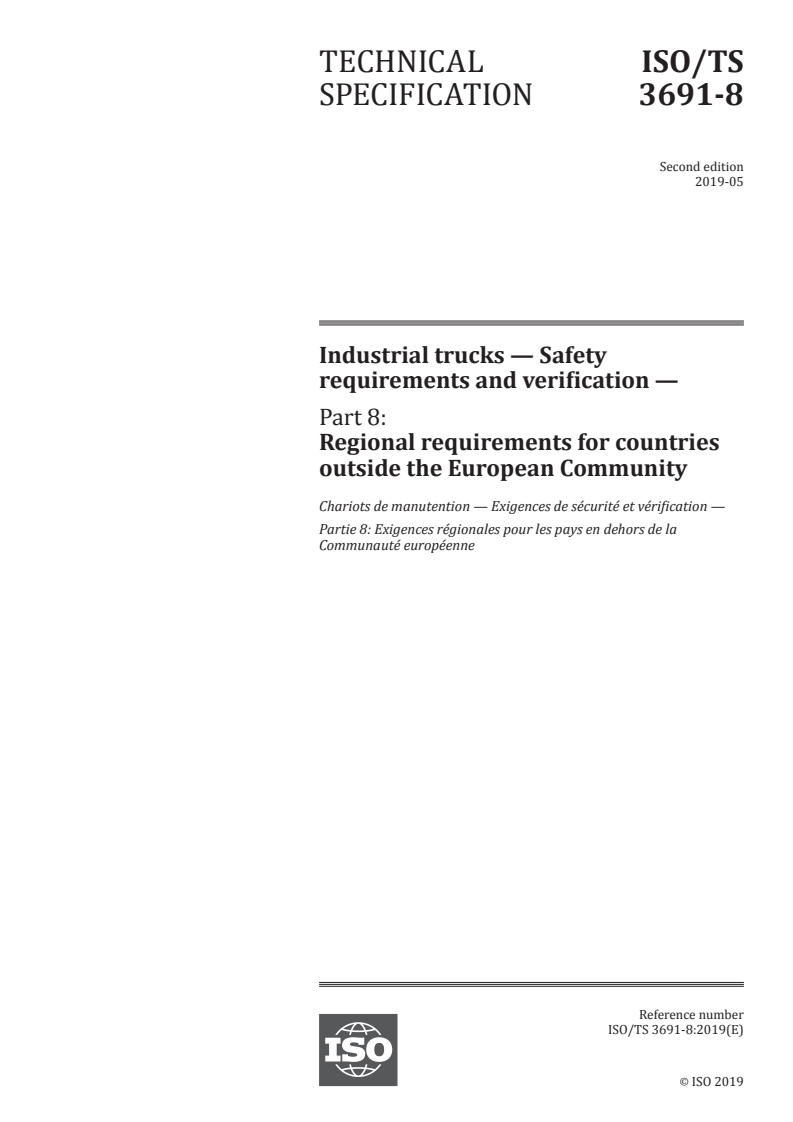
TECHNICAL ISO/TS
SPECIFICATION 3691-8
Second edition
2019-05
Industrial trucks — Safety
requirements and verification —
Part 8:
Regional requirements for countries
outside the European Community
Chariots de manutention — Exigences de sécurité et vérification —
Partie 8: Exigences régionales pour les pays en dehors de la
Communauté européenne
Reference number
©
ISO 2019
© ISO 2019
All rights reserved. Unless otherwise specified, or required in the context of its implementation, no part of this publication may
be reproduced or utilized otherwise in any form or by any means, electronic or mechanical, including photocopying, or posting
on the internet or an intranet, without prior written permission. Permission can be requested from either ISO at the address
below or ISO’s member body in the country of the requester.
ISO copyright office
CP 401 • Ch. de Blandonnet 8
CH-1214 Vernier, Geneva
Phone: +41 22 749 01 11
Fax: +41 22 749 09 47
Email: copyright@iso.org
Website: www.iso.org
Published in Switzerland
ii © ISO 2019 – All rights reserved
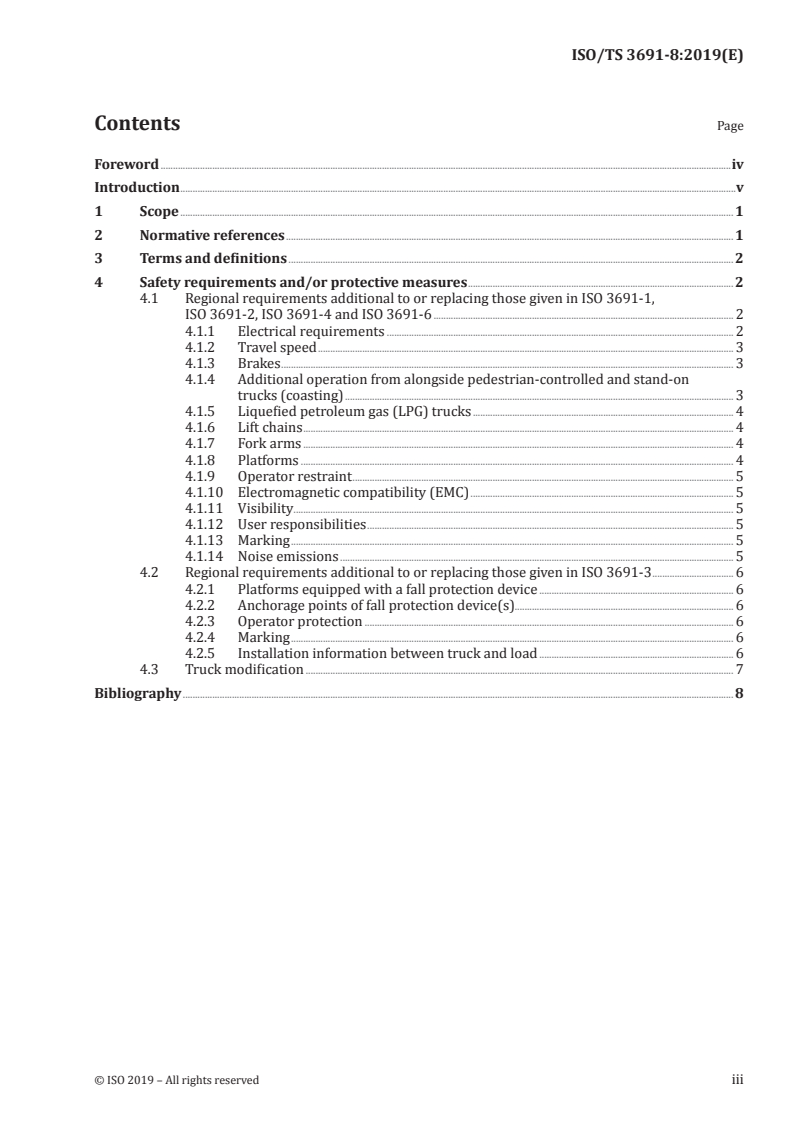
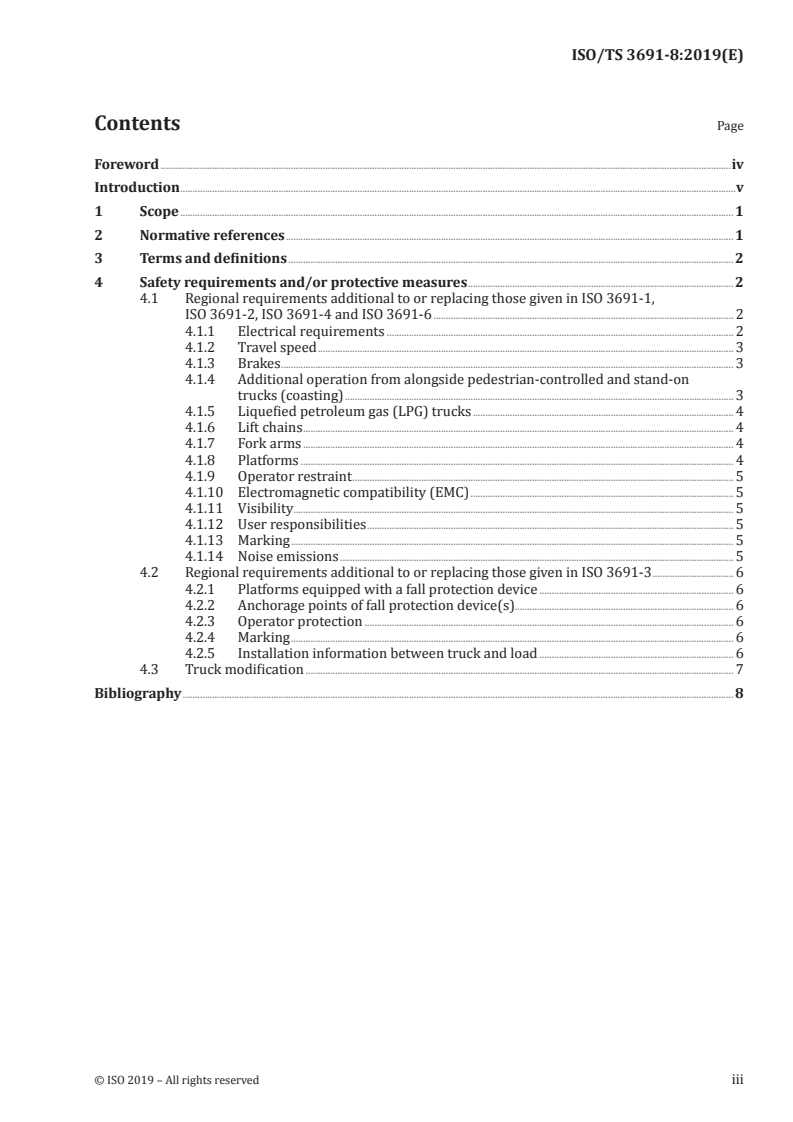
Contents Page
Foreword .iv
Introduction .v
1 Scope . 1
2 Normative references . 1
3 Terms and definitions . 2
4 Safety requirements and/or protective measures . 2
4.1 Regional requirements additional to or replacing those given in ISO 3691-1,
ISO 3691-2, ISO 3691-4 and ISO 3691-6 . 2
4.1.1 Electrical requirements . 2
4.1.2 Travel speed . 3
4.1.3 Brakes . 3
4.1.4 Additional operation from alongside pedestrian-controlled and stand-on
trucks (coasting) . 3
4.1.5 Liquefied petroleum gas (LPG) trucks . 4
4.1.6 Lift chains . 4
4.1.7 Fork arms . 4
4.1.8 Platforms . 4
4.1.9 Operator restraint . 5
4.1.10 Electromagnetic compatibility (EMC) . 5
4.1.11 Visibility. 5
4.1.12 User responsibilities . 5
4.1.13 Marking . 5
4.1.14 Noise emissions . 5
4.2 Regional requirements additional to or replacing those given in ISO 3691-3 . 6
4.2.1 Platforms equipped with a fall protection device . 6
4.2.2 Anchorage points of fall protection device(s). 6
4.2.3 Operator protection . 6
4.2.4 Marking . 6
4.2.5 Installation information between truck and load . 6
4.3 Truck modification . 7
Bibliography . 8
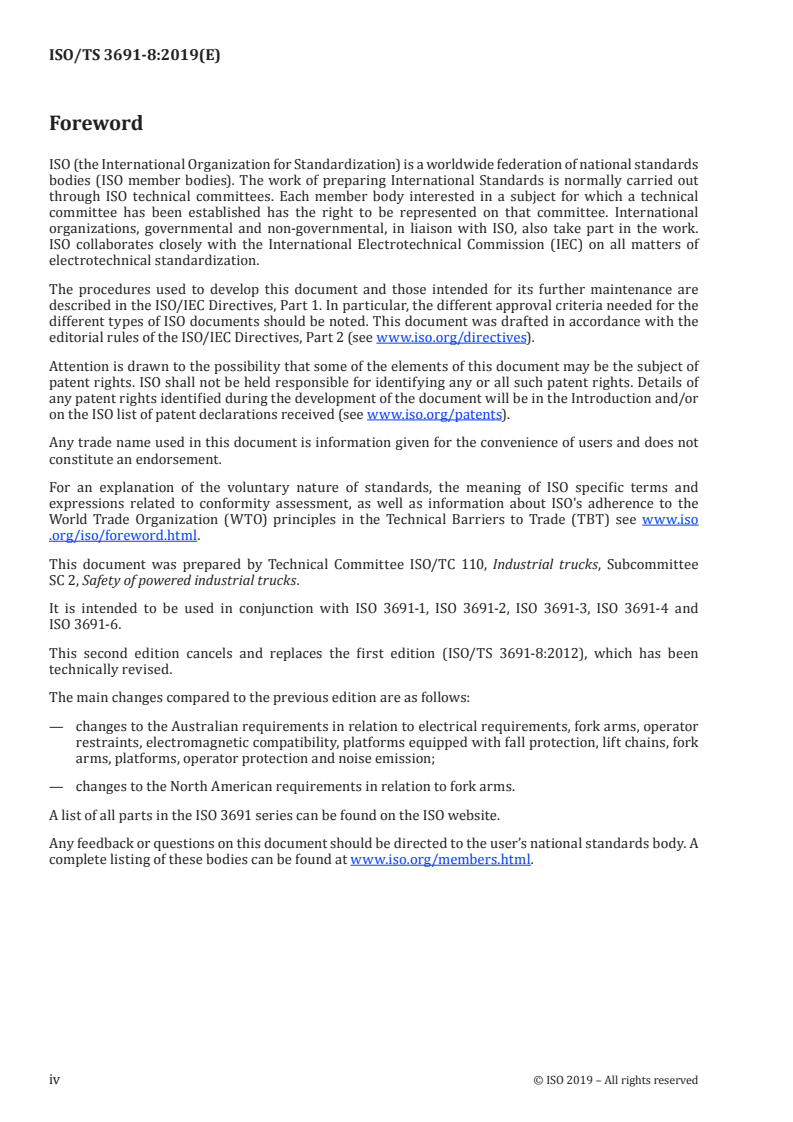
Foreword
ISO (the International Organization for Standardization) is a worldwide federation of national standards
bodies (ISO member bodies). The work of preparing International Standards is normally carried out
through ISO technical committees. Each member body interested in a subject for which a technical
committee has been established has the right to be represented on that committee. International
organizations, governmental and non-governmental, in liaison with ISO, also take part in the work.
ISO collaborates closely with the International Electrotechnical Commission (IEC) on all matters of
electrotechnical standardization.
The procedures used to develop this document and those intended for its further maintenance are
described in the ISO/IEC Directives, Part 1. In particular, the different approval criteria needed for the
different types of ISO documents should be noted. This document was drafted in accordance with the
editorial rules of the ISO/IEC Directives, Part 2 (see www .iso .org/directives).
Attention is drawn to the possibility that some of the elements of this document may be the subject of
patent rights. ISO shall not be held responsible for identifying any or all such patent rights. Details of
any patent rights identified during the development of the document will be in the Introduction and/or
on the ISO list of patent declarations received (see www .iso .org/patents).
Any trade name used in this document is information given for the convenience of users and does not
constitute an endorsement.
For an explanation of the voluntary nature of standards, the meaning of ISO specific terms and
expressions related to conformity assessment, as well as information about ISO's adherence to the
World Trade Organization (WTO) principles in the Technical Barriers to Trade (TBT) see www .iso
.org/iso/foreword .html.
This document was prepared by Technical Committee ISO/TC 110, Industrial trucks, Subcommittee
SC 2, Safety of powered industrial trucks.
It is intended to be used in conjunction with ISO 3691-1, ISO 3691-2, ISO 3691-3, ISO 3691-4 and
ISO 3691-6.
This second edition cancels and replaces the first edition (ISO/TS 3691-8:2012), which has been
technically revised.
The main changes compared to the previous edition are as follows:
— changes to the Australian requirements in relation to electrical requirements, fork arms, operator
restraints, electromagnetic compatibility, platforms equipped with fall protection, lift chains, fork
arms, platforms, operator protection and noise emission;
— changes to the North American requirements in relation to fork arms.
A list of all parts in the ISO 3691 series can be found on the ISO website.
Any feedback or questions on this document should be directed to the user’s national standards body. A
complete listing of these bodies can be found at www .iso .org/members .html.
iv © ISO 2019 – All rights reserved
Introduction
The ISO 3691 series has been developed to provide globally relevant International Standards
for industrial trucks. This goal was achieved with most of the issues. Where divergent regional
requirements remain, these are addressed by this document and by ISO/TS 3691-7.
ISO/TS 3691-7 addresses the legal requirements related to European Directives which could not be
accepted worldwide. ISO/TS 3691-8 addresses requirements related to regulations in force in other
countries that are not applicable elsewhere.
This document does not repeat all the technical rules which are state-of-the-art and are applicable to
the material used to construct the industrial truck. For these, see ISO 12100.
TECHNICAL SPECIFICATION ISO/TS 3691-8:2019(E)
Industrial trucks — Safety requirements and
verification —
Part 8:
Regional requirements for countries outside the European
Community
1 Scope
This document gives regional requirements for specific countries outside the European Community (EC)
and European Economic Area (EEA) for the types of industrial trucks specified in the scopes of
ISO 3691-1, ISO 3691-2, ISO 3691-3, ISO 3691-4 and ISO 3691-6.
2 Normative references
The following documents are referred to in the text in such a way that some or all of their content
constitutes requirements of this document. For dated references, only the edition cited applies. For
undated references, the latest edition of the referenced document (including any amendments) applies.
ISO 2330, Fork-lift trucks — Fork arms — Technical characteristics and testing
ISO 3691-1:2011, Industrial trucks — Safety requirements and verification — Part 1: Self-propelled
industrial trucks, other than driverless trucks, variable-reach trucks and burden-carrier trucks
ISO 3691-2, Industrial trucks — Safety requirements and verification — Part 2: Self-propelled variable-
reach trucks
ISO 3691-3, Industrial trucks — Safety requirements and verification — Part 3: Additional requirements
for trucks with elevating operator position and trucks specifically designed to travel with elevated loads
1)
ISO 3691-4, Industrial trucks — Safety requirements and verification — Part 4: Driverless industrial
trucks and their systems
ISO 3691-6, Industrial trucks — Safety requirements and verification — Part 6: Burden and personnel
carriers
ISO 5053-1, Industrial trucks — Terminology and classification — Types of industrial trucks
ISO 20898, Industrial trucks — Electrical requirements
ICES-002, Vehicles, Boats and Other Devices Propelled by an Internal Combustion Engine, Electrical
Means or Both
ANSI/ITSDF B56 (all parts), Safety Standard for Low Lift and High Lift Trucks
ANSI/NFPA 505, Fire Safety Standard for Powered Industrial Trucks Including Type Designations, Areas of
Use, Maintenance, and Operation
AS 2359-2, Industrial trucks — Operation
AS 4983, Gas fuel systems for forklifts and industrial engines
1) Under preparation. (Stage at the time of publication: ISO/DIS 3691-4:2018.)
AS/NZS 1891-1, Industrial fall-arrest systems and devices — Part 1: Harnesses and ancillary equipment
AS/NZS CISPR 14-1, Electromagnetic Compatibility — Requirements for household appliances, electrical
tools and similar apparatus — Part 1: Emission
EN 1175-1, Safety of industrial trucks — Electrical requirements — Part 1: General requirements for
battery powered trucks
EN 1175-2, Safety of industrial trucks — Electrical requirements — Part 2: General requirements for
internal combustion engine powered trucks
EN 1175-3, Safety of industrial trucks — Electrical requirements — Part 3
...
TECHNICAL ISO/TS
SPECIFICATION 3691-8
Second edition
2019-05
Industrial trucks — Safety
requirements and verification —
Part 8:
Regional requirements for countries
outside the European Community
Chariots de manutention — Exigences de sécurité et vérification —
Partie 8: Exigences régionales pour les pays en dehors de la
Communauté européenne
Reference number
©
ISO 2019
© ISO 2019
All rights reserved. Unless otherwise specified, or required in the context of its implementation, no part of this publication may
be reproduced or utilized otherwise in any form or by any means, electronic or mechanical, including photocopying, or posting
on the internet or an intranet, without prior written permission. Permission can be requested from either ISO at the address
below or ISO’s member body in the country of the requester.
ISO copyright office
CP 401 • Ch. de Blandonnet 8
CH-1214 Vernier, Geneva
Phone: +41 22 749 01 11
Fax: +41 22 749 09 47
Email: copyright@iso.org
Website: www.iso.org
Published in Switzerland
ii © ISO 2019 – All rights reserved
Contents Page
Foreword .iv
Introduction .v
1 Scope . 1
2 Normative references . 1
3 Terms and definitions . 2
4 Safety requirements and/or protective measures . 2
4.1 Regional requirements additional to or replacing those given in ISO 3691-1,
ISO 3691-2, ISO 3691-4 and ISO 3691-6 . 2
4.1.1 Electrical requirements . 2
4.1.2 Travel speed . 3
4.1.3 Brakes . 3
4.1.4 Additional operation from alongside pedestrian-controlled and stand-on
trucks (coasting) . 3
4.1.5 Liquefied petroleum gas (LPG) trucks . 4
4.1.6 Lift chains . 4
4.1.7 Fork arms . 4
4.1.8 Platforms . 4
4.1.9 Operator restraint . 5
4.1.10 Electromagnetic compatibility (EMC) . 5
4.1.11 Visibility. 5
4.1.12 User responsibilities . 5
4.1.13 Marking . 5
4.1.14 Noise emissions . 5
4.2 Regional requirements additional to or replacing those given in ISO 3691-3 . 6
4.2.1 Platforms equipped with a fall protection device . 6
4.2.2 Anchorage points of fall protection device(s). 6
4.2.3 Operator protection . 6
4.2.4 Marking . 6
4.2.5 Installation information between truck and load . 6
4.3 Truck modification . 7
Bibliography . 8
Foreword
ISO (the International Organization for Standardization) is a worldwide federation of national standards
bodies (ISO member bodies). The work of preparing International Standards is normally carried out
through ISO technical committees. Each member body interested in a subject for which a technical
committee has been established has the right to be represented on that committee. International
organizations, governmental and non-governmental, in liaison with ISO, also take part in the work.
ISO collaborates closely with the International Electrotechnical Commission (IEC) on all matters of
electrotechnical standardization.
The procedures used to develop this document and those intended for its further maintenance are
described in the ISO/IEC Directives, Part 1. In particular, the different approval criteria needed for the
different types of ISO documents should be noted. This document was drafted in accordance with the
editorial rules of the ISO/IEC Directives, Part 2 (see www .iso .org/directives).
Attention is drawn to the possibility that some of the elements of this document may be the subject of
patent rights. ISO shall not be held responsible for identifying any or all such patent rights. Details of
any patent rights identified during the development of the document will be in the Introduction and/or
on the ISO list of patent declarations received (see www .iso .org/patents).
Any trade name used in this document is information given for the convenience of users and does not
constitute an endorsement.
For an explanation of the voluntary nature of standards, the meaning of ISO specific terms and
expressions related to conformity assessment, as well as information about ISO's adherence to the
World Trade Organization (WTO) principles in the Technical Barriers to Trade (TBT) see www .iso
.org/iso/foreword .html.
This document was prepared by Technical Committee ISO/TC 110, Industrial trucks, Subcommittee
SC 2, Safety of powered industrial trucks.
It is intended to be used in conjunction with ISO 3691-1, ISO 3691-2, ISO 3691-3, ISO 3691-4 and
ISO 3691-6.
This second edition cancels and replaces the first edition (ISO/TS 3691-8:2012), which has been
technically revised.
The main changes compared to the previous edition are as follows:
— changes to the Australian requirements in relation to electrical requirements, fork arms, operator
restraints, electromagnetic compatibility, platforms equipped with fall protection, lift chains, fork
arms, platforms, operator protection and noise emission;
— changes to the North American requirements in relation to fork arms.
A list of all parts in the ISO 3691 series can be found on the ISO website.
Any feedback or questions on this document should be directed to the user’s national standards body. A
complete listing of these bodies can be found at www .iso .org/members .html.
iv © ISO 2019 – All rights reserved
Introduction
The ISO 3691 series has been developed to provide globally relevant International Standards
for industrial trucks. This goal was achieved with most of the issues. Where divergent regional
requirements remain, these are addressed by this document and by ISO/TS 3691-7.
ISO/TS 3691-7 addresses the legal requirements related to European Directives which could not be
accepted worldwide. ISO/TS 3691-8 addresses requirements related to regulations in force in other
countries that are not applicable elsewhere.
This document does not repeat all the technical rules which are state-of-the-art and are applicable to
the material used to construct the industrial truck. For these, see ISO 12100.
TECHNICAL SPECIFICATION ISO/TS 3691-8:2019(E)
Industrial trucks — Safety requirements and
verification —
Part 8:
Regional requirements for countries outside the European
Community
1 Scope
This document gives regional requirements for specific countries outside the European Community (EC)
and European Economic Area (EEA) for the types of industrial trucks specified in the scopes of
ISO 3691-1, ISO 3691-2, ISO 3691-3, ISO 3691-4 and ISO 3691-6.
2 Normative references
The following documents are referred to in the text in such a way that some or all of their content
constitutes requirements of this document. For dated references, only the edition cited applies. For
undated references, the latest edition of the referenced document (including any amendments) applies.
ISO 2330, Fork-lift trucks — Fork arms — Technical characteristics and testing
ISO 3691-1:2011, Industrial trucks — Safety requirements and verification — Part 1: Self-propelled
industrial trucks, other than driverless trucks, variable-reach trucks and burden-carrier trucks
ISO 3691-2, Industrial trucks — Safety requirements and verification — Part 2: Self-propelled variable-
reach trucks
ISO 3691-3, Industrial trucks — Safety requirements and verification — Part 3: Additional requirements
for trucks with elevating operator position and trucks specifically designed to travel with elevated loads
1)
ISO 3691-4, Industrial trucks — Safety requirements and verification — Part 4: Driverless industrial
trucks and their systems
ISO 3691-6, Industrial trucks — Safety requirements and verification — Part 6: Burden and personnel
carriers
ISO 5053-1, Industrial trucks — Terminology and classification — Types of industrial trucks
ISO 20898, Industrial trucks — Electrical requirements
ICES-002, Vehicles, Boats and Other Devices Propelled by an Internal Combustion Engine, Electrical
Means or Both
ANSI/ITSDF B56 (all parts), Safety Standard for Low Lift and High Lift Trucks
ANSI/NFPA 505, Fire Safety Standard for Powered Industrial Trucks Including Type Designations, Areas of
Use, Maintenance, and Operation
AS 2359-2, Industrial trucks — Operation
AS 4983, Gas fuel systems for forklifts and industrial engines
1) Under preparation. (Stage at the time of publication: ISO/DIS 3691-4:2018.)
AS/NZS 1891-1, Industrial fall-arrest systems and devices — Part 1: Harnesses and ancillary equipment
AS/NZS CISPR 14-1, Electromagnetic Compatibility — Requirements for household appliances, electrical
tools and similar apparatus — Part 1: Emission
EN 1175-1, Safety of industrial trucks — Electrical requirements — Part 1: General requirements for
battery powered trucks
EN 1175-2, Safety of industrial trucks — Electrical requirements — Part 2: General requirements for
internal combustion engine powered trucks
EN 1175-3, Safety of industrial trucks — Electrical requirements — Part 3
...