

ISO 10303-111:2007/Cor 2:2014
(Corrigendum)Industrial automation systems and integration — Product data representation and exchange — Part 111: Integrated application resource : Elements for the procedural modelling of solid shapes — Technical Corrigendum 2
General Information
- Abstract
- Status
- Published
- Publication Date
- 01-Dec-2014
- Technical Committee
- ISO/TC 184/SC 4 - Industrial data
- Drafting Committee
- ISO/TC 184/SC 4/WG 12 - STEP product modelling and resources
- Current Stage
- 6060 - International Standard published
- Start Date
- 02-Dec-2014
- Due Date
- 04-Oct-2016
- Completion Date
- 04-Oct-2016
Buy Documents
ISO 10303-111:2007/Cor 2:2014 - Industrial automation systems and integration — Product data representation and exchange — Part 111: Integrated application resource : Elements for the procedural modelling of solid shapes — Technical Corrigendum 2 Released:12/2/2014
Overview
ISO 10303-111:2007/Cor 2:2014 is a technical corrigendum to the international standard for industrial automation systems and integration, focusing on product data representation and exchange. Specifically, this part of ISO 10303 (also known as STEP - Standard for the Exchange of Product model data) defines integrated generic resources for the procedural modelling of solid shapes. The 2014 corrigendum refines the information model to resolve implementation issues, ensuring greater consistency and clarity in the use of shape elements within product data exchange for manufacturing and engineering environments.
Key Topics
- Procedural Modelling of Solid Shapes: The standard addresses how solid shapes are described using procedural modelling techniques within product data exchange systems, providing clear definitions for key entities such as
edge_blended_solid,track_blended_solid, andsolid_with_variable_radius_edge_blend. - Entity Definitions and EXPRESS Modelling: Updated EXPRESS schema structures clarify the relationships and constraints for solids featuring blended edges, tracks, and variable-radius blends, improving interoperability and reducing ambiguity in data interpretation.
- Continuous and Track Blending: Illustrations and updated notes clarify how blended edges must be connected and how continuous tracks are constructed, including open and closed configurations.
- Variable Radius Edge Blends: The corrigendum details the methodology for specifying blends with variable radii along edges, and the requirements for correspondence of radius-defining points to geometric features.
- Object Identifiers: Assigns and updates unambiguous identifiers, supporting open and reliable integration by referencing ISO/IEC 8824-1 and ISO 10303-1.
Applications
- Product Data Exchange: Facilitates accurate, unambiguous sharing of procedural solid shape data between CAD, CAM, and CAE systems, critical for collaborative engineering, digital manufacturing, and lifecycle management.
- Solid Modelling in Automation: Provides manufacturing and design organizations with standardized constructs for modelling and exchanging complex solids that require precise definitions of blended edges and tracks.
- Interoperability Between Systems: The correction enhances the reliability and compatibility of shape modelling information between different industrial automation platforms, ensuring that procedural modelling logic remains consistent when files are exchanged.
- Advanced Engineering Design: Supports the representation of intricate geometric features, such as variable-radius blends, crucial in industries like automotive, aerospace, and tooling.
Related Standards
- ISO 10303-42 (STEP Part 42): Details geometric and topological representation, crucial for understanding edge and track constructs referenced in this part.
- ISO/IEC 8824-1: Defines Abstract Syntax Notation One (ASN.1), used for object identifiers within ISO 10303.
- ISO 10303-1: Introduction and overview of the STEP standard series, providing context on data modelling and exchange principles.
- ISO 10303-111:2007/Cor.1:2008: The first corrigendum to Part 111, superseded and further refined by Corrigendum 2.
By adhering to the procedural modelling guidance in ISO 10303-111:2007/Cor 2:2014, industries can achieve more robust product data exchange, minimizing errors and maximizing automation efficiency in advanced manufacturing environments. For professionals working in industrial automation, solid modelling, and product lifecycle management, understanding these updated requirements is essential for ensuring compliance and supporting seamless integration across digital platforms.
Relations
- Effective Date
- 25-Apr-2020
Buy Documents
ISO 10303-111:2007/Cor 2:2014 - Industrial automation systems and integration — Product data representation and exchange — Part 111: Integrated application resource : Elements for the procedural modelling of solid shapes — Technical Corrigendum 2 Released:12/2/2014
Get Certified
Connect with accredited certification bodies for this standard

DVS-ZERT GmbH
German welding certification society.
CARES (UK Certification Authority for Reinforcing Steels)
UK certification for reinforcing steels and construction.
EWF/IIW (European/International Welding Federation)
International welding personnel certification.
Sponsored listings
Frequently Asked Questions
ISO 10303-111:2007/Cor 2:2014 is a standard published by the International Organization for Standardization (ISO). Its full title is "Industrial automation systems and integration — Product data representation and exchange — Part 111: Integrated application resource : Elements for the procedural modelling of solid shapes — Technical Corrigendum 2". This standard covers: Industrial automation systems and integration — Product data representation and exchange — Part 111: Integrated application resource : Elements for the procedural modelling of solid shapes — Technical Corrigendum 2
Industrial automation systems and integration — Product data representation and exchange — Part 111: Integrated application resource : Elements for the procedural modelling of solid shapes — Technical Corrigendum 2
ISO 10303-111:2007/Cor 2:2014 is classified under the following ICS (International Classification for Standards) categories: 25.040.40 - Industrial process measurement and control. The ICS classification helps identify the subject area and facilitates finding related standards.
ISO 10303-111:2007/Cor 2:2014 has the following relationships with other standards: It is inter standard links to ISO 10303-111:2007. Understanding these relationships helps ensure you are using the most current and applicable version of the standard.
ISO 10303-111:2007/Cor 2:2014 is available in PDF format for immediate download after purchase. The document can be added to your cart and obtained through the secure checkout process. Digital delivery ensures instant access to the complete standard document.
Standards Content (Sample)
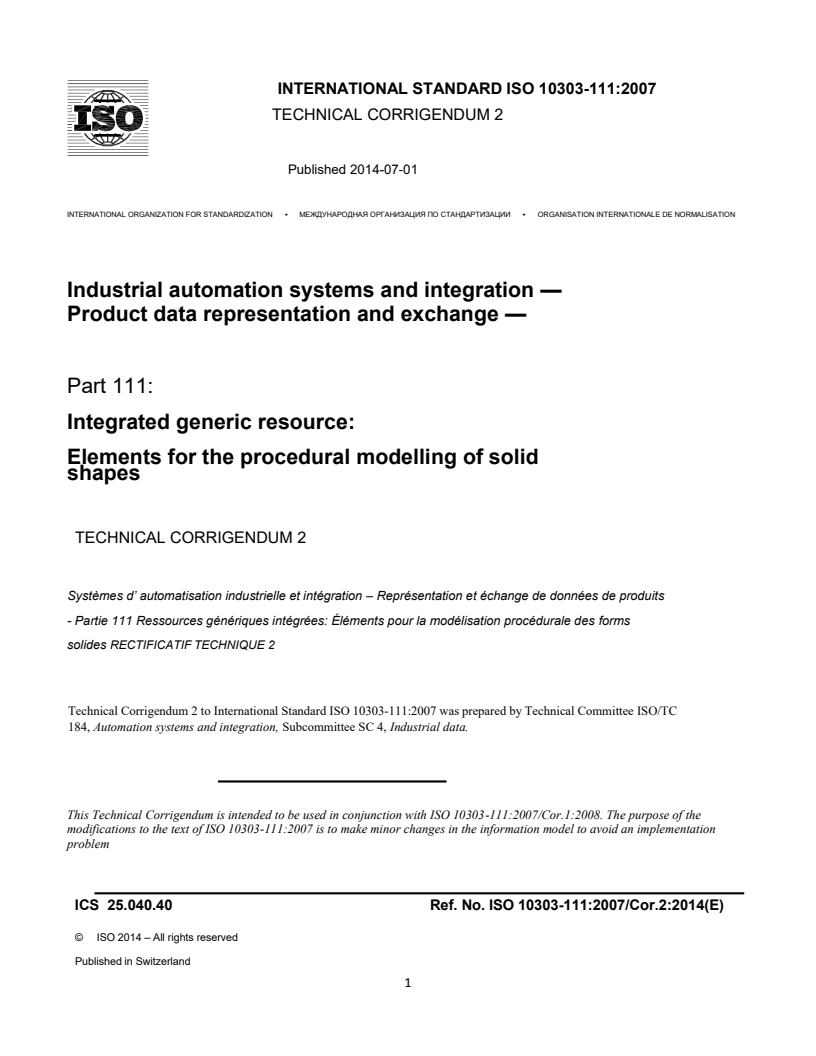
INTERNATIONAL STANDARD ISO 10303-111:2007
TECHNICAL CORRIGENDUM 2
Published 2014-07-01
INTERNATIONAL ORGANIZATION FOR STANDARDIZATION • МЕЖДУНАРОДНАЯ ОРГАНИЗАЦИЯ ПО СТАНДАРТИЗАЦИИ • ORGANISATION INTERNATIONALE DE NORMALISATION
Industrial automation systems and integration —
Product data representation and exchange —
Part 111:
Integrated generic resource:
Elements for the procedural modelling of solid
shapes
TECHNICAL CORRIGENDUM 2
Systèmes d’ automatisation industrielle et intégration – Représentation et échange de données de produits
- Partie 111 Ressources génériques intégrées: Éléments pour la modélisation procédurale des forms
solides RECTIFICATIF TECHNIQUE 2
Technical Corrigendum 2 to International Standard ISO 10303-111:2007 was prepared by Technical Committee ISO/TC
184, Automation systems and integration, Subcommittee SC 4, Industrial data.
This Technical Corrigendum is intended to be used in conjunction with ISO 10303-111:2007/Cor.1:2008. The purpose of the
modifications to the text of ISO 10303-111:2007 is to make minor changes in the information model to avoid an implementation
problem
ICS 25.040.40 Ref. No. ISO 10303-111:2007/Cor.2:2014(E)
© ISO 2014 – All rights reserved
Published in Switzerland
ISO10303-111: 2007/Cor.2:2014(E)
ModificationstothetextofISO10303-111:2007
Clause4.4.2,edge_blended_solid,pp. 11-12
Replace the EXPRESS code on p. 12 with the following, in which solid_with_variable_radius_edge_-
blend has been removed from the SUPERTYPE OF list:
EXPRESS specification:
)
*
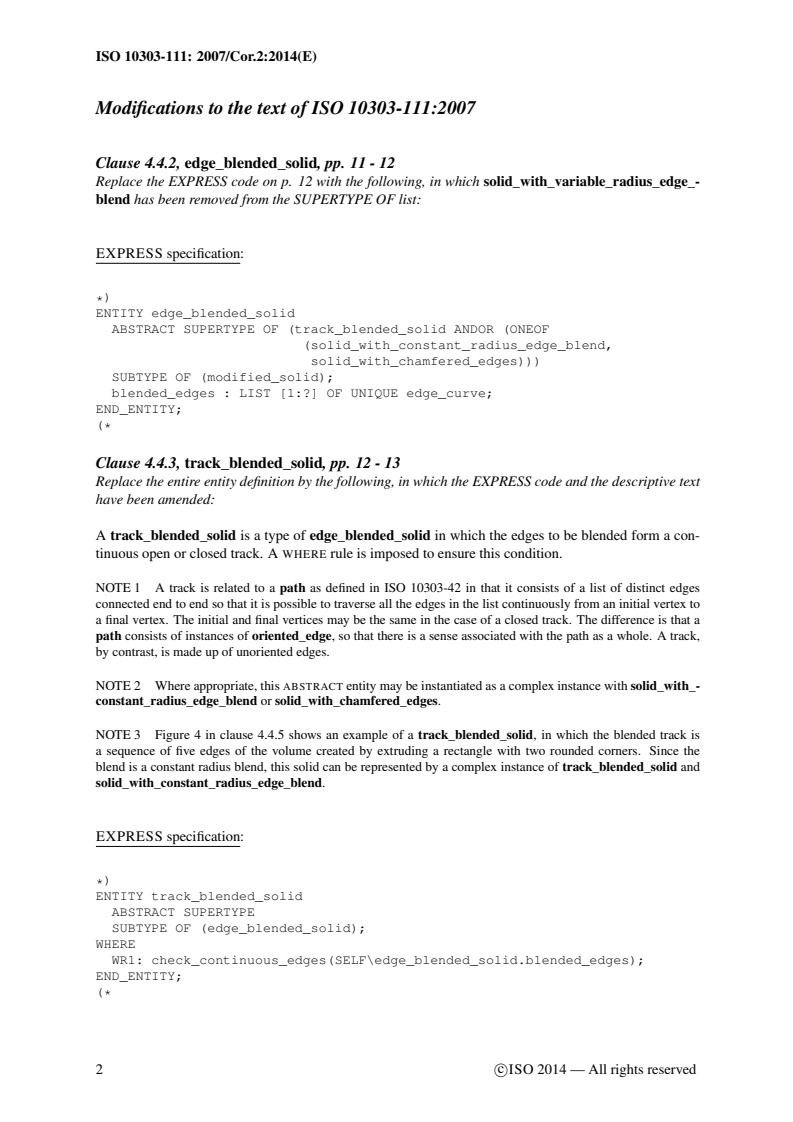
ENTITY edge_blended_solid
ABSTRACT SUPERTYPE OF (track_blended_solid ANDOR (ONEOF
(solid_with_constant_radius_edge_blend,
solid_with_chamfered_edges)))
SUBTYPE OF (modified_solid);
blended_edges : LIST [1:?] OF UNIQUE edge_curve;
END_ENTITY;
(
*
Clause4.4.3,track_blended_solid,pp. 12-13
Replacetheentireentitydefinitionbythefollowing,inwhichtheEXPRESScodeandthedescriptivetext
have been amended:
A track_blended_solid is a type of edge_blended_solid in which the edges to be blended form a con-
tinuousopenorclosedtrack. A WHERE ruleisimposedtoensurethiscondition.
NOTE1 A track is related to a path as defined in ISO 10303-42 in that it consists of a list of distinct edges
connectedendtoendsothatitispossibletotraversealltheedgesinthelistcontinuouslyfromaninitialvertexto
a final vertex. The initial and final vertices may be the same in the case of a closed track. The difference is that a
path consists of instances of oriented_edge, so that there is a sense associated with the path as a whole. A track,
bycontrast,ismadeupofunorientededges.
NOTE2 Whereappropriate,this ABSTRACT entitymaybeinstantiatedasacomplexinstancewithsolid_with_-
constant_radius_edge_blendorsolid_with_chamfered_edges.
NOTE3 Figure 4 in clause 4.4.5 shows an example of a track_blended_solid, in which the blended track is
a sequence of five edges of the volume created by extruding a rectangle with two rounded corners. Since the
blend is a constant radius blend, this solid can be represented by a complex instance of track_blended_solid and
solid_with_constant_radius_edge_blend.
EXPRESS specification:
)
*
ENTITY track_blended_solid
ABSTRACT SUPERTYPE
SUBTYPE OF (edge_blended_solid);
WHERE
WR1: check_continuous_edges(SELF\edge_blended_solid.blended_edges);
END_ENTITY;
(
*
2 ⃝c ISO 2014—Allrightsreserved
ISO10303-111: 2007/Cor.2:2014(E)
Formalpropositions:
WR1: One vertex of each member of the list of edge_curve instances (except the last instance, in the
caseofanopentrack)shallbeidenticalwithonevertexofthefollowingmember.
Clause4.4.6,solid_with_variable_radius_edge_blend,pp. 17-19
Replace the descriptive text and the EXPRESS code of this clause by the following, in which edge_-
blended_solidhasbeenremovedfromtheSUPERTYPEOFlistintheEXPRESScodeandthedescriptive
text has been amended accordingly:
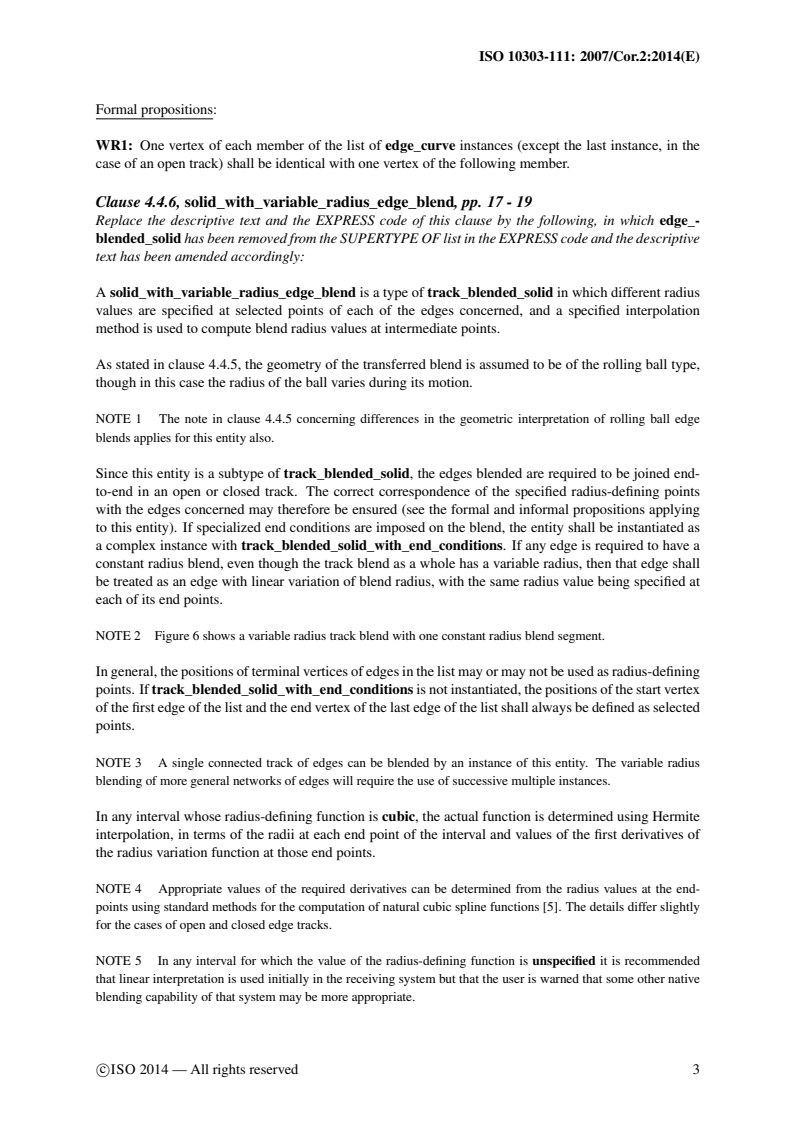
Asolid_with_variable_radius_edge_blendisatypeoftrack_blended_solidinwhichdifferentradius
values are specified at selected points of each of the edges concerned, and a specified interpolation
methodisusedtocomputeblendradiusvaluesatintermediatepoints.
As stated in clause 4.4.5, the geometry of the transferred blend is assumed to be of the rolling ball type,
thoughinthiscasetheradiusoftheballvariesduringitsmotion.
NOTE 1 The note in clause 4.4.5 concerning differences in the geometric interpretation of rolling ball edge
blendsappliesforthisentityalso.
Sinc
...