

ISO 10667-2:2020
(Main)Assessment service delivery — Procedures and methods to assess people in work and organizational settings — Part 2: Requirements for service providers
General Information
- Abstract
This document establishes requirements and guidance for one or more service provider(s) in working with a client to carry out the assessment of an individual, group or organization for work-related purposes and to deliver quality assessment services. This document addresses the requirements for the service provider with respect to, among other areas: a) the choice, integration, implementation and evaluation of assessment procedures and methods in making recommendations to a client who has an assessment need, carrying out and delivering such assessments, and assisting the client in communicating with assessment participants and others; b) the interpretation of assessment results and subsequent reports; c) the collection, processing and storage of personal data of assessment participants and of assessment data; d) ensuring the required competence and professionalism of any person working under its control with a role in the assessment process; e) organizational decisions related to the delivery of assessment services. This document also specifies assessment approaches and procedures that can be carried out for one or more work-related purposes made by or affecting individuals, groups or organizations, including, but not limited to: — employment-related decisions (e.g. recruitment, selection, development, appraisal, promotion, outplacement, succession planning and reassignment); — career-related decisions (e.g. recruiting, coaching, guidance, vocational rehabilitation and outplacement counselling); — group decisions (e.g. training initiatives, team building); — organizational decisions (e.g. restructuring, morale and culture initiatives, mergers and acquisitions). No detailed technical or professional specifications are included within this document; however, an explanation of some of the more common professional quality principles used in assessment (e.g. validity, reliability, fairness, standardization) are included in Annex B. Despite the informative nature of this annex, the quality of assessment procedures and methods is important to the client in relation to the purposes of the assessment, the relevance of the measures involved, their validity, reliability, fairness, standardization and any issues relating to special needs of the assessment participant and other factors that affect the practicality, acceptability and utility of the assessment. NOTE 1 Requirements for the client are specified in ISO 10667-1. NOTE 2 See Bibliography for examples of various professional guidelines and national standards. This document does not detail the specific competences required for assessors as these are dependent upon the nature of the assessment. NOTE 3 See Annex C for further information on assessor competence.
- Status
- Published
- Publication Date
- 03-Nov-2020
- Technical Committee
- ISO/TC 260 - Human resource management
- Drafting Committee
- ISO/TC 260/WG 5 - Recruitment
- Current Stage
- 9092 - International Standard to be revised
- Start Date
- 27-May-2026
- Completion Date
- 29-Aug-2026
Buy Documents

ISO 10667-2:2020 - Assessment service delivery -- Procedures and methods to assess people in work and organizational settings

ISO 10667-2:2020 - Assessment service delivery — Procedures and methods to assess people in work and organizational settings — Part 2: Requirements for service providers/4/2020
Overview
ISO 10667-2:2020 - Assessment service delivery: Requirements for service providers defines requirements and guidance for organizations and vendors that deliver assessments of individuals, groups or organizations in work and organizational settings. It establishes a quality framework for selecting, integrating, implementing and evaluating assessment procedures and methods used for work-related purposes, while addressing data protection, participant rights, assessor competence and organizational decisions that affect assessment services.
Key topics and requirements
- Scope of use: Covers assessments used across the employment life cycle - recruitment, selection, development, appraisal, promotion, outplacement, succession planning, career guidance, team building, organizational change and more.
- Agreement procedures: Clarifies responsibilities in the contract between client and service provider, including scope, deliverables and communication.
- Pre‑assessment requirements: Guidance on identifying assessment needs, recommending services and establishing assessment agreements.
- Assessment delivery lifecycle: Planning, security, informing participants, conducting assessments, interpreting results, reporting, feedback and evaluation (ongoing monitoring and periodic review).
- Data protection and confidentiality: Requirements for collection, processing, storage and access control of personal and assessment data; participant privacy and security of assessment materials.
- Competence and professionalism: Assurance that personnel involved in assessment are competent and trained; Annex C provides supplemental information on assessor competence.
- Quality principles: Emphasis on evidence‑based practice and professional quality concepts (validity, reliability, fairness, standardization) - explained in Annex B (informative), though the standard does not set detailed technical specifications.
- Technology considerations: Addresses use of new technologies (e.g., algorithmic analysis, AI/ML) and associated implications for assessment quality and transparency.
- Post‑assessment review: Procedures for evaluating outcomes and potential consequences, and for conducting supplementary research activities.
Practical applications and users
ISO 10667-2 is intended for:
- Assessment service providers (external vendors and internal HR/assessment teams)
- HR professionals, talent acquisition and development specialists
- Occupational psychologists, career counsellors and consultants
- Regulators and procurement teams seeking to benchmark quality of assessment services
Typical applications include ensuring fair, valid and secure delivery of selection tests, developmental assessments, succession planning exercises, team diagnostics, organizational surveys and career/vocational counselling.
Related standards
- ISO 10667-1 - Requirements for the client (complements Part 2)
- Produced by ISO/TC 260 (Human resource management); Annexes A–D provide guidance on participant rights, technical documentation, interpretation and reporting.
Keywords: ISO 10667-2:2020, assessment service delivery, assessment providers, work-related assessments, validity, reliability, data protection, HR assessment standards.
Relations
- Effective Date
- 21-Oct-2017
Buy Documents
ISO 10667-2:2020 - Assessment service delivery -- Procedures and methods to assess people in work and organizational settings
ISO 10667-2:2020 - Assessment service delivery — Procedures and methods to assess people in work and organizational settings — Part 2: Requirements for service providers/4/2020
Get Certified
Connect with accredited certification bodies for this standard

Great Wall Tianjin Quality Assurance Center
Established 1993, first batch to receive national accreditation with IAF recognition.
Hong Kong Quality Assurance Agency (HKQAA)
Hong Kong's leading certification body.

Innovative Quality Certifications Pvt. Ltd. (IQCPL)
Known for integrity, providing ethical & impartial Assessment & Certification. CMMI Institute Partner.
Sponsored listings
Frequently Asked Questions
ISO 10667-2:2020 is a standard published by the International Organization for Standardization (ISO). Its full title is "Assessment service delivery — Procedures and methods to assess people in work and organizational settings — Part 2: Requirements for service providers". This standard covers: This document establishes requirements and guidance for one or more service provider(s) in working with a client to carry out the assessment of an individual, group or organization for work-related purposes and to deliver quality assessment services. This document addresses the requirements for the service provider with respect to, among other areas: a) the choice, integration, implementation and evaluation of assessment procedures and methods in making recommendations to a client who has an assessment need, carrying out and delivering such assessments, and assisting the client in communicating with assessment participants and others; b) the interpretation of assessment results and subsequent reports; c) the collection, processing and storage of personal data of assessment participants and of assessment data; d) ensuring the required competence and professionalism of any person working under its control with a role in the assessment process; e) organizational decisions related to the delivery of assessment services. This document also specifies assessment approaches and procedures that can be carried out for one or more work-related purposes made by or affecting individuals, groups or organizations, including, but not limited to: — employment-related decisions (e.g. recruitment, selection, development, appraisal, promotion, outplacement, succession planning and reassignment); — career-related decisions (e.g. recruiting, coaching, guidance, vocational rehabilitation and outplacement counselling); — group decisions (e.g. training initiatives, team building); — organizational decisions (e.g. restructuring, morale and culture initiatives, mergers and acquisitions). No detailed technical or professional specifications are included within this document; however, an explanation of some of the more common professional quality principles used in assessment (e.g. validity, reliability, fairness, standardization) are included in Annex B. Despite the informative nature of this annex, the quality of assessment procedures and methods is important to the client in relation to the purposes of the assessment, the relevance of the measures involved, their validity, reliability, fairness, standardization and any issues relating to special needs of the assessment participant and other factors that affect the practicality, acceptability and utility of the assessment. NOTE 1 Requirements for the client are specified in ISO 10667-1. NOTE 2 See Bibliography for examples of various professional guidelines and national standards. This document does not detail the specific competences required for assessors as these are dependent upon the nature of the assessment. NOTE 3 See Annex C for further information on assessor competence.
This document establishes requirements and guidance for one or more service provider(s) in working with a client to carry out the assessment of an individual, group or organization for work-related purposes and to deliver quality assessment services. This document addresses the requirements for the service provider with respect to, among other areas: a) the choice, integration, implementation and evaluation of assessment procedures and methods in making recommendations to a client who has an assessment need, carrying out and delivering such assessments, and assisting the client in communicating with assessment participants and others; b) the interpretation of assessment results and subsequent reports; c) the collection, processing and storage of personal data of assessment participants and of assessment data; d) ensuring the required competence and professionalism of any person working under its control with a role in the assessment process; e) organizational decisions related to the delivery of assessment services. This document also specifies assessment approaches and procedures that can be carried out for one or more work-related purposes made by or affecting individuals, groups or organizations, including, but not limited to: — employment-related decisions (e.g. recruitment, selection, development, appraisal, promotion, outplacement, succession planning and reassignment); — career-related decisions (e.g. recruiting, coaching, guidance, vocational rehabilitation and outplacement counselling); — group decisions (e.g. training initiatives, team building); — organizational decisions (e.g. restructuring, morale and culture initiatives, mergers and acquisitions). No detailed technical or professional specifications are included within this document; however, an explanation of some of the more common professional quality principles used in assessment (e.g. validity, reliability, fairness, standardization) are included in Annex B. Despite the informative nature of this annex, the quality of assessment procedures and methods is important to the client in relation to the purposes of the assessment, the relevance of the measures involved, their validity, reliability, fairness, standardization and any issues relating to special needs of the assessment participant and other factors that affect the practicality, acceptability and utility of the assessment. NOTE 1 Requirements for the client are specified in ISO 10667-1. NOTE 2 See Bibliography for examples of various professional guidelines and national standards. This document does not detail the specific competences required for assessors as these are dependent upon the nature of the assessment. NOTE 3 See Annex C for further information on assessor competence.
ISO 10667-2:2020 is classified under the following ICS (International Classification for Standards) categories: 03.080.30 - Services for consumers. The ICS classification helps identify the subject area and facilitates finding related standards.
ISO 10667-2:2020 has the following relationships with other standards: It is inter standard links to ISO 10667-2:2011. Understanding these relationships helps ensure you are using the most current and applicable version of the standard.
ISO 10667-2:2020 is available in PDF format for immediate download after purchase. The document can be added to your cart and obtained through the secure checkout process. Digital delivery ensures instant access to the complete standard document.
Standards Content (Sample)
INTERNATIONAL ISO
STANDARD 10667-2
Second edition
2020-11
Assessment service delivery —
Procedures and methods to assess
people in work and organizational
settings —
Part 2:
Requirements for service providers
Livraison d'un service d'évaluation — Modes opératoires et
méthodes d'évaluation des personnes au travail et des paramètres
organisationnels —
Partie 2: Exigences pour les fournisseurs de service
Reference number
©
ISO 2020
© ISO 2020
All rights reserved. Unless otherwise specified, or required in the context of its implementation, no part of this publication may
be reproduced or utilized otherwise in any form or by any means, electronic or mechanical, including photocopying, or posting
on the internet or an intranet, without prior written permission. Permission can be requested from either ISO at the address
below or ISO’s member body in the country of the requester.
ISO copyright office
CP 401 • Ch. de Blandonnet 8
CH-1214 Vernier, Geneva
Phone: +41 22 749 01 11
Email: copyright@iso.org
Website: www.iso.org
Published in Switzerland
ii © ISO 2020 – All rights reserved
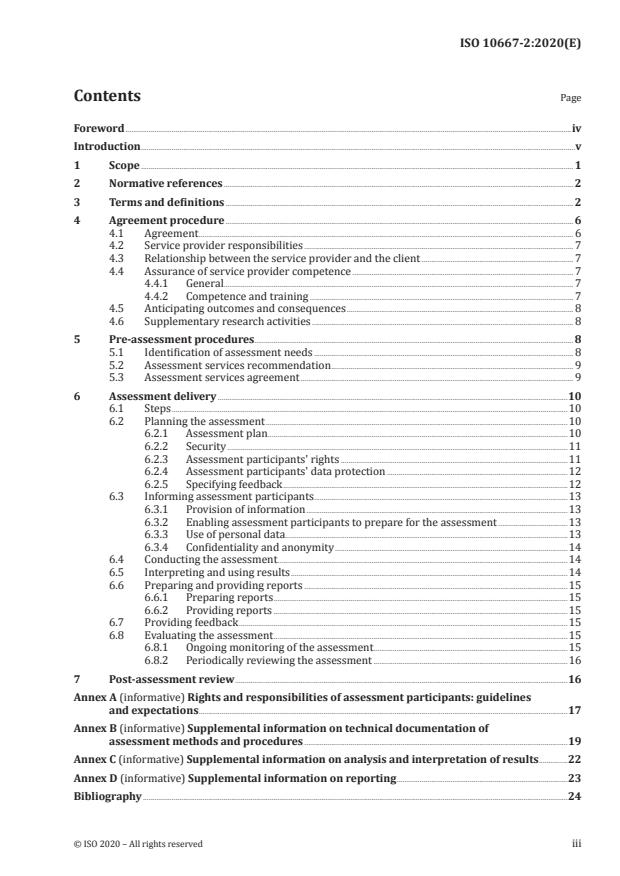
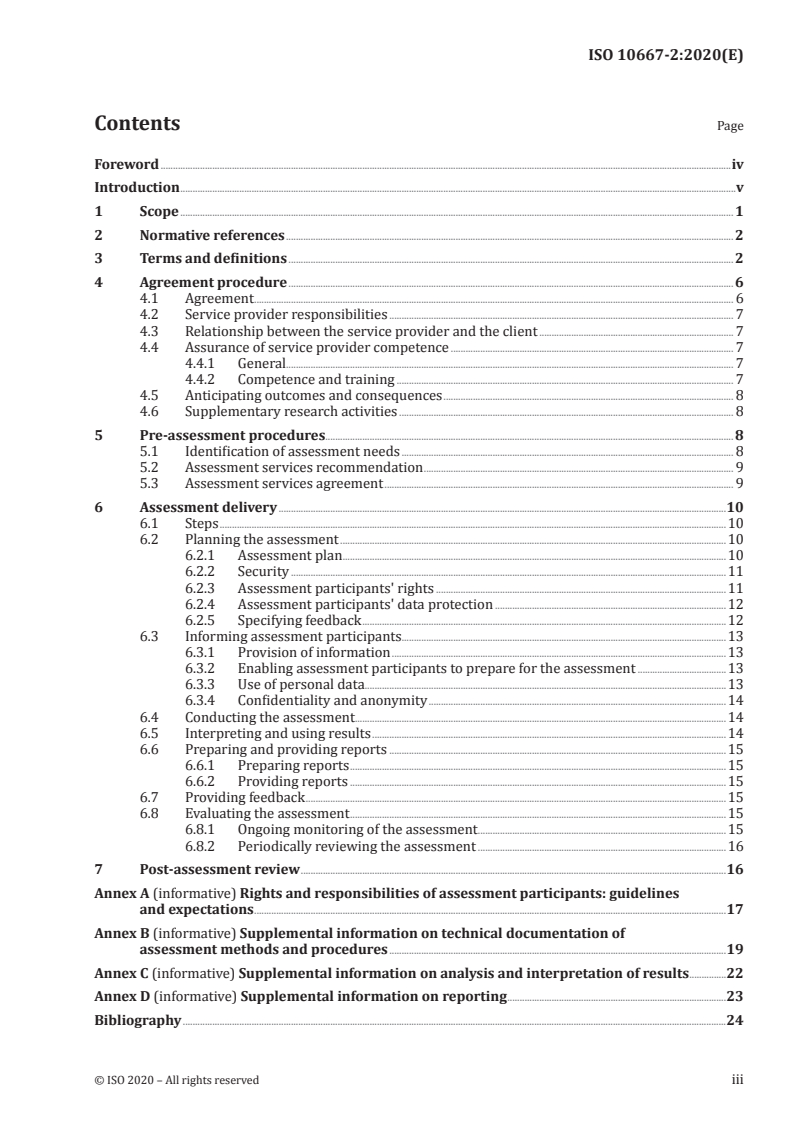
Contents Page
Foreword .iv
Introduction .v
1 Scope . 1
2 Normative references . 2
3 Terms and definitions . 2
4 Agreement procedure . 6
4.1 Agreement . 6
4.2 Service provider responsibilities . 7
4.3 Relationship between the service provider and the client . 7
4.4 Assurance of service provider competence . 7
4.4.1 General. 7
4.4.2 Competence and training . 7
4.5 Anticipating outcomes and consequences . 8
4.6 Supplementary research activities . 8
5 Pre-assessment procedures . 8
5.1 Identification of assessment needs . 8
5.2 Assessment services r ecommendation . 9
5.3 Assessment services agr eement . 9
6 Assessment delivery .10
6.1 Steps .10
6.2 Planning the assessment .10
6.2.1 Assessment plan .10
6.2.2 Security .11
6.2.3 Assessment participants' rights .11
6.2.4 Assessment participants' data protection .12
6.2.5 Specifying feedback .12
6.3 Informing assessment participants.13
6.3.1 Provision of information .13
6.3.2 Enabling assessment participants to prepare for the assessment .13
6.3.3 Use of personal data.13
6.3.4 Confidentiality and anonymity .14
6.4 Conducting the assessment .14
6.5 Interpreting and using results .14
6.6 Preparing and providing reports .15
6.6.1 Preparing reports .15
6.6.2 Providing reports .15
6.7 Providing feedback .15
6.8 Evaluating the assessment .15
6.8.1 Ongoing monitoring of the assessment .15
6.8.2 Periodically reviewing the assessment .16
7 Post-assessment review .16
Annex A (informative) Rights and responsibilities of assessment participants: guidelines
and expectations .17
Annex B (informative) Supplemental information on technical documentation of
assessment methods and procedures .19
Annex C (informative) Supplemental information on analysis and interpretation of results .22
Annex D (informative) Supplemental information on reporting .23
Bibliography .24
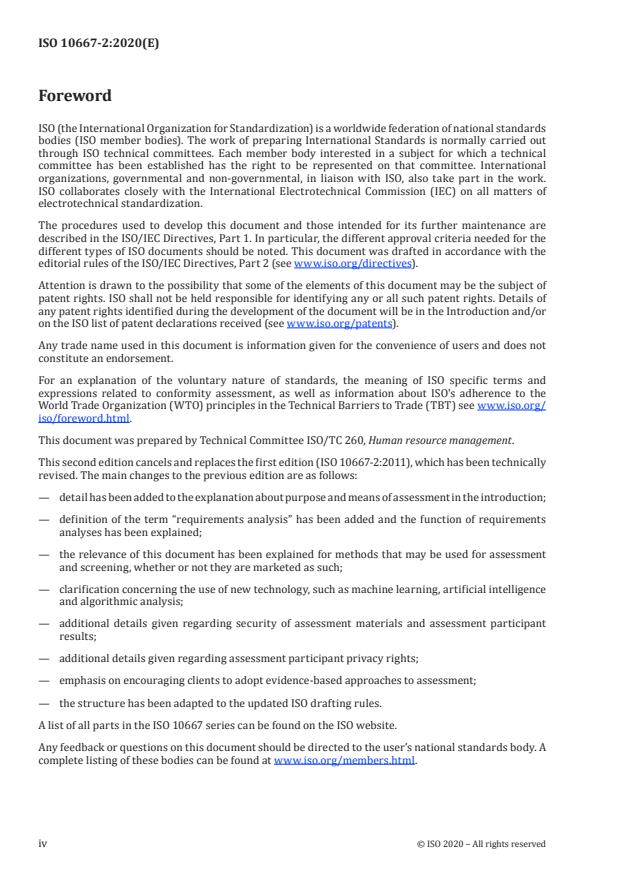
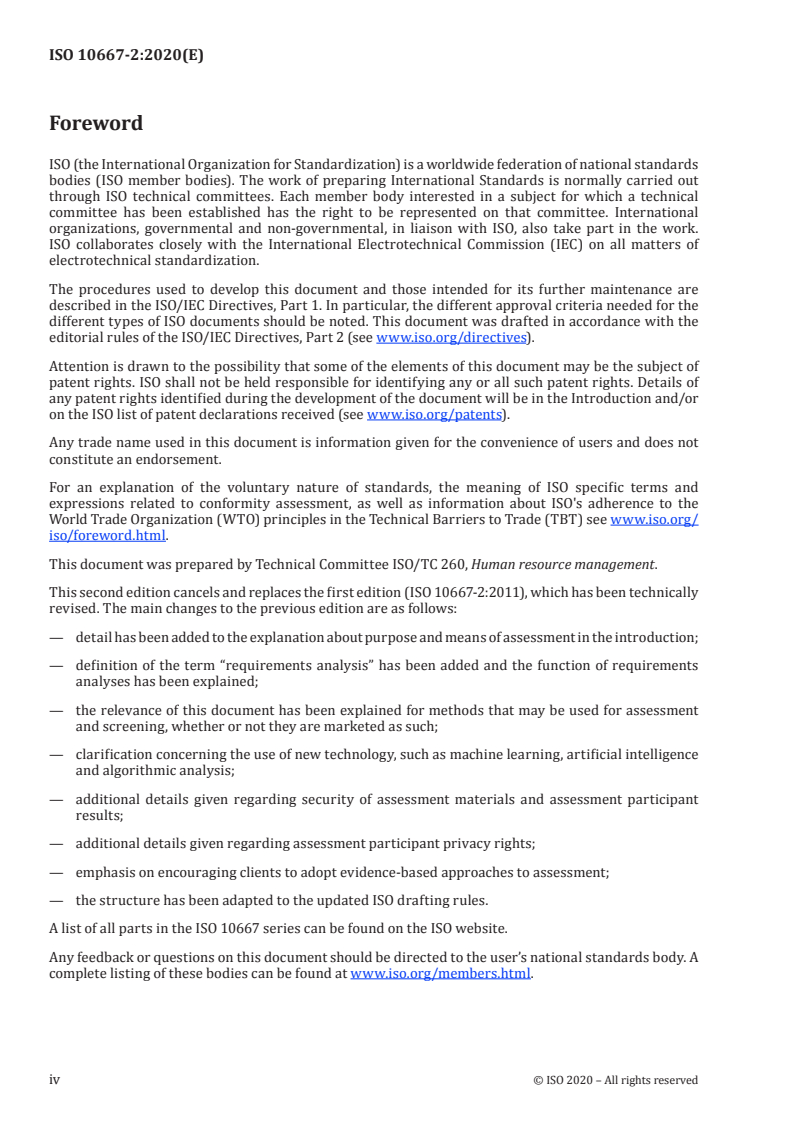
Foreword
ISO (the International Organization for Standardization) is a worldwide federation of national standards
bodies (ISO member bodies). The work of preparing International Standards is normally carried out
through ISO technical committees. Each member body interested in a subject for which a technical
committee has been established has the right to be represented on that committee. International
organizations, governmental and non-governmental, in liaison with ISO, also take part in the work.
ISO collaborates closely with the International Electrotechnical Commission (IEC) on all matters of
electrotechnical standardization.
The procedures used to develop this document and those intended for its further maintenance are
described in the ISO/IEC Directives, Part 1. In particular, the different approval criteria needed for the
different types of ISO documents should be noted. This document was drafted in accordance with the
editorial rules of the ISO/IEC Directives, Part 2 (see www .iso .org/ directives).
Attention is drawn to the possibility that some of the elements of this document may be the subject of
patent rights. ISO shall not be held responsible for identifying any or all such patent rights. Details of
any patent rights identified during the development of the document will be in the Introduction and/or
on the ISO list of patent declarations received (see www .iso .org/ patents).
Any trade name used in this document is information given for the convenience of users and does not
constitute an endorsement.
For an explanation of the voluntary nature of standards, the meaning of ISO specific terms and
expressions related to conformity assessment, as well as information about ISO's adherence to the
World Trade Organization (WTO) principles in the Technical Barriers to Trade (TBT) see www .iso .org/
iso/ foreword .html.
This document was prepared by Technical Committee ISO/TC 260, Human resource management.
This second edition cancels and replaces the first edition (ISO 10667-2:2011), which has been technically
revised. The main changes to the previous edition are as follows:
— detail has been added to the explanation about purpose and means of assessment in the introduction;
— definition of the term “requirements analysis” has been added and the function of requirements
analyses has been explained;
— the relevance of this document has been explained for methods that may be used for assessment
and screening, whether or not they are marketed as such;
— clarification concerning the use of new technology, such as machine learning, artificial intelligence
and algorithmic analysis;
— additional details given regarding security of assessment materials and assessment participant
results;
— additional details given regarding assessment participant privacy rights;
— emphasis on encouraging clients to adopt evidence-based approaches to assessment;
— the structure has been adapted to the updated ISO drafting rules.
A list of all parts in the ISO 10667 series can be found on the ISO website.
Any feedback or questions on this document should be directed to the user’s national standards body. A
complete listing of these bodies can be found at www .iso .org/ members .html.
iv © ISO 2020 – All rights reserved
Introduction
0.1 General
The ISO 10667 series ensures that the benefits of using assessments are realized. This document
focuses on aspects of the quality of assessment service delivery in work and organizational settings
that occur across the employment life cycle, such as recruitment and selection; career or vocational
guidance; learning and development; succession planning; and outplacement. This document
establishes a framework for the assessment process. Its scope covers how all assessments in work and
organizational settings are carried out (directly to assessment participants and indirectly to users of
assessment data). It also identifies core concepts, related to assessment, such as use of evidence-based
approaches, fairness and validity to enhance quality and utility in any assessment process.
The ISO 10667 series consists of two parts:
— Part 1 addresses the responsibilities of a client;
— Part 2 addresses the responsibilities of a service provider.
This document also provides a framework within which to position more specific national and
international standards and qualifications related to assessments.
The ISO 10667 series presents an evidence-based perspective of the assessment service delivery
process that has worldwide applicability. It enables an organization to become a more effective user
of assessment, making better hiring decisions and enhancing the potential, well-being and employee-
organization fit of all its employees. This document promotes the provision of standardized, appropriate
and equitable delivery of assessment services. It also enables regulatory bodies, other authorities and
society at large to have more confidence in assessment procedures.
The ISO 10667 series provides clear and concise requirements and guidance for the clients who require
assessment services and their service providers, in order to enable all stakeholders to realize the
potential benefits of good assessment practices. This is achieved by:
— defining good practice for assessment procedures and methods;
— ensuring fairness in the application of assessment procedures;
— enabling appropriate evaluation of the quality of assessment service provision;
— exploring advantages and disadvantages resulting from and/or associated with implementation of
assessment services and procedures.
It is likely that users of the ISO 10667 series initially possess very different levels of competence,
understanding and familiarity with the concepts involved in the development of standardized
procedures and methods to assess individuals, groups and organizations in the occupational arena.
Accordingly, in order to facilitate its use by a variety of stakeholders and to provide guidance about the
background of the ISO 10667 series, this introduction presents key information about the utility, intent
and layout of the ISO 10667 series.
0.2 Function of the ISO 10667 series
The ISO 10667 series relates to the delivery of assessments used at the individual, group and
organizational levels. The ISO 10667 series aims to promote good practices and to encourage clear
documentation of the working relationship between a client and its service provider(s) involved in the
assessment delivery process.
The aim of the ISO 10667 series is not that organizations – especially small and medium-sized
organizations – are necessarily forced to work with external providers to further improve the quality
of their assessment processes. In fact the ISO 10667 series is guidance for organizations to implement
assessment processes with or without any external support.
It functions as practical guidance for both the client and the service provider(s) involved in the
assessment delivery process. It describes their respective obligations and responsibilities before,
during and after the assessment process. It also provides guidance on the rights and responsibilities
of assessment participants and others involved in assessment procedures, including recipients of the
assessment results.
Figure 1 provides an overview of the possible interactions and relationships between the different
parties in the assessment process.
Figure 1 — Roles in the assessment process
NOTE Parties in the assessment process have different roles and interact with each other throughout the
assessment process. In addition, a single party can serve multiple roles. For example, in a career counselling
setting, a participant purchases the services and thus is also the client; an internal HR team provides services to
the organization and at the same time uses assessment services provided by external vendors.
0.3 Intended users of the ISO 10667 series
The ISO 10667 series is intended for clients and service providers who need to work both sequentially
and collaboratively in order to ensure effective delivery of assessment services. ISO 10667-1 provides
requirements and guidance for the client. This document provides requirements and guidance for the
service provider. A client should be aware of and adhere to ISO 10667-1 in initiating an appropriate
request for assessment services, including fully disclosing its assessment needs and implementing the
requirements of ISO 10667-1. However, if a service provider learns that a prospective client is not aware
of or using ISO 10667-1, it should inform the client of these best practices and encourage the client to act
in accordance with ISO 10667-1 with respect to the entire assessment process.
A service provider is involved in the provision of assessment services in work and organizational
settings, either as an internal employee of a client or as an external contractor. A client is the person
seeking assessment services for himself or herself, or an organization seeking assessment services for
individuals or groups within the organization or for the organization itself.
In both parts of the ISO 10667 series, Annex A outlines the rights and responsibilities of the assessment
participant.
0.4 Other stakeholders
In addition to service providers, clients and assessment participants, stakeholders might include the
following.
a) End users of assessment information within an organization who make strategic decisions,
operational decisions (e.g. hiring managers in the case of assessment for selection, human resources
vi © ISO 2020 – All rights reserved
managers in the case of succession planning or organizational talent management, executive
management in the case of mergers and acquisitions) or both;
NOTE In some countries work councils or employee representatives also have access to the assessment
information.
b) External intermediaries or indirect users include, but are not limited to:
1) developers and distributors of assessment procedures;
2) recruiters, coaches and outplacement counsellors;
3) organizations that provide assessment for licensing or certification of people;
4) assessors of training or vocational education programmes;
5) policymakers (e.g. human resources managers setting organizational assessment policy,
work councils engaged in assessment policy and procedure, external policy makers such as
professional bodies, regulatory authorities and others who rely on the results of assessment).
0.5 Assessment level categories
The ISO 10667 series covers procedures and methods for the following levels of assessment:
a) individual level assessment;
b) group level assessment;
c) organizational level assessment.
0.6 Purpose of assessment
The ISO 10667 series covers all assessments that occur within an employment or occupational context.
Aspects of the employment life cycle where assessment is commonly used include, but are not limited to:
a) internship and trainee programs;
b) recruitment and selection;
c) career or vocational guidance;
d) job rotation, career change or reintegration into the workforce;
e) development, coaching and mentoring;
f) promotion and succession planning;
g) outplacement and job separation;
h) retirement planning;
i) performance management;
j) employee satisfaction, culture change due to merger or acquisition, employee engagement levels of
organizational business units;
k) determination of eligibility, qualifications or both in certain job categories, including for health and
safety or regulatory compliance.
0.7 Means of assessment
The ISO 10667 series covers procedures and methods that are used for the purposes specified in 0.6 and
targeting the levels specified in 0.5. Such methods include, but are not limited to, interviews; behaviour
observations and simulations; document analysis; questionnaires; CV parsing; voice and video analysis;
algorithm-based screening and selection; surveillance methods; and other assessment procedures and
approaches used to collect assessment data regardless of how they are developed and marketed (e.g.
artificial intelligence).
0.8 Organization of the ISO 10667 series
To build an efficient standard, useful to both the client and the service provider, the assessment process
has been divided into four stages:
— agreement procedures;
— pre-assessment procedures;
— assessment delivery;
— post-assessment review.
This document addresses the requirements applicable to a client who determines that they have a
need for one or more assessments for use in the employment life cycle, and then seeks to obtain such
assessment services from a service provider it selects. This document addresses the requirements
applicable to a service provider from whom a client seeks recommendations about what assessments
might meet its needs, and then provides assessment services to a client once it is selected based on
those recommendations.
In both parts of the ISO 10667 series, each assessment stage is covered in a separate clause (see
Clauses 4, 5, 6 and 7) as follows.
a) Agreement procedures (Clause 4) describe mutual responsibilities and obligations of the client and
the service provider, as well as the format of their agreement and a description of what must be
covered in the agreement; documenting the agreement between the client and the service provider
through a written statement of work, or contract, as appropriate.
b) Pre-assessment procedures (Clause 5) covers:
1) identifying what needs to be assessed and how, together with choosing the criteria for
evaluating success and having a clear expectation of the utility of the process;
2) determining whether there are conflicting interests that need to be balanced;
3) providing a clear rationale for the assessment.
c) Assessment delivery (Clause 6) covers all phases of preparing for and carrying out the assessments.
d) Post-assessment review (Clause 7) evaluates the assessment process and the assessment results
to determine whether the outcomes, consequences and utility of the assessment are consistent
with the assessment needs, whether the goals are met and what changes in the assessment process
should be adopted for future use by the client.
viii © ISO 2020 – All rights reserved
INTERNATIONAL STANDARD ISO 10667-2:2020(E)
Assessment service delivery — Procedures and methods to
assess people in work and organizational settings —
Part 2:
Requirements for service providers
1 Scope
This document establishes requirements and guidance for one or more service provider(s) in working
with a client to carry out the assessment of an individual, group or organization for work-related
purposes and to deliver quality assessment services.
This document addresses the requirements for the service provider with respect to, among other areas:
a) the choice, integration, implementation and evaluation of assessment procedures and methods in
making recommendations to a client who has an assessment need, carrying out and delivering such
assessments, and assisting the client in communicating with assessment participants and others;
b) the interpretation of assessment results and subsequent reports;
c) the collection, processing and storage of personal data of assessment participants and of
assessment data;
d) ensuring the required competence and professionalism of any person working under its control
with a role in the assessment process;
e) organizational decisions related to the delivery of assessment services.
This document also specifies assessment approaches and procedures that can be carried out for one or
more work-related purposes made by or affecting individuals, groups or organizations, including, but
not limited to:
— employment-related decisions (e.g. recruitment, selection, development, appraisal, promotion,
outplacement, succession planning and reassignment);
— career-related decisions (e.g. recruiting, coaching, guidance, vocational rehabilitation and
outplacement counselling);
— group decisions (e.g. training initiatives, team building);
— organizational decisions (e.g. restructuring, morale and culture initiatives, mergers and
acquisitions).
No detailed technical or professional specifications are included within this document; however,
an explanation of some of the more common professional quality principles used in assessment (e.g.
validity, reliability, fairness, standardization) are included in Annex B. Despite the informative nature
of this annex, the quality of assessment procedures and methods is important to the client in relation
to the purposes of the assessment, the relevance of the measures involved, their validity, reliability,
fairness, standardization and any issues relating to special needs of the assessment participant and
other factors that affect the practicality, acceptability and utility of the assessment.
NOTE 1 Requirements for the client are specified in ISO 10667-1.
NOTE 2 See Bibliography for examples of various professional guidelines and national standards.
This document does not detail the specific competences required for assessors as these are dependent
upon the nature of the assessment.
NOTE 3 See Annex C for further information on assessor competence.
2 Normative references
The following documents are referred to in the text in such a way that some or all of their content
constitutes requirements of this document. For dated references, only the edition cited applies. For
undated references, the latest edition of the referenced document (including any amendments) applies.
ISO 30400, Human resource management — Vocabulary
3 Terms and definitions
For the purposes of this document, the terms and definitions given in ISO 30400 and the following apply.
ISO and IEC maintain terminological databases for use in standardization at the following addresses:
— ISO Online browsing platform: available at https:// www .iso .org/ obp
— IEC Electropedia: available at http:// www .electropedia .org/
3.1
agreement
specification of the terms and conditions of the engagement between the client (3.6) and the service
provider (3.25)
EXAMPLE Details of the service or products to be delivered, duration, scope, ownership and appropriate use
of intellectual property and costs.
3.2
assessment
systematic method and procedure for ascertaining or measuring work-related knowledge, skills,
abilities or other characteristics of an individual or group of individuals, or the performance of an
individual or group of individuals
Note 1 to entry: An assessment has outcomes and consequences that can be appraised and used to evaluate
its utility. Forms of assessment can include, but are not limited to, structured application forms; biographical
data inventories; tests of general and specific abilities; self-report inventories and other instruments relating to
competencies, personality, motivation, attitudes, values, beliefs and interests; structured interviews; individual
problem-solving tasks; group exercises; simulations and work samples; group and organizational level measures;
employee surveys; multi-rater feedback; and performance evaluations (e.g. assessor interpretations, supervisor
performance ratings).
Note 2 to entry: Assessment tools, approaches and solutions are promoted and marketed under other labels
when in fact they are assessments that relate to people decisions such as screening, pre-screening, search
and evaluation of personal/social media data, resume parsing, natural language processing, voice and video
analysis, algorithm-based decisions or artificial intelligence technology. In order to provide clients with suitable
information on any type of instrument, regardless of the traditional definitions or the marketing label, any tool
that is used, marketed or promoted for direct or indirect assessment purposes is covered by the ISO 10667 series.
3.3
assessment administrator
person or organization having operational responsibility for the administration of assessments (3.2)
Note 1 to entry: Tasks of the assessment administrator include, but are not limited to, face-to-face test
administration; setting up online assessments; remote monitoring; management of activities within an
assessment centre; and other administrative tasks. In some countries, assessment administrators are referred to
as “test proctors”, “test assistants” or “monitors”. An assessment administrator can be an employee of the service
provider or the client, or a third party contracted for the purposes of the assessment.
2 © ISO 2020 – All rights reserved
3.4
assessment participant
individual being assessed, whether for personal purposes or for an organization, either individually or
as part of a group
Note 1 to entry: Assessment participants include, but are not limited to:
— job applicants or candidates;
— employees being assessed for promotion or other internal organizational purposes;
— members of a team being assessed as a group;
— members of an organization being assessed as a system;
— individuals seeking counselling or career guidance.
3.5
assessor
person or organization responsible for evaluating and interpreting an assessment participant’s (3.4)
performance on the assessment (3.2) tasks and providing appropriate reporting and feedback (3.15) to
assessment participants and the client (3.6)
Note 1 to entry: An assessor is competent to make decisions about the use and interpretation of assessment
procedures. In relation to psychological testing, in some countries they are referred to as “test users” to
distinguish them from “test proctors”, “test administrators” or “monitors”. An assessor can be an employee of the
service provider or the client, or a third party contracted by either for the purposes of the assessment.
3.6
client
individual or organization who arranges with a service provider (3.25) to deliver the assessment (3.2)
and related components of the assessment service provision
EXAMPLE A client can be:
a) an individual, for personal benefit (e.g. career-related decisions informed by assessment results including
coaching, guidance, vocational rehabilitation and counselling) or for others (e.g. licensure and certification
bodies);
b) an organization, for assessments of the organization itself (e.g. engagement surveys, assessment of working
conditions, work satisfaction surveys) or of individuals, groups or both within the organization (e.g. making
employment-related decisions such as recruitment, selection, development, promotion, outplacement,
succession planning and reassignment).
Note 1 to entry: Sometimes the assessment participant is also the client. In ISO 10667-1, when the client is the
individual being assessed, that person is referred to as the assessment participant.
3.7
competence
possession of adequate knowledge and skills by education or training to use, interpret
and deliver assessments (3.2) to a level of performance defined by professional guidelines
Note 1 to entry: In the ISO 10667 series, competence refers to the assessor as well as to all those working under
the assessor’s supervision, where appropriate, and not to the assessment participant.
Note 2 to entry: Competence does not necessarily imply eligibility to practice in all countries.
3.8
credential
licence, registration, certification or diploma that indicates a level of competence for specific practice
3.9
criteria
work-related measures or outcomes that are used to judge the meaningfulness, predictive value or
utility (3.27) of the assessment (3.2) results
3.10
data controller
person or organization who determines the purposes for which and the manner in which any personal
data (3.18) are to be collected, processed and stored
3.11
data processor
person [other than an employee of the data controller (3.10)] or organization that collects, processes
and stores personal data (3.18) on behalf of the data controller
3.12
end user
person or organization that uses the assessment (3.2) results to guide a decision or further action
Note 1 to entry: This might be the client or an intermediary person in the assessment process, such as a line
manager. In other instances, the end user might be the assessment participant.
3.13
fairness
principle that every assessment participant (3.4) should be assessed using procedures that are equitable
and as far as possible free from systematic bias
3.14
evidence-based
based on a systematic review of available research, data, theory and other evidence which supports the
quality and relevance of the outcome of the action or decision in a particular context for a particular use
Note 1 to entry: See Annex B for notes on principles of evidence-based approach to assessment.
3.15
feedback
information provided to the assessment participant (3.4) about his or her assessment (3.2) results
Note 1 to entry: Feedback may be provided in different forms, formats and channels, including, but not limited to,
oral or written.
3.16
informed consent
process of providing information regarding the assessment (3.2) itself, its purpose and its possible
consequences for each intended use and in order to obtain agreement (3.1) from the assessment
participant (3.4) to participate in the assessment process and to collect, process and use the participant’s
personal data (3.18)
Note 1 to entry: Pursuant to applicable laws, regulations, or corporate policies, assessment participants may
withdraw from an assessment after having provided consent, but doing so might result in consequences that
should have been explained to the assessment participant at the time of first soliciting consent.
Note 2 to entry: In some circumstances consent is implicit rather than explicit. For example, consent is implied
in compliance with the process, or where an alternative basis has been identified and noted for collecting,
processing and using the participant’s personal data (e.g. a contract between the client and the participant or the
processor and the participant).
4 © ISO 2020 – All rights reserved
3.17
norm
information, based on the scores obtained from a sample (often referred to as a norm group) of some
well-defined population of people (often referred to as the norm population), which enables raw scores,
such as the number of questions correct or the sum of the ratings given to items on a scale, to be
converted into percentile or standard scores (i.e. scores which relate the scores to the distribution of
scores in the norm population)
Note 1 to entry: Typical percentile scores include grades based on the top 10 % of a population, the next 20 %,
the mid 40 %, the next 20 % and the bottom 10 %, respectively; or deciles, which represent 10 % bands of the
reference population. Typical standard scores include z-scores (with a mean of zero and standard deviation of
one); STENS (mean 5,5, standard deviation 2); and T scores (mean 50 and standard deviation 10).
3.18
personal data
data, including personal information, that are identifiable as relating to a particular assessment
participant (3.4)
Note 1 to entry: Personal data does not include data obtained from the assessment participant that are anonymous
or that have been subsequently rendered anonymous. Jurisdictions may specify criteria for anonymization.
Note 2 to entry: Jurisdictions specify criteria for which assessment data are classified as personal data.
3.19
post-assessment review
procedure designed to evaluate whether and to what extent the assessment (3.2) met its objectives,
including the requirements set out in the written record between the client (3.6) and the service provider
(3.25), together with identification of opportunities for improving future assessments
3.20
professionalism
acting in a manner consistent with conduct and practices, including, where applicable, a code of ethics,
adopted by or associated with the assessment (3.2) profession, requiring systematic knowledge and
proficiency, and being aware of one’s limitations and not acting outside one’s area of competence (3.7)
3.21
reliability
amount of systematic variance free from measurement error within the test scores, ratings or both
Note 1 to entry: Based on the reliability a band of error within which an assessment result should be interpreted
can be specified.
Note 2 to entry: Different reliability coefficients (e.g. test-retest reliability, Cronbach alpha, McDonald’s omega)
can be used to estimate reliability. Such coefficients can be obtained by examining the consistency of measures
produced by assessment participants or assessors within administrations of assessment methods, or over
repeated administrations.
3.22
report
written document that describes an interpretation of the assessment (3.2) result for an individual or
group for each intended use
3.23
requirements analysis
systematic process to understand in sufficient detail the assessment (3.2) need and the organisational
context fit in order to specify appropriate assessment (3.2) methods
Note 1 to entry: A job analysis or a job task analysis may be part of the requirements analysis.
Note 2 to entry: For an individual assessment for selection purposes such a process would provide information
on the relevance and appropriate level of requirements, such as knowledge, skills, abilities, interests, personality
traits, behavioural styles and motives.
Note 3 to entry: Existing competency models can be used as a source of information for the requirements analysis
as long as they were developed in a systematic approach.
3.24
security
limiting and controlling access to assessment (3.2) materials, scores, reports (3.22) and other
confidential or personal data (3.18) to ensure that they are not made available inappropriately
Note 1 to entry: Security includes, but is not limited to, preventing materials from becoming available in ways
that would enable an assessment participant to gain an unfair advantage over other assessment participants
or would reduce the future value of the assessment materials, and protecting an assessment participant’s
assessment results from unauthorized use or release.
3.25
service provider
person or organization that provides assessment (3.2) services to the client (3.6), whether
that person or organization is internal or external to the client
Note 1 to entry: The service provider might also employ or contract with others for assessment design and
development, for assessor training or for assessment delivery and administration.
3.26
standardized
extent to which assessment (3.2) procedures are based upon the application of rules
and specifications, including all administrative guidance from the assessment developer, in order to
maintain a uniform, constant assessment administration environment, and scoring and interpreting
results of assessments so that the assessment conditions or environments are comparable for all
assessment participants (3.4) taking the same assessment
3.27
utility
value to the client (3.6) of an assessment (3.2), taking into account the costs and benefits associated
with the assessment
Note 1 to entry: This takes into account factors such as cost per administration, time required per administration,
scoring, profiling, report writing, skills required of the assessor and ease of providing assessment participant
feedback.
Note 2 to entry: Non-monetary factors can also be important in determining the value of the assessment to
the client.
3.28
validity
degree to which the interpretation and use of assessment (3.2) scores are consistent with the proposed
purposes of the assessment and are supported by accumulated evidence and theory
Note 1 to entry: The strategy for accumulating evidence of validity is aligned with the type of assessment and the
purpose for which it is being used.
4 Agreement procedure
4.1 Agreement
There shall be an agreement between the service provider and a client, whether the service provider
is internal or external to the client. The agreement shall identify relevant information regarding the
service and specify all of the respective obligations and responsibilities of each party. Both the client
and the service provider shall ensure that the agreement is appropriately documented.
6 © ISO 2020 – All rights reserved
4.2 Service provider responsibilities
The service provider shall:
a) participate collaboratively with the client to agree on a document, identifying relevant information,
(e.g. scope, details of the service or products to be delivered, duration, ownership and appropriate
use of intellectual property and costs), regarding the service and specify all of the respective
obligations and responsibilities of each party;
b) provide information to the client about any applicable professional, legal and regulatory
requirements surrounding the use of the assessment procedures and methods in carrying out its
responsibilities under the agreement;
c) be informed of any professional, legal and regulatory requirements surrounding the use of
assessment;
d) develop and coordinate a plan with the client to protect the security of all confidential information,
including assessment participants’ personal data, throughout the assessment process;
e) provide full and accurate documentation of the assessment process consistent with the agreement
between the client and the service provider.
NOTE The requirements for the client’s responsibilities are provided in ISO 10667-1.
4.3 Relationship between the service provider and the client
The service provider shall inform the client that the client is responsible for its own conformance with
ISO 10667-1.
4.4 Assurance of service provider competence
4.4.1 General
The service provider shall ensure that it, and anyone whose work it controls, is competent to carry out
the assessment services for which it is responsible under the agreement.
EXAMPLE The service provider could contract
...
INTERNATIONAL ISO
STANDARD 10667-2
Second edition
2020-11
Assessment service delivery —
Procedures and methods to assess
people in work and organizational
settings —
Part 2:
Requirements for service providers
Livraison d'un service d'évaluation — Modes opératoires et
méthodes d'évaluation des personnes au travail et des paramètres
organisationnels —
Partie 2: Exigences pour les fournisseurs de service
Reference number
©
ISO 2020
© ISO 2020
All rights reserved. Unless otherwise specified, or required in the context of its implementation, no part of this publication may
be reproduced or utilized otherwise in any form or by any means, electronic or mechanical, including photocopying, or posting
on the internet or an intranet, without prior written permission. Permission can be requested from either ISO at the address
below or ISO’s member body in the country of the requester.
ISO copyright office
CP 401 • Ch. de Blandonnet 8
CH-1214 Vernier, Geneva
Phone: +41 22 749 01 11
Email: copyright@iso.org
Website: www.iso.org
Published in Switzerland
ii © ISO 2020 – All rights reserved
Contents Page
Foreword .iv
Introduction .v
1 Scope . 1
2 Normative references . 2
3 Terms and definitions . 2
4 Agreement procedure . 6
4.1 Agreement . 6
4.2 Service provider responsibilities . 7
4.3 Relationship between the service provider and the client . 7
4.4 Assurance of service provider competence . 7
4.4.1 General. 7
4.4.2 Competence and training . 7
4.5 Anticipating outcomes and consequences . 8
4.6 Supplementary research activities . 8
5 Pre-assessment procedures . 8
5.1 Identification of assessment needs . 8
5.2 Assessment services r ecommendation . 9
5.3 Assessment services agr eement . 9
6 Assessment delivery .10
6.1 Steps .10
6.2 Planning the assessment .10
6.2.1 Assessment plan .10
6.2.2 Security .11
6.2.3 Assessment participants' rights .11
6.2.4 Assessment participants' data protection .12
6.2.5 Specifying feedback .12
6.3 Informing assessment participants.13
6.3.1 Provision of information .13
6.3.2 Enabling assessment participants to prepare for the assessment .13
6.3.3 Use of personal data.13
6.3.4 Confidentiality and anonymity .14
6.4 Conducting the assessment .14
6.5 Interpreting and using results .14
6.6 Preparing and providing reports .15
6.6.1 Preparing reports .15
6.6.2 Providing reports .15
6.7 Providing feedback .15
6.8 Evaluating the assessment .15
6.8.1 Ongoing monitoring of the assessment .15
6.8.2 Periodically reviewing the assessment .16
7 Post-assessment review .16
Annex A (informative) Rights and responsibilities of assessment participants: guidelines
and expectations .17
Annex B (informative) Supplemental information on technical documentation of
assessment methods and procedures .19
Annex C (informative) Supplemental information on analysis and interpretation of results .22
Annex D (informative) Supplemental information on reporting .23
Bibliography .24
Foreword
ISO (the International Organization for Standardization) is a worldwide federation of national standards
bodies (ISO member bodies). The work of preparing International Standards is normally carried out
through ISO technical committees. Each member body interested in a subject for which a technical
committee has been established has the right to be represented on that committee. International
organizations, governmental and non-governmental, in liaison with ISO, also take part in the work.
ISO collaborates closely with the International Electrotechnical Commission (IEC) on all matters of
electrotechnical standardization.
The procedures used to develop this document and those intended for its further maintenance are
described in the ISO/IEC Directives, Part 1. In particular, the different approval criteria needed for the
different types of ISO documents should be noted. This document was drafted in accordance with the
editorial rules of the ISO/IEC Directives, Part 2 (see www .iso .org/ directives).
Attention is drawn to the possibility that some of the elements of this document may be the subject of
patent rights. ISO shall not be held responsible for identifying any or all such patent rights. Details of
any patent rights identified during the development of the document will be in the Introduction and/or
on the ISO list of patent declarations received (see www .iso .org/ patents).
Any trade name used in this document is information given for the convenience of users and does not
constitute an endorsement.
For an explanation of the voluntary nature of standards, the meaning of ISO specific terms and
expressions related to conformity assessment, as well as information about ISO's adherence to the
World Trade Organization (WTO) principles in the Technical Barriers to Trade (TBT) see www .iso .org/
iso/ foreword .html.
This document was prepared by Technical Committee ISO/TC 260, Human resource management.
This second edition cancels and replaces the first edition (ISO 10667-2:2011), which has been technically
revised. The main changes to the previous edition are as follows:
— detail has been added to the explanation about purpose and means of assessment in the introduction;
— definition of the term “requirements analysis” has been added and the function of requirements
analyses has been explained;
— the relevance of this document has been explained for methods that may be used for assessment
and screening, whether or not they are marketed as such;
— clarification concerning the use of new technology, such as machine learning, artificial intelligence
and algorithmic analysis;
— additional details given regarding security of assessment materials and assessment participant
results;
— additional details given regarding assessment participant privacy rights;
— emphasis on encouraging clients to adopt evidence-based approaches to assessment;
— the structure has been adapted to the updated ISO drafting rules.
A list of all parts in the ISO 10667 series can be found on the ISO website.
Any feedback or questions on this document should be directed to the user’s national standards body. A
complete listing of these bodies can be found at www .iso .org/ members .html.
iv © ISO 2020 – All rights reserved
Introduction
0.1 General
The ISO 10667 series ensures that the benefits of using assessments are realized. This document
focuses on aspects of the quality of assessment service delivery in work and organizational settings
that occur across the employment life cycle, such as recruitment and selection; career or vocational
guidance; learning and development; succession planning; and outplacement. This document
establishes a framework for the assessment process. Its scope covers how all assessments in work and
organizational settings are carried out (directly to assessment participants and indirectly to users of
assessment data). It also identifies core concepts, related to assessment, such as use of evidence-based
approaches, fairness and validity to enhance quality and utility in any assessment process.
The ISO 10667 series consists of two parts:
— Part 1 addresses the responsibilities of a client;
— Part 2 addresses the responsibilities of a service provider.
This document also provides a framework within which to position more specific national and
international standards and qualifications related to assessments.
The ISO 10667 series presents an evidence-based perspective of the assessment service delivery
process that has worldwide applicability. It enables an organization to become a more effective user
of assessment, making better hiring decisions and enhancing the potential, well-being and employee-
organization fit of all its employees. This document promotes the provision of standardized, appropriate
and equitable delivery of assessment services. It also enables regulatory bodies, other authorities and
society at large to have more confidence in assessment procedures.
The ISO 10667 series provides clear and concise requirements and guidance for the clients who require
assessment services and their service providers, in order to enable all stakeholders to realize the
potential benefits of good assessment practices. This is achieved by:
— defining good practice for assessment procedures and methods;
— ensuring fairness in the application of assessment procedures;
— enabling appropriate evaluation of the quality of assessment service provision;
— exploring advantages and disadvantages resulting from and/or associated with implementation of
assessment services and procedures.
It is likely that users of the ISO 10667 series initially possess very different levels of competence,
understanding and familiarity with the concepts involved in the development of standardized
procedures and methods to assess individuals, groups and organizations in the occupational arena.
Accordingly, in order to facilitate its use by a variety of stakeholders and to provide guidance about the
background of the ISO 10667 series, this introduction presents key information about the utility, intent
and layout of the ISO 10667 series.
0.2 Function of the ISO 10667 series
The ISO 10667 series relates to the delivery of assessments used at the individual, group and
organizational levels. The ISO 10667 series aims to promote good practices and to encourage clear
documentation of the working relationship between a client and its service provider(s) involved in the
assessment delivery process.
The aim of the ISO 10667 series is not that organizations – especially small and medium-sized
organizations – are necessarily forced to work with external providers to further improve the quality
of their assessment processes. In fact the ISO 10667 series is guidance for organizations to implement
assessment processes with or without any external support.
It functions as practical guidance for both the client and the service provider(s) involved in the
assessment delivery process. It describes their respective obligations and responsibilities before,
during and after the assessment process. It also provides guidance on the rights and responsibilities
of assessment participants and others involved in assessment procedures, including recipients of the
assessment results.
Figure 1 provides an overview of the possible interactions and relationships between the different
parties in the assessment process.
Figure 1 — Roles in the assessment process
NOTE Parties in the assessment process have different roles and interact with each other throughout the
assessment process. In addition, a single party can serve multiple roles. For example, in a career counselling
setting, a participant purchases the services and thus is also the client; an internal HR team provides services to
the organization and at the same time uses assessment services provided by external vendors.
0.3 Intended users of the ISO 10667 series
The ISO 10667 series is intended for clients and service providers who need to work both sequentially
and collaboratively in order to ensure effective delivery of assessment services. ISO 10667-1 provides
requirements and guidance for the client. This document provides requirements and guidance for the
service provider. A client should be aware of and adhere to ISO 10667-1 in initiating an appropriate
request for assessment services, including fully disclosing its assessment needs and implementing the
requirements of ISO 10667-1. However, if a service provider learns that a prospective client is not aware
of or using ISO 10667-1, it should inform the client of these best practices and encourage the client to act
in accordance with ISO 10667-1 with respect to the entire assessment process.
A service provider is involved in the provision of assessment services in work and organizational
settings, either as an internal employee of a client or as an external contractor. A client is the person
seeking assessment services for himself or herself, or an organization seeking assessment services for
individuals or groups within the organization or for the organization itself.
In both parts of the ISO 10667 series, Annex A outlines the rights and responsibilities of the assessment
participant.
0.4 Other stakeholders
In addition to service providers, clients and assessment participants, stakeholders might include the
following.
a) End users of assessment information within an organization who make strategic decisions,
operational decisions (e.g. hiring managers in the case of assessment for selection, human resources
vi © ISO 2020 – All rights reserved
managers in the case of succession planning or organizational talent management, executive
management in the case of mergers and acquisitions) or both;
NOTE In some countries work councils or employee representatives also have access to the assessment
information.
b) External intermediaries or indirect users include, but are not limited to:
1) developers and distributors of assessment procedures;
2) recruiters, coaches and outplacement counsellors;
3) organizations that provide assessment for licensing or certification of people;
4) assessors of training or vocational education programmes;
5) policymakers (e.g. human resources managers setting organizational assessment policy,
work councils engaged in assessment policy and procedure, external policy makers such as
professional bodies, regulatory authorities and others who rely on the results of assessment).
0.5 Assessment level categories
The ISO 10667 series covers procedures and methods for the following levels of assessment:
a) individual level assessment;
b) group level assessment;
c) organizational level assessment.
0.6 Purpose of assessment
The ISO 10667 series covers all assessments that occur within an employment or occupational context.
Aspects of the employment life cycle where assessment is commonly used include, but are not limited to:
a) internship and trainee programs;
b) recruitment and selection;
c) career or vocational guidance;
d) job rotation, career change or reintegration into the workforce;
e) development, coaching and mentoring;
f) promotion and succession planning;
g) outplacement and job separation;
h) retirement planning;
i) performance management;
j) employee satisfaction, culture change due to merger or acquisition, employee engagement levels of
organizational business units;
k) determination of eligibility, qualifications or both in certain job categories, including for health and
safety or regulatory compliance.
0.7 Means of assessment
The ISO 10667 series covers procedures and methods that are used for the purposes specified in 0.6 and
targeting the levels specified in 0.5. Such methods include, but are not limited to, interviews; behaviour
observations and simulations; document analysis; questionnaires; CV parsing; voice and video analysis;
algorithm-based screening and selection; surveillance methods; and other assessment procedures and
approaches used to collect assessment data regardless of how they are developed and marketed (e.g.
artificial intelligence).
0.8 Organization of the ISO 10667 series
To build an efficient standard, useful to both the client and the service provider, the assessment process
has been divided into four stages:
— agreement procedures;
— pre-assessment procedures;
— assessment delivery;
— post-assessment review.
This document addresses the requirements applicable to a client who determines that they have a
need for one or more assessments for use in the employment life cycle, and then seeks to obtain such
assessment services from a service provider it selects. This document addresses the requirements
applicable to a service provider from whom a client seeks recommendations about what assessments
might meet its needs, and then provides assessment services to a client once it is selected based on
those recommendations.
In both parts of the ISO 10667 series, each assessment stage is covered in a separate clause (see
Clauses 4, 5, 6 and 7) as follows.
a) Agreement procedures (Clause 4) describe mutual responsibilities and obligations of the client and
the service provider, as well as the format of their agreement and a description of what must be
covered in the agreement; documenting the agreement between the client and the service provider
through a written statement of work, or contract, as appropriate.
b) Pre-assessment procedures (Clause 5) covers:
1) identifying what needs to be assessed and how, together with choosing the criteria for
evaluating success and having a clear expectation of the utility of the process;
2) determining whether there are conflicting interests that need to be balanced;
3) providing a clear rationale for the assessment.
c) Assessment delivery (Clause 6) covers all phases of preparing for and carrying out the assessments.
d) Post-assessment review (Clause 7) evaluates the assessment process and the assessment results
to determine whether the outcomes, consequences and utility of the assessment are consistent
with the assessment needs, whether the goals are met and what changes in the assessment process
should be adopted for future use by the client.
viii © ISO 2020 – All rights reserved
INTERNATIONAL STANDARD ISO 10667-2:2020(E)
Assessment service delivery — Procedures and methods to
assess people in work and organizational settings —
Part 2:
Requirements for service providers
1 Scope
This document establishes requirements and guidance for one or more service provider(s) in working
with a client to carry out the assessment of an individual, group or organization for work-related
purposes and to deliver quality assessment services.
This document addresses the requirements for the service provider with respect to, among other areas:
a) the choice, integration, implementation and evaluation of assessment procedures and methods in
making recommendations to a client who has an assessment need, carrying out and delivering such
assessments, and assisting the client in communicating with assessment participants and others;
b) the interpretation of assessment results and subsequent reports;
c) the collection, processing and storage of personal data of assessment participants and of
assessment data;
d) ensuring the required competence and professionalism of any person working under its control
with a role in the assessment process;
e) organizational decisions related to the delivery of assessment services.
This document also specifies assessment approaches and procedures that can be carried out for one or
more work-related purposes made by or affecting individuals, groups or organizations, including, but
not limited to:
— employment-related decisions (e.g. recruitment, selection, development, appraisal, promotion,
outplacement, succession planning and reassignment);
— career-related decisions (e.g. recruiting, coaching, guidance, vocational rehabilitation and
outplacement counselling);
— group decisions (e.g. training initiatives, team building);
— organizational decisions (e.g. restructuring, morale and culture initiatives, mergers and
acquisitions).
No detailed technical or professional specifications are included within this document; however,
an explanation of some of the more common professional quality principles used in assessment (e.g.
validity, reliability, fairness, standardization) are included in Annex B. Despite the informative nature
of this annex, the quality of assessment procedures and methods is important to the client in relation
to the purposes of the assessment, the relevance of the measures involved, their validity, reliability,
fairness, standardization and any issues relating to special needs of the assessment participant and
other factors that affect the practicality, acceptability and utility of the assessment.
NOTE 1 Requirements for the client are specified in ISO 10667-1.
NOTE 2 See Bibliography for examples of various professional guidelines and national standards.
This document does not detail the specific competences required for assessors as these are dependent
upon the nature of the assessment.
NOTE 3 See Annex C for further information on assessor competence.
2 Normative references
The following documents are referred to in the text in such a way that some or all of their content
constitutes requirements of this document. For dated references, only the edition cited applies. For
undated references, the latest edition of the referenced document (including any amendments) applies.
ISO 30400, Human resource management — Vocabulary
3 Terms and definitions
For the purposes of this document, the terms and definitions given in ISO 30400 and the following apply.
ISO and IEC maintain terminological databases for use in standardization at the following addresses:
— ISO Online browsing platform: available at https:// www .iso .org/ obp
— IEC Electropedia: available at http:// www .electropedia .org/
3.1
agreement
specification of the terms and conditions of the engagement between the client (3.6) and the service
provider (3.25)
EXAMPLE Details of the service or products to be delivered, duration, scope, ownership and appropriate use
of intellectual property and costs.
3.2
assessment
systematic method and procedure for ascertaining or measuring work-related knowledge, skills,
abilities or other characteristics of an individual or group of individuals, or the performance of an
individual or group of individuals
Note 1 to entry: An assessment has outcomes and consequences that can be appraised and used to evaluate
its utility. Forms of assessment can include, but are not limited to, structured application forms; biographical
data inventories; tests of general and specific abilities; self-report inventories and other instruments relating to
competencies, personality, motivation, attitudes, values, beliefs and interests; structured interviews; individual
problem-solving tasks; group exercises; simulations and work samples; group and organizational level measures;
employee surveys; multi-rater feedback; and performance evaluations (e.g. assessor interpretations, supervisor
performance ratings).
Note 2 to entry: Assessment tools, approaches and solutions are promoted and marketed under other labels
when in fact they are assessments that relate to people decisions such as screening, pre-screening, search
and evaluation of personal/social media data, resume parsing, natural language processing, voice and video
analysis, algorithm-based decisions or artificial intelligence technology. In order to provide clients with suitable
information on any type of instrument, regardless of the traditional definitions or the marketing label, any tool
that is used, marketed or promoted for direct or indirect assessment purposes is covered by the ISO 10667 series.
3.3
assessment administrator
person or organization having operational responsibility for the administration of assessments (3.2)
Note 1 to entry: Tasks of the assessment administrator include, but are not limited to, face-to-face test
administration; setting up online assessments; remote monitoring; management of activities within an
assessment centre; and other administrative tasks. In some countries, assessment administrators are referred to
as “test proctors”, “test assistants” or “monitors”. An assessment administrator can be an employee of the service
provider or the client, or a third party contracted for the purposes of the assessment.
2 © ISO 2020 – All rights reserved
3.4
assessment participant
individual being assessed, whether for personal purposes or for an organization, either individually or
as part of a group
Note 1 to entry: Assessment participants include, but are not limited to:
— job applicants or candidates;
— employees being assessed for promotion or other internal organizational purposes;
— members of a team being assessed as a group;
— members of an organization being assessed as a system;
— individuals seeking counselling or career guidance.
3.5
assessor
person or organization responsible for evaluating and interpreting an assessment participant’s (3.4)
performance on the assessment (3.2) tasks and providing appropriate reporting and feedback (3.15) to
assessment participants and the client (3.6)
Note 1 to entry: An assessor is competent to make decisions about the use and interpretation of assessment
procedures. In relation to psychological testing, in some countries they are referred to as “test users” to
distinguish them from “test proctors”, “test administrators” or “monitors”. An assessor can be an employee of the
service provider or the client, or a third party contracted by either for the purposes of the assessment.
3.6
client
individual or organization who arranges with a service provider (3.25) to deliver the assessment (3.2)
and related components of the assessment service provision
EXAMPLE A client can be:
a) an individual, for personal benefit (e.g. career-related decisions informed by assessment results including
coaching, guidance, vocational rehabilitation and counselling) or for others (e.g. licensure and certification
bodies);
b) an organization, for assessments of the organization itself (e.g. engagement surveys, assessment of working
conditions, work satisfaction surveys) or of individuals, groups or both within the organization (e.g. making
employment-related decisions such as recruitment, selection, development, promotion, outplacement,
succession planning and reassignment).
Note 1 to entry: Sometimes the assessment participant is also the client. In ISO 10667-1, when the client is the
individual being assessed, that person is referred to as the assessment participant.
3.7
competence
possession of adequate knowledge and skills by education or training to use, interpret
and deliver assessments (3.2) to a level of performance defined by professional guidelines
Note 1 to entry: In the ISO 10667 series, competence refers to the assessor as well as to all those working under
the assessor’s supervision, where appropriate, and not to the assessment participant.
Note 2 to entry: Competence does not necessarily imply eligibility to practice in all countries.
3.8
credential
licence, registration, certification or diploma that indicates a level of competence for specific practice
3.9
criteria
work-related measures or outcomes that are used to judge the meaningfulness, predictive value or
utility (3.27) of the assessment (3.2) results
3.10
data controller
person or organization who determines the purposes for which and the manner in which any personal
data (3.18) are to be collected, processed and stored
3.11
data processor
person [other than an employee of the data controller (3.10)] or organization that collects, processes
and stores personal data (3.18) on behalf of the data controller
3.12
end user
person or organization that uses the assessment (3.2) results to guide a decision or further action
Note 1 to entry: This might be the client or an intermediary person in the assessment process, such as a line
manager. In other instances, the end user might be the assessment participant.
3.13
fairness
principle that every assessment participant (3.4) should be assessed using procedures that are equitable
and as far as possible free from systematic bias
3.14
evidence-based
based on a systematic review of available research, data, theory and other evidence which supports the
quality and relevance of the outcome of the action or decision in a particular context for a particular use
Note 1 to entry: See Annex B for notes on principles of evidence-based approach to assessment.
3.15
feedback
information provided to the assessment participant (3.4) about his or her assessment (3.2) results
Note 1 to entry: Feedback may be provided in different forms, formats and channels, including, but not limited to,
oral or written.
3.16
informed consent
process of providing information regarding the assessment (3.2) itself, its purpose and its possible
consequences for each intended use and in order to obtain agreement (3.1) from the assessment
participant (3.4) to participate in the assessment process and to collect, process and use the participant’s
personal data (3.18)
Note 1 to entry: Pursuant to applicable laws, regulations, or corporate policies, assessment participants may
withdraw from an assessment after having provided consent, but doing so might result in consequences that
should have been explained to the assessment participant at the time of first soliciting consent.
Note 2 to entry: In some circumstances consent is implicit rather than explicit. For example, consent is implied
in compliance with the process, or where an alternative basis has been identified and noted for collecting,
processing and using the participant’s personal data (e.g. a contract between the client and the participant or the
processor and the participant).
4 © ISO 2020 – All rights reserved
3.17
norm
information, based on the scores obtained from a sample (often referred to as a norm group) of some
well-defined population of people (often referred to as the norm population), which enables raw scores,
such as the number of questions correct or the sum of the ratings given to items on a scale, to be
converted into percentile or standard scores (i.e. scores which relate the scores to the distribution of
scores in the norm population)
Note 1 to entry: Typical percentile scores include grades based on the top 10 % of a population, the next 20 %,
the mid 40 %, the next 20 % and the bottom 10 %, respectively; or deciles, which represent 10 % bands of the
reference population. Typical standard scores include z-scores (with a mean of zero and standard deviation of
one); STENS (mean 5,5, standard deviation 2); and T scores (mean 50 and standard deviation 10).
3.18
personal data
data, including personal information, that are identifiable as relating to a particular assessment
participant (3.4)
Note 1 to entry: Personal data does not include data obtained from the assessment participant that are anonymous
or that have been subsequently rendered anonymous. Jurisdictions may specify criteria for anonymization.
Note 2 to entry: Jurisdictions specify criteria for which assessment data are classified as personal data.
3.19
post-assessment review
procedure designed to evaluate whether and to what extent the assessment (3.2) met its objectives,
including the requirements set out in the written record between the client (3.6) and the service provider
(3.25), together with identification of opportunities for improving future assessments
3.20
professionalism
acting in a manner consistent with conduct and practices, including, where applicable, a code of ethics,
adopted by or associated with the assessment (3.2) profession, requiring systematic knowledge and
proficiency, and being aware of one’s limitations and not acting outside one’s area of competence (3.7)
3.21
reliability
amount of systematic variance free from measurement error within the test scores, ratings or both
Note 1 to entry: Based on the reliability a band of error within which an assessment result should be interpreted
can be specified.
Note 2 to entry: Different reliability coefficients (e.g. test-retest reliability, Cronbach alpha, McDonald’s omega)
can be used to estimate reliability. Such coefficients can be obtained by examining the consistency of measures
produced by assessment participants or assessors within administrations of assessment methods, or over
repeated administrations.
3.22
report
written document that describes an interpretation of the assessment (3.2) result for an individual or
group for each intended use
3.23
requirements analysis
systematic process to understand in sufficient detail the assessment (3.2) need and the organisational
context fit in order to specify appropriate assessment (3.2) methods
Note 1 to entry: A job analysis or a job task analysis may be part of the requirements analysis.
Note 2 to entry: For an individual assessment for selection purposes such a process would provide information
on the relevance and appropriate level of requirements, such as knowledge, skills, abilities, interests, personality
traits, behavioural styles and motives.
Note 3 to entry: Existing competency models can be used as a source of information for the requirements analysis
as long as they were developed in a systematic approach.
3.24
security
limiting and controlling access to assessment (3.2) materials, scores, reports (3.22) and other
confidential or personal data (3.18) to ensure that they are not made available inappropriately
Note 1 to entry: Security includes, but is not limited to, preventing materials from becoming available in ways
that would enable an assessment participant to gain an unfair advantage over other assessment participants
or would reduce the future value of the assessment materials, and protecting an assessment participant’s
assessment results from unauthorized use or release.
3.25
service provider
person or organization that provides assessment (3.2) services to the client (3.6), whether
that person or organization is internal or external to the client
Note 1 to entry: The service provider might also employ or contract with others for assessment design and
development, for assessor training or for assessment delivery and administration.
3.26
standardized
extent to which assessment (3.2) procedures are based upon the application of rules
and specifications, including all administrative guidance from the assessment developer, in order to
maintain a uniform, constant assessment administration environment, and scoring and interpreting
results of assessments so that the assessment conditions or environments are comparable for all
assessment participants (3.4) taking the same assessment
3.27
utility
value to the client (3.6) of an assessment (3.2), taking into account the costs and benefits associated
with the assessment
Note 1 to entry: This takes into account factors such as cost per administration, time required per administration,
scoring, profiling, report writing, skills required of the assessor and ease of providing assessment participant
feedback.
Note 2 to entry: Non-monetary factors can also be important in determining the value of the assessment to
the client.
3.28
validity
degree to which the interpretation and use of assessment (3.2) scores are consistent with the proposed
purposes of the assessment and are supported by accumulated evidence and theory
Note 1 to entry: The strategy for accumulating evidence of validity is aligned with the type of assessment and the
purpose for which it is being used.
4 Agreement procedure
4.1 Agreement
There shall be an agreement between the service provider and a client, whether the service provider
is internal or external to the client. The agreement shall identify relevant information regarding the
service and specify all of the respective obligations and responsibilities of each party. Both the client
and the service provider shall ensure that the agreement is appropriately documented.
6 © ISO 2020 – All rights reserved
4.2 Service provider responsibilities
The service provider shall:
a) participate collaboratively with the client to agree on a document, identifying relevant information,
(e.g. scope, details of the service or products to be delivered, duration, ownership and appropriate
use of intellectual property and costs), regarding the service and specify all of the respective
obligations and responsibilities of each party;
b) provide information to the client about any applicable professional, legal and regulatory
requirements surrounding the use of the assessment procedures and methods in carrying out its
responsibilities under the agreement;
c) be informed of any professional, legal and regulatory requirements surrounding the use of
assessment;
d) develop and coordinate a plan with the client to protect the security of all confidential information,
including assessment participants’ personal data, throughout the assessment process;
e) provide full and accurate documentation of the assessment process consistent with the agreement
between the client and the service provider.
NOTE The requirements for the client’s responsibilities are provided in ISO 10667-1.
4.3 Relationship between the service provider and the client
The service provider shall inform the client that the client is responsible for its own conformance with
ISO 10667-1.
4.4 Assurance of service provider competence
4.4.1 General
The service provider shall ensure that it, and anyone whose work it controls, is competent to carry out
the assessment services for which it is responsible under the agreement.
EXAMPLE The service provider could contract
...