

ISO/FDIS 20607
(Main)Safety of machinery — Instruction handbook — General drafting principles
General Information
- Abstract
This document specifies requirements for the machine manufacturer for preparation of the safety-relevant parts of an instruction handbook for machinery. This document: — provides further specifications to the general requirements on information for use given in ISO 12100:2010, 6.4.5; and — deals with the safety-related content, the corresponding structure and presentation of the instruction handbook, taking into account all phases of the life cycle of the machine. NOTE 1 The strategy for risk reduction at the machine is given in ISO 12100:2010, Clause 6, and includes inherently safe design measures, safeguarding and complementary risk reduction measures as well as information for use. NOTE 2 Annex A contains a correspondence table between ISO 12100:2010, 6.4, and this document. NOTE 3 Information for conception and preparation of instructions in general is available in IEC/IEEE 82079-1. This document establishes the principles which are indispensable to provide information on residual risks. This document does not address requirements for declaration of noise and vibration emissions. This document is not applicable to machinery manufactured before the date of its publication.
- Status
- Not Published
- Technical Committee
- ISO/TC 199 - Safety of machinery
- Current Stage
- 5000 - FDIS registered for formal approval
- Start Date
- 19-Jan-2026
- Completion Date
- 30-Jan-2026
Buy Documents
ISO/FDIS 20607 - Safety of machinery — Instruction handbook — General drafting principles/13/2024
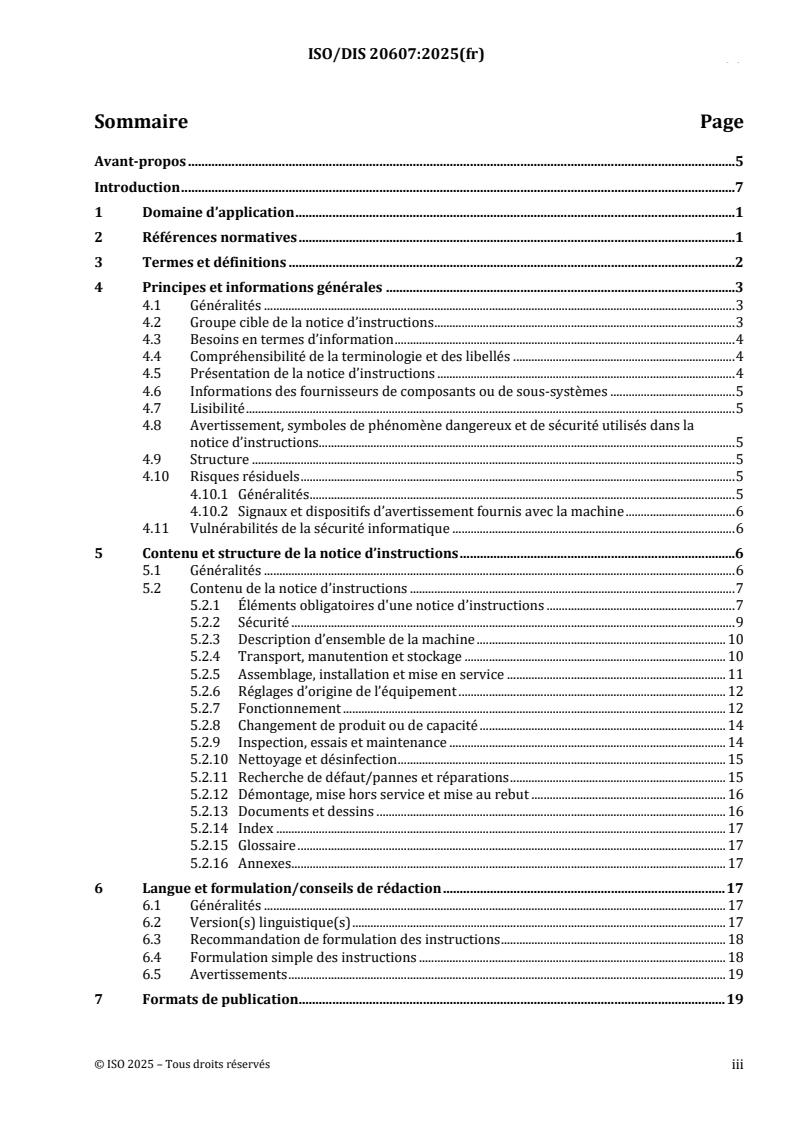
ISO/FDIS 20607 - Sécurité des machines — Notice d'instructions — Principes rédactionnels généraux/15/2025
Overview
ISO/FDIS 20607: Safety of machinery - Instruction handbook - General drafting principles is an international standard published by ISO. It sets out detailed requirements for machine manufacturers regarding the preparation of the safety-relevant parts of an instruction handbook for machinery. The standard is closely aligned with ISO 12100:2010 and focuses on safety-related content, structure, and presentation of information for all phases of the machinery life cycle. ISO/FDIS 20607 aims to enhance safety for users by improving the clarity, consistency, and usability of instruction handbooks, thus supporting effective risk reduction throughout the machine’s design, operation, and maintenance.
Key Topics
- Comprehensive Guidance: The standard clarifies how to draft safety-relevant instructions, building on the general requirements from ISO 12100:2010 and providing additional specifications for structure and content.
- Coverage Throughout Machine Life Cycle: Requirements address all potential phases, including installation, operation, maintenance, and decommissioning, ensuring users receive clear safety instructions for every stage.
- Target User Groups: Guidance is provided on identifying and addressing information needs of different user groups such as operators, installers, maintenance personnel, cleaning staff, and dismantling crews.
- Clear and Consistent Communication:
- Use of standardized terminology and symbols
- Recommendations for language simplicity, active voice, and logical structure
- Tips for enhancing document legibility and navigability (e.g., tables of contents, headings)
- Residual Risks: Manufacturers must clearly communicate any hazards that remain even after all feasible risk reduction measures have been implemented.
- Warnings and Safety Symbols: Effective use and explanation of hazard warnings, pictograms, and safety signs are mandated, following recognized standards (e.g., ISO 3864, ISO 7000, ISO 7010).
- Digital Formats: Requirements also cover fully digital instruction handbooks, reflecting the growing importance of electronic documentation.
- Annexes and Supporting Material: The standard includes informative annexes covering content mapping to ISO 12100, presentation and formatting recommendations, and practical writing advice.
Applications
ISO/FDIS 20607 is essential for:
- Machine Manufacturers: Ensuring complete and legally compliant instruction handbooks supporting safe machine use and operation
- Technical Writers and Documentation Teams: Drafting clear, accessible, and structured safety instructions that meet international expectations
- System Integrators and Component Suppliers: Supplying information that is consistent with overall machine documentation
- Safety Auditors and Regulators: Verifying that documentation meets the latest international safety requirements
- Maintenance, Installation, and Service Providers: Gaining comprehensive, usable, and safety-focused reference material
Instruction handbooks developed in accordance with ISO/FDIS 20607 help reduce accidents, clarify proper usage, and facilitate effective training, inspection, maintenance, and emergency response. The standard is applicable to new machinery manufactured after its publication date and does not cover noise and vibration emissions or cybersecurity requirements.
Related Standards
- ISO 12100:2010 – General principles for machinery design, risk assessment, and risk reduction
- IEC/IEEE 82079-1 – Preparation of instructions for use; general principles and detailed requirements
- ISO 3864-2 – Safety identification and hazard pictograms
- ISO 7000 and ISO 7010 – Standardized graphical symbols for safety information
- ISO/TR 22100-4 – Safety of machinery: Guidance on addressing IT security vulnerabilities
By conforming to ISO/FDIS 20607, manufacturers and technical communicators demonstrate commitment to machinery safety, regulatory compliance, and user-centered documentation best practices. This boosts operational safety, reduces liability, and fosters international market acceptance.
Relations
- Effective Date
- 12-Feb-2026
- Effective Date
- 19-Oct-2024
- Effective Date
- 12-Oct-2024
Buy Documents
ISO/FDIS 20607 - Safety of machinery — Instruction handbook — General drafting principles/13/2024
ISO/FDIS 20607 - Sécurité des machines — Notice d'instructions — Principes rédactionnels généraux/15/2025
Get Certified
Connect with accredited certification bodies for this standard

CIS Institut d.o.o.
Personal Protective Equipment (PPE) certification body. Notified Body NB-2890 for EU Regulation 2016/425 PPE.

Kiwa BDA Testing
Building and construction product certification.
Kmetijski inštitut Slovenije
Agricultural Institute of Slovenia. Soil testing, plant health, agricultural product analysis.
Sponsored listings
Frequently Asked Questions
ISO/FDIS 20607 is a draft published by the International Organization for Standardization (ISO). Its full title is "Safety of machinery — Instruction handbook — General drafting principles". This standard covers: This document specifies requirements for the machine manufacturer for preparation of the safety-relevant parts of an instruction handbook for machinery. This document: — provides further specifications to the general requirements on information for use given in ISO 12100:2010, 6.4.5; and — deals with the safety-related content, the corresponding structure and presentation of the instruction handbook, taking into account all phases of the life cycle of the machine. NOTE 1 The strategy for risk reduction at the machine is given in ISO 12100:2010, Clause 6, and includes inherently safe design measures, safeguarding and complementary risk reduction measures as well as information for use. NOTE 2 Annex A contains a correspondence table between ISO 12100:2010, 6.4, and this document. NOTE 3 Information for conception and preparation of instructions in general is available in IEC/IEEE 82079-1. This document establishes the principles which are indispensable to provide information on residual risks. This document does not address requirements for declaration of noise and vibration emissions. This document is not applicable to machinery manufactured before the date of its publication.
This document specifies requirements for the machine manufacturer for preparation of the safety-relevant parts of an instruction handbook for machinery. This document: — provides further specifications to the general requirements on information for use given in ISO 12100:2010, 6.4.5; and — deals with the safety-related content, the corresponding structure and presentation of the instruction handbook, taking into account all phases of the life cycle of the machine. NOTE 1 The strategy for risk reduction at the machine is given in ISO 12100:2010, Clause 6, and includes inherently safe design measures, safeguarding and complementary risk reduction measures as well as information for use. NOTE 2 Annex A contains a correspondence table between ISO 12100:2010, 6.4, and this document. NOTE 3 Information for conception and preparation of instructions in general is available in IEC/IEEE 82079-1. This document establishes the principles which are indispensable to provide information on residual risks. This document does not address requirements for declaration of noise and vibration emissions. This document is not applicable to machinery manufactured before the date of its publication.
ISO/FDIS 20607 is classified under the following ICS (International Classification for Standards) categories: 13.110 - Safety of machinery. The ICS classification helps identify the subject area and facilitates finding related standards.
ISO/FDIS 20607 has the following relationships with other standards: It is inter standard links to prEN ISO 20607, ISO/TR 21380:2022, ISO 20607:2019. Understanding these relationships helps ensure you are using the most current and applicable version of the standard.
ISO/FDIS 20607 is available in PDF format for immediate download after purchase. The document can be added to your cart and obtained through the secure checkout process. Digital delivery ensures instant access to the complete standard document.
Standards Content (Sample)
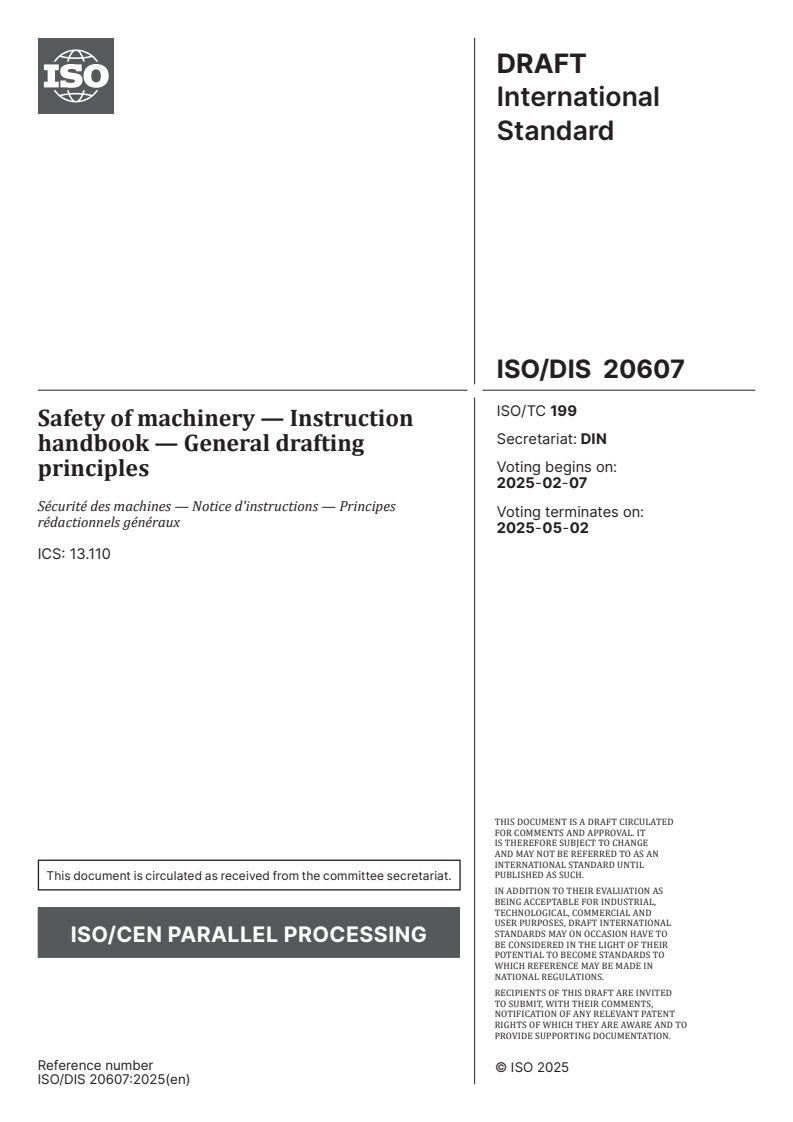
DRAFT
International
Standard
ISO/DIS 20607
ISO/TC 199
Safety of machinery — Instruction
Secretariat: DIN
handbook — General drafting
Voting begins on:
principles
2025-02-07
Sécurité des machines — Notice d'instructions — Principes
Voting terminates on:
rédactionnels généraux
2025-05-02
ICS: 13.110
THIS DOCUMENT IS A DRAFT CIRCULATED
FOR COMMENTS AND APPROVAL. IT
IS THEREFORE SUBJECT TO CHANGE
AND MAY NOT BE REFERRED TO AS AN
INTERNATIONAL STANDARD UNTIL
PUBLISHED AS SUCH.
This document is circulated as received from the committee secretariat.
IN ADDITION TO THEIR EVALUATION AS
BEING ACCEPTABLE FOR INDUSTRIAL,
TECHNOLOGICAL, COMMERCIAL AND
USER PURPOSES, DRAFT INTERNATIONAL
STANDARDS MAY ON OCCASION HAVE TO
ISO/CEN PARALLEL PROCESSING
BE CONSIDERED IN THE LIGHT OF THEIR
POTENTIAL TO BECOME STANDARDS TO
WHICH REFERENCE MAY BE MADE IN
NATIONAL REGULATIONS.
RECIPIENTS OF THIS DRAFT ARE INVITED
TO SUBMIT, WITH THEIR COMMENTS,
NOTIFICATION OF ANY RELEVANT PATENT
RIGHTS OF WHICH THEY ARE AWARE AND TO
PROVIDE SUPPORTING DOCUMENTATION.
Reference number
ISO/DIS 20607:2025(en)
DRAFT
ISO/DIS 20607:2025(en)
International
Standard
ISO/DIS 20607
ISO/TC 199
Safety of machinery — Instruction
Secretariat: DIN
handbook — General drafting
Voting begins on:
principles
Sécurité des machines — Notice d'instructions — Principes
Voting terminates on:
rédactionnels généraux
ICS: 13.110
THIS DOCUMENT IS A DRAFT CIRCULATED
FOR COMMENTS AND APPROVAL. IT
IS THEREFORE SUBJECT TO CHANGE
AND MAY NOT BE REFERRED TO AS AN
INTERNATIONAL STANDARD UNTIL
PUBLISHED AS SUCH.
This document is circulated as received from the committee secretariat.
IN ADDITION TO THEIR EVALUATION AS
BEING ACCEPTABLE FOR INDUSTRIAL,
© ISO 2025
TECHNOLOGICAL, COMMERCIAL AND
USER PURPOSES, DRAFT INTERNATIONAL
All rights reserved. Unless otherwise specified, or required in the context of its implementation, no part of this publication may
STANDARDS MAY ON OCCASION HAVE TO
ISO/CEN PARALLEL PROCESSING
be reproduced or utilized otherwise in any form or by any means, electronic or mechanical, including photocopying, or posting on
BE CONSIDERED IN THE LIGHT OF THEIR
the internet or an intranet, without prior written permission. Permission can be requested from either ISO at the address below
POTENTIAL TO BECOME STANDARDS TO
WHICH REFERENCE MAY BE MADE IN
or ISO’s member body in the country of the requester.
NATIONAL REGULATIONS.
ISO copyright office
RECIPIENTS OF THIS DRAFT ARE INVITED
CP 401 • Ch. de Blandonnet 8
TO SUBMIT, WITH THEIR COMMENTS,
CH-1214 Vernier, Geneva
NOTIFICATION OF ANY RELEVANT PATENT
Phone: +41 22 749 01 11
RIGHTS OF WHICH THEY ARE AWARE AND TO
PROVIDE SUPPORTING DOCUMENTATION.
Email: copyright@iso.org
Website: www.iso.org
Published in Switzerland Reference number
ISO/DIS 20607:2025(en)
ii
ISO/DIS 20607:2025(en)
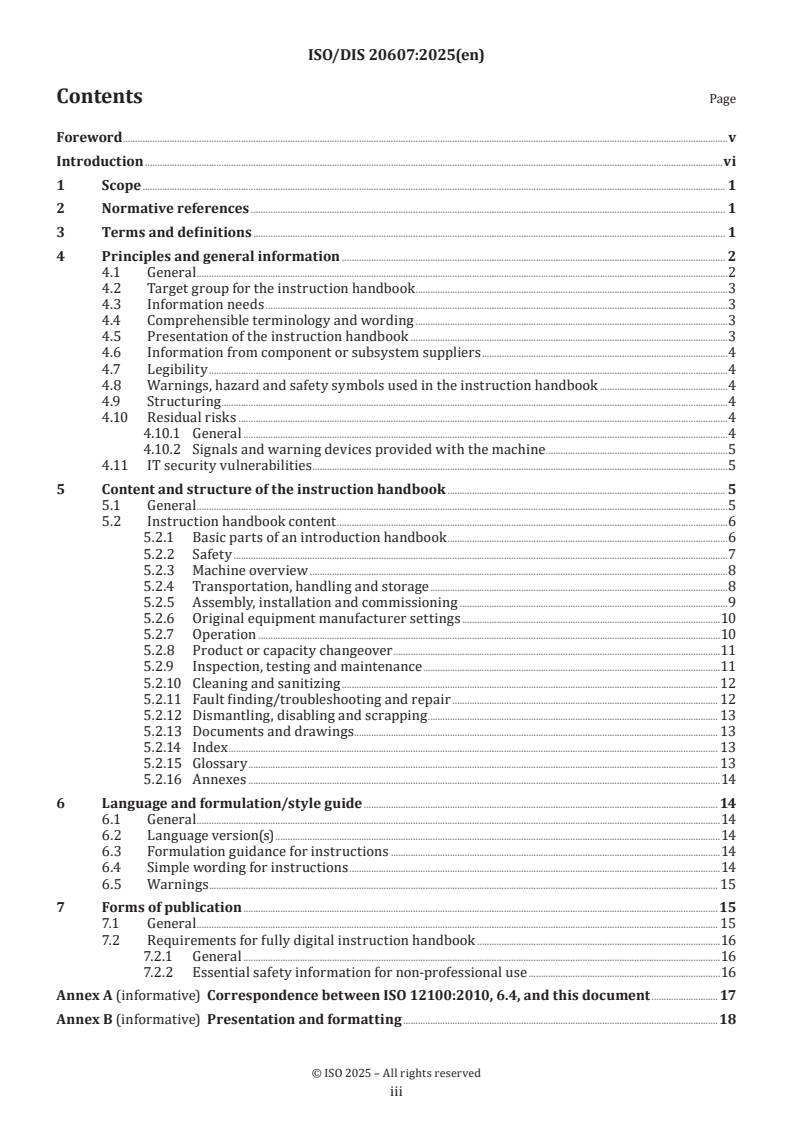
Contents Page
Foreword .v
Introduction .vi
1 Scope . 1
2 Normative references . 1
3 Terms and definitions . 1
4 Principles and general information . 2
4.1 General .2
4.2 Target group for the instruction handbook .3
4.3 Information needs .3
4.4 Comprehensible terminology and wording .3
4.5 Presentation of the instruction handbook .3
4.6 Information from component or subsystem suppliers .4
4.7 Legibility .4
4.8 Warnings, hazard and safety symbols used in the instruction handbook .4
4.9 Structuring .4
4.10 Residual risks .4
4.10.1 General .4
4.10.2 Signals and warning devices provided with the machine .5
4.11 IT security vulnerabilities .5
5 Content and structure of the instruction handbook . 5
5.1 General .5
5.2 Instruction handbook content .6
5.2.1 Basic parts of an introduction handbook .6
5.2.2 Safety .7
5.2.3 Machine overview .8
5.2.4 Transportation, handling and storage .8
5.2.5 Assembly, installation and commissioning .9
5.2.6 Original equipment manufacturer settings .10
5.2.7 Operation .10
5.2.8 Product or capacity changeover .11
5.2.9 Inspection, testing and maintenance .11
5.2.10 Cleaning and sanitizing . 12
5.2.11 Fault finding/troubleshooting and repair . 12
5.2.12 Dismantling, disabling and scrapping . 13
5.2.13 Documents and drawings. 13
5.2.14 Index . 13
5.2.15 Glossary . 13
5.2.16 Annexes .14
6 Language and formulation/style guide . 14
6.1 General .14
6.2 Language version(s) .14
6.3 Formulation guidance for instructions .14
6.4 Simple wording for instructions .14
6.5 Warnings . 15
7 Forms of publication .15
7.1 General . 15
7.2 Requirements for fully digital instruction handbook .16
7.2.1 General .16
7.2.2 Essential safety information for non-professional use .16
Annex A (informative) Correspondence between ISO 12100:2010, 6.4, and this document . 17
Annex B (informative) Presentation and formatting .18
iii
ISO/DIS 20607:2025(en)
Annex C (informative) Recommendations for writing instructions.21
Annex ZA (informative) Relationship between this European Standard and the essential
requirements of Directive 2006/42/EC aimed to be covered .24
Annex ZB (informative) Relationship between this European Standard and the essential
requirements of Regulation (EU) 2023/1230 aimed to be covered .25
Bibliography .26
iv
ISO/DIS 20607:2025(en)
Foreword
ISO (the International Organization for Standardization) is a worldwide federation of national standards
bodies (ISO member bodies). The work of preparing International Standards is normally carried out through
ISO technical committees. Each member body interested in a subject for which a technical committee
has been established has the right to be represented on that committee. International organizations,
governmental and non-governmental, in liaison with ISO, also take part in the work. ISO collaborates closely
with the International Electrotechnical Commission (IEC) on all matters of electrotechnical standardization.
The procedures used to develop this document and those intended for its further maintenance are described
in the ISO/IEC Directives, Part 1. In particular, the different approval criteria needed for the different types
of ISO documents should be noted. This document was drafted in accordance with the editorial rules of the
ISO/IEC Directives, Part 2 (see www.iso.org/directives).
ISO draws attention to the possibility that the implementation of this document may involve the use of (a)
patent(s). ISO takes no position concerning the evidence, validity or applicability of any claimed patent
rights in respect thereof. As of the date of publication of this document, ISO had not received notice of (a)
patent(s) which may be required to implement this document. However, implementers are cautioned that
this may not represent the latest information, which may be obtained from the patent database available at
www.iso.org/patents. ISO shall not be held responsible for identifying any or all such patent rights.
Any trade name used in this document is information given for the convenience of users and does not
constitute an endorsement.
For an explanation of the voluntary nature of standards, the meaning of ISO specific terms and expressions
related to conformity assessment, as well as information about ISO's adherence to the World Trade
Organization (WTO) principles in the Technical Barriers to Trade (TBT), see www.iso.org/iso/foreword.html.
This document was prepared by Technical Committee ISO/TC 199, Safety of machinery.
This second edition cancels and replaces the first edition (ISO 20607:2019), which has been technically
revised.
The main changes are as follows:
a) clarification added to the Scope that this document gives requirements for drafting of the instruction
handbook of all types of machines;
b) clarification added to the Scope that this document does neither address requirements regarding
cybersecurity nor regarding logic with partially or fully self-evolving behaviour applied to machinery;
c) information on the necessary precautions, devices and means for the rescue of persons added as
additional list item d) to 5.2.2.3;
d) controls and display descriptions stated more precisely in 5.2.3 f)
e) new subclause added on requirements for fully digital instruction handbook (see 7.2).
Any feedback or questions on this document should be directed to the user’s national standards body. A
complete listing of these bodies can be found at www.iso.org/members.html.
v
ISO/DIS 20607:2025(en)
Introduction
This document is a type-B standard as stated in ISO 12100.
This document is of relevance, in particular, for the following stakeholder groups representing the market
players with regard to machinery safety:
— machine manufacturers (small, medium and large enterprises);
— health and safety bodies (regulators, accident prevention organisations, market surveillance etc.).
Others can be affected by the level of machinery safety achieved with the means of the document by the
above-mentioned stakeholder groups:
— machine users/employers (small, medium and large enterprises);
— machine users/employees (e.g. trade unions, organizations for people with special needs);
— service providers, e.g. for maintenance (small, medium and large enterprises);
— consumers (in case of machinery intended for use by consumers).
The above-mentioned stakeholder groups have been given the possibility to participate at the drafting
process of this document.
In addition, this document is intended for standardization bodies elaborating type-C standards.
The requirements of this document can be supplemented or modified by a type-C standard.
For machines which are covered by the scope of a type-C standard and which have been designed and built
according to the requirements of that standard, the requirements of that type-C standard take precedence.
The structure of safety standards in the field of machinery is as follows.
a) Type-A standards (basic safety standards) give basic concepts, principles for design and general
aspects that can be applied to machinery;
b) Type-B standards (generic safety standards) dealing with one or more safety aspect(s), or one or more
type(s) of safeguards that can be used across a wide range of machinery:
— type-B1 standards on particular safety aspects (for example, safety distances, surface
temperature, noise);
— type-B2 standards on safeguards (for example, two-hand control devices, interlocking devices,
pressure-sensitive devices, guards);
c) Type-C standards (machine safety standards) dealing with detailed safety requirements for a
particular machine or group of machines.
This type-B standard is written to provide guidance to machine manufacturers on how to provide an
instruction handbook. According to ISO 12100:2010, 6.4.1.1, drafting information for use is an integral
part of the design of a machine. Information for use consists of communication links, such as texts, words,
signs, signals, symbols or diagrams, used separately or in combination to convey information to the user.
Information for use is intended for professional and/or non-professional users. Instructions are a key part
of the information for use of a machine. This document provides safety specifications for machinery that is
more specific than IEC/IEEE 82079-1.
The instruction handbook drafted in accordance with this document is intended to inform the user in such a
manner that after reading it, he/she is aware of how the machine can be used safely according to its intended
use during its life cycle, considering also aspects of reasonably foreseeable misuse.
The objective fulfilled by this document is to improve the safety specifications and readability/ease of use of
the instruction handbook of the machine.
vi
DRAFT International Standard ISO/DIS 20607:2025(en)
Safety of machinery — Instruction handbook — General
drafting principles
1 Scope
This document specifies requirements for the machine manufacturer for preparation of the safety-relevant
parts of an instruction handbook for machinery.
This document
— provides further specifications to the general requirements on information for use given in
ISO 12100:2010, 6.4.5,
— deals with the safety-related content, the corresponding structure and presentation of the instruction
handbook, taking into account all phases of the life cycle of the machine, and
— gives requirements for drafting of the instruction handbook of all types of machines.
NOTE 1 The strategy for risk reduction at the machine is given in ISO 12100:2010, Clause 6, and includes inherently
safe design measures, safeguarding and complementary risk reduction measures as well as information for use.
NOTE 2 Annex A contains a correspondence table between ISO 12100:2010, 6.4, and this document.
NOTE 3 Information for conception and preparation of instructions in general is available in IEC/IEEE 82079-1.
This document establishes the principles which are indispensable to provide information on residual risks.
This document does not address requirements for declaration of noise and vibration emissions.
This document does not address requirements regarding cybersecurity.
This document does not address requirements regarding logic with partially or fully self-evolving behavior
applied to machinery. This includes but is not limited to machine-learning.
This document is not applicable to machinery manufactured before the date of its publication.
2 Normative references
The following documents are referred to in the text in such a way that some or all of their content constitutes
requirements of this document. For dated references, only the edition cited applies. For undated references,
the latest edition of the referenced document (including any amendments) applies.
ISO 12100:2010, Safety of machinery — General principles for design — Risk assessment and risk reduction
3 Terms and definitions
For the purposes of this document, the terms and definitions given in ISO 12100 and the following apply.
ISO and IEC maintain terminology databases for use in standardization at the following addresses:
— ISO Online browsing platform: available at https:// www .iso .org/ obp
— IEC Electropedia: available at https:// www .electropedia .org/
ISO/DIS 20607:2025(en)
3.1
instruction handbook
part of the information for use provided by a machine manufacturer to the machine user that contains
instructions and advice concerning the use of the machinery during all phases of its life cycle
Note 1 to entry: Instruction handbook is a subset of information for use. For more information, see ISO 12100:2010, 6.4.
3.2
integrator
entity who designs, provides, manufactures or assembles an integrated manufacturing system and is in
charge of the safety strategy, including the protective measures, control interfaces and interconnections of
the control system
Note 1 to entry: The integrator may be a manufacturer, assembler, engineering company or the user.
[SOURCE: ISO 11161:2007, 3.10]
3.3
risk reduction measure
action or means to eliminate hazards or reduce risks
Note 1 to entry: The term “risk reduction measure” used in this document corresponds to the term “protective
measure” used in ISO 12100.
EXAMPLE Inherently safe design; protective devices; personal protective equipment; information for use and
installation; organization of work; training; application of equipment; supervision.
[SOURCE: ISO/IEC Guide 51:2014, 3.13, modified – The synonymous term has been deleted and Note 1 to
entry has been added.]
3.4
vulnerable user
user at greater risk of harm from products or systems, due to age, level of literacy, physical or mental
condition or limitations, or inability to access product safety information
[SOURCE: ISO/IEC Guide 51:2014, 3.16, modified – The term “consumer” has been replaced by “user” in the
term and in the definition.]
4 Principles and general information
4.1 General
The purpose of the instruction handbook is to provide the user with such information that the machine
concerned can be effectively and safely used during the life cycle of the machine, also considering reasonably
foreseeable misuse. When the instruction handbook is being prepared, the communication process “read –
think – use” should be followed in order to achieve the maximum effect for the reader.
NOTE For general principles of design of instruction handbooks see also IEC/IEEE 82079-1:2019, 6.3.
The instruction handbook shall follow sequential operations, as applicable.
The instruction handbook shall provide the target group(s) with information on:
— intended use;
— the machine itself and, as appropriate, its parts and components;
— relevant phases of the life cycle of the machine according to ISO 12100;
— hazards that have been identified and risk reduction measures that have been applied in conjunction
with activities the user is expected to perform (human machine interaction); and
ISO/DIS 20607:2025(en)
— residual risks, as these can require risk reduction by the user of the machine.
4.2 Target group for the instruction handbook
Target groups consisting of persons who interact directly with the machine and the task(s) they perform
shall be identified.
Target groups that can interact with the machine shall be described in the instruction handbook and
typically include, but are not limited to:
a) installers (for example, system integrators);
b) operators;
c) maintenance personnel or technicians;
d) cleaning personnel;
e) dismantling personnel.
4.3 Information needs
The instruction handbook shall take into account the specific needs, foreseeable knowledge and technical
vocabulary of the target group intended to use the machine.
4.4 Comprehensible terminology and wording
The instruction handbook shall be:
a) comprehensible by using preferably standardized terms, well recognized technical terms or explaining
special technical terms and expressions, if used;
b) as simple and as brief as possible by using, for example
— language-independent instructions to support the text (pictograms, pictures, drawings etc.);
— short and simple sentences;
— where synonyms are available, use only one term;
— tables and listings;
— chronological, logical and sequential writing;
— repetition, where necessary;
— diagrams, charts;
c) expressed in consistent terms and units (for example, SI quantities);
d) drafted using the active voice;
e) easily translatable.
NOTE For guidance and examples on formulation, see Annex C.
4.5 Presentation of the instruction handbook
The instruction handbook may be presented as a single document or as a set of separate documents, for
example, for the following reasons:
— instructions intended for different target groups (see 4.2);
ISO/DIS 20607:2025(en)
— a single document is too large or complex;
— document is addressing different life phases of the machine.
When providing information for different target groups in a single document the information shall be clearly
separated so that a user does not accidently refer to information which does not apply.
4.6 Information from component or subsystem suppliers
Where information from component or subsystem suppliers is necessary for the instruction handbook, it
shall either:
— be incorporated directly in the instruction handbook; or
— provide the relevant parts of the original instruction handbook of components/subsystems from
suppliers and making appropriate references therein.
4.7 Legibility
Text and graphical symbols shall be legible for the target group(s).
NOTE For examples of recommended text font sizes and graphical symbol heights, see Annex B.
4.8 Warnings, hazard and safety symbols used in the instruction handbook
Warnings, hazard and safety symbols shall be distinguishable from other content of the instruction
handbook.
When signs (pictograms) and/or written warnings are used to indicate important messages their meaning
shall be clearly explained.
NOTE 1 Annex C provides guidance on wording.
NOTE 2 Terms often used in instruction handbooks are “DANGER”, “WARNING”, “CAUTION” without or in
combination with pictograms. For the definitions of these terms and more information about colours for coding, see
ISO 3864-2.
NOTE 3 For safety signs and symbols, see ISO 7000 and ISO 7010.
4.9 Structuring
The instruction handbook should be structured in a such a way that the information can be quickly located,
for example, by using sections, chapters, sub-clauses, headings, numbers, highlighting, colors.
NOTE See Clause 5 for a recommended structure.
Instruction handbooks shall be presented in a such a way that the reader can determine if they are complete
(for example, using a table of contents and the numbering of pages).
4.10 Residual risks
4.10.1 General
Based on the risk assessment and the risk reduction measures the manufacturer of the machine shall inform
and warn the target group, if relevant, for each residual risk. General statements about residual risks shall
be avoided.
NOTE The information on residual risks form the basis for further risk reduction measures to be introduced by
the user of the machine.
Explanations on the risks and appropriate warnings shall be given.
ISO/DIS 20607:2025(en)
4.10.2 Signals and warning devices provided with the machine
The instruction handbook shall describe signals and warning devices provided with the machine and
explain their meaning.
4.11 IT security vulnerabilities
Where applicable, the instruction handbook shall provide information concerning IT security vulnerabilities.
See ISO/TR 22100-4:2018, 10.4.
5 Content and structure of the instruction handbook
5.1 General
The essential information, relevant for the user, shall be structured in an instruction handbook (see
Table 1 for an example). Table 1 does not take into account all different target groups, but is a template for
information that can be placed in an instruction handbook for the machine concerned. From this, a writer
can create a specific instruction handbook for a particular target group. An instruction handbook for a user/
operator need not contain all the sections of Table 1.
Table 1 — Instruction handbook content example
Section Content
Basic parts of an instruction Title page
handbook
Table of contents
(see 5.2.1)
Introduction to/purpose of this instruction handbook
Safety (see 5.2.2) General safety information and general safety instructions
Machine overview Machine description
(see 5.2.3) Intended use
Key machine specifications
Controls and displays descriptions
Floor plan/layout
Transportation, handling and Transporting, handling and storing the machine and/or the components
storage (see 5.2.4)
Assembly, installation and Assembly/integration of the machine
commissioning
Positioning of the machine
(see 5.2.5)
Mechanical, pneumatic, hydraulic and electrical installation
Check and test of safety systems
Installation check
Commissioning
Original equipment manufac- Mechanical settings and synchronization
turer settings
Safety-related (setting) parameters
(see 5.2.6)
Pneumatic, hydraulic, electrical and vacuum settings
Other settings
Operation Operating modes
(see 5.2.7) Machine start-up and shut-down
Sequence or chronology of operations
Other operating instructions, if applicable
Product or capacity changeo- General product or capacity changeover information
ver (see 5.2.8)
Product-specific set-up information
Inspection, testing and main- Maintenance instructions
tenance
(see 5.2.9)
ISO/DIS 20607:2025(en)
TTabablele 1 1 ((ccoonnttiinnueuedd))
Section Content
Cleaning and sanitizing Cleaning and/or sanitizing of the machine
(see 5.2.10)
Fault finding/troubleshooting General fault finding/troubleshooting and repair information
and repair (see 5.2.11)
Troubleshooting chart (electrical engineering)
Troubleshooting of electrical sensors, vacuum systems, pneumatic systems and
hydraulic systems
Dismantling, disabling and Dismantling, disabling and scrapping instructions
scrapping (see 5.2.12)
Documents and drawings (see Documents, drawings and parts list
5.2.13)
Index, glossary, annexes See 5.2.14 to 5.2.16
5.2 Instruction handbook content
5.2.1 Basic parts of an introduction handbook
5.2.1.1 General
The following information shall be included in the instruction handbook, as applicable:
a) title page;
— date of issue, version of publication of the instruction handbook;
— machine designation (model and/or type);
— sufficient information to identify the machine(s) to which the handbook applies (e.g. identification
number, serial number(s), period of application);
b) table of contents;
c) introduction to/purpose of this instruction handbook;
d) how to read and apply the instruction handbook;
e) name of the manufacturer and contact details (postal address, phone numbers, email address, website);
f) type of instruction handbook (for example, operation, maintenance, control software, user guide);
g) date of manufacture;
h) markings in order to indicate compliance with mandatory/legal requirements;
i) list of used abbreviations;
j) symbols and signs for text markings.
If an instruction handbook consists of more than one part, each part is given its own title page as defined
above. Identification of this information shall be in a prominent place.
If an instruction handbook consists of more than one part, each part shall be identified in relation to the
other parts (for example, part 2 of 5 parts). The following subjects shall be included, as applicable:
— addressed target groups;
— abilities/skills required by the target group(s);
— reader’s guide/marking conventions/structure of the instruction handbook.
ISO/DIS 20607:2025(en)
5.2.1.2 Table of contents
The table of contents shall show the structure of the instruction handbook and serves as a navigation aid
within the document.
The instruction handbook shall have a table of contents, if it exceeds 12 pages unless the size or form (for
example, instruction card) makes this unnecessary.
Instruction handbooks shall have numbered pages or electronic equivalent (e.g. links).
The table of contents shall also indicate unnumbered text elements such as preface, abbreviated instructions,
reader instructions, register/index and appendices, as applicable.
The table of contents can be created in various ways, for example:
a) a full table of contents of the instruction handbook with:
1) the chapters and sections of the first three levels of the subdivision; and
2) the page number or electronic equivalent where each chapter and section begins;
b) a simplified table of contents with a full table of contents for each part;
c) the table of contents should reflect each target group and lifecycle phase.
In a simplified table of contents, there should at least the first level of subdivision with the corresponding
page numbers/electronic equivalents.
5.2.2 Safety
5.2.2.1 General
General safety requirements, not restricted to specific tasks, shall be provided together in a specific part of
the instruction handbook, preferably in the “Safety” clause. For specific tasks described in the instruction
handbook, safety information shall be included where the task is described.
5.2.2.2 General rules for preparation of the “Safety” clause
a) warnings about potentially hazardous situations that can occur during intended use of the machine;
b) warnings regarding potentially hazardous situations arising from reasonably foreseeable misuse;
c) residual risks to be described;
d) general warnings and precautions to be included.
The following topics shall be added, if relevant:
— substances and emissions that can create risk for the persons that can be involved in the machine
operations;
— warnings, where the use of the machine can negatively influence electrically controlled medical devices,
such as pacemakers;
— content related to the safety of the user groups. Attention should be given to protect vulnerable user
groups (e.g. children, elderly people);
— personal protective equipment to be used for specific tasks;
— safety symbols, safety signs and/or pictograms used in and on the machine, including an image of them;
— location of safety symbols, safety signs and/or pictograms on the machine;
ISO/DIS 20607:2025(en)
— instructions for renewing of safety symbols, safety signs and/or pictograms on the machine, if necessary.
Standardized symbols (see, for example, ISO 7010, IEC 61310) shall be used to indicate important messages
such as cautions, warnings and safety instructions.
5.2.2.3 Emergency situations
Where applicable, the instruction handbook shall include information to address specific emergency
situations, such as
a) the operating method to be followed in the event of accident or breakdown;
b) the type of emergency equipment to be used;
c) a warning of possible emission or leakage of hazardous substance(s) and, if applicable, an indication of
means for fighting their effects;
d) information on the necessary precautions, devices and means for the rescue of persons.
5.2.3 Machine overview
The instruction handbook shall include a general description of the machine. The following information
shall be included, where applicable:
a) machine description;
b) graphical description (for example, floor plan, drawings, images);
c) intended use including the type of material/products that can be processed by the machine;
d) specific applications that are prohibited;
e) key machine specifications, such as
— length, width and height;
— mass;
— operating speed;
— characteristics of the power supply;
— limits for intended operating conditions, such as temperature, relative humidity and air pressure;
— intended life limit of the machine;
— lifetime (mission time) of components, where relevant for safety aspects;
f) controls and display descriptions, incl. description of controls which are able to react on verbal
commands (i.e. by the means of speech) or non-verbal comments (i.e. by the means of gestures, facial
expressions or body movement), if any;
g) requirements regarding (work)place or environment in which the machine is foreseen to be used (for
example, indoors, outdoors, clean room, potentially explosive atmosphere).
5.2.4 Transportation, handling and storage
The following information shall be included in the instruction handbook for transportation, handling and
storage of the machine and/or the components, if relevant:
— physical characteristics such as dimensions during transportation, mass and centre of gravity of the
machine, gripping/lifting points to be used;
ISO/DIS 20607:2025(en)
— recommended transportation and handling method including required skills and equipment;
— environmental conditions for storage, such as limits for temperature, relative humidity and avoidance of
direct sunlight.
5.2.5 Assembly, installation and commissioning
5.2.5.1 Assembly of the machine
Machines that are not assembled or installed by the manufacturer or under the manufacturer’s responsibility
shall contain the following instructions, if relevant:
— requirements and procedures for assembly and mounting (for example, temporary support or
safeguarding, appropriate climatic conditions);
— requirements for testing, where necessary;
— use of special tools and equipment;
— information on safe disposal of packaging materials and preservation measures.
5.2.5.2 Positioning of the machine
Machines that are not positioned by the manufacturer or under the manufacturer’s responsibility shall
contain the following instructions, if relevant:
— minimum requirements for placing (for example, floor characteristics, point load, dynamic load, levelling,
alignment);
— minimum requirements for fixing and anchoring the machine;
— requirements for accessibility around the machine (for example, for maintenance, cleaning, sanitizing,
work spaces).
5.2.5.3 Installation
The instruction handbook shall include information for mechanical, pneumatic, hydraulic and electrical
installations, and in particular the required characteristics of the energy supply (for example, mechanical,
pneumatic, hydraulic, electrical).
Other information to include in the instruction handbook, if relevant, are
— characteristics of necessary fluids including hazardous substances;
— necessity for an additional exhaust extraction system and its characteristics.
5.2.5.4 Checking and testing of safety systems
The instruction handbook shall include procedures for checking and testing safety systems.
Machines where the installation check is not performed by the manufacturer or under the manufacturer’s
responsibility shall include procedures for checking the correct installation, if relevant.
Each safety relevant check shall be described with the following content:
— what to be checked;
— how to check;
— criteria for acceptance/non-acceptance;
— action required in case of non-acceptance.
ISO/DIS 20607:2025(en)
5.2.5.5 Commissioning
If the machine is not commissioned by the manufacturer or under the manufacturer’s responsibility, the
instruction handbook shall include procedures for commissioning and first use of the machine, such as
— specific risks and hazards, and precautions to be taken;
— information about special procedures for commissioning, if required;
— securing and packaging materials that shall be removed (also consider protective films, strips, etc.);
— necessary tools and equipment;
— procedures, such as adjustments, testing, measuring and reporting; and
— inspections.
5.2.6 Original equipment manufacturer settings
The instruction handbook shall include instructions regarding original equipment manufacturer settings
where accessible for the machine user, such as
— mechanical settings and synchronization;
— safety-related (setting) parameters;
— pneumatic, hydraulic, electrical and vacuum settings; and
— other settings.
5.2.7 Operation
The instruction handbook shall include instructions regarding operating safety considerations, such as
— intended use;
— residual risks;
— information regarding safety relevant emissions [see ISO 12100:2010, 6.4.5.1 c) 4)];
— actuation of controls;
— setting and adjustment;
— operating modes;
— location of the intended operator positions;
— error messages from the control system and location of the error;
— personal protective equipment needed to be used;
— an indication of training requirements;
— checking of hazard area for the absence of persons;
— procedures for starting, control during operation, stopping, emergency situation, reset and restarting
(including relevant safety-related parts);
— conversions or tool changes;
— procedures for clearing jams or blockages without creating hazards;
— information regarding the operational environment;
ISO/DIS 20607:2025(en)
— information about vibration emission of hand-held machines and hand-guided machinery;
— illustrations that clarify and/or provide insight into key functions and risk reduction measures;
— recommendations for removal of waste;
— machine start-up and shut-down;
— sequence or chronology of operations; and
— other operating instructions, if applicable.
Operations that need to be carried out by more than one person shall be prescribed. Appropriate warning
shall be provided about the consequences
...
PROJET
Norme
internationale
ISO/DIS 20607
ISO/TC 199
Sécurité des machines — Notice
Secrétariat: DIN
d'instructions — Principes
Début de vote:
rédactionnels généraux
2025-02-07
Safety of machinery — Instruction handbook — General drafting
Vote clos le:
principles
2025-05-02
ICS: 13.110
CE DOCUMENT EST UN PROJET DIFFUSÉ
POUR OBSERVATIONS ET APPROBATION. IL
EST DONC SUSCEPTIBLE DE MODIFICATION
ET NE PEUT ÊTRE CITÉ COMME NORME
INTERNATIONALE AVANT SA PUBLICATION EN
TANT QUE TELLE.
Le présent document est distribué tel qu’il est parvenu du secrétariat
du comité. OUTRE LE FAIT D’ÊTRE EXAMINÉS POUR
ÉTABLIR S’ILS SONT ACCEPTABLES À DES
FINS INDUSTRIELLES, TECHNOLOGIQUES ET
COMMERCIALES, AINSI QUE DU POINT DE VUE
DES UTILISATEURS, LES PROJETS DE NORMES
INTERNATIONALES DOIVENT PARFOIS ÊTRE
TRAITEMENT PARALLÈLE ISO/CEN
CONSIDÉRÉS DU POINT DE VUE DE LEUR
POSSIBILITÉ DE DEVENIR DES NORMES
POUVANT SERVIR DE RÉFÉRENCE DANS LA
RÉGLEMENTATION NATIONALE.
LES DESTINATAIRES DU PRÉSENT PROJET
SONT INVITÉS À PRÉSENTER, AVEC LEURS
OBSERVATIONS, NOTIFICATION DES DROITS
DE PROPRIÉTÉ DONT ILS AURAIENT
ÉVENTUELLEMENT CONNAISSANCE
ET À FOURNIR UNE DOCUMENTATION
EXPLICATIVE.
Numéro de référence
ISO/DIS 20607:2025(fr)
ISO/DIS 20607:2025(fr)
ISO/TC 199
Date: 2025-01-10
ISO 20607:2025(F)
ISO/TC 199
Secrétariat: DIN
Sécurité des machines— Notice d'instructions— Principes
rédactionnels généraux
Safety of machinery — Instruction handbook — General drafting principles
DOCUMENT PROTÉGÉ PAR COPYRIGHT
© ISO 2025
Tous droits réservés. Sauf prescription différente ou nécessité dans le contexte de sa mise en œuvre, aucune partie de cette
publication ne peut être reproduite ni utilisée sous quelque forme que ce soit et par aucun procédé, électronique ou mécanique,
y compris la photocopie, ou la diffusion sur l’internet ou sur un intranet, sans autorisation écrite préalable. Une autorisation peut
être demandée à l’ISO à l’adresse ci-après ou au comité membre de l’ISO dans le pays du demandeur.
ISO copyright office
Case postale 401 • Ch. de Blandonnet 8
CH-1214 Vernier, Genève
Tél.: +41 22 749 01 11
E-mail: copyright@iso.org
Type du document: Norme internationale
Web: www.iso.org
Sous-type du document:
Publié en Suisse
Stade du document: (50) Approbation
Langue du document: F
H:\Secteur2\00_Normes à publier\ISO\ISO 20607\DIS\DIS_ISO 20607_(F)_trad.docx STD Version 2.9a
ii
ISO/DIS 20607:2025(fr) ISO 20607:2025(F)
Sommaire Page
Avant-propos . 5
Introduction . 7
1 Domaine d’application . 1
2 Références normatives . 1
3 Termes et définitions . 2
4 Principes et informations générales . 3
4.1 Généralités . 3
4.2 Groupe cible de la notice d’instructions . 3
4.3 Besoins en termes d’information . 4
4.4 Compréhensibilité de la terminologie et des libellés . 4
4.5 Présentation de la notice d’instructions . 4
4.6 Informations des fournisseurs de composants ou de sous-systèmes . 5
4.7 Lisibilité . 5
4.8 Avertissement, symboles de phénomène dangereux et de sécurité utilisés dans la
notice d’instructions. 5
4.9 Structure . 5
4.10 Risques résiduels . 5
4.10.1 Généralités . 5
4.10.2 Signaux et dispositifs d’avertissement fournis avec la machine . 6
4.11 Vulnérabilités de la sécurité informatique . 6
5 Contenu et structure de la notice d’instructions . 6
5.1 Généralités . 6
5.2 Contenu de la notice d’instructions . 7
5.2.1 Éléments obligatoires d'une notice d’instructions . 7
5.2.2 Sécurité . 9
5.2.3 Description d’ensemble de la machine . 10
5.2.4 Transport, manutention et stockage . 10
5.2.5 Assemblage, installation et mise en service . 11
5.2.6 Réglages d’origine de l’équipement . 12
5.2.7 Fonctionnement . 12
5.2.8 Changement de produit ou de capacité . 14
5.2.9 Inspection, essais et maintenance . 14
5.2.10 Nettoyage et désinfection . 15
5.2.11 Recherche de défaut/pannes et réparations . 15
5.2.12 Démontage, mise hors service et mise au rebut . 16
5.2.13 Documents et dessins . 16
5.2.14 Index . 17
5.2.15 Glossaire . 17
5.2.16 Annexes . 17
6 Langue et formulation/conseils de rédaction . 17
6.1 Généralités . 17
6.2 Version(s) linguistique(s) . 17
6.3 Recommandation de formulation des instructions . 18
6.4 Formulation simple des instructions . 18
6.5 Avertissements . 19
7 Formats de publication . 19
iii
ISO 20607:2025(F) ISO/DIS 20607:2025(fr)
7.1 Généralités . 19
7.2 Exigences pour la notice d’instructions entièrement numérique . 19
7.2.1 Généralités . 19
7.2.2 Informations essentielles de sécurité pour l’utilisation non professionnelle . 20
Annexe A (informative) Correspondance entre l’ISO 12100:2010, 6.4, et le présent
document . 21
Annexe B (informative) Présentation et formats . 22
Annexe C (informative) Recommandations pour la rédaction des instructions . 25
Annex ZA (informative) Relation entre la présente Norme européenne et les exigences
essentielles concernées de la Directive 2006/42/EC . 28
Annexe ZB (informative) Relation entre la présente Norme européenne et les exigences
essentielles concernées du Règlement (UE) 2023/1230 . 29
Bibliographie . 30
iv
ISO/DIS 20607:2025(fr) ISO 20607:2025(F)
Avant-propos
L'ISO (Organisation internationale de normalisation) est une fédération mondiale d'organismes
nationaux de normalisation (comités membres de l'ISO). L'élaboration des Normes internationales est en
général confiée aux comités techniques de l'ISO. Chaque comité membre intéressé par une étude a le droit
de faire partie du comité technique créé à cet effet. Les organisations internationales, gouvernementales
et non gouvernementales, en liaison avec l'ISO participent également aux travaux. L'ISO collabore
étroitement avec la Commission électrotechnique internationale (IEC) en ce qui concerne la
normalisation électrotechnique.
Les procédures utilisées pour élaborer le présent document et celles destinées à sa mise à jour sont
décrites dans les Directives ISO/IEC, Partie 1. Il convient, en particulier, de prendre note des différents
critères d'approbation requis pour les différents types de documents ISO. Le présent document a été
rédigé conformément aux règles de rédaction données dans les Directives ISO/IEC, Partie 2 (voir
www.iso.org/directives).
L’ISO attire l’attention sur le fait que la mise en application du présent document peut entraîner
l’utilisation d’un ou de plusieurs brevets. L’ISO ne prend pas position quant à la preuve, à la validité et à
l’applicabilité de tout droit de propriété revendiqué à cet égard. À la date de publication du présent
document, l’ISO n'avait pas reçu notification qu’un ou plusieurs brevets pouvaient être nécessaires à sa
mise en application. Toutefois, il y a lieu d’avertir les responsables de la mise en application du présent
document que des informations plus récentes sont susceptibles de figurer dans la base de données de
brevets, disponible à l'adresse www.iso.org/brevets. L’ISO ne saurait être tenue pour responsable de ne
pas avoir identifié tout ou partie de tels droits de propriété.
Les appellations commerciales éventuellement mentionnées dans le présent document sont données
pour information, par souci de commodité, à l’intention des utilisateurs et ne sauraient constituer un
engagement.
Pour une explication de la nature volontaire des normes, la signification des termes et expressions
spécifiques de l'ISO liés à l'évaluation de la conformité, ou pour toute information au sujet de l'adhésion
de l'ISO aux principes de l’Organisation mondiale du commerce (OMC) concernant les obstacles
techniques au commerce (OTC), voir www.iso.org/avant-propos.
Le présent document a été élaboré par le comité technique ISO/TC 199, Sécurité des machines.
Cette deuxième édition annule et remplace la première édition (ISO 20607:2019) qui a fait l’objet d’une
révision technique.
Les principales modifications sont les suivantes:
a) clarification ajoutée au domaine d’application concernant le fait que le présent document fournit des
exigences pour la rédaction de la notice d’instruction de tous les types de machines;
b) clarification ajoutée au domaine d’application concernant le fait que le présent document ne répond
ni aux exigences concernant la cybersécurité ni à celles concernant la logique vis-à-vis du comportement
partiellement ou totalement auto-évolutif appliqué aux machines;
c) informations sur les précautions, dispositifs et moyens nécessaires pour porter secours aux
personnes, ajoutées en tant qu’élément de liste supplémentaire d) au 5.2.2.3;
d) descriptions des commandes et affichages énoncées plus précisément au 5.2.3 f);
v
ISO 20607:2025(F) ISO/DIS 20607:2025(fr)
e) nouveau paragraphe ajouté à propos des exigences pour les notices d’instruction entièrement
numériques (voir 7.2).
Il convient que l’utilisateur adresse tout retour d’information ou toute question concernant le présent
document à l’organisme national de normalisation de son pays. Une liste exhaustive desdits organismes
se trouve à l’adresse http://www.iso.org/fr/members.html.
vi
ISO/DIS 20607:2025(fr) ISO 20607:2025(F)
Introduction
Le présent document est une norme de type B, comme stipulé dans l’ISO 12100.
Le présent document concerne, en particulier, les groupes de parties prenantes suivants, représentant
les acteurs du marché dans le domaine de la sécurité des machines:
— fabricants de machines (petites, moyennes et grandes entreprises);
— organismes de santé et de sécurité (autorités réglementaires, organismes de prévention des risques
professionnels, surveillance du marché, etc.).
D’autres groupes peuvent être affectés par le niveau de sécurité des machines atteint avec les moyens du
document par les groupes de parties prenantes susmentionnés:
— utilisateurs de machines/employeurs (petites, moyennes et grandes entreprises);
— utilisateurs de machines/salariés (par exemple syndicats de salariés, organisations représentant des
personnes ayant des besoins particuliers);
— prestataires de services, par exemple sociétés de maintenance (petites, moyennes et grandes
entreprises);
— consommateurs (dans le cas de machines destinées à être utilisées par des consommateurs).
Les groupes de parties prenantes mentionnées ci-dessus ont eu la possibilité de participer au processus
d’élaboration du présent document.
De plus, le présent document est destiné aux organismes de normalisation chargés d’élaborer des normes
de type C.
Les exigences du présent document peuvent faire l’objet de compléments ou être modifiées par une
norme de type C.
Pour les machines couvertes par le domaine d’application d’une norme de type C et qui ont été conçues
et construites conformément aux exigences de cette norme, les exigences de cette norme de type C
prévalent.
La structure des normes de sécurité dans le domaine des machines est la suivante:
a) normes de type A (normes fondamentale de sécurité) donnant des options fondamentales, des
principes de conception et des aspects généraux applicables aux machines;
b) normes de type B (normes génériques de sécurité) traitant d’un ou plusieurs aspect(s) de la sécurité
ou d’un ou plusieurs moyen(s) de protection valable pour une large gamme de machines:
— les normes de type B1, traitant d'aspects particuliers de la sécurité (par exemple distances de
sécurité, température des surfaces, bruits, etc.);
— les normes de type B2, traitant de moyens de protection (par exemple commandes bimanuelles,
dispositifs de verrouillage, dispositifs sensibles à la pression, protecteurs, etc.).
vii
ISO 20607:2025(F) ISO/DIS 20607:2025(fr)
c) les normes de type C (normes de sécurité de machines) traitant des exigences de sécurité détaillées
pour une machine ou un groupe de machines particulier.
La présente norme de type B est conçue de manière à servir de guide aux fabricants de machines sur la
manière de rédiger une notice d’instructions. Conformément à l’ISO 12100:2010, 6.4.1.1, la rédaction des
informations pour l’utilisation fait partie intégrante de la conception d’une machine. Les informations
pour l’utilisation font appel à des vecteurs de communication tels que des textes, des mots, des panneaux,
des signaux, des symboles ou des diagrammes, utilisés séparément ou conjointement pour apporter de
l’information à l’utilisateur. Les informations pour l’utilisation sont destinées aux utilisateurs
professionnels et/ou non professionnels. Les instructions sont une partie essentielle des informations
pour l’utilisation d’une machine. Le présent document fournit, pour les machines, des spécifications de
sécurité qui sont plus précises que celles de l’IEC/IEEE 82079-1.
La notice d’instructions rédigée conformément au présent document est prévu pour informer l’utilisateur
de manière qu’après l’avoir lu, il comprenne comment utiliser la machine en toute sécurité et
conformément à l’usage prévu pendant toute sa durée de vie, y compris en cas de mauvais usage
raisonnablement prévisible.
L'objectif atteint par le présent document est d'améliorer les spécifications de sécurité et la
lisibilité/facilité d’utilisation de la notice d'instructions de la machine.
viii
PROJET FINAL DE NORME INTERNATIONALE
ISO/DIS 20607:2025(fr)
Sécurité des machines — Notice d'instructions — Principes
rédactionnels généraux
1 Domaine d’application
Le présent document spécifie des exigences, pour le fabricant de machine, pour la préparation des parties
relatives à la sécurité de la notice d’instructions de cette machine.
Le présent document:
— fournit des spécifications complémentaires aux exigences générales relatives aux informations pour
l’utilisation données dans l’ISO 12100:2010, 6.4.5,
— traite avec les contenus relatifs à la sécurité, de la structure correspondante et de la présentation de
la notice d’instructions en tenant compte de toutes les phases du cycle de vie de la machine, et
— fournit des exigences pour la rédaction de la notice d’instruction de tous les types de machines.
NOTE 1 La stratégie pour la réduction des risques au niveau de la machine est donnée dans l’ISO 12100:2010,
Article 6, et comprend les mesures de prévention intrinsèque, la protection et/ou les mesures de prévention
complémentaires ainsi que les informations pour l’utilisation.
NOTE 2 L’Annexe A contient un tableau de correspondance entre l’ISO 12100:2010, 6.4, et le présent document.
NOTE 3 Des informations pour la conception et la préparation des instructions en général sont disponibles dans
l’IEC/IEEE 82079-1.
Le présent document définit les principes indispensables pour la fourniture d’informations sur les
risques résiduels.
Le présent document ne répond pas aux exigences de déclaration d’émission acoustique et vibratoire.
Le présent document ne répond pas aux exigences concernant la cybersécurité.
Le présent document ne répond pas aux exigences concernant la logique vis-à-vis du comportement
partiellement ou totalement auto-évolutif appliqué aux machines. Cela comprend mais ne se limite pas à
l’apprentissage automatique.
Le présent document ne s’applique pas aux machines fabriquées avant la date de sa publication.
2 Références normatives
Les documents suivants sont cités dans le texte de sorte qu’ils constituent, pour tout ou partie de leur
contenu, des exigences du présent document. Pour les références datées, seule l’édition citée s’applique.
Pour les références non datées, la dernière édition du document de référence s'applique (y compris les
éventuels amendements).
ISO 20607:2025(F) ISO/DIS 20607:2025(fr)
ISO 12100:2010, Sécurité des machines — Principes généraux de conception — Appréciation du risque et
réduction du risque
3 Termes et définitions
Pour les besoins du présent document, les termes et définitions de l’ISO 12100 ainsi que les suivants,
s’appliquent.
L’ISO et l’IEC tiennent à jour des bases de données terminologiques destinées à être utilisées en
normalisation, consultables aux adresses suivantes:
— ISO Online browning platform: disponible à https://www.iso.org/obp
— IEC Electropedia: disponible à https://www.electropedia.org/
3.1
notice d’instructions
partie des informations pour l’utilisation fournies par le fabricant d’une machine à l’utilisateur de la
machine qui contient des instructions et des conseils relatifs à l’usage de la machine pendant les
différentes phases de son cycle de vie
Note 1 à l’article: La notice d’instructions constitue un sous-ensemble d’informations pour l’utilisation. Pour plus
d’informations, voir l’ISO 12100:2010, 6.4.
3.2
intégrateur
entité qui conçoit, fournit, fabrique ou assemble un système de fabrication intégré et est responsable de
la stratégie de sécurité, y compris les mesures de prévention, les interfaces de commande et les
interconnexions du système de commande
Note 1 à l’article: L'intégrateur peut être un fabricant, un assembleur, une société d'ingénierie ou l'utilisateur lui-
même.
[SOURCE: ISO 11161:2007, 3.10]
3.3
mesures de réduction du risque
action ou moyens permettant d’éliminer les dangers ou de réduire les risques
Note 1 à l’article: Le terme «mesure de réduction du risque» utilisé dans le présent document correspond au terme
«mesure de prévention» utilisé dans l’ISO 12100.
EXEMPLE Prévention intrinsèque, dispositifs de protection, équipements de protection individuelle,
informations pour l’utilisation et l’installation, organisation du travail, formation, mise en œuvre d’un équipement,
supervision.
[SOURCE: ISO/IEC Guide 51:2014, 3.13 modifiée – Le terme synonyme a été supprimé et la Note 1 à
l’article a été ajoutée.]
3.4
utilisateur vulnérable
utilisateur exposé à un plus grand risque de dommage par des produits ou des systèmes, en raison de son
âge, de son niveau d’alphabétisation, de son état ou de ses limites physiques ou mentales, ou de son
inaptitude à accéder aux informations relatives à la sécurité du produit
ISO/DIS 20607:2025(fr) ISO 20607:2025(F)
[SOURCE: ISO/IEC Guide 51:2014, 3.16 modifiée – Le terme «consommateur» a été remplacé par
«utilisateur» dans les termes et les définitions.]
4 Principes et informations générales
4.1 Généralités
La notice d’instructions a pour objet de fournir à l’utilisateur des informations qui permettent une
utilisation efficace et en toute sécurité de la machine concernée pendant tout le cycle de vie de celle-ci, en
abordant également les aspects de mauvais usage raisonnablement prévisible. Lors de l’élaboration de la
notice d’instructions, il convient de respecter le processus de communication «lire – penser – utiliser»
afin d’obtenir un impact maximal pour le lecteur.
NOTE Pour les principes généraux de conception des notices d’instructions voir aussi
l’IEC/IEEE 82079-1:2019, 6.3.
La notice d’instructions doit respecter la séquence des opérations, selon le cas.
La notice d’instructions doit fournir au(x) groupe(s) cible(s) des informations sur:
— l’utilisation normale;
— la machine en elle-même et, le cas échéant, ses parties et ses composants;
— les phases pertinentes du cycle de vie de la machine conformément à l'ISO 12100;
— les phénomènes dangereux identifiés et les mesures de réduction des risques qui ont été appliquées
en relation avec les activités prévisibles de l’utilisateur (interaction homme-machine); et
— les risques résiduels, car ils peuvent exiger une réduction du risque par l'utilisateur de la machine.
4.2 Groupe cible de la notice d’instructions
Les groupes cibles composés des personnes qui interagissent directement avec la machine et les tâches
qu’elles exécutent doivent être identifiés.
Les groupes cibles qui peuvent interagir avec la machine doivent être décrits dans la notice d’instructions
et comprennent le plus souvent, mais de manière non limitative:
a) installateurs (par exemple, un intégrateur de systèmes);
b) opérateurs;
c) personnels ou techniciens de maintenance;
d) personnel de nettoyage;
e) personnel de démantèlement.
ISO 20607:2025(F) ISO/DIS 20607:2025(fr)
4.3 Besoins en termes d’information
La notice d’instructions doit tenir compte des besoins spécifiques, des connaissances préalables et du
vocabulaire technique du groupe cible destiné à utiliser la machine conformément aux spécifications
fournies par le fabricant de machines.
4.4 Compréhensibilité de la terminologie et des libellés
La notice d’instructions doit être:
a) compréhensible, en utilisant de préférence des termes normalisés, des termes techniques bien
connus ou en expliquant les expressions et termes techniques spéciaux lorsqu’ils sont utilisés;
b) aussi simple et concis que possible, en utilisant par exemple
— instructions indépendantes de la langue à l'appui du texte (pictogrammes, images, dessins, etc.);
— phrases courtes et simples;
— lorsque des synonymes existent, utilisation d’un seul terme;
— tableaux et listes;
— rédaction chronologique, logique et séquentielle;
— répétitions, si nécessaire;
— diagrammes, graphiques;
c) exprimé en termes et unités cohérent (par exemple, grandeurs SI);
d) rédigé en utilisant la voix active;
e) facile à traduire.
NOTE Pour des conseils et des exemples de formulation, voir l’Annexe C.
4.5 Présentation de la notice d’instructions
La notice d’instructions peut se présenter sous la forme d’un ouvrage unique ou d'un ensemble de
documents distincts, par exemple, pour les raisons suivantes:
— instructions destinées à différents groupes cibles (voir 4.2);
— un ouvrage unique trop gros ou trop complexe;
— documents concernant différentes phases du cycle de vie de la machine.
Si les informations fournies dans un document unique sont destinées à différents groupes cibles, elles
doivent être clairement séparées pour que l’utilisateur ne se réfère pas accidentellement à des
informations qui ne le concernent pas.
ISO/DIS 20607:2025(fr) ISO 20607:2025(F)
4.6 Informations des fournisseurs de composants ou de sous-systèmes
Lorsqu’il est nécessaire que la notice d’instructions contienne des informations provenant de
fournisseurs de composants ou de sous-systèmes, elles doivent:
— être intégrées directement dans la notice d’instructions; ou
— fournir les parties pertinentes de la notice d'instructions originale des composants/sous-systèmes
provenant des fournisseurs et y faire les références appropriées.
4.7 Lisibilité
Le texte et les symboles graphiques doivent être lisibles pour le(s) groupe(s) cible(s).
NOTE Pour des exemples de tailles de police de texte et de hauteurs de symboles graphiques conseillés, voir
l’Annexe B.
4.8 Avertissement, symboles de phénomène dangereux et de sécurité utilisés dans la
notice d’instructions
Les avertissements, les symboles de phénomène dangereux et de sécurité doivent pouvoir être distingués
des autres contenus de la notice d’instructions.
Lorsque des signes (pictogrammes) et/ou des avertissements écrits sont utilisés pour indiquer des
messages importants, leur signification doit être clairement expliquée.
NOTE 1 L’Annexe C donne des recommandations sur la rédaction.
NOTE 2 Les termes souvent utilisés dans les notices d’instructions sont «DANGER», «AVERTISSEMENT»,
«ATTENTION», avec ou sans pictogramme associé. Pour les définitions de ces termes et plus d'informations sur le
codage des couleurs, voir l’ISO 3864-2.
NOTE 3 Pour les signaux et symboles de sécurité, voir l’ISO 7000 et l'ISO 7010.
4.9 Structure
Il convient que la notice d’instructions soit structurée de manière à faciliter la localisation rapide de
l’information, par exemple en utilisant des sections, chapitres, paragraphes, en-têtes, numéros, surlignés,
couleurs.
NOTE Voir l’Article 5 pour une structure recommandée.
Les notices d’instructions doivent être présentés de manière que le lecteur puisse déterminer s’ils sont
complets (par exemple, en utilisant une table des matières et la numérotation des pages).
4.10 Risques résiduels
4.10.1 Généralités
Sur la base de l'appréciation du risque et des mesures de réduction du risque, le fabricant de la machine
doit, le cas échéant, informer et avertir le groupe cible pour chaque risque résiduel. Les déclarations
générales concernant les risques résiduels doivent être évitées.
ISO 20607:2025(F) ISO/DIS 20607:2025(fr)
NOTE Les informations relatives aux risques résiduels constituent la base de mesures complémentaires de
réduction du risque devant être mise en place par l'utilisateur de la machine.
Des explications relatives aux risques et aux avertissements appropriés doivent être données.
4.10.2 Signaux et dispositifs d’avertissement fournis avec la machine
La notice d’instructions doit décrire les signaux et dispositifs d’avertissement fournis avec la machine et
en expliquer la signification.
4.11 Vulnérabilités de la sécurité informatique
Le cas échéant, la notice d’instructions doit fournir des informations sur les vulnérabilités de la sécurité
informatique. Voir l’ISO/TR 22100-4:2018, 10.4.
5 Contenu et structure de la notice d’instructions
5.1 Généralités
Les informations essentielles, pertinentes pour l’utilisateur, doivent être structurées dans une notice
d’instructions (voir le Tableau 1 pour un exemple). Le Tableau 1 ne tient pas compte de tous les différents
groupes cibles, mais constitue un modèle pour les informations qu’il est possible d’insérer dans une
notice d’instructions de la machine concernée. À partir de ce modèle, le rédacteur peut créer une notice
d’instructions spécifique à l’intention d’un groupe cible donné. Une notice d’instructions pour un
utilisateur/opérateur n’a pas besoin de contenir toutes les sections du Tableau 1.
Tableau 1 — Exemple de contenu d’une notice d’instructions
Section Contenu
Page de titre
Éléments obligatoires d'une
notice d’instructions
Sommaire
(voir 5.2.1)
Introduction/objet de la présente notice d’instructions
Sécurité (voir 5.2.2) Informations de sécurité générales et instructions de sécurité générales
Description de la machine
Description d’ensemble de la
machine (voir 5.2.3)
Usage prévu
Principales spécifications de la machine
Description des commandes et des affichages
Plan/disposition
Transport, manutention et stockage de la machine et/ou de ses composants
Transport, manutention et
stockage (voir 5.2.4)
Assemblage/intégration de la machine
Assemblage, installation et
mise en service
Positionnement de la machine
(voir 5.2.5)
Installation mécanique, pneumatique, hydraulique et électrique
Contrôles et essais des systèmes de sécurité
Vérification de l’installation
Mise en service
Réglages fabricant de Réglages mécaniques et synchronisation
l’équipement d’origine
Paramètres (réglages) relatifs à la sécurité
(voir 5.2.6)
Réglages pneumatiques, hydrauliques, électriques et relatif au vide
Autres réglages
ISO/DIS 20607:2025(fr) ISO 20607:2025(F)
Fonctionnement Modes de fonctionnement
(voir 5.2.7) Mise en marche et arrêt de la machine
Séquence ou chronologie des opérations
Autres instructions de fonctionnement, le cas échéant
Changement de produit ou de Informations générales sur le changement de produit ou de capacité
capacité
Informations de paramétrage spécifiques au produit
(voir 5.2.8)
Inspection, essai et Instructions de maintenance
maintenance
(voir 5.2.9)
Nettoyage et désinfection Nettoyage et/ou désinfection de la machine
(voir 5.2.10)
Recherche de défauts/de Informations générales sur la recherche de défauts/de pannes et les réparations
pannes et réparation (voir
Organigramme relatif aux pannes (électrotechnique)
5.2.11)
Pannes des capteurs électriques, des systèmes à vide, des systèmes
pneumatiques et des systèmes hydrauliques
Instructions de démontage, mise hors service et mise au rebut
Démontage, mise hors
service et mise au rebut
(voir 5.2.12)
Documents et dessins Liste des documents, des dessins et des pièces
(voir 5.2.13)
Index, glossaire, annexes Voir 5.2.14 à 5.2.16.
5.2 Contenu de la notice d’instructions
5.2.1 Éléments obligatoires d'une notice d’instructions
5.2.1.1 Généralités
Les informations suivantes doivent être incluses dans la notice d’instructions, le cas échéant:
a) page de titre;
— date et version de publication de la notice d’instructions;
— désignation de la machine (modèle et/ou type);
— informations suffisantes permettant d'identifier la(les) machine(s) à laquelle(auxquelles) la
notice d'instructions fait référence (par exemple, numéro d'identification, numéro de série,
période de mise en application);
b) sommaire;
c) introduction/objet de la présente notice d’instructions;
d) comment lire et appliquer la notice d’instructions;
e) nom du fabricant et coordonnées (adresse postale, numéros de téléphone, adresse de courrier
électronique, site Web);
f) type de notice d’instructions (par exemple, fonctionnement, maintenance, logiciel de commande,
guide utilisateur);
ISO 20607:2025(F) ISO/DIS 20607:2025(fr)
g) date de fabrication;
h) marquages indiquant la conformité avec les exigences obligatoires/légales;
i) liste des abréviations utilisées;
j) symboles et signes pour le marquage des textes.
Si une notice d’instructions se compose de plusieurs parties, chaque partie possède sa propre page de
titre comme définie ci-dessus. L’identification de cette information doit se trouver bien en vue.
Si une notice d’instructions se compose de plusieurs parties, chaque partie doit être identifiée par rapport
aux autres (par exemple, Partie 2 de 5 parties). Les sujets suivants doivent être inclus, le cas échéant:
— groupes cibles concernés;
— capacités/compétences requises du (des) groupe(s) cible(s);
— guide du lecteur/conventions de marquage/structure de la notice d’instructions.
5.2.1.2 Sommaire
Le sommaire doit présenter la structure de la notice d’instructions et servir d’aide à la navigation dans le
document.
Si la notice d’instructions comporte plus de 12 pages, elle doit comporter un sommaire, sauf si cela est
rendu inutile de par sa petite taille ou son format réduit (par exemple, fiche d’instructions).
Les pages de la notice d’instructions doivent comporter des pages numérotées ou une équivalence
électronique (par exemple des liens).
Le sommaire doit également indiquer les éléments rédactionnels non numérotés tels que préface,
instructions abrégées, instructions au lecteur, répertoire/index et annexes, le cas échéant.
Le sommaire peut être créé de différentes façon, par exemple:
a) un sommaire complet de la notice d’instructions avec:
1) les chapitres et les sections des trois premiers niveaux de la subdivision; et
2) le numéro de page ou l'équivalence électronique où chaque chapitre et chaque section
commence;
b) un sommaire simplifié avec un sommaire complet pour chaque partie;
c) il convient que le sommaire reflète chaque groupe cible et phase de cycle de vie.
Dans un sommaire simplifié, il convient d’indiquer au moins le premier niveau de subdivision avec les
numéros de page/références d’écran correspondants.
ISO/DIS 20607:2025(fr) ISO 20607:2025(F)
5.2.2 Sécurité
5.2.2.1 Généralités
Les exigences de sécurité générales, non restreintes aux tâches spécifiques, doivent être indiquées
ensemble dans une partie spécifique de la notice d’instructions, de préférence à l’article «Sécurité». Pour
les tâches spécifiques décrites dans la notice d’instructions, les informations de sécurité doivent être
incluses à l’endroit où la tâche est décrite.
5.2.2.2 Règles générales pour la préparation de l’article «Sécurité»
a) avertissements relatifs à des situations potentiellement dangereuses susceptibles de survenir
pendant l’utilisation prévue de la machine;
b) avertissements relatifs à des situations potentiellement dangereuses survenant suite à un mauvais
usage raisonnablement prévisible;
c) risques résiduels à décrire;
d) avertissements généraux et précautions à inclure;
Les informations suivantes doivent être ajoutées, le cas échéant:
— substances et émissions pouvant engendrer des risques pour les personnes susceptibles d’être
impliquées dans le fonctionnement de la machine;
— avertissement lorsque l’utilisation de la machine peut avoir des conséquences négatives sur des
dispositifs médicaux commandés électriquement, tels que des stimulateurs cardiaques;
— contenu relatif à la sécurité des groupes d’utilisateurs. Il convient de prêter une attention particulière
à la protection des groupes d’utilisateurs vulnérables (par exemple, enfants ou personnes âgées);
— équipement de protection individuelle à utiliser pour des tâches spécifiques;
— symboles, signaux et/ou pictogrammes de sécurité utilisés sur la machine;
— emplacement des symboles, signaux et/ou pictogrammes de sécurité sur la machine;
— instructions pour le renouvellement des symboles ou pictogrammes de sécurité sur la machine, si
nécessaire.
Des symboles normalisés (voir, par exemple, l’ISO 7010, l’IEC 61310) doivent être utilisés pour indiquer
des messages importants tels que mises en garde, avertissements et instructions de sécurité.
5.2.2.3 Situations d’urgence
Le cas échéant, la notice d’instructions doit contenir des informations sur des situations d’urgence
spécifiques, telles que:
a) la marche à suivre en cas d’accident ou de panne;
b) le type d’équipement d’urgence à utiliser;
ISO 20607:2025(F) ISO/DIS 20607:2025(fr)
c) un avertissement sur le risque d’émission ou de fuite de substances préoccupantes et, le cas échéant,
une indication des moyens de lutte contre les effets de telles substances;
d) des informations concernant les précautions, dispositifs et moyens nécessaires pour porter secours
aux personnes.
5.2.3 Description d’ensemble de la machine
La notice d’instructions doit contenir une description générale de la machine. Les informations suivantes
doivent être fournies, le cas échéant:
a) description de la machine;
b) description graphique (par exemple, plan, dessins, images);
c) utilisation prévue comprenant le type de matériaux ou de produits pouvant être utilisés par la
machine;
d) applications spécifiques qui sont interdites;
e) principales spécifications de la machine, telles que:
— longueur, largeur et hauteur;
— poids;
— vitesse de travail;
— caractéristiques d’alimentation en énergie;
— limites pour les conditions de fonctionnement prévues, telles que température, humidité relative
et pression atmosphérique;
— durée de vie prévue de la machine;
— durée de vie (durée de fonctionnement assignée) maximale des composants, le cas échéant pour
les aspects liés à la sécurité;
f) descriptions des commandes et affichages, y compris la description des commandes capables de
réagir aux commandes verbales (c’est-à-dire, au moyen de la parole) ou aux commentaires non
verbaux (c’est-à-dire, au moyen de gestes, expressions faciales ou mouvement du corps), le cas
échéant ;
g) exigences relatives au lieu (de travail) ou à l’environnement prévus pour l’utilisation de la machine
(par exemple, intérieur, extérieur, salle blanche, atmosphère potentiellement explosible).
5.2.4 Transport, manutention et stockage
Les informations suivantes relatives au transport, à la manutention et au stockage de la machine et/ou
des composants doivent être incluses dans la notice d’instructions, le cas échéant:
— caractéristiques physiques telles que dimensions pendant le transport, masse et centre de gravité de
la machine, les points de préhension/levage à utiliser;
ISO/DIS 20607:2025(fr) ISO 20607:2025(F)
— méthode recommandée de transport et de manutention, y compris les compétences et les
équipements requis;
— conditions environnementales pour le stockage, telles que limites de température, humidité relative
et non-exposition à la lumière directe du soleil.
5.2.5 Assemblage, installation et mise en service
5.2.5.1 Assemblage de la machine
La notice d’instructions des machines qui ne sont pas assemblées ou installées par le fabricant ou sous la
responsabilité du fabricant doit contenir les instructions suivantes, le cas échéant:
— exigences et procédures pour l’assemblage et le montage (par exemple, appui ou protection
provisoire, conditions météorologiques appropriées);
— exigences pour les essais, le cas échéant;
— utilisation d'outils et d'équipements spéciaux;
— informations sur la mise au rebut en toute sécurité des matériaux d’emballage et sur les mesures de
protection.
5.2.5.2 Positionnement de la machine
La notice d’instructions des machines qui ne sont pas positionnées par le fabricant ou sous la
responsabilité du fabricant doit contenir les instructions suivantes, le cas échéant:
— exigences minimales de positionnement (par exemple, caractéristiques du sol, charge ponctuelle,
charge dynamique, mise à niveau, alignement);
— exigences minimales en matière de fixation et d’ancrage de la machine;
— exigences pour l'accessibilité autour de la machine (par exemple, pour la maintenance, le nettoyage,
la désinfection, les espaces de travail).
5.2.5.3 Installation
La notice d’instructions doit contenir des informations sur la mise en place des installations mécaniques,
pneumatiques, hydrauliques et électriques, et en particulier les caractéristiques exigées pour
l'alimentation en énergie (par exemple, mécanique, pneumatique, hydraulique, électrique).
Les autres informations à inclure dans la notice d'instructions, le cas échéant, sont:
— les caractéristiques des fluides nécessaires y compris les substances dangereuses;
— la nécessité d’un système supplémentaire d’extraction et ses caractéristiques.
5.
...