


IWA 33-1:2019
(Main)Technical guidelines for the development of small hydropower plants — Part 1: Vocabulary
Technical guidelines for the development of small hydropower plants — Part 1: Vocabulary
This document defines the professional technical terms and definitions commonly used for small hydropower (SHP) plants.
Lignes directrices techniques pour le développement de la petite hydraulique — Partie 1: Titre manque
General Information
- Status
- Withdrawn
- Publication Date
- 09-Dec-2019
- Technical Committee
- ISO/TMBG - Technical Management Board - groups
- Drafting Committee
- ISO/TMBG - Technical Management Board - groups
- Current Stage
- 9599 - Withdrawal of International Standard
- Start Date
- 11-Dec-2025
- Completion Date
- 12-Feb-2026
Overview
IWA 33-1:2019 (ISO) - "Technical guidelines for the development of small hydropower plants - Part 1: Vocabulary" - is an ISO International Workshop Agreement that defines professional technical terms and accepted definitions used in the planning, design, construction and operation of small hydropower (SHP) plants (up to 30 MW). Part 1 establishes a common vocabulary across disciplines (hydrology, hydraulic engineering, geology, electrical systems, machinery, environmental and socio‑economic assessment) to improve clarity and consistency in SHP projects worldwide.
Example entry (from the document):
- precipitation: liquid or solid products of the condensation or sublimation of water vapour falling from clouds or deposited from air on to the ground (with notes on measurement units).
Key Topics
The vocabulary covers terms grouped by technical area, including:
- Hydrology: observation, data processing and hydrological computation (e.g., precipitation, precipitation days, intensity).
- Engineering geology: foundational geotechnical vocabulary relevant to SHP siting and risk assessment.
- Hydraulic engineering & structures: forebay, penstock, surge chamber, spillway, intake, tailrace, dams and gates.
- Hydraulic machinery: turbine types, turbine-generator units, governing systems and related parameters.
- Hydro‑mechanical and electrical systems: gates, trash racks, transformers, switchgear, excitation and protection systems, SCADA.
- Construction and site works: diversion, cofferdam, closure, pit drainage.
- Environmental, social and economic terms: impact assessment, economic evaluation and project investment language.
- Terminology resources: references to ISO Online Browsing Platform and IEC Electropedia for cross‑referencing.
Applications
IWA 33-1:2019 is a foundational reference that:
- Standardizes terminology used in technical reports, contracts, design documents and regulations.
- Reduces ambiguity in multi‑disciplinary teams (engineers, hydrologists, geologists, electrical specialists).
- Supports capacity building and technology transfer in countries developing SHP resources.
- Facilitates clearer communication with funders, regulators and communities by aligning definitions across stakeholders.
Who should use it
- SHP project developers and consulting engineers
- National standards bodies and regulators
- NGOs and international development organizations (e.g., UNIDO)
- Financial institutions and investors assessing SHP proposals
- Researchers and educators in renewable energy and water resources
Related standards
- Other parts of the IWA 33 series (additional technical guidance for SHP)
- ISO and IEC terminological databases (ISO OBP, IEC Electropedia) for standardization cross‑references
Keywords: IWA 33-1:2019, small hydropower, SHP vocabulary, ISO, hydropower terminology, hydrology, hydraulic engineering, turbines, small hydro standards.


Get Certified
Connect with accredited certification bodies for this standard

DNV
DNV is an independent assurance and risk management provider.

Lloyd's Register
Lloyd's Register is a global professional services organisation specialising in engineering and technology.
DNV Energy Systems
Energy and renewable energy certification.
Sponsored listings
Frequently Asked Questions
IWA 33-1:2019 is a standard published by the International Organization for Standardization (ISO). Its full title is "Technical guidelines for the development of small hydropower plants — Part 1: Vocabulary". This standard covers: This document defines the professional technical terms and definitions commonly used for small hydropower (SHP) plants.
This document defines the professional technical terms and definitions commonly used for small hydropower (SHP) plants.
IWA 33-1:2019 is classified under the following ICS (International Classification for Standards) categories: 27.140 - Hydraulic energy engineering. The ICS classification helps identify the subject area and facilitates finding related standards.
IWA 33-1:2019 is available in PDF format for immediate download after purchase. The document can be added to your cart and obtained through the secure checkout process. Digital delivery ensures instant access to the complete standard document.
Standards Content (Sample)
INTERNATIONAL IWA
WORKSHOP 33-1
AGREEMENT
First edition
2019-12
Technical guidelines for the
development of small hydropower
plants —
Part 1:
Vocabulary
Reference number
©
ISO 2019
© ISO 2019
All rights reserved. Unless otherwise specified, or required in the context of its implementation, no part of this publication may
be reproduced or utilized otherwise in any form or by any means, electronic or mechanical, including photocopying, or posting
on the internet or an intranet, without prior written permission. Permission can be requested from either ISO at the address
below or ISO’s member body in the country of the requester.
ISO copyright office
CP 401 • Ch. de Blandonnet 8
CH-1214 Vernier, Geneva
Phone: +41 22 749 01 11
Fax: +41 22 749 09 47
Email: copyright@iso.org
Website: www.iso.org
Published in Switzerland
ii © ISO 2019 – All rights reserved
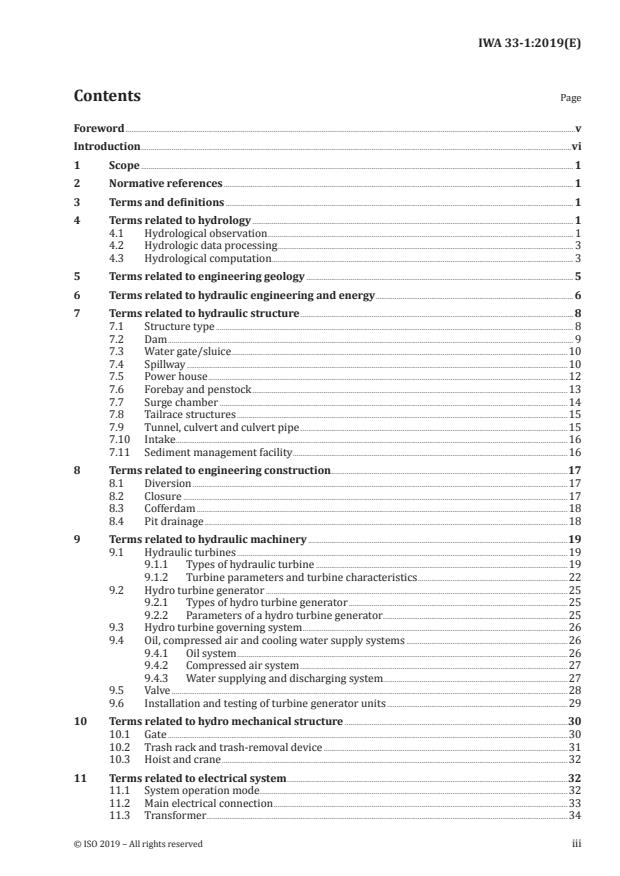
Contents Page
Foreword .v
Introduction .vi
1 Scope . 1
2 Normative references . 1
3 Terms and definitions . 1
4 Terms related to hydrology . 1
4.1 Hydrological observation . 1
4.2 Hydrologic data processing . 3
4.3 Hydrological computation . 3
5 Terms related to engineering geology . 5
6 Terms related to hydraulic engineering and energy . 6
7 Terms related to hydraulic structure . 8
7.1 Structure type . 8
7.2 Dam . 9
7.3 Water gate/sluice .10
7.4 Spillway .10
7.5 Power house .12
7.6 Forebay and penstock .13
7.7 Surge chamber .14
7.8 Tailrace structures .15
7.9 Tunnel, culvert and culvert pipe .15
7.10 Intake .16
7.11 Sediment management facility .16
8 Terms related to engineering construction .17
8.1 Diversion .17
8.2 Closure .17
8.3 Cofferdam .18
8.4 Pit drainage .18
9 Terms related to hydraulic machinery .19
9.1 Hydraulic turbines .19
9.1.1 Types of hydraulic turbine .19
9.1.2 Turbine parameters and turbine characteristics .22
9.2 Hydro turbine generator .25
9.2.1 Types of hydro turbine generator .25
9.2.2 Parameters of a hydro turbine generator .25
9.3 Hydro turbine governing system .26
9.4 Oil, compressed air and cooling water supply systems .26
9.4.1 Oil system .26
9.4.2 Compressed air system .27
9.4.3 Water supplying and discharging system.27
9.5 Valve .28
9.6 Installation and testing of turbine generator units .29
10 Terms related to hydro mechanical structure .30
10.1 Gate .30
10.2 Trash rack and trash-removal device .31
10.3 Hoist and crane .32
11 Terms related to electrical system .32
11.1 System operation mode .32
11.2 Main electrical connection .33
11.3 Transformer.34
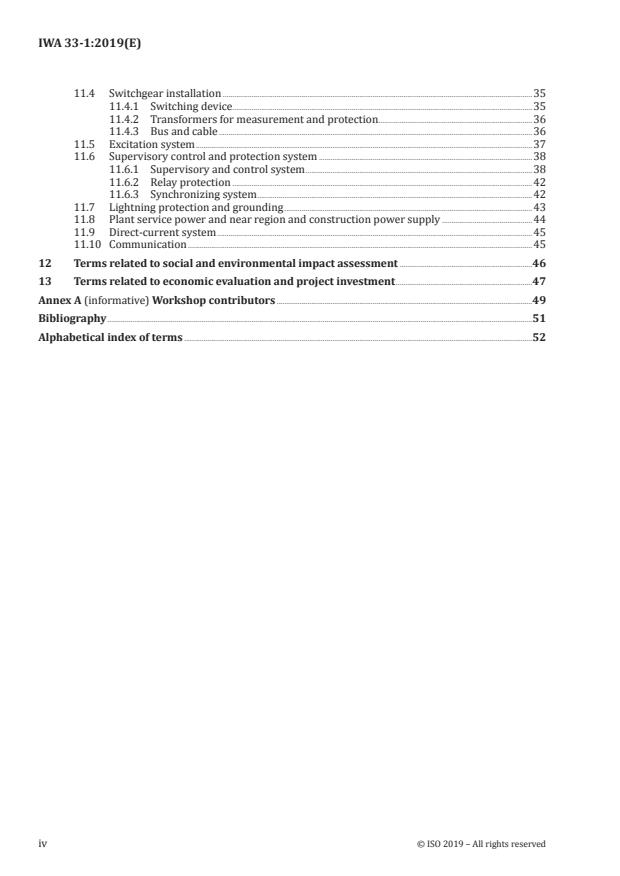
11.4 Switchgear installation .35
11.4.1 Switching device . . .35
11.4.2 Transformers for measurement and protection .36
11.4.3 Bus and cable .36
11.5 Excitation system .37
11.6 Supervisory control and protection system .38
11.6.1 Supervisory and control system .38
11.6.2 Relay protection .42
11.6.3 Synchronizing system .42
11.7 Lightning protection and grounding .43
11.8 Plant service power and near region and construction power supply .44
11.9 Direct-current system .45
11.10 Communication .45
12 Terms related to social and environmental impact assessment .46
13 Terms related to economic evaluation and project investment .47
Annex A (informative) Workshop contributors .49
Bibliography .51
Alphabetical index of terms .52
iv © ISO 2019 – All rights reserved
Foreword
ISO (the International Organization for Standardization) is a worldwide federation of national standards
bodies (ISO member bodies). The work of preparing International Standards is normally carried out
through ISO technical committees. Each member body interested in a subject for which a technical
committee has been established has the right to be represented on that committee. International
organizations, governmental and non-governmental, in liaison with ISO, also take part in the work.
ISO collaborates closely with the International Electrotechnical Commission (IEC) on all matters of
electrotechnical standardization.
The procedures used to develop this document and those intended for its further maintenance are
described in the ISO/IEC Directives, Part 1. In particular, the different approval criteria needed for the
different types of ISO documents should be noted. This document was drafted in accordance with the
editorial rules of the ISO/IEC Directives, Part 2 (see www .iso .org/ directives).
Attention is drawn to the possibility that some of the elements of this document may be the subject of
patent rights. ISO shall not be held responsible for identifying any or all such patent rights. Details of
any patent rights identified during the development of the document will be in the Introduction and/or
on the ISO list of patent declarations received (see www .iso .org/ patents).
Any trade name used in this document is information given for the convenience of users and does not
constitute an endorsement.
For an explanation of the voluntary nature of standards, the meaning of ISO specific terms and
expressions related to conformity assessment, as well as information about ISO's adherence to the
World Trade Organization (WTO) principles in the Technical Barriers to Trade (TBT), see www .iso .org/
iso/ foreword .html.
International Workshop Agreement IWA 33 was approved at a workshop hosted by the Standardization
Administration of China (SAC) and Austrian Standards International (ASI), in association with the
International Center on Small Hydro Power (ICSHP), held in Hangzhou, China, in June, 2019.
Any feedback or questions on this document should be directed to the user’s national standards body. A
complete listing of these bodies can be found at www .iso .org/ members .html.
A list of all parts in the IWA 33 series can be found on the ISO website.
Introduction
Small hydropower (SHP) is increasingly recognized as an important renewable energy solution to
the challenge of electrifying remote rural areas. However, while most countries in Europe, in North
and South America and in China have high degrees of installed capacity, the potential of SHP in many
developing countries remains untapped and is hindered by a number of factors including the lack of
globally agreed good practices or standards for SHP development.
The technical guidelines for the development of small hydropower plants contained in this document
address the current limitations of the regulations applied to technical guidelines for SHP plants by
applying the expertise and best practices that exist across the globe. It is intended for countries to
utilize this document to support their current policy, technology and ecosystems. Countries that have
limited institutional and technical capacities will be able to enhance their knowledge base in developing
SHP plants, thereby attracting more investment in SHP projects, encouraging favourable policies and
subsequently assisting in economic development at a national level. This document will be valuable for
all countries, but especially allow for the sharing of experience and best practices between countries
that have limited technical know-how.
This document is the result of a collaborative effort between the United Nations Industrial Development
Organization (UNIDO) and the International Network on Small Hydro Power (INSHP). About 80
international experts and 40 international agencies were involved in this document’s preparation
and peer review. This document can be used as the principles and basis for the planning, design,
construction and management of SHP plants up to 30 MW.
vi © ISO 2019 – All rights reserved
International Workshop Agreement IWA 33-1:2019(E)
Technical guidelines for the development of small
hydropower plants —
Part 1:
Vocabulary
1 Scope
This document defines the professional technical terms and definitions commonly used for small
hydropower (SHP) plants.
2 Normative references
There are no normative references in this document.
3 Terms and definitions
ISO and IEC maintain terminological databases for use in standardization at the following addresses:
— ISO Online browsing platform: available at https:// www .iso .org/ obp
— IEC Electropedia: available at http:// www .electropedia .org/
4 Terms related to hydrology
4.1 Hydrological observation
4.1.1
precipitation
liquid or solid products of the condensation or sublimation of water vapour falling from clouds or
deposited from air on to the ground
Note 1 to entry: It is the amount of precipitation on a unit of horizontal surface per unit time.
[SOURCE: UNESCO/WMO, WMO-No. 385, Section 2 No. 1114]
4.1.2
precipitation days
number of days with daily precipitation more than 0,1 mm within a specified period of time
4.1.3
precipitation duration
period of time during which continuous precipitation occurs at a specific point or within a specific area
[SOURCE: UNESCO/WMO, WMO-No. 385, Section 2 No. 1115]
4.1.4
precipitation intensity
rainfall intensity
rate at which precipitation occurs, expressed in units of depth per unit of time
[SOURCE: UNESCO/WMO, WMO-No. 385, Section 2 No. 1157]
4.1.5
effective rainfall
part of the rainfall which contributes to runoff
Note 1 to entry: In groundwater, it is the part of the rainfall which contributes to groundwater recharge.
Note 2 to entry: In agriculture, it is that part of the rainfall which remains in the soil and contributes to the
growth of crops.
[SOURCE: UNESCO/WMO, WMO-No. 385, Section 2 No. 458]
4.1.6
probable maximum precipitation
PMP
maximum rainfall that can occur under modern climate conditions within a given period of time in a
certain river basin area
4.1.7
evaporation
water volume of extracting moisture by converting liquid into vapour through heat conduction within
a certain period of time
Note 1 to entry: It is often expressed in terms of the depth of water layer evaporated.
4.1.8
infiltration
percolation
seepage
flow of water through the soil surface into a porous medium
[SOURCE: UNESCO/WMO, WMO-No. 385, Section 2 No. 795]
4.1.9
infiltration intensity
speed at which water will enter a given soil at any given time
4.1.10
stage
water level
elevation of the free water surface of a water body relative to a specified datum
[SOURCE: UNESCO/WMO, WMO-No. 385, Section 2 No. 1621]
4.1.11
maximum stage
maximum instantaneous stage at a certain observation point within the specified duration
4.1.12
minimum stage
minimum instantaneous stage at a certain observation point within the specified duration
4.1.13
discharge
rate of flow
volume of water flowing through a river (or channel) cross section per unit time
[SOURCE: UNESCO/WMO, WMO-No. 385, Section 2 No. 391]
4.1.14
maximum discharge
maximum instantaneous fluid volume which passes through a certain cross section within a specified
duration
2 © ISO 2019 – All rights reserved
4.1.15
minimum discharge
minimum instantaneous fluid volume which passes through a certain cross section within a specified
duration
4.1.16
mean discharge
averaged flow which passes through a certain cross section within a specified duration
EXAMPLE Daily, monthly or yearly mean flow.
4.2 Hydrologic data processing
4.2.1
isohyetal map
map showing the rainfall distribution by a contour connecting the points of equal rainfall
4.2.2
runoff isopleth map
map showing the runoff distribution depth by a contour connecting the points of equal runoff depth
4.2.3
hydrograph
graph showing the variation in time of data such as stage, discharge, velocity
[SOURCE: UNESCO/WMO, WMO-No. 385, Section 2 No. 733]
4.2.4
stage-discharge relation
rating curve
curve showing the relation between stage and discharge of a stream at a hydrometric station
[SOURCE: UNESCO/WMO, WMO-No. 385, Section 2 No. 1172]
4.2.5
storm -runoff relation curve
curve showing the relation between the storm and the corresponding runoff produced by it
4.2.6
flow-duration curve
curve showing the percentage of time during which the flow of a stream is equal to or greater than
given amounts, regardless of chronological order
[SOURCE: UNESCO/WMO, WMO-No. 385, Section 2 No. 570]
4.3 Hydrological computation
4.3.1
bench-mark station
observation station that records the hydrometric data which helps in hydrologic computation
4.3.2
typical year
representative year
year that has hydrologic characteristic values close to the design value, along with its spatial and
temporal distribution, which is used as the design basis
4.3.3
hydrologic series
series composed of hydrologic characteristic values in chronological order
4.3.4
series representativeness
extent of closeness of statistical property of the selected sample to the overall statistical property
4.3.5
design hydrograph
hydrograph of discharge, etc., at a certain frequency, for design of hydropower plants
4.3.6
reservoir back water
rise in water level upstream of the reservoir along the channel stream, after the reservoir is filled
with water
4.3.7
frequency analysis
process of ascertaining the statistical parameters and design values of hydrologic variables from
the existing hydrologic data according to the statistical characteristics of a certain hydrological
phenomenon
4.3.8
return period
recurrence interval
long-term average time interval between a hydrological event of a specific magnitude and an event with
equal or greater magnitude
[SOURCE: UNESCO/WMO, WMO-No. 385, Section 2 No. 1234]
4.3.9
design frequency
frequency of a certain hydrologic feature used for planning and designing any structure
4.3.10
design annual runoff
annual runoff corresponding to the design standard and its annual distribution
4.3.11
naturalized computation of runoff
analysis and computation of runoff data for that volume of river flow which is influenced by the human
activities in the catchment
4.3.12
naturalized water volume
volume of water to be considered while computing runoff as the river flow decreases or increases due
to the influence of human activities
4.3.13
annual distribution of runoff
distribution process of annual runoff by month, ten-day period, or daily
4.3.14
mean annual runoff
long-term average value of annual runoff
4.3.15
design flood
flood adopted for design purposes
Note 1 to entry: It can be the probable maximum flood, the total amount of flood or a flood corresponding to
some adopted frequency of occurrence (e.g. 50, 100, 200 or 500 years), depending on the standard of safety to be
provided.
4 © ISO 2019 – All rights reserved
4.3.16
probable maximum flood
PMF
flood that can occur under probable maximum precipitation
4.3.17
design flood for construction period
flow value that meets the temporary flood control design parameter during the construction period
5 Terms related to engineering geology
5.1
topography
study of all kinds of natural features and forms on the earth surface
5.2
geomorphology
study of all kinds of relief form on the earth surface
5.3
geologic structure
forms of deformation or displacement of rock stratum that make up the earth crust, under the action of
the earth’s internal forces
5.4
lithology
composition, colour, physicochemical properties and structure of the rocks that make up the rock
formation
5.5
hydrogeology
study of phenomena of change and movement of groundwater in nature, including groundwater
distribution and formation rules, physical properties and chemical composition of groundwater,
groundwater resources and their rational utilization, adverse effects of groundwater on engineering
construction and mining, and their mitigation
5.6
physical geology
ecological processes and phenomena which are produced by the external and internal forces of the
earth and adversely affect engineering construction
EXAMPLE Faults; landslide; collapse; karst; suffosion; earthquake; debris flows; weathering; frost heave;
thaw collapse; surface erosion.
5.7
weathering of a rock mass
process and phenomenon relating to the change in organizational structure, mineral chemical
composition and physical behaviour of a rock mass under the combined action of solar radiation,
temperature variations, wind, water (ice), gas and biological factors
5.8
landslide
phenomenon of rock mass, earth mass or debris moving down a slope under gravity
5.9
rockfall
phenomenon of rock falling abruptly down a steep slope
5.10
unloading deformation
deformation of surface rock and earth mass due to the adjustment of internal stresses caused by
unloading, which occurs either due to natural geologic processes or engineering activity
5.11
creep
phenomenon of surface rock and earth mass moving slowly down a slope
5.12
debris flow
mudflow
sudden flood carrying a lot of solid matter like sediment and rocks, which takes place in a mountainous
area, in most cases due to a rainstorm or intense melting of ice and snow
5.13
reservoir leakage
phenomenon of water loss from a reservoir through the rocks and earth mass of the reservoir basin,
which can result in a loss of water volume and can also affect the stability of the dam
5.14
reservoir bank immersion
phenomenon of groundwater level rise in the area surrounding a reservoir zone due to water storage
in the reservoir, and resulting in secondary geological hazards like swampiness, salinization and
deterioration of the foundations of structures
5.15
reservoir bank caving
reservoir bank collapse
phenomenon in which caving of a bank slope occurs due to changes in the stability of the bank slope
under the effects of water level changes and wave action in the reservoir, after or during the process of
water filling
5.16
upward extension of reservoir deposition
phenomenon where back water is gradually elevated due to the continuous deposition of reservoir
sediment, which causes the reservoir tail silt to develop upstream
5.17
limit state of sediment deposition in a reservoir
state of reservoir siltation having ceased as it reaches the equilibrium of sediment transport
5.18
geophysical prospecting
method for determining the geological structure as part of engineering investigation by observing,
analysing and studying the differences in the physical properties of different geological bodies, and in
combination with the relevant geological data
5.19
exploratory drilling
application of the mechanical engineering technology of deep drilling to determine the profile of the
formation and retrieve strata samples to obtain the relevant geological parameters
6 Terms related to hydraulic engineering and energy
6.1
daily regulated hydropower plant
regulation of the supply of uniform inflow from the utilizable reservoir capacity, over a day, to handle
the daily power demand of a hydropower plant
6 © ISO 2019 – All rights reserved
6.2
annual regulated hydropower plant
hydropower station with reservoir capacity sufficient to regulate the river water volume over a year
6.3
multiyear regulation of hydropower station
hydropower station with sufficient reservoir capacity to store the surplus water over the years in the
reservoir and distribute the water stored in high-flow years over several low-flow years
6.4
non-regulated hydropower plant
hydropower station which operates without a regulating reservoir
6.5
regulated reservoir capacity
usable reservoir volume from the normal reservoir water level to the dead water level
6.6
installed capacity
nominal rated generating capacity of all turbine generator units in a hydropower plant
6.7
firm power
firm output
output of a hydropower plant in the hydrological period within the design dependability
6.8
average annual energy output
arithmetic mean value of the hydropower plant’s annual energy output
6.9
load factor
ratio of average power demand to peak power demand for the period being considered
Note 1 to entry: Load factor can be computed on a daily, weekly, monthly or annual basis.
6.10
plant load factor
ratio of power generated to the maximum possible generation from a hydropower plant
6.11
load forecast
process of predicting the load data over a specific period of time in the future, on the premise of
satisfying requirements according to the operational characteristics of the system, decisions on
capacity increases, natural conditions and social influences
6.12
electric power and energy balance
balance of supply and demand of electric power and energy in an electric power system
6.13
normal water level
water level required for meeting the designated use under normal reservoir conditions
6.14
limited level during flood season
upper limit of water level allowed for impounding for utilization during the flood season
Note 1 to entry: It is also the prime level of regulation when the reservoir is operated for flood control during the
flood season.
6.15
dead water level
minimum allowed water level to be reached under normal reservoir conditions
6.16
gross head
elevation difference between the water surfaces at the intake and tailrace of a hydroelectric system
6.17
net head
head available for power generation at the turbine, incorporating all head losses in the water conveyance
system, from intake to turbine inlet
6.18
maximum head
maximum head available for the operation of a unit
6.19
minimum head
minimum head available for the operation of a unit
6.20
design head
minimum head available for the rated output of a unit
6.21
arithmetic average head
arithmetic mean of the heads calculated over various time intervals (e.g. a day, ten days, a month)
within a specified period
6.22
weighted average head
average head calculated for a relatively long operational period with the output power as the weight
7 Terms related to hydraulic structure
7.1 Structure type
7.1.1
permanent structure
structure used during the operational period of a project
7.1.2
temporary structure
structure used during engineering construction and maintenance periods
7.1.3
main structure
structure serving a major role in the project, which, in the case of an accident, can result in a severe
disaster or seriously influence the benefit of a project
7.1.4
secondary structure
structure with a relatively minor role in the project which has little impact in the case of an incident
7.1.5
water retaining structure
hydraulic structure built to store water and/or raise the water level
8 © ISO 2019 – All rights reserved
7.1.6
water release structure
hydraulic structure built for releasing surplus water or discharging sediment and ice
7.1.7
water conveyance structure
hydraulic structure built for conveying water
7.1.8
water intake structure
hydraulic structure built for withdrawing the water from the source
7.1.9
construction diversion structure
cofferdams, diversion tunnels and other hydraulic structures for achieving the construction diversion
objectives
7.1.10
canal structure
hydraulic structures built on channels
7.1.11
fish passage structure
structure built for the fish to migrate upstream and downstream of the dam
7.2 Dam
7.2.1
gravity dam
dam constructed of concrete and/or masonry, which relies on its weight for stability
[SOURCE: ICOLD Dictionary, 41032/4-1]
7.2.2
arch dam
concrete or masonry dam which is curved in plan in order to transmit the major part of the water load
to the abutments
[SOURCE: ICOLD Dictionary, 41034/4-1]
7.2.3
earth-rock-fill dam
dam with the main body filled with local materials, including earth, sand, sand gravel, cobble, rock
block and decomposed rock
7.2.4
rolled earth-rock dam
dam that is filled with earth and rock in layers, where each layer is compacted by rolling
7.2.5
rockfill dam
embankment dam in which more than 50 % of the total volume comprises compacted or dumped
pervious natural or crushed stone
[SOURCE: ICOLD Dictionary, 46006/4-6]
7.2.6
concrete faced rock-fill dam
rock-fill dam having impervious reinforced concrete on the upstream face
7.2.7
earth dam
earthfill dam
embankment dam in which more than 50 % of the total volume is formed of compacted fine grained
material obtained from a borrow area
[SOURCE: ICOLD Dictionary, 46002/4-6]
7.2.8
weir
barrage
low dam or wall across a stream to raise the upstream water level
Note 1 to entry: It is referred to as a fixed-crest weir when uncontrolled.
7.2.9
dam with hydraulic automatic flap gate
dam where the closing and opening arrangement of gates is regulated by virtue of the principles of
lever balance and rotation, i.e. by a hydraulic automatic controlling arrangement
7.3 Water gate/sluice
7.3.1
sluice
hydraulic structure of medium/low head built on a river or a canal to control the flow and regulate the
water level by means of a gate
7.3.2
culvert-type sluice
sluice where the conveyance culvert is buried under the filling and a gate is installed at the culvert
entrance
7.3.3
barrage with sluice
sluice built across a river for regulating the upstream water level and controlling the flow of the river
7.3.4
intake sluice
sluice built at the canal head for diverting and controlling the inflow rate
7.3.5
sand flushing sluice
sluice used for scouring or washing out the accumulated silt from the reservoir, barrage or desander
7.3.6
regulating sluice
check gate
sluice constructed in a river or a canal to regulate the upstream water level
7.4 Spillway
7.4.1
spillway
structure over or through which flood flows are discharged
[SOURCE: ICOLD Dictionary, 81001/8-1]
10 © ISO 2019 – All rights reserved
7.4.2
chute spillway
steeply sloping spillway channel
[SOURCE: ICOLD Dictionary, 81032/8-1]
7.4.3
side spillway
spillway the crest of which is roughly parallel to the channel immediately downstream of the spillway
[SOURCE: ICOLD Dictionary, 81011/8-1]
7.4.4
ski jump spillway
spillway chute or conduit at the bottom of which there is a reverse curve which throws water up into
the air to dissipate energy at a safe distance from the dam
[SOURCE: ICOLD Dictionary, 81016/8-1]
7.4.5
shaft spillway
vertical or inclined shaft into which flood water spills
Note 1 to entry: If the upper part of the shaft is splayed out and terminates in a circular horizontal weir, this is
termed a bellmouth or morning glory spillway.
[SOURCE: ICOLD Dictionary, 81017/8-1]
7.4.6
siphon spillway
spillway with one or more siphons built at crest level
Note 1 to entry: This type of spillway is sometimes used for providing automatic surface level regulation within
narrow limits, or when considerable discharge capacity is necessary within a short period of time.
[SOURCE: ICOLD Dictionary, 81026/8-1]
7.4.7
energy dissipation by hydraulic jump
energy dissipation method in the form of a hydraulic jump for eliminating the surplus energy of
rapids released from the outsole of release structures, and changing torrent flow into slow flow to be
connected with the downstream flow
7.4.8
energy dissipation by surface current
energy dissipation method that involves setting up a step-down floor or small flip bucket at the outflow
of release structures; this directs the releasing torrent to the superstratum of the downstream flow
and forms a spiral roll on the bottom
7.4.9
trajectory bucket energy dissipation
energy dissipation method that involves setting a trajectory bucket at outflow of release structures,
to direct the releasing torrent to the air and form an aerated jet, which then falls into the downstream
water pillow
7.4.10
stilling basin
hydraulic-jump-energy dissipation facility established downstream of water gates or water release
structures
Note 1 to entry: It is protected by aprons and side walls.
7.4.11
energy dissipating bucket
bucket-shaped energy dissipating facility established downstream of water gates or water release
structures for underwater jetting flow
7.4.12
baffle sill
continuous sill or tooth-shaped sill established at the end of the downstream apron of a water gate or
water release structure to assist in energy dissipation from a hydraulic jump
7.4.13
baffle block
baffle pier
pier-shaped assistant energy dissipation structure to improve energy dissipation efficiency
Note 1 to entry: It is located in the hydraulic-jump energy dissipation pool.
7.4.14
chute block
pier-shaped assistant energy dissipation structure to improve energy dissipation efficiency, established
at the toe of the inlet slope section of a hydraulic-jump energy dissipation pool
7.5 Power house
7.5.1
power house
structure required for accommodating a turbine generator unit and its auxiliary equipment, as well as
for their installation, maintenance, operation and management services in the hydropower station
7.5.2
power house at dam toe
power house located close to the toe of the dam which does not bear the upstream hydraulic pressure of
the dam directly and is also a power house of special layout
EXAMPLE An overflow-type power house; a fly-over type power house.
7.5.3
riverbed power house
power house located in a river or a canal bearing the upstream hydraulic pressure directly
Note 1 to entry: It is also known as an in-stream power house.
7.5.4
river-side power house
power house located on a river bank which does not bear the upstream hydraulic pressure of the dam
directly
7.5.5
power house within dam
power house located in the cavity of a dam body
7.5.6
underground power house
power house built in the underground cavity of mountains
7.5.7
semi-underground power house
power house built in a pit, having an underground vertical shaft with the top portion exposed above
the surface
12 © ISO 2019 – All rights reserved
7.5.8
surface power house
power house built on a surface exposed to the atmosphere
7.5.9
control room
structure required for accommodating the instruments, devices and computers for monitoring and
controlling all types of mechanical and electrical equipment for the whole plant
7.5.10
generator floor
generator storey
space above the main machine floor in the power house installed with vertical shaft units
7.5.11
turbine floor
turbine storey
space between the floor of the main machine floor and the spiral casing floor in a power house installed
with vertical shaft units
7.5.12
spiral casing floor
spiral casing storey
space between the turbine floor and draft tube top elevation in a power house installed with vertical
shaft units
7.5.13
draft tube floor
draft tube storey
space between the top elevation and the bottom elevation of the draft tube in a power house installed
with vertical shaft units
7.5.14
valve gallery
gallery for the installation of the main valve in the lower structure of a power house
7.5.15
runner removal gallery
gallery to facilitate the removal of the runner from the turbine
7.5.16
erection and service bay
area provided for the assembly and disassembly of major generating components
7.5.17
switch yard
area used for the installation of various electrical switchgear
7.6 Forebay and penstock
7.6.1
forebay
water retaining structure required for storage, distribution and connecting the headrace channel or
tunnel to the penstock of the turbine
7.6.2
daily regulation pond
water storage pond built for the daily regulation of water volume to meet the power demand
Note 1 to entry: In some cases, it is also used as the forebay.
7.6.3
penstock
pipe that conveys water under pressure from the reservoir, forebay or surge chamber, to the turbine
7.6.4
exposed penstock
penstock laid on the supporting structure above ground
7.6.5
underground penstock
penstock buried in the rock mass either with cement mortar or concrete filling between the penstock
wall and surrounding rock
7.6.6
buried penstock
penstock laid in excavated ground and covered with sandy soil
7.6.7
embedded penstock
penstock in the dam body
7.6.8
bifurcation
pipe section at the bifurcation of penstock
Note 1 to entry: It can be classified as a three-beam bifurcated pipe, spherical bifurcated pipe, shell bifurcated
pipe, crescent-rib reinforced wye piece or hem reinforced branch pipe.
7.6.9
anchor block
block structure required for fixing the position of a penstock, which mainly bears the different forces
on the penstock, including water and its own weight in the longitudinal axis direction
Note 1 to entry: It maintains the penstock’s stability.
7.6.10
support
supporting structure bearing the dead weight of penstock, the weight of water in the penstock and the
friction force in longitudinal axis direction
Note 1 to entry: It can be classified as a saddle pier, anchored ring girder support, sliding ring girder support,
roller support or rocker-mounted ring girder support.
7.6.11
expansion joint
joint provided to permit longitudinal expansion or contraction due to variations in ambient temperature
or base displacement, and to permit slight rotation for differential settlements when a penstock passes
through two structures
7.7 Surge chamber
7.7.1
surge chamber
water storage structure built at the tail of a long-pressure head race, or at the head of a pressure
tailrace, for reducing the water hammer pressure in the penstock and improving the operating
condition of the unit
Note 1 to entry: It can be classified as a cylindrical surge chamber, throttled surge chamber, restricted orifice
surge
...
Questions, Comments and Discussion
Ask us and Technical Secretary will try to provide an answer. You can facilitate discussion about the standard in here.
Loading comments...