

ISO/TS 20175:2018
(Main)Vacuum technology — Vacuum gauges — Characterization of quadrupole mass spectrometers for partial pressure measurement
General Information
- Abstract
This document describes procedures to characterize quadrupole mass spectrometers (QMSs) with an ion source of electron impact ionization and which are designed for the measurement of atomic mass-to-charge ratios m/z This document is not applicable to QMSs with other ion sources, such as chemical ionization, photo-ionization or field ionization sources and for the measurements of higher m/z, which are mainly used to specify organic materials. It is well known from published investigations on the metrological characteristics of quadrupole mass spectrometers that their indications of partial pressures depend significantly on the settings of the instrument, the total pressure, and the composition of the gas mixture. For this reason, it is not possible to calibrate a quadrupole mass spectrometer for all possible kinds of use. The characterization procedures described in this document cover the applications of continuous leak monitoring of a vacuum system, leak rate measurement with tracer gas, residual gas analysis and outgassing rate measurements. The user can select that characterization procedure that best suits his or her needs. These characterization procedures can also be useful for other applications. It is also well known that the stability of several parameters of quadrupole mass spectrometers, in particular sensitivity, are rather poor. Therefore, when a parameter has been calibrated, it needs frequent recalibration when accuracy is required. For practical reasons this can only be accomplished by in situ calibrations. To this end, this document not only describes how a quadrupole mass spectrometer can be calibrated by a calibration laboratory or a National Metrological Institute with direct traceability to the System International (SI), but also how calibrated parameters can be frequently checked and maintained in situ. By their physical principle, quadrupole mass spectrometers need high vacuum within the instrument. By reducing dimensions or by special ion sources combined with differential pumping the operational range can be extended to higher pressures, up to atmospheric pressure. This document, however, does not include quadrupole mass spectrometers with differential pumping technology. Therefore, it does not cover pressures exceeding 1 Pa on the inlet flange of the quadrupole mass spectrometer. This document does not describe how the initial adjustment of a quadrupole mass spectrometer by the manufacturer or by a service given order by the manufacturer should be made. The purpose of such an initial adjustment is mainly to provide a correct m/z scale, constant mass resolution or constant transmission, and is very specific to the instrument. Instead, it is assumed for this document that a manufacturer's readjustment procedure exists which can be carried on-site by a user. This procedure is intended to ensure that the quadrupole mass spectrometer is in a well-defined condition for the characterization. It is the intention of this document that the user gets the best possible metrological quality from his quadrupole mass spectrometer. From investigations it is known that in most cases this can be achieved in the so called "scan mode". The bar graph may also be of an adequate quality depending on the software used for evaluation of the data taken by the quadrupole mass spectrometer. The trend mode, however, often involves the additional uncertainty that a shift of the peak value position on the mass scale causes a shift in ion current. For this reason, the scan mode is preferable for most of the measurement procedures of this document. It is not the intent of this document that all the parameters described be determined for each quadrupole mass spectrometer. However, it is intended that the value of a parameter addressed in this document be determined according to the procedure described in this document if it is given or measured (e.g. for an inspection test). It is assumed for this document that the applicant
- Status
- Published
- Publication Date
- 02-May-2018
- Technical Committee
- ISO/TC 112 - Vacuum technology
- Drafting Committee
- ISO/TC 112 - Vacuum technology
- Current Stage
- 9093 - International Standard confirmed
- Start Date
- 10-Jun-2025
- Completion Date
- 29-Aug-2026
Buy Documents


ISO/TS 20175:2018 - Vacuum technology -- Vacuum gauges -- Characterization of quadrupole mass spectrometers for partial pressure measurement


ISO/TS 20175:2018 - Vacuum technology — Vacuum gauges — Characterization of quadrupole mass spectrometers for partial pressure measurement/3/2018
Overview - ISO/TS 20175:2018 (Quadrupole Mass Spectrometers / QMS)
ISO/TS 20175:2018 provides standardized procedures to characterize quadrupole mass spectrometers (QMS) that use electron impact ionization for partial pressure measurement (atomic mass-to-charge ratios m/z < 300). The technical specification defines how to assess metrological properties of QMS devices used in vacuum technology - including leak detection, residual gas analysis and outgassing tests - and explains calibration approaches, both in a calibration laboratory and in situ with traceability to the SI.
Key topics and technical requirements
- Scope limitations
- Applicable only to QMS with electron impact ion sources (m/z < 300).
- Excludes QMS with chemical/photo/field ionization or differential pumping designs and inlet pressures > 1 Pa.
- Characterization parameters (procedures defined)
- Mass resolution
- Minimum detectable partial pressure (MDPP)
- Minimum detectable concentration (MDC)
- Dynamic range
- Sensitivity and interference-effect ratio
- Linear response range and relative sensitivity factor
- Fragmentation (cracking) pattern
- Outgassing rate and QMS pumping speed
- Calibration and stability
- Procedures for SI-traceable calibration by calibration labs or National Metrology Institutes (NMIs).
- Guidance for frequent in situ checks and recalibration because QMS sensitivity and some parameters can be unstable.
- Measurement systems and setups
- Recommended vacuum systems: continuous expansion (orifice flow), ISO 3567-style calibration systems, or in situ calibration rigs for single gases and gas mixtures.
- Measurement uncertainty and reporting
- Methods to estimate uncertainties for each characterized parameter and standardized reporting formats.
Practical applications and users
ISO/TS 20175:2018 is intended for:
- Vacuum engineers and technicians performing leak detection and continuous leak monitoring (helium, air, water).
- Metrologists and calibration laboratories providing SI-traceable QMS calibration.
- Process-control and R&D teams in semiconductor, EUV lithography, thin-film deposition and etch process monitoring that rely on residual gas analysis and outgassing rate measurement.
- Manufacturers and service organizations needing standardized procedures for on-site characterization and verification.
Practical benefits include improved comparability between instruments, guidance on preferred measurement modes (scan mode is generally recommended), and standardized uncertainty estimates to support quality control and compliance.
Related standards
- ISO 3567:2011 - Vacuum gauges - Calibration by direct comparison
- ISO 14291 - Vacuum gauges - Definitions and specifications for quadrupole mass spectrometers
Keywords: ISO/TS 20175:2018, quadrupole mass spectrometer, QMS characterization, partial pressure measurement, vacuum gauges, residual gas analysis, leak detection, outgassing, in situ calibration.
Buy Documents
ISO/TS 20175:2018 - Vacuum technology -- Vacuum gauges -- Characterization of quadrupole mass spectrometers for partial pressure measurement
ISO/TS 20175:2018 - Vacuum technology — Vacuum gauges — Characterization of quadrupole mass spectrometers for partial pressure measurement/3/2018
Get Certified
Connect with accredited certification bodies for this standard

Institut za varilstvo d.o.o. (Welding Institute)
Slovenia's leading welding institute since 1952. ISO 3834, EN 1090, pressure equipment certification, NDT personnel, welder qualification. Only IIW Au
Sponsored listings
Frequently Asked Questions
ISO/TS 20175:2018 is a technical specification published by the International Organization for Standardization (ISO). Its full title is "Vacuum technology — Vacuum gauges — Characterization of quadrupole mass spectrometers for partial pressure measurement". This standard covers: This document describes procedures to characterize quadrupole mass spectrometers (QMSs) with an ion source of electron impact ionization and which are designed for the measurement of atomic mass-to-charge ratios m/z This document is not applicable to QMSs with other ion sources, such as chemical ionization, photo-ionization or field ionization sources and for the measurements of higher m/z, which are mainly used to specify organic materials. It is well known from published investigations on the metrological characteristics of quadrupole mass spectrometers that their indications of partial pressures depend significantly on the settings of the instrument, the total pressure, and the composition of the gas mixture. For this reason, it is not possible to calibrate a quadrupole mass spectrometer for all possible kinds of use. The characterization procedures described in this document cover the applications of continuous leak monitoring of a vacuum system, leak rate measurement with tracer gas, residual gas analysis and outgassing rate measurements. The user can select that characterization procedure that best suits his or her needs. These characterization procedures can also be useful for other applications. It is also well known that the stability of several parameters of quadrupole mass spectrometers, in particular sensitivity, are rather poor. Therefore, when a parameter has been calibrated, it needs frequent recalibration when accuracy is required. For practical reasons this can only be accomplished by in situ calibrations. To this end, this document not only describes how a quadrupole mass spectrometer can be calibrated by a calibration laboratory or a National Metrological Institute with direct traceability to the System International (SI), but also how calibrated parameters can be frequently checked and maintained in situ. By their physical principle, quadrupole mass spectrometers need high vacuum within the instrument. By reducing dimensions or by special ion sources combined with differential pumping the operational range can be extended to higher pressures, up to atmospheric pressure. This document, however, does not include quadrupole mass spectrometers with differential pumping technology. Therefore, it does not cover pressures exceeding 1 Pa on the inlet flange of the quadrupole mass spectrometer. This document does not describe how the initial adjustment of a quadrupole mass spectrometer by the manufacturer or by a service given order by the manufacturer should be made. The purpose of such an initial adjustment is mainly to provide a correct m/z scale, constant mass resolution or constant transmission, and is very specific to the instrument. Instead, it is assumed for this document that a manufacturer's readjustment procedure exists which can be carried on-site by a user. This procedure is intended to ensure that the quadrupole mass spectrometer is in a well-defined condition for the characterization. It is the intention of this document that the user gets the best possible metrological quality from his quadrupole mass spectrometer. From investigations it is known that in most cases this can be achieved in the so called "scan mode". The bar graph may also be of an adequate quality depending on the software used for evaluation of the data taken by the quadrupole mass spectrometer. The trend mode, however, often involves the additional uncertainty that a shift of the peak value position on the mass scale causes a shift in ion current. For this reason, the scan mode is preferable for most of the measurement procedures of this document. It is not the intent of this document that all the parameters described be determined for each quadrupole mass spectrometer. However, it is intended that the value of a parameter addressed in this document be determined according to the procedure described in this document if it is given or measured (e.g. for an inspection test). It is assumed for this document that the applicant
This document describes procedures to characterize quadrupole mass spectrometers (QMSs) with an ion source of electron impact ionization and which are designed for the measurement of atomic mass-to-charge ratios m/z This document is not applicable to QMSs with other ion sources, such as chemical ionization, photo-ionization or field ionization sources and for the measurements of higher m/z, which are mainly used to specify organic materials. It is well known from published investigations on the metrological characteristics of quadrupole mass spectrometers that their indications of partial pressures depend significantly on the settings of the instrument, the total pressure, and the composition of the gas mixture. For this reason, it is not possible to calibrate a quadrupole mass spectrometer for all possible kinds of use. The characterization procedures described in this document cover the applications of continuous leak monitoring of a vacuum system, leak rate measurement with tracer gas, residual gas analysis and outgassing rate measurements. The user can select that characterization procedure that best suits his or her needs. These characterization procedures can also be useful for other applications. It is also well known that the stability of several parameters of quadrupole mass spectrometers, in particular sensitivity, are rather poor. Therefore, when a parameter has been calibrated, it needs frequent recalibration when accuracy is required. For practical reasons this can only be accomplished by in situ calibrations. To this end, this document not only describes how a quadrupole mass spectrometer can be calibrated by a calibration laboratory or a National Metrological Institute with direct traceability to the System International (SI), but also how calibrated parameters can be frequently checked and maintained in situ. By their physical principle, quadrupole mass spectrometers need high vacuum within the instrument. By reducing dimensions or by special ion sources combined with differential pumping the operational range can be extended to higher pressures, up to atmospheric pressure. This document, however, does not include quadrupole mass spectrometers with differential pumping technology. Therefore, it does not cover pressures exceeding 1 Pa on the inlet flange of the quadrupole mass spectrometer. This document does not describe how the initial adjustment of a quadrupole mass spectrometer by the manufacturer or by a service given order by the manufacturer should be made. The purpose of such an initial adjustment is mainly to provide a correct m/z scale, constant mass resolution or constant transmission, and is very specific to the instrument. Instead, it is assumed for this document that a manufacturer's readjustment procedure exists which can be carried on-site by a user. This procedure is intended to ensure that the quadrupole mass spectrometer is in a well-defined condition for the characterization. It is the intention of this document that the user gets the best possible metrological quality from his quadrupole mass spectrometer. From investigations it is known that in most cases this can be achieved in the so called "scan mode". The bar graph may also be of an adequate quality depending on the software used for evaluation of the data taken by the quadrupole mass spectrometer. The trend mode, however, often involves the additional uncertainty that a shift of the peak value position on the mass scale causes a shift in ion current. For this reason, the scan mode is preferable for most of the measurement procedures of this document. It is not the intent of this document that all the parameters described be determined for each quadrupole mass spectrometer. However, it is intended that the value of a parameter addressed in this document be determined according to the procedure described in this document if it is given or measured (e.g. for an inspection test). It is assumed for this document that the applicant
ISO/TS 20175:2018 is classified under the following ICS (International Classification for Standards) categories: 23.160 - Vacuum technology. The ICS classification helps identify the subject area and facilitates finding related standards.
ISO/TS 20175:2018 is available in PDF format for immediate download after purchase. The document can be added to your cart and obtained through the secure checkout process. Digital delivery ensures instant access to the complete standard document.
Standards Content (Sample)
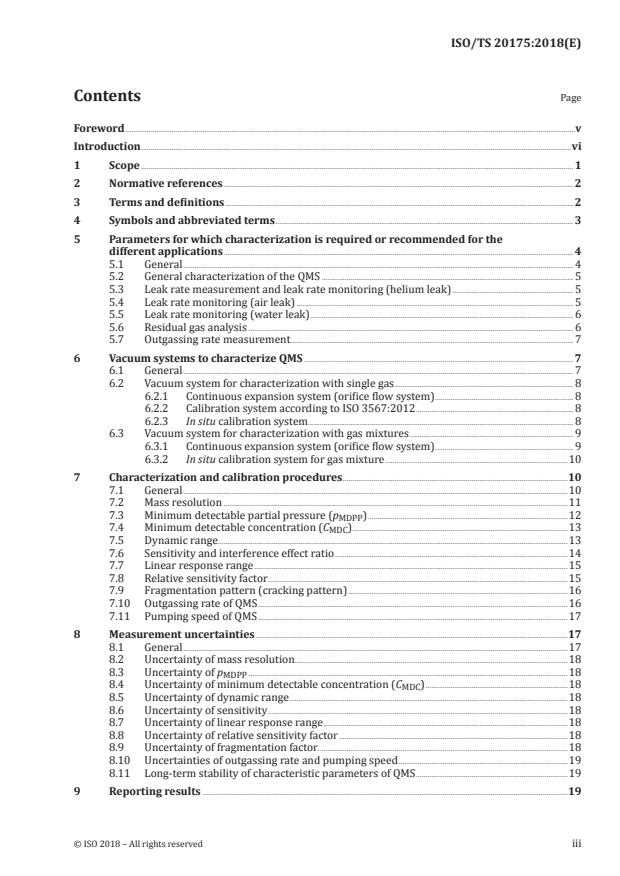
TECHNICAL ISO/TS
SPECIFICATION 20175
First edition
2018-04
Vacuum technology — Vacuum gauges
— Characterization of quadrupole
mass spectrometers for partial
pressure measurement
Technique du vide — Manomètres à vide — Description des
spectromètres de masse quadripolaires pour mesurage de la pression
partielle
Reference number
©
ISO 2018
© ISO 2018
All rights reserved. Unless otherwise specified, or required in the context of its implementation, no part of this publication may
be reproduced or utilized otherwise in any form or by any means, electronic or mechanical, including photocopying, or posting
on the internet or an intranet, without prior written permission. Permission can be requested from either ISO at the address
below or ISO’s member body in the country of the requester.
ISO copyright office
CP 401 • Ch. de Blandonnet 8
CH-1214 Vernier, Geneva
Phone: +41 22 749 01 11
Fax: +41 22 749 09 47
Email: copyright@iso.org
Website: www.iso.org
Published in Switzerland
ii © ISO 2018 – All rights reserved
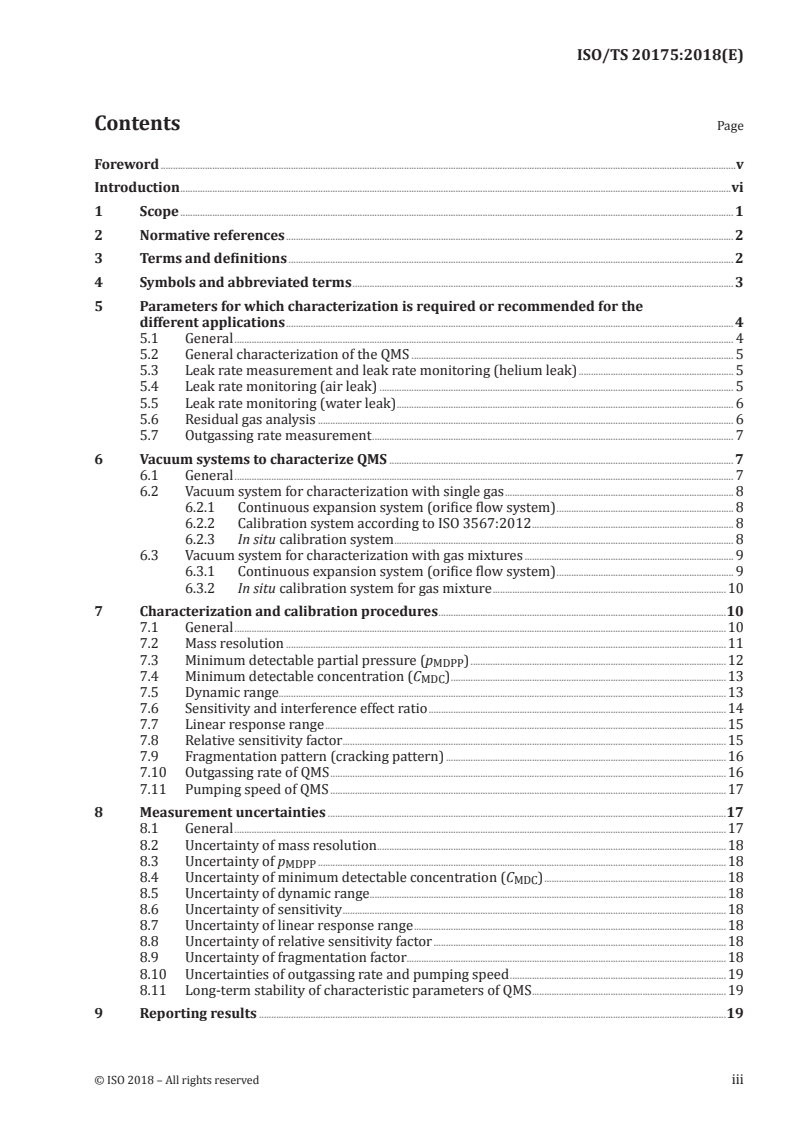
Contents Page
Foreword .v
Introduction .vi
1 Scope . 1
2 Normative references . 2
3 Terms and definitions . 2
4 Symbols and abbreviated terms . 3
5 Parameters for which characterization is required or recommended for the
different applications . 4
5.1 General . 4
5.2 General characterization of the QMS . 5
5.3 Leak rate measurement and leak rate monitoring (helium leak) . 5
5.4 Leak rate monitoring (air leak) . 5
5.5 Leak rate monitoring (water leak) . 6
5.6 Residual gas analysis . 6
5.7 Outgassing rate measurement . 7
6 Vacuum systems to characterize QMS . 7
6.1 General . 7
6.2 Vacuum system for characterization with single gas . 8
6.2.1 Continuous expansion system (orifice flow system) . 8
6.2.2 Calibration system according to ISO 3567:2012 . 8
6.2.3 In situ calibration system . 8
6.3 Vacuum system for characterization with gas mixtures . 9
6.3.1 Continuous expansion system (orifice flow system) . 9
6.3.2 In situ calibration system for gas mixture .10
7 Characterization and calibration procedures .10
7.1 General .10
7.2 Mass resolution .11
7.3 Minimum detectable partial pressure (p ) .12
MDPP
7.4 Minimum detectable concentration (C ) .13
MDC
7.5 Dynamic range.13
7.6 Sensitivity and interference effect ratio .14
7.7 Linear response range .15
7.8 Relative sensitivity factor .15
7.9 Fragmentation pattern (cracking pattern) .16
7.10 Outgassing rate of QMS .16
7.11 Pumping speed of QMS .17
8 Measurement uncertainties .17
8.1 General .17
8.2 Uncertainty of mass resolution .18
8.3 Uncertainty of p .18
MDPP
8.4 Uncertainty of minimum detectable concentration (C ) .18
MDC
8.5 Uncertainty of dynamic range . .18
8.6 Uncertainty of sensitivity .18
8.7 Uncertainty of linear response range .18
8.8 Uncertainty of relative sensitivity factor .18
8.9 Uncertainty of fragmentation factor.18
8.10 Uncertainties of outgassing rate and pumping speed .19
8.11 Long-term stability of characteristic parameters of QMS .19
9 Reporting results .19
Annex A (informative) Estimate of gas composition in the measurement chamber from
known gas composition in the reservoir in front of a leak element under different
flow conditions .21
Bibliography .23
iv © ISO 2018 – All rights reserved
Foreword
ISO (the International Organization for Standardization) is a worldwide federation of national standards
bodies (ISO member bodies). The work of preparing International Standards is normally carried out
through ISO technical committees. Each member body interested in a subject for which a technical
committee has been established has the right to be represented on that committee. International
organizations, governmental and non-governmental, in liaison with ISO, also take part in the work.
ISO collaborates closely with the International Electrotechnical Commission (IEC) on all matters of
electrotechnical standardization.
The procedures used to develop this document and those intended for its further maintenance are
described in the ISO/IEC Directives, Part 1. In particular the different approval criteria needed for the
different types of ISO documents should be noted. This document was drafted in accordance with the
editorial rules of the ISO/IEC Directives, Part 2 (see www .iso .org/directives).
Attention is drawn to the possibility that some of the elements of this document may be the subject of
patent rights. ISO shall not be held responsible for identifying any or all such patent rights. Details of
any patent rights identified during the development of the document will be in the Introduction and/or
on the ISO list of patent declarations received (see www .iso .org/patents).
Any trade name used in this document is information given for the convenience of users and does not
constitute an endorsement.
For an explanation on the voluntary nature of standards, the meaning of ISO specific terms and
expressions related to conformity assessment, as well as information about ISO's adherence to the
World Trade Organization (WTO) principles in the Technical Barriers to Trade (TBT) see the following
URL: www .iso .org/iso/foreword .html.
This document was prepared by Technical Committee ISO/TC 112, Vacuum technology.
Introduction
Quadrupole mass spectrometers (QMSs) are nowadays used not only in vacuum technology for leak
detection and residual gas analysis but also in the process industry as an instrument to provide
quantitative analysis in processes and to control processes such as physical and chemical vapour
deposition, and etch processes. They are also used for quantitative outgassing rate measurements
which are important to characterize vacuum components for critical applications like in the EUV
lithography, semiconductor industry or medical instruments.
Total pressure, composition of the gas mixture, settings and the operational history of QMSs, to name
a few, have a significant influence on the measured signal, its uncertainty and interpretation. For this
reason, it is not possible to calibrate QMS for all its possible applications. Instead, it has either to be
calibrated for the special conditions at use or for a standardized condition. It is the purpose of this
document to establish such conditions.
There is also a need for standardization in order to enable the users of QMSs to compare the devices of
different manufactures and to use the QMS properly.
This document provides standardized calibration procedures for QMSs for some important applications.
These have been selected from the results of a survey of the international project EMRP (European
Metrological Research Programme) IND12 which was conducted in 2013. This survey included
manufacturers, distributors and users of quadrupole mass spectrometers.
vi © ISO 2018 – All rights reserved
TECHNICAL SPECIFICATION ISO/TS 20175:2018(E)
Vacuum technology — Vacuum gauges — Characterization
of quadrupole mass spectrometers for partial pressure
measurement
1 Scope
This document describes procedures to characterize quadrupole mass spectrometers (QMSs) with an
ion source of electron impact ionization and which are designed for the measurement of atomic mass-
to-charge ratios m/z < 300.
This document is not applicable to QMSs with other ion sources, such as chemical ionization, photo-
ionization or field ionization sources and for the measurements of higher m/z, which are mainly used to
specify organic materials.
It is well known from published investigations on the metrological characteristics of quadrupole
mass spectrometers that their indications of partial pressures depend significantly on the settings of
the instrument, the total pressure, and the composition of the gas mixture. For this reason, it is not
possible to calibrate a quadrupole mass spectrometer for all possible kinds of use. The characterization
procedures described in this document cover the applications of continuous leak monitoring of a
vacuum system, leak rate measurement with tracer gas, residual gas analysis and outgassing rate
measurements. The user can select that characterization procedure that best suits his or her needs.
These characterization procedures can also be useful for other applications.
It is also well known that the stability of several parameters of quadrupole mass spectrometers,
in particular sensitivity, are rather poor. Therefore, when a parameter has been calibrated, it needs
frequent recalibration when accuracy is required. For practical reasons this can only be accomplished by
in situ calibrations. To this end, this document not only describes how a quadrupole mass spectrometer
can be calibrated by a calibration laboratory or a National Metrological Institute with direct traceability
to the System International (SI), but also how calibrated parameters can be frequently checked and
maintained in situ.
By their physical principle, quadrupole mass spectrometers need high vacuum within the instrument.
By reducing dimensions or by special ion sources combined with differential pumping the operational
range can be extended to higher pressures, up to atmospheric pressure. This document, however, does
not include quadrupole mass spectrometers with differential pumping technology. Therefore, it does
not cover pressures exceeding 1 Pa on the inlet flange of the quadrupole mass spectrometer.
This document does not describe how the initial adjustment of a quadrupole mass spectrometer by the
manufacturer or by a service given order by the manufacturer should be made. The purpose of such
an initial adjustment is mainly to provide a correct m/z scale, constant mass resolution or constant
transmission, and is very specific to the instrument. Instead, it is assumed for this document that a
manufacturer’s readjustment procedure exists which can be carried on-site by a user. This procedure
is intended to ensure that the quadrupole mass spectrometer is in a well-defined condition for the
characterization.
It is the intention of this document that the user gets the best possible metrological quality from
his quadrupole mass spectrometer. From investigations it is known that in most cases this can be
achieved in the so called “scan mode”. The bar graph may also be of an adequate quality depending on
the software used for evaluation of the data taken by the quadrupole mass spectrometer. The trend
mode, however, often involves the additional uncertainty that a shift of the peak value position on the
mass scale causes a shift in ion current. For this reason, the scan mode is preferable for most of the
measurement procedures of this document.
It is not the intent of this document that all the parameters described be determined for each quadrupole
mass spectrometer. However, it is intended that the value of a parameter addressed in this document be
determined according to the procedure described in this document if it is given or measured (e.g. for an
inspection test).
It is assumed for this document that the applicant is familiar with both the operation of quadrupole
mass spectrometers and high and ultra-high vacuum technology.
2 Normative references
The following documents are referred to in the text in such a way that some or all of their content
constitutes requirements of this document. For dated references, only the edition cited applies. For
undated references, the latest edition of the referenced document (including any amendments) applies.
ISO 3567:2011, Vacuum technology — Vacuum gauges — Calibration by direct comparison with a
reference gauge
ISO 14291, Vacuum technology — Vacuum gauges — Definitions and specifications for quadrupole mass
spectrometer
3 Terms and definitions
For the purposes of this document, the terms and definitions given in ISO 14291 and the following apply.
ISO and IEC maintain terminological databases for use in standardization at the following addresses:
— ISO Online browsing platform: available at https: //www .iso .org/obp
— IEC Electropedia: available at http: //www .electropedia .org/
3.1
matrix gas
gas or gas mixture that makes the major contribution to the total pressure
3.2
equivalent nitrogen pressure
pressure of nitrogen which would produce the same gauge reading as the pressure of gas acting on a
vacuum gauge
[SOURCE: ISO 3529-3:2014, 2.3.5, modified.]
Note 1 to entry: Nitrogen equivalent depends on the type of gauge, since the relative sensitivity factor is different
for different types. For this reason, the term should be used with the type of vacuum gauge.
3.3
transmission probability
ratio of ion current of a certain mass-to-charge ratio exiting a quadrupole filter of a QMS to the current
of ions of the same mass-to-charge ratio entering it
3.4
scan speed
speed as u (Δm/z=1) per time with a defined number of signal points per u (Δm/z=1)
3.5
linear response range
partial pressure range over which the non-linearity is within a specified limit
Note 1 to entry: For the purpose of this document the limit is ± 10 % from the mean value.
2 © ISO 2018 – All rights reserved
Note 2 to entry: The linear response range can also depend on the conversion of the output current signal to a
digital value. Sometimes a single digital bit does not quantise the same amount of current at the lower and upper
end of the range.
[SOURCE: ISO 14291:2012, 2.2.18, modified – Notes to entry have been added.]
3.6
leak rate measurement
quantitative measurement of a tracer gas through a leak
3.7
leak rate monitoring
continuous monitoring of one or several selected gas species with respect to the normal background in
a vacuum system in order to detect a change caused by a leak
EXAMPLE 1 In an accelerator tube, argon is monitored to detect a leak from air.
EXAMPLE 2 In a fusion reactor, water peaks are monitored to detect a leak from the cooling system.
3.8
fragmentation pattern
pattern (i.e. kinds and relative amounts) of ions produced by a given pure gas in a given mass
spectrometer under given conditions
Note 1 to entry: This definition does include the isotopic and isomeric distribution of the species.
[SOURCE: ISO 14291:2012, modified – Notes to entry replaced.]
3.9
interference effect ratio
ratio S ´ / S where
i i
S ´ is the sensitivity of a specified gas species i of partial pressure p present in an interference gas
i i
or interference gas mixture;
S is the sensitivity at the same value of p when only species i is present.
i i
3.10
interference gas
gas species added to a pure gas that may cause an interference effect
3.11
interference gas mixture
mixture of several gas species added to a pure gas that may cause an interference effect
3.12
dynamic range
ratio of the largest signal to the smallest signal within a spectrum
Note 1 to entry: The difference between minimum detectable concentration (C ) as defined in ISO 14291 and
MDC
dynamic range is that for the C it is acceptable to optimize the signal to noise ratio for the minor constituent,
MDC
while this is not possible for the dynamic range.
4 Symbols and abbreviated terms
Symbol Designation Unit
effective conductance of a duct, effective m /s or
C
eff
pumping speed L/s
R dynamic range 1
dyn
f fragmentation factor 1
Symbol Designation Unit
I ion current at partial pressure p A
I ion current at residual pressure p A
0 0
m molecular mass in atomic mass units u
M molecular mass kg
C minimum detectable concentration 1
MDC
p minimum detectable partial pressure Pa
MDPP
p pressure or partial pressure Pa
residual pressure or residual partial
p Pa
pressure
relative sensitivity for a specified gas
r species “x” divided by sensitivity S for 1
x N2
nitrogen
volume flow rate of species i into a vacuum m /s or
q
V,i
pump (pumping speed) L/s
−1
universal gas constant J mol
R
−1
K
S sensitivity (coefficient) A/Pa
SI System International
S sensitivity for nitrogen A/Pa
N2
T temperature K
T transmission probability 1
P
z the ionization state of a molecule 1
Δm mass resolution as defined in ISO 14291 u
CEM continuous dynode electron multiplier
MCP micro-channel plate
QMS quadrupole mass spectrometer
SEM secondary electron multiplier
NOTE The symbol m characterizes the mass of a molecule in u, while m/z characterizes at which position
the molecule with mass m appears on the mass scale indicated by the QMS. This is proportional to the mass-to-
charge ratio and therefore also to m/z.
5 Parameters for which characterization is required or recommended for the
different applications
5.1 General
ISO 14291 requires a certain number of parameters to be stated by a manufacturer for general
characterization. This is covered in 5.1. It is also recommended that the general characterization is
applied as characterization of an individual QMS and its performance monitored over its lifetime. It
is recommended that the parameters described in the following sections are determined to improve
accuracy and reliability of the QMS for the specific application mentioned in the section title.
The extent of such characterizations has to be adapted to the application and can usually not be
accomplished by a manufacturer for economical reasons.
4 © ISO 2018 – All rights reserved
5.2 General characterization of the QMS
It is required by ISO 14291 that the following parameters are given by the manufacturer for a general
characterization:
a) linear response range for pure nitrogen;
b) sensitivity for pure nitrogen in the linear response range as a result of measurement a);
c) minimum detectable partial pressure for helium and nitrogen;
d) dynamic range.
It is recommended that, in addition, the following parameters are given as part of the specification of
the QMS:
e) minimum detectable concentration for helium in nitrogen (nitrogen partial pressure at around
−3
10 % of the maximum operational pressure or around 10 Pa, whatever is lower);
f) mass resolution at m/z = 4 and optionally also m/z = 28 and 136(Xenon).
−4
NOTE The upper limit of linear response range of conventional QMSs is typically below 10 Pa except for
−2
QMSs designed for pressures higher than 10 Pa.
5.3 Leak rate measurement and leak rate monitoring (helium leak)
a) linear response range for pure helium;
b) sensitivity for pure helium in the linear response range as a result of measurement a);
c) interference effect of helium within the linear response range for pure helium by introducing
−3
nitrogen of partial pressure of 10 Pa or the typical operational pressure in the application;
d) linear response range for helium in nitrogen as a result of measurement c);
e) minimum detectable partial pressure for helium;
−3
f) minimum detectable concentration for helium in nitrogen (nitrogen partial pressure around 10 Pa);
g) dynamic range.
5.4 Leak rate monitoring (air leak)
This type of characterization depends on the specific need of application. In particular, it is important
whether a clean UHV system as a high energy accelerator or a system at high vacuum with many
constituents (e.g. fusion or plasma reactor) is monitored.
For a clean UHV system it is recommended that the following is measured:
a) linear response range for nitrogen, oxygen, and argon, each as pure gas;
b) sensitivity for nitrogen, oxygen and argon in linear response range as a result of measurement a);
c) fragmentation pattern for nitrogen and oxygen as a result of measurement a);
d) relative sensitivity factors for oxygen and argon as a result of measurement a);
e) dynamic range.
For other systems with background in the high vacuum range with a major gas constituent m (e.g.
argon), it is recommended that the following is measured:
1) sensitivity for the gas to be monitored as air constituent (nitrogen, oxygen, or argon, whichever
applies), in the major gas constituent m at its maximum operational pressure (equivalent nitrogen
−7
pressure) between partial pressure of 10 Pa and maximum operational pressure (equivalent
nitrogen pressure);
2) relative sensitivity factors for the monitoring gas as a result of measurement a);
3) fragmentation pattern for the monitoring gas as a result of measurement a);
4) minimum detectable concentration for the monitoring gas in the major gas constituent;
5) dynamic range.
5.5 Leak rate monitoring (water leak)
−5
a) Sensitivity for pure water vapour near 10 Pa;
b) fragmentation pattern for water vapour as a result of measurement a);
−5
c) interference effect of water vapour at 10 Pa by introducing nitrogen or the major constituent of
−3
the residual gas in the application at 10 Pa pressure or the operational pressure in the application;
d) linear response range for water vapour in nitrogen or the major constituent of the residual gas as a
result of measurement c);
e) fragmentation pattern for water vapour as a result of measurement c);
f) minimum detectable concentration for water vapour in nitrogen or the major constituent of
−3
the residual gas (partial pressure preferably near 10 Pa or the operational pressure in the
application).
NOTE 1 When the residual gas is water vapour, there is no need to characterize the interference effect.
NOTE 2 Depending on the surface area, the time to reach equilibrium could be many hours.
5.6 Residual gas analysis
a) Total outgassing rate of the QMS in equivalent nitrogen pressure under residual pressure conditions
after a bake-out and optionally outgassing rate for individual gas species of interest;
−5
b) sensitivity for hydrogen, methane, nitrogen and carbon dioxide at a total pressure of 10 Pa
(equivalent nitrogen pressure) in a mixture of 70 % hydrogen, 5 % methane, 20 % nitrogen, 5 %
carbon dioxide;
−5
c) fragmentation pattern for methane, nitrogen, carbon dioxide in pure gas, preferably at 10 Pa;
d) optionally, additional sensitivities for pure gas species to be expected from the chamber may
be measured, for example water vapour or dodecane as an easy-to-handle representative of
hydrocarbons.
NOTE 1 Interference effect for nitrogen can be determined by comparison of sensitivity in general
characterization and measurement b).
The mixture mentioned above shall prevail in the measurement chamber, see Annex A.
If hydrogen is not available in the mixture described above, a separate hydrogen leak may be used to
obtain the desired partial pressure, which could also be helpful for safety issues.
NOTE 2 To include water vapour in the gas mixture is desirable, but at the present stage too complicated to be
realized.
6 © ISO 2018 – All rights reserved
NOTE 3 The mixture above was selected to be similar to the residual gas composition of a baked system.
Further investigations are needed to see if the mixture is also of sufficient significance for an unbaked chamber
or sample.
5.7 Outgassing rate measurement
a) Outgassing rate of the QMS in equivalent nitrogen pressure under residual pressure conditions
after a bake-out and optionally for individual gas species of interest (see 7.10);
b) effective pumping speed for nitrogen and optionally for hydrogen and water vapour (see 7.11);
−5
c) sensitivity for hydrogen, methane, nitrogen and carbon dioxide at a total pressure of 10 Pa
(equivalent nitrogen pressure) in a mixture of 70 % hydrogen, 5 % methane, 20 % nitrogen, 5 %
carbon dioxide;
−5
d) fragmentation pattern for methane, nitrogen, carbon dioxide in pure gas, preferably at 10 Pa;
e) optionally, additional sensitivities for pure gas species to be expected from the sample may
be measured, for example water vapour or dodecane as an easy-to-handle representative of
hydrocarbons.
Consider 5.6, NOTEs 1 to 3.
NOTE Interference effect for nitrogen can be determined by comparison of sensitivity in general
characterization and measurement b).
The outgassing rate of the instrument is determined by design, the choice of material and the
conditioning of the device, but also thermal radiation from the hot filament of the QMS could lead to
significant desorption in other places in the chamber, especially if these are contaminated. In this sense,
the outgassing caused by the instrument should be determined or repeated in situ before measurements
of outgassing rate of samples are started.
6 Vacuum systems to characterize QMS
6.1 General
Most of the characterizations and calibrations described in Clause 7 can be performed in a vacuum
system where a known pressure of a single pure gas can be established. An important part of the
characterizations, however, can only be performed in a system where known partial pressure of at
least two gas species can be established. This is due to the interference effect. The single gas systems
are described in 6.2, the systems for gas mixtures in 6.3. Such systems can typically be provided by
National Metrological Institutes or large research facilities and give the most direct path to the SI.
Due to the instability of some parameters of the QMS, these need repeated determinations in situ during
use. This equipment for in situ calibration, described in 6.2.3 and 6.3.2, is designed for practical use at
any place where it is necessary to obtain quantitative results with QMS, but where the effort to achieve
this has to be cost-effective.
In all systems, the QMS shall be installed such that there is no direct line of sight to any other ion source,
be it from an ionization gauge or another QMS. The position of any reference QMS or vacuum gauge and
the QMS to be investigated shall be such that equal gas densities exist at the different locations. This can
be accomplished by applying symmetry considerations or by suitably positioning the gas inlet and outlet.
The temperature of the vacuum systems should be 23 °C, but a deviation from this value by 7 K is
permitted, if the environmental conditions require this. The QMS to be characterized has to allow this
temperature. The temperature variation during the measurements should not exceed 1 K.
6.2 Vacuum system for characterization with single gas
6.2.1 Continuous expansion system (orifice flow system)
Continuous expansion systems are available in National Metrology Institutes or calibration laboratories
with high metrological level. The calibration pressure is calculated from the ratio of the injected
gas flow rate into the calibration chamber and the conductance of the orifice to the pump. The flow
rate is determined by a flow meter such as a constant volume type or a constant pressure type. The
conductance is determined from physical first principles. In a modification of the continuous expansion
system, the so-called pressure divider systems are used. These rely on the fact that the pressure ratio
across a flow restricting element is independent of pressure in molecular flow regime.
When users of QMS ask to characterize their QMS in calibration laboratories, it is recommended that a
pertinent National Metrological Institute or an accredited calibration laboratory based on ISO 17025
is chosen.
6.2.2 Calibration system according to ISO 3567:2012
ISO 3567 describes a system for calibration of vacuum gauges by direct comparison with a reference
gauge. The usually large volume of a QMS shall be considered for the volume of the calibration chamber
according to ISO 3567:2012, 6.1 a). The stationary equilibrium method [ISO 3567:2012, 7.1.5 b)] shall
be applied. As described in ISO 3567:2012, the reference gauges shall be traceable to the SI. For the
purpose of this document, a hot cathode ionization gauge is recommended as a reference gauge. The
stability of the calibration parameter of the hot cathode ionization gauge may be checked by a spinning
−4
rotor gauge. This may also be used as a reference gauge at pressures > 10 Pa. In addition, capacitance
−2
diaphragm gauges can be used at pressures > 10 Pa.
NOTE 1 The reading of non-heated capacitance diaphragm gauges is not gas-sensitive, while heated ones
reveal a gas-dependent reading due to thermal transpiration effect in the range 0,1 Pa to 100 Pa.
NOTE 2 The accommodation factor of a spinning rotor gauge varies with gas species within about 5 % from
the one determined for nitrogen. Given this, the controller will show the right pressure reading within 5 %
provided that the molecular mass has been set to the right gas species.
NOTE 3 The sensitivity of a hot cathode ionization gauge varies with gas species. The respective gas correction
factors need to be applied. These can be taken from textbooks or manufacturers’ specifications. For uncertainties
see Clause 8.
6.2.3 In situ calibration system
In this approach, a reference gauge calibrated for the respective gas species i is used to determine the
effective pumping speed. In combination with a known gas flow q of a single gas species i, the
pV,i,ref
effective pumping speed C can be determined by Formula (1).
eff,i
q
pV ,,i ref
C = (1)
eff,i
p
i,ref
where p is the pressure indicated by the gauge for a pure gas with molecular mass M . When the
i,ref i
−2
pressure is in a range that the flow of gas is of molecular type, which typically is true for p < 10 Pa, it
i
can be assumed that C is pressure independent. This enables the user to use the determined value of
eff,i
C even at pressures where no reference gauge is available.
eff,i
When an orifice or other small conductance element with known geometry is used between chamber
and pump system in the in situ calibration system, the effective pumping speed C is calculated from
eff,i
the dimensions.
In the following, known partial pressures will be needed for the calibration of QMS. For this, a known gas
flow q has to be injected into the in situ calibration system. This can be accomplished by commercially
pV,i
available mass flow meters, by commercially available standard leaks, or by specially designed leak
elements which leak in the desired gas species or gas mixture from a reservoir at known pressure. An
8 © ISO 2018 – All rights reserved
[1]
example is the SCE element , which exhibits molecular flow through it so that the conductance of the
SCE element can be calculated for any gas species from the conductance of a known gas species, similar
to C previously. The pressure p for species i is calculated from Formula (2).
eff,i i
q
pV ,i
p = (2)
i
C
eff,i
The method to determine C as described previously is sufficiently accurate. It should be carried out
eff,i
for each species i which is needed for the characterization of the QMS. If the indication of the reference
gauge p is not available for the desired species i [Formula (1)], C can be estimated in the following
i,ref eff,i
way, if the pumping speed q and q are known:
V,N2 V,i
1) measure C for nitrogen;
eff,N2
2) calculate the conductance C of the tubulation leading to the pump using Formula (3);
tube,N2
−1
C =− (3)
tube, N2
Cq
eff, N2NV , 2
3) for the species i with relative molecular mass M and unknown C calculate C according to
i eff,i tube,i
Formula (4);
CC= (4)
tube,ti ube, N2
M
i
4) estimate C using Formula (5).
eff,i
−1
C =+ (5)
eff, i
Cq
tube,iV ,i
NOTE q is usually given by the manufacturer. q , if not given by the manufacturer, can be estimated.
V,N2 V,i
6.3 Vacuum system for characterization with gas mixtures
6.3.1 Continuous expansion system (orifice flow system)
These calibration systems shall provide well-defined total pressures of pure gases or well-known
partial pressures of at least two gas species in the high and ultra-high vacuum range. For this, no
secondary standards for total or partial pressures in the high and ultra-high vacuum shall be used.
Continuous expansion systems as described in 6.2.1 are used for this purpose. They are extended
either by:
a) several flowmeters in fundamental method – the partial pressures are determined from
Formula (2);
b) reservoirs, one for each species, with a constant and known pressure in front of a calibrated
conductance (leak element) into the calibration chamber; or
c) a known gas mixture with constant and known pressure in front of a calibrated conductance.
In the final case, it is important that a known quantitative composition of the mixture is established
in the calibration chamber. This can be achieved by molecular flow both in and out of the calibration
chamber.
For b) and c) the partial pressures are determined from Formula (6).
pC ()p
Ri,,Ri Ri,
p = (6)
i
C
eff,i
where p is the pressure (respectively partial pressure in case of c) in the reservoir and C conductance
R,i R,i
of the leak element for species i at this pressure in the reservoir.
6.3.2 In situ calibration system for gas mixture
The method described in 6.2.3 can be extended to a gas mixture that is produced by several gas inlets
as described above in 6.3.1 or by a single inlet of a gas mixture where the partial flows are known.
The system described in 6.3.2 can also be modified as such an in situ system for gas mixture. The
modification includes the addition of standard leaks or of several gas inlets with known flows. The
mixing of gases should happen before they enter the chamber via the regular (single species) gas inlet.
The flow q from the standard leak converts to partial pressure according to the effective pumping speed
pV,i
C for species i. C can be measured according to Formula (1) in 6.2.3 or estimated in the following
eff,i eff,i
way, provided that both the pumping speed q and q are known from the data sheet of the pump:
V,N2 V,i
1) measure C for nitrogen;
eff,N2
2) calculate the conductance C of the tubulation leading to the pump using Formula (7).
tube,N2
−1
C =− (7)
tube, N2
Cq
eff, N2NV , 2
3) for the species i with relative molecular mass M and unknown C calculate C according to
i eff,i tube,i
Formula (8).
CC= (8)
tube,ti ube, N2
M
i
4) estimate C using Formula (9).
eff,i
−1
C =+ (9)
eff, i
Cq
tube,iV ,i
The partial pressures are determined from Formula (2).
Nitrogen can be replaced by any other gas j where q is known from the data sheet of the pump. In this
V,i
case, the relative molecular mass of nitrogen 28 has to be replaced by M in Formula (8).
j
NOTE 1 q is usually given by the manufacturer. q , if not given by the manufacturer, can be estimated.
V,N2 V,i
NOTE 2 If a standard leak for a mixture is provided with a reservoir, the composition in the reservoir will
change with time when the flow out of it is of molecular type. Due to the higher conductance of light molecules,
the portion of light species will be diminished.
7 Characterization and calibration procedures
7.1 General
For all following procedures it is necessary that the QMS has been adjusted. After the adjustment, the
parameters shall not be changed.
Some users may have special adjustment procedures, because they have gained a lot of experience with
their device and optimized it for their application. If these users require a calibration from someone
10 © ISO 2018 – All rights reserved
else, they need to communicate these adjustment procedures so that the QMS can be calibrated with
the same adjustments as during use. For less experienced users it is recommended that they use the
adjustment procedures recommended by the manufacturer.
All operational parameters that are used during the measurements shall be recorded. Different
QMSs may have different parameters that can be changed by the user or that can be recorded. These
parameters can include:
— emission current;
— electron energy;
— extraction voltage;
— focus voltage;
— field axis potential (also called ion energy);
— SEM voltage;
— resolution setting;
— any other parameter that can be adjusted by the user.
If the manufacturer recommends performing “calibration” or “tuning” (like mass scale alignment or
resolution setting) on a regular base (daily up to yearly) or after changing some parameters such as
emission current, this should be done. Also, a re-zeroing of the electrometer may be a part of the (re)
adjustment procedure.
In general, for accurate measurements and calibration purposes, the use of a secondary electron
multiplier should be avoided whenever possible, since it is known that the amplification of this is
unstable due to surface and aging effects. However, depending on the quantity to be measured, for
example the minimum
...
TECHNICAL ISO/TS
SPECIFICATION 20175
First edition
2018-04
Vacuum technology — Vacuum gauges
— Characterization of quadrupole
mass spectrometers for partial
pressure measurement
Technique du vide — Manomètres à vide — Description des
spectromètres de masse quadripolaires pour mesurage de la pression
partielle
Reference number
©
ISO 2018
© ISO 2018
All rights reserved. Unless otherwise specified, or required in the context of its implementation, no part of this publication may
be reproduced or utilized otherwise in any form or by any means, electronic or mechanical, including photocopying, or posting
on the internet or an intranet, without prior written permission. Permission can be requested from either ISO at the address
below or ISO’s member body in the country of the requester.
ISO copyright office
CP 401 • Ch. de Blandonnet 8
CH-1214 Vernier, Geneva
Phone: +41 22 749 01 11
Fax: +41 22 749 09 47
Email: copyright@iso.org
Website: www.iso.org
Published in Switzerland
ii © ISO 2018 – All rights reserved
Contents Page
Foreword .v
Introduction .vi
1 Scope . 1
2 Normative references . 2
3 Terms and definitions . 2
4 Symbols and abbreviated terms . 3
5 Parameters for which characterization is required or recommended for the
different applications . 4
5.1 General . 4
5.2 General characterization of the QMS . 5
5.3 Leak rate measurement and leak rate monitoring (helium leak) . 5
5.4 Leak rate monitoring (air leak) . 5
5.5 Leak rate monitoring (water leak) . 6
5.6 Residual gas analysis . 6
5.7 Outgassing rate measurement . 7
6 Vacuum systems to characterize QMS . 7
6.1 General . 7
6.2 Vacuum system for characterization with single gas . 8
6.2.1 Continuous expansion system (orifice flow system) . 8
6.2.2 Calibration system according to ISO 3567:2012 . 8
6.2.3 In situ calibration system . 8
6.3 Vacuum system for characterization with gas mixtures . 9
6.3.1 Continuous expansion system (orifice flow system) . 9
6.3.2 In situ calibration system for gas mixture .10
7 Characterization and calibration procedures .10
7.1 General .10
7.2 Mass resolution .11
7.3 Minimum detectable partial pressure (p ) .12
MDPP
7.4 Minimum detectable concentration (C ) .13
MDC
7.5 Dynamic range.13
7.6 Sensitivity and interference effect ratio .14
7.7 Linear response range .15
7.8 Relative sensitivity factor .15
7.9 Fragmentation pattern (cracking pattern) .16
7.10 Outgassing rate of QMS .16
7.11 Pumping speed of QMS .17
8 Measurement uncertainties .17
8.1 General .17
8.2 Uncertainty of mass resolution .18
8.3 Uncertainty of p .18
MDPP
8.4 Uncertainty of minimum detectable concentration (C ) .18
MDC
8.5 Uncertainty of dynamic range . .18
8.6 Uncertainty of sensitivity .18
8.7 Uncertainty of linear response range .18
8.8 Uncertainty of relative sensitivity factor .18
8.9 Uncertainty of fragmentation factor.18
8.10 Uncertainties of outgassing rate and pumping speed .19
8.11 Long-term stability of characteristic parameters of QMS .19
9 Reporting results .19
Annex A (informative) Estimate of gas composition in the measurement chamber from
known gas composition in the reservoir in front of a leak element under different
flow conditions .21
Bibliography .23
iv © ISO 2018 – All rights reserved
Foreword
ISO (the International Organization for Standardization) is a worldwide federation of national standards
bodies (ISO member bodies). The work of preparing International Standards is normally carried out
through ISO technical committees. Each member body interested in a subject for which a technical
committee has been established has the right to be represented on that committee. International
organizations, governmental and non-governmental, in liaison with ISO, also take part in the work.
ISO collaborates closely with the International Electrotechnical Commission (IEC) on all matters of
electrotechnical standardization.
The procedures used to develop this document and those intended for its further maintenance are
described in the ISO/IEC Directives, Part 1. In particular the different approval criteria needed for the
different types of ISO documents should be noted. This document was drafted in accordance with the
editorial rules of the ISO/IEC Directives, Part 2 (see www .iso .org/directives).
Attention is drawn to the possibility that some of the elements of this document may be the subject of
patent rights. ISO shall not be held responsible for identifying any or all such patent rights. Details of
any patent rights identified during the development of the document will be in the Introduction and/or
on the ISO list of patent declarations received (see www .iso .org/patents).
Any trade name used in this document is information given for the convenience of users and does not
constitute an endorsement.
For an explanation on the voluntary nature of standards, the meaning of ISO specific terms and
expressions related to conformity assessment, as well as information about ISO's adherence to the
World Trade Organization (WTO) principles in the Technical Barriers to Trade (TBT) see the following
URL: www .iso .org/iso/foreword .html.
This document was prepared by Technical Committee ISO/TC 112, Vacuum technology.
Introduction
Quadrupole mass spectrometers (QMSs) are nowadays used not only in vacuum technology for leak
detection and residual gas analysis but also in the process industry as an instrument to provide
quantitative analysis in processes and to control processes such as physical and chemical vapour
deposition, and etch processes. They are also used for quantitative outgassing rate measurements
which are important to characterize vacuum components for critical applications like in the EUV
lithography, semiconductor industry or medical instruments.
Total pressure, composition of the gas mixture, settings and the operational history of QMSs, to name
a few, have a significant influence on the measured signal, its uncertainty and interpretation. For this
reason, it is not possible to calibrate QMS for all its possible applications. Instead, it has either to be
calibrated for the special conditions at use or for a standardized condition. It is the purpose of this
document to establish such conditions.
There is also a need for standardization in order to enable the users of QMSs to compare the devices of
different manufactures and to use the QMS properly.
This document provides standardized calibration procedures for QMSs for some important applications.
These have been selected from the results of a survey of the international project EMRP (European
Metrological Research Programme) IND12 which was conducted in 2013. This survey included
manufacturers, distributors and users of quadrupole mass spectrometers.
vi © ISO 2018 – All rights reserved
TECHNICAL SPECIFICATION ISO/TS 20175:2018(E)
Vacuum technology — Vacuum gauges — Characterization
of quadrupole mass spectrometers for partial pressure
measurement
1 Scope
This document describes procedures to characterize quadrupole mass spectrometers (QMSs) with an
ion source of electron impact ionization and which are designed for the measurement of atomic mass-
to-charge ratios m/z < 300.
This document is not applicable to QMSs with other ion sources, such as chemical ionization, photo-
ionization or field ionization sources and for the measurements of higher m/z, which are mainly used to
specify organic materials.
It is well known from published investigations on the metrological characteristics of quadrupole
mass spectrometers that their indications of partial pressures depend significantly on the settings of
the instrument, the total pressure, and the composition of the gas mixture. For this reason, it is not
possible to calibrate a quadrupole mass spectrometer for all possible kinds of use. The characterization
procedures described in this document cover the applications of continuous leak monitoring of a
vacuum system, leak rate measurement with tracer gas, residual gas analysis and outgassing rate
measurements. The user can select that characterization procedure that best suits his or her needs.
These characterization procedures can also be useful for other applications.
It is also well known that the stability of several parameters of quadrupole mass spectrometers,
in particular sensitivity, are rather poor. Therefore, when a parameter has been calibrated, it needs
frequent recalibration when accuracy is required. For practical reasons this can only be accomplished by
in situ calibrations. To this end, this document not only describes how a quadrupole mass spectrometer
can be calibrated by a calibration laboratory or a National Metrological Institute with direct traceability
to the System International (SI), but also how calibrated parameters can be frequently checked and
maintained in situ.
By their physical principle, quadrupole mass spectrometers need high vacuum within the instrument.
By reducing dimensions or by special ion sources combined with differential pumping the operational
range can be extended to higher pressures, up to atmospheric pressure. This document, however, does
not include quadrupole mass spectrometers with differential pumping technology. Therefore, it does
not cover pressures exceeding 1 Pa on the inlet flange of the quadrupole mass spectrometer.
This document does not describe how the initial adjustment of a quadrupole mass spectrometer by the
manufacturer or by a service given order by the manufacturer should be made. The purpose of such
an initial adjustment is mainly to provide a correct m/z scale, constant mass resolution or constant
transmission, and is very specific to the instrument. Instead, it is assumed for this document that a
manufacturer’s readjustment procedure exists which can be carried on-site by a user. This procedure
is intended to ensure that the quadrupole mass spectrometer is in a well-defined condition for the
characterization.
It is the intention of this document that the user gets the best possible metrological quality from
his quadrupole mass spectrometer. From investigations it is known that in most cases this can be
achieved in the so called “scan mode”. The bar graph may also be of an adequate quality depending on
the software used for evaluation of the data taken by the quadrupole mass spectrometer. The trend
mode, however, often involves the additional uncertainty that a shift of the peak value position on the
mass scale causes a shift in ion current. For this reason, the scan mode is preferable for most of the
measurement procedures of this document.
It is not the intent of this document that all the parameters described be determined for each quadrupole
mass spectrometer. However, it is intended that the value of a parameter addressed in this document be
determined according to the procedure described in this document if it is given or measured (e.g. for an
inspection test).
It is assumed for this document that the applicant is familiar with both the operation of quadrupole
mass spectrometers and high and ultra-high vacuum technology.
2 Normative references
The following documents are referred to in the text in such a way that some or all of their content
constitutes requirements of this document. For dated references, only the edition cited applies. For
undated references, the latest edition of the referenced document (including any amendments) applies.
ISO 3567:2011, Vacuum technology — Vacuum gauges — Calibration by direct comparison with a
reference gauge
ISO 14291, Vacuum technology — Vacuum gauges — Definitions and specifications for quadrupole mass
spectrometer
3 Terms and definitions
For the purposes of this document, the terms and definitions given in ISO 14291 and the following apply.
ISO and IEC maintain terminological databases for use in standardization at the following addresses:
— ISO Online browsing platform: available at https: //www .iso .org/obp
— IEC Electropedia: available at http: //www .electropedia .org/
3.1
matrix gas
gas or gas mixture that makes the major contribution to the total pressure
3.2
equivalent nitrogen pressure
pressure of nitrogen which would produce the same gauge reading as the pressure of gas acting on a
vacuum gauge
[SOURCE: ISO 3529-3:2014, 2.3.5, modified.]
Note 1 to entry: Nitrogen equivalent depends on the type of gauge, since the relative sensitivity factor is different
for different types. For this reason, the term should be used with the type of vacuum gauge.
3.3
transmission probability
ratio of ion current of a certain mass-to-charge ratio exiting a quadrupole filter of a QMS to the current
of ions of the same mass-to-charge ratio entering it
3.4
scan speed
speed as u (Δm/z=1) per time with a defined number of signal points per u (Δm/z=1)
3.5
linear response range
partial pressure range over which the non-linearity is within a specified limit
Note 1 to entry: For the purpose of this document the limit is ± 10 % from the mean value.
2 © ISO 2018 – All rights reserved
Note 2 to entry: The linear response range can also depend on the conversion of the output current signal to a
digital value. Sometimes a single digital bit does not quantise the same amount of current at the lower and upper
end of the range.
[SOURCE: ISO 14291:2012, 2.2.18, modified – Notes to entry have been added.]
3.6
leak rate measurement
quantitative measurement of a tracer gas through a leak
3.7
leak rate monitoring
continuous monitoring of one or several selected gas species with respect to the normal background in
a vacuum system in order to detect a change caused by a leak
EXAMPLE 1 In an accelerator tube, argon is monitored to detect a leak from air.
EXAMPLE 2 In a fusion reactor, water peaks are monitored to detect a leak from the cooling system.
3.8
fragmentation pattern
pattern (i.e. kinds and relative amounts) of ions produced by a given pure gas in a given mass
spectrometer under given conditions
Note 1 to entry: This definition does include the isotopic and isomeric distribution of the species.
[SOURCE: ISO 14291:2012, modified – Notes to entry replaced.]
3.9
interference effect ratio
ratio S ´ / S where
i i
S ´ is the sensitivity of a specified gas species i of partial pressure p present in an interference gas
i i
or interference gas mixture;
S is the sensitivity at the same value of p when only species i is present.
i i
3.10
interference gas
gas species added to a pure gas that may cause an interference effect
3.11
interference gas mixture
mixture of several gas species added to a pure gas that may cause an interference effect
3.12
dynamic range
ratio of the largest signal to the smallest signal within a spectrum
Note 1 to entry: The difference between minimum detectable concentration (C ) as defined in ISO 14291 and
MDC
dynamic range is that for the C it is acceptable to optimize the signal to noise ratio for the minor constituent,
MDC
while this is not possible for the dynamic range.
4 Symbols and abbreviated terms
Symbol Designation Unit
effective conductance of a duct, effective m /s or
C
eff
pumping speed L/s
R dynamic range 1
dyn
f fragmentation factor 1
Symbol Designation Unit
I ion current at partial pressure p A
I ion current at residual pressure p A
0 0
m molecular mass in atomic mass units u
M molecular mass kg
C minimum detectable concentration 1
MDC
p minimum detectable partial pressure Pa
MDPP
p pressure or partial pressure Pa
residual pressure or residual partial
p Pa
pressure
relative sensitivity for a specified gas
r species “x” divided by sensitivity S for 1
x N2
nitrogen
volume flow rate of species i into a vacuum m /s or
q
V,i
pump (pumping speed) L/s
−1
universal gas constant J mol
R
−1
K
S sensitivity (coefficient) A/Pa
SI System International
S sensitivity for nitrogen A/Pa
N2
T temperature K
T transmission probability 1
P
z the ionization state of a molecule 1
Δm mass resolution as defined in ISO 14291 u
CEM continuous dynode electron multiplier
MCP micro-channel plate
QMS quadrupole mass spectrometer
SEM secondary electron multiplier
NOTE The symbol m characterizes the mass of a molecule in u, while m/z characterizes at which position
the molecule with mass m appears on the mass scale indicated by the QMS. This is proportional to the mass-to-
charge ratio and therefore also to m/z.
5 Parameters for which characterization is required or recommended for the
different applications
5.1 General
ISO 14291 requires a certain number of parameters to be stated by a manufacturer for general
characterization. This is covered in 5.1. It is also recommended that the general characterization is
applied as characterization of an individual QMS and its performance monitored over its lifetime. It
is recommended that the parameters described in the following sections are determined to improve
accuracy and reliability of the QMS for the specific application mentioned in the section title.
The extent of such characterizations has to be adapted to the application and can usually not be
accomplished by a manufacturer for economical reasons.
4 © ISO 2018 – All rights reserved
5.2 General characterization of the QMS
It is required by ISO 14291 that the following parameters are given by the manufacturer for a general
characterization:
a) linear response range for pure nitrogen;
b) sensitivity for pure nitrogen in the linear response range as a result of measurement a);
c) minimum detectable partial pressure for helium and nitrogen;
d) dynamic range.
It is recommended that, in addition, the following parameters are given as part of the specification of
the QMS:
e) minimum detectable concentration for helium in nitrogen (nitrogen partial pressure at around
−3
10 % of the maximum operational pressure or around 10 Pa, whatever is lower);
f) mass resolution at m/z = 4 and optionally also m/z = 28 and 136(Xenon).
−4
NOTE The upper limit of linear response range of conventional QMSs is typically below 10 Pa except for
−2
QMSs designed for pressures higher than 10 Pa.
5.3 Leak rate measurement and leak rate monitoring (helium leak)
a) linear response range for pure helium;
b) sensitivity for pure helium in the linear response range as a result of measurement a);
c) interference effect of helium within the linear response range for pure helium by introducing
−3
nitrogen of partial pressure of 10 Pa or the typical operational pressure in the application;
d) linear response range for helium in nitrogen as a result of measurement c);
e) minimum detectable partial pressure for helium;
−3
f) minimum detectable concentration for helium in nitrogen (nitrogen partial pressure around 10 Pa);
g) dynamic range.
5.4 Leak rate monitoring (air leak)
This type of characterization depends on the specific need of application. In particular, it is important
whether a clean UHV system as a high energy accelerator or a system at high vacuum with many
constituents (e.g. fusion or plasma reactor) is monitored.
For a clean UHV system it is recommended that the following is measured:
a) linear response range for nitrogen, oxygen, and argon, each as pure gas;
b) sensitivity for nitrogen, oxygen and argon in linear response range as a result of measurement a);
c) fragmentation pattern for nitrogen and oxygen as a result of measurement a);
d) relative sensitivity factors for oxygen and argon as a result of measurement a);
e) dynamic range.
For other systems with background in the high vacuum range with a major gas constituent m (e.g.
argon), it is recommended that the following is measured:
1) sensitivity for the gas to be monitored as air constituent (nitrogen, oxygen, or argon, whichever
applies), in the major gas constituent m at its maximum operational pressure (equivalent nitrogen
−7
pressure) between partial pressure of 10 Pa and maximum operational pressure (equivalent
nitrogen pressure);
2) relative sensitivity factors for the monitoring gas as a result of measurement a);
3) fragmentation pattern for the monitoring gas as a result of measurement a);
4) minimum detectable concentration for the monitoring gas in the major gas constituent;
5) dynamic range.
5.5 Leak rate monitoring (water leak)
−5
a) Sensitivity for pure water vapour near 10 Pa;
b) fragmentation pattern for water vapour as a result of measurement a);
−5
c) interference effect of water vapour at 10 Pa by introducing nitrogen or the major constituent of
−3
the residual gas in the application at 10 Pa pressure or the operational pressure in the application;
d) linear response range for water vapour in nitrogen or the major constituent of the residual gas as a
result of measurement c);
e) fragmentation pattern for water vapour as a result of measurement c);
f) minimum detectable concentration for water vapour in nitrogen or the major constituent of
−3
the residual gas (partial pressure preferably near 10 Pa or the operational pressure in the
application).
NOTE 1 When the residual gas is water vapour, there is no need to characterize the interference effect.
NOTE 2 Depending on the surface area, the time to reach equilibrium could be many hours.
5.6 Residual gas analysis
a) Total outgassing rate of the QMS in equivalent nitrogen pressure under residual pressure conditions
after a bake-out and optionally outgassing rate for individual gas species of interest;
−5
b) sensitivity for hydrogen, methane, nitrogen and carbon dioxide at a total pressure of 10 Pa
(equivalent nitrogen pressure) in a mixture of 70 % hydrogen, 5 % methane, 20 % nitrogen, 5 %
carbon dioxide;
−5
c) fragmentation pattern for methane, nitrogen, carbon dioxide in pure gas, preferably at 10 Pa;
d) optionally, additional sensitivities for pure gas species to be expected from the chamber may
be measured, for example water vapour or dodecane as an easy-to-handle representative of
hydrocarbons.
NOTE 1 Interference effect for nitrogen can be determined by comparison of sensitivity in general
characterization and measurement b).
The mixture mentioned above shall prevail in the measurement chamber, see Annex A.
If hydrogen is not available in the mixture described above, a separate hydrogen leak may be used to
obtain the desired partial pressure, which could also be helpful for safety issues.
NOTE 2 To include water vapour in the gas mixture is desirable, but at the present stage too complicated to be
realized.
6 © ISO 2018 – All rights reserved
NOTE 3 The mixture above was selected to be similar to the residual gas composition of a baked system.
Further investigations are needed to see if the mixture is also of sufficient significance for an unbaked chamber
or sample.
5.7 Outgassing rate measurement
a) Outgassing rate of the QMS in equivalent nitrogen pressure under residual pressure conditions
after a bake-out and optionally for individual gas species of interest (see 7.10);
b) effective pumping speed for nitrogen and optionally for hydrogen and water vapour (see 7.11);
−5
c) sensitivity for hydrogen, methane, nitrogen and carbon dioxide at a total pressure of 10 Pa
(equivalent nitrogen pressure) in a mixture of 70 % hydrogen, 5 % methane, 20 % nitrogen, 5 %
carbon dioxide;
−5
d) fragmentation pattern for methane, nitrogen, carbon dioxide in pure gas, preferably at 10 Pa;
e) optionally, additional sensitivities for pure gas species to be expected from the sample may
be measured, for example water vapour or dodecane as an easy-to-handle representative of
hydrocarbons.
Consider 5.6, NOTEs 1 to 3.
NOTE Interference effect for nitrogen can be determined by comparison of sensitivity in general
characterization and measurement b).
The outgassing rate of the instrument is determined by design, the choice of material and the
conditioning of the device, but also thermal radiation from the hot filament of the QMS could lead to
significant desorption in other places in the chamber, especially if these are contaminated. In this sense,
the outgassing caused by the instrument should be determined or repeated in situ before measurements
of outgassing rate of samples are started.
6 Vacuum systems to characterize QMS
6.1 General
Most of the characterizations and calibrations described in Clause 7 can be performed in a vacuum
system where a known pressure of a single pure gas can be established. An important part of the
characterizations, however, can only be performed in a system where known partial pressure of at
least two gas species can be established. This is due to the interference effect. The single gas systems
are described in 6.2, the systems for gas mixtures in 6.3. Such systems can typically be provided by
National Metrological Institutes or large research facilities and give the most direct path to the SI.
Due to the instability of some parameters of the QMS, these need repeated determinations in situ during
use. This equipment for in situ calibration, described in 6.2.3 and 6.3.2, is designed for practical use at
any place where it is necessary to obtain quantitative results with QMS, but where the effort to achieve
this has to be cost-effective.
In all systems, the QMS shall be installed such that there is no direct line of sight to any other ion source,
be it from an ionization gauge or another QMS. The position of any reference QMS or vacuum gauge and
the QMS to be investigated shall be such that equal gas densities exist at the different locations. This can
be accomplished by applying symmetry considerations or by suitably positioning the gas inlet and outlet.
The temperature of the vacuum systems should be 23 °C, but a deviation from this value by 7 K is
permitted, if the environmental conditions require this. The QMS to be characterized has to allow this
temperature. The temperature variation during the measurements should not exceed 1 K.
6.2 Vacuum system for characterization with single gas
6.2.1 Continuous expansion system (orifice flow system)
Continuous expansion systems are available in National Metrology Institutes or calibration laboratories
with high metrological level. The calibration pressure is calculated from the ratio of the injected
gas flow rate into the calibration chamber and the conductance of the orifice to the pump. The flow
rate is determined by a flow meter such as a constant volume type or a constant pressure type. The
conductance is determined from physical first principles. In a modification of the continuous expansion
system, the so-called pressure divider systems are used. These rely on the fact that the pressure ratio
across a flow restricting element is independent of pressure in molecular flow regime.
When users of QMS ask to characterize their QMS in calibration laboratories, it is recommended that a
pertinent National Metrological Institute or an accredited calibration laboratory based on ISO 17025
is chosen.
6.2.2 Calibration system according to ISO 3567:2012
ISO 3567 describes a system for calibration of vacuum gauges by direct comparison with a reference
gauge. The usually large volume of a QMS shall be considered for the volume of the calibration chamber
according to ISO 3567:2012, 6.1 a). The stationary equilibrium method [ISO 3567:2012, 7.1.5 b)] shall
be applied. As described in ISO 3567:2012, the reference gauges shall be traceable to the SI. For the
purpose of this document, a hot cathode ionization gauge is recommended as a reference gauge. The
stability of the calibration parameter of the hot cathode ionization gauge may be checked by a spinning
−4
rotor gauge. This may also be used as a reference gauge at pressures > 10 Pa. In addition, capacitance
−2
diaphragm gauges can be used at pressures > 10 Pa.
NOTE 1 The reading of non-heated capacitance diaphragm gauges is not gas-sensitive, while heated ones
reveal a gas-dependent reading due to thermal transpiration effect in the range 0,1 Pa to 100 Pa.
NOTE 2 The accommodation factor of a spinning rotor gauge varies with gas species within about 5 % from
the one determined for nitrogen. Given this, the controller will show the right pressure reading within 5 %
provided that the molecular mass has been set to the right gas species.
NOTE 3 The sensitivity of a hot cathode ionization gauge varies with gas species. The respective gas correction
factors need to be applied. These can be taken from textbooks or manufacturers’ specifications. For uncertainties
see Clause 8.
6.2.3 In situ calibration system
In this approach, a reference gauge calibrated for the respective gas species i is used to determine the
effective pumping speed. In combination with a known gas flow q of a single gas species i, the
pV,i,ref
effective pumping speed C can be determined by Formula (1).
eff,i
q
pV ,,i ref
C = (1)
eff,i
p
i,ref
where p is the pressure indicated by the gauge for a pure gas with molecular mass M . When the
i,ref i
−2
pressure is in a range that the flow of gas is of molecular type, which typically is true for p < 10 Pa, it
i
can be assumed that C is pressure independent. This enables the user to use the determined value of
eff,i
C even at pressures where no reference gauge is available.
eff,i
When an orifice or other small conductance element with known geometry is used between chamber
and pump system in the in situ calibration system, the effective pumping speed C is calculated from
eff,i
the dimensions.
In the following, known partial pressures will be needed for the calibration of QMS. For this, a known gas
flow q has to be injected into the in situ calibration system. This can be accomplished by commercially
pV,i
available mass flow meters, by commercially available standard leaks, or by specially designed leak
elements which leak in the desired gas species or gas mixture from a reservoir at known pressure. An
8 © ISO 2018 – All rights reserved
[1]
example is the SCE element , which exhibits molecular flow through it so that the conductance of the
SCE element can be calculated for any gas species from the conductance of a known gas species, similar
to C previously. The pressure p for species i is calculated from Formula (2).
eff,i i
q
pV ,i
p = (2)
i
C
eff,i
The method to determine C as described previously is sufficiently accurate. It should be carried out
eff,i
for each species i which is needed for the characterization of the QMS. If the indication of the reference
gauge p is not available for the desired species i [Formula (1)], C can be estimated in the following
i,ref eff,i
way, if the pumping speed q and q are known:
V,N2 V,i
1) measure C for nitrogen;
eff,N2
2) calculate the conductance C of the tubulation leading to the pump using Formula (3);
tube,N2
−1
C =− (3)
tube, N2
Cq
eff, N2NV , 2
3) for the species i with relative molecular mass M and unknown C calculate C according to
i eff,i tube,i
Formula (4);
CC= (4)
tube,ti ube, N2
M
i
4) estimate C using Formula (5).
eff,i
−1
C =+ (5)
eff, i
Cq
tube,iV ,i
NOTE q is usually given by the manufacturer. q , if not given by the manufacturer, can be estimated.
V,N2 V,i
6.3 Vacuum system for characterization with gas mixtures
6.3.1 Continuous expansion system (orifice flow system)
These calibration systems shall provide well-defined total pressures of pure gases or well-known
partial pressures of at least two gas species in the high and ultra-high vacuum range. For this, no
secondary standards for total or partial pressures in the high and ultra-high vacuum shall be used.
Continuous expansion systems as described in 6.2.1 are used for this purpose. They are extended
either by:
a) several flowmeters in fundamental method – the partial pressures are determined from
Formula (2);
b) reservoirs, one for each species, with a constant and known pressure in front of a calibrated
conductance (leak element) into the calibration chamber; or
c) a known gas mixture with constant and known pressure in front of a calibrated conductance.
In the final case, it is important that a known quantitative composition of the mixture is established
in the calibration chamber. This can be achieved by molecular flow both in and out of the calibration
chamber.
For b) and c) the partial pressures are determined from Formula (6).
pC ()p
Ri,,Ri Ri,
p = (6)
i
C
eff,i
where p is the pressure (respectively partial pressure in case of c) in the reservoir and C conductance
R,i R,i
of the leak element for species i at this pressure in the reservoir.
6.3.2 In situ calibration system for gas mixture
The method described in 6.2.3 can be extended to a gas mixture that is produced by several gas inlets
as described above in 6.3.1 or by a single inlet of a gas mixture where the partial flows are known.
The system described in 6.3.2 can also be modified as such an in situ system for gas mixture. The
modification includes the addition of standard leaks or of several gas inlets with known flows. The
mixing of gases should happen before they enter the chamber via the regular (single species) gas inlet.
The flow q from the standard leak converts to partial pressure according to the effective pumping speed
pV,i
C for species i. C can be measured according to Formula (1) in 6.2.3 or estimated in the following
eff,i eff,i
way, provided that both the pumping speed q and q are known from the data sheet of the pump:
V,N2 V,i
1) measure C for nitrogen;
eff,N2
2) calculate the conductance C of the tubulation leading to the pump using Formula (7).
tube,N2
−1
C =− (7)
tube, N2
Cq
eff, N2NV , 2
3) for the species i with relative molecular mass M and unknown C calculate C according to
i eff,i tube,i
Formula (8).
CC= (8)
tube,ti ube, N2
M
i
4) estimate C using Formula (9).
eff,i
−1
C =+ (9)
eff, i
Cq
tube,iV ,i
The partial pressures are determined from Formula (2).
Nitrogen can be replaced by any other gas j where q is known from the data sheet of the pump. In this
V,i
case, the relative molecular mass of nitrogen 28 has to be replaced by M in Formula (8).
j
NOTE 1 q is usually given by the manufacturer. q , if not given by the manufacturer, can be estimated.
V,N2 V,i
NOTE 2 If a standard leak for a mixture is provided with a reservoir, the composition in the reservoir will
change with time when the flow out of it is of molecular type. Due to the higher conductance of light molecules,
the portion of light species will be diminished.
7 Characterization and calibration procedures
7.1 General
For all following procedures it is necessary that the QMS has been adjusted. After the adjustment, the
parameters shall not be changed.
Some users may have special adjustment procedures, because they have gained a lot of experience with
their device and optimized it for their application. If these users require a calibration from someone
10 © ISO 2018 – All rights reserved
else, they need to communicate these adjustment procedures so that the QMS can be calibrated with
the same adjustments as during use. For less experienced users it is recommended that they use the
adjustment procedures recommended by the manufacturer.
All operational parameters that are used during the measurements shall be recorded. Different
QMSs may have different parameters that can be changed by the user or that can be recorded. These
parameters can include:
— emission current;
— electron energy;
— extraction voltage;
— focus voltage;
— field axis potential (also called ion energy);
— SEM voltage;
— resolution setting;
— any other parameter that can be adjusted by the user.
If the manufacturer recommends performing “calibration” or “tuning” (like mass scale alignment or
resolution setting) on a regular base (daily up to yearly) or after changing some parameters such as
emission current, this should be done. Also, a re-zeroing of the electrometer may be a part of the (re)
adjustment procedure.
In general, for accurate measurements and calibration purposes, the use of a secondary electron
multiplier should be avoided whenever possible, since it is known that the amplification of this is
unstable due to surface and aging effects. However, depending on the quantity to be measured, for
example the minimum
...