

ISO/FDIS 13482
(Main)Robotics — Safety requirements for service robots
General Information
- Abstract
This standard specifies the safety requirements for service robots used in personal and professional/commercial applications. The service robots concerned, and the extent to which hazards, hazardous situations or hazardous events are covered, are indicated in this standard. This safety standard considers the conditions for physical human-robot contact to formulate safety requirements for service robots. It includes additional information on the functional safety for service robots. This standard is not intended to cover robots used in industrial applications and medical applications.
- Status
- Not Published
- Technical Committee
- ISO/TC 299 - Robotics
- Drafting Committee
- ISO/TC 299 - Robotics
- Current Stage
- 5020 - FDIS ballot initiated: 2 months. Proof sent to secretariat
- Start Date
- 15-Sep-2026
- Completion Date
- 15-Sep-2026
Buy Documents

ISO/FDIS 13482 - Robotics — Safety requirements for service robots/2/2024
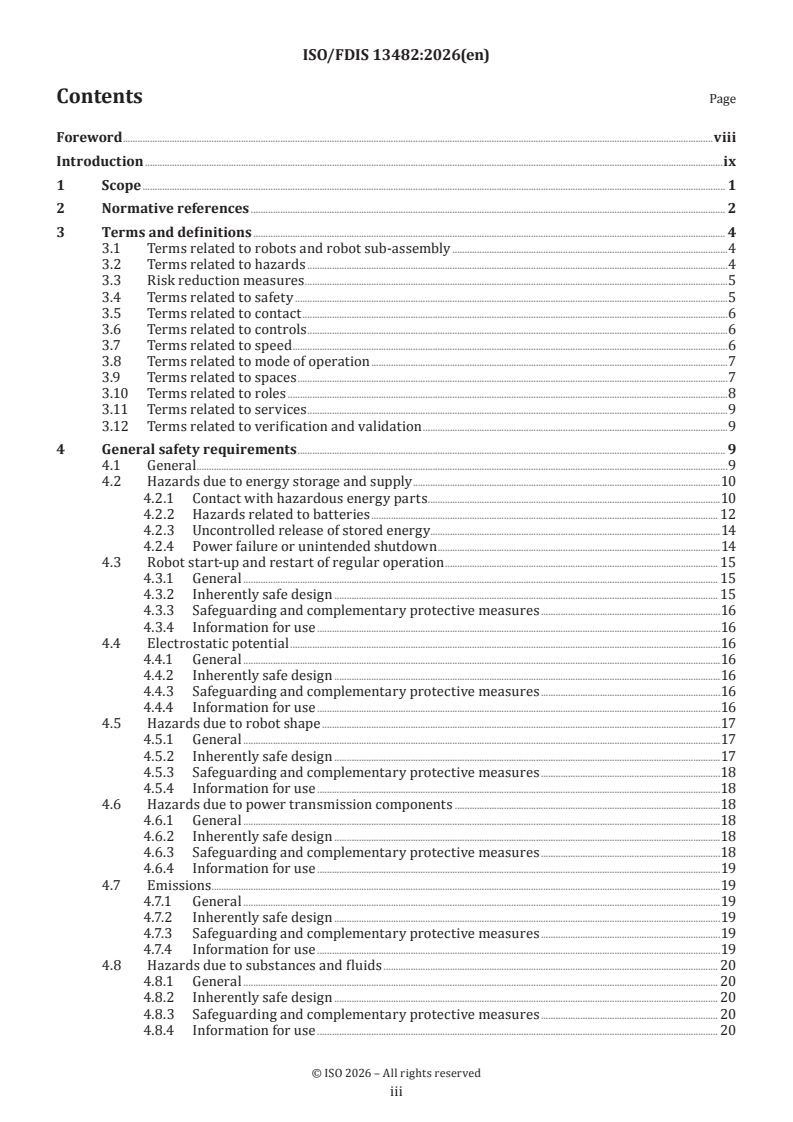
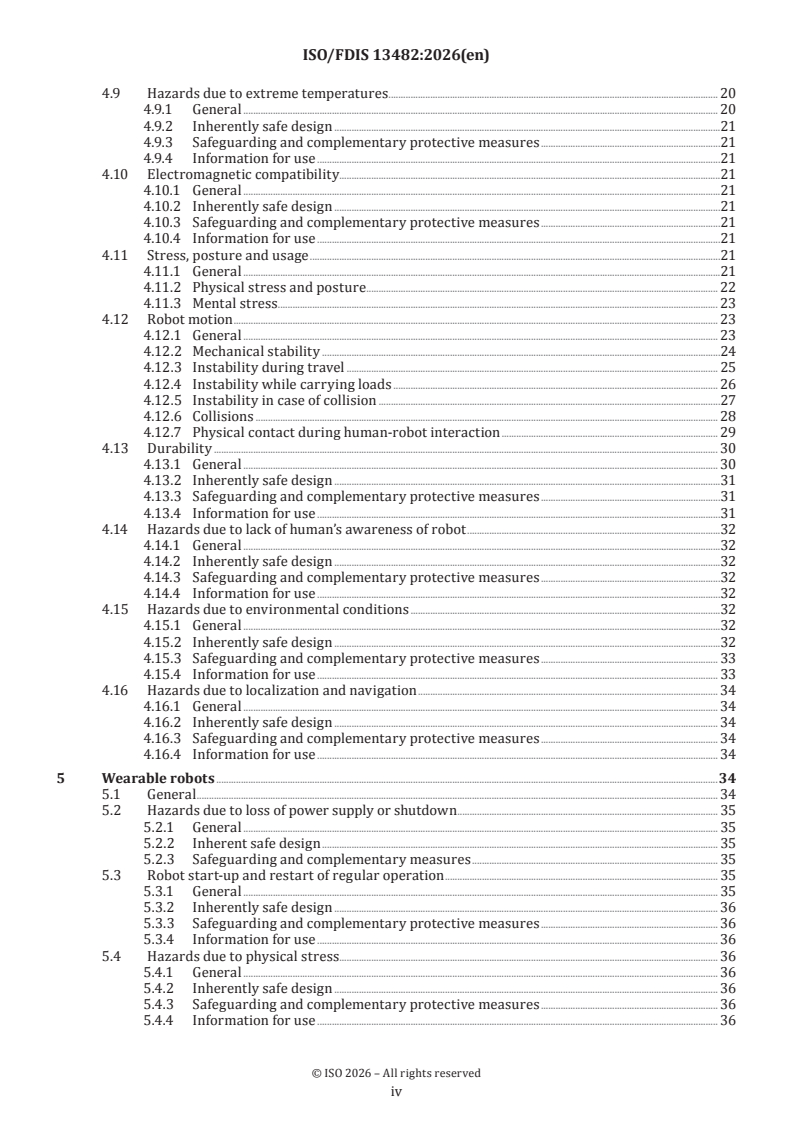
ISO/FDIS 13482 - Robotics — Safety requirements for service robots
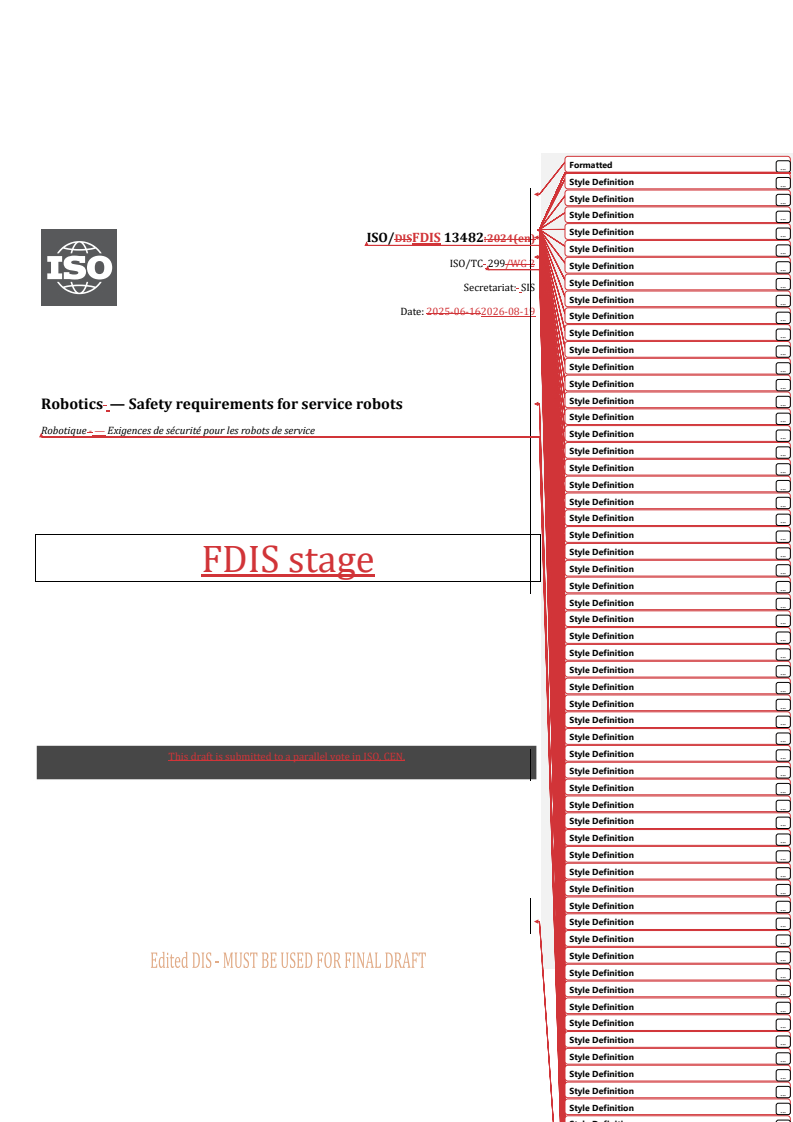
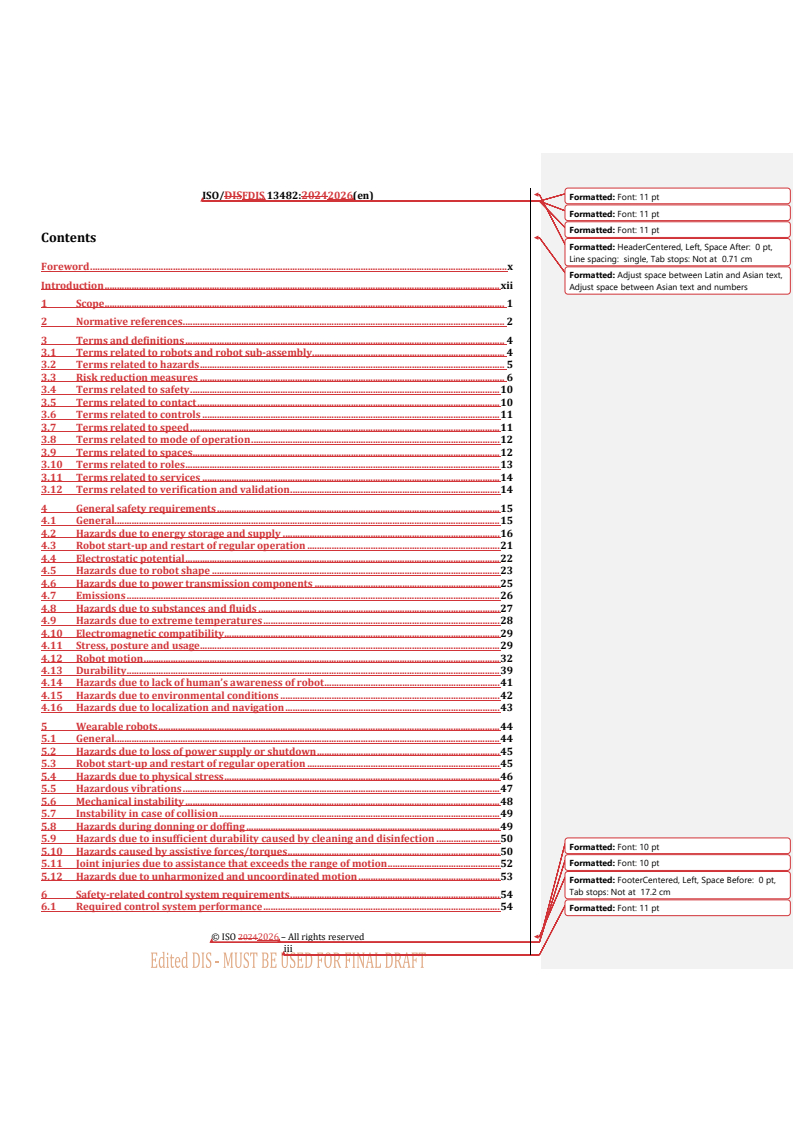
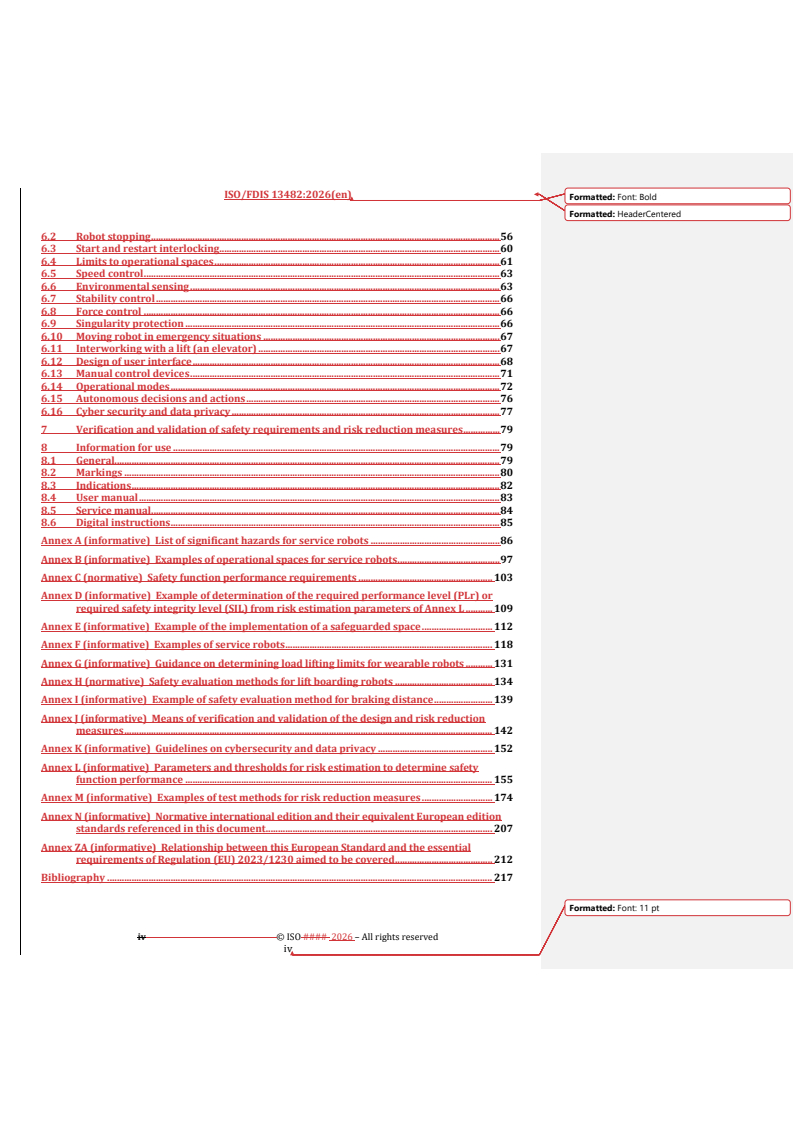
REDLINE ISO/FDIS 13482 - Robotics — Safety requirements for service robots
ISO/FDIS 13482 - Robotique — Exigences de sécurité pour les robots de service/15/2024
Overview
ISO/FDIS 13482: Robotics - Safety requirements for service robots establishes internationally recognized safety requirements for service robots in both personal and professional/commercial environments. Developed by ISO/TC 299, this standard focuses on mitigating hazards and ensuring the safety of humans interacting physically with service robots. Designed to assist manufacturers, integrators, and end-users, ISO/FDIS 13482 excludes industrial and medical robot applications, offering tailored guidance for the unique features and challenges faced by service robots.
By setting safety benchmarks, this standard supports the safe integration of robotics into everyday tasks and commercial services, ensuring that the deployment of service robots is sustainable, reliable, and user-centric.
Key Topics
ISO/FDIS 13482 comprehensively addresses a wide range of safety aspects for service robots, including:
- General Safety Requirements: Outlines principles for safe design, integration, and operation of service robots.
- Hazard Identification: Covers risks from energy sources, mechanical components, electrostatic discharge, and power failures.
- Physical Human-Robot Contact: Sets requirements for safe interactions, managing force limits and collision risks.
- Environmental Considerations: Ensures safe operation under various environmental conditions, accounting for noise, emissions, temperature extremes, and electromagnetic disturbances.
- Autonomous Operation and Control Systems: Details requirements for the safety performance of control systems, including speed and stability control, environmental sensing, and emergency interventions.
- Wearable Robots: Addresses hazards specific to wearable service robots, such as physical stress, vibrations, instability, and risks during donning or doffing.
- Cybersecurity and Data Privacy: Mandates secure handling of data and protection against unauthorized access or cyber threats.
- Information for Use: Requires manufacturers to provide clear documentation to support safe operation, maintenance, and emergency handling.
Applications
ISO/FDIS 13482 applies to a broad range of service robots utilized in both personal and commercial settings, including:
- Domestic Service Robots: Vacuuming robots, lawn mowers, and assistive robotic aids for home use.
- Commercial Service Robots: Robots for cleaning, delivery, hospitality, and public environments such as airports and malls.
- Personal Assistance Robots: Robotic aids designed to support elderly or disabled individuals, enhancing independence and quality of life.
- Wearable Robots: Exoskeletons and assistive devices used in workplaces, rehabilitation, or daily life to augment human capabilities.
This standard is essential for robot designers, manufacturers, product safety engineers, integrators, and regulatory bodies. Adhering to ISO/FDIS 13482 not only improves user safety, but also supports product acceptance and compliance with future regulatory frameworks worldwide.
Related Standards
To ensure comprehensive risk management for service robotics, ISO/FDIS 13482 should be considered alongside related standards, including:
- ISO 10218 (Robots and robotic devices - Safety requirements for industrial robots): For industrial robot safety.
- ISO 12100 (Safety of machinery - General principles for design): Provides general risk assessment and risk reduction methodology applicable to machinery, including robots.
- ISO/IEC 27001 (Information security management): Relevant for data privacy and cybersecurity measures in robotic systems.
Conclusion
ISO/FDIS 13482 provides a robust and systematic approach to service robot safety, covering design, operational hazards, human interaction, and cybersecurity. Its adoption will help manufacturers and users implement globally consistent safety practices, fostering trust in service robots and supporting their successful integration into modern personal and commercial applications.
Relations
- Consolidates
FprEN ISO 13482 - Robotics - Safety requirements for service robots (ISO/FDIS 13482:2026) - Effective Date
- 12-Feb-2026
- Effective Date
- 06-Jun-2022
Buy Documents
ISO/FDIS 13482 - Robotics — Safety requirements for service robots/2/2024
ISO/FDIS 13482 - Robotics — Safety requirements for service robots
REDLINE ISO/FDIS 13482 - Robotics — Safety requirements for service robots
ISO/FDIS 13482 - Robotique — Exigences de sécurité pour les robots de service/15/2024
Get Certified
Connect with accredited certification bodies for this standard

DVS-ZERT GmbH
German welding certification society.
CARES (UK Certification Authority for Reinforcing Steels)
UK certification for reinforcing steels and construction.
EWF/IIW (European/International Welding Federation)
International welding personnel certification.
Sponsored listings
Frequently Asked Questions
ISO/FDIS 13482 is a draft published by the International Organization for Standardization (ISO). Its full title is "Robotics — Safety requirements for service robots". This standard covers: This standard specifies the safety requirements for service robots used in personal and professional/commercial applications. The service robots concerned, and the extent to which hazards, hazardous situations or hazardous events are covered, are indicated in this standard. This safety standard considers the conditions for physical human-robot contact to formulate safety requirements for service robots. It includes additional information on the functional safety for service robots. This standard is not intended to cover robots used in industrial applications and medical applications.
This standard specifies the safety requirements for service robots used in personal and professional/commercial applications. The service robots concerned, and the extent to which hazards, hazardous situations or hazardous events are covered, are indicated in this standard. This safety standard considers the conditions for physical human-robot contact to formulate safety requirements for service robots. It includes additional information on the functional safety for service robots. This standard is not intended to cover robots used in industrial applications and medical applications.
ISO/FDIS 13482 is classified under the following ICS (International Classification for Standards) categories: 25.040.30 - Industrial robots. Manipulators. The ICS classification helps identify the subject area and facilitates finding related standards.
ISO/FDIS 13482 has the following relationships with other standards: It is inter standard links to FprEN ISO 13482, ISO 13482:2014. Understanding these relationships helps ensure you are using the most current and applicable version of the standard.
ISO/FDIS 13482 is available in PDF format for immediate download after purchase. The document can be added to your cart and obtained through the secure checkout process. Digital delivery ensures instant access to the complete standard document.
Standards Content (Sample)
DRAFT
International
Standard
ISO/DIS 13482
ISO/TC 299
Robotics — Safety requirements for
Secretariat: SIS
service robots
Voting begins on:
Robotique — Exigences de sécurité pour les robots de service
2024-08-27
Voting terminates on:
ICS: 25.040.30
2024-11-19
THIS DOCUMENT IS A DRAFT CIRCULATED
FOR COMMENTS AND APPROVAL. IT
IS THEREFORE SUBJECT TO CHANGE
AND MAY NOT BE REFERRED TO AS AN
INTERNATIONAL STANDARD UNTIL
PUBLISHED AS SUCH.
This document is circulated as received from the committee secretariat.
IN ADDITION TO THEIR EVALUATION AS
BEING ACCEPTABLE FOR INDUSTRIAL,
TECHNOLOGICAL, COMMERCIAL AND
USER PURPOSES, DRAFT INTERNATIONAL
STANDARDS MAY ON OCCASION HAVE TO
ISO/CEN PARALLEL PROCESSING
BE CONSIDERED IN THE LIGHT OF THEIR
POTENTIAL TO BECOME STANDARDS TO
WHICH REFERENCE MAY BE MADE IN
NATIONAL REGULATIONS.
RECIPIENTS OF THIS DRAFT ARE INVITED
TO SUBMIT, WITH THEIR COMMENTS,
NOTIFICATION OF ANY RELEVANT PATENT
RIGHTS OF WHICH THEY ARE AWARE AND TO
PROVIDE SUPPORTING DOCUMENTATION.
Reference number
ISO/DIS 13482:2024(en)
DRAFT
ISO/DIS 13482:2024(en)
International
Standard
ISO/DIS 13482
ISO/TC 299
Robotics — Safety requirements for
Secretariat: SIS
service robots
Voting begins on:
Robotique — Exigences de sécurité pour les robots de service
ICS: 25.040.30 Voting terminates on:
THIS DOCUMENT IS A DRAFT CIRCULATED
FOR COMMENTS AND APPROVAL. IT
IS THEREFORE SUBJECT TO CHANGE
AND MAY NOT BE REFERRED TO AS AN
INTERNATIONAL STANDARD UNTIL
PUBLISHED AS SUCH.
This document is circulated as received from the committee secretariat.
IN ADDITION TO THEIR EVALUATION AS
BEING ACCEPTABLE FOR INDUSTRIAL,
© ISO 2024
TECHNOLOGICAL, COMMERCIAL AND
USER PURPOSES, DRAFT INTERNATIONAL
All rights reserved. Unless otherwise specified, or required in the context of its implementation, no part of this publication may
STANDARDS MAY ON OCCASION HAVE TO
ISO/CEN PARALLEL PROCESSING
be reproduced or utilized otherwise in any form or by any means, electronic or mechanical, including photocopying, or posting on
BE CONSIDERED IN THE LIGHT OF THEIR
the internet or an intranet, without prior written permission. Permission can be requested from either ISO at the address below
POTENTIAL TO BECOME STANDARDS TO
WHICH REFERENCE MAY BE MADE IN
or ISO’s member body in the country of the requester.
NATIONAL REGULATIONS.
ISO copyright office
RECIPIENTS OF THIS DRAFT ARE INVITED
CP 401 • Ch. de Blandonnet 8
TO SUBMIT, WITH THEIR COMMENTS,
CH-1214 Vernier, Geneva
NOTIFICATION OF ANY RELEVANT PATENT
Phone: +41 22 749 01 11
RIGHTS OF WHICH THEY ARE AWARE AND TO
PROVIDE SUPPORTING DOCUMENTATION.
Email: copyright@iso.org
Website: www.iso.org
Published in Switzerland Reference number
ISO/DIS 13482:2024(en)
ii
ISO/DIS 13482:2024(en)
Contents Page
Foreword .vii
Introduction .viii
1 Scope . 1
2 Normative references . 1
3 Terms and definitions . 3
4 General safety requirements . 9
4.1 General .9
4.2 Hazards due to energy storage and supply .10
4.2.1 Contact with hazardous energy parts .10
4.2.2 Hazards related to battery .11
4.2.3 Uncontrolled release of stored energy. 13
4.2.4 Power failure or shutdown .14
4.3 Robot start-up and restart of regular operation . 15
4.3.1 General . 15
4.3.2 Inherently safe design . 15
4.3.3 Safeguarding and complementary protective measures . 15
4.3.4 Information for use . 15
4.3.5 Verification and validation . 15
4.4 Electrostatic potential . 15
4.4.1 General . 15
4.4.2 Inherently safe design .16
4.4.3 Safeguarding and complementary protective measures .16
4.4.4 Information for use .16
4.4.5 Verification and validation .16
4.5 Hazards due to robot shape .16
4.5.1 General .16
4.5.2 Inherently safe design .16
4.5.3 Safeguarding and complementary protective measures .17
4.5.4 Information for use .17
4.5.5 Verification and validation .17
4.6 Hazards due to power train components .17
4.6.1 General .17
4.6.2 Inherently safe design .17
4.6.3 Safeguarding and complementary protective measures .18
4.6.4 Information for use .18
4.6.5 Verification and validation .18
4.7 Emissions.18
4.7.1 Noise .18
4.7.2 Substances and fluids.19
4.7.3 Extreme temperatures . . 20
4.7.4 Radiation .21
4.8 Electromagnetic interference . 22
4.8.1 General . 22
4.8.2 Inherently safe design . 22
4.8.3 Safeguarding and complementary protective measures . 22
4.8.4 Information for use . 23
4.8.5 Verification and validation . 23
4.9 Stress, posture and usage . 23
4.9.1 General . 23
4.9.2 Physical stress and posture . 23
4.9.3 Mental stress . .24
4.10 Robot motion . 25
4.10.1 General . 25
4.10.2 Mechanical stability . 25
iii
ISO/DIS 13482:2024(en)
4.10.3 Instability during travel . 26
4.10.4 Instability while carrying loads . 28
4.10.5 Instability in case of collision . 29
4.10.6 Collisions . 30
4.10.7 Physical contact during human-robot interaction .32
4.11 Durability . 33
4.11.1 General . 33
4.11.2 Inherently safe design . 33
4.11.3 Safeguarding and complementary protective measures . 33
4.11.4 Information for use . 33
4.11.5 Verification and validation . 34
4.12 Autonomous decisions and actions . 34
4.12.1 General . 34
4.12.2 Inherently safe design . 34
4.12.3 Safeguarding and complementary protective measures . 34
4.12.4 Information for use . 35
4.12.5 Verification and validation . 35
4.13 Awareness of robots by humans . 35
4.13.1 General . 35
4.13.2 Inherently safe design . 35
4.13.3 Safeguarding and complementary protective measures . 35
4.13.4 Information for use . 36
4.13.5 Verification and validation . 36
4.14 Environmental conditions . . 36
4.14.1 General . 36
4.14.2 Inherently safe design . 36
4.14.3 Safeguarding and complementary protective measures .37
4.14.4 Information for use .37
4.14.5 Verification and validation .37
4.15 Localization and navigation . 38
4.15.1 General . 38
4.15.2 Inherently safe design . 38
4.15.3 Safeguarding and complementary protective measures . 38
4.15.4 Information for use . 38
4.15.5 Verification and validation . 38
5 Wearable robots .39
5.1 General . 39
5.2 Hazards due to loss of power supply or shutdown . 39
5.2.1 General . 39
5.2.2 Inherent safe design . 39
5.3 Robot start-up and restart of regular operation . 40
5.3.1 General . 40
5.3.2 Inherently safe design . 40
5.3.3 Safeguarding and complementary protective measures . 40
5.3.4 Information for use . 40
5.4 Hazards due to physical stress . . 40
5.4.1 General . 40
5.4.2 Inherently safe design . 40
5.4.3 Safeguarding and complementary protective measures . 40
5.4.4 Information for use .41
5.5 Hazardous vibrations .41
5.5.1 General .41
5.5.2 Inherently safe design .41
5.5.3 Safeguarding and complementary protective measures .41
5.5.4 Information for use .42
5.5.5 Verification and validation .42
5.6 Mechanical instability . .42
5.6.1 General .42
iv
ISO/DIS 13482:2024(en)
5.6.2 Inherently safe design .42
5.6.3 Safeguarding and complementary protective measures .42
5.6.4 Information for use .42
5.7 Instability in case of collision or intended contact .43
5.7.1 General .43
5.7.2 Inherently safe design .43
5.7.3 Safeguarding and complementary protective measures .43
5.7.4 Information for use .43
5.8 Hazards during donning or doffing .43
5.8.1 General .43
5.8.2 Inherently safe design .43
5.8.3 Safeguarding and complementary protective measures .43
5.8.4 Information for use . 44
5.9 Hazards due to insufficient durability caused by cleaning and disinfection . 44
5.9.1 General . 44
5.9.2 Inherently safe design . 44
5.9.3 Information for use . 44
5.10 Hazards caused by assistive forces . 44
5.10.1 General . 44
5.10.2 Inherently safe design .45
5.10.3 Safeguarding and complementary protective measures .45
5.10.4 Information for use . 46
5.10.5 Verification and validation . 46
5.11 Joint injuries due to assistance that exceeds the range of motion .47
5.11.1 General .47
5.11.2 Inherently safe design .47
5.11.3 Safeguarding and complementary protective measures .47
5.11.4 Information for use . 48
5.11.5 Verification and validation . 48
5.12 Hazards due to unharmonized and uncoordinated motion . 49
5.12.1 General . 49
5.12.2 Inherently safe design . 49
5.12.3 Safeguarding and complementary protective measures . 49
5.12.4 Information for use . 49
5.12.5 Verification and validation . 49
6 Safety-related control system requirements .49
6.1 Required control system performance . 49
6.1.1 General . 49
6.1.2 Required control system performance . 49
6.1.3 Determining severity . 50
6.1.4 Determining probability of occurrence . 50
6.1.5 Determining possiblity of avoidance . 50
6.2 Robot stopping . 50
6.2.1 General . 50
6.2.2 Robot stopping functions.51
6.2.3 Braking .52
6.3 Start and restart interlocking . 53
6.3.1 Start interlock . 53
6.3.2 Restart interlock . 53
6.4 Limits to operational spaces . 53
6.5 Speed control . 54
6.6 Environmental sensing . 55
6.6.1 General . 55
6.6.2 Object sensing . 55
6.6.3 Travel surface sensing . 56
6.7 Stability control .57
6.8 Force control.57
6.9 Singularity protection .57
v
ISO/DIS 13482:2024(en)
6.10 Moving robot in emergency situations .57
6.11 Interworking with a lift (an elevator) . 58
6.12 Design of user interface . 58
6.12.1 General . 58
6.12.2 Status indication .59
6.12.3 Connection and disconnection . 60
6.12.4 Single command device for multiple robots . 60
6.12.5 Multiple command devices . 60
6.12.6 Cableless or detachable command device .61
6.12.7 Protection against unauthorized use .61
6.13 Manual control devices .61
6.13.1 General .61
6.13.2 Labelling .61
6.13.3 Protection from unintended operation .61
6.14 Operational modes .62
6.14.1 General .62
6.14.2 Autonomous mode . 63
6.14.3 Manual mode . . 63
6.14.4 Semi-autonomous mode. 63
6.14.5 Maintenance mode . . . 64
6.15 Cyber security and data privacy . 64
6.15.1 General . 64
6.15.2 Measures for data privacy and data security . 65
6.15.3 Measures for cyber security managing access privilege and stability of operation . 65
7 Verification and Validation .65
8 Information for use .66
8.1 General . 66
8.2 Markings or indications.67
8.3 User manual . 69
8.4 Service manual .70
Annex A (informative) List of significant hazards for service robots .71
Annex B (informative) Examples of operational spaces for service robots.78
Annex C (normative) Safety function performance requirements .81
Annex D (informative) Example of determination of the PLr or required SIL from risk
estimation parameters of Annex C, C.2 .98
Annex E (informative) Example of the implementation of a safeguarded space .101
Annex F (informative) Examples of service robots .104
Annex G (informative) Information for lifting load .112
Annex H (informative) Example of safety evaluation methods for lift boarding robots .114
Annex I (informative) Example of safety evaluation method for braking distance.116
Annex ZA (informative) Relationship between this European Standard and the essential
requirements of Directive 2006/42/EC aimed to be covered .117
Annex ZB (informative) Relationship between this European Standard and the essential
requirements of Regulation (EU) 2023/1230 aimed to be covered .119
Bibliography .122
vi
ISO/DIS 13482:2024(en)
Foreword
ISO (the International Organization for Standardization) is a worldwide federation of national standards
bodies (ISO member bodies). The work of preparing International Standards is normally carried out through
ISO technical committees. Each member body interested in a subject for which a technical committee
has been established has the right to be represented on that committee. International organizations,
governmental and non-governmental, in liaison with ISO, also take part in the work. ISO collaborates closely
with the International Electrotechnical Commission (IEC) on all matters of electrotechnical standardization.
The procedures used to develop this document and those intended for its further maintenance are described
in the ISO/IEC Directives, Part 1. In particular, the different approval criteria needed for the different types
of ISO documents should be noted. This standard was drafted in accordance with the editorial rules of the
ISO/IEC Directives, Part 2 (see www.iso.org/directives).
Attention is drawn to the possibility that some of the elements of this document may be the subject of patent
rights. ISO shall not be held responsible for identifying any or all such patent rights. Details of any patent
rights identified during the development of the standard will be in the Introduction and/or on the ISO list of
patent declarations received (see www.iso.org/patents).
Any trade name used in this document is information given for the convenience of users and does not
constitute an endorsement.
For
...
FINAL DRAFT
International
Standard
ISO/TC 299
Robotics — Safety requirements for
Secretariat: SIS
service robots
Voting begins on:
Robotique — Exigences de sécurité pour les robots de service 2026-09-15
Voting terminates on:
2026-11-10
RECIPIENTS OF THIS DRAFT ARE INVITED TO SUBMIT,
WITH THEIR COMMENTS, NOTIFICATION OF ANY
RELEVANT PATENT RIGHTS OF WHICH THEY ARE AWARE
AND TO PROVIDE SUPPOR TING DOCUMENTATION.
IN ADDITION TO THEIR EVALUATION AS
BEING ACCEPTABLE FOR INDUSTRIAL, TECHNO
ISO/CEN PARALLEL PROCESSING LOGICAL, COMMERCIAL AND USER PURPOSES, DRAFT
INTERNATIONAL STANDARDS MAY ON OCCASION HAVE
TO BE CONSIDERED IN THE LIGHT OF THEIR POTENTIAL
TO BECOME STAN DARDS TO WHICH REFERENCE MAY BE
MADE IN NATIONAL REGULATIONS.
Reference number
FINAL DRAFT
International
Standard
ISO/TC 299
Robotics — Safety requirements for
Secretariat: SIS
service robots
Voting begins on:
Robotique — Exigences de sécurité pour les robots de service
Voting terminates on:
RECIPIENTS OF THIS DRAFT ARE INVITED TO SUBMIT,
WITH THEIR COMMENTS, NOTIFICATION OF ANY
RELEVANT PATENT RIGHTS OF WHICH THEY ARE AWARE
AND TO PROVIDE SUPPOR TING DOCUMENTATION.
© ISO 2026
IN ADDITION TO THEIR EVALUATION AS
All rights reserved. Unless otherwise specified, or required in the context of its implementation, no part of this publication may
BEING ACCEPTABLE FOR INDUSTRIAL, TECHNO
ISO/CEN PARALLEL PROCESSING
LOGICAL, COMMERCIAL AND USER PURPOSES, DRAFT
be reproduced or utilized otherwise in any form or by any means, electronic or mechanical, including photocopying, or posting on
INTERNATIONAL STANDARDS MAY ON OCCASION HAVE
the internet or an intranet, without prior written permission. Permission can be requested from either ISO at the address below
TO BE CONSIDERED IN THE LIGHT OF THEIR POTENTIAL
or ISO’s member body in the country of the requester.
TO BECOME STAN DARDS TO WHICH REFERENCE MAY BE
MADE IN NATIONAL REGULATIONS.
ISO copyright office
CP 401 • Ch. de Blandonnet 8
CH-1214 Vernier, Geneva
Phone: +41 22 749 01 11
Email: copyright@iso.org
Website: www.iso.org
Published in Switzerland Reference number
ii
Contents Page
Foreword .viii
Introduction .ix
1 Scope . 1
2 Normative references . 2
3 Terms and definitions . 4
3.1 Terms related to robots and robot sub-assembly .4
3.2 Terms related to hazards .4
3.3 Risk reduction measures .5
3.4 Terms related to safety .5
3.5 Terms related to contact .6
3.6 Terms related to controls .6
3.7 Terms related to speed .6
3.8 Terms related to mode of operation .7
3.9 Terms related to spaces .7
3.10 Terms related to roles .8
3.11 Terms related to services .9
3.12 Terms related to verification and validation .9
4 General safety requirements . 9
4.1 General .9
4.2 Hazards due to energy storage and supply .10
4.2.1 Contact with hazardous energy parts .10
4.2.2 Hazards related to batteries . 12
4.2.3 Uncontrolled release of stored energy.14
4.2.4 Power failure or unintended shutdown .14
4.3 Robot start-up and restart of regular operation . 15
4.3.1 General . 15
4.3.2 Inherently safe design . 15
4.3.3 Safeguarding and complementary protective measures .16
4.3.4 Information for use .16
4.4 Electrostatic potential .16
4.4.1 General .16
4.4.2 Inherently safe design .16
4.4.3 Safeguarding and complementary protective measures .16
4.4.4 Information for use .16
4.5 Hazards due to robot shape .17
4.5.1 General .17
4.5.2 Inherently safe design .17
4.5.3 Safeguarding and complementary protective measures .18
4.5.4 Information for use .18
4.6 Hazards due to power transmission components .18
4.6.1 General .18
4.6.2 Inherently safe design .18
4.6.3 Safeguarding and complementary protective measures .18
4.6.4 Information for use .19
4.7 Emissions.19
4.7.1 General .19
4.7.2 Inherently safe design .19
4.7.3 Safeguarding and complementary protective measures .19
4.7.4 Information for use .19
4.8 Hazards due to substances and fluids . 20
4.8.1 General . 20
4.8.2 Inherently safe design . 20
4.8.3 Safeguarding and complementary protective measures . 20
4.8.4 Information for use . 20
iii
4.9 Hazards due to extreme temperatures . 20
4.9.1 General . 20
4.9.2 Inherently safe design .21
4.9.3 Safeguarding and complementary protective measures .21
4.9.4 Information for use .21
4.10 Electromagnetic compatibility.21
4.10.1 General .21
4.10.2 Inherently safe design .21
4.10.3 Safeguarding and complementary protective measures .21
4.10.4 Information for use .21
4.11 Stress, posture and usage .21
4.11.1 General .21
4.11.2 Physical stress and posture . 22
4.11.3 Mental stress . . 23
4.12 Robot motion . 23
4.12.1 General . 23
4.12.2 Mechanical stability .24
4.12.3 Instability during travel . 25
4.12.4 Instability while carrying loads . 26
4.12.5 Instability in case of collision .27
4.12.6 Collisions . 28
4.12.7 Physical contact during human-robot interaction . 29
4.13 Durability . 30
4.13.1 General . 30
4.13.2 Inherently safe design .31
4.13.3 Safeguarding and complementary protective measures .31
4.13.4 Information for use .31
4.14 Hazards due to lack of human’s awareness of robot .32
4.14.1 General .32
4.14.2 Inherently safe design .32
4.14.3 Safeguarding and complementary protective measures .32
4.14.4 Information for use .32
4.15 Hazards due to environmental conditions .32
4.15.1 General .32
4.15.2 Inherently safe design .32
4.15.3 Safeguarding and complementary protective measures . 33
4.15.4 Information for use . 33
4.16 Hazards due to localization and navigation . 34
4.16.1 General . 34
4.16.2 Inherently safe design . 34
4.16.3 Safeguarding and complementary protective measures . 34
4.16.4 Information for use . 34
5 Wearable robots .34
5.1 General . 34
5.2 Hazards due to loss of power supply or shutdown . 35
5.2.1 General . 35
5.2.2 Inherent safe design . 35
5.2.3 Safeguarding and complementary measures . 35
5.3 Robot start-up and restart of regular operation . 35
5.3.1 General . 35
5.3.2 Inherently safe design . 36
5.3.3 Safeguarding and complementary protective measures . 36
5.3.4 Information for use . 36
5.4 Hazards due to physical stress . . 36
5.4.1 General . 36
5.4.2 Inherently safe design . 36
5.4.3 Safeguarding and complementary protective measures . 36
5.4.4 Information for use . 36
iv
5.5 Hazardous vibrations .37
5.5.1 General .37
5.5.2 Inherently safe design .37
5.5.3 Safeguarding and complementary protective measures .37
5.5.4 Information for use .37
5.6 Mechanical instability . . 38
5.6.1 General . 38
5.6.2 Inherently safe design . 38
5.6.3 Safeguarding and complementary protective measures . 38
5.6.4 Information for use . 38
5.7 Instability in case of collision . 38
5.7.1 General . 38
5.7.2 Inherently safe design . 38
5.7.3 Safeguarding and complementary protective measures . 39
5.7.4 Information for use . 39
5.8 Hazards during donning or doffing . 39
5.8.1 General . 39
5.8.2 Inherently safe design . 39
5.8.3 Safeguarding and complementary protective measures . 39
5.8.4 Information for use . 39
5.9 Hazards due to insufficient durability caused by cleaning and disinfection . 40
5.9.1 General . 40
5.9.2 Inherently safe design . 40
5.9.3 Information for use . 40
5.10 Hazards caused by assistive forces/torques . 40
5.10.1 General . 40
5.10.2 Safeguarding and complementary protective measures . 40
5.10.3 Information for use .41
5.11 Joint injuries due to assistance that exceeds the range of motion .41
5.11.1 General .41
5.11.2 Inherently safe design .41
5.11.3 Safeguarding and complementary protective measures .41
5.11.4 Information for use .42
5.12 Hazards due to unharmonized and uncoordinated motion .42
5.12.1 General .42
5.12.2 Inherently safe design .42
5.12.3 Safeguarding and complementary protective measures .43
5.12.4 Information for use .43
6 Safety-related control system requirements .43
6.1 Required control system performance .43
6.1.1 General .43
6.1.2 Required control system performance . 44
6.1.3 Determining severity . 44
6.1.4 Determining probability of occurrence . 44
6.2 Robot stopping . 44
6.2.1 General . 44
6.2.2 Robot stopping functions.45
6.2.3 Braking .47
6.3 Start and restart interlocking . 48
6.3.1 Start interlock . 48
6.3.2 Restart interlock . 48
6.4 Limits to operational spaces . 48
6.5 Speed control . 50
6.6 Environmental sensing . 50
6.6.1 General . 50
6.6.2 Object sensing . 50
6.6.3 Travel surface sensing .52
6.7 Stability control .52
v
6.8 Force control.52
6.9 Singularity protection . 53
6.10 Moving robot in emergency situations . 53
6.11 Interworking with a lift (an elevator) . 53
6.12 Design of user interface . 54
6.12.1 General . 54
6.12.2 Status indication . 55
6.12.3 Connection and disconnection . 55
6.12.4 Single command device for multiple robots . 55
6.12.5 Multiple command devices . 56
6.12.6 Cableless or detachable command device . 56
6.12.7 Protection against unauthorized use .57
6.13 Manual control devices .57
6.13.1 General .57
6.13.2 Labelling .57
6.13.3 Protection from unintended operation .57
6.14 Operational modes .57
6.14.1 General .57
6.14.2 Autonomous mode .59
6.14.3 Manual mode . .59
6.14.4 Semi-autonomous mode.59
6.14.5 Maintenance mode . . .59
6.15 Autonomous decisions and actions . 60
6.15.1 General . 60
6.15.2 Required protective measures for autonomous decisions and actions . 60
6.15.3 Risk reduction for autonomous decisions and actions by usage limitation .61
6.16 Cyber security and data privacy .61
7 Verification and validation of safety requirements and risk reduction measures .62
8 Information for use .62
8.1 General .62
8.2 Markings .62
8.3 Indications . 64
8.4 User manual . 64
8.5 Service manual . 65
8.6 Digital instructions . 66
Annex A (informative) List of significant hazards for service robots . 67
Annex B (informative) Examples of operational spaces for service robots. 74
Annex C (normative) Safety function performance requirements .78
Annex D (informative) Example of determination of the required performance level (PLr) or
required safety integrity level (SIL) from risk estimation parameters of Annex L .83
Annex E (informative) Example of the implementation of a safeguarded space .86
Annex F (informative) Examples of service robots .89
Annex G (informative) Guidance on determining load lifting limits for wearable robots .96
Annex H (normative) Safety evaluation methods for lift boarding robots .99
Annex I (informative) Example of safety evaluation method for braking distance.101
Annex J (informative) Means of verification and validation of the design and risk reduction
measures .102
Annex K (informative) Guidelines on cybersecurity and data privacy .106
Annex L (informative) Parameters and thresholds for risk estimation to determine safety
function performance .107
Annex M (informative) Examples of test methods for risk reduction measures .121
vi
Annex N (informative) Normative international edition and their equivalent European edition
standards referenced in this document . .149
Annex ZA (informative) Relationship between this European Standard and the essential
requirements of Regulation (EU) 2023/1230 aimed to be covered .153
Bibliography .156
vii
Foreword
ISO (the International Organization for Standardization) is a worldwide federation of national standards
bodies (ISO member bodies). The work of preparing International Standards is normally carried out through
ISO technical committees.
...
Formatted
...
Style Definition
...
Style Definition
...
Style Definition
...
Style Definition
...
ISO/DISFDIS 13482:2024(en)
Style Definition
...
ISO/TC 299/WG 2
Style Definition
...
Style Definition
...
Secretariat: SIS
Style Definition
...
Date: 2025-06-162026-08-19
Style Definition
...
Style Definition
...
Style Definition
...
Style Definition
...
Style Definition
...
Style Definition
...
Robotics — Safety requirements for service robots
Style Definition
...
Robotique - — Exigences de sécurité pour les robots de service
Style Definition
...
Style Definition
...
Style Definition
...
Style Definition
...
Style Definition
...
Style Definition
...
Style Definition
...
Style Definition
...
FDIS stage Style Definition
...
Style Definition
...
Style Definition
...
Style Definition
...
Style Definition
...
Style Definition
...
Style Definition
...
Style Definition
...
Style Definition
...
Style Definition
...
Style Definition
...
Style Definition
...
TThhiiss d drraftaft i iss s suubbmmiitttteded t too a pa pararallel vallel vootte e iinn I ISSOO,, C CEENN.
Style Definition
...
Style Definition
...
Style Definition
...
Style Definition
...
Style Definition
...
Style Definition
...
Style Definition
...
Style Definition
...
Style Definition
...
Style Definition
...
Style Definition
...
Style Definition
...
Style Definition
...
Style Definition
...
Style Definition
...
Style Definition
...
Style Definition
...
Style Definition
...
Style Definition
...
Style Definition
...
Style Definition
...
St l D fi iti
Formatted: Font: Bold
Formatted: HeaderCentered
Formatted: Default Paragraph Font
Formatted: Indent: Left: 0 cm, Right: 0 cm, Space
All rights reserved. Unless otherwise specified, or required in the context of its implementation, no part of this publication
Before: 0 pt, No page break before, Adjust space
may be reproduced or utilized otherwise in any form or by any means, electronic or mechanical, including photocopying,
between Latin and Asian text, Adjust space between
or posting on the internet or an intranet, without prior written permission. Permission can be requested from either ISO
Asian text and numbers
at the address below or ISO’s member body in the country of the requester.
Formatted: Left: 1.5 cm, Right: 1.5 cm, Top: 1.4 cm,
ISO copyright office
Bottom: 1 cm, Header distance from edge: 1.27 cm,
CP 401 • Ch. de Blandonnet 8
Footer distance from edge: 0.5 cm
CH-1214 Vernier, Geneva
Phone: + 41 22 749 01 11
Fax: +41 22 749 09 47
EmailE-mail: copyright@iso.org
Formatted: zzCopyright address, Indent: Left: 0 cm,
Website: www.iso.orgwww.iso.org
First line: 0 cm, Right: 0 cm, Adjust space between
Latin and Asian text, Adjust space between Asian text
Published in Switzerland
and numbers
Formatted: Font: 11 pt
ii © ISO #### 2026 – All rights reserved
ii
ISO/DISFDIS 13482:20242026(en) Formatted: Font: 11 pt
Formatted: Font: 11 pt
Formatted: Font: 11 pt
Contents
Formatted: HeaderCentered, Left, Space After: 0 pt,
Line spacing: single, Tab stops: Not at 0.71 cm
Foreword . x
Formatted: Adjust space between Latin and Asian text,
Introduction . xii
Adjust space between Asian text and numbers
1 Scope . 1
2 Normative references . 2
3 Terms and definitions . 4
3.1 Terms related to robots and robot sub-assembly . 4
3.2 Terms related to hazards . 5
3.3 Risk reduction measures . 6
3.4 Terms related to safety . 10
3.5 Terms related to contact . 10
3.6 Terms related to controls . 11
3.7 Terms related to speed . 11
3.8 Terms related to mode of operation . 12
3.9 Terms related to spaces. 12
3.10 Terms related to roles . 13
3.11 Terms related to services . 14
3.12 Terms related to verification and validation . 14
4 General safety requirements . 15
4.1 General. 15
4.2 Hazards due to energy storage and supply . 16
4.3 Robot start-up and restart of regular operation . 21
4.4 Electrostatic potential . 22
4.5 Hazards due to robot shape . 23
4.6 Hazards due to power transmission components . 25
4.7 Emissions . 26
4.8 Hazards due to substances and fluids . 27
4.9 Hazards due to extreme temperatures . 28
4.10 Electromagnetic compatibility . 29
4.11 Stress, posture and usage. 29
4.12 Robot motion . 32
4.13 Durability . 39
4.14 Hazards due to lack of human’s awareness of robot . 41
4.15 Hazards due to environmental conditions . 42
4.16 Hazards due to localization and navigation . 43
5 Wearable robots . 44
5.1 General. 44
5.2 Hazards due to loss of power supply or shutdown . 45
5.3 Robot start-up and restart of regular operation . 45
5.4 Hazards due to physical stress . 46
5.5 Hazardous vibrations . 47
5.6 Mechanical instability . 48
5.7 Instability in case of collision . 49
5.8 Hazards during donning or doffing . 49
5.9 Hazards due to insufficient durability caused by cleaning and disinfection . 50
Formatted: Font: 10 pt
5.10 Hazards caused by assistive forces/torques . 50
5.11 Joint injuries due to assistance that exceeds the range of motion . 52 Formatted: Font: 10 pt
5.12 Hazards due to unharmonized and uncoordinated motion . 53
Formatted: FooterCentered, Left, Space Before: 0 pt,
Tab stops: Not at 17.2 cm
6 Safety-related control system requirements . 54
6.1 Required control system performance . 54
Formatted: Font: 11 pt
iii
Formatted: Font: Bold
Formatted: HeaderCentered
6.2 Robot stopping . 56
6.3 Start and restart interlocking . 60
6.4 Limits to operational spaces . 61
6.5 Speed control . 63
6.6 Environmental sensing . 63
6.7 Stability control . 66
6.8 Force control . 66
6.9 Singularity protection . 66
6.10 Moving robot in emergency situations . 67
6.11 Interworking with a lift (an elevator) . 67
6.12 Design of user interface . 68
6.13 Manual control devices . 71
6.14 Operational modes . 72
6.15 Autonomous decisions and actions . 76
6.16 Cyber security and data privacy . 77
7 Verification and validation of safety requirements and risk reduction measures . 79
8 Information for use . 79
8.1 General. 79
8.2 Markings . 80
8.3 Indications . 82
8.4 User manual . 83
8.5 Service manual . 84
8.6 Digital instructions . 85
Annex A (informative) List of significant hazards for service robots . 86
Annex B (informative) Examples of operational spaces for service robots . 97
Annex C (normative) Safety function performance requirements . 103
Annex D (informative) Example of determination of the required performance level (PLr) or
required safety integrity level (SIL) from risk estimation parameters of Annex L . 109
Annex E (informative) Example of the implementation of a safeguarded space . 112
Annex F (informative) Examples of service robots . 118
Annex G (informative) Guidance on determining load lifting limits for wearable robots . 131
Annex H (normative) Safety evaluation methods for lift boarding robots . 134
Annex I (informative) Example of safety evaluation method for braking distance . 139
Annex J (informative) Means of verification and validation of the design and risk reduction
measures . 142
Annex K (informative) Guidelines on cybersecurity and data privacy . 152
Annex L (informative) Parameters and thresholds for risk estimation to determine safety
function performance . 155
Annex M (informative) Examples of test methods for risk reduction measures . 174
Annex N (informative) Normative international edition and their equivalent European edition
standards referenced in this document . 207
Annex ZA (informative) Relationship between this European Standard and the essential
requirements of Regulation (EU) 2023/1230 aimed to be covered . 212
Bibliography . 217
Formatted: Font: 11 pt
iv © ISO #### 2026 – All rights reserved
iv
ISO/DISFDIS 13482:20242026(en) Formatted: Font: 11 pt
Formatted: Font: 11 pt
Formatted: Font: 11 pt
Foreword . 7
Formatted: HeaderCentered, Left, Space After: 0 pt,
Line spacing: single, Tab stops: Not at 0.71 cm
Introduction . 8
1 Scope . 9
2 Normative references . 9
3 Terms and definitions . 12
4 General safety requirements . 18
4.1 General. 18
4.2 Hazards due to energy storage and supply . 19
4.2.1 Contact with hazardous energy parts . 19
4.2.2 Hazards related to battery. 20
4.2.3 Uncontrolled release of stored energy . 22
4.2.4 Power failure or shutdown. 22
4.3 Robot start-up and restart of regular operation . 23
4.3.1 General. 23
4.3.2 Inherently safe design . 24
4.3.3 Safeguarding and complementary protective measures . 24
4.3.4 Information for use . 24
4.3.5 Verification and validation . 24
4.4 Electrostatic potential . 24
4.4.1 General. 24
4.4.2 Inherently safe design . 24
4.4.3 Safeguarding and complementary protective measures . 25
4.4.4 Information for use . 25
4.4.5 Verification and validation . 25
4.5 Hazards due to robot shape . 25
4.5.1 General. 25
4.5.2 Inherently safe design . 25
4.5.3 Safeguarding and complementary protective measures . 26
4.5.4 Information for use . 26
4.5.5 Verification and validation . 26
4.6 Hazards due to power train components . 26
4.6.1 General. 26
4.6.2 Inherently safe design . 26
4.6.3 Safeguarding and complementary protective measures . 26
4.6.4 Information for use . 27
4.6.5 Verification and validation . 27
4.7 Emissions . 27
4.7.1 Noise . 27
4.7.2 Substances and fluids . 28
4.7.3 Extreme temperatures . 29
4.7.4 Radiation . 30
4.8 Electromagnetic interference . 31
Formatted: Font: 10 pt
4.8.1 General. 31
4.8.2 Inherently safe design . 31 Formatted: Font: 10 pt
4.8.3 Safeguarding and complementary protective measures . 31
Formatted: FooterCentered, Left, Space Before: 0 pt,
4.8.4 Information for use . 31
Tab stops: Not at 17.2 cm
4.8.5 Verification and validation . 31
Formatted: Font: 11 pt
v
Formatted: Font: Bold
Formatted: HeaderCentered
4.9 Stress, posture and usage. 32
4.9.1 General. 32
4.9.2 Physical stress and posture . 32
4.9.3 Mental stress. 33
4.10 Robot motion . 33
4.10.1 General. 33
4.10.2 Mechanical stability . 34
4.10.3 Instability during travel . 35
4.10.4 Instability while carrying loads . 37
4.10.5 Instability in case of collision . 38
4.10.6 Collisions . 39
4.10.7 Physical contact during human-robot interaction . 41
4.11 Durability . 42
4.11.1 General. 42
4.11.2 Inherently safe design . 42
4.11.3 Safeguarding and complementary protective measures . 42
4.11.4 Information for use . 43
4.11.5 Verification and validation . 43
4.12 Autonomous decisions and actions . 43
4.12.1 General. 43
4.12.2 Inherently safe design . 43
4.12.3 Safeguarding and complementary protective measures . 43
4.12.4 Information for use . 44
4.12.5 Verification and validation . 44
4.13 Awareness of robots by humans . 44
4.13.1 General. 44
4.13.2 Inherently safe design . 44
4.13.3 Safeguarding and complementary protective measures . 44
4.13.4 Information for use . 45
4.13.5 Verification and validation . 45
4.14 Environmental conditions . 45
4.14.1 General. 45
4.14.2 Inherently safe design . 45
4.14.3 Safeguarding and complementary protective measures . 46
4.14.4 Information for use . 46
4.14.5 Verification and validation . 46
4.15 Localization and navigation . 47
4.15.1 General. 47
4.15.2 Inherently safe design . 47
4.15.3 Safeguarding and complementary protective measures . 47
4.15.4 Information for use . 47
4.15.5 Verification and validation . 47
5 Wearable robots . 48
5.1 General. 48
5.2 Hazards due to loss of power supply or shutdown . 48
5.2.1 General. 48
5.2.2 Inherent safe design . 48
5.3 Robot start-up and restart of regular operation . 49
5.3.1 General. 49
5.3.2 Inherently safe design . 49
5.3.3 Safeguarding and complementary protective measures . 49
5.3.4 Information for use . 49
5.4 Hazards due to physical stress . 49
5.4.1 General. 49
Formatted: Font: 11 pt
vi © ISO #### 2026 – All rights reserved
vi
ISO/DISFDIS 13482:20242026(en) Formatted: Font: 11 pt
Formatted: Font: 11 pt
Formatted: Font: 11 pt
5.4.2 Inherently safe design . 49
Formatted: HeaderCentered, Left, Space After: 0 pt,
5.4.3 Safeguarding and complementary protective measures . 49
Line spacing: single, Tab stops: Not at 0.71 cm
5.4.4 Information for use . 50
5.5 Hazardous vibrations . 50
5.5.1 General. 50
5.5.2 Inherently safe design . 50
5.5.3 Safeguarding and complementary protective measures . 50
5.5.4 Information for use . 51
5.5.5 Verification and validation . 51
5.6 Mechanical instability . 51
5.6.1 General. 51
5.6.2 Inherently safe design . 51
5.6.3 Safeguarding and complementary protective measures . 51
5.6.4 Information for use . 51
5.7 Instability in case of collision or intended contact . 52
5.7.1 General. 52
5.7.2 Inherently safe design . 52
5.7.3 Safeguarding and complementary protective measures . 52
5.7.4 Information for use . 52
5.8 Hazards during donning or doffing . 52
5.8.1 General. 52
5.8.2 Inherently safe design . 52
5.8.3 Safeguarding and complementary protective measures . 53
5.8.4 Information for use . 53
5.9 Hazards due to insufficient durability caused by cleaning and disinfection . 53
5.9.1 General. 53
5.9.2 Inherently safe design . 53
5.9.3 Information for use . 53
5.10 Hazards caused by assistive forces. 53
5.10.1 General. 53
5.10.2 Inherently safe design . 54
5.10.3 Safeguarding and complementary protective measures . 55
5.10.4 Information for use . 55
5.10.5 Verification and validation . 55
5.11 Joint injuries due to assistance that exceeds the range of motion . 56
5.11.1 General. 56
5.11.2 Inherently safe design . 56
5.11.3 Safeguarding and complementary protective measures . 56
5.11.4 Information for use . 57
5.11.5 Verification and validation . 57
5.12 Hazards due to unharmonized and uncoordinated motion . 58
5.12.1 General. 58
5.12.2 Inherently safe design . 58
5.12.3 Safeguarding and complementary protective measures . 58
5.12.4 Information for use . 58
5.12.5 Verification and validation . 58
6 Safety-related control system requirements . 59
6.1 Required control system performance . 59
6.1.1 General. 59
Formatted: Font: 10 pt
6.1.2 Required control system performance . 59
Formatted: Font: 10 pt
6.1.3 Determining severity . 59
6.1.4 Determining probability of occurrence . 59 Formatted: FooterCentered, Left, Space Before: 0 pt,
Tab stops: Not at 17.2 cm
6.1.5 Determining possiblity of avoidance . 59
6.2 Robot stopping . 60
Formatted: Font: 11 pt
vii
Formatted: Font: Bold
Formatted: HeaderCentered
6.2.1 General. 60
6.2.2 Robot stopping functions . 60
6.2.3 Braking . 62
6.3 Start and restart interlocking . 62
6.3.1 Start interlock . 62
6.3.2 Restart interlock . 63
6.4 Limits to operational spaces . 63
6.5 Speed control . 64
6.6 Environmental sensing . 64
6.6.1 General. 64
6.6.2 Object sensing . 64
6.6.3 Travel surface sensing . 66
6.7 Stability control .
...
PROJET
Norme
internationale
ISO/DIS 13482
ISO/TC 299
Robotique — Exigences de sécurité
Secrétariat: SIS
pour les robots de service
Début de vote:
Robotics — Safety requirements for service robots
2024-08-27
Vote clos le:
ICS: 25.040.30
2024-11-19
CE DOCUMENT EST UN PROJET DIFFUSÉ
POUR OBSERVATIONS ET APPROBATION. IL
EST DONC SUSCEPTIBLE DE MODIFICATION
ET NE PEUT ÊTRE CITÉ COMME NORME
INTERNATIONALE AVANT SA PUBLICATION EN
TANT QUE TELLE.
Le présent document est distribué tel qu’il est parvenu du secrétariat
du comité. OUTRE LE FAIT D’ÊTRE EXAMINÉS POUR
ÉTABLIR S’ILS SONT ACCEPTABLES À DES
FINS INDUSTRIELLES, TECHNOLOGIQUES ET
COMMERCIALES, AINSI QUE DU POINT DE VUE
DES UTILISATEURS, LES PROJETS DE NORMES
INTERNATIONALES DOIVENT PARFOIS ÊTRE
TRAITEMENT PARALLÈLE ISO/CEN
CONSIDÉRÉS DU POINT DE VUE DE LEUR
POSSIBILITÉ DE DEVENIR DES NORMES
POUVANT SERVIR DE RÉFÉRENCE DANS LA
RÉGLEMENTATION NATIONALE.
LES DESTINATAIRES DU PRÉSENT PROJET
SONT INVITÉS À PRÉSENTER, AVEC LEURS
OBSERVATIONS, NOTIFICATION DES DROITS
DE PROPRIÉTÉ DONT ILS AURAIENT
ÉVENTUELLEMENT CONNAISSANCE
ET À FOURNIR UNE DOCUMENTATION
EXPLICATIVE.
Numéro de référence
ISO/DIS 13482:2024(fr)
ISO/DIS 13482:2024(fr)
ISO/TC 299/GT 2
Date : 2024-07-02
ISO/DIS 13482:2024(fr)
ISO/TC 299/GT 2
Secrétariat : SIS
Robotique — Exigences de sécurité pour les robots de service
Robotics — Safety requirements for service robots
DOCUMENT PROTÉGÉ PAR COPYRIGHT
© ISO 2024
Tous droits réservés. Sauf prescription différente ou nécessité dans le contexte de sa mise en œuvre, aucune partie de cette
publication ne peut être reproduite ni utilisée sous quelque forme que ce soit et par aucun procédé, électronique ou mécanique,
y compris la photocopie, ou la diffusion sur l’internet ou sur un intranet, sans autorisation écrite préalable. Une autorisation peut
être demandée à l’ISO à l’adresse ci-après ou au comité membre de l’ISO dans le pays du demandeur.
ISO copyright office
Case postale 401 • Ch. de Blandonnet 8
CH-1214 Vernier, Genève
Tél.: +41 22 749 01 11
E-mail: copyright@iso.org
Type du document: Projet de Norme internationale
Web: www.iso.org
Sous-type du document:
Publié en Suisse
Stade du document: (40) Enquête
Langue du document: F
ii
ISO/DIS 13482:2024(fr)
Sommaire
Avant-propos . viii
Introduction. x
1 Domaine d'application . 1
2 Références normatives . 1
3 Termes et définitions . 4
4 Exigences de sécurité générales . 11
4.1 Généralités . 11
4.2 Phénomènes dangereux dus à l'accumulation et à l'alimentation en énergie . 13
4.2.1 Contact avec des éléments dangereux relatifs à l'énergie . 13
4.2.2 Phénomènes dangereux liés aux batteries . 14
4.2.3 Libération non contrôlée d'énergie accumulée . 16
4.2.4 Défaillance ou interruption de l'alimentation en énergie . 17
4.3 Démarrage et redémarrage du robot en fonctionnement normal . 18
4.3.1 Généralités . 18
4.3.2 Prévention intrinsèque . 18
4.3.3 Protection et mesures de prévention complémentaires . 19
4.3.4 Informations pour l'utilisation . 19
4.3.5 Vérification et validation . 19
4.4 Potentiel électrostatique . 19
4.4.1 Généralités . 19
4.4.2 Prévention intrinsèque . 19
4.4.3 Protection et mesures de prévention complémentaires . 20
4.4.4 Informations pour l'utilisation . 20
4.4.5 Vérification et validation . 20
4.5 Phénomènes dangereux dus à la forme du robot . 20
4.5.1 Généralités . 20
4.5.2 Prévention intrinsèque . 20
4.5.3 Protection et mesures de prévention complémentaires . 21
4.5.4 Informations pour l'utilisation . 21
4.5.5 Vérification et validation . 21
4.6 Phénomènes dangereux liés aux composants du groupe motopropulseur . 21
4.6.1 Généralités . 21
4.6.2 Prévention intrinsèque . 21
4.6.3 Protection et mesures de prévention complémentaires . 22
4.6.4 Informations pour l'utilisation . 22
4.6.5 Vérification et validation . 22
4.7 Émissions . 23
4.7.1 Bruit . 23
4.7.2 Substances et fluides . 24
4.7.3 Températures extrêmes . 25
4.7.4 Rayonnement . 26
4.8 Perturbations électromagnétiques . 27
4.8.1 Généralités . 27
4.8.2 Prévention intrinsèque . 27
4.8.3 Protection et mesures de prévention complémentaires . 28
4.8.4 Informations pour l'utilisation . 28
4.8.5 Vérification et validation . 28
iii
ISO/DIS 13482:2024(fr)
4.9 Stress, posture et utilisation. 28
4.9.1 Généralités . 28
4.9.2 Stress physique et posture . 28
4.9.3 Stress mental . 29
4.10 Mouvement du robot . 30
4.10.1 Généralités . 30
4.10.2 Stabilité mécanique . 30
4.10.3 Instabilité lors du déplacement . 32
4.10.4 Instabilité lors du transport de charges. 34
4.10.5 Instabilité en cas de collision . 36
4.10.6 Collisions . 36
4.10.7 Contact physique pendant une interaction homme-robot . 38
4.11 Durabilité . 40
4.11.1 Généralités . 40
4.11.2 Prévention intrinsèque . 40
4.11.3 Protection et mesures de prévention complémentaires . 40
4.11.4 Informations pour l'utilisation . 41
4.11.5 Vérification et validation . 41
4.12 Décisions et actions autonomes . 41
4.12.1 Généralités . 41
4.12.2 Prévention intrinsèque . 41
4.12.3 Protection et mesures de prévention complémentaires . 41
4.12.4 Informations pour l'utilisation . 42
4.12.5 Vérification et validation . 42
4.13 Connaissance de la présence de robots par les personnes . 42
4.13.1 Généralités . 42
4.13.2 Prévention intrinsèque . 43
4.13.3 Protection et mesures de prévention complémentaires . 43
4.13.4 Informations pour l'utilisation . 43
4.13.5 Vérification et validation . 43
4.14 Conditions d'environnement . 43
4.14.1 Généralités . 43
4.14.2 Prévention intrinsèque . 44
4.14.3 Protection et mesures de prévention complémentaires . 44
4.14.4 Informations pour l'utilisation . 45
4.14.5 Vérification et validation . 45
4.15 Localisation et navigation . 45
4.15.1 Généralités . 45
4.15.2 Prévention intrinsèque . 46
4.15.3 Protection et mesures de prévention complémentaires . 46
4.15.4 Informations pour l'utilisation . 46
4.15.5 Vérification et validation . 46
5 Robots portables . 47
5.1 Généralités . 47
5.2 Phénomènes dangereux liés à une perte ou une interruption de l'alimentation en
énergie . 47
5.2.1 Généralités . 47
5.2.2 Prévention intrinsèque . 47
5.3 Démarrage et redémarrage du robot en fonctionnement normal . 48
5.3.1 Généralités . 48
5.3.2 Prévention intrinsèque . 48
5.3.3 Protection et mesures de prévention complémentaires . 48
iv
ISO/DIS 13482:2024(fr)
5.3.4 Informations pour l'utilisation . 48
5.4 Phénomènes dangereux liés au stress physique . 48
5.4.1 Généralités . 48
5.4.2 Prévention intrinsèque . 49
5.4.3 Protection et mesures de prévention complémentaires . 49
5.4.4 Informations pour l'utilisation . 49
5.5 Vibrations dangereuses . 49
5.5.1 Généralités . 49
5.5.2 Prévention intrinsèque . 50
5.5.3 Protection et mesures de prévention complémentaires . 50
5.5.4 Informations pour l'utilisation . 50
5.5.5 Vérification et validation . 50
5.6 Instabilité mécanique . 50
5.6.1 Généralités . 50
5.6.2 Prévention intrinsèque . 50
5.6.3 Protection et mesures de prévention complémentaires . 51
5.6.4 Informations pour l'utilisation . 51
5.7 Instabilité en cas de collision ou de contact attendu . 51
5.7.1 Généralités . 51
5.7.2 Prévention intrinsèque . 51
5.7.3 Protection et mesures de prévention complémentaires . 52
5.7.4 Informations pour l'utilisation . 52
5.8 Phénomènes dangereux au cours de la pose et du retrait . 52
5.8.1 Généralités . 52
5.8.2 Prévention intrinsèque . 52
5.8.3 Protection et mesures de prévention complémentaires . 52
5.8.4 Informations pour l'utilisation . 52
5.9 Phénomènes dangereux liés à une durabilité insuffisante causée par le nettoyage et
la désinfection . 53
5.9.1 Généralités . 53
5.9.2 Prévention intrinsèque . 53
5.9.3 Informations pour l'utilisation . 53
5.10 Phénomènes dangereux provoqués par les forces d'assistance . 53
5.10.1 Généralités . 53
5.10.2 Prévention intrinsèque . 54
5.10.3 Protection et mesures de prévention complémentaires . 55
5.10.4 Informations pour l'utilisation . 55
5.10.5 Vérification et validation . 56
5.11 Lésions aux articulations causées par une assistance qui dépasse la plage de
mouvements . 56
5.11.1 Généralités . 56
5.11.2 Prévention intrinsèque . 56
5.11.3 Protection et mesures de prévention complémentaires . 57
5.11.4 Informations pour l'utilisation . 57
5.11.5 Vérification et validation . 58
5.12 Phénomènes dangereux liés à des mouvements non harmonisés et non coordonnées. 59
5.12.1 Généralités . 59
5.12.2 Prévention intrinsèque . 59
5.12.3 Protection et mesures de prévention complémentaires . 59
5.12.4 Informations pour l'utilisation . 59
5.12.5 Vérification et validation . 59
6 Exigences relatives au système de commande relatif à la sécurité . 59
v
ISO/DIS 13482:2024(fr)
6.1 Performances exigées du système de commande . 59
6.1.1 Généralités . 59
6.1.2 Performances exigées du système de commande . 60
6.1.3 Détermination de la gravité . 60
6.1.4 Détermination de la probabilité d'occurrence . 60
6.1.5 Détermination de la possibilité d'évitement . 60
6.2 Arrêt du robot . 60
6.2.1 Généralités . 60
6.2.2 Fonctions d'arrêt du robot . 61
6.2.3 Freinage . 63
6.3 Verrouillage du démarrage et du redémarrage . 64
6.3.1 Verrouillage du démarrage . 64
6.3.2 Verrouillage du redémarrage . 64
6.4 Limitations relatives aux espaces de fonctionnement. 64
6.5 Commande de vitesse . 66
6.6 Détection d'environnement . 66
6.6.1 Généralités . 66
6.6.2 Détection d'objets . 66
6.6.3 Détection de surface de déplacement . 68
6.7 Commande de stabilité . 68
6.8 Commande de force . 69
6.9 Protection contre les singularités . 69
6.10 Déplacement du robot en situation d'urgence . 70
6.11 Interaction avec un ascenseur . 70
6.12 Conception d'interface utilisateur . 71
6.12.1 Généralités . 71
6.12.2 Indication d'état . 72
6.12.3 Connexion et déconnexion . 73
6.12.4 Dispositif de commande unique pour plusieurs robots . 73
6.12.5 Dispositifs de commande multiples . 73
6.12.6 Dispositif de commande sans fil ou amovible . 74
6.12.7 Protection contre l'utilisation non autorisée . 74
6.13 Dispositifs de commande manuelle . 74
6.13.1 Généralités . 74
6.13.2 Plaquette d’identification . 74
6.13.3 Protection contre le fonctionnement intempestif . 74
6.14 Mode opérationnel . 75
6.14.1 Généralités . 75
6.14.2 Mode autonome . 77
6.14.3 Mode manuel . 77
6.14.4 Mode semi-autonome . 78
6.14.5 Mode de maintenance . 78
6.15 Cybersécurité et protection des données . 79
6.15.1 Généralités . 79
6.15.2 Mesures pour la protection des données et la sécurité des données . 79
6.15.3 Mesures de cybersécurité pour la gestion des privilèges d'accès et la stabilité de
fonctionnement . 80
7 Vérification et validation . 80
8 Informations pour l'utilisation . 81
8.1 Généralités . 81
8.2 Marquages ou indications . 82
vi
ISO/DIS 13482:2024(fr)
8.3 Manuel utilisateur . 84
8.4 Manuel de service . 86
Annexe A (informative) Liste des phénomènes dangereux significatifs pour les robots de
service . 88
Annexe B (informative) Exemples d'espaces de fonctionnement pour les robots de service . 99
Annexe C (normative) Exigences de performance des fonctions de sécurité . 103
Annexe D (informative) Exemple de détermination du PLr ou du SIL exigé à partir des
paramètres d'estimation des risques de l'Annexe C, C.2 . 125
Annexe E (informative) Exemple de la mise en œuvre d'un espace contrôlé . 128
Annexe F (informative) Exemples de robots de service . 131
Annexe G (informative) Informations pour le levage de charges . 140
Annexe H (informative) Exemple de méthode d'évaluation de la sécurité pour des robots
d'assistance à l'embarquement dans des ascenseurs . 142
Annexe I (informative) Exemple de méthode d'évaluation de la sécurité pour la distance de
freinage . 144
Annexe ZA (informative) Relation entre la présente Norme européenne et les exigences
essentielles concernées de la Directive 2006/42/CE . 145
Annexe ZB (informative) Relation entre la présente Norme européenne et les exigences
essentielles du Règlement (EU) 2023/1230 visant à être couvertes . 148
Bibliographie . 151
vii
ISO/DIS 13482:2024(fr)
Avant-propos
L'ISO (Organisation internationale de normalisation) est une fédération mondiale d'organismes
nationaux de normalisation (comités membres de l'ISO). L'élaboration des Normes internationales est en
général confiée aux comités techniques de l'ISO. Chaque comité membre intéressé par une étude a le droit
de faire partie du comité technique créé à cet effet. Les organisations internationales, gouvernementales
et non gouvernementales, en liaison avec l'ISO participent également aux travaux. L'ISO collabore
étroitement avec la Commission électrotechnique internationale (IEC) en ce qui concerne la
normalisation électrotechnique.
Les procédures utilisées pour élaborer le présent document et celles destinées à sa mise à jour sont
décrites dans les Directives ISO/IEC, Partie 1. Il convient, en particulier, de prendre note des différents
critères d'approbation requis pour les différents types de documents ISO. Le présent document a été
rédigé conformément aux règles de rédaction données dans les Directives ISO/IEC, Partie 2
(voir www.iso.org/directives).
L'attention est attirée sur le fait que certains des éléments du présent document peuvent faire l'objet de
droits de propriété intellectuelle ou de droits analogues. L'ISO ne saurait être tenue pour responsable de
ne pas avoir identifié de tels droits de propriété et averti de leur existence. Les détails concernant les
références aux droits de propriété intellectuelle ou autres droits analogues identifiés lors de l'élaboration
du document sont indiqués dans l'Introduction et/ou dans la liste des déclarations de brevets reçues par
l'ISO (voir www.iso.org/brevets).
Les appellations commerciales éventuellement mentionnées dans le présent document sont données
pour information, par souci de commodité, à l’intention des utilisateurs et ne sauraient constituer un
engagement.
Pour une explication de la nature volontaire des normes, la signification des termes et expressions
spécifiques de l’ISO liés à l’évaluation de la conformité, ou pour toute information au sujet de l’adhésion
de l’ISO aux principes de l’Organisation mondiale du commerce (OMC) concernant les obstacles
techniques au commerce (OTC), voir www.iso.org/avant-propos.
Le présent document a été élaboré par le comité technique l’ISO/TC 299.
Cette deuxième édition annule et remplace la première édition (ISO 13482:2014), qui a fait l’objet d’une
révision technique.
Les principales modifications par rapport à l'édition précédente sont les suivantes :
— Le document a été restructuré d'exigences de sécurité en types de robots spécifiques
— Les articles relatifs aux robots de transport de personne ont été supprimés.
— De nouveaux articles traitant de la cybersécurité et de la protection des données, et de robots
interagissant avec des ascenseurs, ainsi que l'Annexe H informative associée, ont été ajoutés au
document.
— Les robots portables, précédemment désignés par le terme « robots d'assistance à la personne », sont
traités en détail à l'Article 5, ainsi que dans une Annexe G informative.
viii
ISO/DIS 13482:2024(fr)
Le présent document a été élaboré en réponse à une demande de normalisation adressée à [l'OEN
pertinente] par la Commission européenne. Le comité permanent des États de l'AELE approuve ensuite
ces demandes pour ses États membres.
Pour la relation avec la (les) Directive(s) CE, voir l'annexe ZA, informative, qui fait partie intégrante du
présent document.
Il convient que l’utilisateur adresse tout retour d’information ou toute question concernant le présent
document à l’organisme national de normalisation de son pays. Une liste exhaustive desdits organismes
se trouve à l’adresse www.iso.org/fr/members.html.
ix
ISO/DIS 13482:2024(fr)
Introduction
Le présent document a été élaboré en tenant compte des phénomènes dangereux particuliers présentés
par les robots et appareils robotisés pour des applications de services en environnements non industriels
plutôt que pour des applications de fabrication en environnements industriels. Le présent document
s'intéresse tout particulièrement aux exigences de sécurité relatives aux robots de service dans des
applications non médicales.
Le présent document contient des informations alignées sur l'ISO 12100:2010 et adopte l'approche de
sécurité fonctionnelle proposée dans l'ISO 13849 et dans l'IEC 62061:2024. Le présent document de
sécurité tient compte des conditions de contact physique homme-robot pour formuler une norme de
sécurité applicable aux robots de service.
Le présent document est une norme de type C, comme cela est mentionné dans l'ISO 12100:2010.
Lorsqu'une norme de type C s'écarte d'une ou de plusieurs dispositions techniques de normes de type A
ou de type B, c'est la norme de type C qui prend le pas sur les autres.
Il est reconnu que les robots et appareils robotisés utilisés dans les applications de service exigent une
interaction et une coopération étroites homme-robot ainsi qu'un contact physique entre homme et robot.
Les robots de service concernés et l'étendue des phénomènes, situations et événements dangereux
couverts sont indiqués dans le domaine d'application du présent document.
Si les phénomènes dangereux sont bien connus, leurs sources sont souvent spécifiques à des systèmes
robots particuliers. Le nombre et les types de phénomènes dangereux sont directement liés à la nature
de l'application robotisée, à la complexité de l'installation et au niveau d'interaction homme-robot
incorporée.
Les risques associés à ces phénomènes dangereux varient en fonction du type de robot utilisé, de son rôle
et de la façon dont il est installé, programmé, utilisé et entretenu.
Les phénomènes dangereux identifiés par le présent document ne s'appliquent pas tous à chaque robot
de service et le niveau de risque associé à une situation dangereuse donnée varie d'un robot à l'autre. En
conséquence, les exigences de sécurité et/ou les mesures de prévention peuvent varier par rapport à
celles spécifiées dans le présent document. Lorsque les robots ne répondent pas aux exigences de sécurité
et/ou aux mesures de prévention spécifiées dans le présent document, une appréciation du risque est
réalisée afin de déterminer les mesures de prévention qu'il est nécessaire de prendre pour l'application
particulière considérée.
Dans le présent document, les formes verbales suivantes sont utilisées :
— « doit/doivent » identifie une exigence ;
— « il convient » identifie une recommandation ;
— « peut/peuvent » (« may » en anglais) identifie une permission ;
— « peut/peuvent » (« can » en anglais) identifie une possibilité ou une capacité.
Compte tenu de la nature variable des phénomènes dangereux associés aux applications de robot de
service, le présent document fournit des recommandations pour garantir la sécurité lors de la conception
et de la construction des robots de service non médicaux, ainsi que lors de l'intégration, de l'installation
et de l'utilisation des robots tout au long de leur cycle de vie. Dans la mesure où la sécurité lors de
l'utilisation de robots de service est influencée par la conception du système robot considéré, un objectif
supplémentaire, quoique tout aussi important, consiste à fournir des recommandations à propos des
informations pour l'utilisation des robots et appareils robotisés de service.
x
ISO/DIS 13482:2024(fr)
Les exigences de sécurité du présent document doivent être satisfaites par le fabricant et le fournisseur
du robot de service.
L'ISO/TR 23482-2 fournit des recommandations sur les applications robotisées couvertes par le présent
document, ainsi que les écarts et chevauchements avec les normes traitant de produits similaires.
xi
PROJET de Norme internationale ISO/DIS 13482:2024(fr)
Robotique — Exigences de sécurité pour les robots de service
1 Domaine d'application
Le présent document spécifie les exigences de sécurité applicables aux robots de service dans les
applications de service personnel (3.22) et de service professionnel (3.24).
Le présent document fournit des exigences de sécurité pour les robots fixes, mobiles et portables.
Le présent document décrit les phénomènes dangereux associés à l'utilisation de ces robots et fournit des
exigences pour éliminer ou réduire les risques associ
...