

ISO/TR 23482-2:2019
(Main)Robotics — Application of ISO 13482 — Part 2: Application guidelines
General Information
- Abstract
This document provides guidance on the use of ISO 13482 and is intended to facilitate the design of personal care robots in conformity with ISO 13482. Additional guidance is provided for users with limited experience of risk assessment and risk reduction. This document provides clarification and guidance on new terms and safety requirements introduced to allow close human-robot interaction and human-robot contact in personal care robot applications, including mobile servant robots, physical assistant robots and person carrier robots. This document considers the application of ISO 13482 to all service robots and includes related examples.
- Status
- Published
- Publication Date
- 12-Mar-2019
- Technical Committee
- ISO/TC 299 - Robotics
- Drafting Committee
- ISO/TC 299/WG 2 - Service robot safety
- Current Stage
- 6060 - International Standard published
- Start Date
- 13-Mar-2019
- Completion Date
- 29-Aug-2026
Buy Documents

ISO/TR 23482-2:2019 - Robotics — Application of ISO 13482 — Part 2: Application guidelines Released:3/13/2019

ISO/TR 23482-2:2019 - Robotics — Application of ISO 13482 — Part 2: Application guidelines/13/2019
Overview
ISO/TR 23482-2:2019 - "Robotics - Application of ISO 13482 - Part 2: Application guidelines" is a Technical Report from ISO that explains how to apply ISO 13482 (safety requirements for personal care robots). The document clarifies scope, definitions and safety concepts that enable close human‑robot interaction and permitted human‑robot contact in personal care robot applications. It is intended to help designers, manufacturers and stakeholders - including those with limited risk‑assessment experience - design personal care robots in conformity with ISO 13482.
Key topics and requirements
- Scope and definitions: Clarifies what constitutes a service robot and a personal care robot, and distinguishes personal care robots from medical, industrial and household robots. Important robot types covered include mobile servant robots, physical assistant robots and person carrier robots.
- Risk assessment & risk reduction guidance: Practical guidance on applying ISO 13482’s risk reduction methodology, with advice targeted at users with limited prior experience in safety assessment.
- Human‑robot interaction concepts: Explanation of terms and safety requirements introduced to allow close human‑robot interaction and intended physical contact, and guidance on interaction without guards.
- Autonomy and functionality: Guidance on applying safety principles to autonomous functions and on how autonomy affects risk assessment and safety‑related control systems.
- Working examples: Detailed example risk assessments and safety‑related control systems for representative applications (e.g., mobile servant robots - high and low risk, restraint and restraint‑free physical assistant robots, and person carrier robots) to illustrate application of ISO 13482.
Practical applications - who uses this standard
- Robot manufacturers and designers developing personal care robots (assistive devices, mobile servers, person transporters).
- Safety engineers responsible for risk assessment, safety‑related control systems and conformity with ISO 13482.
- Product managers & regulatory compliance teams evaluating scope, gaps and overlaps with medical or industrial standards.
- Healthcare and eldercare technology developers integrating physical assistance or transport functions while maintaining user safety.
- Standards committees and testing laboratories using the guidance to interpret ISO 13482 requirements consistently.
Related standards
- ISO 13482:2014 - Safety requirements for personal care robots (primary normative standard).
- ISO 8373:2012 - Robot vocabulary and definitions referenced by the TR.
- ISO 10218 and other robot safety standards - guidance in the TR on gaps and overlaps with industrial‑robot standards.
- IEC/medical device standards (e.g., IEC 60601 series) where overlap with medical robots occurs.
ISO/TR 23482-2:2019 is a practical companion to ISO 13482 that emphasizes real‑world application, clear definitions, risk‑assessment walkthroughs and worked examples - making it a useful resource for creating safe, standards‑conforming personal care robots.
Buy Documents
ISO/TR 23482-2:2019 - Robotics — Application of ISO 13482 — Part 2: Application guidelines Released:3/13/2019
ISO/TR 23482-2:2019 - Robotics — Application of ISO 13482 — Part 2: Application guidelines/13/2019
Get Certified
Connect with accredited certification bodies for this standard

DVS-ZERT GmbH
German welding certification society.
CARES (UK Certification Authority for Reinforcing Steels)
UK certification for reinforcing steels and construction.
EWF/IIW (European/International Welding Federation)
International welding personnel certification.
Sponsored listings
Frequently Asked Questions
ISO/TR 23482-2:2019 is a technical report published by the International Organization for Standardization (ISO). Its full title is "Robotics — Application of ISO 13482 — Part 2: Application guidelines". This standard covers: This document provides guidance on the use of ISO 13482 and is intended to facilitate the design of personal care robots in conformity with ISO 13482. Additional guidance is provided for users with limited experience of risk assessment and risk reduction. This document provides clarification and guidance on new terms and safety requirements introduced to allow close human-robot interaction and human-robot contact in personal care robot applications, including mobile servant robots, physical assistant robots and person carrier robots. This document considers the application of ISO 13482 to all service robots and includes related examples.
This document provides guidance on the use of ISO 13482 and is intended to facilitate the design of personal care robots in conformity with ISO 13482. Additional guidance is provided for users with limited experience of risk assessment and risk reduction. This document provides clarification and guidance on new terms and safety requirements introduced to allow close human-robot interaction and human-robot contact in personal care robot applications, including mobile servant robots, physical assistant robots and person carrier robots. This document considers the application of ISO 13482 to all service robots and includes related examples.
ISO/TR 23482-2:2019 is classified under the following ICS (International Classification for Standards) categories: 25.040.30 - Industrial robots. Manipulators. The ICS classification helps identify the subject area and facilitates finding related standards.
ISO/TR 23482-2:2019 is available in PDF format for immediate download after purchase. The document can be added to your cart and obtained through the secure checkout process. Digital delivery ensures instant access to the complete standard document.
Standards Content (Sample)
TECHNICAL ISO/TR
REPORT 23482-2
First edition
2019-03
Robotics — Application of ISO 13482 —
Part 2:
Application guidelines
Robotique — Application de l'ISO 13482 —
Partie 2: Lignes directrices sur l'application
Reference number
©
ISO 2019
© ISO 2019
All rights reserved. Unless otherwise specified, or required in the context of its implementation, no part of this publication may
be reproduced or utilized otherwise in any form or by any means, electronic or mechanical, including photocopying, or posting
on the internet or an intranet, without prior written permission. Permission can be requested from either ISO at the address
below or ISO’s member body in the country of the requester.
ISO copyright office
CP 401 • Ch. de Blandonnet 8
CH-1214 Vernier, Geneva
Phone: +41 22 749 01 11
Fax: +41 22 749 09 47
Email: copyright@iso.org
Website: www.iso.org
Published in Switzerland
ii © ISO 2019 – All rights reserved
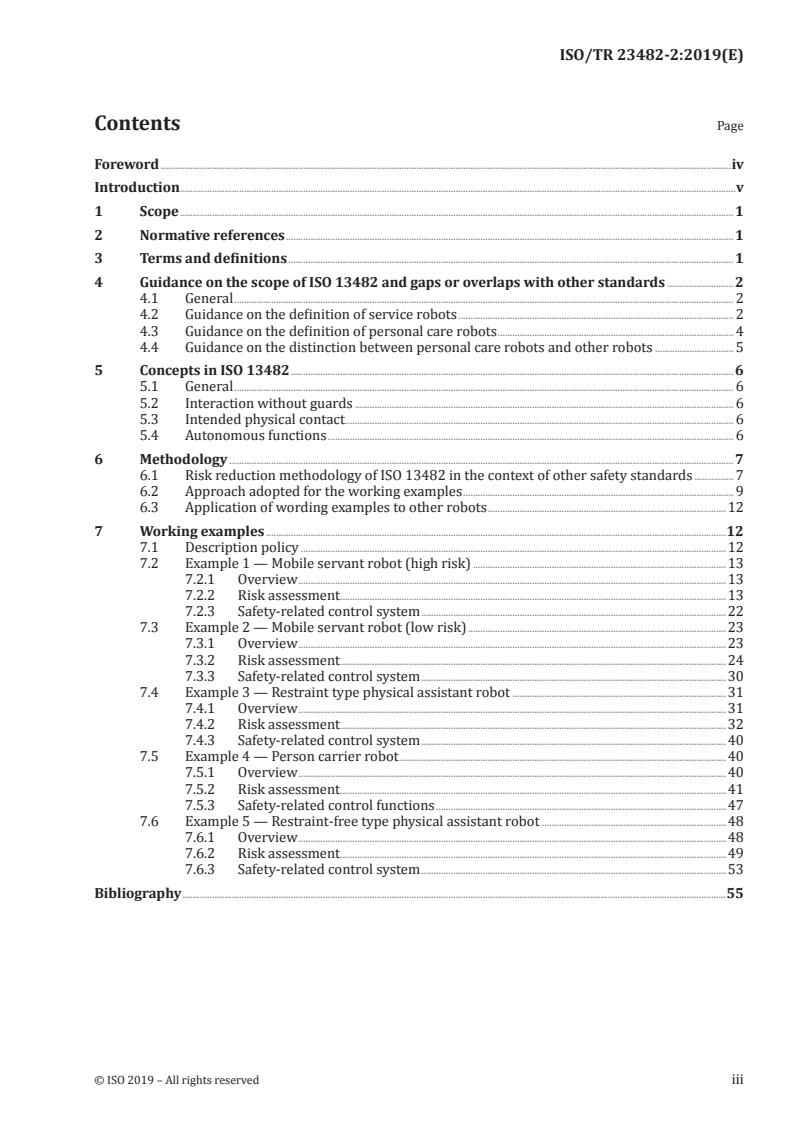
Contents Page
Foreword .iv
Introduction .v
1 Scope . 1
2 Normative references . 1
3 Terms and definitions . 1
4 Guidance on the scope of ISO 13482 and gaps or overlaps with other standards .2
4.1 General . 2
4.2 Guidance on the definition of service robots . 2
4.3 Guidance on the definition of personal care robots . 4
4.4 Guidance on the distinction between personal care robots and other robots . 5
5 Concepts in ISO 13482 . 6
5.1 General . 6
5.2 Interaction without guards . 6
5.3 Intended physical contact . 6
5.4 Autonomous functions . 6
6 Methodology . 7
6.1 Risk reduction methodology of ISO 13482 in the context of other safety standards . 7
6.2 Approach adopted for the working examples . 9
6.3 Application of wording examples to other robots .12
7 Working examples .12
7.1 Description policy .12
7.2 Example 1 — Mobile servant robot (high risk) .13
7.2.1 Overview .13
7.2.2 Risk assessment . .13
7.2.3 Safety-related control system .22
7.3 Example 2 — Mobile servant robot (low risk) .23
7.3.1 Overview .23
7.3.2 Risk assessment . .24
7.3.3 Safety-related control system .30
7.4 Example 3 — Restraint type physical assistant robot .31
7.4.1 Overview .31
7.4.2 Risk assessment . .32
7.4.3 Safety-related control system .40
7.5 Example 4 — Person carrier robot .40
7.5.1 Overview .40
7.5.2 Risk assessment . .41
7.5.3 Safety-related control functions .47
7.6 Example 5 — Restraint-free type physical assistant robot .48
7.6.1 Overview .48
7.6.2 Risk assessment . .49
7.6.3 Safety-related control system .53
Bibliography .55
Foreword
ISO (the International Organization for Standardization) is a worldwide federation of national standards
bodies (ISO member bodies). The work of preparing International Standards is normally carried out
through ISO technical committees. Each member body interested in a subject for which a technical
committee has been established has the right to be represented on that committee. International
organizations, governmental and non-governmental, in liaison with ISO, also take part in the work.
ISO collaborates closely with the International Electrotechnical Commission (IEC) on all matters of
electrotechnical standardization.
The procedures used to develop this document and those intended for its further maintenance are
described in the ISO/IEC Directives, Part 1. In particular, the different approval criteria needed for the
different types of ISO documents should be noted. This document was drafted in accordance with the
editorial rules of the ISO/IEC Directives, Part 2 (see www .iso .org/directives).
Attention is drawn to the possibility that some of the elements of this document may be the subject of
patent rights. ISO shall not be held responsible for identifying any or all such patent rights. Details of
any patent rights identified during the development of the document will be in the Introduction and/or
on the ISO list of patent declarations received (see www .iso .org/patents).
Any trade name used in this document is information given for the convenience of users and does not
constitute an endorsement.
For an explanation of the voluntary nature of standards, the meaning of ISO specific terms and
expressions related to conformity assessment, as well as information about ISO's adherence to the
World Trade Organization (WTO) principles in the Technical Barriers to Trade (TBT) see www .iso
.org/iso/foreword .html.
This document was prepared by Technical Committee ISO/TC 299, Robotics.
A list of all parts in the ISO 23482 series can be found on the ISO website.
Any feedback or questions on this document should be directed to the user’s national standards body. A
complete listing of these bodies can be found at www .iso .org/members .html.
iv © ISO 2019 – All rights reserved
Introduction
ISO 13482 is the first safety standard developed for the area of service robots. It allows close human-
robot interaction, including human-robot contact. Although ISO 13482 follows well-established
principles and practices from standards for industrial robots and machines in general, additional
guidance can facilitate its rapid and successful adoption by manufacturers and other stakeholders.
This document clarifies which robots fall under the definition of personal care robots and what
distinguishes personal care robots from robots in other areas, such as medical robots or industrial
robots. This document also provides further guidance on the risk assessment and risk reduction
process to be conducted for a personal care robot. It contains examples of risk assessments for different
types of personal care robots that can serve as an example for the user of ISO 13482 for their own risk
assessment.
TECHNICAL REPORT ISO/TR 23482-2:2019(E)
Robotics — Application of ISO 13482 —
Part 2:
Application guidelines
1 Scope
This document provides guidance on the use of ISO 13482 and is intended to facilitate the design of
personal care robots in conformity with ISO 13482. Additional guidance is provided for users with
limited experience of risk assessment and risk reduction. This document provides clarification and
guidance on new terms and safety requirements introduced to allow close human-robot interaction
and human-robot contact in personal care robot applications, including mobile servant robots, physical
assistant robots and person carrier robots. This document considers the application of ISO 13482 to all
service robots and includes related examples.
2 Normative references
The following documents are referred to in the text in such a way that some or all of their content
constitutes requirements of this document. For dated references, only the edition cited applies. For
undated references, the latest edition of the referenced document (including any amendments) applies.
ISO 8373:2012, Robots and robotic devices — Vocabulary
ISO 13482:2014, Robots and robotic devices — Safety requirements for personal care robots
3 Terms and definitions
For the purposes of this document, the terms and definitions given in ISO 8373:2012 and ISO 13482:2014
and the following apply.
ISO and IEC maintain terminological databases for use in standardization at the following addresses:
— ISO Online browsing platform: available at https: //www .iso .org/obp
— IEC Electropedia: available at http: //www .electropedia .org/
3.1
service robot
robot that performs useful tasks for humans or equipment excluding industrial automation applications
[SOURCE: ISO 8373:2012, 2.10, modified — Notes to entry have been deleted.]
3.2
personal care robot
service robot (3.1) that performs actions contributing directly towards improvement in the quality of
life of humans, excluding medical applications
[SOURCE: ISO 13482:2014, 3.13, modified — Notes to entry have been deleted.]
3.3
industrial robot
automatically controlled, reprogrammable multipurpose manipulator, programmable in three or more
axes, which can be either fixed in place or mobile for use in industrial automation applications
[SOURCE: ISO 10218-1:2011, 3.10, modified — Notes to entry have been deleted.]
3.4
mobile servant robot
personal care robot (3.2) that is capable of travelling to perform serving tasks in interaction with
humans, such as handling objects or exchanging information
[SOURCE: ISO 13482:2014, 3.14]
3.5
physical assistant robot
personal care robot (3.2) that physically assists a user to perform required tasks by providing
supplementation or augmentation of personal capabilities
[SOURCE: ISO 13482:2014, 3.15]
3.6
person carrier robot
personal care robot (3.2) with the purpose of transporting humans to an intended destination
[SOURCE: ISO 13482:2014, 3.16, modified — Notes to entry have been deleted.]
3.7
medical robot
robot intended to be used as MEE or MES
Note 1 to entry: MEE (medical electrical equipment) and MES (medical electrical system) are defined in
IEC 60601-1.
[SOURCE: IEC/TR 60601-4-1:2017, 3.20, modified — Note to entry has been added.]
3.8
household robot
actuated mechanism with a degree of autonomy, operating within the household and similar
environment, to perform intended tasks
Note 1 to entry: Operating includes travel and/or robot body movement.
[SOURCE: IEC 62849:2016, 3.1]
4 Guidance on the scope of ISO 13482 and gaps or overlaps with other standards
4.1 General
This clause clarifies what robot types and applications are covered by the scope of ISO 13482. It also
covers gaps and overlaps with standards for similar products, such as industrial robots, medical robots
and light electric vehicles.
4.2 Guidance on the definition of service robots
Service robots include various robot categories performing useful tasks for humans or equipment.
Figure 1 illustrates robot categories that are included in the definition of service robot and how they
relate to other relevant areas.
2 © ISO 2019 – All rights reserved
Figure 1 — Categorization of personal care robots and relation with other relevant areas
The term “service robot” contains most robot categories, except industrial robot, as illustrated in
Figure 1. As different legal and regulatory requirements apply to different robot categories, one of the
first tasks for the manufacturer in commercialization of a robot is to identify the robot category to which
it belongs. Robot categories of particular interest to robot manufacturers at the time of publication of
ISO 13482 are summarized in Table 1.
Table 1 — Summary of selected robot categories
Robot Purpose User Examples
categories
Personal care Improvement of the quality of Lay person Autonomous mobile robot that takes ob-
robot life of humans (on a non-medi- (not a patient) jects at the request of its user
cal basis)
Robot exoskeleton to enhance physical
capability of healthy person in non-indus-
trial environment
Self-balancing type personal mobility robot
Medical robot Diagnosis, treatment, or moni- Patient Robot exoskeleton to compensate disabili-
toring of a patient; or compen- ty of affected limbs
Medical expert
sation or alleviation of disease,
Surgery robot
injury or disability
Self-transfer robot transferring a patient
between bed and wheelchair
Household Implementation of housework Lay person Autonomous vacuum cleaner
robot for humans (not a patient)
Mowing robot
Robot used Implementation of tasks in Worker Warehouse mobile robot
in industrial industrial automation
Welding robot
environments
ISO 10218 was the only International Standard dealing with safety for robots and robot systems prior
to the publication of ISO 13482.
4.3 Guidance on the definition of personal care robots
Personal care robots are covered by ISO 13482. They are a subset of service robots that contribute to
the quality of life of users through direct interaction.
ISO 13482 is intended to be applied to personal care robots that improve the quality of life of humans
regardless of their attribute, age or gender (e.g. children, elderly persons, pregnant women). Since the
area of personal care robots is broad, only a small portion thereof was relevant to the existing market
at the time of publication of ISO 13482. With the market relevance in mind, ISO 13482 selects the three
most commercialized types of personal care robot and specifies safety requirements particularly for
these three robot types while allowing its application to any type of personal care robot. The three
robot types are mobile servant robot, physical assistant robot and person carrier robot.
The improvement of the quality of life provided by each of the three robot types is as follows.
— Mobile servant robots provide services to their users. These include serving information as well as
objects. The role of mobile servant robots can be compared to serving personnel, such as butlers,
waiters, secretaries or receptionists.
— Physical assistant robots help the wearer to do a task by physically supporting movements. This
includes supporting the user’s weight, as well as amplifying the force of muscles.
— Person carrier robots transport users. Such robots can be designed to carry a single person or a
small group of persons, at limited speed, normally in pedestrian areas.
Some personal care robots can adopt the attributes of two or more robot types specified in ISO 13482.
This kind of hybrid personal care robots includes:
— person carrying exoskeleton (hybrid of physical assistant robot and person carrier robot);
— person carrier robot handling objects and interacting with humans (hybrid of mobile servant robot
and person carrier robot).
4 © ISO 2019 – All rights reserved
For such hybrid personal care robots, it is important to identify all relevant safety requirements for the
two or more robot types very carefully.
One feature of ISO 13482 compared to ISO 10218 is the physical range of risk of application (see
ISO 13482:2014, 6.1.1). Industrial robot applications range from low to high risk, with more applications
having high risk. As personal care robots tend to have more direct physical contact with humans than
industrial robots, there was a tendency for manufacturers to produce more robots with low risk at
the time of publication of ISO 13482. This trend in the personal care robot market is reflected by the
intensive coverage of robots with low risk.
4.4 Guidance on the distinction between personal care robots and other robots
There are some known overlaps of scope between ISO 13482 and other standards. Such overlaps
allow more than two interpretations of robot category applicable to one robot. To minimize double
interpretations, the robot category can be identified based on the intended use of the robot in question.
The purposes of the four most market-relevant robot categories are specified in Table 1. The following
are examples of identifying robot category based on the purpose of the robot.
— A wearable robot for diagnosis, treatment, or monitoring of a patient, or for compensation or
alleviation of diseases, injury or disability, is categorized as a “medical robot” (see IEC 60601-1).
The same wearable robot can be categorized as a “physical assistant robot” (ISO 13482:2014, 3.15),
if used otherwise, e.g. exoskeleton robot assisting medical worker to transfer a patient.
— A mobile robot for transporting parts for an assembly line can be categorized as a “robot used
in industrial environments”. The same robot can be categorized as a “mobile servant robot”
(ISO 13482:2014, 3.14) if used otherwise, e.g. a mobile robot for fetch and carry tasks in the
household.
— A wearable robot assisting a factory worker in installing a door onto an automobile in manufacturing
premises, can be categorized as a “robot used in industrial environments”. The same robot can be
categorized as a “physical assistant robot” if used otherwise, e.g. to minimize factory worker’s
fatigue when not performing tasks in factory automation.
It is usually in the interests of a robot manufacturer to identify one singular type to which a particular
robot belongs. In this way, it is only necessary to fulfil the safety requirements for this type and
contradicting requirements from different standards are avoided. When a particular robot can belong
to more than one type, the manufacturer chooses the robot type, intended use, conditions for use and
limitation for use.
If a robot is intended to be used for multiple purposes, the robot is normally considered to belong to
multiple robot types. One such example is an autonomous mobile robot able to serve food and beverages
(“mobile servant robot”) and also managing and dispensing medication to a patient (“medical robot”). In
such a case, both applicable medical device standards and machinery standards should be considered.
NOTE 1 If a robot is designed in a way that software can be altered, it is important that the manufacturer
specifies the limits of use and selects applicable safety standards accordingly for the risk assessment process. If
the software is altered beyond the specified limits (e.g. using a non-medical robot for a medical task), a new risk
assessment is conducted according to ISO 12100 (or another applicable standard) by the party responsible for
the alteration.
In the following examples, the boundaries of the personal care robots and the other products need to be
clarified:
— a driverless road vehicle can be classified as a person carrier robot if the speed is limited to 20 km/h;
ISO 13482 applies;
— a person carrier robot is classified as a road vehicle if it is used on the public roads; regulations for
road vehicles apply.
NOTE 2 To determine which standards to apply in case of conflicting requirements, the manufacturer can
consult a third party qualified to provide advice until the boundaries are clarified. This can be from organizations
accredited according to ISO/IEC 17025.
Reasonably foreseeable misuses are identified in the risk assessment, according to ISO 12100. The robot
design can be changed to lessen the likelihood of foreseeable misuses. When these cannot be eliminated,
they are used to determine the intended uses and limitations of use of the personal care robot.
5 Concepts in ISO 13482
5.1 General
ISO 13482 addresses safety issues that are distinct compared to medical and industrial robots. The
following are some elemental differences between personal care robots and other existing machinery:
— personal care robots are usually mobile and work among humans without being separated by guards;
— interaction between human and robot, including physical contact, is often an essential part of the
robot’s task;
— personal care robots often have a certain degree of autonomy which enables them to act and decide
without human intervention.
5.2 Interaction without guards
Personal care robots are usually designed to operate among humans, sharing their operational space
with them. In addition, personal care robots are usually mobile. As a result, protective devices are
usually attached to, or can be integrated with, the personal care robot, rather than being installed in
the environment. Operating zones and zones safeguarded by protective devices and safety functions
are defined relative to the mobile personal robot.
Due to the closer interaction with humans, the protective stop is not considered the only option to
achieve a safe state. More flexibility can be reached when the robot adjusts its speed to the distance and
the relative speed of obstacles. To guarantee safe interaction, safety functions such as safety-related
speed control and obstacle avoidance can be applied. Requirements for the control system performance
of such safety functions are provided in ISO 13482:2014, 6.4 and 6.5.
5.3 Intended physical contact
Physical contact with the user is often essential for the task of a personal care robot. This applies
especially for physical assistant robots where force is directly applied to parts of the human body, but
it is also important that person carrier robots are in permanent contact with their rider. Mobile servant
robots establish temporary physical contact, e.g. when objects are handed over.
During robot design and risk assessment, it is important that a manufacturer distinguishes between
intended and unintended forms of physical contact. For intended contact, it is important to limit contact
forces and impacts to a level that allows interaction with the user without pain or discomfort. A strategy
or process is usually developed for controlled engagement and disengagement into/from physical
contact. It is important to avoid unintended contact, especially harm from collisions and clamping with
high force and impact.
Requirements for the control system performance of a safety-related force control function that can be
used to achieve acceptable physical interaction are provided in ISO 13482:2014, 6.6.
5.4 Autonomous functions
Personal care robots are in many cases equipped with autonomous functions. ISO 13482 distinguishes
between autonomous and semi-autonomous operation (see ISO 13482:2014, 6.10). During autonomous
mode, the frequency of human interaction is very low, e.g. when a mobile servant robot performs
6 © ISO 2019 – All rights reserved
household tasks like tidying up or preparing drinks on its own. In semi-autonomous mode, user and
robot interact frequently, but the robot is only indirectly controlled by the human.
EXAMPLE When the human controls the general direction of motion of a person carrier robot while the
robot performs obstacle avoidance and stability control on its own.
As the level of autonomy in personal care robots is still considerably low and often limited to simple
autonomous decisions, ISO 13482 assumes that the manufacturer still carries the full responsibility for
autonomous actions of the robot. The robot cannot be responsible itself for its actions, nor is the user
responsible for harm originating from autonomous decisions when using the robot as intended. It is
important that the manufacturer of a personal care robot judges carefully which actions and decisions
can be executed autonomously by such a robot without any unacceptable risk of harm. Further guidance
on this issue is provided in ISO 13482:2014, 5.12.
It is expected that the autonomy of personal care robots will increase in the future and will comprise
more complex autonomous actions and decisions. The relevant clause of ISO 13482 is therefore likely to
be expanded in future revisions.
6 Methodology
6.1 Risk reduction methodology of ISO 13482 in the context of other safety standards
The process of risk assessment and risk reduction is shown in Figure 2, which is adapted from
ISO 12100:2010, Figure 1, and has been extended with additional information for users of ISO 13482,
including priority of application order of the risk reduction measures.
As shown in Figure 2, as a first step, the limits of the robot are determined, and thereby the
environment and the use context or application in which the robot operates. Based on these limits,
hazard identification is performed and the risk associated with the identified hazards is estimated.
Risk reduction is required if risk evaluation indicates that a risk has not been adequately reduced. It is
the manufacturer’s responsibility to determine the acceptable risk. Acceptable risk can be understood
as the level of risk that is accepted in a given context based on the current values of society.
A risk reduction is performed according to the three-step method illustrated in Figure 2 for any risks
which need risk reduction. The first step is to reduce the risk by applying inherently safe design
measures. The second step (the reduction of the risk by applying safeguards or complementary
protective measures) can only be applied when the first step is not applicable or the necessary risk
reduction cannot be achieved by applying the first step. In the same way, the third step is not applicable
without performing the first and the second step.
The process of risk reduction is always iterative. After measures have been applied, the residual risk is
again assessed to determine if the risk is adequately reduced. These steps are repeated until finally all
the remaining risks are adequately reduced.
For hazard identification, the list of significant hazards provided in ISO 13482:2014, Annex A, can be
used as a checklist. This list is not exhaustive and does not necessarily cover all hazards of a particular
personal care robot: as a supplement, the more general list of hazards provided in ISO 12100:2010,
Annex B, can be used to identify less common hazards.
Figure 2 — Schematic representation of risk reduction process with extended information for
users of ISO 13482
8 © ISO 2019 – All rights reserved
ISO 13482:2014, Clause 5, is structured in such a way that appropriate measures for the three steps of
risk reduction are provided for each particular hazard in subsequent subclauses, as follows:
— 5.X.2 Inherently safe design;
— 5.X.3 Safeguarding and complementary protective measures;
— 5.X.4 Information for use.
This allows the user to take all possible measures for risk reduction into account and choose appropriate
solutions according to the priorities defined in ISO 12100.
NOTE 1 Other measures than those mentioned in ISO 13482:2014, 5.X.2 to 5.X.4, can be chosen for risk
reduction if they are considered to be appropriate.
When safety functions are implemented for risk reduction using the safety-related part of the control
system, ISO 13482:2014, Clause 6, applies, with each safety function being realized with a sufficiently
high safety performance level (PL). The definition of PL and categories of control architecture are
described in ISO 13849-1. Before applying ISO 13482:2014, Clause 6, users are highly encouraged to
familiarize themselves with the principles and methodology described in ISO 13849-1.
NOTE 2 This document uses PL for evaluation of safety related control circuit according to ISO 13849-1.
However, safety integrity level (SIL) defined in IEC 62061 can also be applied for the same purpose.
ISO 13482 requires that the required performance level (PLr) for a certain safety function be determined
by risk assessment, taking into account expected probability and severity of harm. ISO 13482:2014,
Clause 6, contains recommendations for the PL of typical safety functions for typical robot types.
However, the recommendations in ISO 13482 only serve as a guideline and are not a substitute for users
to determine the PLr of their particular robot. Compared with the recommended PL, the PLr determined
by the user can be higher or lower.
— Higher: In this case, the particular personal care robot has risks that are higher than the risks of
typical examples of personal care robots illustrated in ISO 13482. The manufacturer needs to fulfil
all the requirements of ISO 13849-1 to mitigate these higher risks.
— Lower: In this case, the particular personal care robot can have risks that are lower than the risks
of typical examples of personal care robots illustrated in ISO 13482. However, it should be ensured
that substantial reasons exist for this outcome of risk estimation. These reasons should be carefully
documented in the technical documentation of the robot for later review.
Expected safety-related control functions of personal care robots are used as titles from ISO 13482:2014,
6.2 to 6.11. Each clause shows requirements for the safety-related control system with expected PL.
ISO 13482 subdivides each robot type into a high-risk sub-type and a low-risk sub-type of each
example of a robot type. Choosing either sub-type results in different recommendations for the PLr,
which are usually based on the choice of a high or low expected severity in the associated risk graph.
This differentiation serves as an additional guideline for the user. However, it is not a substitute for
performing a risk assessment to determine the PLr for each safety function. In practice, a robot that at
first sight seems to correspond to the “low-risk” definition can prove to require safety functions with
high PL after careful inspection. The robot sub-type can be changed by implementing inherently safe
design measures.
6.2 Approach adopted for the working examples
Clause 7 comprises working examples to provide guidance on the following subjects:
— procedural steps for risk assessment and the generation of a risk assessment table;
— the application of the ISO 12100 risk reduction methodology;
— the application of safety PL for the safety-related control system function according to ISO 13849-1;
— conformity to specific safety requirements in ISO 13482.
Each working example shows how to use ISO 13482 rules to identify the correct sub-type of the robot
and then shows the process to identify the required PLs of its safety functions. In particular, the
following information is provided.
— A presentation of the general characteristics of the robot that are relevant for the risk assessment,
such as system architecture, specifications, operating environment, typical use scenarios including
degree of autonomy of specific tasks, and robot sub-type determination (size-related assessment/
mass-related assessment/speed-related assessment/force/power-related assessment/etc.).
— Determination of the limits of the personal care robot, including foreseeable misuse. A sample of
initial risk estimation for a few selected risks and hazards. The tables have at least one control-
function related risk reduction measure. The table consists of hazard, potential consequences,
hazardous event, initial risk estimation and evaluation and a link to ISO 13482:2014, Clause 5.
— A selection of inherently safety measures, safeguarding measures for hazards, as well as generation
of information for use for the most important risks and hazards addressed in the initial risk
assessment table. A risk assessment table after the risk reduction measures has been applied for
risks and hazards in the initial risk assessment table. Care should be taken if any measure causes any
new hazard. The same procedure is repeated until all the identified risks are adequately reduced.
— Identification of safety-related control functions used for protective measures and determination of
PLr for identified control functions.
The items listed in ISO 12100:2010, Clauses B.1 to B.4, are the types of hazard, their origin and their
potential consequences to be identified before risk estimation/evaluation, and these clauses also
provide hazardous situations and hazardous events.
For better readability, the working examples in Clause 7 do not offer detailed information regarding
the origins of hazards nor provide hazardous situations. Origins of hazards and hazardous situations
can be implicitly read in the column “hazard and hazardous event”, which contains cause and effect
resulting in a potential consequence.
The examples in this document are not intended to cover all the risks, but to cover some specific
examples. Risk estimation and evaluation in each example relates to Figure 3. Determination of PLr in
each example adopts the methodology shown in Figure 4. This document uses separate risk graphs for
risk estimation/evaluation and determining the PLr of safety functions in order to present the different
steps of risk assessment and risk reduction in a structured and comprehensible way. Since two different
risk graphs are used in the overall process, care should be taken to ensure consistency of analysis
between the risk estimation driving the need for risk reduction measures and that for determining PLr.
Other techniques are available that do not use multiple risk graphs.
EXAMPLE RIA TR R15.306-2016 task-based risk assessment methodology provides an example of mapping
the risk index to PLr without using a second risk graph.
10 © ISO 2019 – All rights reserved
Key
S1 slight injury (usually reversible) O1 low (very unlikely)
S2 serious injury (usually irreversible) O2 medium (likely to occur sometime)
F1 seldom/short duration O3 frequent (likely to occur frequently)
F2 frequent/long duration A1 possible (person can notice and has time to evade)
A2 impossible
NOTE 1 This figure is an example to illustrate the procedures to apply ISO 13482. It is reproduced from ISO/
TR 14121-2:2012, 6.3.2, which contains more detailed explanation of the alternatives for S, F, O and A.
NOTE 2 A risk index of 1 or 2 corresponds to a low risk, a risk index of 3 or 4 corresponds to a medium risk and
a risk index of 5 or 6 corresponds to a high risk. The manufacturer decides up to which risk index a risk is still
acceptable, normally with a justification.
NOTE 3 F, O and A together form the “probability of occurrence of harm”.
Figure 3 — Risk estimation and evaluation
NOTE The criterion “F” is defined differently for the two risk graphs, i.e. “F” and “O” of Figure 3 correspond
to “F” in Figure 4.
Figure 4 — Determination of PLr for safety function
6.3 Application of wording examples to other robots
The working examples for risk assessment and risk reduction are based on assumptions for a certain
robot design and a use scenario. They should be considered to provide guidance for users of ISO 13482
to perform their own risk assessment and risk reduction. Although the examples are intended to be as
realistic as possible, it is not possible to apply the results of these examples to any other personal care
robots, in particular for the following reasons.
— Some hazards and some risk reduction measures have been omitted to keep the examples short and
understandable.
— Different personal care robot designs have different risks, even if they are apparently similar.
— Even identical personal care robots result in different risks and require different risk reduction
measures, if they are used in a different environment or by different user groups.
— It is important to verify carefully, by means of calculations and practical tests, the ability of a
safeguard or complementary protective measure to reduce a risk adequately.
7 Working examples
7.1 Description policy
Clause 7 shows step-by-step procedures to perform risk assessment and risk reduction for personal
care robots specified in ISO 13482. The examples given in Clause 7 represent personal care robots,
already commercialized or about to be commercialized at the time of publication. The examples in
Clause 7 correspond to the approach described in 6.2.
12 © ISO 2019 – All rights reserved
7.2 Example 1 — Mobile servant robot (high risk)
7.2.1 Overview
This example deals with a mobile servant robot designated to perform fetch-and-carry-tasks in private
households in order to support elderly persons.
System architecture:
The robot consists of an omnidirectional mobile base with four wheels. On the base sits a torso with
a single arm. The arm is equipped with a 3-finger-gripper. The robot also has a foldable tray on which
objects can be placed. The robot is powered by a lithium-ion battery which is located in the mobile base.
Specifications:
The robot is about 1,5 m high and weighs 150 kg. The gripper can lift a maximum load of 2 kg. The robot
has a maximum travel speed of 1 m/s. The voltage of the battery is 48 V.
Operating environment:
The mobile servant robot is designated to operate indoors, in home environments with flat ground.
Typical tasks:
The following tasks are foreseen for the mobile servant robot:
— locating and fetching objects from a place inside the home environment (e.g. kitchen, shelf in the
living room, side table in the bedroom) upon user command;
— receiving objects from a user and bringing them to an appropriate place (e.g. a dirty cup back to the
kitchen; a book back to the bookshelf);
— pouring drinks from bottles and serving them to sitting or standing persons.
Task execution is triggered by verbal user commands, by pressing a button on a remote control (e.g.
smart phone app) or by placing or taking an object on/from the robot’s tray.
Degree of autonomy:
The mobile servant robot works almost entirely in autonomous mode (according to ISO 13482:2014,
6.10). Having received a command, it moves between rooms and avoids obstacles, it locates, grasps and
delivers objects without human intervention.
Robot sub-type determination:
The mobile servant robot is equipped with a manipulator. With a weight of 150 kg and a size of 1,5 m,
it is neither small nor light-weight. It is categorized as a high-risk mobile servant robot (Type 1.2
according to ISO 13482:2014, 6.1.2.1).
7.2.2 Risk assessment
7.2.2.1 Determination of the limits of personal care robot
The mobile servant robot is operated by a lay person in a home environment to perform the
aforementioned tasks. The home environment is expected to have flat ground (hard floor or carpet).
During the iterative process of risk assessment, further limitations have been decided to exclude other
hazards and make the risk estimation and risk reduction process easier.
— Conditions for use: no steps and sloped surfaces have an angle below 5°.
— Objects to be handled by the robot are limited to non-hazardous objects. Sharp objects (e.g. knives),
very hot objects or burning object
...
TECHNICAL ISO/TR
REPORT 23482-2
First edition
2019-03
Robotics — Application of ISO 13482 —
Part 2:
Application guidelines
Robotique — Application de l'ISO 13482 —
Partie 2: Lignes directrices sur l'application
Reference number
©
ISO 2019
© ISO 2019
All rights reserved. Unless otherwise specified, or required in the context of its implementation, no part of this publication may
be reproduced or utilized otherwise in any form or by any means, electronic or mechanical, including photocopying, or posting
on the internet or an intranet, without prior written permission. Permission can be requested from either ISO at the address
below or ISO’s member body in the country of the requester.
ISO copyright office
CP 401 • Ch. de Blandonnet 8
CH-1214 Vernier, Geneva
Phone: +41 22 749 01 11
Fax: +41 22 749 09 47
Email: copyright@iso.org
Website: www.iso.org
Published in Switzerland
ii © ISO 2019 – All rights reserved
Contents Page
Foreword .iv
Introduction .v
1 Scope . 1
2 Normative references . 1
3 Terms and definitions . 1
4 Guidance on the scope of ISO 13482 and gaps or overlaps with other standards .2
4.1 General . 2
4.2 Guidance on the definition of service robots . 2
4.3 Guidance on the definition of personal care robots . 4
4.4 Guidance on the distinction between personal care robots and other robots . 5
5 Concepts in ISO 13482 . 6
5.1 General . 6
5.2 Interaction without guards . 6
5.3 Intended physical contact . 6
5.4 Autonomous functions . 6
6 Methodology . 7
6.1 Risk reduction methodology of ISO 13482 in the context of other safety standards . 7
6.2 Approach adopted for the working examples . 9
6.3 Application of wording examples to other robots .12
7 Working examples .12
7.1 Description policy .12
7.2 Example 1 — Mobile servant robot (high risk) .13
7.2.1 Overview .13
7.2.2 Risk assessment . .13
7.2.3 Safety-related control system .22
7.3 Example 2 — Mobile servant robot (low risk) .23
7.3.1 Overview .23
7.3.2 Risk assessment . .24
7.3.3 Safety-related control system .30
7.4 Example 3 — Restraint type physical assistant robot .31
7.4.1 Overview .31
7.4.2 Risk assessment . .32
7.4.3 Safety-related control system .40
7.5 Example 4 — Person carrier robot .40
7.5.1 Overview .40
7.5.2 Risk assessment . .41
7.5.3 Safety-related control functions .47
7.6 Example 5 — Restraint-free type physical assistant robot .48
7.6.1 Overview .48
7.6.2 Risk assessment . .49
7.6.3 Safety-related control system .53
Bibliography .55
Foreword
ISO (the International Organization for Standardization) is a worldwide federation of national standards
bodies (ISO member bodies). The work of preparing International Standards is normally carried out
through ISO technical committees. Each member body interested in a subject for which a technical
committee has been established has the right to be represented on that committee. International
organizations, governmental and non-governmental, in liaison with ISO, also take part in the work.
ISO collaborates closely with the International Electrotechnical Commission (IEC) on all matters of
electrotechnical standardization.
The procedures used to develop this document and those intended for its further maintenance are
described in the ISO/IEC Directives, Part 1. In particular, the different approval criteria needed for the
different types of ISO documents should be noted. This document was drafted in accordance with the
editorial rules of the ISO/IEC Directives, Part 2 (see www .iso .org/directives).
Attention is drawn to the possibility that some of the elements of this document may be the subject of
patent rights. ISO shall not be held responsible for identifying any or all such patent rights. Details of
any patent rights identified during the development of the document will be in the Introduction and/or
on the ISO list of patent declarations received (see www .iso .org/patents).
Any trade name used in this document is information given for the convenience of users and does not
constitute an endorsement.
For an explanation of the voluntary nature of standards, the meaning of ISO specific terms and
expressions related to conformity assessment, as well as information about ISO's adherence to the
World Trade Organization (WTO) principles in the Technical Barriers to Trade (TBT) see www .iso
.org/iso/foreword .html.
This document was prepared by Technical Committee ISO/TC 299, Robotics.
A list of all parts in the ISO 23482 series can be found on the ISO website.
Any feedback or questions on this document should be directed to the user’s national standards body. A
complete listing of these bodies can be found at www .iso .org/members .html.
iv © ISO 2019 – All rights reserved
Introduction
ISO 13482 is the first safety standard developed for the area of service robots. It allows close human-
robot interaction, including human-robot contact. Although ISO 13482 follows well-established
principles and practices from standards for industrial robots and machines in general, additional
guidance can facilitate its rapid and successful adoption by manufacturers and other stakeholders.
This document clarifies which robots fall under the definition of personal care robots and what
distinguishes personal care robots from robots in other areas, such as medical robots or industrial
robots. This document also provides further guidance on the risk assessment and risk reduction
process to be conducted for a personal care robot. It contains examples of risk assessments for different
types of personal care robots that can serve as an example for the user of ISO 13482 for their own risk
assessment.
TECHNICAL REPORT ISO/TR 23482-2:2019(E)
Robotics — Application of ISO 13482 —
Part 2:
Application guidelines
1 Scope
This document provides guidance on the use of ISO 13482 and is intended to facilitate the design of
personal care robots in conformity with ISO 13482. Additional guidance is provided for users with
limited experience of risk assessment and risk reduction. This document provides clarification and
guidance on new terms and safety requirements introduced to allow close human-robot interaction
and human-robot contact in personal care robot applications, including mobile servant robots, physical
assistant robots and person carrier robots. This document considers the application of ISO 13482 to all
service robots and includes related examples.
2 Normative references
The following documents are referred to in the text in such a way that some or all of their content
constitutes requirements of this document. For dated references, only the edition cited applies. For
undated references, the latest edition of the referenced document (including any amendments) applies.
ISO 8373:2012, Robots and robotic devices — Vocabulary
ISO 13482:2014, Robots and robotic devices — Safety requirements for personal care robots
3 Terms and definitions
For the purposes of this document, the terms and definitions given in ISO 8373:2012 and ISO 13482:2014
and the following apply.
ISO and IEC maintain terminological databases for use in standardization at the following addresses:
— ISO Online browsing platform: available at https: //www .iso .org/obp
— IEC Electropedia: available at http: //www .electropedia .org/
3.1
service robot
robot that performs useful tasks for humans or equipment excluding industrial automation applications
[SOURCE: ISO 8373:2012, 2.10, modified — Notes to entry have been deleted.]
3.2
personal care robot
service robot (3.1) that performs actions contributing directly towards improvement in the quality of
life of humans, excluding medical applications
[SOURCE: ISO 13482:2014, 3.13, modified — Notes to entry have been deleted.]
3.3
industrial robot
automatically controlled, reprogrammable multipurpose manipulator, programmable in three or more
axes, which can be either fixed in place or mobile for use in industrial automation applications
[SOURCE: ISO 10218-1:2011, 3.10, modified — Notes to entry have been deleted.]
3.4
mobile servant robot
personal care robot (3.2) that is capable of travelling to perform serving tasks in interaction with
humans, such as handling objects or exchanging information
[SOURCE: ISO 13482:2014, 3.14]
3.5
physical assistant robot
personal care robot (3.2) that physically assists a user to perform required tasks by providing
supplementation or augmentation of personal capabilities
[SOURCE: ISO 13482:2014, 3.15]
3.6
person carrier robot
personal care robot (3.2) with the purpose of transporting humans to an intended destination
[SOURCE: ISO 13482:2014, 3.16, modified — Notes to entry have been deleted.]
3.7
medical robot
robot intended to be used as MEE or MES
Note 1 to entry: MEE (medical electrical equipment) and MES (medical electrical system) are defined in
IEC 60601-1.
[SOURCE: IEC/TR 60601-4-1:2017, 3.20, modified — Note to entry has been added.]
3.8
household robot
actuated mechanism with a degree of autonomy, operating within the household and similar
environment, to perform intended tasks
Note 1 to entry: Operating includes travel and/or robot body movement.
[SOURCE: IEC 62849:2016, 3.1]
4 Guidance on the scope of ISO 13482 and gaps or overlaps with other standards
4.1 General
This clause clarifies what robot types and applications are covered by the scope of ISO 13482. It also
covers gaps and overlaps with standards for similar products, such as industrial robots, medical robots
and light electric vehicles.
4.2 Guidance on the definition of service robots
Service robots include various robot categories performing useful tasks for humans or equipment.
Figure 1 illustrates robot categories that are included in the definition of service robot and how they
relate to other relevant areas.
2 © ISO 2019 – All rights reserved
Figure 1 — Categorization of personal care robots and relation with other relevant areas
The term “service robot” contains most robot categories, except industrial robot, as illustrated in
Figure 1. As different legal and regulatory requirements apply to different robot categories, one of the
first tasks for the manufacturer in commercialization of a robot is to identify the robot category to which
it belongs. Robot categories of particular interest to robot manufacturers at the time of publication of
ISO 13482 are summarized in Table 1.
Table 1 — Summary of selected robot categories
Robot Purpose User Examples
categories
Personal care Improvement of the quality of Lay person Autonomous mobile robot that takes ob-
robot life of humans (on a non-medi- (not a patient) jects at the request of its user
cal basis)
Robot exoskeleton to enhance physical
capability of healthy person in non-indus-
trial environment
Self-balancing type personal mobility robot
Medical robot Diagnosis, treatment, or moni- Patient Robot exoskeleton to compensate disabili-
toring of a patient; or compen- ty of affected limbs
Medical expert
sation or alleviation of disease,
Surgery robot
injury or disability
Self-transfer robot transferring a patient
between bed and wheelchair
Household Implementation of housework Lay person Autonomous vacuum cleaner
robot for humans (not a patient)
Mowing robot
Robot used Implementation of tasks in Worker Warehouse mobile robot
in industrial industrial automation
Welding robot
environments
ISO 10218 was the only International Standard dealing with safety for robots and robot systems prior
to the publication of ISO 13482.
4.3 Guidance on the definition of personal care robots
Personal care robots are covered by ISO 13482. They are a subset of service robots that contribute to
the quality of life of users through direct interaction.
ISO 13482 is intended to be applied to personal care robots that improve the quality of life of humans
regardless of their attribute, age or gender (e.g. children, elderly persons, pregnant women). Since the
area of personal care robots is broad, only a small portion thereof was relevant to the existing market
at the time of publication of ISO 13482. With the market relevance in mind, ISO 13482 selects the three
most commercialized types of personal care robot and specifies safety requirements particularly for
these three robot types while allowing its application to any type of personal care robot. The three
robot types are mobile servant robot, physical assistant robot and person carrier robot.
The improvement of the quality of life provided by each of the three robot types is as follows.
— Mobile servant robots provide services to their users. These include serving information as well as
objects. The role of mobile servant robots can be compared to serving personnel, such as butlers,
waiters, secretaries or receptionists.
— Physical assistant robots help the wearer to do a task by physically supporting movements. This
includes supporting the user’s weight, as well as amplifying the force of muscles.
— Person carrier robots transport users. Such robots can be designed to carry a single person or a
small group of persons, at limited speed, normally in pedestrian areas.
Some personal care robots can adopt the attributes of two or more robot types specified in ISO 13482.
This kind of hybrid personal care robots includes:
— person carrying exoskeleton (hybrid of physical assistant robot and person carrier robot);
— person carrier robot handling objects and interacting with humans (hybrid of mobile servant robot
and person carrier robot).
4 © ISO 2019 – All rights reserved
For such hybrid personal care robots, it is important to identify all relevant safety requirements for the
two or more robot types very carefully.
One feature of ISO 13482 compared to ISO 10218 is the physical range of risk of application (see
ISO 13482:2014, 6.1.1). Industrial robot applications range from low to high risk, with more applications
having high risk. As personal care robots tend to have more direct physical contact with humans than
industrial robots, there was a tendency for manufacturers to produce more robots with low risk at
the time of publication of ISO 13482. This trend in the personal care robot market is reflected by the
intensive coverage of robots with low risk.
4.4 Guidance on the distinction between personal care robots and other robots
There are some known overlaps of scope between ISO 13482 and other standards. Such overlaps
allow more than two interpretations of robot category applicable to one robot. To minimize double
interpretations, the robot category can be identified based on the intended use of the robot in question.
The purposes of the four most market-relevant robot categories are specified in Table 1. The following
are examples of identifying robot category based on the purpose of the robot.
— A wearable robot for diagnosis, treatment, or monitoring of a patient, or for compensation or
alleviation of diseases, injury or disability, is categorized as a “medical robot” (see IEC 60601-1).
The same wearable robot can be categorized as a “physical assistant robot” (ISO 13482:2014, 3.15),
if used otherwise, e.g. exoskeleton robot assisting medical worker to transfer a patient.
— A mobile robot for transporting parts for an assembly line can be categorized as a “robot used
in industrial environments”. The same robot can be categorized as a “mobile servant robot”
(ISO 13482:2014, 3.14) if used otherwise, e.g. a mobile robot for fetch and carry tasks in the
household.
— A wearable robot assisting a factory worker in installing a door onto an automobile in manufacturing
premises, can be categorized as a “robot used in industrial environments”. The same robot can be
categorized as a “physical assistant robot” if used otherwise, e.g. to minimize factory worker’s
fatigue when not performing tasks in factory automation.
It is usually in the interests of a robot manufacturer to identify one singular type to which a particular
robot belongs. In this way, it is only necessary to fulfil the safety requirements for this type and
contradicting requirements from different standards are avoided. When a particular robot can belong
to more than one type, the manufacturer chooses the robot type, intended use, conditions for use and
limitation for use.
If a robot is intended to be used for multiple purposes, the robot is normally considered to belong to
multiple robot types. One such example is an autonomous mobile robot able to serve food and beverages
(“mobile servant robot”) and also managing and dispensing medication to a patient (“medical robot”). In
such a case, both applicable medical device standards and machinery standards should be considered.
NOTE 1 If a robot is designed in a way that software can be altered, it is important that the manufacturer
specifies the limits of use and selects applicable safety standards accordingly for the risk assessment process. If
the software is altered beyond the specified limits (e.g. using a non-medical robot for a medical task), a new risk
assessment is conducted according to ISO 12100 (or another applicable standard) by the party responsible for
the alteration.
In the following examples, the boundaries of the personal care robots and the other products need to be
clarified:
— a driverless road vehicle can be classified as a person carrier robot if the speed is limited to 20 km/h;
ISO 13482 applies;
— a person carrier robot is classified as a road vehicle if it is used on the public roads; regulations for
road vehicles apply.
NOTE 2 To determine which standards to apply in case of conflicting requirements, the manufacturer can
consult a third party qualified to provide advice until the boundaries are clarified. This can be from organizations
accredited according to ISO/IEC 17025.
Reasonably foreseeable misuses are identified in the risk assessment, according to ISO 12100. The robot
design can be changed to lessen the likelihood of foreseeable misuses. When these cannot be eliminated,
they are used to determine the intended uses and limitations of use of the personal care robot.
5 Concepts in ISO 13482
5.1 General
ISO 13482 addresses safety issues that are distinct compared to medical and industrial robots. The
following are some elemental differences between personal care robots and other existing machinery:
— personal care robots are usually mobile and work among humans without being separated by guards;
— interaction between human and robot, including physical contact, is often an essential part of the
robot’s task;
— personal care robots often have a certain degree of autonomy which enables them to act and decide
without human intervention.
5.2 Interaction without guards
Personal care robots are usually designed to operate among humans, sharing their operational space
with them. In addition, personal care robots are usually mobile. As a result, protective devices are
usually attached to, or can be integrated with, the personal care robot, rather than being installed in
the environment. Operating zones and zones safeguarded by protective devices and safety functions
are defined relative to the mobile personal robot.
Due to the closer interaction with humans, the protective stop is not considered the only option to
achieve a safe state. More flexibility can be reached when the robot adjusts its speed to the distance and
the relative speed of obstacles. To guarantee safe interaction, safety functions such as safety-related
speed control and obstacle avoidance can be applied. Requirements for the control system performance
of such safety functions are provided in ISO 13482:2014, 6.4 and 6.5.
5.3 Intended physical contact
Physical contact with the user is often essential for the task of a personal care robot. This applies
especially for physical assistant robots where force is directly applied to parts of the human body, but
it is also important that person carrier robots are in permanent contact with their rider. Mobile servant
robots establish temporary physical contact, e.g. when objects are handed over.
During robot design and risk assessment, it is important that a manufacturer distinguishes between
intended and unintended forms of physical contact. For intended contact, it is important to limit contact
forces and impacts to a level that allows interaction with the user without pain or discomfort. A strategy
or process is usually developed for controlled engagement and disengagement into/from physical
contact. It is important to avoid unintended contact, especially harm from collisions and clamping with
high force and impact.
Requirements for the control system performance of a safety-related force control function that can be
used to achieve acceptable physical interaction are provided in ISO 13482:2014, 6.6.
5.4 Autonomous functions
Personal care robots are in many cases equipped with autonomous functions. ISO 13482 distinguishes
between autonomous and semi-autonomous operation (see ISO 13482:2014, 6.10). During autonomous
mode, the frequency of human interaction is very low, e.g. when a mobile servant robot performs
6 © ISO 2019 – All rights reserved
household tasks like tidying up or preparing drinks on its own. In semi-autonomous mode, user and
robot interact frequently, but the robot is only indirectly controlled by the human.
EXAMPLE When the human controls the general direction of motion of a person carrier robot while the
robot performs obstacle avoidance and stability control on its own.
As the level of autonomy in personal care robots is still considerably low and often limited to simple
autonomous decisions, ISO 13482 assumes that the manufacturer still carries the full responsibility for
autonomous actions of the robot. The robot cannot be responsible itself for its actions, nor is the user
responsible for harm originating from autonomous decisions when using the robot as intended. It is
important that the manufacturer of a personal care robot judges carefully which actions and decisions
can be executed autonomously by such a robot without any unacceptable risk of harm. Further guidance
on this issue is provided in ISO 13482:2014, 5.12.
It is expected that the autonomy of personal care robots will increase in the future and will comprise
more complex autonomous actions and decisions. The relevant clause of ISO 13482 is therefore likely to
be expanded in future revisions.
6 Methodology
6.1 Risk reduction methodology of ISO 13482 in the context of other safety standards
The process of risk assessment and risk reduction is shown in Figure 2, which is adapted from
ISO 12100:2010, Figure 1, and has been extended with additional information for users of ISO 13482,
including priority of application order of the risk reduction measures.
As shown in Figure 2, as a first step, the limits of the robot are determined, and thereby the
environment and the use context or application in which the robot operates. Based on these limits,
hazard identification is performed and the risk associated with the identified hazards is estimated.
Risk reduction is required if risk evaluation indicates that a risk has not been adequately reduced. It is
the manufacturer’s responsibility to determine the acceptable risk. Acceptable risk can be understood
as the level of risk that is accepted in a given context based on the current values of society.
A risk reduction is performed according to the three-step method illustrated in Figure 2 for any risks
which need risk reduction. The first step is to reduce the risk by applying inherently safe design
measures. The second step (the reduction of the risk by applying safeguards or complementary
protective measures) can only be applied when the first step is not applicable or the necessary risk
reduction cannot be achieved by applying the first step. In the same way, the third step is not applicable
without performing the first and the second step.
The process of risk reduction is always iterative. After measures have been applied, the residual risk is
again assessed to determine if the risk is adequately reduced. These steps are repeated until finally all
the remaining risks are adequately reduced.
For hazard identification, the list of significant hazards provided in ISO 13482:2014, Annex A, can be
used as a checklist. This list is not exhaustive and does not necessarily cover all hazards of a particular
personal care robot: as a supplement, the more general list of hazards provided in ISO 12100:2010,
Annex B, can be used to identify less common hazards.
Figure 2 — Schematic representation of risk reduction process with extended information for
users of ISO 13482
8 © ISO 2019 – All rights reserved
ISO 13482:2014, Clause 5, is structured in such a way that appropriate measures for the three steps of
risk reduction are provided for each particular hazard in subsequent subclauses, as follows:
— 5.X.2 Inherently safe design;
— 5.X.3 Safeguarding and complementary protective measures;
— 5.X.4 Information for use.
This allows the user to take all possible measures for risk reduction into account and choose appropriate
solutions according to the priorities defined in ISO 12100.
NOTE 1 Other measures than those mentioned in ISO 13482:2014, 5.X.2 to 5.X.4, can be chosen for risk
reduction if they are considered to be appropriate.
When safety functions are implemented for risk reduction using the safety-related part of the control
system, ISO 13482:2014, Clause 6, applies, with each safety function being realized with a sufficiently
high safety performance level (PL). The definition of PL and categories of control architecture are
described in ISO 13849-1. Before applying ISO 13482:2014, Clause 6, users are highly encouraged to
familiarize themselves with the principles and methodology described in ISO 13849-1.
NOTE 2 This document uses PL for evaluation of safety related control circuit according to ISO 13849-1.
However, safety integrity level (SIL) defined in IEC 62061 can also be applied for the same purpose.
ISO 13482 requires that the required performance level (PLr) for a certain safety function be determined
by risk assessment, taking into account expected probability and severity of harm. ISO 13482:2014,
Clause 6, contains recommendations for the PL of typical safety functions for typical robot types.
However, the recommendations in ISO 13482 only serve as a guideline and are not a substitute for users
to determine the PLr of their particular robot. Compared with the recommended PL, the PLr determined
by the user can be higher or lower.
— Higher: In this case, the particular personal care robot has risks that are higher than the risks of
typical examples of personal care robots illustrated in ISO 13482. The manufacturer needs to fulfil
all the requirements of ISO 13849-1 to mitigate these higher risks.
— Lower: In this case, the particular personal care robot can have risks that are lower than the risks
of typical examples of personal care robots illustrated in ISO 13482. However, it should be ensured
that substantial reasons exist for this outcome of risk estimation. These reasons should be carefully
documented in the technical documentation of the robot for later review.
Expected safety-related control functions of personal care robots are used as titles from ISO 13482:2014,
6.2 to 6.11. Each clause shows requirements for the safety-related control system with expected PL.
ISO 13482 subdivides each robot type into a high-risk sub-type and a low-risk sub-type of each
example of a robot type. Choosing either sub-type results in different recommendations for the PLr,
which are usually based on the choice of a high or low expected severity in the associated risk graph.
This differentiation serves as an additional guideline for the user. However, it is not a substitute for
performing a risk assessment to determine the PLr for each safety function. In practice, a robot that at
first sight seems to correspond to the “low-risk” definition can prove to require safety functions with
high PL after careful inspection. The robot sub-type can be changed by implementing inherently safe
design measures.
6.2 Approach adopted for the working examples
Clause 7 comprises working examples to provide guidance on the following subjects:
— procedural steps for risk assessment and the generation of a risk assessment table;
— the application of the ISO 12100 risk reduction methodology;
— the application of safety PL for the safety-related control system function according to ISO 13849-1;
— conformity to specific safety requirements in ISO 13482.
Each working example shows how to use ISO 13482 rules to identify the correct sub-type of the robot
and then shows the process to identify the required PLs of its safety functions. In particular, the
following information is provided.
— A presentation of the general characteristics of the robot that are relevant for the risk assessment,
such as system architecture, specifications, operating environment, typical use scenarios including
degree of autonomy of specific tasks, and robot sub-type determination (size-related assessment/
mass-related assessment/speed-related assessment/force/power-related assessment/etc.).
— Determination of the limits of the personal care robot, including foreseeable misuse. A sample of
initial risk estimation for a few selected risks and hazards. The tables have at least one control-
function related risk reduction measure. The table consists of hazard, potential consequences,
hazardous event, initial risk estimation and evaluation and a link to ISO 13482:2014, Clause 5.
— A selection of inherently safety measures, safeguarding measures for hazards, as well as generation
of information for use for the most important risks and hazards addressed in the initial risk
assessment table. A risk assessment table after the risk reduction measures has been applied for
risks and hazards in the initial risk assessment table. Care should be taken if any measure causes any
new hazard. The same procedure is repeated until all the identified risks are adequately reduced.
— Identification of safety-related control functions used for protective measures and determination of
PLr for identified control functions.
The items listed in ISO 12100:2010, Clauses B.1 to B.4, are the types of hazard, their origin and their
potential consequences to be identified before risk estimation/evaluation, and these clauses also
provide hazardous situations and hazardous events.
For better readability, the working examples in Clause 7 do not offer detailed information regarding
the origins of hazards nor provide hazardous situations. Origins of hazards and hazardous situations
can be implicitly read in the column “hazard and hazardous event”, which contains cause and effect
resulting in a potential consequence.
The examples in this document are not intended to cover all the risks, but to cover some specific
examples. Risk estimation and evaluation in each example relates to Figure 3. Determination of PLr in
each example adopts the methodology shown in Figure 4. This document uses separate risk graphs for
risk estimation/evaluation and determining the PLr of safety functions in order to present the different
steps of risk assessment and risk reduction in a structured and comprehensible way. Since two different
risk graphs are used in the overall process, care should be taken to ensure consistency of analysis
between the risk estimation driving the need for risk reduction measures and that for determining PLr.
Other techniques are available that do not use multiple risk graphs.
EXAMPLE RIA TR R15.306-2016 task-based risk assessment methodology provides an example of mapping
the risk index to PLr without using a second risk graph.
10 © ISO 2019 – All rights reserved
Key
S1 slight injury (usually reversible) O1 low (very unlikely)
S2 serious injury (usually irreversible) O2 medium (likely to occur sometime)
F1 seldom/short duration O3 frequent (likely to occur frequently)
F2 frequent/long duration A1 possible (person can notice and has time to evade)
A2 impossible
NOTE 1 This figure is an example to illustrate the procedures to apply ISO 13482. It is reproduced from ISO/
TR 14121-2:2012, 6.3.2, which contains more detailed explanation of the alternatives for S, F, O and A.
NOTE 2 A risk index of 1 or 2 corresponds to a low risk, a risk index of 3 or 4 corresponds to a medium risk and
a risk index of 5 or 6 corresponds to a high risk. The manufacturer decides up to which risk index a risk is still
acceptable, normally with a justification.
NOTE 3 F, O and A together form the “probability of occurrence of harm”.
Figure 3 — Risk estimation and evaluation
NOTE The criterion “F” is defined differently for the two risk graphs, i.e. “F” and “O” of Figure 3 correspond
to “F” in Figure 4.
Figure 4 — Determination of PLr for safety function
6.3 Application of wording examples to other robots
The working examples for risk assessment and risk reduction are based on assumptions for a certain
robot design and a use scenario. They should be considered to provide guidance for users of ISO 13482
to perform their own risk assessment and risk reduction. Although the examples are intended to be as
realistic as possible, it is not possible to apply the results of these examples to any other personal care
robots, in particular for the following reasons.
— Some hazards and some risk reduction measures have been omitted to keep the examples short and
understandable.
— Different personal care robot designs have different risks, even if they are apparently similar.
— Even identical personal care robots result in different risks and require different risk reduction
measures, if they are used in a different environment or by different user groups.
— It is important to verify carefully, by means of calculations and practical tests, the ability of a
safeguard or complementary protective measure to reduce a risk adequately.
7 Working examples
7.1 Description policy
Clause 7 shows step-by-step procedures to perform risk assessment and risk reduction for personal
care robots specified in ISO 13482. The examples given in Clause 7 represent personal care robots,
already commercialized or about to be commercialized at the time of publication. The examples in
Clause 7 correspond to the approach described in 6.2.
12 © ISO 2019 – All rights reserved
7.2 Example 1 — Mobile servant robot (high risk)
7.2.1 Overview
This example deals with a mobile servant robot designated to perform fetch-and-carry-tasks in private
households in order to support elderly persons.
System architecture:
The robot consists of an omnidirectional mobile base with four wheels. On the base sits a torso with
a single arm. The arm is equipped with a 3-finger-gripper. The robot also has a foldable tray on which
objects can be placed. The robot is powered by a lithium-ion battery which is located in the mobile base.
Specifications:
The robot is about 1,5 m high and weighs 150 kg. The gripper can lift a maximum load of 2 kg. The robot
has a maximum travel speed of 1 m/s. The voltage of the battery is 48 V.
Operating environment:
The mobile servant robot is designated to operate indoors, in home environments with flat ground.
Typical tasks:
The following tasks are foreseen for the mobile servant robot:
— locating and fetching objects from a place inside the home environment (e.g. kitchen, shelf in the
living room, side table in the bedroom) upon user command;
— receiving objects from a user and bringing them to an appropriate place (e.g. a dirty cup back to the
kitchen; a book back to the bookshelf);
— pouring drinks from bottles and serving them to sitting or standing persons.
Task execution is triggered by verbal user commands, by pressing a button on a remote control (e.g.
smart phone app) or by placing or taking an object on/from the robot’s tray.
Degree of autonomy:
The mobile servant robot works almost entirely in autonomous mode (according to ISO 13482:2014,
6.10). Having received a command, it moves between rooms and avoids obstacles, it locates, grasps and
delivers objects without human intervention.
Robot sub-type determination:
The mobile servant robot is equipped with a manipulator. With a weight of 150 kg and a size of 1,5 m,
it is neither small nor light-weight. It is categorized as a high-risk mobile servant robot (Type 1.2
according to ISO 13482:2014, 6.1.2.1).
7.2.2 Risk assessment
7.2.2.1 Determination of the limits of personal care robot
The mobile servant robot is operated by a lay person in a home environment to perform the
aforementioned tasks. The home environment is expected to have flat ground (hard floor or carpet).
During the iterative process of risk assessment, further limitations have been decided to exclude other
hazards and make the risk estimation and risk reduction process easier.
— Conditions for use: no steps and sloped surfaces have an angle below 5°.
— Objects to be handled by the robot are limited to non-hazardous objects. Sharp objects (e.g. knives),
very hot objects or burning object
...