

IEC 60747-14-12:2026
(Main)Semiconductor devices - Part 14-12: Semiconductor sensors - Performance test methods for CMOS imager-based gas sensors
- Abstract
IEC 60747-14-12:2026 specifies the performance test methods for CMOS imager-based gas sensors. It includes the terms and definitions, the test environmental conditions, the test system, the test methods, and the test report. This document is applicable to the performance test of both CMOS gas sensors based on lens-free imaging and CMOS gas sensors based on lens imaging.
- Status
- Published
- Publication Date
- 03-Nov-2026
- Technical Committee
- SC 47E - Discrete semiconductor devices
- Drafting Committee
- WG 1 - TC 47/SC 47E/WG 1
- Current Stage
- PPUB - Publication issued
- Start Date
- 04-Nov-2026
- Completion Date
- 27-Nov-2026
IEC 60747-14-12:2026 is an International Standard from the International Electrotechnical Commission (IEC) for CMOS imager-based gas sensors. It specifies performance test methods for these sensors and is written for development, production, and delivery acceptance work. The standard covers both CMOS gas sensors based on lens-free imaging and those based on lens imaging.
What does IEC 60747-14-12:2026 specify?
IEC 60747-14-12:2026 specifies how to test the performance of CMOS imager-based gas sensors. Its scope covers the test environment, the test system, the test methods, the required terms and definitions, and the test report.
The document is organized into seven clauses and two informative annexes:
| Annex | What it covers |
|---|---|
| Annex A | Principle and type of CMOS imager-based gas sensor |
| Annex B | Test report template |
Clause 1 states the scope. Clause 2 is reserved for normative references. Clause 3 gives terms and definitions. Clauses 4 and 5 set the environmental conditions and the test system. Clause 6 sets the test methods, and Clause 7 sets the contents of the test report.
What are the key requirements of IEC 60747-14-12:2026?
IEC 60747-14-12:2026 focuses on a practical test setup and a small set of performance measures that describe how a CMOS imager-based gas sensor behaves in use. The main point is to keep the gas delivery, imaging, and data analysis controlled so results can be compared across tests.
Environmental conditions and test setup
Clause 4 says measurements should be made at 15 °C to 35 °C, 25 %RH to 85 %RH, and 86 kPa to 106 kPa unless otherwise specified. In practice, this means the test lab must control the room conditions and record them with the results.
Clause 5 describes a test system made up of a gas flowmeter, gas pipe, gas chamber, image storage device, and image analysis system. The gas chamber should block ambient light, remain airtight except for the inlet and outlet, and have an anti-adsorption inner surface. This matters because the sensor response is optical and gas handling can affect both signal quality and response time.
The gas flow should be stable, and the gas chamber size should be chosen so filling the chamber has little effect on response time. The document notes that a flow rate in the range of 0,5 L/min to 2 L/min is appropriate for a chamber that is usually only several milliliters in volume.
Sensor settings before testing
Clause 6.1 requires the sensor parameters to be specified before testing. These include resolution, frame rate, exposure time, analog gain, and digital gain. For a buyer or test engineer, this means the image sensor must be configured consistently before any performance numbers are compared.
Sensitivity and limit of detection
Clause 6.2 defines sensitivity testing as measuring the sensor at different target gas concentrations and plotting the average sensing unit value against concentration. Sensitivity is the slope of the best linear fit regression line. In practice, the test shows how strongly the sensor signal changes as gas concentration changes.
Clause 6.3 derives the limit of detection (LOD) from the zero noise of the sensor and its sensitivity. Zero noise is taken from repeated images in a stable zero-gas condition. This gives a practical measure of the smallest reliable concentration the sensor can detect.
Selectivity, response time, repeatability, and stability
Clause 6.4 defines selectivity as the ratio of the sensitivity to the target gas and the sensitivity to an interfering gas. This tells the user how well the sensor distinguishes the gas of interest from other gases.
Clause 6.5 defines response time from the change in average sensing unit value between 10 % and 90 % of the step from initial to stable value. The procedure requires continuous image recording with no more than 1 s between frames. This matters because response time is only meaningful if the transition is captured with enough time resolution.
Clause 6.6 defines repeatability from repeated trials at specified concentrations. The result is expressed by standard deviation, so the user can judge how consistent the sensor is from run to run.
Clause 6.7 defines stability as the change in sensor performance over 24 h between two deliveries of the same target gas. The test uses a first and second measurement separated by 24 hours, so the user can see whether the sensor keeps its behavior over time.
Test report
Clause 7 lists the information that should appear in the test report. It includes environmental conditions, zero gas and target gas details, sensor configuration, and the results for sensitivity, LOD, selectivity, response time, repeatability, and stability. Annex B gives a report template that matches these items.
What terms does IEC 60747-14-12:2026 define?
- Zero gas - a gas or gas mixture with very low content of the component of interest, used to produce the zero response of the sensor.
- Target gas - the gas or gas mixture under test, with a known concentration of the component of interest.
- Sensing unit - the sensing area formed by a material that reacts when it contacts a specific gas.
- Average sensing unit value - the average value taken from the sensing unit over specified image frames.
- Stable state - a condition where the fluctuation value of the sensing unit value is less than 3 % within 1 minute, with at least 10 images captured.
- Sensitivity - the ratio of the change of sensing unit value to the concentration of the target gas.
- Limit of detection (LOD) - the smallest reliable concentration of the target gas that the sensor can detect.
- Repeatability (r) and stability (δ) - repeatability is the closeness of agreement between successive measurements, while stability is the ability of the sensor to keep its performance unchanged over a specified time interval.
Who uses IEC 60747-14-12:2026?
IEC 60747-14-12:2026 is used by designers and manufacturers of CMOS imager-based gas sensors who need a common way to measure sensor performance. It is also relevant to test laboratories and quality teams that verify sensitivity, LOD, selectivity, response time, repeatability, and stability before release or acceptance.
The standard is relevant in fields where gas sensing is used for environmental monitoring, healthcare monitoring, leakage and exposure detection, breath analysis, and food detection. It also supports procurement and conformity assessment work when a buyer needs comparable test results from different suppliers or product types.
Which standards are used with IEC 60747-14-12:2026?
This document states that there are no normative references. It does cite the following standards and vocabulary sources in its definitions and bibliography:
- ISO 7504:2015 - source for the definition of zero gas, modified for use with gas sensors.
- IEC 60747-14-10:2019 - source for the definition of LOD, modified for gas sensors.
- IEC 60050-426:2020 - source for the definition of selectivity.
- IEC 60050-300:2001 - source for the definitions of repeatability and stability.
What does the IEC 60747-14-12:2026 document contain?
Clause 5 includes a schematic of the performance test system, showing the gas flowmeter, gas chamber, image storage device, and image analysis system. Clause 6 includes the measurement procedures and data analysis paths for sensitivity, LOD, selectivity, response time, repeatability, and stability.
The document also includes Figure 2 for the concentration-versus-signal curve and Figure 3 for the response-time curve. Annex A explains the operating principle and shows the two sensor types, lensless imaging and lens imaging, with structure diagrams.
Annex B provides a test report template in table form, which is useful for laboratories and manufacturers that need to record test conditions and results in a consistent format.
Frequently Asked Questions
IEC 60747-14-12:2026 is a standard published by the International Electrotechnical Commission (IEC). Its full title is "Semiconductor devices - Part 14-12: Semiconductor sensors - Performance test methods for CMOS imager-based gas sensors". This standard covers: IEC 60747-14-12:2026 specifies the performance test methods for CMOS imager-based gas sensors. It includes the terms and definitions, the test environmental conditions, the test system, the test methods, and the test report. This document is applicable to the performance test of both CMOS gas sensors based on lens-free imaging and CMOS gas sensors based on lens imaging.
IEC 60747-14-12:2026 specifies the performance test methods for CMOS imager-based gas sensors. It includes the terms and definitions, the test environmental conditions, the test system, the test methods, and the test report. This document is applicable to the performance test of both CMOS gas sensors based on lens-free imaging and CMOS gas sensors based on lens imaging.
IEC 60747-14-12:2026 is classified under the following ICS (International Classification for Standards) categories: 31.080.01 - Semiconductor devices in general. The ICS classification helps identify the subject area and facilitates finding related standards.
IEC 60747-14-12:2026 is available in PDF format for immediate download after purchase. The document can be added to your cart and obtained through the secure checkout process. Digital delivery ensures instant access to the complete standard document.
Standards Content (Sample)
IEC 60747-14-12 ®
Edition 1.0 2026-11
INTERNATIONAL
STANDARD
Semiconductor devices -
Part 14-12: Semiconductor sensors - Performance test methods for CMOS
imager-based gas sensors
ICS 31.080.01 ISBN 978-2-8327-1587-1
All rights reserved. Unless otherwise specified, no part of this publication may be reproduced or utilized in any form or
by any means, electronic or mechanical, including photocopying and microfilm, without permission in writing from either
IEC or IEC's member National Committee in the country of the requester. If you have any questions about IEC copyright
or have an enquiry about obtaining additional rights to this publication, please contact the address below or your local
IEC member National Committee for further information.
IEC Secretariat Tel.: +41 22 919 02 11
3, rue de Varembé info@iec.ch
CH-1211 Geneva 20 www.iec.ch
Switzerland
About the IEC
The International Electrotechnical Commission (IEC) is the leading global organization that prepares and publishes
International Standards for all electrical, electronic and related technologies.
About IEC publications
The technical content of IEC publications is kept under constant review by the IEC. Please make sure that you have the
latest edition, a corrigendum or an amendment might have been published.
IEC publications search - IEC Products & Services Portal - products.iec.ch
webstore.iec.ch/advsearchform Discover our powerful search engine and read freely all the
The advanced search enables to find IEC publications by a
publications previews, graphical symbols and the glossary.
variety of criteria (reference number, text, technical With a subscription you will always have access to up to date
committee, …). It also gives information on projects, content tailored to your needs.
replaced and withdrawn publications.
Electropedia - www.electropedia.org
IEC Just Published - webstore.iec.ch/justpublished The world's leading online dictionary on electrotechnology,
Stay up to date on all new IEC publications. Just Published containing more than 22 500 terminological entries in English
details all new publications released. Available online and and French, with equivalent terms in 25 additional languages.
once a month by email. Also known as the International Electrotechnical Vocabulary
(IEV) online.
IEC Customer Service Centre - webstore.iec.ch/csc
If you wish to give us your feedback on this publication or
need further assistance, please contact the Customer
Service Centre: sales@iec.ch.
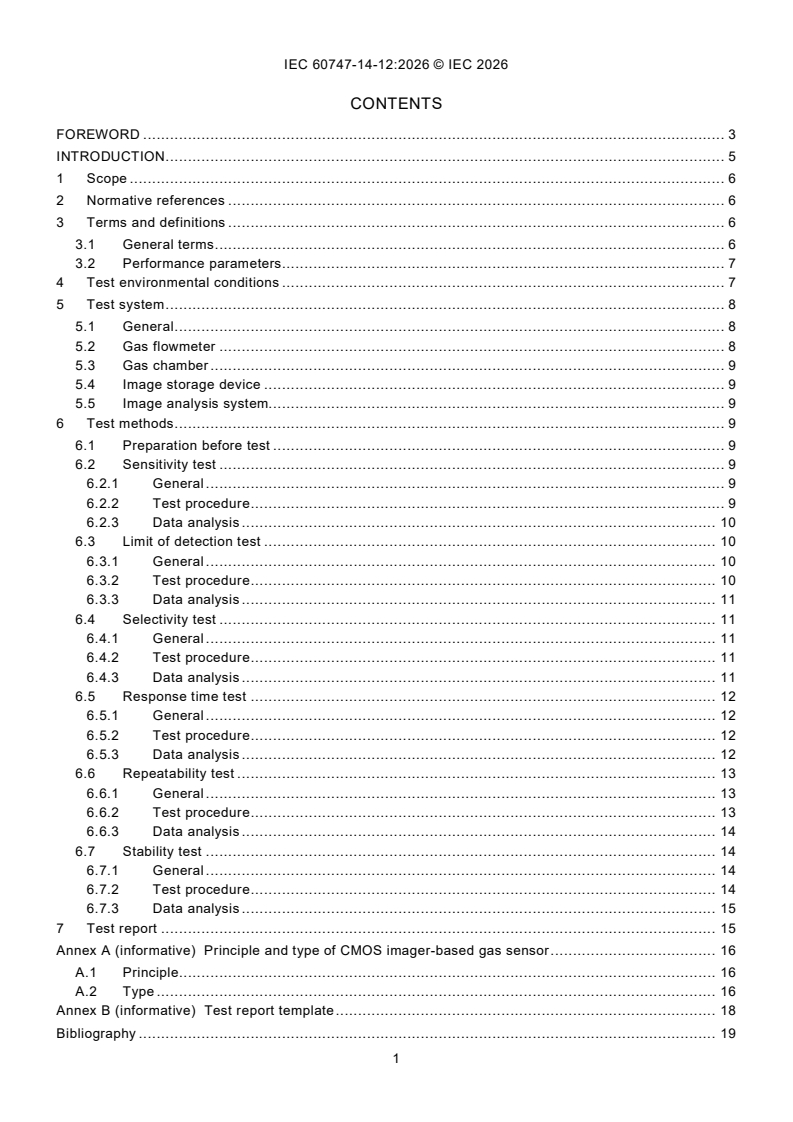
CONTENTS
FOREWORD . 3
INTRODUCTION . 5
1 Scope . 6
2 Normative references . 6
3 Terms and definitions . 6
3.1 General terms . 6
3.2 Performance parameters . 7
4 Test environmental conditions . 7
5 Test system . 8
5.1 General . 8
5.2 Gas flowmeter . 8
5.3 Gas chamber . 9
5.4 Image storage device . 9
5.5 Image analysis system. 9
6 Test methods . 9
6.1 Preparation before test . 9
6.2 Sensitivity test . 9
6.2.1 General . 9
6.2.2 Test procedure . 9
6.2.3 Data analysis . 10
6.3 Limit of detection test . 10
6.3.1 General . 10
6.3.2 Test procedure . 10
6.3.3 Data analysis . 11
6.4 Selectivity test . 11
6.4.1 General . 11
6.4.2 Test procedure . 11
6.4.3 Data analysis . 11
6.5 Response time test . 12
6.5.1 General . 12
6.5.2 Test procedure . 12
6.5.3 Data analysis . 12
6.6 Repeatability test . 13
6.6.1 General . 13
6.6.2 Test procedure . 13
6.6.3 Data analysis . 14
6.7 Stability test . 14
6.7.1 General . 14
6.7.2 Test procedure . 14
6.7.3 Data analysis . 15
7 Test report . 15
Annex A (informative) Principle and type of CMOS imager-based gas sensor . 16
A.1 Principle . 16
A.2 Type . 16
Annex B (informative) Test report template . 18
Bibliography . 19
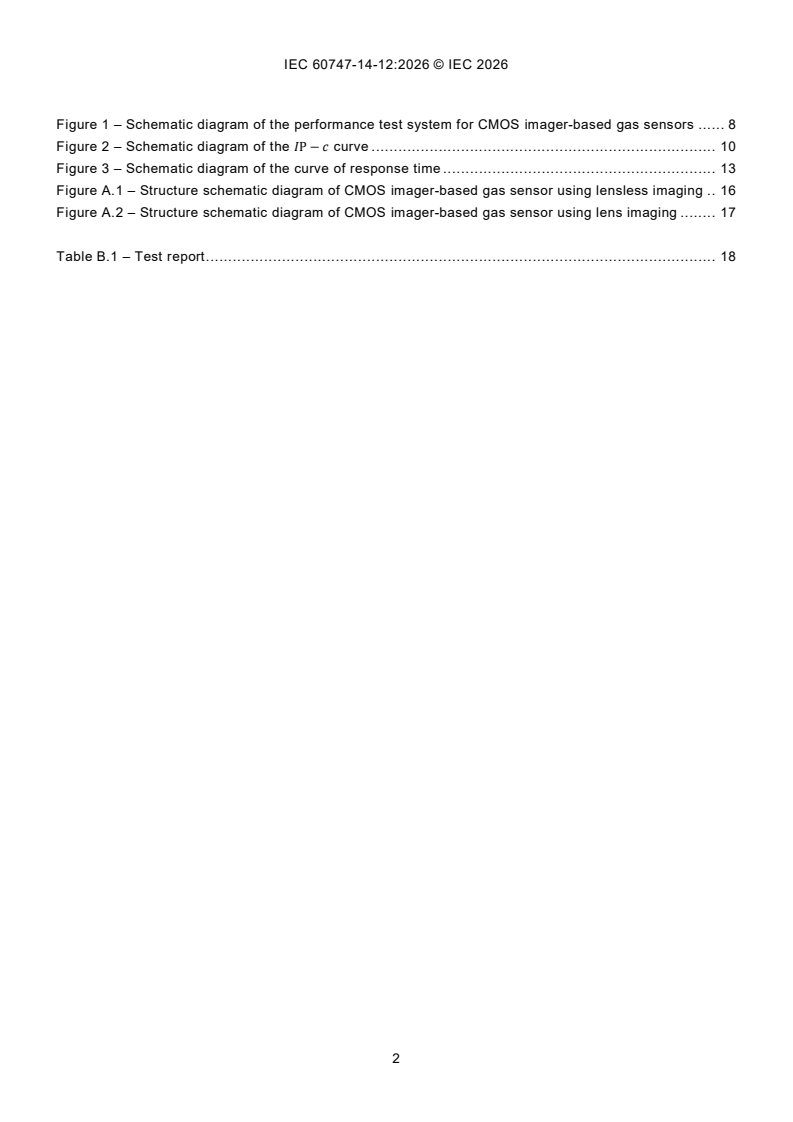
Figure 1 – Schematic diagram of the performance test system for CMOS imager-based gas sensors . 8
Figure 2 – Schematic diagram of the 𝐼𝐼P−𝑐𝑐 curve . 10
Figure 3 – Schematic diagram of the curve of response time . 13
Figure A.1 – Structure schematic diagram of CMOS imager-based gas sensor using lensless imaging . 16
Figure A.2 – Structure schematic diagram of CMOS imager-based gas sensor using lens imaging . 17
Table B.1 – Test report . 18
INTERNATIONAL ELECTROTECHNICAL COMMISSION
____________
Semiconductor devices -
Part 14-12: Semiconductor sensors - Performance test methods for CMOS imager-
based gas sensors
FOREWORD
1) The International Electrotechnical Commission (IEC) is a worldwide organization for standardization comprising all national
electrotechnical committees (IEC National Committees). The object of IEC is to promote international co-operation on all
questions concerning standardization in the electrical and electronic fields. To this end and in addition to other activities, IEC
publishes International Standards, Technical Specifications, Technical Reports, Publicly Available Specifications (PAS) and
Guides (hereafter referred to as "IEC Publication(s)"). Their preparation is entrusted to technical committees; any IEC National
Committee interested in the subject dealt with may participate in this preparatory work. International, governmental and non-
governmental organizations liaising with the IEC also participate in this preparation. IEC collaborates closely with the
International Organization for Standardization (ISO) in accordance with conditions determined by agreement between the two
organizations.
2) The formal decisions or agreements of IEC on technical matters express, as nearly as possible, an international consensus of
opinion on the relevant subjects since each technical committee has representation from all interested IEC National Committees.
3) IEC Publications have the form of recommendations for international use and are accepted by IEC National Committees in that
sense. While all reasonable efforts are made to ensure that the technical content of IEC Publications is accurate, IEC cannot
be held responsible for the way in which they are used or for any misinterpretation by any end user.
4) In order to promote international uniformity, IEC National Committees undertake to apply IEC Publications transparently to the
maximum extent possible in their national and regional publications. Any divergence between any IEC Publication and the
corresponding national or regional publication shall be clearly indicated in the latter.
5) IEC itself does not provide any attestation of conformity. Independent certification bodies provide conformity assessment
services and, in some areas, access to IEC marks of conformity. IEC is not responsible for any services carried out by
independent certification bodies.
6) All users should ensure that they have the latest edition of this publication.
7) No liability shall attach to IEC or its directors, employees, servants or agents including individual experts and members of its
technical committees and IEC National Committees for any personal injury, property damage or other damage of any nature
whatsoever, whether direct or indirect, or for costs (including legal fees) and expenses arising out of the publication, use of, or
reliance upon, this IEC Publication or any other IEC Publications.
8) Attention is drawn to the Normative references cited in this publication. Use of the referenced publications is indispensable for
the correct application of this publication.
9) IEC draws attention to the possibility that the implementation of this document may involve the use of (a) patent(s). IEC takes
no position concerning the evidence, validity or applicability of any claimed patent rights in respect thereof. As of the date of
publication of this document, IEC had not received notice of (a) patent(s), which may be required to implement this document.
However, implementers are cautioned that this may not represent the latest information, which may be obtained from the patent
database available at https://patents.iec.ch. IEC shall not be held responsible for identifying any or all such patent rights.
IEC 60747-14-12 has been prepared by subcommittee 47E: Discrete semiconductor devices, of IEC
technical committee 47: Semiconductor devices. It is an International Standard.
The text of this International Standard is based on the following documents:
Draft Report on voting
47E/906/FDIS 47E/910/RVD
Full information on the voting for its approval can be found in the report on voting indicated in the above
table.
The language used for the development of this International Standard is English.
This document was drafted in accordance with ISO/IEC Directives, Part 2, and developed in accordance
with ISO/IEC Directives, Part 1 and ISO/IEC Directives, IEC Supplement, available at
www.iec.ch/members_experts/refdocs. The main document types developed by IEC are described in
greater detail at www.iec.ch/publications.
A list of all parts in the IEC 60747 series, published under the general title Semiconductor devices, can be
found on the IEC website.
The committee has decided that the contents of this document will remain unchanged until the stability date
indicated on the IEC website under webstore.iec.ch in the data related to the specific document. At this
date, the document will be
– reconfirmed,
– withdrawn, or
– revised.
INTRODUCTION
Gas sensors play a crucial role in various areas, including environmental monitoring, healthcare monitoring,
leakage and exposure detection, and so on. In the era of intelligence, gas sensors are evolving towards
miniaturization, low power consumption, multiplexing, and smart features. CMOS imager-based gas
sensors are at the forefront of this trend, enabling high-density integration and parallel reading of sensing
units. This makes them easily integratable and suitable for intelligent applications, aligning with the future
development direction. These sensors can be applied to environmental monitoring, breath analysis, food
detection, and other fields.
The key parameters of a gas sensor can reflect its performance, such as sensitivity, limit of detection, and
so on. Standards are crucial to specify the test methods of sensor performance and regulate the procedure
and data analysis during the development, productions and delivery acceptance.
IEC 60747-14-12 specifies the performance test methods of CMOS imager-based gas sensors, which
includes the test methods of sensitivity, limit of detection, selectivity, response time, repeatability, and
stability.
1 Scope
This part of IEC 60747 specifies the performance test methods for CMOS imager-based gas sensors. It
includes the terms and definitions, the test environmental conditions, the test system, the test methods,
and the test report. This document is applicable to the performance test of both CMOS gas sensors based
on lens-free imaging and CMOS gas sensors based on lens imaging.
2 Normative references
There are no normative references in this document.
3 Terms and definitions
For the purposes of this document, the following terms and definitions apply.
ISO and IEC maintain terminology databases for use in standardization at the following addresses:
– IEC Electropedia: available at https://www.electropedia.org/
– ISO Online browsing platform: available at https://www.iso.org/obp
3.1 General terms
3.1.1
zero gas
gas or gas mixture with sufficiently low content of the component(s) of interest, used to produce the zero
response of a gas sensor for a given range of content
[SOURCE: ISO 7504:2015 [1], 5.6, modified – The terms "a given instrument" were changed to "gas
sensor".]
3.1.2
target gas
test object of the gas sensor, which is a type of gas or gas mixture with a certain concentration of a kind of
component of interest, used to test the performance of the gas sensor
Note 1 to entry: Gas concentration is expressed as a volume fraction.
3.1.3
sensing unit
sensing area formed by a material that reacts when in contact with a specific gas
3.1.4
pixel value
value of R channel, or G channel, or B channel, or gray value of a pixel
3.1.5
sensing unit value
average of the pixel value covered by a sensing unit in an image
3.1.6
average sensing unit value
average sensing unit value of specified frames of images
3.1.7
stable state
state in which the fluctuation value of the sensing unit value is less than 3 % within 1 minute, with at least
10 images captured
Note 1 to entry: Fluctuation value is the standard deviation of the sensing unit value divided by the average sensing unit value.
3.2 Performance parameters
3.2.1
sensitivity
S
ratio of the change of sensing unit value to the concentration of the target gas
3.2.2
limit of detection
LOD
smallest reliable measurable concentration of the target gas (3.1.2) that the gas sensor is a
...