

IEC TR 62271-310:2008
(Main)High-voltage switchgear and controlgear - Part 310: Electrical endurance testing for circuit-breakers above a rated voltage of 52 kV
General Information
- Abstract
This technical report IEC/TR 62271-310:2008 is applicable to class E2 circuit-breakers above a rated voltage of 52 kV and above intended for use on overhead lines. The test programmes are based on accumulated electrical stresses due to current interruption during a period of 25 years, which was chosen as representative for a maintenance-free interval. This second edition of IEC/TR 62271-310 cancels and replaces the first edition published in 2004. This edition constitutes a technical revision. This edition includes the following significant technical changes with respect to the previous edition:
- reduction of number tests in the wear stage;
- new definition of acceptance test for demonstration of end-of-life thermal interruption capability.
- Status
- Published
- Publication Date
- 26-Mar-2008
- Technical Committee
- SC 17A - Switching devices
- Drafting Committee
- MT 40 - TC 17/SC 17A/MT 40
- Current Stage
- PPUB - Publication issued
- Start Date
- 27-Mar-2008
- Completion Date
- 30-Jun-2008
Buy Documents
IEC TR 62271-310:2008 - High-voltage switchgear and controlgear - Part 310: Electrical endurance testing for circuit-breakers above a rated voltage of 52 kV
IEC TR 62271-310:2008 - High-voltage switchgear and controlgear - Part 310: Electrical endurance testing for circuit-breakers above a rated voltage of 52 kV Released:3/27/2008
Overview
IEC TR 62271-310:2008 is a technical report published by the International Electrotechnical Commission (IEC) providing guidance for electrical endurance testing of class E2 high-voltage circuit-breakers rated above 52 kV, particularly those used on overhead lines. This standard aims to establish standardized test programs to simulate 25 years of accumulated electrical stress from current interruption, representing a typical maintenance-free interval for these devices. The second edition introduces significant improvements over its predecessor, including a reduction in the number of wear stage tests and a new acceptance test definition for assessing end-of-life thermal interruption capability.
Key Topics
Electrical Endurance Testing:
- Focuses on simulating 25 years of operational stress.
- Applies to class E2 circuit-breakers above 52 kV for overhead line applications.
- Aims to support "maintenance-free" switchgear operation, minimizing operational costs.
Test Program Structure:
- Divided into a wear stage (simulating accumulated operational stress) and acceptance tests (verifying continued performance).
- No intermediate maintenance allowed during the test program, ensuring accurate reflection of field conditions.
- Two main approaches:
- Endurance qualification performed separately from type tests.
- Combined endurance qualification within type tests to enhance cost-effectiveness.
Acceptance Testing:
- Assesses circuit-breaker performance in a "worn" state, replicating end-of-maintenance-free-period conditions.
- Includes no-load tests, operations at different current levels, and voltage withstand checks.
Technical Revisions:
- Fewer tests required in the wear stage compared to the earlier edition.
- Enhanced clarity on acceptance tests to demonstrate thermal interruption capability at end of service life.
Applications
Transmission & Distribution Networks:
- Ensures reliability and durability of high-voltage circuit-breakers used in overhead transmission lines.
- Supports utilities in adopting maintenance-free and cost-effective circuit-breaker solutions.
Switchgear Procurement & Specification:
- Provides a standardized framework for manufacturers and utilities to assess and compare products.
- Reduces the risk of diverse, user-specific testing protocols, promoting harmonization within the high-voltage equipment industry.
Circuit-Breaker Design & Testing:
- Enables manufacturers to demonstrate product longevity and field reliability through internationally recognized endurance test programs.
- Facilitates competitive differentiation via demonstrated extended electrical endurance.
Regulatory & Compliance:
- Serves as an essential reference for demonstrating compliance with endurance requirements in tendering or regulatory processes.
Related Standards
Key standards related to IEC TR 62271-310:2008 include:
- IEC 62271-100: High-voltage switchgear and controlgear - Part 100: Alternating-current circuit-breakers (cited as a normative reference for the endurance test methodology and performance criteria).
- Other IEC 62271 Series Documents: Cover various aspects such as general requirements, other testing protocols, and definitions within the context of high-voltage switchgear and controlgear.
Keywords: electrical endurance testing, IEC TR 62271-310, high-voltage circuit-breakers, overhead lines, maintenance-free operation, E2 class switchgear, type tests, switchgear standards, electrical stress, acceptance test, 52 kV, switchgear reliability, transmission and distribution, IEC standards.
Relations
- Effective Date
- 05-Sep-2023
Buy Documents
IEC TR 62271-310:2008 - High-voltage switchgear and controlgear - Part 310: Electrical endurance testing for circuit-breakers above a rated voltage of 52 kV
IEC TR 62271-310:2008 - High-voltage switchgear and controlgear - Part 310: Electrical endurance testing for circuit-breakers above a rated voltage of 52 kV Released:3/27/2008
Get Certified
Connect with accredited certification bodies for this standard

IMQ S.p.A. (Certification)
Italian electrical product certification.

SLG Prüf- und Zertifizierungs GmbH
German testing and certification body.

UL Solutions
Global safety science company with testing, inspection and certification.
Sponsored listings
Frequently Asked Questions
IEC TR 62271-310:2008 is a technical report published by the International Electrotechnical Commission (IEC). Its full title is "High-voltage switchgear and controlgear - Part 310: Electrical endurance testing for circuit-breakers above a rated voltage of 52 kV". This standard covers: This technical report IEC/TR 62271-310:2008 is applicable to class E2 circuit-breakers above a rated voltage of 52 kV and above intended for use on overhead lines. The test programmes are based on accumulated electrical stresses due to current interruption during a period of 25 years, which was chosen as representative for a maintenance-free interval. This second edition of IEC/TR 62271-310 cancels and replaces the first edition published in 2004. This edition constitutes a technical revision. This edition includes the following significant technical changes with respect to the previous edition: - reduction of number tests in the wear stage; - new definition of acceptance test for demonstration of end-of-life thermal interruption capability.
This technical report IEC/TR 62271-310:2008 is applicable to class E2 circuit-breakers above a rated voltage of 52 kV and above intended for use on overhead lines. The test programmes are based on accumulated electrical stresses due to current interruption during a period of 25 years, which was chosen as representative for a maintenance-free interval. This second edition of IEC/TR 62271-310 cancels and replaces the first edition published in 2004. This edition constitutes a technical revision. This edition includes the following significant technical changes with respect to the previous edition: - reduction of number tests in the wear stage; - new definition of acceptance test for demonstration of end-of-life thermal interruption capability.
IEC TR 62271-310:2008 is classified under the following ICS (International Classification for Standards) categories: 01 - GENERALITIES. TERMINOLOGY. STANDARDIZATION. DOCUMENTATION; 29.130.10 - High voltage switchgear and controlgear. The ICS classification helps identify the subject area and facilitates finding related standards.
IEC TR 62271-310:2008 has the following relationships with other standards: It is inter standard links to IEC TR 62271-310:2004. Understanding these relationships helps ensure you are using the most current and applicable version of the standard.
IEC TR 62271-310:2008 is available in PDF format for immediate download after purchase. The document can be added to your cart and obtained through the secure checkout process. Digital delivery ensures instant access to the complete standard document.
Standards Content (Sample)
IEC/TR 62271-310
Edition 2.0 2008-03
TECHNICAL
REPORT
RAPPORT
TECHNIQUE
High-voltage switchgear and controlgear –
Part 310: Electrical endurance testing for circuit-breakers above a rated voltage
of 52 kV
Appareillage à haute tension –
Partie 310: Essais d’endurance électrique pour disjoncteurs de tension assignée
supérieure à 52 kV
IEC/TR 62271-310:2008
All rights reserved. Unless otherwise specified, no part of this publication may be reproduced or utilized in any form or by
any means, electronic or mechanical, including photocopying and microfilm, without permission in writing from either IEC or
IEC's member National Committee in the country of the requester.
If you have any questions about IEC copyright or have an enquiry about obtaining additional rights to this publication,
please contact the address below or your local IEC member National Committee for further information.
Droits de reproduction réservés. Sauf indication contraire, aucune partie de cette publication ne peut être reproduite
ni utilisée sous quelque forme que ce soit et par aucun procédé, électronique ou mécanique, y compris la photocopie
et les microfilms, sans l'accord écrit de la CEI ou du Comité national de la CEI du pays du demandeur.
Si vous avez des questions sur le copyright de la CEI ou si vous désirez obtenir des droits supplémentaires sur cette
publication, utilisez les coordonnées ci-après ou contactez le Comité national de la CEI de votre pays de résidence.
IEC Central Office
3, rue de Varembé
CH-1211 Geneva 20
Switzerland
Email: inmail@iec.ch
Web: www.iec.ch
About the IEC
The International Electrotechnical Commission (IEC) is the leading global organization that prepares and publishes
International Standards for all electrical, electronic and related technologies.
About IEC publications
The technical content of IEC publications is kept under constant review by the IEC. Please make sure that you have the
latest edition, a corrigenda or an amendment might have been published.
ƒ Catalogue of IEC publications: www.iec.ch/searchpub
The IEC on-line Catalogue enables you to search by a variety of criteria (reference number, text, technical committee,…).
It also gives information on projects, withdrawn and replaced publications.
ƒ IEC Just Published: www.iec.ch/online_news/justpub
Stay up to date on all new IEC publications. Just Published details twice a month all new publications released. Available
on-line and also by email.
ƒ Electropedia: www.electropedia.org
The world's leading online dictionary of electronic and electrical terms containing more than 20 000 terms and definitions
in English and French, with equivalent terms in additional languages. Also known as the International Electrotechnical
Vocabulary online.
ƒ Customer Service Centre: www.iec.ch/webstore/custserv
If you wish to give us your feedback on this publication or need further assistance, please visit the Customer Service
Centre FAQ or contact us:
Email: csc@iec.ch
Tel.: +41 22 919 02 11
Fax: +41 22 919 03 00
A propos de la CEI
La Commission Electrotechnique Internationale (CEI) est la première organisation mondiale qui élabore et publie des
normes internationales pour tout ce qui a trait à l'électricité, à l'électronique et aux technologies apparentées.
A propos des publications CEI
Le contenu technique des publications de la CEI est constamment revu. Veuillez vous assurer que vous possédez
l’édition la plus récente, un corrigendum ou amendement peut avoir été publié.
ƒ Catalogue des publications de la CEI: www.iec.ch/searchpub/cur_fut-f.htm
Le Catalogue en-ligne de la CEI vous permet d’effectuer des recherches en utilisant différents critères (numéro de référence,
texte, comité d’études,…). Il donne aussi des informations sur les projets et les publications retirées ou remplacées.
ƒ Just Published CEI: www.iec.ch/online_news/justpub
Restez informé sur les nouvelles publications de la CEI. Just Published détaille deux fois par mois les nouvelles
publications parues. Disponible en-ligne et aussi par email.
ƒ Electropedia: www.electropedia.org
Le premier dictionnaire en ligne au monde de termes électroniques et électriques. Il contient plus de 20 000 termes et
définitions en anglais et en français, ainsi que les termes équivalents dans les langues additionnelles. Egalement appelé
Vocabulaire Electrotechnique International en ligne.
ƒ Service Clients: www.iec.ch/webstore/custserv/custserv_entry-f.htm
Si vous désirez nous donner des commentaires sur cette publication ou si vous avez des questions, visitez le FAQ du
Service clients ou contactez-nous:
Email: csc@iec.ch
Tél.: +41 22 919 02 11
Fax: +41 22 919 03 00
IEC/TR 62271-310
Edition 2.0 2008-03
TECHNICAL
REPORT
RAPPORT
TECHNIQUE
High-voltage switchgear and controlgear –
Part 310: Electrical endurance testing for circuit-breakers above a rated voltage
of 52 kV
Appareillage à haute tension –
Partie 310: Essais d’endurance électrique pour disjoncteurs de tension
assignée supérieure à 52 kV
INTERNATIONAL
ELECTROTECHNICAL
COMMISSION
COMMISSION
ELECTROTECHNIQUE
PRICE CODE
INTERNATIONALE
S
CODE PRIX
ICS 29.130.10 ISBN 2-8318-9668-1
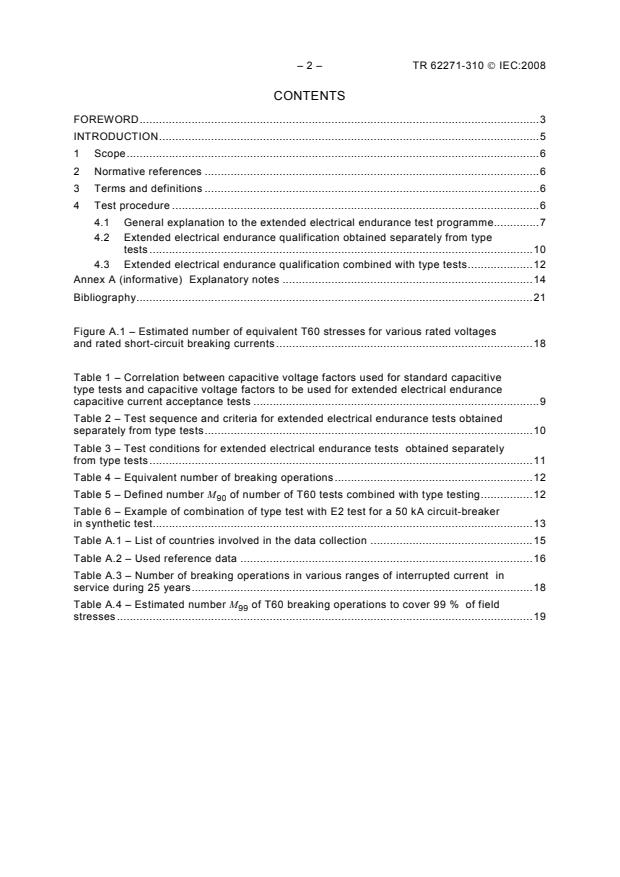
– 2 – TR 62271-310 © IEC:2008
CONTENTS
FOREWORD.3
INTRODUCTION.5
1 Scope.6
2 Normative references .6
3 Terms and definitions .6
4 Test procedure .6
4.1 General explanation to the extended electrical endurance test programme.7
4.2 Extended electrical endurance qualification obtained separately from type
tests .10
4.3 Extended electrical endurance qualification combined with type tests.12
Annex A (informative) Explanatory notes .14
Bibliography.21
Figure A.1 – Estimated number of equivalent T60 stresses for various rated voltages
and rated short-circuit breaking currents .18
Table 1 – Correlation between capacitive voltage factors used for standard capacitive
type tests and capacitive voltage factors to be used for extended electrical endurance
capacitive current acceptance tests .9
Table 2 – Test sequence and criteria for extended electrical endurance tests obtained
separately from type tests.10
Table 3 – Test conditions for extended electrical endurance tests obtained separately
from type tests.11
Table 4 – Equivalent number of breaking operations.12
Table 5 – Defined number M of number of T60 tests combined with type testing.12
Table 6 – Example of combination of type test with E2 test for a 50 kA circuit-breaker
in synthetic test.13
Table A.1 – List of countries involved in the data collection .15
Table A.2 – Used reference data .16
Table A.3 – Number of breaking operations in various ranges of interrupted current in
service during 25 years.18
Table A.4 – Estimated number M of T60 breaking operations to cover 99 % of field
stresses.19
TR 62271-310 © IEC:2008 – 3 –
INTERNATIONAL ELECTROTECHNICAL COMMISSION
____________
HIGH-VOLTAGE SWITCHGEAR AND CONTROLGEAR –
Part 310: Electrical endurance testing for circuit-breakers
above a rated voltage of 52 kV
FOREWORD
1) The International Electrotechnical Commission (IEC) is a worldwide organization for standardization comprising
all national electrotechnical committees (IEC National Committees). The object of IEC is to promote
international co-operation on all questions concerning standardization in the electrical and electronic fields. To
this end and in addition to other activities, IEC publishes International Standards, Technical Specifications,
Technical Reports, Publicly Available Specifications (PAS) and Guides (hereafter referred to as “IEC
Publication(s)”). Their preparation is entrusted to technical committees; any IEC National Committee interested
in the subject dealt with may participate in this preparatory work. International, governmental and non-
governmental organizations liaising with the IEC also participate in this preparation. IEC collaborates closely
with the International Organization for Standardization (ISO) in accordance with conditions determined by
agreement between the two organizations.
2) The formal decisions or agreements of IEC on technical matters express, as nearly as possible, an international
consensus of opinion on the relevant subjects since each technical committee has representation from all
interested IEC National Committees.
3) IEC Publications have the form of recommendations for international use and are accepted by IEC National
Committees in that sense. While all reasonable efforts are made to ensure that the technical content of IEC
Publications is accurate, IEC cannot be held responsible for the way in which they are used or for any
misinterpretation by any end user.
4) In order to promote international uniformity, IEC National Committees undertake to apply IEC Publications
transparently to the maximum extent possible in their national and regional publications. Any divergence
between any IEC Publication and the corresponding national or regional publication shall be clearly indicated in
the latter.
5) IEC provides no marking procedure to indicate its approval and cannot be rendered responsible for any
equipment declared to be in conformity with an IEC Publication.
6) All users should ensure that they have the latest edition of this publication.
7) No liability shall attach to IEC or its directors, employees, servants or agents including individual experts and
members of its technical committees and IEC National Committees for any personal injury, property damage or
other damage of any nature whatsoever, whether direct or indirect, or for costs (including legal fees) and
expenses arising out of the publication, use of, or reliance upon, this IEC Publication or any other IEC
Publications.
8) Attention is drawn to the Normative references cited in this publication. Use of the referenced publications is
indispensable for the correct application of this publication.
9) Attention is drawn to the possibility that some of the elements of this IEC Publication may be the subject of
patent rights. IEC shall not be held responsible for identifying any or all such patent rights.
The main task of IEC technical committees is to prepare International Standards. However, a
technical committee may propose the publication of a technical report when it has collected
data of a different kind from that which is normally published as an International Standard, for
example "state of the art".
IEC/TR 62271-310, which is a technical report, has been prepared by subcommittee 17A:
High-voltage switchgear and controlgear, of IEC technical committee 17: Switchgear and
controlgear.
This second edition of IEC/TR 62271-310 cancels and replaces the first edition published in
2004. This edition constitutes a technical revision.
This edition includes the following significant technical changes with respect to the previous
edition:
– reduction of number tests in the wear stage;
– 4 – TR 62271-310 © IEC:2008
– new definition of acceptance test for demonstration of end-of-life thermal interruption
capability.
The text of this technical report is based on the following documents:
Enquiry draft Report on voting
17A/803/DTR 17A/814/RVC
Full information on the voting for the approval of this technical report can be found in the
report on voting indicated in the above table.
This publication has been drafted in accordance with the ISO/IEC Directives, Part 2.
A list of all parts of IEC 62271 series, under the general title High-voltage switchgear and
controlgear can be found on the IEC website.
The committee has decided that the contents of this publication will remain unchanged until
the maintenance result date indicated on the IEC web site under "http://webstore.iec.ch" in
the data related to the specific publication. At this date, the publication will be
• reconfirmed;
• withdrawn;
• replaced by a revised edition, or
• amended.
TR 62271-310 © IEC:2008 – 5 –
INTRODUCTION
Based on experience with existing high-voltage circuit-breakers in service and with system
protection and maintenance policies, the majority of circuit-breaker applications are covered
by class E1 as defined in 3.4.112 of IEC 62271-100. No additional tests for extended
electrical endurance are required.
However, extended electrical endurance (class E2) as defined in 3.4.113 of IEC 62271-100
should be considered for the following reasons:
• Field experience collected so far by CIGRE is limited only for circuit-breaker designs
available before 1994 (see for example reference [1], [2], [3] and Annex A.3). For this
reason, the data collected by CIGRE so far can hardly be extrapolated to new designs.
Therefore, for new types of circuit-breakers, extended electrical endurance can only be
fully proven by laboratory tests.
• New maintenance practices tend towards “maintenance-free” circuit-breakers. The
reduction of maintenance costs is a major issue for most users today.
• Deregulation of the electricity market may increase the electrical stresses applied to the
circuit-breakers, within their proven capability. Installation of generation capacity by
independent power producers will increase short-circuit levels in certain areas and
consequently change stresses on breakers. This may result in higher stresses applied to
circuit-breakers compared to past practice when the short-circuit rating of the circuit-
breaker was in large excess of the actual fault currents.
• There is a need to standardize a single extended electrical endurance programme to avoid
the specification of different programmes from different users.
• Many manufacturers provide information about electrical endurance capabilities of circuit-
breakers during the purchasing process. There is a need to standardize the way this
information is given to the users.
It must be noted that circuit-breakers having extended electrical endurance capability, are not
intended for use in situations in which electrical arcing stress (which is a combination of high
probability of fault occurrence and high fault current level) is beyond the 90-percentile of the
electrical arcing stress, as summarized by the CIGRE survey [1] and calculations based on
this material [3]. In other words, for networks that are prone to a very high electrical arcing
stress, a custom made test programme, not covered by this technical report, is needed (see
Clause A.7). Similarly, if users consider an interval between major maintenance of the
electrical wearing parts of the interrupters of more than 25 years, a custom made test
programme has to be considered.
When extended electrical endurance capability is required, this capability is demonstrated by
the standardized test programmes outlined below as applicable to overhead line circuit-
breakers above a rated voltage of 52 kV.
———————
Figures in square brackets refer to the bibliography.
– 6 – TR 62271-310 © IEC:2008
HIGH-VOLTAGE SWITCHGEAR AND CONTROLGEAR –
Part 310: Electrical endurance testing for circuit-breakers
above a rated voltage of 52 kV
1 Scope
This technical report is applicable to class E2 circuit-breakers above a rated voltage of 52 kV
for use on overhead lines.
The test programmes are based on accumulated electrical stresses due to current interruption
during a period of 25 years, which was chosen as representative for a maintenance-free
interval.
2 Normative references
The following referenced documents are indispensable for the application of this document.
For dated references, only the edition cited applies. For undated references, the latest edition
of the referenced document (including any amendments) applies.
IEC 62271-100, High-voltage switchgear and controlgear – Part 100: Alternating-current
circuit-breakers
3 Terms and definitions
For the purposes of this document, the following terms and definition applies.
3.1
circuit-breaker class E2 (circuit-breaker with extended electrical endurance)
circuit-breaker designed so as not to require maintenance of the interrupting parts of the main
circuit during its expected operating life
NOTE “Expected operating life” in this definition means a minimum period of use without maintenance of the
interrupting parts. Normally the life expectancy of the design is higher.
4 Test procedure
The tests should be carried out on a specimen identical as per 6.1.2 and 6.101.1.1 of
IEC 62271-100, to one of those already submitted or to be submitted to type tests.
All tests should be performed as single-phase tests. In combination with type tests, three-
phase tests are acceptable.
No intermediate maintenance should be carried out during the extended electrical endurance
test programme.
The test programmes as described in 4.2 and 4.3 are divided into a wear stage followed by
acceptance tests.
During the wear stage, the circuit-breaker will be stressed with the equivalent number of
accumulated breaking operations, but, for convenience of testing, without specified TRV,
except when basic short-circuit test duties are used as described in 4.3.
TR 62271-310 © IEC:2008 – 7 –
The acceptance tests should follow the wear stage of the test programmes. The purpose of
these acceptance tests is to demonstrate the interrupting capability of the circuit-breaker. It is
noted that the worn state of the circuit-breaker is taken into account by not requiring the full
interrupting capabilities as specified in IEC 62271-100, but normal service capabilities, in
accordance with "near end-of-maintenance-free period conditions" of the circuit-breaker.
The test arrangement should be such that no interference with the circuit-breaker between the
tests is necessary. However, if this is not possible and local safety rules require
depressurization to enter the test cell, it is allowed to decrease the pressure in the circuit-
breaker provided that at least 95 % of the gas is re-used when refilling the circuit-breaker.
There are various possible scenarios for performing a test programme for extended electrical
endurance qualification. To limit costs, two alternative possibilities are considered:
• extended electrical endurance qualification obtained separately from type tests;
• extended electrical endurance qualification combined with type tests.
4.1 General explanation to the extended electrical endurance test programme
As a general statement, in defining the extended electrical endurance test programme,
consideration has been given to the following:
– The maintenance-free period of 25 years.
NOTE Should any different period be considered, the number of breaking operations in the wear stage per current
ratings given above (Table 2 and Table 5) should be multiplied by the ratio of the new period and the assumed 25
year period.
– The basic need is that the test programme should maintain its technical soundness while
being simple and affordable.
– Merging of standard type tests and extended electrical endurance type tests into a single
test programme. Even if this does not represent the most likely situation to occur in
practice, the intent is to define designs with margins high enough to withstand basic
expected making and breaking stresses in worn conditions.
– The extended electrical endurance test programme has been defined using modified
standard type tests as acceptance tests. The only aim of combining type test with
electrical endurance test is cost reduction. It has been agreed that the extended electrical
endurance test programme should consist of a no load test, a wear stage (medium arcing
times, no TRV) and acceptance tests.
The characteristics and rationale behind each part of the test programme are as follows:
a) No-load test
Before starting any extended electrical endurance qualification on any design, a no-load
test as per 6.102.6 of IEC 62271-100 should be performed and results compared with
those derived from the reference no-load test to assure design consistency. This test
should be performed at the same pressure for interruption and operating mechanism as
used in type tests (as required in 6.102.6 of IEC 62271-100) to assure result
comparability.
b) Wear stage
This stage will consist of a number of breaking operations with medium arcing time
(determined from the arcing times used during standard type tests) and no TRV (except
when type tests are part of the wear stage; then IEC 62271-100 conditions will apply).
Pressure for operation and interruption and operating voltages are set at their rated values
(except when type tests are part of the wear stage; then IEC 62271-100 conditions will
apply). The number of breaking operations at 60 % of the rated short-circuit breaking
current is given in Table 2.
Operations at 60 % of the rated short-circuit breaking current are a simplification of the
wear expected over the maintenance-free period due to a spread in breaking currents from
– 8 – TR 62271-310 © IEC:2008
load currents to about 60 % of the rated short-circuit breaking current. Breaking operations
at lower short-circuit currents are most likely to occur (see Table A.3).
Operations at 10 % of the rated short-circuit breaking current are considered to be
important in order to represent the wear due to low currents. Nine breaking operations at
10 % of the rated short-circuit breaking current, with no TRV, are required together with
the breaking operations up to 60 % of the rated short-circuit breaking current in order to
complete the wear stage.
No-load tests at rated conditions should be made before the wear stage (to determine the
arcing times) and after the wear stage (to determine the arcing times for the acceptance
tests).
c) Acceptance tests
These tests consist of the following test duties (the preferred order of testing is as listed
below):
1) T10
As per IEC 62271-100, with the following variation: single O operations are performed.
Operating voltages and pressures at rated value are chosen to obtain a consistent
behaviour of the circuit-breaker during the duty. The minimum arcing time may change
due to the worn condition of the circuit-breaker. However, the aim of the test is to show
the full arc extinguishing window including the demonstration of the minimum arcing
time.
The rationale behind these T10 tests is based on the fact that openings at low currents
are the most likely duty in service. For this reason, it is important to check that the
circuit-breaker will, after a reasonable portion of its expected life, represented by the
wear stage, be able to successfully clear this duty over the entire arcing window.
2) L with 60 % of rated short-circuit breaking current
This test consists of L tests with a test-current of 60 % of the rated short-circuit
current as per 4.102.1 of IEC 62271-100 (regarding TRV parameters of the supply
side) and 4.105, with the following variation:
– The supply side current in case of a terminal fault is equal to 75 % of the rated
short-circuit breaking current (addition of a L line side circuit will then yield 60 %
current). Only due to test laboratory limitations reduction of supply circuit voltage is
allowed as an alternative to obtain 60 % of the rated short circuit current.
– Single O operations should be performed.
– Operating voltages and pressures at rated value are chosen.
– The line side time delay of TRV is 0,2 μs or 0,5 μs depending on rated voltage as
stated in 4.105 of IEC 62271-100.
The minimum arcing time may change due to the worn condition of the circuit-breaker.
However, the aim of the test is to show the full arc extinguishing window including the
demonstration of the minimum arcing time.
The rationale behind the selection of this duty is demonstration of short-line fault
interruption capability in practical cases where less (75 %) than 100 % rated short-
circuit breaking current is available at the breaker terminal.
, L short-line fault tests because the
This test is chosen instead of the standard L
90 75
probability to deal with short-line faults with current as high as 90 % or 75 % of the
rated short-circuit breaking current is considered very low.
3) Capacitive current switching
Depending on the restrike performance class assigned to the circuit-breaker (C1 or C2
in accordance with IEC 62271-100) a different test duty is performed. The duty
consists of either 24 O operations for class C1or 48 O operations for class C2.
Opening operations are performed “round the clock” by moving the setting of the
opening signal by 15°.
The capacitive voltage factors (k in 6.111.7 of IEC 62271-100) will be reduced, with
c
respect to those used for standard type tests, to 80 % with the exception of circuit-
TR 62271-310 © IEC:2008 – 9 –
breakers rated for voltage factors equal to 1,2 where relaxation to 80 % would lead to
a test voltage lower than system voltage. Table 1 correlates the capacitive voltage
factors to be used for capacitive current switching tests for electrical endurance with
capacitive voltage factors used for standard type tests.
Table 1 – Correlation between capacitive voltage factors used for standard capacitive
type tests and capacitive voltage factors to be used for extended electrical endurance
capacitive current acceptance tests
Capacitive voltage factor k used
c
for standard capacitive current 1,2 1,4 1,7
type tests
Capacitive voltage factor k used
c
during extended electrical
1,12 1,12 1,36
endurance capacitive current
acceptance tests
Acceptance criteria will be in agreement with 6.111.11.1 b) of IEC 62271-100, i.e. no
restrike over 24 O operations, or, in case of 1 restrike, completion of the duty and
repetition with no further restrikes (class C1) and either no restrike over 48 O
operations or, in case of 1 restrike, completion of the duty and repetition with no
further restrikes (class C2).
The rationale behind this requirement is that the capacitive current switching duty is
the most common duty for the circuit-breaker, and therefore a check as to its ability to
successfully switch capacitive currents near the end of its expected maintenance-free
period is needed.
Users need and require that a circuit-breaker, even after a certain period of service,
and after having accumulated a certain amount of short-circuits, should be capable of
providing reasonable behaviour in terms of statistical restrike performance.
The capacitive current-switching testing protocol, as a stand-alone type test, requires a
high number of breaking operations, and included in the test procedure is a number of
tests performed at minimum arcing time. This results in an acceleration factor so that a
statistical assessment of restrike performance in service based on laboratory tests can
be obtained.
The capacitive current-switching duty required by the acceptance tests in the extended
electrical endurance test programme is chosen to verify that a reasonable restrike
probability performance remains in circuit-breakers approaching their end-of-
maintenance-free period based on short-circuit wear.
Statistical evaluation has shown that the reduced capacitive voltage factor, in
combination with the absence of tests at minimum arcing time, has made this
acceptance test procedure approximately 25 % as severe as the standard capacitive
current switching type test with relation to the restrike probability.
Considering the relatively short length of overhead lines based on the collected data,
the test current will correspond to test duty 1 (10 % to 40 % of the rated capacitive
switching current of the concerned circuit-breaker).
Capacitive current switching tests are performed with rated pressure for operation,
insulation and interruption.
No-load tests at rated conditions should be made after the acceptance tests (for
information only).
4) Condition check
A voltage test as condition check, in agreement with 6.2.11 of IEC 62271-100 but with
rated pressure for operation, insulation and interruption, should be performed as the
final acceptance test. This test is intended to provide confidence that the circuit-
breaker, at the completion of the extended electrical endurance test programme, is still
able to provide sufficient voltage withstand between contacts without requiring
– 10 – TR 62271-310 © IEC:2008
inspections that might be of a subjective nature. No visual inspection is required after
the condition check.
4.2 Extended electrical endurance qualification obtained separately from type tests
Tables 2 and 3 summarize the kind of tests, acceptance criteria and test conditions to be used
for the extended electrical endurance qualification obtained separately from type tests.
For convenience of testing, the order shown in Table 2 and Table 3 of the T10, T60 breaking
operations in the wear and acceptance stage can be changed.
Table 2 – Test sequence and criteria for extended electrical
endurance tests obtained separately from type tests
Rated short circuit
25 kA 31,5 kA 40 kA 50 kA 63 kA 80 kA
≤ 20 kA
breaking current
Type of test
No-load test As per IEC 62271-100, 6.102.6 (see 4.1.a)
Wear tests
As per IEC 62271-100, 6.102.6, except with operating voltages and pressure for
No-load test
interruption at rated conditions (see 4.1.b)
T60 breaking
operations 18 15 12 10 8 7 5
(number of O)
T10 breaking
operations 9
(number of O)
As per IEC 62271-100, 6.102.6, except with operating voltages and pressure for
No-load test
interruption at rated conditions (see 4.1.b)
Acceptance tests
As per IEC 62271-100, with the following variation:
T10
single O operations are performed
As per IEC 62271-100, with the following variations:
L75 with 60 % of
- single O operations are performed
rated short-circuit
- reduction of test current to 60% of rated short-circuit breaking current by
current
increased impedance of the supply circuit.
- For circuit-breakers rated class C1:
0 restrikes over 24 O or 1 restrike over 48 O
LC1
- For circuit-breakers rated class C2:
0 restrikes over 48 O or 1 restrike over 96 O
As per IEC 62271-100, 6.102.6, except with operating voltages and pressure for
No-load test
interruption at rated conditions (see 4.1.c)
According to 6.2.11 of IEC 62271-100 except with operating voltages and pressure
Condition check
for interruption at rated conditions (see 4.1.c)
NOTE The number of T60 breaking operations in the wear stage is based on the assumption that 3
breaking operations with 60 % of the rated short-circuit current are performed in the acceptance stage. When
the number of interruptions performed in the acceptance stage is anticipated to be higher than 3 (i.e. when
synthetic tests are performed), This means that when more than 3 tests are expected in the acceptance stage
(for example 4 in synthetic tests), the number of tests in the wear stage should be reduced accordingly. All
the extra tests during the acceptance stage should be made with TRV.
TR 62271-310 © IEC:2008 – 11 –
The test conditions are given in Table 3. The tests should be performed using rated values of
pressure for operating and interrupting and auxiliary voltages.
Table 3 – Test conditions for extended electrical endurance tests
obtained separately from type tests
Operating
voltage and
Type of test Operations Test voltage/test current pressure for Arcing time
interruption and
operation
Wear tests
No load test As per IEC 62271-100, 6.102.6 Minimum
No load test
As per IEC 62271-100, 6.102.6, but with rated Rated
pressure for operation, insulation and interruption
T60 Only opening According to T60 type test as per Rated Medium arcing
operations 6.106.3 of IEC 62271-100 without time according
TRV to T60 type
test
T10 Only opening According to T10 type test as per Rated Medium arcing
operations 6.106.1 of IEC 62271-100 without time according
TRV to T10 type
test
No load test As per IEC 62271-100, 6.102.6, but with rated Rated
pressure for operation, insulation and interruption
Acceptance tests
T10 Only opening According to T10 type test as per Rated See NOTE 1
operations 6.106.1 of IEC 62271-100
L75 with 60 % of Only opening As per 6.109.4 of IEC 62271-100. Rated See NOTE 1
rated short-circuit operations Reduction of test current to 60 %
current of rated short-circuit breaking
current by increased impedance
of the supply circuit (see
NOTE 4)
LC1 According to 6.111 of IEC 62271- Rated Around the
100. The test voltage is the clock every 15°
highest value between 80 % of (electrical
test voltage specified for type degrees)
tests and the value
corresponding to a voltage factor
of 1,12 (see Table 1)
No load test As per IEC 62271-100, 6.102.6, but with rated Rated
pressure for operation, insulation and interruption
Condition check As per 6.2.11 of IEC 62271-100, but with rated Rated
pressure for operation, insulation and interruption
NOTE 1 For acceptance tests T10 and L with 60 % current the arcing times may vary from those shown
during type tests due to different pressures for operation and interruption, or due to the worn condition of the
circuit-breaker. However the full extinguishing window should be shown including the demonstration of the
minimum arcing time.
NOTE 2 For the wear tests T10 and T60, 50 Hz tests cover 60 Hz requirements, provided that the tests have
been performed with a medium arcing time belonging to 50 Hz. For acceptance test LC1, 60 Hz tests cover
50 Hz requirements.
NOTE 3 Unit testing according to 6.102.4.2 of IEC 62271-100 is permissible.
NOTE 4 In synthetic testing, this condition is most easily met by designing the circuit for the L test duty, and
then inserting an additional reactance equal to the artificial line reactance into the synthetic supply circuit.
– 12 – TR 62271-310 © IEC:2008
4.3 Extended electrical endurance qualification combined with type tests
When extended electrical endurance qualification combined with type tests is desired, it is
recognized that dictating too stringent constraints may impair the economic viability of such a
combination.
In order to allow maximum freedom within this combined programme during the wear tests,
the number of breaking operations at T60 with medium arcing time can be replaced by other
test duties. Limited to the purpose of this qualification, Equation (1) provides the equivalence
between breaking operations carried out at medium arcing time, with current values as used
during type tests, and breaking operations at T60 at medium arcing time.
Table 4 – Equivalent number of breaking operations
One single breaking operation at medium arcing time Equivalent number of breaking operation at 60 % of
and current value as in rated short-circuit breaking current (T60)
T10 0,01
OP2 0,15
T30 0,25
T60 1
NOTE During the performance of type tests, some additional breaking operations may occur for no particular
reason. In such a case, an evaluation of the equivalence in terms of wear should be made, taking into
consideration the actual arcing time (it is assumed that the wear is proportional to the arcing time for the same
current).
0,01N + 0,15N + 0,25N +N =M (1)
10 OP2 30 60 90
with
N the number of breaking operations with 10 % rated short-circuit breaking current;
N the number of breaking operations at test-duty OP2;
OP2
N the number of breaking operations with 30 % rated short-circuit breaking current;
N the number of breaking operations with 60 % rated short-circuit breaking current;
M the number (of T60 tests in the combined test programme) as defined in Table 5 aimed
to cover 90 % of cumulative electrical stresses in 25 years.
Table 5 – Defined number M of number of T60 tests combined with type testing
Rated short-circuit
≤ 20 kA 25 kA 31,5 kA 40 kA 50 kA 63 kA 80 kA
breaking current
M 18 15 12 10 8 7 5
Apart from the equivalence criterion expressed in Equation (1), the following requirements
should be fulfilled:
– The combined test program should include at least 3 breaking operations at 60 % current,
even when in the type-test part of the combined programme a sufficient wear is obtained.
– The combined test program should include at least 9 breaking operations at 10 % current,
even when in the type-test part of the combined programme a sufficient wear is obtained.
– Current values of the breaking operations considered in Equation (1) should be at
maximum 60 % of the rated short-circuit breaking current.
The acceptance stage should be in accordance with Tables 2 and 3.
TR 62271-310 © IEC:2008 – 13 –
The order of testing in the wear stage of the combined program is arbitrary.
A more general equation considering the equivalency of any current (other than the well
defined test-duty values) can be found as Equation (A.1) in A.6.2.
In Table 6, an example is given of a combination of type test with an extended electrical
endurance test.
Table 6 – Example of combination of type test with E2 test
for a 50 kA circuit-breaker in synthetic test
Expected
equivalent Applicable to
number of Applicable to wear
Duty number of T 60 acceptance
breaking stage
arcing stress stage
operations
Type tests only
T100s 5 No: current > 60 % No
T100a 4 No: current > 60 % No
L 5 No: current > 60 % No
L 5 No: current > 60 % No
Not applicable
DEF (Double Earth Fault) 1 No: current > 60 % No
SEF (Single Earth Fault) 1 No: current > 60 % No
LC1 Variable No No
LC2 Variable No No
Combined section of test programme (type tests + wear test for E2 qualification)
0,6 Yes No
OP2 4
1,25 Yes No
T30 5
0,05 Yes No
T10 5
0,04 Yes No
T10 additional to type test 4 to reach 9 T10
T60 5 5 Yes No
T60 additional to type test 1 1 Yes No
Intermediate sum 7,9 (< 8 from Table 5, additional test necessary)
Acceptance tests for E2 qualification
L with 60 % current 4 1 (see NOTE) Yes, 1 test counts Yes
T10 4 Not applicable No Yes
LC1 See Table 2 Not applicable No Yes
Sum 8,9 (> 8 from Table 5)
NOTE Because of synthetic testing, 1 of the 4 60 % tests in the acceptance stage may be added to the 7,9 in the
wear stage, adding up to 8,9 > 8 from Table 5 (see also NOTE in Table 2).
For convenience of testing the order of T10, T60 testing can be changed.
– 14 – TR 62271-310 © IEC:2008
Annex A
(informative)
Explanatory notes
A.1 Introduction
Extended electrical endurance test programmes for rated voltages up to and including 52 kV
have already been introduced in IEC 62271-100. New low-maintenance circuit-breaker
designs are now available, with properties not yet proven over their defined maintenance-free
period. There is also an increasing trend followed by various utilities to install equipment with
specification closer to the needs than before and an increasing demand for “quality of supply”.
These are all issues that require the circuit-breaker to prove its ability to perform successfully
over its expected maintenance-free period, and on this basis, introduction of extended
electrical endurance test programmes to rated voltages above 52 kV may be considered.
At the same time it is recognized that any new extended electrical endurance tests should be
based on actual short-circuit fault statistics and on a sound and traceable process for
determination of the test programme. Over-specification should be avoided, since it leads to
increased cost of the circuit-breakers.
A.2 Determination of extended electrical endurance test programmes
This annex is aimed at providing the information, assumptions and methodology adopted for
selecting extended electrical endurance test programmes for high-voltage circuit-breakers.
The following subclauses describe the collected data, their statistical nature, the choice and
assumptions made and the methodological approach used to derive the extended electrical
endurance test programmes provided in this technical report. The purpose of this report is to
make available all the information backing up the test procedures so that future amendments
may start by positive criticism and feedback of what was made available and collected for
issuing the present technical report.
A.3 Collected data
Since the objective is an extended electrical endurance test programme, it has to represent,
at best, the actual fault statistics in the field. The larger the amount of collected data, the
more representative they are .
A.3.1 Countries involved in the data collection
Several countries participated in the data collection. Depending on the local situation, one or
more utilities may operate in a country. In some cases, data were collected from more than a
single utility per country, again with the aim of collecting as much data as possible,
representative of the country’s fault statistics. The list of participating countries is given in
Table A.1 .
———————
Data were collected through a co-operation between CIGRE WG 13.08 and IEC SC 17A/WG 29 around 1996. In
2005, new detailed fault data from Japan was added [3], used to verify the statistical calculation model leading
to the number of necessary T60 tests in the electrical endurance test programme.
3 To avoid misunderstandings with countries which are not represented in the table, it should be stressed that the
data collection took place through direct contact between CIGRE WG 13.08 and IEC SC 17A/WG 29 members
with utilities’ representatives. This direct contact was needed to obtain data within the specified time schedule.
TR 62271-310 © IEC:2008 – 15 –
Table A.1 – List of countries involved in the data collection
BELGIUM FRANCE
NETHERLANDS SWITZERLAND
BRAZIL USA
ITALY SWEDEN
SPAIN GERMANY
JAPAN CANADA
INDIA
Several types of data per voltage class were the subject of the inquiry, for example:
– number of short-circuits per 100 km of overhead line/year;
– average overhead li
...
IEC/TR 62271-310
Edition 2.0 2008-03
TECHNICAL
REPORT
RAPPORT
TECHNIQUE
High-voltage switchgear and controlgear –
Part 310: Electrical endurance testing for circuit-breakers above a rated voltage
of 52 kV
Appareillage à haute tension –
Partie 310: Essais d’endurance électrique pour disjoncteurs de tension assignée
supérieure à 52 kV
IEC/TR 62271-310:2008
All rights reserved. Unless otherwise specified, no part of this publication may be reproduced or utilized in any form or by
any means, electronic or mechanical, including photocopying and microfilm, without permission in writing from either IEC or
IEC's member National Committee in the country of the requester.
If you have any questions about IEC copyright or have an enquiry about obtaining additional rights to this publication,
please contact the address below or your local IEC member National Committee for further information.
Droits de reproduction réservés. Sauf indication contraire, aucune partie de cette publication ne peut être reproduite
ni utilisée sous quelque forme que ce soit et par aucun procédé, électronique ou mécanique, y compris la photocopie
et les microfilms, sans l'accord écrit de la CEI ou du Comité national de la CEI du pays du demandeur.
Si vous avez des questions sur le copyright de la CEI ou si vous désirez obtenir des droits supplémentaires sur cette
publication, utilisez les coordonnées ci-après ou contactez le Comité national de la CEI de votre pays de résidence.
IEC Central Office
3, rue de Varembé
CH-1211 Geneva 20
Switzerland
Email: inmail@iec.ch
Web: www.iec.ch
About the IEC
The International Electrotechnical Commission (IEC) is the leading global organization that prepares and publishes
International Standards for all electrical, electronic and related technologies.
About IEC publications
The technical content of IEC publications is kept under constant review by the IEC. Please make sure that you have the
latest edition, a corrigenda or an amendment might have been published.
ƒ Catalogue of IEC publications: www.iec.ch/searchpub
The IEC on-line Catalogue enables you to search by a variety of criteria (reference number, text, technical committee,…).
It also gives information on projects, withdrawn and replaced publications.
ƒ IEC Just Published: www.iec.ch/online_news/justpub
Stay up to date on all new IEC publications. Just Published details twice a month all new publications released. Available
on-line and also by email.
ƒ Electropedia: www.electropedia.org
The world's leading online dictionary of electronic and electrical terms containing more than 20 000 terms and definitions
in English and French, with equivalent terms in additional languages. Also known as the International Electrotechnical
Vocabulary online.
ƒ Customer Service Centre: www.iec.ch/webstore/custserv
If you wish to give us your feedback on this publication or need further assistance, please visit the Customer Service
Centre FAQ or contact us:
Email: csc@iec.ch
Tel.: +41 22 919 02 11
Fax: +41 22 919 03 00
A propos de la CEI
La Commission Electrotechnique Internationale (CEI) est la première organisation mondiale qui élabore et publie des
normes internationales pour tout ce qui a trait à l'électricité, à l'électronique et aux technologies apparentées.
A propos des publications CEI
Le contenu technique des publications de la CEI est constamment revu. Veuillez vous assurer que vous possédez
l’édition la plus récente, un corrigendum ou amendement peut avoir été publié.
ƒ Catalogue des publications de la CEI: www.iec.ch/searchpub/cur_fut-f.htm
Le Catalogue en-ligne de la CEI vous permet d’effectuer des recherches en utilisant différents critères (numéro de référence,
texte, comité d’études,…). Il donne aussi des informations sur les projets et les publications retirées ou remplacées.
ƒ Just Published CEI: www.iec.ch/online_news/justpub
Restez informé sur les nouvelles publications de la CEI. Just Published détaille deux fois par mois les nouvelles
publications parues. Disponible en-ligne et aussi par email.
ƒ Electropedia: www.electropedia.org
Le premier dictionnaire en ligne au monde de termes électroniques et électriques. Il contient plus de 20 000 termes et
définitions en anglais et en français, ainsi que les termes équivalents dans les langues additionnelles. Egalement appelé
Vocabulaire Electrotechnique International en ligne.
ƒ Service Clients: www.iec.ch/webstore/custserv/custserv_entry-f.htm
Si vous désirez nous donner des commentaires sur cette publication ou si vous avez des questions, visitez le FAQ du
Service clients ou contactez-nous:
Email: csc@iec.ch
Tél.: +41 22 919 02 11
Fax: +41 22 919 03 00
IEC/TR 62271-310
Edition 2.0 2008-03
TECHNICAL
REPORT
RAPPORT
TECHNIQUE
High-voltage switchgear and controlgear –
Part 310: Electrical endurance testing for circuit-breakers above a rated voltage
of 52 kV
Appareillage à haute tension –
Partie 310: Essais d’endurance électrique pour disjoncteurs de tension
assignée supérieure à 52 kV
INTERNATIONAL
ELECTROTECHNICAL
COMMISSION
COMMISSION
ELECTROTECHNIQUE
PRICE CODE
INTERNATIONALE
S
CODE PRIX
ICS 29.130.10 ISBN 2-8318-9668-1
– 2 – TR 62271-310 © IEC:2008
CONTENTS
FOREWORD.3
INTRODUCTION.5
1 Scope.6
2 Normative references .6
3 Terms and definitions .6
4 Test procedure .6
4.1 General explanation to the extended electrical endurance test programme.7
4.2 Extended electrical endurance qualification obtained separately from type
tests .10
4.3 Extended electrical endurance qualification combined with type tests.12
Annex A (informative) Explanatory notes .14
Bibliography.21
Figure A.1 – Estimated number of equivalent T60 stresses for various rated voltages
and rated short-circuit breaking currents .18
Table 1 – Correlation between capacitive voltage factors used for standard capacitive
type tests and capacitive voltage factors to be used for extended electrical endurance
capacitive current acceptance tests .9
Table 2 – Test sequence and criteria for extended electrical endurance tests obtained
separately from type tests.10
Table 3 – Test conditions for extended electrical endurance tests obtained separately
from type tests.11
Table 4 – Equivalent number of breaking operations.12
Table 5 – Defined number M of number of T60 tests combined with type testing.12
Table 6 – Example of combination of type test with E2 test for a 50 kA circuit-breaker
in synthetic test.13
Table A.1 – List of countries involved in the data collection .15
Table A.2 – Used reference data .16
Table A.3 – Number of breaking operations in various ranges of interrupted current in
service during 25 years.18
Table A.4 – Estimated number M of T60 breaking operations to cover 99 % of field
stresses.19
TR 62271-310 © IEC:2008 – 3 –
INTERNATIONAL ELECTROTECHNICAL COMMISSION
____________
HIGH-VOLTAGE SWITCHGEAR AND CONTROLGEAR –
Part 310: Electrical endurance testing for circuit-breakers
above a rated voltage of 52 kV
FOREWORD
1) The International Electrotechnical Commission (IEC) is a worldwide organization for standardization comprising
all national electrotechnical committees (IEC National Committees). The object of IEC is to promote
international co-operation on all questions concerning standardization in the electrical and electronic fields. To
this end and in addition to other activities, IEC publishes International Standards, Technical Specifications,
Technical Reports, Publicly Available Specifications (PAS) and Guides (hereafter referred to as “IEC
Publication(s)”). Their preparation is entrusted to technical committees; any IEC National Committee interested
in the subject dealt with may participate in this preparatory work. International, governmental and non-
governmental organizations liaising with the IEC also participate in this preparation. IEC collaborates closely
with the International Organization for Standardization (ISO) in accordance with conditions determined by
agreement between the two organizations.
2) The formal decisions or agreements of IEC on technical matters express, as nearly as possible, an international
consensus of opinion on the relevant subjects since each technical committee has representation from all
interested IEC National Committees.
3) IEC Publications have the form of recommendations for international use and are accepted by IEC National
Committees in that sense. While all reasonable efforts are made to ensure that the technical content of IEC
Publications is accurate, IEC cannot be held responsible for the way in which they are used or for any
misinterpretation by any end user.
4) In order to promote international uniformity, IEC National Committees undertake to apply IEC Publications
transparently to the maximum extent possible in their national and regional publications. Any divergence
between any IEC Publication and the corresponding national or regional publication shall be clearly indicated in
the latter.
5) IEC provides no marking procedure to indicate its approval and cannot be rendered responsible for any
equipment declared to be in conformity with an IEC Publication.
6) All users should ensure that they have the latest edition of this publication.
7) No liability shall attach to IEC or its directors, employees, servants or agents including individual experts and
members of its technical committees and IEC National Committees for any personal injury, property damage or
other damage of any nature whatsoever, whether direct or indirect, or for costs (including legal fees) and
expenses arising out of the publication, use of, or reliance upon, this IEC Publication or any other IEC
Publications.
8) Attention is drawn to the Normative references cited in this publication. Use of the referenced publications is
indispensable for the correct application of this publication.
9) Attention is drawn to the possibility that some of the elements of this IEC Publication may be the subject of
patent rights. IEC shall not be held responsible for identifying any or all such patent rights.
The main task of IEC technical committees is to prepare International Standards. However, a
technical committee may propose the publication of a technical report when it has collected
data of a different kind from that which is normally published as an International Standard, for
example "state of the art".
IEC/TR 62271-310, which is a technical report, has been prepared by subcommittee 17A:
High-voltage switchgear and controlgear, of IEC technical committee 17: Switchgear and
controlgear.
This second edition of IEC/TR 62271-310 cancels and replaces the first edition published in
2004. This edition constitutes a technical revision.
This edition includes the following significant technical changes with respect to the previous
edition:
– reduction of number tests in the wear stage;
– 4 – TR 62271-310 © IEC:2008
– new definition of acceptance test for demonstration of end-of-life thermal interruption
capability.
The text of this technical report is based on the following documents:
Enquiry draft Report on voting
17A/803/DTR 17A/814/RVC
Full information on the voting for the approval of this technical report can be found in the
report on voting indicated in the above table.
This publication has been drafted in accordance with the ISO/IEC Directives, Part 2.
A list of all parts of IEC 62271 series, under the general title High-voltage switchgear and
controlgear can be found on the IEC website.
The committee has decided that the contents of this publication will remain unchanged until
the maintenance result date indicated on the IEC web site under "http://webstore.iec.ch" in
the data related to the specific publication. At this date, the publication will be
• reconfirmed;
• withdrawn;
• replaced by a revised edition, or
• amended.
TR 62271-310 © IEC:2008 – 5 –
INTRODUCTION
Based on experience with existing high-voltage circuit-breakers in service and with system
protection and maintenance policies, the majority of circuit-breaker applications are covered
by class E1 as defined in 3.4.112 of IEC 62271-100. No additional tests for extended
electrical endurance are required.
However, extended electrical endurance (class E2) as defined in 3.4.113 of IEC 62271-100
should be considered for the following reasons:
• Field experience collected so far by CIGRE is limited only for circuit-breaker designs
available before 1994 (see for example reference [1], [2], [3] and Annex A.3). For this
reason, the data collected by CIGRE so far can hardly be extrapolated to new designs.
Therefore, for new types of circuit-breakers, extended electrical endurance can only be
fully proven by laboratory tests.
• New maintenance practices tend towards “maintenance-free” circuit-breakers. The
reduction of maintenance costs is a major issue for most users today.
• Deregulation of the electricity market may increase the electrical stresses applied to the
circuit-breakers, within their proven capability. Installation of generation capacity by
independent power producers will increase short-circuit levels in certain areas and
consequently change stresses on breakers. This may result in higher stresses applied to
circuit-breakers compared to past practice when the short-circuit rating of the circuit-
breaker was in large excess of the actual fault currents.
• There is a need to standardize a single extended electrical endurance programme to avoid
the specification of different programmes from different users.
• Many manufacturers provide information about electrical endurance capabilities of circuit-
breakers during the purchasing process. There is a need to standardize the way this
information is given to the users.
It must be noted that circuit-breakers having extended electrical endurance capability, are not
intended for use in situations in which electrical arcing stress (which is a combination of high
probability of fault occurrence and high fault current level) is beyond the 90-percentile of the
electrical arcing stress, as summarized by the CIGRE survey [1] and calculations based on
this material [3]. In other words, for networks that are prone to a very high electrical arcing
stress, a custom made test programme, not covered by this technical report, is needed (see
Clause A.7). Similarly, if users consider an interval between major maintenance of the
electrical wearing parts of the interrupters of more than 25 years, a custom made test
programme has to be considered.
When extended electrical endurance capability is required, this capability is demonstrated by
the standardized test programmes outlined below as applicable to overhead line circuit-
breakers above a rated voltage of 52 kV.
———————
Figures in square brackets refer to the bibliography.
– 6 – TR 62271-310 © IEC:2008
HIGH-VOLTAGE SWITCHGEAR AND CONTROLGEAR –
Part 310: Electrical endurance testing for circuit-breakers
above a rated voltage of 52 kV
1 Scope
This technical report is applicable to class E2 circuit-breakers above a rated voltage of 52 kV
for use on overhead lines.
The test programmes are based on accumulated electrical stresses due to current interruption
during a period of 25 years, which was chosen as representative for a maintenance-free
interval.
2 Normative references
The following referenced documents are indispensable for the application of this document.
For dated references, only the edition cited applies. For undated references, the latest edition
of the referenced document (including any amendments) applies.
IEC 62271-100, High-voltage switchgear and controlgear – Part 100: Alternating-current
circuit-breakers
3 Terms and definitions
For the purposes of this document, the following terms and definition applies.
3.1
circuit-breaker class E2 (circuit-breaker with extended electrical endurance)
circuit-breaker designed so as not to require maintenance of the interrupting parts of the main
circuit during its expected operating life
NOTE “Expected operating life” in this definition means a minimum period of use without maintenance of the
interrupting parts. Normally the life expectancy of the design is higher.
4 Test procedure
The tests should be carried out on a specimen identical as per 6.1.2 and 6.101.1.1 of
IEC 62271-100, to one of those already submitted or to be submitted to type tests.
All tests should be performed as single-phase tests. In combination with type tests, three-
phase tests are acceptable.
No intermediate maintenance should be carried out during the extended electrical endurance
test programme.
The test programmes as described in 4.2 and 4.3 are divided into a wear stage followed by
acceptance tests.
During the wear stage, the circuit-breaker will be stressed with the equivalent number of
accumulated breaking operations, but, for convenience of testing, without specified TRV,
except when basic short-circuit test duties are used as described in 4.3.
TR 62271-310 © IEC:2008 – 7 –
The acceptance tests should follow the wear stage of the test programmes. The purpose of
these acceptance tests is to demonstrate the interrupting capability of the circuit-breaker. It is
noted that the worn state of the circuit-breaker is taken into account by not requiring the full
interrupting capabilities as specified in IEC 62271-100, but normal service capabilities, in
accordance with "near end-of-maintenance-free period conditions" of the circuit-breaker.
The test arrangement should be such that no interference with the circuit-breaker between the
tests is necessary. However, if this is not possible and local safety rules require
depressurization to enter the test cell, it is allowed to decrease the pressure in the circuit-
breaker provided that at least 95 % of the gas is re-used when refilling the circuit-breaker.
There are various possible scenarios for performing a test programme for extended electrical
endurance qualification. To limit costs, two alternative possibilities are considered:
• extended electrical endurance qualification obtained separately from type tests;
• extended electrical endurance qualification combined with type tests.
4.1 General explanation to the extended electrical endurance test programme
As a general statement, in defining the extended electrical endurance test programme,
consideration has been given to the following:
– The maintenance-free period of 25 years.
NOTE Should any different period be considered, the number of breaking operations in the wear stage per current
ratings given above (Table 2 and Table 5) should be multiplied by the ratio of the new period and the assumed 25
year period.
– The basic need is that the test programme should maintain its technical soundness while
being simple and affordable.
– Merging of standard type tests and extended electrical endurance type tests into a single
test programme. Even if this does not represent the most likely situation to occur in
practice, the intent is to define designs with margins high enough to withstand basic
expected making and breaking stresses in worn conditions.
– The extended electrical endurance test programme has been defined using modified
standard type tests as acceptance tests. The only aim of combining type test with
electrical endurance test is cost reduction. It has been agreed that the extended electrical
endurance test programme should consist of a no load test, a wear stage (medium arcing
times, no TRV) and acceptance tests.
The characteristics and rationale behind each part of the test programme are as follows:
a) No-load test
Before starting any extended electrical endurance qualification on any design, a no-load
test as per 6.102.6 of IEC 62271-100 should be performed and results compared with
those derived from the reference no-load test to assure design consistency. This test
should be performed at the same pressure for interruption and operating mechanism as
used in type tests (as required in 6.102.6 of IEC 62271-100) to assure result
comparability.
b) Wear stage
This stage will consist of a number of breaking operations with medium arcing time
(determined from the arcing times used during standard type tests) and no TRV (except
when type tests are part of the wear stage; then IEC 62271-100 conditions will apply).
Pressure for operation and interruption and operating voltages are set at their rated values
(except when type tests are part of the wear stage; then IEC 62271-100 conditions will
apply). The number of breaking operations at 60 % of the rated short-circuit breaking
current is given in Table 2.
Operations at 60 % of the rated short-circuit breaking current are a simplification of the
wear expected over the maintenance-free period due to a spread in breaking currents from
– 8 – TR 62271-310 © IEC:2008
load currents to about 60 % of the rated short-circuit breaking current. Breaking operations
at lower short-circuit currents are most likely to occur (see Table A.3).
Operations at 10 % of the rated short-circuit breaking current are considered to be
important in order to represent the wear due to low currents. Nine breaking operations at
10 % of the rated short-circuit breaking current, with no TRV, are required together with
the breaking operations up to 60 % of the rated short-circuit breaking current in order to
complete the wear stage.
No-load tests at rated conditions should be made before the wear stage (to determine the
arcing times) and after the wear stage (to determine the arcing times for the acceptance
tests).
c) Acceptance tests
These tests consist of the following test duties (the preferred order of testing is as listed
below):
1) T10
As per IEC 62271-100, with the following variation: single O operations are performed.
Operating voltages and pressures at rated value are chosen to obtain a consistent
behaviour of the circuit-breaker during the duty. The minimum arcing time may change
due to the worn condition of the circuit-breaker. However, the aim of the test is to show
the full arc extinguishing window including the demonstration of the minimum arcing
time.
The rationale behind these T10 tests is based on the fact that openings at low currents
are the most likely duty in service. For this reason, it is important to check that the
circuit-breaker will, after a reasonable portion of its expected life, represented by the
wear stage, be able to successfully clear this duty over the entire arcing window.
2) L with 60 % of rated short-circuit breaking current
This test consists of L tests with a test-current of 60 % of the rated short-circuit
current as per 4.102.1 of IEC 62271-100 (regarding TRV parameters of the supply
side) and 4.105, with the following variation:
– The supply side current in case of a terminal fault is equal to 75 % of the rated
short-circuit breaking current (addition of a L line side circuit will then yield 60 %
current). Only due to test laboratory limitations reduction of supply circuit voltage is
allowed as an alternative to obtain 60 % of the rated short circuit current.
– Single O operations should be performed.
– Operating voltages and pressures at rated value are chosen.
– The line side time delay of TRV is 0,2 μs or 0,5 μs depending on rated voltage as
stated in 4.105 of IEC 62271-100.
The minimum arcing time may change due to the worn condition of the circuit-breaker.
However, the aim of the test is to show the full arc extinguishing window including the
demonstration of the minimum arcing time.
The rationale behind the selection of this duty is demonstration of short-line fault
interruption capability in practical cases where less (75 %) than 100 % rated short-
circuit breaking current is available at the breaker terminal.
, L short-line fault tests because the
This test is chosen instead of the standard L
90 75
probability to deal with short-line faults with current as high as 90 % or 75 % of the
rated short-circuit breaking current is considered very low.
3) Capacitive current switching
Depending on the restrike performance class assigned to the circuit-breaker (C1 or C2
in accordance with IEC 62271-100) a different test duty is performed. The duty
consists of either 24 O operations for class C1or 48 O operations for class C2.
Opening operations are performed “round the clock” by moving the setting of the
opening signal by 15°.
The capacitive voltage factors (k in 6.111.7 of IEC 62271-100) will be reduced, with
c
respect to those used for standard type tests, to 80 % with the exception of circuit-
TR 62271-310 © IEC:2008 – 9 –
breakers rated for voltage factors equal to 1,2 where relaxation to 80 % would lead to
a test voltage lower than system voltage. Table 1 correlates the capacitive voltage
factors to be used for capacitive current switching tests for electrical endurance with
capacitive voltage factors used for standard type tests.
Table 1 – Correlation between capacitive voltage factors used for standard capacitive
type tests and capacitive voltage factors to be used for extended electrical endurance
capacitive current acceptance tests
Capacitive voltage factor k used
c
for standard capacitive current 1,2 1,4 1,7
type tests
Capacitive voltage factor k used
c
during extended electrical
1,12 1,12 1,36
endurance capacitive current
acceptance tests
Acceptance criteria will be in agreement with 6.111.11.1 b) of IEC 62271-100, i.e. no
restrike over 24 O operations, or, in case of 1 restrike, completion of the duty and
repetition with no further restrikes (class C1) and either no restrike over 48 O
operations or, in case of 1 restrike, completion of the duty and repetition with no
further restrikes (class C2).
The rationale behind this requirement is that the capacitive current switching duty is
the most common duty for the circuit-breaker, and therefore a check as to its ability to
successfully switch capacitive currents near the end of its expected maintenance-free
period is needed.
Users need and require that a circuit-breaker, even after a certain period of service,
and after having accumulated a certain amount of short-circuits, should be capable of
providing reasonable behaviour in terms of statistical restrike performance.
The capacitive current-switching testing protocol, as a stand-alone type test, requires a
high number of breaking operations, and included in the test procedure is a number of
tests performed at minimum arcing time. This results in an acceleration factor so that a
statistical assessment of restrike performance in service based on laboratory tests can
be obtained.
The capacitive current-switching duty required by the acceptance tests in the extended
electrical endurance test programme is chosen to verify that a reasonable restrike
probability performance remains in circuit-breakers approaching their end-of-
maintenance-free period based on short-circuit wear.
Statistical evaluation has shown that the reduced capacitive voltage factor, in
combination with the absence of tests at minimum arcing time, has made this
acceptance test procedure approximately 25 % as severe as the standard capacitive
current switching type test with relation to the restrike probability.
Considering the relatively short length of overhead lines based on the collected data,
the test current will correspond to test duty 1 (10 % to 40 % of the rated capacitive
switching current of the concerned circuit-breaker).
Capacitive current switching tests are performed with rated pressure for operation,
insulation and interruption.
No-load tests at rated conditions should be made after the acceptance tests (for
information only).
4) Condition check
A voltage test as condition check, in agreement with 6.2.11 of IEC 62271-100 but with
rated pressure for operation, insulation and interruption, should be performed as the
final acceptance test. This test is intended to provide confidence that the circuit-
breaker, at the completion of the extended electrical endurance test programme, is still
able to provide sufficient voltage withstand between contacts without requiring
– 10 – TR 62271-310 © IEC:2008
inspections that might be of a subjective nature. No visual inspection is required after
the condition check.
4.2 Extended electrical endurance qualification obtained separately from type tests
Tables 2 and 3 summarize the kind of tests, acceptance criteria and test conditions to be used
for the extended electrical endurance qualification obtained separately from type tests.
For convenience of testing, the order shown in Table 2 and Table 3 of the T10, T60 breaking
operations in the wear and acceptance stage can be changed.
Table 2 – Test sequence and criteria for extended electrical
endurance tests obtained separately from type tests
Rated short circuit
25 kA 31,5 kA 40 kA 50 kA 63 kA 80 kA
≤ 20 kA
breaking current
Type of test
No-load test As per IEC 62271-100, 6.102.6 (see 4.1.a)
Wear tests
As per IEC 62271-100, 6.102.6, except with operating voltages and pressure for
No-load test
interruption at rated conditions (see 4.1.b)
T60 breaking
operations 18 15 12 10 8 7 5
(number of O)
T10 breaking
operations 9
(number of O)
As per IEC 62271-100, 6.102.6, except with operating voltages and pressure for
No-load test
interruption at rated conditions (see 4.1.b)
Acceptance tests
As per IEC 62271-100, with the following variation:
T10
single O operations are performed
As per IEC 62271-100, with the following variations:
L75 with 60 % of
- single O operations are performed
rated short-circuit
- reduction of test current to 60% of rated short-circuit breaking current by
current
increased impedance of the supply circuit.
- For circuit-breakers rated class C1:
0 restrikes over 24 O or 1 restrike over 48 O
LC1
- For circuit-breakers rated class C2:
0 restrikes over 48 O or 1 restrike over 96 O
As per IEC 62271-100, 6.102.6, except with operating voltages and pressure for
No-load test
interruption at rated conditions (see 4.1.c)
According to 6.2.11 of IEC 62271-100 except with operating voltages and pressure
Condition check
for interruption at rated conditions (see 4.1.c)
NOTE The number of T60 breaking operations in the wear stage is based on the assumption that 3
breaking operations with 60 % of the rated short-circuit current are performed in the acceptance stage. When
the number of interruptions performed in the acceptance stage is anticipated to be higher than 3 (i.e. when
synthetic tests are performed), This means that when more than 3 tests are expected in the acceptance stage
(for example 4 in synthetic tests), the number of tests in the wear stage should be reduced accordingly. All
the extra tests during the acceptance stage should be made with TRV.
TR 62271-310 © IEC:2008 – 11 –
The test conditions are given in Table 3. The tests should be performed using rated values of
pressure for operating and interrupting and auxiliary voltages.
Table 3 – Test conditions for extended electrical endurance tests
obtained separately from type tests
Operating
voltage and
Type of test Operations Test voltage/test current pressure for Arcing time
interruption and
operation
Wear tests
No load test As per IEC 62271-100, 6.102.6 Minimum
No load test
As per IEC 62271-100, 6.102.6, but with rated Rated
pressure for operation, insulation and interruption
T60 Only opening According to T60 type test as per Rated Medium arcing
operations 6.106.3 of IEC 62271-100 without time according
TRV to T60 type
test
T10 Only opening According to T10 type test as per Rated Medium arcing
operations 6.106.1 of IEC 62271-100 without time according
TRV to T10 type
test
No load test As per IEC 62271-100, 6.102.6, but with rated Rated
pressure for operation, insulation and interruption
Acceptance tests
T10 Only opening According to T10 type test as per Rated See NOTE 1
operations 6.106.1 of IEC 62271-100
L75 with 60 % of Only opening As per 6.109.4 of IEC 62271-100. Rated See NOTE 1
rated short-circuit operations Reduction of test current to 60 %
current of rated short-circuit breaking
current by increased impedance
of the supply circuit (see
NOTE 4)
LC1 According to 6.111 of IEC 62271- Rated Around the
100. The test voltage is the clock every 15°
highest value between 80 % of (electrical
test voltage specified for type degrees)
tests and the value
corresponding to a voltage factor
of 1,12 (see Table 1)
No load test As per IEC 62271-100, 6.102.6, but with rated Rated
pressure for operation, insulation and interruption
Condition check As per 6.2.11 of IEC 62271-100, but with rated Rated
pressure for operation, insulation and interruption
NOTE 1 For acceptance tests T10 and L with 60 % current the arcing times may vary from those shown
during type tests due to different pressures for operation and interruption, or due to the worn condition of the
circuit-breaker. However the full extinguishing window should be shown including the demonstration of the
minimum arcing time.
NOTE 2 For the wear tests T10 and T60, 50 Hz tests cover 60 Hz requirements, provided that the tests have
been performed with a medium arcing time belonging to 50 Hz. For acceptance test LC1, 60 Hz tests cover
50 Hz requirements.
NOTE 3 Unit testing according to 6.102.4.2 of IEC 62271-100 is permissible.
NOTE 4 In synthetic testing, this condition is most easily met by designing the circuit for the L test duty, and
then inserting an additional reactance equal to the artificial line reactance into the synthetic supply circuit.
– 12 – TR 62271-310 © IEC:2008
4.3 Extended electrical endurance qualification combined with type tests
When extended electrical endurance qualification combined with type tests is desired, it is
recognized that dictating too stringent constraints may impair the economic viability of such a
combination.
In order to allow maximum freedom within this combined programme during the wear tests,
the number of breaking operations at T60 with medium arcing time can be replaced by other
test duties. Limited to the purpose of this qualification, Equation (1) provides the equivalence
between breaking operations carried out at medium arcing time, with current values as used
during type tests, and breaking operations at T60 at medium arcing time.
Table 4 – Equivalent number of breaking operations
One single breaking operation at medium arcing time Equivalent number of breaking operation at 60 % of
and current value as in rated short-circuit breaking current (T60)
T10 0,01
OP2 0,15
T30 0,25
T60 1
NOTE During the performance of type tests, some additional breaking operations may occur for no particular
reason. In such a case, an evaluation of the equivalence in terms of wear should be made, taking into
consideration the actual arcing time (it is assumed that the wear is proportional to the arcing time for the same
current).
0,01N + 0,15N + 0,25N +N =M (1)
10 OP2 30 60 90
with
N the number of breaking operations with 10 % rated short-circuit breaking current;
N the number of breaking operations at test-duty OP2;
OP2
N the number of breaking operations with 30 % rated short-circuit breaking current;
N the number of breaking operations with 60 % rated short-circuit breaking current;
M the number (of T60 tests in the combined test programme) as defined in Table 5 aimed
to cover 90 % of cumulative electrical stresses in 25 years.
Table 5 – Defined number M of number of T60 tests combined with type testing
Rated short-circuit
≤ 20 kA 25 kA 31,5 kA 40 kA 50 kA 63 kA 80 kA
breaking current
M 18 15 12 10 8 7 5
Apart from the equivalence criterion expressed in Equation (1), the following requirements
should be fulfilled:
– The combined test program should include at least 3 breaking operations at 60 % current,
even when in the type-test part of the combined programme a sufficient wear is obtained.
– The combined test program should include at least 9 breaking operations at 10 % current,
even when in the type-test part of the combined programme a sufficient wear is obtained.
– Current values of the breaking operations considered in Equation (1) should be at
maximum 60 % of the rated short-circuit breaking current.
The acceptance stage should be in accordance with Tables 2 and 3.
TR 62271-310 © IEC:2008 – 13 –
The order of testing in the wear stage of the combined program is arbitrary.
A more general equation considering the equivalency of any current (other than the well
defined test-duty values) can be found as Equation (A.1) in A.6.2.
In Table 6, an example is given of a combination of type test with an extended electrical
endurance test.
Table 6 – Example of combination of type test with E2 test
for a 50 kA circuit-breaker in synthetic test
Expected
equivalent Applicable to
number of Applicable to wear
Duty number of T 60 acceptance
breaking stage
arcing stress stage
operations
Type tests only
T100s 5 No: current > 60 % No
T100a 4 No: current > 60 % No
L 5 No: current > 60 % No
L 5 No: current > 60 % No
Not applicable
DEF (Double Earth Fault) 1 No: current > 60 % No
SEF (Single Earth Fault) 1 No: current > 60 % No
LC1 Variable No No
LC2 Variable No No
Combined section of test programme (type tests + wear test for E2 qualification)
0,6 Yes No
OP2 4
1,25 Yes No
T30 5
0,05 Yes No
T10 5
0,04 Yes No
T10 additional to type test 4 to reach 9 T10
T60 5 5 Yes No
T60 additional to type test 1 1 Yes No
Intermediate sum 7,9 (< 8 from Table 5, additional test necessary)
Acceptance tests for E2 qualification
L with 60 % current 4 1 (see NOTE) Yes, 1 test counts Yes
T10 4 Not applicable No Yes
LC1 See Table 2 Not applicable No Yes
Sum 8,9 (> 8 from Table 5)
NOTE Because of synthetic testing, 1 of the 4 60 % tests in the acceptance stage may be added to the 7,9 in the
wear stage, adding up to 8,9 > 8 from Table 5 (see also NOTE in Table 2).
For convenience of testing the order of T10, T60 testing can be changed.
– 14 – TR 62271-310 © IEC:2008
Annex A
(informative)
Explanatory notes
A.1 Introduction
Extended electrical endurance test programmes for rated voltages up to and including 52 kV
have already been introduced in IEC 62271-100. New low-maintenance circuit-breaker
designs are now available, with properties not yet proven over their defined maintenance-free
period. There is also an increasing trend followed by various utilities to install equipment with
specification closer to the needs than before and an increasing demand for “quality of supply”.
These are all issues that require the circuit-breaker to prove its ability to perform successfully
over its expected maintenance-free period, and on this basis, introduction of extended
electrical endurance test programmes to rated voltages above 52 kV may be considered.
At the same time it is recognized that any new extended electrical endurance tests should be
based on actual short-circuit fault statistics and on a sound and traceable process for
determination of the test programme. Over-specification should be avoided, since it leads to
increased cost of the circuit-breakers.
A.2 Determination of extended electrical endurance test programmes
This annex is aimed at providing the information, assumptions and methodology adopted for
selecting extended electrical endurance test programmes for high-voltage circuit-breakers.
The following subclauses describe the collected data, their statistical nature, the choice and
assumptions made and the methodological approach used to derive the extended electrical
endurance test programmes provided in this technical report. The purpose of this report is to
make available all the information backing up the test procedures so that future amendments
may start by positive criticism and feedback of what was made available and collected for
issuing the present technical report.
A.3 Collected data
Since the objective is an extended electrical endurance test programme, it has to represent,
at best, the actual fault statistics in the field. The larger the amount of collected data, the
more representative they are .
A.3.1 Countries involved in the data collection
Several countries participated in the data collection. Depending on the local situation, one or
more utilities may operate in a country. In some cases, data were collected from more than a
single utility per country, again with the aim of collecting as much data as possible,
representative of the country’s fault statistics. The list of participating countries is given in
Table A.1 .
———————
Data were collected through a co-operation between CIGRE WG 13.08 and IEC SC 17A/WG 29 around 1996. In
2005, new detailed fault data from Japan was added [3], used to verify the statistical calculation model leading
to the number of necessary T60 tests in the electrical endurance test programme.
3 To avoid misunderstandings with countries which are not represented in the table, it should be stressed that the
data collection took place through direct contact between CIGRE WG 13.08 and IEC SC 17A/WG 29 members
with utilities’ representatives. This direct contact was needed to obtain data within the specified time schedule.
TR 62271-310 © IEC:2008 – 15 –
Table A.1 – List of countries involved in the data collection
BELGIUM FRANCE
NETHERLANDS SWITZERLAND
BRAZIL USA
ITALY SWEDEN
SPAIN GERMANY
JAPAN CANADA
INDIA
Several types of data per voltage class were the subject of the inquiry, for example:
– number of short-circuits per 100 km of overhead line/year;
– average overhead li
...