

IEC 61400-4:2025
(Main)Wind energy generation systems - Part 4: Design requirements for wind turbine gearboxes
General Information
- Abstract
IEC 61400-4:2025 is applicable to enclosed speed increasing gearboxes for horizontal axis wind turbine drivetrains with a power rating in excess of 500 kW. This document applies to newly designed gearboxes for wind turbines installed onshore or offshore. The technical requirements given in this document are not intended for repaired or refurbished gearboxes, or for the extension of the service life beyond the design life. This document provides requirements and guidance on the analysis of the wind turbine loads in relation to the design of the gear and gearbox elements. The gearing elements covered by this document include such gears as spur, helical or double helical and their combinations in parallel and epicyclic arrangements in the main power path. This document does not apply to power take off (PTO) gears.
This document includes requirements, design recommendations, and rating of gearboxes with rolling bearings, plain bearings, or combinations of both bearing types. This document is supported by two Technical Reports: IEC TR 61400‑4‑2 provides additional information on lubrication of wind turbine drivetrains and IEC TR 61400‑4‑3 contains explanatory notes and supportive information to the requirements specified in this document.
It is published as a double logo standard.
This second edition cancels and replaces the first edition published in 2012. This edition includes the following significant technical changes with respect to the previous edition:
- extension of the scope to wind turbines above 2 MW reference power;
- considerations for converging differing approaches to reliability in gear, bearing and wind turbine standards;
- new clause on wind turbine loads specific to drivetrains;
- revised clause on verification and validation;
- new clause on design requirements for plain bearings;
- revised and expanded design considerations for rolling bearings;
- revised clause on considerations and requirements in the design and analysis of gearbox structural elements;
- updated considerations and requirements on lubricants and lubrication systems;
- removal of requirements for documenting the compliance of a design with the requirements of the document in favour of reference to IECRE OD‑501‑2.
- Status
- Published
- Publication Date
- 14-Apr-2025
- Technical Committee
- TC 88 - Wind energy generation systems
- Drafting Committee
- JWG 1 - TC 88/JWG 1
- Current Stage
- PPUB - Publication issued
- Start Date
- 15-Apr-2025
- Completion Date
- 17-Mar-2025
Buy Documents
IEC 61400-4:2025 - Wind energy generation systems - Part 4: Design requirements for wind turbine gearboxes Released:4/15/2025
IEC 61400-4:2025 - Systemes de génération d'énergie éolienne - Partie 4: Exigences de conception des boîtes de vitesses des éoliennes Released:4/15/2025
IEC 61400-4:2025 - Wind energy generation systems - Part 4: Design requirements for wind turbine gearboxes Released:4/15/2025
Overview
IEC 61400-4:2025 - "Wind energy generation systems - Part 4: Design requirements for wind turbine gearboxes" is an international standard that specifies technical design, rating and verification requirements for enclosed speed-increasing gearboxes used in horizontal-axis wind turbine drivetrains. It applies to newly designed gearboxes for onshore and offshore turbines (power rating above 500 kW) and replaces the 2012 edition. The document explicitly excludes repaired/refurbished gearboxes, life‑extension beyond the design life, and power take-off (PTO) gears.
Key topics and technical requirements
- Scope and design life: Definitions of design life, component classes, and consequence-of-failure categories that drive reliability requirements.
- Gearing elements: Requirements for spur, helical, double-helical and epicyclic (planetary) gears and their combinations in main power paths. Calculation of gear load capacity, load factors, materials, accuracy and manufacturing considerations.
- Bearings: Design, rating and reliability guidance for rolling bearings, plain bearings, and hybrid arrangements; selection criteria, lubrication and rating calculations. New and expanded clauses for plain and rolling bearing design are included.
- Drivetrain dynamics and loads: New clause on wind turbine loads specific to drivetrains, model requirements, analyses for excitability and verification of dynamic behaviour in the system environment.
- Structural elements & interfaces: Design and analysis requirements for shafts, splines, fasteners, housings and structural interfaces, including boundary-condition considerations.
- Lubrication systems: Updated requirements on lubricant performance, viscosity, cooling, quantity, monitoring, filtration, sensors and temperature control. Supported by IEC TR 61400‑4‑2 (lubrication guidance).
- Verification & validation: Revised guidance on verification methods (testing, simulation, similarity), verification/validation planning and matrix-based documentation.
- Manufacturing & QA: Factory acceptance testing (FAT), quality plans, critical processes, statistical process control and handling of non-conforming components.
- Serviceability & safety: Design-for-service requirements, documentation for operation and safety considerations.
Practical applications and users
IEC 61400-4:2025 is essential for:
- Gearbox designers and R&D teams developing new wind-turbine gearboxes.
- Turbine OEMs and drivetrain integrators ensuring compliant gearbox subsystems for onshore or offshore turbines.
- Component manufacturers (gears, bearings, seals, lubrication systems) specifying performance and testing requirements.
- Certification bodies, test laboratories and asset owners that assess design conformity, perform FATs, and validate drivetrain reliability.
- Operations & maintenance engineers using the standard to design maintainable systems and define monitoring/lubrication strategies.
Practical uses include gearbox sizing and rating, selection of bearing types and lubrication strategy, drivetrain dynamic modeling and validation, production quality control, and FAT/test planning.
Related standards and references
- IEC TR 61400‑4‑2 - supplementary guidance on lubrication of wind turbine drivetrains.
- IEC TR 61400‑4‑3 - explanatory notes and supportive information for IEC 61400‑4 requirements.
- Reference to IECRE OD‑501‑2 for documentation of compliance (replacing some prior documentation requirements).
Keywords: IEC 61400-4:2025, wind turbine gearbox design, drivetrain dynamics, gear and bearing design, lubrication systems, gearbox verification, manufacturing quality assurance, onshore offshore wind.
Relations
- Effective Date
- 05-Sep-2023
Buy Documents
IEC 61400-4:2025 - Wind energy generation systems - Part 4: Design requirements for wind turbine gearboxes Released:4/15/2025
IEC 61400-4:2025 - Systemes de génération d'énergie éolienne - Partie 4: Exigences de conception des boîtes de vitesses des éoliennes Released:4/15/2025
IEC 61400-4:2025 - Wind energy generation systems - Part 4: Design requirements for wind turbine gearboxes Released:4/15/2025
Get Certified
Connect with accredited certification bodies for this standard

DNV
DNV is an independent assurance and risk management provider.

Lloyd's Register
Lloyd's Register is a global professional services organisation specialising in engineering and technology.
DNV Energy Systems
Energy and renewable energy certification.
Sponsored listings
Frequently Asked Questions
IEC 61400-4:2025 is a standard published by the International Electrotechnical Commission (IEC). Its full title is "Wind energy generation systems - Part 4: Design requirements for wind turbine gearboxes". This standard covers: IEC 61400-4:2025 is applicable to enclosed speed increasing gearboxes for horizontal axis wind turbine drivetrains with a power rating in excess of 500 kW. This document applies to newly designed gearboxes for wind turbines installed onshore or offshore. The technical requirements given in this document are not intended for repaired or refurbished gearboxes, or for the extension of the service life beyond the design life. This document provides requirements and guidance on the analysis of the wind turbine loads in relation to the design of the gear and gearbox elements. The gearing elements covered by this document include such gears as spur, helical or double helical and their combinations in parallel and epicyclic arrangements in the main power path. This document does not apply to power take off (PTO) gears. This document includes requirements, design recommendations, and rating of gearboxes with rolling bearings, plain bearings, or combinations of both bearing types. This document is supported by two Technical Reports: IEC TR 61400‑4‑2 provides additional information on lubrication of wind turbine drivetrains and IEC TR 61400‑4‑3 contains explanatory notes and supportive information to the requirements specified in this document. It is published as a double logo standard. This second edition cancels and replaces the first edition published in 2012. This edition includes the following significant technical changes with respect to the previous edition: - extension of the scope to wind turbines above 2 MW reference power; - considerations for converging differing approaches to reliability in gear, bearing and wind turbine standards; - new clause on wind turbine loads specific to drivetrains; - revised clause on verification and validation; - new clause on design requirements for plain bearings; - revised and expanded design considerations for rolling bearings; - revised clause on considerations and requirements in the design and analysis of gearbox structural elements; - updated considerations and requirements on lubricants and lubrication systems; - removal of requirements for documenting the compliance of a design with the requirements of the document in favour of reference to IECRE OD‑501‑2.
IEC 61400-4:2025 is applicable to enclosed speed increasing gearboxes for horizontal axis wind turbine drivetrains with a power rating in excess of 500 kW. This document applies to newly designed gearboxes for wind turbines installed onshore or offshore. The technical requirements given in this document are not intended for repaired or refurbished gearboxes, or for the extension of the service life beyond the design life. This document provides requirements and guidance on the analysis of the wind turbine loads in relation to the design of the gear and gearbox elements. The gearing elements covered by this document include such gears as spur, helical or double helical and their combinations in parallel and epicyclic arrangements in the main power path. This document does not apply to power take off (PTO) gears. This document includes requirements, design recommendations, and rating of gearboxes with rolling bearings, plain bearings, or combinations of both bearing types. This document is supported by two Technical Reports: IEC TR 61400‑4‑2 provides additional information on lubrication of wind turbine drivetrains and IEC TR 61400‑4‑3 contains explanatory notes and supportive information to the requirements specified in this document. It is published as a double logo standard. This second edition cancels and replaces the first edition published in 2012. This edition includes the following significant technical changes with respect to the previous edition: - extension of the scope to wind turbines above 2 MW reference power; - considerations for converging differing approaches to reliability in gear, bearing and wind turbine standards; - new clause on wind turbine loads specific to drivetrains; - revised clause on verification and validation; - new clause on design requirements for plain bearings; - revised and expanded design considerations for rolling bearings; - revised clause on considerations and requirements in the design and analysis of gearbox structural elements; - updated considerations and requirements on lubricants and lubrication systems; - removal of requirements for documenting the compliance of a design with the requirements of the document in favour of reference to IECRE OD‑501‑2.
IEC 61400-4:2025 is classified under the following ICS (International Classification for Standards) categories: 27.180 - Wind turbine energy systems. The ICS classification helps identify the subject area and facilitates finding related standards.
IEC 61400-4:2025 has the following relationships with other standards: It is inter standard links to IEC 61400-4:2012. Understanding these relationships helps ensure you are using the most current and applicable version of the standard.
IEC 61400-4:2025 is available in PDF format for immediate download after purchase. The document can be added to your cart and obtained through the secure checkout process. Digital delivery ensures instant access to the complete standard document.
Standards Content (Sample)
IEC 61400-4
Edition 2.0 2025-04
INTERNATIONAL
STANDARD
Wind energy generation systems –
Part 4: Design requirements for wind turbine gearboxes
All rights reserved. Unless otherwise specified, no part of this publication may be reproduced or utilized in any form
or by any means, electronic or mechanical, including photocopying and microfilm, without permission in writing from
either IEC or IEC's member National Committee in the country of the requester. If you have any questions about IEC
copyright or have an enquiry about obtaining additional rights to this publication, please contact the address below or
your local IEC member National Committee for further information.
IEC Secretariat Tel.: +41 22 919 02 11
3, rue de Varembé info@iec.ch
CH-1211 Geneva 20 www.iec.ch
Switzerland
About the IEC
The International Electrotechnical Commission (IEC) is the leading global organization that prepares and publishes
International Standards for all electrical, electronic and related technologies.
About IEC publications
The technical content of IEC publications is kept under constant review by the IEC. Please make sure that you have the
latest edition, a corrigendum or an amendment might have been published.
IEC publications search - webstore.iec.ch/advsearchform IEC Products & Services Portal - products.iec.ch
The advanced search enables to find IEC publications by a Discover our powerful search engine and read freely all the
variety of criteria (reference number, text, technical publications previews, graphical symbols and the glossary.
committee, …). It also gives information on projects, replaced With a subscription you will always have access to up to date
and withdrawn publications. content tailored to your needs.
IEC Just Published - webstore.iec.ch/justpublished
Electropedia - www.electropedia.org
Stay up to date on all new IEC publications. Just Published
The world's leading online dictionary on electrotechnology,
details all new publications released. Available online and once
containing more than 22 500 terminological entries in English
a month by email.
and French, with equivalent terms in 25 additional languages.
Also known as the International Electrotechnical Vocabulary
IEC Customer Service Centre - webstore.iec.ch/csc
(IEV) online.
If you wish to give us your feedback on this publication or need
further assistance, please contact the Customer Service
Centre: sales@iec.ch.
IEC 61400-4
Edition 2.0 2025-04
INTERNATIONAL
STANDARD
Wind energy generation systems –
Part 4: Design requirements for wind turbine gearboxes
INTERNATIONAL
ELECTROTECHNICAL
COMMISSION
ICS 27.180 ISBN 978-2-8327-0225-3
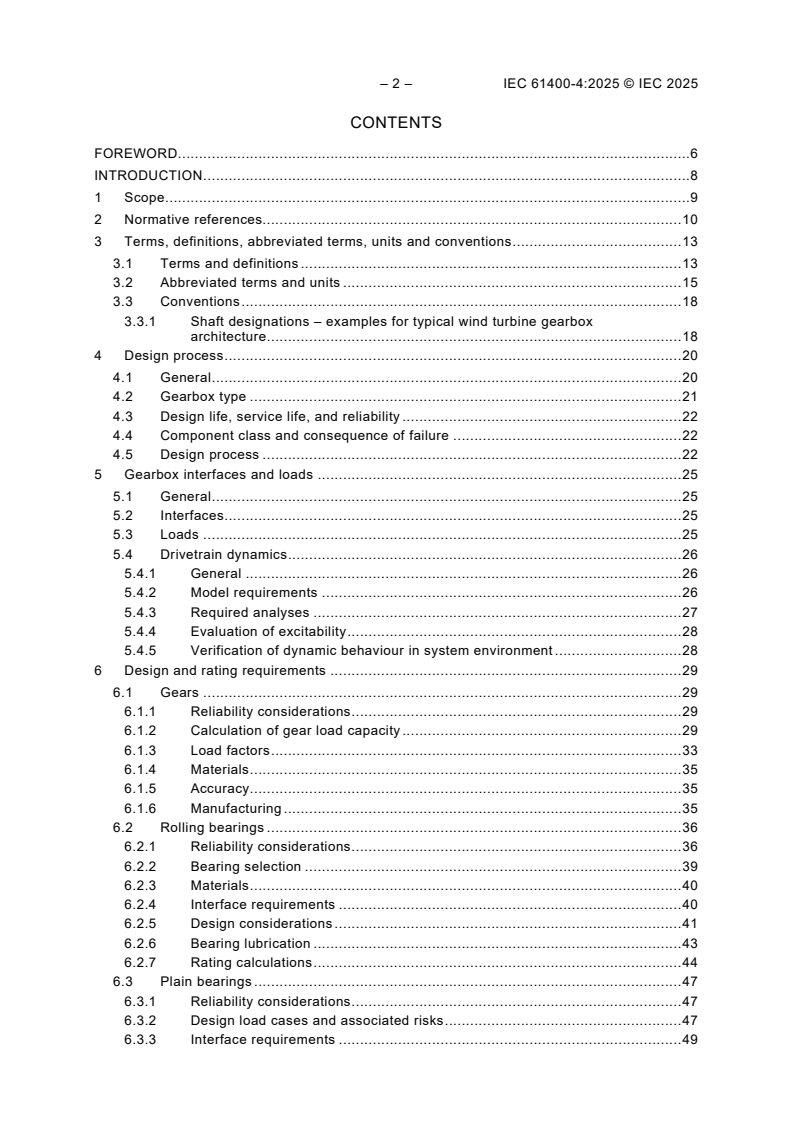
– 2 – IEC 61400-4:2025 © IEC 2025
CONTENTS
FOREWORD . 6
INTRODUCTION . 8
1 Scope . 9
2 Normative references . 10
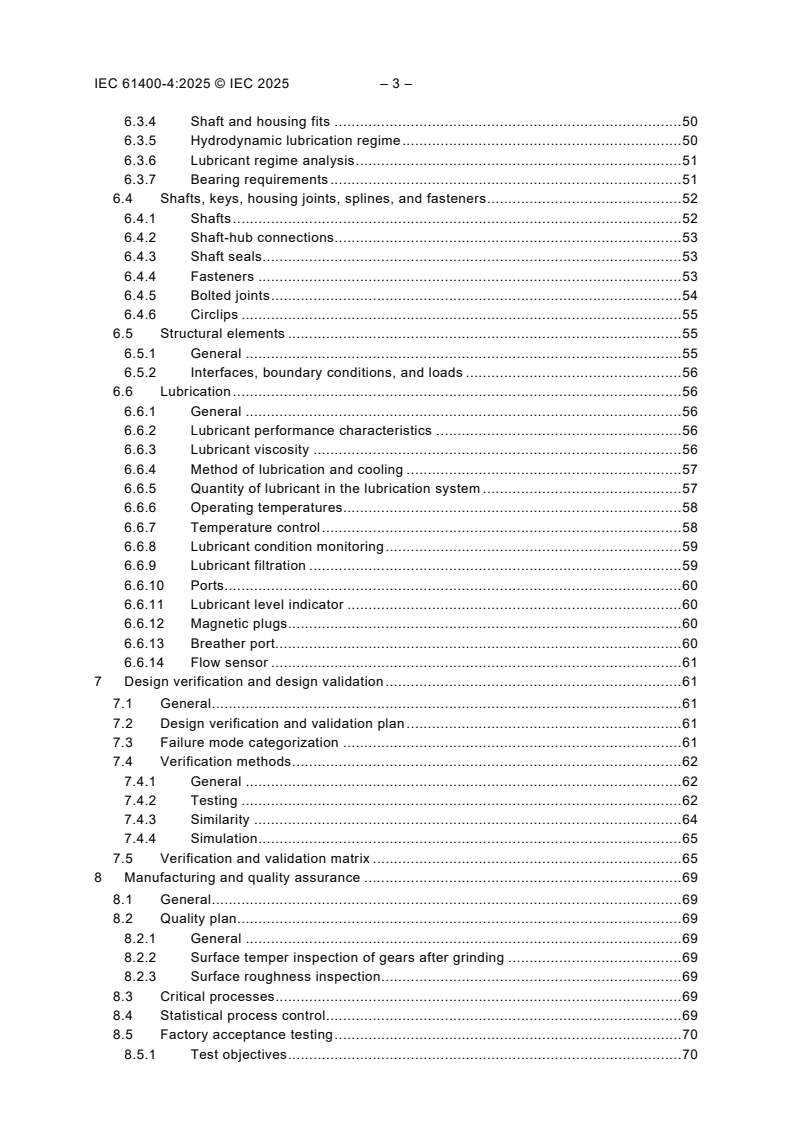
3 Terms, definitions, abbreviated terms, units and conventions . 13
3.1 Terms and definitions . 13
3.2 Abbreviated terms and units. 15
3.3 Conventions . 18
3.3.1 Shaft designations – examples for typical wind turbine gearbox
architecture . 18
4 Design process . 20
4.1 General . 20
4.2 Gearbox type . 21
4.3 Design life, service life, and reliability . 22
4.4 Component class and consequence of failure . 22
4.5 Design process . 22
5 Gearbox interfaces and loads . 25
5.1 General . 25
5.2 Interfaces . 25
5.3 Loads. 25
5.4 Drivetrain dynamics . 26
5.4.1 General . 26
5.4.2 Model requirements . 26
5.4.3 Required analyses . 27
5.4.4 Evaluation of excitability . 28
5.4.5 Verification of dynamic behaviour in system environment . 28
6 Design and rating requirements . 29
6.1 Gears. 29
6.1.1 Reliability considerations . 29
6.1.2 Calculation of gear load capacity . 29
6.1.3 Load factors . 33
6.1.4 Materials . 35
6.1.5 Accuracy . 35
6.1.6 Manufacturing . 35
6.2 Rolling bearings . 36
6.2.1 Reliability considerations . 36
6.2.2 Bearing selection . 39
6.2.3 Materials . 40
6.2.4 Interface requirements . 40
6.2.5 Design considerations . 41
6.2.6 Bearing lubrication . 43
6.2.7 Rating calculations . 44
6.3 Plain bearings . 47
6.3.1 Reliability considerations . 47
6.3.2 Design load cases and associated risks . 47
6.3.3 Interface requirements . 49
6.3.4 Shaft and housing fits . 50
6.3.5 Hydrodynamic lubrication regime . 50
6.3.6 Lubricant regime analysis . 51
6.3.7 Bearing requirements . 51
6.4 Shafts, keys, housing joints, splines, and fasteners . 52
6.4.1 Shafts . 52
6.4.2 Shaft-hub connections . 53
6.4.3 Shaft seals . 53
6.4.4 Fasteners . 53
6.4.5 Bolted joints. 54
6.4.6 Circlips . 55
6.5 Structural elements . 55
6.5.1 General . 55
6.5.2 Interfaces, boundary conditions, and loads . 56
6.6 Lubrication . 56
6.6.1 General . 56
6.6.2 Lubricant performance characteristics . 56
6.6.3 Lubricant viscosity . 56
6.6.4 Method of lubrication and cooling . 57
6.6.5 Quantity of lubricant in the lubrication system . 57
6.6.6 Operating temperatures . 58
6.6.7 Temperature control . 58
6.6.8 Lubricant condition monitoring . 59
6.6.9 Lubricant filtration . 59
6.6.10 Ports. 60
6.6.11 Lubricant level indicator . 60
6.6.12 Magnetic plugs . 60
6.6.13 Breather port . 60
6.6.14 Flow sensor . 61
7 Design verification and design validation . 61
7.1 General . 61
7.2 Design verification and validation plan . 61
7.3 Failure mode categorization . 61
7.4 Verification methods . 62
7.4.1 General . 62
7.4.2 Testing . 62
7.4.3 Similarity . 64
7.4.4 Simulation . 65
7.5 Verification and validation matrix . 65
8 Manufacturing and quality assurance . 69
8.1 General . 69
8.2 Quality plan . 69
8.2.1 General . 69
8.2.2 Surface temper inspection of gears after grinding . 69
8.2.3 Surface roughness inspection . 69
8.3 Critical processes . 69
8.4 Statistical process control . 69
8.5 Factory acceptance testing . 70
8.5.1 Test objectives . 70
– 4 – IEC 61400-4:2025 © IEC 2025
8.5.2 Acceptance test plan . 70
8.5.3 Factory test sequences . 70
8.5.4 Acceptance measurements . 71
8.6 Non-conforming components. 71
8.6.1 General . 71
8.6.2 Grinding notches . 72
9 Design for service and operation . 72
9.1 General . 72
9.2 Service and operation design requirements. 72
9.3 Service and operation documentation requirements . 72
9.4 Safety . 73
Annex A (informative) Examples of drivetrain interfaces and loads specifications . 74
A.1 General . 74
A.2 Common wind turbine drivetrain architectures . 74
A.2.1 Non-integrated drivetrain with 4-point suspension . 74
A.2.2 Non-integrated drivetrain with 3-point suspension . 75
A.2.3 Integrated drivetrain . 75
A.2.4 Interfaces . 78
A.2.5 Coordinate system . 78
A.2.6 Interface descriptions . 78
A.2.7 Engineering data at the interface . 80
A.3 Wind turbine load descriptions . 80
A.3.1 Load description formats . 80
A.3.2 Rainflow matrices . 81
A.3.3 Load revolution distribution . 82
A.3.4 Extreme load descriptions . 83
A.4 Wind turbine reference power and speed . 84
A.4.1 General . 84
A.4.2 Wind turbine power control theory . 84
A.4.3 Practicalities of power control . 85
Annex B (informative) Dynamic gearbox model verification and validation. 87
B.1 General . 87
B.2 Verification of drivetrain dynamics models . 87
B.3 Validation of drivetrain dynamics models . 87
Bibliography . 90
Figure 1 – Shaft designation in 3-stage parallel shaft gearboxes . 19
Figure 2 – Shaft designation in 3-stage gearboxes with one planet stage . 19
Figure 3 – Shaft designation in 3-stage gearboxes with two planet stages . 20
Figure 4 – Shaft designation in 4-stage gearboxes with three planet stages . 20
Figure 5 – Design process flow chart . 23
Figure 6 – Definition of planet gear rim thickness . 31
Figure 7 – Examples of bearing selection criteria . 39
Figure 8 – Notional operational conditions and plain bearing risk regions. 49
Figure A.1 – Non-integrated drivetrain with 4-point suspension . 74
Figure A.2 – Non-integrated drivetrain with 3-point suspension . 75
Figure A.3 – Rotor-side integration with rigid main shaft connection . 76
Figure A.4 – Rotor-side integration with flexible main shaft connection . 76
Figure A.5 – Generator-side integration with rotor support in generator . 77
Figure A.6 – Generator-side integration with rotor support in gearbox and generator . 77
Figure A.7 – Generator-side integration with rotor support in gearbox . 77
Figure A.8 – Example of rainflow cycles per design load case . 82
Figure A.9 – Example of a load revolution distribution . 83
Figure A.10 – Wind turbine power control regions . 84
Figure A.11 – Ideal power and speed control strategy . 85
Figure A.12 – Control strategy compared to actual response . 85
Table 1 – Definition of a gearbox type . 21
Table 2 – Minimum safety factors for pitting resistance and bending strength . 30
Table 3 – Mesh load factor for planetary stages . 33
Table 4 – Required gear accuracy . 35
Table 5 – Typical temperature differences for calculation of operating clearance . 42
Table 6 – Bearing lubricant temperature for calculation of viscosity ratio . 44
Table 7 – Guide values for maximum contact stress. 46
Table 8 – Plain bearing risks coupled to operating conditions . 48
Table 9 – Minimum safety factors. 52
Table 10 – Failure mode categorization . 62
Table 11 – Verification and validation matrix . 66
Table A.1 – Analysis information at interfaces for non-integrated drivetrains . 79
Table A.2 – Analysis information at interfaces for integrated drivetrain . 80
Table A.3 – Engineering data and design load descriptions. 80
Table A.4 – Rainflow matrix example . 81
Table A.5 – Extreme load matrix example . 83
– 6 – IEC 61400-4:2025 © IEC 2025
INTERNATIONAL ELECTROTECHNICAL COMMISSION
____________
WIND ENERGY GENERATION SYSTEMS –
Part 4: Design requirements for wind turbine gearboxes
FOREWORD
1) ISO (the International Organization for Standardization) and IEC (the International Electrotechnical Commission)
form the specialized system for worldwide standardization. National bodies that are members of ISO or IEC
participate in the development of International Standards through technical committees established by the
respective organization to deal with particular fields of technical activity. ISO and IEC technical committees
collaborate in fields of mutual interest. Other international organizations, governmental and non-governmental,
in liaison with ISO and IEC, also take part in the work.
2) The formal decisions or agreements of IEC and ISO on technical matters express, as nearly as possible, an
international consensus of opinion on the relevant subjects since each technical committee has representation
from all interested IEC and ISO National bodies.
3) IEC and ISO documents have the form of recommendations for international use and are accepted by IEC and
ISO National bodies in that sense. While all reasonable efforts are made to ensure that the technical content of
IEC and ISO documents is accurate, IEC and ISO cannot be held responsible for the way in which they are used
or for any misinterpretation by any end user.
4) In order to promote international uniformity, IEC and ISO National bodies undertake to apply IEC and
ISO documents transparently to the maximum extent possible in their national and regional publications. Any
divergence between any IEC and ISO document and the corresponding national or regional publication shall be
clearly indicated in the latter.
5) IEC and ISO do not provide any attestation of conformity. Independent certification bodies provide conformity
assessment services and, in some areas, access to IEC and ISO marks of conformity. IEC and ISO are not
responsible for any services carried out by independent certification bodies.
6) All users should ensure that they have the latest edition of this document.
7) No liability shall attach to IEC and ISO or their directors, employees, servants or agents including individual
experts and members of its technical committees and IEC and ISO National bodies for any personal injury,
property damage or other damage of any nature whatsoever, whether direct or indirect, or for costs (including
legal fees) and expenses arising out of the publication, use of, or reliance upon, this ISO/IEC document or any
other IEC and ISO documents.
8) Attention is drawn to the Normative references cited in this document. Use of the referenced publications is
indispensable for the correct application of this document.
9) IEC and ISO draw attention to the possibility that the implementation of this document may involve the use of (a)
patent(s). IEC and ISO take no position concerning the evidence, validity or applicability of any claimed patent
rights in respect thereof. As of the date of publication of this document, IEC and ISO had not received notice of
(a) patent(s), which may be required to implement this document. However, implementers are cautioned that this
may not represent the latest information, which may be obtained from the patent database available at
https://patents.iec.ch and www.iso.org/patents. IEC and ISO shall not be held responsible for identifying any or
all such patent rights.
IEC 61400-4 has been prepared by IEC technical committee 88: Wind energy generation
systems, in co-operation with ISO technical committee 60: Gears. It is an International
Standard.
It is published as a double logo standard.
This second edition cancels and replaces the first edition published in 2012. This edition
constitutes a technical revision.
This edition includes the following significant technical changes with respect to the previous
edition:
a) extension of the scope to wind turbines above 2 MW reference power;
b) considerations for converging differing approaches to reliability in gear, bearing and wind
turbine standards;
c) new clause on wind turbine loads specific to drivetrains;
d) revised clause on verification and validation;
e) new clause on design requirements for plain bearings;
f) revised and expanded design considerations for rolling bearings;
g) revised clause on considerations and requirements in the design and analysis of gearbox
structural elements;
h) updated considerations and requirements on lubricants and lubrication systems;
i) removal of requirements for documenting the compliance of a design with the requirements
of the document in favour of reference to IECRE OD-501-2.
The text of this International Standard is based on the following documents:
Draft Report on voting
88/971/CDV 88/1003A/RVC
Full information on the voting for its approval can be found in the report on voting indicated in
the above table. In ISO, the standard has been approved by 11 P-members out of 12 having
cast a vote.
The language used for the development of this International Standard is English.
This document was drafted in accordance with ISO/IEC Directives, Part 2, and developed in
accordance with ISO/IEC Directives, Part 1 and ISO/IEC Directives, IEC Supplement, available
at www.iec.ch/members_experts/refdocs. The main document types developed by IEC are
described in greater detail at www.iec.ch/publications.
A list of all parts of the IEC 61400 series, under the general title: Wind energy generation
systems, can be found on the IEC website.
The committee has decided that the contents of this document will remain unchanged until the
stability date indicated on the IEC website under webstore.iec.ch in the data related to the
specific document. At this date, the document will be
• reconfirmed,
• withdrawn, or
• revised.
– 8 – IEC 61400-4:2025 © IEC 2025
INTRODUCTION
IEC 61400-4 outlines minimum requirements for specification, design, and verification of
gearboxes in wind turbines. It does not serve as a complete design specification or instruction
manual. It is intended for use by experienced designers of wind turbine drivetrains, gearboxes,
and gears or bearings who are capable of selecting reasonable values for the design factors,
based on knowledge of similar designs and the effects of such items as lubrication, deflection,
manufacturing tolerances, metallurgy, residual stress, and system dynamics.
Any of the requirements of this document may be altered:
• if more accurate data are available from full scale load tests, precise measurements,
comprehensive mathematical analysis, or any combination of these;
• or on the basis of proven operating experience;
• and if the evidence is accessible for independent assessment (e.g. by an accredited
renewable energy certification body);
• and if the accuracy and reliability of the alternative method is demonstrated with respect to
the safety and reliability of the complete wind turbine drive system.
WIND ENERGY GENERATION SYSTEMS –
Part 4: Design requirements for wind turbine gearboxes
1 Scope
This part of IEC 61400 is applicable to enclosed speed increasing gearboxes for horizontal axis
wind turbine drivetrains with a power rating in excess of 500 kW. This document applies to
newly designed gearboxes for wind turbines installed onshore or offshore. The technical
requirements given in this document are not intended for repaired or refurbished gearboxes, or
for the extension of the service life beyond the design life.
This document provides requirements and guidance on the analysis of the wind turbine loads
in relation to the design of the gear and gearbox elements. The gearing elements covered by
this document include such gears as spur, helical or double helical and their combinations in
parallel and epicyclic arrangements in the main power path. This document does not apply to
power take off (PTO) gears.
This document includes requirements, design recommendations, and rating of gearboxes with
rolling bearings, plain bearings, or combinations of both bearing types.
Also included are requirements and guidance on the engineering of shafts, shaft hub interfaces,
lubrication, wind turbine controller interface, and the gear case structure to achieve a design
that is capable of withstanding the environment and operating conditions of a wind turbine.
Requirements for dynamic analysis of the gearbox within the wind turbine system are specified
for the purpose of identifying load levels exceeding the predictions of the global aeroelastic
simulation. The analysis of noise transmission and emission (e.g. tonal emission at gear mesh
frequencies) is not within the scope of this edition of the document.
Further, this document provides requirements and guidance on gearbox design verification,
prototype testing and production testing, as well as consideration of design for service and
maintenance.
A method for a systematic assessment of the design reliability of a gearbox design under
reference operating conditions is specified in IEC TS 61400-4-1 .
This document is supported by two Technical Reports: IEC TR 61400-4-2 provides additional
information on lubrication of wind turbine drivetrains and IEC TR 61400-4-3 contains
explanatory notes and supportive information to the requirements specified in this document.
___________
Under preparation. Stage at the time of publication: IEC/DTS 61400-4-1:2024.
Under preparation. Stage at the time of publication: IEC/DTR 61400-4-2:2024.
Under preparation. Stage at the time of publication: IEC/DTR 61400-4-3:2024.
– 10 – IEC 61400-4:2025 © IEC 2025
2 Normative references
The following documents are referred to in the text in such a way that some or all of their content
constitutes requirements of this document. For dated references, only the edition cited applies.
For undated references, the latest edition of the referenced document (including any
amendments) applies.
IEC 61400-1:2019, Wind energy generation systems – Part 1: Design requirements
IEC 61400-3-1, Wind energy generation systems – Part 3-1: Design requirements for fixed
offshore wind turbines
IEC TS 61400-3-2, Wind energy generation systems – Part 3-2: Design requirements for
floating offshore wind turbines
IEC 61400-8, Wind energy generation systems – Part 8: Design of wind turbine structural
components
IEC TS 61400-30, Wind energy generation systems − Part 30: Safety of wind turbine generators
− General principles for design
ISO 281, Rolling bearings – Dynamic load ratings and rating life
ISO 683 (all parts), Heat-treatable steels, alloy steels and free-cutting steels
ISO 683-17, Heat-treatable steels, alloy steels and free-cutting steels − Part 17: Ball and roller
bearing steels
ISO 898-1, Mechanical properties of fasteners made of carbon steel and alloy steel – Part 1:
Bolts, screws and studs with specified property classes – Coarse thread and fine pitch thread
ISO 898-2, Fasteners − Mechanical properties of fasteners made of carbon steel and alloy steel
− Part 2: Nuts with specified property classes
ISO 898-3, Mechanical properties of fasteners made of carbon steel and alloy steel – Part 3:
Flat washers with specified property classes
ISO 1328-1, Cylindrical gears − ISO system of flank tolerance classification − Part 1: Definitions
and allowable values of deviations relevant to flanks of gear teeth
ISO 3104, Petroleum products – Transparent and opaque liquids – Determination of kinematic
viscosity and calculation of dynamic viscosity
ISO 4042, Fasteners – Electroplated coating systems
ISO 4406, Hydraulic fluid power – Fluids – Method for coding the level of contamination by solid
particles
ISO 6336 (all parts), Calculation of load capacity of spur and helical gears
ISO 6336-1:2019, Calculation of load capacity of spur and helical gears – Part 1: Basic
principles, introduction and general influence factors
ISO 6336-2:2019, Calculation of load capacity of spur and helical gears – Part 2: Calculation of
surface durability (pitting)
ISO 6336-3:2019, Calculation of load capacity of spur and helical gears – Part 3: Calculation of
tooth bending strength
ISO TS 6336-4, Calculation of load capacity of spur and helical gears – Part 4: Calculation of
tooth flank fracture load capacity
ISO 6336-5:2016, Calculation of load capacity of spur and helical gears – Part 5: Strength and
quality of materials
ISO 6336-6:2019, Calculation of load capacity of spur and helical gears – Part 6: Calculation of
service life under variable load
ISO TS 6336-20, Calculation of load capacity of spur and helical gears – Part 20: Calculation
of scuffing load capacity – Flash temperature method
ISO TS 6336-21, Calculation of load capacity of spur and helical gears – Part 21: Calculation
of scuffing load capacity – Integral temperature method
ISO TS 6336-22, Calculation of load capacity of spur and helical gears – Part 22: Calculation
of micropitting load capacity
ISO 6618, Petroleum products and lubricants – Determination of acid or base number – Colour-
indicator titration method
ISO 6619, Petroleum products and lubricants – Neutralization number – Potentiometric titration
method
ISO 7146-1, Plain bearings – Appearance and characterization of damage to metallic
hydrodynamic bearings – Part 1: General
ISO 8579-1, Acceptance code for gear units – Part 1: Test code for airborne sound
ISO TR 10064-3, Code of inspection practice – Part 3: Recommendations relative to gear
blanks, shaft centre distance and parallelism of axes
ISO 10683, Fasteners – Non-electrolytically applied zinc flake coating systems
ISO 10825-1, Gears – Wear and damage to gear teeth – Part 1: Nomenclature and
characteristics
ISO 12925-1, Lubricants, industrial oils and related products (class L). Family C (gears) –
Part 1: Specifications for lubricants for enclosed gear systems
ISO 14104, Gears – Surface temper etch inspection after grinding, chemical method
ISO 14635-1:2023, Gears – FZG test procedures – Part 1: FZG test method A/8,3/90 for relative
scuffing load-carrying capacity of oils
ISO 15243:2017, Rolling bearings – Damage and failures – Terms, characteristics and causes
ISO 16281:2025, Rolling bearings – Methods for calculating the modified reference rating life
for universally loaded bearings
ISO 17956:2025, Rolling bearings – Method for calculating the effective static safety factor for
universally loaded rolling bearings
– 12 – IEC 61400-4:2025 © IEC 2025
ISO 21920-1, Geometrical product specifications (GPS) – Surface texture: Profile – Part 1:
Indication of surface texture
ISO 21920-2, Geometrical product specifications (GPS) – Surface texture: Profile – Part 2:
Terms, definitions and surface texture parameters
ISO 21920-3, Geometrical product specifications (GPS) – Surface texture: Profile – Part 3:
Specification operators
ANSI/AGMA 6001, Design and selection of components for enclosed gear drives
ANSI/AGMA 6123, Design manual for enclosed epicyclic gear drives
ASTM D445, Standard test method for kinematic viscosity of transparent and opaque liquids
(and calculation of dynamic viscosity)
ASTM D664, Standard test method for acid number of petroleum products by potentiometric
titration
ASTM D974, Standard test method for acid and base number by color-indicator titration
ASTM D5185, Standard test method for multielement determination of used and unused
lubricating oils and base oils by inductively coupled plasma atomic emission spectrometry (ICP-
AES)
ASTM D6304, Standard test method for determination of water in petroleum products,
lubricating oils, and additives by coulometric Karl Fischer titration
DIN 471, Circlips (retaining rings) for shafts: Normal type and heavy type
DIN 472, Circlips (retaining rings) for bores: Normal type and heavy type
DIN 743 (all parts), Calculation of load capacity of shafts and axles
DIN 3990-16, Calculation of load capacity of cylindrical gears – Part 16: Determination of the
micro-pitting load-carrying capacity of lubricants using FZG test method GT-C/8.3/90
DIN 6885-1, Drive type fastenings without taper action; Parallel keys, keyways, deep pattern
DIN 6892, Mitnehmerverbindungen ohne Anzug – Passfedern – Berechnung und Gestaltung
(available in German only)
DIN 7190, Interference fits – Calculation and design rules
DIN 51399-1, Testing of lubricants – Determination of elements content in additives, wear and
other contaminations – Part 1: Direct determination by optical emission spectral analysis with
inductively coupled plasma (ICP OES)
DIN 51777, Petroleum products – Determination of water content using titration according to
Karl Fischer
DIN 51819-3, Testing of lubricants – Mechanical-dynamic testing in the roller bearing test
apparatus FE8 – Part 3: Test method for lubricating oils – Applied test bearing: axial cylindrical
roller bearing
FVA 563 I, FVA Guideline: Recommendations for the standardization of load carrying capacity
test on hardened and tempered cylindrical gears, Research Association for Drive Technology
(FVA). Frankfurt, 2012
VDI 2230-1:2015, Systematic calculation of highly stressed bolted joints – Joints with one
cylindrical bolt
VDI 2230-2:2014, Systematic calculation of highly stressed bolted joints – Multi bolted joints
VDI/VDE 2862-2, Minimum requirements for application of fastening systems and tools –
Applications in plant construction, mechanical engineering, equipment manufacturing and for
flange connections in components under pressure boundary
3 Terms, definitions, abbreviated terms, units and conventions
3.1 Terms and definitions
For the purposes of this document, the following terms and definitions apply.
ISO and IEC maintain terminology databases for use in standardization at the following
addresses:
• IEC Electropedia: available at https://www.electropedia.org/
• ISO Online browsing platform: available at https://www.iso.org/obp
3.1.1
bearing reference load
load derived from the reference torque acting at the load application point
3.1.2
bulk lubricant temperature
temperature of the lubricant that is representative of the overall volume of the lubricant within
the lubrication system
3.1.3
design load
load value that the turbine and its components are designed to withstand
Note 1 to entry: Design loads are obtained by applying the appropriate partial load factors to the characteristic load
in accordance with IEC 61400-1, IEC 61400-3-1, and IEC TS 61400-3-2.
3.1.4
design validation
confirmation, through the provision of objective evidence, that the requirements for a specific
intended use or application have been fulfilled
[SOURCE: IEC 60050-192:2024, 192-01-18, modified – "design" has been added to the term,
notes to entry have been deleted.]
3.1.5
design verification
confirmation, through the provision of objective evidence, that specified requirements have
been fulfilled
[SOURCE: IEC 60050-192:2024, 192-01-17, modified – "design" has been added to the term,
notes to entry have been deleted.]
– 14 – IEC 61400-4:2025 © IEC 2025
3.1.6
equivalent load
load which when repeated for a specified number of cycles causes the same damage as the
actual load variation if a specified life exponent applies
Note 1 to entry: When applied to load ranges, the equivalent load does not take the mean-stress level of the load
cycles into account.
3.1.7
excitability
ability of a specific gearbox element to experience a forced vibration response due to the
interaction of resonances and excitation sources
3.1.8
extreme load
design load from any source, either operating or non-operating, that is the largest absolute
value of the respective load component
Note 1 to entry: This component can be a force, a moment, a torque, or a combination of these.
3.1.9
interface
boundary of the gearbox that is either a physical mount to another wind turbine subcomponent
or a path of exchange such as control signals, hydraulic fluid, or lubricant
3.1.10
lubricant inlet temperature
steady-state temperature of the lubricant where it enters the gearbox in pressure-fed or
combined lubrication systems
3.1.11
maximum operating load
highest load determined by the design load cases used in fatigue analysis including partial load
safety factor as defined in IEC 61400-1, IEC 61400-3-1, and IEC TS 61400-3-2
3.1.12
model validation
process of determining the degree to which the model is an accurate representation of
corresponding physical experiments from the perspective of the intended uses of the model
Note 1 to entry: See ASME V&V 10.
3.1.13
model verification
process of determining that a computational model accurately represents the underlying
mathematical model and its solution
Note 1 to entry: See ASME V&V 10.
3.1.14
hydrodynamic lubrication
condition where sliding surfaces are completely separated by a lubricant film
3.1.15
mixed lubrication
operation of a
...
IEC 61400-4
Edition 2.0 2025-04
NORME
INTERNATIONALE
Systèmes de génération d'énergie éolienne –
Partie 4: Exigences de conception des boîtes de vitesses des éoliennes
ICS 27.180 ISBN 978-2-8327-0599-5
Droits de reproduction réservés. Sauf indication contraire, aucune partie de cette publication ne peut être reproduite ni
utilisée sous quelque forme que ce soit et par aucun procédé, électronique ou mécanique, y compris la photocopie et
les microfilms, sans l'accord écrit de l'IEC ou du Comité national de l'IEC du pays du demandeur. Si vous avez des
questions sur le copyright de l'IEC ou si vous désirez obtenir des droits supplémentaires sur cette publication, utilisez
les coordonnées ci-après ou contactez le Comité national de l'IEC de votre pays de résidence.
IEC Secretariat Tel.: +41 22 919 02 11
3, rue de Varembé info@iec.ch
CH-1211 Geneva 20 www.iec.ch
Switzerland
A propos de l'IEC
La Commission Electrotechnique Internationale (IEC) est la première organisation mondiale qui élabore et publie des
Normes internationales pour tout ce qui a trait à l'électricité, à l'électronique et aux technologies apparentées.
A propos des publications IEC
Le contenu technique des publications IEC est constamment revu. Veuillez vous assurer que vous possédez l’édition la
plus récente, un corrigendum ou amendement peut avoir été publié.
Recherche de publications IEC - IEC Products & Services Portal - products.iec.ch
webstore.iec.ch/advsearchform Découvrez notre puissant moteur de recherche et consultez
La recherche avancée permet de trouver des publications gratuitement tous les aperçus des publications, symboles
IEC en utilisant différents critères (numéro de référence, graphiques et le glossaire. Avec un abonnement, vous aurez
texte, comité d’études, …). Elle donne aussi des toujours accès à un contenu à jour adapté à vos besoins.
informations sur les projets et les publications remplacées
ou retirées. Electropedia - www.electropedia.org
Le premier dictionnaire d'électrotechnologie en ligne au
IEC Just Published - webstore.iec.ch/justpublished monde, avec plus de 22 500 articles terminologiques en
Restez informé sur les nouvelles publications IEC. Just anglais et en français, ainsi que les termes équivalents
Published détaille les nouvelles publications parues. dans 25 langues additionnelles. Egalement appelé
Disponible en ligne et une fois par mois par email. Vocabulaire Electrotechnique International (IEV) en ligne.
Service Clients - webstore.iec.ch/csc
Si vous désirez nous donner des commentaires sur cette
publication ou si vous avez des questions contactez-
nous: sales@iec.ch.
– 96 – IEC 61400-4:2025 © IEC 2025
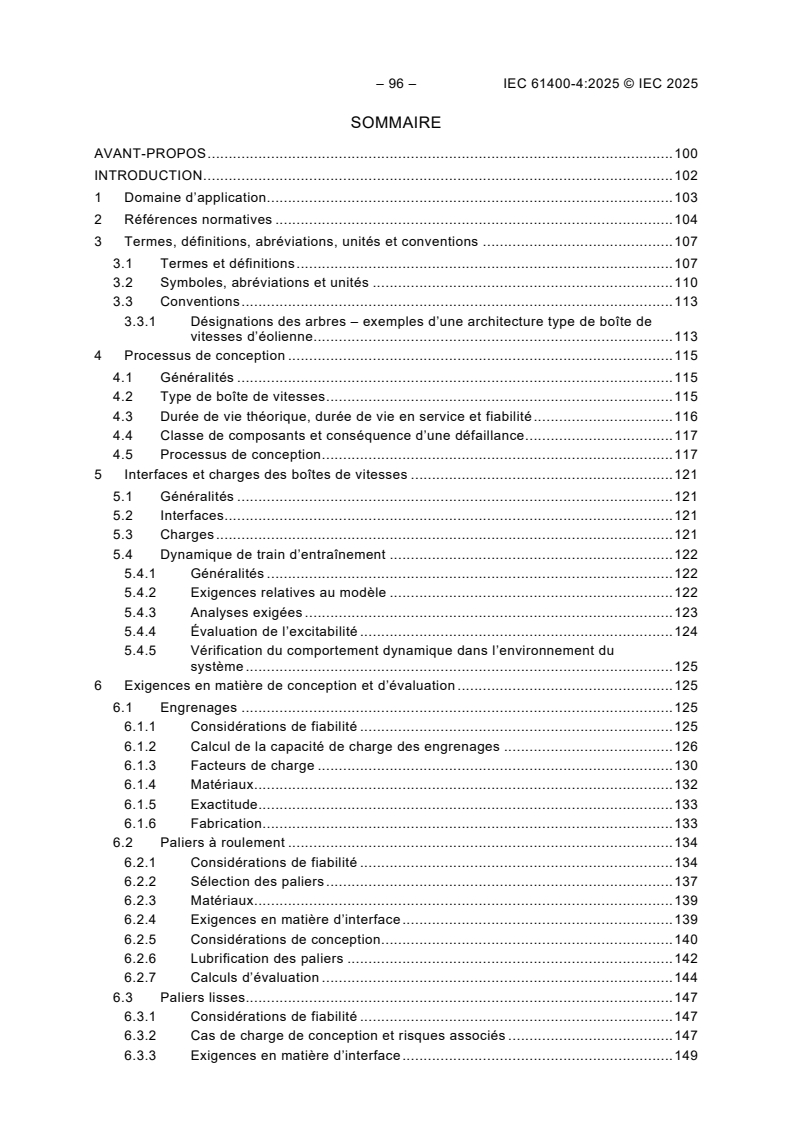
SOMMAIRE
AVANT-PROPOS . 100
INTRODUCTION . 102
1 Domaine d’application. 103
2 Références normatives . 104
3 Termes, définitions, abréviations, unités et conventions . 107
3.1 Termes et définitions . 107
3.2 Symboles, abréviations et unités . 110
3.3 Conventions . 113
3.3.1 Désignations des arbres – exemples d’une architecture type de boîte de
vitesses d’éolienne . 113
4 Processus de conception . 115
4.1 Généralités . 115
4.2 Type de boîte de vitesses . 115
4.3 Durée de vie théorique, durée de vie en service et fiabilité . 116
4.4 Classe de composants et conséquence d’une défaillance . 117
4.5 Processus de conception . 117
5 Interfaces et charges des boîtes de vitesses . 121
5.1 Généralités . 121
5.2 Interfaces . 121
5.3 Charges . 121
5.4 Dynamique de train d’entraînement . 122
5.4.1 Généralités . 122
5.4.2 Exigences relatives au modèle . 122
5.4.3 Analyses exigées . 123
5.4.4 Évaluation de l’excitabilité . 124
5.4.5 Vérification du comportement dynamique dans l’environnement du
système . 125
6 Exigences en matière de conception et d’évaluation . 125
6.1 Engrenages . 125
6.1.1 Considérations de fiabilité . 125
6.1.2 Calcul de la capacité de charge des engrenages . 126
6.1.3 Facteurs de charge . 130
6.1.4 Matériaux . 132
6.1.5 Exactitude . 133
6.1.6 Fabrication . 133
6.2 Paliers à roulement . 134
6.2.1 Considérations de fiabilité . 134
6.2.2 Sélection des paliers . 137
6.2.3 Matériaux . 139
6.2.4 Exigences en matière d’interface . 139
6.2.5 Considérations de conception . 140
6.2.6 Lubrification des paliers . 142
6.2.7 Calculs d’évaluation . 144
6.3 Paliers lisses. 147
6.3.1 Considérations de fiabilité . 147
6.3.2 Cas de charge de conception et risques associés . 147
6.3.3 Exigences en matière d’interface . 149
6.3.4 Assemblages de l’arbre et du carter . 150
6.3.5 Régime de lubrification hydrodynamique . 150
6.3.6 Analyse du régime de lubrifiant . 151
6.3.7 Exigences relatives aux paliers . 151
6.4 Arbres, clavettes, joints de carter, cannelures et fixations . 153
6.4.1 Arbres . 153
6.4.2 Raccordements arbre-moyeu . 153
6.4.3 Joints d’étanchéité des arbres . 154
6.4.4 Fermetures . 154
6.4.5 Assemblages boulonnés . 155
6.4.6 Circlips . 156
6.5 Éléments structurels . 157
6.5.1 Généralités . 157
6.5.2 Interfaces, conditions aux limites et charges . 157
6.6 Lubrification . 157
6.6.1 Généralités . 157
6.6.2 Caractéristiques de performance des lubrifiants . 157
6.6.3 Viscosité du lubrifiant . 158
6.6.4 Méthode de lubrification et de refroidissement . 158
6.6.5 Quantité de lubrifiant dans le système de lubrification . 159
6.6.6 Températures de fonctionnement . 159
6.6.7 Régulation en température . 159
6.6.8 Surveillance de l’état du lubrifiant . 160
6.6.9 Filtration du lubrifiant . 161
6.6.10 Ports . 161
6.6.11 Indicateur de niveau de lubrifiant . 162
6.6.12 Bouchons magnétiques . 162
6.6.13 Orifice de reniflard . 162
6.6.14 Capteur de flux . 162
7 Vérification de la conception et validation de la conception . 163
7.1 Généralités . 163
7.2 Plan de vérification et de validation de la conception . 163
7.3 Catégorisation des modes de défaillance . 163
7.4 Méthodes de vérification. 164
7.4.1 Généralités . 164
7.4.2 Méthodes d’essai . 164
7.4.3 Similitude . 167
7.4.4 Simulation . 167
7.5 Matrice de vérification et de validation . 167
8 Fabrication et assurance qualité . 172
8.1 Généralités . 172
8.2 Plan qualité . 172
8.2.1 Généralités . 172
8.2.2 Inspection de l’état de surface des engrenages après rectification . 172
8.2.3 Inspection de la rugosité de surface . 172
8.3 Processus critiques . 172
8.4 Contrôle statistique des processus . 173
8.5 Recette en usine . 173
8.5.1 Objectifs des essais . 173
– 98 – IEC 61400-4:2025 © IEC 2025
8.5.2 Plan d’essai de réception . 173
8.5.3 Séquences d’essais en usine . 173
8.5.4 Mesurages de réception . 174
8.6 Composants non conformes . 175
8.6.1 Généralités . 175
8.6.2 Entailles de rectification . 175
9 Conception pour l’entretien et l’exploitation . 175
9.1 Généralités . 175
9.2 Exigences de conception relatives à l’entretien et à l’exploitation . 175
9.3 Exigences de documentation relatives à l’entretien et à l’exploitation . 176
9.4 Sécurité . 177
Annexe A (informative) Exemples de spécifications d’interfaces de train
d’entraînement et de charges . 178
A.1 Généralités . 178
A.2 Architectures courantes de train d’entraînement d’éolienne . 178
A.2.1 Train d’entraînement non intégré avec une suspension à 4 points . 178
A.2.2 Train d’entraînement non intégré avec une suspension à 3 points . 179
A.2.3 Train d’entraînement intégré . 180
A.2.4 Interfaces . 183
A.2.5 Repère orthogonal . 183
A.2.6 Description des interfaces . 184
A.2.7 Données d’ingénierie sur l’interface . 185
A.3 Descriptions des charges de l’éolienne . 186
A.3.1 Formats de description des charges . 186
A.3.2 Matrices rainflow . 186
A.3.3 Distribution de tours de charge . 187
A.3.4 Descriptions des charges extrêmes . 188
A.4 Puissance et vitesse de référence de l’éolienne . 189
A.4.1 Généralités . 189
A.4.2 Théorie de la commande de la puissance des éoliennes . 189
A.4.3 Aspects pratiques de la commande de puissance . 190
Annexe B (informative) Vérification et validation du modèle de boîte de vitesses
dynamique . 193
B.1 Généralités . 193
B.2 Vérification des modèles de dynamique de train d’entraînement . 193
B.3 Validation des modèles de dynamique de train d’entraînement . 194
Bibliographie . 196
Figure 1 – Désignation des arbres dans les boîtes de vitesses à axe parallèle à trois
étages . 113
Figure 2 – Désignation des arbres dans les boîtes de vitesses à trois étages avec un
étage planétaire . 114
Figure 3 – Désignation des arbres dans les boîtes de vitesses à trois étages avec deux
étages planétaires . 114
Figure 4 – Désignation des arbres dans les boîtes de vitesses à quatre étages avec
trois étages planétaires . 115
Figure 5 – Diagramme du processus de conception . 119
Figure 6 – Définition de l’épaisseur de jante des satellites . 128
Figure 7 – Exemples de critères de sélection de paliers . 138
Figure 8 – Conditions de fonctionnement théoriques et régions de risque associées
aux paliers lisses . 149
Figure A.1 – Train d’entraînement non intégré avec une suspension à 4 points . 179
Figure A.2 – Train d’entraînement non intégré avec une suspension à 3 points . 179
Figure A.3 – Intégration côté rotor avec raccordement rigide de l’arbre principal . 180
Figure A.4 – Intégration côté rotor avec raccordement flexible de l’arbre principal . 181
Figure A.5 – Intégration côté génératrice avec support du rotor dans la génératrice . 181
Figure A.6 – Intégration côté génératrice avec support du rotor dans la boîte de
vitesses et la génératrice . 182
Figure A.7 – Intégration côté génératrice avec support du rotor dans la boîte de
vitesses . 182
Figure A.8 – Exemple de cycles rainflow par cas de charge de conception . 187
Figure A.9 – Exemple de distribution de rotation de charge . 188
Figure A.10 – Régions de commande de la puissance des éoliennes . 189
Figure A.11 – Stratégie de commande théorique de la puissance et de la vitesse . 190
Figure A.12 – Stratégie de commande comparée à la réponse réelle . 191
Tableau 1 – Définition d’un type de boîte de vitesses. 116
Tableau 2 – Facteurs de sécurité minimaux pour la résistance à la formation de
piqûres et la résistance à la flexion . 127
Tableau 3 – Facteur de charge d’engrènement pour les étages planétaires . 130
Tableau 4 – Exactitude exigée pour les engrenages . 133
Tableau 5 – Différences types de température pour le calcul du jeu en fonctionnement . 141
Tableau 6 – Température du lubrifiant de palier pour le calcul du rapport de viscosité . 143
Tableau 7 – Valeurs indicatives pour la pression de contact maximale . 146
Tableau 8 – Risques associés aux paliers lisses liés aux conditions de fonctionnement . 148
Tableau 9 – Facteurs de sécurité minimaux . 153
Tableau 10 – Catégorisation des modes de défaillance . 164
Tableau 11 – Matrice de vérification et de validation . 168
Tableau A.1 – Informations d’analyse aux interfaces dans le cas de trains
d’entraînement non intégrés . 184
Tableau A.2 – Informations d’analyse aux interfaces dans le cas d’un train
d’entraînement intégré . 185
Tableau A.3 – Données d’ingénierie et descriptions des charges de conception . 185
Tableau A.4 – Exemple de matrice rainflow . 186
Tableau A.5 – Exemple de matrice de charges extrêmes . 188
– 100 – IEC 61400-4:2025 © IEC 2025
COMMISSION ÉLECTROTECHNIQUE INTERNATIONALE
____________
SYSTÈMES DE GÉNÉRATION D’ÉNERGIE ÉOLIENNE –
Partie 4: Exigences de conception des boîtes de vitesses des éoliennes
AVANT-PROPOS
1) L’ISO (Organisation internationale de normalisation) et l’IEC (Commission électrotechnique internationale)
forment le système spécialisé de la normalisation mondiale. Les organismes nationaux membres de l’ISO ou de
l’IEC participent au développement de Normes internationales par l’intermédiaire des comités techniques créés
par l’organisation concernée afin de s’occuper des domaines particuliers de l’activité technique. Les comités
techniques de l’ISO et de l’IEC collaborent dans des domaines d’intérêt commun. D’autres organisations
internationales, gouvernementales et non gouvernementales, en liaison avec l’ISO et l’IEC, participent également
aux travaux.
2) Les décisions ou accords officiels de l’IEC et l’ISO concernant les questions techniques représentent, dans la
mesure du possible, un accord international sur les sujets étudiés, étant donné que les Comités nationaux de
l’IEC et de l’ISO intéressés sont représentés dans chaque comité d’études.
3) Les documents de l’IEC et de l’ISO se présentent sous la forme de recommandations internationales et sont
agréés comme telles par les Comités nationaux de l’IEC et de l’ISO. Tous les efforts raisonnables sont entrepris
afin que l’IEC et l’ISO s’assurent de l’exactitude du contenu technique de leurs documents; l’IEC et l’ISO ne
peuvent pas être tenues responsables de l’éventuelle mauvaise utilisation ou interprétation qui en est faite par
un quelconque utilisateur final.
4) Dans le but d’encourager l’uniformité internationale, les Comités nationaux de l’IEC et de l’ISO s’engagent, dans
toute la mesure possible, à appliquer de façon transparente les documents de l’IEC et de l’ISO dans leurs
publications nationales et régionales. Toutes divergences entre tous documents de l’IEC et de l’ISO et toutes
publications nationales ou régionales correspondantes doivent être indiquées en termes clairs dans ces
dernières.
5) L’IEC et l’ISO eux-mêmes ne fournissent aucune attestation de conformité. Des organismes de certification
indépendants fournissent des services d’évaluation de conformité et, dans certains secteurs, accèdent aux
marques de conformité de l’IEC et de l’ISO. L’IEC et l’ISO ne sont responsables d’aucun des services effectués
par les organismes de certification indépendants.
6) Tous les utilisateurs doivent s’assurer qu’ils sont en possession de la dernière édition de ce document.
7) Aucune responsabilité ne doit être imputée à l’IEC et à l’ISO, à leurs administrateurs, employés, auxiliaires ou
mandataires, y compris leurs experts particuliers et les membres de leurs comités d’études et des Comités
nationaux de l’IEC et de l’ISO, pour tout préjudice causé en cas de dommages corporels et matériels, ou de tout
autre dommage de quelque nature que ce soit, directe ou indirecte, ou pour supporter les coûts (y compris les
frais de justice) et les dépenses découlant de la publication ou de l’utilisation de ce document de l’IEC/ l’ISO ou
de toute autre document de l’IEC et de l’ISO, ou au crédit qui lui est accordé.
8) L’attention est attirée sur les références normatives citées dans ce document. L’utilisation de publications
référencées est obligatoire pour une application correcte du présent document.
9) L’ISO et l’IEC attirent l’attention sur le fait que la mise en application du présent document peut entraîner
l’utilisation d’un ou de plusieurs brevets. L’ISO et l’IEC ne prennent pas position quant à la preuve, à la validité
et à l’applicabilité de tout droit de propriété revendiqué à cet égard. À la date de publication du présent document,
l’ISO et l’IEC n’avaient pas reçu notification qu’un ou plusieurs brevets pouvaient être nécessaires à sa mise en
application. Toutefois, il y a lieu d’avertir les responsables de la mise en application du présent document que
des informations plus récentes sont susceptibles de figurer dans la base de données de brevets, disponible à
l’adresse https://patents.iec.ch et www.iso.org/patents. L’ISO et l’IEC ne sauraient être tenues pour responsables
de ne pas avoir identifié de tels droits de brevets.
L’IEC 61400-4 a été établie par le comité d’études 88 de l’IEC: Systèmes de génération
d’énergie éolienne, en coopération avec le comité technique 60 de l’ISO: Engrenages. Il s’agit
d’une Norme internationale.
Elle est publiée comme norme double logo.
Cette deuxième édition annule et remplace la première édition parue en 2012. Cette édition
constitue une révision technique.
Cette édition inclut les modifications techniques majeures suivantes par rapport à l’édition
précédente:
a) l’extension du domaine d’application aux éoliennes dont la puissance de référence est
supérieure à 2 MW;
b) des considérations pour la convergence de différentes approches en matière de fiabilité
dans les normes relatives aux engrenages, paliers et éoliennes;
c) un nouvel article concernant les charges des éoliennes, spécifiques aux trains
d’entraînement;
d) un article révisé concernant la vérification et la validation;
e) un nouvel article concernant les exigences de conception des paliers lisses;
f) des considérations de conception révisées et étendues pour les paliers à roulement;
g) un article révisé concernant les considérations et les exigences en matière de conception
et d’analyse des éléments structurels d’une boîte de vitesses;
h) des considérations et exigences mises à jour concernant les lubrifiants et les systèmes de
lubrification;
i) la suppression des exigences relatives à la documentation de la conformité d’une
conception aux exigences du document au profit d’une référence à la norme
IECRE OD-501-2.
La présente version bilingue (2025-08) correspond à la version anglaise monolingue publiée en
2025-04.
La version française de cet amendement n'a pas été soumise au vote.
La langue employée pour l’élaboration de cette Norme internationale est l’anglais.
Ce document a été rédigé selon les Directives ISO/IEC, Partie 2, il a été développé selon les
Directives ISO/IEC, Partie 1 et les Directives ISO/IEC, Supplément IEC, disponibles sous
www.iec.ch/members_experts/refdocs. Les principaux types de documents développés par
l’IEC sont décrits plus en détail sous www.iec.ch/publications.
Une liste de toutes les parties de la série IEC 61400, publiées sous le titre général: Systèmes
de génération d’énergie éolienne, peut être consultée sur le site Web de l’IEC.
Le comité a décidé que le contenu de ce document ne sera pas modifié avant la date de stabilité
indiquée sur le site Web de l’IEC sous webstore.iec.ch dans les données relatives au document
recherché. À cette date, le document sera
• reconduit,
• supprimé, ou
• révisé.
– 102 – IEC 61400-4:2025 © IEC 2025
INTRODUCTION
L’IEC 61400-4 présente les exigences minimales pour la spécification, la conception et la
vérification des boîtes de vitesses dans les éoliennes. Elle ne sert pas de spécification de
conception complète ni de manuel d’instructions. Elle s’adresse aux concepteurs expérimentés
de trains d’entraînement, de boîtes de vitesses et d’engrenages ou de paliers capables de
sélectionner des valeurs raisonnables pour les paramètres de conception, à partir de leur
connaissance de conceptions similaires et des effets d’éléments tels que la lubrification, la
déviation, les tolérances de fabrication, la métallurgie, la contrainte résiduelle et la dynamique
du système.
Toute exigence du présent document peut être modifiée:
• lorsque des données plus exactes sont disponibles du fait d’essais de charge en grandeur
réelle, de mesurages précis, d’une analyse mathématique complète ou de toute
combinaison de ces éléments;
• sur la base d’une expérience opérationnelle éprouvée;
• lorsque les preuves sont accessibles pour une évaluation indépendante (par exemple, par
un organisme accrédité de certification des énergies renouvelables);
• et lorsque l’exactitude et la fiabilité de la méthode alternative sont démontrées en ce qui
concerne la sécurité et la fiabilité de l’ensemble du système d’entraînement de l’éolienne.
SYSTÈMES DE GÉNÉRATION D’ÉNERGIE ÉOLIENNE –
Partie 4: Exigences de conception des boîtes de vitesses des éoliennes
1 Domaine d’application
La présente partie de l’IEC 61400 s’applique aux boîtes de vitesses sous carter pour trains
d’entraînement d’éolienne à axe horizontal dont la puissance nominale dépasse 500 kW. Le
présent document s’applique aux boîtes de vitesses de conception nouvelle pour les éoliennes
installées sur terre et en mer. Les exigences techniques indiquées dans le présent document
ne sont pas destinées aux boîtes de vitesses réparées ou remises à neuf ni à la prolongation
de la durée de vie en service au-delà de la durée de vie théorique.
Le présent document fournit des exigences et des recommandations sur l’analyse des charges
d’éolienne en tenant compte de la conception des éléments d’engrenage et de boîte de
vitesses. Les éléments d’engrènement couverts par le présent document comprennent les
engrenages à dentures droite, hélicoïdale simple ou double et leurs combinaisons dans des
configurations parallèles et épicycloïdales dans le trajet de puissance principal. Le présent
document ne s’applique pas aux engrenages de prise de force (PTO - power take-off).
Le présent document comprend les exigences, les recommandations de conception et
l’étalonnage des boîtes de vitesses équipées de paliers à roulement, de paliers lisses ou d’une
combinaison de ces deux types de paliers.
Le présent document inclut également des exigences et des recommandations concernant
l’ingénierie des arbres, les interfaces de moyeux d’arbres, la lubrification, l’interface avec le
limiteur d’éolienne et la structure du carter des engrenages, afin d’obtenir une conception
capable de résister à l’environnement et aux conditions de fonctionnement d’une éolienne. Les
exigences relatives à l’analyse dynamique de la boîte de vitesses au sein du système d’éolienne
sont spécifiées dans le but d’identifier les niveaux de charge qui dépassent les prévisions de
la simulation aéroélastique globale. L’analyse de la transmission et de l’émission du bruit (par
exemple, l’émission tonale aux fréquences d’engrènement des engrenages) ne relève pas du
domaine d’application de la présente édition du document.
En outre, le présent document fournit des exigences et des recommandations concernant la
vérification de la conception des boîtes de vitesses, les essais de prototypes et les essais de
production, ainsi que sur la prise en considération de la conception pour l’entretien et la
maintenance.
Une méthode d’évaluation systématique de la fiabilité de la conception d’une boîte de vitesses
dans des conditions de fonctionnement de référence est spécifiée dans l’IEC TS 61400-4-1 .
Le présent document est étayé par deux rapports techniques: L’IEC TR 61400-4-2 fournit des
informations supplémentaires sur la lubrification des trains d’entraînement des éoliennes et
l’IEC TR 61400-4-3 contient des notes explicatives, ainsi que des informations
complémentaires aux exigences spécifiées dans le présent document.
___________
En cours d’élaboration. Stade au moment de la publication: IEC/DTS 61400-4-1:2024.
En cours d’élaboration. Stade au moment de la publication: IEC/DTR 61400-4-2:2024.
En cours d’élaboration. Stade au moment de la publication: IEC/DTR 61400-4-3:2024.
– 104 – IEC 61400-4:2025 © IEC 2025
2 Références normatives
Les documents suivants sont cités dans le texte de sorte qu’ils constituent, pour tout ou partie
de leur contenu, des exigences du présent document. Pour les références datées, seule
l’édition citée s’applique. Pour les références non datées, la dernière édition du document de
référence s’applique (y compris les éventuels amendements).
IEC 61400-1:2019, Systèmes de génération d’énergie éolienne – Partie 1: Exigences de
conception
IEC 61400-3-1, Systèmes de génération d’énergie éolienne – Partie 3-1: Exigences de
conception des éoliennes fixes en pleine mer
IEC TS 61400-3-2, Systèmes de génération d’énergie éolienne – Partie 3-2: Exigences de
conception des éoliennes en mer flottantes
IEC 61400-8, Systèmes de génération d’énergie éolienne – Partie 8: Conception des
composants structurels des éoliennes
IEC TS 61400-30, Wind energy generation systems – Part 30: Safety of wind turbine generator
systems – General principles for design (disponible en anglais seulement)
ISO 281, Roulements – Charges dynamiques de base et durée nominale
ISO 683 (toutes les parties), Aciers pour traitement thermique, aciers alliés et aciers pour
décolletage
ISO 683-17, Aciers pour traitement thermique, aciers alliés et aciers pour décolletage –
Partie 17: Aciers pour roulements
ISO 898-1, Caractéristiques mécaniques des éléments de fixation en acier au carbone et en
acier allié – Partie 1: Vis, goujons et tiges filetées de classes de qualité spécifiées – Filetages
à pas gros et filetages à pas fin
ISO 898-2, Caractéristiques mécaniques des éléments de fixation en acier au carbone et en
acier allié – Partie 2: Écrous de classes de qualité spécifiées
ISO 898-3, Caractéristiques mécaniques des éléments de fixation en acier au carbone et en
acier allié – Partie 3: Rondelles de forme plane de classes de qualité spécifiées
ISO 1328-1, Engrenages cylindriques – Système ISO de classification des tolérances sur flancs
– Partie 1: Définitions et valeurs admissibles des écarts pour les flancs de la denture
ISO 3104, Produits pétroliers – Liquides opaques et transparents – Détermination de la
viscosité cinématique et calcul de la viscosité dynamique
ISO 4042, Fixations – Systèmes de revêtements électrolytiques
ISO 4406, Transmissions hydrauliques – Fluides – Méthode de codification du niveau de
pollution particulaire solide
ISO 6336 (toutes les parties), Calcul de la capacité de charge des engrenages cylindriques à
dentures droite et hélicoïdale
ISO 6336-1:2019, Calcul de la capacité de charge des engrenages cylindriques à dentures
droite et hélicoïdale – Partie 1: Principes de base, introduction et facteurs généraux d’influence
ISO 6336-2:2019, Calcul de la capacité de charge des engrenages cylindriques à dentures
droite et hélicoïdale – Partie 2: Calcul de la tenue en fatigue à la pression de contact (écaillage)
ISO 6336-3:2019, Calcul de la capacité de charge des engrenages cylindriques à dentures
droite et hélicoïdale – Partie 3: Calcul de la tenue en fatigue à la flexion en pied de dent
ISO/TS 6336-4, Calcul de la capacité de charge des engrenages cylindriques à dentures droite
et hélicoïdale – Partie 4: Calcul de la capacité de charge de la rupture en flanc de dent
(disponible en anglais seulement)
ISO 6336-5:2016, Calcul de la capacité de charge des engrenages cylindriques à dentures
droite et hélicoïdale – Partie 5: Résistance et qualité des matériaux
ISO 6336-6:2019, Calcul de la capacité de charge des engrenages cylindriques à dentures
droite et hélicoïdale – Partie 6: Calcul de la durée de vie en service sous charge variable
ISO/TS 6336-20, Calcul de la capacité de charge des engrenages cylindriques à dentures droite
et hélicoïdale – Partie 20: Calcul de la capacité de charge au grippage – Méthode de la
température-éclair
ISO/TS 6336-21, Calcul de la capacité de charge des engrenages cylindriques à dentures droite
et hélicoïdale – Partie 21: Calcul de la capacité de charge au grippage – Méthode de la
température intégrale
ISO/TS 6336-22, Calcul de la capacité de charge des engrenages cylindriques à dentures droite
et hélicoïdale – Partie 22: Calcul de la capacité de charge aux micropiqûres
ISO 6618, Produits pétroliers et lubrifiants – Détermination de l’indice d’acide ou de l’indice de
base – Méthode par titrage en présence d’un indicateur coloré
ISO 6619, Produits pétroliers et lubrifiants – Indice de neutralisation – Méthode par titrage
potentiométrique
ISO 7146-1, Paliers lisses – Aspect et caractérisation de l’endommagement des paliers
métalliques à couche lubrifiante fluide – Partie 1: Généralités (disponible en anglais seulement)
ISO 8579-1, Code de réception des engrenages sous carter – Partie 1: Code d’essai pour la
détermination du bruit aérien
ISO/TR 10064-3, Engrenages cylindriques – Code pratique de réception – Partie 3:
Recommandations relatives au corps de roues, à l’entraxe et au parallélisme des axes
ISO 10683, Fixations – Systèmes de revêtements non électrolytiques de zinc lamellaire
ISO 10825-1, Engrenages – Usure et défauts des dentures – Partie 1: Nomenclature et
caractéristiques
ISO 12925-1, Lubrifiants, huiles industrielles et produits connexes (classe L) – Famille C
(engrenages) – Partie 1:Spécifications des lubrifiants pour systèmes d’engrenages sous carter
ISO 14104, Engrenages – Contrôle par attaque chimique des zones surchauffées lors de la
rectification
ISO 14635-1:2023, Engrenages – Méthodes d’essai FZG – Partie 1: Méthode FZG A/8,3/90
pour évaluer la capacité de charge au grippage des huiles (disponible en anglais seulement)
– 106 – IEC 61400-4:2025 © IEC 2025
ISO 15243:2017, Roulements – Détérioration et défaillance – Termes, caractéristiques et
causes
ISO 16281:2025, Roulements – Méthodes de calcul de la durée nominale de référence corrigée
pour les roulements chargés universellement
ISO 17956:2025, Roulements – Méthode de calcul du facteur de sécurité statique efficace pour
les roulements chargés universellement
ISO 21920-1, Spécification géométrique des produits (GPS) – État de surface: Méthode du
profil – Partie 1: Indication des états de surface
ISO 21920-2, Spécification géométrique des produits (GPS) – État de surface: Méthode du
profil – Partie 2: Termes, définitions et paramètres d’état de surface
ISO 21920-3, Spécification géométrique des produits (GPS) – État de surface: Méthode du
profil – Partie 3: Opérateurs de spécification
ANSI/AGMA 6001, Design and selection of components for enclosed gear drives
ANSI/AGMA 6123, Design manual for enclosed epicyclic gear drives
ASTM D445, Standard test method for kinematic viscosity of transparent and opaque liquids
(and calculation of dynamic viscosity)
ASTM D664, Standard test method for acid number of petroleum products by potentiometric
titration
ASTM D974, Standard test method for acid and base number by color-indicator titration
ASTM D5185, Standard test method for multielement determination of used and unused
lubricating oils and base oils by inductively coupled plasma atomic emission spectrometry (ICP-
AES)
ASTM D6304, Standard test method for determination of water in petroleum products,
lubricating oils, and additives by coulometric Karl Fischer titration
DIN 471, Anneaux d’arrêt pour arbres: Type standard et type robuste (disponible en anglais
seulement)
DIN 472, Anneaux d’arrêt pour alésages: Type standard et type robuste (disponible en anglais
seulement)
DIN 743 (toutes les parties), Calcul de la capacité des arbres et axes (disponible en anglais
seulement)
DIN 3990-16, Calculs de résistance à l’écrasement des pignons – Partie 16: Détermination de
la capacité de résistance des lubrifiants aux taches grises par la méthode d’essai FZG
GT-C/8.3/90 (disponible en anglais seulement)
DIN 6885-1, Drive type fastenings without taper action; Parallel keys, keyways, deep pattern
(disponible en anglais seulement)
DIN 6892, Mitnehmerverbindungen ohne Anzug – Passfedern – Berechnung und Gestaltung
(disponible en allemand seulement)
DIN 7190, Assemblages frettés – Bases de calculs et règles de construction (disponible en
anglais seulement)
DIN 51399-1, Essai des huiles lubrifiantes – Détermination de teneur des éléments d’additifs,
d’usure et d’autres impuretés – Partie 1: Détermination directe par spectrométrie d’émission
optique avec plasma (ICP OES) (disponible en allemand seulement)
DIN 51777, Produits pétroliers – Détermination de la teneur en eau par méthode de titrage Karl
Fischer (disponible en allemand seulement)
DIN 51819-3, Essai des lubrifiants – Essai mécanique dynamique au banc d’essai à roulement
FE8 – Partie 3: Méthode d’essai pour les huiles lubrifiantes – Roulements utilisants: munis
d’une butée à rouleaux cylindriques (disponible en allemand seulement)
FVA 563 I, FVA Guideline: Recommendations for the standardization of load carrying capacity
test on hardened and tempered cylindrical gears, Research Association for Drive Technology
(FVA). Francfort, 2012
VDI 2230-1:2015, Systematic calculation of highly stressed bolted joints – Joints with one
cylindrical bolt (disponible en anglais seulement)
VDI 2230-2:2014, Systematic calculation of highly stressed bolted joints – Multi bolted joints
(disponible en anglais seulement)
VDI/V
...
IEC 61400-4
Edition 2.0 2025-04
INTERNATIONAL
STANDARD
NORME
INTERNATIONALE
Wind energy generation systems -
Part 4: Design requirements for wind turbine gearboxes
Systèmes de génération d'énergie éolienne -
Partie 4: Exigences de conception des boîtes de vitesses des éoliennes
ICS 27.180 ISBN 978-2-8327-0599-5
All rights reserved. Unless otherwise specified, no part of this publication may be reproduced or utilized in any form or
by any means, electronic or mechanical, including photocopying and microfilm, without permission in writing from either
IEC or IEC's member National Committee in the country of the requester. If you have any questions about IEC copyright
or have an enquiry about obtaining additional rights to this publication, please contact the address below or your local
IEC member National Committee for further information.
Droits de reproduction réservés. Sauf indication contraire, aucune partie de cette publication ne peut être reproduite ni
utilisée sous quelque forme que ce soit et par aucun procédé, électronique ou mécanique, y compris la photocopie et
les microfilms, sans l'accord écrit de l'IEC ou du Comité national de l'IEC du pays du demandeur. Si vous avez des
questions sur le copyright de l'IEC ou si vous désirez obtenir des droits supplémentaires sur cette publication, utilisez
les coordonnées ci-après ou contactez le Comité national de l'IEC de votre pays de résidence.
IEC Secretariat Tel.: +41 22 919 02 11
3, rue de Varembé info@iec.ch
CH-1211 Geneva 20 www.iec.ch
Switzerland
About the IEC
The International Electrotechnical Commission (IEC) is the leading global organization that prepares and publishes
International Standards for all electrical, electronic and related technologies.
About IEC publications
The technical content of IEC publications is kept under constant review by the IEC. Please make sure that you have the
latest edition, a corrigendum or an amendment might have been published.
IEC publications search - IEC Products & Services Portal - products.iec.ch
webstore.iec.ch/advsearchform Discover our powerful search engine and read freely all the
The advanced search enables to find IEC publications by a publications previews, graphical symbols and the glossary.
variety of criteria (reference number, text, technical With a subscription you will always have access to up to date
committee, …). It also gives information on projects, content tailored to your needs.
replaced and withdrawn publications.
Electropedia - www.electropedia.org
IEC Just Published - webstore.iec.ch/justpublished The world's leading online dictionary on electrotechnology,
Stay up to date on all new IEC publications. Just Published containing more than 22 500 terminological entries in English
details all new publications released. Available online and and French, with equivalent terms in 25 additional languages.
Also known as the International Electrotechnical Vocabulary
once a month by email.
(IEV) online.
IEC Customer Service Centre - webstore.iec.ch/csc
If you wish to give us your feedback on this publication or
need further assistance, please contact the Customer
Service Centre: sales@iec.ch.
A propos de l'IEC
La Commission Electrotechnique Internationale (IEC) est la première organisation mondiale qui élabore et publie des
Normes internationales pour tout ce qui a trait à l'électricité, à l'électronique et aux technologies apparentées.
A propos des publications IEC
Le contenu technique des publications IEC est constamment revu. Veuillez vous assurer que vous possédez l’édition la
plus récente, un corrigendum ou amendement peut avoir été publié.
Recherche de publications IEC - IEC Products & Services Portal - products.iec.ch
webstore.iec.ch/advsearchform Découvrez notre puissant moteur de recherche et consultez
La recherche avancée permet de trouver des publications gratuitement tous les aperçus des publications, symboles
IEC en utilisant différents critères (numéro de référence, graphiques et le glossaire. Avec un abonnement, vous aurez
texte, comité d’études, …). Elle donne aussi des toujours accès à un contenu à jour adapté à vos besoins.
informations sur les projets et les publications remplacées
ou retirées. Electropedia - www.electropedia.org
Le premier dictionnaire d'électrotechnologie en ligne au
IEC Just Published - webstore.iec.ch/justpublished monde, avec plus de 22 500 articles terminologiques en
Restez informé sur les nouvelles publications IEC. Just anglais et en français, ainsi que les termes équivalents
Published détaille les nouvelles publications parues. dans 25 langues additionnelles. Egalement appelé
Disponible en ligne et une fois par mois par email. Vocabulaire Electrotechnique International (IEV) en ligne.
Service Clients - webstore.iec.ch/csc
Si vous désirez nous donner des commentaires sur cette
publication ou si vous avez des questions contactez-
nous: sales@iec.ch.
– 2 – IEC 61400-4:2025 © IEC 2025
CONTENTS
FOREWORD . 6
INTRODUCTION . 8
1 Scope . 9
2 Normative references. 10
3 Terms, definitions, abbreviated terms, units and conventions . 13
3.1 Terms and definitions . 13
3.2 Abbreviated terms and units . 15
3.3 Conventions . 18
3.3.1 Shaft designations – examples for typical wind turbine gearbox
architecture . 18
4 Design process . 20
4.1 General . 20
4.2 Gearbox type . 21
4.3 Design life, service life, and reliability . 22
4.4 Component class and consequence of failure . 22
4.5 Design process . 22
5 Gearbox interfaces and loads . 25
5.1 General . 25
5.2 Interfaces . 25
5.3 Loads . 25
5.4 Drivetrain dynamics . 26
5.4.1 General . 26
5.4.2 Model requirements . 26
5.4.3 Required analyses . 27
5.4.4 Evaluation of excitability . 28
5.4.5 Verification of dynamic behaviour in system environment . 28
6 Design and rating requirements . 29
6.1 Gears . 29
6.1.1 Reliability considerations . 29
6.1.2 Calculation of gear load capacity . 29
6.1.3 Load factors . 33
6.1.4 Materials . 35
6.1.5 Accuracy . 35
6.1.6 Manufacturing . 35
6.2 Rolling bearings . 36
6.2.1 Reliability considerations . 36
6.2.2 Bearing selection . 39
6.2.3 Materials . 40
6.2.4 Interface requirements . 40
6.2.5 Design considerations . 41
6.2.6 Bearing lubrication . 43
6.2.7 Rating calculations . 44
6.3 Plain bearings . 47
6.3.1 Reliability considerations . 47
6.3.2 Design load cases and associated risks . 47
6.3.3 Interface requirements . 49
6.3.4 Shaft and housing fits . 50
6.3.5 Hydrodynamic lubrication regime . 50
6.3.6 Lubricant regime analysis . 51
6.3.7 Bearing requirements . 51
6.4 Shafts, keys, housing joints, splines, and fasteners . 52
6.4.1 Shafts . 52
6.4.2 Shaft-hub connections . 53
6.4.3 Shaft seals . 53
6.4.4 Fasteners . 53
6.4.5 Bolted joints . 54
6.4.6 Circlips . 55
6.5 Structural elements . 55
6.5.1 General . 55
6.5.2 Interfaces, boundary conditions, and loads . 56
6.6 Lubrication . 56
6.6.1 General . 56
6.6.2 Lubricant performance characteristics . 56
6.6.3 Lubricant viscosity . 56
6.6.4 Method of lubrication and cooling . 57
6.6.5 Quantity of lubricant in the lubrication system . 57
6.6.6 Operating temperatures. 58
6.6.7 Temperature control . 58
6.6.8 Lubricant condition monitoring . 59
6.6.9 Lubricant filtration . 59
6.6.10 Ports . 60
6.6.11 Lubricant level indicator . 60
6.6.12 Magnetic plugs . 60
6.6.13 Breather port. 60
6.6.14 Flow sensor . 61
7 Design verification and design validation . 61
7.1 General . 61
7.2 Design verification and validation plan . 61
7.3 Failure mode categorization . 61
7.4 Verification methods . 62
7.4.1 General . 62
7.4.2 Testing . 62
7.4.3 Similarity . 64
7.4.4 Simulation . 65
7.5 Verification and validation matrix . 65
8 Manufacturing and quality assurance . 69
8.1 General . 69
8.2 Quality plan. 69
8.2.1 General . 69
8.2.2 Surface temper inspection of gears after grinding . 69
8.2.3 Surface roughness inspection . 69
8.3 Critical processes . 69
8.4 Statistical process control . 69
8.5 Factory acceptance testing . 70
8.5.1 Test objectives . 70
– 4 – IEC 61400-4:2025 © IEC 2025
8.5.2 Acceptance test plan . 70
8.5.3 Factory test sequences . 70
8.5.4 Acceptance measurements . 71
8.6 Non-conforming components . 71
8.6.1 General . 71
8.6.2 Grinding notches . 72
9 Design for service and operation . 72
9.1 General . 72
9.2 Service and operation design requirements. 72
9.3 Service and operation documentation requirements . 72
9.4 Safety . 73
Annex A (informative) Examples of drivetrain interfaces and loads specifications . 74
A.1 General . 74
A.2 Common wind turbine drivetrain architectures . 74
A.2.1 Non-integrated drivetrain with 4-point suspension . 74
A.2.2 Non-integrated drivetrain with 3-point suspension . 75
A.2.3 Integrated drivetrain . 75
A.2.4 Interfaces . 78
A.2.5 Coordinate system . 78
A.2.6 Interface descriptions . 78
A.2.7 Engineering data at the interface . 80
A.3 Wind turbine load descriptions . 80
A.3.1 Load description formats . 80
A.3.2 Rainflow matrices . 81
A.3.3 Load revolution distribution . 82
A.3.4 Extreme load descriptions . 83
A.4 Wind turbine reference power and speed . 84
A.4.1 General . 84
A.4.2 Wind turbine power control theory . 84
A.4.3 Practicalities of power control . 85
Annex B (informative) Dynamic gearbox model verification and validation . 87
B.1 General . 87
B.2 Verification of drivetrain dynamics models . 87
B.3 Validation of drivetrain dynamics models . 87
Bibliography . 90
Figure 1 – Shaft designation in 3-stage parallel shaft gearboxes . 19
Figure 2 – Shaft designation in 3-stage gearboxes with one planet stage . 19
Figure 3 – Shaft designation in 3-stage gearboxes with two planet stages . 20
Figure 4 – Shaft designation in 4-stage gearboxes with three planet stages . 20
Figure 5 – Design process flow chart . 23
Figure 6 – Definition of planet gear rim thickness . 31
Figure 7 – Examples of bearing selection criteria . 39
Figure 8 – Notional operational conditions and plain bearing risk regions . 49
Figure A.1 – Non-integrated drivetrain with 4-point suspension . 74
Figure A.2 – Non-integrated drivetrain with 3-point suspension . 75
Figure A.3 – Rotor-side integration with rigid main shaft connection . 76
Figure A.4 – Rotor-side integration with flexible main shaft connection . 76
Figure A.5 – Generator-side integration with rotor support in generator . 77
Figure A.6 – Generator-side integration with rotor support in gearbox and generator . 77
Figure A.7 – Generator-side integration with rotor support in gearbox . 77
Figure A.8 – Example of rainflow cycles per design load case . 82
Figure A.9 – Example of a load revolution distribution . 83
Figure A.10 – Wind turbine power control regions . 84
Figure A.11 – Ideal power and speed control strategy . 85
Figure A.12 – Control strategy compared to actual response . 85
Table 1 – Definition of a gearbox type . 21
Table 2 – Minimum safety factors for pitting resistance and bending strength . 30
Table 3 – Mesh load factor for planetary stages . 33
Table 4 – Required gear accuracy . 35
Table 5 – Typical temperature differences for calculation of operating clearance . 42
Table 6 – Bearing lubricant temperature for calculation of viscosity ratio . 44
Table 7 – Guide values for maximum contact stress . 46
Table 8 – Plain bearing risks coupled to operating conditions . 48
Table 9 – Minimum safety factors . 52
Table 10 – Failure mode categorization . 62
Table 11 – Verification and validation matrix . 66
Table A.1 – Analysis information at interfaces for non-integrated drivetrains . 79
Table A.2 – Analysis information at interfaces for integrated drivetrain . 80
Table A.3 – Engineering data and design load descriptions . 80
Table A.4 – Rainflow matrix example . 81
Table A.5 – Extreme load matrix example . 83
– 6 – IEC 61400-4:2025 © IEC 2025
INTERNATIONAL ELECTROTECHNICAL COMMISSION
____________
WIND ENERGY GENERATION SYSTEMS –
Part 4: Design requirements for wind turbine gearboxes
FOREWORD
1) ISO (the International Organization for Standardization) and IEC (the International Electrotechnical Commission)
form the specialized system for worldwide standardization. National bodies that are members of ISO or IEC
participate in the development of International Standards through technical committees established by the
respective organization to deal with particular fields of technical activity. ISO and IEC technical committees
collaborate in fields of mutual interest. Other international organizations, governmental and non-governmental,
in liaison with ISO and IEC, also take part in the work.
2) The formal decisions or agreements of IEC and ISO on technical matters express, as nearly as possible, an
international consensus of opinion on the relevant subjects since each technical committee has representation
from all interested IEC and ISO National bodies.
3) IEC and ISO documents have the form of recommendations for international use and are accepted by IEC and
ISO National bodies in that sense. While all reasonable efforts are made to ensure that the technical content of
IEC and ISO documents is accurate, IEC and ISO cannot be held responsible for the way in which they are used
or for any misinterpretation by any end user.
4) In order to promote international uniformity, IEC and ISO National bodies undertake to apply IEC and
ISO documents transparently to the maximum extent possible in their national and regional publications. Any
divergence between any IEC and ISO document and the corresponding national or regional publication shall be
clearly indicated in the latter.
5) IEC and ISO do not provide any attestation of conformity. Independent certification bodies provide conformity
assessment services and, in some areas, access to IEC and ISO marks of conformity. IEC and ISO are not
responsible for any services carried out by independent certification bodies.
6) All users should ensure that they have the latest edition of this document.
7) No liability shall attach to IEC and ISO or their directors, employees, servants or agents including individual
experts and members of its technical committees and IEC and ISO National bodies for any personal injury,
property damage or other damage of any nature whatsoever, whether direct or indirect, or for costs (including
legal fees) and expenses arising out of the publication, use of, or reliance upon, this ISO/IEC document or any
other IEC and ISO documents.
8) Attention is drawn to the Normative references cited in this document. Use of the referenced publications is
indispensable for the correct application of this document.
9) IEC and ISO draw attention to the possibility that the implementation of this document may involve the use of (a)
patent(s). IEC and ISO take no position concerning the evidence, validity or applicability of any claimed patent
rights in respect thereof. As of the date of publication of this document, IEC and ISO had not received notice of
(a) patent(s), which may be required to implement this document. However, implementers are cautioned that this
may not represent the latest information, which may be obtained from the patent database available at
https://patents.iec.ch and www.iso.org/patents. IEC and ISO shall not be held responsible for identifying any or
all such patent rights.
IEC 61400-4 has been prepared by IEC technical committee 88: Wind energy generation
systems, in co-operation with ISO technical committee 60: Gears. It is an International
Standard.
It is published as a double logo standard.
This second edition cancels and replaces the first edition published in 2012. This edition
constitutes a technical revision.
This edition includes the following significant technical changes with respect to the previous
edition:
a) extension of the scope to wind turbines above 2 MW reference power;
b) considerations for converging differing approaches to reliability in gear, bearing and wind
turbine standards;
c) new clause on wind turbine loads specific to drivetrains;
d) revised clause on verification and validation;
e) new clause on design requirements for plain bearings;
f) revised and expanded design considerations for rolling bearings;
g) revised clause on considerations and requirements in the design and analysis of gearbox
structural elements;
h) updated considerations and requirements on lubricants and lubrication systems;
i) removal of requirements for documenting the compliance of a design with the requirements
of the document in favour of reference to IECRE OD-501-2.
The text of this International Standard is based on the following documents:
Draft Report on voting
88/971/CDV 88/1003A/RVC
Full information on the voting for its approval can be found in the report on voting indicated in
the above table. In ISO, the standard has been approved by 11 P-members out of 12 having
cast a vote.
The language used for the development of this International Standard is English.
This document was drafted in accordance with ISO/IEC Directives, Part 2, and developed in
accordance with ISO/IEC Directives, Part 1 and ISO/IEC Directives, IEC Supplement, available
at www.iec.ch/members_experts/refdocs. The main document types developed by IEC are
described in greater detail at www.iec.ch/publications.
A list of all parts of the IEC 61400 series, under the general title: Wind energy generation
systems, can be found on the IEC website.
The committee has decided that the contents of this document will remain unchanged until the
stability date indicated on the IEC website under webstore.iec.ch in the data related to the
specific document. At this date, the document will be
• reconfirmed,
• withdrawn, or
• revised.
– 8 – IEC 61400-4:2025 © IEC 2025
INTRODUCTION
IEC 61400-4 outlines minimum requirements for specification, design, and verification of
gearboxes in wind turbines. It does not serve as a complete design specification or instruction
manual. It is intended for use by experienced designers of wind turbine drivetrains, gearboxes,
and gears or bearings who are capable of selecting reasonable values for the design factors,
based on knowledge of similar designs and the effects of such items as lubrication, deflection,
manufacturing tolerances, metallurgy, residual stress, and system dynamics.
Any of the requirements of this document may be altered:
• if more accurate data are available from full scale load tests, precise measurements,
comprehensive mathematical analysis, or any combination of these;
• or on the basis of proven operating experience;
• and if the evidence is accessible for independent assessment (e.g. by an accredited
renewable energy certification body);
• and if the accuracy and reliability of the alternative method is demonstrated with respect to
the safety and reliability of the complete wind turbine drive system.
WIND ENERGY GENERATION SYSTEMS –
Part 4: Design requirements for wind turbine gearboxes
1 Scope
This part of IEC 61400 is applicable to enclosed speed increasing gearboxes for horizontal axis
wind turbine drivetrains with a power rating in excess of 500 kW. This document applies to
newly designed gearboxes for wind turbines installed onshore or offshore. The technical
requirements given in this document are not intended for repaired or refurbished gearboxes, or
for the extension of the service life beyond the design life.
This document provides requirements and guidance on the analysis of the wind turbine loads
in relation to the design of the gear and gearbox elements. The gearing elements covered by
this document include such gears as spur, helical or double helical and their combinations in
parallel and epicyclic arrangements in the main power path. This document does not apply to
power take off (PTO) gears.
This document includes requirements, design recommendations, and rating of gearboxes with
rolling bearings, plain bearings, or combinations of both bearing types.
Also included are requirements and guidance on the engineering of shafts, shaft hub interfaces,
lubrication, wind turbine controller interface, and the gear case structure to achieve a design
that is capable of withstanding the environment and operating conditions of a wind turbine.
Requirements for dynamic analysis of the gearbox within the wind turbine system are specified
for the purpose of identifying load levels exceeding the predictions of the global aeroelastic
simulation. The analysis of noise transmission and emission (e.g. tonal emission at gear mesh
frequencies) is not within the scope of this edition of the document.
Further, this document provides requirements and guidance on gearbox design verification,
prototype testing and production testing, as well as consideration of design for service and
maintenance.
A method for a systematic assessment of the design reliability of a gearbox design under
reference operating conditions is specified in IEC TS 61400-4-1 .
This document is supported by two Technical Reports: IEC TR 61400-4-2 provides additional
information on lubrication of wind turbine drivetrains and IEC TR 61400-4-3 contains
explanatory notes and supportive information to the requirements specified in this document.
___________
Under preparation. Stage at the time of publication: IEC/DTS 61400-4-1:2024.
Under preparation. Stage at the time of publication: IEC/DTR 61400-4-2:2024.
Under preparation. Stage at the time of publication: IEC/DTR 61400-4-3:2024.
– 10 – IEC 61400-4:2025 © IEC 2025
2 Normative references
The following documents are referred to in the text in such a way that some or all of their content
constitutes requirements of this document. For dated references, only the edition cited applies.
For undated references, the latest edition of the referenced document (including any
amendments) applies.
IEC 61400-1:2019, Wind energy generation systems – Part 1: Design requirements
IEC 61400-3-1, Wind energy generation systems – Part 3-1: Design requirements for fixed
offshore wind turbines
IEC TS 61400-3-2, Wind energy generation systems – Part 3-2: Design requirements for
floating offshore wind turbines
IEC 61400-8, Wind energy generation systems – Part 8: Design of wind turbine structural
components
IEC TS 61400-30, Wind energy generation systems − Part 30: Safety of wind turbine generators
− General principles for design
ISO 281, Rolling bearings – Dynamic load ratings and rating life
ISO 683 (all parts), Heat-treatable steels, alloy steels and free-cutting steels
ISO 683-17, Heat-treatable steels, alloy steels and free-cutting steels − Part 17: Ball and roller
bearing steels
ISO 898-1, Mechanical properties of fasteners made of carbon steel and alloy steel – Part 1:
Bolts, screws and studs with specified property classes – Coarse thread and fine pitch thread
ISO 898-2, Fasteners − Mechanical properties of fasteners made of carbon steel and alloy steel
− Part 2: Nuts with specified property classes
ISO 898-3, Mechanical properties of fasteners made of carbon steel and alloy steel – Part 3:
Flat washers with specified property classes
ISO 1328-1, Cylindrical gears − ISO system of flank tolerance classification − Part 1: Definitions
and allowable values of deviations relevant to flanks of gear teeth
ISO 3104, Petroleum products – Transparent and opaque liquids – Determination of kinematic
viscosity and calculation of dynamic viscosity
ISO 4042, Fasteners – Electroplated coating systems
ISO 4406, Hydraulic fluid power – Fluids – Method for coding the level of contamination by solid
particles
ISO 6336 (all parts), Calculation of load capacity of spur and helical gears
ISO 6336-1:2019, Calculation of load capacity of spur and helical gears – Part 1: Basic
principles, introduction and general influence factors
ISO 6336-2:2019, Calculation of load capacity of spur and helical gears – Part 2: Calculation of
surface durability (pitting)
ISO 6336-3:2019, Calculation of load capacity of spur and helical gears – Part 3: Calculation of
tooth bending strength
ISO TS 6336-4, Calculation of load capacity of spur and helical gears – Part 4: Calculation of
tooth flank fracture load capacity
ISO 6336-5:2016, Calculation of load capacity of spur and helical gears – Part 5: Strength and
quality of materials
ISO 6336-6:2019, Calculation of load capacity of spur and helical gears – Part 6: Calculation of
service life under variable load
ISO TS 6336-20, Calculation of load capacity of spur and helical gears – Part 20: Calculation
of scuffing load capacity – Flash temperature method
ISO TS 6336-21, Calculation of load capacity of spur and helical gears – Part 21: Calculation
of scuffing load capacity – Integral temperature method
ISO TS 6336-22, Calculation of load capacity of spur and helical gears – Part 22: Calculation
of micropitting load capacity
ISO 6618, Petroleum products and lubricants – Determination of acid or base number – Colour-
indicator titration method
ISO 6619, Petroleum products and lubricants – Neutralization number – Potentiometric titration
method
ISO 7146-1, Plain bearings – Appearance and characterization of damage to metallic
hydrodynamic bearings – Part 1: General
ISO 8579-1, Acceptance code for gear units – Part 1: Test code for airborne sound
ISO TR 10064-3, Code of inspection practice – Part 3: Recommendations relative to gear
blanks, shaft centre distance and parallelism of axes
ISO 10683, Fasteners – Non-electrolytically applied zinc flake coating systems
ISO 10825-1, Gears – Wear and damage to gear teeth – Part 1: Nomenclature and
characteristics
ISO 12925-1, Lubricants, industrial oils and related products (class L). Family C (gears) –
Part 1: Specifications for lubricants for enclosed gear systems
ISO 14104, Gears – Surface temper etch inspection after grinding, chemical method
ISO 14635-1:2023, Gears – FZG test procedures – Part 1: FZG test method A/8,3/90 for relative
scuffing load-carrying capacity of oils
ISO 15243:2017, Rolling bearings – Damage and failures – Terms, characteristics and causes
ISO 16281:2025, Rolling bearings – Methods for calculating the modified reference rating life
for universally loaded bearings
ISO 17956:2025, Rolling bearings – Method for calculating the effective static safety factor for
universally loaded rolling bearings
– 12 – IEC 61400-4:2025 © IEC 2025
ISO 21920-1, Geometrical product specifications (GPS) – Surface texture: Profile – Part 1:
Indication of surface texture
ISO 21920-2, Geometrical product specifications (GPS) – Surface texture: Profile – Part 2:
Terms, definitions and surface texture parameters
ISO 21920-3, Geometrical product specifications (GPS) – Surface texture: Profile – Part 3:
Specification operators
ANSI/AGMA 6001, Design and selection of components for enclosed gear drives
ANSI/AGMA 6123, Design manual for enclosed epicyclic gear drives
ASTM D445, Standard test method for kinematic viscosity of transparent and opaque liquids
(and calculation of dynamic viscosity)
ASTM D664, Standard test method for acid number of petroleum products by potentiometric
titration
ASTM D974, Standard test method for acid and base number by color-indicator titration
ASTM D5185, Standard test method for multielement determination of used and unused
lubricating oils and base oils by inductively coupled plasma atomic emission spectrometry (ICP-
AES)
ASTM D6304, Standard test method for determination of water in petroleum products,
lubricating oils, and additives by coulometric Karl Fischer titration
DIN 471, Circlips (retaining rings) for shafts: Normal type and heavy type
DIN 472, Circlips (retaining rings) for bores: Normal type and heavy type
DIN 743 (all parts), Calculation of load capacity of shafts and axles
DIN 3990-16, Calculation of load capacity of cylindrical gears – Part 16: Determination of the
micro-pitting load-carrying capacity of lubricants using FZG test method GT-C/8.3/90
DIN 6885-1, Drive type fastenings without taper action; Parallel keys, keyways, deep pattern
DIN 6892, Mitnehmerverbindungen ohne Anzug – Passfedern – Berechnung und Gestaltung
(available in German only)
DIN 7190, Interference fits – Calculation and design rules
DIN 51399-1, Testing of lubricants – Determination of elements content in additives, wear and
other contaminations – Part 1: Direct determination by optical emission spectral analysis with
inductively coupled plasma (ICP OES)
DIN 51777, Petroleum products – Determination of water content using titration according to
Karl Fischer
DIN 51819-3, Testing of lubricants – Mechanical-dynamic testing in the roller bearing test
apparatus FE8 – Part 3: Test method for lubricating oils – Applied test bearing: axial cylindrical
roller bearing
FVA 563 I, FVA Guideline: Recommendations for the standardization of load carrying capacity
test on hardened and tempered cylindrical gears, Research Association for Drive Technology
(FVA). Frankfurt, 2012
VDI 2230-1:2015, Systematic calculation of highly stressed bolted joints – Joints with one
cylindrical bolt
VDI 2230-2:2014, Systematic calculation of highly stressed bolted joints – Multi bolted joints
VDI/VDE 2862-2, Minimum requirements for application of fastening systems and tools –
Applications in plant construction, mechanical engineering, equipment manufacturing and for
flange connections in components under pressure boundary
3 Terms, definitions, abbreviated terms, units and conventions
3.1 Terms and definitions
For the purposes of this document, the following terms and definitions apply.
ISO and IEC maintain terminology databases for use in standardization at the following
addresses:
• IEC Electropedia: available at https://www.electropedia.org/
• ISO Online browsing platform: available at https://www.iso.org/obp
3.1.1
bearing reference load
load derived from the reference torque acting at the load application point
3.1.2
bulk lubricant temperature
temperature of the lubricant that is representative of the overall volume of the lubricant within
the lubrication system
3.1.3
design load
load value that the turbine and its components are designed to withstand
Note 1 to entry: Design loads are obtained by applying the appropriate partial load factors to the characteristic load
in accordance with IEC 61400-1, IEC 61400-3-1, and IEC TS 61400-3-2.
3.1.4
design validation
confirmation, through the provision of objective evidence, that the requirements for a specific
intended use or application have been fulfilled
[SOURCE: IEC 60050-192:2024, 192-01-18, modified – "design" has been added to the term,
notes to entry have been deleted.]
3.1.5
design verification
confirmation, through the provision of objective evidence, that specified requirements have
been fulfilled
[SOURCE: IEC 60050-192:2024, 192-01-17, modified – "design" has been added to the term,
...