

IEC 61196-6-2:2018
(Main)Coaxial communication cables - Part 6-2: Detail specification for 75-4 type CATV drop cables
General Information
- Abstract
IEC 61196-6-2:2018(E) applies to coaxial communication cables described in IEC 61196-6. It specifies the requirements for 75-4 type CATV drop cables. These cables are used in CATV distribution systems, surveillance and control systems, satellite television receiving systems and as bidirectional hybrid fibre coax (HFC). The operating frequency is from 5 MHz to 3 000 MHz.
This part of IEC 61196 is to be used in conjunction with IEC 61196-1:2005 and IEC 61196 6:2009. It determines the layout and style with respect to the model and type.
- Status
- Published
- Publication Date
- 11-Jan-2018
- Technical Committee
- SC 46A - Coaxial cables
- Drafting Committee
- WG 3 - TC 46/SC 46A/WG 3
- Current Stage
- DELPUB - Deleted Publication
- Start Date
- 27-May-2020
- Completion Date
- 29-Mar-2019
Overview
IEC 61196-6-2:2018 is an international standard developed by the International Electrotechnical Commission (IEC) that specifies detailed requirements for 75-4 type CATV drop cables. These coaxial communication cables are essential components in modern communication networks, particularly for cable television (CATV), surveillance systems, satellite TV reception, and hybrid fibre coax (HFC) architectures. The standard covers cables operating within a frequency range of 5 MHz to 3,000 MHz and provides specifications for cable construction, performance, marking, and testing. It is a critical reference for manufacturers, installers, and system designers seeking high reliability and performance in coaxial cable installations.
Key Topics
- Applicability: IEC 61196-6-2:2018 applies specifically to 75-4 type CATV drop cables as outlined in IEC 61196-6.
- Cable Usage: Suitable for CATV distribution systems, surveillance and control networks, satellite television receiving setups, and bidirectional HFC systems.
- Operating Frequency: Ranges from 5 MHz up to 3,000 MHz, enabling versatility in high-frequency communication applications.
- Construction Variants: Defines variants including dual-shield, tri-shield, and quad-shield constructions, offering varying levels of electromagnetic shielding.
- Marking Requirements: Prescribes standardized methods for cable identification and labeling, ensuring traceability and compatibility.
- Reference Standards: To be used in conjunction with IEC 61196-1:2005 and IEC 61196-6:2009, guaranteeing a harmonized approach to coaxial cable performance.
Applications
IEC 61196-6-2:2018 is widely implemented in sectors where reliable and high-frequency signal transmission is crucial, such as:
- Cable Television Infrastructure: The standard ensures that 75-4 CATV drop cables meet the stringent requirements necessary for robust signal distribution in cable TV networks, supporting both analog and digital services.
- Surveillance & Security Systems: The cables’ defined shielding and attenuation characteristics make them ideal for surveillance camera installations and access control networks, where minimizing signal loss and interference is essential.
- Satellite TV Receiving Systems: Reliable signal transmission and effective shielding are critical for satellite downlinks; the specified performance under this standard helps maintain high signal quality.
- HFC Networks: In hybrid fibre-coaxial broadband networks, the standard supports both downstream and upstream communication, addressing bidirectional data flow needs in modern telecom infrastructures.
Related Standards
IEC 61196-6-2:2018 forms part of a wider family of standards for coaxial cables, providing compatibility and interoperability across various communication applications:
- IEC 61196-1:2005: Generic specification covering general definitions, requirements, and test methods for all coaxial communication cables.
- IEC 61196-6:2009: Sectional specification for CATV drop cables, serving as the overarching framework for cable types used in TV distribution systems.
- IEC 61196-1-115: Specifies electrical test methods focused on impedance regularity.
- IEC 61196-1-314: Focuses on mechanical test methods for cable bending.
- IEC 62153-4-3 & IEC 62153-4-4: Define test methods for electromagnetic compatibility (EMC) and screening attenuation, ensuring cables meet stringent shielding requirements.
Practical Value
Adhering to IEC 61196-6-2:2018 ensures that 75-4 type CATV drop cables deliver dependable, high-performance signal transmission in CATV, satellite TV, and broadband networks. The standard harmonizes performance metrics such as attenuation, shielding, and cable identification, facilitating global compatibility and quality assurance. By specifying construction types, marking conventions, and testing protocols, it enables manufacturers, engineers, and system integrators to select and deploy reliable coaxial communication cables, reducing downtime and maintenance while optimizing network performance.
Keywords: IEC 61196-6-2, CATV drop cables, coaxial communication cables, 75-4 type, cable television, HFC, satellite TV, cable standard, attenuation, cable marking, electromagnetic compatibility, shielding, surveillance cables.
Relations
- Effective Date
- 05-Sep-2023
Get Certified
Connect with accredited certification bodies for this standard

IMQ S.p.A. (Certification)
Italian electrical product certification.

SLG Prüf- und Zertifizierungs GmbH
German testing and certification body.

UL Solutions
Global safety science company with testing, inspection and certification.
Sponsored listings
Frequently Asked Questions
IEC 61196-6-2:2018 is a standard published by the International Electrotechnical Commission (IEC). Its full title is "Coaxial communication cables - Part 6-2: Detail specification for 75-4 type CATV drop cables". This standard covers: IEC 61196-6-2:2018(E) applies to coaxial communication cables described in IEC 61196-6. It specifies the requirements for 75-4 type CATV drop cables. These cables are used in CATV distribution systems, surveillance and control systems, satellite television receiving systems and as bidirectional hybrid fibre coax (HFC). The operating frequency is from 5 MHz to 3 000 MHz. This part of IEC 61196 is to be used in conjunction with IEC 61196-1:2005 and IEC 61196 6:2009. It determines the layout and style with respect to the model and type.
IEC 61196-6-2:2018(E) applies to coaxial communication cables described in IEC 61196-6. It specifies the requirements for 75-4 type CATV drop cables. These cables are used in CATV distribution systems, surveillance and control systems, satellite television receiving systems and as bidirectional hybrid fibre coax (HFC). The operating frequency is from 5 MHz to 3 000 MHz. This part of IEC 61196 is to be used in conjunction with IEC 61196-1:2005 and IEC 61196 6:2009. It determines the layout and style with respect to the model and type.
IEC 61196-6-2:2018 is classified under the following ICS (International Classification for Standards) categories: 01.040.29 - Electrical engineering (Vocabularies); 29.020 - Electrical engineering in general; 33.100 - Electromagnetic compatibility (EMC); 33.120.10 - Coaxial cables. Waveguides. The ICS classification helps identify the subject area and facilitates finding related standards.
IEC 61196-6-2:2018 has the following relationships with other standards: It is inter standard links to IEC 61196-6-2:2020. Understanding these relationships helps ensure you are using the most current and applicable version of the standard.
IEC 61196-6-2:2018 is available in PDF format for immediate download after purchase. The document can be added to your cart and obtained through the secure checkout process. Digital delivery ensures instant access to the complete standard document.
Standards Content (Sample)
IEC 61196-6-2 ®
Edition 1.0 2018-01
INTERNATIONAL
STANDARD
Coaxial communication cables –
Part 6-2: Detail specification for 75-4 type CATV drop cables
All rights reserved. Unless otherwise specified, no part of this publication may be reproduced or utilized in any form
or by any means, electronic or mechanical, including photocopying and microfilm, without permission in writing from
either IEC or IEC's member National Committee in the country of the requester. If you have any questions about IEC
copyright or have an enquiry about obtaining additional rights to this publication, please contact the address below or
your local IEC member National Committee for further information.
IEC Central Office Tel.: +41 22 919 02 11
3, rue de Varembé info@iec.ch
CH-1211 Geneva 20 www.iec.ch
Switzerland
About the IEC
The International Electrotechnical Commission (IEC) is the leading global organization that prepares and publishes
International Standards for all electrical, electronic and related technologies.
About IEC publications
The technical content of IEC publications is kept under constant review by the IEC. Please make sure that you have the
latest edition, a corrigenda or an amendment might have been published.
IEC Catalogue - webstore.iec.ch/catalogue Electropedia - www.electropedia.org
The stand-alone application for consulting the entire The world's leading online dictionary of electronic and
bibliographical information on IEC International Standards, electrical terms containing 21 000 terms and definitions in
Technical Specifications, Technical Reports and other English and French, with equivalent terms in 16 additional
documents. Available for PC, Mac OS, Android Tablets and languages. Also known as the International Electrotechnical
iPad. Vocabulary (IEV) online.
IEC publications search - webstore.iec.ch/advsearchform IEC Glossary - std.iec.ch/glossary
The advanced search enables to find IEC publications by a 67 000 electrotechnical terminology entries in English and
variety of criteria (reference number, text, technical French extracted from the Terms and Definitions clause of
committee,…). It also gives information on projects, replaced IEC publications issued since 2002. Some entries have been
and withdrawn publications. collected from earlier publications of IEC TC 37, 77, 86 and
CISPR.
IEC Just Published - webstore.iec.ch/justpublished
Stay up to date on all new IEC publications. Just Published IEC Customer Service Centre - webstore.iec.ch/csc
details all new publications released. Available online and If you wish to give us your feedback on this publication or
also once a month by email. need further assistance, please contact the Customer Service
Centre: sales@iec.ch.
IEC 61196-6-2 ®
Edition 1.0 2018-01
INTERNATIONAL
STANDARD
Coaxial communication cables –
Part 6-2: Detail specification for 75-4 type CATV drop cables
INTERNATIONAL
ELECTROTECHNICAL
COMMISSION
ICS 33.120.10 ISBN 978-2-8322-5259-8
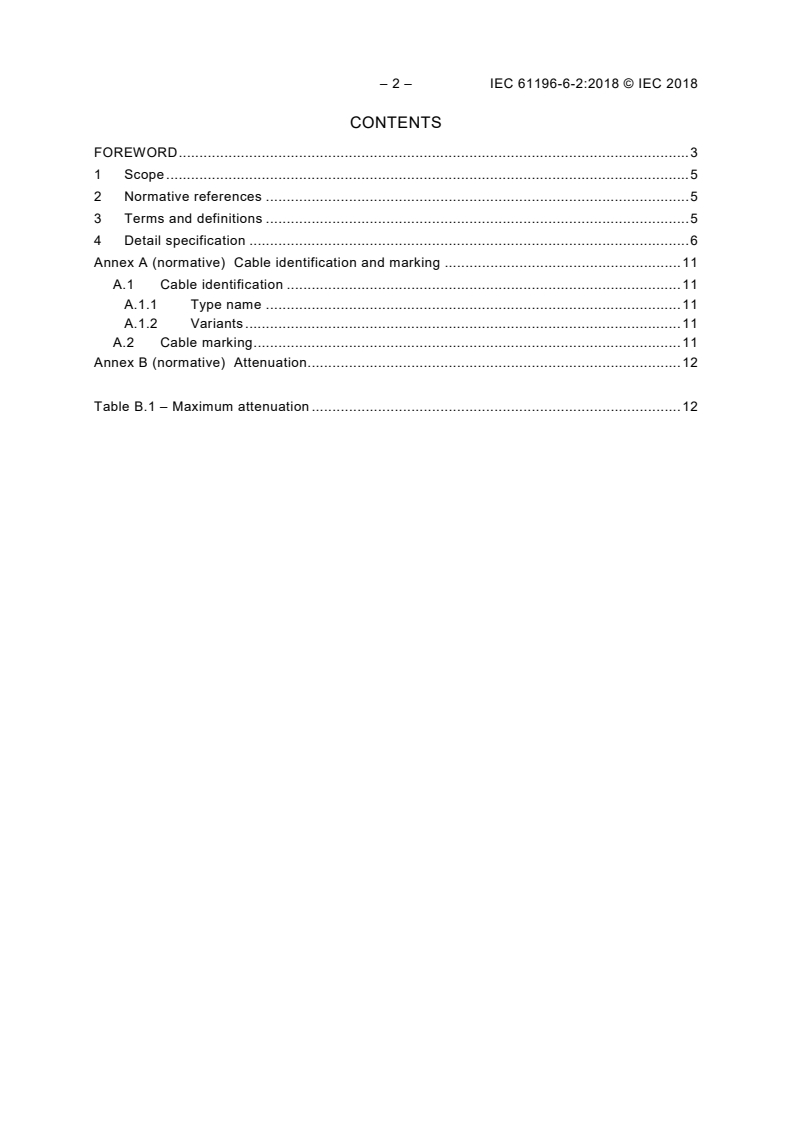
– 2 – IEC 61196-6-2:2018 © IEC 2018
CONTENTS
FOREWORD . 3
1 Scope . 5
2 Normative references . 5
3 Terms and definitions . 5
4 Detail specification . 6
Annex A (normative) Cable identification and marking . 11
A.1 Cable identification . 11
A.1.1 Type name . 11
A.1.2 Variants . 11
A.2 Cable marking . 11
Annex B (normative) Attenuation. 12
Table B.1 – Maximum attenuation . 12
INTERNATIONAL ELECTROTECHNICAL COMMISSION
____________
COAXIAL COMMUNICATION CABLES –
Part 6-2: Detail specification for 75-4 type CATV drop cables
FOREWORD
1) The International Electrotechnical Commission (IEC) is a worldwide organization for standardization comprising
all national electrotechnical committees (IEC National Committees). The object of IEC is to promote
international co-operation on all questions concerning standardization in the electrical and electronic fields. To
this end and in addition to other activities, IEC publishes International Standards, Technical Specifications,
Technical Reports, Publicly Available Specifications (PAS) and Guides (hereafter referred to as “IEC
Publication(s)”). Their preparation is entrusted to technical committees; any IEC National Committee interested
in the subject dealt with may participate in this preparatory work. International, governmental and non-
governmental organizations liaising with the IEC also participate in this preparation. IEC collaborates closely
with the International Organization for Standardization (ISO) in accordance with conditions determined by
agreement between the two organizations.
2) The formal decisions or agreements of IEC on technical matters express, as nearly as possible, an international
consensus of opinion on the relevant subjects since each technical committee has representation from all
interested IEC National Committees.
3) IEC Publications have the form of recommendations for international use and are accepted by IEC National
Committees in that sense. While all reasonable efforts are made to ensure that the technical content of IEC
Publications is accurate, IEC cannot be held responsible for the way in which they are used or for any
misinterpretation by any end user.
4) In order to promote international uniformity, IEC National Committees undertake to apply IEC Publications
transparently to the maximum extent possible in their national and regional publications. Any divergence
between any IEC Publication and the corresponding national or regional publication shall be clearly indicated in
the latter.
5) IEC itself does not provide any attestation of conformity. Independent certification bodies provide conformity
assessment services and, in some areas, access to IEC marks of conformity. IEC is not responsible for any
services carried out by independent certification bodies.
6) All users should ensure that they have the latest edition of this publication.
7) No liability shall attach to IEC or its directors, employees, servants or agents including individual experts and
members of its technical committees and IEC National Committees for any personal injury, property damage or
other damage of any nature whatsoever, whether direct or indirect, or for costs (including legal fees) and
expenses arising out of the publication, use of, or reliance upon, this IEC Publication or any other IEC
Publications.
8) Attention is drawn to the Normative references cited in this publication. Use of the referenced publications is
indispensable for the correct application of this publication.
9) Attention is drawn to the possibility that some of the elements of this IEC Publication may be the subject of
patent rights. IEC shall not be held responsible for identifying any or all such patent rights.
International Standard IEC 61196-6-2 has been prepared by subcommittee 46A: Coaxial
cables, of IEC technical committee 46: Cables, wires, waveguides, RF connectors, RF and
microwave passive components
The text of this International Standard is based on the following documents:
FDIS Report on voting
46A/1352/FDIS 46A/1358/RVD
Full information on the voting for the approval of this International Standard can be found in
the report on voting indicated in the above table.
This document has been drafted in accordance with the ISO/IEC Directives, Part 2.
This International Standard is to be used in conjunction with IEC 61196-1:2005 and
IEC 61196-6:2009.
– 4 – IEC 61196-6-2:2018 © IEC 2018
A list of all the parts in the IEC 61196 series, published under the general title Coaxial
communication cables, can be found on the IEC website.
The committee has decided that the contents of this document will remain unchanged until the
stability date indicated on the IEC website under "http://webstore.iec.ch" in the data related to
the specific document. At this date, the document will be
• reconfirmed,
• withdrawn,
• replaced by a revised edition, or
• amended.
A bilingual version of this publication may be issued at a later date.
COAXIAL COMMUNICATION CABLES –
Part 6-2: Detail specification for 75-4 type CATV drop cables
1 Scope
This part of IEC 61196 applies to coaxial communication cables described in IEC 61196-6. It
specifies the requirements for 75-4 type CATV drop cables. These cables are used in CATV
distribution systems, surveillance and control systems, satellite television receiving systems
and as bidirectional hybrid fibre coax (HFC). The operating frequency is from 5 MHz to
3 000 MHz.
This part of IEC 61196 is to be used in conjunction with IEC 61196-1:2005 and
IEC 61196-6:2009. It determines the layout and style with respect to the model and type.
2 Normative references
The following documents are referred to in the text in such a way that some or all of their
content constitutes requirements of this document. For dated references, only the edition
cited applies. For undated references, the latest edition of the referenced document (including
any amendments) applies.
NOTE Documents which are needed to achieve the tests according to Clause 4, item [8] or item [9], respectively,
are listed in IEC 61196-6.
IEC 61196-1:2005, Coaxial communication cables – Part 1: Generic specification – General,
definitions and requirements
IEC 61196-1-115, Coaxial communication cables – Part 1-115: Electrical test methods – Test
for regularity of impedance (pulse/step function return loss)
IEC 6
...