

IEC 60730-2-13:1995/AMD2:2000
(Amendment)Amendment 2 - Automatic electrical controls for household and similar use - Part 2: Particular requirements for humidity sensing controls
General Information
- Abstract
- Status
- Published
- Publication Date
- 21-Nov-2000
- Technical Committee
- TC 72 - Automatic electrical controls
- Drafting Committee
- WG 6 - TC 72/WG 6
- Current Stage
- DELPUB - Deleted Publication
- Start Date
- 11-Oct-2006
- Completion Date
- 28-Aug-2026
Buy Documents
IEC 60730-2-13:1995/AMD2:2000 - Amendment 2 - Automatic electrical controls for household and similar use - Part 2: Particular requirements for humidity sensing controls Released:11/22/2000
Overview
IEC 60730-2-13:1995/AMD2:2000 is Amendment 2 to the international standard that specifies particular requirements for automatic electrical humidity sensing controls intended for household and similar uses. Developed by the International Electrotechnical Commission (IEC), this amendment provides essential clarifications, updates, and national differences to IEC 60730-2-13, strengthening the safety, testing, and compliance requirements for humidity controllers in home appliances. The scope covers both standalone humidity-sensitive controllers and those integrated into equipment.
Key Topics
Definitions and Scope
This amendment revises certain definitions in line with modern terminology, such as replacing references to 'energy regulators' with 'humidity sensing controls.' It extends the applicability of certain requirements and clarifies their use in different regulatory regions.Constructional Requirements
Updates include more precise guidance for construction, especially with reference to the connection of capacitors in certain control types and specific U.S. requirements for Type 2 action controls.Operational Testing
Amendments address test procedures for humidity controls, emphasizing comprehensive testing both when the device is in the declared condition and when it is not. This ensures reliability under different operational scenarios.Tolerance and Manufacturing Deviation
The amendment allows greater flexibility for manufacturers by enabling separate declarations of tolerance and drift values from the declared operating value. This helps ensure accurate product specification and performance.Electromagnetic Compatibility (EMC)
Enhanced EMC requirements are included, with specific references to emission and immunity tests for electronic humidity controls. Manufacturers are given the option to request testing under declared conditions to better reflect real-world operations.National Differences
The amendment specifies where requirements may vary by country, notably in the United States and Canada, ensuring local compliance and acceptance in key markets.Cycle Endurance Requirements
Updated minimum cycle requirements for independently-mounted controls, as well as those mounted on flexible cords, especially relevant in North America.
Applications
IEC 60730-2-13:1995/AMD2:2000 is applicable to:
- Household Appliances: Including humidifiers, dehumidifiers, HVAC systems, and dryers equipped with automatic humidity controls.
- Integrated Controls: Components embedded within larger electronic appliances that monitor and regulate humidity.
- Standalone Devices: Independent humidity sensing and control units used in domestic environments.
- Testing Laboratories and Compliance Assessment: Ensuring products meet international safety and performance standards for electrical humidity sensing controls.
Related Standards
- IEC 60730-1: Automatic electrical controls for household and similar use - General requirements. Part 1 serves as the foundation for all subsequent parts and amendments.
- IEC 60730-2-X Series: Various parts of the IEC 60730-2 series provide requirements for particular types of automatic controls (temperature, time, or humidity, among others).
- ISO/IEC Guide 51: For terminology and general safety aspects in standards development.
- IEC 61000 Series: Standards for electromagnetic compatibility - complements the EMC requirements referenced in this amendment.
Summary:
IEC 60730-2-13:1995/AMD2:2000 is a key international amendment that supports manufacturers, testing labs, and regulatory bodies in ensuring that humidity sensing controls meet stringent safety, performance, and EMC requirements. Adherence to this standard enhances product reliability, safety, and global market acceptance, particularly in the competitive household appliance sector.
Relations
- Effective Date
- 05-Sep-2023
- Effective Date
- 05-Sep-2023
Buy Documents
IEC 60730-2-13:1995/AMD2:2000 - Amendment 2 - Automatic electrical controls for household and similar use - Part 2: Particular requirements for humidity sensing controls Released:11/22/2000
Frequently Asked Questions
IEC 60730-2-13:1995/AMD2:2000 is a standard published by the International Electrotechnical Commission (IEC). Its full title is "Amendment 2 - Automatic electrical controls for household and similar use - Part 2: Particular requirements for humidity sensing controls". This standard covers: Amendment 2 - Automatic electrical controls for household and similar use - Part 2: Particular requirements for humidity sensing controls
Amendment 2 - Automatic electrical controls for household and similar use - Part 2: Particular requirements for humidity sensing controls
IEC 60730-2-13:1995/AMD2:2000 is classified under the following ICS (International Classification for Standards) categories: 97.120 - Automatic controls for household use. The ICS classification helps identify the subject area and facilitates finding related standards.
IEC 60730-2-13:1995/AMD2:2000 has the following relationships with other standards: It is inter standard links to IEC 60730-2-13:1995, IEC 60730-2-13:2006. Understanding these relationships helps ensure you are using the most current and applicable version of the standard.
IEC 60730-2-13:1995/AMD2:2000 is available in PDF format for immediate download after purchase. The document can be added to your cart and obtained through the secure checkout process. Digital delivery ensures instant access to the complete standard document.
Standards Content (Sample)
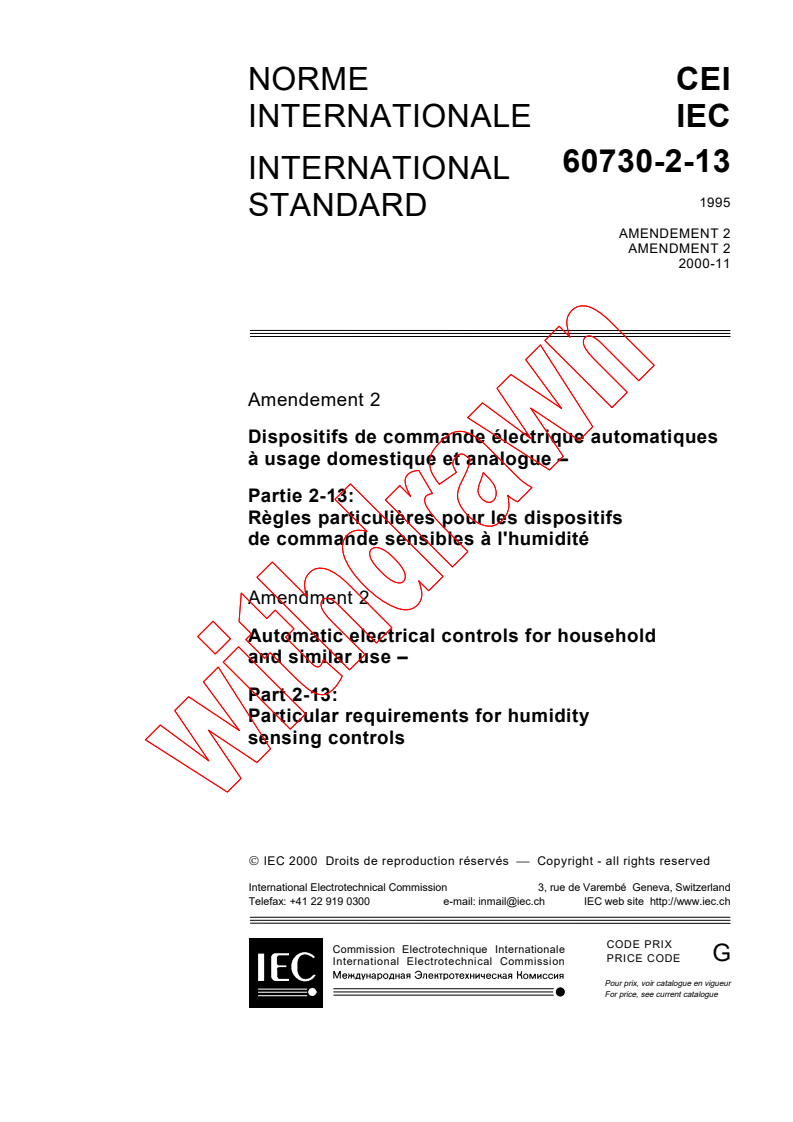
NORME CEI
INTERNATIONALE IEC
60730-2-13
INTERNATIONAL
STANDARD
AMENDEMENT 2
AMENDMENT 2
2000-11
Amendement 2
Dispositifs de commande électrique automatiques
à usage domestique et analogue –
Partie 2-13:
Règles particulières pour les dispositifs
de commande sensibles à l'humidité
Amendment 2
Automatic electrical controls for household
and similar use –
Part 2-13:
Particular requirements for humidity
sensing controls
IEC 2000 Droits de reproduction réservés Copyright - all rights reserved
International Electrotechnical Commission 3, rue de Varembé Geneva, Switzerland
Telefax: +41 22 919 0300 e-mail: inmail@iec.ch IEC web site http://www.iec.ch
CODE PRIX
Commission Electrotechnique Internationale
G
PRICE CODE
International Electrotechnical Commission
Pour prix, voir catalogue en vigueur
For price, see current catalogue
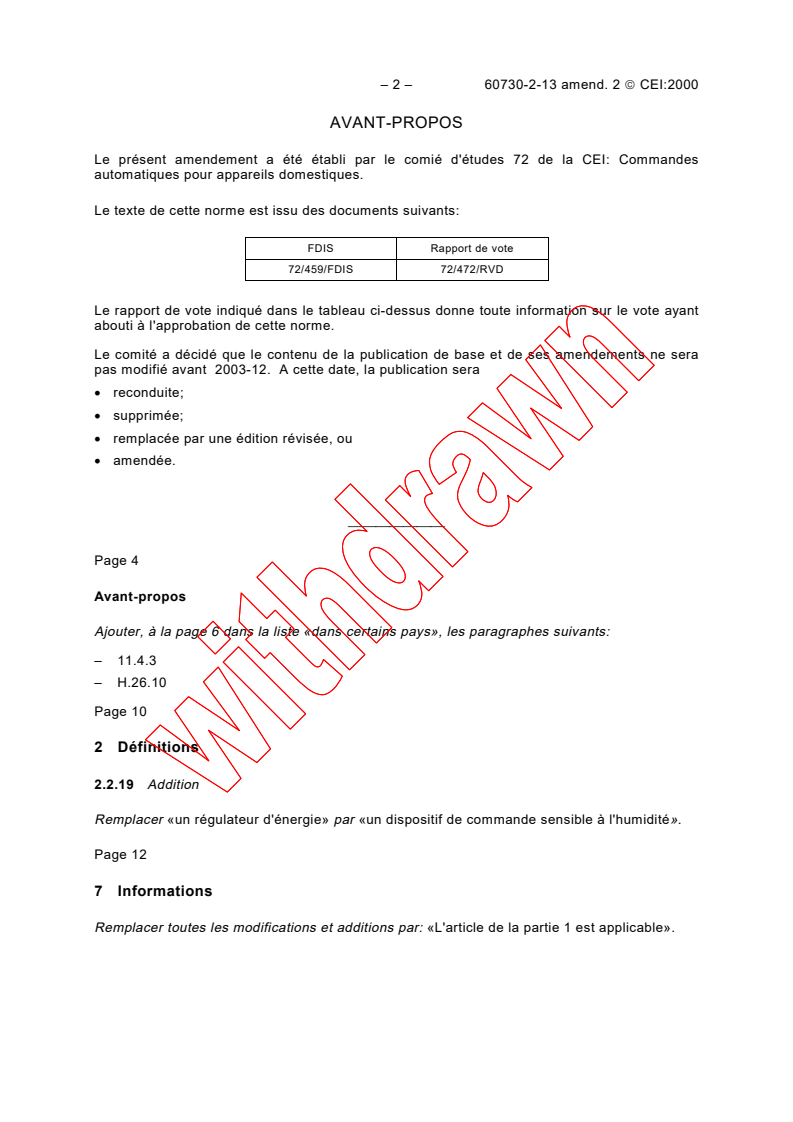
– 2 – 60730-2-13 amend. 2 CEI:2000
AVANT-PROPOS
Le présent amendement a été établi par le comié d'études 72 de la CEI: Commandes
automatiques pour appareils domestiques.
Le texte de cette norme est issu des documents suivants:
FDIS Rapport de vote
72/459/FDIS 72/472/RVD
Le rapport de vote indiqué dans le tableau ci-dessus donne toute information sur le vote ayant
abouti à l'approbation de cette norme.
Le comité a décidé que le contenu de la publication de base et de ses amendements ne sera
pas modifié avant 2003-12. A cette date, la publication sera
• reconduite;
• supprimée;
• remplacée par une édition révisée, ou
• amendée.
Page 4
Avant-propos
Ajouter, à la page 6 dans la liste «dans certains pays», les paragraphes suivants:
– 11.4.3
– H.26.10
Page 10
2 Définitions
2.2.19 Addition
Remplacer «un régulateur d'énergie» par «un dispositif de commande sensible à l'humidité».
Page 12
7 Informations
Remplacer toutes les modifications et additions par: «L'article de la partie 1 est applicable».
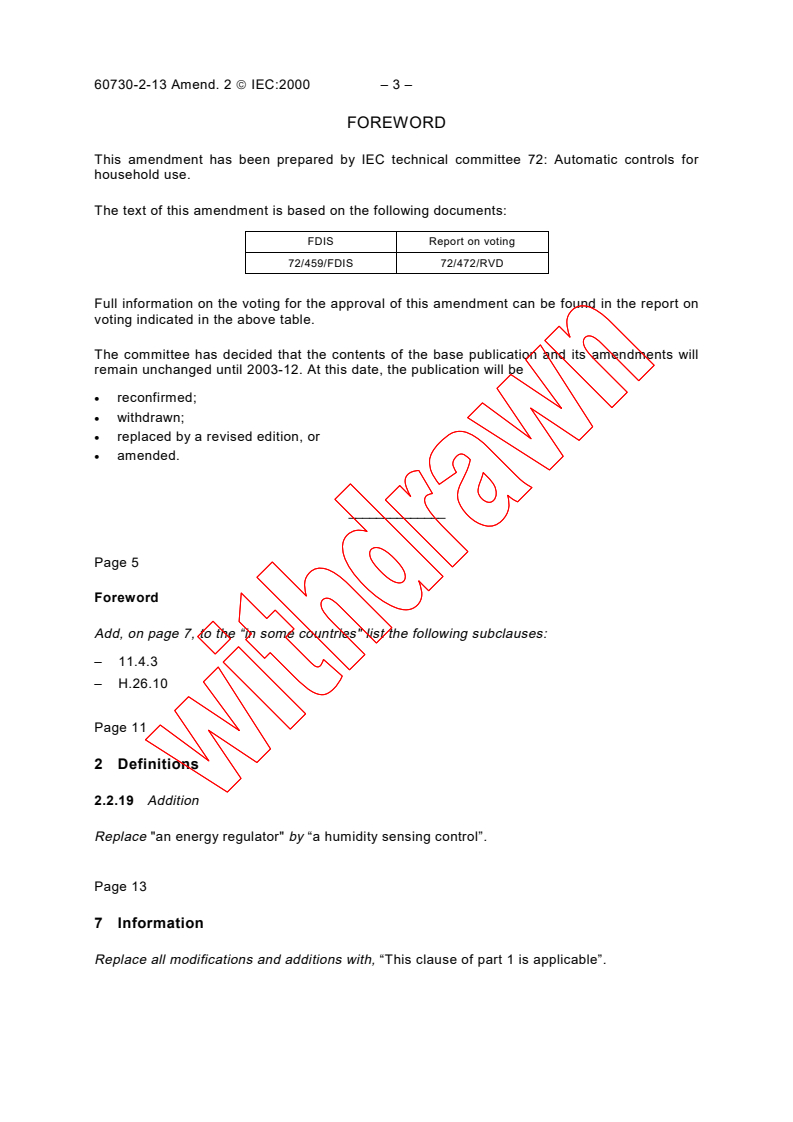
60730-2-13 Amend. 2 IEC:2000 – 3 –
FOREWORD
This amendment has been prepared by IEC technical committee 72: Automatic controls for
household use.
The text of this amendment is based on the following documents:
FDIS Report on voting
72/459/FDIS 72/472/RVD
Full information on the voting for the approval of this amendment can be found in the report on
voting indicated in the above table.
The committee has decided that the contents of the base publication and its amendments will
remain unchanged until 2003-12. At this date, the publication will be
•
reconfirmed;
• withdrawn;
• replaced by a revised edition, or
• amended.
______________
Page 5
Foreword
Add, on page 7, to the “in some countries" list the following subclauses:
– 11.4.3
– H.26.10
Page 11
2 Definitions
2.2.19 Addition
Replace "an energy regulator" by “a humidity sensing control”.
Page 13
7 Information
Replace all modifications and additions with, “This clause of part 1 is applicable”.
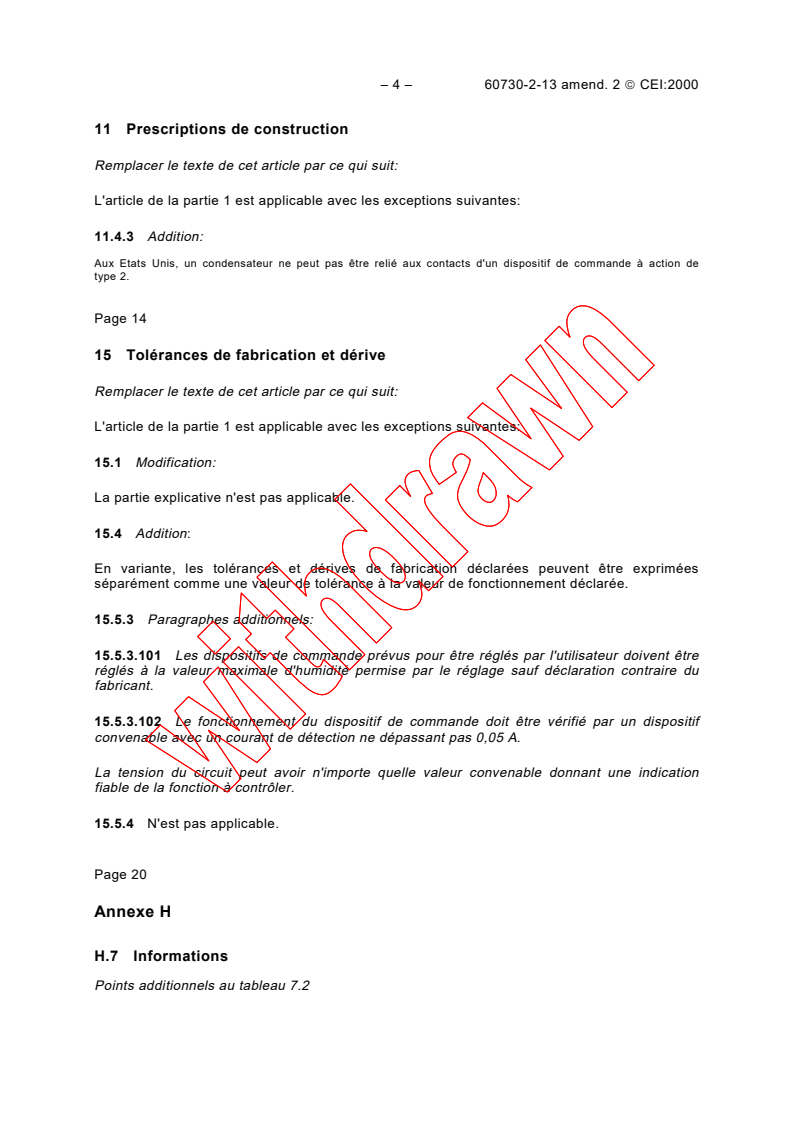
– 4 – 60730-2-13 amend. 2 CEI:2000
11 Prescriptions de construction
Remplacer le texte de cet article par ce qui suit:
L'article de la partie 1 est applicable avec les exceptions suivantes:
11.4.3 Addition:
Aux Etats Unis, un condensateur ne peut pas être relié aux contacts d'un dispositif de commande à action de
type 2.
Page 14
15 Tolérances de fabrication et dérive
Remplacer le texte de cet article par ce qui suit:
L'article de la partie 1 est applicable avec les exceptions suivantes:
15.1 Modification:
La partie explicative n'est pas applicable.
15.4 Addition:
En variante, les tolérances et dérives de fabrication déclarées peuvent être exprimées
séparément comme une valeur de tolérance à la valeur de fonctionnement déclarée.
15.5.3 Paragraphes additionnels:
15.5.3.101 Les dispositifs de commande prévus pour être réglés par l'utilisateur doivent être
réglés à la valeur maximale d'humidité permise par le réglage sauf déclaration contraire du
fabricant.
Le fonctionnement du dispositif de commande doit être vérifié par un dispositif
15.5.3.102
convenable avec un courant de détection ne dépassant pas 0,05 A.
La tension du circuit peut avoir n'importe quelle valeur convenable donnant une indication
fiable de la fonction à contrôler.
15.5.4 N'est pas applicable.
Page 20
Annexe H
H.7 Informations
Points additionnels au tableau 7.2
60730-2-13 Amend. 2 IEC:2000 – 5 –
11 Constructional requirements
Replace the text of this clause with the following:
This clause of part 1 is applicable except as follows:
11.4.3 Addition:
“In the United States, a capacitor may not be connected across the contacts of a control with a Type 2 action.”
Page 15
15 Manufacturing deviation and drift
Replace the text of this clause with the following:
This clause of part 1 is applicable except as follows:
Modification:
15.1
The explanatory matter is not applicable.
15.4 Addition:
Alternatively, the declared manufacturing deviation and drift may be expressed separately as a
tolerance value to the declared operating value.
Additional subclauses
15.5.3
15.5.3.101 Controls intended for setting by the user shall be set at the maximum humidity
value permitted by the adjustment unless otherwise declared by the manufacturer.
15.5.3.102 The operation of the control shall be sensed by a suitable device with a sensing
current not exceeding 0,05 A.
The circuit voltage may be any convenient value that will give reliable indication of the function
being monitored.
15.5.4 Not applicable.
Page 21
Annex H
H.7 Information
Additional items to table 7.2
±#9#± 93:6305046#DPHQG1#5##&(,=5333
$MRXWHU#OHV#SRLQWV#VXLYDQWV#DX[#©SRLQWV#DGGLWLRQQHOVª#DX#WDEOHDX#:15=
,QIRUPDWLRQ $UWLFOH#RX 0pWKRGH
SDUDJUDSKH
8;D $GGLWLRQ=
9RLU#QRWH#4#GX#WDEOHDX#+15915
3UHVFULSWLRQ#DGGLWLRQQHOOH
434 &RQGLWLRQ#GH#VRUWLH#GHV#GLVSRVLWLIV#GH#FRPPDQGH#VHQVLEOHV#j +159151436
434,
O*KXPLGLWp#DSUqV#IRQFWLRQQHPHQW# +159151437 ;
+159151438
1RWH#DGGLWLRQQHOOH
434,
## 3DU#H[HPSOH#FRQGXFWHXU#RX#QRQ#FRQGXFWHXU/#FRPPH#DSSOLFDEOH1
$GGLWLRQ=
+156## 3UHVFULSWLRQV#GH#FRPSDWLELOLWp#pOHFWURPDJQpWLTXH#+&(0,#±#(PLVVLRQ
+1561415## 5HPSODFHU#OH#GHX[LqPH#DOLQpD#HW#OD#QRWH#SDU
3RXU#OHV#GLVSRVLWLIV#GH#FRPPDQGH#pOHFWURQLTXH#LQWpJUpV#HW#LQFRUSRUpV/#OHV#HVVDLV#GH#FHW#DUWLFOH
SHXYHQW#rWUH#HIIHFWXpV#GDQV#OHV#FRQGLWLRQV#GpFODUpHV#VL#GHPDQGp#SDU#OH#IDEULFDQW1
+159# )RQFWLRQQHPHQW#DYHF#GHV#SHUWXUEDWLRQV#FRQGXLWHV#SDU#OH#UpVHDX#HW#GHV
SHUWXUEDWLRQV#PDJQpWLTXHV#HW#pOHFWURPDJQpWLTXHV
5HPSODFHU#OH#WLWUH#GH#FHW#DUWLFOH#SDU#FH#TXL#VXLW=
+159## 3UHVFULSWLRQV#GH#FRPSDWLELOLWp#pOHFWURPDJQpWLTXH#+&(0,#±#,PPXQLWp
+15915## 6XSSULPHU#OH#UHPSODFHPHQW#HW#DMRXWHU#OHV#SDUDJUDSKHV#VXLYDQWV=
+159151434## /H#GLVSRVLWLI#GH#FRPPDQGH#GRLW#UHVWHU#GDQV#VD#SRVLWLRQ#FRXUDQWH#HW#HQVXLWH#GRLW
FRQWLQXHU#j#IRQFWLRQQHU#FRPPH#GpFODUp#GDQV#OHV#OLPLWHV#YpULILpHV#j#O*DUWLFOH#48/#VL#DSSOLFDEOH1
+159151435## /H#GLVSRVLWLI#GH#FRPPDQGH#GRLW#UpSRQGUH#j#OD#FRQGLWLRQ#GpFODUpH#DX#WDEOHDX#:15/
SUHVFULSWLRQ#434#HW#HQVXLWH#GRLW#IRQFWLRQQHU#FRPPH#HQ#+1591514341
+159151436## /H#GLVSRVLWLI#GH#FRPPDQGH#GRLW#UpSRQGUH#j#OD#FRQGLWLRQ#GpFODUpH#DX#WDEOHDX#:15/
SUHVFULSWLRQ#434#±#GH#WHOOH#IDoRQ#TX*LO#QH#SXLVVH#rWUH#UpDUPp#DXWRPDWLTXHPHQW#RX#PDQXHO0
OHPHQW1#/*RQGH#GH#VRUWLH#GRLW#rWUH#VLQXVRwGDOH#RX#FRPPH#GpFODUp#DX#SRLQW#86#GX#WDEOHDX#:15
SRXU#OH#IRQFWLRQQHPHQW#QRUPDO1
+159151437## /H#GLVSRVLWLI#GH#FRPPDQGH#GRLW#UHVWHU#GDQV#OD#FRQGLWLRQ#GpFODUpH#DX#WDEOHDX#:15/
SUHVFULSWLRQ#4341#8Q#GLVSRVLWLI#GH#FRPPDQGH#QRQ#DXWR0UpDUPDEOH#GRLW#rWUH#WHO#TX*LO#QH#SXLVVH
rWUH#UpDUPp#TXH#PDQXHOOHPHQW1#$SUqV#TXH#O*KXPLGLWp/#FDXVH#GH#OD#FRXSXUH/#D#pWp#HQOHYpH/#LO
GRLW#IRQFWLRQQHU#FRPPH#HQ#+159151434#RX#GRLW#UHVWHU#GDQV#OD#FRQGLWLRQ#GpFODUpH#FRPPH#GDQV
+1591514361
+159151438## /H#GLVSRVLWLI#GH#FRPPDQGH#SHXW#UHWRXUQHU#GDQV#VRQ#pWDW#LQLWLDO#HW#HQVXLWH#GRLW
IRQFWLRQQHU#FRPPH#HQ#+1591514341
6L#XQ#GLVSRVLWLI#GH#FRPPDQGH#HVW#GDQV#OD#FRQGLWLRQ#GpFODUpH#DX#WDEOHDX#:15/#SUHVFULSWLRQ#434/#LO#SHXW#VH#UpDUPHU
PDLV#GRLW#UHFRPPHQFHU#j#QRXYHDX#OD#FRQGLWLRQ#GpFODUpH#VL#O*KXPLGLWp/#FDXVH#GH#VRQ#IRQFWLRQQHPHQW/#HVW#WRXMRXUV
SUpVHQWH1
93:6305046#$PHQG1#5##,(&=5333 ±#:#±
$GG#WKH#IROORZLQJ#LWHPV#WR#WKH#³DGGLWLRQDO#LWHPV´#OLVWHG#IRU#WDEOH#:15=
,QIRUPDWLRQ &ODXVH#RU 0HWKRG
VXEFODXVH
8;D $GGLWLRQ=
6HH#1RWH#4#RI#7DEOH#+15915
434 $GGLWLRQDO#UHTXLUHPHQW=
7KH#RXWSXW#FRQGLWLRQ#RI#7\SH#5#KXPLGLW\#VHQVLQJ +159151436
;
434,
FRQWUROV#DIWHU#RSHUDWLRQ# +159151437
+159151438
$GGLWLRQDO#QRWH=
434,
## )RU#H[DPSOH/#FRQGXFWLQJ#RU#QRQ0FRQGXFWLQJ/#DV#DSSOLFDEOH
$GGLWLRQ=
+156## (OHFWURPDJQHWLF#FRPSDWLELOLW\#+(0&,#UHTXLUHPHQWV#±#(PLVVLRQ
+1561415## 5HSODFH#WKH#VHFRQG#SDUDJUDSK#DQG#QRWH#ZLWK#WKH#IROORZLQJ=
)RU#LQWHJUDWHG#DQG#LQFRUSRUDWHG#HOHFWURQLF#FRQWUROV/#WKH#WHVWV#RI#WKLV#FODXVH#PD\#EH#FDUULHG#RXW
XQGHU#GHFODUHG#FRQGLWLRQV#LI#VR#UHTXHVWHG#E\#WKH#PDQXIDFWXUHU1
+159 2SHUDWLRQ#ZLWK#PDLQV0ERUQH#SHUWXUEDWLRQV/#PDJQHWLF#DQG#HOHFWURPDJQHWLF
GLVWXUEDQFHV
5HSODFH#WKH#WLWOH#RI#WKLV#FODXVH#ZLWK#WKH#IROORZLQJ=
+159## (OHFWURPDJQHWLF#FRPSDWLELOLW\#+(0&,#UHTXLUHPHQWV#±#,PPXQLW\
+15915## 'HOHWH#WKH#UHSODFHPHQW#DQG#DGG#WKH#IROORZLQJ#VXEFODXVHV=
+159151434## 7KH#FRQWURO#VKDOO#UHPDLQ#LQ#LWV#FXUUHQW#FRQGLWLRQ#DQG#WKHUHDIWHU#VKDOO#FRQWLQXH#WR
RSHUDWH#DV#GHFODUHG#ZLWKLQ#WKH#OLPLWV#YHULILHG#LQ#FODXVH#48/#LI#DSSOLFDEOH1
+159151435## 7KH#FRQWURO#VKDOO#DVVXPH#WKH#FRQGLWLRQ#GHFODUHG#LQ#WDEOH#:15/#UHTXLUHPHQW#434#DQG
WKHUHDIWHU#VKDOO#RSHUDWH#DV#LQ#+1591514341
+159151436## 7KH#FRQWURO#VKDOO#DVVXPH#WKH#FRQGLWLRQ#GHFODUHG#LQ#WDEOH#:15/#UHTXLUHPHQW#434#±
VXFK#WKDW#LW#FDQQRW#EH#UHVHW#DXWRPDWLFDOO\#RU#PDQXDOO\1#7KH#RXWSXW#ZDYHIRUP#VKDOO#EH#VLQXVRLGDO
RU#DV#GHFODUHG#LQ#UHTXLUHPHQW#86#RI#WDEOH#:15#IRU#QRUPDO#RSHUDWLRQ1
+159151437## 7KH#FRQWURO#VKDOO#UHPDLQ#LQ#WKH#FRQGLWLRQ#GHFODUHG#LQ#WDEOH#:15/#UHTXLUHPHQW#4341#$
QRQ0VHOI0UHVHWWLQJ#FRQWURO#VKDOO#EH#VXFK#WKDW#LW#FDQ#RQO\#UHVHW#PDQXDOO\1#$IWHU#WKH#KXPLGLW\#ZKLFK
FDXVHG#FXW0RXW#WR#RFFXU#LV#UHPRYHG/#LW#VKDOO#RSHUDWH#DV#LQ#+159151434#RU#VKDOO#UHPDLQ#LQ#WKH
GHFODUHG#FRQGLWLRQ#DV#LQ#+1591514361
+159151438## 7KH# FRQWURO# PD\# UHWXUQ# WR# LWV# LQLWLDO# VWDWH# DQG# WKHUHDIWHU# VKDOO# RSHUDWH# DV# LQ
+1591514341
,I#D#FRQWURO#LV#LQ#WKH#FRQGLWLRQ#GHFODUHG#LQ#WDEOH#:15/#UHTXLUHPHQW#434/#LW#PD\#UHVHW#EXW#VKDOO#UHVXPH#WKH#GHFODUHG
FRQGLWLRQ#DJDLQ#LI#WKH#KXPLGLW\#ZKLFK#FDXVHG#LW#WR#RSHUDWH#LV#VWLOO#SUHVHQW1
...